

Cognitive Restructuring for Presentation Anxiety: Reframe the Thoughts That Hold You Back
Quick Answer
Cognitive restructuring is the practice of identifying distorted or catastrophic thoughts before a presentation and replacing them with more accurate ones. It does not mean thinking positively — it means thinking correctly. Most presentation anxiety is maintained by thoughts that overestimate the probability and severity of failure. Challenging those thoughts directly, rather than suppressing them, is one of the most evidence-backed approaches to reducing chronic pre-presentation fear.
In This Article
- What actually maintains presentation anxiety
- The five cognitive distortions most common in presenters
- The cognitive restructuring process step by step
- Working with catastrophic thinking specifically
- Applying restructuring in the hour before you present
- Changing patterns over time, not just individual moments
- When restructuring alone is not enough
- Frequently asked questions
Tomás had presented to small groups without difficulty for most of his career. But after a difficult board meeting three years earlier — one where his numbers had been challenged publicly and he had stumbled through a response he knew was inadequate — something shifted. The anticipatory dread that preceded every major presentation became intense. He began losing sleep the night before. His preparation time tripled, not because he was less competent, but because no level of preparation felt sufficient to prevent the same thing happening again.
He described it to me as “waiting for the ambush.” The actual presentations, when they came, were rarely catastrophic. But the period leading up to them had become almost unbearable.
What Tomás was experiencing is a pattern I see frequently in experienced executives: anxiety maintained not by the reality of their presentations, but by the content of their thoughts about them. His mind had drawn a direct causal line between the difficult board meeting and the conclusion that future high-stakes presentations would produce the same outcome. Every subsequent presentation activated that prediction.
Cognitive restructuring is the process of examining that kind of prediction directly — testing its accuracy rather than accepting it or suppressing it.
Is pre-presentation dread affecting your performance?
Conquer Speaking Fear is a 30-day programme that uses clinical hypnotherapy and nervous system regulation techniques to address the root causes of presentation anxiety — including the thought patterns that sustain it.
What Actually Maintains Presentation Anxiety
Presentation anxiety is not simply a response to difficult presentations. If it were, it would resolve naturally once those presentations passed without disaster. For many people, it does not resolve — it escalates. Understanding why requires looking at what maintains the anxiety rather than what originally caused it.
The primary mechanism is anticipatory cognition: the thoughts generated in advance of a presentation about what is likely to happen and how bad it will be. These thoughts are not neutral predictions. They tend to be systematically biased in the direction of threat. They overestimate the probability of negative outcomes. They underestimate the ability to recover from difficulty. They treat worst-case scenarios as the most likely ones.
These biased predictions produce physical symptoms — elevated heart rate, tension, disrupted sleep — which the anxious mind then interprets as further evidence that something bad is going to happen. This loop between catastrophic prediction and physical response is what maintains anxiety across presentations, regardless of how well the actual presentations go.
Avoidance also plays a role. When anxiety becomes intense enough, the natural response is to reduce exposure to the triggering situation. For executives, full avoidance is rarely possible — but partial avoidance is common. Delegating presentations to colleagues, choosing shorter formats, avoiding meetings where difficult questions are likely. These strategies reduce short-term discomfort but prevent the disconfirmation experiences that would, over time, naturally reduce anxiety. Cognitive restructuring interrupts this pattern by targeting the prediction directly, before avoidance becomes the dominant strategy.
The Five Cognitive Distortions Most Common in Presenters
Cognitive distortions are patterns of thinking that deviate systematically from accurate appraisal. In the context of presentation anxiety, five are particularly common.
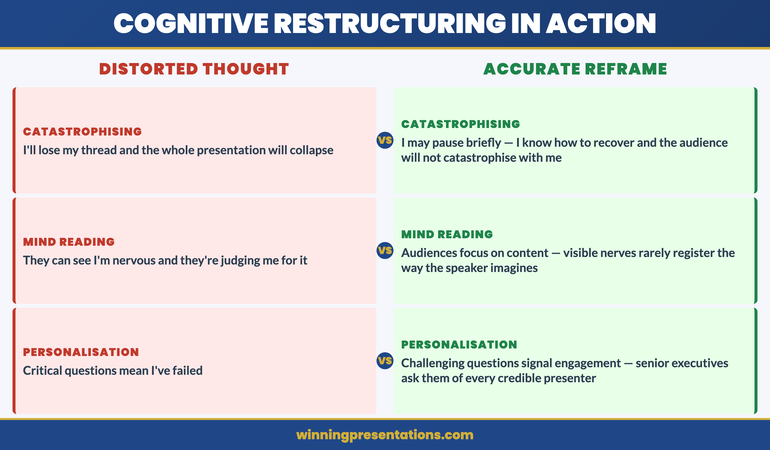
Catastrophising is the tendency to predict the worst possible outcome and treat it as likely. “I will forget my key point and the whole presentation will fall apart” is a catastrophising thought. It conflates a genuine possibility (forgetting a point) with an unlikely cascade (the whole presentation collapsing).
Mind reading involves assuming you know what others are thinking, usually negatively. “They can see I’m nervous and they’re judging me for it” is a mind-reading thought. Audiences are generally focused on content, not on monitoring a presenter’s internal state.
All-or-nothing thinking frames outcomes in binary terms: either the presentation is a complete success or a failure. This distortion removes the vast middle ground of “it went reasonably well and achieved its purpose.”
Fortune telling involves predicting negative outcomes with unwarranted certainty. “They won’t approve this” treated as a fact rather than a possibility is fortune telling. It forecloses options that haven’t yet been determined.
Personalisation attributes difficult moments entirely to internal inadequacy. When a presentation generates critical questions, personalisation interprets this as evidence of personal failure rather than a normal feature of executive decision-making. Critical questions are frequently a sign of engagement, not rejection.
The Cognitive Restructuring Process Step by Step
Cognitive restructuring is not positive thinking. It is not replacing a negative thought with an optimistic one. It is a structured process of examining a thought’s accuracy and replacing distorted predictions with more calibrated ones.
The process has four steps. First, identify the specific thought. Not the emotion (“I feel anxious”) but the thought behind it (“I am going to lose control of the Q&A and the committee will lose confidence in me”). The more precisely you can articulate the thought, the more effectively you can examine it.
Second, examine the evidence. What evidence supports this prediction? What evidence contradicts it? How many times have you lost control of a Q&A session in the last five years? How many presentations have resulted in a committee losing confidence in you in ways that had lasting consequences? In most cases, the evidence against the catastrophic prediction substantially outweighs the evidence for it.
Third, generate an alternative thought — not an optimistic one, a realistic one. Not “the Q&A will go brilliantly” but “I may face a difficult question I can’t answer immediately, and I know how to handle that: I can acknowledge it, take a note, and follow up.” This is accurate and manageable rather than either catastrophic or falsely reassuring.
Fourth, assess the outcome. After generating the alternative thought, how does your anxiety level change? Not to zero — that is not the goal. But typically, replacing a distorted prediction with an accurate one reduces the intensity of anticipatory anxiety to a level that does not impair preparation or performance.
Conquer Speaking Fear
A 30-day programme for executives whose presentation anxiety goes beyond ordinary nerves. Conquer Speaking Fear — £39, instant access — combines clinical hypnotherapy techniques, nervous system regulation, and structured cognitive approaches to address the root causes of presentation fear.
- Daily audio sessions using clinical hypnotherapy techniques
- Nervous system regulation practices for pre-presentation symptoms
- Cognitive frameworks for challenging anxiety-maintaining thoughts
- A 30-day structured programme with progressive exposure
Designed for executives experiencing persistent or escalating presentation anxiety.
Working with Catastrophic Thinking Specifically
Catastrophising deserves extended attention because it is both the most common distortion in presentation anxiety and the one that generates the most intense anticipatory dread. It typically follows a chain of “and then what?” thinking that escalates a plausible difficulty into a career-threatening event.
The interruption technique is to follow the chain deliberately, all the way to its actual endpoint, and examine how likely each link is. “I might forget my key point → and then I’ll lose my thread → and then the audience will see I’m struggling → and then they’ll lose confidence in my judgement → and then my proposal will be rejected → and then my reputation will be damaged.” Each link in that chain is far less probable than the one before it. Most presenters who momentarily lose their thread recover within thirty seconds. Audiences do not interpret a brief pause as evidence of fundamental incompetence.
A second technique is the decatastrophising question: “If the worst-case scenario actually happened, what would I do?” This is not resignation. It is preparation. Most executives who work through this question discover that even their worst-case scenario — a failed presentation, a deferred proposal, a difficult Q&A — is something they have survived before, or is something they could navigate with the resources available to them. The catastrophe, when examined rather than avoided, turns out to be survivable.
If your anxiety around presenting has begun to affect your physical symptoms in the run-up to high-stakes meetings, the article on projecting confidence through a camera covers some of the physical regulation techniques that complement cognitive work.
If you want a structured programme for working through both the cognitive and physical dimensions of presentation anxiety together, Conquer Speaking Fear was designed specifically for executives whose anxiety goes beyond ordinary nerves.
Applying Restructuring in the Hour Before You Present
Cognitive restructuring is most effective when practised regularly rather than applied as an emergency intervention five minutes before you walk into the room. Nevertheless, there is a condensed version that can be useful in the final hour before a presentation when anxiety is already elevated.
The single most valuable question to ask in that period is: “What am I predicting right now?” Not “how do I feel?” but specifically what outcome your mind is predicting. Once the prediction is articulated explicitly, apply the evidence test quickly: in how many similar situations has this prediction come true? If the honest answer is rarely or never, that is the accurate replacement thought: “This has rarely happened in similar situations, and I am as well-prepared as I have been for those.”
Physical anchoring supports this process. The cognitive work is harder when the nervous system is in a state of high activation — which is precisely when you are trying to use it. A brief period of slow, controlled breathing (four counts in, hold for four, six counts out) reduces physiological arousal enough to make clearer thinking more accessible. This is not a substitute for cognitive work; it creates the conditions in which cognitive work is more effective.
In the room itself, the most useful cognitive anchor is task focus rather than self-focus. Self-focused attention (“how am I coming across?”, “do they look engaged?”) amplifies anxiety. Task-focused attention (“what is the most important point to make here?”, “what does this person’s question need from me?”) reduces it. The shift is intentional and practicable. For techniques specifically around managing eye contact and audience connection under pressure, the article on eye contact in presentations covers this in detail.

Changing Patterns Over Time, Not Just Individual Moments
One session of cognitive restructuring before one presentation will reduce anxiety for that presentation. It will not change the underlying pattern. What changes patterns over time is consistent practice across multiple presentations, combined with the gradual accumulation of disconfirmation experiences — presentations that go adequately or well, despite the predictions that they would not.
Keeping a brief written record is more useful than it sounds. After each presentation, note the anxiety prediction you had beforehand and what actually happened. Over three to six months, this record typically reveals a systematic gap between prediction and outcome. The predictions are consistently more negative than the reality. Reviewing this record before subsequent presentations provides evidence that the pattern of over-prediction is a feature of the anxiety, not an accurate reading of reality.
The other factor that changes patterns over time is expanding the range of situations you present in. Anxiety is maintained partly by the brain’s threat appraisal of unfamiliar high-stakes situations. Gradually increasing exposure — taking on presentations that feel slightly outside the comfort zone, rather than staying within what feels safe — provides new evidence that challenges the threat prediction. This is not recklessness; it is systematic desensitisation applied to a professional context.
When Restructuring Alone Is Not Enough
Cognitive restructuring is a powerful technique with a specific scope. It works well for moderate presentation anxiety where the primary maintenance mechanism is distorted thinking. It is less sufficient when anxiety is severe, when physical symptoms are intense enough to impair performance significantly, or when the pattern has become so well-established that cognitive approaches alone cannot interrupt it.
For executives in that situation, a more comprehensive approach is usually required — one that addresses the nervous system regulation component alongside the cognitive one. Hypnotherapy-based techniques work at a level of the brain that direct conscious reasoning does not reach: they can modify the automatic threat response that activates before conscious thought can intervene. This is why they are used in clinical contexts where cognitive approaches alone have not been sufficient.
It is also worth noting that some degree of pre-presentation arousal is normal and useful. The goal is not to eliminate all physical or cognitive signs of activation before a presentation. Moderate arousal sharpens attention and improves performance. The goal of cognitive restructuring — and of more comprehensive programmes — is to bring arousal down from the level that impairs performance to the level that enhances it.
If you present in remote or virtual settings and notice that anxiety is particularly pronounced in that context, the article on managing anxiety when presenting to a camera addresses the specific dynamics of virtual presentation fear.
Conquer Speaking Fear
A 30-day programme combining clinical hypnotherapy and cognitive techniques for executives with persistent presentation anxiety. £39, instant access.
Designed for executives whose anxiety goes beyond ordinary nerves and affects preparation or performance.
Frequently Asked Questions
How quickly does cognitive restructuring work for presentation anxiety?
Many people notice a meaningful reduction in anticipatory anxiety within the first few sessions of deliberate cognitive restructuring practice. However, the effect is cumulative: the technique becomes more effective as it becomes more automatic, which typically takes consistent practice over several weeks. For well-established anxiety patterns, three to six months of regular practice — combined with the gradual accumulation of disconfirmation experiences from actual presentations — is a more realistic timeframe for significant change. This is not a criticism of the technique; it reflects how deeply ingrained thought patterns work.
Is cognitive restructuring the same as positive thinking?
No, and the distinction matters. Positive thinking replaces a negative thought with an optimistic one, regardless of accuracy. Cognitive restructuring replaces a distorted thought with an accurate one. If an accurate assessment of a situation suggests that a presentation carries genuine risk, cognitive restructuring would not deny that risk — it would help you appraise it proportionately rather than catastrophically, and identify what you can do to manage it. The goal is calibration, not optimism.
Can cognitive restructuring help with the physical symptoms of presentation anxiety?
Partly. Physical symptoms of anxiety — elevated heart rate, trembling, voice changes — are produced by the threat appraisal system, which is what cognitive restructuring directly addresses. When the threat appraisal is modified, physiological arousal typically reduces. However, for executives whose physical symptoms are severe or occur very early in the anticipatory period, complementary techniques that work directly on the nervous system — breathing practices, progressive muscle relaxation, hypnotherapy-based approaches — tend to produce faster and more complete relief of physical symptoms.
The Winning Edge — A Newsletter for Executives Who Present
Every Thursday: one practical technique for managing the mental and physical demands of high-stakes presenting. Written for executives who want to perform at their best under pressure.
Related: if you are preparing for a high-stakes Q&A and want to feel more grounded when difficult questions arrive, read the companion article on when honesty is the most credible answer in Q&A.
About the Author
Mary Beth Hazeldine is the Owner and Managing Director of Winning Presentations. With 25 years of corporate banking experience at JPMorgan Chase, PwC, Royal Bank of Scotland, and Commerzbank, she advises executives across financial services, healthcare, technology, and government on structuring presentations and managing the psychological demands of high-stakes presenting.