18 Apr 2026

AGM Presentation: Preparing for Shareholder Questions You Cannot Predict

Quick Answer: You cannot predict every shareholder question at an AGM — but you can build a response framework that handles any question with composure. The most effective AGM presentations do two things well: they establish a clear narrative that pre-empts the most obvious concerns, and they give the presenting team a structured protocol for questions that fall outside the script. The slide deck gets you to the questions. The framework gets you through them.

Valentina was Director of Investor Relations at a London-listed insurance group. She had spent six weeks building the AGM presentation: clean slides, rehearsed remarks, every likely question mapped to a prepared answer. Then, three weeks before the meeting, an activist shareholder group published a public letter challenging the CEO’s long-term incentive structure. Everything she had prepared assumed a broadly cooperative room. None of it was built to absorb that kind of scrutiny.

She did not rewrite the presentation. Instead, she spent two days working through every challenge the activist shareholders might plausibly raise — not scripting answers, but building a response framework for each concern: what the question assumes, what the factual position is, what the board’s stated rationale is, and how to close the answer without escalating. She categorised each question into three types: predictable, anticipated, and deliberately destabilising. Each type got its own response protocol.

On the day, three separate questions came directly from the activist group’s published agenda. She answered all three clearly, calmly, without notes. The Chair told her afterwards it was the strongest AGM she had seen run from an IR perspective in fifteen years.

What had changed was not the slide deck. The deck did its job — it got the meeting to the Q&A. The framework did the work that actually mattered. This article explains how to build both.

If your next high-stakes presentation is coming up soon

The Executive Slide System includes slide templates and scenario playbooks designed for board-level and investor-facing presentations — including the kind of high-scrutiny environments where the Q&A matters as much as the slides.

Explore the System →

What Shareholders Actually Evaluate in an AGM

Most executives preparing AGM presentations focus almost entirely on the financial results and the strategic outlook. Both matter. But neither is what shareholders are primarily evaluating in the room.

What shareholders — particularly institutional shareholders and experienced retail investors — are actually assessing is whether the management team is credible, composed, and in command of their own narrative. The figures are already in the annual report. The slides largely confirm what shareholders already know. What cannot be read in a document is how the senior team handles the pressure of being questioned in public.

There are typically three audiences inside an AGM room. Institutional shareholders are analysing whether the governance narrative is coherent and whether management can defend its decisions under questioning. Activist shareholders or proxy advisers are looking for inconsistencies they can use to build a public challenge. Retail shareholders — often less financially sophisticated but no less engaged — want to feel heard and want reassurance that management understands their interests.

The mistake most AGM presentations make is addressing only the first group. The slides speak to institutional expectations: financial performance, forward guidance, governance disclosures. But the room also contains people who want a human response to their concerns — and the Q&A is where that either happens or it does not.

Understanding this three-audience dynamic changes what you put in your slides and how you prepare for questions. Your opening narrative should simultaneously signal competence (for institutional shareholders), acknowledge complexity (for those looking for weaknesses), and convey directness (for retail investors who want plain language). The board presentation 15-minute framework covers the same principles of narrative economy that apply here: less is more when your audience has already read the papers.

Executive Slide System

Build Presentations That Hold Up Under Shareholder Scrutiny

The Executive Slide System — £39, instant access — includes slide templates for board-level and investor-facing presentations, AI prompt cards for structuring your narrative, and scenario playbooks for high-scrutiny environments including AGMs, investor days, and governance reviews. Designed for presentations where credibility is being assessed alongside the content.

  • Slide templates for board, governance, and investor-facing presentation scenarios
  • AI prompt cards to structure your opening narrative and manage the framing
  • Framework guides for building credibility in high-scrutiny presenting environments
  • Scenario playbooks for meetings where the Q&A matters as much as the deck

Get the Executive Slide System →

Designed for executive presentations where the stakes require structural precision.
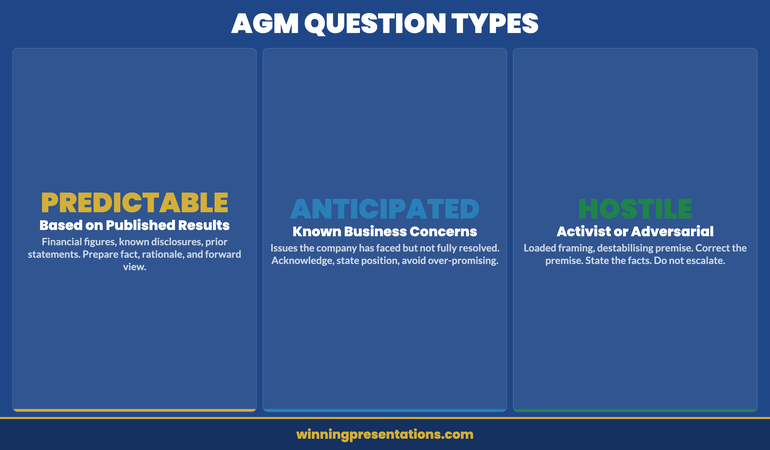

AGM Shareholder Question Types infographic showing three categories: Predictable questions based on published results, Anticipated questions based on known business concerns, and Hostile questions from activist or adversarial shareholders — each with its own response protocol

The AGM Presentation Structure That Creates Stability

An AGM presentation is not a results briefing. It is a governance event with a presentation embedded in it. That distinction matters for how you structure the slides.

Most AGM presentations follow a reporting sequence: financial results, operational highlights, strategic priorities, governance disclosures. This is appropriate. What tends to fail is the proportioning — too much time on the figures (which shareholders already have), not enough time on the narrative around decisions that were made or will be made.

A stronger structure treats each section as a statement of accountability. Not just “here are the results” but “here is what we expected, here is what happened, here is why, and here is what we are doing as a result.” That four-part sequence — expectation, outcome, explanation, response — works for financial results, for governance decisions, and for any strategic change that requires explanation. It pre-empts the most obvious questions by answering them in the slides before the Q&A opens.

One structural addition that is consistently underused is what might be called an “open questions” slide near the end of the formal presentation. This slide briefly acknowledges two or three areas where management knows shareholders have questions — and states the company’s position on each. “We are aware that our capital allocation decisions have attracted comment. Our position is X.” This is not weakness. It signals confidence and depletes the most loaded questions before the room can ask them.

The formal presentation should run no longer than 20 minutes for a typical listed company AGM. Shareholders who have attended many of these meetings are attentive to brevity — it signals respect for their time and confidence in your material. For the structural principles behind executive brevity, the board strategy presentation framework offers a useful reference point on economy of narrative.

Building Your Q&A Response Framework

You cannot script every shareholder question. The attempt to do so is one of the most common mistakes in AGM preparation — executives spend hours writing word-for-word answers to 40 possible questions, then freeze when the 41st question arrives and the script doesn’t cover it.

A response framework is different from a script. Rather than writing specific answers, you build a decision protocol: given a question that falls into this category, here is how I respond structurally. The category, not the content, is what you prepare.

Three categories cover the majority of AGM questions. Predictable questions are based on published financial results, public disclosures, or statements the company has already made. For each predictable question, prepare a three-sentence answer: the factual position, the rationale behind the decision or outcome, and one forward-looking statement. Anticipated questions are based on issues you know the company has faced but may not have fully resolved — market position, management changes, regulatory matters. These require more careful handling; be factual, acknowledge the concern, and state the current position without over-promising. Hostile questions come with an agenda — from activist shareholders, from those with a specific grievance, or from those looking to destabilise the management team in a public forum.

For hostile questions, the framework is simpler than most executives expect. Acknowledge the concern without validating the framing. State the factual position. Close with the company’s considered position. Do not argue. Do not escalate. Do not speculate. The Q&A preparation principles in this briefing document framework apply directly to the AGM context: categorise before you prepare, and prepare the protocol before you prepare the content.

For executives building the slide architecture for investor-facing and governance presentations, the Executive Slide System includes scenario playbooks specifically designed for high-scrutiny presenting environments where the Q&A is as important as the deck itself.
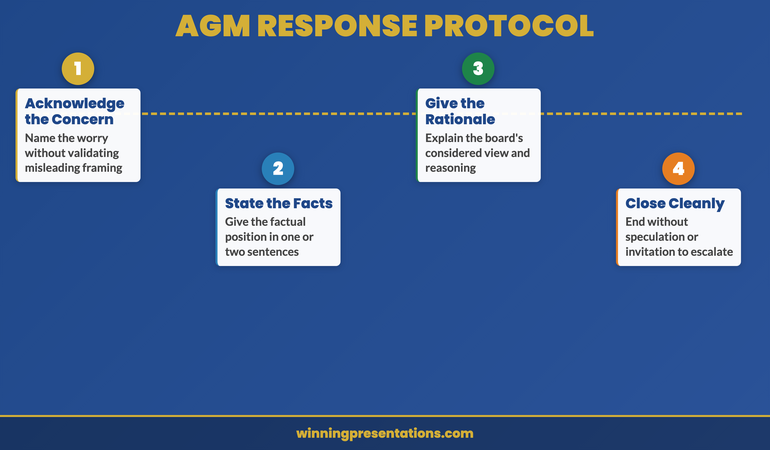

The AGM Q&A Response Protocol infographic showing a four-step framework: Acknowledge the concern, State the factual position, Give the company's rationale, Close without speculation — applied across Predictable, Anticipated, and Hostile question types

When a Shareholder Goes Off-Script

Even the most thorough preparation will occasionally produce a question that sits outside your framework. The question is genuinely unexpected — a concern you had not anticipated, a detail from a subsidiary disclosure you had not mapped, or a question that is genuinely outside the scope of what the AGM is designed to address.

Off-script questions fall into three types, and each warrants a different response. The first is the out-of-scope question: a shareholder asks about a specific operational matter that is not germane to the AGM agenda. The appropriate response is direct: “That specific matter sits outside today’s agenda. I would ask that you contact our Investor Relations team directly, and we will ensure you receive a full written response within five business days.” This is not a deflection — it is a governance protocol, and most experienced shareholders accept it.

The second type is the genuinely unexpected question on a relevant topic where you do not have the precise detail to hand. Here, accuracy matters more than confidence. “I want to give you a precise answer on that. Rather than speculate, I would prefer to provide you with an accurate figure in writing by the end of the week.” This answer is far stronger than an approximate answer that turns out to be incorrect.

The third type is the deliberately destabilising question — one that uses a loaded framing or a misleading premise to put the management team on the defensive. The response here requires you to separate the premise from the concern. “I understand the concern about X. What I can tell you with confidence is Y. We are not in a position to speculate on [the destabilising element of the question], but the factual position on [the legitimate concern] is Z.” You are not accepting the framing. You are not ignoring the concern. You are addressing what is addressable. This connects to the response techniques covered in the management accounts presentation framework — how to handle questions where the framing itself is part of the challenge.

What to Do in the Silence Before You Answer

The seconds between a question being asked and your answer beginning are among the most scrutinised moments in an AGM. Shareholders are watching not just what you say but how you receive the question. A flinch, a glance at a colleague, a sharp breath — these micro-responses are read as signals of discomfort, and discomfort signals something to hide.

The most effective thing you can do in those seconds is nothing — at least, nothing visible. A deliberate pause of two to three seconds before you respond communicates consideration rather than hesitation. It signals that you are giving the question the weight it deserves, rather than reaching for the first answer that comes to mind. This is the opposite of how most executives experience that pause. They feel it as dangerous silence that needs to be filled. Shareholders tend to read it as composure.

What should be happening during those seconds is a rapid internal categorisation. Is this predictable, anticipated, or hostile? Which response protocol applies? That three-category framework reduces the cognitive load of answering under pressure — you are not constructing an answer from scratch, you are selecting the appropriate response structure and filling it in.

There is one phrase that buys time and sounds deliberate rather than evasive: “Let me be precise about this.” Used sparingly, it signals care. Used too often, it sounds like stalling. If you need longer to think — particularly for an off-script question — “I want to give you an accurate answer rather than an approximate one” is a stronger formulation than any version of “that’s a good question,” which no experienced shareholder finds reassuring.

The Closing Statement That Controls the Room’s Last Impression

Most AGMs end poorly — not because anything went wrong, but because the close is not prepared. The chair says something like “and I think that concludes our questions for today,” and the meeting simply stops. Shareholders file out, and the last thing they remember is the final question, which may or may not have been an easy one.

A prepared closing statement is the most underinvested two minutes in AGM preparation. It does three things. First, it reaffirms the company’s strategic direction in one sentence — not a summary of the whole presentation, just the core message. “We remain committed to building long-term shareholder value through disciplined capital allocation and operational execution.” Second, it acknowledges any difficult issues raised in the Q&A — not relitigating them, but signalling that management has heard them. “We have heard the concerns about X, and we take those seriously.” Third, it thanks shareholders for their engagement with substance rather than politeness. Not “thank you for attending” but “your questions today reflect the kind of rigorous engagement that makes better companies.”

Two sentences on direction, one on difficult issues, two on shareholder engagement — six sentences that close the AGM on management’s terms rather than on whatever question happened to come last. The closing statement is the last thing shareholders remember. In the current environment, where AGM summaries circulate quickly through IR networks and financial media, it is also what shapes the first-day narrative in the press. Prepare it with the same precision you give to the opening.

Executive Slide System

The Structure Behind Every High-Stakes Executive Presentation

The Executive Slide System — £39, instant access — gives you slide templates, AI prompt cards, and framework guides for executive presentations where credibility and decision quality are evaluated simultaneously. AGMs, board strategy sessions, investor days — the scenarios where getting the structure right is not optional.

Get the Executive Slide System →

Designed for senior executives presenting in high-scrutiny environments.

Frequently Asked Questions

What should an AGM presentation include?

An AGM presentation should cover financial results in context (not just reported figures, but the narrative around them), operational highlights that connect to strategic priorities, governance disclosures including remuneration and board composition, and a forward-looking statement on strategic direction. A strong AGM presentation also includes an “open questions” slide that acknowledges known areas of shareholder concern and states the company’s position — this depletes the most loaded questions before the formal Q&A begins. The full presentation should run no longer than 20 minutes, leaving adequate time for substantive shareholder questions.

How long should an AGM presentation be?

For a typical listed company AGM, the formal presentation should run 15 to 20 minutes. Shareholders who attend AGMs regularly are attentive to brevity — going significantly over this signals poor preparation or excessive content. The Q&A is often where the meeting’s value lies for shareholders, and a long presentation risks compressing the time available for questions. If you have complex material to cover, the solution is a pre-read document circulated in advance, not a longer presentation on the day. Experienced IR teams treat the AGM as a conversation anchored by a concise presentation, not a presentation that happens to have a conversation attached.

How do you handle aggressive or hostile shareholder questions at an AGM?

Hostile AGM questions follow predictable patterns: they use loaded framing, they make assertions as premises, and they are designed to provoke a defensive response. The most effective protocol is to separate the premise from the legitimate concern. Acknowledge what is a real concern, state the factual position, give the company’s considered view, and close without speculating or engaging with the destabilising element of the question. Do not argue. Do not escalate. Do not accept a false premise by answering inside it. The goal is not to win the exchange — it is to give every other person in the room confidence that management is composed, factual, and in command of its own narrative. That is the shareholder relations outcome that matters most.

The Winning Edge

Weekly insights on executive presentations, delivered every Thursday. Practical frameworks, real scenarios, and no generic advice.

Subscribe to The Winning Edge →

Free resource: Download the Executive Presentation Checklist — a one-page pre-presentation review for high-stakes executive meetings.

About the Author

Mary Beth Hazeldine — Owner & Managing Director, Winning Presentations

With 25 years of corporate banking experience at JPMorgan Chase, PwC, Royal Bank of Scotland, and Commerzbank, Mary Beth Hazeldine advises executives across financial services, healthcare, technology, and government on structuring presentations for high-stakes funding rounds and approvals. She works directly with senior leaders to build the presentation architecture that gets decisions made. Learn more at Winning Presentations.

17 Apr 2026
Senior female executive presenting at head of boardroom table to four board members, city skyline visible, navy attire

Executive Communication Skills Training Online

Quick Answer

Executive communication skills training online covers structured communication for the settings where it matters most: board presentations, senior stakeholder briefings, committee hearings, and investment conversations. While “executive communication” is a broad discipline, the highest-leverage skill for most senior professionals is the ability to build and deliver structured presentations that drive decisions. Online programmes designed specifically for executives — rather than general business communication courses — focus on strategic framing, decision architecture, and handling high-stakes questions rather than generic presentation tips. The AI-Enhanced Presentation Mastery programme on Maven is a structured online programme that works through exactly this skill set — 8 self-paced modules with optional live coaching sessions, combining strategic presentation structure with AI tools for executives presenting at board and senior leadership level. The the next available cohort new cohorts open monthly — the next start date.

Valentina had spent twelve years in investment banking before moving into a senior strategy role at a FTSE 250 company. She could run a meeting, chair a working group, and handle a difficult conversation. None of that prepared her for the first time she had to present to the main board. “I knew the material better than anyone in the room,” she told me later. “But the moment I started speaking, I could hear myself losing the thread. I was answering questions they hadn’t asked yet. I was over-explaining the numbers. I was so busy communicating that I forgot to structure what I was saying.” She had excellent communication skills. What she lacked was the specific form of communication that boards respond to: structured, decision-focused, built around what the audience needs to hear rather than what the presenter feels compelled to say. That gap is what executive communication skills training is designed to close.

Looking for structured executive communication training online? The AI-Enhanced Presentation Mastery programme is a structured online cohort for senior professionals presenting at board and leadership level — 8 self-paced modules, optional live coaching sessions, lifetime access. the next available cohort — explore the programme details →

What Executive Communication Actually Means at Senior Level

Executive communication is not a single skill. It is a cluster of related capabilities that become more critical as seniority increases. At junior levels, good communication means being clear, concise, and responsive. At senior levels, the stakes shift: communication becomes the mechanism through which decisions are made, resources are allocated, and organisations change direction.

The cluster includes written communication — board papers, investment memos, briefing notes. It includes conversational communication — stakeholder management, crisis conversations, one-to-one influencing. And it includes structured presentation — the formal or semi-formal delivery of a case, argument, or proposal to a group that has the authority to approve, reject, or escalate it.

All three matter. But they are not equally difficult to develop, and they are not equally consequential when they go wrong. Written communication can be reviewed and revised before it reaches the reader. Conversational communication is recoverable — you can sense the room shifting and adjust. Structured presentation in front of a board or senior leadership team is the one form of executive communication where there is almost no margin for recovery in the moment.

The skills that serve you well in written documents and one-to-one conversations — nuance, qualification, thoroughness — can actively work against you in a structured presentation. Boards are time-constrained. They are evaluating multiple proposals simultaneously. They need information structured for decision-making, not for comprehensiveness. The connection between executive presence and how you structure a presentation is tighter than most executives realise until they experience the gap first-hand.

Why Structured Presentations Are the Highest-Leverage Skill

Of the three strands of executive communication, structured presentation is typically the one that receives the least deliberate development. Most executives receive some form of coaching on executive presence or stakeholder management at some point in their career. Very few receive structured training on how to build and deliver a decision-focused presentation to a senior audience.

The consequence is a pattern that repeats across sectors. A senior professional with genuine expertise, credibility, and the right answer prepares a presentation. They know their material. They prepare the slides. They deliver the content. And the board defers, asks for more information, or approves something narrower than what was proposed. Not because the content was wrong — but because the structure did not make the decision easy to take.

Structured presentation is high-leverage because its effects compound. A finance director who consistently structures board updates in a way that supports clean decision-making develops a reputation for clarity and credibility that carries across every other form of executive communication. A strategy director who secures approval at the first presentation — rather than going back for a second hearing — saves weeks of elapsed time and builds institutional authority. The return on a well-structured board presentation is not just the immediate approval: it is the ongoing currency of being someone whose thinking is trusted.

The 15-minute framework for board presentations covers the structural logic in detail — and understanding that framework makes it considerably easier to see why general communication training often misses what executives actually need.

AI-Enhanced Presentation Mastery — Maven Programme

A structured online programme for senior professionals who present at board and leadership level. 8 self-paced modules, optional live coaching sessions with Mary Beth, and lifetime access to all content. Combines strategic presentation structure with AI tools (Copilot and ChatGPT). £499 per seat — the next cohort new cohorts open monthly — 26 the current month.

  • ✓ Strategic presentation structure for board and senior leadership settings
  • ✓ AI tools integrated into the presentation-building workflow
  • ✓ Optional live coaching sessions with direct access to the programme lead (fully recorded)
  • ✓ Structured Q&A handling for high-stakes environments

Explore the Maven Cohort → £499/seat

New cohorts open every month — enrol and begin with the next available start date.

What Online Executive Communication Training Should Cover

Not all online communication programmes are equivalent. The term covers everything from generic business writing courses to highly specialised board presentation coaching. When evaluating what an online executive communication programme should cover, it helps to distinguish between foundational skills and advanced executive skills.

Foundational skills — structuring arguments logically, using clear language, adapting message to audience — are worth having but are rarely the gap for senior professionals. By the time someone reaches director or C-suite level, they have typically developed these capabilities through experience. What they often lack is the next layer: how to build the strategic frame before the deck is designed; how to structure the opening of a board presentation to secure attention in the first ninety seconds; how to anticipate the questions a sceptical committee member is likely to raise and build the answers into the narrative before they are asked.

A well-designed executive communication programme will also address the preparation process, not just the delivery. The quality of a board presentation is determined substantially by the work done in the two weeks before the room — the conversations with key decision-makers, the mapping of potential objections, the selection of the two or three messages that the presentation must land regardless of how the discussion evolves.

The stakeholder alignment work that precedes a formal presentation is often the factor that separates a smooth approval from a three-meeting discussion cycle. Programmes that cover only the delivery ignore more than half of what executive communication at board level actually involves. If you’re also exploring the full landscape of online training options, the related guide on executive presentation training online covers the broader market in detail.

Where AI Tools Fit Into Executive Communication

The integration of AI tools — Copilot in Microsoft 365, ChatGPT, and similar tools — into executive communication workflows is changing how senior professionals build presentations. The change is significant, but it requires careful calibration. AI tools are highly capable at generating draft content, structuring initial outlines, and producing alternative versions of a message. They are not capable of making the strategic judgements that determine whether a presentation is designed for a board or for a general audience.

The executives who use AI tools most effectively in their communication workflow treat the tools as accelerators of their own thinking, not substitutes for it. They use AI to get to a first draft faster; they then apply their own strategic understanding to determine what needs to change. This requires knowing what a strong board presentation structure looks like, what language senior stakeholders respond to, and what to cut when the material is too dense.

For executives who are still developing their structural intuition, AI tools can create a new problem: they produce high volumes of polished-sounding content that lacks strategic focus. A well-structured but generic presentation is worse than a direct, occasionally rough document that makes the ask clearly and backs it with the right evidence. Learning to prompt AI tools effectively for executive communication purposes is a distinct skill — and one that most generic AI training does not address.

The AI-Enhanced Presentation Mastery cohort addresses this directly, working through how to use Copilot and ChatGPT in the context of board-level and senior leadership presentations rather than general business communication.

How to Choose the Right Online Programme

The executive communication training market has expanded considerably over the last decade. Narrowing the options down to a programme that fits a specific professional context requires a few practical filters.

The first filter is specificity. A programme designed for executives presenting to boards and investment committees is a different product from one designed for general management communication or public speaking on a stage. The former should address decision architecture, stakeholder mapping, and how to handle a hostile committee member. The latter may be perfectly good at what it does, but will not close the gap for someone preparing for their next board presentation.

The second filter is format. Self-paced recorded courses offer flexibility but provide no opportunity for application feedback or live Q&A. Live cohort programmes — where participants work through material with a group and a programme lead in real time — are more effective for executives because the challenges tend to surface in live discussion rather than in watching a recording. The ability to ask a specific question about a specific presentation you are building has more immediate value than watching someone else’s scenario unfold.

The third filter is practitioner credibility. Communication training is a field where the credentials of the programme lead matter considerably. The relevant question is not what degrees or certifications the lead holds, but what operational experience they bring — ideally in a corporate setting where high-stakes presentations were part of the actual role, not just studied from outside.

With 25 years in corporate banking at JPMorgan Chase, PwC, Royal Bank of Scotland, and Commerzbank — and 16 years delivering executive communication training — Mary Beth Hazeldine brings direct operational context to every aspect of the Maven programme. The methodology is built on what actually works in boardrooms, investment committees, and senior leadership settings, not on academic frameworks developed outside those environments.

New Cohorts Open Monthly

AI-Enhanced Presentation Mastery on Maven is a structured online programme for senior professionals presenting at board and leadership level — 8 self-paced modules, optional live coaching sessions, lifetime access. £499 per seat. the next cohort new cohorts open monthly — 26 the current month.

View the Programme on Maven → £499/seat

Frequently Asked Questions

Is executive communication skills training online UK the same as a general presentation course?

Not in content or outcome, though many courses use similar terminology. General presentation courses tend to focus on delivery mechanics: how to manage nerves, how to use slides, how to structure a basic talk. Executive communication training at a senior level is concerned with a different problem — how to structure a case for a decision-making audience, how to handle technically hostile questions, and how to align stakeholders before the formal meeting. If you are preparing for board presentations, investment committees, or senior leadership briefings, look for programmes that explicitly address those contexts rather than general public speaking or presentation skills.

What does an online executive communication course typically cover?

Content varies considerably by provider. The most relevant areas for senior professionals are: strategic framing and decision architecture (how to build the opening argument), slide structure for executive audiences (what boards expect to see and in what order), Q&A preparation and handling under pressure, stakeholder alignment before the formal presentation, and — increasingly — how to use AI tools in the presentation-building workflow. Programmes that include live cohort sessions and direct feedback on real work-in-progress tend to produce faster results than self-paced recordings for executives operating at board or senior leadership level.

How to improve executive communication if I already have strong technical skills?

Technical expertise and executive communication are separate skills that do not automatically transfer. The most common gap for technically strong professionals is the ability to translate detailed knowledge into a structured case that a non-technical board can evaluate and approve. The fix involves learning to lead with the recommendation rather than the analysis, selecting the three or four data points that carry the decision rather than presenting everything, and anticipating the governance questions a committee will ask rather than the technical objections a peer would raise. Structured practice in a context that mirrors the actual board environment is consistently more effective than generic coaching for this specific gap.

What should I look for in leadership communication training online?

Practitioner credibility matters more than certification in this field. Look for a programme led by someone with direct experience presenting at the level you are targeting — not just coaching others to do it. The format should include opportunities for live application and feedback rather than passive video watching. The content should be specific to executive and leadership contexts rather than adapted from general communication theory. And the programme should address both the preparation process and the delivery — the quality of a board presentation is largely determined before anyone enters the room.

Is executive presence training online effective for board-level communication?

It depends on how “executive presence” is defined by the programme. Generic executive presence training often focuses on body language, vocal delivery, and personal brand — all of which are useful but do not address the structural and strategic dimensions of board communication. Presence in a boardroom is largely a function of the clarity and confidence that comes from knowing your material is structured correctly and your case is sound. Programmes that combine presence development with structural presentation skills tend to produce more durable improvements than those that focus on presence as a standalone quality.

The Winning Edge

Weekly insights on executive presentations, board communication, and leadership credibility.

Subscribe Free

Preparing for a high-stakes board presentation? Download the Executive Presentation Checklist — a structured framework for building decision-ready slides from first draft to final review.

About the author

Mary Beth Hazeldine, Owner & Managing Director, Winning Presentations. With 25 years of corporate banking experience at JPMorgan Chase, PwC, Royal Bank of Scotland, and Commerzbank, she advises executives across financial services, healthcare, technology, and government on structuring presentations for high-stakes approvals and board-level communication.
17 Apr 2026
A male operations manager responding confidently to a question from a senior female executive in a high-level skip-level meeting, boardroom setting, composed and direct, editorial photography style

Skip-Level Meeting Q&A: Handling Questions From Senior Leadership

Quick Answer: Skip-level meetings — where your boss’s boss engages directly with you — carry a distinct Q&A dynamic. Senior leaders ask differently from your direct manager: they operate at a higher level of abstraction, they test your strategic thinking rather than your operational knowledge, and they pay close attention to how you handle uncertainty. Preparation requires mapping the questions they are likely to ask, practising responses that demonstrate judgement rather than just facts, and knowing how to redirect operational detail back to the strategic level without appearing evasive.

Tomás had run his division’s operations for three years. His direct manager trusted him completely. When the group CEO announced a series of skip-level conversations with senior managers, Tomás wasn’t particularly concerned. He knew his numbers. He knew his team. He had delivered consistently.

The CEO’s first question was: “If you had to restructure this division to be twenty percent more efficient without reducing output, where would you start?” Tomás answered with an operational plan — headcount distribution, process changes, technology investments. The CEO listened politely, then said: “That’s useful. I was asking where the biggest strategic constraint is.”

Tomás had answered the question he was comfortable with rather than the one that was asked. He had given operational detail in response to a request for strategic judgement. The CEO moved on. Tomás knew, walking out, that the conversation had not gone the way he needed it to.

It was a recoverable situation — Tomás followed up by email with a more strategic framing, and the CEO later described him positively in a talent review. But the preparation gap was clear: he had been ready for the operational meeting he expected, not the strategic conversation that actually happened.

If you have a skip-level meeting coming up

The Executive Q&A Handling System includes a framework for predicting the questions senior leaders ask, structuring your responses at the right level of abstraction, and handling the difficult moments — the stretch questions, the challenges to your assumptions, the questions you didn’t anticipate.

Explore the System →

Why Skip-Level Q&A Is Different From Any Other Meeting

Skip-level meetings — where a senior leader engages directly with someone two or more levels below them — serve a specific organisational function: they give senior leadership an unfiltered view of how the organisation thinks and operates below the layer of direct management. This purpose shapes every question a senior leader asks in these settings.

Your direct manager assesses whether you are executing well on defined objectives. A skip-level senior leader is assessing something different: whether you have the strategic thinking, the judgement under pressure, and the professional credibility to operate at the next level. They are using the conversation to calibrate your potential, not just your current performance.

This changes the preparation requirement significantly. Preparing for your direct manager’s questions means knowing your operational data deeply. Preparing for skip-level questions means being able to step above the operational data and discuss what it means at a strategic level — what the implications are, where the constraints lie, and what you would do if you were making the decisions rather than executing them.

The emotional dynamic is also different. Most executives are more comfortable being challenged by their direct manager — the relationship has context, history, and established trust. A senior leader who challenges an assumption in a skip-level meeting does so without that context. The challenge can feel more exposing, and the temptation to become defensive or to over-explain is higher. Knowing this in advance — and having specific strategies for managing it — is part of effective skip-level preparation.

Executive Q&A Handling System

Predict the Questions, Structure the Answers, Handle the Pressure

The Executive Q&A Handling System — £39, instant access — gives you a systematic approach to predicting the questions senior executives ask, structuring answers at the right level, and managing the high-pressure moments that define how you are perceived in the room. Designed for executives who present to, or are questioned by, decision-makers more senior than their direct line.

  • Question prediction frameworks for skip-level and senior leadership contexts
  • Response structure guides for strategic, operational, and challenge questions
  • Techniques for handling the questions you didn’t predict — without losing credibility
  • Scenario playbooks for investment committee, board, and skip-level meeting Q&A

Get the Q&A Handling System →

Designed for executives who are questioned by senior decision-makers in high-stakes contexts.


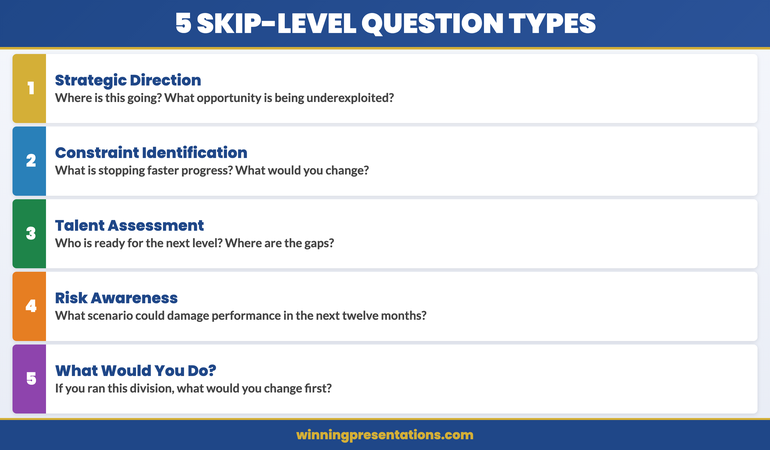
Five Skip-Level Question Types infographic showing: Strategic Direction, Constraint Identification, Talent and Team Assessment, Risk and Challenge, and What Would You Do Differently — the five categories senior leaders use in skip-level meetings

The Five Question Types Senior Leaders Use

Skip-level questions cluster into five recognisable types. Knowing these in advance allows you to prepare answers that operate at the right level — not too operational, not too vague.

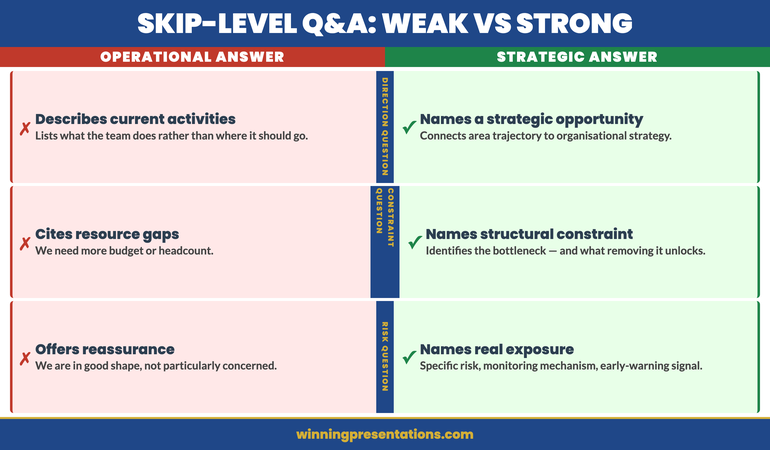
1. Strategic direction questions. “Where do you see this business in three years?” or “What’s the biggest opportunity your team is underexploiting?” These questions invite you to demonstrate that you think above your day-to-day responsibilities. The trap is giving an operational answer — describing what your team does rather than where it should go. The strong response connects your area’s trajectory to the wider organisational strategy and names a specific opportunity or constraint that you believe is underweighted.

2. Constraint identification questions. “What’s stopping you from moving faster?” or “What would you change if you had the authority?” These are diagnostic questions. Senior leaders use them to identify organisational bottlenecks and to assess whether middle management has a clear view of what is holding back performance. The weak response is to describe a resource constraint — “we need more budget or headcount.” The strong response names a structural or strategic constraint — a process, a decision-making dependency, or a talent gap — and articulates what removing it would unlock.

3. Talent and team questions. “Who on your team is ready for the next level?” or “Where are the talent gaps that worry you most?” These questions assess your people judgement and your investment in your team’s development. Have a specific answer — naming individuals where relevant — and demonstrate that you think deliberately about succession and capability rather than managing the team as an undifferentiated group.

4. Risk and challenge questions. “What keeps you up at night?” or “What’s the scenario that could significantly damage performance in the next twelve months?” These questions test your risk awareness and your honesty about vulnerability. Executives who answer with reassurance — “we’re in good shape, I’m not particularly concerned” — miss the point. A thoughtful risk response names a genuine concern, explains the monitoring mechanism in place, and identifies the early-warning signal that would trigger action.

5. The “what would you do” question. “If you were running the division, what’s the first thing you’d change?” This is a test of strategic confidence and intellectual courage. The safest-seeming answer — “that’s not my decision to make” — is the one that signals you are not thinking above your role. The strong response articulates a clear view, grounds it in specific evidence, and frames it as a perspective rather than a criticism of current strategy.

A Preparation Framework That Works at Any Level

Effective skip-level preparation follows a three-layer structure. Each layer prepares you for a different type of question and a different dimension of the conversation.

Layer 1 — Know your brief. What does this senior leader already know about your area? What recent decisions or events have shaped their view of your division? What is their stated agenda for the skip-level series — are they gathering strategic input, conducting a talent assessment, or investigating a specific performance question? Knowing the context of the conversation lets you frame your answers in terms they will find relevant rather than comprehensive.

Layer 2 — Prepare your positions. For each of the five question types above, develop a clear, confident position. This is not a scripted answer — it is a considered point of view. On strategy: where does your area need to go and why? On constraints: what is genuinely holding back performance? On talent: who is ready for more and who needs development? On risk: what is the real exposure? On what you would change: what is your honest view?

Layer 3 — Anticipate the follow-up. Senior leaders who ask a question and get a polished first answer often follow up with something harder — a challenge to an assumption, a request for more specificity, or a question that follows the logic of your answer to an uncomfortable place. For each prepared position, ask yourself: what is the most challenging follow-up question this answer could generate, and what is my response? This is where most skip-level preparation fails: the first answer is prepared, the follow-up is not.

For the underlying approach to Q&A preparation in high-stakes settings, see The Q&A Briefing Document: The Five Sections Every Executive Needs Before a High-Stakes Q&A.

If your skip-level meeting involves formal Q&A — or if you want a systematic approach to predicting and preparing for the questions senior leaders ask — the Executive Q&A Handling System provides the question prediction and response structuring framework in one place.


Weak vs Strong Skip-Level Q&A Responses comparison infographic showing three question types — Strategic Direction, Constraint Identification, and Risk Assessment — with examples of operational answers that miss the mark versus strategic answers that demonstrate senior-level thinking

Handling Questions in the Room

No matter how well you prepare, a skip-level meeting will generate at least one question you didn’t predict. How you handle the unpredicted question is often more revealing than how you handle the prepared ones.

When a question catches you off-guard, the effective response sequence is: pause briefly, clarify if necessary, then answer at the highest level you can before offering to follow up with more specificity. “That’s an important question. My current thinking is [position]. I’d want to check [specific data point] before I give you a more precise answer — can I send that through to you by end of week?” This response demonstrates intellectual honesty, shows that you distinguish between your current thinking and confirmed data, and keeps the conversation moving without bluffing.

When a senior leader challenges an assumption in your answer, don’t immediately capitulate or immediately defend. Both responses look weak — capitulation suggests you weren’t confident in your original position, and over-defence suggests you can’t distinguish between a good challenge and a bad one. Instead, engage with the challenge: “That’s a useful pushback. The reason I landed on [position] is [reasoning]. If [alternative factor the leader raised] is weighted more heavily, I can see how the answer changes.” This demonstrates that you can think in the room, not just recite prepared positions.

When you genuinely don’t know the answer to a question, say so clearly and briefly. “I don’t have that data to hand, but I can get it to you by [specific date]” is a stronger answer than a hedged, half-informed response that a senior leader will see through. The willingness to say “I don’t know” clearly — without excessive apology — is a mark of confidence, not of weakness. See also The Bridging Technique: How to Handle Difficult Questions Without Losing the Room.

The Three Traps That Derail Skip-Level Q&A

Understanding what derails other executives in skip-level meetings is as valuable as knowing what works. Three patterns come up consistently.

Trap 1: Trying to impress rather than inform. Skip-level conversations derail most often when the executive treats it as a performance — an opportunity to demonstrate how impressive they are — rather than as a dialogue. Senior leaders are highly attuned to impression management and discount it quickly. The executive who speaks plainly, admits uncertainty where it exists, and demonstrates genuine thinking is almost always more credible than the one who delivers polished answers that say less than they appear to.

Trap 2: Staying too close to your direct manager’s position. One of the purposes of skip-level meetings is for senior leadership to hear perspectives that may differ from what the management layer above you reports. If you align all your answers with your direct manager’s stated positions, you signal that you are a reliable executor rather than an independent thinker. Have a view. Where it differs from your manager’s, you can acknowledge the difference respectfully: “My manager and I have discussed this — my own read of the situation is slightly different, and I think both perspectives are legitimate.”

Trap 3: Over-managing upward. Some executives use skip-level meetings primarily to manage how they are perceived by the senior leader — steering away from topics where performance has been weak and toward areas of strength. Senior leaders recognise this pattern quickly. A question about a difficult area that gets redirected to a comfortable one signals that the executive is managing the conversation rather than engaging with it. Addressing a difficult topic directly — “I know Q3 performance in my area was below expectation. Here is my assessment of what happened and what we’ve changed” — is far more credible than a smooth deflection. For related techniques, see Regulatory Review Q&A: What Compliance Officers Actually Want to Hear.

After the Meeting: Following Through on What You Said

Skip-level meetings leave two kinds of residue: the impression you created in the room, and the commitments you made during the conversation. Both require active management after the meeting ends.

Within twenty-four hours, send a brief follow-up note to the senior leader’s PA or directly, depending on the level of formality. The note should do two things: thank them for the time and confirm any specific follow-up items you committed to. “Following our conversation this morning, I’ll send through the Q3 variance analysis by Friday and the talent pipeline summary by end of next week.” This demonstrates that you take the conversation seriously, that you are organised, and that commitments made in the room are honoured.

Deliver the follow-up items on time — or earlier. A commitment made to a senior leader that is late, or that requires chasing, signals unreliability at exactly the moment when you want to be creating the opposite impression. If something unexpected delays a follow-up item, communicate proactively rather than waiting to be asked.

After the meeting, brief your direct manager on what was discussed. This is professional protocol — your manager should not hear about the conversation through other channels — and it gives you the opportunity to get their input on whether your answers aligned with the division’s official positions. If you expressed a view that differs from your manager’s, this conversation is important: it surfaces the difference in a direct, constructive way rather than leaving it to emerge through the senior leader’s subsequent communications.

Prepare Systematically, Not Just Thoroughly

The Q&A System That Covers What You Can’t Predict

The Executive Q&A Handling System — £39, instant access — includes question prediction frameworks, response structuring guides, and techniques for handling the challenging moments that no amount of preparation fully eliminates. Designed for executives facing Q&A from senior leadership, investment committees, and boards.

Get the Q&A Handling System →

Frequently Asked Questions

Should I tell my direct manager about a skip-level meeting before it happens?

Yes, always. Attending a skip-level meeting without briefing your direct manager creates an unnecessary trust issue. Most managers understand that skip-level conversations are a normal organisational practice — but they expect to know about them. Before the meeting, let your manager know it is happening, ask if there are any topics you should be aware of, and agree on which areas you have authority to speak to independently. After the meeting, debrief them on what was discussed. This approach keeps the relationship with your manager intact while allowing you to have a genuine, direct conversation with the senior leader.

What if a senior leader asks me about a topic that falls outside my brief?

Acknowledge the boundary clearly and briefly, then offer what you can. “That sits primarily with [function or colleague]. My perspective, from what I observe in working with that team, is [observation].” This response demonstrates self-awareness about your scope without appearing unwilling to engage. Senior leaders often value the cross-functional perspective — your observation, clearly framed as an outside view, can be genuinely useful. The trap is either claiming authority you don’t have or refusing to engage with anything outside your immediate remit.

How should I handle a question where my honest answer reflects badly on the organisation?

Honesty is the correct approach, but framing matters. A response that simply delivers a critical assessment — “morale is poor and I don’t think the restructuring was handled well” — without context or solution-orientation is difficult for a senior leader to do anything with. The more useful framing names the issue, offers your assessment of its cause, and identifies what you believe would address it. This positions you as someone who is engaged with the problem rather than just observing it. Senior leaders generally value candour from executives who can pair it with constructive thinking.

The Winning Edge — Free Weekly Newsletter

Practical frameworks for Q&A handling, executive communication, and presenting to senior leadership. Every Thursday.

Subscribe to The Winning Edge →

About the Author

Mary Beth Hazeldine is Owner & Managing Director of Winning Presentations. With 25 years of corporate banking experience at JPMorgan Chase, PwC, Royal Bank of Scotland, and Commerzbank, she advises executives across financial services, healthcare, technology, and government on structuring presentations for high-stakes funding rounds and approvals.

17 Apr 2026
A female executive standing confidently at a whiteboard presenting to a small team in a bright corporate meeting room, composed and authoritative, editorial photography style

Rebuilding Presentation Confidence After Maternity Leave

Quick Answer: Presentation anxiety after maternity leave is extremely common and follows a recognisable pattern: you step back into professional life expecting to feel capable, and instead feel like a stranger in your own expertise. The anxiety is rarely about forgetting how to present — it’s about re-establishing a relationship with your professional identity after an extended break in a different role. Rebuilding happens through graduated exposure, specific pre-presentation preparation, and learning to distinguish the nervousness of re-entry from the fear of incompetence.

Priya had been in senior leadership for nine years. She had presented to boards, managed investor calls, and delivered difficult news to large teams with composure. None of that prepared her for how she felt standing up to present six months after returning from maternity leave.

“I knew the material perfectly,” she told me. “I’d been the person who taught this framework to the rest of the team. But when I stood up, I couldn’t find my authority. I kept thinking: do they still see me the way they saw me before? Have I lost something I can’t get back?”

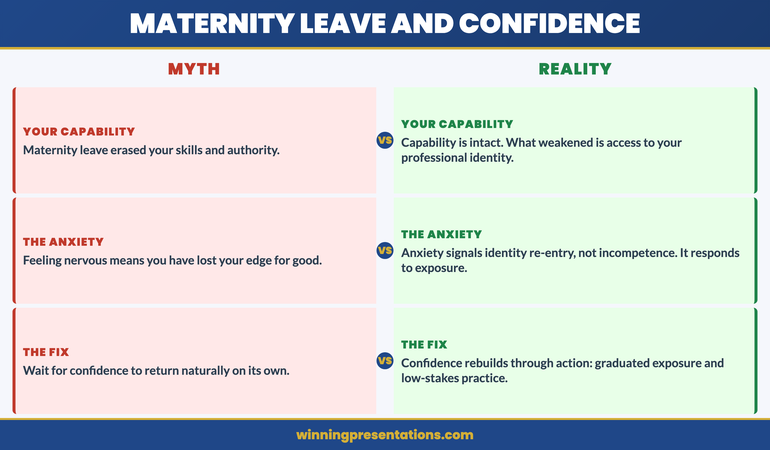
She hadn’t lost anything. But she had stepped out of a professional identity for fourteen months and found that re-entering it was not automatic. The confidence she had before her leave was not gone — it was temporarily inaccessible, buried under a layer of self-consciousness about her return. What she needed was not new skills. She needed a structured path back to the professional self she had temporarily vacated.

If presentation anxiety has intensified since returning to work

Conquer Speaking Fear is a structured 30-day programme that addresses the nervous system patterns behind presentation anxiety — including the type that re-emerges or intensifies after major life transitions. It is not about performing confidence. It is about rebuilding the underlying regulation that makes confidence possible.

Explore the Programme →

Why Maternity Leave Changes Your Relationship With Presenting

Presentation confidence is not a fixed trait. It is a skill that is maintained through regular use, and it is grounded in a sense of professional identity — the clear internal sense of who you are at work, what you know, and what standing you have in the room.

Maternity leave temporarily suspends all three of these. You stop presenting regularly. Your professional identity shifts dramatically — you become a parent in a way that is all-encompassing, and the professional version of yourself recedes. And your sense of standing in the organisation becomes uncertain: Has the team dynamics changed? Has your profile with senior leadership faded? Has someone else filled the space you left?

These are not signs of weakness. They are predictable consequences of a major life transition that involves stepping out of a professional role for an extended period. The challenge on return is that colleagues don’t see the internal recalibration. They see the same capable person they knew before. This mismatch between external expectation and internal experience is what makes presenting feel so exposing in the first months back.

The anxiety is rarely about incompetence. It is about visibility at a moment when you feel uncertain about who you are in the professional context again. That distinction matters enormously, because the response to incompetence (learn new skills) is completely different from the response to identity re-entry (graduated re-engagement with professional roles).

Conquer Speaking Fear

A Structured Programme for Presentation Anxiety That Returns After a Break

Conquer Speaking Fear — £39, instant access — is a 30-day programme that works on the nervous system patterns underlying presentation anxiety. It includes clinical hypnotherapy techniques, nervous system regulation exercises, and a structured exposure sequence — designed for people whose anxiety has intensified after a significant life transition, not just everyday nerves.

  • 30-day structured programme for sustained anxiety reduction
  • Nervous system regulation techniques for use before and during presentations
  • Clinical hypnotherapy audio sessions for deep-rooted fear patterns
  • Graduated exposure framework for rebuilding confidence through low-stakes practice

Get Conquer Speaking Fear →

Designed for presenters whose anxiety has deepened after a major life transition.


Myth vs Reality infographic comparing common beliefs about maternity leave and presentation confidence: Myth — confidence is lost; Reality — it is temporarily inaccessible. Myth — anxiety means incompetence; Reality — it signals identity re-entry. Myth — you need new skills; Reality — you need structured re-engagement.

The Imposter Shift: What’s Actually Happening

Many women describe their post-maternity-leave presentation anxiety using imposter syndrome language: “I feel like I don’t belong here anymore,” or “I’m waiting for someone to notice that I’ve lost my edge.” This framing is understandable but not quite accurate — and the distinction has practical implications.

Classic imposter syndrome is the belief that you are not as competent as others perceive you to be, despite evidence of competence. Post-maternity return anxiety is something slightly different: the sense that your competence is real but your connection to your professional identity has weakened. You know you can do the job. You’re not sure that you still embody it the way you did before.

This distinction matters because it changes the response. Imposter syndrome responds to evidence of past performance — reviewing your achievements, recalling specific successes. Post-maternity confidence rebuilding responds to present performance — small recent wins that re-anchor your professional identity in the current context. Looking backward at what you did before your leave can sometimes reinforce the gap rather than closing it.

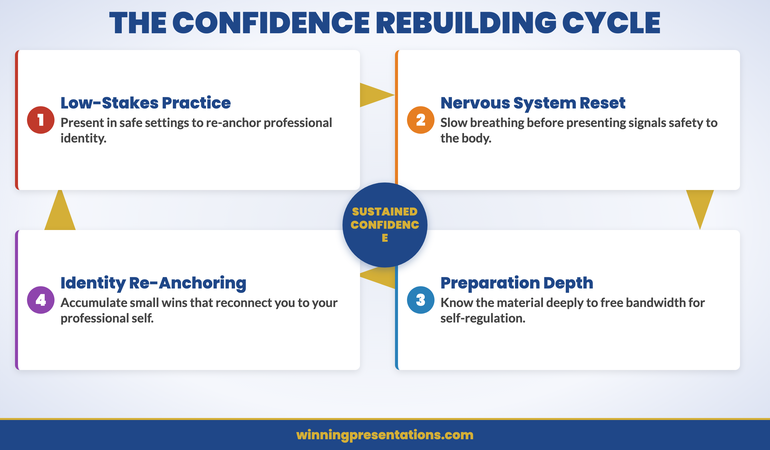
The most effective early step is to seek out low-stakes presenting opportunities in the first weeks back. Team meetings, internal briefings, small-group updates — contexts where the stakes are low enough that a less-than-perfect performance doesn’t feel catastrophic. These early presentations are not about impressing anyone. They are about re-establishing the neural pathways of professional presenting and beginning to rebuild your working identity. See also The Imposter Syndrome Paradox: Why Promotion Makes Presentation Anxiety Worse for related patterns.

Preparation Techniques That Rebuild Confidence Quickly

When confidence is fragile, thorough preparation is not a crutch — it is a legitimate strategy. Knowing your material in more depth than you need to, and having thought through likely questions in advance, reduces the cognitive load during the presentation itself. This frees up mental bandwidth for the self-regulation that anxious presenters need to manage their physical response.

Begin your preparation earlier than you normally would. If your previous standard was preparing the day before, extend this to two or three days. Not to over-rehearse — rehearsing the same material to the point of rigidity creates a different problem — but to give yourself time to let the material settle, add depth to the sections you feel least sure about, and simulate questions that might come up.

Identify the two or three moments in the presentation that feel most exposed. These are usually transitions — moving from one section to another — or moments where you anticipate being challenged. Prepare these moments with extra care. Know exactly what you will say and how you will manage the transition. Uncertainty at transitions is what causes the nervous system spike that triggers visible anxiety.

Before the presentation, use a brief pre-presentation routine to settle your nervous system. This does not have to be elaborate: two minutes of slow breathing (four counts in, six counts out) before entering the room has a measurable effect on the physiological response. Combined with a brief mental rehearsal of the opening — not the whole presentation, just the first ninety seconds — this gives your nervous system a clear signal that this is a manageable event.

If pre-presentation anxiety has become a pattern since returning from maternity leave, Conquer Speaking Fear provides a structured 30-day approach to nervous system regulation that addresses the deeper patterns, not just the surface symptoms.


Confidence Rebuilding Cycle infographic showing four stages: Low-Stakes Practice, Nervous System Regulation, Preparation Depth, and Identity Re-Anchoring — a cyclical process for regaining presentation confidence after maternity leave

Graduated Exposure: The Fastest Path Back

Avoidance is the most reliable way to make presentation anxiety worse. Every time you decline a presenting opportunity because the anxiety feels too high, you confirm to your nervous system that presenting is dangerous — and the threshold for triggering anxiety lowers slightly. This is why executives who avoid presenting for six months find that the anxiety on return is higher than it was before the avoidance began.

Graduated exposure — deliberately seeking out presenting situations in order from lower to higher stakes — is the most effective strategy for reversing this pattern. The principle is to present in conditions where the stakes are low enough that you can tolerate the discomfort, complete the presentation, and demonstrate to your nervous system that presenting is survivable. Over repeated exposures, the nervous system recalibrates its threat assessment.

A practical graduated exposure sequence for returning executives might look like this: Start with internal team meetings where you know everyone in the room well. Move to cross-functional updates with a slightly wider audience. Then to briefings for senior colleagues where some relationship exists. Then to formal presentations to a small leadership group. And eventually to the high-stakes board or committee presentations that were routine before your leave.

The progression should be gradual enough that each step is uncomfortable but manageable — not so gradual that you spend six months only presenting to people who already know you well. The goal is to rebuild tolerance for the discomfort of exposure, which requires actually being exposed. For more on this approach, see Presentation Anxiety Relapse: What to Do When Fear Comes Back.

On the Day: Managing the Physical Response

Presentation anxiety has a physical signature: elevated heart rate, shallow breathing, tension in the chest and throat, and for some people, a noticeable tremor in the hands or voice. These physical symptoms are caused by the activation of your sympathetic nervous system — the same system that produces the fight-or-flight response. They are involuntary, and they are not a sign that something has gone wrong. They are a sign that your body is preparing for something it perceives as high-stakes.

Managing the physical response on the day means working with the nervous system rather than against it. Trying to eliminate the physical response through willpower usually increases it — the effort of suppression adds an additional layer of self-consciousness. The more effective approach is to accept the physical response as information, regulate the breathing to signal safety to the nervous system, and redirect attention outward toward the audience and the material.

Before walking in, stand in a quiet space and take six slow, deliberate breaths — making the exhale slightly longer than the inhale. This activates the parasympathetic nervous system and begins to slow the physical arousal response. It does not eliminate the nerves, but it reduces their intensity enough to make the first thirty seconds of the presentation manageable. The first thirty seconds are the highest-risk moment. Once you are in the material, the presenting instincts that pre-date your maternity leave typically reassert themselves.

What Not to Do When Confidence Is Fragile

Several approaches that feel like they should help actually slow the rebuilding process. Understanding these is as important as knowing the techniques that work.

Don’t compare your current performance to your pre-leave performance. The executive you were before your leave was at the end of a long period of accumulated confidence. You are at the beginning of a rebuilding process. Comparing the two is like comparing a marathon runner at mile one to themselves at mile twenty-six — the comparison has no useful information in it. Measure progress against your current baseline, not your historical best.

Don’t over-explain your return. Some executives feel compelled to acknowledge their leave in every early presentation — to pre-empt any sense that they are rusty or less sharp. This draws attention to the uncertainty rather than projecting stability. Audiences take their cue from the presenter. If you behave as though you are fully returned, most colleagues will respond accordingly.

Don’t mistake thorough preparation for over-rehearsal. Rehearsing a presentation to the point where it is completely scripted removes the spontaneity that makes presenting feel natural. The goal of preparation is fluency with the material, not word-for-word memorisation. Over-rehearsed presentations sound mechanical and are harder to recover from when a question takes you off-script.

Don’t avoid asking for feedback. Trusted colleagues who can give you an honest read after a presentation are an important resource during the rebuilding period. Asking someone you respect for one or two specific observations is not a sign of insecurity — it is how experienced professionals continue to develop. The self-assessment of an anxious presenter is almost always harsher than the assessment of a neutral observer.

Ready for a Structured Approach?

30 Days to Calm Your Nervous System and Rebuild Presentation Confidence

Conquer Speaking Fear — £39, instant access — is a 30-day programme that works on the physiological and psychological roots of presentation anxiety. Includes nervous system regulation techniques, clinical hypnotherapy sessions, and a graduated exposure framework for presenters rebuilding confidence after a significant break.

Get Conquer Speaking Fear →

Frequently Asked Questions

How long does it take to rebuild presentation confidence after maternity leave?

There is no universal timeline, but most executives find that with a structured graduated exposure approach, the gap between their current confidence and their pre-leave confidence closes meaningfully within three to four months of return. The key variable is the frequency and variety of presenting opportunities. Executives who actively seek out low-stakes presenting situations in their first weeks back rebuild significantly faster than those who wait for the confidence to return on its own. Confidence is built through action, not through readiness.

Is it normal for presentation anxiety to be worse after maternity leave than before?

Yes, and it is more common than most people discuss in professional settings. The combination of an extended break from presenting, a major identity transition, and heightened self-consciousness about returning to a senior role creates conditions where anxiety often intensifies rather than picking up where it left off. This does not reflect a permanent change in capability. It reflects the temporary disruption of a confidence that was built through sustained professional engagement — and that can be rebuilt through the same kind of sustained engagement.

My anxiety is affecting my willingness to take on visible projects. Should I be worried?

Avoidance of visibility is the most significant long-term risk of post-maternity presentation anxiety, because career progression at senior levels is closely tied to visibility with decision-makers. If the anxiety is leading you to systematically decline presenting opportunities, it is worth addressing directly rather than waiting for it to resolve on its own. A structured approach — either a programme like Conquer Speaking Fear or work with a coach experienced in presentation anxiety — addresses the underlying pattern more efficiently than time alone.

The Winning Edge — Free Weekly Newsletter

Practical frameworks for managing presentation anxiety and building executive confidence. Every Thursday.

Subscribe to The Winning Edge →

About the Author

Mary Beth Hazeldine is Owner & Managing Director of Winning Presentations. With 25 years of corporate banking experience at JPMorgan Chase, PwC, Royal Bank of Scotland, and Commerzbank, she advises executives across financial services, healthcare, technology, and government on structuring presentations for high-stakes funding rounds and approvals.
17 Apr 2026
A senior female executive in a one-to-one conversation with a male board member in a glass-walled office, building alignment before a formal meeting, confident and collaborative tone, editorial photography style

Stakeholder Alignment Presentation: The Pre-Meeting That Wins Approvals

Quick Answer: Most approvals are decided before the formal presentation begins. A stakeholder alignment session — a structured pre-meeting with key decision-makers — lets you surface objections privately, refine your narrative based on what you hear, and arrive in the room with commitments already secured. The formal presentation then becomes a ratification exercise rather than a persuasion exercise. This approach works for board approvals, finance committee requests, and any high-stakes executive decision.

Astrid had thirty minutes in front of the investment committee. She had rehearsed the deck twenty times. Her financial model was solid, her slides were clear, and her executive sponsor believed in the project. When the committee chair asked a single question — “What does the operations director think about the implementation timeline?” — the presentation stalled.

The operations director hadn’t been consulted. He sat in the room, visibly uncomfortable. The committee read the room, delayed the decision, and asked for a revised proposal that incorporated operational input.

Three weeks later, Astrid submitted the same project with one structural difference: she had spent the preceding fortnight meeting individually with every committee member and the operations director. By the time she walked into the formal presentation, every objection had already been heard, addressed, and in most cases resolved. The formal presentation took nineteen minutes. The approval was unanimous.

If you’re preparing for a high-stakes approval

The Executive Slide System includes scenario playbooks and slide templates for executive approval presentations — including the alignment and pre-meeting frameworks that help you structure what you learn before the formal session.

Explore the System →

Why the Decision Is Made Before You Present

Senior decision-makers rarely change their minds in a committee room. By the time the formal meeting convenes, most members have already formed a view — based on conversations in corridors, emails exchanged with colleagues, and assumptions built from prior context. The formal presentation is where those views are tested, not formed.

This is not cynicism about the process. It reflects how experienced executives make high-stakes decisions: they gather information in advance, test their instincts with trusted colleagues, and arrive in the meeting with a working hypothesis. Your presentation either confirms or challenges that hypothesis. If you’ve done no work to shape it in advance, you’re working against a position that was set before you entered the room.

The most effective executives understand this dynamic and work with it rather than against it. They treat the formal presentation as the final step in a longer engagement process, not the first and only opportunity to make their case.

The pre-presentation alignment session is the mechanism that makes this possible. It is not manipulation — it is thorough preparation. Every concern that surfaces in a private conversation is one that won’t derail the formal meeting. Every commitment secured informally is one that reinforces the approval in the room. And every stakeholder who feels heard in advance is one who arrives in the meeting inclined to support rather than question.

Executive Slide System

Structure Your Approval Presentation to Match the Work Done Before the Room

The Executive Slide System — £39, instant access — gives you slide templates for board, finance committee, and investment committee presentations, plus scenario playbooks for navigating stakeholder alignment before high-stakes approvals. Designed for executives who want to arrive in the formal meeting with the decision already moving in their direction.

  • Slide templates for approval and board presentations across executive scenarios
  • AI prompt cards to map stakeholder concerns before the alignment session
  • Framework guides for structuring the narrative around what you hear pre-meeting
  • Scenario playbooks for investment committee, board, and finance committee contexts

Get the Executive Slide System →

Designed for high-stakes approval presentations where preparation matters more than performance.


Stakeholder Alignment Dashboard infographic showing four metric categories: Decision-Makers to Brief, Concerns to Surface, Commitments Secured, and Objections Outstanding — a pre-presentation tracking framework

Who to Meet and What to Ask Them

Not every stakeholder needs a dedicated pre-meeting. The goal is to meet the people whose support is essential and whose concerns, if left unaddressed, could derail the formal presentation. For most approval presentations, that list is shorter than it appears.

Start with the decision-makers — the people who will vote, recommend, or formally approve. Understand their current view on the topic before you attempt to inform it. Have they been involved in similar decisions before? Do they have a prior position on this type of investment or initiative? Is there a competing proposal that complicates their thinking?

Next, identify the influencers — the people whose opinion the decision-makers trust. In a finance committee context, this is often the CFO’s direct advisers or the head of internal audit. In a board context, it may be the senior independent director or a non-executive with a strong view on capital allocation. These people may not have a vote, but their informal influence on the final outcome can be decisive.

Finally, identify the potential blockers — the people whose opposition, if expressed in the formal meeting, could damage the proposal even if they are in the minority. Understanding a blocker’s concern before the meeting gives you the opportunity to address it privately, which is almost always more productive than managing it in public.

In each pre-meeting, ask three questions. What do they already know about the proposal? What concerns do they have about it? And what would they need to see to be comfortable supporting it? These questions are not a sales pitch — they are information-gathering. The goal is to understand, not to convince. Convincing comes later, in how you update the presentation.

For the framework behind pre-decision conversations, see The Pre-Decision Conversation: How Executives Secure Approval Before the Meeting.

Running the Alignment Session Effectively

An alignment session is a conversation, not a presentation. Executives who use the pre-meeting to walk through their slides — treating it as a rehearsal — miss the point. The slide deck is not what you bring to this meeting. What you bring is curiosity and good questions.

Keep the meeting short: thirty minutes is usually sufficient. Open by explaining your purpose directly — you are seeking input before the formal session to ensure the presentation addresses the right questions. Most decision-makers respect this directness. It signals that you are thorough, not that you are uncertain.

Listen more than you speak. When a concern surfaces, resist the instinct to immediately counter it. Instead, explore it: “That’s useful to know — can you say more about what’s driving that concern?” Understanding the root of an objection is more valuable than overcoming its surface expression. An objection that sounds financial may actually be about trust. An objection about timing may actually be about resource competition.

Take notes, and be transparent about doing so. “I want to make sure I capture this accurately before I revise the presentation” signals that the conversation will have a real impact on what the committee sees. This is important: if decision-makers sense that the pre-meeting is performative rather than genuinely informative, they stop sharing real concerns.

Close each session by confirming what you’ve heard and what changes you plan to make. “Based on what you’ve shared, I’ll strengthen the implementation timeline and add more detail on the alternatives we considered. Does that address the main concerns you raised?” This gives the stakeholder the opportunity to confirm or correct your understanding before you do the work.

If you’re rebuilding a formal approval presentation around what you’ve heard in pre-meeting conversations, the Executive Slide System includes slide templates and AI prompt cards designed to help you translate stakeholder concerns into a presentation narrative that addresses them structurally, not just rhetorically.


Stakeholder Alignment Roadmap infographic showing five stages: Map the Stakeholders, Schedule Pre-Meetings, Surface Concerns, Update the Narrative, and Enter the Room with Commitments Secured

What to Do With What You Hear

The alignment session has value only if it changes something. If you leave every pre-meeting with the same deck and the same narrative, you’ve gathered information that you didn’t act on — which is worse than not gathering it, because it signals to stakeholders that the consultation was cosmetic.

After each pre-meeting, categorise what you’ve heard. Some concerns will be addressed by adding or clarifying information — a new slide, an updated data source, a clearer explanation of a financial assumption. These are structural changes, and they make the presentation more complete. Make them before the formal session.

Other concerns will reflect a disagreement about the underlying business case — a stakeholder who genuinely believes the investment is premature, or that a different approach should be considered. These cannot be resolved with a slide change. They require a direct conversation about the merits, and in some cases, the involvement of a more senior sponsor to navigate the impasse. Identify these early, because they need more time than a slide revision.

Some concerns will be about perception rather than substance — a stakeholder who hasn’t been involved in previous discussions and feels left out, or one who is concerned about credit and visibility when the project succeeds. These are relationship issues, and they are resolved through the pre-meeting process itself: the act of consulting them is the resolution. Make sure they know their input shaped the final presentation.

Keep a simple log of what you heard, what you changed, and what remains unresolved. This is useful for two reasons. It ensures that nothing gets lost between conversations. And if the decision is contested in the formal meeting, your log gives you the basis to say with confidence: “I discussed this with [stakeholder] two weeks ago, and here is how I addressed that concern in the revised presentation.” For related thinking on managing structural change presentations, see Restructuring Presentation: Rebuilding Trust Through Transparent Communication.

Aligning Across Competing Interests

The most challenging stakeholder alignment situations are those where key decision-makers have competing interests — where what one stakeholder needs to hear directly contradicts what another needs to hear. A proposal that involves resource reallocation is a classic example: the function gaining resources welcomes it, while the function losing resources opposes it.

The response here is not to tell different stakeholders different things — that collapses the moment the formal meeting convenes. The response is to find the common ground between competing interests and build the presentation narrative around it.

What both stakeholders share, despite competing interests, is typically a concern about the broader organisational outcome. The function losing resources still cares about the company’s performance. The disagreement is about means, not ends. A presentation that frames the proposal in terms of the shared goal — rather than the redistribution of resources — gives both stakeholders something they can support.

Where interests are genuinely irreconcilable, the alignment session’s value is in surfacing the conflict before the formal meeting rather than discovering it in public. A committee where two factions are in open disagreement is difficult to present to. A committee where the chair knows the disagreement exists and has managed it in advance is a different environment. Use the pre-meeting process to give the chair the information they need to manage the room, as well as to manage your own presentation.

Using the Formal Presentation to Confirm, Not Persuade

When the alignment process has been done well, the formal presentation shifts in character. It becomes a confirmation exercise — a structured walk through the proposal that gives the committee confidence that everything has been considered, rather than a persuasion exercise where the outcome is uncertain.

This changes the tone and the pacing. A confirmation presentation can afford to be shorter, because most of the information has already been shared in pre-meetings. It can acknowledge concerns explicitly — “I know some of you have raised questions about the implementation timeline, so I’ve added a new slide that addresses this directly” — because the concerns are already known. And it can invite a more collaborative discussion, because the presenter isn’t guarding against ambushes.

The questions that arise in a confirmation presentation are also different in character. They tend to be sharper and more specific — looking for the final detail that will complete the picture — rather than broad and exploratory. This is a good sign. It means the committee is doing the final check before committing, not starting the analysis from scratch.

The goal is to make the formal presentation feel inevitable in the best sense: the logical outcome of a rigorous process rather than a surprise outcome from a single event. For guidance on how executive presence supports this dynamic in the room, see Executive Presence in Presentations: The Quality That Closes the Room.

Need the Templates, Not Another Framework?

Slide Templates for Executives Who Present to Senior Decision-Makers

The Executive Slide System — £39, instant access — includes ready-to-use templates for board, finance committee, and investment approval presentations, plus AI prompt cards to structure your narrative around what stakeholders actually need to hear.

Get the Executive Slide System →

Frequently Asked Questions

How many pre-meetings is too many before a formal presentation?

There is no fixed upper limit, but the quality of pre-meetings matters more than the number. Five shallow conversations that don’t surface real concerns are less valuable than two deep ones that reveal the actual objections. As a working guide, prioritise the three to five people whose support is essential and whose concerns are most likely to surface in the formal meeting. Beyond that core group, judge based on the political complexity of the specific approval and the time available.

What if a key stakeholder refuses to meet before the formal session?

A refusal to meet is itself useful information. It may signal opposition, disengagement, or a prior commitment to a competing proposal. If a critical decision-maker declines a pre-meeting, work through your executive sponsor to understand their position and whether there is a backstory that you need to account for. It may also be worth adjusting the formal presentation to explicitly invite that stakeholder’s input — framing their engagement as essential to the process rather than assuming their alignment.

Is it appropriate to share draft slides in a pre-meeting?

In most cases, no. Sharing draft slides in a pre-meeting shifts the conversation from concerns to critique — stakeholders start commenting on slide design rather than sharing their underlying concerns about the proposal. The exception is when a specific stakeholder is a subject-matter expert whose input on a particular section of the deck would meaningfully improve it. In that case, share only the relevant section and frame it as a request for input rather than a preview of the full presentation.

The Winning Edge — Free Weekly Newsletter

Practical frameworks for executives who present to boards, finance committees, and senior leadership. Every Thursday.

Subscribe to The Winning Edge →

Not ready for the full system? Start here instead: download the free Executive Presentation Checklist — a one-page reference covering the structural elements decision-makers look for in board and approval presentations.

About the Author

Mary Beth Hazeldine is Owner & Managing Director of Winning Presentations. With 25 years of corporate banking experience at JPMorgan Chase, PwC, Royal Bank of Scotland, and Commerzbank, she advises executives across financial services, healthcare, technology, and government on structuring presentations for high-stakes funding rounds and approvals.
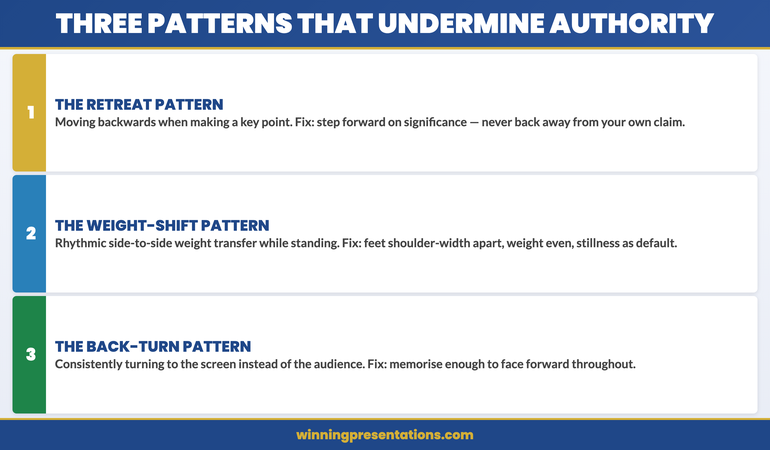
17 Apr 2026
A finance director presenting a revised budget proposal to a sceptical finance committee in a corporate boardroom, navy and dark tones, editorial photography style

Budget Resubmission Presentation: What Finance Committees Need to See

Quick Answer: A budget resubmission fails when you present the same deck again. Finance committees rejected your original request for specific reasons — usually around ROI evidence, timing, or lack of alternatives analysis. A successful resubmission acknowledges the rejection, isolates the exact objections raised, addresses each one with new evidence, and presents the project as stronger, not unchanged. The slides are secondary to the diagnostic work that happens before you open PowerPoint.

Henrik had prepared for six weeks. The CapEx request was airtight — or so he thought. When the finance committee rejected his £2.3 million infrastructure upgrade, the feedback was three lines: “ROI timeline unclear. Alternatives not sufficiently explored. Timing not aligned with current priorities.”

He was deflated. His instinct was to go back in three months with the same deck, slightly updated. His CFO stopped him. “They didn’t reject the project,” she said. “They rejected the presentation of it. That’s a different problem.”

That distinction changed everything. Henrik spent two weeks doing the diagnostic work the first submission skipped — mapping the committee’s actual concerns, building a phased ROI model, and including a genuine alternatives analysis. Six weeks later, the resubmission was approved. Not because the project had changed. Because the presentation finally spoke to what the committee needed to hear.

If your budget request has already been rejected

The Executive Slide System includes slide templates designed specifically for finance and approval presentations — including resubmission scenarios where you need to address prior objections and rebuild credibility with the same committee.

Explore the System →

Why Most Budget Resubmissions Fail

The most common mistake in a budget resubmission is treating it as a resubmission. Executives go back with the same slides, the same narrative, and perhaps some updated figures — and are surprised when the committee says no again.

Finance committees have a specific memory of your previous presentation. They remember why they said no. When you return with something that looks largely unchanged, you signal either that you didn’t understand their objections, or that you understood them but couldn’t address them. Neither reading helps your case.

The second common mistake is addressing the wrong objections. Committees rarely tell you their real concerns in the formal feedback. “ROI timeline unclear” might actually mean “we don’t trust the assumptions in your model.” “Timing not aligned with current priorities” might mean “one board member has a competing project and has already lobbied against yours.” Understanding the surface objection and the underlying concern are different tasks.

A budget resubmission is not a second bite of the same apple. It is a new presentation built from a post-mortem of the first one. The executive who approaches it this way consistently outperforms the one who simply tries harder with the same material.

Executive Slide System

Structure the Resubmission So Finance Committees Say Yes

The Executive Slide System — £39, instant access — includes slide templates for finance and approval scenarios, AI prompt cards to rebuild your ROI narrative, and a scenario playbook for executives presenting to hostile or sceptical decision-makers. Designed for budget presentations where the first submission didn’t land and you need a structurally stronger case the second time.

  • Slide templates for CapEx, opex, and budget approval presentations
  • AI prompt cards to pressure-test your financial assumptions before the meeting
  • Framework guides for structuring an objection-response narrative
  • Scenario playbooks for finance committee, board, and investment committee presentations

Get the Executive Slide System →

Designed for executives facing second-attempt approval presentations.


The Four Changes for a Successful Budget Resubmission infographic showing: Diagnose the Real Objection, Address with New Evidence, Reframe the Narrative, and Present the Alternatives

Diagnosing What the Committee Actually Objected To

Before you change a single slide, you need to understand what the committee actually objected to. This requires going beyond the formal written feedback, which is almost always a sanitised version of the real conversation.

Request a debrief with the chair of the finance committee or the most senior sponsor in the room. Frame it as seeking guidance: “I want to ensure I’m addressing the committee’s concerns properly before resubmitting. Would you be willing to give me fifteen minutes to understand what would strengthen the case?” Most chairs will say yes — they want well-constructed proposals coming back, not the same weak ones.

In that conversation, listen for three things. First, which objections were raised by whom — understanding the political landscape inside the committee matters. Second, what the committee would need to see to be confident in the ROI assumptions — this tells you what new evidence to gather. Third, whether the timing objection is real or a proxy for something else. If one committee member is pushing a competing capital project, timing becomes a way to delay your proposal rather than reject it outright.

Once you have this diagnostic information, map each concern to a specific change you will make in the deck. If you cannot identify what change addresses each concern, the resubmission is not ready yet. The internal link between concern and response is what makes the resubmission feel genuinely responsive rather than cosmetically updated. See how this approach connects to the pre-meeting work described in The Follow-Up Deck: Why Most Approvals Die After the Meeting.

The Four Changes That Earn a Second Look

Not every resubmission needs a complete rebuild. Most need four targeted changes, each one designed to address a specific category of concern that finance committees raise when they reject a budget request.

1. Acknowledge the rejection explicitly. Open the resubmission by referencing the previous presentation and what you heard from the committee. “Following the committee’s feedback in February, this revised proposal addresses three specific areas: the ROI timeline, alternatives analysis, and alignment with the current capital priorities.” This signals that you listened, that you did the work, and that this is a genuinely improved version — not the same material with fresh slides.

2. Restate the problem, not the solution. Many rejected budget requests spend the first ten slides describing the solution — the system, the infrastructure, the initiative — before establishing why the problem matters. Committees who weren’t sold the first time need to be reconnected to the urgency of the problem before they can evaluate the solution on its merits. Rebuild the problem slide before you rebuild anything else.

3. Introduce genuinely new financial evidence. If the ROI model was questioned, you need new inputs — not the same model with different formatting. Commission updated cost modelling, gather vendor quotes that support the assumptions, or bring in market benchmarks from a credible external source. The committee will recognise recycled figures dressed in new slides. New evidence signals that the financial case has been properly stress-tested.

4. Include a structured alternatives analysis. “We considered doing nothing, and also doing the project at half-scale” is not an alternatives analysis. A structured alternatives analysis presents three to four genuine options — including the do-nothing scenario — with honest comparative costs, risks, and timelines for each. This demonstrates that your preferred option is the recommended outcome of a rigorous process, not simply the option the team preferred from the start.

For a deeper look at how CapEx presentations are structured from the outset, see Capital Expenditure Presentation: The Slide Structure That Gets CapEx Approved.

If you need to rebuild the financial narrative quickly and ensure the slide structure meets finance committee expectations, the Executive Slide System includes prompt cards specifically designed for restructuring a presentation that didn’t land the first time.


Weak vs Strong Budget Resubmission comparison infographic showing the difference between cosmetic updates and diagnostic restructuring across four dimensions: problem framing, ROI evidence, alternatives analysis, and objection response

Building Your Resubmission Case

A resubmission is not built in PowerPoint. It is built in the weeks of work that happen before you open a presentation tool. The slides are the output of a process — not the process itself.

Start by updating your stakeholder map. Between your first presentation and the resubmission, the political landscape inside the committee may have changed. New members may have joined. The CFO’s priorities may have shifted. A competing project may have been approved or rejected, which changes the available capital headroom. Your pre-meeting conversations should give you an updated picture of where support and opposition sit before you step into the room.

Next, rebuild the financial model with new inputs. If the committee questioned your assumptions, the only credible response is new data. If they challenged your implementation timeline, bring in updated project management assessments. If they were concerned about total cost of ownership, include a five-year cost comparison that previous models omitted. Every financial assumption that was challenged needs a corresponding piece of new evidence that wasn’t in the original submission.

Then update your risk section. Most first submissions understate implementation risk because project teams are optimistic about their own proposals. A resubmission that honestly names the risks — and then explains how each one is mitigated — signals intellectual rigour. Finance committees are more comfortable approving projects where the risk has been honestly assessed than projects where it appears to have been glossed over.

Finally, update your internal cross-references. If the resubmission references savings from a related initiative, or assumes integration with an existing system, those dependencies need to be named and confirmed in writing before the presentation. Assumptions that couldn’t be confirmed in the first submission should be confirmed before the second.

Structuring the Resubmission Deck

The structure of a resubmission deck differs from a first-pass budget request in one important way: the opening acknowledges the history. Committees who have already seen your proposal need to see that history acknowledged before they can engage with the updated case. A deck that opens as though the rejection never happened reads as either oblivious or evasive.

A resubmission deck structured for finance committees typically follows this sequence:

Slide 1 — Context slide: One line on when the original proposal was submitted and a single sentence on what feedback was received. This is not a defensive slide — it is a signalling slide. It says “I heard you, and this version responds to what I heard.”

Slides 2–3 — The problem: Rebuild the urgency of the business problem. Not the solution — the problem. What happens if this doesn’t get funded? What is the cost of delay, in concrete terms? If the committee didn’t feel the urgency the first time, this is where you earn it back.

Slides 4–5 — The updated ROI case: Present the revised financial model with its new inputs highlighted. Don’t bury the changes — surface them. “Since February, we have obtained revised vendor quotes and updated the model based on current market rates. The revised payback period is 3.2 years, compared to 4.1 years in the original submission.” Specificity here signals that the changes are real, not cosmetic.

Slide 6 — Alternatives analysis: Three or four genuine options, compared on cost, risk, and timeline. Recommend your preferred option at the end, with a brief rationale. Keep this slide to a grid — not paragraphs.

Slides 7–8 — Risk and mitigation: Name the top three implementation risks and the corresponding mitigation for each. If a risk was specifically raised by a committee member in the previous session, address it by name in this section.

Slide 9 — Implementation roadmap: Phased milestones, owners, and decision points. If the original timeline was challenged, show how the revised timeline is structured and what would trigger a go/no-go decision at each phase.

Slide 10 — The ask: One slide. The specific amount, the timing, and one sentence on what approval unlocks. For guidance on how this sequence connects to zero-based budget frameworks, see Zero-Based Budget Presentation: Justify Every Line to Finance.

Presenting the Resubmission Without Appearing Defensive

The tone of a resubmission matters as much as the content. Executives who come back into the room carrying resentment about the original rejection — even when that resentment is concealed — communicate it through their body language, their framing, and the way they handle questions.

The framing that works best is genuine curiosity about whether the case is now strong enough, not determination to get approval at all costs. “Following the feedback from February, we’ve done additional work that I’d like to walk you through” is a different energy from “We’ve addressed every concern that was raised.” The first is collaborative. The second is defensive.

When questions come, don’t pre-empt them with elaborate explanations of why the original model was correct. If the committee asks about a changed assumption, answer the question directly, then explain the new basis for that assumption. The order matters: answer first, explain second. Pre-emptive defensiveness reads as if you’re trying to win an argument rather than inform a decision.

Finally, be prepared to accept a partial approval. Finance committees sometimes approve a phased version of a project when they’re not ready to commit the full amount. If you have structured a phased option in your deck, you’re positioned to accept this outcome as a win rather than a compromise. “Yes to Phase 1, conditional review for Phase 2” can be a stronger outcome than a second outright rejection.

Ready to Rebuild the Case?

Slide Templates Designed for Finance Committee Presentations

The Executive Slide System — £39, instant access — gives you templates for CapEx, budget approval, and resubmission scenarios, plus AI prompt cards to restructure the financial narrative before you step back into the room.

Get the Executive Slide System →

Frequently Asked Questions

How long should I wait before resubmitting a rejected budget?

There is no fixed waiting period, but a resubmission submitted fewer than four weeks after rejection usually signals that insufficient diagnostic work has been done. The credibility of the resubmission depends on the quality of the changes, not the speed of the return. Most committees expect to see a resubmission at the next scheduled budget cycle — typically quarterly. If you have a compelling reason to return sooner, the context slide at the start of your deck should explain the timing rationale.

Should I request a pre-meeting with committee members before resubmitting?

Yes. Pre-meeting conversations with the committee chair and key decision-makers are one of the highest-value activities you can do before a resubmission. These conversations let you confirm that your revised case addresses the specific concerns that led to rejection, rather than the concerns you assumed were the issue. They also give you early signals about whether the timing is right and whether there are any political dynamics you need to account for in how you structure the presentation.

What if the rejection was politically motivated rather than financial?

Political rejections — where a committee member blocked the proposal for reasons unrelated to its financial merit — are common and require a different response to financial rejections. In this situation, the priority before resubmission is shoring up political support outside the meeting room. Identify who opposed the proposal and why, then work with your sponsor to either address their underlying concern or build a coalition of support strong enough that opposition becomes untenable. Resubmitting without addressing a political blockage produces the same result.

The Winning Edge — Free Weekly Newsletter

Practical frameworks for executives who present to boards, finance committees, and senior leadership. Every Thursday.

Subscribe to The Winning Edge →

Not ready for the full system? Start here instead: download the free Executive Presentation Checklist — a one-page reference covering the structural elements finance committees look for in budget and approval presentations.

About the Author

Mary Beth Hazeldine is Owner & Managing Director of Winning Presentations. With 25 years of corporate banking experience at JPMorgan Chase, PwC, Royal Bank of Scotland, and Commerzbank, she advises executives across financial services, healthcare, technology, and government on structuring presentations for high-stakes funding rounds and approvals.

16 Apr 2026
Female manager presenting a business case to senior leadership team, composed and authoritative, navy blazer, corporate boardroom

Presentation Skills Training for Managers

Presenting to your own team and presenting upward to senior leadership are different disciplines. Most managers discover this the hard way — they prepare thoroughly, they know their material, and then something goes wrong in the room. The director asks a question they were not expecting. The CFO challenges the numbers before slide five. A non-executive cuts across the argument with a concern that derails the structure. Generic presentation skills training does not prepare managers for any of this. It teaches confidence and delivery. It does not teach the structural decisions that determine whether a senior audience accepts or defers your recommendation.

Priya had been presenting internally for six years by the time she was asked to bring a business case to the executive leadership team. She was confident in front of groups. She had done presentation training as a new manager and had put it into practice. She could hold a room, manage nerves, and take questions. What she had not done was present to people whose job is to interrogate recommendations, not receive them. Her slide deck covered the case logically, building from context through evidence to conclusion over fourteen slides. Forty seconds into slide three, the Operations Director interrupted: “Just tell me what you’re asking for and why it’s better than doing nothing.” The room fell silent. Priya had prepared thoroughly for a presentation. She had not prepared for that question — because she had placed the recommendation on slide twelve, and no executive committee has ever waited that long. She found the slide, gave the ask, and recovered well. But she had lost the room’s confidence in the architecture of her thinking before the case was made. What she needed was not more confidence. She needed a different structure.

Preparing to present to senior leadership? The Executive Slide System gives managers the slide templates, AI prompt cards, and structure guides for presenting upward with authority. Explore the System →

Why Generic Presentation Training Does Not Prepare Managers for Senior Audiences

Most presentation skills training for managers focuses on delivery: voice projection, eye contact, posture, managing nerves, using pauses effectively. These are useful skills. They are not the skills that determine whether a senior leadership presentation succeeds or fails.

Senior leaders do not typically evaluate presentations on delivery quality. They evaluate them on the quality of the thinking. Is the recommendation clear? Is the evidence logically structured? Has the presenter anticipated the objections? Is there a credible path forward? A manager who delivers with polished confidence but buries the recommendation on slide nine will lose a senior audience before the middle of the deck. A manager who presents with visible nerves but opens with a clear recommendation, supports it with organised evidence, and closes with a specific next step will hold that audience’s attention and respect.

The other thing generic presentation training does not cover is the dynamics specific to presenting upward. In a standard presentation, the presenter controls the floor. In a senior leadership presentation, the audience frequently interrupts — not to be difficult, but because that is how executive committees work. They identify their priority question early and ask it, often before the presenter has reached the slide that addresses it. A manager who has not prepared for this dynamic — who experiences the interruption as a derailment rather than as a normal feature of senior stakeholder engagement — can lose composure at exactly the moment when composure matters most.

Effective presentation skills training for managers must therefore cover three things that generic training omits: presentation architecture for senior decision-makers, objection anticipation and pre-emption, and composure strategies for live challenge. Without these, even a well-delivered presentation may fail to secure the outcome the manager needs.

The Structure Managers Need for Senior Presentations

The Executive Slide System gives managers scenario-specific slide templates, AI prompt cards, and framework guides — built for presenting upward to senior leadership, not for general team communication. £39, instant download.

  • ✓ Slide templates for high-stakes upward presentations
  • ✓ AI prompt cards to build decision-ready decks faster
  • ✓ Framework guides covering structure, evidence, and risk
  • ✓ Instant download — use immediately for your next presentation

Get the Executive Slide System → £39

Designed for managers and executives preparing high-stakes upward presentations

The Structure Gap: How Managers Need to Present Differently Upward

The most consequential structural difference between presenting to peers and presenting to senior leadership is the position of the recommendation. When presenting to a team or a peer group, building context before the conclusion is natural — you establish shared understanding before making the ask. When presenting upward, this approach works against you.

Senior leaders are time-constrained and operate under high cognitive load. They process information more efficiently when they know the conclusion first and evaluate the evidence in light of it, rather than receiving the evidence and forming a view independently. A presentation that opens with context and builds toward a recommendation asks the senior audience to hold all the evidence in working memory until the conclusion arrives — which is not how executive committees read or listen.

The recommendation-first structure that works for senior audiences looks like this: a brief context statement (one to two slides establishing why this is being presented now), the recommendation itself (stated plainly — what you are asking for, or what you recommend doing), the evidence that supports it (organised logically, not chronologically), a risk acknowledgement (the two or three most likely objections, each with a specific response), and a clear next step. This is the structure that allows a senior leader to engage with your recommendation from slide two, rather than suspending judgement for twelve slides.

For new managers presenting upward for the first time, the hardest part of this structural shift is placing the recommendation before they feel they have earned the right to make it. The impulse is to build the case first. But senior audiences are not waiting to be persuaded before hearing the ask — they want the ask upfront so they can evaluate the case with the recommendation in mind. The structure that feels presumptuous in practice is the one that works.

The five-part executive presentation outline maps this structure in full — covering the exact sequencing decisions that allow a manager’s recommendation to land before the room has had time to form a counter-position.

Handling Scrutiny: When Senior Leaders Challenge Your Case

The moment that separates managers who build a reputation in senior presentations from those who do not is usually not the quality of their slides. It is how they respond when a director challenges their numbers, their logic, or their assumptions.

Senior leaders challenge presentations not primarily to undermine them but to test them. A challenge is, in most cases, a signal of interest: the director is engaging with the proposal seriously enough to probe it. A manager who receives a challenge as an attack and becomes defensive has misread the dynamic. A manager who receives a challenge as a question and responds with specific, calm, well-organised information has demonstrated exactly the credibility that senior presentations are designed to establish.

Preparing for scrutiny requires identifying the three to five objections most likely to be raised before you present, and building your response to each into the deck. Not buried in an appendix — in the main body, as a risk acknowledgement section that addresses the objection before it is raised. This has two effects: it pre-empts the objection, which removes one source of challenge from the room, and it demonstrates that you have engaged with the downside, which builds credibility for the recommendation.

When challenges come in real time during the presentation, three composure practices matter most. First, pause before responding — two or three seconds is not a long silence, but it signals that you are considering the question rather than reacting to it. Second, name the question before answering it: “That’s a question about the timeline — let me address that directly.” This gives you a moment to organise your response and signals to the questioner that you have understood what they are asking. Third, answer specifically and move on — do not over-explain or qualify excessively. A direct, specific response followed by a return to the structure of your presentation is more authoritative than a detailed elaboration that leads the room further from the decision.

For managers whose primary concern about senior presentations is the challenge dynamic rather than the structural one, the framework for presenting to resistant or hostile audiences covers the specific techniques for managing a room where the challenge level is sustained rather than occasional.

The Executive Slide System includes framework guides covering how to structure the risk acknowledgement section that pre-empts the objections most likely to arise in management presentations to senior leadership.

Presenting Resource Requests and Business Cases to Senior Leadership

The presentation type that causes managers the most difficulty is the resource request: a budget ask, a headcount case, a capital investment proposal. These are presentations where the manager needs something from the senior audience and the senior audience is simultaneously under pressure to limit or reduce what it gives. The structural and psychological challenge is significant.

The most common failure mode in resource request presentations is what might be called the apologist structure: the manager spends the first half of the deck establishing how much they have achieved with existing resources, implying that they should not need more before eventually making the ask. This structure undermines the request before it is made. It signals awareness that the ask may not be welcome and pre-emptively hedges against it. Senior leaders read this defensiveness and it reduces their confidence in the manager’s conviction about the proposal.

An effective resource request presentation starts from a different premise: the ask is not a favour, it is an investment decision. Framing the request as an investment decision shifts the conversation from “please give us more” to “here is what the organisation gets if it commits this resource.” The financial logic is the same either way, but the framing is entirely different — and framing is what determines whether a senior audience evaluates a resource request as a cost or as an opportunity.

The evidence section of a resource request also needs specific elements that general business presentations omit. The cost of not approving the request — the operational impact, the missed opportunity, the accumulated risk of deferral — is as important as the case for approval. Senior leaders who are undecided between approving and deferring a resource request will often make their decision based on their assessment of what happens if they do nothing. Making that case explicitly, rather than leaving the senior audience to infer it, is one of the structural choices that separates resource requests that are approved from those that are deferred for further consideration.

The framework for presenting difficult information to senior leadership is directly relevant here — resource requests where the current situation is unsustainable require the same credibility-preserving structure as formal difficult-results presentations.

Building Credibility Through Repeated Senior Presentations

Credibility with senior leadership is built presentation by presentation, over time. Each presentation is an opportunity to demonstrate a specific set of qualities: clear thinking, organised evidence, sound judgement about risk, and a realistic understanding of what the organisation can and cannot do. Managers who consistently demonstrate these qualities in their presentations build reputations that precede them — which changes how senior leaders engage with their proposals.

The most important credibility signal in any senior presentation is specificity. Vague language — “we need more resource,” “the timeline might be challenging,” “there are some risks to consider” — signals that the presenter has not done the analytical work to support a recommendation. Specific language — “we need two additional analysts by the end of Q2,” “the implementation timeline has a four-week dependency on the vendor contract review,” “the primary risk is budget overrun in the infrastructure phase, which we have mitigated by capping the vendor commitment until Phase 1 completion” — signals that the presenter has thought the problem through. Senior leaders recognise the difference immediately.

The second credibility signal is the ability to stay on structure when the room becomes difficult. A manager who loses their thread under challenge or who abandons their prepared structure and begins improvising will leave senior leaders with a residual impression of unpreparedness, regardless of how strong the content was. Managers who can acknowledge a challenge, address it specifically, and return cleanly to the structure of their argument demonstrate exactly the composure under pressure that senior leadership values.

Over time, the managers who build the strongest track records in senior presentations are those who treat each presentation as a structured communication exercise, not a performance. The goal is not to impress the room with delivery quality. The goal is to make the decision the room needs to take as easy as possible to take — by providing the right information, in the right order, with the right level of specificity. Managers who do this consistently find that their presentations become shorter, more direct, and more effective with each iteration, because they have learned what senior audiences actually need from them.

Slide Templates and Frameworks for Presenting Upward

The Executive Slide System gives managers scenario-specific slide templates, AI prompt cards, and framework guides for business cases, resource requests, and senior leadership presentations. £39, instant download.

Get the System Now → £39

Frequently Asked Questions

What presentation training do managers actually need?

Managers presenting upward need training in three specific areas that generic public speaking courses do not cover: structuring a recommendation for senior decision-makers, handling the scrutiny that comes with resource requests and business cases, and managing composure when a director challenges their numbers or their logic. Generic presentation skills training teaches eye contact and vocal variety. Effective management presentation training teaches how to structure a case, anticipate objections, and hold your position under pressure.

How do I improve my presentation skills for presenting to senior leadership?

The most important improvement for managers presenting upward is structural — moving the recommendation to the beginning of the presentation rather than building to it at the end. Senior leaders evaluate evidence more effectively when they know what they are being asked to approve. Beyond structure, the specific skills that make the most difference are: concise evidence sequencing (supporting the recommendation without overwhelming it), a risk acknowledgement that shows you have thought through the downside, and a clear next step that defines what you are asking the senior audience to do.

Is there presentation skills training for managers in the UK?

Yes. Winning Presentations offers the Executive Slide System — a self-paced resource covering slide structure, AI prompt cards, and framework guides for managers presenting to senior leadership in UK organisations. It is designed for managers who are preparing a specific high-stakes presentation and need structured guidance rather than a generic training course. It covers the structural and language decisions that matter most when presenting upward in a UK business environment.

How long does it take to improve presentation skills for senior-level presentations?

Structural improvements — particularly recommendation-first framing, concise evidence sequencing, and risk acknowledgement — can be applied to any presentation within a single preparation session once you understand the principles. The Executive Slide System is designed for this: it provides the framework and templates to apply immediately to your next presentation, not a multi-week course before you see results. Sustained improvement in composure under scrutiny takes longer, but the structural improvements that make the biggest difference to senior audience reception can be implemented straight away.

The Winning Edge

Weekly insights on executive presentations, slide strategy, and boardroom communication.

Subscribe Free

About the author

Mary Beth Hazeldine, Owner & Managing Director, Winning Presentations. With 25 years of corporate banking experience at JPMorgan Chase, PwC, Royal Bank of Scotland, and Commerzbank, and 16 years training managers and executives across financial services, healthcare, technology, and government, she works with leaders preparing high-stakes presentations to senior decision-makers.
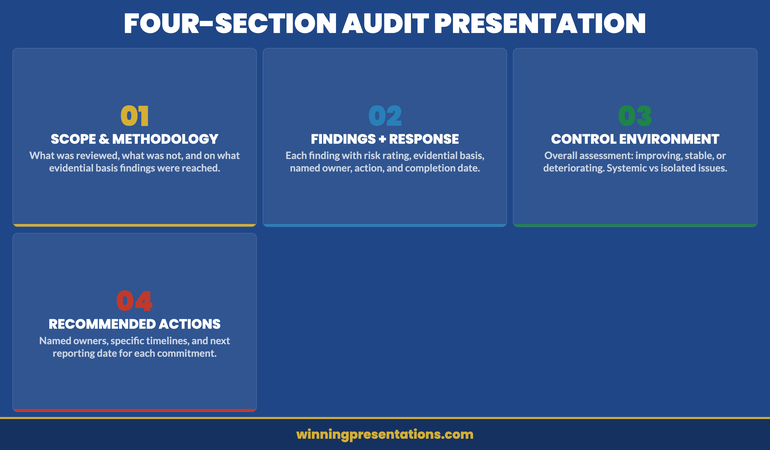
16 Apr 2026
Male executive answering a challenging question in an investment committee meeting, calm measured expression, senior questioners visible around the table, formal boardroom setting

Voice Control in Q&A: Why Experienced Presenters Sound Measured Under Pressure

Quick answer: Your voice changes during Q&A because the physiological activation of being questioned — elevated cortisol, muscle tension, shallower breath — directly affects the vocal mechanism. Experienced presenters sound measured under questioning not because they feel less pressure, but because they have developed specific disciplines: slowing the pace of their first sentence, using a deliberate pause before answering, and maintaining a lower pitch register through breath management. These are learnable techniques, not personality traits.

Kwame had presented the strategy update without difficulty. Twenty-two minutes, clean delivery, the slides doing exactly what he had intended. Then the investment committee chair asked a question he had not fully anticipated — not a hostile one, not even a particularly difficult one, but one that required him to think carefully before answering.

He heard it immediately — the slight thinness in the first word of his answer, the pace that was fractionally too fast, the pitch that had risen in a way he could not control in real time. He was answering correctly. He knew that. But the voice was not matching the confidence he felt intellectually. The committee chair asked a follow-up question. Kwame’s second answer was better. His third was back to where he needed to be. But the first two had set a tone, and he knew it.

The post-meeting debrief with his executive coach focused almost entirely on the transition between the presentation and the Q&A. The coach pointed out that Kwame was not anxious during the presentation — he had rehearsed it thoroughly and was genuinely comfortable with the material. The Q&A was different because it was unpredictable, and unpredictability activated a physiological response that the presentation had not. The voice reveals that shift. Learning to manage the voice in those first few seconds of an answer, the coach said, was the most important single skill Kwame could develop before his next committee presentation.

If Q&A is where your executive presentations tend to lose momentum — through vocal uncertainty, hesitation, or answers that trail off before reaching a clear point — the Executive Q&A Handling System provides a structured approach to managing the full Q&A process.

Explore the System →

Why Your Voice Changes Under Executive Questioning

The transition from presentation to Q&A is one of the most significant shifts in any executive briefing — not because the content changes, but because the presenter’s relationship to what they are saying changes fundamentally. A prepared presentation is delivered from a position of relative control. A question interrupts that control, requires real-time processing, and introduces an element of unpredictability that the nervous system registers as exposure.

The voice reflects this shift because the vocal mechanism is directly affected by the physiological state of the presenter. When cortisol and adrenaline increase — as they do when the nervous system perceives the evaluative exposure of being questioned by a senior audience — the muscles of the throat, jaw, and chest tighten. Breathing becomes shallower, reducing the air support available to the voice. The result is a voice that rises in pitch, reduces in volume, or increases in pace — sometimes all three simultaneously.

For senior audiences, these vocal changes carry interpretive weight. A voice that rises in pitch or speeds up under questioning signals uncertainty about the answer, discomfort with the questioner, or reduced confidence in the position being defended. The audience is not making a conscious diagnostic assessment — they are simply responding to what the voice communicates at a level below deliberate analysis. The effect on perceived authority is real even when the audience cannot articulate why they feel less confident in the presenter.

This dynamic is particularly pronounced in two types of Q&A: when the question is one the presenter was not expecting, and when the questioner is visibly more senior than the presenter or has a reputation for rigorous challenge. Both situations increase the physiological activation above the baseline, which makes the vocal management problem correspondingly harder. Understanding why this happens is the prerequisite for developing the techniques that address it.

Executive Q&A Handling System — £39, instant access

Handle Executive Questions With Consistency, Clarity, and Authority

The Executive Q&A Handling System is a structured framework for predicting, preparing for, and managing the questions that matter most in high-stakes executive presentations. It covers question analysis, response frameworks, and the specific disciplines for maintaining authority when questions are difficult, unexpected, or adversarial.

  • Frameworks for predicting and preparing for high-risk questions
  • Response structures for difficult, unexpected, and loaded questions
  • Techniques for maintaining composure and vocal authority in live Q&A
  • System for handling Q&A in board, investor, and senior leadership contexts

Get the Executive Q&A Handling System →

Designed for executives who present to boards, investors, and senior leadership teams where Q&A is high-stakes.

The Physiological Pattern That Breaks Down Vocal Control

Vocal control under pressure depends on three physiological elements: adequate breath support, relaxed throat and jaw musculature, and a pace of speech that allows the vocal mechanism to function without strain. When a difficult question activates the stress response, all three of these elements are compromised simultaneously — which is why the vocal deterioration under questioning can happen so quickly and feel so difficult to reverse once it has started.

Breath is the most fundamental. The voice is an air-driven instrument, and shallow breathing — the breathing pattern that stress produces — reduces the air column that supports the voice. A voice without adequate breath support loses its lower frequencies first, which is why anxiety tends to produce a higher, thinner vocal quality. The pitch is not deliberately chosen to be higher — it is the acoustic consequence of reduced breath support.

The pace of speech also accelerates under stress as a function of the activated nervous system. Faster speech reduces the natural pauses that punctuate clear, authoritative communication. Those pauses serve a dual function: they give the speaker time to think, and they give the audience time to absorb what has been said. When stress removes them, the answer begins to feel rushed — even when the content is correct — and the audience receives less time to register each point before the next one arrives.

Understanding this pattern matters because the management strategies that work must address the physiological root rather than simply the surface behaviour. Telling yourself to slow down rarely works in the moment if the underlying breath pattern has not changed. Managing the breath first — through deliberate elongated exhale before beginning the answer — changes the physiological state that is generating the vocal deterioration. The surface behaviour follows.


The physiological chain in Q&A vocal breakdown: stress response activates, breath shallows, throat tightens, pitch rises and pace accelerates — and the management approach that addresses each link

The Three Vocal Habits That Communicate Confidence in Q&A

Experienced Q&A presenters share three vocal habits that distinguish their answers from those of less practised colleagues. These habits are not naturally acquired — they are developed through deliberate practice and the sustained attention that comes from treating the Q&A as a performance discipline in its own right, not simply as the portion of the presentation that happens after the prepared content finishes.

The first habit is the deliberate opening. Experienced Q&A presenters begin their answer with a sentence that is slower and more measured than the pace they will settle into once the answer is underway. This first sentence functions as a vocal reset — it establishes the pace and register of the answer before the stress response has had time to accelerate either. The content of that first sentence is often relatively simple: a brief acknowledgement of the question, a restatement of the core point being addressed, or a one-sentence orientation. What matters is the vocal discipline, not the specific words.

The second habit is finishing sentences fully. Anxious answers trail off — the pitch drops, the volume reduces, and the final words of the sentence are swallowed before they have landed. This happens because the speaker’s attention is already moving to the next idea before the current one has been delivered. Deliberate sentence completion — ensuring that the last word of each sentence carries as much vocal energy as the first — is one of the most audible markers of vocal authority in Q&A. It communicates that the speaker is confident in their conclusion, not just their opening.

The third habit is ending on a lower note. Upward inflection at the end of a statement — a vocal pattern common in some regional accents and increasingly prevalent in professional speech — reads as a question or an invitation for the questioner to push back. A declarative answer delivered with downward inflection at the end of the key sentence communicates that the speaker has arrived at a conclusion, not a hypothesis. This single vocal adjustment — conscious in rehearsal, eventually habitual — changes the perceived authority of an answer even when the content is identical.

Physical stillness during the first sentence of an answer supports all three habits. The companion article on movement during presentations covers how physical grounding and deliberate stillness interact with vocal authority — the voice and the body reinforce each other, and managing one makes the other easier.

What to Do When Your Voice Catches Mid-Answer

A voice catch — the brief loss of vocal control that produces a crack, a break in sound, or a sudden increase in pitch mid-sentence — is one of the most disconcerting experiences for a presenter in a high-stakes Q&A. It is involuntary, it is visible to the room, and it produces an immediate self-consciousness that makes the next few seconds of the answer harder to manage than they would otherwise have been.

The most important single thing to know about a voice catch is that the audience’s interpretation of it is shaped almost entirely by what the presenter does immediately afterwards. A voice catch followed by a confident continuation of the answer at the same pace and pitch is read by most audiences as a normal human response to pressure — something that happens, noted briefly, and then forgotten. A voice catch followed by visible distress, a sharp intake of breath, or a halting restart amplifies the moment and makes it the thing the audience remembers.

The practical recovery sequence for a voice catch in Q&A is brief and simple. Pause for one full second — not in the way that signals panic, but in the deliberate way that signals that you are choosing your next words carefully. Take a breath during that pause — not a visible gasp, but a natural breath that replenishes the air support the voice needs. Resume the sentence from the point where the catch occurred, at a slightly slower pace than before, with full sentence completion on the next thought. The pause absorbs the catch; the resumption defines what the room remembers.

For managing the broader Q&A dynamic when questions feel adversarial or when the room has turned against a position, the article on hostile questioner simulation covers how to practise the specific pressure scenarios that make voice catches most likely — and how rehearsed exposure to those scenarios reduces their impact.

For executives who want a systematic approach to managing the full Q&A session, the Executive Q&A Handling System covers the preparation, response structure, and in-the-moment disciplines that experienced Q&A presenters use in board, investor, and senior leadership contexts.


Q&A vocal authority framework showing the three vocal habits of experienced presenters: deliberate opening sentence, full sentence completion, and declarative downward inflection — with examples of each

Pre-Q&A Vocal Preparation in Under Five Minutes

The quality of your vocal performance in Q&A is influenced by your physical and vocal state when the Q&A begins — not only by the techniques you apply once questions start arriving. Five minutes of deliberate preparation before the session begins can meaningfully change your baseline vocal state at the point of transition from presentation to questioning.

Breath is the starting point. Three to five slow, extended exhales — longer than feels natural, emptying the lungs more fully than normal breathing — activate the parasympathetic nervous system and reduce the cortisol-driven activation that constricts the throat and raises pitch. This exercise is not meditative — it is physiological. The extended exhale is the most effective single technique for reducing the physical tension that will otherwise manifest as vocal deterioration when the first question arrives. Do this in a private space in the final few minutes before the session begins.

Speaking aloud at your intended vocal register for two to three minutes before the session also helps to warm the vocal mechanism and establish the pace and pitch you intend to use. This does not require a formal warm-up — reading a few paragraphs from any document at the pace and register you intend to use in the Q&A is sufficient. The purpose is to make that vocal setting feel normal before the pressure of the session makes accessing it harder.

One additional preparation that experienced Q&A presenters use is rehearsing the first sentence of several different types of answer out loud. Not the full answer — just the opening sentence for a factual question, a challenge question, and a question requiring a more nuanced response. The purpose is not to script the answers, but to make the physical and vocal experience of beginning an answer feel familiar. When the first question arrives and the stress response activates, having said something similar out loud in the preceding ten minutes makes the opening discipline easier to access.

The Pause That Resets Vocal Authority in Live Q&A

The deliberate pause before answering a question is one of the most consistently underused tools in executive Q&A. Most presenters begin answering before they have fully formed the answer — because the social pressure of a question feels like a demand for an immediate response, and silence in a group setting feels like exposure. Both of these are perceptions rather than realities. Senior audiences do not experience a two-second pause as emptiness. They experience it as the presenter taking the question seriously.

The pause serves two distinct functions. The first is cognitive — it gives you time to hear the question fully, decide what the core point is, and formulate the first sentence of your answer before you begin speaking. Answers that start well tend to continue well; answers that start with an unformed thought often recover but do so less authoritatively than an answer that opened from a clear position. The pause buys the time to start well.

The second function is physiological. A deliberate pause — not an anxious silence, but a conscious and intentional beat — allows for one full breath before the answer begins. That breath changes the vocal output of the answer. It deepens the register slightly, reduces the pace of the opening sentence, and sets a physical baseline that is closer to composed than to reactive. The pause is the single most accessible in-the-moment vocal management tool available to Q&A presenters, and it works every time it is applied deliberately.

The pause works best when the presenter has already established an expectation of thoughtfulness with the room — when the question has been heard fully, acknowledged briefly (“that’s the right question to raise”), and then a one-beat pause taken before the answer begins. In this context, the pause feels like part of the engagement, not like a moment of difficulty. For more on the mechanics and application of the deliberate pause in executive presentations, the article on the pause technique in presentations covers how silence functions as an authority signal and how to use it without it feeling awkward.

For executives who face structured Q&A challenges — where questioners are persistent, where questions are designed to expose gaps in the position, or where the same objection appears in multiple forms — the article on anticipating executive objections before the session covers the preparation framework that makes the in-session vocal management techniques more effective. Vocal control is significantly easier when the answer is already well-formed before the question is asked.

Executive Q&A Handling System — £39, instant access

A Complete Framework for Predicting, Preparing, and Handling Executive Q&A

The Executive Q&A Handling System gives you the preparation framework and response structures experienced executives use to maintain authority through difficult, unexpected, and adversarial questions — including the vocal and physical disciplines that distinguish composed Q&A presenters from those who lose ground under questioning.

Get the Executive Q&A Handling System →

Designed for executives presenting to boards, investors, and senior leadership teams where Q&A is high-stakes.

Frequently Asked Questions

Why does my voice rise in pitch when I answer questions from very senior people?

Pitch rises under pressure because the muscles of the throat and larynx tighten when cortisol and adrenaline are elevated — and senior questioners typically produce a higher activation response than peers or subordinates. The tighter the throat musculature, the higher the pitch. The direct management approach is breath-first: an elongated exhale before beginning the answer reduces the muscle tension that is raising the pitch. This approach works physiologically rather than trying to consciously lower the pitch, which most people cannot do reliably under genuine pressure.

How long should the pause before an answer be in executive Q&A?

One to two seconds is the most effective range for a deliberate pause before beginning a Q&A answer in most executive contexts. Shorter than one second and the pause does not register as intentional — it simply disappears into the rhythm of the conversation. Longer than three seconds in a standard Q&A context begins to feel like difficulty rather than deliberateness, unless the question is genuinely complex and the pause has been framed explicitly (“let me think about that for a moment”). The one-to-two second pause, combined with a brief breath, is long enough to change the physiological state and short enough to read as thoughtful rather than uncertain.

Does practising Q&A out loud actually make a difference to vocal performance in the room?

Yes — and the mechanism is specific. When you practise answering questions out loud at the pace and register you intend to use, you are building a physical and vocal memory of that state. When the pressure of the actual Q&A activates the stress response, your nervous system has a reference point for what the correct vocal state feels like from the inside. Without that reference, you are trying to access a physical state you have not recently inhabited. With it, you are trying to return to somewhere familiar. The difference in accessibility is significant, particularly in the critical first few seconds of the first answer.

The Winning Edge — Weekly Newsletter

One Insight Per Week on Executive Communication

Each week, The Winning Edge delivers one focused insight on executive communication — structure, delivery, influence, and the mechanics of getting senior audiences to yes. Straightforward, applicable, and written for people who present under pressure.

Subscribe to The Winning Edge →

About the Author

Mary Beth Hazeldine — Owner & Managing Director, Winning Presentations

With 25 years of corporate banking experience at JPMorgan Chase, PwC, Royal Bank of Scotland, and Commerzbank, Mary Beth now advises executives across financial services, healthcare, technology, and government on structuring and delivering high-stakes presentations — including the Q&A sessions that determine whether a well-prepared case is accepted or challenged. Winning Presentations is her specialist advisory practice.

16 Apr 2026
Female executive presenting to a senior team in a large open meeting room, standing with composed grounded posture, audience visible and engaged, professional corporate setting

Movement During Presentations: How to Use Physical Space Without Losing Authority

Quick answer: Movement during presentations affects how authority is perceived — but the nature of that movement determines whether it increases or undermines credibility. Purposeful movement that connects to a specific point, transitions between content sections, or closes the physical distance with a key audience member builds presence. Anxious movement — pacing, rocking, shifting weight repeatedly — signals discomfort and draws the audience’s attention away from what is being said. Managing movement under pressure is a physical discipline, not simply a matter of awareness.

Valentina knew her material. She had spent three evenings preparing the numbers and had rehearsed the key points twice the night before. Walking into the steering committee room, she felt reasonably prepared — until she reached the front of the room and realised there was no lectern, no table to stand behind, and sixteen people seated in a horseshoe facing her directly.

She started well. But by the third slide, she noticed she had moved to the left side of the room and was unconsciously pacing — small, repetitive steps that she could feel herself making but could not seem to stop. The movement was not covering any ground purposefully. It was simply the physical expression of the discomfort she was managing internally. A colleague told her afterwards that one of the committee members had whispered something to the person beside him around slide four. She spent the drive home convinced it was about her movement.

What Valentina experienced was not unusual. The physical symptoms of presentation anxiety — the activated nervous system, the heightened muscle tension, the excess energy that has no natural outlet in a formal presentation setting — often manifest as movement. The movement feels like it is helping, because it is releasing physical tension. But to the audience watching, particularly a senior one, it reads as something else entirely.

If physical symptoms — including nervous movement, tension, and restlessness — are affecting how you come across in high-stakes presentations, Calm Under Pressure provides a structured approach to managing those physical responses in the room.

Explore the Approach →

Why Nervous Movement Signals Uncertainty to Senior Audiences

Senior audiences read physical signals faster than most presenters realise. Before the first sentence has been completed, the room has already formed an impression based on how the presenter entered the space, where they stood, and what their body was communicating before they spoke. Nervous movement is one of the clearest physical signals that an audience receives and interprets — often without consciously registering that they are doing so.

The reason nervous movement reads as uncertainty is grounded in how people interpret physical behaviour in high-stakes contexts. A presenter who is comfortable with the material and comfortable in the room typically uses their body deliberately — they move to make a point, to shift the audience’s attention, or to manage the physical space of the room. When movement is random, repetitive, and disconnected from the content, it signals that the body is reacting to internal discomfort rather than engaging with the external environment.

For senior audiences — particularly boards, investment committees, and executive leadership teams who have spent years assessing presentations — this interpretation happens quickly and often with limited generosity. They are not wrong to notice it. Movement under pressure is genuinely informative about a presenter’s internal state. The question is not whether the audience will read it, but what you are giving them to read.

Understanding the relationship between movement and perceived authority is part of the broader discipline of executive physical presence. For related reading on how hand and arm positioning affects credibility, the article on presentation gestures and executive authority covers how deliberate gesture use reinforces rather than contradicts what is being said.

Calm Under Pressure — £19.99, instant access

Manage the Physical Symptoms of Presentation Anxiety — In the Room, in Real Time

Calm Under Pressure is a practical resource for executives who experience physical symptoms of anxiety in high-stakes presentations — shaking, sweating, voice changes, restlessness, and the kind of nervous energy that shows up in your body before the room has had a chance to form an opinion. It provides in-the-moment physical management techniques designed for professional settings where you cannot pause and regroup.

  • In-the-moment techniques for managing physical symptoms under pressure
  • Methods for grounding restless movement and nervous energy before you speak
  • Physical reset protocols for use between slides and during Q&A
  • Frameworks for maintaining composed physical presence through challenging moments

Get Calm Under Pressure →

Designed for executives and professionals who present under pressure and need practical in-the-moment physical management.

The Difference Between Purposeful Movement and Anxious Pacing

Not all movement during a presentation signals anxiety. Skilled presenters move deliberately and purposefully — and that movement enhances rather than undermines their authority. The distinction between purposeful movement and anxious pacing is not primarily a matter of how much you move, but whether the movement has an intentional relationship to the content and the audience.

Purposeful movement serves a communicative function. Walking toward a specific audience member while making a key point closes the physical distance and increases the sense of direct communication. Moving to a different part of the room when transitioning between sections of content signals to the audience that something has shifted — it provides a physical marker for a structural change in the presentation. Pausing in stillness to allow a significant point to land is a form of deliberate non-movement that communicates confidence and control.

Anxious pacing is characterised by repetitiveness and disconnection from the content. The pacing presenter moves because the internal discomfort demands a physical outlet — not because the movement serves any communicative purpose. The steps are often small, often rhythmic, and often cover the same patch of floor. The audience recognises this pattern not because they have analysed it consciously, but because it lacks the intentionality that deliberate movement carries.

A useful internal test during rehearsal: if you ask yourself why you moved just then and the honest answer is “I don’t know” or “I needed to,” the movement was anxious. If the answer is “I moved to emphasise that point” or “I moved to shift the audience’s attention to the screen,” the movement was purposeful. This distinction, practised in low-stakes rehearsals, builds the habit of intentional physical communication before you enter a room where the stakes are high.


Contrast showing purposeful movement versus anxious pacing in presentations: deliberate movement toward audience, transitional movement between sections, versus repetitive pacing disconnected from content

How Anxiety Produces Unhelpful Physical Patterns

Presentation anxiety produces two distinct physical responses that affect how you occupy space in a room. The first is excess activation — the kind of nervous energy that manifests as pacing, hand movements, weight shifting, and restlessness. The second is physical freezing — a paradoxical stiffness that can set in when the anxiety is high enough that the nervous system pulls the body into a contracted, protective posture.

Both patterns — the overactive and the frozen — communicate anxiety to observers, but they do so in different ways. The overactive presenter reads as unsettled, unfocused, or uncertain about whether they should be in the room. The frozen presenter reads as stiff, disconnected, or under-prepared. Neither pattern is neutral in the way that a presenter might hope when they are simply trying to manage an internal physical state that they cannot directly control.

The anxiety-movement link is physiological. When the body perceives a threat — and a high-stakes presentation to a senior audience is interpreted by many nervous systems as a form of threat — it activates the sympathetic nervous system. Adrenaline and cortisol are released. Muscles are tensed in preparation for physical action that never comes. The body’s physical tension has nowhere to go in a boardroom, so it emerges as movement or as rigidity.

Understanding this mechanism is the first step toward managing it. You are not choosing to pace or to freeze — you are experiencing a physiological response to a perceived threat. The management strategies that work address the physiological state directly, not just the surface behaviour. Telling yourself to stop moving is rarely effective because the underlying activation has not changed. Physical grounding — through breath, through intentional muscle tension and release, through deliberate postural choices — works at the level of the nervous system, not just the conscious instruction.

For executives who experience the pre-presentation activation period as particularly difficult to manage, the article on morning presentation protocols covers how to structure the hours before a high-stakes presentation to reduce the peak of that activation before you enter the room. Managing your physical state ahead of time is more effective than trying to manage it in the moment.

Three Movement Patterns That Undermine Your Credibility

Most presenters have one or two default physical habits that they cannot easily observe in themselves during a presentation. These habits tend to be more visible in video recordings than in live self-assessment — which is one reason that rehearsing on camera, even informally, is such a reliable diagnostic tool. Three patterns appear most commonly in senior executive presentations where movement is unmanaged.

The first is the retreat pattern — moving backwards or sideways away from the audience when making a significant point. This pattern appears when the presenter is unconsciously protecting themselves from the perceived exposure of making a strong claim. The body retreats even as the words advance. The audience reads this as ambivalence — a presenter who is not fully behind what they are saying. Moving forward, toward the audience, on significant points is the correction.

The second is the weight-shift pattern — rhythmically transferring weight from foot to foot while standing in place. This is one of the most common physical habits in presentations and one of the most distracting to observe. It creates a visual rhythm that draws the eye and that reads as restlessness even when the presenter feels relatively calm. The corrective posture is feet shoulder-width apart with weight distributed evenly — a stance that feels slightly over-deliberate in rehearsal but reads as grounded to the audience.

The third is the back-turn pattern — consistently turning toward the screen or slide deck rather than maintaining eye contact with the audience. This pattern often emerges when a presenter is anxious about their content and uses the slides as a prompt. The act of turning away from the audience reduces the physical engagement with the room and signals that the presenter is not fully present with the people in front of them. Managing slides from a position that maintains forward facing — whether through memorisation, a presenter view on a laptop, or deliberate practice — removes the need for the back-turn entirely.

For practical techniques for maintaining eye contact and physical engagement with senior audiences, the article on eye contact techniques in executive presentations covers the specific disciplines for distributing attention across a room of senior decision-makers without triggering the anxiety response that makes sustained eye contact difficult.

If physical symptoms — including these movement patterns — are a persistent challenge in high-pressure presentations, Calm Under Pressure provides in-the-moment physical management techniques designed specifically for professional presentation contexts where the standard approach of taking a break or regrouping is not available.


Three movement patterns that undermine presentation credibility: the retreat pattern, the weight-shift pattern, and the back-turn pattern — with corrections for each

Building Physical Confidence for High-Stakes Presentations

Physical confidence in presentations is not a personality trait — it is a practised competence. Presenters who appear naturally composed in high-stakes rooms have typically developed that composure through deliberate rehearsal, feedback, and the accumulated experience of managing their physical state under pressure. The composure looks natural because it has become habitual; it was not natural at the start.

Building physical confidence begins with establishing a default physical position that feels stable under pressure. For most presenters, this means a grounded stance — feet approximately shoulder-width apart, weight evenly distributed, hands in a neutral position either clasped lightly in front or resting at the sides. This position may feel unnatural at first, particularly if the body’s default response to pressure is to contract or to move. Practising it in low-stakes contexts until it feels comfortable is the only way to make it available when the stakes are genuinely high.

Physical confidence also develops through deliberate movement practice. Rather than waiting for high-stakes presentations to discover your physical habits, rehearsing in a space that mimics the presentation environment — a similar-sized room, a similar physical arrangement — allows you to map out your movement choices before they become reactive. Where will you stand for the opening? Where will you move to on the first key point? Where will you position yourself for the Q&A? Making these decisions in rehearsal means you are not making them for the first time in the room.

The link between physical confidence and voice quality is also worth noting here. When the body is tense and movement is anxious, breath becomes shallow, and the voice loses both depth and steadiness. A grounded physical position supports fuller breathing, which in turn supports a more controlled and authoritative vocal delivery. Physical confidence and vocal confidence are not independent qualities — they reinforce each other in both directions. For related reading on this connection, the companion article on voice control during executive Q&A covers how physical grounding and breath management combine to maintain vocal authority under questioning.

Practising Movement Control Before You Enter the Room

The most effective physical preparation for a high-stakes presentation happens in the minutes immediately before the session, not only in the days of rehearsal leading up to it. The body’s activation state in those final minutes — the cortisol and adrenaline already circulating, the muscles already tensed — will shape how you move and stand once you enter the room. Working with that state deliberately, rather than hoping it will settle on its own, makes a measurable difference to how you present.

One of the most reliable pre-entry practices is deliberate physical grounding. Before entering the presentation room, find a private space — a corridor, an empty office, a bathroom — and spend ninety seconds in the default grounded stance described earlier. Feel the weight distributed evenly through both feet. Relax the muscle tension in the shoulders and jaw, which are typically the first places anxiety concentrates. Take three slow, extended exhales. The purpose is not to eliminate the activation — that would be neither possible nor desirable. It is to establish a physical baseline that is closer to composed than to reactive.

Entering the room early, when it is still empty or occupied only by support staff, also allows you to establish your physical relationship with the space before the audience arrives. Stand where you plan to stand. Walk the movement path you have rehearsed. Make the space familiar to your body before it is occupied by the people whose judgement you are managing your anxiety about. Familiarity with the physical environment reduces the additional activation that comes from encountering an unfamiliar space while simultaneously managing the presentation itself.

The pre-room preparation window is also the right time to set your physical intention. Not your content objective — your physical one. A simple internal instruction — “I will stand still unless I am moving with a purpose” — functions as a behavioural anchor that can interrupt habitual anxious movement patterns before they take hold. The instruction does not need to be complex. It needs to be specific enough that you will remember it in the room when the activation is high and the habits are pulling in a familiar direction.

Calm Under Pressure — £19.99, instant access

Manage Physical Symptoms and Nervous Energy in High-Stakes Presentations

Calm Under Pressure provides in-the-moment physical management techniques for executives who experience shaking, nervous movement, voice changes, or physical tension during presentations. It is designed for professional settings where you cannot pause, retreat, or visibly manage your anxiety.

Get Calm Under Pressure →

Designed for executives and senior professionals who need to present with composure under genuine pressure.

Frequently Asked Questions

Is it better to move around the room or stay in one place during a presentation?

Neither is inherently better — the quality of the movement determines whether it helps or hinders. Purposeful movement that connects to specific moments in the content — walking toward an audience member when making a key point, shifting position to signal a transition between sections — enhances presence. Staying in one place with genuine composure and intentional stillness also communicates authority. What undermines credibility is not the presence or absence of movement, but the repetitive, disconnected movement that signals physical restlessness rather than deliberate engagement with the room.

What should I do with my hands if I am not gesturing?

The two most neutral hand positions for a standing presentation are a light clasp in front of the body — hands lightly held at roughly waist height — or hands resting naturally at your sides. Both feel more self-conscious than they look to the audience. Hands in pockets, arms crossed, or hands gripping a lectern all carry stronger negative signals than either neutral position. If you tend to fidget with rings, pens, or clothing during high-stress moments, removing the prop before entering the room removes the fidgeting opportunity.

How do I stop pacing when I cannot tell I am doing it in the moment?

The most reliable method is to use a physical anchor — a specific spot in the room that you return to as your default position after any deliberate movement. If you have established this anchor in rehearsal, returning to it becomes a habit that interrupts the pacing pattern without requiring you to consciously monitor your movement during the presentation itself. Video review of rehearsal recordings is also valuable: most people are surprised by their movement habits when they see them on screen, and that visual feedback is more effective at building awareness than verbal feedback from observers.

The Winning Edge — Weekly Newsletter

One Insight Per Week on Executive Communication

Each week, The Winning Edge delivers one focused insight on executive communication — structure, delivery, influence, and the mechanics of getting senior audiences to yes. Straightforward, applicable, and written for people who present under pressure.

Subscribe to The Winning Edge →

About the Author

Mary Beth Hazeldine — Owner & Managing Director, Winning Presentations

With 25 years of corporate banking experience at JPMorgan Chase, PwC, Royal Bank of Scotland, and Commerzbank, and 16 years training executives in high-stakes communication, Mary Beth advises professionals across financial services, healthcare, technology, and government on presenting with authority and composure under genuine pressure. Winning Presentations is her specialist advisory practice.

16 Apr 2026
Female CFO presenting to audit committee members with external auditors present, formal governance meeting room, confident and precise delivery, navy tones

Audit Committee Presentation: The Framework Finance Leaders Use for Compliance Briefings

Quick answer: An audit committee presentation requires a different structure from a standard board presentation because the audience includes external auditors with specific procedural expectations alongside board members focused on governance outcomes. The most effective format follows a four-section sequence: scope and methodology, key findings with management response, control environment assessment, and recommended actions with owners and timelines. Directness is essential — audit committee members are specifically looking for any sign that material risks are being minimised or deflected.

Priya had presented to the main board six times. She understood the rhythm of those meetings — the expectation of confidence, the preference for brevity, the implicit protocol around how findings were framed. When the CFO asked her to lead the audit committee presentation for the first time, she assumed it would be similar. It was not.

Halfway through her second slide, the external audit partner interrupted. He wanted to understand the basis for a judgement call she had described as “management assessment.” Priya had expected questions at the end, not in the middle of the narrative. The audit committee chair then asked whether any of the three findings she had characterised as low-risk had been escalated for a second opinion. She had not expected that question either. The meeting did not go badly — but it went differently from every board presentation she had done before.

Afterwards, a more experienced colleague explained the dynamic. Audit committee presentations operate under a different set of expectations. The external auditor is not a passive observer — they are a participant with their own professional obligations. The committee chair is not simply a board member — they are accountable for governance in a way that makes them systematically more sceptical of management framing. And the standard of evidence required for a finding to be accepted without challenge is higher, not lower, than in a commercial presentation. Priya restructured her entire approach for the following quarter.

If you present regularly to audit committees, risk committees, or governance bodies and want a clearer structure for each section, the Executive Slide System includes slide templates and framework guides for finance and compliance presentations.

Explore the System →

Why Audit Committee Presentations Are Not the Same as Board Presentations

Finance leaders who present confidently to their main board often find audit committee meetings unexpectedly difficult. The audience composition is similar — senior people in a formal governance setting — but the dynamics and expectations are structurally different in ways that catch prepared presenters off guard.

The first distinction is the presence of external auditors. In a board presentation, the presenter controls the information flow. In an audit committee meeting, external auditors bring their own independent assessment of the same material. This means the committee has access to a second view on the findings before or during the meeting. Management presentations that omit, minimise, or frame findings too favourably will often be corrected by the auditors in the same session — a dynamic that is visible to the committee and damaging to the presenter’s credibility.

The second distinction is the committee’s governance accountability. Board members attend meetings to make commercial and strategic decisions. Audit committee members attend specifically to provide oversight of financial reporting, internal controls, and risk management. Their professional orientation is fundamentally sceptical — they are there to ensure that material risks and control weaknesses are being surfaced, not managed away from view. A presentation that emphasises positive findings at the expense of a frank assessment of what is not working will strike an audit committee as evasive rather than balanced.

The third distinction is the standard of precision required. Board presentations often use directional language that is understood to be indicative rather than exact. Audit committees require definitional accuracy — a finding described as “low risk” will be interrogated on the basis of how “low risk” was defined and who made that assessment. Management judgements presented as facts will be challenged on their evidential basis. This is not hostility — it is the committee performing its governance function. The presenter who understands this dynamic in advance is far better positioned than one who experiences it as an unexpected challenge.

Understanding the difference between how a board receives information and how an audit committee interprets it is foundational. For background on the broader governance dynamic between management and board members, the article on presenting to non-executive directors covers the sceptical oversight posture these audiences bring to every management presentation.

Executive Slide System — £39, instant access

Structure Governance and Finance Presentations That Withstand Audit Committee Scrutiny

The Executive Slide System contains slide templates and framework guides specifically built for high-accountability governance contexts — including audit committee, risk committee, and compliance briefing formats where the standard of evidence and precision is higher than in commercial presentations.

  • Slide templates for governance and compliance briefings
  • AI prompt cards for framing findings and management responses
  • Framework guides for structuring four-section audit presentations
  • Scenario playbooks for sensitive findings and control environment assessments

Get the Executive Slide System →

Designed for finance leaders, CFOs, and internal audit heads presenting to governance committees and external auditors.

The Four-Section Structure Your Audit Committee Expects

Audit committees generally bring a procedural expectation to management presentations. They have seen enough poorly structured briefings to have formed a view about what constitutes a credible presentation of findings. A four-section structure is consistent with best practice in governance communication and provides the committee with the logical flow they expect.

Section one is scope and methodology. This section tells the committee what the review covered, what it did not cover, and on what basis the findings were reached. Committees are particularly attentive to scope because the scope of a review determines whether a finding of “no issues identified” is meaningful or simply a function of a narrow remit. If your methodology relied on sampling rather than full population testing, say so. If the scope was determined jointly with the external auditor, say so. Committees treat unexplained methodological choices as potential gaps.

Section two presents key findings with management response. Each finding should be stated with its risk rating, the evidential basis for that rating, and the management response already attached. The management response should be specific — a named owner, a completion date, and a description of the remediation action. Findings presented without responses invite the committee to ask what management is doing about them, which shifts the dynamic from a managed briefing to a reactive Q&A.

Section three assesses the overall control environment. This section steps back from individual findings to give the committee a view of whether the control framework as a whole is fit for purpose. Is the control environment improving, stable, or deteriorating? Are there systemic factors behind the findings, or are they isolated incidents? This section is where experienced presenters demonstrate that they are thinking about governance at a structural level, not just reporting individual deficiencies.

Section four proposes recommended actions with named owners and timelines. The committee should leave the meeting knowing what will happen, who is responsible for it, and when it will be reported back. Recommendations without owners and timelines are observations, not governance commitments. Audit committee members have an accountability function that extends beyond the meeting — they need to be able to verify that what was agreed has been delivered.


The four-section audit committee presentation structure: scope and methodology, key findings with management response, control environment assessment, and recommended actions with owners and timelines

How to Handle Auditor and Committee Member Questions Simultaneously

One of the most distinctive challenges of an audit committee presentation is that questions can come from two distinct sources with different roles and different interests: the committee members who are providing oversight, and the external auditors who are providing independent assurance. Managing both simultaneously requires a different discipline from managing questions in a standard executive meeting.

Committee member questions tend to focus on governance adequacy — whether the control environment is sufficient, whether risks have been appropriately assessed, and whether management responses are proportionate. These questions often have a slightly adversarial quality not because the committee member is hostile, but because their governance role requires them to probe for gaps. Respond to these questions with the same four-part structure used for adverse data in any governance context: acknowledge the question, state the current position clearly, note any uncertainty, and confirm the action or timeline.

Auditor questions operate differently. The external audit partner is not challenging management from an oversight position — they are providing professional context based on their own independent review. When the auditor and management have reached different assessments of the same finding, that difference will emerge in the meeting. The most effective approach is to acknowledge the difference directly rather than contest it: “The external auditors have rated this as medium risk; management’s current assessment is low risk on the basis of [specific evidence]. We are in discussion to align our views before the next cycle.”

The most important discipline when managing dual-source questioning is maintaining the committee’s confidence in management’s objectivity. If the committee perceives that management is systematically minimising findings that the auditor has rated more seriously, the meeting dynamic shifts in a way that is difficult to recover from. Transparency about differences in assessment — presented as a professional dialogue rather than a dispute — preserves that confidence far more effectively than a unified narrative that the auditor then contradicts.

For related reading on managing live questions from senior governance audiences, the companion article on the difference between a board paper and a board presentation covers how written documentation and live briefings serve different governance functions and require different levels of precision.

Presenting Sensitive Findings Without Signalling Weakness

Every audit committee presentation includes at least one finding that management would prefer to frame more favourably than the raw assessment warrants. The challenge is to present that finding with the directness the committee requires without communicating that management is uncertain, defensive, or unable to manage the underlying issue.

The critical structural discipline is to lead with the finding’s factual description before providing any interpretive framing. Committees are experienced at recognising when a presentation is sequenced to soften a finding — when context and mitigating factors appear before the finding itself. This sequencing invites scepticism even when the mitigating factors are genuinely relevant. A finding stated directly and then contextualised is received as honest. A finding preceded by extensive context is received as hedged.

For high-sensitivity findings — particularly those that touch on compliance failures, regulatory risk, or senior personnel — the presentation format should include three specific elements: the finding stated in neutral, precise language; the management assessment of its significance with the rationale explained; and the immediate response already taken or the specific action committed to. The sequence matters. The committee’s primary concern is not the finding itself but whether management understands its significance and is responding to it appropriately. A presentation that demonstrates both qualities will generally satisfy the committee even when the finding is serious.

There is also a strategic discipline around what to proactively disclose versus what to wait for questions on. In audit committee presentations, proactive disclosure of sensitive findings is nearly always the stronger approach. Committees that learn of a sensitive issue through their own questioning — rather than through management’s upfront disclosure — draw a straightforward conclusion: management did not consider it important enough to lead with. That conclusion is often more damaging than the finding itself.

If you regularly use slide-based presentations for governance briefings and want a cleaner framework for structuring sensitive disclosures, the Executive Slide System contains slide templates designed specifically for high-accountability governance contexts including audit, risk, and compliance committees.


How to present sensitive audit findings without signalling weakness: lead with the finding, provide management assessment with rationale, state immediate action taken or committed

Pre-Briefing the Chair: The Step Most Finance Leaders Skip

The audit committee chair holds a specific governance role that differs from the role of a standard board chair. They are accountable for the committee’s oversight function and are personally exposed if material risks are not surfaced or if management responses are inadequate. This accountability shapes the chair’s posture in committee meetings — they tend to probe more systematically and are less likely to accept management framings at face value than a board chair in a commercial presentation.

Pre-briefing the audit committee chair before the meeting is the single most effective preparatory step that most finance leaders skip. A conversation of twenty to thirty minutes before the meeting achieves several things: it alerts the chair to any sensitive findings before they encounter them in the session, it allows the chair to indicate whether they have any specific areas of focus the committee has agreed to prioritise, and it gives you the opportunity to align on how the meeting will run procedurally.

A pre-briefed chair is also more likely to help manage the meeting constructively. When a committee member raises a question that has the potential to derail the session’s agenda, a chair who already has context can redirect the discussion more authoritatively. When an external auditor and management are in tension on a particular finding, a pre-briefed chair can frame the discussion in a way that acknowledges the difference without letting it dominate the meeting.

The pre-briefing conversation should not be used to negotiate the framing of findings or to secure the chair’s endorsement of a particular management position. Its purpose is alignment on process and context, not agreement on substance. A chair who feels that a pre-briefing conversation was used to pre-empt scrutiny rather than facilitate it will approach the full committee meeting with heightened scepticism.

For more on managing post-presentation follow-through with audit and board committees, the article on board presentation follow-up protocols covers how finance leaders structure the commitments made in governance meetings and report back reliably to the same audience at the next cycle. The same rigour that applies to audit committee presentations extends to the follow-through process. Also worth reading alongside this: the related article on dashboard presentations for finance directors, which covers the data framing principles that apply to all senior data and finance briefings.

Executive Slide System — £39, instant access

Build Governance Presentations That Demonstrate Credibility Under Scrutiny

The Executive Slide System includes slide templates, AI prompt cards, and scenario playbooks for finance leaders who present to audit committees, risk committees, and governance bodies where the standard of evidence and precision is higher than in commercial settings.

Get the Executive Slide System →

Designed for CFOs, internal audit heads, and finance leaders presenting to governance and compliance committees.

Frequently Asked Questions

How long should an audit committee presentation typically run?

Most audit committee presentations run between 20 and 40 minutes for the management briefing section, with additional time allocated for the auditor’s independent update and committee discussion. The management presentation itself should not exceed 25 minutes — audit committee time is heavily protected and committees will be frustrated by presentations that run over their allocated slot. The four-section structure helps with pacing: if you know each section has roughly five minutes, you can calibrate your level of detail accordingly.

What is the most common mistake finance leaders make in their first audit committee presentation?

The most common error is applying the framing conventions of a board presentation — where positive findings are emphasised and sensitive matters are contextualised before they are stated — to an audit committee context where that approach reads as evasive. Audit committee members are specifically trained to notice when material risks are being managed rather than disclosed. The correction is simple: state findings directly and then provide context, rather than leading with context to soften what follows.

Should the CFO always present to the audit committee, or can another finance leader lead?

The CFO typically leads the management presentation to the audit committee, but it is increasingly common — and strategically useful — to have a direct report lead specific sections or the entire briefing, particularly for routine quarterly reviews. This serves two functions: it develops governance presentation capability in the finance leadership team, and it demonstrates to the committee that the control environment is being managed at an operational level rather than being supervised only from the CFO level. Where a direct report leads, the CFO should remain present and available to contribute on questions of judgement or materiality.

The Winning Edge — Weekly Newsletter

One Insight Per Week on Executive Communication

Each week, The Winning Edge delivers one focused insight on executive communication — structure, delivery, influence, and the mechanics of getting senior audiences to yes. Straightforward, applicable, and written for people who present under pressure.

Subscribe to The Winning Edge →

Free download: The Executive Presentation Checklist — a structured pre-presentation review covering structure, evidence sequencing, and delivery preparation.

About the Author

Mary Beth Hazeldine — Owner & Managing Director, Winning Presentations

With 25 years of corporate banking experience at JPMorgan Chase, PwC, Royal Bank of Scotland, and Commerzbank, Mary Beth now advises executives across financial services, healthcare, technology, and government on structuring presentations for high-stakes funding rounds, board approvals, and governance meetings. Winning Presentations is her specialist advisory practice.