15 Apr 2026
Male executive reviewing a structured presentation outline at a glass desk, city skyline behind him

Executive Presentation Outline: The Five-Part Structure That Builds Any High-Stakes Deck

Quick answer: An executive presentation outline has five mandatory components regardless of topic: context statement, recommendation, three-part evidence structure, risk framing, and next steps. Getting the outline right before building slides is the difference between a deck that builds itself and one requiring eight revisions. The structure forces clarity on what you are actually asking for — and why — before a single slide is designed.

Kwame had a reputation in his division for building decks fast. When colleagues had a board submission due Friday, they would glance over at his desk by Tuesday and see a nearly finished presentation sitting in PowerPoint, polished and structured. They assumed it was natural fluency — some innate ability with slides he had always possessed.

Then came the quarterly review that changed his thinking entirely. He had built the deck in his usual way — starting with the title slide and working forward, slide by slide. The content was solid. The data was accurate. But in the room, the CFO stopped him eleven slides in and asked, “Kwame, what are you actually asking us to decide today?” He didn’t have a clean answer. The meeting ended without resolution and he was asked to come back the following month.

That week, he stopped opening PowerPoint first. Instead, he drafted a five-line outline on paper before touching his laptop. Context. Recommendation. Three evidence points. Risk. Next steps. Every deck he built from that point started on a single sheet. His reputation for speed didn’t change — but the outcomes in the room did. Decisions started being made on the day, not deferred.

If your decks are taking too long to build — or landing without the clarity you intended — it’s rarely a slide design problem. It’s a structure problem. The Executive Slide System gives you the frameworks, outline templates, and AI prompt cards to plan and build high-stakes presentations with confidence.

Explore the System →

Why Most Executive Presentations Fail Before the First Slide

The most common mistake in executive deck preparation is opening PowerPoint before you have clarity on structure. It feels productive — templates fill up, slides get labelled, transitions get applied. But without a deliberate outline in place first, you are essentially writing the second draft before completing the first one.

Senior decision-makers — board members, investors, C-suite stakeholders — evaluate presentations not just on content quality but on structural logic. They want to know, within the first two minutes, what you are asking them to consider and why it matters now. If your deck buries the recommendation in slide fifteen, you have already lost the room’s sharpest thinkers, who will have jumped ahead, formed their own conclusions, and stopped listening to your narrative.

Structure also protects you against scope creep. When you begin building slides without an outline, every interesting data point feels includable. Every supporting chart earns its place. Before long, a 10-slide board presentation becomes a 28-slide information dump. The outline is the editing tool — it forces you to decide what is load-bearing and what is background noise. For a deeper look at how to frame the beginning of any executive presentation, this guide on how to start a presentation covers the critical first moments in detail.

The five-part framework described in this article applies across presentation types: capital allocation requests, strategic updates, operational reviews, project sign-offs, and investor briefings. The components stay constant; only the content within them changes.


STOP REBUILDING DECKS FROM SCRATCH

Build executive slides that get past slide 3

The Executive Slide System gives you 26 templates, 93 AI prompts, and 16 scenario playbooks designed for senior presenters. Drop your content into a structure that already works — finance committees, board approvals, steering meetings, capital reviews. £39, instant access, lifetime updates.

Get the Executive Slide System →

£39, instant access. 26 templates, 93 AI prompts, 16 scenario playbooks. Designed for executive presenters.

The Five-Part Executive Presentation Outline

Every effective high-stakes deck shares the same underlying architecture, regardless of topic or audience. The five components below form the load-bearing structure. Remove any one of them and the deck becomes harder to follow, easier to challenge, and less likely to generate a decision on the day.

1. Context statement. One to three sentences establishing why this topic matters now. Not background — context. The context statement answers the question “Why are we having this conversation today?” It connects the presentation to a specific business condition, deadline, or strategic pressure.

2. Recommendation. A single, clearly stated ask or proposed course of action. This comes second — not at the end. Senior audiences do not need to be walked to a conclusion; they need to know where you are headed so they can evaluate your evidence against your recommendation as they listen.

3. Three-part evidence structure. Three distinct reasons, data points, or strategic rationales that support your recommendation. Not two, not seven. Three is the cognitive limit for retention under pressure, and it forces you to prioritise your strongest arguments rather than presenting everything you know.

4. Risk framing. An honest acknowledgement of what could go wrong, what you have considered, and how you propose to manage it. This section is frequently omitted. Its omission is what causes the sharpest person in the room to derail your presentation with a challenge you have not addressed.

5. Next steps. Specific, time-bound actions that follow a yes decision — or clarity on what happens if the decision is deferred. This closes the loop and transforms a presentation into a decision instrument rather than a status update.
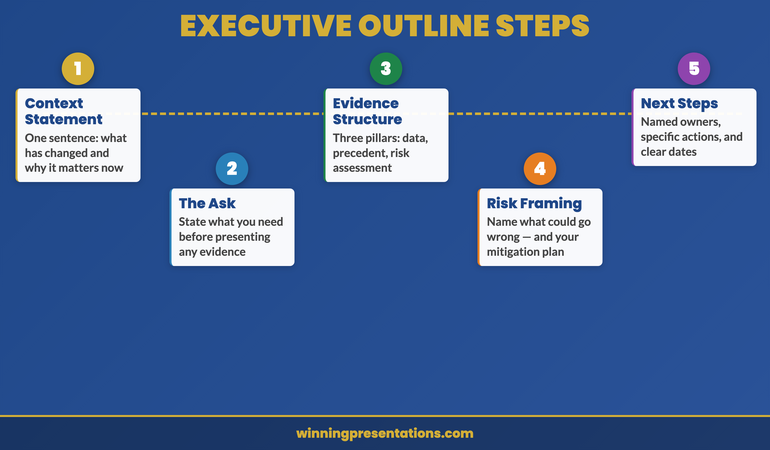

Five-part executive presentation outline diagram showing context, recommendation, evidence, risk framing, and next steps in sequence

The Context Statement: One Sentence That Changes Everything

Most presenters open with background. They explain the history of a project, recap previous decisions, or summarise the market landscape before getting to the point. This approach respects the audience’s knowledge less than it should. Board members and senior leaders do not need a history lesson — they need to know immediately why this presentation is happening today and what it requires from them.

A well-formed context statement is crisp and specific. Compare these two openings:

Weak: “As you will know, our operations in the northern region have been under review for the past eighteen months following the restructure in 2024. Today I want to take you through where we have landed.”

Strong: “The northern region restructure closes on 30 April. This presentation outlines the three decisions that need board approval before that date.”

The second version creates a decision frame immediately. It tells the audience what kind of meeting this is — a decision meeting, not a status update — and it makes the deadline explicit. Every executive in the room now knows what is expected of them before the second slide appears.

When writing your context statement during the outlining phase, ask yourself two questions: What is the specific business pressure creating urgency? And what kind of response do I need from this audience? Your answers should shape a single, declarative sentence that opens your deck. For context on how the executive summary slide fits into this structure, see this guide on the executive summary slide.

Building Your Evidence Structure Around the Decision

The evidence section is where most presentations either earn or lose their credibility. The instinct — particularly for analytically trained leaders — is to present all the data and let the audience draw their own conclusions. This approach hands control of the narrative to whoever in the room is most inclined to challenge you.

An effective evidence structure is built backwards from the recommendation. Start with what you are recommending, then ask: what are the three most compelling reasons a rational, sceptical senior executive should agree with this? Those three reasons become your evidence pillars. Each pillar should be expressible as a single, declarative sentence before you attach any data or analysis to it.

In practice, this means your outline for the evidence section looks like this before you open a single data file:

Evidence 1: The financial case — [one sentence stating the financial rationale]
Evidence 2: The strategic fit — [one sentence connecting to existing priorities]
Evidence 3: The timing imperative — [one sentence explaining why now and not later]

Each of these then becomes a section of your deck, with supporting data underneath. The discipline is in the ordering: you state the point first, then support it — not the other way around. This is the pyramid principle applied to outline architecture, and it is the difference between a deck that reads as a confident recommendation and one that reads as a hesitant data dump.

The Executive Slide System gives you pre-built outline frameworks for the executive presentations most likely to need structural clarity — including capital requests, strategic reviews, and board sign-offs where the evidence structure is the difference between a yes and a deferral.

Risk Framing: The Section Most Executives Leave Out

Omitting the risk section from your presentation outline is one of the most common — and most costly — errors in high-stakes communication. The instinct behind the omission is understandable: you are trying to build confidence in your recommendation, and explicitly surfacing risks feels counterproductive. But senior decision-makers operate differently. They are looking for evidence of judgement, not just advocacy.

A well-structured risk section demonstrates three things simultaneously: that you understand the complexity of the decision you are asking for; that you have done the work to anticipate objections; and that you are a trustworthy steward of the organisation’s resources. These three signals matter as much as the financial case.

In your outline, plan for two to three specific risks — not generic disclaimer language. Vague risk acknowledgements (“there are of course some uncertainties we will monitor”) read as evasion. Specific ones (“the primary execution risk is integration timeline, which we have addressed by bringing the programme manager’s start date forward by six weeks”) read as competence.

For each risk in your outline, draft three elements: the risk itself, your mitigation, and the residual exposure after mitigation. This three-part format prevents the risk section from feeling like a panic list. It shows that you have thought past identification to management. When a board member raises a risk you have already addressed, the credibility gain is significant. When they raise one you have not, your mitigation instinct has to work much harder.

If you are presenting to an audience that may be hostile to your recommendation, the risk framing section becomes even more important. See this article on presentation structure for hostile audiences for specific techniques when the room is divided.
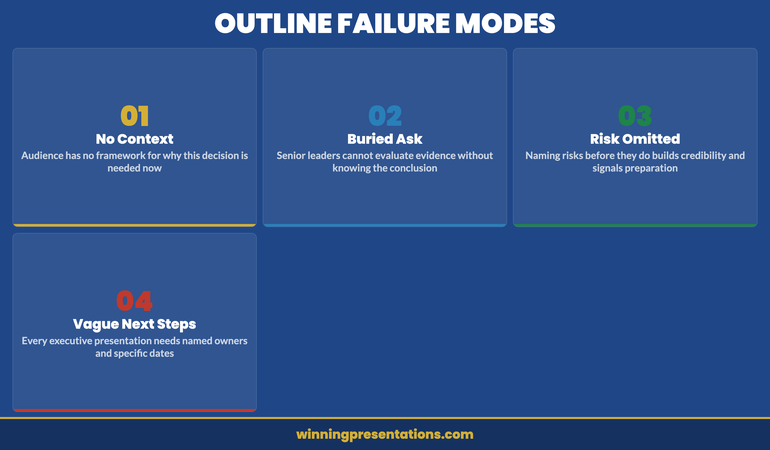

Executive presentation outline risk framing section showing risk, mitigation, and residual exposure structure

Executive Slide System — £39, instant access

Stop Starting From Scratch. Build Faster With the Right Templates.

The Executive Slide System includes outline templates specifically structured for the moments where clarity matters most — board approvals, capital allocation, strategic pivots, and operational reviews. Each template is pre-loaded with the five-part framework so you start every deck in the right place.

Get the Executive Slide System →

Testing Your Outline Before You Build

The outline is a testable document — and testing it before opening PowerPoint is where the real time saving happens. A five-minute outline review at the planning stage is worth sixty minutes of deck revision at the delivery stage. There are three tests worth running on every outline before you commit to building.

The “so what” test. Read your recommendation aloud to someone outside your immediate team — a trusted colleague, a coach, a peer from another division. If their immediate response is “so what?” or “what are you asking me to do?”, your recommendation is not specific enough. A good recommendation names an action, an amount, and a timeline. “I am recommending we proceed” is not a recommendation. “I am recommending board approval of £2.4m for Phase 2, with a go-live target of Q3 2026” is.

The coverage test. Does your evidence section cover financial, strategic, and operational dimensions — or is it heavily weighted towards one category? A purely financial case is vulnerable to strategic objections. A purely strategic case is vulnerable to financial ones. The most resilient outlines have evidence that addresses multiple decision-making lenses so that different stakeholders in the room find their priorities served by at least one pillar.

The one-minute summary test. Can you summarise your entire outline — context, recommendation, three evidence points, primary risk, and next step — in under sixty seconds, out loud, without notes? This is not a presentation rehearsal. It is a clarity check. If you cannot summarise the outline in a minute, the deck will not land cleanly in thirty. Conduct this test before you build a single slide. The clarity you develop in this sixty-second exercise will shape every content decision that follows.

If your presentation is heading to a board or a senior governance committee, the testing phase also needs to include a stakeholder mapping review. Who in the room will champion the recommendation? Who will probe hardest? Where does the power to say yes actually sit? These political considerations belong in the outline phase — not discovered mid-delivery. For board-specific structural guidance, see this article on board agenda presentations.

The outline is not a planning formality. It is the most important document you will produce in the presentation process — and it is the one most leaders skip. The leaders who do not skip it are the ones whose decks consistently drive decisions rather than deferring them.

Need the outline templates rather than building from scratch? The Executive Slide System (£39, instant access) ships with the five-part outline pre-loaded across 26 slide templates, 93 AI prompt cards, and 16 scenario playbooks — including capital requests, board sign-offs, and strategic pivots.

Frequently Asked Questions

How long should an executive presentation outline be?

An effective executive presentation outline should fit on a single page — typically five to eight bullet points covering context, recommendation, three evidence pillars, risk, and next steps. It is a planning document, not a content document. If your outline runs to multiple pages before you have built any slides, you are writing the presentation twice. The outline exists to establish the logic and sequence of your argument; detailed supporting content belongs in the deck itself, not the planning document.

Should the recommendation come at the start or end of an executive presentation?

For executive audiences, the recommendation comes at the start — specifically, as the second element after your context statement. This is the direct opposite of the narrative build used in consumer or public-facing communication. Senior decision-makers are time-pressured, context-rich, and scepticism-prone. They evaluate your evidence more effectively when they know what they are being asked to approve. Burying the recommendation at slide fifteen signals that you are not confident in your ask, or that you are hoping to build enough momentum to make the recommendation impossible to refuse — both of which undermine trust.

How do you outline a presentation when you don’t know the outcome yet?

When the recommendation is genuinely uncertain — exploratory briefings, scenario planning sessions, or strategic option reviews — the five-part structure adapts rather than breaks. Replace the recommendation slot with a “decision frame”: a clear statement of what options you are asking the audience to consider and what criteria they should use to evaluate them. Your evidence section then presents the case for each option rather than a single path. The risk and next steps sections remain the same. This approach maintains the structural clarity of the framework while respecting the genuinely open nature of the decision.

Ready for the deeper buy-in framework?

The Executive Buy-In Presentation System

A self-paced programme on Maven covering the structure, psychology, and stakeholder analysis behind senior approvals. 7 modules with optional recorded Q&A sessions — no deadlines, no mandatory attendance. £499, lifetime access to materials.

Explore the programme →

Get more executive communication strategies every Thursday. The Winning Edge is a weekly newsletter for senior leaders who want sharper presentations, stronger boardroom presence, and clearer communication under pressure.

Subscribe to The Winning Edge →

Free resource: The Executive Presentation Checklist — a one-page reference covering the key structural and delivery checks before any high-stakes presentation. Download it and use it before your next board or leadership team meeting.

Download the Free Checklist →

About the Author

Mary Beth Hazeldine

With 25 years of corporate banking experience at JPMorgan Chase, PwC, Royal Bank of Scotland, and Commerzbank, Mary Beth Hazeldine has spent 16 years coaching senior leaders to communicate with the clarity and authority their roles demand. She works with executives who need to perform under pressure — in board rooms, investor meetings, and high-stakes leadership settings where the quality of the presentation determines the outcome.

15 Apr 2026
Female executive presenting to a sceptical boardroom, confident composed expression, navy boardroom setting

Presentation Structure for Hostile Audiences: The Framework That Turns Resistance Into Approval

Quick answer: A hostile audience presentation requires a fundamentally different sequence from a standard executive deck. Begin with shared ground rather than your proposal, build your evidence in layers that preempt known objections, and position your decision request only after the room has had room to shift. The structure is not about softening your message — it is about sequencing it so resistance has less to attach to.

Valentina had been in the boardroom before with a restructuring proposal. Eighteen months earlier, she had stood at the same table, presented what she believed was a compelling case, and watched the chairman shut it down inside seven minutes. The board had concerns about headcount, about timing, about what the proposal signalled to the market. She had answered each objection as it came. It made no difference.

When the same restructuring need resurfaced — more urgently this time — Valentina knew she could not walk in with the same structure. The board had not forgotten what they had already rejected. Two members had actively lobbied against it in the months since. She was not presenting to a neutral room. She was presenting to a room that had already made up its mind.

She rebuilt the deck from scratch. Instead of opening with the proposal, she opened with what the board had said they needed twelve months ago — their language, their stated priorities, their own risk appetite. She structured the evidence around those concerns rather than around her solution. She placed the decision slide at the back. The board approved it. One member said it felt like a completely different proposal. The fundamentals had not changed. The structure had.

If you are building a deck for a room that is already resistant, the Executive Slide System gives you slide templates and scenario playbooks for exactly these situations.

Explore the System →

Why Conventional Presentation Structure Fails With Hostile Audiences

Most executive presentations follow a logic that assumes a receptive room: open with the headline, build the case, address questions at the end. That sequence works well when your audience is broadly aligned with what you are there to say. It fails badly when they are not.

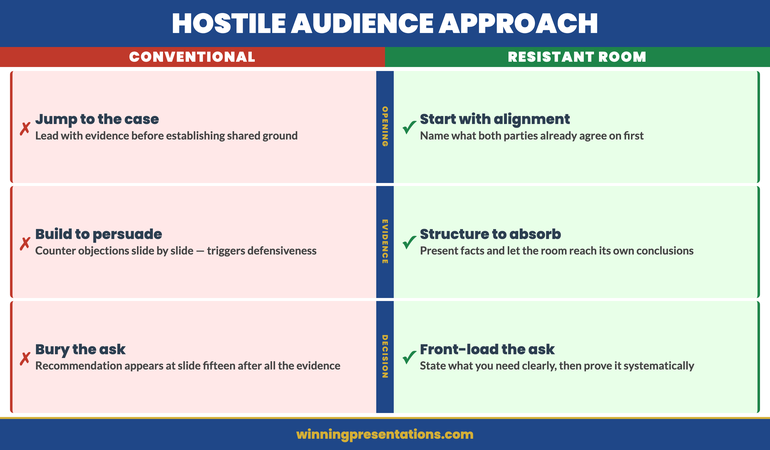
The problem is cognitive, not just interpersonal. When a senior audience has pre-existing reservations — about your proposal, your track record, or the last time this idea was raised — they do not process your opening headline neutrally. They process it through the filter of what they already believe. A strong opening statement that leads with your conclusion gives a hostile room an immediate target. The resistance organises itself around your first slide.

Conventional structure also tends to front-load what you want rather than what the audience cares about. For receptive rooms, this signals confidence. For resistant ones, it signals that you have not listened to their previous concerns. The moment a board member thinks “we have already been through this,” the rest of your presentation is uphill.

A hostile audience presentation also tends to surface objections early, which means you spend the session defending rather than persuading. Conventional decks rarely account for where objections will land — they address questions only in the Q&A, by which point the room has already formed its view. Restructuring your deck means thinking about when resistance is most likely to surface and neutralising it before it arrives, not after.

This is not a problem you can solve with better slides. It is a sequencing problem. The content may be strong. The order in which it reaches the room determines whether it is heard.

Executive Slide System — £39, instant access

Build Decks That Senior Decision-Makers Approve — Even When They Walk In Sceptical

The Executive Slide System is a practical toolkit for executives who present to boards, investors, and senior leadership teams. It contains professionally structured slide templates built around real executive scenarios — not generic business slides — alongside AI prompt cards to help you draft and refine your narrative, and scenario playbooks for high-resistance rooms.

  • Slide templates for board approvals, restructuring proposals, and funding presentations
  • AI prompt cards to structure your argument and anticipate objections
  • Framework guides for sequencing evidence in resistant rooms
  • Scenario playbooks for hostile and sceptical senior audiences

Get the Executive Slide System →

Designed for leaders who present to boards, investors, and senior leadership teams.

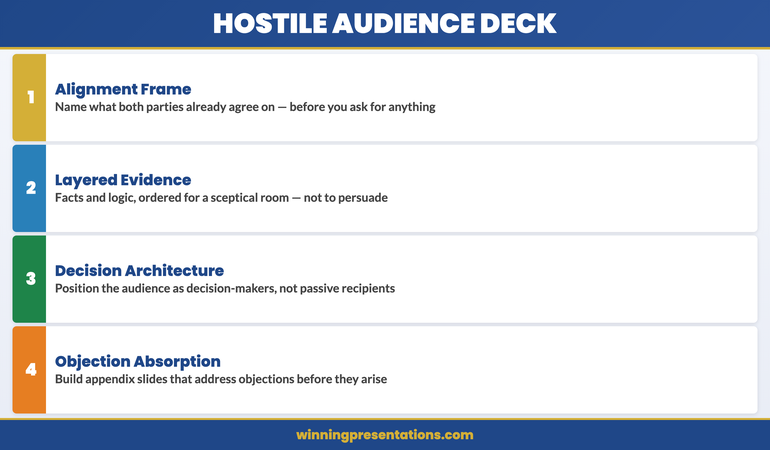
The Alignment Frame: What You Share Before What You Want

The single most effective structural shift for a resistant room is delaying your proposal and opening instead with alignment. This is not about softening your position — it is about establishing shared ground before you introduce anything contested.

An alignment frame works by surfacing the priorities, concerns, and stated objectives that your audience has already expressed. You are not inventing a shared starting point — you are reflecting their own language back to them. If the board said in the last meeting that they need to see cost containment before any structural changes, your opening slide acknowledges that priority directly. If a committee rejected a similar proposal on governance grounds, your opening addresses governance before you address anything else.

The practical structure looks like this: slide one establishes what the audience has told you they care about most. Slide two confirms what has and has not changed since the last relevant discussion. Slide three outlines the problem you are addressing, framed in terms of their priorities — not yours. Only then do you move toward your proposal.

This sequence does two things. It signals that you have listened, which reduces the defensive posture that hostile rooms adopt when they expect to be steamrolled. And it narrows the distance between where they are and where you need them to go before you make a single ask. By the time your proposal appears, the room has already spent several minutes thinking in alignment with you rather than in opposition to you.

For executives working on strategy presentations that require buy-in from resistant leadership teams, this alignment-first sequence applies equally — the principle holds whether you are presenting to a board, an investment committee, or a senior leadership group that has publicly doubted the direction.


Diagram showing the alignment-first presentation sequence for hostile audiences: shared ground, context, problem, evidence, proposal, decision

Structuring Evidence for a Sceptical Room

Evidence sequencing in a hostile audience presentation is not the same as evidence sequencing in a neutral one. In a neutral room, you build from general context to specific proof. In a resistant room, you need to think about which objections exist, what evidence directly counters each one, and what order allows the evidence to land before the objection has been voiced.

The starting point is a simple exercise: before you open a slide deck, write down the three most predictable objections from this specific audience. These are not hypothetical — they are based on what the room has said previously, what you know about individual members’ priorities, and what the political landscape looks like. Once you have those objections listed, you can work backwards into your evidence structure.

Each major evidence section should address one of those objections — before it is raised. The goal is not to pre-emptively defend yourself, which reads as anxious. The goal is to demonstrate that you have already considered what the audience is about to say, and that your evidence accounts for it. When done well, this approach often means that objections are not raised at all, because the room can see they have been addressed.

Layering also matters. Present your strongest evidence early within each section, not at the end. Resistant audiences are less patient with build-up than receptive ones — they want to know whether you have a point before they invest attention in how you are making it. A headline finding followed by supporting data is more effective than a data walkthrough that arrives at a headline on the final bullet.

Keep your evidence slides clean and literal. Sceptical audiences look for gaps in reasoning and will scrutinise anything ambiguous. Complex visualisations, indirect language, or data presented without a clear interpretive label give hostile rooms something to challenge that is separate from your actual proposal. Remove that friction by being explicit: state what the data shows, what it means, and why it matters — in that order, on every evidence slide.

For executives building decks for resistant or sceptical senior audiences, the Executive Slide System provides scenario-specific frameworks for exactly this type of presentation.

Where to Place the Decision in Your Deck

One of the most common structural errors in a hostile audience presentation is placing the decision slide too early. In a standard executive deck, many presenters open with a clear ask — this is good practice for a receptive room, where leading with the conclusion saves time and signals clarity. For a resistant room, it is the wrong move.

When a hostile audience sees your decision request on slide two, they spend the rest of the presentation looking for reasons to say no. The ask has been made, their resistance has been activated, and every subsequent slide is processed through the lens of “why I should reject this.” You have effectively handed the room a target before you have given them any reason to shift.

In a resistant room, the decision slide belongs near the end — after the alignment frame, after the evidence layers, and after you have addressed the known objections. This does not mean you are being evasive. You can signal early in the presentation that a decision will be requested: “By the end of this session, I will be asking for board approval on one of three options.” That signals intent without triggering resistance before you are ready.

When the decision slide does arrive, it should present options rather than a binary yes/no. Hostile audiences often resist a single recommendation because it removes their agency. Offering three options — one of which is clearly your preferred path — gives the room the feeling of choice, which reduces resistance to the act of deciding, even when the preferred option is the one selected.

This approach is particularly relevant when presenting competitive or contentious strategies. Presentations where client resistance or competitive pressure is already present benefit from the same delayed-decision sequencing — the audience needs to feel they have moved with you before they are asked to commit.


Visual showing the decision slide positioned near the end of a hostile audience presentation structure, following alignment frame and layered evidence sections

Managing Objections Without Defensive Slides

Many executives respond to the challenge of a hostile room by adding more slides — a risks section, a counter-arguments slide, a “we hear your concerns” summary. This instinct is understandable, but these slides almost always backfire. They signal anxiety, they invite scrutiny of the objections themselves, and they slow the narrative at exactly the moment you need momentum.

The more effective approach is to address objections inside your substantive slides rather than in dedicated counter-argument sections. If cost is a known concern, your financial modelling slide addresses it directly — not by flagging it as a concern, but by showing that your numbers account for it. If governance is the issue, your implementation timeline includes governance milestones, not because you are managing the objection, but because the proposal genuinely addresses it.

This embedded approach requires preparation. You need to know what the objections are before you build the deck, not after you finish it. The most common failure pattern is executives who build the full deck first and then try to add objection handling at the end. That produces defensive slides because the content is genuinely defensive — it is been added as an afterthought rather than integrated into the logic.

For live Q&A, the structural principle carries forward. Practising how to handle the most predictable hostile questions without becoming defensive is a separate skill from building the deck, but it works in tandem with the structure you have created. Preparing for hostile Q&A through structured simulation is one of the most reliable ways to enter a resistant room with composure rather than defensiveness — and the structure of your deck makes that composure easier to sustain, because you have already addressed most of what the room is likely to raise.

One practical addition: a pre-read. For particularly hostile rooms, circulating a one-page summary of your proposal — framed around their stated priorities — before the meeting can allow initial resistance to surface in writing rather than in the room. Board members who have already asked their sharpest questions in email tend to be less combative in session, because the most charged moments have already passed.

Executive Slide System — £39, instant access

Build Your Deck in Less Time — With Frameworks That Already Account for Resistance

If you are under time pressure and presenting to a difficult room, the Executive Slide System removes the guesswork. Ready-built scenario playbooks mean you are not starting from a blank deck — you are adapting a structure that has already been designed for resistant senior audiences. Get to a solid draft faster, and spend your preparation time on rehearsal rather than architecture.

Get the Executive Slide System →

The Visual Language of a Hostile Audience Presentation

The visual choices in a resistant-room deck are not decorative — they affect how authority is read and how easily the audience can find things to challenge. A deck that looks informal, cluttered, or inconsistent gives a hostile room a low-stakes place to direct its energy. A deck that is visually clear and structurally deliberate signals that the work behind it is similarly rigorous.

Slide titles matter more than most presenters realise. In a resistant room, titles are often the first thing read — and the last thing remembered. Titles that make assertions (“Cost savings exceed initial modelling”) are more useful than titles that describe (“Financial overview”). An assertive title makes your evidence interpretive before anyone has had a chance to reframe it.

Data visualisation should be conservative. Resistant audiences tend to scrutinise data more closely than receptive ones, and they will look for inconsistencies in your charts, your axes, your source notes. This is not a reason to limit your data — it is a reason to present it with care. Use standard chart types rather than novel ones. Label everything explicitly. Cite your sources on the slide rather than in a footnote.

Colour and density also signal intent. A deck with too many slides, too much text per slide, or too many colour variations reads as unedited — and hostile audiences interpret that as a lack of rigour. For a resistant room, aim for fewer slides with more deliberate content. Each slide should have one clear point. If a slide is trying to do three things, it is trying to do too much.

Finally, your cover slide and your appendix are structural tools, not afterthoughts. A clearly labelled appendix signals that you have done more work than fits in the main deck — which is reassuring in a room that will want to dig. And a clean cover slide that includes the date, the presenting executive’s name, and a subtitle that frames the purpose of the session signals that this is a formal, considered piece of work — not a reactive one.

The visual language of your deck contributes to how seriously the room takes your argument before you have spoken a word. In a hostile audience presentation, that first impression — formed before slide two — is not something you can afford to leave to chance. For more detail on how deck structure and outline choices interact, the executive presentation outline framework covers the sequencing decisions that underpin every element described in this article.

Frequently Asked Questions

What makes a hostile audience different from a sceptical one?

A sceptical audience is unconvinced — they need evidence and a clear rationale before they will agree. A hostile audience has already formed a negative view, often based on prior experience, political positioning, or a direct conflict of interest with what you are proposing. Scepticism is a starting position that evidence can shift; hostility involves active resistance that structural and interpersonal strategy must address before evidence can land. The structural response to each is different. Sceptical rooms need stronger evidence sequencing. Hostile rooms need an alignment frame first, then evidence, then the decision ask — in that order.

Should you acknowledge the resistance directly in your presentation?

In most cases, acknowledging prior concerns is more effective than ignoring them — but the framing matters significantly. Referencing what the board or committee raised previously (“I know the timeline was a concern in our last discussion”) signals that you have listened and adapted. This is different from framing your entire opening around defensiveness or apology. You are acknowledging the prior conversation, not conceding the argument. Naming the resistance briefly and constructively — then moving forward — tends to reduce the temperature in the room rather than raise it. What you want to avoid is excessive hedging or a structure that signals you expect to lose.

How long should a hostile audience presentation be?

Shorter than you think. Resistant audiences lose patience faster than receptive ones, and a longer deck gives them more opportunity to interrupt, challenge, or redirect. Aim for a main deck of no more than twelve to fifteen slides, with a well-stocked appendix available if questions require deeper evidence. A focused, tight deck signals that you have done the editorial work — you know what matters most and you have not buried it. The appendix handles the detail without slowing your central argument. If you cannot make your case in fifteen slides for a senior board, the structure is not yet clear enough, and adding slides will not solve that.

The Winning Edge — Weekly Newsletter

Practical Executive Presentation Advice, Every Thursday

Each week, The Winning Edge delivers one focused insight on executive communication — structure, delivery, influence, and the mechanics of getting senior audiences to yes. Straightforward, applicable, and written for people who present under pressure.

Subscribe to The Winning Edge →

Free download: The Executive Presentation Checklist — a structured pre-presentation review covering structure, evidence sequencing, and delivery preparation.

About the Author

Mary Beth Hazeldine — Owner & Managing Director, Winning Presentations

With 25 years of corporate banking experience at JPMorgan Chase, PwC, Royal Bank of Scotland, and Commerzbank, she advises executives across financial services, healthcare, technology, and government on structuring presentations for high-stakes funding rounds and approvals.

14 Apr 2026
Senior executive responding confidently to a challenging question in a boardroom

Handle Tough Questions in Presentations: Training System

Quick answer: The Executive Q&A Handling System (QAHS) is a structured training resource for senior professionals who need to handle tough, hostile, or politically loaded questions in high-stakes presentations. Unlike improvisation training, QAHS is built on the insight that most difficult questions follow predictable patterns — which means you can prepare for them systematically rather than hoping to think quickly under pressure. The system covers question type identification, response frameworks for each major category of challenge, and techniques for buying thinking time without losing authority. It is available for £39 with instant access. This page explains exactly what it covers and whether it is the right fit for your situation.

The Problem: Most Executives Improvise When They Could Prepare

Tough questions in presentations feel like they come from nowhere. A board member pivots from the agenda to a question about a decision made two years ago. An investor asks you to defend an assumption buried on slide fourteen. A committee chair reframes your proposal in a way that implies it is riskier than you have presented it. In the moment, these feel like ambushes. They do not have to.

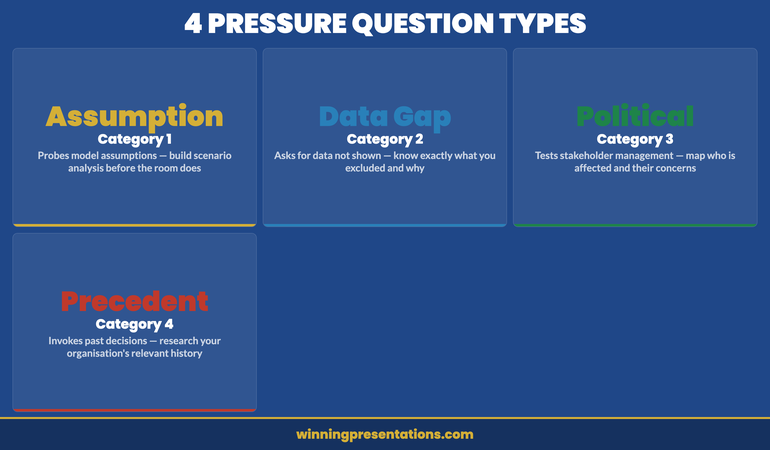
The reason difficult Q&A feels unpredictable is that most senior professionals have never been taught a framework for categorising it. Once you understand that executive-level tough questions fall into a small number of recurring types — fishing questions, loaded questions, hypothetical questions, binary-choice questions, precedent questions — you can prepare for each category specifically. You stop rehearsing your presentation and start anticipating your Q&A.

The consequences of poor Q&A handling at board level are significant. A well-constructed presentation can be undermined in the Q&A session by a single clumsy response. An executive who handles challenge poorly signals uncertainty about their own case — regardless of the quality of their analysis. Decision-makers who were inclined to approve a proposal begin to hedge when the presenter cannot respond to a straightforward challenge without stumbling.

The fix is not to become a better improviser. It is to prepare more systematically — and the Executive Q&A Handling System provides the method for doing exactly that.

The Solution: A System for Predicting and Handling Executive Q&A

The Executive Q&A Handling System is not a collection of clever phrases or a set of deflection techniques. It is a structured method for understanding what types of tough questions you are likely to face, why questioners ask them, and how to respond in a way that is both honest and authoritative.

The system is built on a simple premise: most executive-level challenge questions are not random. They reflect specific concerns — about risk, about process, about precedent, about political positioning — and those concerns are largely predictable given what you know about your audience, your proposal, and the context of the meeting. If you can map those concerns in advance, you can prepare responses that address them directly rather than scrambling in real time.

The QAHS covers four major question types that appear consistently in board, committee, and investor Q&A sessions:

  • Fishing questions — designed to find out what you have not said, rather than to challenge what you have
  • Loaded questions — containing an embedded assumption or framing that, if you accept it, weakens your position
  • Hypothetical questions — asking you to defend scenarios that may never occur, often used to stress-test your confidence in your own case
  • Binary-choice questions — presenting a false either/or that constrains your answer if you do not recognise the framing

For each type, the system provides a response framework — a structured approach that allows you to answer confidently without being led into ground you have not prepared. The frameworks are designed to feel natural rather than formulaic: the goal is not to sound rehearsed but to respond with the authority that preparation provides.

The system also covers Q&A session management: how to open the Q&A in a way that sets the right tone, how to handle the dynamic when multiple questioners are pushing simultaneously, and how to close the Q&A session without losing the room’s sense of momentum towards a decision.

What You Get

  • A question-type identification system — so you can categorise the questions you are likely to face before you walk into the room, not after you have been caught off guard
  • Response frameworks for each major question category — structured approaches that give you a clear path through fishing, loaded, hypothetical, and binary-choice challenges
  • Techniques for buying thinking time without losing authority — specific language and approaches for creating space to think when a question catches you off guard, without signalling uncertainty
  • A method for handling hostile or politically motivated questions — including how to recognise when a question is about positioning rather than genuine inquiry, and how to respond in a way that does not inflame the dynamic
  • Q&A session structure guidance — how to open, manage, and close the Q&A session itself, not just how to handle individual questions

Price: £39 — instant access, no subscription.

Go Into Your Next Presentation Knowing Exactly How to Handle Whatever the Room Throws at You

The Executive Q&A Handling System gives you the frameworks to anticipate, categorise, and respond to the tough questions that derail executive presentations — for £39, instant access.

Get the Executive Q&A Handling System → £39

Instant access. Designed for directors and senior leaders in complex stakeholder environments.

Is This Right For You?

This system is designed for: senior professionals — directors, heads of function, senior managers — who present regularly in complex stakeholder environments where the Q&A carries real consequences. If you present to boards, investment committees, regulatory bodies, or senior leadership teams, and the questions you face are often politically charged, technically demanding, or strategically loaded, this system was built for that context.

It is also well suited to senior professionals preparing for a specific high-stakes presentation — a funding round, a restructuring proposal, a board strategy review — where the Q&A is as consequential as the presentation itself.

This system is not designed for: people who are new to presenting and who need foundational skills — structure, slide design, delivery basics. The QAHS assumes you are already a competent presenter and focuses specifically on the Q&A dimension. It also assumes your presentation environment is one where questioners may have interests that do not align with yours — it is not optimised for low-stakes internal meetings where questions are largely supportive.

If you are also looking to strengthen the structural architecture of the presentation that precedes the Q&A, the guide to pressure-testing your presentation Q&A before the meeting covers the preparation process in more detail.

Frequently Asked Questions

What types of tough questions does this cover?

The system covers the four question types that appear most consistently in executive-level Q&A: fishing questions (designed to surface what you have not said), loaded questions (with embedded assumptions that constrain your response), hypothetical questions (used to stress-test your confidence in your case), and binary-choice questions (false either/or framings). It also covers politically motivated questions — where the questioner’s goal is positioning rather than genuine inquiry — and the specific challenge of handling hostile challenge in a group setting without inflaming the dynamic.

How is this different from improvisation training?

Improvisation training builds your capacity to think quickly in novel situations. The QAHS is built on a different premise: that most executive-level tough questions are not novel — they follow predictable patterns that you can anticipate before the meeting. The system gives you a preparation method rather than a performance technique. This distinction matters because improvisation under pressure is a difficult skill to develop, while systematic preparation is something you can do the day before any presentation.

Can I use this for investor presentations?

Yes. Investor Q&A sessions are one of the contexts the system is well-suited to. Investors frequently use fishing questions to probe for risks you have not disclosed, loaded questions to test whether you are realistic about downside scenarios, and hypothetical questions to stress-test your financial assumptions. The frameworks in the QAHS apply directly to these patterns. The system does not cover the specific content of financial modelling or investment memoranda — it focuses on the Q&A dynamic itself, which is where investor presentations often succeed or fail independently of the quality of the underlying analysis.

How long does it take to work through the system?

The system is structured so that you can work through the core frameworks in a focused session of two to three hours. Most users then return to specific sections when preparing for a particular presentation — spending thirty to forty-five minutes mapping the question types they are likely to face and preparing responses using the relevant frameworks. It is designed to be used repeatedly, not worked through once and set aside.

Does this work if questioners are politically motivated?

Yes — and politically motivated questions are one of the hardest categories to handle well without a framework. The system includes specific guidance on recognising when a question is motivated by positioning rather than genuine inquiry, and on responding in a way that is direct and composed without escalating the tension. A key principle: politically motivated questioners want to provoke a defensive response. The system helps you identify the pattern early enough to avoid giving them one.

The Winning Edge

Weekly insights on executive presentations, Q&A strategy, and high-stakes communication for senior professionals.

Subscribe Free

About the author

Mary Beth Hazeldine, Owner & Managing Director, Winning Presentations. With 25 years of corporate banking experience at JPMorgan Chase, PwC, Royal Bank of Scotland, and Commerzbank, she has spent 16 years training senior professionals to handle board-level presentations and Q&A with clarity and authority.

14 Apr 2026

Repeated Questions in Presentations: How to Respond Without Losing Patience

Quick Answer
When the same question is asked twice in a presentation, it is not a sign of failure — it is information. Repeated questions signal one of three things: your first answer was not clear enough, the questioner is stress-testing your consistency, or this topic is their highest priority and they need more than your initial response gave them. The right approach is a four-step framework: acknowledge the repeat directly, diagnose which of the three signals applies, respond with a different angle rather than the same words, and check for comprehension explicitly. Losing patience — or repeating your original answer verbatim — converts a manageable question into a credibility problem.

Priya had answered the ROI question at the 20-minute mark. She had used a clear structure: the investment figure, the projected return, the payback period, and the confidence interval on the forecast. It was one of the cleaner answers she had given in an executive presentation. Then, twelve minutes later, a senior director on the committee asked it again. Not a follow-up — the same question, almost word for word.

Her instinct was to feel frustrated. She had already answered. She had answered clearly. She looked briefly at her CFO sponsor, who gave nothing back. Then she made a decision that she later described as the moment the presentation turned: she paused, acknowledged the repeat without defensiveness, and responded with an entirely different angle — not the numbers, but the strategic logic behind the numbers, and why that logic held even under the pessimistic scenario. The director nodded. “That’s what I needed,” she said. “Thank you.”

Priya told me afterwards that she had almost said, “As I mentioned earlier…” — the phrase that every senior presenter knows is dangerous, and that she had used in a previous presentation with visibly damaging results. Catching it before it came out was, she said, the most important in-the-moment decision she made that afternoon.

If Q&A is consistently a weak point in your executive presentations — whether from repeated questions, hostile questioners, or questions you haven’t anticipated — the Executive Q&A Handling System gives you a complete framework for predicting, preparing for, and responding to the questions that derail most presentations.

Explore the System →

Why Questions Get Asked Twice

Understanding why a question is being repeated is the diagnostic work that determines the right response. There are three primary drivers, and they require different treatment.

The clarity gap. Your first answer did not fully resolve the questioner’s concern, even if it addressed the literal question they asked. This is the most common driver of repeated questions. It does not mean your answer was wrong — it means there was a gap between what you understood the question to be asking and what the questioner was actually trying to resolve. The question they asked was a proxy for the concern they had; your answer addressed the proxy, not the underlying concern.

The consistency test. Some senior executives deliberately ask the same question twice — sometimes in the same meeting, sometimes framed slightly differently — to test whether your answer holds. This is especially common in high-stakes financial presentations, board settings, and investor Q&A. The questioner has no specific gap to fill; they are checking whether your first answer was a reliable position or a situational response that might shift under pressure. If you answer differently the second time without acknowledging why, you fail the test. If you acknowledge the repeat, confirm your original position, and add a further dimension of reasoning, you pass it.

The priority signal. Repeated questions sometimes indicate that this topic is the questioner’s primary concern — more significant to them than your presentation structure may have reflected. In this case, the repetition is not a critique of your clarity or a test of your consistency; it is the questioner communicating, without saying so directly, that they need this topic to receive more weight and depth than your initial answer provided. The appropriate response is to recognise this and give the topic the space it is asking for.

Diagnosing which driver applies requires reading the room, the questioner’s tone, and the degree to which your initial answer appeared to land. It is not always clear-cut. When in doubt, treat the repeat as a clarity gap — the response to a clarity gap is never damaging, and it addresses all three possible drivers simultaneously.

Four-step framework for responding to repeated questions in presentations: acknowledge, diagnose, respond with new angle, check comprehension

The Wrong Responses and What They Signal

Three responses to repeated questions are consistently damaging to executive credibility, and they are all understandable — which is exactly why they need to be explicitly avoided.

“As I mentioned earlier…” This phrase — and its close relatives, “I covered this in the third slide” or “I already addressed that point” — signals impatience and places the responsibility for the gap on the questioner rather than on the presenter. Even when the questioner did not listen carefully to your first answer, making this visible in a group setting damages the relationship and creates social tension in the room. Other attendees notice. The questioner notices. The response to a repeated question should never, under any circumstances, include a reference to having already answered it — even when it is factually true.

Repeating your original answer verbatim. If your first answer did not resolve the question, repeating it identically cannot resolve it either. The information content is the same; only the volume may change. Verbatim repetition signals that you do not have additional depth on the topic — which is a vulnerability in an executive Q&A setting — or that you have not listened to the fact that your first answer missed what the questioner needed. Either reading reduces confidence in the presenter.

Visible impatience. A pause that runs slightly too long, a tone shift, a glance toward the CFO sponsor, or a subtle change in facial expression are all readable by senior audiences. Executives at board and C-suite level have high social intelligence — it is part of why they are where they are. Any display of impatience when a question is repeated will be noted, will be remembered, and will affect how your credibility is assessed for the remainder of the meeting.

See the related guidance on handling trick questions in presentations — a situation where the same discipline of reading intent before responding is equally critical.

Executive Q&A Handling System — £39, instant access

A System for Predicting and Handling Every Question Type in Executive Q&A

The Executive Q&A Handling System gives you a complete framework for classifying question types, predicting the questions most likely to arise in your specific presentation context, and responding with authority regardless of what is asked. Designed for executives who need to handle Q&A with precision — not improvise under pressure.

  • System for predicting and classifying executive Q&A question types
  • Framework for responding to repeated, hostile, and trap questions with consistency
  • Scenario playbooks for board Q&A, investor Q&A, and all-hands settings
  • Preparation guides for the questions most likely to derail high-stakes presentations

Get the Q&A Handling System →

Designed for executives who present to boards, investors, and senior leadership teams.

The Four-Step Response Framework

The framework below applies regardless of which of the three repeat drivers is at play. It works because it acknowledges the repeat without making the questioner feel they should not have asked, offers a genuinely different dimension of response rather than repetition, and closes with a check that ensures the loop is properly closed.

Step 1: Acknowledge the repeat explicitly and without apology. “You’ve raised this again — let me make sure I address what you’re getting at.” This single sentence does several things: it signals that you have noticed the repetition (which shows attentiveness), it takes responsibility for the gap rather than projecting it onto the questioner, and it sets up a different response rather than a repetition. The phrase “let me make sure I address what you’re getting at” is important — it signals that you are going to listen more carefully this time to what the question is actually seeking, not just respond to its surface form.

Step 2: Diagnose the underlying concern in one sentence. “It sounds like the core question is less about the headline return figure and more about the reliability of the assumptions behind it — is that right?” This diagnostic sentence serves two purposes. It demonstrates that you are trying to understand the concern more precisely than the first time. And it gives the questioner the opportunity to confirm or correct your diagnosis before you invest in a response. If they confirm, proceed. If they correct, update and proceed. Either way, you are now responding to the actual concern rather than its surface expression.

Step 3: Respond with a different angle. Never repeat your original answer with different words. Instead, choose a genuinely different entry point: a different level of analysis (from the number to the methodology), a different scenario (from base case to downside), a different stakeholder perspective (from finance to operations), or a different time horizon (from year one to year three). The Executive Q&A Handling System includes specific frameworks for rotating between these angles when a question is repeated — so you always have a different dimension to offer rather than stalling.

Step 4: Close with an explicit comprehension check. “Does that address your concern, or would it be useful to go deeper on a specific element?” This closing question has a specific function: it converts a potentially open-ended loop into a bounded exchange. You are inviting the questioner to confirm closure or specify exactly what additional depth they need. In most cases, they will confirm closure. Occasionally they will specify a narrow follow-up — which is far easier to answer than a vague repeat of the original question.

For more on managing time during Q&A without losing control of the room, see the article on buying time in Q&A — which covers the related challenge of needing a moment to think before answering a question you were not prepared for.

Four reasons why questions get repeated in presentations: clarity gap, consistency test, priority signal, and context reminder

When the Same Question Comes From Multiple People

When more than one person asks the same question in the same session — or when you notice the same question appearing across multiple separate presentation contexts — it is no longer a management challenge. It is a structural signal. Your presentation has a gap in that area, and the gap is large enough that multiple independent observers have identified it.

The appropriate response in the room is to acknowledge the pattern explicitly: “I notice this concern has come up from several people — that tells me I haven’t addressed it as clearly as I should have in the main presentation. Let me spend five minutes on this directly.” This meta-acknowledgement signals self-awareness, takes collective responsibility for the gap, and gives you a legitimate reason to depart from your planned structure and give the topic the depth it evidently needs.

The follow-up action after the meeting is equally important: revise the presentation so that the next version addresses this area proactively, before the Q&A. A question that the room asks is often a question the presentation should have answered. Adding it to a dedicated slide, or restructuring the narrative flow so the topic arrives at a more natural point, eliminates the repeat question before it occurs.

The technique of bridging between a question and the answer that serves your narrative best is also relevant here — see the article on the bridging technique for difficult questions for a method that allows you to acknowledge and redirect in a single smooth response.

Handling Repeats Mid-Presentation

Some presentations invite questions throughout rather than saving them for a formal Q&A section. In these formats, a question that is asked mid-presentation and then raised again before the session closes is particularly challenging — because you have not yet delivered the section of the presentation that may have resolved it, and you cannot easily refer the questioner forward to content they have not yet seen.

The most effective approach for mid-presentation repeats is the “address and flag” method. Provide a concise direct answer to the immediate concern — the diagnostic and response steps from the four-step framework — and then flag that a later section of the presentation will address a related dimension: “I want to address the reliability of the assumptions now, and I’ll come back to the downside scenario specifically in the section on risk parameters, which is about ten minutes from here.” This closes the immediate loop while signalling that depth is coming, which reduces the probability of further repetition.

When you reach the flagged section, acknowledge the earlier question explicitly: “Ingrid, this is the section I mentioned in relation to your question on the assumptions.” This closes the loop that you opened earlier and demonstrates that you have been tracking the conversation as a whole, not just managing each question in isolation. It is a subtle but significant indicator of Q&A competence.

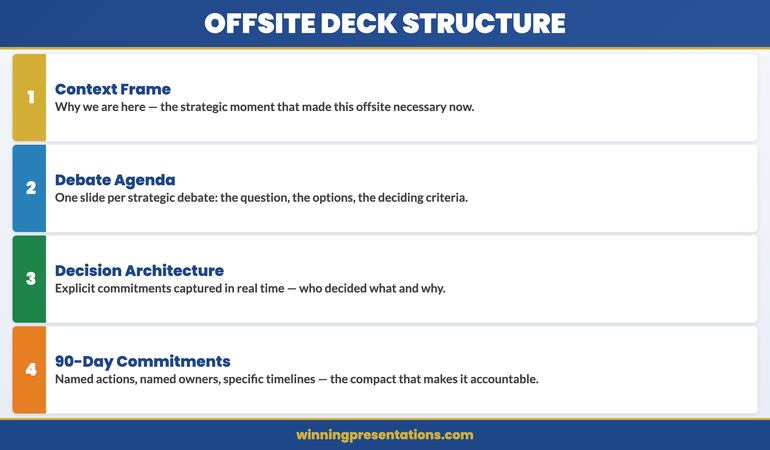
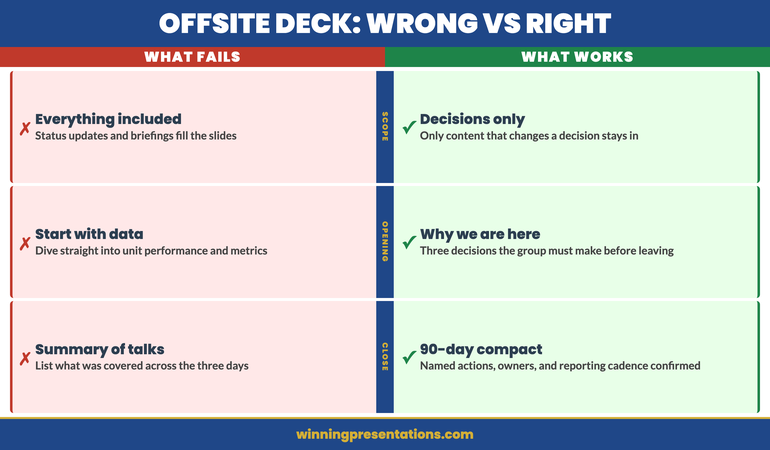
See today’s companion piece on managing confidence before high-stakes presentations — because the emotional discipline required to handle repeated questions calmly is closely linked to the physiological state you arrive in. And see the article on offsite strategy presentations for the broader challenge of managing sustained Q&A across a multi-day format where repeated questions are particularly common.

Executive Q&A Handling System — £39, instant access

Predict, Prepare For, and Handle Every Question Type With Authority

Repeated questions, hostile questions, trick questions, off-topic questions — the Executive Q&A Handling System gives you the framework to classify and respond to every question type that arises in executive Q&A, without improvising under pressure.

Get the Q&A Handling System →

Designed for executives presenting to boards, investors, and senior leadership teams.

Frequently Asked Questions

What if the questioner genuinely was not listening and missed your first answer?

Even when you are certain the questioner was not listening, the four-step framework applies without modification. This is a governance discipline, not a question of fairness. Senior executive audiences are observing how you manage the Q&A as much as they are evaluating the content of your answers. A presenter who handles a repeated question gracefully — even when the repetition is the questioner’s fault — is a presenter who demonstrates professional composure and audience respect. That impression outlasts the specific exchange. The alternative — making the inattention visible — creates a social tension that the room remembers and that affects how your subsequent answers are received.

How many times can you answer the same question before it becomes a problem?

If the same question is asked three or more times in a single session, the dynamic shifts from a Q&A management issue to a structural conversation about the presentation’s gap. At the third repetition, the appropriate response is direct meta-commentary: “We’ve returned to this question several times — I think it reflects something important that the presentation hasn’t fully resolved. Could I ask: what specific dimension of this would give you the confidence you’re looking for?” This moves from answering to diagnosing, which is what the situation requires. It is also a legitimate way to surface the real concern behind the repeated question, which the questioner may not have articulated directly in any of their three attempts.

What if the second answer needs to contradict or qualify the first?

If the second answer requires correcting or qualifying the first, acknowledge this clearly and without hedging: “Having thought about this more carefully, I want to refine what I said earlier. My initial answer addressed the base case — on reflection, I should have added that the confidence interval widens significantly in the downside scenario, and I didn’t make that clear.” An unprompted correction, delivered directly, preserves significantly more credibility than an inconsistency that the questioner has to draw out of you. Executives respect intellectual honesty. They do not respect evasion. Volunteering a refinement signals analytical rigour; being caught in an inconsistency signals the opposite.

Subscribe to The Winning Edge — Mary Beth’s weekly briefing for executives on Q&A strategy, presentation structure, and high-stakes communication.

Subscribe to The Winning Edge →

About the Author

Mary Beth Hazeldine is Owner & Managing Director of Winning Presentations. With 25 years of corporate banking experience at JPMorgan Chase, PwC, Royal Bank of Scotland, and Commerzbank, she advises executives across financial services, healthcare, technology, and government on Q&A strategy, presentation structure, and high-stakes executive communication.

14 Apr 2026

Power Posing Before Presentations: What the Research Actually Shows

Quick Answer
Power posing before presentations — standing in an expansive posture for two minutes — does not reliably produce the hormonal changes Amy Cuddy’s original 2010 study claimed. Independent replications have not reproduced the cortisol and testosterone findings. What the research does support is that open, upright posture affects your own psychological state — not through hormone changes, but through proprioceptive feedback. For executive presenters, the most reliable pre-presentation confidence tools are deliberate preparation, controlled breathing, and an explicit intent statement — not a pose. Understanding why power posing became so popular reveals what presenters actually need.

Marcus had read the book. He had watched the TED Talk three times. Two minutes before every high-stakes presentation, he disappeared into a bathroom cubicle, stood with his hands on his hips and his feet apart, and held the pose for exactly 120 seconds. He had been doing it for four years. He believed it worked — and he believed it so completely that when his L&D director mentioned the replication research at a team meeting, he felt something close to personal offence.

The L&D director was not wrong. The research Marcus had built his pre-presentation ritual around had not replicated. But the L&D director missed something important too: Marcus’s ritual was not entirely without value. The two minutes of stillness, the deliberate separation from the pre-presentation noise, the act of doing something purposeful rather than scrolling his phone in a corridor — all of that had genuine psychological value. The pose itself was irrelevant. The ritual was not.

This distinction — between a specific technique and the category of behaviour it represents — is where most of the power posing debate loses its usefulness. The question is not really “does power posing work?” The question is: what does an executive presenter actually need in the two minutes before they walk into a high-stakes room, and how do they get it reliably?

If presentation anxiety goes deeper than pre-presentation rituals can reach — if the fear is significant enough to affect your performance, your sleep, or your career decisions — Conquer Speaking Fear is a structured 30-day programme that addresses the underlying anxiety pattern, not just the surface symptoms.

Explore the System →

What Power Posing Originally Claimed

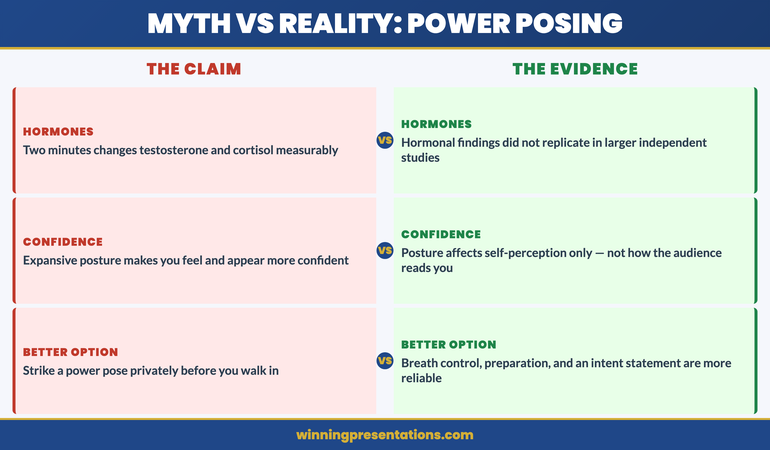
Amy Cuddy and her colleagues published a study in 2010 — later expanded into a widely shared TED Talk and a bestselling book — claiming that standing in an expansive, dominant posture for two minutes produced measurable physiological changes: increased testosterone and decreased cortisol. The conclusion was striking: a brief physical intervention could change your hormonal profile and, consequently, your psychological readiness for a high-stakes situation.

The research attracted enormous popular attention because it offered a simple, accessible, cost-free intervention for one of the most common professional problems: feeling underprepared or inadequate before an important presentation. The idea that two minutes of deliberate posture could level the physiological playing field was intuitively appealing and practically convenient. It required no equipment, no prior training, and no significant time investment.

The TED Talk became one of the most viewed in the platform’s history. It entered corporate learning programmes, coaching curricula, and pre-presentation advice from well-meaning managers worldwide. By the mid-2010s, power posing had achieved the status of established science in most professional training contexts, despite the fact that its scientific foundations were already being actively questioned by researchers in the field.

Myth versus reality of power posing: original hormonal claims versus what replications actually found, and what works instead

What the Replication Research Found

Independent attempts to replicate the hormonal findings of the original power posing study have not produced consistent results. A large pre-registered replication by Ranehill and colleagues in 2015 — involving a significantly larger sample than the original study — found that expansive postures did produce self-reported feelings of power, but did not produce the hormone changes that were central to Cuddy’s original claim. The cortisol and testosterone results did not hold.

Subsequent meta-analyses have generally confirmed this pattern: the psychological effects of posture — feeling more confident, more in control, more ready — are real and replicable. The hormonal effects are not. This distinction matters because the original claim was that power posing worked by changing your biology, which would then change your behaviour. The revised understanding is that power posing, if it has any effect at all, works through cognitive and attentional channels — it shifts what you are thinking about and how you are evaluating your own readiness, not what your hormones are doing.

Cuddy herself has refined her position over time, arguing that the self-reported psychological effects are the meaningful outcome, even in the absence of the hormonal findings. This is a legitimate scientific position, but it represents a significant narrowing of the original claim. The mechanism is different. The magnitude of effect may be different. And the implication for practice is different: if power posing produces a modest self-perception shift rather than a physiological transformation, then it competes directly with other cognitive techniques that may produce comparable or larger effects.

Conquer Speaking Fear — £39

Address the Anxiety Pattern That Rituals Can’t Reach

Pre-presentation rituals help. But if your anxiety is significant — if it follows you into the days before a presentation, affects your sleep, or causes you to avoid high-profile opportunities — it needs more than a posture adjustment. Conquer Speaking Fear is a structured 30-day programme that uses nervous system regulation and clinical hypnotherapy techniques to address the underlying anxiety pattern, not just manage its symptoms.

  • 30-day structured programme for presentation anxiety and public speaking fear
  • Nervous system regulation techniques grounded in clinical practice
  • Clinical hypnotherapy methods adapted for professional presenters
  • Designed for executives whose anxiety pattern affects their career and performance

Get Conquer Speaking Fear →

Designed for professionals whose presentation anxiety is affecting their performance and opportunities.

What Posture Actually Does to Confidence

The research on embodied cognition — the relationship between physical posture and psychological state — is broader than the power posing debate and considerably more robust. Several consistent findings emerge from this literature that are directly relevant to presenters.

First, contracted, closed posture — shoulders rounded, chest caved, head down — has consistent negative effects on self-perception and cognitive performance. The research on this is more reliable than the research on expansive posture effects, possibly because the contrast between collapsed and upright posture is more physiologically significant than the contrast between neutral and expansive posture. If you are anxious before a presentation and your body has collapsed into itself, deliberately correcting your posture to upright — not superhero stance, just neutral upright — will have a measurable positive effect on how you feel.

Second, the relationship between posture and self-perception runs in both directions. Feeling confident tends to produce upright posture; upright posture tends to increase felt confidence. This is proprioceptive feedback — your body’s own sensory system reporting on its physical state and influencing your psychological state in return. This mechanism is real and supported by a substantial body of research. It is why slumping over your phone in a corridor before a presentation is a worse preparation strategy than standing or walking.

Third, the effect of posture on confidence is almost entirely self-directed, not audience-directed. Your posture in the two minutes before a presentation changes how you feel about yourself — it does not reliably change how your audience perceives you from the moment you walk in. Audience perception is shaped by how you carry yourself in the room, how you speak, and how you engage with questions — not by what you were doing in the corridor beforehand.

This reframes the useful question. Rather than asking whether expansive posture changes your hormones, ask: what physical and cognitive state do you want to be in when you walk through the door, and what is the most reliable way to get there in the time available? For most presenters, Conquer Speaking Fear addresses the systematic anxiety pattern that no pre-presentation ritual can fully manage on its own.

For specific physical techniques that reliably reduce anxiety state before a presentation, see the companion article on box breathing for executive presenters — a method with considerably stronger physiological support than power posing.

A Pre-Presentation Confidence Sequence That Works

If the goal is to be in the optimal psychological state when the presentation begins, a structured pre-presentation sequence is more reliable than any single technique. The sequence below is designed for the 24 hours preceding a high-stakes presentation and can be adapted based on individual preference and available time.

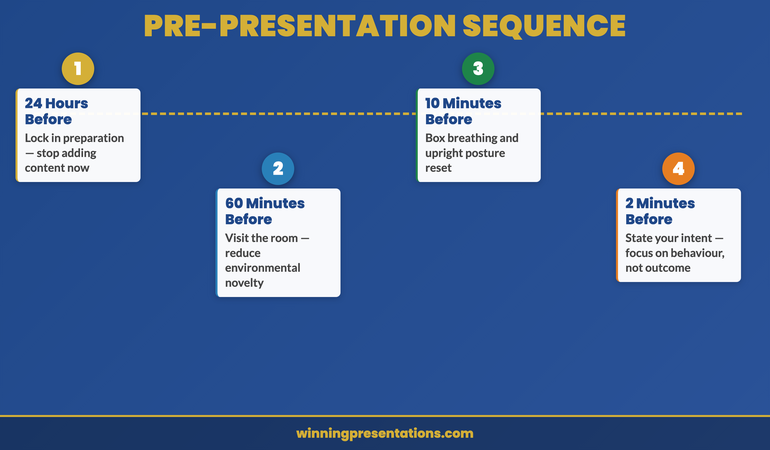
24 hours before: Preparation lock-in. Make a deliberate decision to stop adding material to your preparation. Late additions to a presentation script or slide deck — made under the time pressure of the night before — consistently increase anxiety without improving presentation quality. The preparation phase should have ended by 24 hours before delivery. If you are still making significant changes at this point, note them as a learning for next time, but stop making them now. What you know is what you will present with.

60 minutes before: Environment scan. If possible, visit the presentation room before the audience arrives. Sit in the chair you will present from or stand at the front of the room. This familiarisation exercise reduces the novelty of the environment, which is one of the primary anxiety triggers for executive presenters. An unfamiliar room activates threat-assessment responses. A familiar room does not. This is why a structured pre-presentation ritual that includes environmental familiarisation is worth the time.

10 minutes before: Breath and posture reset. Find a quiet space and do four to six cycles of box breathing — four counts in, four counts hold, four counts out, four counts hold. Simultaneously check your posture: feet flat, shoulders back and relaxed, spine upright. This is not power posing. It is a deliberate physiological reset that reduces sympathetic nervous system activation and restores a baseline of physical composure. The effect is immediate and measurable.

2 minutes before: Intent statement. State — silently or aloud — your intention for the presentation. Not a prediction (“this will go well”) and not a hope (“I want them to like it”). An intent statement is about process: “I am going to be clear, I am going to be direct, and I am going to listen carefully to their questions.” This cognitive anchor replaces rumination about outcome — the most common source of pre-presentation anxiety escalation — with a focus on behaviour that is entirely within your control.

Pre-presentation confidence sequence: 24 hours before, 60 minutes before, 10 minutes before, and 2 minutes before the presentation

When Anxiety Is Deeper Than a Posture Problem

Pre-presentation techniques — power posing, box breathing, visualisation, intent statements — address the surface experience of presentation anxiety: the activation, the racing thoughts, the physical symptoms in the moments before walking in. For many executives, these techniques are sufficient. The anxiety is situational, manageable, and does not significantly affect performance or career decisions.

For others, the anxiety pattern is more persistent. It begins days before the presentation. It involves anticipatory catastrophising — elaborate internal narratives about what might go wrong. It affects sleep. It leads to over-preparation as an anxiety-management strategy rather than a quality-improvement strategy. In some cases, it affects which opportunities executives accept: declining high-profile presentations, deferring to colleagues in senior meetings, avoiding situations that would otherwise advance their careers.

This pattern is not addressable through posture. No two-minute ritual touches the underlying anxiety architecture that is generating it. Addressing it requires working at the level of the nervous system’s threat-assessment — the learned associations and conditioned responses that activate the anxiety cycle in the first place. This is the work that clinical approaches, including the nervous system regulation and hypnotherapy techniques in the cognitive restructuring approach covered in a separate article, are specifically designed to do.

For the Q&A dimension of presentation anxiety — particularly the fear of being caught off-guard by difficult questions — see today’s companion piece on handling repeated questions in presentations. Repeated questions are a particularly common anxiety trigger for executives who interpret them as a signal of inadequacy rather than a routine communication dynamic.

Conquer Speaking Fear — £39

A 30-Day Programme for Persistent Presentation Anxiety

When pre-presentation rituals are not enough — because the anxiety starts earlier, runs deeper, or affects your professional decisions — Conquer Speaking Fear gives you a structured 30-day approach to addressing the underlying pattern, not just managing the moment.

Get Conquer Speaking Fear →

Designed for professionals whose presentation anxiety is persistent and affecting their performance.

Frequently Asked Questions

Is power posing harmful?

There is no evidence that power posing is harmful, and some evidence that it produces modest self-perception benefits in specific contexts. The concern is not that the technique is damaging — it is that over-reliance on a ritual whose effects are poorly understood may crowd out more effective interventions. If standing in a bathroom cubicle for two minutes helps you feel more settled before a presentation, there is no reason to stop. But if persistent presentation anxiety is affecting your performance and you are treating power posing as the solution, you may be underestimating the problem and its available remedies.

Does body language matter during the actual presentation?

Yes — but the effect operates differently than most presenters assume. Research on body language in presentations consistently finds that audiences respond primarily to energy and engagement, not to specific posture configurations. An executive who is genuinely engaged with the material and the audience will carry themselves authentically and read as confident. An executive who is performing a posture they believe signals confidence but do not feel will read as incongruent. The best preparation for confident body language during a presentation is thorough preparation that reduces anxiety, not a specific pose adopted beforehand.

What should I actually do in the two minutes before a high-stakes presentation?

Find a quiet space away from the pre-presentation conversation and noise. Stand or sit with upright posture — not expansive, just neutral and open. Do three to four rounds of box breathing to reduce physiological activation. State your intent for the presentation — one sentence about how you intend to show up, not what outcome you want. Then walk in. This sequence takes less than two minutes and draws on techniques with substantially stronger evidence than power posing. The goal is a calm, focused, ready state — not a peak adrenaline state, which is what some presenters are trying to produce and which tends to interfere with measured, authoritative delivery.

Subscribe to The Winning Edge — Mary Beth’s weekly briefing for executives on presentation confidence, anxiety management, and high-stakes communication.

Subscribe to The Winning Edge →

About the Author

Mary Beth Hazeldine is Owner & Managing Director of Winning Presentations. With 25 years of corporate banking experience at JPMorgan Chase, PwC, Royal Bank of Scotland, and Commerzbank, she advises executives across financial services, healthcare, technology, and government on presentation confidence, communication strategy, and high-stakes delivery.

14 Apr 2026

Budget Variance Presentation: Explain Financial Gaps Without Losing Credibility

Quick Answer
A budget variance presentation should follow a four-part structure: acknowledge the gap, explain the root cause in one concise layer, present the recovery plan, and confirm the controls now in place. The most common mistake is opening with the raw variance number before context has been established. Executives hear a number without a frame and immediately form a judgement. Establish the context first, then the number, then the explanation. This sequence maintains credibility and positions you as someone who understands the business — not someone defending a mistake.

Valentina had managed the EMEA operations budget for six years without a significant variance. When the Q3 numbers came in £2.3 million over plan, she prepared eighteen slides: twelve pages of underlying data, three pages of market analysis, and three pages of adjusted forecasts. She opened her CFO presentation with slide one — a full variance waterfall — and watched the room’s body language shift before she had spoken a second sentence.

The CFO’s first question was not about the data. It was: “Do we have a control problem?” Valentina had not prepared for that question. She had prepared for questions about the numbers, not about her team’s governance. She spent the next forty minutes in reactive mode, answering questions she had not anticipated because she had prepared a document instead of a story.

She rebuilt the presentation overnight. Six slides: context, variance summary, root cause, immediate recovery actions, controls now in place, and a clear ask. She delivered it the following morning to a smaller group. No one questioned the governance. Three people thanked her for the clarity. The same financial problem, reframed through a different presentational architecture, produced a fundamentally different conversation.

If you present financial results to boards or senior leadership teams, the Executive Slide System includes slide templates and scenario playbooks for exactly this kind of high-pressure financial communication.

Explore the System →

Why Budget Variance Presentations Go Wrong

Budget variance presentations go wrong in a predictable sequence. First, the presenter arrives over-prepared with data and under-prepared for the emotional temperature of the room. A variance is never just a financial event — it is a credibility event. Executives hearing about a significant overspend or underperformance are simultaneously processing financial information and updating their assessment of the person in front of them. Presenters who treat the meeting as a data briefing miss this entirely.

Second, presenters frequently bury the lead. They spend the first half of the presentation on context, market conditions, and contributing factors — in the hope that by the time the audience reaches the number, they will have been sufficiently pre-framed to receive it calmly. The opposite usually happens. Executives sense that something is being withheld, and their anxiety escalates during the preamble. When the number finally appears, they are irritated at the delay as well as concerned about the figure.

Third, presenters over-explain. A budget variance presentation that runs to forty minutes of detail signals that the presenter has not yet done the analytical work of identifying the primary root cause. Senior executives do not need every contributing factor — they need the one or two factors that account for most of the variance, and they need confidence that the presenter has a clear understanding of those factors. More explanation does not convey more competence. It conveys less.

The structural answer to all three problems is the same: lead with the frame, state the number, explain the primary cause concisely, and move quickly to recovery. Every additional slide beyond that requires specific justification.

Four-stage variance response cycle: acknowledge the gap, explain root cause, present recovery plan, confirm controls in place

The Four Types of Budget Variance

Before structuring a budget variance presentation, it is worth being precise about the type of variance being explained. Each type has a different implication for credibility and a different recovery narrative.

Volume variance occurs when the volume of activity differs from plan — more units sold than forecast, or fewer projects delivered than budgeted. Volume variances are generally the easiest to explain because they are visible in the operational data and often have a clear external driver. The credibility question is: was this volume change foreseeable and, if so, why did the budget not reflect it?

Rate variance occurs when the cost or revenue rate per unit of activity differs from plan — higher supplier costs, currency movements, or wage inflation. Rate variances require a different explanation because they are often partially controllable. The credibility question is: what hedging or contractual arrangements were in place, and why were they insufficient?

Timing variance occurs when costs or revenues fall in a different period than budgeted, without changing the full-year position. Timing variances are the least alarming type but require careful communication — executives who hear “it’s just a timing issue” without clear evidence that the full-year number is intact will remain sceptical.

Scope variance occurs when the work done differs from the work planned — typically because additional requirements were added after budgeting, or because the original scope was underspecified. Scope variances require careful handling because they often touch questions of planning quality and client management. The narrative here must acknowledge the scope change cleanly and position it as a decision that was made, not a mistake that happened.

Knowing which type of variance you are presenting shapes every element of the presentation — the framing, the supporting data, the recovery narrative, and the controls slide. Treating all variances as the same kind of problem is one of the most common analytical errors in budget variance presentations.

Executive Slide System — £39, instant access

Build the Financial Presentations That Maintain Executive Credibility

The Executive Slide System includes slide templates for financial presentations — budget reviews, variance analyses, capital requests, and revenue forecasts — along with AI prompt cards to build structured arguments and scenario playbooks for presentations under pressure. Designed for finance leaders who need to present difficult numbers without losing the room’s confidence.

  • Slide templates for executive financial scenarios including budget variances and reforecasts
  • AI prompt cards to structure financial arguments without starting from scratch
  • Framework guides for presenting bad news while maintaining credibility
  • Scenario playbooks for high-pressure financial communication to boards and CFOs

Get the Executive Slide System →

Designed for leaders who present financial results to boards, investors, and senior leadership teams.

The Four-Part Structure for Finance Credibility

The most reliable structure for a budget variance presentation follows four stages. This is not a template for hiding bad news — it is a framework for presenting it in the sequence that allows executives to process it clearly and move to resolution efficiently.

Stage One: Acknowledge the gap. Open by naming the variance directly and owning it without qualification. “Our Q3 operating costs came in £2.3 million above plan. I want to walk you through what drove that and what we are doing about it.” This sentence does four things simultaneously: it confirms you know the number, it signals you are not about to excuse it, it indicates you understand the cause, and it commits to a path forward. Do not begin with context, market conditions, or contributing factors. Begin with the number and ownership.

Stage Two: Explain the root cause. State the primary root cause in one concise layer. If the variance has multiple contributing factors, identify the one or two that account for the majority of the gap, state them clearly, and acknowledge that additional detail is available in the appendix. A budget variance presentation that gives equal airtime to a £1.9 million factor and a £0.4 million factor misallocates executive attention and signals poor analytical prioritisation.

Stage Three: Present the recovery plan. Move directly from cause to action. What has already changed, what will change in the next 30 days, and what is the revised full-year position? The recovery plan should be specific: named actions, named owners, and specific timelines. Vague commitments (“we are reviewing our cost structure”) do not restore credibility. Specific commitments (“we have already renegotiated the supplier contract — effective November 1 — which recovers £800k in H2”) demonstrate that you have moved from diagnosis to execution.

Stage Four: Confirm the controls. Close with a brief statement of what governance changes are now in place to prevent recurrence. This is the answer to the question the CFO is thinking but may not ask: “Is this a one-off, or do we have a systemic control problem?” A controls slide that shows specific changes — a new approval threshold, a revised forecasting cadence, an additional sign-off requirement — signals institutional learning rather than reactive damage control.

For more on structuring financial presentations to senior leadership, the article on presenting a capital expenditure request covers the related challenge of framing large investment decisions to a financially sceptical audience.

Common Mistakes That Destroy Credibility

The most credibility-destroying mistake in a budget variance presentation is attributing the entire gap to factors outside the presenter’s control. External factors — currency movements, market conditions, regulatory changes — are legitimate components of a variance explanation when they genuinely apply. But when a presenter attributes a variance primarily to external factors without acknowledging any internal shortfall, senior executives notice. They have usually seen the same external environment and have formed their own view of how much it explains. A narrative that overstates external causation reads as evasion, not analysis.

A second mistake is presenting a revised forecast that is suspiciously close to the new run rate, without adjusting for the root cause. If costs ran 12% above plan in Q3 and the Q4 forecast shows costs returning to plan without a clear explanation of what changed, the revision is not credible. Senior executives will note the gap between the implied improvement and the actual changes being made. A conservative revised forecast — one that acknowledges continued risk while showing directional recovery — is always more credible than an optimistic forecast that assumes the problem has been solved by the act of presenting it.

A third mistake is presenting without a clear ask. Budget variance presentations sometimes conclude with a summary slide and an implicit assumption that the conversation will simply continue. Senior executives prefer precision: “I am asking for approval of the revised H2 cost ceiling of £X” or “I am asking the board to note this variance and the recovery plan — no additional approval is required.” Even when the ask is small, stating it explicitly demonstrates competence and saves time.

The Executive Slide System includes slide templates for presenting financial asks with precision — including a specific framework for the recovery plan and controls sections of a budget variance presentation.

Four categories of budget variance: volume variance, rate variance, timing variance, and scope variance — each with different recovery narratives

Presenting Variance Data Visually

The waterfall chart is the standard visualisation for budget variances, and it is widely understood by finance audiences. However, waterfall charts become difficult to read when they contain more than six to eight bars. A waterfall showing twenty contributing factors does not clarify the variance — it obscures the primary cause within a visual noise of small contributors. Apply the same prioritisation discipline to your charts as to your narrative: show the top two or three factors in the main chart, and move everything else to an appendix table.

For the revised forecast slide, a simple table with three columns — original budget, current forecast, and variance — is usually clearer than a chart. Add a fourth column for the narrative: a one-line explanation of each variance line. This format allows executives to scan the full picture quickly, drill into any line with a question, and see immediately that the presenter has a narrative for each movement rather than data without interpretation.

Colour discipline matters in financial presentations. Red for negative variances, green for positive, and grey for on-plan is a standard palette that executives read without thinking. Departing from this convention — using amber for “amber but manageable” variances, for example — forces the audience to learn your legend before they can read the data. When presenting to an executive audience, use the conventions they already know.

For further context on presenting financial data to a board audience, the piece on the difference between a board paper and a board presentation gives useful framing on when data belongs in a slide versus a supporting document.

Closing on Recovery, Not on the Gap

The last impression of a budget variance presentation shapes how the audience carries the information out of the room. A presentation that closes with a slide showing the full variance — columns of red numbers, a large unfavourable figure — leaves executives with a loss frame. A presentation that closes with a clear recovery trajectory and specific controls leaves executives with a management frame. The financial facts are identical in both cases. The cognitive residue is very different.

Structure your closing slide around the forward position: the revised full-year forecast, the specific actions already taken, and the governance now in place. Include the ask clearly at the bottom of the slide. End with: “I’m confident we have the right measures in place. I’m happy to take questions.” This phrasing is not false optimism — it is a specific claim that the presenter has a plan and is prepared to discuss it. It invites scrutiny from a position of readiness.

Budget variance presentations frequently lead into broader financial planning conversations at leadership level. See today’s companion article on structuring an offsite strategy presentation for guidance on how financial variance discussions integrate into multi-day leadership agendas. Also see the article on presenting a revenue forecast for the parallel challenge of presenting forward-looking financial numbers with authority under scrutiny.

Executive Slide System — £39, instant access

Templates for the Financial Presentations That Put Most Executives Under Pressure

Budget variances, capital requests, reforecasts, and board financial updates — the Executive Slide System gives you the slide structures and AI prompt cards to build each format confidently, without designing from a blank slide while under time pressure.

Get the Executive Slide System →

Designed for finance leaders presenting to boards, audit committees, and senior leadership teams.

Frequently Asked Questions

What if the variance is so large it will shock the room?

For large variances, the approach is the same but the pre-work is different. Before any formal presentation, the CFO or relevant executive sponsor should be briefed individually — not to soften the blow, but to ensure they are not hearing the number for the first time in a group setting. Leaders who are surprised in a group tend to respond with protective scepticism. Leaders who have already processed the number privately come to the group presentation ready to engage with the recovery plan rather than react to the headline figure. The formal presentation then becomes a governance event rather than a disclosure event.

What if you don’t yet know the full root cause?

If the analysis is not yet complete, say so explicitly and state what you do know. “We have identified two factors that account for £1.6 million of the £2.3 million variance. The remaining £0.7 million is still under analysis — I expect to have full clarity by Thursday and will circulate a written note before the end of the week.” This is significantly more credible than presenting partial analysis as if it were complete, which will be visible to any executive who reviews the numbers independently. A clear statement of what you know and what you are still confirming is a mark of analytical rigour, not weakness.

How do you maintain credibility when presenting a variance that was previously forecast as unlikely?

The most effective approach is to address the forecasting failure directly — before you are asked. “In Q2, when we reviewed the risk register, we rated the probability of this scenario at low. I want to explain why that assessment was wrong and what we are changing in our forecasting approach.” This kind of direct acknowledgement is rare enough that it consistently registers as a credibility signal rather than a vulnerability. Executives who attempt to avoid the forecasting question are usually pursued more aggressively than those who address it voluntarily.

Subscribe to The Winning Edge — Mary Beth’s weekly briefing for executives on presentation strategy, financial communication, and high-stakes delivery.

Subscribe to The Winning Edge →

Also available: Free Executive Presentation Checklist — a reference guide for high-stakes financial presentations.

About the Author

Mary Beth Hazeldine is Owner & Managing Director of Winning Presentations. With 25 years of corporate banking experience at JPMorgan Chase, PwC, Royal Bank of Scotland, and Commerzbank, she advises executives across financial services, healthcare, technology, and government on structuring presentations for high-stakes funding rounds, board approvals, and senior leadership reviews.

14 Apr 2026

Offsite Strategy Presentation: How to Structure One Deck for a 3-Day Executive Agenda

Quick Answer
An offsite strategy presentation should frame a 3-day executive agenda — not attempt to replicate it in slides. Structure it around four components: the strategic context, the debate agenda, the decisions required, and the 90-day commitments. The deck is a navigation tool, not a content delivery vehicle. Most offsite presentations fail because they try to do too much. A focused, 20-slide deck that guides three days of genuine strategic conversation outperforms a 90-slide masterwork that eliminates the conversation entirely.

Henrik was twelve days out from a three-day leadership offsite when his CEO forwarded a single message: “Can you send the deck?” He had a 94-slide PowerPoint that covered every business unit update, every market headwind, every strategic initiative and its dependencies. He sent it across at 11 pm, confident it was comprehensive.

The CEO replied the next morning: “This is a lot. I’m not sure we can get through all of this in three days. Can we talk about what we actually need to decide?” That single reply landed like cold water. Henrik had spent three weeks building a document instead of designing a conversation.

He rebuilt the deck in two days. 22 slides. One opening frame, four strategic debates, three non-negotiable decisions, and a 90-day commitment grid. The offsite ran differently. People argued more — and agreed more. Henrik later said the 22-slide version had done in 20 minutes what the 94-slide version couldn’t have done in three days: it told the team what the offsite was actually for.

If you’re building an offsite strategy presentation — or any high-stakes executive deck — the Executive Slide System gives you slide templates, AI prompt cards, and scenario playbooks for exactly these situations.

Explore the System →

Why Offsite Strategy Presentations Fail

The most common failure mode is treating the offsite presentation as a status update at scale. Executives bring every report, every metric, every initiative that has been in progress since the last offsite. The result is a deck that functions like an extended board paper — complete, exhaustive, and almost entirely unsuited to the purpose of three days in a room together.

A second failure mode is structural: decks that have no clear decision architecture. The slides present problems, but never force a choice. Attendees leave an offsite feeling informed but uncommitted — because the presentation never positioned them as decision-makers. It positioned them as an audience.

A third failure is mismatched depth. Presenters give ten slides to a topic that needs twenty minutes of discussion, and two slides to a topic that should anchor an entire afternoon. The deck’s internal weighting rarely matches the organisation’s strategic priorities in that moment. This can only be corrected if the designer first understands what decisions need to be made — and works backward from there.

What all three failure modes share is a confusion between documentation and facilitation. An offsite strategy presentation is not a record of where the organisation stands. It is a structured invitation to move the organisation forward. That distinction shapes every decision about what goes in, what stays out, and how much space each topic receives.

Four-part structure for an offsite strategy presentation: context frame, strategic pillars, decision points, and 90-day commitments

The Strategic Constraint: What to Cut

The single most useful discipline when building an offsite strategy presentation is the removal constraint: before you add a slide, ask whether removing it would change a decision. If the answer is no, it does not belong in the deck. It belongs in a pre-read document — distributed two to three days before the offsite begins, with a cover note that says, “You’re expected to have read this before we arrive.”

Status updates — divisional performance, year-to-date financials, pipeline snapshots — belong in the pre-read. Market context, competitor intelligence, and regulatory landscape belong in the pre-read. These are the shared baseline that makes the strategic debate possible. They should not consume offsite presentation time.

What belongs in the live deck are the topics that only the room can resolve: strategic choices that require debate, resource allocation decisions that require authority, and cultural commitments that require buy-in from the leaders present. These cannot be resolved asynchronously. They require the friction of real-time conversation, which is why the offsite exists.

A useful test: if a slide could be replaced with a pre-read paragraph and a question — “Given what you’ve read, what is your position on X?” — remove it from the deck. The offsite presentation is not a briefing. It is the architecture for a conversation that has already been adequately briefed.

For advice on structuring other high-stakes executive formats, the piece on the difference between a board paper and a board presentation gives useful framing on when to use each vehicle.

Executive Slide System — £39, instant access

Build Executive Decks That Drive Decisions — Not Just Discussion

The Executive Slide System gives you the slide templates, AI prompt cards, and scenario playbooks used to build decks for boards, leadership offsites, and high-stakes funding rounds. Designed for executives who need to present once and get the decision — not present repeatedly and wait for consensus.

  • Slide templates built for executive scenarios including offsites, budget reviews, and governance updates
  • AI prompt cards to build structured decks without starting from a blank slide
  • Framework guides for opening frames, decision architecture, and closing sequences
  • Scenario playbooks for the presentations most likely to derail without structure

Get the Executive Slide System →

Designed for leaders who present to boards, investors, and senior leadership teams.

The Opening Frame That Earns Attention

An offsite strategy presentation must answer one question within its first three slides: why are we here, and what will be different when we leave? If the opening frame cannot answer that question, the entire three days are at risk of drifting. Senior leaders fill ambiguity with their own agendas. An explicit opening frame prevents that drift before it starts.

The opening frame typically contains three elements. First, a one-sentence articulation of the strategic moment: what has changed in the external environment, or the organisation’s position, that makes this offsite necessary now rather than at the usual quarterly cadence? This creates urgency without alarm. Second, a statement of the three decisions that must be made before the group leaves. Not the topics for discussion — the specific decisions. “By close of Thursday, we will have agreed: our investment priority for H2, the structure of the new operating model, and the leadership appointments for the two new regions.” Third, the rules of engagement: how the three days will run, and what is expected from participants.

This opening frame should be no more than three slides. Its function is orientation, not persuasion. Executives do not need convincing that strategic planning matters — they need clarity about what this particular offsite is trying to achieve. The opening frame is the only part of the deck that addresses the group as a whole before breaking into individual strategic debates.

If you are presenting at a year-end leadership offsite, the approach overlaps significantly with the format discussed in the article on structuring a year-end review presentation. The distinction is that year-end reviews look backward by design; offsite presentations must balance backward context with forward commitment.

The Four-Part Structure That Works

Effective offsite strategy presentations follow a consistent four-part logic. This structure works because it mirrors how strategic decisions actually get made: context is established, options are debated, commitments are made, and accountability is assigned.

Part One: Context Frame (3 slides). As described above — why we’re here, what decisions must be made, and how we will work. This anchors the three days and prevents the offsite from becoming a free-floating strategy conversation with no defined output.

Part Two: Strategic Debate Agenda (4–8 slides, one per debate). Each strategic topic gets its own single slide — a crisp framing of the debate, the options available, and the criteria by which a decision should be made. These slides do not resolve the debate. They start it. Good debate agenda slides use a consistent format: “The Question” at the top, two or three strategic options in the body, and a prompt at the bottom: “What do we believe is true about this?” Not “What do we decide?” — because the group is not ready to decide before they have debated.

Part Three: Decision Architecture (3–5 slides). After debates have been run, the presentation moves into explicit decision territory. Each decision gets its own slide — the decision statement, the option selected, and the immediate implications. These slides are where the organisation formally commits on record. They should be drafted in advance as hypotheses and updated in real time as decisions are made. A skilled offsite facilitator often projects the decision slide at the close of each debate so the room can see their position being captured.

Part Four: 90-Day Commitments (2–3 slides). The offsite should not close without a concrete commitment grid: who will do what, by when, and how progress will be reported. This is not a project plan — it is a leadership compact. The 90-day commitment grid converts strategic decisions into traceable action, and it is the only slide set that will be revisited at the next quarterly review. Its presence makes the offsite accountable. Its absence makes the offsite forgettable.

If the offsite includes a capital investment decision, the framing from the article on structuring a capital expenditure presentation applies directly to Part Three — particularly the decision architecture for resource allocation under uncertainty.

You can find further guidance on handling the financial elements of strategic discussions in today’s companion piece on structuring a budget variance presentation — specifically when offsite conversations surface spending gaps that require immediate leadership alignment.

The full four-part format typically lands between 18 and 25 slides. If you find yourself approaching 40 slides, you have migrated content that belongs in the pre-read back into the live deck. Return to the removal constraint: does this slide change a decision? If not, remove it.

The Executive Slide System includes scenario playbooks for exactly this kind of multi-phase offsite structure, with templates that allow you to build the four-part framework without designing from scratch.

Comparison of ineffective versus effective offsite strategy presentation approaches: scope, opening, and closing structure

Visual Principles for Offsite Decks

Offsite presentations are frequently projected in non-standard environments: hotel conference rooms with inconsistent lighting, large screens that amplify visual clutter, or breakout spaces where participants are sitting at odd angles to the display. The visual approach must accommodate these conditions. High-contrast, clean slide design is not aesthetic preference — it is functional necessity.

Dark backgrounds with light text read well in bright rooms. Single-column layouts with large type are easier to read from a distance. Decision slides should use a consistent visual signature — perhaps a distinct colour band or a specific header format — so participants immediately recognise when they have moved from debate to commitment.

Avoid complex data visualisations in the live deck unless the data is central to the decision. Complex charts slow the room down while individuals decode them individually. Data visualisations belong in appendix slides or in the pre-read, where participants can study them at their own pace. In the live deck, reduce every data point to its strategic implication: not the chart, but the conclusion the chart supports.

Slide titles should be declarative statements rather than topic labels. “Revenue Growth” is a label. “Revenue growth is concentrated in two markets — that concentration is our primary strategic risk” is a statement. Declarative titles tell the room what to think before discussion opens. They are also more useful when the deck is reviewed six months later as a record of the leadership team’s position at the time of the offsite.

Handling Q&A Across a 3-Day Format

An offsite is not a presentation with a Q&A segment. It is a sustained Q&A environment with occasional presentation segments. This distinction matters because it changes how you manage questions. In a standard board presentation, you manage Q&A at the end of a defined slot. In an offsite, questions arise continuously, and the presenter’s role shifts between facilitator, responder, and recorder.

Build an explicit “parking lot” into the offsite structure — a shared space, whether digital or on a physical flipchart, where off-agenda questions are captured and scheduled for later. This prevents a single challenging question from derailing an entire session. When a question is parked, the response is: “That’s an important question and I want to give it proper time. I’ve added it to the parking lot — we’ll address it this afternoon.” This is not avoidance. It is discipline.

For questions that challenge the strategic assumptions underpinning the presentation, the right response is to invite the assumption to be made explicit: “You’re questioning whether the market growth assumption holds. Let me put that on the decision slide — is the group’s position that we should retest that assumption before committing to the investment?” Converting a challenge into a decision point moves the conversation forward rather than into a recursive debate.

Also see today’s piece on handling repeated questions in presentations — a pattern that surfaces frequently at offsites when a strategic concern is not being adequately addressed by the group’s debate structure.

Executive Slide System — £39, instant access

The Slides Behind High-Stakes Leadership Decisions

Offsite presentations, board decks, budget reviews — the Executive Slide System gives you the templates and AI prompt cards to build each format with authority, without designing from a blank slide under time pressure.

Get the Executive Slide System →

Designed for executives presenting to boards, leadership teams, and investors.

Frequently Asked Questions

How many slides should an offsite strategy presentation have?

Most effective offsite strategy presentations run between 18 and 25 slides for a three-day format. The four-part structure — context frame, debate agenda, decision architecture, and 90-day commitments — typically fills this range comfortably. Anything beyond 35 slides usually indicates that pre-read material has migrated into the live deck, or that status updates are included where they don’t belong. The test is simple: does each slide either set up a debate or record a decision? If not, it belongs in the appendix or the pre-read.

Should each business unit present its own section at the offsite?

Individual business unit presentations at offsites are one of the most reliable ways to convert a strategic conversation into a series of operational briefings. If each unit is given 30 minutes to present its performance, the offsite becomes a three-day board meeting rather than a leadership strategy event. Business unit performance belongs in the pre-read. What belongs in the live session is the cross-cutting strategic debate: where should we invest, where should we consolidate, and where do we have a structural competitive advantage that we are not fully exploiting?

What do you do when a debate runs over time and the agenda slips?

When a debate runs over, it is usually a signal that either the question was not framed narrowly enough, or the group has surfaced a genuinely more important issue than the one scheduled. In the first case, park the debate, sharpen the question overnight, and return to it the next morning with a 20-minute time box. In the second case, name what is happening explicitly: “This conversation has revealed that we have an unresolved assumption about X that we haven’t formally debated. I want to propose we add this to the decision architecture and defer one of the scheduled debates.” Offsites that stick rigidly to the agenda when something more important has emerged rarely produce better outcomes than ones that adapt with discipline.

Subscribe to The Winning Edge — Mary Beth’s weekly briefing for executives on presentation strategy, Q&A mastery, and high-stakes communication.

Subscribe to The Winning Edge →

Also available: Free Executive Presentation Checklist — a quick-reference guide for high-stakes presentations.

About the Author

Mary Beth Hazeldine is Owner & Managing Director of Winning Presentations. With 25 years of corporate banking experience at JPMorgan Chase, PwC, Royal Bank of Scotland, and Commerzbank, she advises executives across financial services, healthcare, technology, and government on structuring presentations for high-stakes funding rounds, board approvals, and leadership strategy events.

13 Apr 2026
Senior female director in online coaching session, laptop open on video call, composed expression, home office with navy bookshelf

Executive Presentation Coaching Online: What to Look For

Quick answer: Executive presentation coaching online ranges from solo video courses to live 1:1 sessions to structured group cohort programmes. Each serves a different need. If you are a senior professional who presents to boards, committees, or investors — and you want to improve the strategic architecture of your presentations as well as your delivery — a structured cohort programme typically offers more than unstructured 1:1 coaching alone: peer challenge, a repeatable framework, and guided practice with real-world scenarios. The Executive Buy-In Presentation System is a self-paced programme designed for exactly that context — building and delivering presentations that move decision-makers to a clear yes.

Valentina had been presenting to boards for six years. She was competent — she knew her brief, handled questions reasonably well, and had never had a presentation go badly wrong. But she had also never had one go memorably right. Her proposals were approved, often after a second meeting. Her updates were noted, then forgotten. When she finally asked for feedback from a non-exec she trusted, his answer surprised her: “Your content is sound. But I never feel like you believe your own case.” She had not thought of it that way. She booked onto a coaching programme and, three sessions in, realised she had been presenting information when her audience needed a decision-path. The coaching did not change her knowledge. It changed her architecture — how she built the case, where she placed the key ask, and how she handled the silence after she had said what she needed to say. Her next board presentation resulted in same-meeting approval. Not because she had become a different presenter. Because she had become a clearer one.

Looking for executive presentation coaching online? The Executive Buy-In Presentation System is a self-paced programme for senior professionals presenting at board and committee level. New cohorts open monthly. Explore the programme →

Coaching vs Training: A Useful Distinction

The words “coaching” and “training” are often used interchangeably in the context of executive presentations, but they describe meaningfully different things. Understanding the distinction helps you choose the right type of support for where you are now.

Training is typically structured around a curriculum. It delivers a set of frameworks, principles, or techniques that the participant learns and applies. The content is consistent — the same frameworks are taught to every participant. Training works well when you need to build capability from a defined starting point: you do not know how to structure an executive summary slide, so you learn the principles. You have not thought about Q&A strategy, so you acquire the method.

Coaching is more contextual. A coach works with what you are already doing and helps you understand why it is or is not working — and what to change. The content is personal rather than curriculum-led. Coaching works well when the gap is not knowledge but application: you know what an executive summary should contain, but your current version does not land. You have a framework, but you are not using it fluently.

In practice, the most effective executive presentation coaching online programmes combine both: a structured framework (so every participant learns a rigorous method) with personalised application (so you work on your actual presentations, not hypothetical scenarios). This is what distinguishes a good cohort programme from a self-study course on one hand and unstructured 1:1 sessions on the other.

Comparison infographic showing three executive presentation coaching formats: 1-to-1 coaching, cohort programmes, and self-study — with price tiers, best use cases, and what each delivers

What Executive Presentation Coaching Online Actually Delivers

The quality of online executive presentation coaching varies considerably. At one end, you have pre-recorded video courses with no live interaction: these are training products, not coaching, regardless of what the sales page says. At the other end, you have bespoke 1:1 sessions with a coach who watches you present live and gives feedback — these are closer to genuine coaching but depend heavily on the individual coach’s methodology.

Between those extremes sits a category that has become more viable as remote collaboration tools have matured: live cohort programmes with a structured curriculum and expert facilitation. These combine the repeatability of training (everyone works through the same framework) with the personalisation of coaching (sessions involve live practice, peer feedback, and real-scenario work).

What you should expect from a credible online executive presentation coaching programme, regardless of format:

  • A clear structural framework for building executive presentations — not just delivery advice but the logic of how to sequence information for a board or committee audience
  • Live practice with real feedback — you should be presenting, not just watching or reading about presenting
  • Q&A handling — how to respond to challenging, politically motivated, or technically complex questions without losing authority
  • Confidence and composure — managing nerves and reading the room are as important as slide structure at senior level
  • Tangible outputs — at the end, you should have improved a real presentation, not just understood a theory

Understanding the pre-decision conversations that shape executive approval is one component that separates genuinely senior-level coaching from generic public speaking advice. Coaching that stops at slide design misses the political and interpersonal layer that determines whether a board presentation moves to a decision or defers for another cycle.

Build the Case. Win the Room. Secure the Decision.

The Executive Buy-In Presentation System teaches senior professionals how to structure and deliver presentations that move boards and committees to a clear yes. Self-paced, £499, new cohorts open monthly.

Explore the Programme →

1:1 Coaching vs Cohort Programmes: Which Serves You Better?

This is not a binary choice — both formats have genuine value — but understanding what each does well helps you make a more informed decision about where to invest your time.

One-to-one coaching offers maximum personalisation. Every session is built around your specific situation: your upcoming presentation, your particular board, your current gap. If you have a specific high-stakes moment coming up in the next two weeks and need focused help, 1:1 coaching is often the right call. It is also the right format when the issue is highly individual — a specific pattern of anxiety, a particular stakeholder dynamic, a communication style mismatch with a specific audience.

The limitation of 1:1 coaching is that it is entirely dependent on the coach’s methodology. If the coach has a strong structural framework, you will get one. If they operate more intuitively, you may get excellent feedback on individual presentations without ever building a transferable method. You are also working in isolation — there is no peer dimension, no exposure to how other senior professionals structure their presentations or handle challenge.

A structured cohort programme changes that. In a small group, you see how your peers approach the same challenges — and their approaches reveal assumptions in your own thinking that you would not notice in 1:1 work. Peer challenge, when the group is appropriately senior, is often more penetrating than coach feedback. Your cohort peers know what your audience sounds like because they are the same kind of audience.

The principles behind high-stakes executive slide decisions apply in both formats — but a cohort programme allows you to stress-test your application of those principles against the perspectives of other senior professionals in real time.

The Executive Buy-In Presentation System is a self-paced programme with a defined curriculum — so you get the framework discipline of training with the structured approach and feedback of a cohort format. It is designed for the senior professional who wants a systematic method, not a one-off coaching session.

What to Look For When Choosing Executive Presentation Coaching Online

Not all executive presentation coaching online is designed for the same level of seniority. Much of what is marketed as “executive” coaching is, in practice, content aimed at early-career professionals or people presenting in lower-stakes internal meetings. Before committing time or budget, look for these indicators that a programme is genuinely built for senior-level work.

Board-and-above specificity. Does the curriculum address the particular dynamics of presenting to non-executive directors, investment committees, or senior leadership teams? These audiences behave differently from internal management audiences — they are time-constrained, politically aware, and evaluation-focused. A programme that does not address this specifically is not designed for your context.

Q&A and challenge handling. At director level and above, the Q&A session is often more consequential than the presentation itself. A coaching programme that does not include substantive work on how to handle hostile, loaded, or politically motivated questions is missing a significant portion of what actually determines whether a board presentation succeeds.

Structural framework, not just delivery tips. Delivery coaching — eye contact, pace, gesture — is available everywhere. What is harder to find is coaching on the logic of how to sequence an executive argument: how to build a case that moves from data to recommendation to decision without losing a board that has fifteen other agenda items. Look for programmes that address structure explicitly.

Facilitator credibility. The person running the programme should have direct experience of the environments they are coaching for. This does not mean they must have been a board director themselves — but they should have substantive exposure to the contexts their participants navigate. It is worth asking specifically about the facilitator’s background before booking.

Four criteria for evaluating executive presentation coaching online: board-level specificity, Q&A handling, structural framework, and facilitator credibility — shown as stacked criteria cards in navy and gold

Who Benefits Most From Executive Presentation Coaching Online

The professionals who get the most from executive presentation coaching online tend to share a common profile: they are technically credible, they know their brief, and they have been presenting for several years. They are not new to presenting. What they are encountering is a ceiling — a level of seniority where the rules of what makes a presentation effective have changed, and their existing approach is no longer adequate.

This ceiling shows up in predictable ways. Proposals go to a second meeting instead of being approved in the first. Boards ask for more information when the information was already in the deck. Key messages are misunderstood or not remembered. The presenter leaves a meeting unsure whether the audience was persuaded or merely polite.

These are structural problems, not delivery problems. They tend to improve with coaching that addresses the architecture of the presentation — the sequencing, the ask, the handling of likely objections — rather than with delivery coaching focused on vocal projection or slide aesthetics.

The profile of a participant who is likely to find the Executive Buy-In Presentation System genuinely useful: a director, head of function, or senior leader who presents to board or committee audiences at least several times a year, and who wants a systematic approach to building and delivering presentations that move decision-makers to a clear yes.

Related: if you are working on how to manage the approval process after your board presentation, that post addresses what happens once you leave the room — the follow-through that turns a promising presentation into a confirmed decision.

The Executive Buy-In Presentation System

A self-paced programme for senior professionals who present to boards, committees, and decision-making groups. Stop informing. Start deciding. £499 — new cohorts open monthly.

Explore the Programme →

Frequently Asked Questions

What is an executive presentation coach online?

An executive presentation coach online is a specialist who works with senior professionals — typically directors, heads of function, or C-suite executives — to improve the structure, delivery, and strategic effectiveness of their presentations to high-stakes audiences. Online delivery means sessions happen via video call rather than in person; the work itself is the same. Quality varies significantly: the best coaches and cohort facilitators have substantive direct experience of the environments their clients present in, and they work on structure and strategy as well as delivery technique.

What does online coaching for executive presentations cover?

Good executive presentation coaching online covers both strategy and delivery. Strategy includes: how to sequence information for a board or committee audience, how to build a case that moves a room towards a decision, and how to anticipate and prepare for likely objections. Delivery includes: composure under pressure, handling Q&A, managing the room when the conversation goes off-script, and the physical signals (pace, pause, gesture) that communicate confidence or uncertainty. A programme that addresses only delivery — without the structural and strategic layer — will not move the needle at board level.

What is presentation coaching for directors specifically?

Presentation coaching for directors addresses the specific challenges that arise when presenting to board-level or near-board audiences: non-executive directors with scrutiny responsibilities, investment committees evaluating capital allocation decisions, or executive leadership teams with authority to approve or reject major proposals. These audiences are time-constrained, politically aware, and experienced at identifying gaps in reasoning. Coaching for this context goes beyond general presentation skills — it works on how to build a case that earns decision, how to handle politically motivated questions, and how to maintain authority when challenged.

Is a presentation coach worth it at director level?

For senior professionals who present regularly to high-stakes audiences, good presentation coaching typically delivers a return that is difficult to achieve through self-study alone. The value is not in the information — most directors know the theory of executive communication. The value is in the external perspective: someone who can see the gaps in your current approach that you cannot see because you are inside it, and who can give you a structured method for closing those gaps. Whether 1:1 coaching or a cohort programme is the right format depends on your specific needs, timeline, and how much you would benefit from peer challenge alongside expert facilitation.

The Winning Edge

Weekly insights on executive presentations, board communication, and high-stakes delivery — for senior professionals.

Subscribe Free

About the author

Mary Beth Hazeldine, Owner & Managing Director, Winning Presentations. With 25 years of corporate banking experience at JPMorgan Chase, PwC, Royal Bank of Scotland, and Commerzbank, she has spent 16 years training senior professionals to present with greater clarity and confidence at board and executive committee level.

13 Apr 2026
Male CFO responding calmly to a challenging board question — composed expression under Q&A pressure, other board members visible, executive boardroom with navy and gold tones, editorial photography style

How to Pressure-Test Your Presentation Q&A Before the Meeting

Quick Answer

Presentation Q&A preparation moves from reactive to systematic when you pressure-test your answers before entering the room. This means categorising the questions you are likely to face, identifying the gaps your data does not cover, rehearsing with an adversarial questioner, and building a response framework for the questions you cannot fully answer. Rehearsing answers you already know is not preparation — it is confirmation. Real preparation stress-tests the limits of what you know.

Kwame had run the numbers six times. As CFO of a mid-size logistics company, he had presented budget proposals to the board before — but this one was different. The proposal involved a £4.2 million capital commitment to upgrade a fleet management system, and the board had already pushed back twice on discretionary spending. He had built what he believed was an airtight case.

The presentation itself went well. The slides were clear, the narrative was coherent, and the ROI model was thorough. Then, at the twelve-minute mark, the Chairman asked a question Kwame had not seen coming: “Before we go further, Kwame — what assumptions are you making about fuel price movements over the implementation period, and have you stress-tested the ROI against a thirty per cent increase?”

Kwame knew the answer in principle. But he had not built that specific scenario into the model. He hedged. He said he could run those numbers after the meeting. The Chairman nodded, but the energy in the room shifted. Two other board members asked follow-up questions he handled less confidently than the main presentation had suggested he would. The proposal was deferred for a second meeting.

Afterwards, the CFO of the parent company — who had been in the room as an observer — pulled Kwame aside: “The proposal was solid. But you walked in having rehearsed what you know and hoping they wouldn’t ask what you don’t. That’s not preparation. That’s optimism.”

Systematic presentation Q&A preparation is not about practising the answers you already have. It is about identifying the assumptions embedded in your case, finding the weakest points in your data, and constructing a response framework that holds up even when the question lands outside your prepared territory.

Need a systematic Q&A preparation framework?

The Executive Q&A Handling System gives you a structured method for anticipating, categorising, and preparing responses to the questions that derail executive presentations — before you walk into the room. Explore the System →

Why rehearsing your answers is not enough

Most executives who prepare for Q&A do so by thinking through the questions they expect to receive and running through their answers mentally or verbally. This is better than no preparation. But it has a fundamental limitation: you are rehearsing a conversation you have already imagined, which means you are only testing your ability to deliver answers you have already constructed.

Real Q&A pressure does not come from the questions you expected. It comes from the question you did not see coming — the one that probes an assumption you made but did not flag, the one that connects two data points in a way that reveals a tension in your model, or the one that is framed in a way that makes any direct answer politically difficult. Rehearsing expected questions builds fluency in territory you already control. It does not build resilience in territory you do not.

The distinction matters most in the moments after a difficult question lands. An executive who has only rehearsed their prepared answers will feel a spike of alarm when the unexpected question arrives, because it signals that they are outside the plan. That alarm shows — in the hesitation before they speak, in the way their answer trails off rather than concluding, in the eye contact that breaks rather than holds. An executive who has actively pressure-tested the limits of their case approaches the unexpected question differently: they know the shape of their uncertainty, which means they can navigate it without being surprised by it.

For a related approach to handling the most confrontational form of unexpected question, see how to handle a hostile question in a board meeting without losing the room.

The four categories of pressure question every executive faces

Pressure questions in executive presentations fall into four distinct categories. Understanding which category a question belongs to is the first step in building a preparation method that covers all of them.

The four categories of pressure question in executive presentations: assumption challenges, data gap questions, political implication questions, and precedent questions — dashboard infographic with preparation method for each

Category 1: Assumption challenge questions. These questions probe the assumptions embedded in your model, forecast, or recommendation. “What are you assuming about interest rates over that period?” “Have you modelled the downside scenario?” “What happens to the ROI if adoption is slower than forecast?” These questions are often the most embarrassing to be caught unprepared for, because the assumptions are visible to anyone who looks closely at your analysis — which suggests you have not looked closely enough yourself.

Preparation method: For every key number in your presentation, write down the two or three assumptions that number depends on. Then build a simple scenario: what does the model look like if each assumption is twenty per cent worse than your base case? You do not need to present these scenarios — you need to know the answers so you can give them when asked.

Category 2: Data gap questions. These questions ask about data you have not included, either because you chose not to or because you did not have it. “Do you have a comparable from another division?” “What does the competitor analysis show?” “Have you validated this with the operational team?” These questions can reveal either that your analysis is incomplete or that you have made a deliberate choice not to include something — and the audience will wonder why.

Preparation method: Before finalising your deck, ask yourself what data an informed sceptic would expect to see but cannot find in your slides. Either include it or prepare a clear explanation of why you have not.

Category 3: Political implication questions. These questions are not really about your analysis — they are about the politics of the decision. “How does this affect the northern division?” “Has this been discussed with the operations board?” “Who owns the implementation risk?” These questions signal that the questioner has a stakeholder interest in the outcome and is testing whether you have addressed it. They can feel like hostile questions but are usually legitimate governance concerns.

Preparation method: Map the stakeholders who will be affected by your recommendation and anticipate the concern each one would raise. Prepare a one-sentence response to each concern that acknowledges it and names how it is being managed.

Category 4: Precedent questions. These questions invoke a previous decision or a comparable situation to test the consistency of your current recommendation. “When we approved a similar programme in 2023 it took twice as long as the forecast — why will this be different?” “We had a similar analysis for the IT project and it underestimated the integration costs. Have you accounted for that?” These questions require specific knowledge of the precedent being cited and a clear, factual explanation of what is different this time.

Preparation method: Research your organisation’s relevant history before the presentation. If there are obvious precedents the audience will raise, address them proactively in the deck rather than waiting for the question.

Executive Q&A Handling System

Anticipate, Prepare, and Handle Every Pressure Question

The Executive Q&A Handling System — £39, instant access — gives you a structured system for predicting the questions your specific audience is likely to ask, building response frameworks for each category of pressure question, and managing the Q&A process so that difficult questions strengthen rather than undermine your credibility.

  • System for predicting and categorising executive Q&A questions
  • Response frameworks for assumption challenges, data gaps, and political questions
  • Adversarial rehearsal guides for high-stakes presentation settings
  • Recovery strategies for questions that expose genuine gaps in your analysis

Get the Executive Q&A Handling System →

Designed for executives who face high-stakes Q&A in board, committee, and investor settings.

The stress-test method: how to run an adversarial Q&A

The most effective Q&A preparation method is the adversarial rehearsal — a structured session in which a trusted colleague, mentor, or adviser tries to find the weaknesses in your case by asking the most difficult questions they can generate. This is fundamentally different from a practice run, where the colleague asks supportive clarifying questions and you deliver your prepared answers. An adversarial rehearsal has a specific goal: to find the questions that you cannot answer well and identify what that reveals about your preparation.

The setup matters. Give your adversarial questioner the following brief before the session: “Your job is not to help me practise. Your job is to find the weakest point in my case and keep pushing until I either give you a satisfying answer or we identify a genuine gap. Ask the same question differently if I give you a vague answer. Escalate if I give you a deflection. I need to know where my preparation is thin.”

During the adversarial rehearsal, track the questions you struggle with in three categories. Questions you struggled with because you do not know the answer are a preparation gap — you need to either find the answer or prepare an explicit response to not knowing it. Questions you struggled with because the answer reveals a tension in your case are a content gap — you may need to adjust the recommendation or explicitly acknowledge the tension in the presentation. Questions you struggled with because the framing caught you off-guard are a rehearsal gap — you need to practise responding to the same content delivered in different, more challenging framings.

One session of genuine adversarial questioning will reveal more about the vulnerabilities in your Q&A preparation than ten sessions of practising your prepared answers.

Pressure-testing your data and the numbers behind your slides

Every number that appears on a slide in a high-stakes executive presentation will be interrogated by at least one person in the room. The question is whether that interrogation will happen before or after you walk in. Pressure-testing your data means asking, for every significant number: what is the source, what are the assumptions, what happens if the assumptions are wrong, and what would a sceptic say about the methodology?

Five-step data pressure test framework for executive presentations: source verification, assumption mapping, downside scenario, sceptic methodology challenge, and reconciliation check — stacked cards infographic

The source question is the most basic and the most frequently neglected. If you are presenting a market size figure, a cost estimate, or a timeline, you should be able to state immediately who produced that number and how recently. A number from a report published two years ago presented as current market data is a vulnerability. An estimate produced internally without external validation is a vulnerability. Neither of these need prevent you from using the number — but you need to know they are vulnerabilities before someone else identifies them.

The reconciliation check is particularly important in financial presentations. Every number in your deck should reconcile with every other related number. If your cost estimate on slide four implies a certain unit cost, and your volume forecast on slide seven implies a different unit cost, a sharp analyst in the room will find the inconsistency. Running a systematic reconciliation across your slides — not just checking individual numbers but checking that the numbers are internally consistent — is a discipline that most presenters skip and most experienced audiences notice the absence of.

For a structured approach to buying time when a data question catches you short, see buying time in Q&A: techniques for managing questions you need a moment to answer.

If you want a structured system for building and running this kind of adversarial Q&A preparation before high-stakes presentations, the Executive Q&A Handling System includes question prediction frameworks, adversarial rehearsal guides, and response strategies for each category of pressure question.

Building a framework for questions you cannot fully answer

Pressure-testing will sometimes reveal that you genuinely do not have the answer to a question the audience is likely to ask. This is not a failure of preparation — it is the purpose of preparation. Finding these gaps before the room does is exactly what the process is designed to do. The question is what to do with them once you have found them.

There are three legitimate responses to a question you cannot fully answer, and one illegitimate one. The illegitimate response is to deflect — to give an answer that sounds responsive but does not actually address the question. Experienced questioners recognise deflection immediately, and it damages credibility far more than an honest acknowledgement of a gap.

The first legitimate response is to close the gap before the meeting. If pressure-testing reveals that you do not know your fuel price assumptions, get the answer before the presentation. Many gaps that feel large in the preparation phase are actually addressable with a few hours of additional analysis or a conversation with a colleague.

The second legitimate response is to acknowledge the gap explicitly in the presentation, frame it as a known uncertainty, and name how you are managing it. “The model does not include a scenario for a thirty per cent fuel price increase. We have not modelled that because it falls outside the range our supply chain team considers realistic — but if the board would find it useful, I can run that scenario and bring it to the next meeting.” This response is far stronger than being caught by the question.

The third legitimate response is to answer the spirit of the question without answering the exact question: “I don’t have that specific number with me, but the broader point you’re making about input cost sensitivity is addressed in the sensitivity analysis on slide nine — would it help to walk through that section?” This only works when the redirect is genuinely responsive to the concern behind the question, not a deflection dressed up as engagement.

For a structured bridging technique that supports these responses in the moment, see the bridging technique for difficult presentation questions: how to navigate without losing credibility.

When pressure-testing reveals a real gap

Occasionally, adversarial Q&A preparation does not just identify a question you cannot answer — it reveals that the case you are making has a genuine substantive weakness. The numbers do not hold up to a simple sensitivity analysis. The recommendation depends on an assumption that is clearly contestable. The implementation plan has a dependency that has not been addressed.

When this happens, the temptation is to press ahead anyway — the presentation is scheduled, the slides are built, and the gap might not come up. This is the wrong choice. A real gap that emerges in the room — that you were aware of and chose not to address — damages your credibility as a presenter and as an analyst in ways that take much longer to recover from than a delayed presentation.

The appropriate response is to decide, before the meeting, whether the gap is material enough to delay the presentation. If the gap would change the recommendation — or would change the conditions under which the recommendation holds — it is material, and the presentation should be delayed until the gap is addressed. If the gap is peripheral — it does not affect the core recommendation but represents a risk the audience should be aware of — it should be disclosed proactively in the presentation, not concealed in the hope it will not be raised.

Executives who earn lasting credibility in high-stakes Q&A settings are those who demonstrate that they have stress-tested their own analysis before presenting it. That quality of rigour is visible — in the specificity of their answers, in their ability to name the assumptions in their model, and in their comfort with the limits of what they know. It is the quality that adversarial Q&A preparation builds.

For a companion resource on presenting with confidence in the room, see presentation gestures: the body language signals that build executive credibility.

Executive Q&A Handling System — £39

The System Behind Executives Who Handle Tough Q&A With Clarity

The Executive Q&A Handling System — £39, instant access — gives you a structured method for predicting and preparing for every category of pressure question, running adversarial rehearsals, and managing the Q&A process so that difficult questions strengthen rather than undermine your credibility in the room.

Get the Executive Q&A Handling System →

Designed for executives who face high-stakes Q&A in board, committee, and investor settings.

Frequently Asked Questions

How much time should I allocate to Q&A preparation before a major presentation?

For a high-stakes presentation — board, investor, or senior committee — allocate at least as much time to Q&A preparation as to slide preparation. In practice, this is rarely done: most executives spend ninety per cent of their preparation time on the deck and twenty minutes on Q&A. The imbalance is understandable, because slide preparation is a creative task with a clear output, whereas Q&A preparation is an analytical task with an uncomfortable one. The adversarial rehearsal session should run for at least sixty minutes for a significant presentation. Data pressure-testing — checking sources, assumptions, and internal consistency — is a separate exercise and should be treated as a quality check on the analysis, not just the communication.

Is it better to ask a colleague or a senior mentor to run the adversarial Q&A?

A senior mentor or someone from outside your team is typically more effective than a close colleague. The problem with colleagues is that they are often too familiar with your context to ask genuinely challenging questions — they fill in the gaps with their own knowledge rather than exposing the gaps as the audience would. A mentor or trusted senior peer who does not know your specific project in detail is more likely to ask the naïve but important question that the audience will also ask. If you do use a colleague, brief them explicitly to ask the questions they think the sceptics in the room will ask — not the questions they themselves would ask as a supportive peer.

What should I do if I get a question in the room that I am genuinely not able to answer?

Say so — specifically and without apology. “I don’t have that figure with me, and I don’t want to give you a number I haven’t verified. I’ll get it to you by close of business today.” This response is more credible than a hedged estimate, more respectful than a deflection, and far less damaging than a wrong answer given confidently. What damages credibility is not the absence of an answer but the pretence of having one. Most experienced decision-makers have significantly more patience for honest uncertainty than for confident inaccuracy.

The Winning Edge

Weekly executive communication insight — every Thursday

Practical, no-filler analysis of Q&A strategy, board presentation technique, and executive communication — from 25 years of experience in high-stakes business settings.

Subscribe to The Winning Edge →

About the Author

Mary Beth Hazeldine — Owner & Managing Director, Winning Presentations

With 25 years of corporate banking experience at JPMorgan Chase, PwC, Royal Bank of Scotland, and Commerzbank, Mary Beth advises executives across financial services, healthcare, technology, and government on structuring presentations and managing the Q&A dynamics that determine whether decisions are made or deferred.

13 Apr 2026
Female executive Director presenting to the leadership team — deliberate, grounded gesture visible, open palm facing audience, corporate boardroom, authoritative confident posture, editorial photography style

Presentation Gestures: The Body Language Signals That Build Executive Credibility

Quick Answer

Presentation gestures undermine executive credibility when they are unconscious and driven by anxiety — self-touching, repetitive movements, or hands hidden below the table. They build credibility when they are intentional and match the pace of speech: open palms to signal transparency, contained gestures to signal precision, and deliberate pauses that give the body time to settle. The goal is not to choreograph movement — it is to stop nervous movement from speaking louder than your words.

Priya had been promoted to Director six months earlier and had presented to the executive leadership team twice since then. Both times, the feedback from her line manager was the same: technically excellent, but something feels slightly off in the room. People aren’t quite as convinced as they should be given the quality of the content.

The third time, her line manager sat in and watched. Afterwards, he asked her to watch a recording of the presentation — just the first three minutes, with the sound off.

What Priya saw startled her. She had no idea her hands were doing what they were doing. Throughout the opening — the part where she was most confident in her content — her left hand was touching her collar repeatedly, then her right hand was gripping the edge of the table, then both hands were clasped together in front of her. Her upper body was also subtly angled away from the most senior person in the room. She looked, she said afterwards, “like someone who was waiting to be told off.”

The content of those three minutes was strong. The body language was reading a completely different story — one of self-protection, uncertainty, and low status. And the people in that room, all of them experienced at reading people under pressure, were responding to the story they could see, not the one they could hear.

Gesture is not decoration. In executive presentations, it is a primary communication channel — and unlike the words you choose, it operates largely below conscious awareness. Understanding how to manage your own gesture patterns is one of the most direct routes to building the kind of credibility your content deserves.

Is anxiety affecting how you present physically?

If nerves are showing up in your body language — tight gestures, gripping, self-touching — Conquer Speaking Fear addresses the underlying anxiety that drives these physical patterns, not just the surface symptoms. Explore the Programme →

Why gesture matters more than words in executive settings

The research on non-verbal communication in high-stakes professional contexts is consistent: when verbal content and non-verbal signals are misaligned, audiences prioritise the non-verbal signal. They may not be able to articulate why they are unconvinced — “something felt off” is the most common description — but the misalignment registers and creates a vague but persistent sense of doubt.

In executive settings, this effect is amplified by the seniority of the audience. Senior leaders are experienced at reading people under pressure. They have spent careers in rooms where people present optimistic forecasts, defend difficult decisions, and ask for resources they may not be confident about. They have learned to use non-verbal cues as a reliability signal — not consciously, but through accumulated pattern recognition. When your gesture patterns signal anxiety, they read it as uncertainty about your content, whether or not that is what the anxiety is actually about.

The practical implication is that gesture management is not about performance. It is about alignment — ensuring that the credibility signals your body is sending are consistent with the quality of the case you are making. An executive with a genuinely strong case who presents with high-anxiety body language loses credibility they did not need to lose. An executive with a moderate case who presents with calm, grounded body language buys the room’s patience and attention.

For a related dimension of executive physical presence, see eye contact technique for presentations: how to hold the room without staring anyone down.

The four gesture zones every executive presenter needs to understand

Gesture research identifies four distinct spatial zones that matter for executive presenters. Understanding which zone your habitual gestures occupy — and what each zone communicates — is the starting point for deliberate gesture management.

The four gesture zones for executive presenters infographic: the power zone, the credibility zone, the anxiety zone, and the withdrawal zone — showing what each communicates to the audience

The power zone. This is the space between your waist and your sternum, directly in front of your body. Gestures made in this zone — open, visible, with palms facing up or facing the audience — signal confidence and transparency. Leaders who gesture naturally in this zone tend to be perceived as authoritative without being aggressive. This is the zone you want most of your visible gestures to occupy.

The credibility zone. Slightly higher than the power zone, between your sternum and your collarbone. Gestures here — particularly precision gestures, where fingers and thumb touch — signal analytical confidence and attention to detail. Finance directors and technical specialists instinctively use this zone when discussing numbers or complex systems. It reads as competence.

The anxiety zone. This is the space at or above shoulder height. Gestures that drift into this zone — touching your face, hair, or collar — are the clearest non-verbal signal of anxiety available to an audience. They are almost always involuntary and almost always noticed. If you know you have a habit of touching your face or neck when you are under pressure, this is the single most important thing to address.

The withdrawal zone. This is everything below the table or behind your back. Hands that disappear from view — clasped behind you, hidden below the desk line, shoved into pockets — signal that you are managing yourself rather than engaging with the room. The audience may not consciously notice, but the engagement deficit is real.

Conquer Speaking Fear

Address the Anxiety That’s Showing Up in Your Body

Anxiety-driven gestures are a symptom, not the problem. Conquer Speaking Fear — £39, instant access — is a 30-day programme built on nervous system regulation and clinical hypnotherapy techniques, designed for executives whose anxiety is showing up physically in high-stakes presentation settings.

  • 30-day structured programme for presentation anxiety
  • Nervous system regulation techniques for the days and hours before presenting
  • Clinical hypnotherapy-based approaches for deep-rooted speaking fear
  • In-the-moment composure strategies for when nerves spike unexpectedly

Get Conquer Speaking Fear →

Designed for executives whose anxiety is limiting their professional presence and credibility.

Grounding gestures vs distancing gestures

Within the power and credibility zones, there is a further distinction that matters for executive presentations: the difference between grounding gestures and distancing gestures. Both types occur in the visible zone and neither is inherently anxious — but they communicate very different things about your relationship with your content and your audience.

Grounding gestures are gestures that move towards the audience or that are centred and contained. Open palms facing upward or toward the audience, a gesture that physically moves in the direction of a screen or a person, a deliberate downward motion that emphasises a point — these all create a sense of connection and presence. They say, in non-verbal terms: “I am here, I am engaged with you, and I want you to receive what I am saying.”

Distancing gestures are gestures that move away from the audience or that are turned inward. Palms facing down in a pressing motion (which can read as dismissive when overused), hands folded in front of the body (which creates a physical barrier), arms crossed (ditto), or gestures that stay close to the body’s centreline without extending outward — these all create a sense of separation. The speaker appears to be presenting from behind a physical boundary.

The practical intervention is to notice, before you begin any high-stakes presentation, what your default gesture pattern is when you are under moderate stress. Most people have one. If you tend toward contained, inward gestures, practise a single grounding gesture — an open, slow sweep toward the screen when referring to a slide, or an open palm toward the audience when making a key point. You do not need to overhaul your natural style. One intentional, grounded gesture per major content section is enough to shift how the room reads you.

For a broader framework on building executive presence before you walk into the room, see executive presence in presentations: the components that signal authority before you speak.

How the boardroom table works for and against you

A significant proportion of high-stakes executive presentations happen seated — board meetings, steering committees, investor briefings. The boardroom table changes the gesture landscape in ways that most presenters do not fully account for.

The table creates a natural boundary that can easily slide into the withdrawal zone. When you are seated, the temptation is to keep your hands below the table line — particularly if you are feeling anxious or uncertain. This removes your most important credibility signal from view entirely. The audience sees a talking head and infers, correctly, that the rest of the body is doing something it does not want observed.

The single most effective intervention in a seated executive presentation is to keep both hands visible above the table line at all times — resting lightly on the table or gesturing in the power zone above it. This alone shifts the impression from guarded to open, without requiring any additional gesture changes.

The table also creates opportunities. A deliberate, palm-down press on the table surface when making a firm point registers as decisive. A single fingertip placed on the table to enumerate a list point draws the audience’s eye and creates emphasis without the largeness of a standing gesture. Seated presenters who learn to use the table surface as part of their gesture repertoire typically find that their perceived authority increases significantly.

If anxiety is causing you to physically close down in presentations — hands hidden, gestures contracted, body angled away — Conquer Speaking Fear addresses the underlying nervous system response that drives those physical patterns, rather than treating the symptoms in isolation.

Common gesture mistakes that undermine authority

Five gesture patterns appear consistently across executives whose body language is undermining their credibility. These are not personality flaws — they are learned responses to the specific stress of presenting to senior audiences, and they can be addressed with awareness and practice.

Common presentation gesture mistakes vs credibility-building alternatives: contrast panels showing anxious gestures (face touching, hidden hands, crossed arms) against grounded executive alternatives

The self-touch. Touching the face, neck, collar, hair, or ear during a presentation is the most visible anxiety signal available to an audience. It happens when the nervous system is trying to self-soothe under pressure. Awareness is the first step — if you know you do this, you can create a simple circuit-breaker: when you feel the impulse, redirect the hand to a deliberate gesture in the power zone instead.

The grip. Gripping the edge of a table, a pen, a pointer, or your own hands together conveys tension directly. The knuckles whiten, the forearm tightens, and the audience reads physical effort where you intend conviction. If you need something to hold, use a pen lightly — not gripped. Better still, keep your hands free and resting lightly on the table.

The fig leaf. Hands clasped together below the waist (standing) or in the lap (seated) create a closed, self-protective posture. This is one of the most common default positions for presenters under stress, and one of the most damaging in terms of perceived authority. The fix is to simply part the hands — resting them separately on the table or thighs — which immediately creates a more open and settled impression.

The repetitive movement. Swaying, rocking, pen-clicking, tapping, or any other repeated physical action draws attention from the content and signals restlessness or anxiety. These behaviours are almost always invisible to the presenter and very visible to the audience. A recording of your last presentation, watched with the sound off for two minutes, will tell you definitively whether you have a repetitive movement pattern.

The turned body. Presenting with your body or torso angled away from the most senior person in the room — usually the person you find most intimidating — creates a subtle but consistent impression of avoidance. The most effective correction is deliberate: before you begin, physically orient your body toward the decision-maker rather than toward the screen or the room in general.

For morning routine techniques that help you arrive at presentations in a calmer physical state, see the morning presentation protocol that elite executives use to manage pre-presentation nerves.

When nerves take over: recovering composure mid-presentation

Even experienced executive presenters encounter moments mid-presentation when the nervous system spikes unexpectedly — an aggressive question, an unexpected technical failure, a silence that lasts too long. In these moments, the body tends to revert to its anxious default, and the gesture patterns described above will all try to activate at once.

The most effective in-the-moment recovery technique is what performance coaches call the reset breath — a single, deliberate, slow exhale before you respond. The exhale activates the parasympathetic nervous system, which moderates the acute stress response. It takes less than three seconds. To the audience it looks like a considered pause before a thoughtful response. To your nervous system, it is a circuit breaker.

Pair the reset breath with a deliberate physical reset: both hands visible and flat on the table, shoulders dropped rather than raised, body facing toward the questioner. This physical posture tells your nervous system that you are in a position of stability rather than threat — which further moderates the anxiety response.

The longer-term solution is not performance management but the underlying anxiety itself. Gesture problems in executive presentations are almost always a symptom of a presenting anxiety that has not been fully addressed at its root — the belief, often below conscious awareness, that this presentation is dangerous, that failure here will be catastrophic, that the audience is looking for reasons to dismiss you. Addressing that belief — rather than managing its physical expressions — is what creates lasting change.

Conquer Speaking Fear — £39

From Managed Symptoms to Genuine Confidence

Conquer Speaking Fear — £39, instant access — is a structured 30-day programme using nervous system regulation and clinical hypnotherapy techniques. Designed for executives whose anxiety is showing up physically — in gestures, posture, or in-the-moment composure — and who want lasting change, not coping strategies.

Get Conquer Speaking Fear →

Designed for executives whose presentation anxiety is limiting their professional credibility.

Frequently Asked Questions

Should I rehearse specific gestures before a presentation?

Rehearsing specific gestures tends to make them look choreographed rather than natural — which creates a different kind of credibility problem. What is worth rehearsing is the absence of anxious gestures: recording yourself on your phone for five minutes while you walk through the opening of your presentation, then watching it back with the sound off to identify which anxiety patterns are active. Once you know what your default anxious gestures are, you can practise redirecting them rather than scripting replacements. The goal is not controlled performance — it is the physical calm that comes from a nervous system that is not in high alert.

Does gesture style need to change depending on the audience’s culture?

Cultural context does affect gesture norms, and this matters most in international or cross-cultural executive presentations. In general, contained gestures that stay in the power zone are culturally neutral — they read as professional and deliberate across most Western and Asian corporate cultures. What varies is the degree of expressiveness that is expected: some cultures read low gesture volume as composure, others as coldness or disengagement. If you are presenting to an audience from a culture significantly different from your own, the safest approach is to observe how your most respected counterparts in that culture gesture during presentations, and calibrate accordingly.

How long does it take to change habitual gesture patterns?

For most executives, awareness alone produces a noticeable change within three to five presentations. The anxious gesture pattern is habitual, not instinctive — which means it can be interrupted with conscious attention. What takes longer is the underlying anxiety that drives the pattern. If you find that the gestures return under high-pressure conditions even when you have worked hard to address them in lower-stakes settings, that is a signal that the anxiety itself needs to be addressed rather than just managed at the surface level.

The Winning Edge

Weekly executive communication insight — every Thursday

Practical, evidence-based analysis of presentation confidence, delivery, and body language for executives who present in high-stakes settings.

Subscribe to The Winning Edge →

About the Author

Mary Beth Hazeldine — Owner & Managing Director, Winning Presentations

With 25 years of corporate banking experience at JPMorgan Chase, PwC, Royal Bank of Scotland, and Commerzbank, Mary Beth advises executives across financial services, healthcare, technology, and government on structuring presentations and managing the anxiety that limits their professional impact. Her approach draws on neuroscience, performance psychology, and 16 years of executive presentation training.