13 Apr 2026
Male CFO at the closing moment of a board presentation — composed, authoritative expression, board members visible in background, executive boardroom with navy and gold tones, editorial photography style

Presentation Closing Framework: The Three-Part Close That Drives Executive Decisions

Quick Answer

A strong presentation closing framework has three components: a decision consolidation statement (one sentence summarising why this is the right choice), a specific next step (not a general invitation to proceed), and a tangible handout or commitment anchor. The goal is not to summarise — it is to make the decision feel inevitable and the path forward feel clear.

Henrik had presented the cost-reduction programme to the board three times in as many months. Each time, the analysis was thorough, the numbers were clear, and the recommendation was unambiguous. Each time, the board thanked him, asked a few clarifying questions, and agreed to revisit the decision at the next meeting.

As CFO of a mid-size healthcare group, Henrik understood that boards are cautious by design. What he had not understood — until a non-executive director told him privately — was that his presentations were ending in a way that made deferral the default.

“Every time you finish,” she said, “you say, ‘I’m happy to take any questions.’ That’s the signal that you’re done presenting and you’re handing control back to us. We’re very comfortable deciding when we want to decide. You need to tell us when you need us to decide.”

Henrik had been spending enormous energy on the substance of his presentations and almost none on how they ended. His closings were technically correct — a summary slide, a clear recommendation — but they were passive. They created no forward momentum and gave the board no particular reason to act now rather than later.

The next month, he ended differently. He named the decision clearly, stated the cost of another month’s delay in concrete terms, and said: “I’m asking for a decision today. If there are concerns that prevent that, I’d like to understand which ones so I can address them before we leave the room.” The board approved the programme at that meeting.

The closing of a presentation is not the tail end of a communication process. It is the moment when everything you have built either converts into action or dissolves into a follow-up email that may never be answered.

Want a structured closing framework?

The Executive Slide System includes closing sequence templates and scenario guides designed for high-stakes decision presentations, board updates, and funding rounds. Explore the System →

Why most executive presentations end weakly

The convention in most organisations is to end a presentation with a summary slide and an open invitation for questions: “That’s the overview — happy to take any questions you have.” This convention is so widespread that most presenters apply it without examining what it actually does to a room.

What it does is transfer control. The moment you say “happy to take any questions,” you are signalling that the formal part of the presentation is over and the audience is now in charge of what happens next. In an executive or board context, this is rarely the outcome you want. Senior decision-makers are accustomed to being in control of their own time and their own agenda. The moment you hand control back to them, they will use it — to ask questions, to deliberate, to defer, or to end the meeting early.

The passive close also creates an ambiguity problem. It is not clear from “happy to take any questions” whether you are inviting clarification, seeking endorsement, or asking for a decision. Decision-makers — particularly board members — are very sensitive to what is actually being asked of them. When the ask is ambiguous, the safest response is no response: defer the decision until the next meeting, when there may be more clarity.

The active close does the opposite. It names what is happening, what the decision is, and what happens next. It does not leave the outcome to inference. This is a significant shift in presentation culture for many executives, who have been trained to present and then yield. But in high-stakes contexts, yielding is not a virtue. It is a risk.

For a related structural principle applied at the opening, see how to start a presentation: the opening techniques that set executive authority from the first slide.

The three-part executive close

The most effective presentation closing framework for executive contexts has three distinct components, each doing a specific job. Used together, they transform the end of a presentation from a passive handover into an active decision moment.
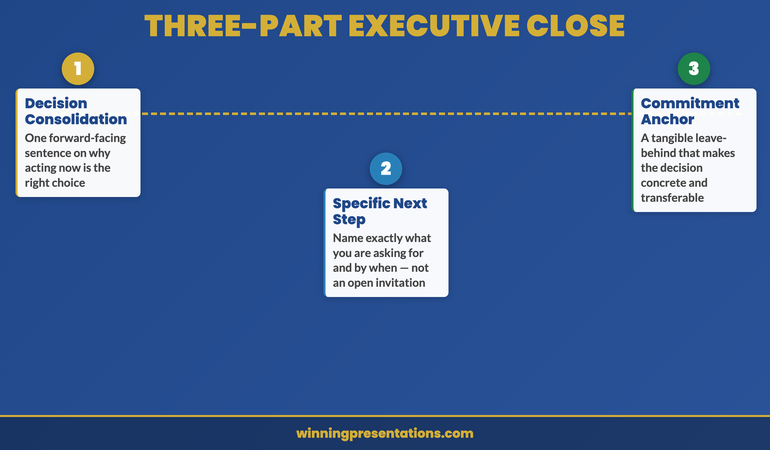
The three-part executive presentation closing framework infographic — decision consolidation, specific next step, and commitment anchor — showing how each component drives audience action

Component 1: The decision consolidation statement. This is a single sentence — delivered verbally, not read from a slide — that names the decision and frames it in terms of its strategic consequence. It should not be a summary of your presentation. A summary is backwards-facing: it tells the audience what they have just heard. The consolidation statement is forwards-facing: it tells the audience what happens if they act on what they have just heard. Example: “Approving this investment today means we can begin the procurement process this quarter and have systems in place before the regulatory deadline — which protects the business from the compliance risk we identified on slide twelve.”

Component 2: The specific next step. Name exactly what you are asking the audience to do, and by when. Not “I hope we can move forward” — that is a wish, not a next step. Not “we look forward to your feedback” — that is an invitation for correspondence, not a decision path. A specific next step sounds like: “I’m asking for approval today, subject to any conditions the board wishes to attach. If approval is given, the procurement team can begin the vendor selection process on Monday.” The more specific the next step, the more clearly the audience understands what they are being asked to do.

Component 3: The commitment anchor. This is a tangible leave-behind — a one-page summary, a printed timeline, a named next action — that makes the decision feel concrete rather than conceptual. The commitment anchor serves two purposes: it gives the audience something to refer to after you leave the room, and it signals that you are operationally ready to proceed. Presenting without a leave-behind suggests that you are still in the analysis phase. Presenting with one suggests that you have already begun.

Executive Slide System

Build Presentations That Close — Not Just Inform

The closing sequence is where presentations succeed or fail. The Executive Slide System — £39, instant access — gives you the slide templates, AI prompt cards, and closing frameworks to build presentations that drive decisions rather than generate follow-up emails.

  • Slide templates for decision-focused executive presentations
  • AI prompt cards to structure closing arguments quickly
  • Framework guides for board approvals, budget bids, and programme sign-off
  • Scenario playbooks covering common high-stakes presentation contexts

Get the Executive Slide System →

Designed for executives who need decisions, not discussions.

Commitment close vs summary close — which to use

There are two primary closing approaches used in executive presentations. The summary close — a recap of your main points followed by a recommendation — is the more common and the less effective. The commitment close — a forward-facing statement of what you are asking for and why now — is the approach that actually moves decisions.

The summary close has one legitimate use: when the audience is genuinely processing complex information for the first time and needs a synthesis before they can decide. In a ninety-minute technical briefing covering new regulatory requirements, a summary close is appropriate. In a board presentation where the topic has been on the agenda for two months, it reads as filler.

The commitment close works because it aligns with how senior decision-makers actually think about their role. They are not there to absorb information — they have assistants and briefing packs for that. They are there to make decisions. A presenter who treats the close as the decision moment — who explicitly names what the decision is and why this meeting is the right moment to make it — is speaking directly to how executives understand their function in the room.

The practical difference is in the verb you use. The summary close uses “is”: “Our recommendation is X.” The commitment close uses “need” or “ask”: “We need a decision today so that…” or “I’m asking the board to approve…” The commitment close positions you as someone with authority who is asking for a specific outcome — which is a very different posture from someone who has completed a presentation and is waiting to see what happens.

For a companion approach to the pre-meeting phase that complements a strong close, see how to use pre-decision conversations to build executive approval before the meeting.

How to handle the silence after the close

The moment after you deliver the close of a presentation is often the most uncomfortable part of the entire communication. You have named the decision. You have stated what you are asking for. And then — nothing. The room is quiet, people are looking at the table or at each other, and the temptation is to fill the silence.

Do not fill it.
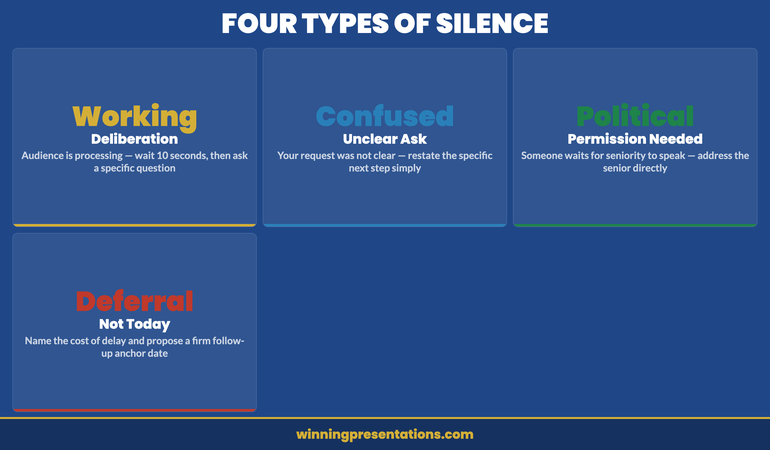
Presentation closing framework — handling silence after the close: a dashboard showing the four types of silence every executive presenter faces and the correct response to each

The silence after a close is a working silence. Decision-makers are processing — weighing the case against their own priorities, considering the implications for their stakeholders, formulating their question or their position. This is a good sign. It means your close landed and the decision is being actively considered.

When you speak into working silence, you undermine it. You suggest that you are not comfortable with the weight of the decision, that you have more to say, or that you need to soften your ask. Any of these signals weakens your close. The audience will take their cue from you: if you seem uncertain about whether to act, they will feel uncertain too.

The practical rule is to count to ten after your close. Ten seconds feels much longer than it is. In that time, the decision-maker who was about to speak will speak. If nobody speaks after ten seconds, ask a specific question: “Does anyone have concerns they’d like to raise before we move to a decision?” This moves the silence from open-ended to purposeful, without retreating from your position.

If you are building a presentation for a critical decision meeting and want a structured framework that takes you from opening through to close, the Executive Slide System includes closing sequence templates specifically designed for high-stakes executive contexts.

Closing mistakes that undermine credibility

There are five closing patterns that consistently undermine the effectiveness of executive presentations, regardless of how strong the preceding content has been.

The apologetic close. “I know this was a lot to cover in a short time” or “I realise there’s still some uncertainty in these numbers.” Self-deprecation in the close signals that you are not fully confident in your own case — which gives decision-makers permission to defer. If there is genuine uncertainty in your data, address it during the body of the presentation, not in the final sentence.

The laundry list close. Ending with five or six “next steps” dilutes the decision and gives the audience multiple low-friction alternatives to the main ask. If you need approval today, that should be the only next step in the close. Other actions can follow from it.

The over-summarised close. A summary that takes more than ninety seconds is no longer a summary — it is a second presentation. Decision-makers in executive settings have excellent memories for content they found compelling. A lengthy recap implies you do not trust them to remember what you said.

The open-ended close. Ending with “I’m happy to discuss further” or “I’d welcome your thoughts” without naming a decision invites discussion, not decision-making. Both have their place, but they are different processes. Be clear about which one you are opening.

The gratitude close. “Thank you for your time — I really appreciate you giving us this opportunity.” Gratitude is appropriate at the very end of a meeting, after the decision has been made. Opening the close with it signals that you consider the presentation to be over before the decision has been made, which it has not.

For a foundational treatment of executive summary structure that informs the closing sequence, see how to structure an executive summary slide that sets the decision frame.

The follow-up anchor technique

When a decision cannot be made in the room — because a key stakeholder is absent, because additional information is genuinely needed, or because the governance structure requires a second layer of approval — the follow-up anchor is the technique that keeps momentum alive rather than allowing the decision to drift.

The follow-up anchor is a specific, named commitment made in the room before the meeting ends. Not “we’ll be in touch” — that is not a commitment, it is a valediction. The follow-up anchor sounds like: “Before we close, can I confirm that you’ll have a response to me by next Wednesday? I’ll send a one-page summary with the key decision points this afternoon to support your deliberations.” The anchor has a date, a named person, and a specific deliverable.

The follow-up anchor works because it converts a vague “we’ll think about it” into a named next action with a deadline. It also signals operational competence — you are already managing the process, not just presenting the case. Decision-makers respond positively to this because it reduces their administrative burden: they know what they will receive and when, which makes it easier for them to engage.

The one-page summary you send after the meeting should be designed for forwarding. Senior decision-makers rarely make decisions alone — they consult their own advisers, their finance directors, their chief of staff. A clean, one-page summary that travels well through an organisation is more powerful than a detailed report that requires the decision-maker to interpret it on behalf of others.

For related thinking on how competitive presentations use the closing sequence, see the companion article: competitive tender presentation: how to win the room against an established vendor.

Executive Slide System — £39

The Structure Behind Presentations That Get Decisions

The Executive Slide System — £39, instant access — gives you slide templates, closing frameworks, and AI prompt cards to build executive presentations that move from opening context to clear decision moment without losing the room in between.

Get the Executive Slide System →

Designed for executives who need decisions, not discussions.

Frequently Asked Questions

How long should the close of a presentation be?

For most executive presentations, the close should take no more than two to three minutes. This includes the decision consolidation statement (one sentence, delivered verbally), the specific next step (one or two sentences), and the handover of any commitment anchor. If your close is taking longer than three minutes, you are either summarising rather than closing, or you have identified that additional persuasion is needed — which means you should address it in the body of the presentation, not the close. The brevity of the close is itself a signal of confidence: you believe your case has been made and you are asking for the decision.

What if the audience has objections during the close?

An objection raised during the close is usually one of two things: a genuine concern that was not addressed during the presentation, or a signal that the audience is engaging seriously with the decision. In either case, welcome it rather than defending against it. Name the objection: “That’s a fair challenge — let me address it directly.” Then answer specifically, without retreating from your recommendation. If the objection reveals a genuine gap in your case, acknowledge it, state how you will address it, and modify your next step accordingly: “Given that concern, what I’d suggest is a thirty-minute session next week to go through the risk model in more detail. Can we agree that as the next step?”

Is it appropriate to ask for a decision in a board presentation?

Yes — and in most cases it is not only appropriate but expected. Board members are decision-makers by function. Presenting to a board without asking for a decision leaves them in the position of advisers rather than governors, which is not the role they are paid to play. The key is to frame the decision clearly and to name the consequence of not deciding: “Every month we delay the programme costs the business approximately £X in operational inefficiency.” This is not pressure — it is information. Decision-makers need to understand the cost of inaction in order to weigh the decision correctly.

The Winning Edge

Weekly executive communication insight — every Thursday

Practical, no-filler analysis of what works in high-stakes presentations — including closing techniques, board communication, and decision-meeting structure.

Subscribe to The Winning Edge →

Free resource: Download the Executive Presentation Checklist — a pre-presentation audit used by Mary Beth’s clients before every high-stakes decision meeting.

About the Author

Mary Beth Hazeldine — Owner & Managing Director, Winning Presentations

With 25 years of corporate banking experience at JPMorgan Chase, PwC, Royal Bank of Scotland, and Commerzbank, Mary Beth advises executives across financial services, healthcare, technology, and government on structuring presentations for high-stakes funding rounds and board approvals. Her work focuses on the communication architecture that moves decisions.

13 Apr 2026
Female VP Business Development presenting a competitive tender to a corporate procurement panel — confident, composed posture, presentation screen visible, executive boardroom setting with navy and gold tones

Competitive Tender Presentation: How to Win the Room Against an Established Vendor

Quick Answer

A competitive tender presentation wins when it addresses the buyer’s real risk — the risk of switching — rather than simply competing on features and price. Structure your presentation around the cost of staying, your transition credibility, and a specific decision path. The goal is not to be the best option in the room. It is to make switching feel safer than staying.

Valentina had spent eleven years building her consultancy’s reputation in supply chain technology. When a procurement opportunity came through from a global retail group — one the firm had been pursuing for two years — she put together what she considered the strongest pitch deck of her career. Detailed capability statements, three comparable implementation case studies, and a pricing model that came in twelve per cent below the incumbent.

She presented to a panel of seven. The conversation was professional, the questions were substantive, and she left the room feeling cautiously optimistic. Two weeks later, the client renewed with the incumbent.

When she called the procurement lead to ask for feedback, the response was instructive: “Your capability was not in question. But when we tried to imagine the transition, it felt like a risk we didn’t know how to manage. The incumbent knows our systems. You don’t — yet.”

Valentina had done what most challengers do: she had built a presentation designed to prove she was good enough. What she had not done was address the one question that actually drove the decision: Is switching worth the disruption?

A competitive tender presentation is not a capability audit. It is a risk management conversation. The buyers already know you have capability — you passed the initial screening. What they are evaluating in the room is whether the risk of choosing you is lower than the risk of staying with a known quantity. Every slide in your tender deck needs to speak to that question, directly or indirectly.

Preparing a competitive tender deck?

If you’re structuring a tender presentation from scratch and want a framework built for high-stakes competitive pitches, the Executive Slide System provides templates and scenario guides designed for exactly this context. Explore the System →

Why challengers lose tender presentations before they begin

The structural disadvantage facing any challenger in a competitive tender is well understood: the incumbent has relationships, institutional knowledge, and the powerful psychological advantage of familiarity. Buyers know exactly what they are getting if they stay. They do not know exactly what they are getting if they switch — which means switching carries uncertainty even when your offering is objectively superior.

What is less well understood is how challengers make this disadvantage worse through their presentation choices. The most common mistake is building a capability-led deck: a presentation that leads with who you are, what you have done, and why you are qualified. This structure unintentionally confirms the buyer’s anxiety. It says, in effect, “here is why we are good enough to consider.” The incumbent does not need to make this argument. They are already the default.

A capability-led presentation also invites the wrong comparisons. When you open with your track record and credentials, you prompt the panel to compare your track record with the incumbent’s track record — a comparison the incumbent will almost always win, simply by virtue of having more history in the specific industry or category.

The challenge-led presentation works differently. It opens with the buyer’s problem — ideally the specific cost or risk the buyer is carrying by staying with the current provider — and positions your solution as the structured response to that cost. This is a fundamentally different conversation. Instead of competing on the same territory as the incumbent, you are reframing what the tender decision is actually about.

For related thinking on competitive pitch structure, see how to structure a competitive displacement pitch against an incumbent vendor.

The five structural elements of a winning competitive tender presentation

The most effective competitive tender presentations share a consistent architecture regardless of sector or deal size. The specific content changes; the structure does not.

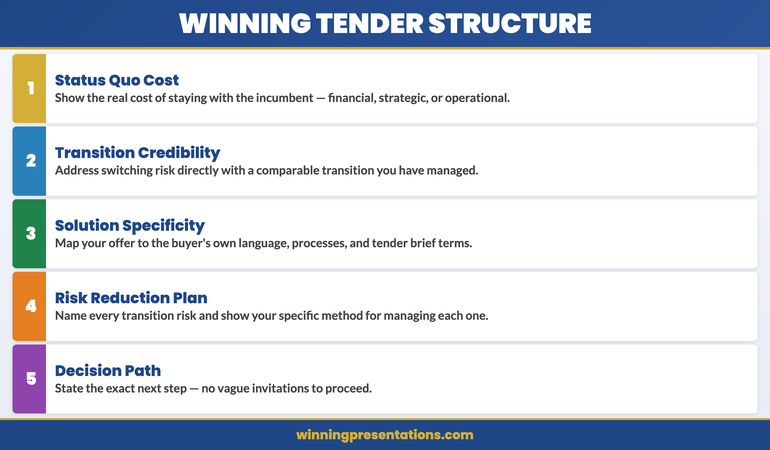
The five structural elements of a competitive tender presentation infographic: status quo cost, transition credibility, solution specificity, risk reduction plan, decision path — showing each stage with key questions

1. The status quo cost (slides 1–2). Open not with who you are, but with what staying is currently costing the buyer. This requires research — you need to identify the specific operational, financial, or strategic cost the buyer is bearing under the current arrangement. It might be underperformance against a contract metric, a capability gap the current supplier has not addressed, or an emerging strategic risk the buyer faces that the incumbent’s offering does not cover. Frame this cost in terms the panel will recognise immediately.

2. Transition credibility (slides 3–4). Before presenting your solution, address the switching risk directly. Show comparable transitions you have managed — the complexity involved, the timeline, and the method by which you reduced disruption for the previous client. If you can include a specific example from a similar procurement environment, do so. The goal is to make the buyer feel that your transition management is a known and tested capability, not an aspiration.

3. Solution specificity (slides 5–7). Now present your solution — but do so in the specific language of this buyer’s context. Generic capability slides undermine your credibility at this stage. Instead, map your solution to the specific requirements, processes, and terminology in the tender brief. Buyers notice — and respond positively — when a presenter has absorbed their language rather than presenting in their own.

4. Risk reduction plan (slide 8). This slide is often absent from challenger decks, and its absence is frequently the deciding factor. A risk reduction plan shows the panel that you have already anticipated the transition risks they are worried about and have a specific method for managing each one. Include timelines, accountability, and escalation paths. The more concrete this slide is, the more it neutralises the incumbent’s primary advantage.

5. Decision path (slide 9). End with a specific next step rather than a general invitation to proceed. Name the decision the panel needs to make, the information they would need to make it, and the timeline within which you can begin. This demonstrates operational readiness and removes the vagueness that allows panels to defer rather than decide.

Executive Slide System

Structure Your Tender Pitch to Win — Not Just Compete

When the incumbent has the relationship advantage, your presentation structure becomes the differentiator. The Executive Slide System — £39, instant access — gives you the frameworks and templates designed for competitive, high-stakes pitches where capability alone is not enough.

  • Slide templates for competitive and procurement scenarios
  • AI prompt cards to build challenger narratives quickly
  • Framework guides for structuring risk-reduction arguments
  • Scenario playbooks for high-stakes client and tender presentations

Get the Executive Slide System →

Designed for executives presenting in competitive, high-stakes procurement environments.

How to frame the risk of change without triggering inertia

The most counterproductive thing a challenger can do in a tender presentation is ignore the switching risk. Buyers know the risk is there. If you do not address it, they will carry it silently through the rest of your presentation — and that unaddressed anxiety will eventually outweigh your capability argument.

The equally counterproductive response is to minimise the switching risk: “The transition is very straightforward” or “We have done this hundreds of times.” These reassurances are generic and feel hollow because they do not engage with the specific complexity of this buyer’s context. They can actually increase anxiety by suggesting you have not fully understood what you are taking on.

The approach that works is specificity. Acknowledge the real complexity of the transition — name the specific systems, processes, or stakeholders that will be affected — and then show your specific method for managing each point of complexity. This demonstrates that you understand the buyer’s environment in detail and that your transition plan is not a template but a tailored response.

There is also a reframing technique that experienced tender presenters use to good effect: explicitly comparing the risk of switching with the risk of staying. If the buyer is considering switching, it is because the current arrangement carries some form of risk — performance, capacity, strategic fit, or cost. A slide that maps the risks on both sides of the decision helps the panel see that the question is not “shall we take on a transition risk?” but “which risk is more manageable?” This reframe moves the conversation from a comparison of you versus the incumbent to a comparison of two different risk profiles — and gives the panel a more honest basis for deciding.

See also: how to structure a partnership proposal presentation that gets to yes in one meeting — the risk-reframing principle applies equally in partnership contexts.

The competitor comparison that builds credibility

Many tender presentations either include a direct competitor comparison slide or avoid it entirely. Both approaches, handled poorly, create problems. A direct comparison slide can look defensive and invites the panel to scrutinise every claim. Avoiding comparison entirely can leave the panel drawing their own comparisons — which may be less favourable.

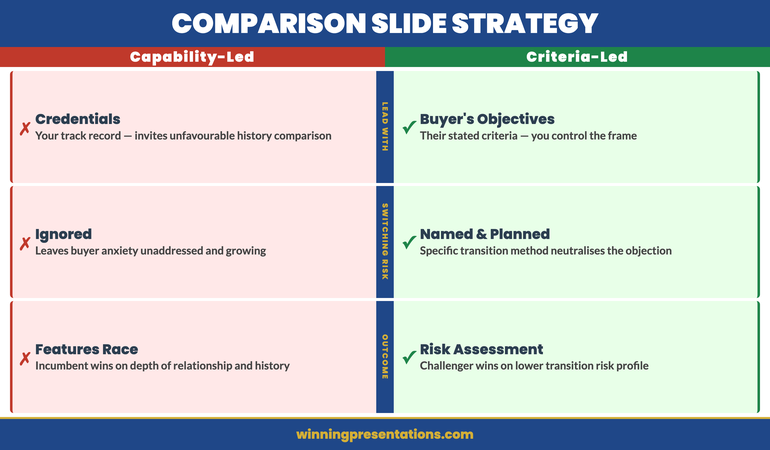
Competitive tender presentation comparison slide strategy: wrong approach vs right approach — infographic showing how challenger presenters should frame competitor comparisons to build rather than undermine credibility

The most effective comparison approach focuses not on features but on decision criteria. Rather than building a table that compares your offering directly against the incumbent’s (which you will lose on depth of relationship and institutional knowledge regardless of your product superiority), build a table that maps both options against the buyer’s specific stated objectives from the tender brief.

This approach has three advantages. First, it anchors the comparison in criteria the buyer has already committed to publicly — making it harder to dismiss. Second, it shifts the conversation from a personality contest to a strategic assessment. Third, it gives you control over which criteria appear on the slide — allowing you to emphasise the dimensions where the challenger naturally performs strongly and where the incumbent’s age or approach is genuinely a limiting factor.

The comparison slide also works well as a device for naming the switching cost explicitly. A row labelled “Transition risk management” that shows your specific methodology against the incumbent’s “existing relationship” creates a natural opening for the risk-reduction conversation.

One important discipline: every claim you make on a comparison slide must be defensible in Q&A. If a panel member challenges a point, you need to be able to substantiate it calmly and specifically. Vague claims — “we offer superior customer service” — will be challenged and undermine your overall credibility if you cannot back them up with a specific example or metric.

If you are building this presentation from scratch and want a framework for structuring competitive pitches at executive level, the Executive Slide System includes scenario-specific templates and prompt cards designed for high-stakes procurement presentations.

“You’re too new to us” — handling the relationship objection in Q&A

Almost every competitive tender Q&A will include some version of the relationship objection. It may be explicit: “How do we know you’ll understand our business quickly enough?” Or it may be implicit, emerging as a series of questions about your experience in their specific sector, their geography, or with organisations of their scale.

The relationship objection is not really about your knowledge or capability — you have already demonstrated those through the tender process. It is about the buyer’s anxiety around the unknown. They are asking, in effect: “When something goes wrong — and something always goes wrong — will you know how to respond in a way that fits how we operate?”

The most effective response pattern has three parts. First, validate the concern without dismissing it: “You are right that we are building this relationship from scratch rather than extending an existing one — and that is worth taking seriously.” Second, reframe what ‘knowing your business’ actually requires at the operational level: most organisations’ internal processes are not as unique as they feel from inside, and your experience with comparable organisations is directly transferable. Third, offer a specific mechanism for accelerating the relationship: a structured discovery process, named relationship managers, and a defined escalation path during the first six months.

The worst response to the relationship objection is a defensive one: “We have significant experience in your sector and have worked with organisations like yours across twelve countries.” This reads as a credential recitation — which the panel has already seen — rather than an engagement with their specific concern. It confirms the anxiety rather than addressing it.

For a related account management scenario, see how to structure an account review presentation to retain a client.

The closing sequence in competitive tender presentations

The close of a competitive tender presentation is where most challengers revert to convention — a summary slide, a “thank you for your time” acknowledgement, and a general invitation to proceed. This is a missed opportunity.

The closing sequence of a tender presentation should do three things. First, it should consolidate the decision logic — not rehearse your entire capability argument, but name the single most important reason why selecting you is the lower-risk decision. One sentence, delivered with authority. Second, it should anticipate the next step specifically: not “we look forward to your decision” but “the next step would be a thirty-minute technical review with your operations team, which we can schedule for any time this week.” Third, it should leave the panel with something tangible — a one-page summary of your risk-reduction plan, your transition timeline, or your named relationship team.

The tangible handout serves two purposes: it gives the panel something to refer to during their deliberations, and it demonstrates the operational confidence that distinguishes a serious challenger from a speculative one. Incumbents rarely bring handouts to tender presentations — they do not need to. You do. Use them.

For a deeper treatment of closing sequences in high-stakes presentations, see the companion article: presentation closing framework: the techniques that drive executive decisions.

Executive Slide System — £39

The Framework Behind Every Competitive Pitch

The Executive Slide System — £39, instant access — gives you the templates, AI prompt cards, and scenario playbooks to structure competitive tender presentations that address switching risk, demonstrate transition credibility, and close with a specific decision path.

Get the Executive Slide System →

Designed for executives presenting in competitive procurement environments.

Frequently Asked Questions

How long should a competitive tender presentation be?

Most procurement panels allocate thirty to sixty minutes for a tender presentation, including Q&A. Structure your presentation to use no more than two-thirds of the allotted time for the formal presentation, leaving the remainder for questions. If you are given sixty minutes, aim for a forty-minute deck. A presentation that runs over time signals poor planning — a significant disadvantage in a competitive context. The goal is a tight, decision-focused narrative, not a comprehensive capability audit.

Should I name the incumbent in my tender presentation?

Name the incumbent only if doing so is strategically useful and you can substantiate every claim you make. In most cases, it is more effective to reference the incumbent obliquely through the “status quo cost” framing — describing the type of limitation the buyer is experiencing — rather than directly naming them. Direct naming can come across as aggressive and may put the panel in a defensive posture if they have an existing positive relationship with the provider. The exception is a direct comparison slide anchored to the buyer’s own tender criteria, where naming the incumbent is expected and framing is neutral and factual.

What if the buyer tells us we lost on price?

If price is cited as the reason for losing, it is worth exploring whether price was the actual reason or a proxy for a different concern. Procurement panels sometimes cite price because it is a defensible, objective explanation — whereas the real hesitation may have been around relationship, transition confidence, or internal politics. Ask for a thirty-minute debrief and listen carefully for what sits behind the price objection. Occasionally the real opportunity is to address the underlying concern rather than adjust your pricing.

The Winning Edge

Weekly executive communication insight — in your inbox every Thursday

Join executives across financial services, healthcare, and technology who receive practical, no-filler analysis of what works in high-stakes presentations and what doesn’t.

Subscribe to The Winning Edge →

Free resource: Download the Executive Presentation Checklist — a pre-presentation audit used by Mary Beth’s clients before every high-stakes pitch.

About the Author

Mary Beth Hazeldine — Owner & Managing Director, Winning Presentations

With 25 years of corporate banking experience at JPMorgan Chase, PwC, Royal Bank of Scotland, and Commerzbank, Mary Beth advises executives across financial services, healthcare, technology, and government on structuring presentations for high-stakes funding rounds, procurement decisions, and board approvals. Her work focuses on the communication architecture that moves decisions — not just the slides.

12 Apr 2026
Professional executive presenting calmly and confidently to boardroom colleagues

Overcome Presentation Anxiety: Online Course for Professionals

If you are looking for an online course to overcome presentation anxiety, Conquer Speaking Fear is a 30-day programme designed specifically for professionals who present regularly and need a structured, evidence-informed approach to managing their response to high-stakes speaking. Unlike generic mindfulness apps or public speaking tips, Conquer Speaking Fear combines nervous system regulation techniques with clinical hypnotherapy sessions built around the presentation context — not just speaking in the abstract. It is available now at £39, instant access. This page explains what the programme includes, who it is designed for, and how to decide whether it is right for your situation.

The Problem: Presentation Anxiety Is Not Just Nerves

For many professionals, the difficulty with presentations goes beyond the pre-meeting nerves that most people describe. It shows up differently depending on the person — a voice that tightens in the first few minutes, a mind that empties of everything it rehearsed the moment a difficult question arrives, or a pattern of quietly declining to present in high-stakes meetings when alternatives are available. Over time, avoidance becomes its own problem: the fewer high-stakes presentations you do, the more charged each one becomes.

Senior professionals often experience this acutely precisely because the stakes are higher. When you have been promoted to a level where your presentations carry real weight — where decisions get made or blocked based on how you communicate — the pressure compounds. Anxiety at this level is not about lacking experience. It is about a nervous system that has learned to treat the presenting environment as a threat, and that responds accordingly regardless of how well you know the material.

This is a physiological pattern, not a character flaw. The voice tightening, the mind going blank under pressure, the dread in the days before a presentation — these are normal nervous system responses that have been calibrated to the wrong stimulus. They are also, with the right structured approach, genuinely workable.

If you have tried general confidence-building approaches and found that they help in lower-stakes situations but do not reliably hold under real pressure, the reason is usually that those approaches do not address the nervous system response directly. Understanding the full range of what treatment-resistant presentation anxiety looks like can help clarify whether what you are experiencing falls into that category.

The Solution: Conquer Speaking Fear

Conquer Speaking Fear is a 30-day structured online programme that addresses presentation anxiety at the level where most approaches stop short: the nervous system. The programme does not ask you to think your way out of anxiety or to simply push through it with willpower. It gives you a set of practical, evidence-informed techniques — drawn from nervous system regulation and clinical hypnotherapy — that change how your body and mind respond to the presentation environment over time.

The programme is built around consistency over intensity. Thirty days of structured practice, with each module building on the previous, creates lasting change in a way that a single intensive workshop rarely does. The techniques are designed to be used in real professional life — not just in quiet practice sessions, but in the moments before you enter a room and during a presentation when you need them most.

Clinical hypnotherapy is one component that often raises questions. In this context, it refers to audio-guided sessions designed to work at the level of the subconscious associations that drive the anxiety response — the part of the brain that decides presentations are threatening before the rational mind has a chance to evaluate the situation. This is not stage hypnosis. It is a well-established technique used in clinical practice for anxiety management, adapted here specifically for the professional presenting context.

The programme also includes a dedicated module for professionals who have had a presenting experience that went badly — a major stumble, a hostile Q&A, or a presentation that resulted in significant professional consequences. For some people, that kind of experience creates a specific pattern that general anxiety work does not touch. The exposure ladder approach to presentation anxiety covers the gradual re-engagement strategy that complements this module well.

What You Get

  • 30-day structured programme — daily modules that build systematically, designed to fit around a working professional’s schedule
  • Nervous system regulation techniques — practical methods for managing the physiological response before, during, and after presentations
  • Clinical hypnotherapy audio sessions — guided sessions designed specifically for the professional presentation context, addressing subconscious anxiety patterns
  • Module for presenting after a difficult experience — dedicated support for professionals recovering from a presentation that went significantly wrong
  • In-the-moment symptom management techniques — tools you can use during a live presentation, not just in preparation
  • Instant access — start today, work at your own pace within the 30-day structure

Price: £39 — instant access, no subscription.

Build a Presenting Practice That Does Not Depend on the Day You Are Having

Conquer Speaking Fear gives you the structured, 30-day programme to shift your relationship with high-stakes presenting — using nervous system regulation and clinical hypnotherapy techniques developed for professionals, not for general public speaking anxiety. £39, instant access.

  • ✓ 30-day programme with daily structured modules
  • ✓ Clinical hypnotherapy audio sessions for presentations
  • ✓ Nervous system techniques for before and during presentations
  • ✓ Module for recovering from a difficult presenting experience

Get Conquer Speaking Fear → £39

Instant access · £39 · No subscription

Is This Right for You?

Conquer Speaking Fear is designed for professionals who present regularly as part of their role and who experience a consistent anxiety pattern that affects their performance or their willingness to take on high-visibility presentations. It is particularly suited to people who have already tried general confidence-building approaches — workshops, affirmations, breathing techniques — and found that those approaches do not hold reliably under real pressure.

It is right for you if: you experience physical symptoms (voice tightening, mind going blank) under presentation pressure; you find that dread in the days before a presentation affects your preparation; you avoid certain high-stakes speaking opportunities; or you have had a difficult presenting experience that has affected your confidence since.

It is not designed for people who are simply looking to improve their slide design or delivery technique without an anxiety component — for those needs, a slide structure resource or presentation skills training would be more appropriate. It is also not a replacement for clinical support if you are experiencing significant anxiety across multiple areas of your life — if that is your situation, working alongside a qualified therapist while using this programme is entirely appropriate.

For professionals with specific questions about how cognitive restructuring for presentation anxiety works as a complementary approach, that guide covers the thinking-level techniques that sit alongside the nervous system work in this programme.

Frequently Asked Questions

Is this the same as meditation or mindfulness?

No. Mindfulness and meditation are valuable practices, but they work primarily at the level of conscious awareness. Conquer Speaking Fear includes nervous system regulation techniques that address the physiological response to presentation pressure — the physical symptoms that occur before and during presenting — and clinical hypnotherapy sessions that work at the level of subconscious association patterns. If you have tried mindfulness and found it helpful in daily life but unreliable under presentation pressure, this programme addresses a different mechanism.

Does this work if my anxiety is severe?

The programme is designed for professionals who experience meaningful anxiety in presenting contexts — ranging from persistent pre-presentation dread to physical symptoms that affect delivery. If your anxiety is severe enough that it is affecting your broader daily functioning, working alongside qualified clinical support is advisable, and this programme can complement that work. If your anxiety is specifically and primarily triggered by presenting situations — which is the case for many professionals — this programme is directly designed for your pattern.

How long until I see results?

Most participants notice a shift in their physical response to presentation preparation within the first two weeks of consistent practice. The nervous system regulation techniques in particular can produce noticeable results relatively quickly, because they address the physiological response directly rather than trying to change it through thought alone. Full integration — where the techniques hold reliably under significant pressure — typically develops over the 30-day programme period. The programme is structured to build progressively, so results deepen as you continue.

Can I do this alongside other anxiety support?

Yes. Conquer Speaking Fear is designed to work as a standalone programme, and it is also compatible with other anxiety support — including therapy, coaching, or medication prescribed by a clinical professional. If you are currently working with a therapist on anxiety, it is worth mentioning that you are using a presentation-specific programme so they can be aware of the techniques you are practising. The approaches in this programme do not conflict with standard evidence-based anxiety treatments.

Is this suitable for C-suite executives?

Yes — and the programme is particularly relevant at C-suite level, where the stakes of each presentation are highest and the expectation to appear composed under pressure is most acute. Senior executives often find that general public speaking courses feel too basic for their experience level. Conquer Speaking Fear does not address presentation skills or delivery technique — it addresses the anxiety pattern itself, which operates independently of seniority or experience. The more visibility your presentations carry, the more disruptive an unchecked anxiety pattern becomes.

The Winning Edge

Weekly insights on executive presentations, speaking confidence, and high-stakes communication — delivered every Thursday.

Subscribe Free

About the author

Mary Beth Hazeldine, Owner & Managing Director, Winning Presentations. With 25 years of corporate banking experience at JPMorgan Chase, PwC, Royal Bank of Scotland, and Commerzbank, and 16 years working with executives on high-stakes presentations, she advises senior professionals across financial services, healthcare, technology, and government on structuring and delivering presentations under pressure.

12 Apr 2026
Female executive facilitating a hybrid meeting with colleagues on a large video screen and in-person attendees at the table, corporate boardroom setting

Hybrid Meeting Facilitation: How to Include Remote Participants Without Losing Control

Quick Answer

Hybrid meeting facilitation works when you design the room dynamics deliberately rather than hoping in-person and remote participants will self-equalise. The anxiety many facilitators feel in hybrid rooms comes from the loss of unified attention — which is a structural problem, not a personal one, and it has practical solutions.

Valentina had facilitated hundreds of meetings in her career as an operations director. In-person rooms she could read in seconds — the body language, the energy shift when someone disengaged, the moment when the room was ready to decide. She was good at it, and she knew it.

Then her organisation moved to hybrid working and the nature of her meetings changed. Half the team in the room, half on screen. And something she hadn’t anticipated happened: she felt nervous in a way she hadn’t felt since the early years of her career.

“I couldn’t read the room any more,” she told me. “The people on screen — I could see their faces but I couldn’t tell whether they were engaged or had muted themselves and gone to make coffee. And the people in the room were talking to each other instead of the camera. I came out of one meeting and thought: I have no idea whether that was useful for anyone.”

What Valentina was experiencing is one of the more common and underacknowledged confidence challenges in modern workplace presenting. It isn’t glossophobia — the fear of speaking in front of groups. It’s a specific disorientation that comes from losing the unified attention that in-person rooms provide. When you can’t read all the signals, the uncertainty triggers an anxiety response that experienced presenters often find more unsettling than the more familiar nerves of a high-stakes speech.

The good news is that this specific form of hybrid anxiety is almost entirely addressable through structure and technique — not through years of practice or therapeutic intervention, but through deliberate design of the meeting environment before you start.

Is presentation or facilitation anxiety affecting your confidence?

If the anxiety you feel in hybrid or virtual rooms is part of a broader pattern of speaking nerves, the Conquer Speaking Fear programme gives you a structured approach to addressing the nervous system response at its source — not just managing the symptoms. Explore the Programme →

Why hybrid meeting facilitation feels so difficult

Hybrid meeting facilitation is genuinely more demanding than either in-person or fully virtual facilitation — not because it combines both, but because it combines both badly unless you actively prevent that from happening. The default hybrid room dynamic, left unmanaged, creates two separate and unequal experiences: in-person participants get a richer, more connected meeting; remote participants get a window into someone else’s meeting.

This inequality is not primarily a technology problem. It is a facilitation problem. The room audio favours in-person participants — their side conversations are audible; the remote participants’ contributions require deliberate acknowledgement to be heard. The visual default is the in-person room — the camera faces the room rather than each individual participant, so remote participants see a collection of backs and profiles rather than faces. And the social dynamics of in-person groups mean that in-person participants naturally gravitate towards each other — which unconsciously de-prioritises the remote contributions.

The facilitator in this environment is managing two rooms simultaneously, with different sensory feedback from each. In the physical room, you can see engagement, restlessness, confusion, and readiness. On screen, you see a grid of faces — some attentive, some in shadow, some clearly multitasking. The bandwidth for social cues is dramatically reduced, and for a facilitator whose instincts have been trained on in-person rooms, the loss of that signal creates a specific kind of anxiety: the feeling that you are not really in control of what’s happening.

Understanding that this is a structural feature of hybrid rooms — rather than evidence of a personal shortcoming — is the first and most important step in addressing the anxiety it generates.

Conquer Speaking Fear

Address the Anxiety at Its Source

If the anxiety you experience in hybrid rooms is part of a broader pattern of presentation nerves, Conquer Speaking Fear — £39, instant access — gives you a structured 30-day programme designed to address the nervous system response that underlies speaking anxiety in any format.

  • 30-day structured programme for executive speaking confidence
  • Nervous system regulation techniques that work before and during meetings
  • Clinical hypnotherapy-based approaches for deep-seated speaking anxiety
  • Practical strategies for high-stakes and unfamiliar presenting environments

Get Conquer Speaking Fear →

Designed for executives experiencing speaking anxiety in any context — in-person, virtual, or hybrid.

The anxiety response in hybrid rooms — and why it’s not your fault

The anxiety that hybrid facilitation produces in experienced presenters is rooted in a specific neurological dynamic: uncertainty. The human nervous system is significantly more reactive to ambiguous threat signals than to clear ones. When you can read a room — when you know who is engaged, who is sceptical, who is ready to contribute — your nervous system has enough information to regulate. When the signals are partial or unclear, the nervous system tends to assume the worst and increases its arousal level accordingly.

In a hybrid meeting, the remote participants represent a zone of reduced signal clarity. You can see their faces, but you can’t read their body language with the same accuracy as in-person participants. You can hear them when they speak, but you can’t hear the small sounds of engagement — the murmured agreements, the shifted attention — that in-person facilitators rely on. This reduced signal creates a low-level but persistent uncertainty that, for many experienced presenters, triggers an anxiety response disproportionate to the actual difficulty of the situation.

The key insight is that this response is adaptive — it is your nervous system correctly identifying that it has less information than it’s used to having — but it is not a reflection of your capability as a facilitator. The solution is not to try harder to read the remote room with the same instincts you use for in-person rooms. Those instincts were calibrated for an environment with more information. The solution is to build a different set of deliberate facilitation practices that compensate for the reduced signal — and to reduce the uncertainty through structure rather than trying to perceive your way through it.

For a broader discussion of how the nervous system response to presenting environments can be regulated, the article on managing presentation anxiety in remote and camera settings covers the physiological basis of camera-related speaking anxiety and the techniques that address it.

Designing the room before the meeting starts

The single most effective thing a hybrid meeting facilitator can do is spend ten minutes before the meeting designing the environment — not the content, the environment. This includes the physical setup, the technology configuration, and the explicit agreement with participants about how the session will run.

Hybrid meeting facilitation setup checklist infographic showing five pre-meeting design decisions: camera positioning, audio configuration, participant roles, engagement protocol, and turn-taking method

Camera positioning. The default camera position in most meeting rooms points at the in-person group — which means remote participants see a wide-angle view of several people rather than clear faces. Where possible, position cameras so that individual in-person participants are visible to the remote group. If the room has a single camera, position the in-person group in a tight arc that fits the camera frame rather than spread across a large table.

Audio configuration. Test the microphone pickup before the meeting starts, specifically for the participants furthest from the primary microphone. Side conversations and quieter voices are the most common source of remote participant exclusion — not because people are excluding them deliberately, but because the room’s acoustic default isn’t configured for remote pickup.

Explicit participation protocol. Open the meeting by naming the facilitation approach: “I’m going to actively bring the remote participants into the discussion by name — please don’t feel I’m putting you on the spot, I want to make sure we’re hearing from both rooms.” This sets expectations, reduces the anxiety of remote participants who don’t know when to contribute, and gives you a facilitation tool you can use without it feeling like an intervention.

Remote participant roles. For meetings with a strong facilitation component, consider giving remote participants an active role beyond contribution — for example, one remote participant as the designated note-taker, one as the time-keeper, or one as the summariser. Active roles reduce the passive observation dynamic that makes remote participation feel marginal.

Facilitation techniques that work across both rooms

Once the room is set up appropriately, the facilitation techniques that work best in hybrid meetings share a common characteristic: they are explicit rather than implicit. Where in-person facilitation can rely on eye contact, gesture, and spatial movement to direct the conversation, hybrid facilitation requires verbalising the things that would otherwise be communicated non-verbally.

Named contribution. Rather than opening the floor generally (“does anyone have thoughts on this?”), direct contributions by name: “Kwame, you’ve worked on this in your region — what’s your read?” This works for in-person participants but is particularly valuable for remote ones, who are more likely to hold back when the floor is open than when they’re directly invited. It also reduces the awkward dynamic where multiple people try to speak at once.

Regular remote checks. At natural breakpoints in the discussion — after a key point has been made, before moving to a new agenda item — explicitly check with the remote group: “Before we move on, is there anything from the remote side that hasn’t had a chance to come in?” This normalises the check rather than making it feel like an afterthought, and it creates a rhythm that remote participants can rely on.

The Conquer Speaking Fear programme includes techniques for managing the specific nervous system response that hybrid and virtual environments trigger — approaches that work immediately, not after months of practice — see what’s included.

Visible shared document. For meetings that involve collective decision-making or problem-solving, a shared document or digital whiteboard that both in-person and remote participants can see simultaneously equalises the visual experience. In-person participants who can see a physical whiteboard have an advantage over remote participants who cannot — a shared digital workspace removes that asymmetry.

For a complete set of techniques for virtual and hybrid presentations, the article on virtual presentation tips for executive meetings covers the full range of engagement strategies that transfer from in-person to screen environments.

Building your confidence as a hybrid facilitator

Confidence in hybrid facilitation — like confidence in any presenting context — comes from accumulated experience of it going well. The challenge is that hybrid meetings are still relatively new as a format, and many experienced presenters don’t yet have the same bank of successful hybrid experiences that they have for in-person facilitation. The default is to rely on in-person instincts in a format where those instincts are less reliable — which creates exactly the uncertainty and anxiety described earlier.

Building hybrid facilitation confidence — roadmap infographic showing five stages from first hybrid session to fluent facilitation, with key skills to develop at each stage

The most direct route to building hybrid facilitation confidence is deliberate low-stakes practice. If your high-stakes hybrid meetings are board presentations or executive committee sessions, the confidence you need for those environments should be built in lower-stakes hybrid meetings first — team calls, project updates, internal workshops. Treating these as practice sessions for the specific techniques of hybrid facilitation — named contribution, remote checks, shared documents — builds the instincts that the higher-stakes sessions require.

Post-meeting reflection is also valuable in a way that it often isn’t for experienced in-person facilitators who already have well-developed instincts. After each hybrid meeting, spend two minutes noting: what worked for the remote participants, what didn’t, and what one thing you would change next time. This systematic reflection accelerates the development of hybrid-specific facilitation instincts significantly faster than simply accumulating experiences without analysing them.

For a broader discussion of how speaking confidence develops in unfamiliar presenting environments, the article on managing hybrid presentations when half the audience is remote covers the specific confidence dynamics of split-room audiences.

Conquer Speaking Fear — £39

Build the Confidence That Works in Any Room

Conquer Speaking Fear — £39, instant access — gives you a 30-day structured programme for building the kind of deep nervous system confidence that holds in hybrid rooms, virtual sessions, and high-stakes in-person environments alike.

Explore the Programme →

Designed for executives who want lasting speaking confidence rather than short-term coping strategies.

When the hybrid room goes wrong — recovery techniques

Even well-prepared hybrid facilitation encounters moments where the split-room dynamic creates a visible problem: a remote participant has clearly been excluded from a discussion, a technology failure has made part of the group inaccessible, or the energy in the room has fragmented between the in-person and remote groups.

In these moments, the worst response is to ignore the problem and hope the room self-corrects. The best response is to name it directly and briefly: “I’m aware we’ve lost the thread with the remote group — let me bring them back in before we go further.” This kind of direct acknowledgement, without excessive apology or disruption to the meeting’s momentum, is what participants on both sides of the split appreciate. It signals that the facilitator is aware of both rooms, which is itself a source of psychological safety for remote participants.

When technology fails entirely — audio drops, video freezes, a remote participant is cut off — pause the meeting, address the problem, and restart with a brief summary of where the discussion had reached. Trying to continue a hybrid meeting without a functioning connection to remote participants is almost always counter-productive: the in-person room makes progress, the remote group returns to a decision they weren’t part of, and the fragmentation of experience that hybrid meetings are supposed to avoid has occurred anyway.

The anxiety that facilitators often feel in these moments — the sense that a visible problem reflects badly on their competence — is worth addressing directly. Technical failures and hybrid room dynamics are partly outside the facilitator’s control. The measure of a skilled hybrid facilitator is not that problems never arise, but that when they do, the response is calm, direct, and effective.

Frequently Asked Questions

How do you stop in-person participants from dominating hybrid meetings?

The most effective technique is a structural one: before the meeting begins, explain that you will be actively managing contributions across both rooms, and that you will call on people by name to ensure both groups are heard equally. This sets the expectation that in-person participants shouldn’t fill the space by default, and it gives you a facilitation tool you can use without it seeming like an intervention. In practice, most in-person participants will self-regulate once they understand that the facilitation approach is actively managing the balance — they don’t need to fill every silence because they know the facilitator will bring the remote group in.

Is it better to have everyone on separate screens in a hybrid meeting?

For meetings of up to eight or ten people, having every participant on their own screen — even those physically in the same building — can produce a more equitable experience than a hybrid setup where some participants share a room camera. It removes the in-person/remote distinction entirely and gives every participant the same visual and audio experience. The obvious drawback is the loss of in-person collaboration dynamics for co-located teams. For high-stakes decision-making meetings or workshops where collaboration quality matters, a well-set-up hybrid room is generally preferable to full individual screens. For information-sharing or feedback sessions, full individual screens often work better.

How do you handle a remote participant who is clearly disengaged in a hybrid meeting?

Address it directly but lightly: “Ngozi, I want to make sure we’re getting your perspective on this — what’s your read?” This brings a disengaged remote participant back into the conversation without singling them out for the disengagement itself. If a remote participant is consistently difficult to engage, consider whether the meeting format is actually serving them well — some meeting types benefit significantly from being fully in-person rather than hybrid, and if a key decision-maker cannot meaningfully participate in the hybrid format, it may be worth rescheduling for a format where they can.

The Winning Edge — Weekly Insights for Executive Presenters

Every Thursday: one practical insight to sharpen your executive communication. No generic tips — only what works in real high-stakes rooms.

Join The Winning Edge →

About the Author

Mary Beth Hazeldine — Owner & Managing Director, Winning Presentations

With 25 years of corporate banking experience at JPMorgan Chase, PwC, Royal Bank of Scotland, and Commerzbank, Mary Beth advises executives across financial services, healthcare, technology, and government on structuring presentations for high-stakes funding rounds and approvals. She is the creator of the Executive Slide System and the Conquer Speaking Fear programme.

12 Apr 2026
Male VP Strategy presenting annual strategic plan to a board of directors, large strategy framework slide visible on screen

Strategic Planning Presentation: How to Structure the Annual Board Update

Quick Answer

A strategic planning presentation works at board level when it gives directors genuine input into direction, priorities, and resource trade-offs — not just a polished summary of decisions already made. The structure that succeeds leads with context, presents choices clearly, and positions the board as a decision-making body rather than a ratification audience.

Henrik had been Head of Strategy at his organisation for two years when he presented the annual strategic plan to the board for the first time. He had prepared meticulously: an executive summary, a competitive analysis, a three-year financial plan, five strategic priorities, and a detailed implementation roadmap. The deck ran to thirty-one slides.

The Chair listened carefully through the presentation and then, in the discussion that followed, asked a single question: “Of these five priorities, if you could only fully resource three, which would they be?”

Henrik didn’t have an answer prepared. He had assumed the board’s role was to endorse the full plan. The Chair’s question revealed something important: the board hadn’t been told what was in tension with what, and they hadn’t been given the context they needed to make a genuine contribution to the strategic conversation. Instead, they had been presented with a complete, apparently coherent plan — and their only realistic option was to accept or reject it.

The strategic planning presentation is one of the most consequential presentations a leadership team makes each year. When it’s structured well, the board leaves with genuine ownership of the direction. When it’s structured poorly, the board leaves feeling like a rubber stamp — and the executive team loses the independent challenge and external perspective that a board is designed to provide.

The difference between these two outcomes is almost entirely structural.

Preparing your annual strategy board presentation?

If you’re building the deck for an annual strategic planning session, the Executive Slide System includes templates and frameworks for structuring the kind of strategy presentation that gives boards genuine input rather than a ratification exercise. Explore the System →

The most common strategic planning presentation failure

The most frequent failure in a strategic planning presentation is what experienced board directors call the “fait accompli” problem. The executive team has worked for months to develop the strategy, has aligned internally, and has arrived at the board session with a fully formed plan. The presentation is designed to communicate that plan — not to explore it. The board senses this, and the most engaged directors push back.

This dynamic creates a frustrating paradox. The executive team has done significant work to reach a considered view, and that work deserves to be presented coherently. But presenting a strategy as though every decision has already been made removes the board’s most valuable contribution: the independent, externally-informed perspective on direction, priorities, and risk.

The solution is not to present an undeveloped strategy to the board and ask them to co-author it. That would be equally ineffective. The solution is to structure the presentation so that the board understands the executive team’s thinking — including the options that were considered and rejected — and has genuine input into the specific strategic questions where board-level judgement adds value.

Typically those questions are: the one or two significant strategic choices where the evidence is genuinely ambiguous; the resource trade-offs between competing priorities; and the appetite for risk in relation to the external environment. These are questions that benefit from board-level perspective. They are also the questions most frequently absent from strategic planning presentations.

Executive Slide System

Present Strategy. Build Commitment.

Strategic planning presentations fail when they’re built for internal alignment rather than board-level conversation. The Executive Slide System — £39, instant access — gives you the templates and frameworks to structure a strategy presentation that gives boards the context, choices, and clarity they need to make a genuine contribution.

  • Slide templates for strategy presentations, annual reviews, and board updates
  • AI prompt cards to build your strategic narrative and trade-off framing fast
  • Framework guides for structuring complex multi-year strategic plans
  • Scenario playbooks for presenting strategic choices and resource priorities

Get the Executive Slide System →

Designed for executives preparing strategy presentations, annual reviews, and board-level investment cases.

What boards actually need from a strategy presentation

Non-executive directors bring a perspective that operational teams often undervalue: they have seen strategies succeed and fail at other organisations, across different market cycles, and under different leadership conditions. When a strategic planning presentation is built well, it gives that perspective a productive role. When it isn’t, the board’s external knowledge becomes an obstacle rather than an asset — because it generates challenges to a plan that has already been presented as complete.

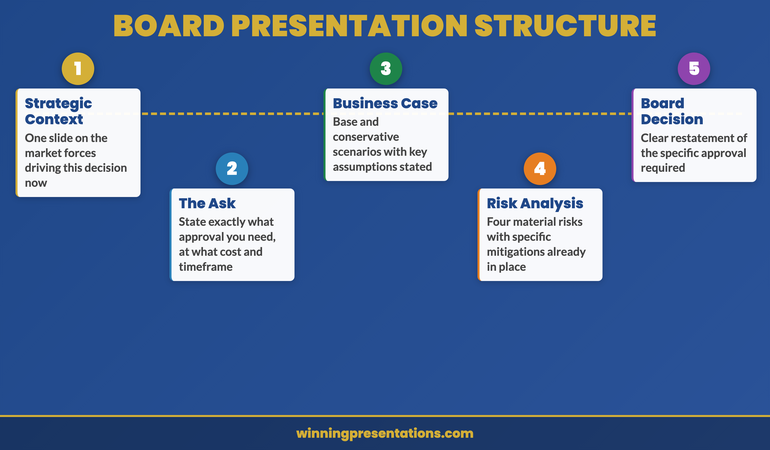
What boards need from a strategy presentation, specifically, is: a clear view of the external environment the strategy is responding to; an honest account of the organisation’s current position including its weaknesses; a clear articulation of the strategic choices that have been made and the options that were not chosen; an understanding of the resource requirements and the trade-offs involved; and a specific set of questions or areas where the board’s input is sought.

That last element — the explicit invitation for board input — is what most presentations omit. When a presentation ends with “we look forward to your questions,” the implicit message is that the plan is finished and questions are optional. When a presentation ends with “we’d specifically value the board’s perspective on these two questions,” the message is that the strategy is a live document and the board’s contribution is expected and valued. The difference in how the board engages is significant.

For a related discussion of how the board presentation fits within the broader governance communication calendar, the article on structuring a board strategy presentation covers the sequencing of pre-reads, formal presentations, and follow-up communications.

The structure that works: context, choices, and commitments

The most reliable structure for a strategic planning board presentation has three acts: context, choices, and commitments. This structure respects the board’s time, gives directors the external framing they need to engage usefully, presents the strategic choices clearly rather than as a fait accompli, and ends with a set of specific commitments that define what success looks like.

Strategic planning board presentation structure infographic showing three acts: context (environment and position), choices (strategic priorities and trade-offs), and commitments (milestones and accountability)

Act 1 — Context (3–4 slides). Begin with the external environment: the market dynamics, competitive shifts, regulatory changes, and customer trends that are shaping the strategic landscape. Follow with an honest assessment of your organisation’s current position — where you are strong, where you are not. This gives the board the frame of reference they need to evaluate the strategic choices that follow.

Act 2 — Choices (5–7 slides). Present the strategic priorities in the context of the trade-offs involved. For each priority, show briefly what it requires in terms of resource, capability, or attention — and what that means for other areas of the business. Where there are genuine strategic choices — directions the organisation could have taken but didn’t — show those choices and explain the reasoning. This is the section that most distinguishes a high-quality strategy presentation from a list of aspirations.

Act 3 — Commitments (3–4 slides). Close with the specific commitments the executive team is making: the milestones that will be reported against at the quarterly reviews, the resource requirements being requested from the board, and the accountability framework for delivery. End with the specific questions where board input is sought — keep this to two or three focused questions that the board can meaningfully address.

Total deck length: twelve to sixteen primary slides, with an appendix available for supporting analysis. For boards that work from a pre-read, the supporting detail can be in the pre-read document, which means the presentation itself can be more focused.

How to present strategic priorities without overwhelming the room

The most common structural problem in strategic planning presentations is the strategic priorities slide that lists seven, eight, or nine priorities. This slide is almost always the product of internal political compromise — every function has negotiated its way onto the list — rather than genuine strategic focus. Boards see it for what it is, and it undermines confidence in the executive team’s ability to make hard choices.

A strategic plan with more than five priorities is effectively a plan with no priorities. The board’s immediate question — asked aloud or not — is: what happens if we can’t resource all of these simultaneously? If the answer to that question isn’t in the presentation, it will dominate the discussion.

The solution is to present a tiered structure: the two or three priorities that are genuinely non-negotiable for this planning period, followed by the priorities that are important but conditional on resource availability. This is a more honest representation of how strategies are actually executed, and it gives the board a much clearer basis for a productive resource conversation.

The Executive Slide System includes framework guides specifically for structuring strategic priorities in a way that shows the hierarchy of commitments clearly, rather than presenting everything at the same level of urgency — see how it works.

Making trade-offs explicit: the section most presenters skip

The trade-off section of a strategic planning presentation is the most intellectually demanding to construct and the most valuable for the board to see. It is also the section most frequently absent.

A strategic trade-off exists when pursuing one priority at full intensity makes it harder to pursue another. Investment in geographic expansion reduces resource available for product development. A cost reduction programme creates tension with a talent investment agenda. Accelerating time-to-market on a new product increases technical debt in the core platform. These tensions exist in every strategic plan. The question is whether the board sees them explicitly or only discovers them when performance against one priority falls short.

Strategic trade-off analysis infographic showing how to present competing priorities with a clear recommendation on sequencing and resource allocation for board review

Presenting trade-offs explicitly does three things. It demonstrates that the executive team has done the hard thinking rather than presenting aspirations as plans. It gives the board a clear basis for resource discussions rather than a theoretical wish list. And it creates a shared record of the choices made — which matters when, six months later, a particular priority is underperforming because of a trade-off the executive team made and the board approved.

The format for a trade-off slide is straightforward: name the tension, show the two options, and present the recommended approach with the rationale. One or two slides on this section is usually sufficient — the goal is to surface the key tensions, not to document every operational constraint.

For related thinking on how to present strategic direction to a board in the context of a significant change programme, the article on the annual strategy presentation format covers the communication calendar that supports the formal board session.

Executive Slide System — £39

The Strategy Deck That Earns Board Commitment

The Executive Slide System — £39, instant access — gives you a structured approach to annual strategy presentations that positions your board as an active contributor, not a ratification audience.

Explore the System →

Designed for executives presenting annual strategies, multi-year plans, and board-level priority decisions.

From presentation to board commitment: closing the loop

A strategic planning presentation that ends without specific board commitments is an opportunity missed. The formal session is the moment when the board’s attention and accountability are most engaged — and the decisions made in that session should be captured in a way that creates genuine follow-through accountability.

The follow-through mechanism that works best is a one-page summary of the board’s input and the specific commitments arising from the session, circulated within forty-eight hours. This should include: the strategic direction that was confirmed or amended in discussion, the resource decisions that were made, the specific questions that will be brought back for board review, and the performance milestones that will be reported against at the next quarterly review.

This kind of structured follow-through serves two purposes. It ensures that decisions made in the strategy session are not lost in the volume of board business that follows. And it creates a clear accountability framework that makes the next strategic review — typically twelve months later — a much more productive conversation, because both the board and the executive team can assess progress against specific, agreed commitments rather than a retrospective interpretation of what was said the previous year.

For the practical mechanics of quarterly reporting against strategic commitments, the article on board presentation best practices covers the ongoing governance communication that maintains board confidence between formal strategic reviews.

Also see the related article on how to structure a cross-department quarterly review for the operational alignment layer that supports delivery against strategic commitments.

Frequently Asked Questions

How far in advance should a strategic planning presentation be circulated as a pre-read?

For a full annual strategy presentation, circulate the pre-read seven to ten days before the board session. A shorter notice period doesn’t give non-executive directors sufficient time to read the material carefully and bring prepared questions. A longer period risks the document feeling stale if market conditions shift. The pre-read should be a written narrative document — typically five to ten pages — that provides the detail the presentation itself won’t have time to cover. The presentation is then a conversation tool, not an information dump.

Should the CEO or the strategy director present the strategic plan to the board?

The CEO should lead the strategic planning presentation, with the strategy director or relevant functional leaders presenting specific sections where their expertise is needed. A presentation delivered entirely by the strategy team without visible CEO ownership signals to the board that the strategy is a staff exercise rather than a leadership commitment. The CEO’s presence and engagement throughout the session communicates that the strategic direction is owned at the top of the organisation — which is the foundation for board confidence in the plan’s delivery.

What should happen when a board member fundamentally disagrees with the strategic direction?

A fundamental disagreement from a board member in a formal session is a signal that the pre-meeting alignment conversation didn’t happen or wasn’t sufficient. Before any major strategic planning presentation, it is worth having brief, informal conversations with the directors most likely to raise substantive challenges — not to pre-negotiate the strategy, but to understand their perspective and ensure the presentation addresses it explicitly. If a disagreement surfaces unexpectedly in the room, acknowledge it directly: “That’s an important point of view — can we spend ten minutes exploring the reasoning, and if we haven’t resolved it today, we can identify a process for working through it before the next session.” Trying to steamroll a board disagreement in the formal session always makes the problem worse.

The Winning Edge — Weekly Insights for Executive Presenters

Every Thursday: one practical insight to sharpen your executive communication. No generic tips — only what works in real high-stakes rooms.

Join The Winning Edge →

Free resource: The Executive Presentation Checklist — a pre-meeting quality check for high-stakes presentations.

About the Author

Mary Beth Hazeldine — Owner & Managing Director, Winning Presentations

With 25 years of corporate banking experience at JPMorgan Chase, PwC, Royal Bank of Scotland, and Commerzbank, Mary Beth advises executives across financial services, healthcare, technology, and government on structuring presentations for high-stakes funding rounds and approvals. She is the creator of the Executive Slide System and the Conquer Speaking Fear programme.

12 Apr 2026
Female chief digital officer presenting a digital transformation investment case to a board of directors in a glass-walled boardroom

Digital Transformation Board Presentation: How to Build the Business Case

Quick Answer

A digital transformation board presentation succeeds when it leads with strategic context rather than technical capability, frames the investment in terms of risk and competitive position rather than feature sets, and gives the board a clear choice with a recommended direction — not a technology briefing to absorb.

Priya had spent four months on the business case. As Chief Digital Officer at a mid-size financial services firm, she had commissioned an independent vendor review, benchmarked against three competitors, and built a financial model that showed a clear return within thirty months. The board presentation was scheduled for ninety minutes. She had allocated the first forty to walking through the technology landscape.

The Chair stopped her at slide nine. “Priya, we appreciate the detail, but can you take us to the decision? What are you actually asking us to approve?”

She had a recommendation on slide twenty-three. By the time she reached it, the board had mentally disengaged. The investment wasn’t approved that day — it was deferred for “further consideration,” which, in practice, meant another quarter of delay and a request for a shorter, clearer paper.

The problem wasn’t the quality of the analysis. It was the sequencing. Priya had built a presentation for an audience that wanted to understand the technology — but boards don’t want to understand the technology. They want to understand the risk, the opportunity cost, and the decision in front of them. The more technical context you provide before reaching the ask, the more confused and disengaged a board audience becomes.

Digital transformation is one of the most common investment decisions reaching boardrooms today. It is also one of the most frequently mishandled presentations — not because the analysis is weak, but because the story is told in the wrong order for a board audience.

Building a board-ready transformation deck?

If you’re preparing a digital transformation investment case for a board or executive committee, the Executive Slide System includes templates and frameworks for exactly this type of high-stakes approval presentation. Explore the System →

Why digital transformation presentations fail at board level

The most common failure mode in a digital transformation board presentation is technology-first sequencing. The presenter builds the story from capability outwards — here is what the technology can do, here is how we would implement it, here is the projected return. This is a logical order for a project team. It is the wrong order for a board.

Boards operate from a different frame of reference. Their primary concern is not operational capability — it’s fiduciary responsibility and strategic positioning. When a presentation opens with technology, it triggers a set of questions in the board’s collective mind that have nothing to do with the slides: Is this within our strategic priorities? Who is accountable if this goes wrong? What happens if we don’t do it? A technology-first presentation typically never answers these questions, because it was built around the solution rather than the decision.

The second failure mode is scope ambiguity. “Digital transformation” is a phrase that means different things to different people in the same boardroom. Without an explicit definition of what is and isn’t included in the scope of the investment, board members will import their own interpretations — and the discussion will fragment along those lines. A clear scope statement, positioned early in the deck, prevents this.

The third failure mode is the absence of a clear ask. Many digital transformation presentations end with a roadmap or a phased plan — but without a specific, bounded decision for the board to make. Boards are accustomed to approving specific things: a budget envelope, a mandate to proceed to the next phase, a vendor selection. An open-ended “we’d welcome the board’s thoughts on the direction” creates uncertainty about what is actually being requested and typically results in deferral.

For related thinking on how transformation programmes should be communicated to executive audiences, the article on how to structure a transformation programme presentation covers the ongoing communication layer that sits alongside the initial investment case.

Executive Slide System

Build the Board Case — Not Just the Deck

Digital transformation investments fail at board level when the presentation is built for the project team rather than the approving body. The Executive Slide System — £39, instant access — gives you the templates and frameworks to build a board-ready investment case that leads with strategic context, not technical capability.

  • Slide templates for investment approval and business case presentations
  • AI prompt cards to build your strategic narrative fast
  • Framework guides for structuring risk, ROI, and stakeholder impact
  • Scenario playbooks for high-stakes board and executive committee presentations

Get the Executive Slide System →

Designed for executives preparing complex investment cases for board and executive committee approval.

The presentation structure that works for board audiences

The most effective digital transformation board presentations follow a decision-first structure. The ask is on slide one or two — not at the end. This is counterintuitive for many executives who have been trained to build to a conclusion, but for board audiences it is almost always the right approach.

Digital transformation board presentation structure infographic showing six sections: strategic context, the decision, business case, risk analysis, implementation approach, and board ask

A seven-to-ten slide structure that reliably works for this type of presentation:

Slide 1 — Strategic context. One slide that frames the market or competitive position that makes this investment relevant now. This is not a market research presentation — it’s a single compelling observation that positions the decision in the context of the board’s existing strategic priorities.

Slide 2 — The decision. State clearly what you are asking the board to approve, at what cost envelope, over what timeframe, and with what accountability. Boards respond well to precision at this stage. Vagueness here creates anxiety throughout the rest of the presentation.

Slides 3–4 — Business case. The quantified case for the investment: revenue protection or growth, cost efficiency, operational risk reduction, or competitive positioning. Boards are not looking for exhaustive financial modelling — they’re looking for confidence that the numbers have been stress-tested and the assumptions are defensible.

Slide 5 — Risk analysis. What are the three or four material risks, and how are they being managed? A board that sees no risks on a transformation deck becomes more concerned, not less. Acknowledging risk credibly is a sign of programme maturity.

Slides 6–7 — Implementation approach. A high-level phased plan with clear milestones, governance structure, and accountability. Boards don’t need a Gantt chart — they need to see that there is a credible delivery framework.

Slide 8 — Alternatives considered. What other approaches were evaluated, and why is this the recommended option? A single slide on this prevents the question “have you considered X?” from derailing the discussion.

Slide 9 — The ask. A clear restatement of the specific decision required: budget approval, mandate to proceed to Phase 1, or endorsement of the vendor recommendation. This is the action slide — it should specify what happens next and who is responsible.

How to build the business case without losing the room

The business case section of a digital transformation presentation is where most presenters spend disproportionate time and where most boards switch off. The mismatch arises because the presenter is presenting the full analytical process — here is how we built the model, here is every assumption — when the board wants the conclusions and the confidence level behind them.

A practical approach: present the business case as a range rather than a point estimate. “The base case shows X, the conservative case shows Y, and the optimistic case shows Z — and here is the single factor that most significantly determines which scenario we’re in.” This demonstrates analytical rigour without requiring the board to follow detailed financial modelling, and it prepares them for the risk conversation that follows.

The business case should also address the cost of not acting. Many transformation investment cases focus entirely on the projected return from the investment, without quantifying the risk of the status quo. For a board audience, the cost of inaction is often the most compelling part of the argument — particularly where the competitive context shows that peers or competitors are already investing in the same capabilities.

For guidance on how to present technology evaluation decisions to mixed executive and finance audiences, the article on technology evaluation presentations for IT and finance covers the specific adaptations needed when multiple executive functions share the decision.

The Executive Slide System includes AI prompt cards specifically designed to help you pressure-test a business case narrative before the board meeting — see what’s included.

Framing risk: the argument boards actually respond to

Risk is the most important and most frequently mishandled section of a digital transformation board presentation. There are two failure modes: presenting no risks (which destroys credibility), and presenting an exhaustive list of every possible risk (which creates paralysis).

The format that works best for a board audience is a focused risk register with three columns: the risk, the likelihood and impact assessment, and the specific mitigation measure already in place or proposed. Limit this to four or five material risks. The board does not need to see operational delivery risks that sit below the programme governance threshold — only the risks that genuinely have strategic or financial significance.

Risk framing infographic for digital transformation board presentations showing four risk types: strategic, financial, operational, and dependency risks, with mitigation approaches for each

The framing of risk in this context also matters. A risk presented as “technology implementation failure” triggers a generalist anxiety in the boardroom. A risk presented as “vendor dependency risk — mitigated by contractual break clauses and a parallel in-house capability build in Phase 2” is specific, manageable, and demonstrates programme maturity. The specificity is what builds confidence.

One risk that boards consistently want to see addressed — and that is frequently absent from transformation decks — is organisational change risk. Technology implementation is typically not what derails digital transformation programmes. Cultural resistance, capability gaps, and middle management inertia are. Acknowledging this explicitly and showing that the people-side of the programme has a plan demonstrates the kind of executive maturity that boards look for in a programme sponsor.

Executive Slide System — £39

The Investment Case That Gets Approved

The Executive Slide System — £39, instant access — gives you a structured framework for building the kind of board-ready investment case that gets a decision rather than a deferral.

Explore the System →

Designed for executives presenting investment cases, strategic initiatives, and transformation programmes to boards.

The questions boards ask — and how to prepare for them

Experienced non-executive directors ask a fairly consistent set of questions in digital transformation presentations. Preparing for these in advance — and, where possible, pre-empting them in the deck — removes the most common sources of discussion that extend meetings beyond their allocated time.

The most frequent board questions in this context are: Why now? What happens if we don’t do this? How confident are you in the vendor? What does Phase 1 actually cost and what does it prove? Who is the senior accountable person, and what authority do they have? What does success look like at the twelve-month mark?

Each of these questions should have a clear, brief answer in the presenter’s head before the meeting — ideally with a corresponding slide or appendix page they can reference. The ability to answer “who is accountable?” with a specific name and a description of their authority is a more confidence-building answer than “we’re working through the governance structure.” Boards approve investments in people as much as in programmes.

For a broader discussion of how to anticipate and handle the difficult questions that arise in high-stakes presentations, the article on stakeholder buy-in psychology covers the underlying dynamics of executive decision-making in complex investment contexts.

Preparing the room before you enter it

The single most effective thing you can do to improve the outcome of a digital transformation board presentation is to have a brief, informal conversation with the Chair or Senior Independent Director before the formal meeting. This is not about lobbying — it’s about understanding whether there are specific concerns, recent experiences with similar investments at peer organisations, or governance questions that are likely to surface in the discussion.

Board members bring their external perspectives to every investment discussion. A non-executive who has recently seen a high-profile digital transformation failure at another company will bring that context into the room. A Chair who has a background in technology will have different questions to one whose career is in finance. Understanding the composition of the room allows you to calibrate your presentation — not to change the substance, but to sequence the content in a way that addresses the concerns most likely to arise.

A pre-meeting brief to the executive sponsor — not the full presentation, but a two-page summary of the ask and the key risks — is also worth considering for complex investment cases. It prevents the sponsor from hearing the analysis for the first time in the room and gives them the foundation to contribute constructively to the discussion rather than asking orientation questions.

For the cross-department alignment that often needs to happen in parallel with a transformation investment case, see also the approach covered in how to structure a cross-department quarterly review — the stakeholder alignment principles transfer directly to programme governance communications.

Frequently Asked Questions

How many slides should a digital transformation board presentation have?

For a ninety-minute board session, aim for eight to ten primary slides with an appendix of three to five supporting slides available for deep-dive questions. The board should be able to understand the investment case, the risks, and the decision from the primary deck alone. The appendix demonstrates rigour without slowing down the main presentation. If your primary deck is running beyond twelve slides, review whether each slide contains a decision-relevant point or whether it’s presenting process information that belongs in a supporting document rather than the presentation itself.

Should I include a financial model in the board presentation?

Include the outputs of the financial model — a single slide showing base, conservative, and optimistic scenarios with the primary assumptions stated — but not the model itself. Boards need to understand the logic and the confidence level behind the numbers, not to audit the spreadsheet. If a board member wants to review the model in detail, that conversation should happen in a pre-meeting briefing or a designated working session rather than during the formal presentation. Walking a board through financial modelling assumptions in real time typically results in the discussion getting stuck on technical detail rather than the strategic decision.

What if the board asks for a delay to “consider further”?

A deferral request usually signals one of three things: a specific unanswered question, an unresolved concern about governance or accountability, or a need for broader board alignment that hasn’t happened yet. The most useful response to a deferral is to ask directly what information or assurance would allow the board to make the decision at the next meeting. This converts a vague delay into a specific action list — and it demonstrates the programme maturity that boards are implicitly testing for when they ask for more time.

The Winning Edge — Weekly Insights for Executive Presenters

Every Thursday: one practical insight to sharpen your executive communication. No generic tips — only what works in real high-stakes rooms.

Join The Winning Edge →

Free resource: The Executive Presentation Checklist — a pre-meeting quality check for high-stakes presentations.

About the Author

Mary Beth Hazeldine — Owner & Managing Director, Winning Presentations

With 25 years of corporate banking experience at JPMorgan Chase, PwC, Royal Bank of Scotland, and Commerzbank, Mary Beth advises executives across financial services, healthcare, technology, and government on structuring presentations for high-stakes funding rounds and approvals. She is the creator of the Executive Slide System and the Conquer Speaking Fear programme.

12 Apr 2026
Executive team gathered around a boardroom table presenting cross-department quarterly review data on a large screen

Cross-Department Quarterly Review: How to Stop the Blame Game

Quick Answer

A cross-department quarterly review stops becoming a blame session when you structure it around shared data, forward-facing language, and a single executive narrative — rather than individual departmental reports. The key shift is framing every slide around decisions and progress, not performance scores.

Marcus had been preparing for three weeks. As Head of Operations at a mid-size logistics company, he was responsible for presenting the cross-department quarterly review to the executive committee — a room that included the CFO, two divisional MDs, and the Group CEO.

The first twenty minutes went according to plan. Then the IT Director put up a slide showing system uptime metrics. Operations pushed back. Sales said the delays were causing client churn. Finance said the numbers didn’t reconcile with what they’d seen the previous month. Within thirty minutes, the review had become a tribunal — with every department defending its own data and attacking everyone else’s.

Marcus told me afterwards: “The executive sponsor sat there in silence for most of it. At the end he said, ‘I don’t need to know what happened. I need to know what we’re doing about it.’ Nobody had an answer.”

The problem wasn’t the data. It was the structure. Each department had prepared slides designed to demonstrate their own performance — which meant every difficult interdependency was someone else’s problem. The meeting had no shared narrative, no forward focus, and no mechanism for building agreement. What it produced instead was defensiveness, frustration, and a room full of executives who left with less confidence in the leadership team than when they’d arrived.

Cross-department quarterly reviews are among the most politically complex presentations in business. Done well, they demonstrate executive cohesion and strategic momentum. Done poorly, they become the stage on which leadership teams publicly undermine each other — often without realising they’re doing it.

Preparing for a cross-department review?

If you’re building the deck and wondering how to present shared data without triggering defensiveness, the Executive Slide System gives you a structured framework designed for exactly these scenarios. Explore the System →

Why cross-department quarterly reviews descend into blame

The blame game in quarterly reviews is almost always structural, not personal. It emerges when the meeting is designed around individual departmental accountability rather than shared organisational progress.

When each department prepares its own slides in isolation, a predictable dynamic emerges. Each presenter selects data that reflects well on their function. When there’s a performance shortfall, the natural response is to show how it connects to a dependency in another department. The other department does the same in reverse. The executive audience watches the cycle repeat and loses confidence in the entire leadership tier.

There’s also a presentation format problem. Most cross-department quarterly reviews use a round-robin structure — each department presents in sequence, each for ten to fifteen minutes. This format guarantees fragmentation. There is no shared narrative, no agreed baseline, and no common language for interpreting the data. The executive sponsor receives five separate stories with five separate recommendations that often contradict each other.

The cross-department quarterly review that works is built differently. It starts from a single agreed executive narrative, uses shared data presented once, and keeps every slide oriented towards future decisions rather than past performance. The departments aren’t gone — their data is there — but it’s been integrated into a unified story rather than a collection of individual defences.

For related structure thinking, see how to structure a monthly business review presentation — many of the same principles apply at the quarterly level.

Executive Slide System

Stop Building Slides. Start Building Agreement.

The cross-department quarterly review tests whether your executive communication can rise above departmental politics. The Executive Slide System — £39, instant access — gives you the templates and frameworks to structure a presentation that drives decisions rather than debate.

  • Slide templates for executive scenario presentations including reviews and approvals
  • AI prompt cards to build your quarterly narrative fast
  • Framework guides for structuring complex multi-stakeholder data
  • Scenario playbooks for high-stakes business reviews

Get the Executive Slide System →

Designed for executives who need clarity in complex, multi-stakeholder environments.

The four-part structure that prevents blame before it starts

The most effective cross-department quarterly reviews use a four-part structure that begins with agreement rather than individual data. This structure does something counterintuitive: it removes the incentive to defend departmental performance by framing the entire review as a shared challenge rather than a collection of individual report cards.

The four-part cross-department quarterly review structure: shared context, performance against shared goals, interdependency analysis, and forward decisions — infographic showing each stage

Part 1 — Shared context (2–3 slides). Open with the external environment and the strategic priorities that all departments are working towards. This reframes the review from “how did each department do?” to “how are we tracking as a business?” Senior executives respond well to this framing because it mirrors how they think about the quarter.

Part 2 — Performance against shared goals (4–6 slides). Present the key metrics that cut across all departments — revenue, customer satisfaction, operational efficiency, and any programme milestones — as a single integrated view. Show interdependencies explicitly. When performance is below target, name the shared nature of the gap before attributing it to any specific function.

Part 3 — Interdependency analysis (2–3 slides). This is the section most reviews skip — and it’s the section that prevents blame. Name the handoff points between departments explicitly. Where a handoff is working, show it. Where it’s not, frame the analysis as a systems question: what is the process that needs to change? Avoid framing any individual department as the cause of a failure.

Part 4 — Forward decisions (2–3 slides). End with a clear set of proposed actions and the decision you need from the executive sponsor. This is what senior audiences are waiting for. If the meeting ends without decisions, it will feel like a waste of time regardless of how good the data was.

The total deck for this structure is typically twelve to fourteen slides — well within the tolerance of most executive committees for a quarterly review.

How to present departmental data without triggering defensiveness

Data triggers defensiveness when it’s presented as a verdict. The moment a slide reads “Operations: underperforming against target,” the Operations Director is no longer listening to the rest of the review — they’re constructing a rebuttal.

The reframe is straightforward: present every metric as a question, not a conclusion. “We’re at 78% against our target of 85% — here’s what the data tells us about where the gap is sitting” is a fundamentally different proposition to “the Operations function missed its target by 7 percentage points.” Same data, different implication. One invites collaboration. The other triggers a territorial response.

A few specific techniques worth using:

Aggregate first, disaggregate second. Start with the combined business-level number, then break it down by function. This trains the audience to see the data as a shared issue before they see their own piece of it.

Use trend lines, not snapshot comparisons. A snapshot comparison (“Q3 vs Q4”) invites argument about what changed. A trend line invites conversation about direction. If the trend is improving, the story is encouraging even if the number is below target. If the trend is worsening, the question becomes what intervention is needed — not who is responsible.

Attribute causality to processes, not people or departments. “The delay in the customer onboarding cycle is sitting in the handoff between CRM and provisioning” is process language. It avoids naming a department as the cause, focuses attention on the system rather than the individual, and creates space for a collaborative solution.

If you’re presenting alongside colleagues from other departments, the cross-functional presentation translation framework covers how to communicate technical or functional data to mixed executive audiences without losing clarity.

The Executive Slide System includes prompt cards specifically designed to help you frame complex performance data in language that builds rather than disrupts executive confidence — see what’s included.

The language of shared accountability

Language is the mechanism through which a cross-department review either builds or destroys alignment. There are specific word choices that consistently escalate defensiveness — and specific alternatives that consistently reduce it.

The highest-risk phrase in any cross-department review is the indirect attribution: “The delays in X were due to late sign-off from Y department.” Even if accurate, this kind of statement — particularly on a slide — puts Y on the defensive for the remainder of the meeting. They will spend the rest of their time accumulating evidence of their own competence rather than contributing to the forward conversation.

The replacement is accountability framing: “The sign-off process between X and Y has created delays in the pipeline. We’ve identified three points where the cycle time can be reduced, and we’re proposing to test a new protocol in Q1.” This acknowledges the same underlying reality but frames it as a shared process improvement rather than an individual failing.

Pronouns matter as well. “We” is always more constructive than “they” in this context. “Our performance in the quarter” is a better frame than “the performance of each function” — even when the reality is that some functions performed better than others. The executives in the room know that nuance exists. They don’t need the slides to dramatise it.

Comparison of blame language versus shared accountability language in cross-department quarterly reviews — infographic showing four before and after examples

What your executive audience actually wants from this meeting

Most presenters preparing for a cross-department quarterly review spend ninety per cent of their preparation time on what the data shows, and almost none on what the executive audience is actually trying to learn from the meeting.

Senior executives attending a cross-department quarterly review are typically trying to answer three questions. First: are we on track to achieve what we committed to, and if not, how far off are we? Second: do the people running this business understand the interdependencies well enough to manage them? Third: what decisions need to be made at this level, and are they being proposed clearly?

They are not trying to audit each department’s performance in granular detail. That level of operational review happens elsewhere. The quarterly review in front of the executive committee is a strategic conversation — and if it descends into operational detail, the room will disengage quickly.

This has a practical implication for your deck. The slides that matter most to a senior executive audience are the context slide (where are we against strategic goals?), the interdependency slide (what’s working, what’s not, what needs a decision?), and the forward-looking recommendation slide (what are we proposing to do, and what do we need from you?). Everything else supports those three moments.

For the board-level version of these principles, how to structure a department update presentation for senior leadership covers the specific adaptations needed when the audience includes non-executive directors.

Executive Slide System — £39

The Quarterly Review Deck That Works

The Executive Slide System — £39, instant access — gives you a structured approach to quarterly business reviews that keeps the focus on decisions, not departmental politics.

Explore the System →

Designed for cross-department reviews, board presentations, and multi-stakeholder updates.

Preparing for the difficult conversation ahead

Even with a well-structured deck and careful language choices, cross-department quarterly reviews sometimes surface genuine conflict that a presentation structure alone cannot contain. A department has significantly underperformed. A key project has stalled. Relationships between senior leaders are strained. In these circumstances, the presentation is only part of the solution — and in some cases, an important conversation needs to happen before the formal meeting.

The pre-meeting executive alignment conversation is one of the most underused tools in this situation. Before a quarterly review that you know will contain difficult news, a short conversation with the executive sponsor — not to rehearse the content, but to align on the narrative and the tone — is almost always worth the time. Sponsors who feel blindsided by difficult data in the room become a destabilising presence. Sponsors who have been briefed become a stabilising one.

When preparing your pre-meeting brief, keep it to three elements: what the challenging data shows, what you believe the underlying cause is (in systems language, not blame language), and what you’re proposing to do about it. That framing gives the executive sponsor everything they need to contribute constructively to the discussion.

Also worth considering: who else in the room needs a pre-meeting conversation? If you know that two department heads are in conflict over a shared metric, a brief alignment call between the three of you before the formal review can prevent thirty minutes of circular argument in front of the executive committee. It’s not about rehearsing a script — it’s about ensuring the room is focused on decisions rather than relitigating the past.

For parallel thinking on this approach when presenting strategic change, the article on structuring a digital transformation board presentation covers similar stakeholder alignment principles in a programme-led context.

Frequently Asked Questions

How long should a cross-department quarterly review presentation be?

For an executive committee audience, aim for twelve to fourteen slides and a sixty-minute meeting: twenty minutes for the presentation, twenty minutes for discussion, and twenty minutes for decisions. If the review is running longer than ninety minutes, the structure usually needs tightening — either there’s too much operational detail in the deck, or the forward-looking decision section is absent and the discussion is filling that gap.

What should I do if another department’s data contradicts mine during the review?

Address data discrepancies before the meeting, not during it. If you identify a conflict between datasets in the preparation phase, align with the relevant department head to agree a shared number and a brief explanation of the variance. Walking into a quarterly review with unresolved data conflicts creates exactly the kind of credibility problem that undermines the entire session. If a discrepancy surfaces unexpectedly in the room, name it calmly: “We’ll need to reconcile these two numbers — can we action that today and send an update to the committee?” This keeps the meeting moving and demonstrates competence rather than concealing the problem.

Who should present which sections of a cross-department quarterly review?

The most effective format is a single lead presenter who owns the shared narrative — usually the most senior executive responsible for cross-functional outcomes — with subject matter contributors speaking to specific technical or operational sections when genuine expertise is required. Avoid the round-robin format where each department presents its own section: it fragments the narrative, makes the meeting feel like a series of individual reports rather than a shared review, and creates the conditions for blame dynamics to emerge.

The Winning Edge — Weekly Insights for Executive Presenters

Every Thursday: one practical insight to sharpen your executive communication. No generic tips — only what works in real high-stakes rooms.

Join The Winning Edge →

Free resource: The Executive Presentation Checklist — a pre-meeting quality check for high-stakes presentations.

About the Author

Mary Beth Hazeldine — Owner & Managing Director, Winning Presentations

With 25 years of corporate banking experience at JPMorgan Chase, PwC, Royal Bank of Scotland, and Commerzbank, Mary Beth advises executives across financial services, healthcare, technology, and government on structuring presentations for high-stakes funding rounds and approvals. She is the creator of the Executive Slide System and the Conquer Speaking Fear programme.

11 Apr 2026
Female executive presenting board paper slides to non-executive directors, confident posture, glass-walled boardroom, navy and gold

Board Presentation Training Course

A board presentation training course addresses one of the most underserved gaps in executive development: the specific competence of communicating to a board of directors. Presenting to a board is not an extension of presenting to your management team — it demands a different structure, a different register, and a fundamentally different understanding of what the audience needs to make a decision. This guide explains what effective board presentation training covers, how to evaluate a course that will genuinely build that competence, and what to expect from the process.

Priya had been an impressive presenter inside her organisation for years. Her quarterly updates to the executive committee were concise, well-structured, and always received positively. When she was asked to present the case for a new market entry strategy to the board for the first time, she prepared exactly as she always had: a deck with clear data, a logical flow, and a confident delivery. The board was polite, but the questions came in directions she had not anticipated. A non-executive director asked about regulatory exposure in the second market — Priya had not included it because it had not yet been flagged internally. Another asked what the position would be if the entry assumption turned out to be wrong by thirty percent. She answered as best she could, but the meeting ended without a decision. She had not failed because she lacked intelligence or preparation — she had prepared for the wrong audience. Board presentation skills, it turned out, needed specific training she had never received.

Looking for structured support before your next board presentation? The Executive Slide System includes scenario-specific templates for board updates, strategic investment cases, and executive approvals — with the narrative structure boards expect built in. Explore the System →

What Board Presentation Training Actually Covers

Effective board presentation training is not a general public speaking course with a boardroom backdrop added. It addresses the specific conditions of board-level communication: an audience of non-executives and executive directors who have limited time, broad governance responsibilities, and a mandate to scrutinise rather than simply receive information.

At its core, a board presentation skills course covers four areas. The first is decision architecture — how to structure a presentation so the board can make a decision rather than simply review information. This is one of the most commonly misunderstood aspects of board communication. Many executives still structure board papers the way they structure internal reports: background first, analysis in the middle, recommendation at the end. Boards work the other way around. They need the recommendation upfront, the rationale second, and the supporting detail available but not dominant.

The second area is risk fluency. Boards are constitutionally interested in risk — it is a core governance function. Board presentation training teaches executives to anticipate and address risk proactively, to frame risk in terms the board uses (strategic, financial, reputational, operational), and to present mitigations that are specific rather than reassuring. “We have contingency plans in place” is not a risk response. “If the primary supplier fails, we have a secondary supplier in place at eight percent additional cost with a two-week onboarding period” is.

The third area is slide architecture. A board presentation training course will typically cover how to build slides that work without narration — because board papers are often pre-read. This means slide titles that are declarative rather than descriptive, visual hierarchies that make the key point obvious at a glance, and appendices that hold detailed data without cluttering the main deck.

The fourth area is Q&A management. Board questions are often probing, occasionally adversarial, and sometimes emerge from a governance agenda you are not fully aware of. Training in this area develops the skills to handle unexpected questions without losing composure, to acknowledge uncertainty without appearing unprepared, and to redirect to your core argument without seeming evasive.

Why Board Presentations Fail — and What Training Must Address

Most board presentation failures share a common cause: the presenter has optimised for the wrong outcome. They have built a presentation that demonstrates thoroughness — extensive analysis, comprehensive data, detailed process explanations — when what the board needs is a clear case for a specific decision. Thoroughness and clarity are not the same thing. A board presentation training course that does not address this distinction directly will not produce meaningful improvement.

A second common failure is a mismatch in time horizon. Operational leaders spend their days in the detail of implementation. Boards operate at the level of strategy, governance, and accountability. When an executive presents an operational initiative to the board, they often remain at the level they know best — talking about how something will work rather than why it matters at the strategic level and what risk it manages or creates. Training that does not actively develop the capacity to shift between levels will leave this gap intact.

The third failure mode is under-preparation for challenge. Many executives prepare thoroughly for the content of their presentation and almost not at all for the questions they might face. Board questions are unpredictable — they can come from a prior agenda item, from a concern a non-executive has raised in a pre-meeting, or from a pattern the board has observed across multiple management presentations. A board presentation skills course should include structured practice in fielding unexpected challenges, not just rehearsing delivery.

Understanding the board presentation best practices that experienced presenters apply consistently is a useful starting point — but training builds the muscle memory to apply them under pressure, not just to understand them in principle.

Build Your Board Presentation Skills With the Right Structure

The Executive Slide System — £39, instant access — gives you scenario-specific slide templates for board updates, investment cases, and executive approvals, with AI prompt cards and framework guides that put the right structure at your fingertips every time.

  • ✓ Scenario-specific templates for board presentations and executive approvals
  • ✓ AI prompt cards to build decision-ready decks efficiently
  • ✓ Framework guides for narrative structure and risk communication
  • ✓ Designed for executives who present to boards and senior leadership

Get the Executive Slide System →

Instant download · £39 · No subscription

Slide Structure for Board Presentations

Board presentation structure training is one area where the gap between general presentation coaching and board-specific training is most visible. General presentation courses typically teach chronological or problem-solution structures that work well in sales or management contexts. Board presentations follow a different logic.

The structure that works consistently for board presentations opens with a one-slide executive summary containing the recommendation, the rationale in three to five words, and the decision required. This is not the conclusion — it is the starting point. Everything that follows is the evidence base for a decision the board already knows you are asking them to make. This structure reduces the cognitive load on board members who are managing multiple agenda items, and it allows the board chair to set context before you have said a word.

The second structural principle is the separation of the main deck from the supporting material. A well-structured board presentation rarely exceeds twelve slides in the main body. The detail that management teams typically include — detailed financial models, operational timelines, process diagrams — belongs in an appendix that board members can reference if they choose, not in the main presentation flow. This discipline is harder than it sounds: it requires genuine confidence that your argument holds without the scaffolding of exhaustive supporting data.

The third structural principle is explicit risk architecture. Every substantive board presentation should include a dedicated section — typically two to three slides — that addresses the risk landscape directly: what are the primary risks, how are they being mitigated, and what early indicators would signal that the risk picture is changing? This is not an optional addition for risk-averse organisations. It is what boards expect to see, and its absence is often interpreted as a sign that management has not thought carefully enough.

For board presentations that involve ESG or sustainability investment, the ESG board presentation approach adds additional dimensions — regulatory framing, materiality assessment, and stakeholder accountability — that require their own structural treatment. The Executive Slide System includes templates designed specifically for these governance-sensitive presentation scenarios.

How to Evaluate a Board Presentation Training Course

Not all board presentation training courses are built to the same standard. Several factors distinguish courses that build durable competence from those that provide a day of interesting frameworks that fade quickly without sustained application.

The first factor is specificity. A course that positions itself as covering “executive communication” broadly is unlikely to develop board-specific skills to a useful depth. Look for training that explicitly addresses the governance context of board communication — the roles of non-executive directors, the difference between board papers and management reports, and the way board-level risk scrutiny functions. If those elements are not mentioned in the course description, the training is probably not board-specific in any meaningful way.

The second factor is practice structure. Reading about slide architecture or watching someone else demonstrate it does not build skill. Effective board presentation training includes structured practice in building a board paper or deck from a real scenario, followed by feedback from someone who has genuine experience of presenting at board level. One-way instruction without application practice is better than nothing — but only marginally.

The third factor is what happens between formal training sessions. The best board presentation skills courses provide frameworks and templates that participants can use independently — so that each board presentation they prepare becomes its own training opportunity, reinforcing what they learned rather than allowing it to atrophy. A course that ends with a certificate but no ongoing structural support will not produce lasting change in high-pressure situations.

The executive presentation structure principles that underpin effective board communication are transferable across industries and seniority levels — what changes is the depth of application and the specific governance context. Strong training helps you develop that application across all the board presentations you will face in your career, not just the one you are preparing for now.

Applying Your Training Before the Next Board Meeting

The most common mistake after completing a board presentation training course is treating the new frameworks as aspirational — ideas to implement eventually rather than tools to apply immediately. The single most effective thing you can do in the days after training is to apply the structure you have learned to a presentation you are already preparing. This creates immediate reinforcement and allows you to identify where the framework requires adaptation for your specific context.

Begin with slide titles. If you cannot read only the title row of your deck and understand the argument it makes, the titles are doing the wrong job. This single discipline — making slide titles declarative rather than descriptive — will change how your board papers read more than almost any other structural intervention. A title that reads “Market Entry Options” tells the reader nothing. A title that reads “European expansion carries lower regulatory risk than APAC — recommendation: prioritise Europe” gives the board the conclusion before they have read a word of the slide body.

After titles, move to the opening summary. Write the one-slide executive summary last, once you know exactly what you are recommending and why. This forces clarity: if you cannot write the recommendation in a single sentence and the rationale in three to five words, the argument is not yet clear enough. The process of writing the summary often reveals gaps in the logic that would otherwise only surface under board questioning.

Finally, prepare for the three most difficult questions you would not want the board to ask. Not the questions you expect — the ones that would catch you off guard. This is the practice that separates presenters who survive board scrutiny from those who genuinely command it. The board presentation follow-up protocol covers the post-meeting process that keeps decisions moving — because a strong board presentation and an effective follow-up are equally important to achieving a result.

Put the Right Board Presentation Structure to Work Now

The Executive Slide System gives you templates, AI prompt cards, and framework guides for building board presentations that communicate decisions clearly — at £39, instant access. Use it alongside any training programme or independently to build every board deck on a decision-tested foundation.

Get the System → £39

Frequently Asked Questions

What is the best board presentation training available for senior executives?

The best board presentation training combines governance-specific content — understanding the role of non-executive directors, the board’s risk function, and the difference between management and board-level communication — with structured practice and transferable frameworks. One-size-fits-all executive communication training rarely develops genuine board-specific competence. Look for training that explicitly addresses board paper structure, Q&A under scrutiny, and how to communicate at the strategic level, not just the operational one.

How do I learn how to present to a board of directors?

Start with the structural differences between board and management presentations. Boards need the recommendation first, the rationale second, and the supporting detail available but not dominant in the main deck. Then build your risk fluency — understand the risk categories boards use and practise articulating mitigations specifically rather than reassuringly. Finally, practise Q&A with someone who can ask from a governance perspective rather than a management one. Formal training accelerates this significantly, but self-directed preparation using the right frameworks can achieve meaningful improvement before your next presentation.

What does a board presentation skills course cover?

A board presentation skills course should cover decision architecture (structuring for a decision, not an information transfer), slide construction for pre-read documents, risk communication at the governance level, Q&A handling under board scrutiny, and the specific language register boards expect. Courses that focus only on delivery skills — voice, posture, confidence — without addressing the structural and governance dimensions will not produce the improvement most executives need for board-level presentations.

What is the right structure for a board presentation?

The structure that works consistently for board presentations opens with a one-slide executive summary: the recommendation, the rationale, and the decision required. The main deck — typically eight to twelve slides — covers the strategic context, the business case, the risk landscape, and the implementation overview. Supporting detail belongs in an appendix. Slide titles should be declarative (stating the conclusion) rather than descriptive (naming the topic). Every board presentation should anticipate the three to five questions the board is most likely to ask and address them in the deck before they are asked.

The Winning Edge

Weekly insights on executive presentations, slide strategy, and boardroom communication — straight to your inbox.

Subscribe Free

Preparing for an upcoming board presentation? Download the Executive Presentation Checklist — a structured framework for building decision-ready slides from first draft through to final board review.

About the author

Mary Beth Hazeldine, Owner & Managing Director, Winning Presentations. With 25 years of corporate banking experience at JPMorgan Chase, PwC, Royal Bank of Scotland, and Commerzbank, she advises executives across financial services, healthcare, technology, and government on structuring presentations for high-stakes board approvals and funding decisions. She has spent 16 years in executive training, working directly with leaders preparing for their most consequential boardroom moments.

11 Apr 2026
Executive presenter fielding a challenging question from a senior panel — composed, prepared expression, boardroom setting, navy tones

Anticipating Executive Objections: How to Prepare for Every Challenging Question Before It’s Asked

Quick Answer

Anticipating executive objections requires a structured stakeholder analysis completed before you write a single slide. Map each decision-maker’s primary concern, their most likely objection type, and the evidence that would satisfy them. The most damaging Q&A moments are not the questions you couldn’t answer — they are the questions you didn’t think to prepare for.

Tomás had spent four weeks building his case. The investment proposal was rigorous — financial modelling, market analysis, risk assessment, a phased implementation plan. He had rehearsed the presentation. He had anticipated the CFO’s questions about payback period. He had prepared the risk mitigation slides the CEO typically asked for.

What he had not prepared for was the Chief Operating Officer, who asked, twelve minutes into the presentation, whether the implementation plan accounted for the existing system migration that was already scheduled for Q3. It didn’t. Tomás had not known about the Q3 migration — it sat in a different part of the organisation, and no one had thought to brief him.

The question was not hostile. It was not even a challenge to his proposal. But his inability to answer it — combined with the visible uncertainty it produced — undermined the confidence the preceding twelve minutes had built. The board deferred. The Q3 conflict, it turned out, was solvable in a single conversation. But Tomás had not had that conversation before the meeting.

Most Q&A failures at executive level are not failures of knowledge. They are failures of intelligence gathering — the pre-meeting work of understanding what each person in the room is likely to raise, what they need to hear, and what operational context they hold that you may not. This article sets out a systematic approach to that intelligence gathering work.

Preparing for a high-stakes executive Q&A?

The Executive Q&A Handling System gives you a structured approach for predicting and preparing for executive questions — including a framework for mapping stakeholder objections before you walk into the room.

Explore the System →

Why Executive Objections Still Catch Presenters Off Guard

The standard advice for Q&A preparation is to anticipate likely questions and prepare answers. Most presenters do this to some degree — they think through the three or four questions they most expect, and they have responses ready. The problem is that this preparation is usually anchored to the content of the presentation, not to the perspective of the individual decision-makers in the room.

Questions from executive audiences rarely come from the content alone. They come from three other sources that content-focused preparation misses entirely. The first is organisational context — information about operational priorities, competing initiatives, budget constraints, or political dynamics that the presenter does not have access to. The Q3 migration in Tomás’s case was not in his brief. The second is personal priority — each executive in the room has a specific mandate, a specific set of concerns, and a specific lens through which they evaluate proposals. The CFO’s objection will be different from the General Counsel’s, even to the same proposal. The third is relational history — prior decisions, prior relationships with the presenter or the team, prior positions taken on related topics that create a predisposition toward certain objections.

Content-focused Q&A preparation addresses none of these three sources. Stakeholder-focused preparation addresses all of them — and it is the preparation discipline that consistently separates executives who navigate complex Q&A sessions from those who are regularly caught off guard. The approach to building a question map before a presentation provides the foundation that the stakeholder objection framework extends.

The Stakeholder Objection Map: A Pre-Presentation Framework

A stakeholder objection map is a structured document — typically a simple table — that organises your pre-meeting intelligence about each key decision-maker. It is built before you write your slides, not after. The sequence matters: knowing what each person is likely to object to shapes how you structure the presentation, what you address pre-emptively in the body of the talk, and what you prepare in your appendix for Q&A.

The map has five columns for each stakeholder. Their primary mandate — the single most important outcome their role is measured on. Their most likely concern about your proposal — what threatens their mandate, their budget, their operational plan, or their existing position. Their objection type — how they tend to raise concerns (more on this below). The evidence they need to be satisfied — what specific data, commitment, or assurance would move them from concern to support. And the information gap — what you do not know about their position that you need to find out before the meeting.

Building this map requires more than internal analysis. It requires conversations — with the person’s direct reports, with colleagues who have presented to them before, and ideally with the person themselves in a pre-meeting. The intelligence in the map is not available from the organisation chart or the meeting agenda. It comes from the network of people who know how each stakeholder operates and what they are currently focused on.

The map also surfaces the information gaps — the things you do not know — which are as valuable as the things you do know. An information gap is a risk: it is a question you cannot answer, a conflict you have not resolved, or a position you have not aligned before walking into the room. Each information gap in the map generates a pre-meeting action: who do you need to speak to, and what do you need to find out? Addressing information gaps before the meeting is the most reliable way to eliminate the category of objection that surprised Tomás.

Stakeholder objection map structure: five columns covering mandate, concern, objection type, required evidence, and information gaps

The Five Objection Types Executives Use Most

Identifying not just what someone might object to, but how they tend to raise objections, significantly improves preparation quality. Executive objections cluster into five recognisable types, and each type requires a different response approach.

The financial scrutiny objection. “What is the payback period?” “How does this compare to the cost of doing nothing?” “What assumptions sit behind the revenue projection?” This objection type is characteristic of CFOs, finance committee members, and CEOs with a strong financial orientation. It requires precise, conservative financial analysis — and the willingness to acknowledge uncertainty ranges rather than presenting false precision that invites challenge.

The operational feasibility objection. “Do we have the capacity to execute this alongside our existing commitments?” “What happens to current-state operations during the transition?” “Who owns the delivery?” This is the COO’s territory, and it is the objection type that most surprises presenters who have focused on the strategic case. The response requires a credible implementation narrative — not just a plan, but an honest assessment of dependencies, constraints, and risks.

The risk and governance objection. “What is the regulatory position?” “Have legal reviewed this?” “What is the downside scenario?” General Counsels, Chief Risk Officers, and Non-Executive Directors with governance responsibilities raise this type. The response requires a clear risk register and a demonstrated understanding of the regulatory context — not a dismissal of the risk, but a credible mitigation position.

The strategic alignment objection. “How does this fit with the three-year plan?” “Does this conflict with the decision we made in January?” “Is this the right priority given where we are in the cycle?” This objection type tests whether the presenter has done their homework on the organisation’s strategic context. It requires a clear articulation of how the proposal connects to, rather than competes with, existing strategic commitments.

The political or territorial objection. “This affects my team’s remit — has that been discussed?” “I wasn’t aware this was moving at this pace.” “What does the [other division / partner organisation / key client] think about this?” This objection type is the hardest to prepare for from the content alone, because it arises from organisational dynamics rather than analytical concerns. It is addressed almost entirely through pre-meeting stakeholder engagement — by identifying territorial sensitivities before the presentation and addressing them through direct conversation beforehand.

A full Q&A preparation framework covering all five objection types, with structured response approaches for each, is the core of the Q&A preparation briefing document approach — building a written document that maps objections before the meeting is more reliable than keeping this analysis in your head.

A System for Predicting and Handling Executive Q&A

The Executive Q&A Handling System — £39, instant access — gives you a structured approach for predicting the questions executives will ask before you walk into the room, and a proven framework for handling the ones you didn’t predict. Designed specifically for high-stakes Q&A in boardrooms, investment committees, and executive approval settings.

  • System for predicting and preparing for executive questions
  • Stakeholder analysis frameworks for Q&A preparation
  • Response structures for each of the five objection types
  • Scenario playbooks for hostile, sceptical, and ambush questions

Get the Executive Q&A Handling System →

Designed for executives who present to boards, investment committees, and senior leadership teams where Q&A shapes the outcome.

Using Pre-Meeting Intelligence to Narrow the Unknown

Pre-meeting intelligence gathering is the most underused tool in executive Q&A preparation. The standard approach is to spend the preparation period building slides and rehearsing content. The more effective approach is to spend a significant portion of the preparation period gathering intelligence about the room — and using that intelligence to shape both the content and the Q&A preparation.

Intelligence gathering has three tiers. The first tier is documented intelligence — board papers, committee minutes, prior presentations on related topics, and any written communications that reveal the current position or concerns of key stakeholders. This is available without any direct outreach and should always be reviewed before stakeholder conversations.

The second tier is network intelligence — conversations with people who know the key decision-makers, have presented to them recently, or operate in the same organisational space as your proposal. These conversations are not about gathering gossip; they are about understanding operational context, recent decisions that bear on your proposal, and the specific lens each person brings to the topic. A thirty-minute conversation with the CFO’s direct report the week before the presentation can eliminate the category of financial scrutiny objection that otherwise catches presenters by surprise.

The third tier — and the most valuable — is direct pre-meeting conversations with the key decision-makers themselves. A brief meeting with the CFO to walk through the financial model, a conversation with the COO to understand the Q3 operational picture, a call with the Non-Executive Director who has the most questions about governance — each of these conversations serves two purposes simultaneously. They provide intelligence about likely objections. And they give each stakeholder the opportunity to raise their concerns in a context where you can address them properly, rather than in a room where the quality of your answer affects the credibility of the entire proposal in front of their peers. This pre-meeting alignment principle is explored in detail in the framework for managing executive objections — the same intelligence-gathering logic applies directly.

People also ask: How do I know what objections executives will raise before a presentation? You cannot know with certainty, but you can narrow the range substantially. Start with their role mandate — what outcome is each person most accountable for? Map your proposal against that mandate and identify where it creates tension, uncertainty, or additional work. Then layer in their known communication style and objection type. Finally, review any recent decisions or positions they have taken that might predispose them to a particular concern. This three-step analysis covers the majority of predictable objections for most executive audiences.

Building Prepared Responses That Hold Under Pressure

A prepared response to an anticipated objection is not a scripted answer. It is a structured position — a clear statement of your view, supported by the specific evidence or reasoning that addresses the concern, delivered with the confidence that comes from having thought it through rather than constructing it under pressure in real time.

Prepared responses for executive objections should follow the same logical structure regardless of the objection type. Acknowledge the concern directly — not dismissively, but genuinely. State your position clearly. Provide the specific evidence that supports it. Identify any limitations or uncertainties you have not resolved. And close with a clear statement of what the concern does or does not change about your recommendation.

The acknowledgement step is the one most commonly skipped under pressure. When a challenging question is asked in a high-stakes room, the instinct is to move immediately to the defence of your position. But skipping the acknowledgement signals that you are treating the question as an attack rather than a legitimate concern — and it puts the questioner in a position where they feel the need to restate or escalate their objection rather than hear your response. A two-second acknowledgement — “That is an important point, and it is something we looked at carefully” — resets the dynamic before the substantive response begins.

For objections where the honest answer includes genuine uncertainty or an unresolved issue, the prepared response should include a clear statement of what you do not yet know and how you plan to resolve it. “We have not yet confirmed the Q3 implementation timeline with the programme team — I can have that information to you by Thursday” is a stronger response than a hesitant or improvised attempt to address a gap you were not expecting. Acknowledging the gap and providing a specific resolution commitment maintains credibility; appearing to improvise an answer to a question you should have known damages it.

Four-step structure for prepared responses to executive objections: acknowledge, state position, provide evidence, close with recommendation

Managing Live Objections When Preparation Meets Reality

Even the most thorough preparation leaves gaps. Every executive Q&A session will include at least one question you did not anticipate — either because you lacked the intelligence to predict it, or because the conversation takes a direction you could not have foreseen. The discipline of live Q&A management is knowing how to handle these moments without losing the forward momentum of the presentation.

The most reliable technique for unexpected objections is the structured pause. Before responding, take a deliberate two to three second pause. This pause serves multiple functions simultaneously: it signals that you are taking the question seriously rather than deflecting, it gives your cognitive processing system time to retrieve relevant information, and it prevents the escalating improvisation that produces unclear or contradictory answers. Most presenters fear the pause because they equate it with appearing unprepared. Experienced executive audiences read a deliberate pause as thoughtfulness, not ignorance.

For questions where you genuinely do not have an answer, the most credible response is a direct acknowledgement combined with a specific commitment. “I don’t have the data on that with me, but I will confirm it in writing by end of week” is a more credible answer than an improvised approximation that may be wrong. Executives at board level make high-stakes decisions regularly — they are practised at working with incomplete information, and they respect presenters who are clear about the boundaries of their knowledge.

The Executive Q&A Handling System covers the full range of live Q&A techniques — including the specific approaches for handling hostile questions, multi-part questions, and questions that are designed to challenge your credibility rather than seek information. If you want a structured approach to the live session as well as the preparation, the system addresses both phases of the Q&A challenge.

Predict the Questions. Control the Room.

The Executive Q&A Handling System — £39 — gives you a complete framework for predicting executive objections before the meeting and handling the ones you didn’t predict when they arise. Stop rebuilding your Q&A preparation from scratch for every presentation.

Get the Executive Q&A Handling System →

Designed for executives whose Q&A performance shapes high-stakes approval decisions.

Frequently Asked Questions

How far in advance should I start preparing for executive Q&A?

For a significant investment approval or board presentation, Q&A preparation should begin at least two weeks before the meeting — with the stakeholder objection map completed in the first week and pre-meeting conversations scheduled for the second week. This timeline allows you to identify and address information gaps before the day of the presentation, rather than discovering them in the room. For smaller presentations to a familiar audience, a structured but compressed version of the same process — a few hours of stakeholder mapping and one or two brief conversations — still adds significant value over content-only preparation.

What do I do if an executive raises an objection I can’t answer?

Acknowledge the question directly, state clearly that you do not have a complete answer, and make a specific written commitment to follow up. “I want to make sure I give you an accurate answer on that — let me confirm the position and come back to you in writing by [specific date].” This response preserves credibility because it demonstrates that you are more interested in giving an accurate answer than in appearing to have one. Follow through on the commitment within the stated timeframe — failing to do so damages trust more than the original gap did.

Should I address anticipated objections in the body of the presentation before Q&A?

Yes, for the most predictable and significant objections — but with care. Pre-empting objections in the presentation body works well when you can address them briefly and confidently as part of the logical flow of your argument. It works less well when the objection requires extensive defence, because you are then allocating significant presentation time to a concern rather than to your positive case. A useful rule of thumb: address objections that, if unaddressed, would prevent a decision-maker from following your argument. Leave objections that are more about detail or verification to the Q&A, where you can give them your full attention in response to a direct question.

Get weekly Q&A and presentation strategy in your inbox

Every Thursday, The Winning Edge delivers one actionable insight for executives who present to boards, investment committees, and senior leadership teams — including practical Q&A preparation techniques drawn from real board-room experience.

Subscribe to The Winning Edge →

About the Author

Mary Beth Hazeldine is Owner & Managing Director of Winning Presentations. With 25 years of corporate banking experience at JPMorgan Chase, PwC, Royal Bank of Scotland, and Commerzbank, she advises executives across financial services, healthcare, technology, and government on Q&A strategy, stakeholder preparation, and structuring high-stakes presentations for board and executive approval.

11 Apr 2026
Professional speaking confidently to an executive audience — visible calm, open posture, boardroom setting, editorial photography style

Exposure Ladder for Presentation Anxiety: A Systematic Approach to Building Speaking Confidence

Quick Answer

An exposure ladder for presentation anxiety works by building a hierarchy of speaking situations from low-anxiety to high-anxiety, then moving through them deliberately and repeatedly until each step becomes manageable. Unlike willpower-based approaches, systematic desensitisation changes the nervous system’s threat response — not just your attitude toward presenting.

Ngozi had presented at every level of her organisation for eleven years. She had closed deals, led strategy reviews, and presented to the board. By any external measure she was an accomplished presenter. But for the past three years, the week before any significant presentation had become a period of progressive dread — poor sleep, a constant low-level nausea, and an inability to concentrate on anything else. The presenting itself was manageable. The anticipation had become unbearable.

She had tried all the standard advice. She had recorded herself presenting. She had meditated. She had told herself the anxiety was excitement. None of it made a lasting difference. What changed, eventually, was working through a structured exposure hierarchy — not to presentations she was already doing, but to a deliberate sequence of lower-stakes speaking situations she had quietly been avoiding for years. Speaking in a meeting when she did not need to. Offering opinions without being asked. Presenting informally to three people without slides.

The exposure ladder did not make Ngozi comfortable with presenting because she practised presenting more. It worked because it systematically reduced her nervous system’s baseline threat response to being observed and evaluated — the underlying mechanism that was driving the dread. Once that baseline came down, the anticipatory anxiety reduced with it.

This article explains how to build and use an exposure ladder for presentation anxiety — and why the clinical logic behind it is the most reliable route out of a pattern that willpower alone rarely shifts.

Is presentation anxiety limiting your career progression?

Conquer Speaking Fear is a 30-day programme that combines nervous system regulation and clinical hypnotherapy techniques, designed specifically for professionals whose anxiety is persistent despite years of presenting experience.

Explore the Programme →

Why Exposure Works When Everything Else Doesn’t

Presentation anxiety is not fundamentally a confidence problem. It is a threat response. The amygdala — the part of the brain responsible for threat detection — has learned, through repeated association, that being observed and evaluated in front of an audience is dangerous. It responds to that stimulus the same way it would respond to a physical threat: elevated cortisol, accelerated heart rate, restricted breathing, heightened vigilance. The cognitive experience of this response is dread, self-consciousness, and the urge to avoid.

This is why approaches that work at the cognitive level — reframing your thoughts, replacing negative self-talk, visualising success — produce limited results for people with persistent anxiety. The threat response is not cognitive in origin. It does not respond reliably to cognitive correction. You can tell yourself rationally that the presentation is not dangerous, while your nervous system continues to respond as though it is. The rational argument and the threat response operate in different systems.

Exposure therapy works at the level of the nervous system itself. By repeatedly experiencing the feared stimulus — in a controlled, gradual way — without the catastrophic outcome the nervous system anticipates, the amygdala progressively updates its threat assessment. The technical term is habituation: the response to a stimulus decreases with repeated, non-catastrophic exposure. This is not a motivational insight. It is a neurobiological process. It works whether or not you believe in it, and it works for people whose anxiety has been resistant to every cognitive approach they have tried.

The critical requirement is gradation. Throwing yourself into high-stakes presentations does not produce habituation — it can reinforce the threat response if the experience is sufficiently distressing. The ladder structure exists to ensure that each step is challenging enough to activate the anxiety response, but manageable enough that repeated exposure produces habituation rather than reinforcement. This is the clinical insight that makes the difference between an exposure programme that works and one that makes anxiety worse.

For professionals whose anxiety has been resistant to standard approaches, the exposure ladder is often the first intervention that produces a measurable, sustained change — because it is the first intervention that works at the level where the anxiety actually lives.

How to Build Your Personal Exposure Ladder

An exposure ladder is a personally constructed hierarchy of speaking situations, ordered from least to most anxiety-provoking. It is not a generic list — it is built from your specific pattern of avoidance and your specific anxiety triggers. Two people with presentation anxiety will often have completely different ladders, because the situations they find most threatening are different.

Begin by listing every type of speaking or being-observed situation that produces anxiety for you — not just formal presentations. Include meetings where you speak up, phone calls with people you find intimidating, informal updates in team settings, social situations where you are introduced to groups, and any other context where you experience the same anticipatory or in-the-moment anxiety response. This list is your raw material.

Next, rate each situation on a scale of 0–10 for the anxiety it produces, where 0 is no anxiety and 10 is the highest anxiety you can imagine. These ratings are subjective and they will not be consistent — a situation that feels like a 7 one week may feel like a 5 a month later. That variability is normal and expected. For now, use your current honest rating.

Organise your list from lowest to highest anxiety rating. This is your exposure ladder. You will work from the bottom up — beginning with situations rated 2–3, working toward situations rated 8–9. The principle is that you do not move to the next rung until the current rung no longer consistently produces a significant anxiety response. For most people this means repeating a situation three to five times, over days or weeks, until the anxiety rating for that situation drops to 2 or below.

The ladder should have enough rungs that the gaps between adjacent steps are small — typically no more than one to two points on the anxiety rating scale. If you find a large gap between two adjacent items, insert an intermediate situation. The goal is a gradual gradient, not a series of large jumps.

How to build a personal exposure ladder for presentation anxiety: listing situations, rating anxiety, ordering from low to high

The First Rungs: Low-Stakes Practice That Actually Counts

The most common mistake people make when starting an exposure programme is skipping the lower rungs because they seem too easy or too unrelated to presentations. This is a significant error. The lower rungs are where the neurobiological work of reducing baseline threat response happens — and that baseline reduction is what makes the higher rungs easier when you reach them.

For many professionals with presentation anxiety, typical first-rung situations include: asking a question in a meeting with three or four people present; making a comment in a small team discussion when you did not feel obligated to; speaking to a stranger in a professional context; introducing yourself in a group of five to eight people. These may feel trivially low-anxiety, or they may feel more significant than that — either way, they belong at the bottom of your ladder if they are situations you have been avoiding or find uncomfortable.

The discipline of the first rungs is repeatability. You are not trying to have one good experience — you are trying to accumulate repeated, non-catastrophic experiences until the situation loses its anxiety charge. A first rung situation should be practised multiple times per week, in naturally occurring opportunities, until the anxiety rating consistently stays at 2 or below. Only then should you move up.

It is also worth noting that the situations that belong on the lower rungs are often the situations that high-functioning professionals with presentation anxiety have been unconsciously managing around for years. They contribute to meetings in writing but not verbally. They send emails rather than picking up the phone. They arrive early and leave before social conversation starts. These avoidance patterns maintain the anxiety — each avoidance confirms to the nervous system that the situation is dangerous. The first rungs of the exposure ladder directly address this maintenance cycle.

Conquer Speaking Fear includes structured exercises for this phase of the work — specifically the progression from daily low-stakes vocal presence to deliberate speaking situations in professional environments. If the lower rungs are where you need the most support, the 30-day programme provides a week-by-week structure for this exact progression.

A 30-Day Programme for Persistent Presentation Anxiety

Conquer Speaking Fear is a structured 30-day programme combining nervous system regulation and clinical hypnotherapy techniques. Designed for professionals whose anxiety persists despite years of presenting experience — not a confidence course, but a clinical-grade approach to changing your nervous system’s response to speaking situations.

  • 30-day programme with progressive nervous system regulation exercises
  • Clinical hypnotherapy techniques for acute and anticipatory anxiety
  • Structured exposure progression for professional speaking contexts
  • Framework for managing anxiety during high-stakes presentations

Get Conquer Speaking Fear →

Designed for executives and professionals whose presentation anxiety has been resistant to standard techniques.

The Middle Rungs: Structured Escalation in Professional Settings

The middle section of the ladder — typically situations rated 4–6 — is where the most practically significant progress happens for professionals. This is the range that includes the everyday speaking situations that presentation anxiety is quietly limiting: contributing substantively in larger meetings, presenting updates informally to senior colleagues, volunteering to lead a section of a team discussion, speaking at a workshop or professional event.

The principle remains the same: deliberate, repeated exposure to each situation until the anxiety rating drops consistently to 2 or below. But the middle rungs require more intentional engineering of opportunities, because the situations do not occur as frequently as lower-rung situations, and because the stakes involved mean that avoidance is more tempting when the anxiety is present.

One effective strategy for the middle rungs is to create low-consequence versions of higher-stakes situations. Before presenting to a senior leadership team, present the same material to a trusted peer or a small team. Before speaking at an industry event, present informally at an internal team meeting. Before delivering a board update, walk through your slides in a small pre-meeting. These are not rehearsals — they are genuine exposure steps, because the anxiety they produce and the habituation that follows are both real, even when the stakes are modest.

The middle rungs also surface the cognitive distortions that accompany anxiety — the conviction that your voice will shake visibly, that people will notice your anxiety, that you will lose your thread and be unable to recover. Repeated middle-rung experiences provide direct evidence against these predictions, which is why cognitive restructuring approaches are most effective when combined with exposure rather than used in isolation. The exposure creates the evidence; the cognitive work makes that evidence legible to a mind that has been filtering it out.

People also ask: How long does it take for exposure therapy to work for public speaking? The timeline varies considerably by individual, by the severity of the anxiety, and by the consistency of practice. For professionals with moderate presentation anxiety, consistent work through an exposure ladder typically produces noticeable reduction in lower-rung anxiety within four to eight weeks. Progress to high-stakes situations often takes three to six months of sustained practice. The programme is not linear — anxiety will be higher on some days than others, and there will be setbacks. The measure of progress is the trend over time, not any individual session.

Approaching High-Stakes Presentations Without Regression

The upper rungs of the exposure ladder — board presentations, large conference speeches, high-visibility client pitches — are the situations that professionals with presentation anxiety most want to resolve. They are also the situations where the work of the lower and middle rungs pays the largest dividend, because the baseline threat response that drove the dread has been systematically reduced.

The risk at the upper rungs is regression — returning to high anxiety after a difficult experience. A presentation that goes poorly, a tough question you struggled to answer, or an audience that appeared unresponsive can temporarily reset anxiety ratings upward. This is normal and does not signal that the exposure programme has failed. What matters is returning to the practice rather than returning to avoidance. Avoidance after a difficult experience is the single most reliable way to maintain and deepen anxiety. Re-exposure, at a slightly lower rung if necessary, is the path through.

High-stakes presentations also benefit from two specific preparation approaches that work in conjunction with the lower anxiety baseline the exposure ladder creates. Physiological regulation — box breathing, slow exhalation, deliberate postural adjustment — directly modulates the acute threat response in the minutes before a presentation. And cognitive decoupling — separating your evaluation of the presentation’s quality from your evaluation of yourself — reduces the self-referential threat response that drives much of the anticipatory anxiety in high-performing professionals.

The pattern of recovery from anxiety relapse is also predictable. If a difficult high-stakes presentation temporarily reactivates anxiety that had reduced, the recovery through the ladder typically happens faster than the original progression — because the nervous system retains habituation more efficiently than it retains threat learning. This is a useful frame for understanding presentation anxiety relapse: the setback is real, but the recovery is faster than the original work.

Exposure ladder progression from low-stakes daily situations through middle rungs to high-stakes board and conference presentations

Common Mistakes That Stall Progress Up the Ladder

Three patterns reliably stall progress through an exposure ladder, and all three are driven by the same underlying mechanism: avoiding the anxiety response rather than experiencing it.

Safety behaviours. A safety behaviour is anything you do during an exposure to reduce or manage the anxiety rather than experiencing it. Reading from notes rather than speaking from memory. Focusing entirely on the screen rather than making eye contact. Presenting standing behind a lectern when you could present without one. Safety behaviours prevent habituation because they prevent the full anxiety response — and therefore prevent the nervous system from learning that the full response is survivable. Identifying and gradually removing safety behaviours is as important as adding new rungs to the ladder.

Moving up too quickly. Impatience is the most common structural mistake. Moving to the next rung before the current rung has habituated means you are working at anxiety levels that are too high to produce reliable habituation. The discomfort of repeated middle-rung exposure is the work — shortcutting it by jumping to higher rungs creates distress rather than habituation, and can make the upper rungs feel harder rather than easier.

Treating single positive experiences as evidence that the anxiety is resolved. Anxiety is variable. One good presentation does not reset the pattern — and the next difficult one does not undo the progress. The consistency of the practice, not the quality of any individual experience, is what produces lasting change. People who stop their exposure practice after a run of good presentations often find that the anxiety returns when the stakes rise again, because the nervous system has not been habituated fully to the highest-anxiety situations on the ladder.

For a structured approach to maintaining progress and avoiding these stall patterns, the Conquer Speaking Fear programme includes week-by-week guidance on pacing, safety behaviour removal, and recovery from setbacks.

A Structured Path Through Persistent Presentation Anxiety

Conquer Speaking Fear — £39 — is a 30-day programme combining nervous system regulation and clinical hypnotherapy techniques for professionals whose anxiety persists despite years of presenting. If you have tried reframing and positive thinking and found them insufficient, this programme works at the level where the anxiety actually lives.

Get Conquer Speaking Fear →

Designed for executives and professionals with persistent, anxiety that has resisted standard confidence-building approaches.

Frequently Asked Questions

Can I build an exposure ladder on my own, or do I need a therapist?

For presentation anxiety that is persistent but does not significantly impair daily functioning, a self-directed exposure ladder is a reasonable starting point. The principles are straightforward, and many professionals make meaningful progress through structured self-practice. The challenges of self-directed work are consistency, pacing, and identifying safety behaviours — these are easier to monitor with an external guide. If your anxiety is severe, accompanied by panic attacks, or has been present for many years without any period of reduction, working with a therapist trained in exposure-based approaches is worth pursuing alongside or instead of a self-directed programme.

Is systematic desensitisation the same as exposure therapy?

Systematic desensitisation and exposure therapy are closely related but not identical. Systematic desensitisation, developed by Joseph Wolpe in the 1950s, combines a hierarchy of feared situations with progressive muscle relaxation — the original clinical model involved practising relaxation responses while imagining feared situations in order. Modern exposure therapy typically focuses on live (in-vivo) exposure without requiring a specific relaxation component, and the evidence base for live exposure is stronger than for imaginal exposure alone. The exposure ladder approach described in this article draws primarily on the in-vivo exposure model — deliberate, graduated exposure to real situations rather than imagined ones.

What if my anxiety is worse than usual during an exposure practice?

Variable anxiety during exposure practice is entirely normal and does not signal that the approach is failing. Anxiety tends to be higher when you are tired, stressed, or facing other pressures — and exposure sessions that happen to fall on high-stress days may feel harder than usual. The principle is to continue the practice rather than avoid it, even on difficult days — but to reduce the step if necessary rather than forcing an exposure that is significantly beyond your current capacity. If a situation that was previously a 3 on your anxiety scale suddenly feels like a 7, drop back one rung on your ladder and repeat from there. Progress is measured over weeks and months, not individual sessions.

Get weekly insight on presentation confidence in your inbox

Every Thursday, The Winning Edge delivers one actionable insight for professionals working to build sustainable presentation confidence — including practical techniques drawn from clinical anxiety research.

Subscribe to The Winning Edge →

About the Author

Mary Beth Hazeldine is Owner & Managing Director of Winning Presentations. With 25 years of corporate banking experience at JPMorgan Chase, PwC, Royal Bank of Scotland, and Commerzbank, she advises executives across financial services, healthcare, technology, and government on overcoming presentation anxiety and structuring high-stakes presentations for board and executive audiences.