22 Apr 2026
A confident executive woman standing at the head of a boardroom table delivering her opening line to attentive board members, navy suit, professional lighting, editorial photography style

Board Presentation Opening Lines

Quick Answer

The most effective board presentation opening lines follow one principle: tell the board what they need to decide before you tell them why. Start with the recommendation, the decision, or the single number that frames everything else. Anything else is delay — and delay costs credibility.

Fatima had been working on the proposal for six weeks. The numbers were solid. The risk analysis was thorough. Her opening slide said: “Agenda.”

The chair of the audit committee looked at it, glanced at his phone, and didn’t look up again for four minutes.

She recovered — eventually — but she lost the room before she said her second sentence. The agenda slide wasn’t just a weak choice. It was a signal: I don’t know what decision you need to make yet. And senior executives interpret that signal immediately.

I’ve watched hundreds of board presentations open this way. The presenter believes they’re being professional and organised. The board experiences it as someone who hasn’t done the work to understand what matters at that level.

Already have strong content but losing the room at the start?

The Executive Slide System includes opening slide frameworks designed specifically for boardroom and approval presentations — the structures that get executives oriented fast and decisions made sooner.

Explore the Executive Slide System →

Why most board presentation openings fail in the first 30 seconds

Most people open a board presentation the way they were taught to open any presentation: orient the audience, set context, preview the agenda, then build your argument. In academic settings and general business presentations, this works reasonably well.

In boardrooms, it destroys momentum before you’ve started.

Board members are not a general audience. They have typically received a pre-read. They already have context. What they’re waiting for — consciously or not — is the one thing they need to engage with: the decision, the recommendation, or the number that frames everything.

When you open with context they already have, you signal that you don’t understand their workflow. When you open with an agenda slide, you’re asking them to wait even longer before you reach the point. The attention loss is immediate, and it affects how they receive everything that follows.

The three most common failing opening structures are:

  • The orientation delay: “Good morning, thank you for the opportunity to present today. I’ll be covering three areas: background, analysis, and recommendation.” You’ve used 15 seconds and said nothing of value.
  • The agenda slide: Bullet points listing your section headings. Boards don’t need to know you have three sections. They need to know what’s in them.
  • The context dump: Opening with market data, company history, or project background before you’ve stated your recommendation. This makes them sit through context before they know what you want them to do with it.

Each of these has the same root problem: they put the presenter’s structure ahead of the board’s need to decide.
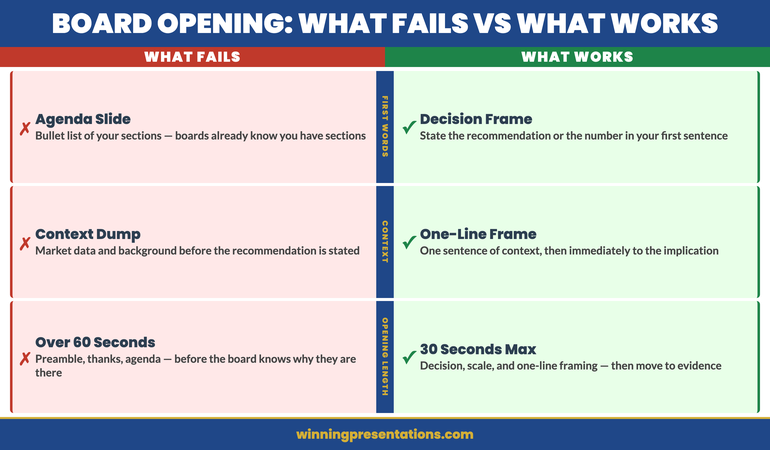
Infographic showing three failing board presentation opening structures — orientation delay, agenda slide, and context dump — contrasted with the decision-first approach

What boards actually want to hear first

I spent 24 years in corporate banking at JPMorgan Chase, PwC, Royal Bank of Scotland, and Commerzbank. I sat in hundreds of board and steering committee meetings on both sides of the table. The single most consistent pattern I observed: the presentations that held attention from the first sentence always led with the decision frame.

Not the process frame. Not the background frame. The decision frame.

A decision frame answers one question before any other: What are you asking us to do, or what do you need us to know in order to act?

This isn’t the same as a recommendation. Sometimes the board isn’t being asked to approve anything — they’re being given an update that requires awareness. A decision frame still works: “The programme is on track. The one item requiring board attention is the supplier risk in Q3.”

That sentence tells them exactly where to direct their scrutiny. Everything that follows is supporting detail. They’re not waiting for the point. The point arrived in your first sentence.

According to research into executive communication, senior decision-makers form an initial assessment of a presenter’s credibility within the first minute of a presentation. That first impression shapes how they interpret every data point that follows. An opening that respects their time and intelligence creates a halo effect. An opening that delays the point creates the opposite.

Your Opening Line Shouldn’t Be an Apology for Making Them Wait

The Executive Slide System — £39, instant access — includes the opening slide structures used in boardroom and high-stakes approval presentations. Lead with the decision frame, not the agenda. Your first slide should tell them what they need to know before you explain why.

  • Opening slide frameworks for board and approval presentations
  • Decision-first structure templates for different meeting types
  • AI prompt cards to draft opening lines in under 5 minutes
  • Slide templates for context, recommendation, and risk framing

Get the Executive Slide System →

Designed for board, approval, and investor presentations at executive level.

Four opening structures that work at executive level

There isn’t one perfect opening structure. Context matters: the type of meeting, what the board has already seen, the level of urgency, and whether you’re seeking approval or providing a report. These four structures cover the main scenarios.

1. The direct recommendation opening

Use this when you are seeking a decision or approval.

“We’re recommending [specific action]. The investment required is [amount]. Subject to board approval, we can move to contract by [date].”

Everything after this is evidence. The board knows what you want from them before you’ve showed them a single piece of supporting data. They can now evaluate your evidence against a clear decision framework. This is genuinely helpful — it changes how they listen.

2. The single-number opening

Use this when one metric defines the situation.

“Revenue is [X]. That’s [above/below] plan by [Y]. I want to spend our time on the two structural factors driving that variance — they’re different from what we expected.”

A specific number commands attention in a way that “overview of our quarterly performance” never does. It grounds the board immediately. They know the scale, the direction, and the frame for the discussion before you move to your second sentence.

3. The one-thing-to-know opening

Use this for updates where you’re not seeking a decision but awareness matters.

“Everything is on track. The one item I want to make sure you’re aware of is [issue]. It doesn’t require a decision today, but I want to ensure it’s visible at board level.”

This structure respects their time and shows judgement. You’ve told them what to care about and what not to worry about in a single breath. That’s a significant signal of executive competence.

4. The context-then-implication opening

Use this when the board needs a small amount of new context before your recommendation makes sense — but the context should take 30 seconds, not five minutes.

“Since our last meeting, [one significant external development]. That changes our position on [topic] in one specific way: [implication and recommendation].”

The key is compression. One development, one implication, one recommendation. Then you expand. The internal structure of your presentation can be as detailed as needed — your opening sentence sets the frame.

Roadmap infographic showing the four board presentation opening structures: direct recommendation, single-number, one-thing-to-know, and context-then-implication

Phrases to eliminate from every board opening

Certain phrases appear in board presentations so frequently that they’ve lost all meaning. More damaging, they’ve become signals of a presenter who hasn’t thought carefully about their opening. If you use any of these, you’re starting with borrowed language rather than a clear frame.

“Thank you for having me” / “Thank you for the opportunity to present.” This is not wrong, exactly. But it consumes your first sentence on politeness that everyone understands is implied. The board didn’t invite you to be thanked — they invited you because they need information. Get to it.

“Before I begin…” This tells the board that whatever follows is not the actual presentation — it’s preamble. You’ve signalled delay before you’ve started.

“As you’ll see from the agenda…” If your opening sentence refers to your agenda, your opening sentence is about your structure rather than their decision. That’s the wrong priority.

“I know you’re all very busy…” Acknowledging their busyness doesn’t make your presentation faster. It suggests you’re worried about their patience, which makes them more aware of time.

“This is a complex topic, but…” Anything that follows “but” in an opening sentence carries anxiety about whether your argument will land. Boards don’t need forewarning about complexity — they need your clearest summary of what it means.

Removing these phrases is not about being brusque. It’s about using your opening line for what it should do: establish the decision frame and earn attention through clarity.

If you want to see how the internal structure of a high-stakes presentation supports a strong opening, the article on executive presentation structure covers this in detail. And for the specific difference between a board paper and a board presentation — which changes what your opening needs to do — see board paper vs board presentation.

The first slide rule that changes everything

Your opening words and your first slide are not the same thing. But they should be aligned.

The most effective first slides for board presentations share one characteristic: they show the conclusion, not the agenda. This is counterintuitive for most presenters trained in traditional presentation structures. The instinct is to ease the audience in — set up the problem before revealing the solution.

Boards don’t want to be eased in. They want to know immediately what position you’re advocating, then evaluate whether your supporting evidence holds.

A first slide that shows your recommendation (with the supporting rationale compressed to three bullet points) lets the board challenge the right things from the start. If they see a problem with your recommendation in the first minute, they’ll tell you — and you can address it before spending 20 minutes on analysis that doesn’t resolve their concern.

Compare these two first-slide approaches for a budget approval request:

Approach A: Title: “FY2027 Budget Request — Technology Infrastructure Division.” Content: Agenda.

Approach B: Title: “We’re requesting £2.4M for infrastructure replacement — here’s why it’s the only option.” Content: Three-line summary of the business case and the alternative cost of inaction.

Approach B tells the board what decision they’re being asked to make, frames the scale, and gives them the argument in compressed form. If they want more detail, your subsequent slides provide it. If they have a question about the assumption behind the recommendation, they can raise it now rather than at slide 22.

The principles behind strong board presentation structure — including how to open, present, and close effectively — are covered in depth in the guide to how to start a presentation.

If you’d prefer a complete ready-made framework rather than building your opening structure from scratch, the Executive Slide System includes opening slide templates designed specifically for board and approval presentations.

Stop Rebuilding Your Board Slides From Scratch

The Executive Slide System — £39, instant access — is designed for executives who need a structured, repeatable format for high-stakes presentations. No more guessing what to put on slide one. The opening frameworks tell you exactly what information belongs where and why.

Get the Executive Slide System →

Designed for boardroom and executive approval presentations.

Frequently Asked Questions

Should I introduce myself at the start of a board presentation?

Only if you are presenting to a board for the first time and there are members who don’t know your role. In that case, one sentence is sufficient: “I’m [name], [role], and I’m responsible for [area].” If the board already knows you, skip the introduction entirely. Your time is better spent on the decision frame.

How long should a board presentation opening be?

The opening — from your first spoken word to your first piece of supporting evidence — should take 30 to 60 seconds. If it takes longer, you have too much preamble. The opening’s job is to establish the decision frame, not to explain your thinking process. Thinking is shown through the structure of your evidence, not the length of your introduction.

What if I need to provide context before the board can understand my recommendation?

Keep the context to one sentence and state the recommendation anyway. “Since our last meeting, the regulator has issued updated guidance — our recommendation is [X] to stay compliant” gives both context and recommendation without the extended build-up. If the context requires more than one sentence, that’s a sign that your pre-read document needed to be stronger, not that your opening needs to be longer.

The Winning Edge

Weekly strategies for executives who want to present with clarity and conviction. Every Thursday.

Subscribe Free →

Not ready for the full system? Start here instead: download the free Executive Presentation Checklist — a single-page reference for the structure, opening, and closing every executive presentation needs.

For executives presenting in hybrid or virtual environments, where opening line technique requires additional adaptation, see when to turn your camera off in virtual presentations — a related consideration for how presence translates across formats.

Your next board presentation deserves a first sentence that earns attention rather than waits for it. Start with the decision. Let the evidence follow. The board will notice the difference.

About the Author

Mary Beth Hazeldine is Owner & Managing Director of Winning Presentations. With 24 years of corporate banking experience at JPMorgan Chase, PwC, Royal Bank of Scotland, and Commerzbank, she advises executives across financial services, healthcare, technology, and government on structuring presentations for high-stakes funding rounds and approvals. She is a qualified clinical hypnotherapist and NLP practitioner.

21 Apr 2026
A senior executive commanding a boardroom presentation, speaking with authority to a small C-suite audience, projected slides visible, editorial photography style

Senior Executive Presentation Skills: The Structured Approach That Works

Quick Answer

Senior executive presentation skills are a distinct capability set — not simply “good presenting” scaled up. At C-suite and board level, the ability to structure your thinking, command a room, and move a decision forward in a single meeting is what separates executives who advance from those who plateau. This article sets out the four core skills, a structured development approach, and practical tools for embedding them permanently.

Ines had been Head of Risk for six years. She knew the numbers cold. She knew the regulators. She knew every objection her board would raise before they raised it.

Her first presentation as Group CRO went sideways in the third minute.

Not because she was wrong. Not because she was unprepared. She was stopped because the Chair said, quietly but unmistakably: “Ines, can you tell me why you’re recommending this before you tell me what it is?”

She had walked into a board presentation with a director-level deck. At director level, you build the context, walk through the data, and arrive at the recommendation by page twelve. At board level, that structure is read as uncertainty. They want the conclusion first, then the evidence, then the decision they need to make. In under seven slides.

Ines recovered well. But she told me later: “Nobody told me the structure changes completely when you change level. I had to learn it under fire.”

That is the gap this article addresses.

For Executives Who Want a Structured Approach

The Executive Slide System gives you 22 slide templates built for C-suite and board-level scenarios — plus 51 AI prompt cards to build your deck fast. If you want a ready-made framework rather than a blank canvas, it is worth a look.

Explore the Executive Slide System →

Why Senior-Level Presentations Are Fundamentally Different

The skills that make someone an effective presenter at management level actively work against them at executive level. This is not obvious until it goes wrong.

At middle management, detailed context-building signals thoroughness. At senior executive level, it signals that you have not yet decided what you think. The most senior rooms — boards, executive committees, investment panels — are not looking for a briefing. They are looking for a recommendation from someone who has already done the thinking.

The second difference is time. A board director may be looking at eight agenda items in a two-hour meeting. A minute spent on scene-setting that everyone already knows is a minute taken from their Q&A. Executives who understand this respect the room. Those who do not, however thorough their preparation, are perceived as failing to read the context.

Third, the political dimension increases sharply. At board level, every word is read for signal. How you frame risk, how you handle disagreement, how you respond when a non-executive challenges your figures — these are not just presentational moments. They are data points that shape how you are assessed as an executive.

Understanding these shifts is the first step. Building specific skills to address them is the work.

The Four Skills That Define Executive-Level Presenting

Across more than twenty years of advising executives on high-stakes presentations, four capabilities separate those who command senior rooms from those who survive them.

Infographic for: senior executive presentation skills (image 1)

1. Recommendation-Led Structuring

The instinct to build context before the recommendation is almost universal. It comes from a legitimate desire to bring the room with you before asking for something. At senior executive level, this logic reverses. Lead with your recommendation. State it in plain language in your first sentence. Then provide the evidence that supports it. Then address the objections you expect.

This structure — sometimes called the Pyramid Principle — is not new, but most executives only apply it partially. They use it for the headline but revert to bottom-up logic by the third slide. Consistent application, from title to close, is a learned and practised skill. See how executive presentation structure works in practice for a full walk-through of how to apply it across a complete deck.

2. Precision Language Under Scrutiny

Senior boards and executive committees ask hard questions. The quality of your response in that moment matters as much as the quality of your deck. Precision language means choosing words that are accurate without being defensive, confident without being overcommitted, and clear without being simplistic.

Executives who hedge excessively — “it could be”, “in some scenarios”, “it depends” — signal uncertainty even when the evidence is strong. Executives who overclaim — “this will definitely”, “we are certain” — invite the kind of forensic challenge that derails a presentation. The middle path is language that is calibrated: specific enough to demonstrate command, honest enough to hold up under questioning.

3. Stakeholder Psychology at Board Level

Every person in a senior room has a position, a concern, and a risk appetite. Presenting without mapping these in advance is presenting blind. Understanding stakeholder buy-in psychology is not manipulation — it is preparation. Knowing that your CFO cares about capital efficiency, your Chief People Officer cares about change impact, and your CEO cares about competitive positioning allows you to frame the same recommendation in language that each person finds compelling.

This does not mean different decks for different stakeholders. It means deliberate language choices and sequencing that address the concerns of the room you are in.

4. Composure in High-Stakes Moments

Being challenged mid-presentation is a test that every senior executive faces regularly. The ability to receive a hard challenge without becoming defensive, without losing the thread of your argument, and without showing the anxiety that the challenge may provoke — this is a trainable skill, not a personality trait.

Composure at this level is partly physical (voice, pace, posture) and partly cognitive (the ability to acknowledge the challenge, buy yourself three seconds of thinking time, and respond from your evidence). Both dimensions respond to deliberate practice.

Executive Slide System

Stop Rebuilding Your Decks From Scratch Every Time

The Executive Slide System — £39, instant access — gives you 22 slide templates built for the exact scenarios senior executives face: board presentations, investment cases, change approvals, and stakeholder briefings. Includes 51 AI prompt cards to draft each section and a set of playbooks and checklists for high-stakes preparation. Designed for executives who present to boards, executive committees, and senior leadership teams.

Get the Executive Slide System →

22 templates · 51 AI prompt cards · Playbooks and checklists for senior presentations

How to Structure Your Thinking Before You Structure Your Slides

The most common mistake in senior executive presentation preparation is opening PowerPoint too early. When the blank slide is the starting point, the temptation is to fill it with data — and data-led decks rarely lead to decisions at board level.

Before any slide is built, three questions must be answered:

What decision do you need this room to make? Not “what do I want to present” — what decision, in this meeting, on this day? If you cannot state it in a single sentence, your preparation is not complete.

What is the single most powerful argument for that decision? Most presentations carry five or six arguments of roughly equal weight. Senior audiences do not retain five or six arguments. One strong argument, supported by credible evidence, is more effective than six moderate ones competing for attention.

What objection will be hardest to answer? Identify it before the presentation, not during. Prepare a response that acknowledges the concern directly rather than deflecting it. Executives who can say “I know your concern on timeline — here is how we have addressed it in the plan” demonstrate command of the subject. Those who are surprised by the objection appear under-prepared regardless of the quality of their underlying work.

The answers to these three questions define the skeleton of a senior executive presentation. The slides carry the evidence. They do not carry the thinking — that has to happen before the deck is built.

For a structured guide to board-level preparation, board presentation best practices covers the full preparation sequence from first principles.

If you want a structured template set that applies this thinking-first approach to 22 common executive scenarios, the Executive Slide System builds the decision logic into every template, so the structure supports your thinking rather than replacing it.

Reading the Room at C-Suite Level

Senior rooms have dynamics that are not visible on the agenda. Who deferred to whom in the last meeting? Which non-executive is most likely to challenge on governance? Has there been a recent disagreement between two committee members that might surface through their responses to your presentation?

These dynamics shape how your presentation will land, independent of its quality. Executives who read and adapt to them in real time demonstrate political intelligence — a capability that is valued at senior level precisely because it is rare.

Reading the room at C-suite level means three specific things in practice:

Pace adaptation. If the Chair is signalling impatience through body language or brief questions, compress your slides and move to Q&A earlier. Rigidly following a prepared structure when the room has moved on is a form of not listening.

Challenge differentiation. Not all challenges are the same. A challenge that comes from genuine concern (“I am not sure we have the risk appetite for this”) requires a different response than a challenge that comes from positional signalling (“In my experience, these projects always overrun”). The first needs evidence. The second needs acknowledgement and a bridge back to your argument.

Silence management. After a key recommendation, silence often means the room is processing, not that your recommendation has failed. Many executives fill silence with additional explanation — which can undermine a recommendation that was actually landing well. Learning to hold silence is a practised skill that takes nerve and repetition.

Building a Development Practice That Actually Sticks

“Work on your presentation skills” is advice that most executives have received at least once. Almost none of them have been told specifically what to work on, how to do it, or how to know when it is working. Without that specificity, the feedback is not actionable.

A development practice for senior executive presentation skills needs three components:

Deliberate preparation habits. The single highest-impact habit change for most senior executives is to prepare the verbal narrative separately from the slides. Build the deck, then rehearse what you will say at each slide out loud — not reading from notes, but speaking it as if to the actual room. The gap between what you planned to say and what comes out under pressure is usually large until this rehearsal becomes routine.

Post-presentation review. Within twenty-four hours of every significant presentation, note three things: what worked exactly as planned, what did not land as expected, and one thing you would change in the preparation process. Over six to eight weeks, patterns emerge — and patterns are what make development systematic rather than reactive.

Structured formats for high-stakes scenarios. Most executives who struggle with senior presentations are not struggling with delivery skills. They are struggling with structure — particularly in scenarios they encounter less frequently: investment committee presentations, crisis briefings, major change announcements. Having a tested template for each of these scenarios removes the blank-page problem and frees cognitive capacity for the strategic thinking the room actually needs from you.

The acceleration path for executives working on their promotion case, which explores how presentation skills connect directly to advancement, is covered in depth at how to make the business case for your own promotion.

Already Know What You Need — Want the Templates?

22 Senior Executive Presentation Templates, Ready to Use

The Executive Slide System — £39, instant access — includes templates for the scenarios this article covers: board presentations, investment cases, change approvals, and stakeholder briefings. Each template has the decision logic built in. Pairs with 51 AI prompt cards that draft the content for you.

Get the Executive Slide System →

Designed for executives presenting to boards, executive committees, and senior leadership teams

Frequently Asked Questions

What makes executive presentation skills different from general presentation skills?

At senior executive level, the structure, language, and political awareness required are substantially different from general presentation skills. Boards and executive committees expect a recommendation-led structure, precision language under challenge, and clear decision framing — not the context-first, evidence-building approach that works at management level. The skills are related but not the same, and the gap typically only becomes visible once an executive is already presenting at the new level.

How long does it take to develop senior executive presentation skills?

With a structured approach — deliberate preparation habits, post-presentation review, and structured templates for high-stakes scenarios — most executives see a meaningful improvement within six to eight weeks. The most important variable is whether the development is systematic (specific habits, specific review, clear feedback loop) or generic (“work on your presentations”). Generic feedback rarely produces change. Structured practice consistently does.

What is the most common mistake executives make in board presentations?

The most common mistake is leading with context and arriving at the recommendation late — usually on page eight or ten of a fifteen-slide deck. Board members are often looking at six to eight agenda items in a single meeting. An executive who buries the recommendation in the second half of their presentation has, in effect, asked the board to process twelve minutes of evidence before they know what they are processing it for. Starting with the recommendation, supporting it with evidence, and addressing the anticipated objections directly is the structure that works consistently at board level.

Is an executive presentation skills course worth it for a senior leader?

The value depends on what the course addresses. Generic presentation skills training — designed for managers or team leaders — rarely addresses the specific demands of board and C-suite presenting. What works for a senior executive is structured template work for high-stakes scenarios, deliberate Q&A handling practice, and specific guidance on recommendation-led structuring. A course that addresses those elements is worth serious consideration. One that covers confidence, body language, and general slide design is likely not calibrated to where the gap actually sits.

The Winning Edge — Weekly Newsletter

Practical frameworks for senior executives — delivered every Thursday. One technique. One application. No filler.

Subscribe to The Winning Edge →

Not ready for the full system? Start here instead: download the free Executive Presentation Checklist — a one-page pre-presentation review covering structure, language, and stakeholder framing for senior-level decks.

About the Author

Mary Beth Hazeldine is Owner & Managing Director of Winning Presentations. With 25 years of corporate banking experience at JPMorgan Chase, PwC, Royal Bank of Scotland, and Commerzbank, she advises executives across financial services, healthcare, technology, and government on structuring presentations for high-stakes funding rounds, board approvals, and executive committee decisions. She has been delivering presentation skills training to senior leaders for 16 years.

21 Apr 2026
Project leader standing at whiteboard facilitating a team retrospective discussion with colleagues seated around a table, calm professional atmosphere, editorial photography style

Team Retrospective Q&A: Honest Answers Without Creating Blame

Quick Answer

Team retrospective Q&A fails when the leader answers defensively or when honesty produces blame rather than insight. The technique that works is separating the system from the individual: acknowledge what happened factually, name the contributing conditions rather than the responsible person, and close each answer with a forward-looking action. Retrospective sessions where leaders model this approach consistently generate more useful information than those where people protect themselves from scrutiny.

Hendrika had run the project for seven months. The delivery had been late by three weeks and two milestones had been missed. The retrospective was scheduled for the Tuesday after go-live, and she had spent the weekend preparing her slides and anticipating the questions.

What she had not prepared for was the question that opened the session. A senior stakeholder looked at the timeline summary and asked, simply: “What happened to the testing phase?”

Hendrika knew exactly what had happened. A resource decision made six weeks into the project had reduced the QA team by two people, a decision she had flagged in writing and been overruled on. But the person who had overruled her was in the room. So was the person who had been leading the under-resourced QA team. Giving the factually accurate answer meant pointing at someone. Giving a vague answer meant accepting responsibility for something that was not entirely hers. Both felt wrong, and she felt the seconds stretching as she tried to find a third path.

The retrospective Q&A is one of the most technically demanding Q&A formats in professional life. It requires honesty without blame, accountability without defensiveness, and forward focus without dismissing what went wrong. These are not natural combinations. They require deliberate technique.

Handling difficult Q&A across all executive formats?

The Executive Q&A Handling System gives you the frameworks to predict, prepare for, and respond to executive questions with confidence — including structured techniques for high-pressure Q&A in team and stakeholder settings.

Find Out More →

Why Retrospective Q&A So Often Produces the Wrong Information

The purpose of a retrospective is to extract accurate information about what happened and why, so the team can learn from it. The structure of a retrospective Q&A almost always works against this purpose.

The problem is that retrospective Q&A takes place in a room where people are simultaneously the witnesses, the subjects, and the interpreters of events. The person answering a question about what went wrong with the testing phase was also involved in the testing phase. The person asking about the missed milestone may have contributed to it. The asymmetry of information is high and the emotional stakes are real, which means the social dynamics of the room frequently override the stated purpose of learning.

Two failure modes dominate. The first is defensive answering: leaders give technically accurate but contextually incomplete answers that protect their decisions from scrutiny without overtly denying the facts. This produces a version of events that is difficult to argue with and impossible to learn from. The second is blame-seeking: questions are framed in ways that pursue accountability for specific individuals rather than understanding of systemic conditions, which causes those individuals to become defensive and the information they hold to become inaccessible.

Both failure modes are rational responses to the incentives in the room. Nobody wants to be publicly identified as the person whose decision caused the delay. Nobody wants to be seen as the person protecting others from accountability. The retrospective format creates a pressure that makes honest information sharing feel risky, and people respond to risk by managing their exposure rather than serving the stated purpose of the session.

The leader’s job in a retrospective Q&A is to change those incentives through the quality of their own answers. When the most senior person in the room models honest, non-defensive, system-focused answers, it signals that the session is genuinely safe to participate in. When they do not, it signals that self-protection is the correct strategy, and the session produces politics rather than learning.

The Blame vs System Distinction: How to Frame Every Answer

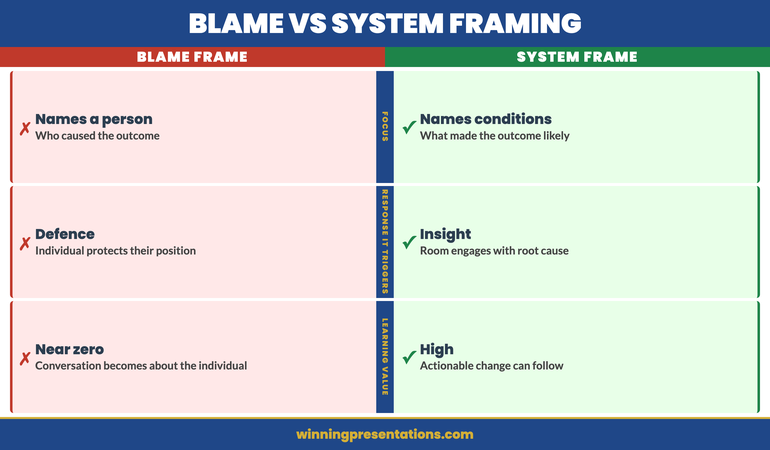
The most useful tool in retrospective Q&A is the distinction between individual blame and systemic explanation. These are not mutually exclusive, but they require different framing, and choosing the right frame for each question determines whether the answer generates insight or defensiveness.

A blame frame identifies a person as the cause of an outcome: “The testing phase overran because the QA lead underestimated the scope.” This may be factually accurate. It is almost always unhelpful, because it produces one response: the QA lead defending their estimation, and the rest of the room waiting to see whether they succeed or fail. The conversation becomes about the individual rather than the conditions in which the estimation was made.

A system frame identifies the conditions that produced the outcome: “The testing phase overran because the scope estimate was made before two significant late-stage requirements were added, and the resource model wasn’t adjusted when those requirements came in.” This is more accurate as a causal account, it is more actionable as a learning point, and it does not require anyone in the room to publicly accept personal responsibility for a failure they may reasonably dispute.

Applying this frame requires that you actually know the systemic conditions — which is why retrospective preparation matters. Before the Q&A, map the key failure points in the project and identify for each one: what were the conditions that made this outcome likely? What decision points existed where a different choice could have changed the result? Who had the information and authority to make those different choices? This analysis gives you system-framed answers for the questions you are most likely to receive, prepared in advance rather than constructed under pressure in the room.

Blame vs system framing in retrospective Q&A: blame frame names a person and produces defensiveness; system frame names conditions and produces actionable insight — four-step approach shown

Handling Direct Criticism of Your Own Decisions

The most uncomfortable moments in retrospective Q&A are those where the question is clearly about a decision you made. The temptation is either to explain at length why the decision was correct given the information available at the time, or to accept responsibility in language so broad that it becomes meaningless. Neither approach serves the session.

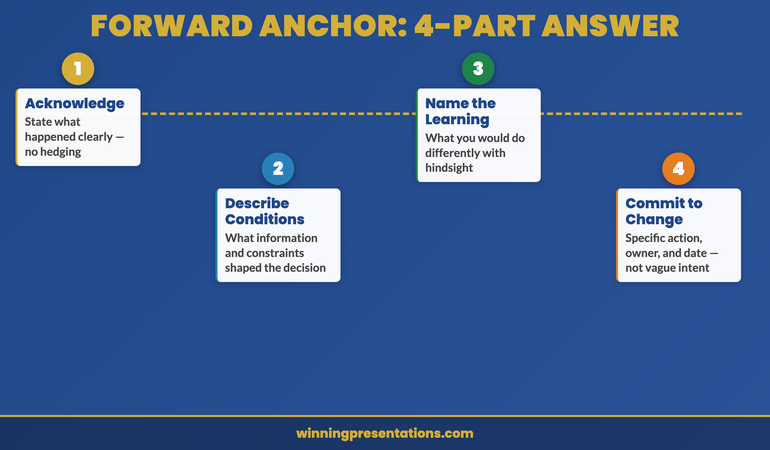
The formula that works is: acknowledge the decision clearly, describe the information and constraints you were working with at the time, name what you would do differently now that the outcome is known, and connect to a specific forward action. This structure does three things simultaneously: it demonstrates accountability without defensiveness, it provides the room with useful information about the decision-making conditions, and it moves the conversation toward what can actually be changed.

An example of this in practice: “The decision to reduce the QA resource in week six was mine. At that point I was prioritising against a budget constraint and I accepted a risk that turned out to be larger than I assessed. If I were making that decision again with what I know now, I would have pushed harder on the timeline rather than on the resource budget. Going forward, the change I’m committing to is a formal risk review whenever resource changes are made after the planning stage.”

Notice what this answer does not do: it does not blame the budget constraint, it does not suggest the outcome was unforeseeable, and it does not imply that anyone else was responsible. It is completely honest about the decision and its consequences. It is also completely constructive in its orientation. Most rooms will respond to this kind of answer with respect rather than further interrogation, because it gives them everything the question was seeking.

For situations where the criticism is directed at a decision that involved others — particularly in a skip-level meeting Q&A context where senior leaders are asking about team decisions — the same formula applies, but with additional care to avoid inadvertently naming individuals whose decisions contributed to the outcome.

The Executive Q&A Handling System

Retrospective Q&A is one of the most demanding formats in executive life. The Executive Q&A Handling System — £39, instant access — gives you the frameworks to predict the questions before they are asked, structure answers that are honest without being exposed, and handle the full range of difficult Q&A scenarios executives face.

  • Frameworks for predicting and preparing for executive questions
  • Structured response techniques for hostile and critical questions
  • System for handling Q&A with confidence across all meeting types
  • Scenario guides for high-pressure retrospective and review sessions

Get the Q&A Handling System →

Walk into Q&A knowing 80% of the questions before they are asked.

Protecting Individual Team Members During Q&A

One of the leader’s primary responsibilities in a retrospective Q&A is ensuring that individual team members are not exposed to public blame in a format where they cannot defend themselves without appearing defensive. This is not about shielding people from accountability. It is about ensuring that accountability happens in the right context, with the right information, and with appropriate due process — not in a group session where the questioner controls the framing and the subject has seconds to respond.

The most common threat to individual team members comes from questions that are phrased to invite a named response: “Who was responsible for the testing plan?” or “Which team signed off the scope change?” These questions are not necessarily malicious. They may be genuine attempts to understand accountability. But in a group retrospective, they create a situation where the honest answer names a specific person in front of their peers and leadership, with no opportunity for context or nuance.

The correct response is to redirect to the systemic level: “The testing plan was a shared responsibility between project management and the QA function — the more useful question is why the plan wasn’t updated when the scope changed in week nine, and that’s what I’d like to address.” This acknowledges the question, redirects to the more useful version of it, and removes the individual from the firing line without appearing evasive.

If an individual genuinely does need to be held accountable for a specific decision or outcome, that conversation happens privately and after the retrospective — not in the session itself. A retrospective Q&A is not a disciplinary process. Treating it as one produces a session where no one who has anything at risk will speak honestly, which defeats the entire purpose of the exercise.

The Forward Anchor: Closing Answers That Move Rather Than Revisit

Every answer in a retrospective Q&A should end with a forward anchor: a specific, concrete statement about what will be done differently based on what is now understood. This is the element most leaders omit, and its absence is what makes retrospective sessions feel circular.

A forward anchor is not a vague commitment to improvement. “We will be more careful about resource decisions in future” is not a forward anchor. It is a statement of intention with no mechanism behind it. A forward anchor identifies the specific change: what will be done, by whom, and by when. “From the next project kick-off, resource changes after week four require a formal impact assessment signed off by the project sponsor before they can be implemented” is a forward anchor. It is concrete, attributable, and auditable.

Including a forward anchor in each answer changes the experience of the retrospective session for everyone in the room. When the leader consistently closes answers by committing to specific changes, the session stops feeling like an autopsy and starts feeling like a useful exercise. Team members who were sceptical about the value of the retrospective become more engaged when they see that the answers they are contributing to are being translated into concrete changes. Stakeholders who came to the session looking for accountability find it — in the form of commitments rather than blame.

The discipline required is that the forward anchors must be real commitments, not placeholders. If you close four answers with forward anchors and none of them are implemented before the next retrospective, the session becomes evidence that retrospectives are a performative exercise rather than a genuine learning mechanism. Treat each forward anchor as a public commitment and manage it accordingly.

Forward anchor technique for retrospective Q&A: four-part answer structure — acknowledge, describe conditions, name the learning, commit to specific change with owner and date

Questions That Need Deferring and How to Do It Honestly

Not every question in a retrospective Q&A can or should be answered fully in the group session. Some questions involve information that is sensitive, incomplete, or that touches on matters requiring individual conversations rather than group disclosure. Deferring these questions is appropriate; how you defer them determines whether the questioner accepts the deferral or pushes harder.

There are three situations where deferral is legitimate. The first is where the answer involves individual performance matters that should not be discussed in a group setting — any question that requires naming a specific person’s failure or shortcoming falls into this category. The second is where the answer requires information you do not yet have: if the post-mortem analysis is still in progress and the question is asking for a conclusion that has not yet been reached, saying so is more useful than offering a provisional answer that may need to be corrected later. The third is where the answer is politically sensitive in a way that the full group context cannot handle safely — a question that implicates a decision made at a level above the session, for example, or one that touches on a matter that is subject to ongoing investigation or process.

Deferring well requires two elements: a clear statement of why the question is being deferred and a specific commitment to when and how it will be answered. “That’s a question I want to answer properly, and I don’t have all the information I need right now. I will have a complete answer by Friday and I will send it to everyone in this room directly” is a legitimate deferral. “That’s something we can look at separately” is not — it is a deflection that the questioner will correctly identify as evasive.

The same principle of honest deferral applies in other high-pressure Q&A settings. When a question in an all-hands session catches you unprepared, a clear deferral with a specific follow-up commitment is more credible than an improvised answer that turns out to be inaccurate.

For executives who want a complete system for managing difficult questions across all formats, the Executive Q&A Handling System provides structured frameworks for prediction, preparation, and response across the full range of executive Q&A scenarios.

Frequently Asked Questions

How do you handle a question in a retrospective that you know is politically motivated?

Treat it as though it were a genuine question and answer it at face value. Responding to the political motivation rather than the stated question escalates the tension and signals that you are also operating politically rather than professionally. The questioner who is trying to create a moment will find it harder to do so if you give a clear, honest, system-framed answer that removes the emotional charge from the exchange. If the question is genuinely unanswerable at face value — if it is so loaded that any answer confirms the implied accusation — name the assumption in the question before answering: “I want to address the assumption in that question before I answer it directly.”

What is the right approach when a team member answers a retrospective question in a way that is factually inaccurate?

Do not correct them publicly in the session unless the inaccuracy is material to the learning the session is trying to produce. A minor factual error about a date or a sequence is best noted and corrected in the written summary after the session. A significant inaccuracy that would lead the group to a wrong conclusion about what happened needs to be addressed, but the technique matters: “I want to add some context to that” is a more effective opening than “Actually, that’s not correct.” The former invites dialogue; the latter invites defence.

Should the leader present before Q&A, or open directly to questions?

A brief structured presentation before Q&A almost always produces better questions and more useful answers. When the group has a shared factual baseline — the timeline, the key decision points, the actual outcomes against the plan — their questions are more specific and more productive. Opening directly to questions in a retrospective without a shared baseline produces questions that are partly answering themselves and partly seeking the basic information that a five-minute presentation would have provided. The presentation does not need to be long. A ten-minute structured summary of what happened is sufficient to anchor the Q&A that follows.

The Winning Edge — A Newsletter for Executives Who Present

Every Thursday: one practical technique for structuring, presenting, or defending a high-stakes proposal. Designed for executives who need to communicate with authority, not just confidence.

Subscribe to The Winning Edge →

The Executive Q&A Handling System

The complete system for predicting and handling executive Q&A — across retrospectives, board sessions, stakeholder reviews, and all-hands meetings. Walk into Q&A knowing 80% of the questions before they are asked. £39, instant access.

Get the Q&A Handling System →

Designed for executives who need to handle difficult questions with confidence.

For the physical and vocal delivery elements of a difficult presentation session, see the companion piece on microphone technique for executive presentations — the mechanics of how you sound in a large room matter as much as what you say.

About the Author

Mary Beth Hazeldine is the Owner and Managing Director of Winning Presentations. With 25 years of corporate banking experience at JPMorgan Chase, PwC, Royal Bank of Scotland, and Commerzbank, she advises executives across financial services, healthcare, technology, and government on structuring presentations for high-stakes funding rounds and approvals.

21 Apr 2026
Female executive presenting confidently on a large conference stage holding a handheld microphone, professional lighting, large audience visible, editorial photography style

Microphone Technique for Executives: Handheld, Lapel and Podium

Quick Answer

Poor microphone technique is one of the fastest ways to lose an audience before you have said anything worth hearing. The three types of microphone used in executive presentations — handheld, lapel, and podium — each require different habits. Get the technique right and the microphone disappears from the room’s awareness. Get it wrong and it becomes the only thing anyone notices. This is a mechanical skill, not a talent. It takes twenty minutes to learn and applies immediately.

I watched a divisional director lose the room in the first forty-five seconds of a company-wide address. He had prepared well. The content was clear. The slide structure was sound. But he walked to the front holding the handheld microphone at chin level and turned his head away from it every time he looked at his slides. The words reached the front rows and evaporated. The back third of the room heard a sequence of half-sentences and ambient noise.

The people in those back rows did not know why they could not follow him. They simply stopped trying. They checked their phones, leaned to whisper to colleagues, and disconnected from a presentation that deserved better. The director did not recover, not because the content failed, but because the physical credibility gap opened in the first minute became the frame through which everything else was read.

Microphone technique is one of those skills that is invisible when done correctly and catastrophic when done badly. Most executives are never taught it. It is assumed that someone who can present to a boardroom can also handle an amplification system. The assumption is wrong, and the consequences are measurable in audience engagement from the first sentence.

Presenting to a large audience and managing your nerves at the same time?

Conquer Speaking Fear is a 30-day programme using nervous system regulation techniques from clinical hypnotherapy. Designed for executives who have tried other approaches and still struggle with the physical and psychological experience of high-stakes presenting.

Find Out More →

Why Microphone Technique Matters More Than Most Executives Realise

In a small meeting room, voice projection is managed by the speaker. In a larger venue — a conference hall, a company-wide townhall, an awards ceremony, an industry event — amplification takes over that function. The microphone becomes the primary instrument of your voice, and if you do not know how to use it, you have handed control of your first impression to a piece of equipment you have not practised with.

The problem is compounded because microphone issues are almost always invisible to the speaker. When you turn your head and your voice drops out of the microphone’s pickup range, you feel nothing different. You have no signal that fifty per cent of the room just missed your opening statement. The feedback loop that would normally alert you — a restless audience, a confused expression, a question that reveals they did not follow — is delayed by several minutes, by which time the connection has already been severed.

The deeper issue is what poor amplification signals to an experienced audience. Senior professionals who attend many large presentations have a calibrated sense of what confident, prepared speakers look like on stage. Fumbling with a microphone, holding it inconsistently, or having feedback spikes from a lapel badly clipped suggests either inexperience with large formats or poor preparation. Neither is the impression you want to create in the first sixty seconds.

The solution is not complex. It requires understanding the three microphone types, the specific error patterns of each, and a pre-presentation soundcheck protocol that takes under five minutes. None of this is performance coaching. It is mechanical knowledge that anyone can apply immediately.

Handheld Microphone: The Positioning Errors That Destroy Clarity

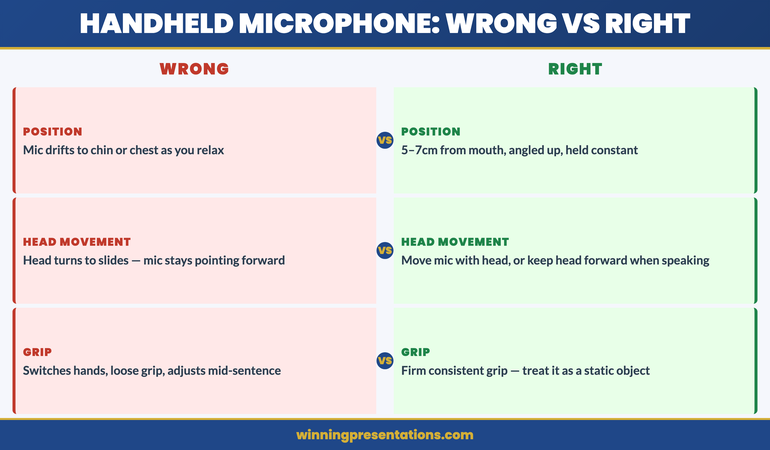
The handheld microphone is the most common in corporate presentations and the one most frequently misused. The fundamental rule is consistent distance: the microphone should be held approximately five to seven centimetres from your mouth, angled slightly upward, and maintained at that distance regardless of what your head does.

The most common error is letting the microphone drift downward as the presentation progresses. Speakers start with correct positioning and, as they relax into their content or begin referencing slides, the hand holding the microphone drops toward chin level, then toward the chest. At this point the microphone is capturing significantly less of the voice and more of the room’s ambient noise. The audience hears a reduction in clarity and volume that feels like disengagement, even if the speaker is fully present.

The second error is head-turning. When speakers turn to reference slides or look across the room, they often rotate their head while keeping the microphone stationary. The microphone stays pointing at where the voice was rather than following where it is. The fix is to move the microphone with your head, or to train yourself to keep your head forward when speaking and only glance at slides briefly rather than addressing them.

The third error is inconsistent grip. Nervous speakers often transfer the microphone between hands, hold it loosely, or grip it tightly and then adjust mid-sentence. Each adjustment creates a brief movement that disrupts pickup distance. Hold the microphone with a firm, consistent grip — treating it as a static object, not a prop — from the moment you take it to the moment you hand it back.

A practical test before any presentation with a handheld microphone: stand in front of a mirror, hold the microphone at the correct distance, and then do what you plan to do on stage — turn your head, gesture, reference notes. Watch what happens to the microphone position. The errors that appear in a mirror will also appear on stage.

Handheld microphone technique errors: drift downward, head-turning without moving mic, inconsistent grip — correct position shown at 5-7cm, angled upward, consistent throughout

Lapel Microphone: Placement, Clothing and Movement Rules

The lapel microphone, also called a lavalier, clips to clothing near the collar and provides hands-free amplification. It is common at conferences and company-wide events where the speaker needs freedom of movement. The three variables that determine whether it works are placement, clothing choice, and movement habits.

Placement is the most frequently mismanaged element. The clip should sit approximately fifteen to twenty centimetres below the chin, close to the centreline of the chest. Too low and the pickup weakens significantly; too high and the microphone is visible in camera shots and more susceptible to clothing noise. The exact placement depends on the sensitivity of the specific device, which is why a soundcheck matters — the technician will advise on positioning for that particular room and system.

Clothing creates the most unpredictable problems. Fabrics that rustle — certain synthetics, stiff cotton, structured jackets with internal lining — generate constant friction noise that the lapel microphone amplifies. This is not volume that the speaker can hear, but it is clearly audible to the audience and to anyone watching a recording. If you are presenting at a large event and wearing a lapel microphone, test your outfit with movement before you go on. Run your hand across the lapel area and listen for any fabric sound. Jackets with lapels are generally better than soft knitwear, which can move against the clip and generate intermittent noise.

Movement habits matter because turning your head sharply to one side — particularly if wearing a collar microphone near the jawline — can bring the jaw or shoulder into proximity with the pickup capsule, causing brief distortion. The fix is to turn from the body rather than leading with the chin: rotate your whole torso to address different parts of the room rather than swinging your head while your shoulders stay square.

Podium Microphone: How to Work It Without Being Trapped by It

The podium microphone is fixed in position, which creates a specific constraint that many speakers handle badly: they become physically anchored to the podium. They stand directly behind it, keep their movement minimal, and lose the stage presence that comes from occupying space freely. The microphone that was supposed to amplify their authority ends up containing it.

The key to working a podium microphone without being trapped by it is understanding its pickup angle. Most podium microphones have a cardioid pattern that captures a cone of sound roughly thirty to forty-five degrees wide directly in front of the capsule. You do not need to lean into the microphone. You need to speak across it from a consistent distance — typically twenty to thirty centimetres — and maintain that relationship even when you move your weight, gesture, or shift your stance.

The error most speakers make is leaning forward when they want to emphasise a point. The instinct is to move toward the audience when you want to make something land. But leaning into a podium microphone creates a volume spike that is jarring for the audience and uncomfortable in a large hall. Emphasis is better delivered through vocal variation — a slower pace, a deliberate pause, a lower register — rather than through physical proximity to the pickup.

If you want the freedom to move away from the podium briefly, discuss this with the AV team before the session. Many podium setups can be paired with a lapel backup that allows you to step out from behind the stand for a section of the presentation and then return. Planning this in advance is far more effective than improvising it on stage.

Understanding how to use eye contact effectively in executive presentations becomes significantly more powerful when your microphone technique is already handled — you can direct full attention to the room rather than managing the equipment at the same time.

Conquer Speaking Fear

Microphone technique handles the mechanics. Conquer Speaking Fear — £39, instant access — addresses the anxiety that makes the mechanics harder to manage in the moment. A 30-day programme built from clinical hypnotherapy techniques for executives who need a systematic approach to high-stakes presenting.

  • Nervous system regulation techniques from clinical hypnotherapy
  • 30-day structured programme for lasting anxiety reduction
  • In-the-moment techniques for the day of a high-stakes presentation
  • Designed for executives who have tried other approaches

Get Conquer Speaking Fear →

The anxiety management system built from clinical hypnotherapy, not just presentation tips.

When Anxiety Meets a Microphone: Managing Amplified Nerves

For speakers who experience presentation anxiety, a microphone adds a specific layer of difficulty. The physical symptoms of anxiety — a slight tremor in the voice, an increase in breathing rate, a dry mouth — become more apparent under amplification. Sounds that would be imperceptible to an audience of twenty become audible to an audience of two hundred. This knowledge itself increases the anxiety, which worsens the physical symptoms, which increases the awareness of the microphone. It is a reliable loop that catches many capable executives off guard the first time they present at scale.

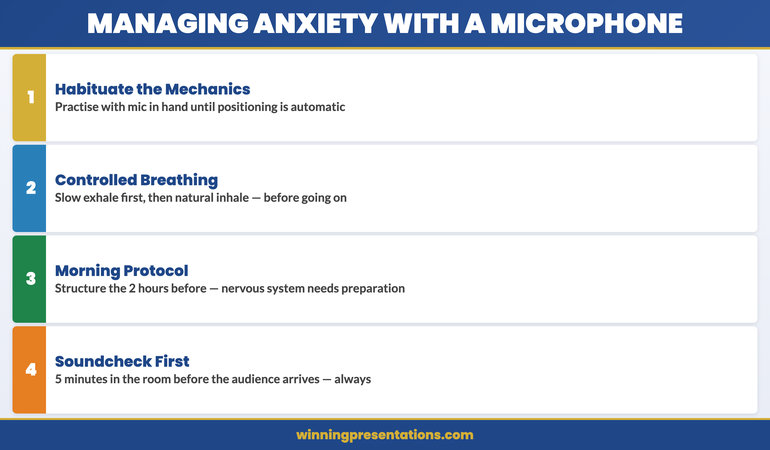
The most effective counter is preparation that is specific to the amplified format, not just to presenting in general. Practise with a microphone, or at least with your hand held in the position a microphone would occupy, so that the physical habit of holding it becomes automatic. Automatic behaviours are not disrupted by anxiety in the same way that novel behaviours are. When the mechanics of microphone use are fully habitual, they no longer compete with the cognitive and physical demands of managing nerves.

Breathing is more important under amplification than in smaller formats. The microphone will pick up an audible breath if it is sharp or gasped. Practise deliberate, controlled breathing before you go on stage: slow exhale, then a natural inhale, not the other way around. This is the breathing pattern associated with the parasympathetic nervous system rather than the stress response, and it reduces the visible and audible signs of anxiety more effectively than deep inhalation does.

The morning before a large presentation is also a significant factor. What you do in the two hours before you go on stage has a measurable effect on how well your nervous system manages the amplified format. A structured morning presentation protocol specifically for high-stakes events gives the nervous system the conditions to perform, rather than asking it to recover from a disordered start to the day.

If anxiety in large-format presentations is a consistent pattern for you rather than an occasional occurrence, that is not a microphone technique problem. The technique helps, but the root cause requires a different kind of work. Conquer Speaking Fear is designed specifically for executives dealing with persistent presentation anxiety — a 30-day programme built from clinical hypnotherapy, not generic confidence advice.

Microphone anxiety management: four steps — habituate the mechanics, controlled breathing technique, morning protocol, address root cause if pattern is persistent

The Soundcheck Protocol Most Speakers Skip

Most speakers arrive at a large event, accept the microphone from an AV technician, and walk to the stage. This skips the single most effective preparation available to them: a working soundcheck in the actual space, at the actual volume level, before the audience arrives.

A soundcheck takes four minutes. What it gives you is worth far more. First, you get to hear your own voice as the audience will hear it — amplified, in that specific room, at that specific volume. For most people this is a surprising experience: the voice sounds different, often deeper and more resonant, and getting comfortable with that difference before you are in front of five hundred people means you are not distracted by it when it matters.

Second, the soundcheck is where you discover problems. The lapel clip that causes friction against your jacket. The podium microphone positioned too far to the left of centre. The feedback frequency that kicks in when you turn toward the screen. These are all fixable before the presentation and difficult to manage during it.

Third, the soundcheck is where you establish rapport with the AV team. These are the people who control your volume, your slide progression, and the lighting. Treating them as professionals who are invested in your success — which they are — rather than as technicians to be given brief instructions creates a collaborative dynamic that consistently produces better outcomes on the day.

Request a soundcheck as a formal part of your arrival process for any event that uses amplification. If the organisers say there is no time, arrive thirty minutes earlier than they suggest and ask the AV team directly. Almost always, they will make time. They want the audio to work as much as you do.

The same principle of deliberate physical preparation applies to movement and stage positioning: professionals who walk the stage before the audience arrives always look more comfortable when the audience is there.

Frequently Asked Questions

What should you do if the microphone cuts out mid-presentation?

Pause briefly, signal to the AV team with a clear look or a raised hand, and project your voice naturally until the system is restored. Do not apologise repeatedly or call attention to the technical problem beyond acknowledging it once. Audiences are forgiving of equipment failures that are managed calmly and unforgettable when a speaker appears thrown by them. The ability to project without amplification for thirty seconds, if necessary, is worth practising specifically: speak from the diaphragm, not the throat, and maintain the same pace and authority your amplified voice would carry.

Is it acceptable to hold a handheld microphone with two hands?

Not typically. Two-handed microphone holding limits gesture, signals physical tension, and looks uncertain on stage. The exception is if the venue is very large and the microphone is heavy — some broadcast-quality handheld microphones have significant weight, and a two-handed hold can be appropriate for extended periods. In most corporate presentation contexts, one hand with a firm, relaxed grip is correct. The other hand should be free to gesture naturally or rest at your side.

How do you handle a microphone when you want to pause dramatically?

A deliberate pause is one of the most powerful tools in executive presenting, and the microphone changes how you manage it. If you lower the microphone during a pause, you signal that you are about to speak again when you raise it — which can reduce the impact of the silence. Keeping the microphone in position during a pause maintains the tension of the silence rather than breaking it. The audience reads the raised microphone and the silence simultaneously, which creates a more powerful expectation of what comes next.

The Winning Edge — A Newsletter for Executives Who Present

Every Thursday: one practical technique for structuring, presenting, or defending a high-stakes proposal. Designed for executives who need to communicate with authority, not just confidence.

Subscribe to The Winning Edge →

Conquer Speaking Fear

The 30-day programme for executives dealing with persistent presentation anxiety — built from clinical hypnotherapy techniques that address the nervous system root cause, not just the surface symptoms. £39, instant access.

Get Conquer Speaking Fear →

The anxiety management system built from clinical hypnotherapy, not just presentation tips.

When you are ready to address the Q&A session that follows a large-format presentation, the same discipline applies: preparation and habit formation reduce the unpredictability. See the companion article on handling Q&A in team settings for a structured approach to managing questions under pressure.

About the Author

Mary Beth Hazeldine is the Owner and Managing Director of Winning Presentations. With 25 years of corporate banking experience at JPMorgan Chase, PwC, Royal Bank of Scotland, and Commerzbank, she advises executives across financial services, healthcare, technology, and government on structuring presentations for high-stakes funding rounds and approvals.

21 Apr 2026
Senior male executive in a boardroom presenting a career transition proposal to a small panel of leaders, confident expression, corporate setting, editorial photography style

Career Pivot Presentation: How to Frame a Lateral Move to Senior Leadership

Quick Answer

A career pivot presentation succeeds when it closes the perceived gap between where you are and where you want to go. Senior leaders are not opposed to lateral moves — they are opposed to unclear logic and unmanaged risk. Show the transferable value you bring, acknowledge the learning curve honestly, and make the case that developing this capability serves the organisation as well as your own growth. The executives who secure lateral moves do so by making the decision easy, not by making the request compelling.

Tomás had spent eight years in finance. He was technically excellent, politically well-positioned, and genuinely respected by the CFO. When a senior commercial role opened in the business development team, he believed the transition made obvious sense: he understood the numbers better than any BD candidate on the shortlist, he had managed relationships with external partners, and he had spent years advising on deals from the financial side. He could not understand why the decision-makers seemed hesitant.

The hesitation was not about his capability. It was about the narrative. Tomás was presenting a career story in which the pivot was obvious because he could see all the evidence. The hiring committee saw a finance director asking to move into a commercial role without a clear explanation of why now, why this role, and how his particular strengths would serve BD’s specific challenges rather than finance’s. He had the content. He had not built the frame.

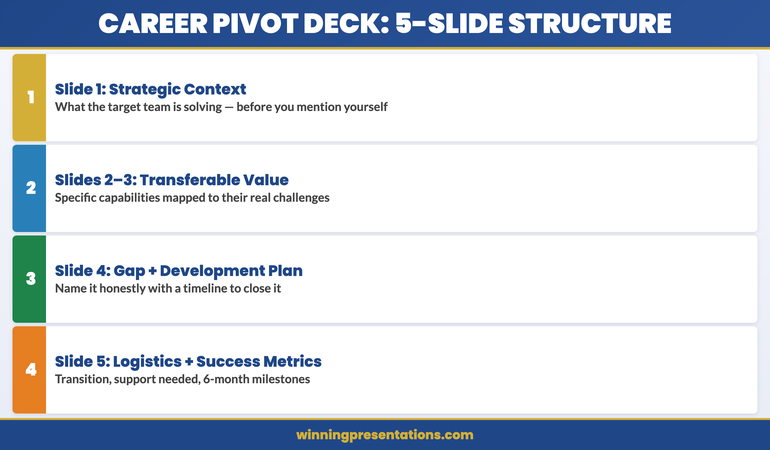
A career pivot presentation is not primarily about demonstrating readiness. It is about making the logic of the move legible to people who do not share your internal experience of why it is the right thing to do. That requires a different kind of preparation from a standard promotion case.

Building a structured case for a senior career decision?

The Executive Slide System includes proposal frameworks and slide templates designed for high-stakes executive presentations, including career and strategic positioning decks.

Explore the System →

Why Lateral Moves Are Harder to Pitch Than Promotions

A promotion pitch tells a linear story. The evidence is cumulative: you have done more of the same things at a higher level, and the organisation already has a framework for evaluating readiness. Decision-makers are assessing degree, not direction. The question is whether you are ready for the next step on a path they can already see.

A lateral move asks decision-makers to evaluate a different kind of question: whether someone whose entire track record is in one domain can genuinely contribute to a different one. This is harder to assess because the comparison set is different. A finance director being evaluated for a finance director role is compared with other finance directors. A finance director being evaluated for a commercial role is compared with commercial directors — people who have been doing that specific work for years. The bar is not lower because you are changing direction. It is, in some ways, higher, because you have to establish a plausible case for competence in a domain where you have less evidence to offer.

The implication for your presentation is significant. You cannot rely on your existing track record to carry the argument. You need to translate it — to show explicitly how what you have done in your previous domain is directly relevant to what the new role requires. That translation is the core job of a career pivot presentation, and it is the step most people skip because the connection feels obvious to them.

The Gap Problem: Naming It Before They Do

Every career pivot has a gap. There is something in the target role that you have not done directly, a skill set you are developing rather than bringing fully formed, or an industry context you are entering rather than inheriting. Senior leaders will identify that gap. The question is whether they identify it as a disqualifying absence or as a known, managed risk.

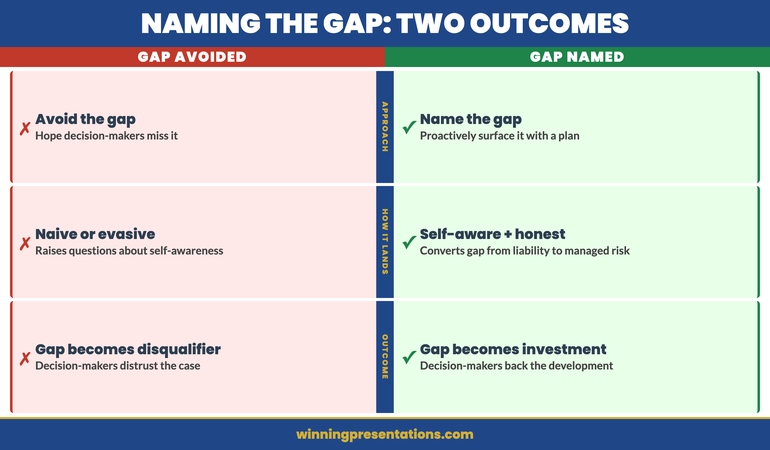
The fastest way to turn a gap into a disqualifier is to avoid mentioning it. When decision-makers raise a concern that you have not addressed, it suggests either that you are unaware of the gap (which raises questions about your self-assessment) or that you are hoping they won’t notice (which raises questions about your transparency). Either reading creates doubt that is difficult to recover from in a single conversation.

Naming the gap proactively has the opposite effect. When you surface it clearly — “I recognise that I’m coming into this from a financial rather than a commercial background, and the direct client relationship management is an area where I’ll be developing quickly” — you demonstrate self-awareness, signal honesty, and convert the gap from a hidden liability into a named and managed item on the table. Decision-makers who feel that you have been straight with them about the learning curve are significantly more willing to invest in your development than those who feel you have been evasive.

The gap acknowledgement should be followed immediately by a development plan: how you intend to close the gap, what exposure you have already sought, and what support you are requesting. A gap without a plan is a confession. A gap with a plan is a professional risk assessment.

Career pivot gap management: name the gap proactively, show development plan, convert absence into managed risk — comparison of avoided gap vs named gap outcomes

The Transferable Value Frame: What Actually Convinces Leadership

The transferable value frame is the core of a successful lateral pitch. It answers a single question: given that you are not coming from the exact background this role traditionally draws from, what specific capabilities do you bring that are more valuable than what a direct-path candidate would offer?

This is a harder question to answer than it looks, because most people answer it by listing generic strengths rather than domain-specific advantages. “Strong analytical ability,” “senior stakeholder management,” “commercial awareness” — these are standard attributes that every candidate will claim. They do not differentiate you as a lateral mover, and they do not address the specific question on the decision-maker’s mind, which is: what does this person bring that someone from within this function would not?

The more powerful version is function-specific. If you are moving from finance to commercial, the honest answer might be: “I understand the margin dynamics of our product portfolio in more detail than most commercial directors because I’ve built the models that underpin them. I’ve been in the room where deals were rejected on financial grounds, so I know what the commercial team is working against. And I have relationships with external partners that were built on financial credibility rather than commercial positioning, which opens conversations that standard BD relationships don’t always access.” That is transferable value that a direct-path candidate genuinely cannot claim.

Building this frame requires honest analysis. Start with the specific challenges the receiving role faces — not generic responsibilities but the actual problems the team is trying to solve right now. Then map your experience against those specific challenges, not against the generic job description. Where your background gives you a meaningful advantage over a direct-path candidate, name it explicitly. Where it does not, address the gap with a development plan. The ratio of advantage to gap determines how credible your case is.

The Executive Slide System

Career pivot decks are high-stakes proposals that require a precise structure. The Executive Slide System — £39, instant access — includes proposal frameworks, AI prompt cards, and scenario playbooks for structuring executive-level cases where the argument needs to work across multiple sceptical audiences.

  • Slide templates for executive proposal scenarios
  • AI prompt cards to build persuasive decks fast
  • Framework guides for high-stakes career and advancement pitches
  • Scenario playbooks for multi-stakeholder approval meetings

Get the Executive Slide System →

Designed for executives preparing structured proposals for senior decision meetings.

Addressing the Learning Curve Without Undermining Your Case

The learning curve is the most delicate element of a career pivot presentation. Acknowledge it too little and you appear naive. Acknowledge it too much and you appear unready. The right balance comes from framing the learning curve as a defined, time-limited investment rather than an open-ended uncertainty.

Decision-makers are not afraid of a learning curve. They manage them constantly. What they are afraid of is an unclear picture of how long the investment will take and what it will cost in reduced productivity. When you can give them a specific, credible picture of your ramp time — “I expect to be operating at full effectiveness in the commercial relationship management aspects of this role within ninety days, based on the three clients I’ve already worked with from the finance side” — you replace uncertainty with a risk profile they can evaluate.

The elements of a credible learning curve frame are: a clear assessment of which parts of the role you can do immediately, which parts you will be developing in, and the specific milestones by which your progress can be evaluated. This is not asking for a reduced performance expectation. It is proposing a structured onboarding plan that gives both sides a fair way to assess whether the move is working.

If you have already begun developing the relevant skills — through voluntary projects, secondments, or external learning — surface this explicitly. Nothing reduces concern about a learning curve faster than evidence that you took the initiative to close part of it before the formal conversation began.

The same principle applies when you are preparing a 90-day presentation in a new role: the framing that earns trust is not “I know everything” but “I know what I know, I know what I’m learning, and here is how I am managing both.”

The Structure of a Credible Career Pivot Deck

A career pivot presentation follows a different structure from a standard promotion case. The promotion case is primarily backward-looking: evidence, track record, impact. The pivot case is primarily forward-looking: strategic fit, transferable value, development plan. Building the deck in the wrong order creates a presentation that feels more like a CV review than a strategic proposal.

A credible pivot deck typically runs five to seven slides. The opening slide establishes the strategic context: what the target function or role is working towards, where the most significant opportunities or challenges sit, and why this moment is the right time for this move. This is not about you yet. It is about demonstrating that you understand the domain you are entering well enough to speak credibly about its priorities.

The second section presents your transferable value: two or three specific capabilities drawn from your current background that are directly relevant to the challenges you have just framed. Each capability should be grounded in a concrete example from your track record, mapped explicitly to a current need in the target domain. This is where the translation work matters most.

The third section addresses the gap and development plan honestly. One slide, clearly structured: what the gap is, how you intend to close it, and what the timeline looks like.

The final section covers logistics: proposed transition, support needed, and how success would be measured in the first six months. Decision-makers who can see a concrete success framework are significantly more comfortable with career pivot risks than those who are left to imagine the risk for themselves.

When managing stakeholder alignment around a pivot pitch, applying the same pre-meeting principles used in stakeholder alignment before major proposals is equally effective: identify the two or three people whose position will matter most and address their specific concerns before the formal meeting.

If you want to build this kind of structured pitch efficiently, the Executive Slide System includes proposal frameworks and scenario playbooks that give you the starting structure for exactly this type of executive-level case.

Career pivot deck structure: five slides — strategic context, transferable value with examples, gap and development plan, logistics and success metrics, transition timeline

What Not to Say: The Four Phrases That Sink Pivot Pitches

The content of a career pivot pitch matters. So does the language. These four phrases consistently undermine credibility in pivot conversations, and they appear in almost every poorly received pitch.

“I’m ready for a new challenge.” This is the personal case dressed up as a business case. It signals that the primary motivation is your own stimulation rather than the organisation’s need. It also positions the conversation as one where you are asking for something rather than proposing something. Replace it with a statement about the specific contribution you intend to make.

“I can learn quickly.” This is an assertion without evidence. Every candidate says this, and it tells the decision-maker nothing about how you actually approach unfamiliar domains. Replace it with a specific example of a time you entered a new area without full expertise, what you did to close the gap, and how quickly you were effective.

“I’ve always been interested in this area.” Interest is not capability. A sustained interest that has produced no concrete preparation, shadowing, study, or exposure reads as a hobby aspiration rather than a professional commitment. If you have a genuine interest, demonstrate it through what you have actually done to develop it.

“I think I could add a lot of value.” This is hedged and vague. The word “think” signals uncertainty; “a lot” signals imprecision. Replace it with a specific, grounded statement about the particular value you bring and the evidence that supports it.

Frequently Asked Questions

How do you justify a lateral move when a direct-path candidate is available?

Acknowledge the direct-path candidate directly and turn it into a differentiator rather than a weakness. A lateral mover brings cross-functional perspective that a direct-path candidate, by definition, does not have. If you can articulate specifically what that perspective enables — in terms of the actual problems the role needs to solve — you reframe the comparison from “less experienced in this domain” to “brings something the direct-path candidate cannot.” The argument only works if you can be specific. Generic claims about cross-functional value will not hold up against a candidate who has been doing the job for ten years.

Should you address your salary expectations in a lateral move pitch?

Not in the initial presentation. The business case and the compensation conversation are separate, and conflating them creates the impression that you are negotiating before you have been selected. If the role involves a reduction in level or compensation, that is worth addressing briefly — confirming that you have considered the implications and are proceeding deliberately rather than naively — but keep it short and move back to the capability conversation quickly. Detailed compensation discussions happen after the business case has been accepted.

How long should a career pivot pitch take?

In a formal meeting, fifteen to twenty minutes for the structured pitch, followed by open conversation. The mistake most people make is over-presenting: spending forty minutes walking through every element of their background in chronological order, leaving no time for the decision-maker to engage. The pivot pitch should be concise enough that the majority of the meeting is dialogue, not presentation. Decision-makers form their view in conversation, not in passive listening. Give them the structure in fifteen minutes and then let them ask the questions that matter to them.

The Winning Edge — A Newsletter for Executives Who Present

Every Thursday: one practical technique for structuring, presenting, or defending a high-stakes proposal. Designed for executives who need to communicate with authority, not just confidence.

Subscribe to The Winning Edge →

Also available: the Executive Presentation Checklist — a free pre-presentation checklist for senior decision meetings.

The Executive Slide System

Proposal frameworks and scenario playbooks for high-stakes executive presentations — including career pivot and advancement decks for senior audiences where the logic of the move needs to be made explicit. £39, instant access.

Get the Executive Slide System →

Designed for executives preparing structured proposals for senior decision meetings.

If you are managing the more complex process of an internal transfer pitch that involves both a current manager and a receiving team, the structural principles are similar but the political sequencing requires a different approach.

About the Author

Mary Beth Hazeldine is the Owner and Managing Director of Winning Presentations. With 25 years of corporate banking experience at JPMorgan Chase, PwC, Royal Bank of Scotland, and Commerzbank, she advises executives across financial services, healthcare, technology, and government on structuring presentations for high-stakes funding rounds and approvals.

21 Apr 2026
Senior female executive presenting her career case to two board-level leaders in a polished boardroom, composed and authoritative, navy tones, editorial photography style

Promotion Presentation: How to Make the Business Case for Your Own Advancement

Quick Answer

A promotion presentation is not a request for recognition — it is a business case. Frame your advancement as the solution to a specific organisational problem, support it with quantified evidence from the past twelve months, anticipate the “not ready” objection with pre-emptive evidence, and deliver it in a format that mirrors the standards you apply to every other executive decision. Senior leaders approve promotions when they can see the business logic, not just the tenure.

Priya had been doing the CFO role in everything but title for fourteen months. She managed the treasury function, chaired the audit subcommittee, deputised for the outgoing CFO during his extended sick leave, and delivered the annual accounts presentation to the board — an event no other Finance Director in the business had ever been asked to lead. She had not been passed over; no formal process had started. She simply assumed that the evidence was visible and that the right conversation would happen when the time was right.

The time never quite arrived on its own. A restructure was announced. An external search was commissioned for a Group CFO. Priya’s name appeared on nobody’s shortlist because nobody had a structured record of what she had been doing. The hiring panel knew she was capable. They did not know how to articulate her case internally, because she had never given them the language to do it.

Priya was not passed over because she lacked the evidence. She was passed over because she had never organised that evidence into a format her organisation could act on. The business case for her promotion existed; it simply had not been presented.

The executives who consistently advance are not always the most accomplished. They are the ones who have learned to treat their own career advancement with the same analytical precision they apply to any other business decision they take to a senior committee.

Why Most Promotion Pitches Fail Before They Reach the Decision-Maker

The most common failure mode in promotion conversations is not rejection — it is deferral. “Let’s revisit this in six months” is almost always code for: the person making the case did not give us a clear enough reason to act now. Decision-makers rarely say that explicitly. They schedule another review instead.

Promotion pitches fail at three points. The first is framing: the candidate presents their tenure and competence rather than the business problem their advancement would solve. The second is evidence: achievements are described rather than quantified, making comparison with any external candidate impossible. The third is timing: the conversation is initiated before the candidate has built sufficient internal support, leaving the formal decision-maker without allies when the case is discussed.

Each of these failures is structural. They are not personality failures or confidence failures — they are presentation failures. The evidence may be solid; the problem is that it has not been organised into a format that a busy senior leader can process, evaluate, and act on under time pressure.

The solution is to treat your own promotion like any other business case you have presented: with a clear recommendation, supporting evidence, a response to the most predictable objections, and a specific ask.

The Business Case Framing: You Are Solving a Problem, Not Asking a Favour

The shift that changes everything in a promotion conversation is moving from a narrative about yourself to a narrative about the organisation. “I have been performing at this level for two years and I believe I deserve recognition” is a request. “The business has a gap at Group Finance leadership level, and my track record in the deputy role makes me the lowest-risk path to filling it” is a business case.

The distinction is not cosmetic. It changes the entire structure of the conversation. When you frame your promotion as a business problem — a capability gap, a succession risk, a transition challenge — you give the decision-maker something to agree with before they have to agree with you. They can support the idea of solving the problem without committing to you personally in the first instance. Your case then becomes the argument for why you, specifically, are the most efficient solution.

To build this frame, identify the specific business problems your promotion would solve. Is there a succession gap? A capability shortage? A risk created by the current structure? A growth objective that requires senior capacity at your level? Each of these is a legitimate business driver for promotion, and each is more persuasive than personal merit alone, because it gives your advocate something to present on your behalf when you are not in the room.

The question to answer in your framing is: “Why does the business need this to happen now?” The answer to that question is the foundation of your case.

Building Your Evidence File: The Twelve-Month Impact Audit

Before any promotion conversation, conduct a structured audit of your impact over the previous twelve months. Do not rely on memory and do not rely on your performance review documents, which tend to capture activity rather than impact. Instead, build a working document that contains four categories of evidence.

The first is financial outcomes: revenue generated or protected, costs reduced, budget variances managed, capital deployed. Any figure that appears in a management account or board report and that your decisions influenced belongs here. Quantify in absolute terms and as a percentage improvement where relevant.

The second is organisational outcomes: projects delivered, teams led, structural changes implemented, risks identified and resolved. These are the contributions that do not always appear in financial metrics but that senior leaders recognise as the work of someone operating above their grade.

The third is stakeholder outcomes: relationships built, decisions influenced, external credibility established, internal alignment achieved. If you have managed an external client relationship, led a major procurement, or been the internal face of a significant initiative, record it explicitly.

The fourth is scope evidence: instances where you performed at a higher level than your role required — covering a more senior colleague, leading a cross-functional workstream, representing the function at board or committee level. This is the category that most directly supports the case that your title has not kept pace with your actual level of operation.

Compile the audit before you begin structuring your promotion conversation. The material is unlikely to surprise you, but organising it systematically will reveal patterns of contribution that are not visible when the evidence is scattered across emails, project updates, and memory.

Translating Your Achievements Into Board-Ready Language

Senior decision-makers evaluate people using the same language they apply to any resource allocation decision: impact, risk, and return. Your evidence file needs to be translated from the language of individual performance into the language of organisational investment.

The translation rule is: every achievement should have a measurable outcome attached. “Led the supplier renegotiation” becomes “Led the supplier renegotiation, reducing annual category spend by 12% and extending contract terms by three years.” “Managed the team during the restructure” becomes “Maintained team retention at 94% through a six-month restructure period, against a sector average of 78%.”

When a direct financial metric is unavailable, use proxy metrics: time saved, risk reduced, scope managed, or scale of stakeholders involved. The goal is not to fabricate precision but to attach some external reference point that allows a decision-maker to calibrate the significance of what you did.

Avoid comparative language that positions you against your peers inside the organisation — this generates political risk without adding persuasive value. Instead, use external benchmarks where available: sector averages, industry norms, or publicly reported figures from comparable organisations. External comparisons strengthen the case without creating internal friction.

The Promotion Business Case — four evidence categories: Financial Outcomes, Organisational Outcomes, Stakeholder Outcomes, Scope Evidence

The Executive Slide System — Structure Every High-Stakes Deck

Your promotion case needs to be as sharply structured as any other business case you present. The Executive Slide System gives you the frameworks, templates, and slide structures to build a compelling, board-ready case for your own advancement — and every other high-stakes presentation you lead.

Get the Executive Slide System — £39 →

Anticipating and Answering the “Not Ready” Objection

The most common reason promotion conversations stall is the unspoken objection: “We’re not sure you’re ready for the full scope of the senior role.” This objection is rarely stated directly. It surfaces instead as a request for more time, a suggestion that you “continue to develop in the current role”, or a commitment to “revisit this in the next cycle.”

Because the objection is rarely explicit, most candidates never address it. The most effective approach is to surface it yourself and respond to it before it is raised. “I want to address directly the question of whether I am ready for the full scope of the role, because I know that is likely to be a concern given that I haven’t held the title formally.” Then answer it with the scope evidence from your audit: the specific instances where you have already been performing at the higher level.

The structure for this response is: acknowledge the concern, present the contrary evidence, and offer a specific reference. “My concern would be well-founded if I hadn’t been operating at this level for the past fourteen months. During that period I led [X], managed [Y] directly, and delivered [Z] in a context that was structurally equivalent to the senior role.” If a more senior colleague can attest to your performance at that level, reference them explicitly and ensure they have agreed to do so in advance.

Addressing the objection directly demonstrates the kind of confident self-awareness that senior leadership roles require. It also eliminates the gap that usually allows the objection to persist quietly beneath a polite deferral.

The One-Slide Personal Career Brief

In a formal promotion presentation, whether written or verbal, you need one slide — or one clearly delimited section — that summarises your entire case in ninety seconds. This is the component that your advocate will use when your case is discussed without you present, which is where most promotion decisions are actually made.

The one-slide brief has five components. The first is your current title and the level at which you have been operating in practice. The second is the business problem your promotion solves. The third is three to four headline impact metrics from your twelve-month audit, stated in board-ready language. The fourth is your response to the most predictable objection. The fifth is the specific ask: the title, the timing, and — if relevant — any structural change to your remit.

Keep the slide or section genuinely brief. The purpose is not to summarise your CV — it is to give a decision-maker a clear, memorable argument that they can repeat accurately to others. If someone who reads it once cannot reproduce the core logic five minutes later, it is too complex.

The discipline of constructing this brief will also help you identify the weakest element of your case. If any of the five components feels thin, that is where your preparation needs more work before the formal conversation begins.

Build a sharper promotion case with the Executive Slide System →

Structuring the Promotion Conversation: Timing, Audience, and Format

The most effective promotion conversations do not happen spontaneously. They are requested explicitly, prepared for in advance, and structured as a working meeting rather than an informal discussion. The distinction matters: an informal conversation gives the decision-maker permission to respond informally, which usually means no commitment and no timeline.

Request a dedicated meeting — thirty minutes, framed as a structured career conversation. Send a brief agenda in advance: three items, each stated as a business question rather than a personal request. This positions the meeting as a professional dialogue rather than a lobbying exercise.

Before the formal conversation, apply the same pre-meeting approach you would use for any other high-stakes decision. Identify the two or three people whose informal support will influence the formal outcome. Meet them individually, understand their perspective, and address any concerns privately before the formal meeting. The principles of stakeholder alignment apply as directly to career conversations as they do to any other executive decision.

On the question of format: for a formal promotion into a senior leadership role, a written one-page summary sent in advance of the meeting is worth preparing. It signals seriousness of intent and gives the decision-maker time to formulate a considered response rather than an instinctive one. It also creates a record of the conversation’s basis, which is useful if the outcome is a conditional commitment with milestones attached.

Promotion conversation structure roadmap: Step 1 Stakeholder alignment (2 weeks before), Step 2 Written summary sent (3 days before), Step 3 Formal meeting (the ask), Step 4 Follow-up with milestones

When the Answer Is “Not Yet”: Using the Conversation to Create a Pathway

A “not yet” response is not the end of the conversation — it is the beginning of the next one. How you handle the deferral determines whether it becomes a genuine developmental pathway or a polite way of managing you out of the conversation indefinitely.

If the answer is “not yet”, ask three specific questions before you leave the room. The first: what specific evidence or capability would need to be demonstrated for the answer to change? The second: what is the realistic timeline, and what external factors — headcount, restructure, budget cycle — will influence it? The third: who else needs to be part of this conversation for a decision to be made, and is it appropriate for you to speak with them directly?

These questions serve two purposes. They convert a vague deferral into a structured commitment, and they reveal whether the deferral is genuine or indefinite. If the decision-maker cannot answer the first question with any specificity, the barrier to your promotion is probably not developmental — it is political, structural, or budgetary. Knowing that allows you to make an informed decision about whether to continue building your case internally or to consider whether the organisation has the capacity to advance you at all.

Document the conversation and any commitments made immediately afterwards. If milestones were agreed, write them up and share them with the decision-maker within 24 hours: “Following our conversation, I understood the next steps to be…” This is not aggressive — it is professional. It also prevents the well-intentioned deferral from quietly disappearing from the decision-maker’s priority list. If you are planning a different kind of career move — into a new organisation or a lateral transition — the principles of the career pivot presentation apply to structuring that case.

Rescue Block

If your promotion conversation is imminent and you haven’t had time to build the full business case, focus on one thing: the scope evidence. The single most persuasive argument for promotion is concrete evidence that you have already been performing at the higher level. Write down the five most significant things you have done in the past twelve months that were above your current grade. Lead with those. Everything else can be structured after the first conversation.

The Executive Slide System

Structure your promotion case — and every other high-stakes presentation — with the Executive Slide System. Slide frameworks, business case structures, and executive presentation templates used by senior leaders across finance, operations, and professional services.

Get the Executive Slide System — £39 →

Frequently Asked Questions

How long should a promotion presentation be?

For a formal promotion conversation at senior level, a written summary of one page and a thirty-minute meeting is the right format. The written document’s purpose is not to be exhaustive but to be clear: it should contain your business case framing, three to four headline impact metrics, your response to the most predictable objection, and a specific ask. The meeting itself should be structured as a working conversation rather than a monologue. Present your case in ten to twelve minutes, then invite questions. The quality of the questions tells you where the resistance lies and gives you the opportunity to address it directly in the room.

Should you share your promotion case in writing before the meeting?

Yes, for a formal senior promotion into a defined leadership role. Sharing a brief written summary two to three days before the meeting serves several functions: it signals that you are treating the conversation seriously, it gives the decision-maker time to prepare a considered response, and it creates a record of the basis on which the conversation was held. For more informal conversations — an annual review where promotion is one of several topics — a written document is unnecessary and may come across as disproportionately formal. Use your judgement about the register of the conversation before deciding.

What if you don’t have direct financial metrics to support your promotion case?

Most functional roles have significant indirect financial impact that can be quantified with some effort. If direct financial metrics are genuinely unavailable, use proxy metrics: team retention rates, project delivery rates, stakeholder satisfaction from formal feedback processes, scope of roles managed, or complexity of decisions taken. For roles in HR, legal, communications, or research, the relevant metrics might be response time, case volume, coverage scope, or error rate. The goal is not financial precision but external comparability — any figure that allows a decision-maker to calibrate the significance of your contribution against some reference point beyond your own assertion is worth including. If you are preparing for a first presentation in a new leadership role after your promotion, the same principle of evidence-first communication applies.

The Winning Edge — A Newsletter for Executives Who Present

Every Thursday: one structured technique for executive presentations, business cases, and high-stakes decision meetings. Practical and direct.

Subscribe to The Winning Edge →

Free Resource

Download the Executive Presentation Checklist — the pre-flight audit used by senior leaders before every high-stakes presentation. Covers structure, evidence, stakeholder alignment, and delivery.

Download the checklist (free) →

About the Author

Mary Beth Hazeldine has spent 25 years in banking and 16 years training executives to present with precision and authority. She works with senior leaders on high-stakes presentations, board communications, and career advancement conversations at the executive level.

20 Apr 2026
Male executive reviewing structured executive presentation deck on large monitor, analytical expression, navy and gold corporate environment

PowerPoint Presentation Skills Training

Quick Answer

Most PowerPoint presentation skills training teaches design: cleaner slides, better fonts, smarter animations. For executives presenting to boards and senior committees, the gap is almost never visual. It is structural. A presentation that fails at the decision level fails because the logic is unclear, the ask is buried, or the argument does not sequence the evidence in a way that makes the conclusion feel inevitable. Effective training addresses structure first — design is the final step, not the foundation.

Marcus had been a programme director at a large infrastructure company for six years. He had built hundreds of slides. He was meticulous about formatting — consistent fonts, aligned boxes, colour-coded status indicators. When his company brought in a design consultancy to review internal presentations, his decks were rated the highest for visual quality. They were also rated the lowest for clarity of recommendation. The consultants’ feedback was specific: his slides told the story of what had happened and what was planned, but they never told the committee what it needed to do. The logic was all there — buried in the presenter notes and the narrative he delivered verbally. On the slides themselves, the decision was invisible. He had been spending his time on the wrong problem. The visual quality of his decks was a strength he had over-invested in. The structural clarity of his argument was the gap he had never noticed — because no one had ever told him that structure and design were separate skills.

Building slides for a board update, budget proposal, or executive approval? The Executive Slide System includes scenario-specific slide templates and framework guides for senior-level presentations. Explore the System →

Why Most PowerPoint Training Teaches the Wrong Thing

The PowerPoint training market is dominated by design-focused content. Search for “PowerPoint presentation skills training” and the majority of results will point you towards courses on slide layouts, colour theory, animation effects, and visual hierarchy. This content is useful if the limiting factor in your presentations is visual quality. For most senior professionals, it is not.

Design-focused training persists because it is easier to teach and easier to demonstrate. You can show a before-and-after slide in a course video and make the improvement immediately visible. You cannot do the same with argument structure — the quality of the logic is only apparent in the context of a specific recommendation, a specific audience, and a specific decision. That context requires more sophisticated instruction and more personalised feedback, which is harder to produce at scale.

The consequence is that a large number of senior professionals have received extensive training on how to make slides look better and almost no training on how to make slides argue better. They have learned to format a slide and not learned to structure one. The distinction matters because the senior audiences who evaluate their presentations are evaluating argument quality, not design quality.

A board director reviewing a capital investment proposal is asking: is the logic sound? Is the ask clear? Has this person considered the risks I will raise? Is the implementation credible? None of these questions are answered by font choices or alignment grids. They are answered by the structure of the argument — by which information appears in which sequence, by how the recommendation is framed, by whether the evidence builds to a conclusion or merely accumulates around a topic.

Effective PowerPoint presentation skills training starts with this distinction and builds from it. Design is the last step in a well-structured presentation, not the first. Understanding the structural framework for executive presentations is the prerequisite — before a single slide is formatted.

Executive Slide System — Scenario-Specific Templates for Senior Presentations

Stop starting from a blank slide. The Executive Slide System gives you decision-ready templates for the specific presentation scenarios senior professionals face — board updates, budget proposals, project pitches, and executive approvals. £39, instant download.

  • ✓ Scenario-specific slide templates for executive presentations
  • ✓ AI prompt cards for building decision-ready decks
  • ✓ Framework guides for structuring executive arguments
  • ✓ Instant download — apply directly to your next presentation

Get the Executive Slide System → £39

Instant access — designed for executives preparing high-stakes presentations

The Structure Gap: What Senior Audiences Actually Evaluate

Senior audiences — boards, executive committees, investment panels, audit committees — evaluate presentations along a specific set of dimensions that most presenters never receive training on. They are assessing: Is the ask clear? Is the evidence credible? Has the presenter considered the objections I am about to raise? Is the implementation realistic? Does this person understand the constraints I am working within?

These are structural questions. They are answered by how information is sequenced across slides, how the recommendation is positioned relative to the evidence, and whether the presentation anticipates the audience’s decision-making concerns rather than simply presenting information and waiting for the audience to draw their own conclusions. Most presentations fail at one or more of these structural tests — and most PowerPoint training does not address any of them.

The “so what” test is the most basic structural check, and it is the one most commonly failed. Every slide in an executive presentation should be able to answer the question: “So what does this mean for the decision we are being asked to take?” A slide that presents a chart without a headline that states the implication has failed this test. A slide that summarises activity without connecting it to a recommendation has failed this test. A slide that raises a risk without proposing a mitigation has failed this test. These are structural failures, not design failures.

The structure gap becomes particularly consequential in long or complex presentations. A board update covering six work streams over twelve months contains enough information to obscure the argument if it is not carefully structured. The skill — the one that advanced PowerPoint training for professionals rarely teaches — is knowing what to include, what to exclude, and how to order what remains so the committee follows the logic without effort.

For presentations that will be followed by a decision process spanning multiple meetings, the follow-up deck for approval meetings is an underused structural tool — a separate, decision-focused document sent within forty-eight hours of a positive meeting to maintain the approval momentum that the presentation created.

Slide Architecture for Executive Presentations

Slide architecture — the structural logic that determines what goes on each slide, in what sequence — is the skill that separates presentations that move committees from presentations that merely inform them. It has nothing to do with design and everything to do with decision logic.

The opening slide of an executive presentation carries the heaviest structural load. It needs to establish the context (why are we here?), state the recommendation (what are we being asked to approve?), and signal the structure (how will this be argued?). Many presenters spread this across three or four slides — a title slide, an agenda slide, a background slide, and then a “situation” slide. By the time they reach the recommendation, senior audiences have already formed an initial judgement based on what they have not yet been told. Leading with the ask, and then building the case, is structurally superior — and it is the standard that experienced board presenters learn to apply consistently.

The evidence sequence matters as much as the opening. A presentation that presents all the positive evidence before addressing risks is structurally weaker than one that acknowledges risks early and then demonstrates why the recommendation is sound despite them. Senior audiences are sceptical by training — they are looking for the problems, and if a presenter does not surface them, the audience will do so in Q&A, often more forcefully than the problem actually warrants. Pre-empting the objection is a structural technique, not a rhetorical one.

The closing slide — the ask — is where most presentations sacrifice structural clarity for polish. “Next steps” slides, “questions?” slides, and summary slides that relist all the main points are structural dead ends. The closing slide should do one thing: state what the committee is being asked to decide, when, and why the timing matters. Everything else is surplus.

If you are working on a major presentation and want to review the structural elements of your stakeholder preparation, the stakeholder alignment process that precedes board presentations covers the pre-meeting work that makes the structural case easier to land.

For the structural templates that apply this logic to specific presentation scenarios, the Executive Slide System gives you the decision-ready starting point for board updates, budget proposals, project pitches, and executive approvals — so the structural logic is built in before you begin customising for your specific situation.

Scenario-Specific Templates: Why Context Determines Structure

One of the most common errors in PowerPoint presentation skills training is treating all presentations as structurally equivalent. A board update, a budget proposal, a project pitch, and an executive approval request are four fundamentally different documents. They have different audiences, different decision contexts, different risk tolerances, and different structural requirements. Training that teaches a single “executive presentation framework” and applies it to all four will produce presentations that are adequate in most scenarios and excellent in none.

A board update is a monitoring document — its job is to give the board sufficient information to discharge their oversight function. The structure is: status, issues, decisions required. It should be short, specific, and clearly separated from the main presentation deck. Many programme directors conflate their update slides with their strategy slides and produce documents that serve neither purpose well.

A budget proposal is a persuasion document — its job is to make the case that a specific allocation of resource is the highest-value use of the available capital. The structure is: problem (the cost of not investing), proposal (the specific investment and its rationale), evidence (why this investment, why now, why at this level), and risk (what could go wrong and how it is managed). The most common structural failure in budget proposals is leading with the cost before establishing the value — a sequencing error that puts the committee in a defensive posture before the case has been made.

A project pitch is a credibility document — its job is to establish that the presenter has the capability, the plan, and the organisational support to deliver a defined outcome. Its structure prioritises the implementation over the vision, because senior audiences are generally more sceptical of execution than of ambition. A pitch that leads with the opportunity and buries the delivery plan will typically receive questions that the presenter experiences as hostile but that are simply the committee trying to find the execution logic that the structure has not made visible.

An executive approval request is a decision document — its job is to make the decision easy to take. Its structure is: here is exactly what you are approving, here is why it is the right decision, here are the conditions under which it is sound, and here is what you need to do to approve it. Anything that does not serve those four purposes belongs in the appendix.

Scenario-specific slide templates address this structural variety directly. Rather than starting from a blank slide and applying a generic framework, scenario-specific templates embed the structural logic for each presentation type — so the presenter’s energy goes into the content and the argument, not into reconstructing the architecture from scratch every time.

Is This Right for You?

The Executive Slide System is designed for senior professionals who build their own presentations for high-stakes executive audiences. It is most useful for directors, heads of function, senior managers, and project leads who present regularly to boards, investment committees, executive committees, or major clients — and who want a structural starting point that is calibrated for those audiences rather than generic corporate use.

It is not a design resource. If you are looking for aesthetic inspiration or visual templates for marketing or client-facing presentations, this is not the right tool. It is a structural resource — the logic of each template is built around the decision that the audience needs to take, not the visual impression the presenter wants to create.

The four scenario templates — board updates, budget proposals, project pitches, and executive approvals — cover the majority of high-stakes presentation contexts that senior professionals encounter regularly. The AI prompt cards within the system extend this into the specific challenge of directing AI tools to build structurally sound drafts, rather than producing fluent but logically weak content.

If you are also using AI tools like Copilot to build your slides, the Executive Prompt Pack (£19.99) includes 71 prompts built specifically for executive presentation scenarios — a complementary resource for professionals who want to go deeper on the AI-assisted drafting side of the process.

Structure Your Next Executive Presentation From the Right Starting Point

The Executive Slide System gives you scenario-specific templates and framework guides for board updates, budget proposals, project pitches, and executive approvals. £39, instant access — no more blank slides for high-stakes presentations.

Get the Executive Slide System → £39

Instant download — designed for executives presenting to boards and senior committees

Frequently Asked Questions

What should PowerPoint presentation skills training cover for executives?

For executives, PowerPoint presentation skills training should prioritise structure and narrative logic above design. The most common reason board and committee presentations fail is not visual quality — it is that the argument is unclear, the ask is buried, or the decision the audience needs to take is never explicitly stated. Effective training addresses slide architecture, decision framing, and how to sequence evidence so the conclusion is inevitable rather than optional.

How is executive PowerPoint training different from standard presentation training?

Standard PowerPoint training typically covers design principles, animation, and slide layout. Executive PowerPoint training focuses on how to structure slides so that a time-pressured senior audience can navigate the argument, understand the recommendation, and take a decision without needing the presenter to narrate every point. The distinction is between slides as a visual aid and slides as a standalone decision document.

How do I improve my PowerPoint presentations for an executive audience?

Start with the closing slide, not the opening. Write the specific ask — what the committee is being asked to decide, by when, and why the timing matters — before you build the preceding argument. This forces the entire deck to serve a single, clear purpose rather than accumulating information around a vague topic. Then work backwards: what evidence does the committee need to make this decision confidently? Structure those slides to build sequentially towards the conclusion you have already written. This approach consistently produces clearer, shorter, and more effective executive presentations than building forwards from context and background.

Why do executive presentations fail even when the slides look professional?

Professional-looking slides and structurally sound slides are not the same thing. A deck can be beautifully formatted and still fail to move a committee if the argument is not sequenced correctly, the ask is ambiguous, or the evidence does not build to an inevitable conclusion. Senior audiences evaluate presentations for the quality of the thinking, not the quality of the visual design. A slide that presents clear logic in a simple layout will outperform a designed slide that buries the point in visual complexity.

The Winning Edge

Weekly insights on executive presentations, slide structure, and boardroom communication — for professionals who present at the highest stakes.

Subscribe Free

Building a high-stakes presentation now? Download the Executive Presentation Checklist — a structured self-review framework for senior professionals preparing board-level and executive committee decks.

If you are developing a proof-of-concept presentation to secure the next stage of approval, the guide to structuring a proof-of-concept presentation covers the specific structural requirements of that high-stakes format.

About the author

Mary Beth Hazeldine, Owner & Managing Director, Winning Presentations. With 25 years of corporate banking experience at JPMorgan Chase, PwC, Royal Bank of Scotland, and Commerzbank, she works with executives across financial services, healthcare, technology, and government on structuring presentations for high-stakes approvals, board reviews, and senior stakeholder communication.

20 Apr 2026
Female executive responding to a board question with composed authority at a polished conference table, steady eye contact with the questioner, corporate boardroom setting, navy and gold tones, editorial photography style

When “I Don’t Know” Is the Right Answer: Honesty and Credibility in Q&A

Quick Answer

Saying “I don’t know” in an executive Q&A is not a credibility risk — fabricating or hedging an answer you do not have is. An honest acknowledgement of a knowledge gap, delivered with composure and a clear commitment to follow up, signals analytical rigour and professional integrity. The executives who build the strongest long-term credibility in Q&A are those who are consistently accurate, not those who are never uncertain.

Astrid had been the Group Finance Director for four years when she presented the annual results to the full board. The presentation had been prepared meticulously. Every number had been stress-tested. The narrative was clear. She had rehearsed the likely questions with her team.

Then the Non-Executive Chairman asked a question she had not anticipated — a specific query about the pension liability calculation methodology that her actuarial team handled directly. Astrid knew the conclusion of the calculation. She did not know the precise methodology behind it.

She had two options. She could construct a plausible-sounding answer from the elements she did know and hope the Chairman would not press further. Or she could say, clearly and without apology: “I know the output of that calculation and I’m confident in the number. The methodology question is one for my actuarial team — I’ll send you a direct briefing note by end of day tomorrow.”

She chose the second. The Chairman nodded and moved on. Afterwards, he told a colleague that Astrid was one of the most trustworthy senior managers he had encountered in a boardroom setting. The reason he gave: she never guessed.

Preparing for executive-level Q&A?

The Executive Q&A Handling System is a structured approach to predicting, preparing for, and responding to the questions that matter most in high-stakes meetings — including how to handle the ones you cannot fully answer.

Explore the System →

The Credibility Myth: Why Executives Resist Saying “I Don’t Know”

The instinct to avoid admitting a knowledge gap in an executive setting is understandable. In many organisational cultures, being the person with the answer is associated with authority, preparation, and competence. Being the person without the answer can feel like exposure — a signal to the room that you are not as across the brief as your role requires.

This instinct is mostly wrong, and importantly, it is wrong in proportion to the seniority of the audience. Junior stakeholders may expect a presenter to be encyclopaedic. Senior executives, who have conducted hundreds of Q&A sessions themselves, tend to evaluate a different quality: reliability. They are not asking themselves “does this person know everything?” — that is not a realistic standard at any level of an organisation. They are asking: “Can I trust what this person tells me?” And trust is built through accuracy, not omniscience.

An executive who gives a confident but inaccurate answer to avoid admitting uncertainty creates a specific kind of credibility problem. If the inaccuracy is discovered — in the meeting, in a subsequent review, or when the decision based on that answer produces a poor outcome — every previous statement they have made is retrospectively questioned. A single fabricated answer does more damage to credibility than ten honest admissions of limited knowledge.

The executives who maintain the strongest Q&A reputations over time are not the ones who always have the answer. They are the ones who are never wrong about what they know.

When Honesty Wins the Room

There are specific conditions in which an honest acknowledgement of a knowledge gap does more than protect credibility — it actively builds it. The first is when the gap is genuine and discoverable. If the question requires information that is genuinely outside your brief, and an informed audience member would recognise that fact, saying “that sits with my technical team rather than directly with me — I’ll get you the precise figure” is not weakness. It is accurate scope management. An attempt to answer it anyway would be visible and would undermine the parts of the Q&A where you do have genuine authority.

The second condition is when the honest answer demonstrates analytical rigour. “I don’t have sufficient data to answer that confidently yet — we’re three weeks into the monitoring period” is not an admission of failure. It is a signal that you distinguish between what is known and what is speculative — which is exactly the quality that drives sound decision-making. A board or committee that receives this answer typically respects it. They have encountered the alternative too often: confident assertions delivered ahead of the evidence.

The third condition is a follow-up setting — a presentation that follows a prior meeting where a commitment was made. If you promised to return with specific data and you are now doing so, the explicit acknowledgement that a previous question was outside your knowledge and has now been addressed signals follow-through. It transforms an earlier limitation into a demonstration of reliability.

Three conditions when honesty wins the room: Genuine discoverable gap, Analytical rigour signal, and Follow-up demonstration — with the credibility effect of each

How to Frame an Honest Answer Without Undermining Authority

The difference between an honest answer that builds credibility and one that appears as unpreparedness lies almost entirely in framing. Three structural elements determine which it becomes.

First, state what you do know before acknowledging what you do not. “The contract is currently in its second year of a three-year term — the specific break clause mechanics are something I’d want to confirm with Legal before giving you a definitive answer.” This structure demonstrates knowledge within your scope, then accurately bounds what lies outside it. It prevents the common misreading of “I don’t know” as “I know nothing about this topic.”

Second, be specific about the gap rather than vague. “I’m not sure” reads as uncertain. “I don’t have the Q3 breakdown with me — I can have it to you by close of business tomorrow” reads as organised. Specificity about what you do not know, and a specific commitment for when you will, converts a limitation into a process signal.

Third, maintain physical composure. An honest answer delivered with hesitation, lowered eye contact, or a apologetic tone reads as embarrassment — which confirms the questioner’s suspicion that the gap was a failing rather than a boundary. The same words delivered with steady eye contact and a settled tone read as professional precision. The authority of the answer comes from the delivery as much as the content.

The Executive Q&A Handling System

A structured system for predicting and handling the questions that define executive credibility. The Executive Q&A Handling System — £39, instant access — includes frameworks for preparing comprehensive question banks, structuring responses under pressure, and managing the questions you cannot fully answer.

  • Question prediction frameworks for high-stakes meetings
  • Response structures for difficult, partial, and hostile questions
  • Preparation playbooks for board, committee, and investor settings
  • Techniques for managing credibility when knowledge is incomplete

Get the Q&A Handling System →

Designed for executives who present to boards, committees, and senior investment panels.

The Follow-Up Commitment: Turning a Gap Into a Demonstration

The follow-up commitment is what separates an honest answer from a deflection. An executive who says “I’ll get back to you on that” without specifying when, how, or to whom leaves the questioner with a vague promise rather than a reliable commitment. An executive who says “I’ll send you the confirmed figure directly by tomorrow morning, copied to the Chair” has converted a knowledge gap into a visible process of accountability.

The follow-up commitment also reframes the dynamic of the Q&A moment. When a question cannot be fully answered in the room, the audience’s attention shifts from the gap to the response to the gap. A specific, confident commitment captures that attention and directs it toward a positive signal: this person handles incomplete situations with precision, which is exactly how they will handle the programme they are proposing.

Always honour the commitment, and always do so by the deadline you named. An honest answer followed by a missed follow-up produces a credibility outcome significantly worse than either alone. The missed follow-up reframes the original admission as evasion in retrospect. Conversely, an honest answer followed by a timely, accurate follow-up is one of the most effective credibility-building sequences available in an executive presenting context.

If you are preparing a comprehensive question bank before a high-stakes meeting, the article on structuring Q&A answers with the STAR method provides a useful companion framework for the questions you can fully answer. The Executive Q&A Handling System covers both preparation and in-the-moment handling across all question types.

Handling Partial Knowledge: What You Know and What You Don’t

Most Q&A knowledge gaps are not total. The more common situation is partial knowledge: you understand the principle or the conclusion but not the precise mechanism; you know the figure for last year but not the current year; you know the general direction of the regulation but not the specific implementation date. How you manage that partiality determines whether the answer reads as informed or evasive.

The structure for partial knowledge answers has three components. State what you know with confidence, including the level of confidence: “The overall direction here is clear — the regulation moves in our favour.” Then bound the partial gap precisely: “The implementation date I’d want to verify before committing to it — my understanding is Q4, but I know there have been recent consultation updates.” Then offer a disposition: “I can confirm that by the end of the week.”

This three-part structure works because it separates what is established from what is uncertain, and treats each appropriately. The questioner receives accurate information about your actual knowledge state — which is exactly what they need to evaluate the reliability of your answer. An attempt to present partial knowledge as complete knowledge fails on this dimension and creates trust problems when the gap becomes apparent.

A related technique is to use epistemic language accurately: “My understanding is…”, “I believe the figure is… but let me verify”, “to the best of my knowledge…” These phrases are not hedges of weakness. They are precision instruments that allow you to communicate exactly what your confidence level is, which allows the audience to calibrate accordingly.

Partial knowledge answer structure: three components — State what you know with confidence level, Bound the gap precisely, Offer a specific commitment — with example language for each

When “I Don’t Know” Is Not the Right Response

There are situations where admitting a knowledge gap is not the optimal choice, and understanding them prevents overuse of the technique to the point where it undermines preparation credibility.

The first situation is when the gap is in core material that you should reasonably be expected to know. If you are presenting a business case and a committee member asks what the total budget request is, “I’d need to check” is not an honest answer — it is a preparation failure. There are categories of question for which the honest answer requires preparation, not admission. Know the boundaries of your own brief thoroughly enough that you can distinguish between what is genuinely outside your scope and what is simply inadequately prepared.

The second situation is when the question is a testing question rather than an information-seeking one. Some senior executives ask questions they already know the answer to, specifically to test whether you do. In these cases, a confident, accurate answer demonstrates mastery. An honest “I don’t know” is technically honest but fails the test it was designed to pass. Distinguishing between testing questions and genuine information requests requires reading the questioner — their tone, their prior statements, their domain expertise. If they clearly know the answer already, they are testing you.

The third situation is when the answer requires a judgement rather than a fact. “What do you think will happen to the market over the next twelve months?” is not a knowledge gap question. It is a judgement question. “I don’t know” is an evasion here. The appropriate response is an honest assessment of your view, with appropriate calibration: “My judgement, based on what we’re seeing in the data, is X — though there are two or three scenarios that could change that.”

Prepare for the distinction between these question types in advance. The article on recognising fishing questions in Q&A covers how to read the intent behind questions rather than simply their surface content. Pre-meeting stakeholder alignment conversations can also surface likely questions in advance, so you can prepare substantive answers rather than relying on honest admission in the room.

Preparing for Honest Q&A in Advance

The most effective Q&A practitioners are not the ones who are best at improvising under pressure. They are the ones who have thought most rigorously about what they do and do not know before they walk into the room. This preparation has two components: mapping the question space, and mapping the knowledge boundary.

Mapping the question space means systematically identifying every question that is plausible given the material you are presenting, the audience you are presenting to, and the context of the meeting. For a financial presentation, this includes detail questions about the numbers, methodology questions about how they were calculated, strategic questions about whether the conclusion is the right one, and risk questions about what happens if assumptions do not hold. For each category, prepare the substantive answer. For the ones you cannot fully answer, prepare the honest framing and the follow-up commitment.

Mapping the knowledge boundary means being explicit with yourself — before the meeting — about the precise edges of what you know. Not in general, but for this specific presentation and this specific audience. The CFO will ask different questions than the Chief Operating Officer. The edge of your knowledge looks different in each conversation. Knowing where that edge is, in advance, means you will not discover it with surprise in the room. You will encounter it exactly where you expected it, and you will have a composed and specific response ready.

The Executive Q&A Handling System

A structured system for predicting and handling executive Q&A — including the questions you cannot fully answer. £39, instant access.

Get the Q&A Handling System →

Designed for executives preparing for board, committee, and investor Q&A sessions.

Frequently Asked Questions

Does saying “I don’t know” damage your credibility with a senior audience?

Not when it is framed correctly. Senior executives evaluate reliability above all other qualities in a Q&A setting. An honest acknowledgement of a knowledge gap, delivered with composure and a specific follow-up commitment, signals exactly the quality they are looking for: the discipline to distinguish between what is known and what is speculative. What damages credibility is a confident answer that turns out to be inaccurate — which retroactively undermines everything else the executive has said in the room.

How do you avoid looking unprepared when you don’t know the answer?

The most effective technique is to state clearly what you do know before acknowledging the gap. “The overall financial position is solid — the specific covenant calculation for that structure is one I’d want to confirm with the treasury team before giving you a definitive figure.” This structure demonstrates knowledge within your scope, then accurately bounds what lies outside it. It prevents the conflation of “I don’t know this one detail” with “I am not across this brief.” Composure in delivery reinforces that this is a boundary, not an oversight.

What if the question you can’t answer is about something you feel you should know?

There are two situations here. If you genuinely should know it and do not, that is a preparation gap — acknowledge it honestly, commit to following up, and use the experience to calibrate your preparation more thoroughly for the next meeting. Do not compound the preparation gap by constructing an answer you are not confident in. If the question is in genuinely ambiguous territory — neither clearly inside nor clearly outside your scope — err on the side of honesty and specificity: name exactly what you know, name exactly what you would need to confirm, and make the commitment clearly.

The Winning Edge — A Newsletter for Executives Who Present

Every Thursday: one structured technique for executive presentations and high-stakes Q&A. Written for senior leaders who need to communicate with precision and authority.

Subscribe to The Winning Edge →

If you are preparing for a major presentation and want to manage the anxiety that comes with difficult Q&A, read the companion article on cognitive restructuring for presentation anxiety.

About the Author

Mary Beth Hazeldine is the Owner and Managing Director of Winning Presentations. With 25 years of corporate banking experience at JPMorgan Chase, PwC, Royal Bank of Scotland, and Commerzbank, she advises executives across financial services, healthcare, technology, and government on structuring presentations and handling high-stakes Q&A with precision and authority.

20 Apr 2026
Executive sitting calmly in a quiet corporate office before a high-stakes presentation, composed and focused, reviewing notes, navy tones, editorial photography style

Cognitive Restructuring for Presentation Anxiety: Reframe the Thoughts That Hold You Back

Quick Answer

Cognitive restructuring is the practice of identifying distorted or catastrophic thoughts before a presentation and replacing them with more accurate ones. It does not mean thinking positively — it means thinking correctly. Most presentation anxiety is maintained by thoughts that overestimate the probability and severity of failure. Challenging those thoughts directly, rather than suppressing them, is one of the most evidence-backed approaches to reducing chronic pre-presentation fear.

Tomás had presented to small groups without difficulty for most of his career. But after a difficult board meeting three years earlier — one where his numbers had been challenged publicly and he had stumbled through a response he knew was inadequate — something shifted. The anticipatory dread that preceded every major presentation became intense. He began losing sleep the night before. His preparation time tripled, not because he was less competent, but because no level of preparation felt sufficient to prevent the same thing happening again.

He described it to me as “waiting for the ambush.” The actual presentations, when they came, were rarely catastrophic. But the period leading up to them had become almost unbearable.

What Tomás was experiencing is a pattern I see frequently in experienced executives: anxiety maintained not by the reality of their presentations, but by the content of their thoughts about them. His mind had drawn a direct causal line between the difficult board meeting and the conclusion that future high-stakes presentations would produce the same outcome. Every subsequent presentation activated that prediction.

Cognitive restructuring is the process of examining that kind of prediction directly — testing its accuracy rather than accepting it or suppressing it.

Is pre-presentation dread affecting your performance?

Conquer Speaking Fear is a 30-day programme that uses clinical hypnotherapy and nervous system regulation techniques to address the root causes of presentation anxiety — including the thought patterns that sustain it.

Explore the Programme →

What Actually Maintains Presentation Anxiety

Presentation anxiety is not simply a response to difficult presentations. If it were, it would resolve naturally once those presentations passed without disaster. For many people, it does not resolve — it escalates. Understanding why requires looking at what maintains the anxiety rather than what originally caused it.

The primary mechanism is anticipatory cognition: the thoughts generated in advance of a presentation about what is likely to happen and how bad it will be. These thoughts are not neutral predictions. They tend to be systematically biased in the direction of threat. They overestimate the probability of negative outcomes. They underestimate the ability to recover from difficulty. They treat worst-case scenarios as the most likely ones.

These biased predictions produce physical symptoms — elevated heart rate, tension, disrupted sleep — which the anxious mind then interprets as further evidence that something bad is going to happen. This loop between catastrophic prediction and physical response is what maintains anxiety across presentations, regardless of how well the actual presentations go.

Avoidance also plays a role. When anxiety becomes intense enough, the natural response is to reduce exposure to the triggering situation. For executives, full avoidance is rarely possible — but partial avoidance is common. Delegating presentations to colleagues, choosing shorter formats, avoiding meetings where difficult questions are likely. These strategies reduce short-term discomfort but prevent the disconfirmation experiences that would, over time, naturally reduce anxiety. Cognitive restructuring interrupts this pattern by targeting the prediction directly, before avoidance becomes the dominant strategy.

The Five Cognitive Distortions Most Common in Presenters

Cognitive distortions are patterns of thinking that deviate systematically from accurate appraisal. In the context of presentation anxiety, five are particularly common.

Catastrophising is the tendency to predict the worst possible outcome and treat it as likely. “I will forget my key point and the whole presentation will fall apart” is a catastrophising thought. It conflates a genuine possibility (forgetting a point) with an unlikely cascade (the whole presentation collapsing).

Mind reading involves assuming you know what others are thinking, usually negatively. “They can see I’m nervous and they’re judging me for it” is a mind-reading thought. Audiences are generally focused on content, not on monitoring a presenter’s internal state.

All-or-nothing thinking frames outcomes in binary terms: either the presentation is a complete success or a failure. This distortion removes the vast middle ground of “it went reasonably well and achieved its purpose.”

Fortune telling involves predicting negative outcomes with unwarranted certainty. “They won’t approve this” treated as a fact rather than a possibility is fortune telling. It forecloses options that haven’t yet been determined.

Personalisation attributes difficult moments entirely to internal inadequacy. When a presentation generates critical questions, personalisation interprets this as evidence of personal failure rather than a normal feature of executive decision-making. Critical questions are frequently a sign of engagement, not rejection.

Five cognitive distortions in presentation anxiety: Catastrophising, Mind Reading, All-or-Nothing Thinking, Fortune Telling, and Personalisation — with a brief description of each pattern

The Cognitive Restructuring Process Step by Step

Cognitive restructuring is not positive thinking. It is not replacing a negative thought with an optimistic one. It is a structured process of examining a thought’s accuracy and replacing distorted predictions with more calibrated ones.

The process has four steps. First, identify the specific thought. Not the emotion (“I feel anxious”) but the thought behind it (“I am going to lose control of the Q&A and the committee will lose confidence in me”). The more precisely you can articulate the thought, the more effectively you can examine it.

Second, examine the evidence. What evidence supports this prediction? What evidence contradicts it? How many times have you lost control of a Q&A session in the last five years? How many presentations have resulted in a committee losing confidence in you in ways that had lasting consequences? In most cases, the evidence against the catastrophic prediction substantially outweighs the evidence for it.

Third, generate an alternative thought — not an optimistic one, a realistic one. Not “the Q&A will go brilliantly” but “I may face a difficult question I can’t answer immediately, and I know how to handle that: I can acknowledge it, take a note, and follow up.” This is accurate and manageable rather than either catastrophic or falsely reassuring.

Fourth, assess the outcome. After generating the alternative thought, how does your anxiety level change? Not to zero — that is not the goal. But typically, replacing a distorted prediction with an accurate one reduces the intensity of anticipatory anxiety to a level that does not impair preparation or performance.

Conquer Speaking Fear

A 30-day programme for executives whose presentation anxiety goes beyond ordinary nerves. Conquer Speaking Fear — £39, instant access — combines clinical hypnotherapy techniques, nervous system regulation, and structured cognitive approaches to address the root causes of presentation fear.

  • Daily audio sessions using clinical hypnotherapy techniques
  • Nervous system regulation practices for pre-presentation symptoms
  • Cognitive frameworks for challenging anxiety-maintaining thoughts
  • A 30-day structured programme with progressive exposure

Get Conquer Speaking Fear →

Designed for executives experiencing persistent or escalating presentation anxiety.

Working with Catastrophic Thinking Specifically

Catastrophising deserves extended attention because it is both the most common distortion in presentation anxiety and the one that generates the most intense anticipatory dread. It typically follows a chain of “and then what?” thinking that escalates a plausible difficulty into a career-threatening event.

The interruption technique is to follow the chain deliberately, all the way to its actual endpoint, and examine how likely each link is. “I might forget my key point → and then I’ll lose my thread → and then the audience will see I’m struggling → and then they’ll lose confidence in my judgement → and then my proposal will be rejected → and then my reputation will be damaged.” Each link in that chain is far less probable than the one before it. Most presenters who momentarily lose their thread recover within thirty seconds. Audiences do not interpret a brief pause as evidence of fundamental incompetence.

A second technique is the decatastrophising question: “If the worst-case scenario actually happened, what would I do?” This is not resignation. It is preparation. Most executives who work through this question discover that even their worst-case scenario — a failed presentation, a deferred proposal, a difficult Q&A — is something they have survived before, or is something they could navigate with the resources available to them. The catastrophe, when examined rather than avoided, turns out to be survivable.

If your anxiety around presenting has begun to affect your physical symptoms in the run-up to high-stakes meetings, the article on projecting confidence through a camera covers some of the physical regulation techniques that complement cognitive work.

If you want a structured programme for working through both the cognitive and physical dimensions of presentation anxiety together, Conquer Speaking Fear was designed specifically for executives whose anxiety goes beyond ordinary nerves.

Applying Restructuring in the Hour Before You Present

Cognitive restructuring is most effective when practised regularly rather than applied as an emergency intervention five minutes before you walk into the room. Nevertheless, there is a condensed version that can be useful in the final hour before a presentation when anxiety is already elevated.

The single most valuable question to ask in that period is: “What am I predicting right now?” Not “how do I feel?” but specifically what outcome your mind is predicting. Once the prediction is articulated explicitly, apply the evidence test quickly: in how many similar situations has this prediction come true? If the honest answer is rarely or never, that is the accurate replacement thought: “This has rarely happened in similar situations, and I am as well-prepared as I have been for those.”

Physical anchoring supports this process. The cognitive work is harder when the nervous system is in a state of high activation — which is precisely when you are trying to use it. A brief period of slow, controlled breathing (four counts in, hold for four, six counts out) reduces physiological arousal enough to make clearer thinking more accessible. This is not a substitute for cognitive work; it creates the conditions in which cognitive work is more effective.

In the room itself, the most useful cognitive anchor is task focus rather than self-focus. Self-focused attention (“how am I coming across?”, “do they look engaged?”) amplifies anxiety. Task-focused attention (“what is the most important point to make here?”, “what does this person’s question need from me?”) reduces it. The shift is intentional and practicable. For techniques specifically around managing eye contact and audience connection under pressure, the article on eye contact in presentations covers this in detail.

Pre-presentation hour protocol: three steps — Identify the prediction, Apply the evidence test, Shift to task focus — with the question to ask at each stage

Changing Patterns Over Time, Not Just Individual Moments

One session of cognitive restructuring before one presentation will reduce anxiety for that presentation. It will not change the underlying pattern. What changes patterns over time is consistent practice across multiple presentations, combined with the gradual accumulation of disconfirmation experiences — presentations that go adequately or well, despite the predictions that they would not.

Keeping a brief written record is more useful than it sounds. After each presentation, note the anxiety prediction you had beforehand and what actually happened. Over three to six months, this record typically reveals a systematic gap between prediction and outcome. The predictions are consistently more negative than the reality. Reviewing this record before subsequent presentations provides evidence that the pattern of over-prediction is a feature of the anxiety, not an accurate reading of reality.

The other factor that changes patterns over time is expanding the range of situations you present in. Anxiety is maintained partly by the brain’s threat appraisal of unfamiliar high-stakes situations. Gradually increasing exposure — taking on presentations that feel slightly outside the comfort zone, rather than staying within what feels safe — provides new evidence that challenges the threat prediction. This is not recklessness; it is systematic desensitisation applied to a professional context.

When Restructuring Alone Is Not Enough

Cognitive restructuring is a powerful technique with a specific scope. It works well for moderate presentation anxiety where the primary maintenance mechanism is distorted thinking. It is less sufficient when anxiety is severe, when physical symptoms are intense enough to impair performance significantly, or when the pattern has become so well-established that cognitive approaches alone cannot interrupt it.

For executives in that situation, a more comprehensive approach is usually required — one that addresses the nervous system regulation component alongside the cognitive one. Hypnotherapy-based techniques work at a level of the brain that direct conscious reasoning does not reach: they can modify the automatic threat response that activates before conscious thought can intervene. This is why they are used in clinical contexts where cognitive approaches alone have not been sufficient.

It is also worth noting that some degree of pre-presentation arousal is normal and useful. The goal is not to eliminate all physical or cognitive signs of activation before a presentation. Moderate arousal sharpens attention and improves performance. The goal of cognitive restructuring — and of more comprehensive programmes — is to bring arousal down from the level that impairs performance to the level that enhances it.

If you present in remote or virtual settings and notice that anxiety is particularly pronounced in that context, the article on managing anxiety when presenting to a camera addresses the specific dynamics of virtual presentation fear.

Conquer Speaking Fear

A 30-day programme combining clinical hypnotherapy and cognitive techniques for executives with persistent presentation anxiety. £39, instant access.

Get Conquer Speaking Fear →

Designed for executives whose anxiety goes beyond ordinary nerves and affects preparation or performance.

Frequently Asked Questions

How quickly does cognitive restructuring work for presentation anxiety?

Many people notice a meaningful reduction in anticipatory anxiety within the first few sessions of deliberate cognitive restructuring practice. However, the effect is cumulative: the technique becomes more effective as it becomes more automatic, which typically takes consistent practice over several weeks. For well-established anxiety patterns, three to six months of regular practice — combined with the gradual accumulation of disconfirmation experiences from actual presentations — is a more realistic timeframe for significant change. This is not a criticism of the technique; it reflects how deeply ingrained thought patterns work.

Is cognitive restructuring the same as positive thinking?

No, and the distinction matters. Positive thinking replaces a negative thought with an optimistic one, regardless of accuracy. Cognitive restructuring replaces a distorted thought with an accurate one. If an accurate assessment of a situation suggests that a presentation carries genuine risk, cognitive restructuring would not deny that risk — it would help you appraise it proportionately rather than catastrophically, and identify what you can do to manage it. The goal is calibration, not optimism.

Can cognitive restructuring help with the physical symptoms of presentation anxiety?

Partly. Physical symptoms of anxiety — elevated heart rate, trembling, voice changes — are produced by the threat appraisal system, which is what cognitive restructuring directly addresses. When the threat appraisal is modified, physiological arousal typically reduces. However, for executives whose physical symptoms are severe or occur very early in the anticipatory period, complementary techniques that work directly on the nervous system — breathing practices, progressive muscle relaxation, hypnotherapy-based approaches — tend to produce faster and more complete relief of physical symptoms.

The Winning Edge — A Newsletter for Executives Who Present

Every Thursday: one practical technique for managing the mental and physical demands of high-stakes presenting. Written for executives who want to perform at their best under pressure.

Subscribe to The Winning Edge →

Related: if you are preparing for a high-stakes Q&A and want to feel more grounded when difficult questions arrive, read the companion article on when honesty is the most credible answer in Q&A.

About the Author

Mary Beth Hazeldine is the Owner and Managing Director of Winning Presentations. With 25 years of corporate banking experience at JPMorgan Chase, PwC, Royal Bank of Scotland, and Commerzbank, she advises executives across financial services, healthcare, technology, and government on structuring presentations and managing the psychological demands of high-stakes presenting.

20 Apr 2026
Female executive presenting proof-of-concept results to an investment committee in a corporate boardroom, data charts on screen, composed and authoritative, navy and gold tones, editorial photography style

Proof-of-Concept Presentation: Securing the Next Stage of Approval

Quick Answer

A proof-of-concept presentation must answer three questions for an executive audience: did the POC do what it was designed to test, is the evidence sufficient to de-risk the next stage, and is the investment required for that next stage proportionate to what has been demonstrated? Executives are not evaluating your work so far. They are evaluating whether the case for the next decision has been made.

Ingrid had led the pilot for fourteen weeks. The system integration had worked. User adoption in the test group had exceeded the original forecast. Customer satisfaction scores had improved by a measurable margin. By any internal metric, the proof of concept had been a success.

She walked into the investment committee certain that the results would speak for themselves.

They did not. The committee asked why the pilot group had been selected rather than a random sample. One board member questioned whether the cost overrun in month eleven was a structural issue or an anomaly. Another asked why the proposed Phase 2 budget was forty percent higher than the original POC cost when the scope was described as “similar.” Ingrid had answers to all of these questions, but they were not in her slides. She improvised. The committee asked for a revised submission.

The problem was not her results. The problem was her framing. She had presented a success report. What the committee needed was a decision document.

Building a case for executive approval of the next stage?

The Executive Slide System includes slide frameworks and scenario playbooks for proposal and approval presentations, including how to structure a POC business case for an executive decision meeting.

Explore the System →

What Executives Actually Evaluate in a POC Presentation

A proof-of-concept presentation sits at a peculiar intersection. The presenter has completed something and is proud of the outcome. The executive audience is starting something and needs to know whether to proceed. These are different conversations, and conflating them is the source of most POC presentation failures.

Executives evaluating a POC are not assessing past performance. They are assessing forward risk. The specific question in their minds is: does the evidence produced by this pilot reduce the probability of failure in the full deployment to a level we are willing to accept? That is a different question from “did the pilot succeed?” A pilot can succeed on its own terms and still fail to make the case for the next stage — if the methodology was too narrow, if the sample was unrepresentative, or if the next stage introduces risks that the pilot did not test.

This means a POC presentation must be built around the decision-maker’s risk calculus, not the execution team’s achievement narrative. The framing is: “Here is what we set out to test, here is what we learned, here is why that learning reduces the risk in what we are proposing next.” Not: “Here is everything we accomplished and how hard we worked.”

Understanding this distinction also clarifies what to leave out. Results that are impressive but irrelevant to the next-stage decision dilute the argument. Features that were tested but are not part of the next-stage scope add confusion. An appendix exists for detail; the main presentation exists for the decision.

The Three-Part POC Presentation Structure

A proof-of-concept presentation that secures executive approval for the next stage follows a specific logical sequence. It does not begin with results; it begins with objectives. It does not end with a summary; it ends with a decision request.

Part 1: The original test design. Restate what the POC was designed to test and what success criteria were agreed at the outset. This matters because an executive audience may not remember — or may never have been fully briefed on — the original parameters. Starting with the design reanchors the conversation around the agreed framework rather than allowing retrospective judgements based on assumptions that were never part of the scope.

Part 2: Results against those criteria. Present each agreed success criterion and the actual result. Be explicit about which criteria were met, which were partially met, and which were not assessed. The last category requires a brief explanation: why was it not assessed, and does that create a risk for the next stage? Leaving unexplained gaps invites speculation from an audience trained to find risk.

Part 3: The next-stage case. Make the explicit argument for why the results from Part 2 are sufficient to proceed. This is where most POC presentations fail — they stop at presenting results and assume the committee will draw the inference. They often will not, or not in the direction you expect. Spell out the chain of reasoning: the POC tested the highest-risk elements of the full deployment, those elements performed as required, therefore the residual risk in proceeding is X, and the next stage is structured to manage X through Y mechanism.

POC presentation three-part structure: Part 1 Original Test Design, Part 2 Results Against Criteria, Part 3 Next Stage Case — with the key question each part answers for the executive audience

Framing Evidence for a Risk-Averse Audience

Executive audiences in investment or approval settings are calibrated for risk detection. They have been in meetings where over-confident presentations produced expensive failures. The result is a scepticism that is not personal and not irrational — it is institutional. Your evidence presentation needs to account for this.

The most credible approach to evidence framing in a POC context is to lead with methodology before results. Presenting what you measured and how you measured it before presenting what you found signals rigour. It also pre-empts the methodology questions that will otherwise arrive as objections after you have finished.

Acknowledge limitations explicitly and early. If the pilot sample was small, say so and explain why it is still representative for the purpose it served. If there were external variables that affected results, name them rather than leaving the committee to discover them in questions. An executive audience that discovers a limitation you did not mention loses confidence in the integrity of the entire presentation. An executive audience that hears you name a limitation clearly and then explain why it does not undermine the core finding respects the analytical honesty.

Use comparative context where possible. Raw numbers are harder to evaluate than numbers with a benchmark. If user adoption in the pilot reached 73%, that tells the committee little unless they know that comparable pilots in this sector typically land at 55–65%, or that the original forecast was 60%. Comparison makes data meaningful without overstating it.

The Executive Slide System

Proposal presentations that win approval are built around the decision, not the evidence. The Executive Slide System — £39, instant access — includes slide frameworks and scenario playbooks for business case and approval presentations.

  • Slide templates for executive approval scenarios
  • AI prompt cards to structure complex business cases fast
  • Scenario playbooks for POC, pilot, and phase-gate decisions
  • Framework guides for risk framing and evidence presentation

Get the Executive Slide System →

Designed for executives presenting business cases and proposals to senior decision-makers.

The Scope Creep Problem: What Not to Present

One of the most common structural errors in POC presentations is expanding the scope beyond what was originally agreed. During a pilot, the team almost always discovers adjacent opportunities, interesting edge cases, and potential future features. Including these in the approval presentation creates three problems.

First, it dilutes the core argument. The committee came to evaluate a specific proposal. Every additional element they are asked to consider creates a new decision variable and increases the cognitive load of the meeting. A presentation that covers more than it needs to is harder to approve than one that is precisely scoped.

Second, it signals uncertain scope management. If the pilot uncovered so many adjacent possibilities that the team felt compelled to include them all, a cautious executive will wonder whether the next stage will suffer from the same expansive thinking — and whether the budget being requested reflects that expansion.

Third, it opens new objections. Every new element you introduce is a new surface for scrutiny. Features or opportunities that you raise in passing may be the very things a sceptic seizes on to complicate the approval. If something is not essential to the next-stage decision, it belongs in a separate document or a future meeting.

The discipline required is to present only what the committee needs to make the specific decision in front of them: proceed to the next stage, at this scope, at this cost, on this timeline. Everything else is scope creep, regardless of how genuinely interesting it is.

Before the formal presentation, consider conducting stakeholder alignment conversations to understand which elements of the proposal are most important to each decision-maker — this often reveals where to focus and what to leave out.

Structuring the Next-Stage Ask

The next-stage ask is the most consequential slide in a POC presentation. It is also the most frequently underprepared. Most presenters treat it as a natural conclusion: here are the results, and now here is what we need next. But the logic connecting those two things must be made explicit, because it is exactly where an unconvinced committee member will intervene.

A well-structured next-stage ask has four components. First, a clear statement of what is being requested: not a “move forward” but a specific approval with named scope, budget, and timeline. Second, a direct link to the POC findings: “the results from Phase 1 demonstrate X, which means the primary risk in Phase 2 is Y, and we have structured Phase 2 to manage Y through Z.” Third, a risk summary: what are the remaining unknowns, how significant are they, and how will Phase 2 address them? This is not pessimism — it is the language of rigour that risk-aware executives respond to. Fourth, a cost-of-delay argument: what does waiting another quarter cost, in financial terms, strategic terms, or competitive terms?

The cost-of-delay argument is often omitted because it feels presumptuous. In practice, it is one of the most useful elements of any approval presentation because it reframes the decision. Without it, “defer” appears to be a low-cost option. With a concrete cost attached, deferral becomes a choice with a price — and most committees prefer to make that choice explicitly rather than implicitly.

For a broader view of how to close a proposal and secure commitment, the Executive Slide System includes scenario-specific frameworks for phase-gate and approval presentations.

Presenting When Results Are Mixed or Partial

Not every proof of concept produces clean results. Sometimes a key metric was not achieved. Sometimes the pilot ran into external factors that affected results. Sometimes the technology performed but the change management did not. How you handle mixed or partial results will significantly affect the committee’s confidence in your integrity — which, in turn, affects their confidence in your next-stage proposal.

The worst approach is to obscure partial results in favourable framing. An experienced executive audience will notice if positive results are presented in detail and negative results are glossed over with qualifying language. This creates a credibility problem that is far more damaging than the underlying result.

The most effective approach with mixed results is to acknowledge them directly, explain what caused them, and then make the case for why they do not undermine the next-stage proposal. If the CRM integration was slower than planned but the customer-facing functionality performed exactly as required, say so. Explain why the integration timeline will be different in Phase 2 (different resources, pre-built connectors, lessons incorporated). The argument is: “We encountered this, we understand why, and here is how Phase 2 is structured to avoid it.”

This approach is more persuasive than a purely positive presentation because it demonstrates analytical honesty, which is the quality that executive audiences most need to trust before they commit significant resources.

Handling mixed POC results: three-step approach — Acknowledge directly, Explain the cause, Make the Phase 2 case showing how the issue is addressed in the next stage

Common POC Presentation Mistakes

The most common mistake is presenting outputs rather than outcomes. Outputs are the things your team produced: the integration was built, the training was delivered, the data was collected. Outcomes are what those outputs achieved in terms that matter to the executive: customer retention improved, processing time reduced, error rate declined. Executive audiences make decisions based on outcomes, not outputs. A presentation that emphasises what was built over what it achieved misses the point of the exercise.

The second mistake is treating scope ambiguity as a minor detail. If there is genuine uncertainty about what is included in the next-stage budget or timeline, addressing it vaguely in a presentation will produce a much more painful discussion when it surfaces as a formal question. Be precise about what the next-stage scope includes and explicitly state what is excluded. “Phase 2 covers X, Y, and Z. The integration with the legacy finance system is out of scope for Phase 2 and will be addressed as a separate initiative.” That clarity signals control.

The third mistake is presenting to the wrong level of detail. A POC presentation to an investment committee should contain the evidence and argument necessary to make the next-stage decision. It should not contain every data point collected during the pilot. If the committee wants detail, they will ask; the appendix exists for that purpose. An overly detailed main presentation signals either poor judgement about audience needs or a lack of confidence in the top-level argument.

If you need to structure a broader executive presentation outline for the full business case, use the approved POC summary as your evidence anchor rather than repeating the pilot analysis in full.

The Executive Slide System

Slide templates and scenario playbooks for approval presentations, including POC and business case structures. £39, instant access.

Get the Executive Slide System →

Designed for executives presenting complex proposals and phase-gate decisions to senior audiences.

Frequently Asked Questions

How long should a proof-of-concept presentation be?

For a senior executive or investment committee setting, fifteen to twenty minutes of presentation time is appropriate, with ten minutes reserved for questions. In slides, this typically means twelve to eighteen slides: two or three on the original POC design and objectives, four to six on results and evidence, and four to six on the next-stage case and ask. Everything else belongs in the appendix. If you find yourself with significantly more slides than this, the presentation has not yet been edited to its decision-relevant content.

Should you mention the budget for the next stage in the POC presentation?

Yes — always. An approval presentation that does not include a specific budget request is incomplete. Executives cannot approve a next stage without understanding its cost, and leaving that number until it is asked for signals either that you are not confident in it or that you expect it to create a problem. Present the next-stage budget with a brief breakdown of its main components and a direct comparison to the POC cost, with an explanation of why the numbers differ if they differ significantly. Transparency about cost is a signal of financial competence, not vulnerability.

What if the committee is split on whether to proceed?

If you identify or suspect a split in the committee during the meeting, do not try to resolve it in real time by negotiating a compromise. Instead, acknowledge the different perspectives clearly: “It sounds like there are two different views on the timeline risk — one that the pilot has sufficiently de-risked it, and one that would want to see the vendor contract confirmed first. Is that a fair summary?” This reframes the disagreement as a structured problem rather than a conflict, and often surfaces a specific resolution — such as conditional approval subject to a named milestone — that neither side had proposed explicitly.

The Winning Edge — A Newsletter for Executives Who Present

Every Thursday: one structured technique for executive presentations, business cases, and high-stakes decision meetings. Practical and direct.

Subscribe to The Winning Edge →

Also available: the Executive Presentation Checklist — a free pre-presentation checklist for senior decision meetings.

If you are preparing for an executive decision meeting and need to align stakeholders in advance, read the companion article on running a stakeholder alignment workshop before the formal session.

About the Author

Mary Beth Hazeldine is the Owner and Managing Director of Winning Presentations. With 25 years of corporate banking experience at JPMorgan Chase, PwC, Royal Bank of Scotland, and Commerzbank, she advises executives across financial services, healthcare, technology, and government on structuring presentations for high-stakes funding rounds and approvals.