

STAR Method for Q&A: How to Structure Answers Under Executive Pressure
Quick Answer: The STAR method — Situation, Task, Action, Result — gives executives a reliable structure for answering questions under pressure without rambling or losing the thread. Most executives over-answer under scrutiny: they provide context that was not requested, explore tangents that undermine their core point, and arrive at their conclusion after the board has already drawn its own. STAR is the correction. It sequences your answer so that every sentence earns its place, and the response ends on your terms rather than trailing off.
Tomás was Head of Strategy at a professional services firm and was known — admired, even — for the quality of his thinking. His analysis was rigorous. His written work was precise. In Q&A, however, he had a problem that had been following him for three years. He gave five-minute answers to two-sentence questions. He knew it. His colleagues knew it. And the board, which had begun to route certain questions away from him during strategy reviews, knew it too.
When it came up at his performance review, his CEO was direct: “Your answers contain everything you know about a topic. We only need everything that’s relevant to what we asked.” That distinction — everything you know versus everything that’s relevant — became the problem Tomás spent the next six months solving.
He began working with the STAR framework: Situation, Task, Action, Result. Not as a rigid script, but as a decision architecture. Before answering any question — in a formal Q&A, in a one-to-one, in a senior committee — he would silently allocate one or two sentences to each component and use that allocation as his answer’s spine. The result was answers that ran 90 seconds rather than five minutes, that landed on a clear conclusion, and that left room for the questioner to follow up rather than waiting for him to stop.
Two board reviews later, the CEO said: “You’ve changed how you answer questions.” Tomás had not changed what he knew. He had changed the architecture through which he expressed it.
If your Q&A handling needs a systematic approach
The Executive Q&A Handling System is designed for executives who need a complete framework for predicting and handling questions in board, investor, and senior committee presentations — including structured answer frameworks, preparation protocols, and approaches for the question types that most commonly derail experienced presenters.
Why Most Executives Over-Answer Under Pressure
The instinct to over-answer under questioning is not a failure of knowledge. It is a failure of structure — and it has a specific cause. When a question triggers mild anxiety (the stakes are high, the questioner is senior, the topic is sensitive), the brain’s threat response extends the answer in search of safety. More context feels like more protection. More explanation feels like more credibility. The executive continues talking because silence, or a concise answer that might invite a follow-up, feels more exposed than a comprehensive one that covers every possible angle.
This cognitive mechanism produces the opposite of the intended effect. Boards and senior committees are experienced at distinguishing between the executive who is comprehensive because the topic requires it and the executive who is comprehensive because they are uncomfortable. A 90-second answer that precisely addresses the question reads as mastery. A five-minute answer that addresses the question plus three adjacent questions that were not asked reads as anxiety management.
The second driver of over-answering is the absence of an answer structure. Without a predetermined architecture, the executive makes real-time decisions about what to include and what to leave out — under pressure, and with the questioner watching. These decisions almost always result in more content rather than less, because exclusion requires confidence and pressure reduces confidence. Structure removes this decision from the moment of answering and places it in preparation, where the executive has time to make it well.
The short answer framework for executive Q&A identifies the same pattern: most executives have a content problem in their answers not because they lack content, but because they have not decided in advance what to leave out. STAR is the architecture that makes that decision for you.
Executive Q&A Handling System
A Complete System for Predicting and Handling Executive Q&A
The Executive Q&A Handling System — £39, instant access — is designed for executives who present to boards, investors, and senior committees where the Q&A determines the outcome as much as the slides. It includes structured response frameworks, question prediction tools, and preparation protocols for the question types that most commonly derail senior presentations.
- Question prediction frameworks for board, investor, and finance committee presentations
- Structured answer frameworks including STAR and executive-adapted alternatives
- Scenario playbooks for hostile, compound, and off-topic questions
- Preparation guides for high-stakes Q&A sessions where the decision hinges on the answers
Designed for executives where Q&A outcomes shape the decision as much as the presentation itself.
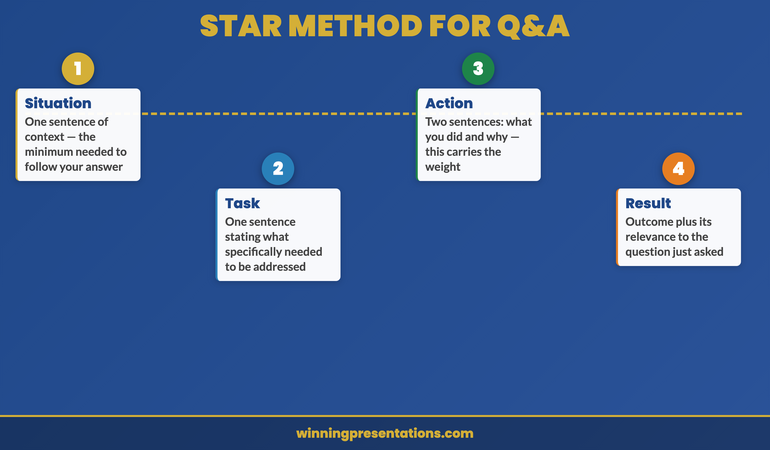
The STAR Method Explained — and What Most People Get Wrong
The STAR framework — Situation, Task, Action, Result — was originally designed for structured interview responses, where a candidate is asked to give an example of a specific competency. In that context, it works well: it gives the interviewer a complete narrative arc in a predictable sequence, and it gives the candidate a structure that prevents them from either under-answering (missing essential context) or over-answering (losing the thread in excessive detail).
In an executive Q&A context, STAR serves a different purpose, and the adaptation matters. The most common mistake executives make when applying STAR to board or senior committee questions is treating each component as equal in weight. In an interview, Situation and Task may require several sentences of context-setting. In an executive Q&A, Situation gets one sentence — possibly two if the context is genuinely unfamiliar to the questioner — and Task gets one sentence. The substantive weight of the answer lives in Action and Result. Executives who spend too long on S and T have not answered the question by the time they reach the components that actually matter.
The second common error is treating Result as the factual outcome and nothing more. In an executive presenting context, Result has two components: what the outcome was, and what it means for the decision or situation currently under discussion. An answer that ends with “and the result was a 14% improvement in processing time” is technically complete but strategically incomplete. An answer that ends with “and the result was a 14% improvement in processing time, which is why we believe the same approach is viable in the context you are asking about” connects the narrative to the questioner’s actual concern. That connection is what transforms a technically correct answer into one that advances the conversation.
How to Use STAR for Hostile or Compound Questions
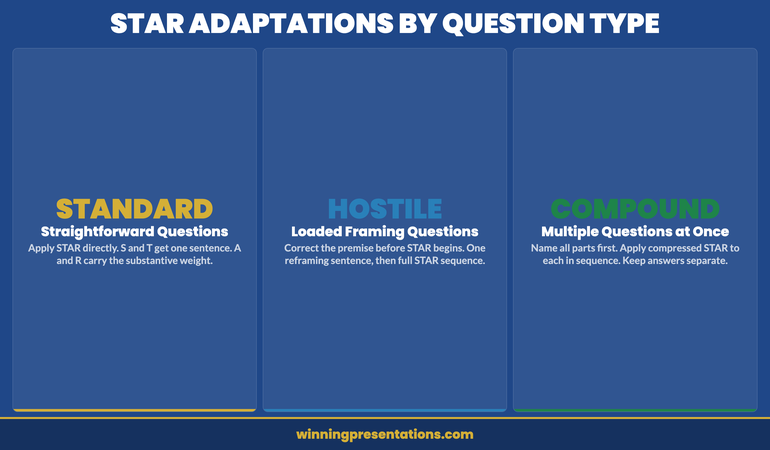
STAR works well for straightforward questions. For hostile questions and compound questions — two of the most common Q&A challenges in executive presenting — it requires adaptation.
A hostile question typically contains a loaded premise: an assertion embedded in the question that, if accepted, puts the respondent in a losing position. “Given that your division has consistently missed its targets over three consecutive quarters, how do you justify the current headcount?” The loaded premise is “consistently missed its targets” — which may be a selective reading of a more complex performance picture. Applying STAR directly to this question means accepting the premise in your Situation component, which undermines the entire answer.
The adaptation for hostile questions is to introduce a pre-STAR clarification: one sentence that either corrects the factual premise or reframes the context before beginning the STAR sequence. “I want to be precise about the performance context here.” Then STAR begins from a corrected starting point. This is not evasion — it is accuracy. Boards and senior committees respect an executive who corrects a false premise without becoming defensive, because it demonstrates both knowledge and composure. The hostile questioner simulation framework in the executive Q&A preparation programme works through this adaptation in detail across different question types.
Compound questions — “Can you explain the revenue shortfall, and while you are at it, what is your view on the M&A pipeline, and has that affected the team’s capacity to deliver?” — require a different adaptation. The first step is to explicitly acknowledge the compound nature of the question: “There are three elements to that question — let me take them in turn.” This signals organisation rather than confusion, and it gives you permission to answer each part with appropriate brevity rather than attempting to weave them together in a way that loses all three. Apply a compressed STAR to each element — one sentence of Situation and Task, two of Action and Result — and the compound answer remains structured throughout.
For executives who want a complete system for handling the full range of board and senior committee questions — not just STAR but the prediction frameworks, preparation protocols, and specific techniques for the most challenging question types — the Executive Q&A Handling System covers the full landscape.
Adapting STAR for Different Executive Question Types
Not every Q&A question in an executive context is asking for a narrative example — which is what the STAR framework was originally designed to provide. Boards ask three other types of questions with significant frequency, and each requires a slight adaptation of the STAR architecture.
Opinion questions ask for the executive’s view rather than a factual account: “What is your assessment of the market opportunity in the next 18 months?” For opinion questions, the Situation component becomes context-setting (the facts that inform the view), Task becomes the specific question being assessed, Action becomes the reasoning process (what factors you have weighed and how), and Result becomes the conclusion — the actual opinion. The structure is otherwise the same; the content in each component is different.
Forward-looking questions ask about plans, projections, or intentions: “What are you planning to do about the competitor that just entered your market?” For these, Situation is the current landscape, Task is the strategic challenge being addressed, Action is the planned response, and Result is the anticipated outcome — stated with appropriate confidence rather than as a guarantee. Be specific about what you know and appropriately cautious about what you are projecting. Boards distinguish between executives who are precise about certainty levels and those who present projections as facts.
Clarifying questions ask the executive to revisit something already presented: “You mentioned earlier that you are confident in the Q3 projection — can you walk us through why?” For these, the Situation component is brief (you are returning to a point already made), the Task is what specifically needs clarification, the Action is the additional detail or reasoning, and the Result connects back to the confidence stated earlier. The key with clarifying questions is not to become defensive — the questioner is giving you an opportunity to strengthen your position, not challenging it.
All three question types benefit from the same preparatory discipline: the two-second pause before answering to categorise the question and select the appropriate STAR adaptation, as covered in the pause technique for executive Q&A. The pause is not delay — it is the moment in which the structural decision gets made.
The STAR Exit: How to Land Your Answer Without Trailing Off
The exit — the final sentence of a STAR answer — is where most executives lose the ground they have spent the previous 60 to 90 seconds building. The answer arrives at the Result component and then continues: one more qualifying clause, one more piece of context, one more hedge against a follow-up question. The landing that the structure set up gets cancelled by the executive’s inability to stop talking.
A strong STAR exit has one sentence: the Result, stated plainly, connected where appropriate to the question’s underlying concern. “The result was X, which is why we are confident / which is why we are monitoring / which is why we have changed our approach.” Full stop. No qualifiers. No additional context. No invitation for a follow-up by pre-emptively addressing objections that have not been raised.
The difficulty of stopping precisely at the right moment is not a content problem. It is a physical one. The anxiety of senior Q&A produces a tendency to fill silence — the silence after your final sentence feels exposed in a way that compels the executive to add one more clause. The practical solution is to build an exit marker into your STAR preparation: a deliberate phrase that you know signals the end of your answer. “That is the position as we understand it” or “that is what the data showed” are phrases that function as exit signals — they close the answer with a tone of finality rather than tentativeness. They also tell the questioner that you have finished, which gives them permission to respond rather than waiting for you to continue.
Making STAR Automatic: The Practice Protocol
The STAR framework is not useful in a Q&A if you are consciously constructing it in real time while a board member is looking at you. The goal of STAR practice is to make the structure automatic — to reach a point where the categorisation and sequencing happen without deliberate effort, leaving your conscious attention free for the content of the answer itself.
The practice protocol has three stages. The first stage is deliberate application: for one week, consciously apply STAR to every question you are asked in any professional context — one-to-ones, team meetings, informal conversations with senior stakeholders. This stage feels mechanical and slightly awkward; that is expected and necessary. The structure needs to become familiar before it can become fluent.
The second stage is high-stakes simulation. Work with a trusted colleague to run a 20-minute Q&A session in which they ask the ten questions you most expect at your next board or senior committee presentation. Record the session. Review each answer against the STAR structure: where did the Situation run too long? Where did the Action lack specificity? Where did the Result fail to connect to the underlying concern? This kind of structured review produces faster improvement than any number of unstructured rehearsals. The simulation approach used in the hostile questioner simulation framework applies the same principle to the most demanding question types.
The third stage is transfer: using STAR in increasingly high-stakes contexts until the board room or investor meeting no longer feels categorically different from a well-prepared team presentation. The same structured practice approach applies in virtual and recorded presentation contexts — the asynchronous presentation framework addresses the specific challenges of delivering without live audience feedback, where STAR’s answer architecture provides equally useful discipline for the absence of an immediate follow-up exchange. This transfer does not happen automatically — it requires deliberately choosing to apply the structure in the next senior context rather than reverting to unstructured answering when the stakes rise. Executives who complete all three stages consistently report that Q&A sessions that once felt like a threat become, over time, the part of a presentation they are most comfortable with — because they are the part they have systematically prepared for.
Executive Q&A Handling System
Predict, Prepare, and Handle the Questions That Shape Decisions
The Executive Q&A Handling System — £39, instant access — gives you a complete framework for executive Q&A: question prediction tools, structured response frameworks, preparation protocols, and scenario playbooks for the question types most likely to derail a senior presentation. For board, investor, finance committee, and high-stakes management Q&A.
Designed for executives where the Q&A determines whether the decision goes their way.
Frequently Asked Questions
Is the STAR method appropriate for executive Q&A, or is it mainly an interview technique?
The STAR method was developed in an interview context, but the underlying architecture — Situation, Task, Action, Result — is applicable to any answering context where structure prevents over-answering and ensures the response ends on a clear conclusion. In executive Q&A, the adaptation is primarily one of weight: Situation and Task receive minimal space (one sentence each at most), and Action and Result carry the substantive weight of the answer. The framework is particularly useful in board and senior committee presentations where the questioner has limited patience for long preambles and where the executive’s credibility is partly assessed by the economy and precision of their answers. STAR is most valuable not as a rigid formula but as a decision architecture that removes the need to construct your answer’s structure in real time under pressure.
How long should a STAR answer be in a board or executive Q&A context?
In an executive Q&A context, most STAR answers should run between 60 and 90 seconds when spoken at a measured pace. This typically allows one or two sentences per STAR component, with slightly more weight on Action and Result. Answers running shorter than 60 seconds may be appropriate for simple or factual questions but risk appearing evasive for questions requiring substantive explanation. Answers running longer than 90 seconds — unless the question is genuinely complex and the additional length is justified — typically reflect either an S or T component that has run longer than necessary, or a Result component that has been qualified and extended beyond the point where it serves the answer. If you consistently find your STAR answers running over 90 seconds, the most likely fix is compressing your Situation to one sentence and cutting any Task context that the questioner already knows.
What do you do when you do not have a relevant result to complete the STAR structure?
When a question asks about a situation that is ongoing or one where the outcome is not yet known, the Result component becomes a forward-looking statement rather than a historical outcome. “We are currently in the process of X, and our expectation is Y by Z date” is a valid and honest Result for an open situation. The alternative — attempting to offer a historical result when none exists — produces answers that sound evasive or manufactured. Boards and senior committees are generally comfortable with “we do not yet have the result because the initiative is ongoing” when that statement is followed by a specific expected outcome and timeline. What they are not comfortable with is ambiguity about whether management has a clear view of where it is heading. The Result component, whether historical or forward-looking, is always about demonstrating that management is in command of the situation — not simply that things have gone well.
The Winning Edge
Weekly insights on executive presentations, delivered every Thursday. Practical frameworks, real scenarios, and no generic advice.
About the Author
Mary Beth Hazeldine — Owner & Managing Director, Winning Presentations
With 25 years of corporate banking experience at JPMorgan Chase, PwC, Royal Bank of Scotland, and Commerzbank, Mary Beth Hazeldine advises executives across financial services, healthcare, technology, and government on structuring presentations for high-stakes funding rounds and approvals. She works directly with senior leaders to build the Q&A capability that shapes decisions in the room. Learn more at Winning Presentations.