15 Mar 2026
Professional executive having a one-to-one pre-meeting conversation with a colleague in a modern glass office, navy and gold corporate aesthetic, high-stakes approval setting

The Pre-Decision Conversation: Where Approvals Actually Happen

Quick Answer: Most executives make their decision in an informal conversation hours or days before the formal meeting. The formal meeting is a confirmation ritual, not the decision moment. The pre-decision conversation — a single phone call, a corridor chat, or a brief coffee meeting — is where approvals actually happen. Getting this conversation right means your presentation delivers confirmation, not persuasion. That changes everything about how you prepare.

🚨 Pitching for approval this month? Quick diagnostic: Have you had a pre-decision conversation with the decision-maker yet, or are you relying entirely on the formal presentation? If it’s the latter, you’re walking in without the framework that determines whether you win. → Get the Executive Slide System (£39), which includes the exact pre-conversation positioning strategy and decision-meeting follow-up.

A CFO told me she approved a £2 million budget in a five-minute corridor conversation two days before the formal approval meeting.

The executive who was presenting sent her a single-page executive summary in advance. They had a brief phone call the morning before that one-pager arrived. She asked three questions. He answered them with precision.

By the time the formal meeting happened, the decision was already made. Everyone in the room knew it. The presentation became a confirmation ritual — addressing questions that had already been resolved, walking through slides that she had already mentally approved.

This is the norm at executive level, not the exception. Most senior decision-makers make their decision outside the formal meeting. The formal meeting is theatre.

But most presenters still approach it as if the meeting itself determines the outcome. They prepare slides for persuasion. They build arguments for a room that has already decided. They walk in hoping to land a decision they should have secured days before.

What Is a Pre-Decision Conversation?

A pre-decision conversation is an informal discussion — usually a phone call, a corridor chat, or a brief in-person meeting — between you and a decision-maker or key influencer before the formal approval meeting takes place.

Its purpose is not to present your case. You’re not pitching. You’re clarifying what the decision-maker actually cares about, answering the questions that would otherwise sit unanswered in the formal meeting, and creating space for them to voice concerns that they wouldn’t raise in front of a full committee.

This is fundamentally different from a “pre-meeting brief” or a presentation rehearsal. Those are preparation activities. A pre-decision conversation is a sales conversation. It happens one-on-one or in a very small group. It is designed to move someone from uncertainty toward a yes before they enter the formal decision space.

The stakes are high because this conversation often determines whether the formal meeting is a smooth confirmation or an ambush. A decision-maker who has already agreed in principle will defend your proposal in the room. A decision-maker who is hearing your argument for the first time in front of peers is far more likely to defer, object, or propose conditions.

Why the Informal Conversation Determines the Outcome

Executives avoid surprise decisions in public. They prefer to know where they stand before they commit in front of peers or their own leadership team.

When you lead with a formal presentation without a pre-decision conversation, you’re asking the decision-maker to commit in an unfamiliar environment, in front of an audience, without private space to raise concerns or renegotiate terms. They are more likely to defer, ask for more time, or propose modifications rather than give a clean yes.

A pre-decision conversation removes the risk of public commitment. It allows the decision-maker to ask difficult questions privately. It gives you space to adapt your position based on what you learn. It lets them feel heard before they have to perform a decision in front of others.

This is why informal influence often outweighs formal persuasion. The best slide deck in the world cannot compete with a decision-maker who has already made up their mind — and pre-decision conversations are where minds actually get made up.

Many executives don’t even attend their own approval meetings. They send a delegate with instructions: approve if certain conditions are met, or defer if X happens. The pre-conversation with the actual decision-maker is what determined their position. The formal meeting is just execution.
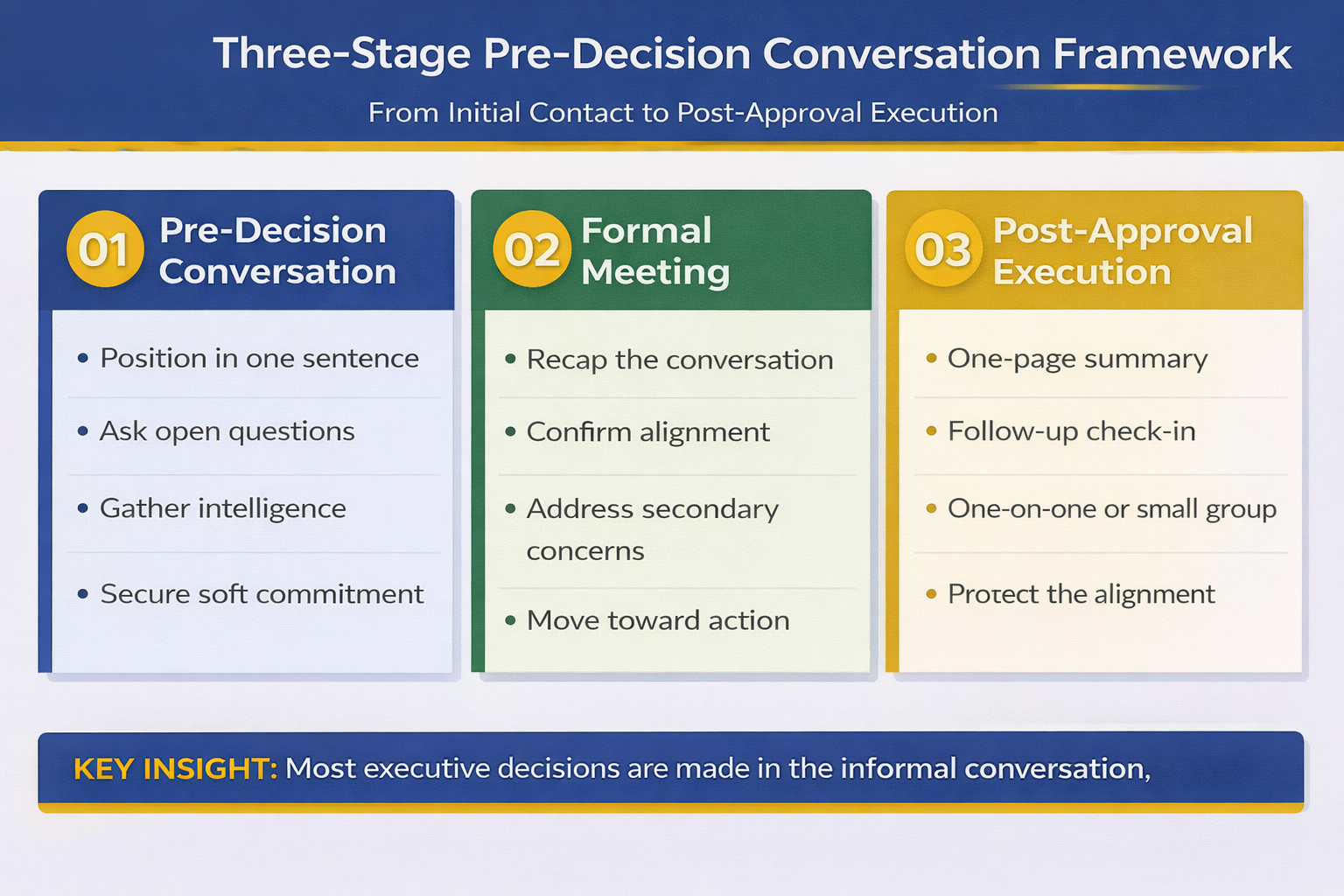
Three-stage pre-decision conversation framework infographic showing Pre-Decision Conversation, Formal Meeting, and Post-Approval Execution phases with key actions for each stage including positioning, intelligence gathering, recap and confirmation

When to Initiate the Pre-Decision Conversation

Timing determines whether a pre-decision conversation feels natural or manipulative. Get it wrong and you risk appearing to lobby behind the scenes. Get it right and you’re simply being thoughtful.

The ideal window is 5–10 days before the formal meeting. This gives you enough time to gather intelligence, adapt your approach, and ensure your formal presentation reflects any insights you gained. It’s recent enough that momentum hasn’t shifted, but distant enough that reaching out doesn’t feel like a last-minute panic.

You should initiate the conversation with the person most likely to become your champion or the person most likely to block you — often both are the same person. If there is a steering committee, start with the chair. If there is a finance committee, start with the CFO or budget-holder. If there is a project governance board, start with the executive sponsor.

The conversation should feel organic to your relationship. If you have never spoken to this person one-on-one before, a sudden pre-meeting call can read as suspect. Build it into existing touchpoints: “I know you’re reviewing this next Tuesday. Would you have 20 minutes this week for a quick call? I’d like to make sure I’m addressing your specific concerns rather than presenting a generic case.”

Never frame it as “getting approval early” or “lobbying support.” Frame it as preparation, intelligence-gathering, or relationship-building. “I’d like to understand what you’re looking for” is very different from “I’d like to get you to approve this.”

Secure Buy-In Before the Room Through Strategic Pre-Decision Conversations

The difference between executives who consistently win approvals and those who don’t isn’t the quality of their presentations. It’s whether they have already secured the decision before the formal meeting begins.

  • The exact timing, framing, and positioning strategy for pre-decision conversations that feel natural, not manipulative
  • Word-for-word scripts for three common pre-conversation scenarios: finance approval, programme governance, and stakeholder alignment
  • The questions to ask that reveal what the decision-maker actually cares about — before you build your formal presentation
  • The follow-up framework that converts informal agreement into formal approval without re-negotiation

Get the Executive Slide System → £39

Includes the pre-conversation positioning strategy from 24 years of corporate banking approvals at JPMorgan Chase, RBS, and Commerzbank — where executive alignment is the difference between a decision and a deferral.

How to Structure the Conversation for Maximum Impact

A pre-decision conversation that works has three distinct phases. They must happen in order, and each must be brief.

Phase 1: The Positioning Statement (30 seconds)
Lead with your core positioning in a single sentence. Not your company. Not your features. The one thing that makes this decision matter to them right now. “We’re proposing a shift in how we structure our approval workflow, and I wanted to understand whether this aligns with your priority of reducing sign-off delays.”

Phase 2: Intelligence Gathering (5–10 minutes)
Ask questions. Shut up and listen. The goal is to discover what the decision-maker is actually worried about, what they care about most, and what would make them feel confident saying yes. Most presenters skip this entirely and launch into their pitch. Don’t. The conversation should be 70% them talking and 30% you talking. Ask open questions: “What does success look like for you here?” “What are your main concerns about moving forward?” “What would need to be true for you to feel confident saying yes?”

Phase 3: The Soft Commitment (2–3 minutes)
Once you understand where they stand, you can adapt. But you also need to move toward alignment. “Based on what you’ve told me, I want to make sure next Tuesday’s presentation addresses what actually matters to you. It sounds like the cost impact is your main concern and the implementation timeline is secondary. Is that right?” This does two things: it shows you listened, and it creates space for them to confirm or correct you. Either way, you’re getting closer to agreement.

Close with something like: “I appreciate your time. I’ll make sure the presentation reflects this conversation. If anything shifts before Tuesday, just let me know.”

Get the Pre-Decision Conversation Script Template

The exact words to use when you initiate the conversation, how to transition into intelligence-gathering, and how to secure the soft commitment without sounding like you’re lobbying. Included in the Executive Slide System.

View Inside → £39

What to Do When You Encounter Resistance

Sometimes you initiate a pre-decision conversation and the response is not enthusiasm. The decision-maker is busy. They say they’ll wait for the formal meeting. They raise a concern that wasn’t on your radar.

If they defer the conversation: accept it gracefully. “No problem. I know you’re busy. I’ll make sure the presentation covers your main priorities. If you have a few minutes the day before, I’d still appreciate your input. Either way, we’re good.” Don’t push. Pushiness signals desperation and erodes trust.

If they raise a concern in that moment: this is the most valuable intelligence you can get. Don’t dismiss it or defend. Clarify it. “Tell me more about that.” “What specifically worries you?” “What would need to change for that not to be a concern?” If it is a genuine blocker, knowing about it now gives you time to address it before the formal meeting. If it is a smoke screen, the conversation will reveal that too.

If they seem aligned but non-committal: don’t interpret silence as agreement. Test it gently. “So it sounds like you see the value, but you want to see how the team responds in the meeting before you fully commit? Is that fair?” This forces clarity. They either confirm they’re waiting for the room’s input, or they reveal that they’re actually more convinced than they sounded.

Stop Walking Into Approval Meetings Cold

The anxiety of an approval meeting without a pre-decision conversation is the anxiety of genuine uncertainty. You don’t know where the decision-maker actually stands. The formal meeting becomes a high-stakes gamble.

  • The pre-conversation checklist that ensures you ask the right questions in the right order
  • How to read signals: what it means when they go quiet, when they challenge, when they agree too quickly

Get the Executive Slide System → £39

Essential preparation framework for anyone securing budget approval, board-level agreement, or stakeholder alignment.

Common Questions About Pre-Decision Conversations

Isn’t having a pre-decision conversation before the formal meeting just lobbying?
No. Lobbying is trying to build a coalition against someone else’s position. A pre-decision conversation is one-on-one, transparent, and focused on understanding the decision-maker’s position so you can address it. It is how senior executives do their jobs. When a CFO has concerns about a budget request, the finance director talks to them one-on-one before the formal budget meeting. That is not lobbying. That is due diligence. The same applies to you.

What if I have multiple decision-makers? Who do I talk to first?
Start with the person who can say no most definitively — usually the person who controls the budget or who has formal authority over the approval. Get them comfortable. Then work down the influence chain. Each conversation should be brief and should focus on understanding where that person stands, not on trying to turn them into your advocate. If the primary decision-maker is already aligned, the secondary influencers are usually not a problem.

What if the decision-maker says yes in the pre-conversation but then doesn’t defend the proposal in the formal meeting?
This happens when they said yes to move the conversation forward but were never genuinely convinced. That is why testing for real commitment matters. If you sense soft agreement, push slightly: “So you’re comfortable moving forward if [specific condition]?” If they waffle, you have discovered that you don’t actually have alignment yet. Now you know what to do: address the real concern before the formal meeting, or adjust your ask.
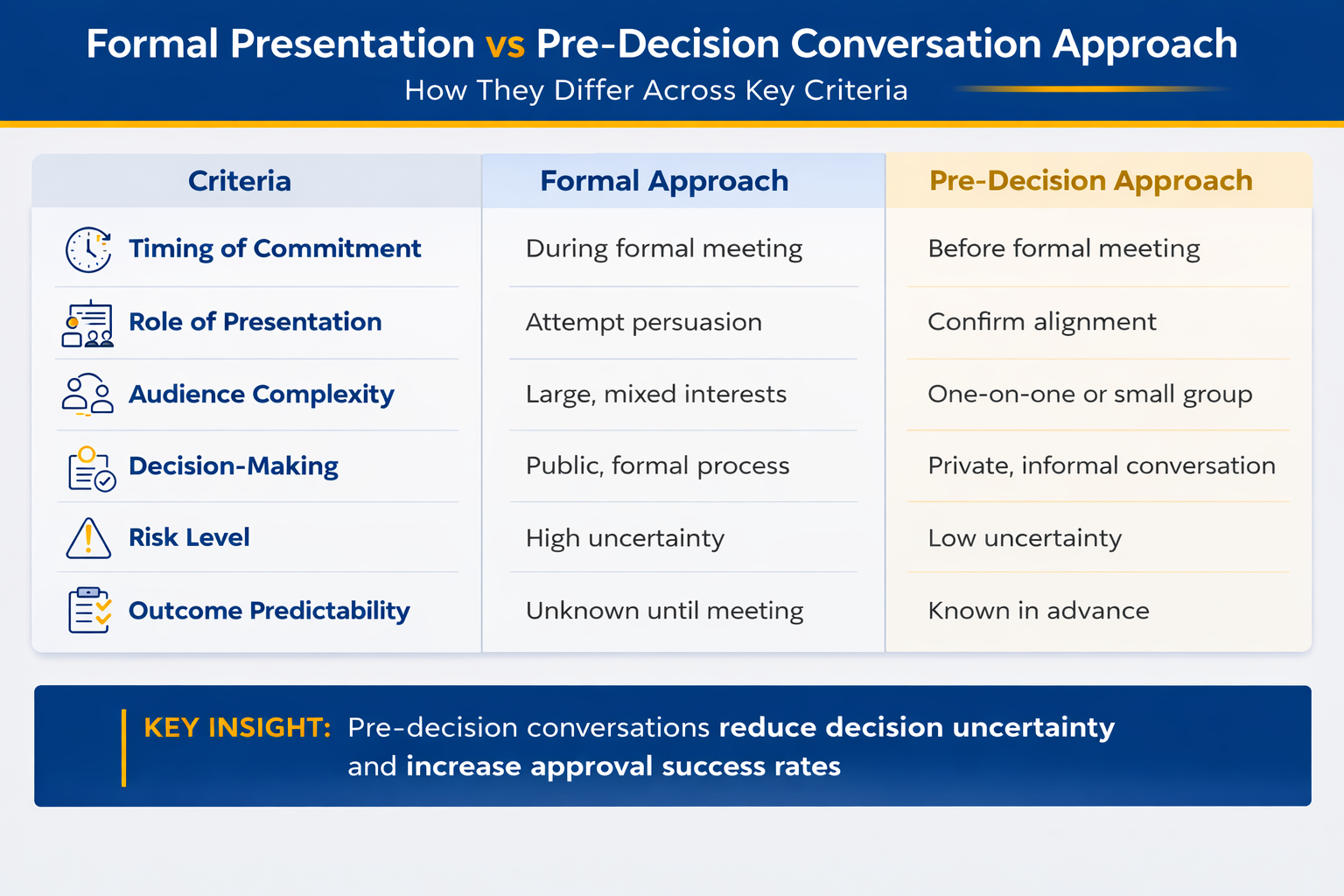
Comparison matrix infographic contrasting formal presentation approach versus pre-decision conversation approach across six criteria including timing, format, objective, decision dynamics, success rate, and risk level

The Formal Meeting: Converting Pre-Decision Alignment Into Action

Once you have had a pre-decision conversation and secured at least soft alignment, the formal meeting becomes a different exercise. You are no longer pitching for a decision. You are confirming one and addressing secondary concerns.

This changes everything about how you present. Your opening is no longer a pitch. It is a recap of the conversation: “In our discussions this week, it became clear that your main priority is implementing this with minimal disruption to current operations. The proposal I’m presenting has that as its core structure. Here’s how.” You are reminding them of the conversation they had with you and showing them that you listened.

Your presentation is shorter. You have already covered the main questions and objections. The formal meeting can focus on addressing the secondary concerns and handling questions from the broader audience that weren’t present in the pre-conversation.

Your close is not a call to action. It is a recap and next step: “Based on what we’ve discussed, the next step is [specific action]. Are there any questions before we move forward?” This is not a question. It is a transition into action.

Executives who have already committed in the pre-conversation will support your presentation. They will fill in gaps, answer peer questions, and smooth the path to final approval. You have made them your champion because you listened to them before anyone else did.

The Formal Meeting Playbook

Once you have secured pre-decision alignment, the formal meeting structure is fundamentally different. Get the exact template for opening, body, and close that converts confirmed decisions into final approvals.

Get the Templates → £39

Is This Right for You?

This is for you if:

  • You’re seeking formal approval from a decision-maker or committee for something that matters (budget, programme, initiative, hire)
  • You have identified the key decision-maker but haven’t had a one-on-one conversation with them about your proposal
  • You’ve had approval meetings that went sideways despite strong slides, or that resulted in unexpected objections you could have addressed
  • You want to shift from hoping your presentation persuades them to knowing you have alignment before you walk in the room

This is NOT for you if:

  • You’re presenting to a wide, unfamiliar audience where one-on-one conversations aren’t practical (company town hall, public conference)
  • The decision is genuinely distributed across a large committee with no clear champion
  • The decision-maker has explicitly asked not to be contacted before the formal meeting (respect that boundary)
  • You haven’t yet built enough relationship credibility for a pre-meeting conversation to feel natural

After the Green Light: Managing the Handover

A pre-decision conversation secures alignment. The formal meeting confirms it. But many approvals still fail at the handover — the moment between formal approval and actual implementation.

This is where discipline matters. After the formal meeting, send a one-page summary within 24 hours. Not a full recap. A single page covering: the approval, the next step, the timeline, and who is responsible for what. This document serves two purposes: it confirms what was actually agreed (no room for interpretation later), and it signals professionalism and follow-through.

Then schedule a brief follow-up conversation with the key decision-maker — not another formal meeting, just a check-in. “I wanted to confirm we’re aligned on the timeline. Implementation starts [date]. Is there anything you want to flag or discuss before we move into execution?” This catches scope creep or shifting priorities before they become problems.

Finally, keep them informed as implementation begins. Monthly updates, not because they asked for them, but because it shows respect for their decision and their time. Executives who feel kept informed are executives who continue to support the approval even when implementation gets messy.

Built From 24 Years of High-Stakes Approval Conversations in Banking. Now a Framework You Can Use.

I spent two decades in corporate banking securing approvals for multi-million-pound initiatives, vendor switches, and programme expansions. The difference between approvals that sailed through and those that got blocked was almost never the slides. It was whether the key decision-maker had already made up their mind before the formal meeting. The pre-decision conversation is where that happens. The Executive Slide System gives you the exact framework.

  • 22 executive templates including budget request, programme approval, and stakeholder alignment formats
  • Word-for-word scripts for three pre-decision conversation scenarios — finance approval, governance, and executive alignment
  • The post-approval handover checklist that ensures agreement doesn’t slip during implementation
  • 51 AI prompts to prepare for your pre-conversation, including research, objection-handling, and follow-up frameworks

Your approval meeting has a date. The decision-maker’s mind may already be made, or it may still be open. Find out before you present.

Get the Executive Slide System → £39

Trained thousands of executives in high-stakes presentations across banking, consulting, and technology. Immediate digital download. Used in budget approvals, board presentations, and governance meetings.

Frequently Asked Questions

How do you initiate a pre-decision conversation without appearing to lobby or influence the decision before the formal process?

Frame it as clarification, not persuasion. The language matters enormously. Use: “I’d like to understand your specific priorities before I present,” not “I want to get your buy-in early.” Use: “I’m making sure I address your concerns rather than guess at them,” not “I want to align with you before the meeting.” The intent is genuine — you are seeking to understand, not to manipulate. If your language matches that genuine intent, the conversation feels natural and professional. Senior executives talk one-on-one with peers and stakeholders all the time. This is exactly that.

What if a decision-maker agrees in the pre-conversation but the broader committee challenges them in the formal meeting?

This is one of the reasons the pre-conversation is so valuable. The person who has already committed to you will tend to defend your proposal in the room because they’ve already staked their credibility on it. If they face unexpected objections, they have usually had time to think through counterarguments. If they were only softly aligned, the committee pushback will reveal that you don’t actually have agreement yet — which is far better to learn in a pre-conversation than in a public meeting. If this happens, treat it as intelligence: you need to address a real concern before the formal meeting.

Is a pre-decision conversation different for budget approvals versus programme approvals versus stakeholder alignment?

The framework is the same (positioning, intelligence-gathering, soft commitment), but the questions change. For budget approvals, focus on cost impact, ROI, and trade-offs. For programme approvals, focus on risk, resourcing, and timeline. For stakeholder alignment, focus on their specific department’s impact and dependencies. The structure stays consistent; the content adapts to what that person actually cares about.

What happens if you don’t have a direct relationship with the decision-maker? How do you initiate the conversation then?

Use a warm introduction. Ask your sponsor or the person who invited you to the formal meeting to facilitate an introduction: “I’d appreciate if you could introduce me to [decision-maker]. I’d like a 20-minute call to understand what they’re most focused on before I present.” This makes the conversation feel less like cold outreach and more like a natural part of the process. If a warm introduction isn’t possible, reach out briefly and directly: “I’m presenting a proposal in your area next Tuesday. Would you have 20 minutes this week for a quick call? I’d like to make sure I’m addressing your specific priorities.” Be honest about why you’re reaching out. Honesty builds trust.

The Winning Edge — Executive Presentation Insights

Weekly strategies for executives who present at board level, secure approvals, and navigate high-stakes decisions. Practical frameworks from 24 years in the room, not theory.

Subscribe Free →

🎁 Free resource: Executive Presentation Checklist — the pre-meeting audit framework for approval presentations. Free download, no email required.

Also published today:

Your next approval meeting is already on the calendar. You will walk into that room with either the advantage of having already secured alignment, or the disadvantage of hoping your presentation convinces them.

The difference is a single 20-minute conversation that happens days before the formal meeting. Use the Executive Slide System (£39) to structure that conversation. It includes the exact scripts for initiating the call, the questions that reveal what they actually care about, and the follow-up approach that converts informal alignment into formal approval.

For further reading on executive alignment and approval strategy: Pre-Meeting Executive Alignment: The Strategy That Determines Outcomes, The Decision Slide: The One Slide That Matters in Executive Presentations, and Building Executive Buy-In: From First Contact to Final Approval.

About the Author

Mary Beth Hazeldine is the Owner & Managing Director of Winning Presentations. With 24 years of corporate banking experience at JPMorgan Chase, PwC, Royal Bank of Scotland, and Commerzbank, she has delivered high-stakes presentations in boardrooms across three continents.

A qualified clinical hypnotherapist and NLP practitioner, Mary Beth combines executive communication expertise with evidence-based techniques for managing presentation anxiety. She has trained thousands of executives and supported presentations that have secured high-stakes funding rounds and approvals.

Book a discovery call | View services

14 Mar 2026
Executive reviewing a structured question bank document before a presentation meeting

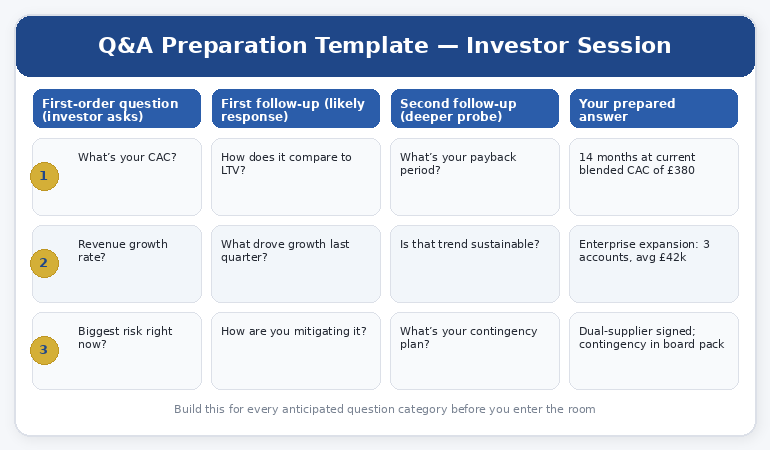
The Question Bank: Building a Personal Library of Answers You’ll Need Again and Again

A presentation question bank is a personal system of recurring Q&A patterns with tested answers you’ve refined through real meetings. It prevents inconsistent responses, saves preparation time, and dramatically improves your closing rate. This guide shows you how to build, categorise, maintain, and use one.

The Problem That Started It All

A sales VP at a SaaS firm was closing just three out of every forty-seven client demos—a 6% close rate. When we dug into what was happening, the issue became clear: he was being asked essentially the same fifteen questions in every single demo. “How does this integrate with our legacy system?” “What’s your migration process?” “What happens if your company gets acquired?”

The problem wasn’t that he couldn’t answer these questions. The problem was that he was answering them from scratch every single time. In Demo 1, he’d emphasise technical integration. In Demo 7, he’d focus on risk mitigation. In Demo 23, he’d suddenly mention a customer story he’d forgotten about in earlier demos. The prospects could feel the inconsistency. More importantly, some answers came across as stronger and more credible than others—and he had no system for knowing which version worked best.

The moment he built a personal question bank with tested answers refined through real feedback, everything shifted. He structured each recurring question with a core narrative, supporting data, and a customer example. He practised the answers until they sounded natural. His close rate climbed from 3 out of 47 to 9 out of 23 in the next four months. That’s a jump from 6% to 39%.

This wasn’t luck. It was systematic preparation.

Quick Diagnostic: Are You Losing Deals to Inconsistency?

Consider these questions about your own presentation Q&A:

  • Are you answering the same questions in every presentation but explaining them differently each time?
  • Do you sometimes wish you’d answered a question differently after the meeting ended?
  • Are your best answers happening by accident rather than by design?
  • Do you spend energy crafting answers in the moment instead of drawing on tested responses?

If you recognised yourself in more than one of those, you’re ready for this approach. The Executive Q&A Handling System gives you the exact framework to build and maintain a question bank that works. It’s £39 and designed specifically for this challenge.

What a Question Bank Actually Is

A question bank is not a FAQ. It’s not a script. It’s not something you memorise.

A question bank is a curated personal library of questions you know will come up in your presentations—organised by category, each with a framework for answering that you’ve tested in real meetings. It captures the structure of your best answers, the specific data points that resonate, the customer stories that illustrate your point, and the natural language you use when you’re at your most confident.

Think of it like a jazz musician’s practice framework. A jazz musician doesn’t memorise every solo. Instead, she knows the underlying patterns, the chord progressions, the scales that work, and the techniques that create impact. When she plays, she improvises within that structure. That’s what a question bank does for your Q&A.

The core benefit isn’t that you’ll remember the answer. It’s that you’ll deliver it consistently, confidently, and with the specific elements that have proven to work. You’re no longer inventing responses on the spot. You’re drawing on a tested system.

Building a question bank takes about four to six weeks if you’re deliberate about it. Maintaining it takes roughly thirty minutes per month. The return—in consistency, confidence, and closing rates—is immediate and measurable.

How to Categorise Your Questions

Not all questions are created equal, and grouping them correctly saves you time during preparation and helps you spot gaps in your thinking.

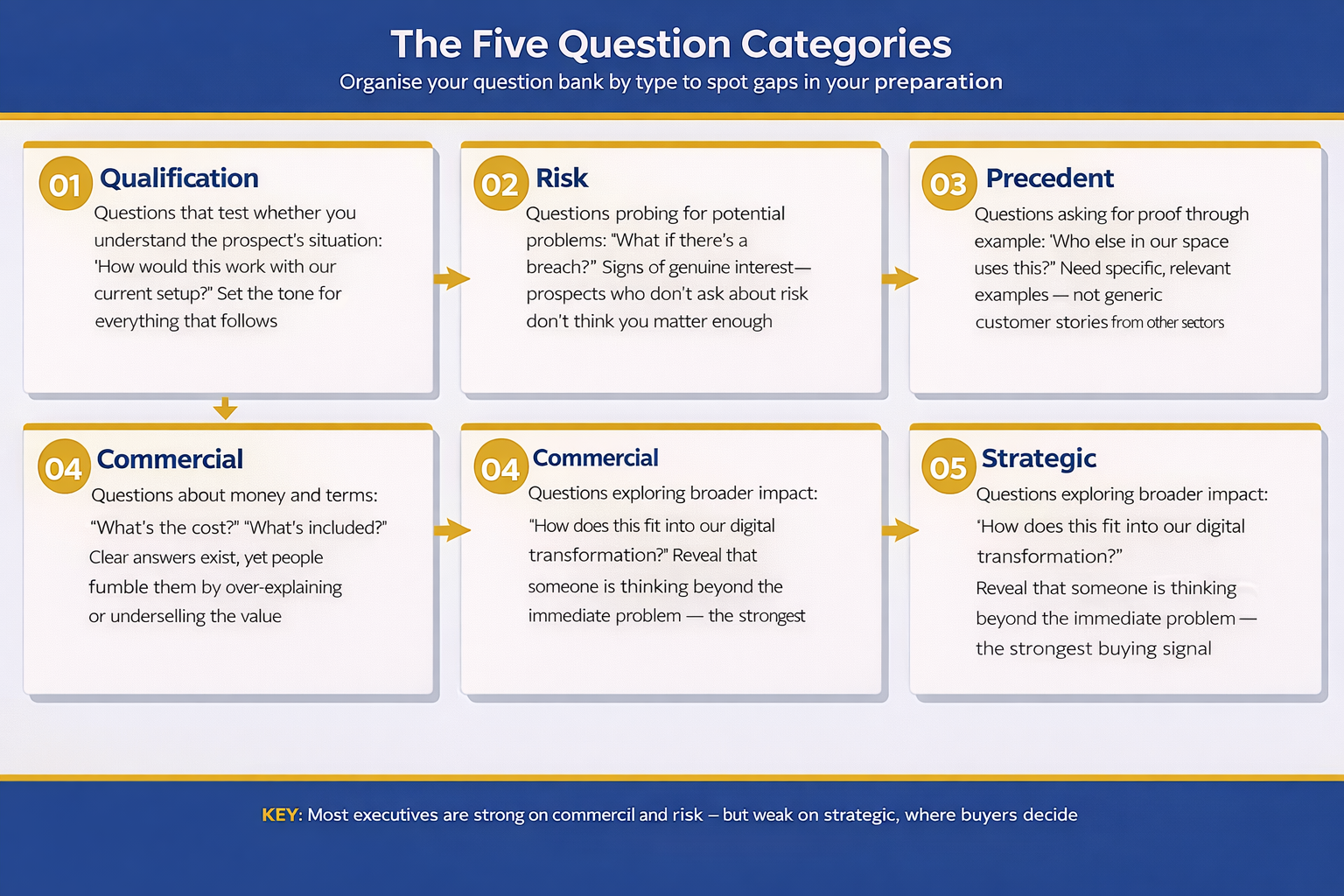
Most presentation questions fall into five natural categories:

Category 1: The Qualification Questions. These test whether you understand the prospect’s situation. “How would this work with our current setup?” “What’s the typical timeline?” “Has anyone in our industry implemented this?” These questions come early and set the tone for everything that follows.

Category 2: The Risk Questions. These probe for potential problems. “What if there’s a data breach?” “What happens if you go out of business?” “How do we ensure this doesn’t disrupt our operations?” Risk questions often feel aggressive, but they’re actually signs of genuine interest. A prospect who doesn’t ask about risk doesn’t believe you matter enough to worry about.

Category 3: The Precedent Questions. These ask for proof through example. “Who else in our space uses this?” “Can you share a case study?” “What did you do when a client had this exact problem?” Precedent questions need specific, relevant examples—not generic customer stories.

Category 4: The Commercial Questions. These focus on money and terms. “What’s the cost?” “How do you price this?” “What’s included in the base package?” These questions have clear answers, yet people often fumble them by over-explaining or underselling.

Category 5: The Strategic Questions. These explore broader implications. “How does this fit into our digital transformation?” “What’s your vision for where this goes?” “How will this change the way we work?” Strategic questions reveal that someone is thinking beyond the immediate problem and imagining long-term outcomes.

When you’re building your question bank, categorise each recurring question into one of these five types. This immediately shows you where your preparation is strongest and where you need to do more work. Most executives have strong answers for commercial and risk questions but weaker answers for strategic questions—precisely the questions that buyers ask when they’re seriously considering you.

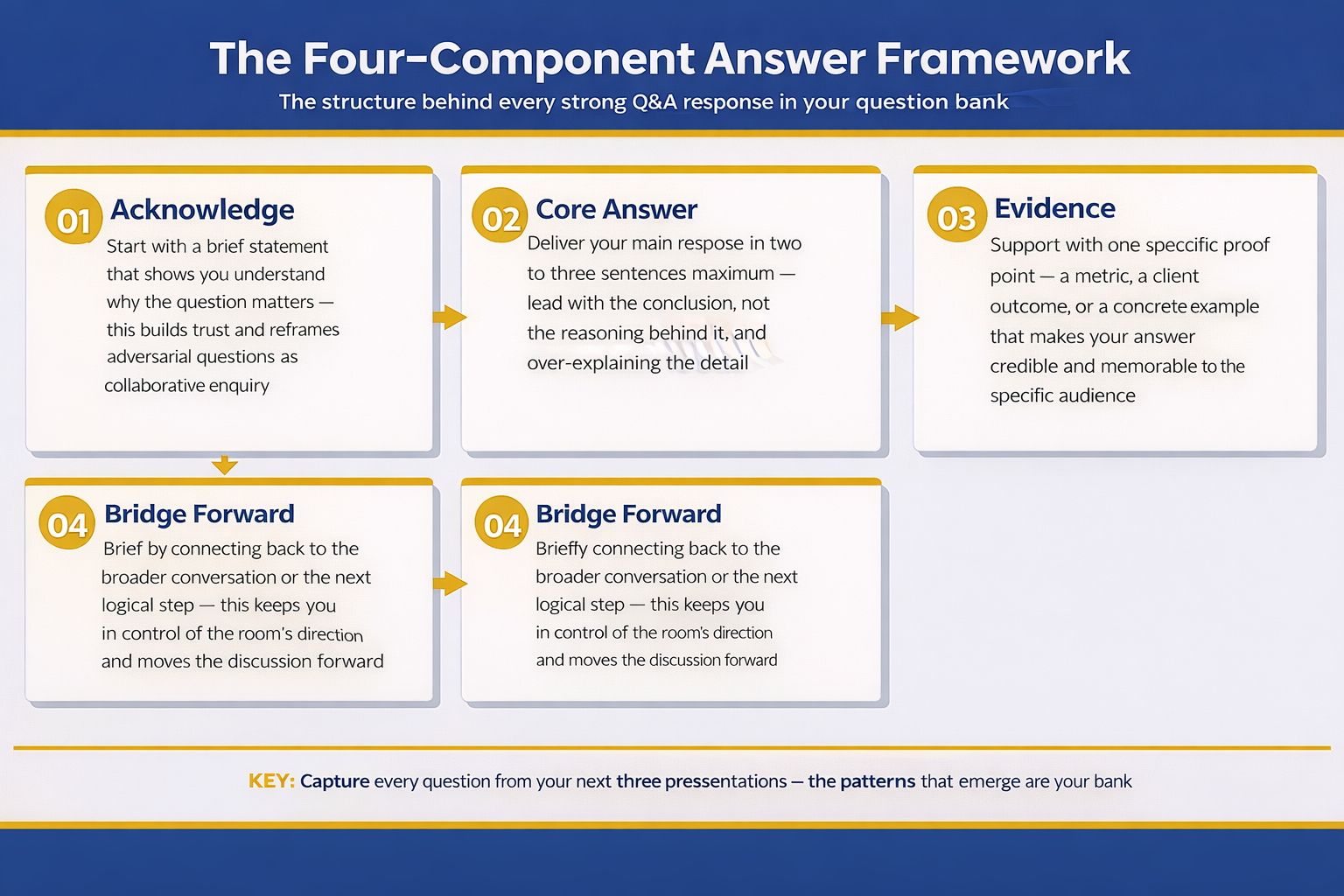
The Four-Component Answer Framework infographic showing the structure behind every strong Q&A response: Acknowledge (show you understand why the question matters), Core Answer (deliver your main response leading with the conclusion), Evidence (support with one specific proof point that builds credibility), and Bridge Forward (connect back to the broader conversation to maintain control)

The Answer Framework for Each Entry

Once you’ve identified a recurring question and categorised it, the next step is to build a framework for your answer. This isn’t a word-for-word script. It’s the architecture of your response—the elements that make the answer work.

Every strong answer has four components. Master this framework, and you’ll never be caught flat-footed by a question again.

Component 1: The Acknowledgement. Start by acknowledging what the question reveals about the prospect’s concern. If someone asks “What happens if there’s a data breach?” they’re signalling that security and trust matter to them. Your first words should reflect that you understand the seriousness of the concern. “That’s a critical question—it shows you’re thinking about operational resilience, and you’re right to ask.” This takes five seconds and immediately builds trust. It also reframes the question from adversarial to collaborative.

Component 2: The Core Answer. This is the substance. It’s one to three sentences that directly address the question without hedging or over-explaining. For the data breach question, your core answer might be: “We use AES-256 encryption at rest and in transit, maintain SOC 2 Type II certification, and carry cyber liability insurance of £X million. We’ve been audited by [recognised auditor] annually for the past five years.” Notice what’s missing: you’re not explaining what encryption is, apologising for industry-wide security challenges, or offering unnecessary qualifications. You’re stating the fact with confidence.

Component 3: The Proof. This is where you provide evidence through example, data, or case study. For the data breach question: “Across our customer base, we’ve had zero breaches in our platform in [number] years. We’ve had clients in regulated industries like [sector] choose us specifically because of our security posture.” The proof component answers the unspoken follow-up: “How do I know you’re telling me the truth?” A strong proof component uses specific, verifiable evidence, not generic reassurance.

Component 4: The Bridge Forward. This brings the conversation back to the prospect’s situation and moves the discussion forward. “The reason I mention our security approach is that we know it’s non-negotiable in your industry. Once we’ve confirmed the technical architecture meets your requirements, we can move to discussing implementation and timeline.” The bridge acknowledges their concern has been addressed and introduces the next logical conversation.

Apply this framework to every recurring question in your bank. You’ll notice two things: first, you have to really understand your answer to structure it this way. You can’t fake this framework. Second, when you deliver a response using this structure, people perceive you as more competent and more trustworthy. The structure itself is persuasive.

The Five Question Categories infographic for organising a presentation question bank: Qualification (testing understanding), Risk (probing for problems), Precedent (asking for proof), Commercial (money and terms), and Strategic (broader impact and transformation)

Building Your Bank from Real Meetings

The strongest question banks are built from real presentations, not from theoretical guessing. Here’s how to build yours without waiting for a perfect moment.

Step 1: Listen and Record. In your next five presentations, bring a notebook or use your phone to jot down every question that comes up. Don’t overthink it—just write the question as it was asked. You’re looking for patterns. After five presentations, you’ll likely see that the same eight to twelve questions appeared across multiple meetings, even if they were phrased slightly differently.

Step 2: Cluster and Name. Take your list of questions and group the similar ones together. “How do you handle integrations?” and “Does this connect with Salesforce?” are essentially the same question asked different ways. Name the cluster with a clear, single question that captures the essence. “How does the platform integrate with existing systems?” becomes your bank entry.

Step 3: Rate Your Current Answers. For each clustered question, honestly rate how confident you felt answering it in recent presentations. Use a simple scale: Strong (I answered this with confidence and clarity), Moderate (I answered it adequately but felt there was something missing), Weak (I stumbled through this or changed my answer between presentations).

Step 4: Build the Framework. Start with your “Strong” answers. Write them up using the four-component framework: acknowledgement, core answer, proof, bridge forward. Don’t overthink this. If the answer worked in a real presentation, capture what made it work. Then move to your “Moderate” answers and refine them using the framework. Finally, tackle your “Weak” answers, which usually means researching a bit more and finding a better proof point.

Step 5: Test and Refine. The next time someone asks one of your banked questions, deliver the framed answer. Pay attention to their reaction. Did they seem satisfied? Did they ask a follow-up? Did you spot a better way to phrase something? Make notes after the presentation. Your question bank isn’t static—it evolves based on what works in real conversations.

This approach takes the guesswork out of preparation. You’re not trying to imagine what questions might come up. You’re capturing what actually comes up and building a tested response system around it.

Maintaining and Updating Your Bank

A question bank is only valuable if it stays current. The moment your market, your product, or your competitive situation shifts, your answers need to shift too.

Monthly Review. Set a calendar reminder for the first Monday of each month. Spend thirty minutes reviewing your question bank. Go through each entry and ask: Have I answered this question in the past month? If yes, how did it land? Do I need to adjust anything? If no, is this still a question that comes up, or can I retire this entry? This monthly discipline keeps your bank aligned with what’s actually happening in your presentations.

Seasonal Updates. Quarterly, do a deeper review. Look for new questions that have emerged. In Q1, prospects might focus on budget cycles and board-approved initiatives. In Q4, they might focus on year-end commitments and next-year planning. Your question bank should reflect these seasonal variations. Add new questions that surfaced in recent presentations. Remove questions that haven’t appeared in three months. This keeps your bank lean and relevant.

Competitive Shifts. If a competitor launches a new feature, releases new pricing, or makes a market announcement, review your bank immediately. You’ll almost certainly be asked about it. Develop your four-component answer before the next presentation, not during it. This is where the value of a maintained bank becomes obvious. Everyone will be asked the same competitive question. Your question bank means you’ll be ready. Your competitors will be improvising.

Proof Point Rotation. Every six months, look at the proof points (case studies, customer examples, data points) in your answers. Have they aged? Do they still feel current and relevant? Replace older examples with newer ones. A prospect is more impressed by “We helped a customer in your sector solve this in the past two months” than “We’ve been solving this for years.” Rotating proof points keeps your answers feeling fresh and recent.

The Q&A Preparation Checklist for Executives can help you structure this monthly and seasonal review process.

Using Your Bank for Live Preparation

A question bank is only useful if you actually use it before presentations. Here’s how to make it part of your real preparation workflow.

Seven Days Before. Pull your presentation attendee list. Based on titles, industries, and company type, identify which questions from your bank are most likely to come up. If you’re pitching to CFOs, your commercial and risk questions matter most. If you’re pitching to operations leaders, your implementation and integration questions matter most. Prioritise your review based on the specific audience.

Three Days Before. Review the five to seven questions most likely for this specific presentation. Read through each four-component answer. Don’t memorise it. Just let the framework settle into your mind. Read it once, let it sit, read it again. This is different from studying. You’re activating knowledge you already have, not cramming new information.

Day Before. Do a final read of your top three questions. If there’s a new development you should mention (new customer, new feature, new market announcement), update your proof point accordingly. Spend five minutes visualising how you’ll answer each question. See yourself staying calm, delivering the answer with the four components in order, and moving the conversation forward. This mental rehearsal is remarkably effective.

During the Presentation. When a question lands, take a breath. You know the framework for this question because you’ve practiced it. You know the acknowledgement that shows you understand their concern. You know your core answer with confidence. You know the proof point that builds credibility. You know the bridge that moves the conversation forward. You’re not thinking on your feet. You’re executing a framework you’ve already internalised.

This is where most people realise the actual value of a question bank. It doesn’t reduce spontaneity. It enables spontaneity. You can fully listen to the questioner, respond authentically, and draw on a structure that you know works—all at the same time.

If you want to accelerate this process and integrate Q&A preparation into a complete system, the Executive Q&A Handling System walks you through the entire build-and-maintain process with templates, frameworks, and strategic guidance.

Stop Leaving Your Best Answers to Chance

A well-built question bank eliminates inconsistency, saves preparation time, and directly improves your close rate. The difference between answering questions from memory and drawing on a tested framework is measurable—often the difference between 6% and 39% conversion.

  • Capture every recurring question in one place, organised by type
  • Build tested answers using the four-component framework that works
  • Maintain your bank monthly to stay current with your market

Get the Executive Q&A Handling System → £39

Used by executives across finance, technology, and professional services.

People Also Ask: How long does it take to build a question bank?A functional question bank takes four to six weeks if you’re deliberate about it. You’ll identify your top recurring questions in the first two weeks (based on real presentations), build out the four-component framework for each question over the next two weeks, and spend the final two weeks testing the answers in live presentations and refining them. Most people find they can dedicate just thirty minutes a week to this without disrupting their schedule. The time investment returns itself in your first post-bank presentation through improved confidence and consistency.

The Three Questions Every Presenter Faces

Most of the questions that appear in your bank will fall into three recurring themes, regardless of your industry or product. Understanding these meta-questions will help you anticipate and prepare for the questions you haven’t yet heard.

Theme 1: “Will this actually work for us?” This is the core doubt underneath qualification and risk questions. The prospect is asking whether your solution is credible, viable, and suitable for their specific situation. Your answer needs to acknowledge their specific constraints and show that you’ve solved similar challenges before. This is where precedent questions are so valuable. Prospects don’t want generic reassurance. They want evidence from situations that look like theirs.

Theme 2: “Can we afford this and what are the trade-offs?” This surfaces in commercial questions, but it goes deeper than just price. Prospects are asking whether the value justifies the cost, whether it will create other expenses they haven’t anticipated, and whether they’re getting a good deal compared to alternatives. Your answer needs to separate total cost of ownership from upfront price, and anticipate the trade-offs they’re worried about before they ask.

Theme 3: “What does this change about how we work?” This is the strategic question that separates buyers who are seriously considering you from those who are just gathering information. They’re asking about implementation, timeline, change management, and the implications for their team and operations. Your answer needs to be honest about what will change (they know something will) and clear about how you’ll guide them through it.

As you build your question bank, notice how your recurring questions connect to these three meta-themes. Your bank answers should directly address these underlying concerns, not just answer the surface question.

People Also Ask: Should I include questions I’ve never been asked?Only if you anticipate them based on your market or competitive situation. The strongest question banks are built from real presentations, not theoretical scenarios. However, there’s a reasonable exception: if you know a competitor released a feature that will definitely generate questions, or if there’s a regulatory change that will surface concerns, you can proactively add these to your bank. But start with questions that have actually come up. A bank of real questions is more valuable than a bank of possible questions.

Use your question map to visually organise these three meta-themes across your five question categories. This gives you a complete strategic view of your Q&A landscape and helps you spot gaps in your preparation.

Master the Framework That Changes Everything

The difference between a scattered Q&A approach and a systematic question bank is the difference between hoping you answer well and knowing you’ll answer well.

  • Apply the four-component answer framework to every recurring question
  • Build answers that are tested, credible, and naturally delivered

Get the Executive Q&A Handling System → £39

The framework used by top sales leaders and business development executives.

Moving from Scattered Q&A to Systematic Preparation

The mistake most executives make is waiting for perfection before they start capturing their questions. They think they’ll build a complete, exhaustive question bank all at once. That’s backwards. Start with your top five questions. Build the four-component answer for each. Test them. Refine them. Then add five more.

A question bank isn’t built in a day. It’s built in conversations—in presentations, in follow-ups, in moments where you realise a question worked better when you answered it differently.

The system is simple. Capture it. Test it. Refine it. Repeat. After four weeks, you’ll have a bank that covers 80% of your presentations. After eight weeks, you’ll realise you’ve stopped answering questions inconsistently. After twelve weeks, you’ll notice your close rate has shifted.

This isn’t about memorising scripts or sounding robotic. It’s about building confidence through systematic preparation. When you know you have a tested answer for the most important questions, you can be fully present in the conversation. You can listen deeply. You can respond authentically. You can move deals forward.

People Also Ask: How many questions should be in my final bank?Most executives have between twelve and twenty questions that cover 90% of their presentations. A few industries have more—complex B2B sales environments might have twenty to thirty. The key is that every question in your bank should be one that has actually appeared in at least two separate presentations. Don’t aim for comprehensiveness. Aim for the questions that matter and that come up repeatedly. A tight bank of well-answered questions is more useful than a bloated one with questions you rarely face.

The Complete Q&A Preparation System for Executives

A question bank is just the foundation. A complete Q&A handling system includes question prediction, tactical frameworks, and maintenance protocols. The result is that you walk into every presentation knowing you can handle whatever comes your way.

  • Identify your core recurring questions using the clustering method
  • Build tested answers using the four-component framework
  • Integrate Q&A preparation into your pre-presentation workflow
  • Maintain your bank monthly to stay competitive and current
  • Use your bank to improve consistency, confidence, and close rates

Get the Executive Q&A Handling System → £39

Complete system including question capture templates, answer frameworks, maintenance checklists, and strategic Q&A mapping.

Is This Right For You?

This approach is right for you if you:

  • Answer the same questions repeatedly but sometimes give different versions of the answer
  • Want to reduce your Q&A preparation time without reducing quality
  • Know your best answers work but haven’t systematised them
  • Want to close more deals by being more consistent and confident in Q&A
  • Are responsible for multiple presentations or team preparation
This approach is not for you if you:

  • Face entirely new questions in every presentation (you need question mapping, not banking)
  • Are not currently presenting regularly (build your bank once you have recurring presentations)
  • Prefer to improvise all answers without frameworks

Frequently Asked Questions

Q: Won’t a question bank make me sound scripted or robotic?A: No. A question bank is a framework, not a script. You’re memorising the structure (acknowledgement, core answer, proof, bridge), not the exact wording. Because the framework is internalised, you can deliver it conversationally and authentically. In fact, most people report sounding more natural and confident because they’re not searching for the right words—they’re drawing on a structure they’ve practiced. The framework frees you to listen and respond naturally rather than scrambling for an answer.

Q: How do I know if a question is recurring enough to include in my bank?A: Include a question in your bank if it’s appeared in at least two separate presentations. If it showed up once and you haven’t seen it again, it’s not yet recurring. Keep a separate “watch list” of questions that appeared once or twice. Once a question reaches the threshold of appearing in three presentations (even if phrased differently), that’s your signal to add it to your permanent bank. This ensures you’re capturing genuine patterns, not one-off edge cases.

Q: Can I use someone else’s answers in my question bank or do I have to develop my own?A: You can use others’ answers as a starting point, but your bank is most powerful when it contains your answers, tested in your presentations, refined based on your market. Borrowed answers often lack the specificity and proof points that land best with your exact audience. Start with your own answers. If you’re unsure about something, research it, develop your own perspective, and then build your answer framework around that. This ensures you can deliver the answer authentically and adjust it based on audience reaction.

Q: What should I do if I’m asked a question that’s in my bank but my answer doesn’t land well in the moment?A: Pay attention. After the presentation, review what happened. Did the question come in a different context than you expected? Did you miss their underlying concern? Did the proof point feel dated or irrelevant? Use the mismatch as feedback to refine that entry in your bank. Your bank isn’t static. It evolves based on what you learn in real conversations. If an answer doesn’t work, change it. The moment you realise a proof point isn’t landing, find a better one. This is how a question bank stays valuable over time.

Your Next Step

A question bank isn’t complex. It’s just systematic. You’ve probably already built most of it in your head through dozens of presentations. What’s missing is the discipline to capture it, structure it, and maintain it.

Start this week. In your next presentation, capture every question that comes up. Don’t overthink it. Just write them down. After your third presentation, you’ll see patterns. Those patterns are the beginning of your question bank. From there, apply the four-component framework we’ve discussed, test your answers, and maintain them monthly. Within a month, you’ll notice the difference in your preparation time and your confidence. Within three months, you’ll notice the difference in your close rate.

The Executive Q&A Handling System gives you templates and frameworks to accelerate this process, but the work itself—the listening, the refining, the maintenance—is worth doing regardless. This is foundational to executive presence.

About the Author

Mary Beth Hazeldine is the Owner & Managing Director of Winning Presentations. With 24 years of corporate banking experience at JPMorgan Chase, PwC, Royal Bank of Scotland, and Commerzbank, she has delivered high-stakes presentations in boardrooms across three continents.

A qualified clinical hypnotherapist and NLP practitioner, Mary Beth combines executive communication expertise with evidence-based techniques for managing presentation anxiety. She has trained thousands of executives and supported presentations that have secured high-stakes funding rounds and approvals.
Book a discovery call | View services

14 Mar 2026
Executive pressing thumb and finger together as an NLP anchor before stepping onto a presentation stage

NLP Anchoring for Presenters: The Technique That Changed My Career (Step-by-Step)

Quick Answer: NLP anchoring is a psychological technique that associates a specific sensory cue (touch, sound, or gesture) with a desired mental state. By repeatedly pairing the cue with confidence, you train your nervous system to trigger that state on command—allowing you to access calm assurance moments before presenting, regardless of anxiety levels.

My Five Years of Terror—and the Discovery That Changed Everything

For five years, I was terrified. Not of the content I knew I’d present—I was confident in that. I was terrified of the presentation itself. My hands would shake. My throat would tighten. My mind would go blank the moment I stood up. I’d spend nights before presentations feeling sick, and I’d wake at 3 am in cold panic.

I was a corporate banker with 24 years of technical expertise. I could advise clients on complex financial structures, but I couldn’t stand in front of a room without my nervous system hijacking me.

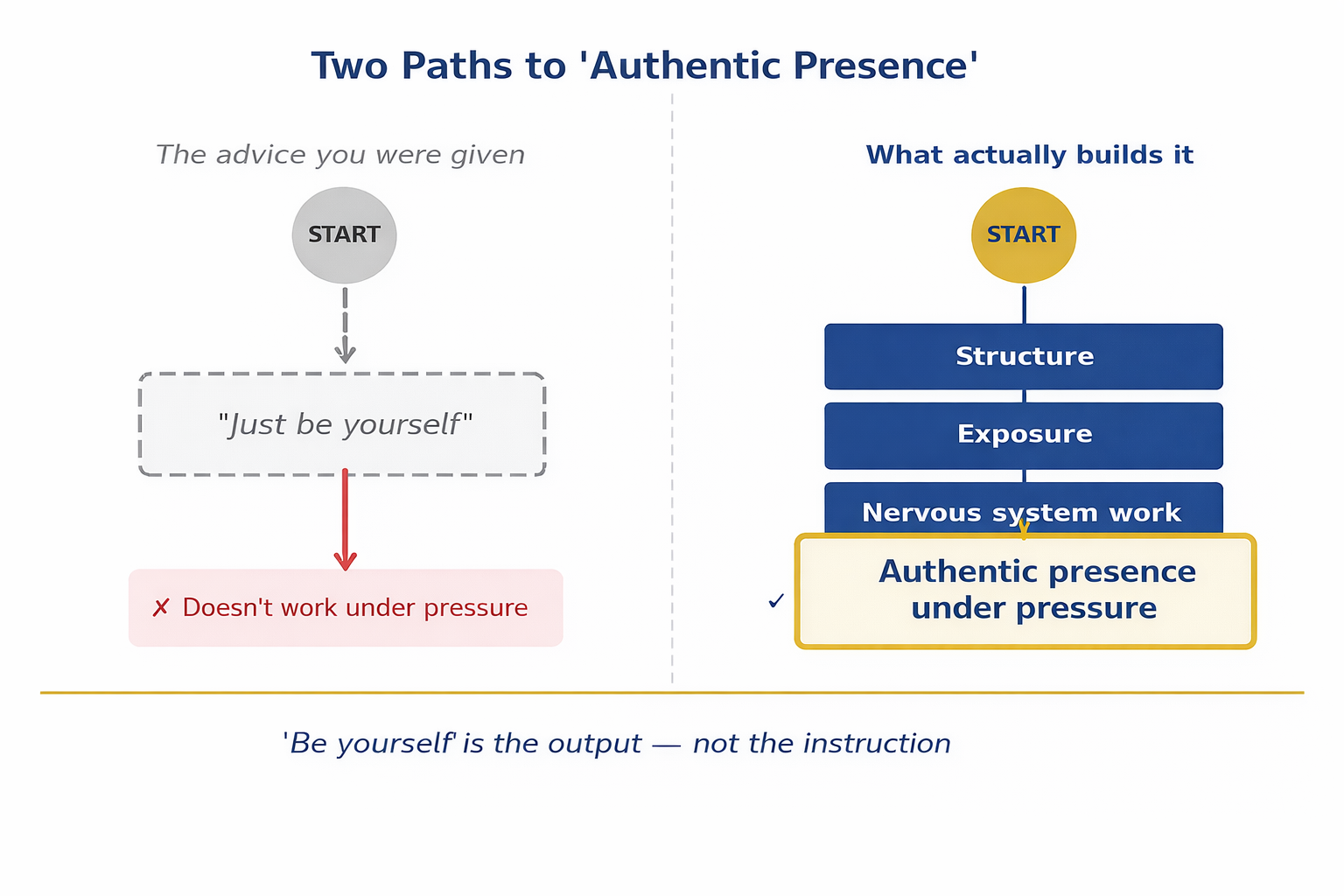
Then I trained in neuro-linguistic programming and clinical hypnotherapy. I discovered anchoring—a technique that quite literally rewired my nervous system’s response to presenting. Not through willpower. Not through breathing exercises alone (though they help). But through direct neurological conditioning.

Within three months of using the anchor I’ll teach you in this article, I went from being the person who dreaded presenting to being the person people asked for advice on how to present with such calm confidence. That shift changed my career, my income, and my entire relationship with public speaking.

Quick Diagnostic: Is Anchoring Right for Your Anxiety?

Before we go further, let’s make sure we’re addressing the right problem. Anchoring is exceptionally effective for acute presentation anxiety—the kind where you know exactly what to say, but your nervous system misfires when you’re about to deliver it. Your chest tightens. Your hands shake. Your breathing becomes shallow. You might even feel nauseous.

Anchoring works because it gives your nervous system a physiological pathway to access calm confidence on demand. It’s not about thinking positively or reframing thoughts. It’s about conditioning a sensory-motor response that your body can reproduce instantly.

However, if you’re experiencing burnout, chronic exhaustion, or a deeper nervous system depletion from overwork, anchoring alone won’t be sufficient. You’d benefit from a more comprehensive programme that addresses both acute anxiety and system recovery.

The good news: most presenters dealing with stage fear fall into the acute anxiety category, and that’s exactly what anchoring solves. If that’s you—if you’re confident in your content but your nervous system sabotages you in the moment—this technique will be transformative.

Ready to learn how to create your first anchor? Let’s go. Or if you want the full system including other hypnotherapy techniques for presentation anxiety, Conquer Speaking Fear £39 walks you through the complete process.

What Is NLP Anchoring, Exactly?

NLP anchoring is a technique from neuro-linguistic programming that uses a deliberate sensory trigger—a gesture, sound, or physical touch—to evoke a specific mental or emotional state on command.

Here’s the mechanism: Your brain is fundamentally associative. Pavlov’s dogs learned to salivate at the sound of a bell because the bell became paired with food. You learned to feel hunger when you smell coffee in the morning because that smell has been paired with breakfast time. This is classical conditioning, and it’s one of the most reliable processes in neuroscience.

Anchoring harnesses that same principle deliberately. You choose a mental state you want to access (confidence, calm, focus). You experience that state intensely. Then you pair it with a specific, unique sensory trigger—perhaps pressing your thumb and forefinger together, or touching a specific point on your wrist. After multiple repetitions, that trigger becomes hardwired to that state. Eventually, you can activate the state simply by firing the trigger.

The anchor itself is neutral. A thumb-and-finger press is meaningless. But through repetition and intensity, your nervous system learns: This gesture means access confidence now.

Unlike positive self-talk or visualisation, anchoring doesn’t rely on conscious thought. Your nervous system doesn’t care what your logical brain believes. Once an anchor is properly installed, it works even if you’re anxious, doubtful, or disoriented—because the anchor operates at a neurological level, not an intellectual one.

The NLP Anchoring Process for Presenters infographic showing five sequential steps: Choose Your Anchor (select a discrete physical gesture), Access the State (recall a vivid moment of genuine confidence), Set the Anchor (apply the gesture at peak intensity for 5-8 seconds), Break State (clear the emotional state completely before testing), and Test and Reinforce (fire the anchor and repeat 7-15 times to build a reliable neural pathway)

The Science: Why Anchoring Actually Works

When you experience a powerful emotion or mental state, your brain activates specific neural pathways. If you’re feeling confident, particular networks in your prefrontal cortex, amygdala, and anterior cingulate cortex light up. These aren’t abstract concepts—they’re actual electrical and chemical activity in your brain.

When you pair that brain state with a sensory cue repeatedly, something remarkable happens: the neural pathway becomes bidirectional. Normally, confidence leads to calm physiology. But through anchoring, the sensory cue activates the confidence pathway directly, bypassing the need for logical thought or conscious effort.

This is why anchoring is so effective for presentation anxiety. Anxiety lives in the amygdala and limbic system—the ancient, automatic parts of your brain. You can’t logic your way out of amygdala activation. But you can create a more powerful competing activation through anchoring. When you fire your anchor, you’re not fighting anxiety with your conscious mind. You’re recruiting the same ancient brain systems to create a stronger, competing state of calm.

The research supports this. Studies on neuro-linguistic programming show that anchoring produces measurable changes in cortisol levels (stress hormone), heart rate variability, and subjective anxiety ratings. It’s not placebo. It’s not wishful thinking. It’s applied neuroscience.

This is particularly important if you’ve read about how presentation anxiety lives in your nervous system—because anchoring is one of the most direct ways to communicate with that nervous system and shift its default response.

How quickly does an NLP anchor start to work?

Most people report feeling a shift within 2–3 uses of a properly installed anchor. You’ll notice the anchor firing (triggering the state) immediately, though the intensity builds over the first week or two of consistent use. For presentation anxiety specifically, you should feel measurably calmer within 3–5 presentations where you’ve used the anchor. That said, the stronger and more emotionally vivid your anchor installation, the faster it works.

How to Create Your Own Anchor (Step-by-Step)

Now for the practical bit. This is where anchoring stops being theory and becomes something you can actually use. Creating an anchor involves four key steps.

Step 1: Choose Your Trigger

Your trigger needs to be specific, unique, and easy to reproduce. Most people choose a physical gesture because it’s portable and invisible during a presentation. Common triggers include:

  • Pressing your thumb and forefinger together (the most popular choice)
  • Touching a specific point on your wrist or arm
  • Pressing your tongue against the roof of your mouth in a particular way
  • Squeezing a specific muscle in your leg

The trigger should be something you can do discreetly, even while presenting or on a video call. You also want it to be distinct enough that you don’t trigger it accidentally throughout your day. Choose something now and stick with it—consistency is crucial for anchoring.

Step 2: Activate a Powerful State of Confidence

This is the critical step that most people skip or rush through, which is why their anchors don’t work. You cannot create a strong anchor while feeling mildly confident. You need to activate a genuinely powerful state of confidence and calm.

The best way to do this is to recall a specific memory where you felt absolutely confident and assured. Not arrogant—genuinely calm and certain of your capabilities. It could be from presenting, from a moment in your career, or from any domain of life. Close your eyes. Step into that memory. Remember what you saw, what you felt in your body, your posture, your breathing. Make it vivid and visceral. Spend at least 2–3 minutes fully inhabiting that state.

If you don’t have a powerful confidence memory, you can create one through visualisation. Imagine yourself presenting brilliantly—calm, articulate, commanding the room. Watch yourself as if you’re watching a film. Then step into the image and feel it from the inside. Again, spend 2–3 minutes really living it, not just thinking about it.

Step 3: Pair the Trigger with the State (The Anchoring Moment)

At the peak moment of your confidence state—when you’re feeling it most strongly—perform your trigger gesture. If you’ve chosen the thumb-and-forefinger press, press them together firmly while taking a breath. Hold the trigger for 2–3 seconds whilst the state is at its strongest. Then release.

This is the moment of anchoring. You’re creating an association between the gesture and the state.

Step 4: Repeat the Installation (Minimum 7 Times)

A single pairing is not enough. Your nervous system learns through repetition. Repeat the full process—activate the state, pause, reach peak confidence, fire the trigger—a minimum of 7 times in one session. Ideally 10–15 times. Each time, make sure you’re reaching genuine confidence, not just half-heartedly going through the motions.

After your first installation session, repeat the anchor at least once daily for five days. This cements the neural pathway. After that, you can maintain it with occasional use (firing the anchor a few times per week).

If you want additional anchoring variations and how to layer multiple anchors together, Conquer Speaking Fear £39 includes a complete guided video walkthrough of this exact process.

Stop Anxiety Before It Hijacks Your Presentation

  • Create a neurological anchor that accesses calm on demand—no willpower required
  • Learn the exact 7-step installation process used by executives who present to boards and investors
  • Discover how to use your anchor in real presentations (even when presenting on video)
  • Understand why traditional anxiety management often fails—and what actually works
  • Install your anchor correctly the first time (mistakes will cost you weeks of progress)

Get Conquer Speaking Fear → £39

Trusted by 1000+ professionals in finance, tech, and consulting

How to Fire Your Anchor Before Presenting (The Deployment Strategy)

Installing an anchor is one thing. Using it effectively in the high-stress environment of a real presentation is another. Here’s how to actually deploy your anchor when it matters most.

The Pre-Presentation Window (15 Minutes Before)

Find a private space—the bathroom, a quiet hallway, your car, even a locked conference room. You need 2–3 minutes of solitude. Fire your anchor 3–5 times in succession. Each time, pause for a few seconds and let yourself feel the calm it generates. Don’t just mechanically perform the gesture; actually inhabit the confident state it triggers.

This is different from the installation process. You’re not trying to deepen the anchor further. You’re activating it to bring that confident state into your present moment, ready for your presentation.

The Waiting Moment

After you fire the anchor, you have roughly 10–15 minutes before the anchor naturally “decays”—meaning the neurological activation fades. Time your anchor-firing strategically so that you’re presenting within that window. If you’re waiting longer than 15 minutes, fire the anchor again closer to your presentation start.

During the Presentation Itself

Once you’re presenting, you can fire the anchor discreetly during the talk if you feel anxiety spiking. A thumb-and-finger press hidden at your side, or a tongue-press that no one will notice, can reset your nervous system mid-presentation. Some presenters do this during pauses, whilst taking a sip of water, or when moving between sections of their talk.

Most people find they don’t need to fire it during the presentation if they’ve installed it strongly and fired it beforehand. The initial activation is usually sufficient.

What if I forget to fire my anchor before presenting?

If you’ve already begun presenting, you can still fire it discreetly at any point. The anchor will activate a calm state within seconds. However, the better strategy is to build firing the anchor into your pre-presentation routine, so it becomes automatic. Some presenters fire their anchor whilst walking to the stage, or immediately before they’re introduced. Make it part of your ritual.

Advanced Techniques for Powerful Anchors

Once you’ve installed a basic anchor, you can enhance it with additional techniques that make it stronger and more reliable. Here are the most effective variations.

Stacking Anchors (Multiple States)

Instead of anchoring only to confidence, you can create separate anchors for different states: calm, focus, articulation, charisma. Then fire them all in sequence before presenting, creating a compounded effect. For instance, you might press your thumb-and-forefinger for calm, then touch your wrist for focus, then press a leg muscle for charisma. The neurological intensity multiplies.

Anchor Chaining

This involves firing one anchor to access a state, then immediately performing a second action (perhaps a power pose or a specific breathing pattern) whilst the first anchor is active. This creates an association between the anchor and the secondary behaviour, making both more powerful together.

Collapsing Anchors

If you have a lingering anxiety state that you want to eliminate, you can create an anchor for confidence, then deliberately activate the anxiety state, and fire the confidence anchor immediately whilst the anxiety is present. The confidence state “collapses” the anxiety state, and over repetitions, this weakens the anxiety response. This is advanced work and works best when paired with understanding your fight-or-flight response.

Resource Anchoring

Some people create an anchor not just for a mental state, but for accessing a specific resource or memory of a person they trust. For example, you might anchor to a memory of a mentor you admire, or a moment when a colleague praised your presentation skills. The anchor gives you neurological access to that resource precisely when you need it.

Never Walk Into a Presentation Unprepared Again

  • Master anchoring plus five additional NLP techniques specifically for presentation anxiety

Get Conquer Speaking Fear → £39

Includes video guides, workbook, and quick-reference deployment checklists

Can anchors fade or stop working?

An anchor can weaken if you don’t use it regularly. Think of it like a muscle—if you stop exercising, it atrophies. However, it’s remarkably easy to reactivate. Even if you haven’t used an anchor in months, firing it a few times usually restores its full power. Additionally, if you repeatedly fail at your anchor (for instance, trying to fire it whilst in a state of panic without having installed it properly first), you can inadvertently weaken it. This is why proper installation is non-negotiable.

Side-by-side comparison of five common NLP anchoring mistakes and the correct approach for each, covering state intensity, installation depth, trigger consistency, and first test environment

The Mistakes That Kill Anchoring (And How to Avoid Them)

I’ve seen hundreds of people attempt anchoring and fail. Not because anchoring doesn’t work, but because they made preventable mistakes during installation or deployment. Here are the most common ones.

Mistake 1: Installing Without Reaching a Genuinely Powerful State

This is the number one reason anchors fail. People think about confidence rather than feeling it. They go through the motions without really accessing the state. Your anchor will be only as strong as the state you pair it with. If you’re 60% confident during installation, your anchor will trigger 60% confidence when you fire it. Invest the time to genuinely access a powerful, vivid state of confidence. Make it real. Make it felt.

Mistake 2: Firing the Anchor Without Installing It Properly First

Some people try to use an anchor after just one or two pairings, then conclude it doesn’t work. Anchors need a minimum of 7 proper installations to be neurologically reliable. You’re building a neural pathway, and pathways need repetition to become strong. If you try to use an untrained anchor under stress, it won’t work—and then you’ll question the whole technique.

Mistake 3: Changing Your Trigger Mid-Stream

Once you choose a trigger, commit to it. If you keep switching between different gestures, you never build a consistent pairing. Your brain is learning: This gesture means this state. If you’re constantly introducing new gestures, you’re starting the learning process from scratch each time.

Mistake 4: Relying on the Anchor Alone Without Context

Anchoring is extraordinarily powerful, but it’s not magic. If you’re presenting on zero sleep, or you’re in a genuinely dangerous situation (not presentation anxiety, but actual danger), no anchor will override your nervous system’s appropriate response. Anchoring works best when paired with proper preparation, adequate sleep, and other practical tools like breathing techniques.

Mistake 5: Firing the Anchor Under Extreme Distress Without Prior Installation

Your first test of an anchor should not be a high-stakes presentation in front of your board of directors. Install the anchor in low-stress situations first (perhaps presenting to a small friendly group, or in a low-pressure meeting). Let it prove itself in manageable contexts before you rely on it in the most critical moments.

Beyond these installation mistakes, there are also mistakes in how people think about what anchoring can do. Anchoring is brilliant for acute presentation anxiety. It’s less effective if you’re dealing with chronic burnout or deeper nervous system dysregulation. Know what problem you’re solving.

If you want to understand not just how to install an anchor, but also how to diagnose what type of presentation anxiety you’re dealing with and which techniques work for each type, Conquer Speaking Fear £39 walks through the complete diagnostic and treatment process.

Learn From Someone Who’s Used Anchoring With Thousands of Presenters

  • 24 years in corporate banking at JPMorgan Chase, PwC, Royal Bank of Scotland, and Commerzbank
  • Qualified clinical hypnotherapist and certified NLP practitioner with live case studies from clients
  • Video walkthroughs of the exact anchor installation process, plus six additional NLP techniques
  • Troubleshooting guide: what to do when your anchor isn’t working (and why)
  • Real-world deployment strategies for presentations, investor pitches, board meetings, and speaking engagements

Get Conquer Speaking Fear → £39

Trusted by professionals at FTSE 100 companies and Silicon Valley tech firms

Want the slides too?

If you’re installing anchors but struggling to deliver them with visual confidence, your slides might be working against you instead of amplifying your message. The Executive Slide System £39 teaches the slide design and delivery approach used by executives at FTSE 100 firms—so your visuals reinforce your nervous system work, not undermine it.

Is NLP Anchoring Right For You?

✅ Anchoring is right for you if:

  • You’re confident in your presentation content but anxious in the delivery
  • Your anxiety spikes only in presentation moments, not throughout your day
  • You want a practical tool you can use immediately, before your next presentation
  • You’re open to learning applied neuroscience rather than relying on willpower alone
  • You’ve tried breathing exercises and positive self-talk but need something stronger
  • You’re willing to spend 20 minutes installing an anchor properly before expecting results

❌ Anchoring might not be sufficient if:

  • You’re experiencing severe chronic anxiety unrelated to presentations
  • You’re burnt out or experiencing nervous system exhaustion from overwork
  • You lack confidence in your presentation content itself
  • You’re unwilling to spend time practising the anchor installation process
  • You’re expecting a magic solution without any personal effort or commitment
  • You’re in acute crisis and need immediate professional mental health support

Frequently Asked Questions

How long does it take to install an anchor properly?

The initial installation takes 20–30 minutes. This includes 10–15 repetitions of activating the state, reaching peak confidence, and firing the trigger. After installation, you’ll want to reinforce it daily for 5 days (5–10 minutes per day). Most people report measurable results within a week, though the anchor becomes more powerful over the first month of use.

Can anchoring work if I’m naturally anxious or introverted?

Yes, absolutely. Anchoring doesn’t depend on your personality type or baseline anxiety level. It depends on your nervous system’s ability to learn associations, and that’s universal. Whether you’re naturally anxious or calm, whether you’re introverted or extroverted, your nervous system can be trained to access confidence on command. Introversion and anxiety are different things—introversion is personality, anxiety is a nervous system state.

What if I’ve tried anchoring before and it didn’t work?

Most commonly, anchoring “failed” because the initial installation wasn’t done properly. Perhaps the state wasn’t genuinely powerful, or the anchor was fired only once or twice before being tested under stress, or the trigger was changed mid-stream. The technique itself is neurologically sound. If you’re willing to redo the installation with proper attention to each step, it will work. The second time around, most people see dramatic results.

Can I use anchoring alongside other anxiety-management techniques?

Yes, and in fact this is the ideal approach. Anchoring works brilliantly with breathing techniques, preparation, adequate sleep, and other NLP methods. Anchoring addresses the neurological pathway to confidence. Other techniques address preparation, physical state, and cognitive framing. Together, they’re more powerful than any single tool alone.

🆓 Free resource: Executive Presentation Checklist — a free guide to strengthen your presentation preparation.

Your Next Step

You now understand how anchoring works, why it’s neurologically powerful, and exactly how to install an anchor that will be reliable in your presentations. The technique is straightforward. The challenge most people face isn’t understanding—it’s execution. Most people read about anchoring and then don’t actually do it.

So here’s my challenge to you: within the next three days, choose your trigger gesture, find a quiet space for 20 minutes, activate a memory of genuine confidence, and install your anchor using the step-by-step process outlined above. Don’t overthink it. Don’t wait for the “perfect” moment. Just do it. By next week, you’ll have a neurological tool that will fundamentally change how your body responds to presentations. Your next presentation is your first real test. Use the anchor beforehand, and notice the difference.

If you want the full video walkthrough, additional NLP techniques, and troubleshooting support, Conquer Speaking Fear £39 is designed exactly for that.

About the Author

Mary Beth Hazeldine is the Owner & Managing Director of Winning Presentations. With 24 years of corporate banking experience at JPMorgan Chase, PwC, Royal Bank of Scotland, and Commerzbank, she has delivered high-stakes presentations in boardrooms across three continents.

A qualified clinical hypnotherapist and NLP practitioner, Mary Beth combines executive communication expertise with evidence-based techniques for managing presentation anxiety. She has trained thousands of executives and supported presentations that have secured high-stakes funding rounds and approvals.

Book a discovery call | View services

14 Mar 2026
Businessman in a suit points at a large screen displaying charts during a boardroom presentation to colleagues in a glass-walled office.

The Competitive Displacement Pitch: Replacing an Incumbent Vendor When They’re in the Room

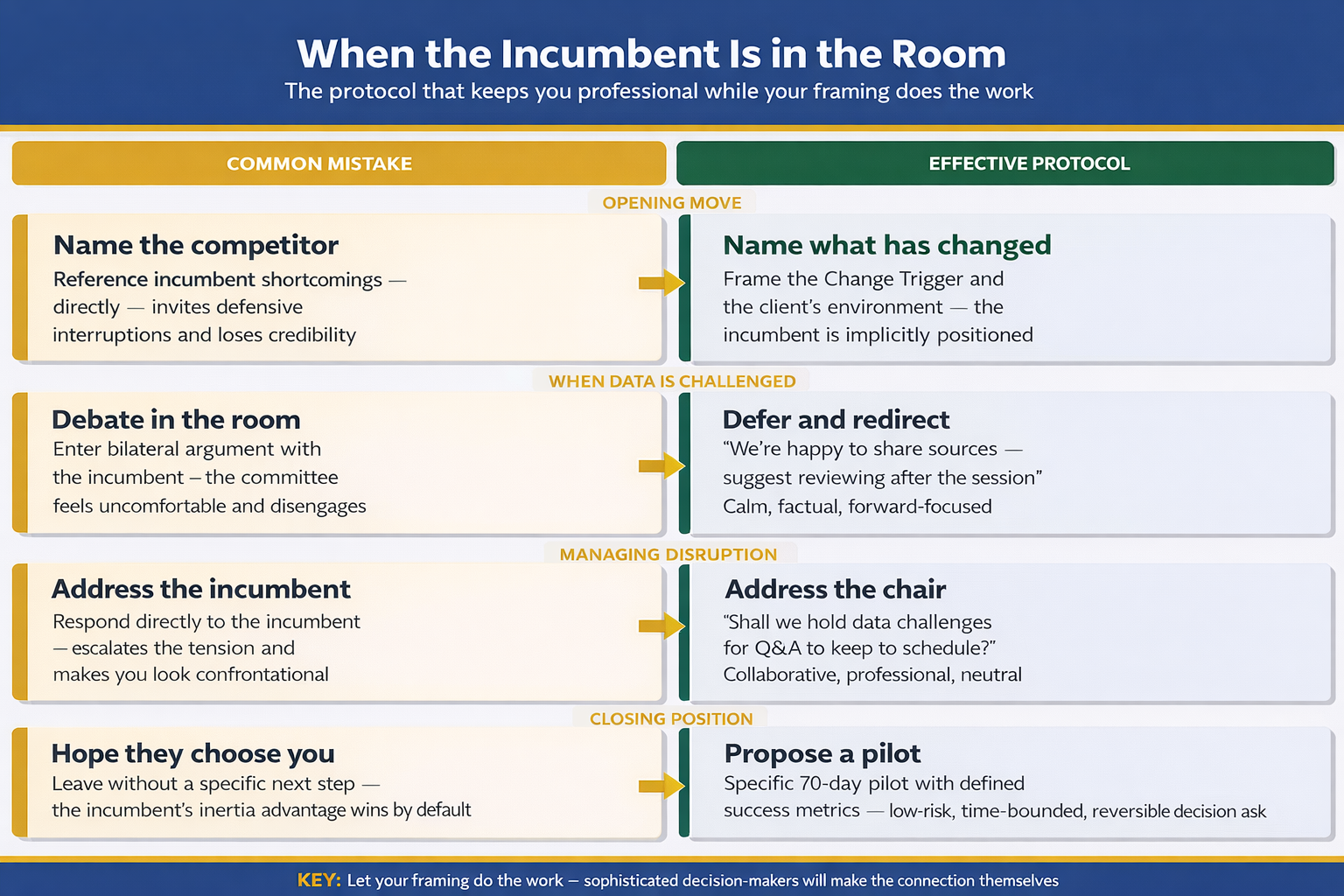
Quick Answer: Winning a competitive displacement pitch against an incumbent vendor requires a specific slide structure and positioning strategy that most challengers get completely wrong. The key is never to attack the incumbent directly — instead, you shift the conversation from “who is better” to “what has changed” and “what does staying cost.” A four-part framework — Change Trigger, Gap Evidence, Risk of Inaction, and Decision Architecture — executed in the right sequence is the difference between winning the review and walking out with polite thanks and no contract.

I once watched a talented senior director lose a competitive review she should have won — because she opened her pitch with a slide titled “Why We’re Better Than [Incumbent].”

The incumbent’s account manager was sitting three seats to her left. The procurement lead shifted uncomfortably. The CFO — the actual decision-maker — looked at the ceiling. By slide four, the body language in the room had closed. She spent the next eighteen slides trying to claw back authority she’d lost in the first thirty seconds.

She lost the review. Not on capability. Not on price. She lost because she misread the psychology of a competitive displacement pitch against an incumbent vendor.

Displacement pitches are a specific, high-stakes category. The incumbent has inertia, relationships, and institutional familiarity on their side. You have one hour and a deck. The standard pitch structure — open with your value proposition, present your features, handle objections at the end — is the wrong framework for this situation entirely.

This article gives you the exact slide structure and strategic positioning that works in competitive reviews against entrenched suppliers, including the scenarios where the incumbent’s representative is physically present in the room.

🚨 In a competitive review this month? Quick diagnostic: Does your opening slide state what has changed in the business environment — or does it open with your company credentials? If it opens with credentials, you’re already giving the incumbent the advantage. → Need the exact displacement pitch slide structure? Get the Executive Slide System (£39)

Why Most Displacement Pitches Fail Before Slide 3

The mistake most challengers make is treating a displacement pitch like a standard sales presentation. They lead with company credentials, outline their capabilities, and spend the first quarter of their deck establishing who they are. This is exactly what the incumbent wants you to do.

Here is why: the incumbent doesn’t need to prove they exist. The client already knows them. They have a working relationship, existing integrations, established processes, and a track record — however imperfect. Your credential slides don’t counter any of that. They just consume time while the committee waits for you to get to the point.

The three psychological barriers you must dissolve before any capability discussion lands are:

  1. Inertia: “Switching is complicated and risky.”
  2. Relationship loyalty: “We’ve worked with them for years — it feels disloyal to move.”
  3. Decision risk: “What if the challenger is worse? At least we know what we have.”

Notice that none of these are about your product or service. They’re about the cost and psychological discomfort of change. Your pitch must address those three fears before you spend a single slide on your capabilities.

The executives who succeed at competitive displacement pitches reframe the entire conversation early. Instead of “here’s why we’re better,” their opening message is: “Here’s what has changed — and here’s why that makes the current arrangement more expensive to maintain than to replace.”

Four-part competitive displacement pitch framework showing Change Trigger, Gap Evidence, Risk of Staying and Decision Architecture slide sequence

The Change Trigger Slide: Frame the Problem, Not the Competitor

Your first substantive slide — after a sharp, one-line positioning statement as your opener — must be the Change Trigger slide. This is not about you. It is entirely about what has shifted in the client’s business environment that makes their current arrangement no longer fit for purpose.

Change triggers fall into four categories:

  • Strategic shift: A new direction, acquisition, or market pressure that the incumbent’s solution wasn’t designed for
  • Performance gap: Measurable metrics that have deteriorated or plateaued under the current arrangement
  • Market change: Regulatory, competitive, or technology shifts that create new requirements
  • Cost of status quo: The financial or operational cost of maintaining the current approach has increased materially

One well-chosen change trigger, supported by client-specific data, is more persuasive than ten slides of your product capabilities. It does something no credential slide can: it makes the audience feel the urgency of the situation from their own frame of reference rather than yours.

The discipline here is to use their language and their numbers wherever possible. If their last annual report mentioned a strategic priority that the incumbent is not supporting, reference it. If their industry has seen regulatory changes, quantify what non-compliance costs. If their closest competitor has moved, note it.

This slide tells the decision-maker: you understand their world. The incumbent, by contrast, is already positioned as part of the old world — simply by association with the problem you’ve just named.

The full competitive displacement slide sequence — Change Trigger, Gap Evidence, Risk of Staying, and Decision Architecture — is built into the Executive Slide System (£39), with scenario-specific templates for competitive reviews and vendor replacement pitches.

Gap Evidence: What Data Makes Switching Impossible to Ignore

Once you’ve established the Change Trigger, you need a single slide — never more than one — that presents the performance gap in measurable terms. This is the Gap Evidence slide, and it has a precise job: to make the cost of the current arrangement visible.

This slide works best when it presents data in three categories:

  1. What the current arrangement was supposed to deliver (the original promise or specification)
  2. What it has actually delivered (the measurable reality — ideally drawn from their own internal data)
  3. What that gap has cost (in revenue, efficiency, risk, or strategic momentum)

The most common mistake at this stage is presenting comparative data between you and the incumbent. Avoid this. Comparison slides invite the incumbent to challenge your numbers in the room and turn the meeting into a debate. Instead, show the gap between what the client expected and what they received. That data belongs entirely to the client’s own experience and cannot be disputed by the incumbent.

If you don’t have access to their internal performance data — which is common in early competitive reviews — you can use industry benchmarks, peer company results, or publicly available metrics as a proxy. Frame them clearly as contextual references, not direct comparisons.

Keep this slide to a maximum of three data points. Decision-makers are not convinced by the volume of evidence. They’re convinced by one or two undeniable numbers that connect directly to something they care about: budget, risk, competitive position, or strategic progress.

The Displacement Pitch Structure That Wins Competitive Reviews

When the incumbent has relationships, history, and inertia on their side, your pitch needs more than good slides. It needs a precise strategic sequence that reframes the decision before you present a single capability.

  • The exact 4-part competitive displacement slide sequence (Change Trigger → Gap Evidence → Risk of Staying → Decision Architecture)
  • Scenario Playbook page for competitive vendor reviews — including the objection scripts and pre-meeting positioning strategy
  • 15 executive-grade templates for high-stakes pitches: challenger, vendor replacement, and competitive bid formats
  • 51 AI prompts to build your displacement deck in under 40 minutes — including research and data framing prompts

Get the Executive Slide System → £39

Built from 24 years of competitive pitches in corporate banking and consulting — including vendor displacement reviews at JPMorgan Chase, RBS, and Commerzbank.

The Risk of Staying Slide: The Frame That Changes the Decision

This is the most psychologically powerful slide in a displacement pitch and the one almost every challenger presentation omits. Most presenters spend their time reducing the perceived risk of switching to them. The Risk of Staying slide does something entirely different: it makes inertia itself the risky choice.

Decision-makers default to incumbents because of loss aversion — the deeply human tendency to weigh potential losses more heavily than equivalent gains. Your capability slides fight against this instinct. Your Risk of Staying slide works with it.

This slide has three components:

  • Operational risk: What specific failure modes or escalating costs does continuing the current arrangement carry over the next 12–24 months?
  • Strategic risk: What competitive or market opportunity does the client forfeit by maintaining the status quo?
  • Reputational or career risk: (Use with surgical precision, never as a threat.) If the decision-maker has a professional stake in this outcome — and they almost always do — what does continued underperformance of the current arrangement mean for their credibility with their own leadership?

The framing discipline here is essential. You are not threatening the client or catastrophising. You are presenting a sober, evidence-based view of what staying costs — the same analytical rigour a good consulting firm would apply. If anything, the tone should be more measured here than anywhere else in the deck.

Once a decision-maker has genuinely calculated the cost of inaction, switching is no longer a risk. It becomes risk mitigation.

If you’re preparing a competitive displacement pitch this month, the Executive Slide System (£39) includes the pre-built Risk of Staying template with the exact framing language that keeps this slide credible rather than aggressive.

Decision Architecture: How to Make Yes Feel Safe

After the first three slides have done their work — establishing urgency, evidencing the gap, and reframing inertia as risk — your capabilities now land differently. The audience is no longer evaluating you as the challenger trying to unseat a known quantity. They’re evaluating you as a potential solution to a problem they now feel acutely.

Decision Architecture is the structure of your final section — typically slides five through nine — and it has one job: make the decision to switch feel low-risk, clearly bounded, and reversible if needed.

The components that reduce switching anxiety most effectively are:

  • A phased transition plan: Show them the first 90 days in concrete steps. Uncertainty about implementation is the single biggest silent objection in vendor replacement reviews. Remove it before they raise it.
  • A risk mitigation slide: Name the three most common transition concerns pre-emptively and show your approach to each. This is counter-intuitive — addressing problems they haven’t raised yet — but it builds disproportionate trust.
  • A clear decision ask: Your final slide must state the specific decision you’re asking for and what happens next. Not “we’d welcome the opportunity to work with you.” A precise ask: “We’re proposing a 90-day pilot with defined success metrics, starting [month]. The decision we need today is go/no-go on the pilot scope.”

Executives make decisions more confidently when the first step is time-bounded, low-commitment, and reversible. A pilot or phased engagement is often easier to approve than a full contract switch — and once you’re in, the incumbent’s advantage of inertia works in your favour.

Common Questions About Competitive Displacement Pitches

How do you pitch against an incumbent vendor without attacking them?
The most effective approach never directly criticises the incumbent. Instead, position the conversation around what has changed in the client’s business environment and what the current arrangement was not designed to address. This reframes the decision as forward-looking rather than evaluative — which reduces the incumbent’s relationship advantage and focuses the committee on future needs rather than past loyalty.

What is the biggest mistake in a competitive displacement pitch?
Leading with credentials and capabilities before establishing urgency. Challengers who open with “who we are” allow the incumbent’s inertia to dominate the room. The first ten minutes of a displacement pitch should be entirely about the client’s situation — not about the challenger. Capabilities only land once the decision-maker is already questioning whether the current arrangement is sustainable.

How long should a competitive displacement pitch deck be?
Eight to twelve slides for most executive-level competitive reviews. The four-part framework — Change Trigger, Gap Evidence, Risk of Staying, Decision Architecture — takes four to six slides. Your capabilities, case evidence, and transition plan take the remaining slides. Anything beyond twelve slides shifts the meeting from decision-making to information-processing, which benefits the incumbent by deferring the decision.

Comparison infographic showing common mistakes versus effective protocol when the incumbent vendor is present during a competitive displacement pitch

What to Do When the Incumbent Is Actually in the Room

In competitive reviews with multiple vendors presenting in sequence, the incumbent’s representative may be present during part of the process — or, in some procurement formats, all vendors may present to the same panel on the same day, with representatives from each firm present.

This changes the dynamic significantly. Here’s the protocol:

Never acknowledge the incumbent directly. Do not reference them by name, allude to their specific shortcomings, or make any remark that requires them to be in the room to make sense. Everything you say should be fully coherent to a panel that has never worked with the incumbent at all. This keeps you professional and prevents them from putting you on the defensive.

Let your framing do the work. The Change Trigger and Gap Evidence slides implicitly position the incumbent as part of the old state without naming them. Sophisticated decision-makers will make the connection themselves — and they’ll respect you for not making it for them.

Expect the incumbent to interrupt or challenge data in the room. Prepare for this. Have the source of every data point on your notes page. When challenged, respond calmly: “We’re happy to share our data sources — the underlying analysis draws from [source]. We’d suggest reviewing it together after the session.” This removes the challenge from the meeting without conceding the point.

Manage the room temperature with the chair. If you notice the atmosphere becoming uncomfortable or the incumbent becoming disruptive, address the chair — not the incumbent. “Shall we agree to hold detailed data challenges for the Q&A section so we can keep to schedule?” This keeps you collaborative and professional while neutralising the disruption.

🔥 The Q&A section is where most displacement pitches get derailed. When the incumbent challenges your data in the room, the decision-maker is watching how you handle pressure — not just what you say. The Executive Q&A Handling System (£39) includes the exact preparation framework for handling hostile questions and incumbent pushback — so you don’t just survive the Q&A, you win it.

Stop Walking Out of Competitive Reviews With “We’ll Be in Touch”

If you’ve been through a competitive review in the last 12 months and lost to an entrenched incumbent — despite genuinely better capability — the problem almost certainly wasn’t your product. It was the pitch structure. The Executive Slide System gives you the displacement framework built for exactly this scenario.

  • The 4-part competitive displacement sequence — ready to populate with your own data in under an hour
  • Risk of Staying template with pre-written framing language (keeps the slide credible, not aggressive)
  • Decision Architecture templates including phased transition and risk mitigation formats
  • 6 checklists and guides including the competitive review preparation checklist

Get the Executive Slide System → £39

Used in competitive vendor reviews, challenger pitches, and procurement presentations across banking, consulting, and technology sectors.

The 48-Hour Preparation Plan for Displacement Pitches

The displacement framework above is the strategic structure. But the execution happens in the 48 hours before you walk into the room. The preparation process for a competitive review is fundamentally different from a standard pitch because you are managing two dynamics simultaneously: your own positioning and the incumbent’s inertia.

In the first 24 hours, your priority is intelligence. Confirm who will be on the evaluation panel and map their relationship history with the incumbent. Identify the one or two committee members most likely to be sympathetic to change — they typically sit in roles where the incumbent’s shortcomings are most visible. Build your Change Trigger slide around data points that connect directly to their professional concerns, not abstract industry trends.

In the final 24 hours, rehearse the first three minutes of your pitch — the Change Trigger and Gap Evidence — more than any other section. These opening slides carry more weight in a displacement review than your closing. If you lose the room in the first three minutes, no amount of capability demonstration recovers the position. Practise handling the most likely challenge from the incumbent’s side and prepare your one-line redirection to the chair.

Finally, confirm your decision ask. The single most common failure in competitive displacement pitches is leaving the room without a specific next step. Your final slide should name the decision, the timeline, and the first action if approved.

Is This Right for You?

This is for you if:

  • You’re in a competitive vendor review or procurement process where an incumbent supplier holds the existing contract
  • You have a stronger capability than the incumbent but keep losing on “relationship” or “transition risk” grounds
  • You’re preparing a pitch for a client review in the next 30 days and need a tested structure, not a generic template
  • You want slide-level frameworks you can populate with your own data, not a theory of what good pitches look like

This is NOT for you if:

  • You’re pitching to a client with no existing supplier relationship (a standard sales pitch structure will serve you better)
  • You’re in an informal or relationship-driven sales process without a formal procurement stage
  • You need bespoke pitch consulting rather than a self-serve framework (consider a discovery call instead)

After the Pitch: Managing the Decision Window

What happens after you leave the room matters as much as what happens inside it. The decision window following a competitive displacement review is the period of highest vulnerability for a challenger — and most presenters do nothing with it. The incumbent, by contrast, has the advantage of proximity: they can reach the committee through existing channels without it feeling like a follow-up.

Your post-pitch strategy should include three actions within 48 hours. First, send a one-page executive summary — not a full deck recap — to the decision-maker covering the Change Trigger, the gap cost, and your proposed 90-day pilot structure. Second, provide the data sources you referenced during the pitch, delivered cleanly and without commentary. This builds credibility and removes any question marks the incumbent may have planted during the session.

Third, and most overlooked: reach out to the sympathetic committee member identified during your preparation. A brief, professional message acknowledging the discussion and offering to answer any follow-up questions gives your internal champion the material they need to advocate for you in the rooms you are not in. The decision in a displacement review is rarely made during the pitch itself. It is made in the conversations that follow — and the challenger who manages those conversations wins.

Built From 24 Years of High-Stakes Competitive Pitches. Now Available as Templates.

I spent two decades in corporate banking presenting, evaluating, and sitting on the other side of vendor displacement pitches at JPMorgan Chase, Royal Bank of Scotland, PwC, and Commerzbank. I’ve watched challengers lose on capability they had and incumbents survive reviews they should have lost. The difference was almost always structure — not skill, not price, not product. The Executive Slide System gives you the exact framework that works when the stakes are a contract, a client, or a career.

  • 22 executive templates including competitive displacement, challenger, and vendor review pitch formats
  • 15 scenario playbook pages covering the competitive review scenario end to end
  • 51 AI prompts — including Change Trigger research prompts, Gap Evidence framing, and Risk of Staying language
  • Immediate download — ready to use before your next competitive review

Your next competitive review date is fixed. The incumbent has the advantage of familiarity. Close that gap before you walk in the room.

Get the Executive Slide System → £39

Trained thousands of executives in high-stakes presentations including competitive pitches, funding rounds, and board-level approvals. Immediate digital download.

Frequently Asked Questions

How do you handle objections when the incumbent is actively defending their position in the room?

Acknowledge the challenge briefly, defer detailed data disputes to after the session, and redirect to the decision-maker rather than entering a bilateral debate with the incumbent. Your goal is to ensure the committee feels informed, not that you’ve “won” an argument. Decision-makers are watching how you handle pressure — stay measured, factual, and forward-focused. If the incumbent makes an inaccurate claim, address it once with a source reference, then move on.

Should I mention price differences between my solution and the incumbent’s?

Only if price is a core differentiator in your favour, and only after the Risk of Staying slide has reframed the total cost of the current arrangement. Presenting a lower unit price before establishing the cost of inertia reduces your pitch to a procurement comparison rather than a strategic conversation. If the incumbent is cheaper, don’t lead with price at all — lead with cost of the current approach, then position your value in strategic rather than transactional terms.

What if the committee appears loyal to the incumbent throughout the pitch?

Loyalty signals — nodding at incumbent comments, protective body language, warm references to the existing relationship — are normal in displacement reviews and don’t mean the decision is made. Your job is to give the decision-maker permission to change their mind without it feeling like a betrayal. The Decision Architecture section is specifically designed for this: a phased pilot with defined metrics gives a loyal committee a low-risk, face-saving path to approving change.

How early in the competitive process should I start building my displacement case?

Ideally before the formal RFP is issued. Pre-RFP conversations with sympathetic stakeholders are the most valuable intelligence-gathering opportunity for a displacement pitch. Use them to understand which change triggers resonate internally, what the incumbent’s known gaps are from the client’s own perspective, and who within the committee has the most motivation to change. This pre-work turns generic displacement frameworks into a pitch that feels as though it was written by someone already inside the room.

The Winning Edge — Executive Presentation Insights

Weekly strategies for executives who present at board level, in competitive reviews, and in high-stakes leadership meetings. No filler. No theory. Practical frameworks from 24 years in the room.

Subscribe Free →

🆓 Free resource: Executive Presentation Checklist — a free guide to strengthen your presentation preparation.

Also published today:

Your next competitive review has a date on the calendar. The incumbent walks in with relationships, familiarity, and the psychological advantage of inertia. The only way to counter that is with a pitch structure designed specifically for the displacement scenario — not a standard sales deck.

Start with the Change Trigger slide. Make the cost of staying visible before you present a single capability. Use the Executive Slide System (£39) to build the full four-part framework before you walk in the room.


For further reading on high-stakes pitch strategy: Client Presentation Skills: Why ‘Impressive’ Loses and Presentation Objection Handling.

About the Author

Mary Beth Hazeldine is the Owner & Managing Director of Winning Presentations. With 24 years of corporate banking experience at JPMorgan Chase, PwC, Royal Bank of Scotland, and Commerzbank, she has delivered high-stakes presentations in boardrooms across three continents.

A qualified clinical hypnotherapist and NLP practitioner, Mary Beth combines executive communication expertise with evidence-based techniques for managing presentation anxiety. She has trained thousands of executives and supported presentations that have secured high-stakes funding rounds and approvals.
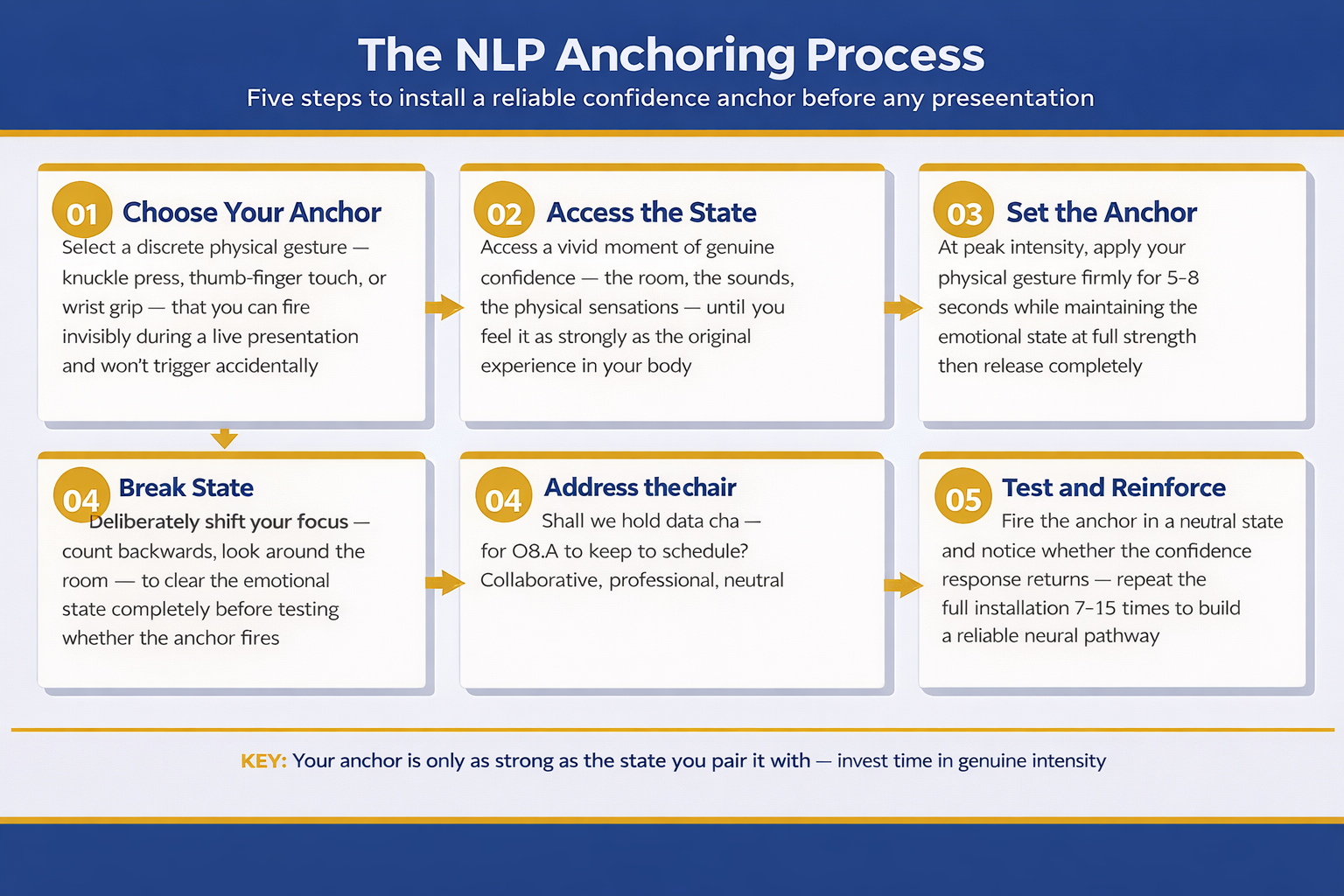
Book a discovery call | View services

13 Mar 2026
Professional woman at a boardroom table holding composed focus while facing a question from a male executive — Q&A under pressure

Loaded Questions in Presentations: Recognising the Setup Before You Fall Into It

The question sounded straightforward: “Given what you’ve told us today, would you say the previous approach was a mistake?” It was not straightforward. It was a closed frame with a false binary embedded in it — and the moment you answered either yes or no, you had accepted a premise that was never yours to accept.

The executive who fell into it gave a careful, nuanced answer. What she didn’t do was recognise the question type before she started speaking. By the time she realised the frame was wrong, the answer was already in the room, and the follow-up question was waiting.

Loaded questions in presentations are not rare. They are a consistent feature of high-stakes Q&A — particularly in board meetings, investor sessions, regulatory reviews, and any room where someone has an interest in the answer being something specific. The executives who handle them well don’t have better answers. They recognise the setup faster.

Quick answer: A loaded question contains a false premise, a false binary, or an embedded accusation that forces you to accept the questioner’s framing before you can answer. The recognition test is simple: before answering, ask yourself whether the question’s framing is yours. If you can’t answer yes or no without accepting a premise you don’t hold, the question is loaded. The deflection technique is to name the frame before answering it — not to challenge the questioner, but to set the terms of your response before you begin.

🚨 Preparing for a Q&A where loaded questions are likely? The Executive Q&A Handling System (£39) includes the loaded question recognition framework, the three deflection patterns that work in executive rooms, and the preparation method that anticipates traps before you’re in the room.

I spent 24 years in corporate banking at JPMorgan Chase, PwC, Royal Bank of Scotland, and Commerzbank. In that time I observed and participated in a significant number of Q&A sessions that were designed, explicitly or implicitly, to produce a particular answer. Regulatory reviews, board challenge sessions, investor Q&As before difficult announcements — these are environments where questions are not always requests for information. Sometimes they are frames.

The executives who handled them best were not the most combative. They were the most methodical. They had a recognition process that ran faster than their instinct to answer, and they deployed it in the pause before every response. That pause — brief, unhurried, apparently natural — was where the recognition happened. By the time they began speaking, they had already decided whether to answer the question as framed or to name the frame first.

This article covers the three types of loaded question, the recognition test that distinguishes them from legitimate challenge, and the deflection pattern that works in rooms where you cannot afford to seem evasive but also cannot afford to accept a false premise.


Three-part infographic showing the loaded question taxonomy: False Premise (contains an unaccepted assumption), False Binary (forces a two-option choice), and Embedded Accusation (criticism wrapped in a question)

The Three Types of Loaded Question

Not all difficult questions are loaded questions. A difficult question is one that requires a careful or uncomfortable answer. A loaded question is one where the framing itself is designed to constrain the answer — where accepting the question as posed means accepting a premise, a binary, or an implication that limits your options before you’ve said a word.

There are three types, and they operate differently. The false premise question contains a fact or assumption that is contestable, embedded inside what sounds like a straightforward enquiry. The false binary question presents two options as if they are the only options. The embedded accusation question wraps an implicit criticism inside a neutral grammatical structure so that answering it means implicitly accepting the criticism.

All three share a structural feature: they are more damaging when answered within the questioner’s frame than when answered outside it. The executive who recognises the type before answering can choose where to stand. The executive who answers within the frame has already conceded ground that may not be theirs to give.

The framework for handling difficult questions in presentations covers the broader category of challenging Q&A. Loaded questions are a specific subset that requires a specific recognition step before the handling technique applies.

🚨 Recognise the Trap Before You Walk Into It: The Executive Q&A Handling System

The Executive Q&A Handling System includes the complete loaded question framework — recognition, categorisation, and deflection — plus the preparation method that anticipates these questions before the session begins:

  • The three-type loaded question taxonomy with real examples from board, investor, and regulatory Q&A contexts
  • The recognition test — four questions that run in under five seconds and identify whether you’re inside a loaded frame
  • Three deflection patterns that work in executive rooms: reframe, acknowledge-and-replace, and explicit frame-naming
  • The preparation method for anticipating loaded questions before the session — including the stakeholder analysis that identifies who is likely to use them and why
  • Script templates for each deflection type — worded for executive contexts where you cannot appear evasive but cannot accept a false premise

Get the Executive Q&A Handling System → £39

Built from 24 years of observing Q&A sessions in banking boardrooms, investor meetings, and regulatory reviews — the environments where loaded questions are most consistently deployed.

The Recognition Test: Is the Frame Yours?

Before answering any question in a high-stakes Q&A, the recognition test runs as follows. Ask yourself: if I answer this question as posed — yes, no, or with the specific information requested — am I accepting a premise, a binary, or an implication that I would not otherwise accept?

If the answer is yes, the question is loaded. The framing does not belong to you, and accepting it will cost you something — credibility, flexibility, or the accuracy of your position — that may be more valuable than the question is worth to answer within its own terms.

The test takes less time to run than it takes to describe. With practice, it becomes automatic: a brief check, in the pause before you speak, that runs faster than your instinct to answer. The pause itself is useful — it signals that you are thinking about the question seriously rather than reacting to it, which is a credibility signal in itself. The pause is where the recognition happens. It is also where the answer is constructed.

Four specific signals indicate a loaded question: the word “still” (implying a prior behaviour or state you haven’t confirmed), the word “admit” (framing your answer as a concession), a question that begins with “given that” or “in light of” (embedding a premise before the actual question begins), and any question that presents exactly two options as the only available choices.

Heading into a session where loaded questions are predictable? The Executive Q&A Handling System (£39) includes the preparation template for anticipating loaded questions before the session — including the stakeholder analysis that identifies who is likely to use them and what their intent is.

Type 1: The False Premise Question

The false premise question embeds a contestable fact or assumption inside the question itself. Classic examples: “Now that the market has confirmed your original approach was too conservative, how are you adjusting?” — where “confirmed” is doing significant work. Or “Given that the board agreed to this approach in February, why have outcomes underperformed?” — where “agreed” may be a contested characterisation of a more complex discussion.

The mechanism is that the false premise is grammatically subordinate — it arrives inside a clause before the actual question begins, making it easy to miss when you’re processing the question. Your attention goes to the main clause; the premise slips through unexamined.

The deflection for a false premise question is to address the premise before addressing the question. Not aggressively — the framing does not need to be challenged as if the questioner is being dishonest. It simply needs to be placed differently before you continue. The pattern is: “I’d want to be careful about the framing there — [restatement of the accurate premise] — but to your underlying question: [answer].” This names the false premise without making the questioner defensive, places your own premise on record, and proceeds to answer the actual question, which demonstrates that you are not being evasive.


Three-step Loaded Question Deflection Framework: Recognise (identify the question type before responding), Name the Frame (surface the embedded assumption), Answer the Underlying Question (respond to the legitimate concern)

⚠️ Stop Accepting Frames That Aren’t Yours

Loaded questions are more damaging when answered within the questioner’s frame than when named and redirected. The Executive Q&A Handling System (£39) gives you the recognition test, the deflection scripts, and the preparation method that takes the trap away before the room sets it.

Get the Executive Q&A Handling System → £39

Used by executives preparing for board challenge sessions, investor Q&As, and regulatory reviews where questions are designed to produce specific answers.

Type 2: The False Binary Question

The false binary question presents two options as if they are the only options, when there is at least one other option the questioner has not offered. “Do you think the problem is in the strategy or the execution?” is a false binary if the honest answer is that the strategy and execution both contributed — or that neither is the primary problem, and the issue is something the question hasn’t named.

False binary questions are particularly common in investment and board contexts, where the questioner wants to establish accountability. The binary structure makes attribution easier: if you accept either option, the question has been answered in a way that assigns responsibility to one of two named causes. The option that assigns responsibility elsewhere — or that disputes the framing entirely — is never offered, because offering it would undermine the purpose of the question.

The deflection for a false binary is not to refuse to answer but to expand the option set before answering. The pattern is: “I don’t think it’s quite either of those — [name the third option or combination] — but if you’re asking where the most significant opportunity to improve is, that would be [answer].” This sidesteps the false binary, provides a more accurate answer, and demonstrates that you are engaging with the substance of what the questioner is actually trying to understand.

The short answer framework for executive Q&A is particularly useful here: the deflection and the answer combined should be shorter than the question was. Long responses to loaded questions create the impression that you are trying to talk your way out of something. Concise responses create the impression that you had the answer ready, which you did.

Type 3: The Embedded Accusation Question

The embedded accusation question wraps an implicit criticism inside neutral grammatical structure. “How are you planning to address the trust deficit that’s developed with the team?” embeds the accusation that a trust deficit exists. “What’s your explanation for the communication failures during the transition?” embeds the accusation that there were communication failures. Both are framed as requests for information; both contain an accusation in the subordinate clause that you would not accept if it were stated directly.

The embedded accusation is the most damaging of the three types because answering it within the frame means accepting the accusation. An answer that begins “To address the trust deficit…” has confirmed that the trust deficit exists. An answer that begins “The communication failures during the transition…” has confirmed that there were communication failures. The questioner has gotten the confirmation they wanted without having to make the accusation explicitly — and now the accusation is on record in your words, not theirs.

The deflection for an embedded accusation requires naming the assumption before responding. The pattern is: “I’d challenge the framing slightly — [specific restatement of the actual situation] — but your underlying concern is [acknowledgement], and here’s how I’d address that: [answer].” This does three things: it declines the embedded accusation, it demonstrates that you understand the concern behind the question, and it provides a substantive response that does not allow the questioner to claim you were being evasive.

The most common Q&A mistakes executives make in presentations include accepting frames they haven’t verified and providing long answers to deflect questions they should have deflected concisely. The embedded accusation type is where both mistakes are most likely to occur together.

Also published today: International Presentations: The Cultural Mistakes That Kill Deals Before Slide One — including how cultural context affects the Q&A dynamic and which loaded question types are most common by cultural profile.

Common Questions About Loaded Questions in Presentations

Is it always appropriate to name a loaded frame in a formal Q&A?
It depends on the room and the intent behind the question. In a regulatory review or a hostile board challenge, naming the frame directly — precisely but without aggression — is both appropriate and necessary. In an investor Q&A where the questioner is genuinely probing rather than trying to trap, naming the frame can come across as defensive. The recognition test helps here: if the framing genuinely limits your options in a way that would misrepresent your position, name it. If the framing is imprecise but the questioner’s intent is legitimate, you can widen the frame without naming it explicitly — just by answering from a broader position than the question offered.

What if I name a loaded frame and the questioner insists their framing is correct?
Acknowledge their view and hold your position. The pattern is: “I understand that’s how you’re reading it — my read of the situation is [restatement]. I’m happy to explain why I see it differently if that’s useful, but I wouldn’t want my answer to imply agreement with a characterisation I don’t hold.” This is firm without being combative, offers to continue the discussion, and makes clear that you’re not going to accept a premise under social pressure. Questioners who insist on their framing after this response are usually seeking confirmation, not information — and the room can see that.

How do I prepare for loaded questions before a session rather than handling them in the room?
The preparation method involves a stakeholder analysis for each person likely to ask questions: what is their current position relative to your presentation, what outcome serves their interests, and what framing of your work would produce that outcome? Once you have identified who might use a loaded question and what type it is likely to be, you prepare your recognition response and your deflection script in advance. The Executive Q&A Handling System includes a structured preparation template for this process — it takes 30–45 minutes and removes the most likely traps before you are in the room.

Is This Right For You?

This article and the Executive Q&A Handling System are for executives who face structured Q&A sessions where some participants are likely to use questions as framing tools rather than as genuine requests for information. Board challenge sessions, investor Q&As before difficult announcements, regulatory reviews, and competitive sales presentations all fit this profile.

If your Q&A sessions are largely collaborative — colleagues asking genuine questions about how to implement a proposal — the loaded question framework is less immediately relevant, though the recognition test is useful in any high-stakes room where you are accountable for your answers. If you are preparing for a session where you know from experience or context that some questions will be designed to constrain rather than to enquire, the preparation method and deflection scripts in the Executive Q&A Handling System will be the most efficient investment you can make before the meeting.

Frequently Asked Questions

Does the deflection technique work in writing as well as in spoken Q&A?
Yes, and in writing it is often more effective because you have more time to compose the response. Written loaded questions — in email, in committed papers, in written submissions to regulators — follow the same three-type structure. The false premise, false binary, and embedded accusation appear in written form as frequently as in spoken Q&A. The written deflection follows the same pattern: name the frame, restate the accurate position, and address the underlying question. In writing, the naming of the frame can be slightly more formal — “I note the question assumes X; the accurate position is Y” — because the written register supports more explicit framing without appearing combative.

Are there cultural differences in how often loaded questions are used?
Loaded questions are more common in adversarial cultural contexts — UK regulatory environments, US legal depositions, investment committee sessions with activist investors — and less common in consensus-oriented cultures where direct challenge is considered inappropriate. However, the false premise type appears across virtually all professional contexts, because it is often not intended as a trap — it is simply the questioner’s genuine belief. The recognition test does not assume bad intent: it identifies structural problems in framing regardless of motivation, which is why it is useful even when the questioner is not being deliberately manipulative.

About the Author

Mary Beth Hazeldine is the founder of Winning Presentations and has spent over two decades advising executives on high-stakes communication. Her background includes roles at JPMorgan Chase, PwC, Royal Bank of Scotland, and Commerzbank, where she participated in and prepared executives for board challenge sessions, investor Q&As, and regulatory reviews. She developed the Executive Q&A Handling System from the question patterns she observed consistently across those contexts, with particular focus on the recognition and deflection techniques that protect executives from accepting frames that are not theirs to accept.

The Winning Edge Newsletter

Practical executive presentation guidance, once a week. No padding, no noise — just the techniques that matter when the room is full of people whose questions are more than questions.

Subscribe Free →

13 Mar 2026
Professional woman in a boardroom setting looking directly at the viewer with confident composure — executive presenter commanding the room"

The Fear That’s Worse Than Stage Fright: Being Forgettable

She delivered the presentation perfectly. Clear structure, confident delivery, sharp answers in Q&A. The senior leadership team thanked her warmly. Three weeks later, when the project was being discussed at board level, her name didn’t come up. Someone else’s did.

She wasn’t passed over because she failed. She was passed over because she hadn’t registered. The presentation had been technically correct and entirely unmemorable — and in the room where careers advance, those two things are not the same as doing well.

Stage fright gets diagnosed. It gets talked about, treated, trained away. The fear of being forgettable is quieter — but for the executives I work with, it is often the more accurate description of what they are actually afraid of. Not that it will go wrong. That it will go fine, and nobody will notice.

Quick answer: The fear of being forgettable is not a performance problem — it is a distinctiveness problem. Technically correct presentations fail to register because they are built to avoid failure rather than to create impression. The fix is the one decision point that every presentation needs and most executives skip: what single thing do you want the room to remember when everyone has left? That question, answered before the deck is built, changes the structure, the language, and the moment in the room that makes you memorable.

🎯 Worried your presentations land and then disappear? Conquer Speaking Fear (£39) includes the memorability framework — the single structural change that makes executive presentations stick rather than slide off the room.

I spent 24 years in corporate banking at JPMorgan Chase, PwC, Royal Bank of Scotland, and Commerzbank. I sat in hundreds of presentations — some of which I still think about today, and most of which I cannot recall a single detail of. The ones I remember were not always the most technically accomplished. They were the ones where the presenter had made a decision about what to leave behind.

The fear of being forgettable is almost never named as a fear. It presents as something else: a vague dissatisfaction with your own presentations, a frustration that you prepare thoroughly and deliver competently but don’t seem to build momentum, a nagging sense that you’re getting positive feedback but not advancement. What sits underneath all of that is the knowledge — accurate, if unarticulated — that the room is processing your presentation in real time and discarding most of it within 48 hours.

This is not a confidence problem. Many of the executives I work with are entirely confident in front of a room. They are confident and forgettable, and the combination is more frustrating than stage fright, because stage fright at least has a diagnosis.


Executive presenter at boardroom table showing the contrast between technically correct delivery and memorable impression-creating presentation technique

What the Fear of Being Forgettable Actually Is

The fear of being forgettable is not anxiety about the presentation itself. It is anxiety about what happens after the presentation — specifically, about whether the work you put into the room will translate into anything that changes how people think about you, your ideas, or your capability.

It is existential in a way that stage fright is not. Stage fright is about a visible, acute failure — the stumble, the blank, the meltdown. The fear of being forgettable is about an invisible, chronic failure — the presentation that goes smoothly from start to finish and changes nothing. It is possible to manage stage fright and still live with the fear of being forgettable. They are different problems.

The fear is rational. Most executive presentations are, in fact, forgettable. Not because the presenters are weak — because they are built to survive the room rather than to shape it. Built to avoid objections rather than to create impressions. Built for correctness rather than distinctiveness, and correctness, as a standard, produces adequate presentations at best.

The presentation confidence that most people work to build is about managing their own state in front of a room. That matters. But it does not solve the fear of being forgettable — because forgettable presentations are delivered by confident people every day. Confidence is necessary. It is not sufficient.

🎯 From Technically Correct to Genuinely Memorable: The Framework Inside Conquer Speaking Fear

Conquer Speaking Fear addresses both the anxiety that makes you hold back and the structural problem that makes you forgettable — because they are connected. The memorability framework inside includes:

  • The single decision that changes how your presentation is built — the one question most executives skip that determines whether the room retains anything
  • The structural change that creates impression without changing your delivery style or requiring you to be more extroverted
  • The moment-in-the-room technique — how to create one point of genuine distinctiveness that travels out of the room after you’ve left
  • Why technically correct presentations fail to register — and the three specific elements that create retention
  • Scripts and frameworks for building distinctiveness into any presentation, including updates and committee briefings

Get Conquer Speaking Fear → £39

Built from 24 years of reviewing what makes executives memorable — from performance coaching, but in banking boardrooms where careers advance on the quality of the impression you leave behind.

Why GettingIt Right Isn’t the Same as Being Remembered

There is a common assumption that technical competence in presentation leads to memorability. That if you structure your content well, deliver it clearly, and handle Q&A professionally, the impression will follow. It does not work this way.

Technically correct presentations are processed by the audience as expected. Expected things are not memorable. The brain’s memory systems are optimised for novelty, significance, and pattern disruption — not for competent execution of a familiar format. When a presentation ticks every box and surprises no one, the audience experiences it as confirmation of baseline. That confirmation does not generate lasting impression.

There are three specific elements that create memorability in executive presentations. The first is a distinctive frame: a way of seeing the topic that the audience has not encountered before, and cannot easily dismiss. The second is a moment of genuine specificity — a number, a story, a piece of evidence so precise that it does not generalise. The third is a closing that creates tension rather than resolution: something the audience leaves with that has not yet been answered, or a commitment so specific that it follows them out of the room.

Most presentations have none of these. They are built on the assumption that clarity is sufficient for impact. Clarity is necessary for impact. It is not impact.

Preparing a presentation where being remembered genuinely matters? Conquer Speaking Fear (£39) includes the three-element memorability checklist and the templates to build each element into any presentation format.

The One Decision That Makes You Memorable

Before building any presentation, answer this question: what is the single thing you want the room to remember when everyone has left, the coffee cups have been cleared, and two other presentations have happened since yours?

Not the key messages — there are always three or five of those. Not the overall objective. The single thing. The one sentence that you would consider the presentation successful if it was still in someone’s head three days later.

Most executives cannot answer this question without several attempts. Not because they haven’t thought about the presentation — they have thought about it extensively — but because they have been building toward comprehensive communication rather than toward a single retained point. The question forces a prioritisation that comprehensive communication never requires, and that prioritisation is what makes the difference.

Once the single point is identified, it changes the structure, the language, the evidence selection, and the closing. Every section of the deck can be evaluated against one criterion: does this section serve the single point, or is it here because it belongs in a complete treatment of the topic? A complete treatment of the topic is for a report. A presentation that leaves one point behind is for a room.

This is not the same as simplifying your content. The evidence, the depth, the rigour — all of that remains. What changes is the architecture: everything is built to deposit one thing in the room’s memory, and everything that does not serve that deposit is moved to an appendix or removed entirely.


Presentation structure diagram showing the single retained point architecture — how to build every section toward one memorable conclusion rather than comprehensive topic coverage

⚠️ Stop Presenting Well and Being Forgotten

Technical competence is not the problem. The problem is building presentations that aim for correctness rather than impression. Conquer Speaking Fear (£39) gives you the framework to identify your single retained point and build the rest of the deck to serve it — so you leave something behind when you leave the room.

Get Conquer Speaking Fear → £39

Used by executives who present confidently and want to know why they’re not advancing as fast as their performance warrants.

The Structural Change That Creates Impression

Once you have identified your single retained point, there is one structural change that consistently makes it land: give it three times more space than you think it needs.

Most executives identify the central point of their presentation and give it a slide. They present it in the same format as every other slide — the same visual weight, the same amount of speaking time, the same level of evidence. The audience processes it as one of many points and does not distinguish it as the point they are meant to carry with them.

A presentation built for memorability gives the central point a different kind of attention. It arrives at the point from two directions — an evidence approach and a case study approach. It lingers there rather than moving on. It uses language that is slightly more precise, slightly more surprising, than the surrounding sections. And it returns to the point at the close — not as a summary, but as a reframing that shows the audience something they have just been made to see that they could not see before the presentation began.

The fear of being judged when speaking often produces exactly the opposite structure: executives rush through the material to minimise exposure to judgment, and the rushed pace means no single section gets enough space to register. Slowing down at the central point — deliberately, visibly, without apology — is both a confidence signal and a memorability technique.

The Moment in the Room That People Carry With Them

There is a specific type of moment in executive presentations that travels out of the room with the audience. It is not the best slide. It is not the sharpest Q&A answer. It is the moment where the presenter says something that the audience had not heard formulated that way before — and that formulation makes something they already knew suddenly more useful.

This moment is not spontaneous. It is engineered. The best presenters I observed over 24 years in financial services had prepared two or three formulations that they delivered as if they were occurring to them in real time. The sentences were precise, unexpected, and impossible to improve. They stuck because they had been sharpened in advance to a point that could not be blunted by the audience’s existing vocabulary.

The technique is to write one sentence that your audience will want to use themselves. Not a quotable headline — a usable thought. Something that gives them language for a problem they already have. When an executive leaves a presentation and says to someone in the corridor, “she said something interesting — she said that…” the sentence they complete is the one the presenter put there deliberately.

This is not manipulation. It is the same precision that good writing requires — the sentence that could not have been written differently and still meant the same thing. Presentations that are remembered tend to contain at least one of these sentences. Presentations that are forgotten contain none.

The process of overcoming public speaking fear often focuses on managing internal state in front of a room. That work is valuable. But the executive who has resolved their anxiety and still presents forgettably needs a different intervention: not less fear, but more considered preparation of the specific moment that will travel.

Also published today: International Presentations: The Cultural Mistakes That Kill Deals Before Slide One — the structural adjustments that make you read as credible rather than problematic in cross-cultural rooms.

Common Questions About the Fear of Being Forgettable in Presentations

Is the fear of being forgettable the same as imposter syndrome?
They are related but different. Imposter syndrome is the belief that you are not as capable as others perceive you to be. The fear of being forgettable is the belief that even if you perform well, you will not make an impact. Many executives experience both — but the fear of being forgettable is often the more accurate fear, because it is a response to real feedback: presentations that go well and produce no change. Imposter syndrome is a distortion of self-perception. The fear of being forgettable is often an accurate assessment of a structural problem in how presentations are being built.

How do I become more memorable without changing my personality or presentation style?
The memorability techniques in this article and in Conquer Speaking Fear are structural, not stylistic. You do not need to become more energetic, more performative, or more extroverted. You need to identify your single retained point, give it disproportionate space in the presentation, and engineer one sentence that your audience will want to use themselves. These changes live in the preparation, not in the delivery. Your personality, your voice, your style — none of that changes. What changes is the architecture of the deck and the precision of one or two key sentences.

What if the content I’m presenting doesn’t lend itself to being memorable — like a budget update or a quarterly review?
Every presentation can contain one memorable moment, regardless of topic. A budget update can contain one framing that changes how the audience thinks about a number they have seen before. A quarterly review can contain one sentence that gives the audience language for a pattern they have been observing but haven’t been able to articulate. The technique works across presentation types because it does not depend on the subject matter being inherently interesting — it depends on the presenter doing the preparation work to find the single formulation that makes the familiar suddenly more useful.

Is This Right For You?

This article and Conquer Speaking Fear are for executives who present competently and know it, but who are not seeing the career impact that their presentation performance should generate. If you are getting consistent positive feedback and not advancing, if you are being told your presentations are good but not being remembered after them, or if you sense that you are technically doing everything right and still not registering — the memorability framework is the relevant intervention.

If your primary challenge is managing anxiety or fear in front of a room, Conquer Speaking Fear addresses that too. The memorability work and the anxiety management work are covered together because they connect: the executives who are most afraid of being forgettable tend to rush through their material to reduce exposure, and that rushed pace is exactly what prevents the central point from landing with enough weight to be retained.

Frequently Asked Questions

Does being memorable require being controversial or provocative?
No, and in many executive contexts, controversy is actively counterproductive. Memorability in executive presentations comes from precision and distinctiveness, not from provocation. The formulation that makes you memorable is more likely to be a precisely articulated insight that your audience already half-knows than a deliberately provocative claim. Controversial presentations are remembered, but often for the wrong reasons. The goal is to be remembered for the quality of your thinking, not for having caused friction in the room.

How long does the memorability preparation take?
The critical question — what is the single thing I want the room to remember? — takes 15–30 minutes to answer well if you have not done it before. The first answers are usually too broad. The useful answer is specific enough that you could repeat it to someone who wasn’t in the room and they would understand both the point and why it matters. Once you have that answer, the structural adjustments to the deck take 30–60 minutes for a presentation you have already built. The one engineered sentence takes longer — sometimes a day of writing and revision — because it needs to be precise enough to survive a room full of people who will immediately try to improve it.

📊 Want the slides too?

Preparation reduces anxiety. The Executive Slide System (£39) includes templates designed for executives who want their deck to carry the weight of the memorable moment — so your delivery can focus on the room rather than on the slides.

About the Author

Mary Beth Hazeldine is the founder of Winning Presentations and has spent over two decades advising executives on high-stakes communication. Her background includes roles at JPMorgan Chase, PwC, Royal Bank of Scotland, and Commerzbank. She has observed hundreds of executive presentations across board and leadership contexts and developed Conquer Speaking Fear from the patterns that separated the presentations people still talk about from the presentations nobody remembers. She works with senior leaders on both performance anxiety and the structural problem that lies beneath it.

Free resource: Executive Presentation Checklist — includes the memorability check for every presentation: the five signals that indicate your central point has enough structural weight to be retained.

The Winning Edge Newsletter

Practical executive presentation guidance, once a week. No padding, no noise — just the techniques that matter when the room is full of people whose time is expensive.

Subscribe Free →

13 Mar 2026
Professional woman presenting to a diverse international executive group in a high-rise boardroom — cross-cultural business presentation in progress

International Presentations: The Cultural Mistakes That Kill Deals Before Slide One

The deal was worth £4.2 million. The presentation was technically flawless. The German client left the room politely, emailed two days later with “we’ll need more time to consider,” and never responded again.

The presenter never found out what happened. I did — because I was at the table. The opening slide had started with a story about a client relationship built over three years of informal dinners and trust-building conversations. To the UK team, that was a credibility anchor. To the two German executives opposite them, it was a signal: these people make decisions on relationships, not on data. This company operates on gut feel, not process. We cannot predict how they will behave after the contract is signed.

The deal died before the first number appeared on screen.

Quick answer: The three cultural mistakes that kill international presentations are: opening with relationship-first framing in data-first cultures, using hierarchy-neutral slides in high-hierarchy cultures, and presenting conclusions without visible evidence trails in low-trust-of-authority markets. The fix is not a different personality — it is a different slide structure that communicates credibility in the terms each culture uses to define it.

🌐 Presenting to an international audience this week? The Executive Slide System (£39) includes the cross-cultural deck adaptation framework — the slide-by-slide structure you adjust based on the cultural communication profile of your audience.

I spent 24 years in corporate banking at JPMorgan Chase, PwC, Royal Bank of Scotland, and Commerzbank. That last posting — Commerzbank in Frankfurt — was where I learned most of what I know about cross-cultural presentations, and most of what I learned came from watching slides fail in ways that had nothing to do with the content on them.

Cross-cultural presentation failure is different from standard presentation failure. When a deck is structurally poor, the audience becomes disengaged. When a deck reads as culturally wrong, the audience becomes wary. Disengaged audiences can be recovered. Wary audiences begin building alternative explanations for why you’re presenting in the way you’re presenting — and those explanations are rarely flattering.

The three mistakes I’m about to describe are not about ignorance of foreign customs or failure to respect cultural differences. They are structural mistakes: choices about how to open, how to signal authority, and how to present conclusions that read as credible in one culture and as dangerous in another.


Cross-cultural presentation framework showing three adaptation dimensions: relationship vs data opening, hierarchy signalling, and evidence trail structure across different cultural profiles

Why Cultural Mistakes Are Invisible Until It’s Too Late

The reason cultural presentation mistakes are so damaging is that they rarely produce visible objections. In most high-stakes international contexts, the audience will not tell you that your deck structure is wrong for their culture. They will simply become less engaged, less trusting, and eventually less available.

The polite silence that follows a culturally misjudged presentation is not neutrality. It is a decision already being made. By the time you’re asking “how do you think it went?” the answer is already settled.

There is a second problem: the presenter almost always thinks it went well. The deck was thorough, the delivery was confident, the Q&A was handled smoothly. Nothing went wrong in any way they could detect. The cultural signal that lost the room operated at a level below active attention — it was processed as a felt sense of misalignment, not as a specific objection.

The executive presentation structure that works reliably in domestic settings fails internationally not because the logic is wrong, but because the trust signals it depends on — what counts as credibility, what counts as preparation, what counts as confidence — vary by culture in ways that a domestic structure never has to account for.

🌐 The Deck Structure That Communicates Credibility in Any Cultural Context

The Executive Slide System includes the cross-cultural adaptation framework — the questions you answer before building the deck, and the slide-by-slide structure you adjust based on three cultural dimensions:

  • The relationship vs. data opening diagnostic — which culture you’re presenting to, and which slide one signals credibility
  • Hierarchy signalling templates — how to position authority in the deck when your audience expects rank to be visible
  • Evidence trail structures — how to lay the path from data to conclusion for cultures that need to see the journey, not just the destination
  • One-page cultural profile cards for 8 major business cultures — the three structural adjustments each requires
  • Before/after slide examples showing the same content adapted for two different cultural contexts

Get the Executive Slide System → £39

Built from 24 years presenting and reviewing executive decks across European, Asian, and North American business cultures at JPMorgan Chase, PwC, RBS, and Commerzbank.

Mistake 1: The Relationship Opening in a Data Culture

In the UK and United States, the standard executive presentation opens by establishing the relationship: shared history, mutual respect, a brief story that signals the presenter is human and invested. This is the trust-first structure, and it works in low-uncertainty-avoidance cultures where relationship signals are a legitimate form of credibility.

In high-uncertainty-avoidance cultures — Germany, Japan, Scandinavia, Switzerland — this opening does the opposite of what you intend. It signals that the presenter relies on interpersonal warmth rather than on the rigour of their analysis. The audience registers: this person is going to ask me to trust them. They are not going to show me why I should.

The structural fix is not to remove warmth from the opening. It is to make data the first signal. Open with the finding, the evidence base, or the analytical framework — and place the relationship signals inside the evidence, not before it. “We have worked with 47 companies in this sector, which is why the pattern I’m about to show you took 18 months of data to isolate” is both relationship and data. “We’ve been working together for three years and I’m delighted to be here today” is relationship only — and in a data culture, that is a missed opportunity that shapes how every subsequent slide is read.

The specific adjustment: if your current opening is a story, a personal anecdote, or a statement of relationship, move it to slide three or four, after your first piece of evidence. Let data introduce you. Let the relationship deepen what the data has already established.

Adapting an existing deck for an international audience? The Executive Slide System (£39) includes AI prompts to restructure your current deck for a specific cultural profile in under 20 minutes.

Mistake 2: Hierarchy-Neutral Slides in a Hierarchy Culture

In hierarchy-neutral cultures — the UK, Australia, much of Northern Europe — the executive presentation is designed for the room, not for the most senior person in it. The assumption is that everyone present has earned their place at the table, and the deck addresses them collectively. This works because hierarchy in these cultures is functional, not ceremonial.

In high-hierarchy cultures — Japan, South Korea, China, many Middle Eastern markets, India in formal settings — the deck is read first by the most senior person present. Not because they are looking for flattery, but because they are evaluating whether the presenter understands the decision-making structure they are entering. A hierarchy-neutral deck, addressing the room collectively, signals that the presenter has not done this evaluation.

The structural adjustment has three elements. First, the executive summary slide — if there is one — should be designed as if only the most senior person will read it. It should answer the question that person will ask: what do you want from us, and why should we say yes? Second, supporting data slides should be positioned explicitly as validation for the decision the senior person is being asked to make, not as context for a collective discussion. Third, the closing slide should address commitment in a way that is appropriate for a single decision-maker, not a committee — because even when a committee makes the final call, the senior person often makes it first.

None of this requires obsequiousness. It requires structural acknowledgement that in a hierarchy culture, the most senior person in the room is reading a different presentation than the rest of the audience — and if you build only one presentation, you have built it for the wrong person.


International business presentation slide showing hierarchy-aware executive summary design with clear decision framing and evidence trail structure for cross-cultural audiences

⚠️ Stop Building One Deck and Hoping It Works Everywhere

The same deck that wins in London loses in Frankfurt, Tokyo, or Dubai — not because the content is wrong, but because the structure sends the wrong signals. The Executive Slide System (£39) includes the cultural adaptation framework that adjusts your existing deck, not your personality.

Get the Executive Slide System → £39

Used by executives presenting cross-border proposals across European, Asian, and Middle Eastern markets.

Mistake 3: Conclusions Without Evidence Trails

The pyramid principle — conclusion first, evidence second — is the dominant executive communication framework in Anglo-American business culture. It works because the audience has been trained to distrust lengthy build-up and to respect presenters who have the confidence to lead with their conclusion. The implicit message is: I know the answer. Trust me enough to hear why.

In cultures with lower institutional trust of authority — and this includes much of Continental Europe, East Asia, and parts of Latin America — conclusions without evidence trails produce a different response. The audience thinks: you want me to accept this before you’ve shown me the reasoning. That is either arrogance or concealment. Either way, I need to examine the evidence before I can trust the conclusion.

The structural fix is not to abandon the pyramid principle entirely. It is to make the evidence trail visible even when leading with conclusions. This means: before the conclusion slide, include one slide that shows how the evidence was gathered or what it consists of. Not the evidence itself — just the evidence structure. “This analysis draws on three years of client outcome data across 47 engagements in this sector” tells the audience that there is a trail before you show them the destination. The conclusion becomes acceptable because they can see the map, even if they haven’t yet walked the route.

The board presentation structure uses a related principle: even for audiences who want conclusions first, you build credibility faster when the conclusion slide is immediately followed by a one-slide evidence anchor, not by the full supporting analysis. The difference internationally is that this evidence anchor is more important, not less — and its position shifts earlier in the deck.

The Adaptation Framework: Three Questions Before You Build the Deck

Before building or adapting a deck for an international audience, answer three questions. The answers determine three structural choices.

Question 1: Is this a relationship-first or data-first culture? If data-first: your opening slide is your most important evidence point, not your most engaging story. If relationship-first: your opening story needs to be long enough to establish genuine warmth before data appears.

Question 2: Is hierarchy visible or functional in this culture? If visible: your executive summary serves one reader, your supporting slides serve the rest. Design accordingly — two layers, not one. If functional: address the room as a collective and let your evidence do the status work.

Question 3: What is the trust-of-authority default in this culture? If high trust: pyramid structure, conclusion-first, abbreviated evidence. If low trust: evidence trail visible before conclusion, conclusion positioned as the result of a visible reasoning process rather than the presenter’s judgment.

None of these questions requires deep cultural expertise to answer. They require only that you have identified the cultural profile of your audience before you start building slides — and that you treat the answers as structural inputs, not as notes in the margin.

The high-stakes slide structure for executive decisions applies the same logic: every structural choice in the deck is driven by the specific decision-making context of the audience, not by what the presenter finds most natural to deliver.

Also published today: Loaded Questions in Presentations: Recognising the Setup Before You Fall Into It — how to spot culturally-charged Q&A traps before they close around you, in any meeting context.

The Cross-Cultural Slide Structure That Travels

There is no single slide structure that works perfectly across all cultural contexts. But there is a structure that avoids catastrophic misreads in most of them — and it does so by building in the cultural signals that the three most common variations require.

Slide 1 — Evidence anchor. Not a title slide with your company logo. A single statement of what this presentation is based on: the data, the experience, the analysis. This satisfies data cultures, signals preparation to hierarchy cultures, and begins the evidence trail for low-trust-of-authority cultures. One sentence. One statistic. Nothing else.

Slide 2 — The decision framing. One question: what decision are we here to make? Not “the purpose of this presentation is to…” but the specific decision in plain language. This orients the room — and signals to hierarchy cultures that you understand what the senior person needs.

Slide 3 — The conclusion. In Anglo-American contexts this is slide one. Moving it to slide three means it lands after the evidence anchor and the decision frame — which means it lands with credibility rather than with the demand to trust your judgment.

Slides 4–7 — Supporting evidence. The path from data to conclusion, structured as explicitly as the cultural profile requires. In high-trust cultures, this can be abbreviated. In low-trust cultures, each slide is a step in the reasoning, not a supporting data point.

Slide 8 — The ask. Specific, time-bound, addressable by whoever in the room has the authority to say yes. In hierarchy cultures, this slide is written for one person — even if the room is full.

This structure is not optimal for any single culture. It is good enough for all of them — which is the actual goal when you are presenting to a mixed international room or adapting a standard deck for multiple markets.

✅ Trained on 24 Years of Cross-Border Executive Presentations

The Executive Slide System (£39) is built from two decades of reviewing, preparing, and delivering executive presentations across European, Asian, and North American business cultures. The cross-cultural framework inside it is not theory — it is the structure that survived the table.

Get the Executive Slide System → £39

Includes cultural profile cards, adaptation AI prompts, and the cross-cultural evidence trail templates.

Common Questions About International Presentation Cultural Mistakes

Do cultural differences in presentations really affect business outcomes?
They affect outcomes significantly — and almost always invisibly. The most damaging cultural mismatches produce polite silence rather than visible objection, which means the presenter never gets the feedback they need to improve. The impact shows up in delayed decisions, reduced follow-through, and deals that never quite close. The structural adjustments described here are small in execution but material in outcome precisely because they remove signals that cause unease at a subconscious level before the audience has formed any conscious objection.

How do I adapt my presentation style for different cultures without coming across as inauthentic?
The adjustment is structural, not personal. You are not changing how you present — you are changing the order in which information appears and what the first slide signals. The personality, the voice, the delivery remain yours. What changes is the deck’s architecture: which slide comes first, whether the evidence trail is explicit or abbreviated, whether the executive summary addresses one reader or the room. Most people in international contexts do not find this inauthentic — they find it considered.

What is the single most important adjustment for British executives presenting in Continental Europe?
Move the relationship opening to after the evidence anchor. British professional culture is comfortable with presentations that begin with personal warmth and shared history. Continental European business cultures — particularly German, Dutch, and Nordic — read this as the presenter substituting relationship for rigour. The adjustment is one slide: make your first piece of evidence the first thing the room sees, then use your personal credibility story to support what the evidence has already established, not to pre-empt it.

Is This Right For You?

This article and the Executive Slide System are for executives who present in international or cross-cultural contexts — whether that means regular cross-border deal work, global account presentations, or preparing decks for audiences from different professional cultures within the same organisation.

If you are preparing for a single domestic presentation to a familiar audience, the standard executive presentation structure will serve you well and the cross-cultural framework is not necessary. If you are presenting to an international audience — or to a mixed room where you are uncertain about the cultural communication defaults — the adaptation framework will be relevant. The three adjustments described in this article take under two hours to apply to an existing deck.

Frequently Asked Questions

Can I use the same deck for multiple international markets if I adjust the opening?
Opening adjustment is necessary but not always sufficient. For data-first cultures, the opening and the evidence trail structure both need adjustment. For hierarchy cultures, the executive summary and the closing ask both need adjustment. For mixed international audiences — a room with executives from three or four different cultural backgrounds — the structure described in this article (evidence anchor first, then conclusion, then evidence) is the best compromise position. It avoids the most damaging misreads without requiring a bespoke deck for each culture.

Is it appropriate to research the cultural background of specific individuals before a presentation?
Yes, and this research should include both national culture and organisational culture. A German executive at a US-headquartered multinational may have been trained in the pyramid principle and be entirely comfortable with conclusions-first structure. An Australian executive at a Japanese firm may have adapted significantly to hierarchy signalling. National culture is a starting assumption, not a rule. The framework described here gives you a default structure that works across most combinations — and the specific adjustments to make when you have more precise information about the room.

What about virtual international presentations — do the same rules apply?
The same structural rules apply and some of the risks increase. In a virtual setting, you lose the non-verbal cues that tell you the room is becoming wary — the slight change in posture, the exchange of glances across the table. Cultural misreads that you might have detected and recovered from in person run further and faster on a video call. The adjustment: build the cross-cultural structure more conservatively than you would in person, and use the opening two slides to establish both credibility and cultural fluency before any substantive content appears.

About the Author

Mary Beth Hazeldine is the founder of Winning Presentations and has spent over two decades advising executives on high-stakes communication. Her background includes roles at JPMorgan Chase, PwC, Royal Bank of Scotland, and Commerzbank, where she prepared and reviewed executive presentations across European, Asian, and North American business cultures. She now works with senior leaders preparing for board presentations, investor meetings, and cross-cultural deal presentations, and has developed the Executive Slide System from the patterns she observed across those contexts.

Free resource: Executive Presentation Checklist — the pre-flight checklist for every executive presentation, including cross-cultural adaptation prompts.

The Winning Edge Newsletter

Practical executive presentation guidance, once a week. No padding, no noise — just the techniques that work at board level and above.

Subscribe Free →

Also published today: The Fear That’s Worse Than Stage Fright: Being Forgettable — a different kind of presentation anxiety that affects executives who present well, and still don’t matter.

12 Mar 2026
Investor Q&A follow-up questions that kill funding — second-order question map for founders preparing for investor conversations

Investor Q&A: The Follow-Up Questions That Kill Funding (And How to Prepare for Them)

Most investor presentations don’t collapse on the first question. They collapse on the second one.

The founder answers the opening question confidently — “what’s your customer acquisition cost?” — with a specific number and a clear explanation. Then the investor asks: “And how does that break down by channel?” Pause. Then: “What’s the trend over the last four quarters?” Another pause. Then: “What’s driving the increase in Q3?” By the fourth question, the founder is visibly reaching for data they don’t have immediately available. By the fifth, the room has reached a conclusion about how well the business is understood.

The first answer wasn’t wrong. The follow-ups revealed the boundaries of preparation. That’s where investor Q&A funding conversations are actually decided — not on whether you can answer the initial question, but on how far into the second order your preparation extends.

Quick answer: Investor Q&A follow-up questions follow predictable patterns. Every first-order question about metrics, strategy, or competitive positioning has three or four second-order follow-ups that experienced investors use to test the depth of understanding behind the initial answer. Preparing for the follow-ups — not just the opening questions — is what separates funded founders and executives from those who present well but leave investors uncertain. The preparation method is systematic: map each expected question, then generate the three most likely follow-ups for each, and prepare answers to all of them.

📋 Preparing for an investor Q&A this week? The Executive Q&A Handling System (£39) includes the investor Q&A framework with the second-order question map, preparation templates, and exact language for handling the questions most people aren’t ready for.

I spent 24 years in corporate banking at JPMorgan Chase, PwC, Royal Bank of Scotland, and Commerzbank. I have been in rooms where capital decisions were made — and in rooms where they weren’t, despite a strong headline pitch. The difference between those outcomes was rarely the first question and almost always what happened in the third and fourth.

Experienced investors are not trying to catch you out with follow-up questions. They’re trying to assess something specific: how deeply you understand your own business, and whether the answers you gave to the opening questions were genuinely grounded or were polished responses built for presentation rather than for interrogation.

The preparation framework that works isn’t “know your numbers.” Every funded founder knows their headline numbers. It’s “know the story behind every number, the story behind that story, and where the story breaks down.” That’s three levels deep. Most preparation stops at the first.


Investor Q&A follow-up question map showing first-order questions and three levels of second-order follow-ups across metrics, strategy, competitive, and risk categories

Why Follow-Up Questions Are Where Funding Is Decided

An investor who asks a follow-up question is not being difficult. They’re doing exactly what their role requires: assessing whether the person in front of them has the depth of understanding to manage the capital they’re being asked to commit.

The follow-up question serves a diagnostic function. If the first answer was memorised or prepared for the pitch, the follow-up will surface that. If the first answer was grounded in genuine understanding, the follow-up is easy — because the same understanding that produced the first answer produces the second one naturally, without additional preparation.

This is why investor Q&A preparation that only covers anticipated first-order questions consistently fails. Founders spend hours preparing answers to “what’s your CAC?” and “who are your main competitors?” and “what’s your burn rate?” — and are then derailed by “how does CAC vary by segment?” or “what’s your win rate against that competitor specifically?” or “at current burn, what’s your runway if the next round takes six months longer than expected?”

The follow-up isn’t harder to answer than the original question. It’s harder only if the answer to the original question was a prepared surface response rather than an expression of genuine understanding. The diagnostic function of the follow-up is precise: it distinguishes one from the other.

Today’s sister article on the investor relations presentation format covers how to structure the deck itself to prevent questions before they’re asked. This article covers the Q&A that follows — and specifically the follow-ups that most preparation misses.

📋 The Investor Q&A Framework That Prepares You Three Questions Deep

The Executive Q&A Handling System includes the investor Q&A preparation framework — the second-order question map, the preparation templates, and the exact language for handling follow-ups on metrics, strategy, competition, and risk:

  • The investor follow-up question map for each major Q&A category — what experienced investors ask second, third, and fourth
  • Preparation template: map your first-order answers and generate second-order questions systematically before the meeting
  • Language for handling questions where the honest answer isn’t the one you planned — without losing credibility
  • The bridging technique for redirecting follow-ups that are moving into territory you want to control
  • How to answer “I don’t know” in a way that builds rather than erodes investor confidence

Get the Executive Q&A Handling System → £39

Built from 24 years in corporate banking and executive Q&A preparation at JPMorgan Chase, PwC, and RBS — including preparing executives for investor presentations and funding rounds.

The Follow-Up Map: Metrics Questions

Every metric question an investor asks has a predictable set of follow-ups. Here are the most common, across the metrics categories that matter most in investor conversations.

Customer acquisition cost (CAC). First order: “What’s your CAC?” The follow-ups investors actually use: “How does that break down by channel?” “What’s the trend over the last four quarters?” “What’s driving the change?” “How does that compare to your LTV at different customer segments?” Preparation means knowing the channel breakdown, the trend, the driver, and the LTV-to-CAC ratio by segment — not just the headline CAC number.

Revenue growth. First order: “What’s your revenue growth rate?” Follow-ups: “New versus expansion revenue?” “Churn rate?” “Net revenue retention?” “What’s the growth rate of your top 10 accounts?” Most founders prepare the growth rate headline. Experienced investors are trying to understand whether that growth is healthy or fragile — new customer acquisition masking significant churn, or a stable expanding base. The follow-ups diagnose which.

Burn rate and runway. First order: “What’s your current burn?” Follow-ups: “How does that compare to six months ago?” “What are the main drivers of burn?” “What happens to burn if you hit your growth targets?” “What levers do you have if you need to extend runway?” Prepare the drivers, the sensitivity, and the optionality. Investors are stress-testing your understanding of the cash dynamics, not just the headline number.

Preparing for an investor meeting? The Executive Q&A Handling System (£39) includes the full investor follow-up question map across metrics, strategy, competitive, and risk categories.

The Follow-Up Map: Strategy Questions

Go-to-market strategy. First order: “What’s your GTM strategy?” Follow-ups: “What’s working best right now and why?” “What have you tried that hasn’t worked?” “What does the unit economics look like at scale?” “How does your GTM need to change when you move upmarket?” Most prepared answers describe the intended strategy. Investors want to know whether you’ve run it, what you’ve learned from running it, and whether your unit economics work beyond the current stage.

Pricing strategy. First order: “How did you arrive at that pricing?” Follow-ups: “Have you tested higher price points?” “Where do you lose deals on price?” “What’s the average contract value trend?” “How does your pricing compare to your top competitor in a head-to-head?” The follow-up questions are probing your pricing confidence — whether it’s based on customer research and competitive intelligence, or on a number that felt reasonable when you set it.

Expansion strategy. First order: “What’s your expansion plan?” Follow-ups: “What are the three biggest risks to the expansion timeline?” “What milestones do you need to hit before you can expand?” “Who else has expanded into that market and what happened to them?” “What does the team composition need to look like to execute?” Investors are looking for realistic planning versus aspirational planning. The follow-ups test whether you’ve worked the plan backwards from the risks.

The Follow-Up Map: Competitive Questions

Competitive positioning. First order: “Who are your main competitors?” The follow-ups: “What do customers choose them over you for?” “What’s your win rate against [specific competitor]?” “What would need to change for a customer to switch back to them?” “What are they doing now that concerns you?” Most competitive answers describe why you’re better. Investors want to understand whether you have accurate intelligence on your competitors’ strengths — not just their weaknesses.

Defensibility. First order: “What’s your competitive moat?” Follow-ups: “How long would it take a well-resourced competitor to replicate your key advantage?” “What assumptions is your moat argument dependent on?” “What happened to the last company that had this advantage?” The defensibility follow-up is almost always about identifying which assumptions the moat depends on. Prepare your moat argument and then prepare the honest answer to “what would need to be true for this advantage to erode?”


Investor Q&A preparation template showing how to map first-order questions to three levels of follow-up questions across competitive, risk, and metrics categories

⚠️ Stop Being Derailed by the Questions You Didn’t Prepare For

Most investor Q&A preparation covers the opening questions. The Executive Q&A Handling System (£39) includes the follow-up question maps that prepare you three levels deep — so you know exactly how to answer what comes after the first answer.

Get the Executive Q&A Handling System → £39

Used by executives and founders preparing for investor presentations, board meetings, and high-stakes funding conversations.

The Follow-Up Map: Risk Questions

Key person risk. First order: “What happens if you leave?” Follow-ups: “Who on your team could step up?” “What’s been documented so far?” “What would a succession plan look like?” “What would make you leave?” The key person question is expected. The follow-ups are probing whether you’ve actually thought about business continuity or whether “we’re building the team” is a placeholder answer.

Regulatory and legal risk. First order: “What are your main regulatory risks?” Follow-ups: “Have you had any regulatory interaction to date?” “What’s your current legal spend and what’s it for?” “What happens to your business model if [specific regulation] changes?” Prepare the honest answer to the regulatory question, then prepare the follow-up on what you’ve done about it, not just what the risk is.

Technology or execution risk. First order: “What’s the biggest technical risk to delivery?” Follow-ups: “What’s the fallback if that risk materialises?” “Have you had any incidents so far and how did you handle them?” “What does your testing and validation process look like?” Investors are testing whether you have realistic risk management or optimistic risk assessment. The follow-ups are designed to find out.

The CFO presentation framework uses the same principle: financial decision-makers always have prepared follow-ups for every first-order answer, and the presenter who knows what those follow-ups are enters the conversation at a significant advantage.

The Preparation System That Covers Second-Order Questions

The preparation method is straightforward once you understand what it’s for. It has four steps.

Step 1: List every question you expect. Not the questions you hope to get — every question that could reasonably arise across metrics, strategy, competitive positioning, team, and risk. This is your first-order question bank. Most founders have this. Most stop here.

Step 2: For each first-order question, generate three follow-ups. Ask yourself: if I give my planned answer to this question, what’s the next question an experienced investor would logically ask? Then ask it again: and if I answer that, what’s the next one? Three levels. Some questions will only have one or two logical follow-ups. Others will have five. The discipline of generating three forces you to think past your prepared surface answer.

Step 3: Prepare honest answers to the difficult follow-ups. Some of the follow-ups will surface genuine gaps — numbers you don’t know, assumptions you haven’t tested, risks you haven’t fully modelled. This is the most valuable part of the exercise: discovering your preparation gaps before the investor does. Where you have gaps, fill them. Where they can’t be filled before the meeting, prepare an honest, credible answer to “I don’t have that to hand, but here’s what I do know.”

Step 4: Run the preparation with a colleague who hasn’t seen it. The preparation that stays in your head isn’t tested. Having someone else ask you the first-order questions — then follow up unprompted — reveals whether your preparation is actually solid or whether it still has surface areas that look prepared but break down three questions in. The executive presentation structure that works in investor contexts is built to handle Q&A, not just delivery — and practising the Q&A is as important as rehearsing the deck.

Also published today: The Investor Relations Update Format That Prevents Awkward Questions — how to structure the deck itself so that many Q&A questions never need to be asked.

Common Questions About Investor Q&A Preparation

How many investor questions should I prepare for?
Prepare for every question you can anticipate, but the preparation that matters is the second-order follow-ups — not just additional questions. A bank of 40 first-order questions with no follow-up preparation is less valuable than 15 first-order questions, each with three follow-ups you’ve genuinely worked through. Quality of preparation depth matters more than quantity of questions covered.

What should I do when an investor asks a question I genuinely don’t know the answer to?
The honest answer is nearly always more effective than a deflection. The specific phrasing matters: “I don’t have that number with me, but I can tell you that [related thing you do know] — I’ll get you the exact figure after this meeting.” That response demonstrates honesty, demonstrates that related knowledge is solid, and demonstrates that you’ll follow through. What damages credibility is the visible search for an answer that isn’t there, or an answer that clearly isn’t what was asked.

How do investors use follow-up questions differently from opening questions?
Opening questions often probe what you know. Follow-up questions probe how you know it and how deeply. “What’s your CAC?” tests whether you have the number. “What’s driving the increase in Q3?” tests whether you understand why the number is what it is. Investors are assessing both layers simultaneously — but the follow-up is where the second layer is actually examined.

Is This Right For You?

✅ This is for you if:

  • You’re preparing for an investor presentation, board meeting, or funding conversation where Q&A is a significant part of the session
  • You’ve been caught out by follow-up questions in previous investor meetings and want to close those preparation gaps
  • You want a systematic method for preparing Q&A, not just a list of questions to memorise

❌ This is NOT for you if:

  • You’re preparing for an internal Q&A with colleagues rather than external investor scrutiny (the stakes and preparation depth differ)
  • You’re looking for guidance on the deck structure itself rather than the Q&A — that’s covered in the IR update format article published today

🏛️ The Q&A System Built From 24 Years of Watching What Investors Actually Test

The Executive Q&A Handling System is built on a simple premise: the questions that kill funding are not the ones you’ve prepared for. They’re the follow-ups that expose whether the prepared answers were grounded or polished:

  • The investor follow-up question map across metrics, strategy, competitive, and risk categories
  • The four-step preparation system for generating and answering second-order questions before the meeting
  • Language for handling difficult follow-ups — including the honest “I don’t know” that builds credibility rather than eroding it
  • The bridging technique for redirecting follow-ups into the territory you’ve prepared without appearing to deflect
  • Q&A preparation templates for the eight most common investor meeting formats

Get the Executive Q&A Handling System → £39

Built from 24 years in corporate banking at JPMorgan Chase, PwC, Royal Bank of Scotland, and Commerzbank — including preparing executives for investor Q&A, board scrutiny, and high-stakes funding conversations.

Frequently Asked Questions

How do follow-up questions in investor Q&A differ from those in a board presentation?

Board Q&A follow-ups are typically aimed at governance, accountability, and strategic direction — boards are testing whether management understands the decision they’re being asked to approve. Investor follow-ups are more specifically financial and risk-focused — investors are assessing whether the business model and management team warrant the capital commitment. The preparation principles are similar (prepare three levels deep, know the story behind every number), but the territory of the follow-ups is different. The investor Q&A preparation described in this article is specific to investor and fundraising contexts; for board Q&A preparation, the approach is adapted but the underlying method is the same.

What if an investor keeps following up with increasingly detailed questions I can’t fully answer?

The most effective response is to draw a clear line honestly: “That level of detail is in the data room rather than in my head — I’d rather give you accurate numbers than approximate ones. Can I get that to you by end of week?” This response is more credible than an attempted answer that turns out to be imprecise. Experienced investors understand that not every figure is memorised; what they’re assessing is whether the response to uncertainty is honest and organised, or defensive and evasive. The former is reassuring. The latter is not.

How long before a funding meeting should I start Q&A preparation?

The second-order question preparation is most effective when done at least five days before the meeting — not because the content changes, but because the follow-up mapping exercise surfaces preparation gaps that take time to close. If you identify a gap the day before the meeting, you may not be able to fill it; if you identify it a week out, you can get the number, build the analysis, or at least form a credible bridging response. The preparation itself takes three to four hours for a thorough investor meeting. The rehearsal — having a colleague ask first-order questions and follow up unprompted — needs a separate two-hour session.

Should I prepare differently for angel investors versus institutional VCs?

The depth of preparation required is broadly similar, but the territory of follow-up questions differs. Angel investors often focus heavily on founder background, motivation, and resilience — the follow-ups to “what’s your exit strategy?” or “why are you the right person to build this?” tend to be character and commitment-based. Institutional VCs are more likely to pursue financial model follow-ups, comparable transactions, and market sizing logic in detail. Preparing for both audiences requires the same systematic mapping approach, but with different follow-up question banks for each.

The Winning Edge — weekly insight on Q&A handling, executive presentations, and investor communication. Subscribe free →

Want everything in one place? The Complete Presenter Bundle (£99) includes the Executive Q&A Handling System, the Executive Slide System, Conquer Speaking Fear, and four additional products.

About the Author

Mary Beth Hazeldine is the Owner & Managing Director of Winning Presentations. With 24 years of corporate banking experience at JPMorgan Chase, PwC, Royal Bank of Scotland, and Commerzbank, she has delivered high-stakes presentations in boardrooms across three continents.

A qualified clinical hypnotherapist and NLP practitioner, Mary Beth combines executive communication expertise with evidence-based techniques for managing presentation anxiety. She has trained thousands of executives and supported high-stakes funding rounds and approvals.
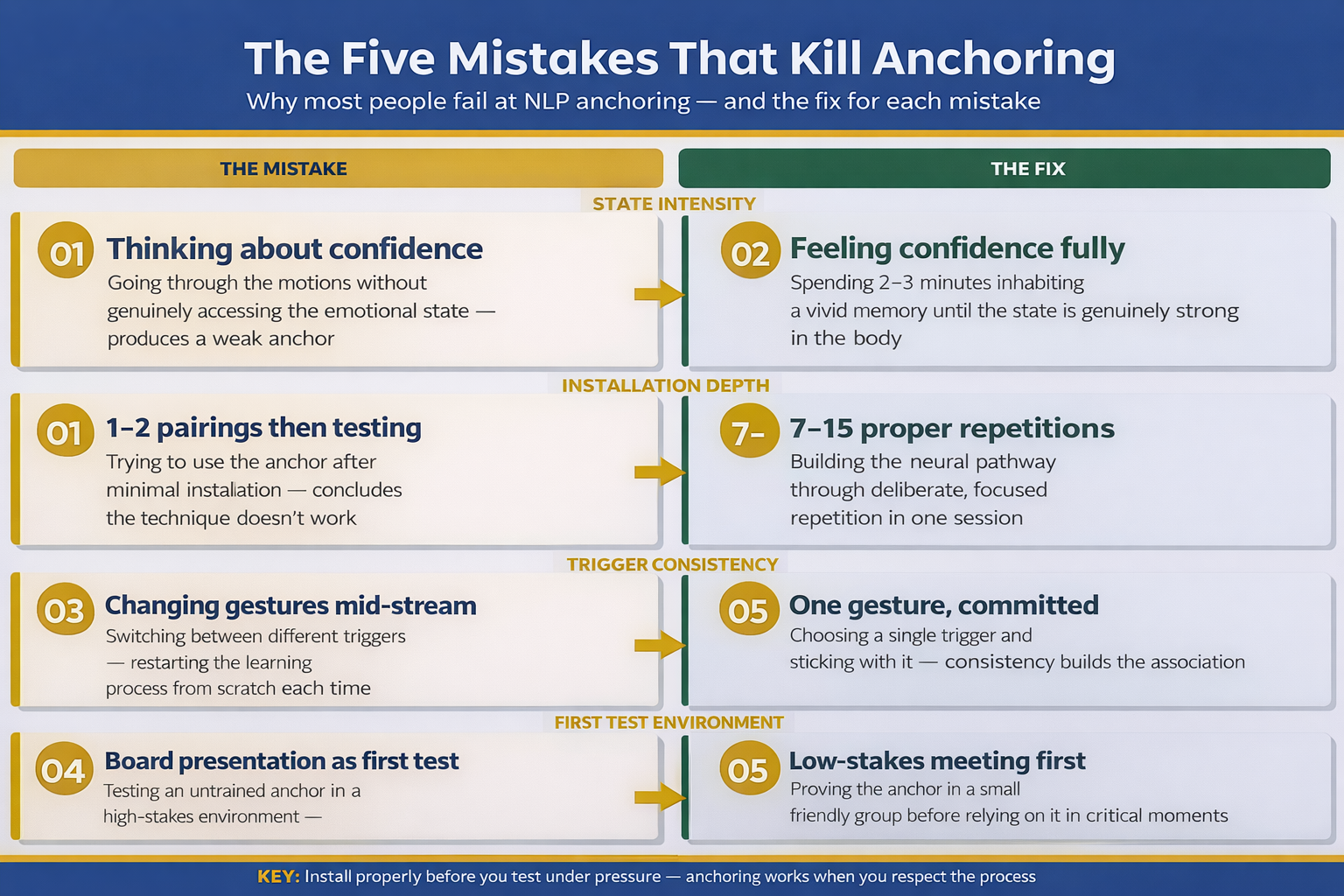
Book a discovery call | View services

12 Mar 2026
Why 'be yourself' is the worst presentation advice — and what actually builds genuine confidence when presenting

Why ‘Just Be Yourself’ Is the Worst Presentation Advice Ever Given

I have heard this advice given in every variation imaginable. “Just relax and be yourself.” “Be authentic — they’ll respond to that.” “Don’t overthink it, just be natural.” It is delivered by coaches, managers, colleagues, and well-meaning friends. It is almost completely useless.

Here is the problem. The person asking for help with their presentation anxiety is anxious because, in that specific context, they don’t know how to be themselves. The presentation setting activates a version of them they don’t recognise — the one with the dry mouth and the racing thoughts and the sudden inability to remember what they were about to say. Telling them to “just be yourself” in that state is like telling someone who is lost to “just know where you are.”

The advice is not wrong because authenticity doesn’t matter. It matters enormously. It’s wrong because it mistakes the destination for the route.

Quick answer: “Just be yourself” fails as presentation advice because it assumes you already have access to a confident, composed version of yourself in a high-pressure context — and for many people, you don’t yet. Authenticity in presentations isn’t a starting position; it’s a result of having a reliable structure, having prepared the right way, and having repeated the experience enough times for the nervous system to stop treating it as a threat. The route to authentic presenting runs through skill, not sentiment.

🧠 Struggling with presentation anxiety despite trying every tip you’ve been given? Conquer Speaking Fear (£39) addresses the root cause — not the symptoms — with a four-step approach built on clinical hypnotherapy and NLP.

I spent 24 years in corporate banking before I became a presentation coach and clinical hypnotherapist. In my banking career I gave many presentations that went well and several that didn’t — and I received “just be yourself” advice before most of them. I know what it feels like to walk into a room where the stakes are high, where the audience is senior, and where your nervous system is telling you that you are not safe.

In that state, “yourself” is not a useful concept. “Yourself” is simultaneously the person who knows this material better than anyone in the room, and the person whose heart rate has just doubled and who has forgotten how to breathe properly. Telling that person to “be themselves” doesn’t help them access the first version — it just leaves them alone with the second.

What actually builds presenting confidence is not more permission to be authentic. It’s removing the obstacles that prevent authenticity from being accessible. That’s a different problem with a different solution.


Presentation humiliation recovery process showing the 3 mechanisms: interrupt replay loop, separate shame from identity, rebuild nervous system baselineWhy ‘Be Yourself’ Fails in High-Pressure Contexts

The advice “just be yourself” contains a hidden assumption: that the self you normally inhabit is readily available in high-stakes situations. For most people, it isn’t — and this isn’t a character flaw, it’s a neurological response.

When your nervous system perceives threat — and many brains are wired to classify a large audience, an important meeting, or a high-stakes pitch as a threat — it triggers physiological responses designed to help you survive, not to help you present well. Elevated heart rate. Shallow breathing. Reduced access to higher-order thinking. A narrowed attentional focus. These responses are not evidence that you’re not good enough. They’re evidence that your brain is doing exactly what evolution designed it to do.

The problem is that “be yourself” offers no pathway through this response. It doesn’t tell you how to work with your nervous system rather than against it. It doesn’t provide structure that reduces the cognitive load of an unfamiliar or threatening situation. It doesn’t address the root pattern that makes presenting feel dangerous in the first place.

What’s more, the advice can actually increase anxiety. When someone tries to “be themselves” and still feels anxious, the natural conclusion is that there’s something wrong with them — that even their authentic self isn’t good enough for this situation. The advice doesn’t just fail to help; it creates a new layer of self-criticism on top of the existing anxiety. The research on why even confident presenters still get nervous confirms this: the problem isn’t authenticity, it’s the model people hold about what anxiety means.

🧠 The Approach That Actually Works When ‘Just Be Yourself’ Hasn’t

Conquer Speaking Fear addresses presentation anxiety at the level where it actually lives — the nervous system pattern that activates in high-pressure contexts — not the surface symptoms that generic advice tries to manage:

  • The four-step framework for retraining the nervous system response that makes presenting feel threatening
  • Clinical hypnotherapy and NLP techniques applied specifically to presentation anxiety
  • The pre-presentation physical routine that creates genuine calm rather than performed confidence
  • Evidence-building practices that change how your brain classifies the presenting situation over time
  • The distinction between managing anxiety (which keeps the pattern in place) and resolving it

Get Conquer Speaking Fear → £39

Built from clinical hypnotherapy, NLP practice, and 24 years of high-stakes presenting at JPMorgan Chase, PwC, and RBS. Used by executives who’ve tried every other approach.

What Authenticity in Presenting Actually Is

Authentic presenting is not performing naturalness. It’s not trying to replicate how you feel in a low-stakes conversation and importing it into a high-stakes one. Authenticity in the context of presentations means that your words, delivery, and presence are congruent — that there isn’t a visible gap between what you’re saying and how you appear to be experiencing saying it.

That congruence is available to most people in some contexts and not in others. In a conversation with a trusted colleague about a subject you know well, it’s probably effortless. In a room with senior stakeholders, cameras, or an audience that includes people who can affect your career, it’s not — because your nervous system has added a layer of self-monitoring and threat assessment that didn’t exist in the smaller conversation.

Removing that layer is not a matter of trying harder to be authentic. It’s a matter of reducing what your nervous system needs to monitor. Structure does part of that work — when you know exactly where your presentation is going, you’re not simultaneously navigating and performing. Preparation does another part — when you’ve rehearsed the opening enough times, it stops requiring conscious attention and frees up cognitive resource for presence. And nervous system work — the kind that changes the underlying response pattern — does the part that structure and preparation alone can’t reach.

The result is what people experience as authenticity: the sense that the presenter is genuinely present, not performing presence. But that result is downstream of a specific set of inputs. It doesn’t arrive just because someone gave you permission.

Why Structure Comes Before Authenticity

This is the idea that most presentation advice gets backwards. The conventional model says: first be yourself, then communicate your content confidently. The actual sequence is: first build a reliable structure, then reduce the cognitive load of delivering it, then the self that was always there becomes accessible.

Structure reduces threat. When you walk into a presentation knowing exactly what your first sentence is, what your three main points are, and what you’re going to say in your closing — the brain has far less to manage. The threat response that generates the symptoms most presenters try to hide has less reason to activate. Not because you’ve suppressed it, but because the situation is now more predictable.

This is why some of the best presenter frameworks begin with slide structure rather than mindset. Building presentation confidence starts with giving yourself a reliable architecture to stand inside — not with trying to think your way into a more relaxed emotional state.

It’s also why the “just be yourself” advice works for experienced presenters and fails for anxious ones. Experienced presenters have already developed structure and reduced the cognitive load through repetition. Their brain genuinely has less to monitor in the presenting situation. When someone tells them to “be themselves,” they have reliable access to that self because the threat response has already been downgraded. They’re not natural because they’re naturally relaxed. They’re relaxed because they’ve done the work that structure and repetition require.


Presentation humiliation recovery: Event versus Identity comparison showing how to separate a single bad presentation from your self-narrative

🚫 If Generic Advice Hasn’t Worked, the Route Is Different — Not Longer

Most presentation anxiety programmes manage symptoms. Conquer Speaking Fear (£39) addresses the nervous system pattern underneath — the one that ‘just be yourself’ never reaches.

Get Conquer Speaking Fear → £39

Built on clinical hypnotherapy and NLP — for executives who’ve already tried practice, positive thinking, and being told to relax.

What Actually Builds Genuine Presenting Confidence

The route to confident, authentic presenting has three components. They work in sequence, not simultaneously.

The first is structural certainty. Know exactly where your presentation starts, what it covers, and how it ends. This isn’t about scripting every word — it’s about having a reliable architecture that your brain trusts. When the structure is solid, the self-monitoring that activates in ambiguous situations has less to do.

The second is graduated exposure. Presenting in low-stakes contexts — team meetings, small groups, recorded practice — builds the evidence base that your nervous system needs to downgrade the threat assessment of the presenting situation. Each successful experience registers as data: I presented and the outcome was acceptable. Over time, the brain reclassifies presenting from threat to familiar challenge. This is the mechanism behind why experienced presenters appear naturally confident. It’s not that they were born different — it’s that they’ve created a different data set.

The third, and the one that matters most when the first two haven’t been enough, is addressing the underlying pattern directly. Clinical hypnotherapy and NLP work at the level of the nervous system response itself — not by convincing you to think differently about presenting, but by changing the subconscious association between the presenting context and the threat signal. This is the component that ‘just be yourself’ and most generic presentation advice never reaches.

When all three are in place, authenticity stops being something you have to try to produce. It becomes, as it should always have been, the natural state of a person who is not being overwhelmed by anxiety. Looking confident when presenting is not a performance you layer over anxiety — it’s what emerges when the anxiety has been genuinely addressed.

The Nervous System Problem the Advice Ignores

Presentation anxiety isn’t a mindset problem. It’s a nervous system response that was calibrated in situations where social threat was genuinely dangerous — where being judged by the group could result in exclusion — and which now activates in professional presenting contexts even though the actual consequences are rarely catastrophic.

Telling someone with this response to “be themselves” is asking them to perform naturalness while a part of their brain is running a threat protocol. The physiological symptoms — the racing heart, the shallow breathing, the dry mouth, the trembling hands — are not the result of insufficient authenticity. They’re the result of an overactive threat response in a context where threat has been overestimated.

The work that changes this isn’t in the advice given before presentations. It’s in the pattern-interruption that happens underneath the conscious, rational mind — through techniques that access the subconscious associations between presenting and danger that maintain the response. That work is specific, it takes a particular set of tools, and it is available. But “just be yourself” isn’t it.

Also published today: The Investor Relations Update Format That Prevents Awkward Questions — the four-part slide structure for IR updates that keeps executives in control of the narrative.

Recognise that pattern in yourself? Conquer Speaking Fear addresses the nervous system response that ‘just be yourself’ never reaches — with a four-step clinical approach built on hypnotherapy and NLP.

Get Conquer Speaking Fear → £39

Common Questions About Presentation Advice and Authenticity

Is ‘be yourself’ ever good advice for presenting?
Yes — for people who already have a confident, accessible version of themselves in presenting contexts. For them, the advice is a useful reminder not to over-perform or adopt a stylised ‘presenter voice.’ But for anyone whose nervous system still treats presenting as a threat, “be yourself” describes a destination they can’t reach from where they currently are. It’s good advice for the wrong people, given at the wrong stage.

What’s the difference between authentic presenting and faking confidence?
Faking confidence means performing a state you don’t have access to — and audiences can usually detect the gap, even if they can’t name it. Authentic presenting means the external and internal are congruent: you don’t appear more composed than you feel because you’ve done the work to reduce the gap. The goal isn’t to act calm while feeling panicked. The goal is to reach a state where calm is genuinely available. That’s a different project from ‘just be yourself,’ but it’s an achievable one.

Why do confident colleagues seem to naturally ‘be themselves’ in presentations?
Because their nervous system has already downgraded the threat assessment for presenting — usually through repetition, through a history of acceptable outcomes, or occasionally through a fundamentally different anxiety profile. They’re not naturally more authentic. They’re operating in a context their brain has reclassified as safe, so they have access to the full range of who they are. The route to that state is available to most people, but it runs through the work, not through the advice.

Is This Right For You?

✅ This is for you if:

  • You’ve received ‘just be yourself’ advice and found it doesn’t help — or makes things worse
  • You present competently but never feel genuinely present or relaxed in front of an audience
  • You want to understand why standard presentation tips don’t address what you’re actually experiencing

❌ This is NOT for you if:

  • You already feel calm and confident when presenting and are looking for delivery technique improvements
  • You want a quick list of tips to apply before tomorrow’s presentation (that’s a different article)

🏛️ Built by a Clinical Hypnotherapist Who Spent 24 Years Presenting in High-Stakes Corporate Environments

Conquer Speaking Fear wasn’t built from academic theory about presentation confidence. It was built from the inside — by someone who experienced severe presentation anxiety in a professional context where generic advice consistently failed, and who spent years developing a clinical approach to what that experience actually required:

  • The four-step nervous system retraining framework — not symptom management, root cause resolution
  • Clinical hypnotherapy techniques for changing the subconscious associations that maintain the anxiety response
  • NLP approaches for interrupting the thought patterns that escalate anticipatory anxiety in the days before a presentation
  • The pre-presentation physical routine that creates genuine calm — not performed composure
  • Evidence-building practices that change the data your nervous system holds about presenting over time

Get Conquer Speaking Fear → £39

From a qualified clinical hypnotherapist and NLP practitioner with 24 years of corporate presenting experience at JPMorgan Chase, PwC, Royal Bank of Scotland, and Commerzbank.

📊 Want the slides too?

Preparation reduces anxiety. The Executive Slide System (£39) includes confident-presenter templates designed to reduce preparation stress — because knowing your structure is solid before you walk in genuinely changes how your nervous system responds to the situation.

Related reading: Why Confident Presenters Still Get Nervous Before Every Talk — why the goal isn’t to eliminate nerves and what to do with them instead.

Frequently Asked Questions

How do I get comfortable presenting without having to ‘perform’ confidence I don’t feel?

The route is to stop trying to perform confidence and instead do the work that makes genuine confidence available. That means building a reliable structure so your brain has less to manage in the presenting context, using graduated exposure to give your nervous system new evidence, and — if those two haven’t been enough — working directly on the underlying anxiety pattern through approaches like clinical hypnotherapy or NLP. Performed confidence is exhausting and detectable. Genuine confidence is the result of the brain no longer classifying the presenting situation as a significant threat.

Is presentation anxiety something you can actually resolve, or is it just something you manage forever?

For most people, it’s resolvable — not just manageable. The distinction matters because ‘managing’ anxiety keeps the underlying pattern in place and requires ongoing effort. Resolving it means changing the nervous system response that generates the anxiety in the first place, so that presenting becomes a familiar challenge rather than an activating threat. That resolution isn’t guaranteed, and it requires specific approaches rather than generic tips. But the clinical tools exist, and for the majority of people who haven’t tried them, they produce significantly different outcomes than anything that’s been attempted before.

Why does the advice to ‘just relax’ also not work for presentation anxiety?

Because “just relax” is a request to consciously override a subconscious response — and the conscious mind doesn’t have access to the systems that generate the anxiety symptoms. You can’t decide your way out of an elevated heart rate in the same way you can decide to answer a question differently. The symptoms are produced by the autonomic nervous system responding to a perceived threat signal. The work that changes those symptoms has to operate at the level where that signal originates, not at the level of conscious intention.

What’s the difference between introversion and presentation anxiety?

Introversion is a preference for lower-stimulation environments and a tendency to recharge through solitude rather than social interaction. Presentation anxiety is a fear response to a perceived threat in a social performance context. They often co-occur, but they’re not the same thing and they don’t have the same solution. Many introverts present extremely well because they’ve addressed the anxiety component — introversion doesn’t cause anxiety, it just means the social aspects of presenting require more recovery time afterwards. The work of building presenting confidence is available to introverts as much as to anyone else.

The Winning Edge — weekly insight on presentation confidence, anxiety, and executive communication. Subscribe free →

Want everything in one place? The Complete Presenter Bundle (£99) includes Conquer Speaking Fear, the Executive Slide System, the Executive Q&A Handling System, and four additional products.

Free resource: Executive Presentation Checklist — the pre-presentation checklist for structure, content, and delivery, free to download.

About the Author

Mary Beth Hazeldine is the Owner & Managing Director of Winning Presentations. With 24 years of corporate banking experience at JPMorgan Chase, PwC, Royal Bank of Scotland, and Commerzbank, she has delivered high-stakes presentations in boardrooms across three continents.

A qualified clinical hypnotherapist and NLP practitioner, Mary Beth combines executive communication expertise with evidence-based techniques for managing presentation anxiety. She has trained thousands of executives and supported high-stakes funding rounds and approvals.

Book a discovery call | View services

12 Mar 2026
Investor relations presentation format update — four-part IR slide structure for executive control of every investor conversation

The Investor Relations Update Format That Prevents Awkward Questions

The CFO paused halfway through the IR update. Three investors were leaning forward. One had already opened a notebook. The problem wasn’t the numbers — the numbers were fine. The problem was the slide order.

She’d led with detailed pipeline figures before establishing the headline performance narrative. So the first question wasn’t “what’s driving the growth?” It was “why is deal conversion down 4 points from last quarter?” A defensible number, buried in context nobody had been given yet, had become the story. The meeting never recovered its footing.

That’s the hidden cost of the wrong investor relations presentation format: it doesn’t just make meetings uncomfortable — it hands control of the narrative to whoever asks the first question.

Quick answer: The investor relations presentation format that prevents awkward questions follows a four-part structure: Headline Performance (where you are vs. expectation, one sentence), Strategic Progress (three things moving forward, three metrics), Emerging Risks (flagged proactively, with your mitigation), and the Forward Commitment (what the next 90 days will deliver). Lead with your narrative before they can build their own. Every question that would have caught you off-guard becomes a question you’ve already answered.

📊 Building an investor update this week? The Executive Slide System (£39) includes the IR update template with the exact four-part structure — plus AI prompts to draft each section from your data in under 30 minutes.

I spent 24 years in corporate banking at JPMorgan Chase, PwC, Royal Bank of Scotland, and Commerzbank. In that time I reviewed, prepared for, and sat in on hundreds of investor relations presentations — from routine quarterly updates at listed companies to high-stakes briefings before material announcements.

The pattern that generates awkward questions is almost always the same. The presenter has built the deck in the order they prepared it — data first, narrative second. They’re thinking about what happened. Investors are thinking about what to ask. Those two frameworks collide the moment the first slide appears.

The IR update that prevents awkward questions doesn’t hide information. It leads with the frame that makes every piece of information legible. When you give investors your headline narrative before they’ve had a chance to form their own, most of their questions become clarifying rather than challenging. That’s not spin. It’s structure.


Quarterly forecast presentation simplified structure showing 3 sections: Headline Number, Three Drivers, and Decision Ask with layout guidance

Why IR Updates Trigger the Wrong Questions

Most IR updates fail for a structural reason, not a performance reason. The company may be delivering on every metric that matters. But if the slide deck is ordered by category rather than by argument, investors will fill the narrative gap themselves — usually with their most pressing concern.

There are three slide order mistakes that generate avoidable questions. The first is leading with supporting data before establishing the headline. When the first slides show regional breakdown, pipeline depth, or operational KPIs before the audience knows whether the overall picture is positive or negative, they’re building a judgment while you’re still providing context. Any number that looks anomalous becomes a target.

The second mistake is burying risk disclosure at the back. Investors know risk exists. When they don’t see it flagged early, they assume you’re hiding it — and they’ll surface it themselves, on their terms, in front of the room. Proactive risk disclosure is not weakness. It’s narrative control.

The third mistake is ending without a forward commitment. “We’ll continue to monitor” is not a closing statement. It tells investors there’s nothing concrete to hold you to. The best IR updates close with a specific, time-bound commitment — and it transforms the final question from “what are you going to do about it?” to “we look forward to seeing that.”

The executive presentation structure that works in boardrooms applies to investor updates for the same reason: decision-makers in both contexts need the conclusion before the evidence, not after it.

📈 The IR Update Structure That Keeps Executives in Control of Every Investor Conversation

The Executive Slide System includes the investor relations update template — built around the Headline Performance / Strategic Progress / Emerging Risks / Forward Commitment structure that controls the narrative from slide one:

  • The IR update slide order that front-loads your narrative and eliminates ambush questions
  • Risk disclosure templates that project confidence, not defensiveness
  • Forward Commitment slide format — the closing structure that replaces “we’ll monitor” with a concrete 90-day anchor
  • AI prompts to draft each section from your quarterly data in under 30 minutes
  • Before/after examples showing how the same data reads completely differently in the wrong vs. right slide order

Get the Executive Slide System → £39

Built from 24 years preparing and reviewing IR presentations at JPMorgan Chase, PwC, and RBS. Used by executives presenting to institutional investors and listed company boards.

Part 1: Headline Performance — Lead With the Verdict

The first section of your IR update should answer one question in one sentence: are we ahead, on track, or behind — and by how much? Not “revenue was £42.3M against a budget of £41.7M.” The headline is: “We delivered £600k above budget in Q3, driven by enterprise contract timing.”

That single sentence does three things. It establishes the verdict before any supporting data appears. It attributes the result rather than just reporting it. And it signals that you understand your own numbers well enough to summarise them without the slides doing the work for you.

The headline performance section should contain three elements: the headline metric (one number, one comparison), the primary driver (one sentence), and the secondary story (one sentence flagging what’s underneath the headline that you’ll cover in section two). Nothing else. Everything else is supporting data and it belongs in sections two through four or in the appendix.

What this prevents: the opening question that starts with “your revenue was X but your margin was Y — can you explain the delta?” Because you’ve led with the verdict and the driver, investors know the delta is coming. You’ve told them you’re aware of it. The question becomes a clarifier, not a challenge.

Building this IR update structure from scratch? The Executive Slide System (£39) includes the investor update template with pre-built slide layouts for each of the four sections.

Part 2: Strategic Progress — Three Things Moving Forward

After the headline, investors need to see that the business has direction, not just results. The Strategic Progress section gives them three initiatives with three associated metrics — not a comprehensive strategic review, and not a list of everything the management team has been working on.

Three is the ceiling, not the target. Most companies present six, eight, sometimes twelve strategic items. What happens is that investors leave without knowing which three actually matter. They end the meeting uncertain about priorities — and uncertainty generates questions in the next update.

Each strategic item needs one sentence on status and one metric that proves it. “Enterprise pipeline: 23% growth year-on-year, with two contracts in final negotiation.” Not “our enterprise team is working hard on pipeline development.” The metric does the credibility work so you don’t have to.

The frame that makes this work is explicit prioritisation. Not “here are three things we’re working on” — but “these are our three strategic priorities this quarter.” The word ‘priorities’ does significant work. It tells investors these were chosen deliberately, not selected because they showed well.

Part 3: Emerging Risks — Own the Story Before They Ask

This is the section most IR presentations either skip entirely or bury after the strategic highlights. Both choices are mistakes. Investors know every business has risks. When they don’t see risk disclosure, they don’t conclude there are no risks — they conclude the presenter isn’t showing them everything.

Proactive risk disclosure in the third section serves a specific function: it converts potential hostile questions into acknowledged and managed issues. When you present a risk alongside a mitigation, you’ve reframed it. The investor’s question shifts from “are you aware this is a problem?” to “can you tell me more about the mitigation timeline?”

The format is simple. For each risk: one sentence identifying it, one sentence quantifying the potential impact (even qualitatively — “material” vs “manageable”), one sentence on your current mitigation. Maximum three risks. If you have more than three genuine emerging risks, your IR update has a bigger problem than format.

This section also solves the single most common IR meeting failure: the moment late in a Q&A when an investor surfaces a risk the presenter visibly hadn’t planned to discuss. Once you’ve seen that happen from the investor side of the table, you understand immediately why proactive disclosure is protective rather than vulnerable.


Before and after quarterly forecast slide comparison showing cluttered 15-slide deck versus simplified 3-section single slide

⚠️ Stop Losing Control of the Q&A in IR Meetings

When the slide order is wrong, investors control the conversation. The Executive Slide System (£39) includes the investor relations format that front-loads narrative, neutralises ambush questions, and closes with a forward commitment investors can hold you to.

Get the Executive Slide System → £39

Used by finance executives presenting quarterly updates to institutional investors.

Part 4: The Forward Commitment — Replace “Monitor” With a 90-Day Anchor

Most IR updates end with a summary of what happened. The best ones end with a commitment about what comes next. Not “we remain confident in our outlook” — that’s not a commitment, it’s a sentiment. A Forward Commitment names specific outcomes, tied to a timeframe, with a measurable signal.

“By the end of Q4, we expect enterprise deal conversion to return to 18% — up from the current 14% — as the two contracts in final negotiation close. We’ll be in a position to confirm this at the February update.” That’s a commitment. It gives investors something to evaluate you against. It replaces “what are you going to do about it?” with “we’ll hold you to that.”

This closing structure has a secondary benefit that’s underappreciated. When executives commit to a specific, measurable outcome, it forces clarity in their own planning. The act of articulating “we will achieve X by Y” often surfaces unstated assumptions inside the management team that were creating misalignment. The investor relations update becomes a planning discipline, not just a communication exercise.

The high-stakes slide structure uses the same principle: when every slide closes with a decision or commitment, the meeting ends with something actionable rather than something vague.

The Slide Order That Controls the Narrative

Here is the exact slide sequence for an IR update built on the four-part structure:

Slide 1 — Title and date. Nothing else. Not performance highlights, not key metrics. Let the next slide be the first data they see.

Slide 2 — Headline Performance. One metric, one comparison, one driver, one secondary flag. The verdict in four lines.

Slides 3–5 — Strategic Progress. One slide per initiative. Status, metric, what it means for the year. No more than three slides.

Slide 6 — Emerging Risks. All three risks on one slide. Risk, impact, mitigation. Side-by-side columns work well.

Slide 7 — Forward Commitment. One paragraph, one number, one date. The 90-day anchor investors will quote back to you next quarter — and that’s exactly what you want.

Appendix. All supporting data — regional breakdowns, pipeline detail, headcount analysis, scenario modelling. Present everything. Just don’t lead with it.

If you find yourself wanting to add more slides before the appendix, ask which question that slide answers that isn’t already answered by slides 2–7. If the answer is “none,” it belongs in the appendix. The budget presentation structure uses the same logic: every slide in the main deck earns its place by moving the narrative forward, not by adding detail.

Also published today: Investor Q&A: The Follow-Up Questions That Kill Funding (And How to Prepare for Them) — the second-order questions institutional investors ask after the update, and how to prepare answers before you’re in the room.

Common Questions About Investor Relations Presentation Format

How long should an investor relations update presentation be?
The main deck should be seven slides: title, headline performance, three strategic progress slides, risk disclosure, and forward commitment. Anything beyond that belongs in an appendix. Most IR updates are too long because they’re built to be comprehensive rather than decisive. Investors don’t need to see everything on the main deck — they need to understand where the business is and what comes next.

What do investors actually look for in a quarterly update?
Three things: whether the headline is ahead, on track, or behind; whether management understands why; and whether they have a credible plan for what comes next. Everything else — pipeline detail, regional breakdown, headcount analysis — is context. Lead with those three things and the context becomes supporting evidence rather than the main event.

Why do investor presentations generate so many hostile questions?
Usually because the slide order forces investors to build their own narrative before you’ve given them yours. When data appears before context, the first anomaly an investor notices becomes the story. The fix isn’t better data — it’s a slide order that leads with your headline verdict, so investors are responding to your frame rather than constructing their own.

Is This Right For You?

✅ This is for you if:

  • You present quarterly or half-year updates to institutional investors, analysts, or a listed company board
  • Your IR meetings regularly go off-track when an investor surfaces a number or risk you weren’t planning to lead with
  • You want a repeatable format that works every quarter without rebuilding the structure from scratch

❌ This is NOT for you if:

  • You’re building a fundraising pitch deck for first-time investors (different structure, different objective)
  • Your IR communications are primarily written rather than presented

🏛️ The IR Update Format Built From 24 Years of Watching What Actually Works With Investors

The Executive Slide System contains the investor relations update template, the QBR structure, the budget presentation framework, and nine other executive deck templates — all built around the principle that executives need to control the narrative, not just report the data:

  • The four-part IR update structure described in this article — ready to populate with your numbers
  • Risk disclosure slide template: the format that projects confidence, not defensiveness
  • Forward Commitment language bank — exact phrases that replace “we’ll monitor” with specific, credible anchors
  • AI prompts for each section — draft the full update from your data in under 30 minutes
  • Appendix structuring guide — how to include all the detail investors need without letting it dominate the narrative

Get the Executive Slide System → £39

Built from 24 years in corporate banking at JPMorgan Chase, PwC, Royal Bank of Scotland, and Commerzbank — including preparing and reviewing IR presentations for listed companies and institutional investors.

Frequently Asked Questions

Can this investor relations format work for private companies updating angel investors or a board?

Yes — the four-part structure (Headline Performance, Strategic Progress, Emerging Risks, Forward Commitment) applies to any recurring investor or board update, whether the company is listed or private. The core principle is identical: lead with your narrative before investors build their own. The specific metrics and risk categories will differ, but the slide order and the logic behind it are format-agnostic.

What if our headline performance is negative — does this format still work?

It works especially well when performance is below expectations, because you’re controlling the framing from the first slide. Lead with the headline honestly — “Q3 revenue came in 8% below plan, driven by two contract delays we’ll address in this update.” Investors will respect the directness. What generates difficult questions is not underperformance, but the appearance of concealing it. The risk disclosure and forward commitment sections are designed precisely for quarters where the headline is difficult.

How do I handle investors who always want more detail than this format provides?

The appendix does that work. The format described here is for the main deck — the narrative that every investor receives, regardless of how deeply they want to drill. Investors who want regional breakdowns, cohort analysis, or pipeline detail get it in a structured appendix that you’ve already organised. The main deck doesn’t become less useful because the appendix exists; it becomes more useful because investors know where everything lives.

Should the format change for a results announcement versus a routine quarterly update?

The four-part structure works for both, with one adjustment: results announcements typically require more space in the Headline Performance section, since analysts need enough detail to update their models. For routine quarterly updates, the headline section can be more compressed. The principle — verdict first, evidence second, risk proactively, commitment to close — remains the same regardless of whether it’s a formal results announcement or a mid-year progress briefing.

The Winning Edge — weekly insight on executive presentations, IR communication, and high-stakes slide strategy. Subscribe free →

Want everything in one place? The Complete Presenter Bundle (£99) includes the Executive Slide System, Conquer Speaking Fear, the Executive Q&A Handling System, and four additional products — all seven tools for executives who present at senior level.

Free resource: Investor Pitch Deck Checklist — the slide-by-slide checklist for investor presentations, free to download.

About the Author

Mary Beth Hazeldine is the Owner & Managing Director of Winning Presentations. With 24 years of corporate banking experience at JPMorgan Chase, PwC, Royal Bank of Scotland, and Commerzbank, she has delivered high-stakes presentations in boardrooms across three continents.

A qualified clinical hypnotherapist and NLP practitioner, Mary Beth combines executive communication expertise with evidence-based techniques for managing presentation anxiety. She has trained thousands of executives and supported high-stakes funding rounds and approvals.
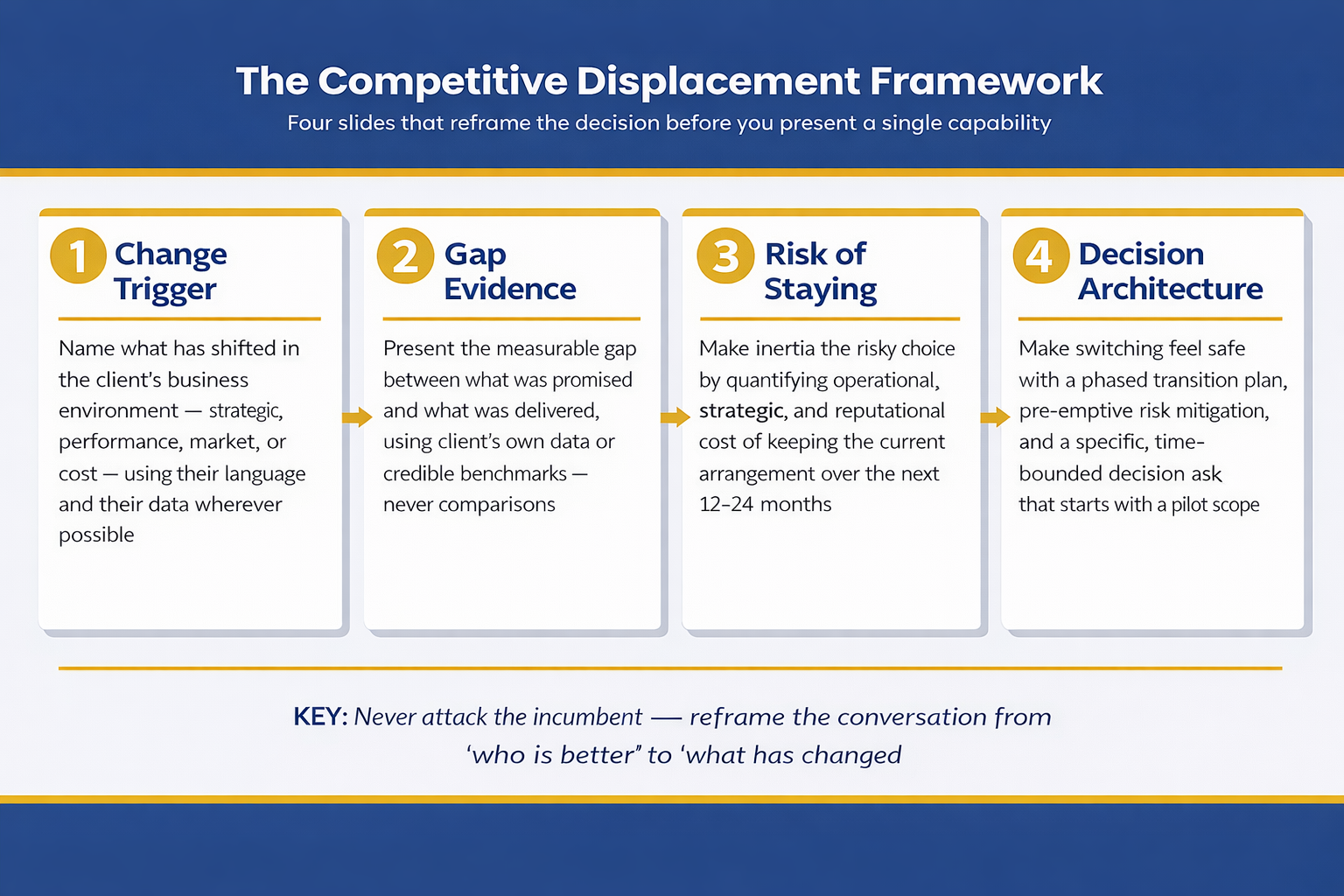
Book a discovery call | View services