11 Mar 2026
Executive hand resting on a polished conference table in a moment of pause, microphone in soft focus background, navy and gold tones, calm professional atmosphere

The Pause Before You Answer: Why the Best Q&A Performers Wait Three Seconds

I once had to present 200 redundancies to a room that didn’t know they were coming. The questions afterwards were the hardest I’ve ever faced. Not because they were complex — because they were human. Angry. Frightened. Personal.

The single thing that kept me from falling apart during that Q&A was a three-second pause before every answer. Not because I needed time to think. Because without the pause, my nervous system would have matched the room’s panic — and panic answers are always wrong.

That three-second gap is the most underrated technique in executive Q&A. Most people rush to answer because silence feels dangerous. It’s not. Silence is where authority lives.

Quick answer: The pause before answering in Q&A does three things simultaneously. It gives your prefrontal cortex time to override the amygdala’s fight-or-flight impulse (which produces reactive, defensive answers). It signals to the audience that you’re considering their question seriously rather than deflecting. And it creates a micro-rhythm that makes your answer land with more weight — because the room is already listening before you speak. Three seconds is the optimal interval: long enough to reset, short enough that it doesn’t feel like hesitation.

📋 Facing an executive Q&A session soon? The Executive Q&A Handling System (£39) includes the complete pause-and-respond framework — plus question prediction templates that let you prepare answers before the Q&A starts.

I’ve watched hundreds of Q&A sessions across banking, professional services, and technology. The pattern is almost universal: the presenter finishes their slides, opens the floor to questions, and the moment someone raises a hand, something shifts. The composure evaporates. The carefully structured delivery — clear points, measured pacing, confident tone — disappears. In its place: rapid-fire answers, defensive qualifications, and a subtle but unmistakable panic in the voice.

The executives who handle Q&A brilliantly all share one habit. They pause. Not a dramatic silence. Not a power move. A genuine, three-second space between the question and the answer. It looks like consideration. It feels like control. And it produces answers that are materially better than whatever would have come out of their mouths in the first 0.5 seconds.

I learned this the hard way. Early in my banking career, I treated every question as a test of speed — as though the faster I answered, the more competent I appeared. It took me years to understand that speed signals anxiety, not expertise. The most senior executives I’ve worked with across JPMorgan, PwC, and Commerzbank all do the same thing: they wait. And the room respects them for it.


The 3-second Q&A pause technique showing what happens neurologically: amygdala override, audience attention, and answer quality improvement

Why Rushing to Answer Destroys Your Credibility

When you answer a question the instant it’s asked, you send an unintended signal: I’m afraid of silence. The audience reads this as anxiety, not preparedness. Even if your answer is technically correct, the delivery undermines its authority.

Rushed answers have three structural problems. First, they tend to be longer than necessary — because you start talking before you’ve decided where the answer ends, so you ramble until you find a conclusion. Second, they’re more likely to be defensive — because your amygdala is in control, and the amygdala’s default mode is protect, not persuade. Third, they often miss the real question — because many executive questions contain a surface question and an underlying concern, and it takes a moment to hear both.

A finance director once asked me: “What happens if the market contracts by 15% next quarter?” On the surface, that’s a forecasting question. Underneath, it’s a risk tolerance question — she was asking whether I’d planned for downside scenarios. If I’d rushed to answer the surface question with numbers, I’d have missed the real ask. The three-second pause gave me time to hear both layers and respond to the concern, not just the data point.

Understanding how to handle difficult questions in presentations starts with this recognition: the question you hear isn’t always the question being asked. The pause is what lets you hear the difference.

🎯 The Q&A Framework That Turns Difficult Questions Into Career-Building Moments

The Executive Q&A Handling System gives you the complete pause-and-respond methodology — so you walk into Q&A with composure, not dread:

  • The 3-second pause protocol with specific anchoring techniques — so the pause feels natural, not awkward
  • Question prediction templates that let you prepare answers to the questions executives actually ask in your context
  • The surface-question / underlying-concern framework — so you answer what’s really being asked
  • Hostile question deflection patterns that maintain authority without creating conflict

Get the Executive Q&A Handling System → £39

Built from hundreds of executive Q&A sessions across banking, technology, and professional services — where the wrong answer to the wrong question ends careers.

The Neuroscience Behind the Three-Second Pause

When a question hits you unexpectedly, your amygdala activates before your prefrontal cortex can engage. The amygdala’s response is fast, emotional, and defensive. The prefrontal cortex’s response is slower, analytical, and strategic. In real-time: the amygdala produces an answer in 0.3 seconds. The prefrontal cortex needs 2-3 seconds to formulate one.

This is why rushed answers sound different from considered answers. They’re literally generated by a different part of your brain. The amygdala answer protects you: it deflects, qualifies, hedges, or counter-attacks. The prefrontal cortex answer persuades: it structures, contextualises, concedes where appropriate, and redirects to strength.

The three-second pause is the bridge between these two systems. It’s not “thinking time” in the conventional sense. It’s neurological switching time — the interval your brain needs to move from reactive mode to strategic mode. Without that interval, you’re answering from the part of your brain designed to deal with sabre-toothed tigers, not board members.

This is also why Q&A anxiety feels so intense. The rapid-fire nature of questions keeps your amygdala perpetually activated. Each question is a new micro-threat. The pause breaks that cycle — it gives your nervous system a reset between each trigger.

What the Audience Actually Sees When You Pause

Most people avoid the pause because they believe the audience will interpret silence as not knowing the answer. This is almost always wrong. Research into conversational dynamics consistently shows that brief pauses before responses are interpreted as thoughtfulness, not incompetence.

When you pause for three seconds before answering, here’s what the executive audience sees: someone who takes the question seriously enough to consider their response. Someone who isn’t flustered. Someone who has enough command of the material to choose their words rather than blurt them. That’s authority.

Compare this to the fast responder. The executive who answers before the questioner has finished speaking. What the audience sees: someone reactive. Someone who may have missed the nuance of the question. Someone who values speed over accuracy. That’s anxiety disguised as competence.

There’s a reason that every senior partner I worked with at PwC paused before answering client questions. It wasn’t because they were slow. It was because they understood that the pause itself communicates a message: your question deserves a considered response.

Want to predict the questions before they’re asked? The Executive Q&A Handling System includes question prediction templates for common executive meeting types — so you’ve rehearsed your paused, structured response before the Q&A begins.

Get the Executive Q&A Handling System → £39

How to Build the Pause Into Your Q&A Performance

Knowing you should pause and actually doing it under pressure are different things. The amygdala is fast, and it fights against the pause. Here’s how to train it.

Step 1: The Physical Anchor. When a question lands, do something physical before you speak. Shift your weight slightly. Place your hand on the table. Take one deliberate breath. This physical action occupies the 0.3 seconds your amygdala needs to fire — and by the time you’ve completed the action, your prefrontal cortex is online. The key is that the physical anchor is small enough to be invisible to the audience but definite enough to feel to you.

Step 2: The Silent Repetition. In the first second of your pause, silently repeat the last three words of the question. This serves two purposes: it confirms you heard the question correctly, and it keeps your brain processing the question rather than jumping to an answer. If the question was “What happens to margins if raw material costs increase by 20%?” — you silently repeat “increase by 20%” — and by the time you’ve done that, your answer has already begun to structure itself.

Step 3: The Opening Frame. Before the content of your answer, use a framing phrase: “That’s an important consideration.” “Let me address that directly.” “There are two dimensions to that question.” These phrases buy a further half-second and signal to the audience that a structured answer is coming. They’re not filler — they’re architecture.

Practise this sequence in low-stakes conversations first. A colleague asks you a question in a meeting — pause, anchor, repeat, frame, then answer. Within a week, the sequence will feel natural. Within a month, it will be automatic.


The 3-step pause technique: Physical Anchor, Silent Repetition, and Opening Frame — with timing breakdown

⏱️ Stop Giving Rushed Answers That Undermine Your Best Presentations

The Executive Q&A Handling System gives you the complete pause-to-respond methodology — so your Q&A performance matches the quality of your prepared slides:

  • The physical anchor + silent repetition + opening frame sequence — rehearsed and ready before your next Q&A

Get the Executive Q&A Handling System → £39

Used by presenters who deliver brilliant slides — then lose credibility in the Q&A because their answers don’t match their preparation.

Using the Pause With Difficult or Hostile Questions

The pause is useful for routine questions. It’s essential for difficult ones.

When someone asks a hostile question — one designed to challenge your competence, expose a weakness, or embarrass you in front of the room — your amygdala response is strongest. The urge to answer immediately is overwhelming. And the immediate answer is almost always the wrong one. It’s defensive. It’s emotional. It gives the hostile questioner exactly what they wanted: evidence that you’re rattled.

The three-second pause neutralises hostile questions by changing the dynamic. The questioner expects a reaction. When they get silence followed by a composed, structured answer, their strategy fails. The room’s attention shifts from the attack to your response. And because your prefrontal cortex had time to engage, your response addresses the substance of the question rather than its tone.

Here’s a practical example. A board member asks: “Isn’t this the same strategy that failed last year?” That’s hostile framing. The amygdala answer: “No, this is completely different because—” (defensive, reactive, already losing). The paused answer: “That’s a fair comparison to draw. The strategy shares one element with last year’s approach — the market targeting. The execution model, the pricing, and the team structure are new. Let me walk you through the three changes.” Same information. Completely different authority.

The complete guide to presentation Q&A covers the full taxonomy of difficult questions — but the pause is the foundation that every other technique builds on.

Facing hostile questions in your next Q&A? The Executive Q&A Handling System includes deflection patterns for the most common hostile question types — with specific language you can adapt to your context.

Get the Executive Q&A Handling System → £39

PAA: Quick Answers on Q&A Pausing

Won’t pausing before answering make me look like I don’t know the answer?
No — the opposite. Research shows brief pauses (2-4 seconds) are interpreted as thoughtfulness, not ignorance. What looks like not knowing the answer is rambling, filler words, and defensive qualifications — all of which happen when you rush. A confident pause followed by a structured answer signals command of the material.

How long is too long to pause before answering a question?
Beyond 5 seconds, the pause starts to read as hesitation rather than consideration. The optimal window is 2-4 seconds. Three seconds is the sweet spot — long enough for your prefrontal cortex to engage, short enough to feel natural. If you genuinely need more time, use a bridging phrase: “Let me think about the best way to frame this for you.”

Can I practise the pause technique alone, or do I need a coach?
You can build the core habit alone. Start in low-stakes conversations — colleague questions, team check-ins, informal discussions. The physical anchor (a small movement before speaking) and the silent repetition (repeating the last few words of the question internally) can both be practised without anyone knowing. Within a week of deliberate practice, the pause will feel less forced.

Is This Right For You?

✓ This is for you if:

  • You deliver strong presentations but your Q&A answers don’t match the quality of your prepared slides
  • You rush to answer questions and then wish you’d said something different
  • You’re facing an upcoming Q&A with senior executives and want a concrete technique to improve your composure

✗ This is NOT for you if:

  • Your Q&A challenge is primarily anxiety-related (physical symptoms, avoidance) — see Conquer Speaking Fear for root cause work
  • You already pause naturally and your challenge is structuring the answers themselves

💬 The Q&A System Built From Hundreds of Executive Sessions Across Three Continents

The Executive Q&A Handling System was built from real Q&A sessions in boardrooms where the wrong answer to one question can derail a project, a budget, or a career:

  • The full pause-and-respond protocol — physical anchor, silent repetition, opening frame — with practice exercises
  • Question prediction templates for board meetings, QBRs, investor sessions, and steering committees
  • Hostile question deflection patterns — including the specific language that neutralises aggressive framing
  • The surface-question / underlying-concern framework that reveals what the questioner really wants to know

Get the Executive Q&A Handling System → £39

Built from 24 years of executive Q&A sessions at JPMorgan Chase, PwC, RBS, and Commerzbank — where composure under questioning determines outcomes.

Frequently Asked Questions

What if I pause and then my mind goes blank?

This is the most common fear — and the pause actually prevents it. Mind-blanking in Q&A happens when the amygdala overwhelms your working memory. The pause gives your prefrontal cortex time to engage, which keeps your working memory functional. If you do blank after pausing, use the bridging phrase: “Let me make sure I address the right dimension of that question.” This buys another 3-5 seconds and often the answer surfaces during the bridge.

Does the three-second pause work in fast-paced meetings where multiple people are asking questions?

Yes — and it’s more important in fast-paced settings. When questions are coming rapidly, your nervous system escalates with each one. The pause resets the escalation. Even in a rapid-fire Q&A, a 2-second pause before each answer prevents the cumulative stress buildup that leads to deteriorating answer quality. The room actually benefits from the rhythm — it creates space for them to process your answers before the next question.

How do I handle follow-up questions that are fired immediately after my answer?

Apply the same pause. Follow-up questions are where most people lose composure — because the follow-up feels like the questioner wasn’t satisfied. Your amygdala interprets the follow-up as escalation. The pause disrupts that interpretation. It gives you time to recognise whether the follow-up is a genuine clarification (answer it directly) or a challenge to your competence (address the underlying concern, not the surface question).

📬 The Winning Edge

One email per week. Q&A strategies, executive communication techniques, and the mistakes I see in boardrooms across three continents. No fluff. Just what sharpens your edge.

Subscribe to The Winning Edge

Read next: If you’re presenting a quarterly forecast and the Q&A afterwards is what concerns you, read how to simplify your forecast slide so the Q&A has fewer surprises. And if presentation anxiety goes deeper than Q&A nerves, read the humiliation recovery story I’ve never told before.

Your next Q&A session is coming. Before you walk into it, try one thing: pause for three seconds before every answer. Not because you need time. Because the pause changes what comes out of your mouth — and how the room receives it. Three seconds. That’s all it takes to shift from reactive to authoritative.

About the Author

Mary Beth Hazeldine is the Owner & Managing Director of Winning Presentations. With 24 years of corporate banking experience at JPMorgan Chase, PwC, Royal Bank of Scotland, and Commerzbank, she has delivered high-stakes presentations in boardrooms across three continents.

A qualified clinical hypnotherapist and NLP practitioner, Mary Beth combines executive communication expertise with evidence-based techniques for managing presentation anxiety. She has trained thousands of executives and supported high-stakes funding rounds and approvals.

Book a discovery call | View services

11 Mar 2026
Executive standing at a glass boardroom table with a single clean slide projected on the wall, navy and gold tones, professional corporate environment

The Quarterly Forecast Slide Everyone Dreads Building (Simplified to 20 Minutes)

The CEO stopped the presenter on slide 4. “Start over,” she said. “But start with the decision.”

The presenter — a VP of Finance at a FTSE 250 firm — had spent two full days building a quarterly forecast deck. Fourteen slides of revenue projections, pipeline assumptions, risk scenarios, headcount impact modelling, and regional breakdowns. He thought he was being thorough. The CEO thought he was wasting her time.

Four words changed how he built every forecast slide after that: “What do you need from me?”

That’s the question your quarterly forecast presentation simplified to its core is really answering. Not “here’s what the numbers say.” But “here’s what you need to decide, and here’s the data that gets you there.”

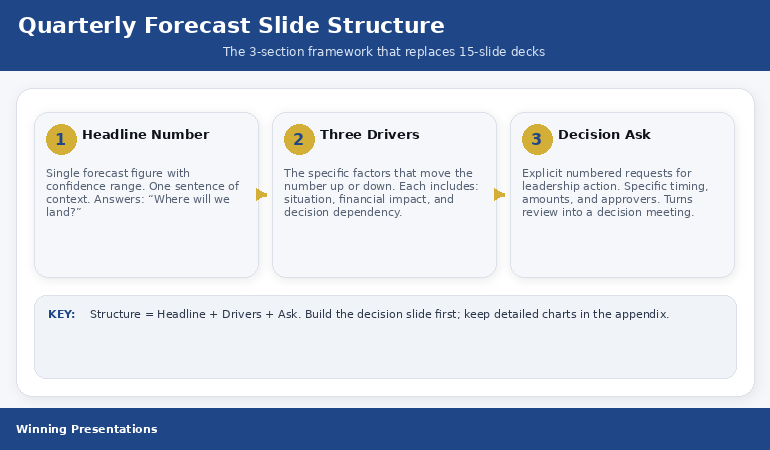
Quick answer: The quarterly forecast slide that executives actually use has three sections: the Headline Number (where you’ll land, expressed as a single figure with a confidence range), the Three Drivers (the specific factors that move the number up or down), and the Decision Ask (what you need from leadership to hit the better end of the range). Most teams bury these three things inside 15 slides of supporting data. Pull them onto one slide. It takes 20 minutes once you know the structure.

📋 Building a quarterly forecast presentation this week? The Executive Slide System (£39) includes the QBR template with the exact 3-section forecast structure — plus AI prompts to populate each section from your data in minutes.

I’ve reviewed quarterly forecast presentations across banking, technology, pharmaceuticals, and professional services for more than two decades. The pattern is the same in every industry.

Someone on the finance team spends hours pulling data from three systems, building charts that show quarter-over-quarter trends, adding commentary boxes that explain every variance, and layering in scenario models that account for best case, worst case, and “realistic” case. The deck runs to 12-18 slides. The meeting runs to 45 minutes. The executive team asks two questions. Both of them could have been answered from a single, well-structured slide.

The problem isn’t the data. The problem is that most quarterly forecast slides are built to defend rather than decide. They’re designed to show how much work went into the analysis. Executives don’t care about the work. They care about where the number lands and what they need to do about it.

Here’s the structure that changes that — and yes, you can build it in 20 minutes once you’ve done it twice.


Quarterly forecast presentation simplified structure showing 3 sections: Headline Number, Three Drivers, and Decision Ask with layout guidance

Why Most Quarterly Forecast Slides Fail Executives

The failure sits in a single misalignment. Finance teams build forecast slides to be complete. Executives need forecast slides to be clear.

Complete means every line item, every assumption, every variance explained. Clear means one number, three reasons, one decision. Complete is a spreadsheet printed on a slide. Clear is a decision tool. When you show up with complete, the executive has to do the work of extracting what matters. That’s your job — not theirs.

I watched a VP of Engineering present a quarterly review with 47 data points on screen. The CEO asked one question: “So are we on track or not?” He couldn’t answer in one sentence. Not because he didn’t know — because his slide didn’t force him to distil it down. The QBR presentation structure is designed to prevent exactly this failure.

The fix isn’t less data. It’s better architecture. Three sections, one slide, and the data lives in the appendix where it belongs — ready for the CFO who wants to drill into regional breakdowns, but not blocking the CEO who wants to make a decision.

📈 The Quarterly Forecast Structure That Gets Executive Decisions in One Meeting

The Executive Slide System includes the QBR and Project Status templates — built around the Headline Number / Three Drivers / Decision Ask structure that turns forecast meetings into decision meetings:

  • The single-slide quarterly forecast layout that replaces 15-slide decks (the exact structure described in this article)
  • AI prompts that pull your data into the 3-section framework in under 20 minutes
  • Executive Summary and Team Dashboard templates for the supporting slides your CFO will want
  • The appendix slide structure that satisfies detail-oriented stakeholders without cluttering the main deck

Get the Executive Slide System → £39

Built from 24 years of quarterly reviews in banking — where the forecast slide decides whether projects get funded or killed.

Section 1: The Headline Number

The top third of your forecast slide has one job: tell the executive where you expect to land. One number. One confidence range. One sentence of context.

Here’s what this looks like in practice: Q2 Revenue Forecast: £4.2M (range: £3.8M–£4.6M). Below that, a single line: “Tracking 6% above plan, contingent on Enterprise pipeline closing at historical rates.”

That’s it. No chart. No trend line. No quarter-over-quarter comparison. Those belong in the appendix. The headline number answers the CEO’s first question — “Where are we?” — before she has to ask it.

Most teams resist this because it feels reductive. It is reductive. That’s the point. Your job in a quarterly forecast isn’t to display comprehensiveness. Your job is to give a busy executive a decision anchor. The headline number is that anchor. Everything else hangs off it.

The confidence range is non-negotiable. A single number without a range is either optimistic or sandbagged — and the executive knows it. The range signals honesty. It also sets up Section 2, because the natural follow-up question is: “What moves us from the low end to the high end?”

Section 2: The Three Drivers

The middle section answers the question the headline number creates: what moves the forecast up or down?

Not ten factors. Not “market conditions.” Three specific, named drivers. Each one should be a lever the executive team can actually pull — or at least understand why they can’t.

For example: Driver 1: Enterprise pipeline conversion — three deals worth £1.1M total are in late-stage negotiation. If all three close, you hit the top of the range. If two close, you’re at midpoint. If one, you’re near the floor. Driver 2: Professional services margin — two projects running 15% over budget on labour. Resolution depends on a staffing decision this quarter. Driver 3: New product adoption — the Q1 launch is tracking at 40% of target. Acceleration depends on the marketing spend decision that hasn’t been approved yet.

Notice what each driver includes: the specific situation, the financial impact, and the decision or dependency that determines the outcome. That’s the structure. Situation, impact, dependency. Three drivers, each with three components. It fits on one-third of a slide.

This is where the operational review presentation framework becomes useful — it applies the same driver-based logic to progress updates, not just financial forecasts.

Need the quarterly slide template for this structure? The Executive Slide System includes the QBR and Project Status templates with this exact Headline / Drivers / Decision framework — plus AI prompts to draft your forecast slide from raw data in minutes.

Get the Executive Slide System → £39

Section 3: The Decision Ask

The bottom third of the slide is where most forecast presentations fall apart — because most forecast presentations don’t have a decision ask at all.

They end with the data. The implicit message is: “Here’s what the numbers say. Any questions?” The executive team nods, asks a few clarifying questions, and moves to the next agenda item. Nothing gets decided. Nothing changes.

The Decision Ask changes that. It’s a direct, specific request for action: “To hit the high end of the range, I need three things: (1) approval to extend the Enterprise sales cycle by offering Q3 payment terms, (2) a staffing decision on the two over-budget projects by March 28, and (3) reallocation of £40K in marketing budget to the new product launch.”

That’s a slide that drives action. The executive doesn’t have to translate data into decisions — you’ve done it for them. The meeting shifts from “let’s review the numbers” to “let’s approve or reject these three requests.” That’s the difference between a forecast presentation and a decision meeting.

When I worked in banking, the quarterly reviews that got things done all had this structure. The ones that didn’t ended with “let’s take this offline” — which is corporate for “nothing happened.”


Before and after quarterly forecast slide comparison showing cluttered 15-slide deck versus simplified 3-section single slide

⏱️ Stop Spending Days on Forecast Decks That Get Skimmed in Seconds

The Executive Slide System gives you the pre-built forecast structure — so you fill in your numbers instead of designing slides from scratch:

  • QBR and Project Status templates with the 3-section layout — ready to populate

Get the Executive Slide System → £39

Used by finance leaders, VPs, and programme directors who are tired of rebuilding the same forecast deck every quarter.

The 20-Minute Build Process

Here’s the step-by-step for building your quarterly forecast slide in 20 minutes — once you have your data to hand.

Minutes 1–5: Write the Headline Number. Pull your topline forecast figure. Add the confidence range. Write one sentence of context. If you can’t write the context in one sentence, you haven’t distilled the forecast enough. Force yourself. “Tracking 6% above plan” or “At risk due to pipeline slippage” or “On track if Q3 staffing is approved.” One sentence.

Minutes 6–12: Identify the Three Drivers. Open your forecast model. Ask yourself: what are the three things that most move this number? Not the ten things. The three. For each, write the situation (one line), the financial impact (one number), and the dependency (who or what needs to act). If a driver doesn’t have a clear dependency, it’s a background factor — move it to the appendix.

Minutes 13–18: Write the Decision Ask. For each driver, extract the decision or approval needed. Combine them into a numbered list. Be specific about timing, amounts, and who approves. “Approval to extend payment terms” is actionable. “We need more flexibility” is not.

Minutes 19–20: Check the appendix signal. Add a footer line to the slide: “Supporting data: slides 6–12.” This tells the CFO that the detail exists without putting it on the main slide. It’s a trust signal — you’ve done the work, you’re just not inflicting all of it on the room.

The CFO-approved budget presentation template uses the same principle — leading with the decision, supporting with data on request.

Running a quarterly review meeting soon? The full QBR presentation guide covers the complete meeting structure — forecast, progress, and decision slides — so your quarterly review drives outcomes, not just updates.

PAA: Quick Answers on Quarterly Forecast Presentations

How many slides should a quarterly forecast presentation have?
The main deck should be 3–5 slides: one forecast summary (the 3-section structure), one progress update, one decisions/actions slide, and 1–2 optional context slides. Supporting data lives in an appendix of 5–10 slides that you reference but don’t present unless asked. The goal is a 15-minute meeting, not a 45-minute data review.

What’s the difference between a quarterly forecast and a QBR?
A quarterly forecast is one element of a QBR (Quarterly Business Review). The forecast covers where the numbers will land. A full QBR also includes progress against goals, operational highlights, risks, and resource requests. The 3-section forecast slide described here is the financial anchor of the broader QBR deck.

Should you present best case, worst case, and expected case separately?
No. Presenting three separate scenarios turns a decision meeting into a discussion about assumptions. Instead, present one expected number with a confidence range. Use the Three Drivers section to show what pushes the outcome toward the high or low end. This keeps the conversation focused on actions, not probabilities.

Is This Right For You?

✓ This is for you if:

  • You present quarterly forecasts to senior leadership and the meeting always runs over
  • Your forecast slides get questions like “so what’s the bottom line?” — meaning the structure isn’t doing its job
  • You want a repeatable template so you’re not rebuilding the forecast deck from scratch every quarter

✗ This is NOT for you if:

  • Your audience is a finance team that needs granular model-level detail (that’s a working session, not a presentation)
  • You’re building an annual strategic plan (different structure, different purpose)

🎯 The Quarterly Presentation System Used by Finance Leaders Across Three Continents

The Executive Slide System was built from real quarterly reviews in banking, technology, and professional services — where the forecast slide decides what gets funded:

  • 22 templates including QBR, Executive Summary, and Budget Request — each built for the decision-first format
  • 51 AI prompt cards that turn your raw data into structured executive slides (3 prompts per template: Draft, Refine, Executive Polish)
  • The 15 Scenario Playbook pages that cover quarterly reviews, budget requests, board meetings, and investor updates
  • CFO Questions Checklist — the questions financial executives will ask, and how to pre-answer them on the slide

Get the Executive Slide System → £39

Built from 24 years of quarterly reviews at JPMorgan Chase, PwC, RBS, and Commerzbank — where forecast slides determine project survival.

Frequently Asked Questions

How do I handle it when my forecast data keeps changing right up to the meeting?

Lock the headline number 48 hours before the meeting. Any changes after that go into a verbal caveat at the start: “Since the deck was circulated, Driver 2 has shifted — I’ll update you live.” This prevents the endless cycle of re-building slides the night before. The 3-section structure helps because you only need to update three data points, not fifteen slides.

What if my leadership team wants to see all the detail on one slide?

This usually means they don’t trust the summary — which means previous forecast slides have surprised them. Build trust by including the appendix reference on the main slide and proactively saying: “The supporting model is on slides 6 through 12 — happy to go through any line item.” Once they see that the detail is there and the summary is accurate, they’ll stop asking for it on the main slide.

Can I use this structure for a board-level forecast presentation?

Yes — in fact, it’s even more important at board level. Board members have less context than your executive team. They need the headline, the drivers, and the ask even more urgently. The only difference: your confidence range may need a brief methodology note in the appendix for governance purposes.

📬 The Winning Edge

One email per week. Executive presentation strategies, slide structures that actually work, and the mistakes I see in boardrooms across three continents. No fluff. No filler. Just the edge.

Subscribe to The Winning Edge

📥 Free resource: Download the CFO Questions Cheatsheet — the questions financial executives ask in quarterly reviews, and how to pre-answer them on your slides.

Read next: If quarterly presentations trigger anxiety, here’s what I learned about recovery from my worst presentation moment. And if the Q&A after your forecast presentation is what worries you most, read why the best Q&A performers wait three seconds before answering.

Your next quarterly forecast presentation is coming. Before you open PowerPoint and start building 15 slides of data, try this: write the headline number, name the three drivers, and draft the decision ask. Then build one slide around those three sections. You’ll spend 20 minutes instead of two days — and your leadership team will actually make decisions in the meeting.

About the Author

Mary Beth Hazeldine is the Owner & Managing Director of Winning Presentations. With 24 years of corporate banking experience at JPMorgan Chase, PwC, Royal Bank of Scotland, and Commerzbank, she has delivered high-stakes presentations in boardrooms across three continents.

A qualified clinical hypnotherapist and NLP practitioner, Mary Beth combines executive communication expertise with evidence-based techniques for managing presentation anxiety. She has trained thousands of executives and supported high-stakes funding rounds and approvals.

Book a discovery call | View services

10 Mar 2026
Investment committee member asking a pointed question to a presenter in a formal meeting room, navy and gold accents

The Hypothetical Trap: When Executives Ask “What If” to Test Your Limits (And How to Answer)

“What if your main customer leaves?”

The question came from the Investment Committee member on the left, 20 minutes into a funding presentation. Not aggressive. Quiet. Almost casual.

The presenting team stopped. Looked at each other. Then gave a three-minute explanation of why that scenario was unlikely. Market share data. Contract terms. Customer relationship depth.

They never answered the actual question.

The committee member waited until they finished and then said: “I understand why you think that’s unlikely. I asked what would happen if it did.”

Quick answer: When executives ask hypothetical questions in presentations, they’re not asking you to predict the future. They’re testing the quality of your thinking under uncertainty — specifically, whether you’ve identified the gaps in your own argument and planned for them. The right answer structure is: acknowledge the scenario directly (don’t argue it away), state what would happen (honest, specific), then describe what you’d do (mitigation or pivot). Three parts. The mistake most presenters make is spending 80% of their answer defending the assumption rather than engaging with the hypothetical.

📋 Facing executive Q&A this week? The Executive Q&A Handling System (£39) includes the hypothetical question framework from this article — plus the complete question prediction map, answer structures for 9 difficult question types, and the pre-meeting Q&A briefing template. Walk in knowing 80% of what they’ll ask.

I’ve been in a lot of rooms where this happens. Hypothetical questions are one of the most reliably mishandled moments in executive presentations — not because the presenter doesn’t know the answer, but because they misread the question.

The investment committee scenario above is typical. The presenting team heard “what if your main customer leaves?” as an objection to their business case. It wasn’t. It was a gap-finding exercise. The committee member already had a view on the customer concentration risk — they were in the business of finding these things. What they wanted to know was: does this management team see the gap too? Have they thought through it? Is there a contingency? Can they discuss it calmly without getting defensive?

The team answered a question that hadn’t been asked. They defended their assumption instead of engaging with the scenario. And in doing so, they failed the actual test — which had nothing to do with customer retention probability.

That presenting team eventually got funded. But they left two committee members uncertain rather than confident — and that uncertainty shaped the terms they were offered. One answer, handled differently, can change the outcome of a room.


Three types of hypothetical questions in executive presentations: gap-finding, stress-testing, and values-probing framework

What Executives Are Actually Testing With Hypotheticals

Understanding the intent behind a hypothetical question changes how you answer it.

Executives ask hypothetical questions for three reasons — and none of them is to trip you up for its own sake. They are senior professionals with limited time. When they ask a speculative question, it’s because they want to learn something that your prepared presentation hasn’t told them.

The first thing they test is thinking quality under uncertainty. Can you reason clearly when you’re not on script? Do you distinguish between what you know and what you’ve assumed? Do you get defensive, or do you engage? A presenter who can hold an uncertain scenario calmly and think through it clearly in real time signals a quality of mind that data alone can’t demonstrate.

The second thing they test is self-awareness. Do you know where the risks are in your own argument? The most trustworthy presenters can identify their own assumptions and gaps before an executive points them out. When you acknowledge the hypothetical without flinching — “yes, if that happened, here’s what the impact would be” — you demonstrate that you’ve already thought about it. That’s a significant trust signal.

The third thing they test is preparedness. A well-prepared presenter has thought through the likely hypotheticals in advance. Their answer isn’t invented on the spot — it draws on thinking they’ve done, scenarios they’ve modelled, contingencies they’ve identified. That preparedness is visible in the quality and specificity of the answer. You can hear the difference between a presenter who’s thought this through and one who’s improvising.

For a deeper look at the trust signals executives read during Q&A, see: Executive Questions as a Trust Test.

💬 Walk Into Q&A Knowing 80% of the Questions Before They’re Asked

The Executive Q&A Handling System is built for executives who face high-stakes Q&A — boards, investment committees, senior leadership, client pitches — and want to handle any question with confidence rather than hoping for easy ones:

  • The hypothetical question framework from this article — with the 3-part answer structure and worked examples across board, investor, and stakeholder scenarios
  • The question prediction map — the method for identifying 80% of the questions you’ll face before entering the room
  • Answer structures for 9 difficult question types: hypotheticals, data challenges, the “I don’t know” scenario, loaded questions, compound questions, and more
  • The pre-meeting Q&A briefing template — what to prepare, in what order, for each presentation context
  • The short answer framework — how to give a complete, credible answer in under 60 seconds without appearing evasive

Get the Executive Q&A Handling System → £39

Built from 24 years in the rooms where these questions get asked — boardrooms, investment committees, and executive reviews across global banking and professional services.

The Three Types of Hypothetical Question

Not all hypothetical questions work the same way. The three types below each require a slightly different framing in your response.

Type 1: Gap-finding hypotheticals. “What if your key assumption is wrong?” “What if this regulation changes?” “What if you lose your main client?” These are scenario questions about known risks or vulnerabilities. The executive already suspects the gap exists. They’re asking whether you see it too. The correct response acknowledges the scenario and addresses impact and mitigation. Do not argue the likelihood. Do not say “that’s unlikely because…”

Type 2: Stress-testing hypotheticals. “What if you had to do this with half the budget?” “What if the timeline moved by three months?” “What if you lost two key people in Q3?” These are pressure tests on the robustness of the plan. The executive wants to know if you’ve built in any flex, and whether you have a hierarchy of priorities if resources are constrained. The correct response shows you’ve thought about sequencing and trade-offs, not just the best-case scenario.

Type 3: Values-probing hypotheticals. “What if a major client asked you to do something your team objected to?” “What if you had to choose between timeline and quality?” “What if a regulatory decision came back negative and the board wanted to proceed anyway?” These are questions about how you make hard decisions under conflict. The executive is evaluating your judgement and integrity, not just your analytical ability. The correct response is honest, specific, and doesn’t try to avoid the tension in the question.

Most presenters handle Type 1 by defending the assumption (wrong), freeze on Type 2 because they haven’t thought through trade-offs (unnecessary), and over-hedge on Type 3 to avoid committing to a position (exactly the wrong move — executives are looking for someone with a clear framework for hard decisions).

Want the complete question type library with answer structures? The Executive Q&A Handling System covers all three hypothetical types above — plus 6 additional difficult question categories — with worked answer frameworks for each.

Get the Q&A Handling System → £39

The 3-Part Answer Structure That Works Every Time

The structure below works for all three hypothetical types. The proportions shift depending on context, but the three components are constant.

Part 1: Acknowledge the scenario directly. Don’t argue the premise. Don’t say “that’s unlikely.” The executive knows it might be unlikely — that’s not why they’re asking. Say: “If that happened…” or “In that scenario…” and mean it. Commit to engaging with the hypothetical rather than routing around it. This takes about one sentence and is the difference between an answer that lands and one that sets the room’s teeth on edge.

Part 2: State what would happen — specifically. This is where most presenters underdeliver. They say “it would be challenging” or “we’d need to reassess.” That’s not an answer. An answer is: “Revenue would drop by approximately 30% in the first quarter, the cash position would require bridging for 90 days, and we’d need to accelerate the diversification programme we have planned for Q4.” Specific. Honest. Quantified where you can be. This part signals whether you’ve actually modelled the scenario or are improvising. Executives hear the difference immediately.

Part 3: Describe what you’d do. The mitigation or pivot. Not the full plan — two to three sentences maximum. “Our response would be: [action 1], [action 2], and [action 3] within [timeframe].” This closes the loop. You’ve acknowledged the scenario, you’ve been honest about the impact, and you’ve demonstrated that there’s a response. The executive can now decide whether that response is adequate. That’s what they wanted — not certainty that the scenario won’t happen, but confidence that if it did, the team would handle it.

For a method to predict which hypotheticals you’ll face before entering the room, see: Predict Presentation Questions: The Question Map.


The 3-part answer structure for hypothetical questions: acknowledge the scenario, state what happens, describe your response

The Trap: Why Defending the Assumption Makes It Worse

The presenting team I described at the start spent three minutes explaining why their main customer was unlikely to leave. They were probably right. That wasn’t what made the exchange go wrong.

When a presenter defends the assumption behind a hypothetical question, they signal several things that erode confidence rather than building it. They signal that they’ve heard the question as a threat rather than as genuine inquiry. They signal that they may not have thought through the scenario being raised. And they signal that they’re not comfortable with uncertainty — which is a significant credibility problem at senior level, where uncertainty is the constant operating condition.

The investment committee member who asked the question was not suggesting the customer would leave. She was asking: if that happened, what would happen next, and what would the team do? When the team spent three minutes arguing that it wouldn’t happen, they answered a question she hadn’t asked — and left her own question unanswered.

The corrected version takes about 45 seconds. “If that customer left, we’d lose approximately 28% of revenue in year one. That’s the scenario that keeps me up at night, frankly. We’d activate our two Tier 2 clients immediately — they’re ready to scale, they’re just waiting for capacity. We’d bridge the revenue gap with our reserve facility, and we’d restructure Q3 and Q4 priorities to accelerate the expansion we have planned for 2027. It’s not a scenario we want. But we’ve modelled it, and we could survive it.” That’s it. She asked, you answered. The room moves on with confidence rather than uncertainty.

🛑 Stop Improvising Answers to Questions You Could Have Predicted

  • The question prediction methodology that identifies the hypotheticals, stress tests, and gap-finding questions before you walk in — with the Q&A briefing template to organise your preparation
  • The short answer framework: how to give a complete, credible answer to any hypothetical in under 60 seconds

Get the Q&A Handling System → £39

Used for board presentations, investment committee sessions, and executive reviews across global banking, consulting, and corporate environments.

PAA: Quick Answers on Hypothetical Questions

How should I prepare for hypothetical questions before a presentation?
Map your presentation’s three most material assumptions. For each assumption, ask: what if this is wrong, what would the impact be, and what would we do? Those six answers — two per assumption — are your hypothetical Q&A preparation for the questions most likely to come. Then map your known gaps: what are the weakest points in your argument? Executives will find them. Having an honest, prepared answer is far stronger than being caught improvising. For the full methodology, see the question prediction map.

What’s the best way to handle a hypothetical you genuinely haven’t thought about?
Say so — briefly and without apology. “I haven’t modelled that specific scenario, but let me work through it now.” Then use the 3-part structure: what would happen, what would we do, and what are the uncertainties. A thoughtful response to an unanticipated hypothetical, worked through in real time, is more credible than a prepared answer that doesn’t engage with the actual question. Executives value the quality of your thinking, not just the completeness of your preparation.

How do I answer a hypothetical without committing to something I’m not certain about?
Language of probability is acceptable: “Our best estimate in that scenario would be…” or “Based on our modelling, the most likely outcome would be…” What’s not acceptable is refusing to engage with the scenario at all. The goal is not certainty — it’s honest, specific reasoning under uncertainty. Executives don’t expect you to know the future. They do expect you to be able to think clearly about it. For related guidance, see how to handle difficult questions in presentations.

Is the Executive Q&A Handling System Right For You?

✔️ This is for you if:

  • You regularly face executive Q&A — board presentations, investment committees, senior leadership reviews — where hypothetical and challenging questions are expected
  • You’ve been caught out by a hypothetical or difficult question and want a structured preparation method rather than hoping for easy ones
  • You want a repeatable answer framework so you don’t have to improvise under pressure

❌ This is NOT for you if:

If you recognised any of those scenarios in your own Q&A experience, the answer isn’t better improvisation under pressure. It’s a preparation system that removes the improvisation requirement altogether.

🏛️ The Q&A System Built From the Rooms Where These Questions Get Asked

The Executive Q&A Handling System was built from 24 years inside the rooms where hypotheticals, stress tests, and gap-finding questions are standard equipment — investment committees at JPMorgan, board reviews at RBS and Commerzbank, and senior client presentations across global financial services:

  • The complete hypothetical question framework — all three types with answer structures and worked examples
  • The question prediction map: the pre-meeting methodology that identifies 80% of the questions before you walk in
  • Answer frameworks for 9 difficult question types: hypotheticals, data challenges, compound questions, loaded questions, “I don’t know” scenarios, and more
  • The Q&A briefing document template — the pre-meeting preparation structure that executives who handle Q&A with confidence use every time
  • The short answer framework — how to give a complete, credible answer in under 60 seconds that doesn’t sound evasive

Get the Executive Q&A Handling System → £39

Your next board or executive Q&A is already on the calendar. Walk in knowing what’s coming — and exactly how to answer it.

Frequently Asked Questions

Why do executives ask hypothetical questions when they could just ask direct ones?

Because the hypothetical question tests something a direct question doesn’t: how you think under uncertainty. A direct question (“what are your risks?”) gets a prepared list. A hypothetical question (“what if your main risk materialises?”) gets your actual reasoning about consequences, trade-offs, and responses. The hypothetical also reveals whether you’ve genuinely modelled the scenario or whether your risk list is a compliance exercise. Most executives have learned that the hypothetical question cuts through prepared positioning more reliably than the direct version.

Is it acceptable to ask for time to think before answering a hypothetical?

Yes — briefly. “Give me a moment to work through that” followed by 10–15 seconds of visible thinking is better than a rushed, incomplete answer. What you’re signalling is that you take the question seriously enough to think before you speak — which is exactly the quality of mind the question is testing. Longer than 20 seconds starts to read as a preparation gap. If the scenario is genuinely complex, acknowledge that: “That’s a multi-variable scenario — let me give you the primary impact first and flag the dependencies.” Then do exactly that.

What should I do if a hypothetical reveals a real gap I haven’t addressed?

Acknowledge it directly. “You’ve identified something we haven’t fully resolved” is a strong answer — far stronger than trying to paper over the gap with improvised reasoning. State what you know, what you don’t know, and what you’d do to close the gap before a decision is required. Executives fund and approve managers who demonstrate clear self-awareness about their own unknowns. The gap isn’t the problem. Discovering the gap in the room when you should have found it in your preparation is the problem — and honesty about that is part of the solution.

How many hypothetical questions should I prepare for before a presentation?

As a minimum: three to five questions based on your presentation’s most material assumptions, plus any known sensitive areas you’ve deliberately kept brief. For high-stakes presentations — board, investment committee, major client pitch — extend this to eight to ten scenarios using the question prediction methodology. The goal is not to pre-answer every possible question. It’s to build enough fluency with the material under uncertainty that even an unanticipated hypothetical gets a thoughtful, structured response rather than a defensive one.

📬 The Winning Edge — Weekly Presentation Intelligence

One article per week on executive communication, Q&A mastery, and high-stakes presentation strategy. No fluff, no motivation — just the frameworks that work in real executive environments.

Subscribe to The Winning Edge

Also published today: if the challenge is building the right slide structure for a high-stakes deal or acquisition meeting, see The Due Diligence Presentation That Almost Killed a £50M Deal. And if the physical symptoms of Q&A anxiety are the real problem, read When Public Speaking Fear Becomes a Medical Emergency.

About the Author

Mary Beth Hazeldine is the Owner & Managing Director of Winning Presentations. With 24 years of corporate banking experience at JPMorgan Chase, PwC, Royal Bank of Scotland, and Commerzbank, she has delivered high-stakes presentations in boardrooms across three continents.

A qualified clinical hypnotherapist and NLP practitioner, Mary Beth combines executive communication expertise with evidence-based techniques for managing presentation anxiety. She has trained thousands of executives and supported presentations for high-stakes funding rounds and approvals.

Book a discovery call | View services

10 Mar 2026
Executive standing alone outside a boardroom, hand on glass wall, composed exterior masking visible tension, navy and gold accents

When Public Speaking Fear Becomes a Medical Emergency: Signs You Need More Than Techniques

I kept beta blockers in my desk drawer for three years.

Never took one. But knowing they were there — knowing I had an exit — was the only thing that got me into some meeting rooms on bad days. The shaking, the nausea, the voice that cracked regardless of how many times I’d rehearsed. I had all of it. For five years before I found what actually worked.

What I’ve learned since, from training thousands of executives, is that there’s a line most people don’t know how to find. On one side: normal performance anxiety that techniques can fix. On the other: something that has crossed into the nervous system so deeply that breathing exercises and positive self-talk aren’t touching it.

This article is for people who suspect they might be on the wrong side of that line.

Quick answer: Public speaking anxiety becomes a medical concern when it produces physical symptoms that are disproportionate, persistent, and interfering with professional function — vomiting, chest pain, blackouts, or days of anticipatory dread before a single meeting. These are signs the nervous system is operating in a trauma response, not just a performance stress response. Standard presentation techniques don’t reach this level. What does: nervous system regulation work, clinical-grade somatic techniques, and in some cases, medical consultation for anxiety disorders or specific phobia.

🚨 Have a presentation this week and physical symptoms are already starting? Calm Under Pressure (£19.99) is built specifically for in-the-moment physical symptom management — the 60-second resets for shaking, nausea, racing heart, and voice cracking, for the day of the presentation.

A C-suite executive I worked with had a secret she’d kept for three years.

She vomited before every major presentation. Not occasionally. Every single time, without exception, for three years. Her team thought she was one of the most composed presenters in the company. She had a 20-minute window in the bathroom before each meeting and a very precise mental ritual for walking back in as though nothing had happened.

She was referred to me after an incident that finally scared her: she blacked out briefly in the lift on the way to a board presentation. Came to in time, walked in, delivered the presentation. Nobody knew. But she knew.

That’s when we crossed from “I get nervous” into a different conversation entirely.

She didn’t need better techniques. She needed nervous system work that addressed what was actually happening in her body — not a list of tips for managing nerves. The techniques she’d tried for years hadn’t failed her because she hadn’t tried hard enough. They’d failed because they weren’t designed for what she was experiencing.


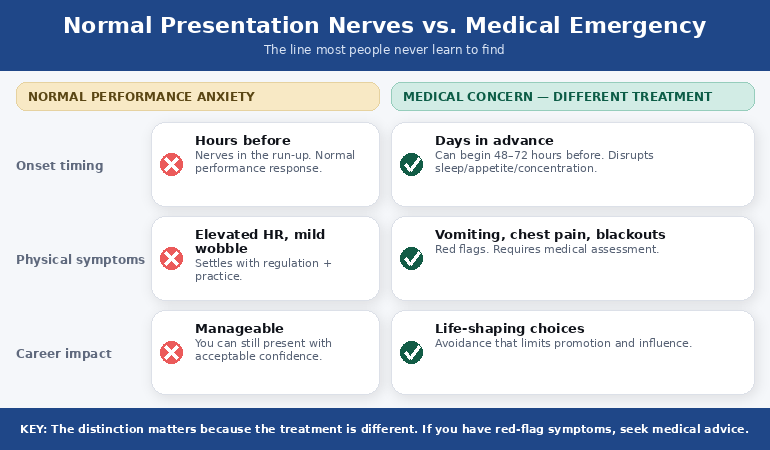
Comparison infographic showing normal presentation anxiety symptoms versus medical emergency warning signs in public speaking

Normal Presentation Nerves vs. Medical Emergency: What’s the Difference?

Some level of performance anxiety is physiologically normal. The autonomic nervous system interprets high-stakes visibility — standing in front of people who are evaluating you — as a threat signal. Heart rate increases. Cortisol rises. Muscle tension increases. That’s not malfunction. That’s your body trying to help.

What makes anxiety cross into concerning territory isn’t the presence of those symptoms. It’s the severity, the duration, and the functional impairment.

Normal performance anxiety: you feel nervous in the hours before a presentation. Your heart rate is elevated when you stand up to speak. Your voice might wobble slightly at the start. Within the first 60–90 seconds, the nervous system regulation kicks in and you settle.

Concerning anxiety: the dread starts days in advance. Physical symptoms — nausea, gastrointestinal distress, sleep disruption — begin 24–72 hours before the presentation. On the day, symptoms reach a level that impairs function: shaking that you can’t stop, voice loss, blanking on content you’ve rehearsed dozens of times, or physical symptoms severe enough to affect your health (vomiting, chest pain, difficulty breathing, pre-syncope or blackouts).

The distinction matters because the treatment is different. Techniques designed for normal performance anxiety — breathing exercises, visualisation, anchoring, positive self-talk — operate at the cortical level. They work on the thoughts. When anxiety is operating at the level of a trauma or phobia response, the threat signal is firing from subcortical brain structures that don’t respond to reasoning or intention. You can’t think your way out of a nervous system response that’s running below conscious control.

🧠 The 60-Second Resets That Stop Physical Symptoms Before They Take Over

Calm Under Pressure is built specifically for in-the-moment physical symptom management on presentation day — not theory, not mindset tips. The techniques from clinical hypnotherapy and NLP, adapted for high-pressure executive environments:

  • The 60-second nervous system reset for racing heart, shaking, or voice cracking — designed to be used in the corridor outside the meeting room
  • The pre-meeting vomiting and nausea protocol — specific techniques for gastrointestinal anxiety responses before high-stakes presentations
  • The voice recovery sequence — what to do when your voice cracks or tightens in the first 90 seconds
  • The blank-mind recovery technique — how to retrieve content your brain has temporarily blocked under threat response
  • The grounding sequence for dissociation and pre-syncope — for those who experience derealization or lightheadedness before presenting

Get Calm Under Pressure → £19.99

Evidence-based techniques from clinical hypnotherapy and NLP, adapted for executive environments. Used by presenters who had tried everything else first.

The Symptoms That Cross the Line

There is no single threshold, because individual nervous systems vary. But certain presentations of anxiety warrant medical assessment rather than (or in addition to) technique-based intervention:

Cardiovascular symptoms. Chest tightness, palpitations, or irregular heartbeat before or during a presentation should always be checked medically first, before attributing them to anxiety. The anxiety interpretation may be correct — but ruling out cardiac causes is not optional.

Pre-syncope or blackouts. Lightheadedness, tunnel vision, or actual loss of consciousness connected to presentation situations is a medical symptom. This can have anxiety-related causes (vasovagal syncope is common in high-stress situations) but it needs assessment.

Severe gastrointestinal distress. Vomiting before every presentation for months, or persistent gastrointestinal symptoms that begin days in advance and don’t resolve, may indicate a physiological anxiety disorder rather than a situational one. This is different from occasional nausea on a particularly high-stakes day.

Anticipatory dread lasting days. When anxiety about a presentation begins 48–72 hours in advance and is functionally impairing — disrupting sleep, appetite, or concentration on unrelated work — that’s a level of anticipatory anxiety that clinical intervention is designed for. Breathing exercises don’t reach anticipatory anxiety that’s already running three days ahead.

Avoidance that’s costing career opportunities. This is perhaps the most common threshold that goes unnamed. When a professional is declining presentations, turning down visibility, or shaping their entire career choices around avoiding public speaking — that’s a level of interference that warrants taking seriously. It doesn’t have to be dramatic symptoms. Chronic, career-shaping avoidance is its own form of severity.

For more on how the nervous system gets stuck in presentation trauma patterns, this article is relevant background: Presentation Trauma and the Nervous System.

Recognise any of those symptoms? Calm Under Pressure handles the in-the-moment physical responses — the ones that techniques like breathing exercises and visualisation don’t reach quickly enough on presentation day.

Get Calm Under Pressure → £19.99

Why Standard Techniques Stop Working at This Level

Most presentation anxiety advice — and most presentation coaches — operates at the behavioural level. Practice more. Breathe. Visualise success. Reframe your thoughts. These are legitimate techniques, and they work for a significant proportion of people with normal-range performance anxiety.

They don’t work when the anxiety has become a conditioned response. That’s the clinical distinction most presentation advice ignores.

A conditioned response is what happens when the nervous system has encoded “presentation” as a threat signal through repeated experience. You’ve presented while anxious. The anxiety was uncomfortable. The nervous system noted the correlation: presentation environment = threat. This encoding happens below conscious awareness — which is why telling yourself “there’s nothing to be afraid of” doesn’t change the physical response. The part of your brain generating the response doesn’t speak the language of rational reassurance.

The C-suite executive who vomited before every board meeting had been practising breathing techniques for two years before she came to me. The techniques weren’t wrong. They were just operating on the wrong part of the nervous system. When we shifted to somatic work — approaches that address the conditioned response directly through the body rather than through reasoning — the physical symptoms resolved in six weeks of consistent practice. Not years. Six weeks.

That’s the difference between treating the symptom and treating the signal. Standard techniques treat the symptom. Somatic and clinical approaches treat the signal — the nervous system’s learned association between presentation contexts and threat. You can’t always do deep somatic work on the day of a presentation. For in-the-moment management, you need a different set of tools. For the underlying pattern, you need to go deeper.

If you’ve tried the standard approaches and they haven’t worked, this is directly relevant: Treatment-Resistant Presentation Anxiety — What’s Actually Left to Try.


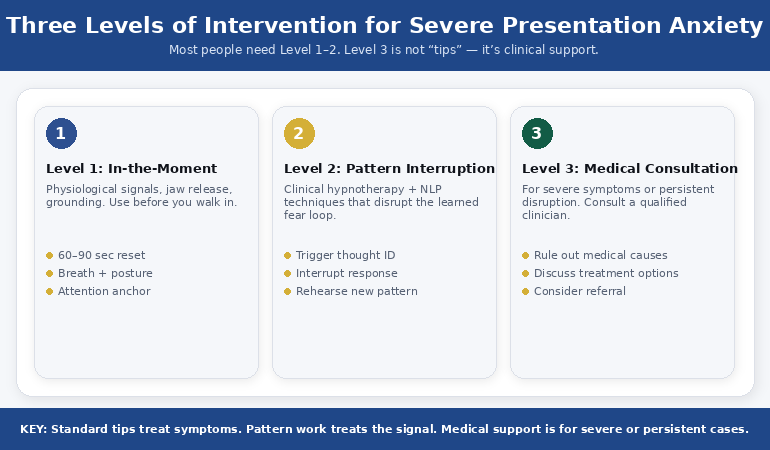
Three levels of intervention for severe presentation anxiety: in-the-moment, pattern interruption, and medical consultation

What Actually Works When Techniques Don’t

There are three levels of intervention for severe presentation anxiety, and the right one depends on what’s driving the symptoms.

Level 1: In-the-moment symptom management. For physical symptoms on the day — shaking, nausea, voice cracking, heart racing — somatic techniques work faster than cognitive ones. Physiological sighing (double inhale through the nose, extended exhale) reduces heart rate measurably within 60 seconds and doesn’t require sustained practice to work. Cold water on the wrists, jaw release, and specific grounding sequences address the physical presentation of the response rather than the thought behind it. These are the tools that work in the corridor outside the meeting room when you have 90 seconds and nowhere to hide.

Level 2: Pattern interruption. For anticipatory anxiety that begins days in advance, the intervention needs to work on the conditioned association rather than just the acute response. Techniques from clinical hypnotherapy and NLP — specifically those that work on the encoded memory structures behind the conditioned response — are effective here. This is where I do most of my individual client work. The executive who vomited before every board meeting saw resolution at this level: the acute response in the meeting room resolved once the underlying conditioned association was disrupted.

Level 3: Medical consultation. For symptoms that include chest pain, blackouts, or a level of impairment that’s affecting quality of life beyond presentation situations, medical assessment is appropriate. A GP can evaluate for specific phobia or social anxiety disorder, refer to a CBT or EMDR specialist, and assess whether medication is a useful adjunct (not a replacement) for the work above. There is no shame in this. There is also no award for suffering through a diagnosable condition without support.

Most people reading this need Level 1 and Level 2 — not a medical referral, but also not the standard advice they’ve already tried. The in-the-moment work and the pattern-interruption work are the gap between “I’ve tried everything” and “I’ve actually tried the right things.”

🛑 Stop Relying on Techniques That Were Never Designed for Severe Physical Symptoms

  • The clinical somatic techniques for in-the-moment management of shaking, nausea, heart racing, and voice cracking — designed for executive environments, not therapy rooms
  • The pre-meeting protocol for the morning of a high-stakes presentation when physical symptoms are already escalating

Get Calm Under Pressure → £19.99

Created by a qualified clinical hypnotherapist with 5 years of her own severe presentation anxiety — and 24 years watching executives face it in the highest-stakes rooms in global banking.

PAA: Quick Answers on Severe Presentation Anxiety

Is it normal to vomit before a presentation?
Occasional nausea before a very high-stakes presentation is within the range of normal performance anxiety. Vomiting before most or every significant presentation is not — it indicates a level of physiological activation that warrants clinical attention rather than more breathing exercises. This is a conditioned response, not weakness. It’s treatable.

Can presentation anxiety cause chest pain?
Yes — anxiety activates the cardiovascular system and can cause chest tightness, palpitations, and discomfort that mimics cardiac symptoms. However, chest pain should always be medically evaluated before attributing it to anxiety. This is non-negotiable. Once a cardiac cause is ruled out, anxiety-related chest symptoms respond well to somatic regulation techniques and, in persistent cases, clinical anxiety treatment.

I’ve tried everything for presentation anxiety. What’s left?
Usually the missing piece is the level of intervention, not the category. Most people have tried behavioural techniques (breathing, practice, visualisation) but haven’t worked at the somatic level — techniques that address the conditioned nervous system response directly rather than through reasoning. If you’ve tried techniques without sustained success, the panic attack before presentation framework explains the next level of what’s available.

Is Calm Under Pressure Right For You?

✔️ This is for you if:

  • You experience physical symptoms — shaking, nausea, voice cracking, racing heart — on presentation day and need something that works fast, in the moment
  • You’ve tried breathing exercises and standard anxiety techniques and they’re not enough on a high-stakes day
  • You have an upcoming presentation and want clinical-grade in-the-moment tools, not more theory

❌ This is NOT for you if:

  • Your challenge is the underlying anxiety pattern over months and years rather than acute day-of symptoms — for that level, Conquer Speaking Fear (£39) addresses the root cause rather than the in-the-moment response
  • Your presenting challenge is slide structure rather than anxiety — for that, see today’s executive slide structure article

If you recognised your own experience in the severe end of what’s described above, the gap isn’t willpower or more practice. It’s having the right intervention at the right level — clinical tools designed for the body’s response, not the mind’s.

🧪 Clinical Tools for Physical Symptoms — Built From 5 Years of My Own

I spent five years with the full range of physical presentation anxiety: nausea, shaking, voice cracking, face flushing. I also have clinical hypnotherapy and NLP qualifications. Calm Under Pressure is what I wish I’d had in those years — not theory, not motivation, but the specific techniques that address what the body is actually doing:

  • In-the-moment resets for every major physical symptom: shaking, nausea, voice cracking, racing heart, facial flushing, mind going blank
  • The pre-meeting morning protocol — what to do from the moment you wake up on a high-stakes presentation day
  • The 90-second grounding sequence for dissociation and lightheadedness
  • The vomiting and gastrointestinal anxiety protocol — the techniques I developed specifically because this symptom is almost never addressed anywhere else
  • Voice recovery techniques — somatic resets for tightening or cracking that work in the first 90 seconds of a presentation

Get Calm Under Pressure → £19.99

Your next presentation is already on your calendar. The symptoms are not going to resolve on their own. Get the tools that actually work for severe physical anxiety — on the day you need them.

Frequently Asked Questions

How do I know if my presentation anxiety needs professional help?

The thresholds to watch for: physical symptoms that are severe (vomiting, blackouts, chest pain), anticipatory dread that starts days in advance and disrupts your functioning, or career-shaping avoidance where you’re turning down opportunities because of the anxiety. Any of these warrant taking more seriously than standard self-help techniques. Starting with your GP is appropriate if you’re experiencing cardiovascular or other concerning physical symptoms. For anxiety that’s functioning but severe, a clinical hypnotherapist, CBT therapist, or EMDR practitioner who specialises in performance anxiety is a good route.

Are beta blockers effective for public speaking anxiety?

Beta blockers reduce the cardiovascular manifestations of anxiety — heart racing, trembling, voice shake — but they don’t address the underlying anxiety itself. They can be useful as a short-term bridge when the physical symptoms are impairing function and nothing else is working quickly enough. They are not a treatment for the conditioned anxiety pattern. Most people I work with who have used beta blockers find them less effective than they expected, or find they create a dependency on having them available (as I described with having them in my desk drawer) rather than actually resolving the problem.

Can presentation anxiety get worse over time even if I keep presenting?

Yes — this is counterintuitive but important. The standard advice is “present more, fear less.” For many people, this is true. For others, repeated experiences of presenting while highly anxious don’t reduce the anxiety — they reinforce the conditioned association. Every high-anxiety presentation can deepen the nervous system’s encoding of “presentation = threat.” This is why some people find their anxiety gets worse through their careers despite years of presenting regularly. More exposure isn’t the answer if the exposure is consistently aversive. The pattern needs interrupting, not reinforcing.

I have a board presentation in two weeks. What should I do right now?

Start with the in-the-moment physical tools — the grounding, breathing, and voice reset techniques that you can practise now and use on the day. These take two to three days of daily practice to work reliably under pressure. Don’t start them on the morning of the presentation. Alongside that, work on the preparation side — a well-structured deck reduces anxiety because it removes uncertainty about what comes next. For structure, see the due diligence presentation framework if it’s a high-stakes investor context, or the hypothetical questions framework if you’re anticipating a tough Q&A.

📊 Want better slides too?

Preparation reduces anxiety. The Executive Slide System (£39) includes confident-presenter templates designed to minimise preparation stress — so you walk into the room knowing the structure works, not hoping it does.

📬 The Winning Edge — Weekly Presentation Intelligence

One article per week on executive communication, presentation anxiety, and high-stakes performance. Evidence-based, executive-focused, no fluff.

Subscribe to The Winning Edge

🆓 Free resource: 7 Presentation Frameworks — a free guide to strengthen your presentation preparation.

Also published today: if your challenge is the slide structure for a high-stakes presentation rather than the anxiety, see The Due Diligence Presentation That Almost Killed a £50M Deal. And if you’re preparing for executive Q&A with difficult hypothetical questions, read The Hypothetical Trap.

About the Author

Mary Beth Hazeldine is the Owner & Managing Director of Winning Presentations. With 24 years of corporate banking experience at JPMorgan Chase, PwC, Royal Bank of Scotland, and Commerzbank, she has delivered high-stakes presentations in boardrooms across three continents.

A qualified clinical hypnotherapist and NLP practitioner, Mary Beth combines executive communication expertise with evidence-based techniques for managing presentation anxiety. She has trained thousands of executives and supported presentations for high-stakes funding rounds and approvals.

Book a discovery call | View services

10 Mar 2026
Executive presenting due diligence slides to an acquisition committee in a modern boardroom, navy and gold accents

The Due Diligence Presentation That Almost Killed a £50M Deal (And the 3 Slides That Saved It)

The biotech company had done everything right. Twelve months of preparation. A data room that ran to 4,000 pages. A management team that could answer any question the acquirer threw at them.

Their due diligence presentation was 54 slides.

On slide 11, the lead partner from the acquiring firm put down his pen. “We need to stop,” he said. “I’m still waiting to understand what you actually want us to know.”

The deal didn’t die in the room. But it came close.

Quick answer: A due diligence presentation that works has one job — give the acquirer confidence, fast. That means three structural anchors: a Deal Rationale slide (why this deal makes strategic sense), a Value Story slide (where the value is and why it’s real), and a Risk Map slide (the risks you’ve already found, and what you’ve done about them). Everything else is appendix. Most DD presentations bury these three slides inside 50 others. That’s what kills deals.

📋 Presenting in a due diligence process this month? The Executive Slide System (£39) includes an Investor Presentation template with the exact deal rationale, value story, and risk framing structures described in this article — ready to adapt in 30 minutes.

I’ve sat in a lot of due diligence rooms. On both sides. And the pattern is almost always the same.

The presenting company arrives with a deck that answers every question an acquirer might ask — in the order that felt logical to the team that built it. Market overview. Competitive landscape. Product roadmap. Financial history. Management team. Growth projections. Risk factors. Regulatory environment.

The acquirer’s team arrives with a very short list of questions. Not 54 slides worth. Usually three to five things they need to believe before they’ll proceed.

The mismatch is the problem. The presenting team is answering questions that weren’t asked. The acquirer is waiting for answers to questions that aren’t coming. By slide 20, the room has lost the thread. The acquirer’s attention has shifted to their own notes. The management team is presenting into a vacuum.

The biotech company I mentioned almost lost a £50M acquisition this way. What saved it wasn’t better data. It was rebuilding three slides — and understanding why those three, in that order, are the only slides that actually matter in a due diligence presentation.

The 3-slide structure for due diligence presentations: Deal Rationale, Value Story, and Risk Map with numbered framework

Why Most Due Diligence Presentations Fail

The failure is almost never about the quality of the business. It’s about the structure of the argument.

Most due diligence presentations are built by finance teams and lawyers who are trained to be comprehensive. Comprehensive is correct for a data room. It is the wrong instinct for a live presentation to an acquisition team.

Acquirers in a due diligence meeting are not reading. They are deciding. Their question isn’t “have you answered every question?” Their question is: “Should we keep moving?” Those are fundamentally different questions — and they require fundamentally different slide structures.

When a presentation doesn’t answer the “should we keep moving?” question fast enough, three things happen. The acquirer’s team starts asking clarifying questions earlier than expected. The presenting team interprets questions as scepticism and adds more detail. The room bogs down in specifics before the core argument has landed. That’s when a partner puts their pen down and says, “I’m still waiting to understand what you actually want us to know.”

📈 The Investor Presentation Structure That Moves Acquirers Forward

The Executive Slide System includes the Investor Presentation template — built around the deal rationale, value story, and risk framing structures that get acquisitions approved rather than deferred:

  • The Decision-First slide order for investor and M&A presentations — the exact sequence that answers “should we keep moving?” on slide 3
  • Deal Rationale, Value Story, and Risk Map templates — pre-built and ready to adapt with your specific deal data
  • AI prompt cards to draft investor-ready slide content in under 30 minutes
  • The Executive Summary structure used to get £50M+ acquisition approvals moving in a single meeting
  • Strategic Recommendation and Risk Assessment slide templates — with framing that shows rigour without burying the lead

Get the Executive Slide System → £39

Built from board-level presentations at JPMorgan, RBS, and Commerzbank — including transactions exceeding £50M. Board-ready in 30 minutes or less.

Slide 1: The Deal Rationale Anchor

The first thing an acquisition team needs to see isn’t your financials. It’s the strategic logic. Why does this deal make sense — for them?

Most presenting companies build a market overview slide first. The acquirer already knows the market. They’re in it. What they don’t know yet is: why this company, why now, and what they’d get that they can’t easily build themselves.

The Deal Rationale slide answers those three questions in 90 seconds. It should contain: the strategic gap the acquisition fills for the acquirer, the core capability or asset being acquired (one sentence, not a feature list), and the timing argument (why the window is now, not in two years). That’s it. No company history. No founding story. No market size graphic with a hockey stick.

The biotech company’s original deck opened with a 7-slide company overview. The acquirer’s team had read the IM. They already knew the overview. They were waiting for the deal rationale. When we moved the deal rationale to slide 2 (after a one-slide executive summary), the room shifted. The lead partner picked up his pen.

Need the slide template for this structure? The Executive Slide System includes the Strategic Recommendation and Investor Presentation templates with this exact Deal Rationale framing — including AI prompts to draft each section in minutes.

Get the Executive Slide System → £39

Slide 2: The Value Story

After deal rationale comes the value story — and this is where most presentations overcomplicate things.

The value story is not a financial model. It’s not a revenue bridge or a scenario analysis. Those live in the data room. The value story slide has one job: make the acquirer believe the value is real and accessible.

There are three components to a strong value story in due diligence: the headline number (the value created or to be realised), the proof point (the evidence that makes the number credible — a comparable transaction, a customer contract, a market share figure), and the access mechanism (what happens post-acquisition to unlock it — integration pathway, team retention, IP transfer).

Where presenting teams go wrong is building financial detail without giving the acquirer the narrative to interpret it. A revenue graph without a proof point is just a claim. A growth projection without an access mechanism is just optimism. The value story slide should be the narrative spine that makes the financial model believable — not a replacement for it.

For the biotech deal, the value story had been buried inside a 12-slide financials section. When we extracted it into a single slide with those three components — headline number, proof point (a signed licensing agreement worth £8M in year one), and access mechanism (the key relationship that came with the acquisition, not just the IP) — the acquirer’s team stopped asking sceptical questions and started asking integration questions. That’s the shift you’re looking for.


Before and after comparison of value story slide structure showing what makes acquirers believe the number is real

Slide 3: The Risk Map (The One Nobody Wants to Show)

Most due diligence presentations treat risk like a legal disclosure. They bury it at the back. They minimise it. They qualify everything.

That’s exactly the wrong approach — and acquirers know it.

An acquirer doing due diligence is actively looking for what you’re not showing them. If your risk section looks sanitised, they don’t feel reassured. They feel suspicious. They start digging harder. That’s when due diligence drags into month four and deals fall apart.

The Risk Map slide does the opposite. It puts the three to five most material risks on the table — clearly, with specifics. Not “regulatory risk” as a bullet point, but “EU regulatory approval for the lead compound requires a Phase 3 trial estimated at 18 months.” Then, for each risk: what you’ve already done to mitigate it.

This slide has a counterintuitive effect in the room. When an acquirer sees that you’ve identified the real risks and have mitigation plans in place, their confidence goes up — not down. They’re buying a management team as much as an asset. A team that knows its own risks and has thought through the responses is a team they want to own.

For the biotech company, this was the hardest slide to get agreement on. The finance team wanted to soften it. What went in was specific: three risks, with ownership, timelines, and mitigations. The lead partner read it carefully and then said, “This is the most honest risk page I’ve seen this year.” They moved to term sheet within three weeks.

If you’re preparing for a due diligence presentation, you might also find this article useful: Investor Pitch Deck Template — it covers the structural overlap between an investor deck and a DD presentation, and where the two formats diverge.

🛑 Stop Preparing Slides Your Acquirer Won’t Read

  • The exact deal structure templates that frame acquisitions the way acquirers think — not the way finance teams present
  • Risk framing language that builds confidence instead of triggering deeper scrutiny

Get the Executive Slide System → £39

Used in high-stakes M&A and funding presentations across global banking and consulting.

What Goes to the Appendix (and What Stays Out)

Once you have the three anchor slides — Deal Rationale, Value Story, Risk Map — everything else needs a test before it goes in the main deck.

The test: does this slide help the acquirer decide, or does it help the acquirer verify? If it’s verification material — detailed financial models, product roadmap timelines, team CVs, customer case studies — it belongs in the appendix. If it’s decision material — why this deal, why now, why you — it belongs in the main deck.

Acquirers will ask for appendix material when they need it. They will not dig for decision material buried on slide 38. Front-load the decision content. Let the appendix absorb everything else.

The practical rule: your main deck should not exceed 15 slides. The biotech company’s 54-slide deck restructured to 11 slides and an appendix of 43. The acquirer said they got more out of the 11-slide version than they had from an hour with the original deck.

For a deeper look at how decision-first structure works across different executive scenarios, see: Decision Slide That Gets Yes — the same structural principle applied to internal approvals.

Working on an executive or investor presentation right now? The executive presentation structure framework covers the decision-first ordering principle for high-stakes decks — useful background before using the templates.

PAA: Quick Answers on Due Diligence Presentations

How long should a due diligence presentation be?
A live due diligence presentation should be 10–15 slides in the main deck, with supporting material in the appendix. The goal is to answer the acquirer’s key decision questions — why this deal, why now, where is the value — before going into detail. Anything beyond 15 slides in the main deck means the structure hasn’t been resolved. Move verification material to the appendix.

What slides must be in a due diligence presentation?
Three slides anchor every effective due diligence deck: a Deal Rationale slide (strategic logic for the acquirer), a Value Story slide (where the value is, with proof), and a Risk Map slide (material risks with mitigations already in place). These three answer the only question that matters at this stage: should we keep moving?

Why do acquirers stop reading due diligence decks?
Usually because the deck is structured to answer the presenting company’s questions rather than the acquirer’s. Acquirers want to know: does this deal make strategic sense? Is the value real? What are the material risks? When those answers are buried behind market overviews and company history, attention drops. Put the decision material first.

Is the Executive Slide System Right For You?

✔️ This is for you if:

  • You’re preparing a due diligence, investor, or M&A presentation and need a structured template rather than starting from scratch
  • You’ve had a deal room meeting go flat and suspect the structure — not the data — was the problem
  • You need board-ready slides with clear decision framing and you have less than a week to prepare

❌ This is NOT for you if:

  • You need a full financial model or valuation tool — this is a presentation system, not a financial modelling toolkit
  • Your presentation challenge is speaking confidence rather than slide structure — for that, see When Public Speaking Fear Becomes a Medical Emergency

If you recognised your last deal room in any of the above, the structure isn’t the hard part — it’s having the right templates to implement it quickly under time pressure. That’s what the Executive Slide System is built for.

🏛️ The M&A Slide System Built From Deals, Not Textbooks

The Executive Slide System was built from 24 years inside global financial institutions — including due diligence and acquisition presentations at JPMorgan, PwC, and RBS. Not from theory. From rooms where £50M+ decisions were being made on slides like these:

  • 22 PowerPoint templates including Investor Presentation, Strategic Recommendation, and Risk Assessment — all with Decision-First structure
  • 51 AI prompt cards to draft and refine each slide, including the deal rationale and value story sections from this article
  • 15 scenario playbooks covering M&A, board approval, investor, and executive communication scenarios
  • 6 checklists including the Investor Presentation Checklist — covers the due diligence meeting structure step by step
  • The Executive Summary template that answers the acquirer’s three questions before slide 3

Get the Executive Slide System → £39

Your next due diligence meeting isn’t waiting. Get the framework that keeps acquirers at the table. Board-ready in 30 minutes or less.

Frequently Asked Questions

How is a due diligence presentation different from an investor pitch deck?

An investor pitch deck is designed to generate interest and create a first impression. A due diligence presentation comes after the acquirer or investor has already decided they’re interested — it’s designed to maintain momentum and answer the “should we keep moving?” question. The tone is less persuasive, more transparent. The risk framing that would be softened in a pitch deck should be direct and specific in a DD presentation. The structural logic is similar — decision-first, value-anchored — but the risk section is much more prominent and detailed.

Should the management team or the finance team lead the due diligence presentation?

The management team should lead — with finance supporting on the numbers sections. Acquirers are buying a team as much as an asset. The MD or CEO presenting the deal rationale and value story, and then handing to the CFO for the financials section, sends the right signal about capability and ownership. Presentations that are led entirely by bankers or advisers feel one step removed from the actual business, and acquirers notice.

What happens if the acquirer asks questions our deck doesn’t cover?

That’s the appendix’s job. Any question that goes beyond the 15 slides in your main deck should have an appendix slide ready. Prepare for the top 15–20 questions the acquirer is likely to ask — build corresponding appendix slides, know exactly where they are, and pull them into the conversation seamlessly. A smooth transition to appendix material signals preparation and confidence, not weakness. If you’re looking for a structured way to anticipate executive questions, the Hypothetical Trap framework is directly applicable to due diligence Q&A scenarios.

Can I use the same due diligence presentation for multiple acquirer meetings?

The structure should be consistent, but the Deal Rationale slide should be tailored for each acquirer. The strategic logic for why this acquisition makes sense varies depending on who’s buying. A financial acquirer looking for yield has different strategic priorities from a strategic acquirer looking for market entry. The Value Story and Risk Map can remain largely consistent, but the deal rationale — the 90-second argument for why this deal makes sense for them specifically — needs to be adapted for each room.

📬 The Winning Edge — Weekly Presentation Intelligence

One article per week on executive communication, slide structure, and high-stakes presentation strategy. No fluff, no generic advice.

Subscribe to The Winning Edge

🆓 Free resource: Investor Pitch Deck Checklist — a free guide to strengthen your presentation preparation.

Also published today: if the presentation itself isn’t the problem but the physical symptoms of nerves are, read When Public Speaking Fear Becomes a Medical Emergency. And if you’re facing Q&A from executives who like to test hypotheticals, The Hypothetical Trap covers exactly that.

About the Author

Mary Beth Hazeldine is the Owner & Managing Director of Winning Presentations. With 24 years of corporate banking experience at JPMorgan Chase, PwC, Royal Bank of Scotland, and Commerzbank, she has delivered high-stakes presentations in boardrooms across three continents.

A qualified clinical hypnotherapist and NLP practitioner, Mary Beth combines executive communication expertise with evidence-based techniques for managing presentation anxiety. She has trained thousands of executives and supported presentations for high-stakes funding rounds and approvals.

Book a discovery call | View services

09 Mar 2026
Small team of executives gathered around a boardroom table in an intense Q&A rehearsal session with one person gesturing

Role-Playing Q&A With Your Team: The 20-Minute Rehearsal That Changes Everything


A SaaS account executive—let’s call her Rachel—was closing 3 deals out of every 47 demos. The presentations were solid. The product was strong. But something was failing during Q&A. Six months after implementing structured team role-play rehearsals—where colleagues played the sceptical CFO, the hostile procurement lead, the silent evaluator—that same executive closed 9 out of 23 demos. The presentations didn’t change. The Q&A preparation did.

Quick answer: Role-playing Q&A with your team before high-stakes presentations exposes gaps in your knowledge and deflates the anxiety that derails executives under pressure. A 20-minute structured rehearsal—where team members play four distinct adversarial roles—inoculates you against surprise questions and teaches you to stay calm when you don’t know the answer. It’s the difference between surviving Q&A and owning it.

High-stakes Q&A this week?

Most executives prepare slides. Few prepare for the questions nobody wants to face. If you’re walking into a board meeting, funding round, or customer pitch without having rehearsed Q&A scenarios with your team, you’re accepting unnecessary risk.

  • Block 20 minutes with two colleagues before your presentation
  • Assign them specific adversarial roles (this article shows you how)
  • Answer their hardest questions out loud, under mild pressure

→ Need the complete Q&A preparation system? Get the Executive Q&A Handling System (£39)

The SaaS Demo That Proved the Point

Here’s what changed for Rachel. Before the role-play rehearsals, she prepared by reading her slides and memorising talking points. She studied the customer’s business model. She predicted three or four likely questions and crafted perfect answers. But in the actual demo, the CFO asked something completely different—something she hadn’t anticipated. Her mind went blank. She hedged. She equivocated. The customer sensed weakness.

After six months of 20-minute team rehearsals before every major demo, something shifted. Not the presentation deck. Not the product. Her ability to stay composed under unpredictable questioning. When an unfamiliar question came—and they always did—she’d already rehearsed the feeling of not knowing the answer. She’d already practised saying “That’s a brilliant question; let me find the exact figure and come back to you.” She’d already built confidence through adversarial simulation. The close rate doubled. The presentations stayed the same.

Why Solo Q&A Preparation Fails

Most executives prepare Q&A alone. They sit at their desk, mentally rehearsing answers. They write down questions they think might come. They practise their responses silently. It feels productive. It feels safe. It changes nothing when pressure arrives.

Solo preparation fails because:

  • You already know your own thinking. Your brain won’t be surprised. When a real questioner challenges your logic, confronts an assumption you haven’t examined, or asks something sideways, you haven’t built the neural pattern for staying calm under that specific type of pressure.
  • You can’t simulate the emotional weight of a real question. A question you ask yourself is a permission slip. You know it’s coming. You know you’ll catch it. A hostile question from someone else—especially someone playing a sceptical role convincingly—triggers a different fight-or-flight response. You need to rehearse that response before the actual presentation.
  • You’ll soften your own questions. If you’re the questioner and the answerer, you unconsciously make the hardest questions easier. You signal where the difficult bits are. You give yourself escape routes. A trained colleague playing an adversarial role won’t do that.
  • You have no mirror for your delivery. Sitting alone, you might think you sound confident. Answering a challenging question from across a table—where someone is watching your face, listening for hesitation, noting every pause—you discover whether you actually sound confident. You can’t rehearse that alone.

This is why solo Q&A preparation feels productive but doesn’t transfer to high-stakes situations. You’re practising in isolation. Presentation Q&A happens under social pressure, in real time, with real consequences. You need to rehearse under conditions that approximate that pressure.

The 20-Minute Q&A Rehearsal infographic showing five steps: Brief, Assign Roles, Fire Questions, Debrief, and Refine

The 20-Minute Team Role-Play Format

A structured 20-minute rehearsal is long enough to be valuable, short enough to fit into a busy day. Here’s the framework:

  1. Setup (2 minutes): Explain to your two team members what you’re doing. “I’m walking into a pitch with the procurement team on Friday. I need you two to ask me hard questions. Don’t go easy on me. I want to discover what I don’t know before the real meeting.” Give them brief context about the audience and the stakes.
  2. Role assignment (1 minute): Assign each colleague a specific adversarial role (see next section). One plays the Sceptic. One plays the Devil’s Advocate. If you have a third person, rotate—or stick with two. Make the roles explicit and slightly exaggerated so they stay in character.
  3. Live presentation (8-10 minutes): Deliver a condensed version of your opening and key points—not the full 45-minute presentation, but the core 10 minutes that will face the hardest questions. Speak as you would in the real situation. Use your slides if you want, or just talk. Your colleagues should interrupt when questions arise naturally, not wait for a formal Q&A segment. This mirrors reality: questions often come mid-presentation.
  4. Continuous questioning (5-8 minutes): Your colleagues ask questions in character. They don’t ask softball questions. They push. They play sceptical. They challenge assumptions. They ask the same question three ways if your first answer dodges it. You answer each question as you would in the real presentation. Don’t try to be perfect. Don’t worry about looking bad. That’s the whole point.
  5. Debrief (3-5 minutes): This is critical. Stop the role-play. Discuss: What questions revealed gaps in your knowledge? Where did your delivery waver? What assumptions did they challenge that you hadn’t prepared for? What will you do differently before Friday? (See debrief section below.)

The format is deliberately simple so it doesn’t require special materials or production. It’s informal enough that it fits into a working day. But it’s structured enough that it exposes genuine weaknesses.

The Four Adversarial Roles That Matter

Not all sceptical questions feel the same. Different questioners challenge you in different ways. Your rehearsal should cover all four. If you have two team members, they can rotate. If you have three, assign one each and have the third observe or participate in the debrief.

1. The Sceptic

The Sceptic doesn’t believe your premise. They doubt the problem exists, or they think the problem is smaller than you claim, or they believe the solution won’t work. Their questions start with “But isn’t it true that…” or “How do you know that…” or “What if the opposite were true?”

Example: You’re presenting a new sales process. The Sceptic says, “We’ve tried process changes before. What makes you think this one will stick when the last three didn’t?”

Why rehearse the Sceptic role: Most executives expect agreement. When someone doubts the fundamental premise, they lose their footing. Rehearsing against scepticism teaches you to defend your assumptions—not defensively, but clearly.

2. The Devil’s Advocate

The Devil’s Advocate doesn’t necessarily disagree. They probe the logical structure. They ask “What if?” questions. They explore edge cases and exceptions. Their questions sound like: “What if…?” “Have you considered…?” “How would that work if…?”

Example: You’re pitching a new product feature. The Devil’s Advocate says, “That logic works if customers adopt the feature immediately. What if adoption is slower than you predict? How does your business case change?”

Why rehearse the Devil’s Advocate role: This person isn’t hostile. They’re rigorous. They expose holes in your logic that look fine on a slide but collapse under examination. Rehearsing with them teaches you to think like an engineer, not a salesperson.

3. The Silent Questioner

The Silent Questioner barely speaks. They ask one or two pointed questions in a neutral tone, then go quiet. No follow-up. No emotion. You can’t read whether they’re satisfied, sceptical, or uninterested. Their questions often expose what you’ve left unsaid: “Who decides?” “What’s the timeline?” “What happens if this fails?”

Example: After your full pitch, they ask quietly, “How does this affect headcount?” Then silence. You have no idea what they’re thinking.

Why rehearse the Silent Questioner role: These are often the people with actual decision-making power. The silence makes executives nervous. They start talking too much, over-explaining, contradicting themselves. Rehearsing against silence teaches you to answer the question and stop.

4. The Hostile Questioner

The Hostile Questioner disagrees and shows it. Their tone is challenging. Their questions carry an edge: “Isn’t that just a disguised cost-cutting measure?” “How do we know you won’t abandon this in six months?” “Why should we trust the numbers when you’ve been wrong before?”

Example: You’re explaining a restructuring. The Hostile Questioner says, “You’re talking about ‘efficiency gains,’ but what you really mean is layoffs. Why should my team not start looking for other jobs now?”

Why rehearse the Hostile Questioner role: Hostility triggers a fight response. Most executives either get defensive (which makes them sound dishonest) or shut down (which makes them sound weak). Rehearsing with genuine hostility—played convincingly by a colleague—teaches you to stay present, acknowledge the emotion behind the question, and answer the substance without matching the tone.

Solo Prep vs Team Role-Play comparison infographic contrasting question sourcing, answer testing, blind spots, and confidence across four dimensions

Walk Into Q&A Having Already Heard the Worst Questions — From Your Own Team

  • Know exactly which questions will derail you—before you’re in front of the decision-maker
  • Build unshakeable confidence by rehearsing adversarial scenarios 20 minutes before the real presentation
  • Stop second-guessing your answers and start trusting your ability to handle pressure

Get the Executive Q&A Handling System → £39

Used by executives preparing for board meetings, funding rounds, and customer pitches across investment banking, SaaS, and consulting.

Not sure if team role-play is right for your situation?

The system includes a diagnostic tool that shows you exactly which Q&A preparation method (solo, AI-assisted, or team role-play) fits your specific presentation context and timeline. Get clarity in 5 minutes.

Get the Executive Q&A Handling System → £39

How to Run the Rehearsal Without It Feeling Awkward

Team role-play can feel awkward if the purpose isn’t clear. Here’s how to make it feel natural and productive:

Set the Frame Explicitly

Tell your colleagues: “I’m nervous about Q&A on Friday. I want you to ask me the hardest questions you can think of. I want to know where I’m weak before the real meeting. Don’t hold back.” This reframes the rehearsal from “practicing” (which can feel childish) to “stress-testing” (which feels professional). Most colleagues will lean into this willingly.

Start with What They Actually Wonder

Before you assign roles, ask them: “What would you really ask me about this if you were in that meeting?” Let them ask genuine questions first. They’ll be more engaged if their real concerns are heard. Then assign adversarial roles to explore the territory you haven’t covered.

Play It at Conversation Pace

This isn’t a theatrical performance. Your colleagues don’t need to be melodramatic. A Hostile Questioner can sound hostile with a sharp tone and direct challenge—not by being rude. A Sceptic can express doubt with a calm “I’m not convinced because…” not with eyerolls. Authentic, conversational intensity is more useful than caricature.

Interrupt Naturally

Don’t wait for a formal Q&A section. Tell them to interrupt when questions occur naturally. This mirrors real presentations, where tough questions often come mid-point, not at the end. You’ll discover whether your explanations actually make sense to a live person, or whether you’re assuming understanding that isn’t there.

Let Yourself Look Bad

The point of rehearsal is to fail before it matters. If a question stumps you, say so. “I don’t know the exact answer to that. I’d check and come back to you.” Your colleagues will see that you can admit uncertainty without panicking. You’ll learn that you don’t need to have every answer perfect. And you’ll discover which gaps to research before Friday.

The Debrief: What to Do After the Role-Play

The role-play itself is only half the value. The debrief is where insight turns into preparation. Spend 3-5 minutes on these questions:

What Questions Revealed Gaps?

Which questions did you stumble on? Not because you were nervous, but because you genuinely didn’t have a clear answer. These are your research tasks before the real presentation. Make a list. Prioritise by how likely each question is in your actual meeting. Fill the biggest gaps first.

Where Did Your Delivery Waver?

Your colleagues watched your face, your pace of speech, your pauses. Ask them directly: “When did you notice I got uncomfortable?” They’ll point to moments you didn’t feel uncomfortable—because you were focused on content, not on how you sounded. This is invaluable data. You now know which topics make you sound uncertain, even if you think you’re being clear.

What Assumptions Did They Challenge?

Every presentation rests on unstated assumptions. “The market wants this.” “Customers will adopt quickly.” “Competitors won’t respond.” Your colleagues, playing adversarial roles, will probe these assumptions. Which ones did they question? Are those assumptions actually solid, or are they hopes? If they’re hopes, how do you position them in the real presentation?

What Will You Do Differently?

List three specific changes: additions to your narrative, slides you’ll revise, gaps you’ll research, clarifications you’ll add, assumptions you’ll address earlier. Don’t try to change everything. Focus on high-impact shifts. Then do them before the real presentation.

When NOT to Use Team Role-Play Q&A Prep

Team role-play is powerful. It’s not the answer for every situation. Here’s when to use a different approach:

When You Need AI-Powered Depth

If you’re facing technical questions that require detailed scenario modelling—”What if interest rates rise 2%?” or “How does this architecture scale to 10 million users?”—an AI system can generate more scenarios and edge cases than a colleague can improvise. (See AI Q&A Preparation for Executives for that approach.)

When You’re Completely Unprepared

If you haven’t yet researched the audience, the market context, or your own position, role-play will expose your gaps—but won’t fill them fast enough. Do your research first. Then role-play to pressure-test what you know.

When You Have No Trusted Colleagues Available

Role-play requires colleagues who are invested in your success and won’t hold back. If your team is fractious or competitive, or if you don’t have peers you trust, solo preparation or AI-assisted prep might be safer. Forced role-play with the wrong people wastes time and creates stress.

When the Presentation Is Low Stakes

A routine client check-in? An internal status update? A weekly team meeting? You probably don’t need 20 minutes of adversarial rehearsal. Save the effort for presentations where the outcome genuinely matters: board meetings, funding rounds, major customer pitches, leadership transitions, public speaking.

Stop Being Blindsided by Questions You Could Have Predicted

  • The four question archetypes behind nearly every hostile Q&A moment—and how to rehearse against each
  • A debrief framework that turns rehearsal insights into specific presentation changes
  • The one question pattern that derails most executives—and the response technique that neutralises it

Get the Executive Q&A Handling System → £39

Includes the complete debrief template, role assignment cards, and a decision matrix for when to use team role-play vs. other Q&A methods.

Already doing Q&A prep, but hitting a wall?

The Executive Q&A Handling System includes a troubleshooting guide for common prep failures: answers that sound hollow, nerves that spike when you’re put on the spot, questions that expose gaps in your thinking. Get specific fixes for your specific challenge.

Get the Executive Q&A Handling System → £39

Is This Right For You?

Team role-play Q&A rehearsal is the right approach if:

  • You have a high-stakes presentation (board meeting, funding pitch, customer decision) in the next 1–2 weeks
  • You have 2–3 trusted colleagues who can spare 20 minutes
  • You’re concerned about being blindsided by hostile or challenging questions
  • You tend to lose confidence under pressure—and knowing you’ve rehearsed would help
  • The audience is known (you know roughly who’ll be in the room)
  • You already have solid content prepared; you’re not starting from scratch

It’s not the right approach if you need quick, AI-generated scenarios; if you’re completely unprepared; if you have no trusted colleagues; or if the stakes are genuinely low.

Three Ways Team Role-Play Changes Your Q&A Confidence

Beyond the tactical value of rehearsing against actual questions, team role-play changes how you experience pressure:

1. You Build Antifragility

In the rehearsal, you get a hostile question and your mind stutters. That feels bad. Then you answer it. You realise you didn’t die. You recovered. You tried again. By the time the real presentation arrives, you’ve already survived the worst-case scenario—multiple times. Your nervous system has learned that unexpected questions aren’t fatal.

2. You Discover What You Actually Know

Reading notes and slides, you feel confident. When someone challenges your position conversationally, you sometimes freeze—not because you don’t know, but because you suddenly have to defend it in real time. Team role-play teaches you the difference between “I’ve memorised this” and “I understand this deeply enough to defend it.” The gap is often smaller than you think once you speak it aloud.

3. You Recognise Patterns in Questioning

After a 20-minute rehearsal with four adversarial roles, you start to see which questions map onto which roles. The hostile question often masks a real concern. The sceptical question often reveals an assumption you haven’t tested. The devil’s advocate often finds the edge case that matters. In the real presentation, when these patterns appear, you’ll recognise them. You’ll know how to respond because you’ve seen the type before.

📬 The Winning Edge

Weekly strategies for executives who want to own Q&A sessions instead of surviving them.

Subscribe Free → The Winning Edge

The Q&A Preparation System Built From Thousands of Executive Sessions

  • Diagnostic: Know which Q&A prep method (solo, AI, or team role-play) is right for your situation—in 5 minutes
  • Role-play framework: The exact 20-minute structure that exposes gaps before high-stakes presentations
  • Debrief template: Turn rehearsal insights into three specific presentation changes you’ll make before Friday
  • Four adversarial role cards: Scripts and question types for Sceptic, Devil’s Advocate, Silent Questioner, Hostile Questioner
  • Troubleshooting guide: Fixes for common Q&A prep failures (hollow answers, anxiety spikes, exposed gaps)

Get the Executive Q&A Handling System → £39

24 years of corporate banking experience distilled into repeatable frameworks. Created by Mary Beth Hazeldine, Owner of Winning Presentations. Used by executives preparing for board meetings, funding rounds, and customer pitches.

FAQ

How long should a role-play rehearsal actually take?

20 minutes is the minimum effective dose. Setup (2 min) + condensed presentation (8–10 min) + questioning (5–8 min) + debrief (3–5 min). If you have more time, extend the questioning phase. If you have less, tighten the presentation to 6–7 minutes and do two shorter rehearsals with different question focuses instead of one long one.

What if my colleagues are too polite to ask hard questions?

Assign them a specific role. “You’re the sceptical CFO. You don’t believe this initiative will deliver ROI. Push back on my numbers.” The role gives them permission to be harder than they’d naturally be. Make it explicit: “I need you to be tough. If you go easy on me, I won’t be ready for the real thing.” Most colleagues will rise to that challenge.

Can I do team role-play rehearsals the day of the presentation?

Yes, but it’s not ideal. The rehearsal should give you time to research gaps before the real meeting. If your presentation is this afternoon and you just discovered a hole, you can’t fill it. Ideally, rehearse 24–48 hours before, giving yourself time to research and adjust.

Is team role-play better than AI-powered Q&A prep?

They’re different tools. AI excels at breadth—generating dozens of scenarios and edge cases quickly. Team role-play excels at depth—exposing how you handle real social pressure and emotional challenge. For a board meeting in two weeks, do both: use AI to map question territory, then use team role-play to rehearse under pressure. (See AI Q&A Preparation for Executives for the AI approach, and Predict Presentation Questions Using a Question Map for systematic questioning frameworks.)

Related Articles

About the Author

Mary Beth Hazeldine is the Owner & Managing Director of Winning Presentations. With 24 years of corporate banking experience at JPMorgan Chase, PwC, Royal Bank of Scotland, and Commerzbank, she has delivered high-stakes presentations in boardrooms across three continents.

A qualified clinical hypnotherapist and NLP practitioner, Mary Beth combines executive communication expertise with evidence-based techniques for managing presentation anxiety. She has trained thousands of executives and supported high-stakes funding rounds and approvals.

Book a discovery call | View services

09 Mar 2026
Executive gripping the edge of a boardroom lectern with white knuckles, dramatic lighting showing tension and vulnerability

The Panic Attack That Changed How I Teach Presentations (And What I Wish Someone Had Told Me)

I had a full panic attack fifteen minutes before presenting to thirty bankers at JPMorgan. Racing heart, tunnel vision, convinced I would collapse on stage. No one in that room knew. I presented. It was fine. But here’s what nearly destroyed my career: the five years of avoidance that followed.

Panic attacks before presentations aren’t a performance flaw—they’re a nervous system response to perceived threat. But the real damage comes from the avoidance patterns that follow. After working with thousands of executives, I’ve discovered that conventional fear-management advice actually reinforces the panic cycle. This is what I wish someone had told me then, and what I now teach every client: retraining your nervous system response, not just managing symptoms, changes everything.

🚨 Presentation coming up and dreading it?

You might be caught in the avoidance trap without realising it. If you’re saying “yes” to any of these, your nervous system needs retraining, not just breathing exercises:

  • Volunteering for fewer visible projects because of presentation anxiety
  • Over-preparing to exhaustion to feel “safe”
  • Avoiding eye contact or certain audience members during talks

→ Need the full fear-management system? Get Conquer Speaking Fear (£39)

The Five Years That Cost More Than the Five Minutes

That panic attack at JPMorgan happened on a Tuesday in autumn. The presentation itself was solid. I delivered the content, the clients engaged, and my manager commended my performance. But I left that room convinced that what nearly happened—that total system shutdown—would happen again. So I did what most people do: I tried to prevent it.

I over-prepared presentations by weeks. I rewrote slides until midnight. I avoided eye contact because making it was “too stimulating.” I turned down a high-visibility pitch to senior leadership because the scale felt dangerous. I spoke too fast, gave fewer ground-floor talks, and gradually became the person in the room who looked least confident—even when I knew my material inside out.

It wasn’t the panic attack that damaged my career trajectory. It was five years of choices made by a nervous system in lockdown mode, each one a small move away from visibility, risk, and leadership. The real cost of panic isn’t the moment itself. It’s what we do in the five years after.

The Panic-to-Confidence Path infographic showing five retraining stages: Recognise, Interrupt, Reframe, Rehearse, and Reinforce

What Panic Actually Is (And Why the Nervous System Matters)

A panic attack before a presentation isn’t a personal weakness. It’s your nervous system doing exactly what it’s supposed to do—detecting a threat and mobilising your body to respond. The problem is that your amygdala, the brain’s threat centre, doesn’t distinguish between a charging lion and a room of thirty executives waiting to hear your quarterly update.

When you perceive a presentation as a threat, your nervous system triggers the fight-flight-freeze response. Adrenaline surges. Your heart accelerates. Blood floods away from your prefrontal cortex—the thinking part—and into your limbs. Your breathing becomes shallow. This response kept our ancestors alive. It’s maladaptive in a boardroom.

The clinical reality is this: panic isn’t the problem. Unconditioned panic—panic that persists and prevents you from doing the thing that triggered it—becomes the problem. And that unconditioned state develops through a pattern of avoidance.

The Avoidance Trap: Why Conventional Fear Management Backfires

Most presentation-anxiety advice follows this logic: feel the fear, manage the fear, do the presentation anyway. Breathing exercises. Positive visualisation. Reframing thoughts. All reasonable. All inadequate.

Here’s why: each time you avoid a presentation (or downsize it, or over-prepare to reduce risk), your nervous system learns that presentations are genuinely dangerous. The avoidance reinforces the threat signal. You might feel momentary relief—”I didn’t have to give that talk”—but you’ve actually strengthened the panic circuit.

This is the mechanism behind presentation anxiety ruining careers. One panic attack, one year of avoidance, and suddenly you’re the person everyone knows is brilliant in a room but won’t speak at company forums. Your skills become invisible. Your potential gets rewritten by fear.

Conventional anxiety management treats panic as the enemy to defeat. But if you’re fighting it, you’re still treating it as a threat. Your nervous system notices. The cycle deepens.

From “Managing Fear” to Retraining Your Response

After eight years of clinical hypnotherapy training and NLP practice, I learned that the shift isn’t cognitive—it’s neurological. You don’t think your way out of panic. You retrain your nervous system to recognise that presentations aren’t actually dangerous.

This retraining works through a principle called habituation. When you expose yourself to a presentation situation repeatedly, without the expected catastrophe, your amygdala gradually reduces its threat response. You’re not becoming brave. You’re teaching your brain new data.

But here’s the critical part: this only works if the exposure is structured, graduated, and supported. If you throw yourself into a high-stakes presentation unprepared, you reinforce the threat signal. If you avoid presentations entirely, you get no new data. The middle path—graduated, intentional exposure with proper nervous system regulation—is where the retraining happens.

This is why I shifted my teaching five years ago. I stopped teaching executives how to manage fear and started teaching them how to retrain their response to perceived threat. It’s a different conversation entirely.

Four Retraining Techniques That Actually Work

1. Deliberate Micro-Exposures (Not Avoidance, Not Full-Scale Panic)

Start with presentations that are just slightly outside your comfort zone. Not the board presentation you’ve been avoiding. A team update. A small group. Something where the stakes are real enough that your nervous system is engaged, but low enough that you can actually recover properly afterwards. The goal is to gather evidence that presentations don’t produce the catastrophe you’re expecting.

2. Somatic Regulation Before Entry (Not Breathing Exercises, Physiology)

Breathing exercises can actually keep you in the fight-flight state if done incorrectly. Instead, activate your parasympathetic nervous system through progressive physical regulation. Cold water on your face, isometric muscle tension for 5 seconds then release, or the physiological sigh (a longer exhale than inhale). These shift your body state before you enter the presentation space. Your mind follows your physiology.

3. Reframing Sensations as Readiness (Not Safety, Optimal Activation)

Your racing heart before a presentation isn’t a sign of danger—it’s a sign of activation. High performers in sports, music, and public speaking report the same physiological response. Instead of trying to calm your nervous system, label the sensations differently. “My heart is racing because I’m ready.” “This adrenaline is preparing me to perform.” This isn’t positive thinking—it’s accurate nervous system literacy.

4. Post-Presentation Integration (The Overlooked Step)

After you present, your nervous system needs evidence of completion and safety. Most people present, feel relief, then move directly to the next task. Instead, take 5-10 minutes to physically signal completion. Walk outside. Hydrate. Have a conversation with someone you trust about what you just accomplished. This signals to your nervous system that you survived, you’re safe, and the threat has passed. This is the data that rewires the circuit.

Old Approach vs New Approach comparison infographic contrasting four dimensions of presentation fear management: strategy, timeline, exposure, and mindset

Present Without the Panic Hijacking Your Performance

  • Four retraining techniques proven to reduce panic response, not just symptoms
  • Graduated exposure framework—start small, build evidence, scale safely
  • Nervous system literacy: understand your physiology so it stops controlling you
  • Integration protocols that signal safety and prevent re-traumatisation

Get Conquer Speaking Fear → £39

Developed by a clinical hypnotherapist and NLP practitioner with 24 years of executive communication experience.

Ready to stop the avoidance cycle?

Conquer Speaking Fear teaches you the nervous system retraining protocols I wish I’d known five years ago. Fast, evidence-based, and designed for executives who can’t afford another year of panic controlling their choices.

Get Conquer Speaking Fear → £39

How I Teach This Now

When I work with an executive who has experienced a panic attack before a presentation, the first conversation isn’t about their fear. It’s a diagnostic: “What have you avoided since?” Because that answer tells me everything I need to know about where their nervous system is operating from.

One client—a finance director at a major investment firm—had experienced panic before a quarterly earnings call three years prior. The call itself was fine. But the three years that followed? She’d slowly declined every board-level speaking opportunity. She’d delegated away her visibility. She’d become, in her own words, “invisible to the people who matter.” The panic attack was five minutes. The cost was a stalled career.

When she completed the nervous system retraining in Conquer Speaking Fear, the shift wasn’t dramatic. She didn’t “become brave.” Instead, she gathered new evidence. She did a small presentation to her team. It went well. She did a slightly larger one. Still fine. She slowly, systematically, taught her nervous system that presentations weren’t the danger she’d spent three years treating them as.

By month three, she volunteered for a board-level presentation. By month six, she’d presented twice at external industry forums. She didn’t feel fearless—she felt competent, because her nervous system had recalibrated. This is what retraining looks like in practice.

Stop Letting One Bad Experience Control Every Presentation for Years

  • The avoidance mechanism explained—and how to interrupt it before it costs you your career
  • Graduated retraining framework you can implement immediately
  • Proven protocols from clinical hypnotherapy and trauma-informed coaching

Get Conquer Speaking Fear → £39

Used by executives across FTSE 100 firms, investment banks, and professional service networks.

The avoidance cost you didn’t realise was happening

Every presentation declined. Every team you avoided leading. Every visibility opportunity that passed to someone else. One panic attack shouldn’t derail five years of career momentum. Get the system that rewires it.

Get Conquer Speaking Fear → £39

Is This Right For You?

Conquer Speaking Fear is designed specifically for executives and professionals who have experienced panic or severe anxiety before presentations and notice that avoidance has become their primary coping mechanism. It’s for people who know their technical competence is solid but whose nervous system is running an outdated threat programme.

This course is not a substitute for crisis mental health support. If you’re experiencing panic attacks that are severely impairing your functioning, or if you have a clinical anxiety disorder, you should consult a mental health professional alongside any self-directed course work. Retraining protocols work best when combined with proper clinical support if needed.

It’s also not a motivational course. There are no affirmations or willpower frameworks here. This is clinical nervous system retraining—physiological, evidence-based, and designed to work even if you’re skeptical about positive thinking.

From 5 Years of Terror to Teaching Thousands — The System That Changed Everything

  • The exact retraining protocols I developed after my own panic experience
  • Refined through work with thousands of corporate clients across banking, investment, and professional services
  • Grounded in clinical hypnotherapy, NLP, and trauma-informed nervous system science
  • Fast implementation: structured protocols you can begin using within days
  • Lifetime access: return to the material whenever you need nervous system recalibration

Get Conquer Speaking Fear → £39

Designed by a clinical hypnotherapist and NLP practitioner with 24 years of corporate banking background.

Want the slides too?

Preparation reduces anxiety. The Executive Slide System (£39) includes confident-presenter templates designed to minimise preparation stress.

Frequently Asked Questions

Is this just breathing exercises and positive thinking?

No. Conquer Speaking Fear focuses on nervous system retraining through graduated exposure, somatic regulation, and post-presentation integration. Breathing exercises alone keep many people trapped in the anxiety cycle. This course addresses the mechanism that creates panic in the first place—your nervous system’s learned threat response to presentations. You’ll learn why conventional anxiety management often backfires, and what actually changes the neurological pattern.

What if I’ve been avoiding presentations for years?

That actually means you need this more, not less. The longer the avoidance pattern, the more entrenched the nervous system signal becomes. But the retraining protocols work specifically because they’re graduated. You won’t start with the board presentation. You’ll start with a small, manageable exposure that gathers new evidence for your nervous system. Each success builds on the last. The course includes a full framework for determining where to start and how to scale.

How quickly will I see results?

Some clients notice a shift in their physiology and confidence within the first presentation they undertake after learning the techniques. Others see the real change over a month or two as they complete multiple small exposures. The retraining isn’t about feeling brave immediately—it’s about your nervous system gradually recognising that presentations aren’t actually dangerous. This is a process, not a switch. But most clients report noticeable confidence improvement within two to three weeks of consistent application.

What if my panic is tied to a specific traumatic presentation experience?

Conquer Speaking Fear is designed for presentation-specific anxiety and panic. If your panic is part of a broader anxiety disorder, PTSD, or other clinical condition, you should work with a qualified mental health professional. The protocols in this course work best for nervous system dysregulation specific to presentation anxiety, not for clinical trauma that requires trauma-focused therapy.

📬 The Winning Edge

Weekly strategies for executives who refuse to let fear control their careers.

Subscribe Free → The Winning Edge

🆓 Free resource: 7 Presentation Frameworks — a free guide to strengthen your presentation preparation.

About the Author

Mary Beth Hazeldine is the Owner & Managing Director of Winning Presentations. With 24 years of corporate banking experience at JPMorgan Chase, PwC, Royal Bank of Scotland, and Commerzbank, she has delivered high-stakes presentations in boardrooms across three continents.

A qualified clinical hypnotherapist and NLP practitioner, Mary Beth combines executive communication expertise with evidence-based techniques for managing presentation anxiety. She has trained thousands of executives and supported high-stakes funding rounds and approvals.

Book a discovery call | View services

09 Mar 2026
Small team of executives gathered around a boardroom table in an intense Q&A rehearsal session with one person gesturing

Why the Best Presenter Didn’t Get Promoted (The Hidden Factor Nobody Discusses)

The best presenter I ever trained didn’t get the promotion. The worst one did.

This isn’t a metaphor. It happened. And once you see the pattern, you’ll understand why promotion boards make the decisions they do — and why your slide design matters far less than what happens after you close them.

The Quick Answer

Presentation skill and promotion readiness are not the same thing. The executives who get promoted are the ones who use presentations to drive decisions and outcomes — not the ones who deliver the prettiest slides or the smoothest narrative. The hidden factor is decision-making architecture: the ability to structure information so that listeners walk out knowing exactly what to decide and why.

🚨 Promotion review coming up?

Most executives think their presentation skills are the barrier. They’re wrong. The question boards actually ask is: Does this person drive decisions, or just deliver information?

  • Can they structure a presentation so the listener knows what to decide?
  • Do they articulate the stakes clearly?
  • Do they make it easy for leadership to act?

→ Need decision-driving slide templates? Get the Executive Slide System (£39)

The Sarah Story: Why Beautiful Slides Aren’t Enough

Sarah spent 14 hours on one deck. Every slide was polished. The colour palette was sophisticated. The data was accurate and compelling. She delivered it with confidence and grace — no filler, no rambling, strong eye contact.

She was the best presenter on her leadership team. Everyone said so. When the VP role opened, she applied.

The person promoted instead was Marcus. Marcus had clunky slides. Half of them were overcrowded with text. His delivery was awkward — he stumbled on a few words, shifted his weight nervously, and paused too long at one point.

But every presentation Marcus gave ended with a clear decision request. He articulated the stakes. He removed ambiguity about next steps. The board trusted him to drive outcomes. That’s what got him promoted.

Sarah learned the hard way: presentation skill is not promotion currency. Decision-making architecture is.


Decision-Driving Presentations infographic showing four elements that get you promoted: Clear Ask, Outcome Framing, Accountability Close, and Strategic Positioning

Why Delivery Mastery Alone Won’t Get You Promoted

There’s a deeply held assumption in the presentation training world: if you improve your delivery — your pacing, your vocal variety, your body language — you’ll be seen as more senior and capable.

This assumption is backwards.

Senior executives don’t choose their leaders based on who sounds most polished. They choose based on who can move a business forward. A flawless presentation that doesn’t result in a clear decision is a missed opportunity. A slightly rough presentation that mobilises action is strategic.

Consider what happens in actual boardrooms. A director presents to the executive committee about a product launch delay. The slides are beautiful. The narrative is compelling. Then the CEO asks: “So what do you need from us?”

If the presenter has to backtrack, search for a conclusion, or ask for “more time to think about it,” that’s a sign of junior thinking. If the presenter says immediately, “I need approval to extend the timeline by six weeks. This is the cost, this is the risk of not extending it, and here are the three options” — that’s a senior leader.

The difference isn’t in the slides. It’s in the structure of the thinking behind them.

What Decision-Driving Actually Looks Like

Decision-driving presentations have four non-negotiable elements:

1. A single, clear decision request
Not “feedback,” not “thoughts.” A specific ask: approval, budget reallocation, timeline change, or resource commitment. The listener should never have to guess what success looks like.

2. Stakes articulation
Why does this decision matter now? What happens if you don’t decide? What’s the cost of delay? Many executives bury this. The best ones lead with it.

3. Constraint clarity
What are you not asking for? What’s off the table? This paradoxically builds trust because it shows you’ve thought through boundaries and aren’t asking for a blank cheque.

4. Next-step momentum
The presentation shouldn’t end with “let’s schedule a follow-up.” It should end with: “If you approve this, here’s what happens in the next 48 hours.” Listeners should walk out knowing exactly what they’ve committed to and what comes next.

Sarah’s presentations had elements 1 and 2 sometimes. Marcus’s always had all four. That’s why the board chose him.

The Promotion Criteria Gap Nobody Talks About

Here’s what most people think boards look for in promotion candidates:

  • Technical expertise in their field
  • Years of experience
  • Ability to communicate clearly
  • Track record of delivering results

And those things matter. But there’s a fifth criterion that almost no one trains for: the ability to influence without direct authority.

Once you’re in a senior role, you rarely have everyone reporting to you directly. You need to move things forward across teams, up the hierarchy, and sideways through the organisation. That means every presentation you give is an influence conversation.

An executive who can’t structure a presentation to drive a decision is an executive who can’t move the needle. So boards look for people who’ve proven they can do this at their current level.

This is why your presentation patterns matter more than your presentation skills. Not “How well do you speak?” but “When you present, do things move forward or do they stall?”


Delivery Expert vs Decision Driver comparison infographic contrasting slide quality, content approach, closing move, and how you're remembered

The Slide System That Gets You Noticed for Decisions, Not Just Delivery

  • 5 core decision-driving templates used by executives in FTSE 250 firms
  • How to structure every section so the board knows what you’re asking for
  • The stakes-articulation formula that turns “nice to have” into “we must approve this”
  • Real examples of presentations that moved £2M+ decisions — before and after restructure
  • Checklist: Is your next presentation decision-ready?

Get the Executive Slide System → £39

Used by hundreds of executives preparing for promotion conversations. 30-day money-back guarantee.

Your next presentation could be a promotion moment.

Most executives treat presentations as delivery exercises. The ones who get promoted treat them as decision architecture. Which are you?

Get the Executive Slide System → £39

How to Restructure Your Presentations for Outcomes

If you’ve been trained in traditional presentation structure, you probably lead with context: “Here’s the background, here’s where we are, here’s what I’m proposing, here are the implications.”

This is backwards for decision-driving.

Decision-driving presentations lead with the ask. Within the first 90 seconds, the listener should know: What decision are you requesting? Why now? What changes if we don’t act?

Then you build the case. Then you handle objections. Then you confirm next steps.

This feels counterintuitive if you’ve been trained in classical narrative. You might worry it seems abrupt. But executives don’t find clarity abrupt — they find it refreshing. Most meetings stall because people spend 20 minutes waiting to find out what’s actually being asked.

When you lead with the decision, you signal respect for the listener’s time and clarity about your own thinking. Both are signs of senior readiness.

The Pattern That Matters Most

Over 24 years in corporate banking and executive training, I’ve observed something consistent: the executives who get promoted are the ones whose presentations move things forward. Not the ones with the best slide animations or the most compelling storytelling.

This doesn’t mean polish doesn’t matter. It matters. But it matters less than clarity. It matters less than structure. It matters far less than the ability to remove ambiguity and mobilise action.

If you’re preparing for a promotion conversation, the question isn’t “How do I become a better speaker?” The question is “How do I structure my presentations so the board walks out knowing exactly what we’re going to do and why?”

That’s the hidden factor. And it’s entirely within your control.

Stop Being the Best Presenter Who Never Gets Promoted

  • Templates that replace vague “context-heavy” decks with decision architecture
  • The six-slide framework that boards expect from senior leaders

Get the Executive Slide System → £39

Apply these immediately to your next board or leadership presentation.

What gets boards to say yes?

Clear decisions. Clear stakes. Clear next steps. Not beautiful animations.

Get the Executive Slide System → £39

Is This Right For You?

You should get the Executive Slide System if:

  • You’re preparing for a promotion conversation or interview in the next 6 months
  • You present regularly to senior leadership but feel your recommendations aren’t landing the way they should
  • You’ve been told you’re a “good communicator” but still haven’t advanced to the next level
  • You’re moving into a role that requires more influence and less direct authority
  • You’ve invested in presentation training before but haven’t seen career movement

It’s probably not for you if:

  • You’re not presenting to decision-makers in the near term
  • You’re focused purely on public speaking technique (not business outcomes)
  • You’re happy at your current level and not seeking progression

24 Years Watching Who Gets Promoted (It’s Never the Best Speaker)

  • What I learned from 24 years in corporate banking and training thousands of executives
  • Why soft skills training hasn’t moved your career — and what actually works
  • The five-element framework that separates “good communicator” from “ready for promotion”
  • Real case studies: how three executives restructured presentations and got approved for major initiatives within 60 days
  • The one slide most executives get completely wrong (and how to fix it)

Get the Executive Slide System → £39

Complete system. Lifetime access. Used by executives across financial services, tech, consulting, and government.

Frequently Asked Questions

Q: Isn’t presentation design still important?
A: Yes — but it’s hygiene, not differentiator. A cluttered slide will distract from a good decision. But a beautiful slide won’t save a weak decision request. Focus design effort on clarity, not aesthetics. The board cares about the decision, not your font choice.

Q: What if my organisation values storytelling?
A: They do. But storytelling should serve the decision, not replace it. The best stories in executive settings show why this decision matters now, why this path is better than alternatives, why the listener should act. Story is your tool for moving the decision forward, not your replacement for clarity.

Q: Can I restructure presentations that have already been approved?
A: Absolutely. In fact, if you’re presenting the same material to multiple audiences (your team, your leadership, the board), restructuring for decision-clarity at each level often strengthens your credibility. You’re showing you understand what each audience needs to decide.

Q: How quickly will this change promotion outcomes?
A: The template shift is immediate. Using the structure in your next three presentations should clarify whether this is your missing piece. Promotion outcomes depend on many factors, but executives who structure presentations this way consistently report that decisions move faster and their influence increases noticeably within 60–90 days.

📬 The Winning Edge

Weekly strategies for executives who want their presentations to drive promotions, not just applause.

Subscribe Free → The Winning Edge

🆓 Free resource: Executive Presentation Checklist — a free guide to strengthen your presentation preparation.

About the Author

Mary Beth Hazeldine is the Owner & Managing Director of Winning Presentations. With 24 years of corporate banking experience at JPMorgan Chase, PwC, Royal Bank of Scotland, and Commerzbank, she has delivered high-stakes presentations in boardrooms across three continents.

A qualified clinical hypnotherapist and NLP practitioner, Mary Beth combines executive communication expertise with evidence-based techniques for managing presentation anxiety. She has trained thousands of executives and supported high-stakes funding rounds and approvals.

Book a discovery call | View services

08 Mar 2026
Executive confidently answering a question during a boardroom Q&A session with colleagues listening attentively

The 15-Second Answer Framework: Why Shorter Always Wins

Here’s the gap nobody talks about in executive presentations: You spend weeks preparing a brilliant deck. The content is solid. You rehearse the main narrative. But then the Q&A starts, and everything falls apart — not because you don’t know the answer, but because you can’t stop talking.

The room wants clarity. You’re giving complexity. The executive wants a decision driver. You’re providing context.

This is where the 15-second answer framework changes everything.

Quick Answer: The 15-second answer framework is a structured approach to deliver substantive, boardroom-ready responses that land harder than rambling explanations. It works because human attention in live settings peaks within the first 10–12 seconds. After that, you’re fighting cognitive overload. This framework teaches you to lead with your conclusion, anchor it with one piece of evidence, and stop.

🚨 Q&A session coming up this week?

Quick check: Can you answer your three most likely questions in under 15 seconds each?

  • Write your answer to the hardest question — time yourself reading it aloud
  • If it’s over 15 seconds, cut the context and lead with the conclusion
  • Practise the “Answer-Evidence-Stop” structure three times before your session

→ Want the complete Q&A prediction and response system? Get the Executive Q&A Handling System →

The 14-Hour Deck Moment

Sarah had worked for three days on her deck. The analysis was clean. Her recommendations were logical. She’d built a 14-slide narrative arc that moved from problem to solution to financial impact. She was ready.

The CFO asked a single question: “How much of this cost comes from the vendor increase?”

Sarah launched into a three-minute answer. She explained the vendor negotiations. She walked through the pricing model. She touched on the broader supply chain context. She covered alternative approaches that had been considered and rejected. She brought it back to the headline number.

The room checked out after 40 seconds.

Two weeks later, Sarah’s boss pulled her aside: “Your analysis was thorough. But when the CFO asked about costs, they needed one sentence. You gave them a lecture.” The feedback wasn’t about content. It was about signal-to-noise ratio. Sarah had confused explanation with answers.

This is the hidden cost of rambling in Q&A: you don’t lose points for being wrong. You lose credibility for failing to read the room. And once that’s gone, no amount of additional context brings it back.

Why Brevity Wins: The Neuroscience Is Non-Negotiable

Here’s what happens neurologically when you exceed 15 seconds in a Q&A answer:

Seconds 0–10: Your listener is in active engagement mode. They’re parsing your words, assessing credibility, asking themselves if they agree. Their prefrontal cortex is doing the work.

Seconds 10–15: Attention begins to fragment. They’re still listening, but their brain is now wondering about the next question, the time, whether they need to respond. Cognitive load increases.

Seconds 15+: They’ve mentally checked out. You’re speaking into silence. Your words are noise.

Executives who present under pressure often misinterpret this silence as permission to keep explaining. It’s the opposite. Silence means your listener has disengaged and is waiting for you to finish so they can ask someone else.

The short answer framework executive Q&A approach works because it respects this neurological boundary. You’re not being brief because it’s polite. You’re being brief because that’s when cognitive retention peaks.

Research in executive decision-making shows that executives remember approximately 65% of information delivered in 10–15 second segments, versus 22% of information delivered over 45 seconds or more. The difference isn’t about the quality of content. It’s about bandwidth.

Infographic about the rambling answer vs. the 15-second answer explaining that brevity isn't about saying less, it's about deciding what matters most.

Real Q&A Before and After: The Framework in Practice

Scenario: Funding round, investor asks about your path to profitability.

Before the Framework (32 seconds):
“That’s a great question, and it’s something we’ve spent considerable time thinking about. We have a clear roadmap towards profitability that spans three phases. In the first phase, we’re focused on market penetration and building our user base. In the second phase, which we expect to begin in Q3 of next year, we’ll optimise our cost structure and introduce tiered pricing. And in the third phase, we expect to leverage our data infrastructure to unlock adjacent revenue streams. We project profitability in month 24 of operations, which aligns with peer companies in our segment.”

After the Framework (14 seconds):
“We reach profitability in month 24. We get there through user acquisition costs declining as we optimise our marketing funnel — we’ve already dropped CAC by 31% — and by launching our tiered pricing model in Q3.”

The after version has more specificity (the 31% CAC reduction), more precision (month 24, Q3), and more confidence. The before version has volume without substance. It’s easier to dismiss.

Scenario: Board presentation, director asks if you can hit your revenue target with current headcount.

Before (38 seconds):
“We’ve modelled several scenarios, and headcount is really the constraint. If we maintain our current team, we can reach approximately 85% of our target, assuming current conversion rates hold. However, if we bring on two additional account executives, which is in our budget, we could potentially hit 92–95%, which is within our stretch range. The ROI on those two hires would be approximately 4.2x in year one, based on our average contract value and close rates. We’re also exploring some process improvements in our sales cycle that could unlock an additional 5–7% uplift without headcount, but those are dependent on the new CRM implementation, which we’re targeting for Q2.”

After (13 seconds):
“No, not without two additional account executives. With them, we hit 94% of target. They’re already budgeted, and the ROI is 4.2x in year one.”

The before version buries the answer in nuance and caveats. The after version is direct, specific, and shows you’ve already thought through the trade-offs.

Master the Short Answer: Build Boardroom Credibility in 15 Seconds

The difference between executives who control their Q&A and those who ramble isn’t confidence. It’s structure. The Executive Q&A Handling System gives you the complete framework: how to predict questions, structure answers for impact, handle curveballs, and emerge from Q&A stronger than when you entered.

  • The Question Prediction Map: anticipate 9 out of 10 questions before you walk in
  • The Answer-Evidence-Stop framework: deliver substantive responses in under 15 seconds
  • The Confidence Sequence: practise without anxiety, perform with control
  • Real-world Q&A scripts from 50+ boardroom scenarios
  • The Pause Protocol: how to handle tough questions when you’re not sure

Get the Executive Q&A Handling System → £39

The Three-Part Answer Structure: Answer-Evidence-Stop

The framework has three non-negotiable components:

1. The Answer (First 3–4 Seconds)

Start with your conclusion. Not context. Not background. The actual answer to the question asked.

Weak: “Well, there are several factors at play here, and we’ve looked at this from multiple angles, but essentially…”

Strong: “No, we cannot absorb that cost without reducing headcount.”

The executive asked a yes/no question. Give them yes or no in the first sentence. Everything after that is explanation, not answer.

2. The Evidence (Next 8–10 Seconds)

Now provide one data point, one precedent, or one logical anchor that makes your answer defensible. Not three reasons. Not a full analysis. One supporting element.

Weak evidence: “Our costs have risen 23% this year due to inflation, market dynamics, supply chain constraints, and increased demand for specialised talent, which has also affected our competitors, who’ve reported similar increases…”

Strong evidence: “Our vendor costs rose 23% this year. That’s above inflation and eats into our margin entirely.”

You’ve given the executive one fact they can hold onto. It’s specific. It’s directional. It’s enough.

3. Stop (0–2 Seconds)

This is the hardest part. After you’ve delivered your answer and evidence, silence. No “does that answer your question?” No “let me know if you need more detail.” No trailing off with additional context.

Stop. Breathe. Wait for the next question.

The silence is not awkward. It’s powerful. It signals confidence and control. It tells the room you’ve said what needs saying and you’re comfortable with it.

Why This Matters Beyond the Boardroom

The executives we work with often say the same thing after they’ve integrated this framework: “I thought this was just about Q&A. But it’s changed how I communicate in every meeting.”

That’s because the 15-second answer framework isn’t a Q&A technique. It’s a thinking discipline. It forces you to distil complexity down to its essential elements. It reveals which parts of your argument actually matter and which are just noise.

In a world where attention is scarce and cognitive overload is the default state, this discipline is a competitive advantage. Executives who can deliver substantive answers in 15 seconds stand out. They appear confident, prepared, and in control — not because they’re smarter, but because they’ve done the work to understand what their audience actually needs.

The short answer framework executive Q&A approach isn’t about being brief for politeness. It’s about being sharp for impact.

Already rambling in your Q&A sessions?

It’s the most common pattern senior professionals fall into under pressure: too much context, too little conclusion. The Answer-Evidence-Stop structure fixes this in one week of focused practise — and the Executive Q&A Handling System (£39, instant access) walks you through it step by step.

Get the Executive Q&A Handling System →

Common Questions About the Framework

What if 15 seconds isn’t enough for your specific question?

Almost always, 15 seconds is enough for an answer. What takes longer is over-explanation and context-building. If you find yourself needing more than 15 seconds, ask yourself: “What is the core answer to this specific question?” Deliver that in 15 seconds. If they want elaboration, they’ll ask.

Doesn’t this framework make you sound robotic or scripted?

Only if you practise it until it sounds scripted. The goal is to practise until the structure is invisible. When you deliver your answer, you’re not thinking about the framework — you’re thinking about the content. The framework ensures that content is organised cleanly.

What happens if the room wants you to go deeper?

They’ll ask a follow-up question. And you’ll answer that in 15 seconds too. One question leads to another, and each answer builds on the previous one. This actually keeps you in control. You’re not guessing what they want to know; they’re telling you.

Ready to Control Your Next Q&A Session?

The anxiety around Q&A isn’t about the content. It’s about not knowing how to structure your thoughts under pressure. The Executive Q&A Handling System teaches you the framework, the practise sequence, and the confidence protocols that make Q&A your strongest moment in any presentation.

  • Step-by-step question prediction process
  • Answer templates that work across sectors
  • The Pause Protocol for questions you don’t know

Get the Executive Q&A Handling System → £39

30-day refund guarantee — no questions asked

The Three Traps That Kill Short Answers

Trap 1: Mistaking “Brief” for “Shallow”

Executives often resist the 15-second framework because they worry it makes them sound uninformed. It’s the opposite. A well-constructed 15-second answer proves you’ve done the thinking. A rambling 45-second answer suggests you’re making it up as you go.

Your job in Q&A is not to show how much you know. It’s to show you understand what matters to this question right now.

Trap 2: Leading with Caveats Instead of Conclusions

Anxiety makes us hedge: “Well, it depends…”, “There are several factors…”, “It’s complicated, but…”. These openers signal you’re uncertain, even if you’re not. They also eat your 15 seconds without providing any answer.

Lead with your conclusion. Caveats come after, if they’re necessary at all.

Trap 3: Confusing the Questioner’s Question with the Question You Want to Answer

If someone asks, “Can we launch in Q2?”, the answer is yes or no. Not a 10-minute breakdown of your launch readiness assessment. Not a history of your previous launches. Answer what was asked, then stop.

This is where the framework forces discipline. You have 15 seconds. You cannot afford to answer a different question.

How to Practise This Framework: From Awkward to Automatic

Day 1: Script Your Three Hardest Questions

Identify the three questions most likely to come up in your next presentation. Write out your answer to each one using the Answer-Evidence-Stop structure. Read each answer aloud and time it. If you’re over 15 seconds, cut ruthlessly. Remove adjectives. Remove explanations. Keep only the answer and one supporting fact.

Day 2–3: Record and Listen

Record yourself answering each question twice. Listen back. You’ll hear where you’re padding, hedging, or repeating yourself. Edit your script. Record again.

Day 4–5: Speak Without the Script

Now answer the question from memory, without reading. You should know the structure well enough that you can deliver it naturally. Time yourself again. You’ll likely run a bit longer (3–4 seconds) when you’re not reading, which is fine. You’re still under 15 seconds.

Day 6–7: Add the Pressure

Have someone ask you the question and listen like a sceptic. Watch your instinct to keep explaining. Pause after you’ve answered. Let them sit with your answer. If they want more, they’ll ask. Most won’t.

By the time you step into the boardroom, the Answer-Evidence-Stop structure is automatic. You’re not thinking about framework. You’re thinking about what to say, and the framework ensures you say it cleanly.

Is This Right For You?

This framework works best if you:

  • Present regularly in boardrooms, investor meetings, or executive forums
  • Know your content but struggle to deliver clear, concise answers under pressure
  • Find yourself over-explaining or getting derailed by follow-up questions
  • Want to build confidence in high-stakes Q&A environments
  • Recognise that your technical knowledge isn’t your weakness — your ability to communicate it is

If you’re already comfortable and concise in Q&A, you probably don’t need this. But if any of the above resonates, the framework is designed specifically for you.

Why Brevity Is Your Competitive Advantage

There’s a moment in every high-stakes Q&A when the room is deciding whether to trust you. It doesn’t happen when you deliver your presentation. It happens when you answer a hard question quickly, clearly, and with visible confidence.

That moment is where credibility is made or lost.

The executives who thrive in these moments aren’t the ones with the most information. They’re the ones with the discipline to deliver the essential information and stop. They’ve trained themselves to see brevity not as a limitation but as a strength.

The 15-second answer framework isn’t a trick. It’s an investment in your credibility. And in boardrooms, credibility is everything.

Infographic about the rambling answer vs. the 15-second answer explaining that brevity isn't about saying less, it's about deciding what matters most.

The Complete Q&A Mastery System: Answer, Evidence, Control

This is the system we use to train executives who present under pressure. It covers question prediction, answer architecture, managing curveballs, and the psychological protocols that keep you steady when the room is tough.

  • Full question prediction framework with 50+ real boardroom scenarios
  • The Answer-Evidence-Stop structure with video walkthroughs
  • Scripts and templates for the most common tough questions
  • The Pause Protocol for handling questions you don’t know
  • Post-Q&A debrief system to improve every session

Get the Executive Q&A Handling System → £39

Built on 25 years of high-stakes Q&A — banking, consulting, and senior leadership rooms.

📬 The Winning Edge

Weekly strategies for executives who present under pressure. Concise, actionable, no filler.

Subscribe Free →

Related Reading

You might also find these articles useful:

About the Author

Mary Beth Hazeldine is the Owner & Managing Director of Winning Presentations. With 25 years of corporate banking experience, she has delivered high-stakes presentations in boardrooms across three continents.

A qualified clinical hypnotherapist and NLP practitioner, Mary Beth combines executive communication expertise with evidence-based techniques for managing presentation anxiety. She advises senior professionals across financial services, consulting, technology, and government on high-stakes presentations and Q&A.

Book a discovery call | View services

08 Mar 2026
Executive sitting alone in an empty boardroom reflecting on a past presentation experience with dramatic lighting

The Shame Cycle: Why One Bad Presentation Creates a Decade of Fear

You’ve replayed that moment a thousand times. Not the entire presentation—just the 47 seconds when your voice cracked, or you lost your place, or someone’s expression shifted. Eleven years later, you can still feel the heat rising in your chest.

This isn’t anxiety about the next presentation. This is something deeper: a shame spiral that has reorganised your relationship with speaking itself. One moment of perceived failure created a psychological feedback loop that rewired your threat response. And unless you understand the mechanism, it will keep working against you.

Quick Answer: Shame cycles perpetuate presentation fear because they collapse the distinction between a single failure and your identity as a presenter. Your nervous system learned to treat any speaking situation as dangerous, not because of present risk, but because of a moment that was internalised as evidence of your inadequacy. The fear persists because the shame narrative runs automatically beneath conscious awareness.

🚨 Still replaying a bad presentation from years ago?

Quick check: Can you recall the exact moment the shame started?

  • Name the specific thought that triggers the memory
  • Notice whether you feel it physically (chest, stomach, throat)
  • Ask: “Am I the same presenter I was then?”

→ Ready to break the cycle for good? Get Conquer Speaking Fear (£39)

The Audience Judgment Loop (11 Years)

A senior finance director stood to present quarterly results to the board. Thirty seconds in, the screen froze. In the silence, she heard someone sigh—a small, barely perceptible sound. Her mind immediately filled the gap: They think I’m incompetent. They’re judging me.

She recovered. The presentation continued. The results were approved. By every objective measure, it was fine.

But something had shifted. That sigh—real or imagined—had planted a seed of doubt. From that moment, every time she entered a boardroom, her nervous system returned to that moment. Before the next presentation, she felt the same quickening in her chest. During it, she was acutely aware of faces, of shifts in posture, of any expression that might signal disapproval. After it, she ruminated: Did they judge me? Are they still judging me?

She turned down promotions that required regular presentations. She delegated important updates to colleagues. She rehearsed obsessively, trying to eliminate any possible reason for judgment. None of it worked, because the shame wasn’t about the next presentation—it was about what that sigh had convinced her was true: I am not a credible presenter.

Eleven years later, a reframing technique broke the cycle. She learned to separate the event (the freeze) from the meaning her shame had assigned to it. When the intrusive thought returned, she now recognises it for what it is: a protection mechanism, not a truth. Within three months, the physical anxiety responses began to fade.

The Presentation Shame Cycle infographic showing five stages: The Event, Shame Response, Nervous System Lock, Avoidance Pattern, and Reinforcement — illustrating how one bad presentation moment creates years of fear through identity-level encoding and avoidance behaviour

Shame Collapses the Boundary Between Event and Identity

Anxiety and shame are neurologically distinct experiences, and this distinction is critical to understanding why presentation fear can persist for decades.

Anxiety is about anticipating a future threat: Something bad might happen. It’s responsive, proportional, and it decreases when the threat is removed or mastered.

Shame is about present identity: Something is wrong with me. It’s absolute, internalised, and it doesn’t respond to evidence of competence because shame logic doesn’t operate in the realm of logic.

When you have a bad presentation, a brief moment of anxiety is normal and adaptive. Your nervous system registers: “That didn’t go well. Let me adjust next time.” But when shame enters, something different happens. That single failure becomes a permanent data point about who you are. The thought evolves from “I performed poorly in that moment” to “I am a poor presenter” to “I am fundamentally inadequate when people are watching me.”

This is the mechanism that transforms a single bad presentation into a decade of fear. Shame doesn’t live in the past—it colonises the future. Every presentation becomes a test of your identity, not an opportunity to communicate. The stakes stop being about the message and become entirely about whether you’ll be exposed as a fraud.

Why this matters: Anxiety management techniques—breathing exercises, positive self-talk, preparation strategies—can reduce the intensity of anxiety. But they often fail with shame-based fear because shame isn’t a miscalibration of threat response. It’s a story you’ve internalised about who you are. Standard anxiety interventions treat the symptom (nervousness) without addressing the root (identity collapse).

How Your Nervous System Encoded the Fear

From a neurobiological perspective, what happened in your bad presentation was this: Your amygdala (threat detector) registered a mismatch between what you expected to happen and what actually occurred. Your voice didn’t steady. The pause stretched too long. Someone’s face showed something you couldn’t interpret.

That mismatch triggered a cascade. Your sympathetic nervous system activated—heart rate increased, blood vessels constricted, digestion paused. Your prefrontal cortex (the rational, thinking part of your brain) was partially offline, which is why logical reassurance doesn’t touch the fear. You were in threat mode.

Here’s the critical part: Your nervous system didn’t just register “that moment was uncomfortable.” It registered that being watched while speaking triggered a threat response, and it did so in an environment marked by judgment and evaluation. Over subsequent presentations, your amygdala learned to pattern-match: the sound of a boardroom, the sight of faces, the sensation of attention—all became early-warning signals that threat was imminent.

This is called trauma conditioning, and it doesn’t require a genuinely dangerous event. It requires a moment of felt exposure, vulnerability, and perceived judgment. Your nervous system treats shame the same way it treats physical threat because shame, neurologically, activates threat circuits. Your body doesn’t distinguish between “I might be attacked” and “I might be exposed as inadequate.”

What reinforces this conditioning? Every time you avoid a presentation opportunity, your nervous system receives confirmation: “See? That situation was dangerous. You were right to protect yourself.” Avoidance feels like relief in the moment, but it’s actually the most powerful teacher your nervous system has. It’s saying: “Your fear response works. Keep it.”

The Thought Loop That Won’t Break

One of the most insidious features of shame-based presentation fear is that it becomes self-perpetuating through the mechanism I call the Audience Judgment Loop.

The loop operates like this:

  1. Pre-presentation: You anticipate being judged. Anxiety rises.
  2. During presentation: Hypervigilance increases. You interpret neutral expressions as critical. You notice the one person checking their phone and miss the three nodding along. Your attention narrows to threat signals.
  3. Post-presentation: You recall selectively—the moments of uncertainty, the face you misread, the question you didn’t answer perfectly. You construct a narrative: “They were unimpressed. I could tell.”
  4. Rumination: For days or weeks, you replay specific moments, analysing what you said and what their reactions meant. Each replay strengthens the neural pathway that connects “presenting” with “being judged.”
  5. Next presentation: Your nervous system is now primed. You anticipate judgment again, hypervigilance increases again, you find confirming evidence again. The loop tightens.

This is why presenting more doesn’t always fix shame-based fear. More presentations can actually deepen the loop if you’re still operating under the shame narrative. You’re collecting more evidence for the story you’ve already internalised: “I am not a good presenter, and this next experience will prove it again.”

The PAA question: “Why doesn’t exposure therapy fix presentation shame?” Because exposure without reframing still treats the shame narrative as true. You’re still accepting the premise that your value as a presenter is on trial. What breaks the loop isn’t more exposure—it’s a shift in the meaning assigned to the experience.

Why Avoidance Deepens the Shame Cycle

One of the paradoxes of shame is that the most natural coping mechanism—avoidance—is also the one that strengthens it most powerfully.

When you avoid a presentation, decline a promotion, delegate the board update, or cancel the team briefing, you experience immediate relief. That relief feels like the right choice. Your nervous system says: “See? I protected you.” But you’re teaching your nervous system something false—that the threat was real and your fear response kept you safe.

More importantly, avoidance prevents disconfirmation. Your shame narrative survives because it never encounters counter-evidence. You never stand in front of an audience as the person you are now—with years of additional competence, with a different understanding of what really matters, with a different nervous system than the one that struggled through that single bad presentation. Instead, you remain psychologically frozen in that moment, with only the shame to keep you company.

Over time, this creates a secondary shame: shame about the avoidance itself. Executives find themselves ashamed not just of their presentation anxiety, but of the opportunities they’ve missed, the visibility they’ve sacrificed, the promotions they’ve declined. Shame compounds shame, and the fear becomes layered.

This is why breaking the shame cycle often requires not just a shift in perspective, but a structured approach that helps your nervous system reprocess the original event while you’re simultaneously changing your behaviour. Standard willpower-based approaches—”just do the presentation anyway”—often backfire because they don’t address the shame narrative. You’re still operating under the belief that you’re inadequate; you’re just fighting through it. That’s not freedom. That’s exhaustion.

Breaking the Cycle: The Reframing Technique That Works

From clinical hypnotherapy and neuroscience, we know that traumatic or shame-based memories aren’t fixed. They’re reconsolidated—re-stored in memory—each time you recall them. This means that how you recall a memory can change how it’s stored and how it affects you.

The technique that broke the eleven-year shame cycle for that finance director involved three elements:

1. Separation: Isolating the event (the presentation freeze) from the meaning (I am inadequate). This is harder than it sounds because shame collapses these two things. She had to learn to say: “A presentation didn’t go as planned. That’s data about that moment, not data about me.”

2. Context restoration: Reconnecting with the version of herself that existed before the shame narrative took hold. What did she know about her own competence before that sigh? What evidence of capability existed then that she’d discounted? What was true about her abilities in other areas? This wasn’t positive thinking—it was historical accuracy.

3. Nervous system reset: Practising the reframed perspective while simultaneously managing her nervous system’s response. This meant that when the intrusive thought (“They’re judging me”) arose, she didn’t fight it or try to reason it away. She acknowledged it, recognised it as a protection mechanism, and then consciously returned to the separated, contextualised version of the story. Over time, her nervous system learned that this particular trigger wasn’t actually dangerous.

This is not the same as “positive self-talk” or “reframing your thoughts.” Those interventions often fail because they ask you to believe something your nervous system doesn’t accept. This technique works because it aligns the conscious narrative with nervous system learning. Both change together.

PAA question: “Can I fix shame-based presentation fear on my own?” You can begin to recognise the mechanism. But the deepest shifts usually happen when you have a structured process and someone who can hold the framework while your nervous system is learning something new. That’s where the real work happens.

Infographic of the Shame Response vs. the Recovery Response showing that recovery separates the event from the identity while shame fuses them together.

Break the Bad Presentation Shame Cycle Once and For All

The difference between executives trapped in presentation anxiety for a decade and those who move past it isn’t talent, preparation, or courage. It’s the ability to separate a single failure from identity, and to reprocess that original event so your nervous system stops treating speaking as dangerous.

Conquer Speaking Fear teaches you exactly how:

  • The neurobiological mechanism behind shame spirals—and why standard anxiety management fails when shame is the root
  • The separation technique that breaks the “event = identity” collapse that keeps presentation fear alive
  • How to reframe the original bad presentation in a way that resets your nervous system’s threat response
  • The 3-element reprocessing protocol used in clinical hypnotherapy for trauma-based presentation anxiety
  • A 30-day progression that moves you from avoidance to intentional, low-stress presentation practice

Get Conquer Speaking Fear → £39

Includes video training, reframing worksheets, and the full 30-day progression. Used by executives at FTSE-listed companies and professional services firms.

The thought loop is running on autopilot right now.

The reframing technique works because it doesn’t ask you to override your nervous system—it teaches your nervous system that the threat isn’t real. The executives who’ve used this approach report that intrusive thoughts about past presentations fade within weeks, not years.

Get Conquer Speaking Fear → £39

Understanding the Maintenance Loops That Keep Shame Cycles Alive

Even when executives recognise that shame-based fear isn’t serving them, the cycle persists because it’s maintained by multiple reinforcing patterns.

Perfectionism as shame-avoidance: Many executives who have internalised shame about presentation ability respond by raising standards obsessively. Over-preparation, scripting every word, anticipating every possible question—these look like diligence, but they’re often shame-management strategies. The underlying belief is: “If I can’t be natural and confident, I’ll at least be flawless.” This strategy fails because no amount of preparation can defend against the shame thought, and the effort required to maintain it becomes exhausting.

Identity-protective behaviour: Once shame has collapsed the boundary between event and identity, your nervous system actively protects the identity you’ve internalised. You unconsciously seek out environments and roles where you don’t have to present. You interpret neutral feedback as confirming evidence of inadequacy. You dismiss positive responses (“They were just being polite”). These aren’t conscious choices—they’re protective behaviours generated by your nervous system to avoid the dissonance of succeeding while still believing you’re inadequate.

Rumination as pseudo-control: Replaying the bad presentation over and over feels productive—as if understanding what went wrong will prevent it from happening again. But rumination is actually your nervous system trying to solve an unsolvable problem: “How do I make sure I’m never exposed as inadequate again?” You can’t solve it because the real problem isn’t the presentation logistics. It’s the shame narrative. But your mind keeps trying, and rumination becomes a compulsive loop that strengthens the neural pathways connecting “presenting” with “threat.”

PAA question: “What happens if I keep avoiding presentations?” The brain has remarkable plasticity, but it also has impressive durability. The longer shame-based patterns run, the more deeply encoded they become. An executive who has avoided presenting for five years has more nervous system learning to undo than one who avoided for one year. The mechanism doesn’t change, but the timeframe for resolution typically does. This isn’t meant to create urgency—it’s meant to clarify that the earlier you interrupt the cycle, the less entrenched the pattern becomes.

Stop Ruminating. Stop Avoiding. Stop Carrying the Shame.

The exhaustion of shame-based presentation fear isn’t just about nervousness—it’s about the constant mental load of avoidance, the opportunity cost of missed promotions, and the grinding discomfort of having your behaviour controlled by a fear mechanism you don’t understand.

  • End the rumination loop that replays bad presentations for years after they occur
  • Reclaim career opportunities by addressing the root cause, not just managing symptoms

Get Conquer Speaking Fear → £39

Evidence-based framework from clinical hypnotherapy and trauma-informed coaching.

Shame makes you small.

It narrows your choices, dims your visibility, and tells you your fear is justified. Breaking the cycle doesn’t mean becoming a naturally confident presenter. It means reclaiming the choice to present or not, based on what’s right for your career—not what’s safe for your shame narrative.

Get Conquer Speaking Fear → £39

Is This Right For You?

Conquer Speaking Fear is designed for executives who:

  • Have a specific bad presentation they’re still replaying (months or years later)
  • Recognise that their nervousness about presenting is actually shame-based—a belief about their inadequacy, not genuine risk
  • Have avoided presentation opportunities as a result, and want to stop
  • Have tried standard anxiety techniques (breathing exercises, more practice, positive thinking) and found they didn’t touch the core fear
  • Want to understand the mechanism so they can stop being controlled by it

It’s probably not the right fit if:

  • You’re looking for slide design tips or presentation structure frameworks (try The Operational Review That Gets Action instead)
  • You experience generalised social anxiety that extends beyond presentations
  • Your presentation anxiety is secondary to untreated clinical anxiety or depression

If you’re in the last two categories, working with a clinical psychologist or therapist first is the more appropriate path. Conquer Speaking Fear is specifically designed to address the shame-based, presentation-specific fear mechanism.

Built on 24 Years of Corporate Experience and Clinical Training

This isn’t motivational advice or willpower strategies. Conquer Speaking Fear draws from my background as a clinical hypnotherapist and NLP practitioner, combined with 24 years delivering high-stakes presentations in banking, professional services, and corporate environments. I’ve trained hundreds of executives who were trapped in exactly this cycle. The framework that works is built on evidence, not inspiration.

  • Grounded in trauma-informed reprocessing techniques from clinical hypnotherapy
  • Designed specifically for the shame cycle that standard anxiety management misses
  • Includes the exact reframing protocol used with executives at FTSE-listed firms and Big Four professional services
  • The 30-day progression moves from understanding the mechanism to practising reframed thinking to intentional low-stress presentations
  • Comprehensive worksheets and video training mean you have the full context, not just inspiration

Get Conquer Speaking Fear → £39

Complete video training, reframing worksheets, 30-day progression, and lifetime access. Hundreds of executives have used this to move from avoidance to intentional presenting.

Want the slides too?

Preparation reduces anxiety. The Executive Slide System (£39) includes confident-presenter templates designed to minimise preparation stress.

Frequently Asked Questions

How is shame-based presentation fear different from regular presentation anxiety?

Regular presentation anxiety is about performance concerns: “Will I remember my points? Will the audience engage?” Shame-based fear is about identity: “I am fundamentally inadequate when people are watching.” Anxiety responds to reassurance and practice. Shame doesn’t, because shame isn’t a miscalculation of risk—it’s a belief about who you are. This distinction is why some executives can prepare perfectly and still feel terrified, while others feel nervous but not ashamed. The shame narrative bypasses all the logical reassurance.

Can I break a decade-long shame cycle in 30 days?

The nervous system can shift much faster than most people expect once you interrupt the reinforcing pattern. In my experience, executives report significant shifts within 3-4 weeks when they’re actively using the reframing technique and simultaneously changing behaviour (moving from avoidance toward intentional practice). That said, “breaking the cycle” doesn’t mean the intrusive thought disappears entirely—it means the thought loses its power. It becomes a passing neural pattern, not a truth about your identity. Full consolidation of the new pattern takes longer, typically 2-3 months of consistent practice. Conquer Speaking Fear is designed to support exactly this timeline.

What if I’ve been avoiding presentations for years? Is it too late?

It’s never too late. Your nervous system has remarkable plasticity. The longer the pattern has run, the more intentional the reprocessing needs to be—but the mechanism for breaking it is the same. If you’ve avoided for ten years, it may take longer than thirty days to feel fully confident, but you’ll likely notice shifts in how the shame thought affects you within the first 2-3 weeks. The critical part is interrupting the avoidance cycle simultaneously, even at small scale. Avoidance is the most powerful reinforcer of shame-based fear, and also the most powerful tool for breaking it once you reverse it.

Is this for me if I’m naturally nervous about public speaking?

If you’re naturally somewhat nervous but you don’t feel ashamed, and you’re willing to present despite the nervousness, then standard anxiety management and practice usually work fine for you. This programme is specifically for the subset of people whose nervousness is accompanied by shame—the belief that their inadequacy is being exposed. If you’re unsure whether shame is the driver, ask yourself: “Would I feel nervous if no one was watching?” If the answer is no, shame is likely the core mechanism, and Conquer Speaking Fear is for you. If yes, you might benefit more from general anxiety management techniques.

📬 The Winning Edge

Weekly strategies for executives who present under pressure. Evidence-based techniques, not motivational platitudes.

Subscribe Free →

Today’s Other Articles

About the Author

Mary Beth Hazeldine is the Owner & Managing Director of Winning Presentations. With 24 years of corporate banking experience at JPMorgan Chase, PwC, Royal Bank of Scotland, and Commerzbank, she has delivered high-stakes presentations in boardrooms across three continents.

A qualified clinical hypnotherapist and NLP practitioner, Mary Beth combines executive communication expertise with evidence-based techniques for managing presentation anxiety. She has trained thousands of executives and supported presentations for high-stakes funding rounds and approvals.

Book a discovery call | View services