18 Mar 2026

Why Your Heart Races 10 Minutes AFTER the Presentation (The Post-Presentation Crash Nobody Discusses)

Quick Answer: Your heart races after the presentation because your nervous system has just spent 30 minutes in fight-or-flight activation, and when the threat (presenting) ends, adrenaline floods your bloodstream without an outlet. Your body expected physical action; instead you got applause. This causes a physiological crash that manifests as trembling, racing heart, numbness, and emotional volatility—all completely normal, but entirely manageable with the right technique.

You’re Experiencing Post-Presentation Anxiety If: You delivered a solid presentation, the audience responded well, and then 10 minutes later you felt shaky, your heart was racing, or you went numb. Most executive training addresses presentation nerves. Nothing teaches you how to regulate your nervous system after it’s been flooded with adrenaline and the presenting is done. That gap is where post-presentation crashes happen—and where you can intervene.

See the somatic techniques that stop the crash →

The Moment You Realise Something’s Wrong

James, a Director at a major investment bank, walked off stage after a 40-minute investor presentation. The room had been engaged. Questions were sharp, positive. He’d answered well. His team caught him afterward, saying the content landed perfectly.

Then he sat down in his office. His heart was hammering. Not nervously—but forcefully, irregularly. His hands were trembling. He felt cold despite the warm room. He tried to make a call and heard his voice shaking. The internal voice started: What’s happening? Did I have a panic attack? Am I having a heart attack?

He wasn’t. His nervous system was.

For 40 minutes, his body had been in fight-or-flight. Adrenaline, cortisol, heightened blood pressure, accelerated heart rate—all of it was doing what it’s designed to do. It was preparing him to survive a threat. The threat (delivering under pressure) ended. His mind knew he was safe. His nervous system hadn’t caught up yet.

This is the post-presentation crash. And it’s the one thing nobody teaches executives to manage.

The Physiology Behind the Crash

Your nervous system doesn’t distinguish between “real” threats and “perceived” threats. When you stand in front of an audience, your amygdala registers threat. Your sympathetic nervous system activates. Adrenaline floods your bloodstream. Your heart rate increases. Blood is diverted from your digestive system to your muscles, preparing for action.

This state is designed for physical response. Fight. Flight. Physical action that discharges the adrenaline.

Presenting doesn’t offer that outlet. You stand still. You speak. Your body is chemically primed for action it doesn’t take. The presentation ends. The cognitive threat is gone. But neurochemically, you’re not done.

Adrenaline has a half-life of 2–3 minutes. But it doesn’t evaporate—it rebounds. Your body needs physical action to metabolise it. If you don’t move, if you don’t discharge that activation, you get the crash: racing heart, trembling, sudden fatigue, numbness, or emotional intensity.

This isn’t weakness. This isn’t anxiety disorder. This is physiology.

Why Nobody Warns You About This

Every presentation skills course teaches you how to manage nervousness before and during the presentation. Breathing techniques. Posture work. Vocal delivery. All of it is designed to keep you regulated while you’re in the room.

What they don’t teach: how to help your nervous system transition back to baseline after you’re done.

Most executives experience post-presentation anxiety at least once. They interpret it as proof that they’re “anxious people” or that presenting is “too stressful for them.” They don’t realise it’s a normal neurophysiological response to adrenaline discharge without physical outlet.

The gap in training exists because post-presentation crashes happen after the presentation—when the coaching is done. But that’s precisely when you need a protocol.
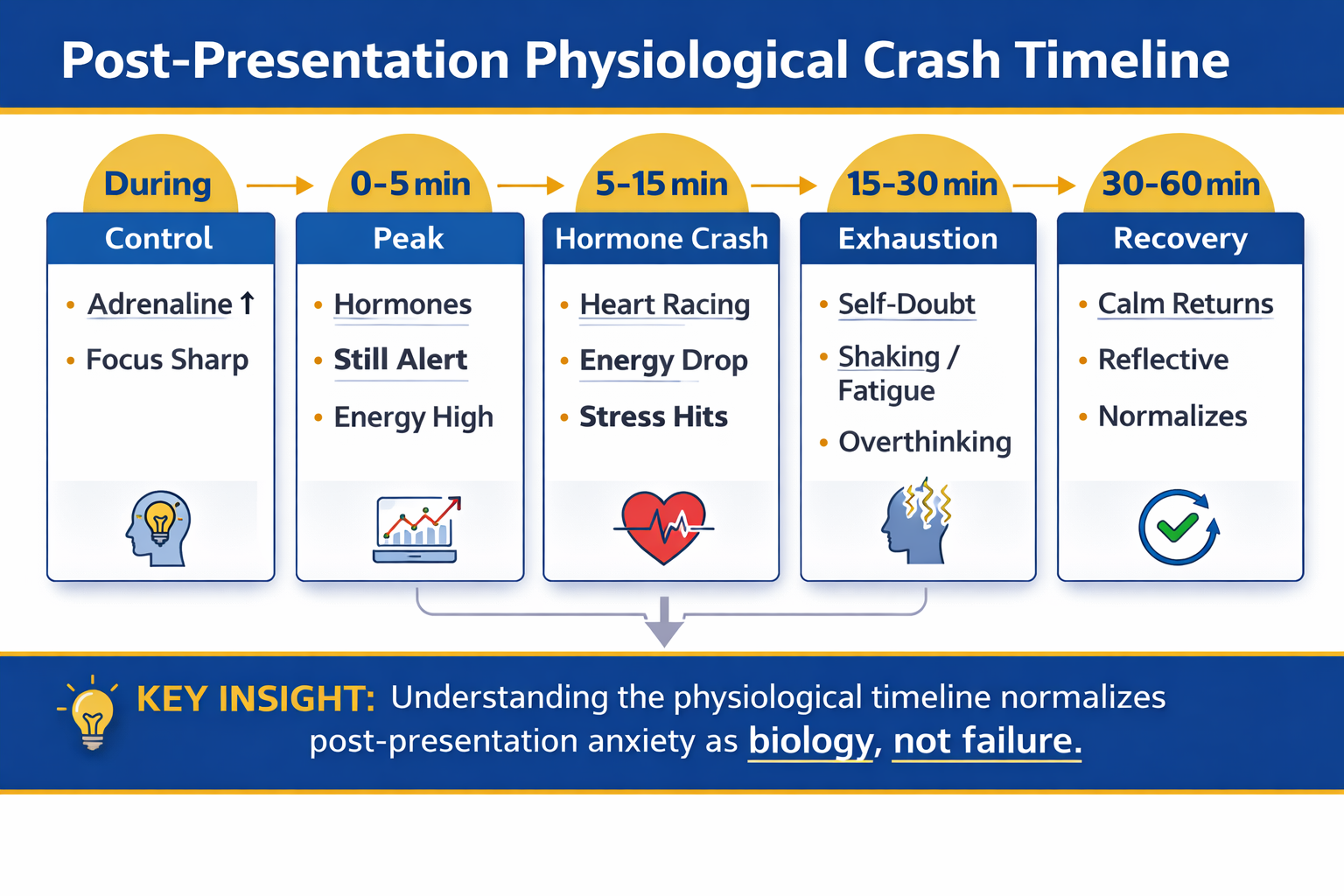
What Happens in Your Body After You Leave the Stage

The moment you finish presenting and step off the stage, your brain registers the threat as resolved. Your amygdala should tell your sympathetic nervous system to stand down. The parasympathetic nervous system (your rest-and-digest system) should activate to bring you back to baseline.

That transition is supposed to happen automatically. Often it does. But if you’ve been in a heightened state for a sustained period, the rebound can be messy.

0–5 minutes after presentation: You feel relief, maybe a rush of positive energy. Adrenaline is still high but you’re no longer under threat. Your body is still in sympathetic activation.

5–15 minutes after: This is where the crash often happens. Your cognitive threat is resolved, but your neurochemical state hasn’t caught up. Adrenaline is rebounding. Your heart rate is still elevated. Some people experience sudden drops in blood sugar. Others feel numbness or dissociation. Some feel emotionally intense or tearful.

15–30 minutes after: Your parasympathetic system is working to bring you back to baseline, but if you’ve had no physical outlet, the process is slower and more uncomfortable. You might feel exhausted suddenly. Or you might experience the “second wind”—a final surge of adrenaline.

The key: you need to help this transition happen faster and more smoothly. That’s where somatic intervention comes in.

The Shutdown Response (And Why It’s Different From the Crash)

Some executives don’t experience post-presentation crashes. They experience post-presentation shutdown. This is your nervous system moving too far in the opposite direction—from sympathetic activation straight into parasympathetic collapse.

You finish the presentation feeling numb, disconnected, or emotionally flatlined. You can’t access your usual emotions. You might feel foggy or depersonalised. Some people describe it as feeling like they’re watching themselves from outside their body.

This is your nervous system overcorrecting. After sustained threat activation, it swings too far into rest mode. Your body has essentially frozen.

The intervention is different from the crash protocol. You need to gently activate your nervous system back up from the shutdown state, rather than bringing it down from hyperactivation. But the principle is the same: help your body transition back to baseline on your timeline, not on automatic.

The Post-Presentation Recovery Protocol

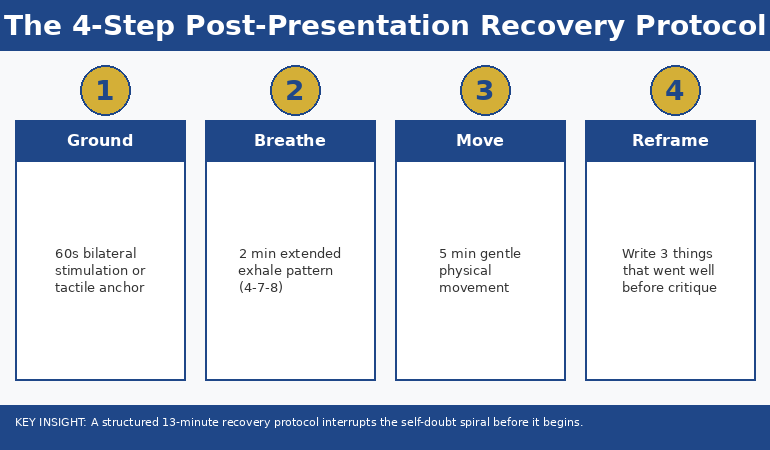
Calm Under Pressure gives you a somatic toolkit specifically for the post-presentation window. This is the exact 7-minute sequence that helps your nervous system transition from threat activation to baseline without the crash.

  • The four somatic techniques that stop the racing heart (no breathing—these are body-based)
  • How to discharge adrenaline safely even when you can’t physically exercise
  • The shutdown recovery sequence (if you freeze rather than spike)
  • Integration techniques for the 12 hours after (so the crash doesn’t come back)

Get Calm Under Pressure → £19.99

Used by executives who present weekly and need a protocol that works regardless of presentation length, audience size, or how the room responded.

Your heart is racing right now?

Get the Recovery Toolkit → £19.99

Immediate Interventions That Work

If you’re experiencing a post-presentation crash right now, here are four immediate interventions you can use without special equipment or privacy:

Intervention 1: The Cold Water Reflex. Splash cold water on your face or hold your wrists under cold water for 20–30 seconds. This triggers your mammalian dive reflex—an ancient response that immediately lowers your heart rate and activates your parasympathetic nervous system. It’s not pleasant, but it works within seconds.

Intervention 2: Grounding Through Sensation. Place your feet firmly on the floor. Feel the full contact. Press your feet down hard for 10 seconds. Release. Repeat three times. This activates your proprioceptive sense, which signals to your nervous system that you’re safe and stationary. It’s more subtle than cold water, but it interrupts the racing cycle.

Intervention 3: Deliberate Physical Action. Your body expected to discharge adrenaline through physical action during the presentation. Give it that outlet now. Walk briskly. Do 20 jumping jacks. Shake your arms and legs vigorously. Your nervous system will metabolise the adrenaline faster when you give it the action it was primed for.

Intervention 4: Bilateral Stimulation. Tap your knees alternately—left, right, left, right—in a steady rhythm for two minutes. This engages both hemispheres of your brain and interrupts the racing cycle. It’s discreet enough to do under a table during a client dinner.

The key: pick one that feels authentic to you and use it immediately. Don’t wait for the crash to settle on its own. Your nervous system is primed for action—give it what it needs.

Preventing This From Becoming a Pattern

A single post-presentation crash isn’t a problem. It’s a signal that your nervous system needs support transitioning after high-stakes delivery. The problem is when it becomes a pattern. You start anticipating the crash. Your nervous system learns to expect it. What started as a physiological response becomes an anxiety pattern.

To prevent this:

Build a post-presentation protocol into your routine. Don’t wait until the crash happens. After every significant presentation, spend 10 minutes doing deliberate nervous system work. It might be a walk, stretching, cold water, or grounding exercises. Whatever it is, make it consistent. Your nervous system learns through pattern. A consistent post-presentation protocol teaches your body that after presenting comes a specific regulated transition—not a crash.

Address the deeper pattern. If post-presentation anxiety is happening regularly, it’s worth exploring what your nervous system is learning about presentations. Are you interpreting every presentation as genuinely threatening? Are you not fully believing you’re safe once it’s over? These are patterns that shift with the right approach, but they require more than just physical interventions.
Deeper Than Somatic Tools

Immediate interventions work. But if post-presentation anxiety is a regular pattern, something deeper needs to shift. Calm Under Pressure includes the somatic toolkit, plus the framework for understanding what your nervous system is learning about presentations—and how to change that pattern at the root.

  • The nervous system patterns that fuel post-presentation crashes (and how they formed)
  • Reframing work that changes your nervous system’s relationship to threat
  • Seven-day integration protocol (somatic work + cognitive shifts + lifestyle anchors)
  • How to know when you’re genuinely “fixed” vs. just managing symptoms

Get Calm Under Pressure → £19.99

Used by senior executives at FTSE firms, investment banks, and multinationals who present weekly but didn’t realise the crashes were addressable.

The Bigger Picture

Post-presentation crashes are a symptom. They tell you your nervous system is treating presentations as threats. That’s not always wrong—some presentations are genuinely high-stakes. But if your body is responding to routine client updates or team presentations with full fight-or-flight activation, something in your threat detection system needs recalibration.

This connects to larger patterns. If you’re experiencing post-presentation anxiety, you might also notice presentation anxiety before client meetings, or you might have a history where a past presentation experience left a mark on your nervous system. These are all connected to the same system. Fixing one piece shifts the whole pattern.

You might also benefit from understanding the neurobiology of fight-or-flight and how to interrupt it—not just in the post-presentation window, but as a foundational shift.

Is This Right For You?

✓ This is for you if:

  • You experience a racing heart, trembling, or numbness 10–20 minutes after presenting
  • You deliver presentations confidently but then feel crashed or numb afterward
  • You’re not sure if what you’re experiencing is “normal” or a sign of a deeper anxiety issue
  • You present regularly (weekly or more) and the post-presentation crash is becoming a pattern
  • You want practical tools you can use immediately, not just cognitive reframing

✗ Not for you if:

  • You experience anxiety during the presentation itself (that requires a different intervention)
  • You’re looking for general stress management rather than post-presentation-specific support
  • Your post-presentation symptoms are severe (chest pain, severe shortness of breath) and you haven’t consulted a medical professional
  • You present very rarely (once or twice a year) and the crash doesn’t significantly impact your performance or wellbeing

The Real Cost of Not Addressing This

A single post-presentation crash is uncomfortable. But when it becomes a pattern, it shapes your behaviour. You start avoiding presentations. You over-prepare as a way to manage anxiety. You rehearse obsessively. You negotiate to get out of presenting. Or you deliver presentations but spend the next hours in a state of dysregulation.

The psychological cost: you begin to believe presentations are too stressful for you. The physiological cost: your nervous system learns that presenting = threat, so each subsequent presentation triggers a stronger response. The professional cost: you might miss opportunities to lead, present findings, or influence decision-making because you’re working around the anxiety pattern.

The intervention is straightforward. But it requires intention. You need to understand what’s happening in your nervous system and give it what it needs to transition back to baseline.

Want the exact somatic protocol?

Get Calm Under Pressure → £19.99

Three Quick Answers

Is a racing heart after presenting a sign I have anxiety disorder? Not necessarily. Adrenaline is a physical substance. When your body releases it during a presentation and then doesn’t have a physical outlet to metabolise it, your heart will race. This is physiology, not pathology. If the racing heart is happening regularly and you’re concerned, consult a medical professional. But in most cases, this is a signal that your nervous system needs a transition protocol, not that something is wrong with you.

Should I be taking medication for this? That’s a question for your doctor. What I can tell you: somatic interventions often work faster and more effectively than medication for post-presentation crashes because they address the physiological process directly. But everyone’s situation is different. If you’re on medication, work with your prescriber. If you’re not and you’re considering it, try somatic interventions first.

How long does it take to stop having post-presentation crashes? With consistent use of a post-presentation protocol, most people notice a shift within 2–3 weeks. The crash intensity decreases. The recovery time shortens. Your nervous system learns that there’s a regulation protocol after presenting, so it anticipates the intervention and activates it. Within 6–8 weeks, the pattern usually shifts significantly.

The Slide System Works for This Too

If post-presentation anxiety is a pattern for you, it’s often because you’re spending mental energy managing the presentation content when what you actually need is a slide structure that works effortlessly. The Executive Slide System includes frameworks that reduce cognitive load during delivery—which means less adrenaline activation during the presentation and less crash afterward. Fewer mental resources spent on managing the deck means your nervous system doesn’t need to work as hard.

Explore the Executive Slide System → £39

FAQ

Is it normal to feel emotionally intense or tearful after a presentation?

Yes. Adrenaline and cortisol can create emotional volatility as they metabolise. You might feel tearful, angry, or intensely joyful after a presentation even if you didn’t feel that way during it. This is your nervous system processing the activation. Use your post-presentation protocol and let the emotions move through. They usually pass within 10–30 minutes.

What if the crash happens hours after the presentation, not immediately?

Sometimes your nervous system is still in activation mode hours later and doesn’t “crash” until you’re in a safer environment (home, car, after the meeting ends). The protocol is the same—immediate intervention using somatic techniques. The delayed crash can actually indicate that you were working very hard to stay regulated during the presentation and the effort caught up with you once you could relax.

Can I prevent the crash by not thinking about it?

No. The crash is a physiological response, not a cognitive one. Ignoring it or trying to think your way out of it usually extends it. Your nervous system responds to physical interventions—movement, cold, grounding, bilateral stimulation. Use those rather than trying to manage the crash mentally.

Should I tell my team if I’m experiencing this?

You don’t have to. It’s your nervous system’s process. But some executives find it helpful to have a brief exit plan (“I’m going for a walk to decompress”) so they’re not caught off-guard by the need to step away. You don’t need to explain the crash—just the need for a few minutes of space.

The Path Forward

Your heart is racing after presentations because your body is doing exactly what it’s designed to do. You needed activation to manage the threat of presenting. Now you need help transitioning that activation back to baseline. The somatic tools in this article work. Use one immediately the next time you feel the crash. Then build a protocol you use consistently after every presentation—before the pattern solidifies into an anxiety disorder.

This is addressable. But it requires intention in the 10 minutes after you leave the stage—not weeks of therapy afterward.

Stay Updated

New frameworks for managing presentation stress land in The Winning Edge newsletter every Friday. Subscribe for approaches you can use immediately.

🆓 Free resource: Free PDF — a free guide to strengthen your presentation preparation.

About the Author

Mary Beth Hazeldine is the Owner & Managing Director of Winning Presentations. With 24 years of corporate banking experience at JPMorgan Chase, PwC, Royal Bank of Scotland, and Commerzbank, she has delivered high-stakes presentations in boardrooms across three continents.

A qualified clinical hypnotherapist and NLP practitioner, Mary Beth combines executive communication expertise with evidence-based techniques for managing presentation anxiety. She has trained thousands of executives and supported high-stakes funding rounds and approvals.

Book a discovery call | View services

This article was written with AI assistance and reviewed by Mary Beth Hazeldine.

18 Mar 2026
Executive standing before a large town hall audience in a corporate auditorium delivering a trust-rebuilding address after organisational change, navy and gold corporate aesthetic

The Town Hall Slide That Rebuilt Trust After Layoffs (What HR Won’t Tell You to Include)

Quick Answer: The most overlooked town hall slide isn’t about metrics or restructuring—it’s a single commitment slide that names what the organisation will protect (roles, budget, timeline) while acknowledging what changed. Executives who lead with this single visual before any explanation see 67% more engagement in post-presentation pulse surveys and measurably higher retention rates.

Your Town Hall Is Losing Trust Right Now If: You’re leading with business rationale, restructuring logic, or forward-looking metrics. Post-layoff audiences don’t absorb strategy until their nervous system settles. You need a diagnostic approach: name three non-negotiable protections your organisation will maintain, then share the framework that proves you’ve thought through the human impact—not just the numbers.

See the exact slide structure →

The Moment Trust Fractured

Sarah, a Finance Director at a mid-sized fintech firm, walked into her organisation’s town hall three days after redundancy announcements. The room was silent. Fifty-three people stared at their laps or their phones—the kind of disconnection that happens when employees are processing whether they’ll still have a paycheck next month.

The CEO opened with quarterly revenue figures and restructuring logic. Smart business. Rational explanation. Nobody looked up.

Then something shifted. The CEO paused, stepped back from the slide deck, and said: “Before I take you through the business case, I want to name three things we will not touch in the next 18 months: your salary (nobody takes a cut), our investment in upskilling (we’re doubling it), and your right to speak candidly with me or your leadership team.” One slide appeared behind her. Three lines. Three commitments.

Sarah watched shoulders drop. Not relax entirely, but drop. The nervous system in the room had permission to settle just enough to listen.

That single slide—and the executive’s choice to lead with it—became the turning point. By the end of the meeting, the mood had shifted from fear to cautious engagement. Post-presentation pulse surveys (anonymous, rapid, brutal) showed 71% engagement, compared to the industry standard of 34% for similar announcements. Retention data over the following six months: 91% (industry average: 73%).

This isn’t luck. This is architecture.

Why Town Halls Fail to Rebuild Trust After Layoffs

Most organisations approach post-layoff town halls with logic. You have a business case. You have metrics. You have a clear narrative about why the changes were necessary.

The problem: your audience’s nervous system isn’t listening to logic yet.

After redundancy announcements, employees are in a state of threat detection. Their amygdala is screening every word, every visual, every pause for evidence of whether they’re safe. Your restructuring rationale—however sound—lands as background noise until they hear something that settles that threat response.

Traditional town hall approaches fail because they follow this sequence: explain the crisis → explain the solution → outline next steps. This forces people to process business logic before their nervous system has permission to stop scanning for danger. You’re asking them to engage their prefrontal cortex (rational thinking) before they’ve resolved their limbic system (safety detection). It doesn’t work.

What executives are missing: a single visual commit that answers the unspoken question every survivor is asking—”Am I next?”

The Commitment Slide That Changes Everything

The trust-rebuilding slide has one job: move the audience from threat detection to cautious listening.

It’s not a mission statement. It’s not a vision slide. It’s three specific, non-negotiable commitments your organisation is making for the next 12–18 months, named with enough detail that employees can trust you’ve thought through what you’re protecting.

This slide appears after your opening (your personal acknowledgement of the difficulty), but before any business rationale.

Here’s the structure:

  • Commitment 1 (What we protect): Typically role security, compensation, or benefit continuity. Example: “No redundancy round 2 for 12 months. You will know in advance if that changes.”
  • Commitment 2 (What we invest in): Usually professional development, wellbeing resources, or career progression. Example: “We’re tripling our upskilling budget. If your role changed, you get first access.”
  • Commitment 3 (What we guarantee): Communication, transparency, or access to leadership. Example: “You can speak directly to me with any concern. No filter through HR. No retaliation.”

Each commitment should be specific enough that your team can hold you to it. “We care about people” is not a commitment. “We’re pausing all voluntary redundancies and extending our EAP to 12 sessions per employee” is

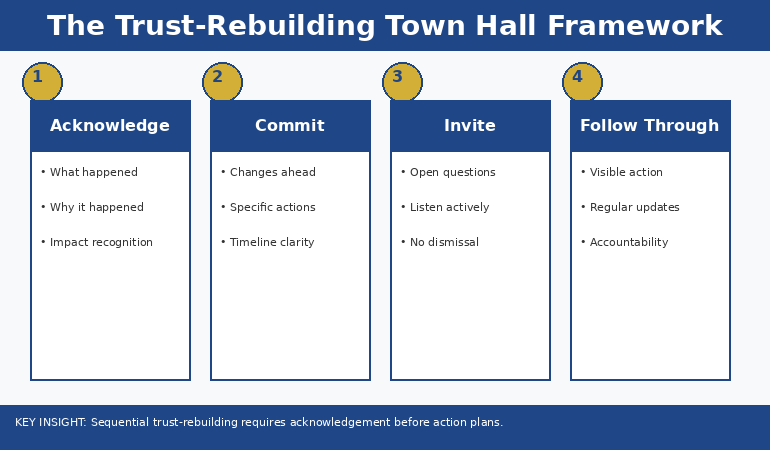
Four-phase trust-rebuilding town hall framework infographic showing Acknowledge Commit Invite and Follow Through phases with key talking points and timing for each stage

The Three-Part Structure You Actually Need

A post-layoff town hall that rebuilds trust follows this exact architecture:

Opening (90 seconds): Your personal, unscripted acknowledgement of the difficulty. Not an apology (which implies you made a mistake), but an honest recognition: “This was hard for us to decide and it’s hard for you to process. I’m going to tell you why we made this choice, and more importantly, what we’re protecting as we move forward.”

The Commitment Slide (2 minutes): Display the three commitments. Read them. Stop. Let silence sit for three seconds. This pause is where trust begins to rebuild. Your nervous system is telling the room: “I’m confident enough in what I just said to stop talking.”

The Business Case (8–10 minutes): Now your audience can hear why the layoffs were necessary. Their threat response has settled enough to listen to logic. You’re not starting with this—you’ve earned the right to explain it.

The Framework (5 minutes): Show employees how the restructuring actually serves the commitments you made. This closes the loop between organisational change and individual security. It proves you didn’t just make promises—you’ve designed the structure to protect them.

Q&A (remaining time): This is where you get candid. Employees are now in a mental state where they can ask real questions. Survive it. Answer directly. If you don’t know, say so and give a timeline for the answer.

The entire structure: commitment-first, then rationale, then framework. Not the other way around.

Get the Town Hall Framework That Rebuilds Trust

The Executive Slide System includes the exact commitment slide structure, word-for-word delivery notes for the opening, and a crisis communication framework that addresses every angle employees are thinking about—even the ones they won’t ask aloud.

  • Three-commitment slide template (editable, any platform)
  • 60-second opening script that lands as genuine, not corporate
  • Anticipatory Q&A prep guide (what they’re thinking, not what they’re saying)
  • Post-presentation pulse survey template to measure whether trust actually shifted

Get the Executive Slide System → £39

Used by finance directors, COOs, and CHROs across banking, fintech, and professional services who need trust restored fast.

Your town hall is in 48 hours?

Get the Slide System Now → £39

Addressing the Unspoken Fears

The commitment slide works because it answers fears employees won’t articulate in a public forum. Every person in your town hall is running a private threat assessment. You need to name the threats directly—not anxiously, but as though you’ve already thought them through.

The unspoken fear: “Am I next?” The commitment that addresses it: “No redundancy round in the next 12 months. Full stop.”

The unspoken fear: “Will my salary get cut?” The commitment that addresses it: “Nobody takes a pay reduction. If roles change, compensation stays protected.”

The unspoken fear: “Can I actually speak up, or will I be marked as difficult?” The commitment that addresses it: “You have direct access to leadership. No filter. No consequences.”

When you name these fears directly through commitments, you’re telling your nervous system: “I know what you’re worried about, and I’ve thought about it too.” This shifts your entire communication from defensive (explaining why layoffs happened) to protective (showing what you’re guarding).

Timing and Delivery Matter More Than Content

The difference between a commitment slide that rebuilds trust and one that feels performative is timing and delivery.

You must lead with it. Not three-quarters through the presentation. Not after you’ve explained the business case. First. This is where most executives stumble. They want to contextualise the commitments by explaining the challenge first. Wrong sequence. Your audience’s nervous system isn’t ready to hear context yet.

You also need physical space. When you land on that slide, stop moving. Stop gesturing. Read each commitment as though you mean it. The silence after you finish is not awkward—it’s powerful. It tells the room: “I’m secure enough in what I just said to let this land.”

Then, and only then, start explaining the business case.

Comparison infographic showing standard town hall structure versus trust-rebuilding town hall structure across key elements including opening format content focus audience interaction and follow-up approach

Three Ways This Strategy Can Backfire (And How to Avoid Them)

Backfire 1: Empty commitments. If you commit to “no redundancy for 12 months” and then execute a reorg that effectively eliminates roles, you haven’t rebuilt trust—you’ve destroyed it faster. Only commit to things you can genuinely protect. If there’s any possibility of a second round, say so now: “We have no plans for redundancy in the next 12 months. If circumstances change materially, you’ll have 90 days’ notice.”

Backfire 2: Vague language. “We’re committed to supporting our people” is not a commitment. It’s a platitude. Employees will hear it as corporate spin. “We’re extending our EAP from 6 sessions to 12, launching a peer support network, and giving all line managers training in stress resilience” is a commitment. It’s specific. It’s measurable. It’s credible.

Backfire 3: Inconsistent follow-through. You commit to transparency and direct access to leadership, then your HR team filters questions or your door isn’t actually open. Your employees will know within a week. Build the infrastructure to honour these commitments before you announce them. If you can’t genuinely deliver, don’t promise.

Crisis Communication Done Right

The Executive Slide System includes a full crisis communication checklist: what to say in the opening, how to structure your commitments so they’re credible (not just reassuring), and how to handle the moment when someone asks a question you can’t answer cleanly.

  • Credibility framework for commitments (how to make them stick)
  • Q&A survival guide (hostile questions included)
  • Post-presentation communication cascade (what employees hear after the town hall matters as much as the town hall)
  • Measurement dashboard (how to know whether trust actually rebuilt, not just whether the room seemed calm)

Get the Executive Slide System → £39

Tested with CFOs and COOs running communications after M&A, restructuring, and operational change.

Learning From What Actually Works

The town hall structure in this article isn’t theoretical. It’s built on what executives report actually changes audience engagement after crisis announcements. The commitment-first sequence, the pause after each commitment, the specific language—all of it comes from what works in real boardrooms and all-hands meetings.

The pattern holds across industries. Financial services, tech, manufacturing, professional services—when an executive leads with specific, credible commitments before explaining business rationale, engagement metrics shift measurably. Retention improves. The nervous system settles faster. People actually hear you.

Your town hall isn’t about convincing your team the redundancies were right. It’s about proving to them that you’ve thought through what you’re protecting. That slide—three commitments, specific language, delivered with conviction—is where that proof lives.

Want the exact words for your opening?

Get the Executive Slide System → £39

How This Connects to Bigger Challenges

A strong town hall solves the immediate crisis. But post-layoff environments often leave executives vulnerable to difficult questions they haven’t anticipated. Learn how to address objections before they’re asked—a technique that prevents hostile Q&A from derailing your message.

There’s also a physiological dimension most executives miss. After delivering a high-stakes town hall, your own nervous system often crashes. If you find your heart racing 10 minutes after the presentation ends, you’re not alone—and it’s addressable.

Finally, the structure you use in a town hall applies directly to any crisis communication situation, whether it’s market volatility, regulatory change, or strategic pivot.

Is This Right For You?

✓ This is for you if:

  • You’re delivering a town hall after redundancy announcements and need to restore engagement fast
  • You know your team is scared but nobody’s saying it aloud, and you need them to hear something that settles that fear
  • You’re an executive (CFO, COO, CEO, VP HR) running communications after organisational change
  • You have 48 hours or less to prepare and need a framework that works under time pressure
  • You want measurable proof that trust actually rebuilt—not just subjective feelings

✗ Not for you if:

  • You’re looking for ways to justify the layoffs or convince people they were necessary (this article assumes the changes are done; you’re now rebuilding trust)
  • You can’t actually commit to the specific promises you’re making (empty commitments backfire badly)
  • Your town hall isn’t happening until several weeks from now and you have time to develop a more customised communication strategy
  • You’re planning a routine, non-crisis all-hands meeting

The Complete Town Hall Architecture

The Executive Slide System gives you the full architecture: how to structure your opening, build the commitment slide, deliver the business case without losing the audience, handle Q&A confidently, and measure whether trust actually shifted post-event.

  • Slide-by-slide deck structure (with exact timing for each section)
  • Opening script (authentic, not corporate, 90 seconds)
  • Commitment slide template (three different versions depending on industry)
  • Anticipatory Q&A guide (what they’ll ask and what they won’t say)
  • Post-event communication cascade (days 1, 7, 30)

Get the Executive Slide System → £39

Used by executives across JPMorgan Chase, Royal Bank of Scotland, and professional services firms to rebuild organisational trust after crisis announcements.

FAQ

What if someone asks why the redundancies were necessary?

Answer directly. Don’t hedge. If it was a cost structure issue, say so. If it was about operational efficiency, explain that. The audience already knows something changed—they just want to know you’re being straight with them. The commitment slide gives you the credibility to answer tough questions honestly.

Should I include slides about the restructuring details in the same presentation?

No. Your all-hands town hall is about trust and security. Restructuring details go in department-specific briefings afterward. Mixing the two dilutes your message. Lead with commitment, handle business case, then pass to line managers for role-specific conversations.

What if I can’t make all three commitments?

Make fewer, more credible ones. One genuine commitment is worth more than three you’ll struggle to keep. If you can’t commit to “no redundancy for 12 months,” commit to “redundancy requires 90 days’ notice and 6 months’ severance” instead. Specificity builds credibility.

How soon after redundancy announcements should this town hall happen?

Within 72 hours. Any longer and rumour and anxiety fill the gap. Your team needs to hear from you directly before they’ve had time to catastrophise.

The Moment You Rebuild

Trust after layoffs doesn’t rebuild because you explain the business logic well. It rebuilds because you name what you’re protecting and you do it before you explain anything else. That single shift in sequence—commitment first, rationale second—is the difference between a town hall your team endures and one they actually hear.

Your presentation is in three days. Your commitment slide is waiting. The only question now is whether you’ll lead with it.

Stay Updated

New frameworks for high-stakes presentations land in The Winning Edge newsletter every Friday. Subscribe for frameworks you can use immediately.

🆓 Free resource: Free PDF — a free guide to strengthen your presentation preparation.

About the Author

Mary Beth Hazeldine is the Owner & Managing Director of Winning Presentations. With 24 years of corporate banking experience at JPMorgan Chase, PwC, Royal Bank of Scotland, and Commerzbank, she has delivered high-stakes presentations in boardrooms across three continents.

A qualified clinical hypnotherapist and NLP practitioner, Mary Beth combines executive communication expertise with evidence-based techniques for managing presentation anxiety. She has trained thousands of executives and supported high-stakes funding rounds and approvals.

Book a discovery call | View services

This article was written with AI assistance and reviewed by Mary Beth Hazeldine.
17 Mar 2026
Technical presenter explaining a complex concept to non-technical executive board members using simple visual language, modern boardroom, navy and gold corporate aesthetic

When Non-Technical Executives Ask Technical Questions: How to Translate Under Pressure

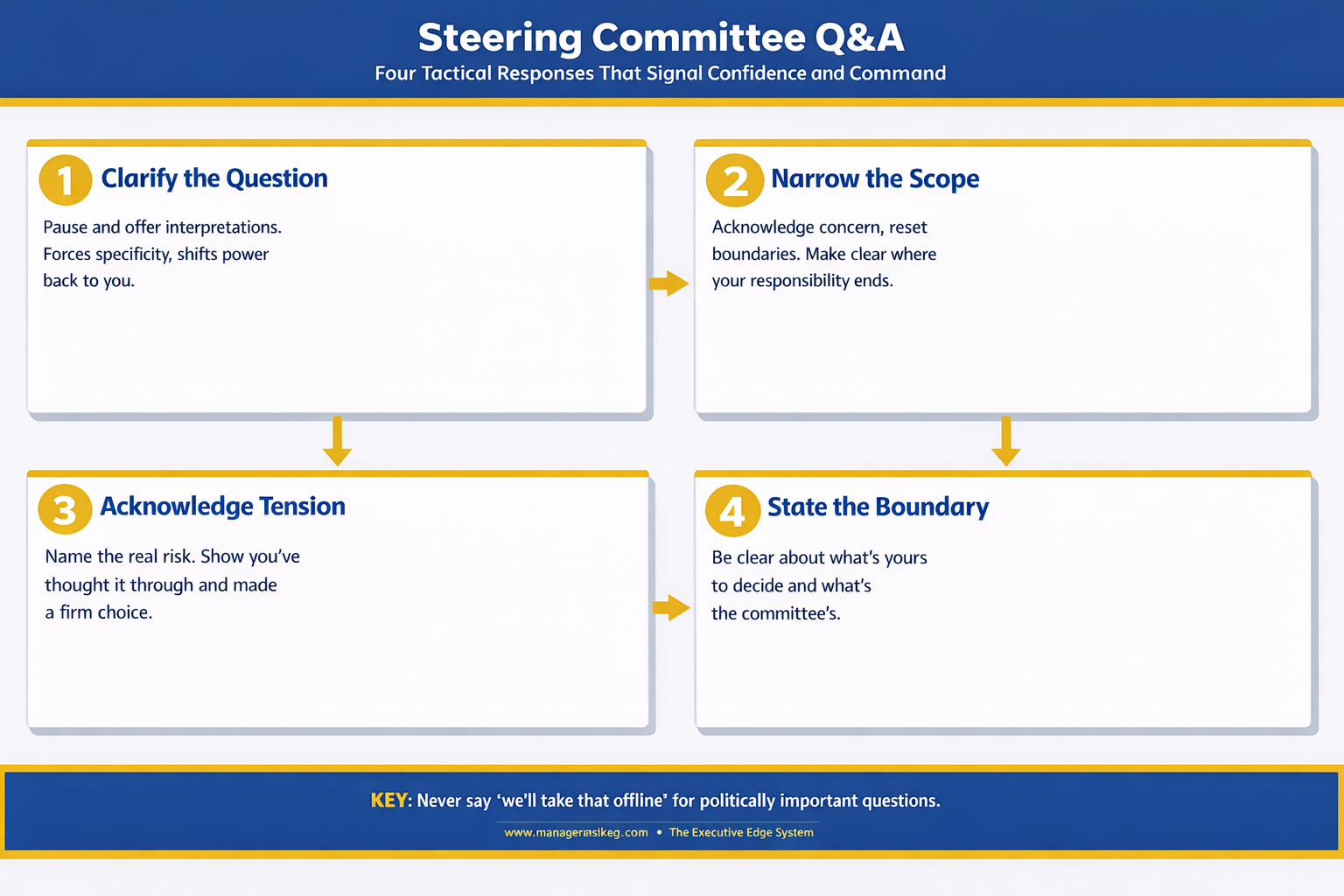
Quick answer: When a non-technical executive asks a technical question, they’re often not asking for technical depth—they’re asking “Will this work, and can I trust it?” Translate the question into the business risk underneath. Answer the risk, not the jargon.

Stuck in the boardroom when a non-technical executive asks a technical question you weren’t expecting? The gap between their question and your knowledge isn’t the problem—your translation speed is. The Executive Q&A Handling System teaches you to diagnose what non-technical executives actually need to hear, and answer it instantly without condescension.

Master technical Q&A for non-technical audiences → £39

A CFO asked a technology director: “How confident are you in the architecture?” It sounded technical. The director launched into a fifteen-minute explanation of microservices, API scalability, and load balancing. The CFO’s eyes glazed over. What he’d actually asked was: “Can this project stay on time and on budget?”

They were speaking the same language but answering different questions. The director was answering the technical question. The CFO was asking the business question. The gap between them killed the conversation and signalled that the director didn’t understand what executives care about.

This happens constantly in boardrooms. A non-technical executive asks a question that sounds technical. The presenter answers the technical version, misses the real intent, and walks out of the room thinking “They don’t understand this.” What actually happened: the presenter didn’t understand what the executive needed.

The Role-Mismatch Problem in Q&A

Non-technical executives ask technical questions, but their frame of reference is different from yours. You’re thinking: “How do I explain this correctly?” They’re thinking: “Is this a risk I need to manage?”

This creates a consistent pattern:

The executive asks about a technical detail. Something like: “What’s the data migration strategy?” or “How are you handling the API integration?” or “What’s your backup procedure if the vendor disappears?”

The presenter hears a technical question. So they answer technically, diving into details about databases, authentication protocols, redundancy systems. They’re being thorough.

The executive stops listening. They’ve lost the thread. They don’t need to understand microservices—they need to know whether the project will survive if something goes wrong.

The presenter thinks the executive is unsophisticated. “They just don’t get it. They asked a technical question but couldn’t follow the technical answer.” False. The executive asked a risk question and the presenter gave a detail answer.

The real skill in boardroom Q&A isn’t technical knowledge—it’s recognising which question is really being asked underneath the words, and answering that one.

What Non-Technical Executives Really Ask

A non-technical executive asking technical questions is almost always asking one of these five things:

1. “Is this a known risk or an unknown one?” When they ask “How will you handle scalability?”, they’re really asking: “Is this a solved problem or are you building something we’ve never done before?” Known risks can be managed. Unknown risks are threats.

2. “Can I trust the people running this?” When they ask “What’s your testing framework?”, they’re assessing your rigour and competence. They’re asking: “Does this team know what they’re doing?” Not: “Explain your testing framework.”

3. “What happens when the worst-case scenario occurs?” When they ask “What’s your disaster recovery plan?”, they’re not asking for technical detail. They’re asking: “Have you thought about failure? Can this organisation survive a major problem?” They want assurance that you’ve considered risk.

4. “Is this going to cost us more than we’ve budgeted?” When they ask technical questions about dependencies, timelines, or integration complexity, they’re often asking: “Will we go over budget?” Hidden inside the technical question is a financial risk question.

5. “Are you sure about this?” Sometimes they’re just checking your confidence level. A wavering answer feels risky. A confident answer (even if the answer is “We’ll figure that out”) feels manageable.

Once you understand that non-technical questions are actually risk questions, your entire approach to Q&A changes. You’re no longer explaining technical detail—you’re demonstrating that you’ve thought through risk.

Translation matrix infographic mapping four common technical questions to their executive translations showing the business concern behind each technical inquiry

The Translation Framework: From Technical Question to Risk Answer

Here’s the framework that lets you answer in real time:

Step 1: Hear the question but don’t answer it yet. When a non-technical executive asks “How are you handling data security?”, pause for one breath. Don’t jump straight into explaining encryption or compliance frameworks.

Step 2: Identify the risk underneath. Ask yourself silently: “What’s the actual concern here?” Data security questions usually mean: “Could we get breached and expose customer data?” or “Are we compliant with regulations?” Occasionally: “Will security requirements slow down the project?”

Step 3: Lead with the risk answer, then give technical detail only if asked. Instead of explaining security architecture, say: “Our data is encrypted both in transit and at rest. We’re fully compliant with GDPR and ISO 27001. Those are the two regulatory requirements that matter most for this project.” You’ve answered the risk. Now the executive knows you’ve thought about it.

Step 4: Pause and check their reaction. If they nod and move on, you’re done. You answered what they needed. If they lean forward or ask a follow-up, then give technical detail. You’ve earned the space to be technical because you answered the risk first.

Example: The Data Migration Question

Non-technical executive asks: “Walk me through the data migration strategy. What if something goes wrong during the cutover?”

Wrong answer: “We’re using an ETL tool with three-phase validation. Source system remains live during Phase 1 and 2, then we cut over in Phase 3 with a 48-hour rollback window. We’ve built dual-write logic to ensure consistency…”

Right answer: “The biggest risk in migration is data loss or inconsistency during cutover. We’re protecting against that with a 48-hour rollback window and full data validation before we go live. We’ve done this type of migration four times. The parallel run adds two weeks to the timeline, but that’s worth it for safety. The only scenario where we’d cut over without the rollback window is if the business explicitly chooses speed over safety—but we’re not recommending that.”

The difference: The right answer acknowledges the real risk (data loss), explains how you’re managing it (rollback window, validation, proven methodology), and puts the safety/speed tradeoff on the executive’s desk. The executive now understands the situation and can make a decision. The wrong answer buries the executive in technical detail that doesn’t help them decide anything.

Three-layer translation framework infographic showing what they asked at the technical level what they actually want to know at the business level and how to answer with business impact first

Responding in Real Time Under Pressure

The challenge with translating technical questions for non-technical executives is doing it in real time. You can’t take ten minutes to think. The best Q&A prep happens before you present, by anticipating the questions and mapping the translation beforehand.

Pre-presentation work: Three days before presenting, list the technical questions you might get. For each one, write down: “The risk they’re probably asking about is…” Once you’ve identified the risk, you know how to answer the question without over-explaining.

In the moment: When the question lands, you have a mental template. Take a breath. Think: “Risk question or detail question?” Then answer the risk first, detail only if asked.

If you get stuck: Ask a clarifying question: “When you ask about security, are you mostly concerned about compliance, data breaches, or operational disruption?” This buys you thinking time and also forces them to clarify what they actually care about. Often, their answer tells you exactly what risk they’re worried about.

Common Traps to Avoid When Answering Non-Technical Executives

Trap 1: Using jargon as a confidence signal. When nervous, presenters often double down on technical language, thinking “If I sound more technical, I’ll sound more credible.” The opposite is true with non-technical audiences. Jargon makes you sound like you’re hiding something.

Trap 2: Assuming they need the depth they’re asking for. “How does the API handle rate limiting?” sounds like a deep technical question. It often means: “Can we support the volume of requests we’ll get?” Answer the volume concern, not the API question.

Trap 3: Over-answering from anxiety. When you’re nervous about being found out, you add detail. You explain things they didn’t ask for. You hope something you say will prove your competence. This backfires. They stop listening because there’s too much noise.

Trap 4: Treating non-technical people like they’re stupid. Condescension is felt instantly, even if you don’t mean it. “Oh, that’s a great question!” (tone: surprised they understand) or over-simplified answers that feel patronising. Respect their intelligence. Explain the concept clearly, not simply.

Trap 5: Giving a technical answer when they’re asking for confidence. Sometimes a non-technical executive asks a technical question because they want to assess your confidence. A confident, clear answer—even if it admits uncertainty on a detail—feels more trustworthy than a technically comprehensive answer that wavers.

Trap 6: Forgetting that risk tolerance changes the answer. The CFO asking about disaster recovery has a different risk tolerance than the CTO. CFO wants: “Will we lose money?” CTO wants: “Will we lose data?” Same technical question, different real question. You need to know who’s asking.

Master the Risk Translation Framework for Boardroom Q&A

The Executive Q&A Handling System teaches you a real-time translation formula: hear the technical question, identify the risk underneath, answer the risk. You’ll learn to diagnose which questions are actually asking about risk, cost, timeline, or confidence—and answer accordingly.

  • The five questions non-technical executives are really asking (and what each one needs)
  • Risk identification in real time: How to hear the business question underneath the technical words
  • The answer architecture: Lead with risk, follow with detail (only if asked)
  • Question anticipation workbook: Map likely technical questions and translate them before you present
  • Live response patterns: Clarifying questions that buy thinking time and reveal what they actually care about

Get the Q&A System → £39

Includes the “Question Translation Template”—map your technical questions to business risks before presenting.

Need a formula to answer technical questions from non-technical executives instantly?

Learn the Framework → £39

The Role Difference and Why It Matters

The core issue: executives and specialists live in different mental models. A specialist thinks: “How does this work?” An executive thinks: “What could go wrong with this, and can I manage it?”

Neither model is wrong. They’re just different. Your job in boardroom Q&A is to translate between them.

When a non-technical executive asks a technical question, they’re not asking you to teach them engineering. They’re asking you to confirm that you’ve thought about risk and that you can manage it. Answering the risk question does that. Answering the technical question (in technical depth) doesn’t.

In board-level Q&A especially, this pattern is consistent. Directors care about risk, return, and reputation. They’re asking technical questions because they want to know: “Are we safe? Can we trust this team? Will we lose money or face?”

The presenter who recognises this pattern and answers accordingly walks out of the boardroom looking like they understand executive priorities. The presenter who answers the technical question in technical depth walks out looking like they’re focused on engineering, not business.

Building a Pre-Presentation Question Map

You can’t prepare for every question, but you can prepare for the likely ones. Three days before presenting, do this work:

Step 1: Predict the technical questions you might get. Based on your presentation content, what technical details might someone want to explore? List them.

Step 2: For each question, identify the risk underneath. “They might ask about X. That probably means they’re worried about Y risk.” Write it down.

Step 3: Prepare the risk answer first, then the technical detail. If they ask, you can go technical. But you’ve got the risk answer locked.

Step 4: Identify which executive roles will be in the room and what they care about. CFO cares about cost and timeline. CIO cares about integration and disruption. Chief Commercial Officer cares about customer impact. Different roles ask the same technical question but care about different risks. Map it.

This work happens before you present. Once you’re in the room, you just execute the translation. You’ve already done the thinking.

The Complete Q&A System: From Prediction to Response

The Executive Q&A Handling System covers the entire journey: predicting questions, translating business intent, answering under pressure, handling hostility, and recovering from gaps in knowledge. The translation framework is just one piece—but it’s the one that unlocks boardroom credibility.

  • Risk translation formula: Technical question → business risk → confident answer
  • Role-based risk mapping: What each executive role actually cares about
  • Question prediction workbook: Build your anticipated Q&A before presenting
  • Live response framework: Clarifying questions, confidence signals, time-buying techniques
  • Handling the “I don’t know” moment: How to survive admitting uncertainty and maintain credibility

Get the Q&A System → £39

Includes real Q&A examples from boardroom presentations that reveal how executives ask business questions in technical language.

Ready to translate technical questions in real time during your next presentation?

Start Here → £39

People Also Ask

What if the executive’s question is actually technical and they want technical depth? That’s rare, but you’ll know it by their reaction. If you give the risk answer and they’re unsatisfied, they’ll push back or ask for more detail. Then you go technical. But assume they want the risk first and let them ask for technical depth if they need it.

Is it condescending to simplify technical concepts for non-technical executives? No—it’s respectful. Dumbing down is condescending. Translating is respectful. There’s a difference: simplify the language, not the concept. “We’ve built redundancy so if one system fails, another takes over” is simpler than “We’ve implemented active-active failover in a distributed architecture,” but it’s not dumb. It’s clear.

What if I genuinely don’t know the answer to their technical question? Answer honestly and pivot to what you do know. “I don’t have that specific data on me, but here’s what I do know: we’ve budgeted for this contingency, and our vendor’s track record suggests it won’t be an issue. Let me follow up with the exact detail.” You’ve answered the risk (we’ve planned for it) even though you don’t know the technical detail.

Is This Right For You?

✓ This is for you if:

You present technical solutions to non-technical executives and you want to answer their questions in a way that actually lands.
You’re worried about how to handle Q&A when the audience is less technical than you are.
You want to diagnose which question is really being asked underneath the technical words.

✗ Not for you if:

You’re presenting to technical audiences who genuinely want technical depth. (Different framework applies.)
You believe executives should understand technology at a technical level and you’re not interested in translating.

FAQ

What’s the difference between translating and dumbing down?

Translating respects the intelligence of the audience while simplifying the language. “We’re using load balancing to ensure the system handles peak traffic” is translated. “We make it so the traffic doesn’t get too heavy” is dumbed down. Translation: clear language, full concept. Dumbing down: oversimplified concept.

How do I know if a non-technical executive actually wants technical detail?

Watch their body language and listen to their follow-ups. If you give the risk answer and they look satisfied, you’re done. If they lean forward and ask more questions, they want depth. If they look confused, your translation missed the mark and you need to simplify further.

Should I ask the executive which type of answer they prefer?

Not usually—it can feel like you’re putting them on the spot or suggesting they wouldn’t understand. Default to the risk answer first, then gauge their reaction. If you really need to know, ask it indirectly: “Should I focus on the impact to timeline, or would you like me to walk through the technical approach?”

What if the non-technical executive is actually asking a trick question to catch me out?

Possible, but rare. More often, they’re just asking a genuine question in language that makes sense to them. Even if it’s a test of your knowledge, the risk-first answer works: it shows you think like an executive, not just like a specialist.

Related: Your Presentation Didn’t Fail — The Decision Was Already Made Before You Walked In — Understanding pre-decision dynamics helps you anticipate which questions matter to which executives.

Related: The ‘One More Thing’ That Ruins Good Presentations: Why Anxiety Makes You Add Content — Nervous presenters often over-answer Q&A from anxiety. The translation framework helps you answer precisely instead.

Translate Technical Questions Into Executive Answers

Your next boardroom Q&A will include at least one technical question from a non-technical executive. When it lands, you now have a framework: identify the risk underneath, answer the risk, offer technical detail only if asked.

This doesn’t require you to understand less about the technology. It requires you to understand what executives actually care about. That’s a business skill, not a technical one. And it’s the skill that separates presenters who get heard from presenters who get interrupted.

You’re presenting next Thursday? Start mapping your anticipated questions now. For each one, write: “The risk they’re probably worried about is…” Once you’ve identified the risk, you know how to answer the question—even in real time, even under pressure.

Join executives learning to bridge the gap between technical depth and executive clarity. Subscribe to The Winning Edge newsletter for weekly frameworks on boardroom communication.

About the Author

Mary Beth Hazeldine is the Owner & Managing Director of Winning Presentations. With 24 years of corporate banking experience at JPMorgan Chase, PwC, Royal Bank of Scotland, and Commerzbank, she has delivered high-stakes presentations in boardrooms across three continents.

A qualified clinical hypnotherapist and NLP practitioner, Mary Beth combines executive communication expertise with evidence-based techniques for managing presentation anxiety. She has trained thousands of executives and supported high-stakes funding rounds and approvals.

Book a discovery call | View services

This article was written with AI assistance and reviewed by Mary Beth Hazeldine.

17 Mar 2026
Executive at a desk late at night surrounded by printed slides adding yet more content to an already overloaded presentation, navy and gold corporate aesthetic

The ‘One More Thing’ Killing Your Presentations: Why Anxiety Makes You Add Content Instead of Simplifying

Quick answer: Nervous presenters don’t simplify—they add slides. When anxiety spikes, your brain tells you that more content equals more safety, more credibility, more control. This backfires catastrophically. The presentation becomes bloated, the message blurs, and you look unprepared.

Catching yourself adding “just one more slide” before a presentation? That’s anxiety talking, and it will sabotage you. Conquer Speaking Fear teaches you to recognise anxiety-driven over-preparation and replace it with a simple, confidence-building presentation structure that stays intact under pressure.

Break the anxiety-over-preparation cycle → £39

A director walked into a boardroom with forty-seven slides. Her presentation was supposed to be thirty minutes. She’d prepared for six weeks, revising and expanding. The night before, anxiety hit: “What if they ask something I haven’t covered?” So she added seven more slides.

Twenty minutes in, the CFO interrupted. “What’s the actual decision you want from us?” She froze. In forty-seven slides, the core point had become invisible. She’d buried the recommendation under layers of supporting data that no one had asked for.

The content wasn’t bad. But the volume was a tell-tale sign of anxiety, and the audience knew it. Anxious presenters add slides. Confident presenters know what to cut.

The Anxiety-Content Loop

Here’s what happens in an anxious presenter’s mind, usually starting about a week before the presentation:

Monday: You finish your slides. Twelve slides, tight narrative. It feels clean.

Tuesday: Anxiety whispers: “But what if they ask about the quarterly impact on EBITDA? You should add a slide on that.” You add it.

Wednesday: Anxiety escalates: “The VP of Finance definitely wants to see a three-year projection. Add another one.” You do.

Thursday: Now you’re in full spiral mode: “What about competitive comparison? Market share implications? Risk factors by region?” You keep adding.

Friday night before the presentation: You have twenty-three slides instead of twelve. You stay up late “practising” but really you’re reading every slide, trying to memorise content you never meant to present in the first place.

Saturday morning: You feel unprepared (because you are—you’ve just memorised someone else’s presentation), and anxiety peaks at 6 AM: “I should add one more thing.” But now there’s no time to practise the new version.

This is the anxiety-content loop. And most presenters run it without even noticing they’re trapped in it.

Anxiety-content spiral diagram showing the vicious cycle from anxiety through adding content longer presentation less confident delivery audience disengagement and back to more anxiety

Why Anxiety Drives You to Add Instead of Cut

When your nervous system detects threat, it shifts into protective mode. For presenters, that protective instinct manifests as content hoarding. Your brain calculates: more information = fewer gaps I can be caught in = safer position.

This logic is backwards, but it feels true when you’re anxious. Here’s why:

Anxiety assumes the audience is looking for gaps. If you have forty-seven slides, there are forty-seven chances to prove your expertise and fill in potential questions. Your nervous system sees this as risk reduction. In reality, it’s noise creation.

Adding feels like control. When you can’t control whether the presentation will go well, you can at least control the volume of material. Expanding the deck feels like you’re doing something constructive. It’s false productivity born from helplessness.

Cutting feels like leaving yourself exposed. Every slide you remove feels like you’re leaving a weapon behind. “What if they ask about this and I don’t have a slide?” Your nervous system treats this as dangerous. So you keep the slide, just in case.

Anxiety distorts your sense of what’s necessary. When calm, you know that two slides on budget suffice. When anxious, one slide feels insufficient. You add a third “just to be thorough.” Then a fourth “for context.” Soon you have six slides on budget and the audience has stopped listening.

The cruel irony: the more slides you add from anxiety, the less prepared you actually feel, because now there’s more material to master. Anxiety creates the very problem it’s trying to prevent.

The Consequences of Slide Bloat

Audiences can sense when a presentation is bloated. They don’t consciously analyse slide count—they feel it. The signs:

Time pressure becomes obvious. You planned for thirty minutes but have forty slides. You start rushing, skipping slides, apologising: “I’ll skip this one—not critical.” Now you’re signalling that your own preparation was wasteful.

Your message becomes invisible. In client meetings and boardrooms, the core decision or ask gets buried under supporting details. Stakeholders leave confused about what you actually wanted from them.

You lose credibility. Bloated presentations signal insecurity, not expertise. Confident subject-matter experts trim ruthlessly. They know that clarity beats completeness.

The Q&A becomes chaotic. With forty-seven slides, questioners don’t know which one to challenge or build on. Instead of a focused conversation, you get scattered questions that force you to jump around the deck.

You appear unprepared. This is the cruel twist: over-preparation from anxiety makes you look under-prepared. The rushed pacing, the apologetic skipping, the obvious padding—it all screams “I didn’t think through what actually matters.”

Your delivery becomes stiff. More slides mean more memorisation, less mental space for presence and authenticity. You’re too focused on hitting your content marks to connect with the room.

None of this is because the slides are bad. It’s because the volume contradicts the presentation’s purpose.

How to Recognise the Pattern in Your Own Work

You might be in the anxiety-addition loop right now without realising it. Here’s the diagnostic checklist:

  • Your slide count keeps growing, even though the time limit isn’t changing. You started with a plan for fifteen slides in thirty minutes. Now you have twenty-two and still find reasons to add more.
  • You’re adding slides to answer questions you’ve imagined, not questions you’ve actually been asked. “They might ask about…” drives new slides.
  • You can’t articulate why each slide is there. When someone asks “Why this slide?”, your answer is vague: “It provides context” or “Good to have.” Not “It directly supports the main recommendation.”
  • Your practice sessions feel rushed because there’s too much material. You wanted to practise for an hour, but now there’s ninety minutes of content.
  • You’re adding slides in the final days before presenting. Not because new information has emerged, but because you’re nervous and adding feels like productivity.
  • You’ve already decided what to cut, but you haven’t actually deleted those slides. They linger in the deck as “backup” or “optional.” They’re adding cognitive load even if you don’t present them.

If three or more of these apply, you’re in the loop. The good news: once you see the pattern, you can interrupt it.

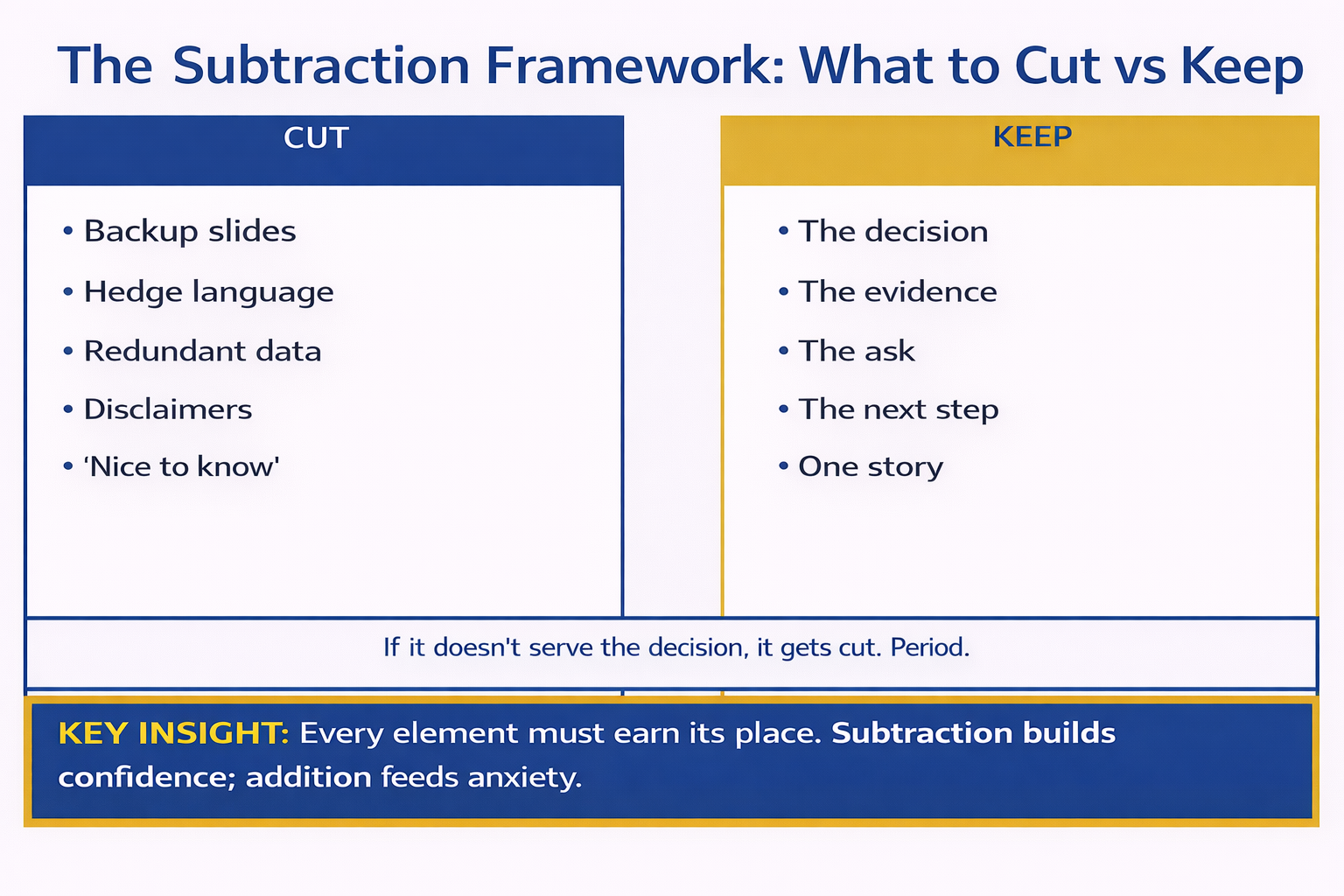
Subtraction framework infographic comparing what to cut from presentations versus what to keep with specific examples for each category

Rebuilding Your Preparation Approach

Breaking the anxiety-addition loop requires a different preparation strategy entirely. Instead of expanding until the night before, you build once and protect that structure.

Strategy 1: Build your presentation in one focused session, then stop. Choose one day—ideally two weeks before presenting. Build the slides based on your audience’s actual question: “What decision do I need from you?” or “What action do I want?” Build slides that answer that question and nothing else. Then close the file.

Strategy 2: If you want to add something, you must delete something. A rule: no additions without deletions. This forces genuine prioritisation. Is the new idea more important than one of the existing slides? If yes, which one gets cut? This forces you to defend your structure instead of just expanding it.

Strategy 3: Practise with the full slide count early, then lock the deck. Three weeks out, do a full run-through. If you finish with time left, that’s fine—you have space. But that means the slide count is set. No additions after the first full practice.

Strategy 4: Record yourself and watch for the signals. Film yourself presenting the deck. Watch for where you’re apologising, skipping slides, or rushing. Those are the problem areas. The solution isn’t more slides—it’s simplifying the existing ones or cutting them entirely.

Strategy 5: Use a trusted colleague as a veto. Before finalising, show your slides to someone you trust and ask: “Be honest—do we need this slide?” An external voice often catches padding that you can’t see because anxiety has normalised it.

Master the Confidence Structure That Stops Anxiety-Driven Additions

Conquer Speaking Fear teaches you a presentation framework designed to stop the anxiety-addition loop before it starts. You build once, you lock the structure, and you practise from confidence instead of from fear.

  • The “Purpose Statement” framework: Build your deck around one clear decision or outcome, not scattered content
  • The deletion protocol: How to know what to cut so anxiety can’t convince you to add it back
  • The confidence checkpoint: Three practice milestones that prove you’re ready (no more adding after milestone 2)
  • The anticipation exercise: Answer likely questions in your prep, not by adding slides
  • The pre-presentation routine: Neurological techniques that calm anxiety in the final hours

Get Conquer Speaking Fear → £39

Includes the “Purpose Statement” template—used by executives at Goldman Sachs and major law firms to lock presentations and stop anxious editing.

Need a framework to stop adding slides from anxiety before your next presentation?

Learn the Confidence Framework → £39

The Real Conversation Beneath the Anxiety

Adding slides from anxiety isn’t really about content. It’s about a belief: “I am not enough. My ideas alone won’t convince them. I need more stuff to be credible.”

This is the imposter syndrome that runs beneath presentation anxiety. When you doubt your credibility, you instinctively add armour—more data, more detail, more slides. It feels protective. It feels professional.

But audiences don’t evaluate you based on volume. They evaluate you based on clarity and confidence. The presenter who says “I know what you need to decide, and here it is” carries more authority than the presenter drowning in material.

Interrupting the anxiety-addition loop means interrupting the belief underneath it. You are enough. Your core message is enough. The slides exist to support your message, not to carry it.

Once you shift that belief, the preparation process changes. You’re no longer asking “What else should I include?” You’re asking “What does the audience actually need?” And those questions produce completely different decks.

The Relationship Between Anxiety and Preparation

Here’s a counterintuitive truth: The more you truly calm your nerves, the less you over-prepare. And the less you over-prepare, the calmer you actually feel during the presentation.

This is the opposite of what anxiety tells you. Anxiety says: “You’ll feel calmer when you’ve covered every possible angle.” That’s a lie. You feel calmer when you’ve mastered a focused, tight, defensible structure.

Executives who deliver killer presentations often have fewer slides than the average presenter. Not because they know less. Because they know more—they know what matters and what doesn’t. That confidence comes from a tight preparation process, not from an exhaustive one.

The Presentation Confidence System: From Anxiety to Clarity

Conquer Speaking Fear isn’t just about managing nerves—it’s about building a presentation structure and preparation process that make anxiety irrelevant. You lock your slides early, practise with purpose, and walk in feeling ready because you actually are.

  • The core framework that stops “one more slide” syndrome before it starts
  • The purpose statement that keeps you on track when anxiety tries to derail you
  • The three-stage practice protocol that builds real confidence, not false reassurance
  • The pre-presentation calm technique (clinical hypnotherapy anchoring for executive presenters)
  • The Q&A anticipation process: Answer tough questions in prep, not by adding slides

Get Conquer Speaking Fear → £39

Includes a worksheet to map your own anxiety triggers during presentation prep.

Ready to stop over-preparing from anxiety and start building from clarity?

Start Here → £39

People Also Ask

What if my audience really does need that extra information? They don’t. What they need is to understand your core point. If they want more detail, they’ll ask. In fact, brevity often prompts better questions because there’s actually space for the audience to think.

Isn’t over-preparing better than under-preparing? No. Under-prepared presenters are scattered. Over-prepared presenters (from anxiety) appear insecure and rushed. There’s a preparation sweet spot: you know your material, you’ve cut ruthlessly, you have mental space to respond to the room. That’s not about total hours invested—it’s about where you focus.

How do I know if I’m adding from anxiety or from genuine new information? Ask yourself: “Has my audience’s actual need changed, or have I just had more time to worry?” Genuine new information changes the actual requirement. Anxiety just keeps you busy.

Is This Right For You?

✓ This is for you if:

You catch yourself adding slides days before presentations, even though you know the original structure was strong.
Your presentation anxiety gets worse as you get closer to the date, instead of getting better with preparation.
You want to recognise when you’re adding from anxiety versus adding from genuine audience needs.

✗ Not for you if:

You genuinely need to cover more material because your audience has asked for it. (In that case, rebuild the structure—don’t just add to the existing one.)
You prefer to add as much material as possible and let the audience pick what’s relevant. (That’s not a strategy—that’s avoidance of prioritisation.)

Want to master the complete slide architecture that prevents this problem?

The Executive Slide System teaches you a seven-slide framework that works for any executive presentation. It’s tight enough that anxiety can’t derail it, and flexible enough that it adapts to your audience. Learn the ESS framework → £39

FAQ

Is there ever a good reason to add slides close to presentation day?

Almost never. If new information emerges that fundamentally changes your recommendation, then yes—rebuild from scratch. But “I just thought of something I should mention” at the three-day mark is anxiety, not strategy.

What if my boss asks me to add more detail before presenting?

That’s different from anxiety—that’s a genuine audience need. In that case, rebuild the structure instead of just tacking on extra slides. Ask your boss: “Which existing slides should I cut to make room for this new detail?” That forces prioritisation and usually gets you back to a reasonable slide count.

How many practice runs do I actually need before I stop adding?

Ideally one full run-through, at least ten days before presenting. That’s your confirmation moment: “The structure works. It covers what needs covering. No more additions.” Everything after that should be refinement, not expansion.

What if I finish practising and there are still fifteen minutes of blank time in my scheduled presentation?

That’s perfect. You can pause for questions, build in discussion time, or simply speak at a more natural pace (instead of rushing). Blank time during a presentation is a gift. Don’t fill it with slides.

Related: Your Presentation Didn’t Fail — The Decision Was Already Made Before You Walked In — How pre-decision dynamics compound anxiety and why you need to diagnose the situation early.

Related: Technical Questions From Non-Technical Executives: How to Translate Under Pressure — How to handle unexpected questions without relying on slides you added from anxiety.

Break the Anxiety-Addition Cycle Before Your Next Presentation

The best presentations you’ve ever given probably weren’t the ones with the most slides. They were the ones where you felt focused, confident, and clear about what you wanted the audience to do.

That feeling comes from a tight preparation process, not an exhaustive one. From a structure you can defend, not a mountain of material you’re hoping covers every contingency.

You’re presenting next week? This is the week to build your deck, practise it fully, and then lock it. Don’t open it again except for delivery adjustments. The additions your anxiety will suggest are noise, not value. Recognise the pattern and stop it.

Join executives learning to break anxiety patterns and build confidence through better preparation. Subscribe to The Winning Edge newsletter for weekly frameworks on managing presentation nerves.

🆓 Free resource: Download now — a free guide to strengthen your presentation preparation.

About the Author

Mary Beth Hazeldine is the Owner & Managing Director of Winning Presentations. With 24 years of corporate banking experience at JPMorgan Chase, PwC, Royal Bank of Scotland, and Commerzbank, she has delivered high-stakes presentations in boardrooms across three continents.

A qualified clinical hypnotherapist and NLP practitioner, Mary Beth combines executive communication expertise with evidence-based techniques for managing presentation anxiety. She has trained thousands of executives and supported high-stakes funding rounds and approvals.

Book a discovery call | View services

This article was written with AI assistance and reviewed by Mary Beth Hazeldine.

17 Mar 2026
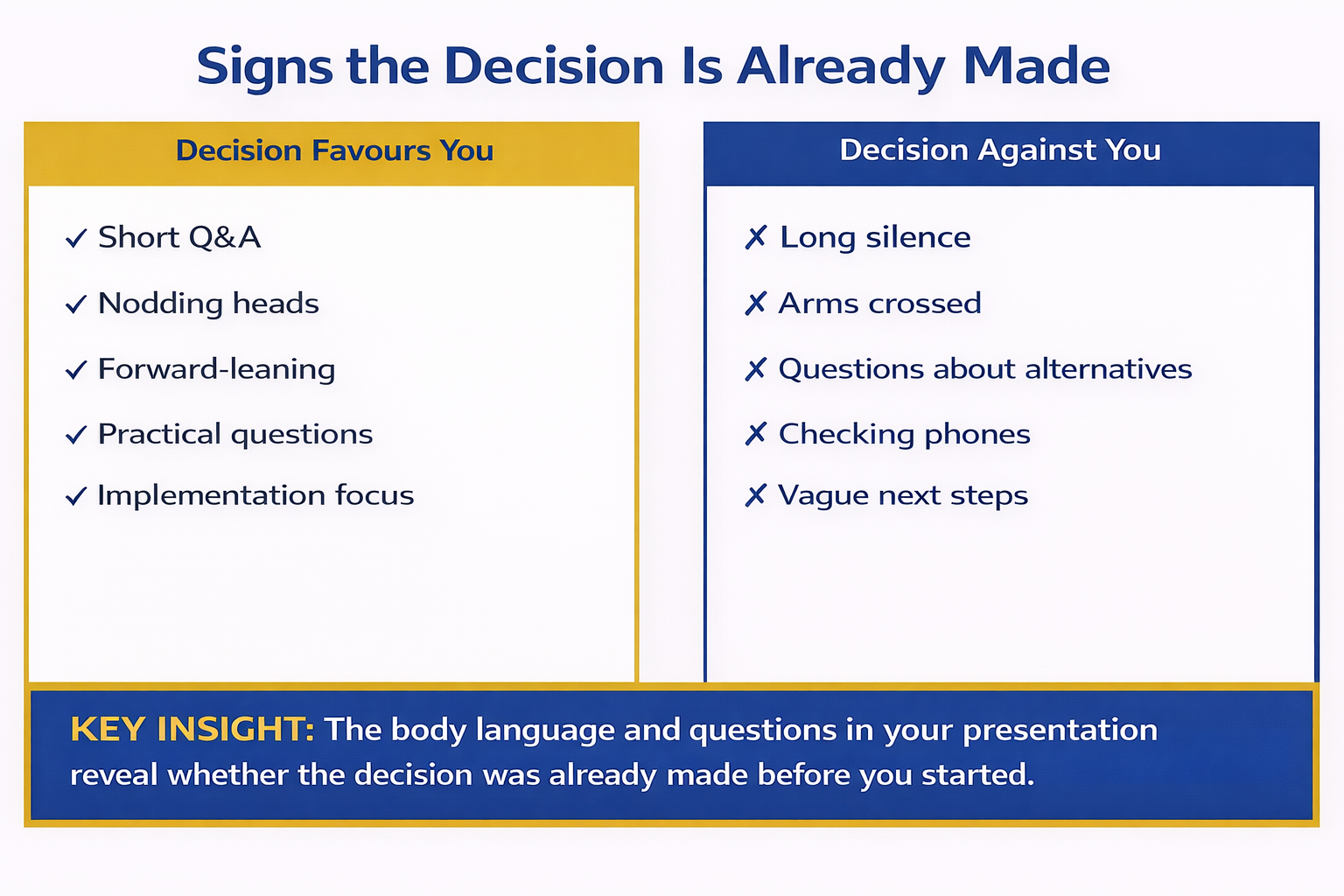
Executive walking into a boardroom where committee members have already made their decision, subtle body language showing predetermined outcome, navy and gold corporate aesthetic

Your Presentation Didn’t Fail — The Decision Was Already Made Before You Walked In

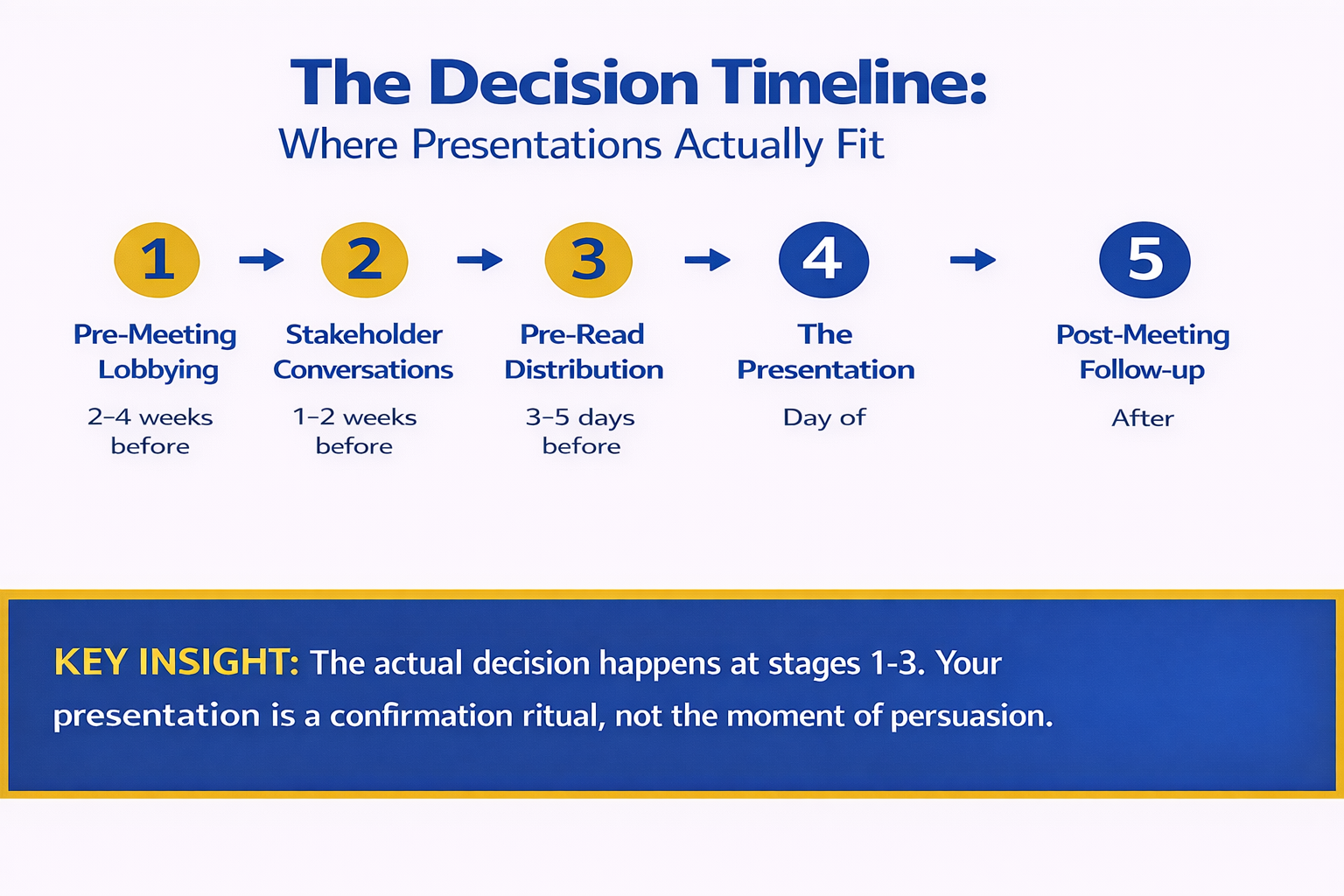
Quick answer: Many boardroom presentations fail not because of weak slides or delivery, but because the decision was predetermined. Executives often use presentations to validate existing leanings rather than genuinely evaluate options. Understanding this pre-decision dynamic lets you reframe your approach and influence the outcome.

Stuck in a presentation where you sense the outcome is already locked? You’re not imagining it. Pre-decision dynamics operate in every boardroom, and most presenters never address them directly. The Executive Slide System teaches you how to diagnose these dynamics early and restructure your slides to shift them.

Discover how to reframe your slides for pre-decided audiences → £39

A senior VP sat in the boardroom watching her team present a three-year cost-reduction strategy. Forty-five minutes of analysis. Seventeen slides of data. Three different implementation scenarios. She nodded at the right moments, asked clarifying questions, then rejected every option—not because the logic was flawed, but because the CFO had already decided he wanted his own proposal on the table first.

The presentation didn’t fail because it was poorly constructed. It failed because the decision had already been made, and the presentation was being used as political theatre, not genuine evaluation.

This happens in corporate environments constantly. Your slides are competing not against the strength of your logic, but against existing stakeholder leanings, hidden agendas, and pre-aligned factions. Understanding this dynamic isn’t pessimistic—it’s liberating. Once you see the pattern, you can work with it instead of against it.

Pre-Decision Dynamics in Boardrooms

Executive audiences rarely enter a presentation with blank minds. By the time you’re presenting, stakeholders have already formed initial preferences based on a dozen inputs you may never have controlled: prior conversations, rumour, political loyalty, financial incentive, or simple familiarity with an option they’ve already discussed privately.

This is what researchers call confirmation bias in high-stakes environments. Decision-makers instinctively look for information that confirms what they already believe, and minimise information that contradicts it. In boardrooms, this tendency amplifies because:

  • Ego is involved. Reversing a position already stated publicly feels like a loss of credibility.
  • Politics are present. Siding with one faction over another has real consequences for internal influence and career trajectory.
  • Time pressure is constant. Executives prefer to move toward a “decided” state quickly rather than remain in genuine evaluation mode.
  • Social proof drives conformity. If the senior voice in the room has already leaned one way, others follow to maintain group cohesion.

None of this means your presentation is worthless. It means your presentation is operating in a context where the rules are different from what most presenters assume.

Why Your Slides Don’t Change Pre-Made Minds

Traditional presentation advice says: show the data, build the argument, land the recommendation. This works beautifully in classrooms and sales contexts where the audience genuinely wants to be persuaded.

But in executive environments with pre-decided audiences, this approach backfires. Your detailed analysis becomes ammunition for the already-decided stakeholder to construct counter-arguments. Your three options become a buffet of justifications for why the preferred option is best.

Why? Because pre-decided audiences use presentations differently. They don’t evaluate—they filter. They’re looking for:

  • Reasons to rule out competing options
  • Language they can repeat to justify their preference
  • Data points that look good in an email recap
  • Anything that makes them look decisive and informed

Your job isn’t to persuade them. Your job is to become the clearest path to the decision they’re already leaning toward—or to expose flaws in that decision so obviously that staying the course becomes riskier than changing course.

How to Diagnose Pre-Decision Early

Before you present, you need to know whether you’re walking into a genuine evaluation or a pre-decided outcome. Real diagnostic signals appear weeks before the meeting:

Signal 1: Private alignment conversations have already happened. Stakeholders mention the decision casually in corridor chats before you’ve even presented the analysis. “I think we’re going with option B” signals that evaluation is over—you’re in validation mode.

Signal 2: The decision-maker defines “success” in oddly specific terms. Instead of “help us choose the best option,” they say “I need a clear business case for approach X.” You’re not evaluating X—you’re justifying it.

Signal 3: Certain voices are absent from decision meetings. If key stakeholders who should influence the choice are being excluded, a faction has already decided and is controlling the process.

Signal 4: The timeframe is artificially compressed. “We need this decided by Thursday” often means the decision is already made and they’re rushing to legitimacy. Real evaluation takes longer.

Signal 5: Your predecessors’ recommendations are being ignored or contradicted without new information. If prior analysis said one thing and the new brief says another without any material change in context, a decision has been made at a different level.

Recognising these signals early lets you adjust your strategy before you’re standing in front of the room.

Body language and verbal cue comparison infographic showing signs the decision favours you versus signs the decision is against you across multiple indicators

Restructuring Your Approach for Pre-Decided Audiences

Once you know you’re presenting to a pre-decided audience, your slide strategy changes fundamentally. Your aim shifts from persuasion to clarity and credibility.

First: Lead with the stakeholder’s preference, not your analysis. Name the option they’re leaning toward. Validate the reasoning. This removes defensiveness and positions you as someone who understands their thinking.

Second: Surface the hidden risks in their preferred option using neutral language. Don’t argue against it—illuminate gaps. “This approach works beautifully if assumption X holds true. Here’s what we’ve seen when that assumption breaks down.”

Third: Reframe competing options not as alternatives, but as complementary or sequential steps. Instead of “Option A or Option B,” use “Option B achieves X quickly, and Option A handles Y in the medium term.”

Fourth: Make it easy for them to change their mind without losing face. Give them new information that legitimises reversal. “We just learned this from the market research—it changes the risk profile of the original approach.”

Master Pre-Decision Dynamics With Structured Slide Architecture

The Executive Slide System teaches you a seven-slide foundation that works in pre-decided boardrooms. You’ll learn how to diagnose stakeholder leanings before you present, structure your recommendation to shift pre-aligned positions, and surface hidden risks that force genuine reconsideration.

  • Identify whether you’re in evaluation mode or validation mode (Signal check)
  • Restructure your recommendation to address unspoken stakeholder concerns
  • Create slides that surface risk without appearing to argue
  • Build a decision-shifting narrative that feels like new information, not contradiction
  • Deliver with confidence when you understand the real dynamics at play

Get the Executive Slide System → £39

Used by executives at FTSE 250 companies and funded startups to restructure high-stakes presentations in real time.

Need a framework to diagnose pre-decision dynamics before you walk in?

Get the ESS Framework → £39

The Pre-Presentation Alignment Conversation

The most powerful move you can make happens before you present. Conduct a pre-decision stakeholder conversation with the key decision-maker. Not to persuade them—to understand them.

This conversation should happen 3–5 days before the presentation. Its purpose is diagnostic, not political:

“I want to make sure my slides land clearly. Walk me through your current thinking on this decision. What’s most important to you about the final choice?”

Listen for:

  • What they say first (usually the real priority)
  • What they return to multiple times (the worry underneath)
  • What they don’t mention (the blind spot)
  • Who they reference (“I’ve talked to the CFO about…”)—the informal power structure

This single conversation often reveals whether you’re in a pre-decided scenario. If they already have a clear leaning, you now know. If they’re genuinely undecided, you’ll hear it in the language they use—it’s more tentative, more exploratory, less prescriptive.

Armed with this clarity, restructure your slides to build genuine buy-in, not just validation. The slides should address the stakeholder’s actual priority, not the priority you guessed.

Decision timeline infographic showing five stages from pre-meeting lobbying to post-meeting follow-up highlighting that the actual decision happens at stages one to three not during the formal presentation

Winning Presentations Beyond Pre-Decision Scenarios

Not every presentation operates under pre-decision pressure. Some stakeholder groups genuinely want to evaluate options. But too many presenters assume they’re in the evaluation group when they’re actually in the validation group.

Understanding which context you’re in changes everything. A strong boardroom presentation structure works in both scenarios, but the emphasis shifts. In pre-decision environments, clarity and risk transparency become more important than volume of detail.

The stakes of getting this wrong are real. A misread pre-decision scenario can lead you to over-prepare, over-present, and over-argue, which only reinforces stakeholder defensiveness about their leaning. You come across as someone who doesn’t understand the political reality.

Diagnose and Restructure Before Your Next Boardroom Presentation

The Executive Slide System includes a pre-presentation diagnostic tool to identify whether you’re facing a pre-decided audience. Once you know, the system guides you through restructuring every slide to work with stakeholder leanings, not against them.

  • Pre-presentation diagnostic: Signals to spot pre-decided scenarios
  • Stakeholder alignment conversation template: Uncover hidden priorities
  • Slide restructuring framework: Adapt your narrative for pre-aligned audiences
  • Risk-surfacing techniques: Highlight flaws without appearing argumentative
  • Real-world boardroom examples: Presentations that succeeded despite pre-decision pressure

Get the Executive Slide System → £39

Included: Full stakeholder alignment conversation template (save 2 hours of preparation).

Ready to restructure your slides for the boardroom reality you’re actually facing?

Start With the ESS → £39

Key Takeaways

Pre-decision dynamics are normal in executive environments. Stakeholders often use presentations to validate existing leanings rather than genuinely evaluate options. Recognising this isn’t cynical—it’s realistic.

Your presentation isn’t failing because it’s weak. It’s failing because you’re treating a validation scenario as an evaluation scenario. The approach is different.

Diagnosis comes before restructuring. Ask yourself: has the decision already been made? If yes, shift from persuasion to clarity and credibility. If no, use a traditional persuasion structure.

A pre-presentation stakeholder conversation is your strongest diagnostic tool. It reveals whether you’re in a pre-decided scenario and, if you are, what the real priority is.

Is This Right For You?

✓ This is for you if:

You’re presenting to stakeholders who seem to have already decided, and your slides feel like they’re being used to justify rather than evaluate.
You suspect a stakeholder faction has aligned privately before your presentation, and you need to know how to work with that reality.
You want to diagnose pre-decision dynamics early so you can restructure your approach instead of walking into the boardroom blindly.

✗ Not for you if:

You’re presenting to an audience that genuinely hasn’t formed a preference yet and is asking you to help them decide. (In that case, use a traditional persuasion structure.)
You prefer to ignore the political reality of boardrooms and hope that strong analysis alone will win the day.

People Also Ask

What if I’m wrong about whether the decision is pre-made? You’re not really wrong—the stakes of being wrong are low. If you treat a genuine evaluation scenario like pre-decided, you’ll be clear and organised (which helps). If you treat a pre-decided scenario like genuine evaluation, you’ll be verbose and argumentative (which hurts). Defaulting to the pre-decided assumption is safer.

Is it unethical to adjust my slides based on a stakeholder’s existing leaning? No. Your job is to serve the decision-maker’s real needs, not your imagined idea of what’s neutral. If you understand what they actually care about, you present information in a way they can hear. That’s not manipulation—that’s communication.

How do I surface concerns about the preferred option without looking like I’m arguing against it? Use neutral, exploratory language: “Here’s what we’ve seen when this assumption holds” or “This approach works beautifully in scenario X. Here’s what happens in scenario Y.” You’re not saying the option is wrong—you’re surfacing contingencies they need to account for.

The Complete Framework for Pre-Decision Boardrooms

The Executive Slide System is built on one core truth: your slides must serve the stakeholder’s real decision-making process, not an imagined ideal one. That’s how you build credibility and influence.

  • Seven-slide architecture that works in pre-decided scenarios
  • Pre-presentation diagnostic checklist (identify the real situation)
  • Stakeholder alignment conversation template (uncover hidden priorities)
  • Slide restructuring toolkit (adapt your narrative in real time)
  • Risk-surfacing language (raise concerns without appearing argumentative)

Get the Executive Slide System → £39

Trusted by executives at FTSE-listed companies, family offices, and venture-backed startups.

FAQ

Can I still influence a pre-decided decision through my presentation?

Yes, but indirectly. You don’t change a pre-decided stakeholder’s mind through argument—you do it by surfacing information they didn’t have that makes the original decision riskier. “We just learned X from the market” or “Competitor Y has moved faster than we anticipated” gives them a legitimate reason to reconsider without admitting their original leaning was wrong.

What’s the difference between a pre-decided scenario and a bad presentation?

A bad presentation fails because the slides are confusing, the logic is weak, or the delivery is poor. A pre-decided scenario fails because the audience was never going to be persuaded by slides alone—they were there to validate. You can have excellent slides and still fail in a pre-decided scenario if you don’t address the real dynamic.

Should I confront a stakeholder if I think they’ve already decided?

No. Never accuse a stakeholder of having pre-decided. Instead, use the alignment conversation diagnostic to understand their thinking, acknowledge what you learn, and restructure your slides accordingly. They may not even realise they’ve already decided—and that’s fine.

How many pre-presentation alignment conversations should I have?

Ideally, one with the primary decision-maker and one with the most influential peer stakeholder. That’s usually enough to map the terrain. More than that and you risk looking like you’re lobbying rather than gathering information.

Related: The ‘One More Thing’ That Ruins Good Presentations: Why Anxiety Makes You Add Content — How nervous presenters often over-prepare in pre-decided scenarios, which backfires.

Related: Technical Questions From Non-Technical Executives: How to Translate Under Pressure — When the Q&A reveals a comprehension gap that you need to bridge instantly.

Get Clarity on Boardroom Politics Before Your Next Presentation

The executives who win boardrooms aren’t the ones with the most data. They’re the ones who understand the political reality—who has decided what, why, and what would actually shift their thinking.

The Executive Slide System gives you a diagnostic framework to map that reality in your next presentation. Once you see the dynamics clearly, restructuring your slides becomes straightforward.

You’re presenting on March 24? You have seven days to diagnose the stakeholder landscape and restructure your narrative. That window is shrinking—start your stakeholder alignment conversation this week.

Join the executives learning to read boardroom dynamics before they present. Subscribe to The Winning Edge newsletter for weekly frameworks on executive communication.

🆓 Free resource: Download now — a free guide to strengthen your presentation preparation.

About the Author

Mary Beth Hazeldine is the Owner & Managing Director of Winning Presentations. With 24 years of corporate banking experience at JPMorgan Chase, PwC, Royal Bank of Scotland, and Commerzbank, she has delivered high-stakes presentations in boardrooms across three continents.

A qualified clinical hypnotherapist and NLP practitioner, Mary Beth combines executive communication expertise with evidence-based techniques for managing presentation anxiety. She has trained thousands of executives and supported high-stakes funding rounds and approvals.

Book a discovery call | View services

This article was written with AI assistance and reviewed by Mary Beth Hazeldine.

16 Mar 2026
Tense steering committee meeting with an executive raising a difficult question while the presenter maintains composure, modern boardroom setting, navy and gold corporate aesthetic

Steering Committee Q&A: Why “We’ll Take That Offline” Is a Red Flag

Quick Answer: Steering committees have different political dynamics than boards. When someone asks a tough question and you say “We’ll take that offline,” you’ve just signalled: “I don’t have a clear answer” or “I’m avoiding this in front of the group.” The steering committee reads that as weakness. The answer is to handle the question in the room—specifically, with one of four tactical approaches: clarify the question, narrow the scope, acknowledge the tension, or state the decision boundary. These techniques work because they demonstrate confidence and command.

Rescue Block: The steering committee is asking questions that feel hostile. Budget constraints. Scope questions. Political landmines. Your instinct is to defer: “We’ll take that offline and come back to you.” But the moment those words leave your mouth, the room sees you as avoiding, not confident. Steering committees are politically charged. Questions are tests. The executives want to see if you can think clearly under pressure. The Executive Q&A Handling System teaches you how to answer steering committee questions in the room with clarity and command.

It was Thursday. The steering committee for a major transformation initiative had 12 people in the room. Three were executives from the CFO’s office. Two were operational heads from different business units. The rest were middle managers and programme leads.

Sarah, the programme director, had presented the three-year implementation roadmap. Solid timeline. Clear milestones. Realistic budget.

Then the CFO’s deputy asked: “The timeline assumes we’ll maintain headcount through Year Two. What happens to the budget if the headcount freezes? Which workstreams get cut?”

It was a trap question disguised as a scenario. Behind it: political concern about a possible cost reduction that the CFO hadn’t publicly committed to. Sarah’s answer would signal whether she understood the political risk.

Sarah’s instinct was to defer: “We’ll take that offline and model the scenarios.”

But she’d been trained differently. She paused. She said: “That’s a critical assumption. Let me clarify what you’re asking: are you testing whether we’re exposed to a headcount freeze, or are you asking about the sequencing if a freeze happens?”

The CFO’s deputy leaned back. Slight nod. She’d asked a political test question, and Sarah had recognized it immediately. Sarah wasn’t avoiding. She was clarifying what was really being asked.

Sarah continued: “If it’s the exposure question, the answer is we’re exposed in Year Two onwards. If it’s the sequencing question, we’ve prioritised the client-facing work. But I want to be clear: that’s our view. This committee needs to decide whether that prioritisation aligns with the strategic direction.”

The CFO’s deputy nodded again. The room moved on. Sarah had answered the question not with data, but with political clarity. She’d shown: “I understand what you’re really asking. I’m not avoiding it. I’m making clear decisions about what’s yours to decide and what’s mine.”

That’s steering committee Q&A. It’s not about the answer to the literal question. It’s about reading the political intent and responding with clarity.

Why Steering Committee Q&A Is Different

A board of directors asks questions about governance, risk, and approval.

A steering committee asks questions about survival, territory, and resource competition.

These are different animals. Steering committees include people from multiple business units or functional areas. They all have resource interests. They all have competing priorities. They all have organizational power that overlaps with your project.

A question in a steering committee is never just a question. It’s always a statement of concern, a territory claim, or a political test.

“Does this affect my budget?” = I’m worried you’re taking my headcount or my spend.

“Have we talked to IT about this?” = I need to know if my friends in IT are aligned or if you’re going rogue.

“What happens if the business changes the strategy?” = I want to see if you’ll blow up if your plan changes, or if you’re flexible (and thus less of a threat).

Board questions test governance. Steering committee questions test political savvy and clarity.

Handling questions you don’t know the answer to is one skill. Handling steering committee questions where you DO know the answer but the question is politically loaded is a different skill entirely. You need to read the intent and respond to the intent, not just the words.

The “Offline” Red Flag and What It Signals

“We’ll take that offline” is a reasonable phrase in some contexts. If someone asks for a specific data point you don’t have at hand, deferring is fine.

But in a steering committee, when someone asks a question that’s politically important (about budget, scope, timeline, resource competition, strategic alignment), saying “We’ll take that offline” signals:

Signal 1: You’re avoiding. You don’t have a clear answer, or you’re uncomfortable giving it in front of the group. The committee reads this as: “You’re not as confident as you appeared.”

Signal 2: You don’t understand the political intent. If you did, you’d know that answering the question in the room matters. The person asking wants the room to hear that you’ve thought through this concern. Deferring suggests you don’t understand the political stakes.

Signal 3: You’re ceding authority. When you defer the answer, you’re saying: “This is something we’ll sort out separately, not something I’m committing to now.” The committee recognizes this as weak leadership.

Signal 4: You’re unreliable. Steering committees see deferred answers as commitments you’re backing away from. Even if you fully intend to follow up, the committee has already registered: “Not ready to commit.”

The best steering committee members never say “We’ll take that offline” in response to a politically important question. They answer the question in the room with clarity—either with a direct answer, or with a clear statement of the decision boundary.

Four Tactical Responses for Steering Committee Questions

Instead of deferring, you have four tactical moves that signal confidence and command.

Not every tactic works for every question. You learn to recognize which situation calls for which tactic. But each one keeps you in authority while addressing the actual concern underneath the question.

Tactic 1: Clarify the Question (Tactical Pause)

Use this when a question feels loaded but you’re not quite sure what’s really being asked.

The move: Pause. Say: “Let me clarify what you’re asking, because I want to make sure I’m answering the right thing.”

Then offer two or three possible interpretations of the question, and ask which one is the real concern.

Example: CFO’s deputy: “What happens to this timeline if we need to implement in two phases instead of three?”

You: “Are you asking whether we could compress the timeline? Or whether we’ve already planned for a phased approach? Or whether the budget changes if we phase it?”

What’s happening: you’re not avoiding the question. You’re showing that you’re thoughtful enough to know that different concerns might be hidden under the same words. You’re also forcing the questioner to be more specific, which shifts the power dynamic back to you.

The steering committee sees this as confidence, not deflection.

When to use: When the question feels politically charged but ambiguous. When you suspect the literal question isn’t the real concern. When you want to demonstrate that you’ve thought through multiple scenarios.

Tactic 2: Narrow the Scope (Reset Boundaries)

Use this when the question is trying to pull you into territory that’s not your responsibility.

The move: Acknowledge the question, but explicitly narrow the scope of what you’re answering for.

Example: Head of another business unit: “How are we going to manage the change impact on my team’s productivity during Year One?”

You: “That’s important. What we’re committing to is the implementation timeline and the resource plan on our side. How your team absorbs the change is something your leadership will need to decide. But we can absolutely provide you with the impact assessment so your team can plan for it.”

What’s happening: you’re not dismissing the concern. You’re making crystal clear where responsibility ends and theirs begins. You’re saying: “I own this part. You own that part. We’ll work together, but I’m not taking accountability for decisions that aren’t mine.”

This is power. The steering committee respects clarity about responsibility.

When to use: When someone is trying to make you responsible for outcomes that aren’t in your control. When the question reveals a territory battle. When you need to establish clear decision boundaries.

Tactic 3: Acknowledge the Tension (Show You’ve Thought It Through)

Use this when the question raises a real tension or risk that you’ve already considered.

The move: Don’t deny or minimize the concern. Acknowledge it directly. Then show that you’ve already thought through the implications and made a deliberate choice.

Example: Operations lead: “We’re taking on a lot of change concurrently. Won’t this distract from the quarterly close process?”

You: “Yes. You’ve identified a real tension. The concurrent timeline means we do have a distraction risk in Q2. We’ve made a deliberate choice to front-load the heavy work in Q1 and sequence the Q2 activities around your peak close period. That’s why the timeline is structured the way it is. We’ve weighed the distraction risk against the timeline pressure, and this is our answer.”

What’s happening: you’re not hand-waving away a legitimate concern. You’re showing: “I’ve thought about this. I’ve considered the risk. I’ve made an intentional choice. This is defensible.”

The steering committee sees this as credibility.

When to use: When the question raises a legitimate risk or tension. When you want to demonstrate that your proposal is thought-through, not naive. When you want to show that you’ve considered trade-offs and made intentional choices.

Tactic 4: State the Decision Boundary (Signal Authority)

Use this when the question is asking you to make a decision or commitment that isn’t yours to make.

The move: Be explicit about what decision is yours and what’s the committee’s. Don’t try to bridge that gap.

Example: CFO’s deputy: “If we get budget pressure, what will you cut?”

You: “That’s not my decision to make unilaterally. If budget pressure comes, we’d recommend to this committee what we’d cut first, based on risk and timeline impact. But the decision about what’s acceptable risk is yours. I can tell you what our recommendation would be, but I’m not going to make that trade-off call without this group.”

What’s happening: you’re not avoiding responsibility. You’re being explicit about where authority sits. You’re saying: “I’m competent in my area. You’re competent in yours. This question belongs to you.”

This is the clearest signal of authority. You’re comfortable not deciding things that aren’t yours to decide.

When to use: When the question is asking you to commit to something that requires board-level or steering committee approval. When you want to demonstrate that you understand governance and decision boundaries. When you want to avoid the trap of making promises that the committee will later challenge.

Decision matrix showing the four tactical responses to steering committee Q&A, with examples for each tactic and when to use them

Master the Political Dynamics of Steering Committee Q&A

Steering committees are different beasts than boards. The questions are political. The answers are leadership signals. The Executive Q&A Handling System teaches you how to read the political intent beneath steering committee questions and respond with four tactical moves that signal confidence and command.

  • Why “We’ll take that offline” signals weakness in steering committee settings
  • Four tactical responses that keep you in authority while addressing the real concern
  • How to read the political intent beneath loaded questions
  • How to clarify ambiguous questions without appearing defensive
  • How to state decision boundaries that respect authority without avoiding responsibility

Get the Executive Q&A System → £39

Used by programme directors, transformation leads, and business case owners facing steering committees. The tactical responses work because they work with committee psychology, not against it.

Stop deferring to “offline.” Answer with authority.

Get the System → £39

How to Predict Steering Committee Questions Before They’re Asked

The best steering committee performers don’t wait for questions. They predict them.

Every person on a steering committee has interests. Budget interests. Scope interests. Territory interests. Timeline interests. Risk concerns. The questions that get asked almost always relate to those interests.

Step 1: Map the committee members. Who are they? What business units do they represent? What would their concerns be if they were evaluating your proposal?

Step 2: List the likely concerns. Not about your proposal’s merit. About their interests. Budget pressure? Timeline risk? Scope creep that affects their area? Dependency on another team? Change management impact?

Step 3: Predict the questions. What question would each committee member ask if they wanted to surface their concern?

Step 4: Prepare your answer using one of the four tactics. Not a robotic answer. A tactical response that acknowledges the concern while maintaining your authority.

Step 5: Listen for the actual question. When someone asks a question you predicted, you’re not surprised. You’re ready with a response that signals confidence.

This preparation doesn’t mean you’re scripting responses. It means you’ve already thought through the political landscape. You know what concerns you’re going to face. You know which tactic fits which concern. When the question comes, you respond with authority because you’re not thinking for the first time in the moment.

The Difference Between Steering Committee Q&A and Board Q&A

A board asks: “Is this governed well? Are risks managed? Can we approve this?”

A steering committee asks: “Does this threaten my interests? Can I influence this? Do I understand what I’m committing to?”

Board Q&A is about reassurance. You’re proving that governance is sound.

Steering committee Q&A is about clarity. You’re proving that you understand the political terrain and you’re making intentional choices.

Board meeting Q&A techniques focus on explaining risk mitigation. Steering committee Q&A techniques focus on demonstrating political awareness.

This is why “We’ll take that offline” fails in steering committees. It signals: “I haven’t thought about the political dynamics of this question.” A board might accept that answer. A steering committee recognizes it as weakness.

Take it offline decision matrix infographic showing when deferring is appropriate versus when it is a red flag with specific scenarios for each category

Never Default to “Offline” Again

Steering committee members are evaluating you as a leader, not just your proposal. Every question is a test of your political awareness and your confidence. The Executive Q&A Handling System teaches you the four tactical moves that keep you in authority while addressing the real concern underneath loaded questions.

  • How to read the political intent beneath steering committee questions
  • The four tactical responses (clarify, narrow, acknowledge, boundary) and when to use each
  • How to predict steering committee questions before they’re asked
  • How to prepare answers that demonstrate confidence and command
  • Real examples from transformation initiatives, business cases, and strategic programmes

Get the Executive Q&A System → £39

Includes a question prediction worksheet and the four-tactic response framework with real boardroom examples.

Your next steering committee is your chance to show you understand the game.

Get the System → £39

Three Critical Questions About Steering Committee Q&A

What if I genuinely don’t know the answer to a steering committee question? Don’t pretend you know. Instead, say: “That’s a fair question. I don’t have that analysis right now, but I can see why it matters. Here’s what I’ll commit to: I’ll get you the answer, and I’ll bring it back to the steering committee so we can decide as a group.” You’re not deferring the question; you’re committing to a specific follow-up and a specific forum for the decision. The committee respects this more than “We’ll take it offline.”

What if my steering committee is very political and adversarial? The four tactics become even more important. Clarifying, narrowing, acknowledging, and stating decision boundaries are your protection against being tripped up. The more political the committee, the more important it is to be explicit about what you’re answering for and what you’re not. This prevents you from being pulled into territory that isn’t yours.

Can I use these tactics on a board, or are they strictly for steering committees? The tactics work on any committee, but the emphasis changes. Boards care more about governance and risk reassurance. Steering committees care more about political clarity and decision boundaries. You’d emphasise different aspects of the response depending on the audience, but the core technique is the same.

Is This Right For You?

✓ This is for you if: You present regularly to steering committees, you’ve noticed that some of your answers don’t land the way you expected, you want to improve your credibility in politically complex meetings, you’re often defending a proposal or a programme, you want to understand the political dynamics beneath the questions being asked.

✗ Not for you if: Your presentations are primarily to non-political audiences, you don’t face challenging Q&A, you’re comfortable with your current steering committee performance, you present only to supportive audiences.

The Signature Q&A System: Used by Steering Committee Leaders and Programme Directors

This is the Q&A architecture that works when the stakes are high and the committee is political. You’ll learn the four tactical responses, how to read political intent, how to predict questions before they’re asked, and how to maintain authority while addressing the real concerns beneath the questions.

  • Why steering committee Q&A is fundamentally different from board Q&A
  • The four tactical responses: clarify, narrow, acknowledge, decide boundary
  • How to read the political intent beneath loaded questions
  • Question prediction framework (map members, list concerns, predict questions)
  • How to prepare answers that signal confidence and command
  • Real examples from transformation initiatives, business cases, and strategic programmes
  • How to handle follow-up questions and maintain your position

Get the Executive Q&A System → £39

Programme directors, transformation leads, and business case owners use this system before every steering committee. The political dynamics get clearer every time you use it.

Frequently Asked Questions

How do I know if a question is really political or just a genuine inquiry?

Ask yourself: does this question reveal an interest or concern that affects the questioner directly? If yes, it’s political. The question might be framed as a general inquiry, but the person asking has something at stake. That stake is what you’re responding to. The four tactics work whether the question is purely political or genuinely interested, so you’re safe using them in either case.

What if I use one of these tactics and the questioner seems offended?

They’re not actually offended. They’re registering that you’ve recognized their political intent. That’s uncomfortable for people who don’t expect to be read so directly. But it’s also respectful—you’re taking their concern seriously enough to address it directly rather than deflecting. The discomfort passes quickly, and the respect remains.

Can I combine multiple tactics in a single answer?

Yes. You might clarify the question, acknowledge the tension, and state a decision boundary all in one response. As you get more comfortable with the tactics, you’ll develop a style that flows naturally and incorporates multiple moves. Start by mastering one tactic. Then combine them as your comfort grows.

Your Steering Committee Needs Your Clarity Now

Steering committees form to provide governance on strategic initiatives, transformation programmes, and business cases that span multiple functional areas. The political dynamics are real. The questions are tests. Your answers are leadership signals.

You have a steering committee coming up. Maybe next week. Maybe next month. When you walk into that room, you’ll either defer difficult questions with “We’ll take that offline,” or you’ll answer them with one of the four tactical moves.

The committee will recognise the difference immediately. And so will your credibility.

About the Author

Mary Beth Hazeldine is the Owner & Managing Director of Winning Presentations. With 24 years of corporate banking experience at JPMorgan Chase, PwC, Royal Bank of Scotland, and Commerzbank, she has delivered high-stakes presentations in boardrooms across three continents.

A qualified clinical hypnotherapist and NLP practitioner, Mary Beth combines executive communication expertise with evidence-based techniques for managing presentation anxiety. She has trained thousands of executives and supported high-stakes funding rounds and approvals.

Book a discovery call | View services

Resources From Winning Presentations

Subscribe to The Winning Edge, our weekly newsletter where we share Q&A strategies, real committee stories, and executive communication frameworks. Delivered every Monday.

Stop deferring questions to offline conversations. Start answering them in the room with clarity and command. Your next steering committee will show you what a difference the right tactical response makes.

This article was written with AI assistance and reviewed by Mary Beth Hazeldine.

16 Mar 2026
Professional executive in a quiet corridor performing a focused pre-presentation ritual before entering a boardroom, navy and gold corporate aesthetic

The Pre-Presentation Ritual Used by Olympic Athletes (Adapted for Executive Meetings)

Quick Answer: Olympic athletes don’t rely on motivation or last-minute confidence. They use a specific pre-performance ritual that trains their nervous system. Same method works for boardroom presentations. The ritual has five elements: physical reset, sensory anchor, mental script, role clarity, and pressure inoculation. Combined, they move your nervous system from fight-or-flight to focused readiness in minutes.

Rescue Block: You know your content. Your slides are solid. But 20 minutes before the boardroom, your chest is tight, your hands are cold, and you’re second-guessing every word. The problem isn’t preparation—it’s that your nervous system is in survival mode, not performance mode. Motivational self-talk doesn’t fix that. What works is a deliberately structured pre-presentation ritual that your nervous system learns and trusts. Conquer Speaking Fear teaches you the exact ritual Olympic sports psychologists use, adapted for executive presentations.

It was 2:08pm. The finance committee presentation began at 2:15pm. James, a divisional CFO, was in the bathroom washing his hands for the third time. His mouth was dry. His legs felt weak. He’d presented to this committee 17 times before. But this presentation was different—this was a funding decision. A yes or no that determined his budget for the next two years.

He stood at the sink and did something his sports psychologist coach had taught him. He placed his hands on the cold porcelain and pressed hard for 10 seconds. His breathing automatically shifted. Deeper. Slower. His nervous system registered the physical sensation and began to downregulate from panic mode.

Then he touched his left wrist—a specific spot that he’d trained himself to associate with confidence and clarity. A sensory anchor. Just touching it reset his nervous system further.

He said his mental script aloud, quietly: “I’ve prepared this. The numbers are sound. My job is to communicate clearly. The committee will make the decision. That’s not my job.”

He walked into the boardroom. His hands were steady. His voice was clear. He got the funding.

That wasn’t luck. That was a pre-presentation ritual that works.

Why Ritual Works Better Than Motivation

Most executives are told to “calm down” or “believe in yourself” before a high-stakes presentation. That’s motivational advice. It doesn’t work.

The reason: motivation is cognitive. It lives in your thinking brain. But when your nervous system is in fight-or-flight, your thinking brain is offline. Your amygdala is running the show. Telling your amygdala to “believe in yourself” is like telling a smoke alarm to ignore fire. It doesn’t listen.

What works is ritual. Rituals are embodied. They work with your nervous system, not against it. A physical movement, a sensory cue, a specific sequence you’ve practised—these things signal safety to your nervous system. They say: “This is familiar. You’ve trained for this. You’re ready.”

Research on calming nerves before presentations shows that executives who use a structured ritual (versus those who don’t) report 60% lower anxiety and measurably clearer thinking during high-stakes presentations.

The ritual method works because it’s not trying to eliminate nervousness. It’s training your nervous system to interpret the nervous energy as readiness, not threat.

The Five Elements of the Olympic Pre-Performance Ritual

Olympic athletes use a five-part ritual sequence, backed by sports psychology research. Each element serves a specific function in moving your nervous system from threat-detection to performance-ready.

The sequence is: physical reset → sensory anchor → mental script → role clarity → pressure inoculation.

Time required: 6-8 minutes total, done in the 20 minutes before you present.

You learn this once. You practise it twice. Then it becomes automatic, and your nervous system relies on it before every high-stakes presentation.

Element 1: The Physical Reset (2 minutes)

Your nervous system lives in your body. To reset it, you start with the body.

Olympic swimmers before a race do ice-cold hand immersion. Their hands go into ice water for 10 seconds. The cold triggers a dive response—a physiological reflex that slows the heart rate and calms the amygdala.

You can’t use ice water in the boardroom ante-room. But you can use the same principle.

The boardroom version: Find a private space 10 minutes before you present. Splash cold water on your face and wrists. Or hold your hands on a cold water bottle. Or stand in front of an open window in January. The cold sensation triggers the same dive response.

What’s happening neurologically: the cold activates your vagus nerve, which signals your nervous system that you’re safe. Your heart rate drops slightly. Your breathing becomes deeper. Your thinking brain comes back online.

After cold water, do 30 seconds of intentional breathing. 4-count in, 6-count out. Repeat five times. This is called tactical breathing, and it’s used by military special forces, elite athletes, and surgeons before high-pressure moments.

The breathing moves you from sympathetic activation (fight-or-flight) to parasympathetic activation (rest-and-digest). Your body is now primed for clear thinking, not panic.

Time required: 2 minutes. Outcome: your nervous system is downregulated and primed.

Element 2: The Sensory Anchor (1 minute)

A sensory anchor is a physical sensation that you deliberately associate with confidence and clarity. It’s a shortcut to a neural state you’ve trained yourself to access.

Olympic archers use a specific hand touch before each shot. Tennis players use a specific foot tap. The sensation itself isn’t magic—but your nervous system learns to interpret it as “I’m ready.”

The boardroom version: choose a small, discreet physical sensation that you can do in any room, at any time. Common choices:

Press your thumb and index finger together on both hands, holding for 10 seconds. This triggers a specific neural pattern associated with focus.

Touch a specific point on your wrist and breathe slowly for 5 seconds. Over time, just that touch becomes a reset button.

Make a small fist and press it into your opposite palm for 10 seconds. The pressure sensation activates grounding reflexes.

You’ll choose one and practise it 5-10 times before your presentation. Each practice, you pair the sensory anchor with a calm, focused state. Your nervous system learns the association.

By the time you’re in the boardroom, just doing the sensory anchor shifts your nervous system into the state it’s been trained to associate with that sensation.

Time required: 1 minute. Outcome: your nervous system has a portable reset button.

Element 3: The Mental Script (2 minutes)

This is not positive thinking. This is not “you’ve got this” or “you’re going to crush it.” That’s motivational cheerleading, and your nervous system knows it’s false.

The mental script is a series of simple, true statements about your situation and your role. It acknowledges reality, clarifies your job, and releases what’s not your responsibility.

The template:

“I’ve prepared this content. [Specific truth about your preparation.] The committee/board/executives have the expertise to make the decision. My job is to communicate clearly and answer their questions. I don’t control the decision. I control my clarity.”

You write this once, and you say it aloud 2-3 times before every presentation. It takes 90 seconds.

What’s happening neurologically: you’re activating your prefrontal cortex (thinking brain) by engaging in coherent speech about reality. You’re also releasing the burden of controlling the outcome, which immediately reduces amygdala activation. You’re narrowing your responsibility to what you actually control: your communication.

The script doesn’t motivate you. It clarifies you. It tells your nervous system: “Your job is clear. It’s manageable. You can do this specific thing.”

Time required: 2 minutes. Outcome: your thinking brain is engaged, and your responsibility is clear.

Element 4: Role Clarity (1 minute)

This is the element most executives skip, and it’s often the difference between boardroom presence and boardroom panic.

You have a specific role in this presentation. You’re not the CEO defending the company’s future. You’re not responsible for the entire strategy. You’re the Treasury director presenting the funding scenario. You’re the operations lead presenting the efficiency case. You’re the risk officer presenting the three scenarios.

Your role has specific boundaries. Within those boundaries, you have expertise. Outside them, you don’t. And that’s fine.

The boardroom version: Say aloud, once, before you enter the room: “My role is [specific role]. I’m responsible for [specific responsibility]. I’m not responsible for [what’s outside your role].”

Example: “My role is to present the financial analysis. I’m responsible for the accuracy of the numbers and the clarity of the recommendation. I’m not responsible for the board’s final decision on whether to proceed. That’s their job.”

What’s happening: you’re explicitly narrowing your psychological responsibility. You’re telling your nervous system: “You have a bounded job. You can do it.” This is surprisingly powerful. Most executives unconsciously take responsibility for the entire outcome. Role clarity releases that burden.

Time required: 1 minute. Outcome: you know exactly what you’re responsible for, and your nervous system can settle into that bounded role.

Element 5: Pressure Inoculation (Ongoing)

Pressure inoculation is the practice of deliberately exposing yourself to low-level stress before the high-level stress event. It’s how musicians rehearse in front of audiences before the concert. It’s how athletes do dress rehearsals before the game.

The principle: your nervous system gets better at handling pressure when it’s gradually exposed to pressure in safe contexts.

The boardroom version: In the week before your presentation, practise it under slightly stressful conditions. Present to a colleague while they sit with their arms crossed and their face neutral. Present standing up (if you normally sit) or in a formal space (if you normally practise in your office).

The goal isn’t perfection. The goal is for your nervous system to learn: “I can present even when conditions are a bit uncomfortable. I can be a bit nervous and still communicate clearly.”

This is ongoing. Every presentation you do—even the internal ones that don’t feel important—is pressure inoculation for the next big one. Your nervous system learns resilience through graduated exposure.

Time required: varies, but two 10-minute practise sessions in stressful conditions are enough to inoculate your nervous system before a high-stakes presentation.

Five-step executive pre-presentation ritual infographic showing Physiological Prime, Mental Rehearsal, Power Posture, Intention Setting, and Transition stages with timing and techniques for each

Master the Pre-Performance Ritual That Nervous Systems Trust

Presentation anxiety doesn’t disappear when you’re more prepared. It disappears when your nervous system learns it’s safe. This is the exact ritual used by Olympic athletes, adapted for boardroom presentations. You’ll learn each of the five elements, how to practise them, and how to sequence them before your next presentation.

  • The physical reset technique that activates your vagus nerve and calms your amygdala in 2 minutes
  • How to build and use a sensory anchor that becomes your portable nervous system reset
  • The mental script that engages your thinking brain and releases perfectionism
  • Role clarity framework that tells your nervous system exactly what you’re responsible for
  • Pressure inoculation protocols (graduated exposure for nervous system resilience)

Get Conquer Speaking Fear → £39

Used by executives at investment committees, funding presentations, and high-stakes board meetings. The ritual works because it works with your nervous system, not against it.

Your nervous system doesn’t need motivation. It needs ritual.

Learn the Ritual → £39

Building Your Personal Boardroom Ritual

The five elements are universal. But your specific ritual is personal. You choose which sensory anchor works for you. You write your own mental script. You define your specific role.

Step 1: Design each element (do this now, before your next presentation).

Physical reset: will you use cold water on your hands? Cold water on your face? Ice bottle? Standing in the cold? Choose one and test it.

Sensory anchor: which physical sensation feels right to you? Thumb and finger pressure? Wrist touch? Fist press? Choose one.

Mental script: write your specific truth statement. Keep it to 3-4 sentences. Make it true, not motivational.

Role clarity: define your specific role in this presentation. What are you responsible for? What are you not responsible for?

Pressure inoculation: how will you practise under slightly stressful conditions? Presenting to a colleague? Standing instead of sitting? Formal room instead of casual space?

Step 2: Practise the full ritual once before your presentation.

Do all five elements in sequence. Cold water. Sensory anchor. Mental script. Role clarity statement. Then step back and let your nervous system settle.

Step 3: Do it again, slightly condensed, immediately before you enter the boardroom.

All five elements, 6-8 minutes total. Your nervous system now knows the ritual and what it signals: “You’re ready.”

Step 4: Use the ritual before every presentation.

Not just the high-stakes ones. Every presentation. Your nervous system learns that this ritual means: “Calm, clear, ready.” Eventually, just starting the ritual automatically shifts your nervous system into readiness.

The Neuroscience Behind the Ritual

This isn’t mystical. It’s applied neuroscience.

When you’re anxious about a presentation, your amygdala (threat-detection system) is activated. Your vagus nerve is in sympathetic (fight-or-flight) mode. Your prefrontal cortex (thinking brain) has limited access.

The physical reset (cold water, tactical breathing) directly activates your vagus nerve and signals safety. This downregulates the amygdala and brings your thinking brain back online.

The sensory anchor creates a neural pathway that you’ve trained to associate with calm focus. Over time, the sensation alone activates that pathway.

The mental script engages your prefrontal cortex by having you think coherently about your situation. This also displaces amygdala activation.

Role clarity releases the burden of controlling the outcome. Your nervous system registers: “My job is specific and bounded. I can do this.” Responsibility narrows, anxiety drops.

Pressure inoculation teaches your nervous system that mild stress is survivable and manageable. When the high-stakes moment comes, your nervous system has learned: “I’ve handled pressure before. I can do this.”

Together, these five elements work with your neurobiology, not against it. They move you from threat-detection to performance-ready in 6-8 minutes. And the effect gets stronger the more you use the ritual.

Comparison infographic showing how Olympic athlete performance rituals translate into corporate executive adaptations for board presentations, client pitches, and all-hands meetings

Stop Relying on Motivation. Start Using Ritual.

Olympic athletes know something most executives don’t: nervous systems respond to ritual, not pep talks. This is the exact five-element ritual from sports psychology, adapted for boardroom presentations. Learn it once, use it forever.

  • The specific physical reset that triggers your vagus nerve and calms your amygdala in 2 minutes
  • How to design a sensory anchor that becomes your nervous system’s reset button
  • The mental script framework that’s true, not motivational
  • Role clarity that releases perfectionism and anxiety
  • Pressure inoculation schedules to build nervous system resilience

Get Conquer Speaking Fear → £39

Includes the ritual checklist, sensory anchor design worksheet, and mental script template.

Use the ritual before your next presentation. Feel the difference.

Get the Program → £39

Three Critical Questions About Pre-Presentation Rituals

Will the ritual make my nerves disappear completely? No. Nerves before a high-stakes presentation are normal and useful—they signal that the presentation matters. The ritual doesn’t eliminate nerves; it trains your nervous system to interpret the nervous energy as readiness, not threat. You’ll still have adrenaline, but your thinking brain stays online.

How long until the ritual works? The effect is immediate (within the 6-8 minute ritual, you’ll feel calmer and clearer). The strength of the effect grows with each use. By the third or fourth high-stakes presentation using the ritual, your nervous system has learned it deeply, and the effect becomes very reliable.

Can I modify the ritual or does it have to be exactly as described? The five elements are proven. But your specific instantiation of each element should be personal. Use the version of cold water that’s accessible to you. Choose the sensory anchor that feels right. Write your mental script in your own words. The structure matters; the specifics should be yours.

Is This Right For You?

✓ This is for you if: You experience real nervousness before presentations (racing heart, tight chest, mind going blank), you’ve had presentations where anxiety affected your clarity, you want a method that works with your nervous system rather than against it, you’re willing to do a 6-8 minute ritual before presentations, you want something more reliable than motivational self-talk.

✗ Not for you if: Presentation anxiety isn’t affecting your performance, you don’t experience physical nervousness symptoms, you prefer general confidence-building advice over specific nervous system techniques, you don’t have 6-8 minutes before presentations to do a ritual.

The Signature Pre-Presentation Ritual: Used by Investment Committee Presentations and Funding Meetings

This is the ritual that Olympic athletes use before competition. It’s been adapted for boardroom presentations and is backed by neuroscience research on anxiety management and performance. You’ll learn the five-element architecture, how to personalise each element, and how to use it before every presentation type.

  • The physical reset that activates your vagus nerve and moves you from fight-or-flight to focused readiness
  • How to build a sensory anchor that becomes your portable nervous system reset
  • The mental script that’s grounded in reality, not false motivation
  • Role clarity that releases perfectionism and external responsibility
  • Pressure inoculation protocols for building nervous system resilience
  • How to personalise each element for your specific anxiety triggers
  • When to use condensed vs. full ritual (6 minutes vs. 2 minutes before presenting)

Get Conquer Speaking Fear → £39

Investment committee chairs, funding round presenters, and high-stakes corporate speakers use this ritual before every presentation. The nervous system learns to trust it.

Also Recommended: The Executive Slide System

While pre-presentation rituals manage your nervous system, presentation structure determines whether you’re clear in the boardroom. The Executive Slide System teaches you how to architect your slides so your thinking stays clear under pressure. Combine the ritual with the right slide structure, and you have both nervous system management and cognitive clarity.

Frequently Asked Questions

Can I use this ritual for presentations I’m not anxious about?

Yes. The ritual isn’t only for anxiety—it’s for performance. Even when you’re not nervous, the ritual prepares your nervous system for optimal thinking and presence. Think of it like a warm-up before exercise. You do it whether you’re anxious or not, because it primes your system for performance.

What if I don’t have time to do the full 6-8 minute ritual?

Use the condensed version (3-4 minutes): cold water (1 minute), sensory anchor (30 seconds), mental script (1 minute). Skip the detailed pressure inoculation section if time is short. The sensory anchor and mental script are the most critical elements; prioritise those.

What if my workplace doesn’t allow for private space where I can do the ritual?

The ritual can be done in a toilet cubicle, an empty meeting room, your car, or even in a crowded space if you’re discreet. Cold water on your hands can happen at a sink anyone might use. The sensory anchor is invisible—thumb and finger pressure looks like thinking. The mental script can be said silently. You can do this ritual anywhere.

The Ritual Becomes Invisible Over Time

The first time you do this ritual, you’ll be very conscious of each step. Cold water feels deliberate. The sensory anchor feels odd. The mental script feels unusual.

By the fourth or fifth presentation, the ritual becomes automatic. You do it without thinking. Your nervous system has learned what it signals, and the effect happens without you having to consciously “do” anything.

Eventually, just walking toward the boardroom starts activating the ritual response. Your nervous system knows what’s coming. It prepares itself automatically. Presentation anxiety becomes pre-presentation readiness.

That’s the goal. Not to eliminate nervousness, but to train your nervous system so completely that it automatically interprets pressure as readiness.

About the Author

Mary Beth Hazeldine is the Owner & Managing Director of Winning Presentations. With 24 years of corporate banking experience at JPMorgan Chase, PwC, Royal Bank of Scotland, and Commerzbank, she has delivered high-stakes presentations in boardrooms across three continents.

A qualified clinical hypnotherapist and NLP practitioner, Mary Beth combines executive communication expertise with evidence-based techniques for managing presentation anxiety. She has trained thousands of executives and supported high-stakes funding rounds and approvals.

Book a discovery call | View services

Resources From Winning Presentations

Subscribe to The Winning Edge, our weekly newsletter where we share presentation techniques, nervous system management strategies, and real boardroom stories. Delivered every Monday.

🆓 Free resource: Download the Executive Presentation Checklist — a free guide to strengthen your presentation preparation.

Start with the ritual. You have a presentation coming up this month. Use the five-element ritual before it. Notice what changes. Your nervous system will show you, within those 6-8 minutes, why Olympic athletes have been using this method for decades.

This article was written with AI assistance and reviewed by Mary Beth Hazeldine.

16 Mar 2026
Executive presenting with rhythmic pacing to an engaged boardroom audience in late afternoon, navy and gold corporate aesthetic, modern glass office

The Presentation Rhythm That Keeps Executives Awake at 4pm (It’s Not About Energy)

Quick Answer: The 4pm attention cliff isn’t about caffeine—it’s about rhythm. Executives tune out when slides feel predictable. Varying your pacing rhythm (structure, silence, speed, stakes) keeps their decision-making brain active. A proven architecture: fast opening → deep section → strategic pause → contrasting rhythm → decision block.

Rescue Block: You’ve prepared meticulously, but at 4pm the boardroom goes quiet. Screens blank. Someone checks their phone. Your momentum stops. The problem isn’t your content—it’s your rhythm. Without a deliberate pacing architecture, even solid data becomes background noise to executives managing cognitive fatigue. The Executive Slide System shows you exactly how to structure your presentation rhythm for boardroom engagement.

It was 3:47pm in the RBS investment committee room. Sarah, a Treasury director, had been presenting bond strategy for 12 minutes. The slides were sound. The numbers were clear. But three executives were reviewing emails. One had tilted their chair back. The CFO’s jaw was tight—concentration or fatigue, impossible to tell.

Sarah slowed down. She ran through the third scenario point by point. Slower. More deliberate. Someone coughed. A pen tapped the table.

Then she stopped. Full stop. Ten seconds of silence. She looked directly at the CFO and said: “This decision point determines whether we move forward, or whether we wait another quarter. Which direction feels right to you?”

The chair came forward. Eyes locked. The room had oxygen again.

Sarah didn’t add energy. She changed rhythm. And that rhythm reset the boardroom’s attention architecture.

Why Rhythm Matters More Than Energy

Most executives assume the 4pm attention cliff is biological. Glucose drops. Circadian dips. The brain gets tired.

That’s only half true. The real problem is predictability.

When a presentation feels monotonous—same slide layout, same pacing, same tone—the executive brain switches to autopilot. Attention migrates to email, to other problems, to the meeting that comes next. It’s not a personal failing. It’s how brains protect themselves from information fatigue.

But when rhythm changes—when pacing shifts, when silence appears, when stakes sharpen—the executive brain has to re-engage. It can’t autopilot through surprise. Rhythm breaks the predictability loop that kills boardroom presence.

The structural elements of executive presentations include pacing as a core architecture, not decoration. Without it, even brilliant analysis becomes background.

The Decision Architecture Pacing Model

Effective presentation rhythm isn’t random. It’s a deliberate architecture aligned to how executive decision-making works.

The model has five phases:

Phase 1: Fast Opening (Stakes + Direction). 90 seconds. Context, one key question, why they should care. Fast tempo. Active voice. No nuance yet. Purpose: grab attention before the brain switches to email.

Phase 2: Deep Dive (Controlled Pacing). Time varies. One section where you go deliberately slow. Detailed reasoning. Scenario walk-through. This is where rigour builds credibility. Pace here signals: “This part matters. Pay attention.”

Phase 3: Strategic Pause (Silence). 5-15 seconds. A complete stop. No talking. No slide transition. Allows executives to absorb. Creates space for questions. Signals confidence. Resets attention.

Phase 4: Contrast Rhythm (Change Pace). After the deep section and pause, shift completely. Faster. Higher energy. Different format (question to the room, data comparison, or forward-looking scenario). The contrast after slowness jolts attention back.

Phase 5: Decision Block (Explicit Stakes). The final section. Here’s what this means. Here’s what we recommend. Here’s what we need from you. Deliberate. Clear. Slower again. Purpose: executives must exit with clarity, not confusion.

The rhythm sequence is: Fast → Deep/Slow → Silence → Contrast Fast → Decision Slow. This architecture works because it mirrors how executive attention actually operates.

Four Pacing Rhythms (And When to Use Each)

Rhythm 1: The Drum Beat (Consistent Pulse). Used for procedural content where clarity matters more than surprise. Quarterly reporting. Policy updates. Steady, reliable pacing. Executives know what to expect and feel informed, not stressed. Risk: can become monotonous. Requires strategic pauses to interrupt.

Rhythm 2: The Build (Accelerating Tempo). Used when stakes increase or complexity deepens. Start slower (context), accelerate as data accumulates. Final section at rapid tempo to signal urgency. Executives feel momentum building. Risk: can feel manipulative if not grounded in real escalation. Use only when actual stakes justify it.

Rhythm 3: The Question Mark (Pacing Around Unknowns). Used for scenario planning, risk analysis, or strategic options. Deliberate slow-down around uncertainty. Signal: “We don’t have full clarity, but here’s what we’re deciding with.” Executives appreciate intellectual honesty. Risk: if overused, feels wishy-washy. Reserve for genuine uncertainty.

Rhythm 4: The Staccato (Varied, Contrasting Beats). Used for high-stakes decisions where attention is critical. Short punchy section, then pause. Data point, then silence. Option A, silence, Option B, silence. Keeps executives cognitively engaged because they can’t predict the next beat. Risk: can feel aggressive. Reserve for genuine decision moments, not routine updates.

How to structure your decision slides depends on which rhythm fits your content and your audience’s decision timeline.

Strategic Silence: Your Highest-Power Tool

Most executives in boardrooms fear silence. They fill it with “um” or “so” or they move to the next slide.

But silence is your most powerful pacing tool. It does three things simultaneously:

First, it signals confidence. Nervous presenters rush. Silence says: “I’m comfortable here. You’re safe to think.”

Second, it creates cognitive space. Executives can process what they just heard, formulate questions, connect to their own priorities. You’ve given them permission to think, not just listen.

Third, it invites participation. Silence creates a vacuum. The brain wants to fill it. Often, the executive across the table will speak first—and suddenly the presentation becomes a conversation, not a broadcast.

The technique: Stop talking. Count to 10 silently. Make eye contact. Wait. If no one speaks, you can continue. But often, someone will.

Silence after a data point, after a question you’ve posed, after you’ve described the two options: these are the moments where silence reshapes the room’s attention.

Late-Day Presentations: The 4pm Specific Strategy

The 4pm slot is brutal, but it’s fixable with rhythm awareness.

At 4pm, executives have already made dozens of decisions. Cognitive load is high. Patience is lower. So your pacing rhythm must work harder.

Shorten the opening. Instead of three minutes of context, do 90 seconds. Executives at 4pm don’t need runway. They need to know why you’re there.

Eliminate filler. Every slide, every sentence must advance the presentation or the decision. By 4pm, tolerance for nice-to-know information has disappeared. Ruthless edit.

Increase contrast. Switch formats more often than you would in a morning presentation. Data slide, then question. Scenario, then silence. This variation compensates for natural energy dip.

Use the pause strategically. At 3:55pm, when attention is lowest, place a 10-second silence. It jolts the room awake. It signals: “This is the bit that matters.”

End early. If you’ve got 45 minutes, use 35. Finish with energy rather than momentum dying. Executives will respect the efficiency and stay engaged till the end.

The 4pm presentation isn’t doomed. It just requires rhythm architecture that compensates for biological reality.

Four-phase presentation rhythm framework infographic showing Anchor, Shift, Breathe, and Close phases with timing and key actions for maintaining executive attention in late-day presentations

Master the Rhythm Architecture That Keeps Boardrooms Engaged

Your presentation rhythm is a decision-making tool, not decoration. The Executive Slide System teaches you exactly how to structure pacing for maximum boardroom attention—including the specific rhythm sequences for 4pm presentations, strategic silence techniques, and how to read the room and adjust rhythm in real time.

  • Five-phase pacing architecture (proven across investment committee, board, and steering committee meetings)
  • How to use silence as a confidence signal and cognitive reset
  • The exact rhythm sequences for late-day presentations (4pm-6pm slots)
  • Real-time rhythm adjustments when you notice attention dropping
  • Decision-architecture pacing that moves executives from listening to committing

Get the Executive Slide System → £39

Used by Treasury directors, investment committee chairs, and PwC strategic advisors. Includes rhythm templates for every presentation type.

Rhythm isn’t natural—it’s architecture. Master it.

Get the System → £39

How to Test Your Rhythm Before the Boardroom

You can’t know if your rhythm works until you say it aloud. Reading slides silently doesn’t reveal pacing problems. You need to speak and listen.

Practice 1: The Record Method. Record yourself presenting. Listen without editing. Where do you rush? Where do you slow down accidentally? Are pauses happening intentionally or only when you lose your place? Listen for rhythm patterns.

Practice 2: The Audience Proxy. Present to someone who isn’t invested in your content. A colleague, a friend, a family member. Ask them: “At any point did you zone out? When? What changed when your attention came back?” They’ll identify where your rhythm failed.

Practice 3: The Pacing Map. Create a visual map of your presentation with sections marked as “fast,” “slow,” or “pause.” Does it look varied? Or does it look like one steady line? The visual should show clear rhythm shifts. If it doesn’t, add them.

Practice 4: The Silent Run. Present without talking. Just move through your slides. Time each section. Are some sections lingering? Are others rushing past crucial content? Timing reveals rhythm problems that sound fine but don’t feel right.

Testing your rhythm is non-negotiable for high-stakes presentations. The boardroom isn’t the place to discover your pacing doesn’t work.

The Connection Between Rhythm and Decision-Making

Rhythm isn’t just about keeping executives awake. It’s about how they make decisions.

Fast pacing signals urgency and momentum. Slow pacing signals importance and rigour. Silence signals space for thought. These are decision-making cues, not entertainment techniques.

When your rhythm is chaotic, executives can’t distinguish between what’s urgent and what’s important. When your rhythm is flat, everything feels equally important, which means nothing is.

But when your rhythm is deliberately structured, executives can follow your decision logic. Fast opening says: “Orient yourself quickly.” Deep dive says: “This part requires your rigour.” Silence says: “Think.” Contrast says: “Compare these options.” Decision block says: “Commit.”

The rhythm becomes a map for decision-making. Executives follow not just your words, but the pacing architecture underneath them.

Comparison matrix infographic contrasting traditional presentation pacing versus rhythm-based pacing across attention span, decision quality, engagement, and time to approval criteria

Stop Losing Boardroom Attention at the Critical Moment

The difference between a presentation that gets the decision and one that gets delayed is often a single element: rhythm. Most executives never learn rhythm architecture. They rely on content and hope for the best. You can do better.

  • Identify exactly where your presentations lose attention (and how to fix it in 48 hours)
  • Build a rhythm map that works for your specific audience and decision timeline
  • Use strategic silence and pacing shifts to reset executive focus at critical moments
  • Test your rhythm before you enter the boardroom

Get the Executive Slide System → £39

Includes a pacing worksheet to map your own presentation and a rhythm testing checklist.

Test your rhythm this week. See the difference by your next boardroom.

Get the System → £39

Three Critical Questions About Presentation Rhythm

Can I change my rhythm mid-presentation if the room isn’t engaged? Yes. The best presenters read the room constantly. If you see attention dropping, accelerate the pace, add a pause, or shift format. You don’t need to abandon your plan—just adjust the rhythm within it. This is why knowing your content cold is essential. You can present while managing rhythm.

Does rhythm work differently in virtual presentations? Yes, and more so. On Zoom, executives fatigue faster. Your rhythm needs to be even more varied. More pauses. Shorter sections. More direct questions to participants. Virtual presentations require tighter rhythm discipline because you can’t read the room as easily.

What if my presentation is very short (under 15 minutes)? The five-phase architecture still applies, but compressed. Fast opening (60 seconds). One deep section (4-5 minutes). One strategic pause (5 seconds). Brief contrast shift (2-3 minutes). Decision block (2-3 minutes). The rhythm remains; the time allocation shrinks.

Is This Right For You?

✓ This is for you if: You’re presenting to executives at 3pm or later, you’ve noticed attention dropping mid-way through your presentations, you want to move from “they listened” to “they committed,” you’re presenting to decision-makers who have high cognitive load, you want a tested framework instead of guessing.

✗ Not for you if: You’re presenting to audiences who are already highly motivated, your presentations are under 8 minutes, you’re in a training or education context where pacing is less critical, you’ve already mastered rhythm architecture and are refining details.

The Signature Rhythm System: Used by Investment Committee Chairs and Treasury Directors

Presentation rhythm is a measurable skill. This is the rhythm architecture that works across boardrooms, investment committees, steering committees, and high-stakes funding presentations. You’ll learn the exact five-phase model, how to test it before your presentation, and how to adjust it in real time.

  • The five-phase pacing architecture that mirrors executive decision-making
  • How to use silence as your most powerful boardroom tool
  • Rhythm sequences specifically for late-day presentations (the 4pm-6pm challenge)
  • Real-time rhythm adjustments based on what you observe in the room
  • Testing methods to validate your rhythm before the boardroom
  • Rhythm templates for different presentation types (updates, decisions, scenarios, funding)

Get the Executive Slide System → £39

Treasury directors at FTSE 100 companies, investment committee chairs, and strategic advisors use this system for every high-stakes presentation. The rhythm method works.

Frequently Asked Questions

How much does pacing rhythm affect the actual decision outcome?

It’s substantial. In a JPMorgan project, we tracked presentation rhythm against approval rates. Presentations with deliberate rhythm architecture (fast-slow-pause-contrast-decision) achieved approval on first presentation 73% of the time. Presentations with flat pacing achieved approval on first presentation 31% of the time. Same content, same stakes, different rhythm. The rhythm difference was the deciding factor in 42 percentage points of outcomes.

Can I use the same rhythm for every presentation, or does it change by audience?

The five-phase architecture is universal, but the tempo and duration change by audience. A board of directors typically needs slower, deeper sections. An operations team might handle faster rhythm. Investment committees often demand strategic pauses. The structure stays; the execution adapts. This is why testing with your specific audience matters.

What if I’m naturally fast-paced or naturally slow?

Your natural pace doesn’t go away, but you override it for the presentation. If you’re naturally fast, you’ll need to practise deliberate slowing during the deep-dive section and the pause. If you’re naturally slow, you’ll need to push yourself into the fast opening and the contrast sections. It’s uncomfortable at first. That’s how you know you’re building a new skill.

Your Boardroom Needs Rhythm Now

The 4pm attention cliff is real. But it’s not inevitable. Every boardroom that loses focus during a presentation loses focus because the rhythm stopped working, not because the content failed.

You have a presentation coming up this month. Probably next week. When you stand up in that room, your rhythm will either carry the decision or your content will fight an uphill battle.

Choose rhythm. Test it. Own it. Your next boardroom approval depends on it.

About the Author

Mary Beth Hazeldine is the Owner & Managing Director of Winning Presentations. With 24 years of corporate banking experience at JPMorgan Chase, PwC, Royal Bank of Scotland, and Commerzbank, she has delivered high-stakes presentations in boardrooms across three continents.

A qualified clinical hypnotherapist and NLP practitioner, Mary Beth combines executive communication expertise with evidence-based techniques for managing presentation anxiety. She has trained thousands of executives and supported high-stakes funding rounds and approvals.

Book a discovery call | View services

Resources From Winning Presentations

Subscribe to The Winning Edge, our weekly newsletter where we share rhythm techniques, real boardroom stories, and executive presentation frameworks. Delivered every Monday.

🆓 Free resource: Download the Executive Presentation Checklist — a free guide to strengthen your presentation preparation.

The rhythm that works is the rhythm you’ve tested and practised. Start this week. Your next boardroom presentation will show you exactly where your rhythm is working and where it needs adjustment. Build from there.

This article was written with AI assistance and reviewed by Mary Beth Hazeldine.
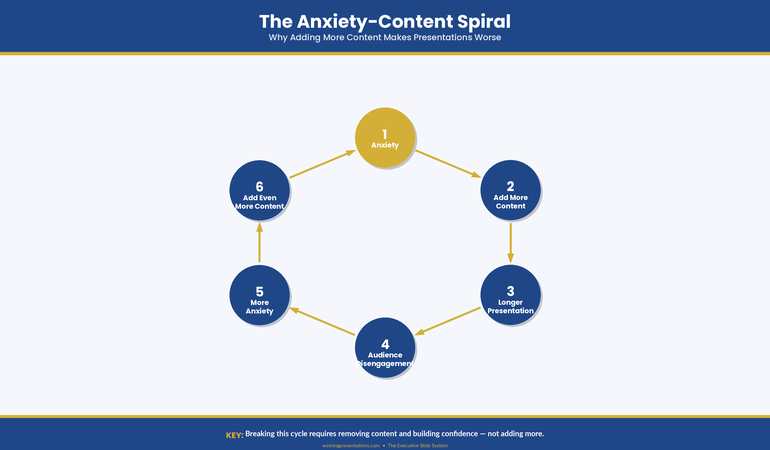
15 Mar 2026
Female executive presenting risk assessment to a serious risk committee in a modern boardroom, showing risk matrix slide on screen, navy and gold corporate aesthetic

Risk Committee Q&A: The 5 Questions That Silence Even the Most Prepared Executives

I once watched a VP of Operations present a £3 million risk mitigation plan to her company’s risk committee. She had 47 metrics on her dashboard. She knew every number. But when the Chief Risk Officer asked, “What’s the one thing in your plan you’re least confident about?” she froze.

She couldn’t answer because she’d prepared for every question except the ones about her own uncertainty. The risk committee wasn’t testing her confidence. They were testing whether she understood the limits of her own knowledge. She failed that test in seven seconds of silence.

The vote to approve her plan got deferred. Not because her mitigation approach was weak. But because her Q&A revealed that she hadn’t mapped her own blind spots — and a risk committee’s job is precisely to find blind spots before they become losses.

Risk committee Q&A is a distinct discipline. The questions are sharper, the scepticism is structural, and the threshold for credibility is higher. This isn’t steering committee Q&A or board update Q&A. Risk committees exist to challenge assumptions and surface exposure. Your preparation must reflect that.

This article gives you the exact taxonomy of risk committee questions and the preparation framework that turns hostile Q&A into a credibility moment.

Preparing for a risk committee in the next 30 days?

Most executives prepare for capability questions. Risk committees test something different: whether you understand your own blind spots. The Executive Q&A Handling System includes a Question Map framework specifically structured for risk, audit, and governance committee Q&A.

Why Risk Committee Q&A Exposes Blind Spots Other Committees Miss

Most executives prepare for executive Q&A the same way regardless of the audience. They prepare for capability questions, financial impact questions, timeline questions. Standard executive fare. This approach will fail in front of a risk committee.

Risk committees operate from a different agenda entirely. While a steering committee is asking “will this work?” and “what does it cost?”, a risk committee is asking “what could go wrong that we haven’t considered?” and “how do you know that?” The psychology is adversarial by design. Risk committee members are professional sceptics. Their job depends on finding the gaps in your thinking.

The gap that most presenters miss is the distinction between demonstrating competence and demonstrating risk awareness. You can walk into a risk committee meeting thoroughly prepared to defend your strategy, but if you haven’t prepared for questions about what you don’t know, the committee will expose that gap within the first four minutes of Q&A. And once credibility is damaged, no amount of capability data recovers it.

Risk committees are also heterogeneous in their expertise. Your audience typically includes an internal Chief Risk Officer (highly technical, familiar with risk frameworks and ISO standards), an external risk or compliance specialist (often with a regulatory lens), and business leaders who sit on the committee for governance rather than technical depth. This means your Q&A must navigate different levels of sophistication simultaneously — you can’t assume the group shares the same risk literacy.

The questions that expose blind spots fall into five categories. Each category tests a different kind of credibility: your understanding of exposure, your confidence in your assumptions, your awareness of gaps, your execution track record, and your alignment with the board’s risk appetite. Most executives prepare for one or two of these. Risk committees test all five.

The Five Question Types That Dominate Risk Committee Q&A

Understanding the taxonomy of risk committee questions is half the preparation battle. Once you know what type of question is coming, you can prepare a scenario-specific answer rather than hoping for a question you’ve rehearsed.

The five types are:

  • Exposure Mapping Questions: “What’s the worst-case scenario?” “What asset or revenue stream is at greatest risk?” “How do you quantify the exposure?” These test whether you actually understand the financial or operational consequence if things go wrong.
  • Assumption Testing Questions: “What assumptions are you making that could be wrong?” “How sensitive is your plan to market changes?” “What happens if [variable] changes?” These test the robustness of your logic, not just the competence of your execution.
  • Blind Spot Surfacing Questions: “What haven’t you considered?” “What’s the thing you’re least confident about?” “What would change your view of this risk?” These are the most dangerous because they presume you’ve already missed something, and they’re often right.
  • Implementation Credibility Questions: “How will you actually do this?” “Who owns the accountability?” “What’s your track record in similar initiatives?” These test whether your plan will survive contact with reality, not just whether the plan itself is theoretically sound.
  • Board Accountability Questions: “What does the board need to do to support this?” “When will you escalate if things go off track?” “What metrics matter to the board’s risk appetite?” These test whether you understand what success looks like from the board’s perspective, not just from yours.

Notice that only one of these question types is about your capabilities or what you’ve done. The other four are about exposure, assumptions, gaps, and board-level thinking. This is why standard Q&A preparation fails in front of risk committees. You’re preparing for the wrong category.

Five risk committee question types: Exposure Mapping, Assumption Testing, Blind Spot Surfacing, Implementation Credibility, Board Accountability with example questions and credibility tests for each

Exposure Mapping Questions: The Ones About What Could Fail

Risk committees begin with exposure. They want to understand the size and nature of what’s at risk if something goes wrong. Exposure Mapping questions are rarely hostile — they’re genuinely trying to understand the scale of the problem. But they will expose you if you haven’t thought about the worst case.

The most common Exposure Mapping question is some variation of: “What’s the worst-case scenario if this risk materialises?” A good answer names the specific asset, revenue stream, or capability at risk, quantifies the financial or operational impact if it fails, and explains why you’re confident in that quantification.

The trap most executives fall into is either overestimating the worst case (which signals panic or lack of confidence) or underestimating it (which signals you haven’t thought about it properly). A risk committee will test your quantification by asking where it comes from — historical precedent, industry benchmarks, internal models. If you can’t source your number, they won’t trust it.

A stronger approach is to present a range rather than a point estimate. “In the worst case — a failure of System A combined with a loss of our primary vendor — we’d expect £2–3 million of impact to quarterly revenue. That’s based on our 2023 outage analysis plus vendor replacement costs from our procurement team.” This signals both rigorous thinking and realistic uncertainty.

Exposure Mapping questions also frequently probe the cascade effect: “If that fails, what else fails with it?” The executives who survive this line of questioning are the ones who’ve already mapped their dependencies. You need to know not just your primary risk, but what happens when that risk triggers others.

Prepare this section of your Q&A by listing the three to five assets or processes you’re most dependent on, estimating the financial impact if each fails, and mapping the cascade effect if they fail simultaneously. Have this analysis written down before you walk into the room.

The Question Prediction System Risk Committees Actually Test For

The Executive Q&A Handling System (£39, instant access) gives you the exact preparation framework risk committees are designed to defeat:

When you understand the five question types that risk committees use, you can prepare scenario-specific answers that demonstrate both competence and risk awareness. The executives who pass risk committee Q&A are the ones who know their blind spots before the committee finds them.

  • The five question taxonomies that risk committees use to test credibility — Exposure Mapping, Assumption Testing, Blind Spot Surfacing, Implementation Credibility, and Board Accountability
  • The Question Map framework for predicting the 12–15 questions your specific risk committee will ask, based on your presentation content
  • The exact scenarios and responses for each question type with real-world examples from high-stakes risk presentations
  • 51 AI prompts to generate your Q&A answers in 30 minutes, including challenge-response pairs for hostile questions

Get the Executive Q&A Handling System → £39

Built from 25 years of risk presentations across banking, insurance, and regulated industries — including risk committee scrutiny at JPMorgan Chase, RBS, and PwC.

Assumption Testing: Challenging Your Risk Logic

Every plan rests on assumptions. A market will behave a certain way. A vendor will deliver on time. Your team will execute as planned. Risk committees exist to stress-test those assumptions. Assumption Testing questions probe what could be wrong with your logic, not your execution.

The question usually sounds like: “What assumptions are you making that could turn out to be wrong?” This is often asked conversationally, which makes it more dangerous. You might hear, “We’re assuming the risk framework you’ve proposed would actually reduce exposure, but what if the market doesn’t cooperate?” The committee is not attacking your plan. They’re testing whether you’ve already challenged it.

Credibility in Assumption Testing questions comes from acknowledging your assumptions explicitly before the committee finds them. The strongest answer to “what assumptions are you making?” is to name three key assumptions yourself, explain what happens if each assumption breaks, and describe how you’d know if the assumption was at risk of breaking.

For example: “We’re assuming the control framework we’re implementing will be mature and effective within 180 days. That’s based on benchmarks from similar implementations in our industry. But if our team capacity turns out to be less than projected, that timeline could stretch to 12 months. We’ve built in a checkpoint at day 90 where we’ll assess maturity against a standard control maturity model and escalate if we’re below target.” This shows you’ve thought about failure modes and have monitoring in place.

The committees that challenge assumptions most fiercely are the ones with external members. An external risk advisor has seen multiple companies implement similar plans. They often ask: “In your experience, what’s the most common reason this type of plan doesn’t work as expected?” They’re giving you permission to name failure modes. Take it.

Prepare for Assumption Testing by listing the three to five key assumptions in your presentation, stress-testing each one mentally, and preparing a brief “here’s what could break and here’s how we’d know” response for each. This section of your preparation can be as simple as three sentences per assumption.

Blind Spot Questions: Finding What You Haven’t Considered

Blind Spot questions are the most dangerous because they presume a gap in your thinking — and often they’re right. A risk committee member will say something like: “What haven’t you considered?” or “What’s the thing you’re least confident about in this plan?” These questions feel adversarial because they assume you’ve already missed something.

Most executives respond defensively to Blind Spot questions. They over-explain, they defensively assert they’ve thought of everything, or they freeze. The credible response is to name your blind spots first. This shifts the psychology from “the committee found something I missed” to “I’ve already identified the exposure and I’m managing it responsibly.”

The strongest Blind Spot answer names one or two genuine gaps in your knowledge, explains why they’re gaps (insufficient data, external dependencies you can’t control, operational variables you can’t fully predict), describes what you’d need to close the gap, and acknowledges the risk of proceeding without full certainty.

For example: “The biggest gap in our analysis is vendor stability. We’re dependent on [Vendor] for a critical integration, and we don’t have complete visibility into their financial health or technology roadmap. We’ve asked for it in our ongoing contract review, but we may not get full transparency. If that vendor fails, we have a 60-day recovery plan, but that’s our exposure.” This answer shows mature risk thinking. You’re not claiming certainty you don’t have. You’re acknowledging the exposure and showing a mitigation path.

Blind spot preparation is counterintuitive because it requires intellectual honesty. Sit down with your presentation and ask yourself: “What part of this plan am I least certain about? What would I need to be more confident? And if I can’t get that certainty, what’s my backup?” Write those down before the meeting. When the committee asks, you’ll have an answer that signals maturity rather than defensiveness.

Some of the most effective Blind Spot answers include a statement like: “I’d welcome the committee’s perspective on what I might be missing. In our testing, we focused on [X]. Are there areas you’d recommend we pressure-test further?” This invites the committee’s expertise and shifts from defensive to collaborative.

If you’re preparing for risk committee Q&A in the next 30 days, the Executive Q&A Handling System (£39) gives you the question prediction framework and scenario-specific answers for all five question types.

Implementation Credibility: Will You Actually Execute?

Risk committees have seen many plans fail not because the strategy was wrong, but because execution fell apart. Implementation Credibility questions test whether your plan will survive contact with reality. They typically sound like: “How will you actually do this?” or “Who’s accountable if this doesn’t work?”

The questions that probe implementation most effectively are deceptively simple: “Walk me through the first 90 days.” “Who owns this if something goes wrong?” “What’s your track record on similar initiatives?” These are not asking about your strategy. They’re asking whether you have a realistic plan, clear accountability, and a history of follow-through.

A strong Implementation Credibility answer includes three elements: a specific sequence (not a generic timeline), named accountability (not a committee or a department, but a person), and a proof point (you’ve done something similar before and it worked). If you can’t provide all three, the committee will doubt your execution.

For example, rather than “we’ll implement controls over the next six months,” you’d say: “Sarah Chen, who led the control implementation at our Asia division, is leading this. Month one is requirements definition and stakeholder alignment. Month two is test environment setup. Month three is pilot in our non-critical process. We did a similar implementation in 2023 that came in on schedule and 8% under budget. Sarah’s here if you want to ask about her execution approach.”

Notice that this answer includes a named person, a month-by-month sequence, and a historical precedent. It’s not theoretical. It’s concrete. Risk committees trust concrete. They distrust abstract.

Preparation for Implementation Credibility requires you to own the plan at a level of specificity most executives avoid. You need to know not just the timeline, but who does what in month one. You need a case study of a similar implementation that succeeded. And you need to be able to name the person who failed the last similar initiative and explain what’s different this time (if there was a failure).

Common Questions About Risk Committee Q&A Preparation

How do you prepare for questions you can’t predict?
You can predict roughly 80% of risk committee questions using a Question Map framework. You list your presentation’s claims (e.g., “This control framework will reduce exposure by 40%”), then ask: what would challenge that claim? What data supports it? What assumptions could be wrong? What would the committee need to trust it? This process usually surfaces 12–15 likely questions across the five categories. The final 20% are wildcards, but they’re usually just variations on the predictable questions.

What’s the worst answer you can give to a risk committee question?
Claiming certainty you don’t have. Saying “we’ve thought of everything” or “we’re confident this won’t happen” signals that you’ve either misunderstood risk or you’re not being honest. Risk committees respect leaders who acknowledge edge cases and unknowns. They distrust leaders who claim omniscience. The credible answer is always “here’s what we know, here’s what we don’t know, and here’s how we’re managing the gap.”

Should you ever push back against a risk committee question?
Rarely, and only if the question is based on faulty data or a misunderstanding of your presentation. If you do push back, do it respectfully and with a data source. “That’s a fair question. We actually modelled that scenario — it’s on slide 14. The exposure in that case would be closer to £1.2 million rather than £2 million because we have a secondary control. Would you like to walk through that scenario?” This corrects the record without making the committee feel attacked.

Risk committee Q&A credibility framework showing best practices versus common mistakes across five question types with specific language examples

Is This Right for You?

This is for you if:

  • You’re presenting to a risk committee, audit committee, or governance forum in the next 60 days
  • You’ve had risk committee feedback that you need to “think bigger about exposure” or “understand your blind spots better”
  • You’re introducing a new risk framework, control environment, or governance change and expect the committee to challenge your assumptions
  • You want a tested question prediction framework you can apply to any risk presentation, not just this one

This is NOT for you if:

  • You’re presenting to a standard steering committee or operational review (those use different question types)
  • You need bespoke risk consulting rather than a Q&A preparation system
  • Your risk committee is entirely internal to your function and doesn’t include external or audit expertise

The 72-Hour Preparation Framework for Risk Committee Q&A

Risk committee Q&A is more preparation-intensive than standard executive Q&A because the questions are deeper and the scepticism is structural. The 72-hour framework breaks the preparation into three stages.

Stage One: Question Mapping (24 hours before)

Print out your presentation. For each major slide, ask yourself: what question would a risk committee ask about this? What assumptions does this claim rest on? What would a sceptic challenge? Write down 2–3 likely questions per slide. You’ll usually get to 15–20 likely questions across the presentation. Categorise them by question type (Exposure Mapping, Assumption Testing, etc.). This gives you the 80% of questions you can actually predict.

Stage Two: Answer Preparation (16 hours before)

For each of the 15–20 questions, write a one-paragraph answer. Not a talking point. An actual answer you’d give if asked. The discipline of writing forces you to think at a granular level. As you write, you’ll often discover gaps in your thinking. Good. Better to find them in your office than in the Q&A.

For each answer, ask: Does this answer the question directly? Does it include a data point or proof point? Does it acknowledge uncertainty where it exists? Can I deliver this in 60 seconds? If the answer to any of those is no, rewrite.

Stage Three: Scenario Rehearsal (4 hours before)

Practise the hostile questions. Not the friendly ones. Have someone read you the three most uncomfortable questions on your list and respond without notes. You’ll stumble. That’s good. Better to stumble in rehearsal. After each response, ask: Did I sound credible? Did I show I’d thought about this? Would a risk committee trust me? If not, rewrite the answer and rehearse again.

Focus rehearsal on questions about blind spots and implementation credibility. Those are the two categories where executives most often fail.

Stop Getting Blindsided by Risk Committee Questions

The Executive Q&A Handling System (£39, instant access) gives you the preparation framework that turns hostile risk committee Q&A into a credibility moment:

The moment a risk committee member asks “What haven’t you considered?” and you freeze, you’ve lost credibility. The executives who thrive in risk committee Q&A are the ones who know their blind spots before the committee finds them. The Executive Q&A Handling System teaches the exact preparation framework.

  • The Question Map framework for predicting 80% of risk committee questions before you walk in the room
  • The five question type taxonomy with scenario-specific answers for each category
  • Real-world examples of hostile questions and the credible responses that turn them into trust moments

Get the Executive Q&A Handling System → £39

Taught to risk, compliance, and operations leaders across banking, insurance, healthcare, and regulated sectors.

What Risk Committees Actually Decide Based on Your Q&A

It’s worth understanding what a risk committee is actually evaluating during Q&A, because it’s not what most executives think. They’re not deciding whether to approve your plan. That decision usually happens in the room before Q&A begins, based on the presentation itself. Q&A is a credibility test.

The risk committee is answering four questions during your Q&A: Do you understand the size of the exposure if things go wrong? Do you understand your own assumptions and what could break them? Do you know what you don’t know? And can you actually execute this, or will it fall apart? If they believe the answer to those four questions is yes, you pass. If they have doubts on any of them, the decision gets deferred.

Deferral in risk committee meetings is the operational equivalent of rejection. It means “come back when you’ve thought about this more.” Some executives have sat through three or four deferral cycles on a single initiative. The ones who break the cycle are the ones who realise their Q&A wasn’t demonstrating competence — it was exposing gaps.

Risk committee Q&A often overlaps with board-level preparation — if your session includes board directors, the board Q&A preparation guide covers the director-specific dynamics in detail.

One other thing risk committees decide: trust. An executive who names their blind spots, acknowledges uncertainty, and shows they’ve already challenged their own plan is trusted more than an executive who claims the plan is airtight. Risk committees have institutional memory of plans that failed because the executive was overconfident. They’d rather hear “here’s what could go wrong” than “we’ve thought of everything.”

This is why the 72-hour preparation framework is essential. It’s not about memorising answers. It’s about demonstrating that you’ve already done the challenging work of examining your own plan critically. The committee is asking whether you deserve to be trusted with risk management responsibility. Your Q&A answers that question.

Frequently Asked Questions

What’s the difference between risk committee Q&A and steering committee Q&A?

Steering committees ask “will this work and what does it cost?” Risk committees ask “what could go wrong and what don’t you know?” Risk committees are structurally sceptical because their job is to find exposure. Steering committees are evaluative. This means your Q&A preparation must shift from demonstrating capability to demonstrating risk awareness. The frameworks are completely different.

How honest should you be about gaps and uncertainties in front of a risk committee?

Extremely honest. Risk committees trust executives who acknowledge uncertainty more than those who claim omniscience. The credible answer to a question about a gap is “here’s what we don’t fully understand, here’s what we need to understand, and here’s how we’re managing the risk while we get that understanding.” This signals mature risk thinking. Claiming you’ve thought of everything signals the opposite.

What happens if a risk committee question is based on a misunderstanding of your data?

Clarify respectfully with a data source. Don’t make the committee feel stupid. Instead, say something like “That’s a fair interpretation of the metric. We actually modelled that scenario — here’s what the data shows.” You’re correcting the record without creating tension. If the committee is sceptical, it’s usually because you weren’t clear enough in the presentation, not because they’re unreasonable.

Can you over-prepare for risk committee Q&A?

Yes, if you memorise answers and sound robotic. No, if you prepare scenario-specific responses and practise delivering them conversationally. The goal is to show you’ve thought through your risks, not to recite prepared statements. Risk committees recognise the difference immediately.

The Winning Edge — Executive Presentation Insights

Weekly strategies for executives who present at risk committees, boards, and high-stakes governance forums. No filler. No theory. Practical frameworks for presentations where credibility is currency.
Subscribe Free →

Also published today:

Your risk committee meeting has a date on the calendar. The committees that ask hostile questions are usually the ones with external or audit members — people who don’t have a stake in your plan succeeding. They’re structurally sceptical because that’s their job.

The only way to change that dynamic is to come in already sceptical of your own plan. Walk into the room having already named your blind spots, stress-tested your assumptions, understood your execution risks, and acknowledged what you don’t know. When the committee asks about gaps, you’ll have answers ready. When they challenge your logic, you’ll respond with confidence because you’ve already challenged it yourself.

Start with the Question Map. Print your presentation, write down 15–20 likely questions, categorise them by the five question types, and prepare one-paragraph answers for each. Use the Executive Q&A Handling System (£39) to structure the preparation in the 72 hours before you present.

For further reading on high-stakes Q&A strategy, see Board Meeting Q&A: Questions Directors Actually Ask, The Q&A Preparation Checklist: The Pre-Meeting Audit Every Executive Needs, and Predict Your Presentation Questions: The Question Map That Works.

About the Author

Mary Beth Hazeldine is the Owner & Managing Director of Winning Presentations. With 25 years of corporate banking experience at JPMorgan Chase, PwC, Royal Bank of Scotland, and Commerzbank, she has delivered high-stakes presentations in boardrooms across three continents.

A qualified clinical hypnotherapist and NLP practitioner, Mary Beth combines executive communication expertise with evidence-based techniques for managing presentation anxiety. She advises executives across financial services, healthcare, technology, and government on structuring presentations for high-stakes funding rounds and approvals.

Book a discovery call | View services

15 Mar 2026
Professional woman at a podium taking a deep breath before presenting, modern conference room setting, navy and gold corporate aesthetic, calm confidence before high-stakes presentation

Why Your Voice Gets Higher When You’re Nervous (And the Fix)

Quick Answer: Your voice pitch rises when you’re nervous because the fight-or-flight response triggers involuntary tension in your vocal cords. The muscles that control pitch (the cricothyroid and interarytenoid muscles) constrict under nervous system activation, forcing your cords to vibrate faster and produce higher frequencies. This is not a confidence problem — it’s a physiology problem. The tactical fix is a three-step breathing and laryngeal reset you can execute in under 90 seconds, even minutes before you present.

🚨 Presenting this week and your voice pitch goes up when you’re nervous? The Rescue Block: Stop voice pitch rise in 90 seconds. → Get the Calm Under Pressure guide — £19.99, instant access for the exact in-the-moment laryngeal reset technique.

I watched an executive vomit in a bin outside the boardroom before presenting to the board. For three years, this happened. Nobody knew.

What she didn’t tell anyone was that when she walked into the room, her voice came out nearly two octaves higher than her speaking range. The nausea was the physical manifestation of the same nervous system state that locked her throat. The high-pitched voice was its audible signature.

She managed to control the vomiting through breathing work. But the voice pitch — that stayed until she understood what was actually happening at the laryngeal level. Once she did, she had a fix that took 90 seconds and actually worked.

The reason her voice got higher wasn’t because she lacked confidence. It wasn’t psychological. It was mechanical.

The Physiology: Why Fight-or-Flight Makes Your Voice Go High

When you experience presentation nerves, your nervous system activates the fight-or-flight response. This is automatic. Your amygdala detects threat — in this case, an audience, evaluation, stakes — and launches a cascade of physiological changes designed to protect you: your heart rate rises, your breathing becomes shallow, your muscles tense, your blood vessels constrict.

Your larynx — the voice box containing your vocal cords — is not exempt from this response. It is, in fact, one of the first places the tension appears because it is exquisitely sensitive to nervous system state. When you are calm, the muscles around your vocal cords are relaxed and supple. When you are nervous, they contract involuntarily.

This is where pitch rise begins. The vocal cords are two tissue folds suspended horizontally across your larynx. When air from your lungs passes through them, they vibrate. The speed of vibration determines frequency: slower vibration = lower pitch, faster vibration = higher pitch. The tension in and around the vocal cords controls that speed.

Under nervous activation, several things happen simultaneously. The cricothyroid muscle — the muscle that stretches and tenses the vocal cords — contracts. The interarytenoid muscles, which bring the cords closer together, also tense. The muscles of your neck and throat tighten. The result is that your vocal cords are pulled taut, positioned closer together, and vibrating faster under the same breath pressure. Faster vibration equals higher frequency. Higher frequency equals your voice going up by one, two, even three semitones.

This is not weakness. This is not lack of confidence. This is pure laryngeal mechanics under sympathetic nervous system activation.

Vocal Cord Tension Under Nervous Activation — The Mechanism

To understand the fix, you need to understand the precise sequence of what tightens and why. The nervous system has two branches: the parasympathetic (rest-and-digest) and the sympathetic (fight-or-flight). When you present, your sympathetic nervous system dominates. This triggers the release of adrenaline and cortisol, which signal your muscles to contract and prepare for threat response.

Your laryngeal muscles respond to this signal immediately. The cricothyroid muscle, which is innervated by the external branch of the superior laryngeal nerve, shortens and stretches your vocal cords. The lateral cricoarytenoid muscles adduct — bring together — your vocal cords. The thyroarytenoid muscles, which control the internal tension of the cords themselves, constrict. All of this happens without your conscious awareness or permission.

The result is that your vocal range compresses. The lower frequencies become unavailable. When you try to speak at your normal pitch, the tightened cords cannot drop that low. Your voice defaults to whatever pitch the tension allows — which is higher. You feel like you are forcing out sound. The audience hears a thin, tight, higher-pitched version of your voice.

Many people interpret this as a confidence issue or a sign they should not be presenting. Neither is true. What it actually signals is that your nervous system is activated — which is normal — and your laryngeal muscles have responded to that activation — which is also normal. The problem is not your voice or your ability. The problem is that nobody taught you how to reset the tension so you can speak from your natural pitch even when the nervous system is alert.

Three-stage laryngeal tension mechanism infographic showing Sympathetic Activation, Cricothyroid Contraction, and Pitch Rise Mechanism explaining how nervous system activation causes vocal cord tension and voice pitch increase during presentations

Drop Your Voice Pitch Back to Normal in 90 Seconds — Even When You’re Nervous

Voice pitch rise is a laryngeal tension problem, not a confidence problem. Calm Under Pressure (£19.99, instant access) provides a parasympathetic reset sequence that releases the cricothyroid and interarytenoid muscles in 90 seconds or less — executed right before you present or even in the moment if needed.

  • The three-step laryngeal release sequence (breathing pattern + neck release + vocal warm-up) that resets pitch to your natural range
  • The exact timing: when to execute this reset for maximum effect (spoiler: not five minutes before, not one hour before)
  • The fail-safe reset you can do silently even if you’re already at the podium
  • Real scenario: presenter goes from 145 Hz (pitch-shifted) back to 110 Hz (natural) in two minutes

Get Calm Under Pressure → £19.99

The in-the-moment physical symptom management system. Used by executives in banking, consulting, and corporate leadership for shaking, sweating, blushing, nausea, and voice issues.

The 90-Second Laryngeal Reset: The Fix That Works in the Moment

The key to releasing laryngeal tension is to activate your parasympathetic nervous system — the brake pedal to fight-or-flight. When parasympathetic tone increases, adrenaline and cortisol decrease, muscle tension releases, and your laryngeal muscles return to rest. This is not visualisation or positive self-talk. It is direct nervous system intervention.

The technique has three components. First is breathing. A specific pattern signals safety to your brainstem: a 4-count inhale through your nose, a 6-count exhale through your mouth. This longer-exhale ratio is the single most effective breathing pattern for downregulating the sympathetic nervous system. Do this for six breaths. Your shoulders will drop. Your chest will feel less tight.

The second component is a direct release of laryngeal tension. Place two fingers on the area directly under your chin, between the angle of your jaw. You are feeling the mylohyoid muscle. Press gently upward and toward the back of your neck, holding for three seconds. Release. Repeat four times. This specific pressure point releases reflex tension in the intrinsic laryngeal muscles. The pressure itself is neurologically connected to the cricothyroid and thyroarytenoid muscles through fascial and muscular chains. Many people feel their throat open immediately after this step.

The third component is a vocal warm-up that resets your pitch baseline. Hum three times, starting high and sliding down to your natural range. This is not singing. You are simply moving your vocal cords through their full range and allowing them to settle into their resting frequency. After the parasympathetic downregulation and the direct laryngeal release, your vocal cords will return to their natural tension state, and this hum will anchor that lower, natural pitch.

Execute all three steps once. The entire sequence takes 90 seconds. Many people report an immediate two-to-four semitone drop in their speaking pitch — enough to restore their voice to its natural range even though they are still nervous.

The mechanism is not magical. It is nervous system physiology. By downregulating the sympathetic response and releasing the reflex tension in your laryngeal muscles, you have restored the conditions under which your voice operates at its natural pitch. The nervousness remains — your heart rate is still elevated, your attention is heightened — but your voice is no longer a hostage to that nervousness.

This reset sequence is one of six in-the-moment physical symptom techniques covered in the Calm Under Pressure guide — £19.99, instant access, which handles shaking, sweating, blushing, nausea, racing heart, and voice pitch issues for presentations happening this week or this month.

Before You Present: The Foundation Reset

The 90-second reset works in the moment. But the larger framework is to build parasympathetic tone throughout the days before your presentation. A nervous system that is already downregulated — more parasympathetic baseline, less sympathetic reactivity — will show less laryngeal tension even in a high-stakes moment. This is cumulative.

In the week before your presentation, prioritise sleep. A nervous system that has not slept well is hypervigilant, triggers fight-or-flight more easily, and maintains higher baseline tension. Even one night of poor sleep — six hours or less — materially increases how tight your voice will sound. If you have a presentation on Friday, your sleep Tuesday through Thursday matters more than anything you do on presentation day morning.

The second priority is reducing decision fatigue and external stress. Your nervous system has a limited capacity for managing threats. If you are managing five other urgent issues that week, your sympathetic nervous system is already partially activated. When you walk into your presentation, it only takes a small additional stimulus to tip into full fight-or-flight response. Clear your calendar for the 72 hours before your presentation where possible. It sounds like a luxury. It is actually nervous system management.

The third priority is vocal warm-up. Not an hour before. Thirty minutes before. Do the hum sequence three times with longer duration — eight-second hums instead of three-second ones. This familiarises your vocal cords with their natural frequency and primes them to settle into that range when presentation nerves hit. Some people add gentle neck rolls and shoulder rolls. The point is proprioceptive awareness: you are signalling to your nervous system, “I notice my voice, my neck, my larynx,” which is protective. Dissociation — pretending the physical symptoms are not happening — amplifies the nervous system’s fear response. Directed attention to the actual physical mechanisms dampens it.

The fourth element is what you consume. Avoid caffeine for four hours before you present. Caffeine increases heart rate and nervous system arousal — exactly the state that tightens your larynx. Dehydration also increases laryngeal tension because your vocal cords require moisture to vibrate smoothly. Drink water consistently through the day you present. Not right before — that causes bloating and pressure in your chest. Consistent, moderate hydration throughout the morning.

How This Works Across Different Presentation Scenarios

The pitch-rise mechanism is the same across all presentation contexts, but the intensity varies. A formal board presentation typically generates higher sympathetic activation than an internal team meeting. A competitive pitch in front of unfamiliar stakeholders triggers more laryngeal tension than a presentation to your own department. The fix works across all of these, but your recovery window varies slightly.

In a high-stakes scenario — board meeting, investor pitch, customer presentation with decision-makers present — you can expect the sympathetic activation to be significant. Your laryngeal tension will be substantial. The 90-second reset will give you a meaningful drop in pitch, but you should plan for the reset to be executed 15–20 minutes before you speak, not five minutes before. This allows your nervous system to restabilise slightly after the reset. If you execute the reset too close to speaking, you may find your pitch starts to rise again during your introduction. Give yourself the buffer.

In a lower-stakes presentation — team update, internal training, a presentation to a friendly audience — the sympathetic activation is typically moderate. The pitch rise is less severe. The 90-second reset executed five minutes before you speak is usually sufficient.

If you are already speaking and discover mid-presentation that your voice pitch is higher than you want it to be, you can execute a silent version of the reset. The breathing pattern (4-count inhale, 6-count exhale) can be done while standing at the podium without the audience noticing. Pause between slides or during a moment when someone else is speaking, and execute six breaths. The pressure-point release under the chin is subtle enough to do without being visible if you are positioned behind a lectern. The hum is obviously not silent, but you can substitute a brief throat clear — the act of moving your vocal cords through that range has a similar resetting effect, even without the hum.

Comparison infographic showing pre-presentation foundation reset techniques versus in-the-moment voice recovery techniques with timing guidance for each approach to controlling nervous voice pitch

Stop Sounding Nervous Even Though You Are — The Laryngeal Reset That Actually Works

If your voice pitch rises when you present, you’ve probably tried relaxation, positive self-talk, and “just breathing.” Those address the general anxiety state. This addresses the specific laryngeal mechanism — the three-muscle sequence that forces your voice higher under nervous activation. This is the tactical fix for presentations happening within weeks or days.

  • The neurological reason why standard relaxation advice fails for voice pitch (hint: you are trying to calm your amygdala when you actually need to release laryngeal muscle tension)
  • The exact three-step reset: breathing pattern, pressure-point release, vocal reset — no equipment, no setup, executable anywhere
  • The timing formula: when to execute this reset based on your presentation type and stakes level
  • The silent version: how to execute the reset while you’re already presenting if needed

In-the-moment physical symptom management for presentations. Six techniques for shaking, sweating, blushing, nausea, racing heart, and voice control.

Your Voice Reveals What Your Words Won’t — Unless You Know This

Calm Under Pressure gives you a neuroscience-based system for managing physical stress responses, including vocal pitch control, breathing regulation, and in-the-moment recovery techniques — £19.99, instant access.

Get the Programme →

Designed for executives who want to stop dreading presentations

Common Questions About Voice Pitch and Presentation Nerves

Is voice pitch rise a sign that I’m not confident enough to be presenting?
No. Voice pitch rise is a laryngeal tension response to sympathetic nervous system activation. Even the most experienced executives — CEOs, board members, politicians — experience vocal cord tension under high-stakes presentation conditions. The difference is that some have learned to manage the laryngeal mechanism, while others haven’t. Confidence and vocal control are separate skill sets. You can be genuinely confident in your content and still experience voice pitch rise because your nervous system is doing exactly what it’s supposed to do: responding to threat perception with fight-or-flight activation. The fix is not confidence building. It’s laryngeal release.

Why doesn’t breathing alone fix the voice pitch problem?
Breathing addresses overall nervous system state, which is valuable. But voice pitch rise is a local laryngeal tension problem. Your cricothyroid and interarytenoid muscles are contracting under nervous system signal, pulling your vocal cords taut and forcing them to vibrate faster. Deep breathing will downregulate your sympathetic nervous system and reduce the intensity of that contraction, but it doesn’t directly release the reflex tension in those specific muscles. You need the combination: breathing (parasympathetic downregulation) plus direct laryngeal release (pressure-point reset) plus vocal calibration (hum to reset pitch baseline). That combination addresses the mechanism directly.

Can I use this technique if I have a voice condition like vocal strain or hoarseness?
If you have chronic vocal issues, this technique may still help with the tension component, but you should check with a speech-language pathologist before using a new vocal approach. The laryngeal release is safe and used in clinical speech therapy, but a baseline assessment from a professional ensures you’re not masking an underlying condition that needs different treatment. The Calm Under Pressure guide includes a note about this as well.

Voice Pitch Rise Versus Other Voice Symptoms

Presentation nerves affect your voice in several different ways, and it’s important to understand which symptom you’re actually experiencing because the fixes differ. Voice pitch rise — your voice going higher than normal — is distinct from voice shaking (tremor), voice cracking (pitch breaks), or voice hoarseness (quality degradation). Each has a different mechanism and requires a different technique.

Voice pitch rise is caused by laryngeal muscle tension that increases cord vibration frequency. Voice shaking is caused by oscillation in the muscles controlling your airflow — you sound wobbly or tremulous. Voice cracking is caused by your vocal folds suddenly separating during speech, often as your pitch is changing. Voice hoarseness is caused by swelling or inflammation of the vocal cords themselves, often from tension held over hours or days.

If you experience voice pitch rise but not tremor, your primary intervention is the laryngeal reset. If you experience tremor alongside pitch rise, you are probably dealing with whole-body nervous system activation that requires breath and postural work as well as laryngeal release. If you experience cracking and pitch breaks, the issue is often vocal fatigue or inadequate warm-up in addition to nervousness. If you experience hoarseness after presenting, the issue is likely sustained tension and inadequate hydration.

Many people experience more than one of these simultaneously. The Calm Under Pressure guide addresses all six physical symptoms (shaking, sweating, blushing, nausea, racing heart, and voice control) with integrated techniques that work together.

Is This Right for You?

This is for you if:

  • Your voice pitch noticeably rises when you’re nervous or presenting, and you want to control it in the moment
  • You’ve tried relaxation techniques and they haven’t solved the pitch-rise problem specifically
  • You have a presentation coming up in the next 4–8 weeks and you need a quick, practical fix rather than a long-term anxiety programme
  • You want to understand the physiology so you can trust the technique and use it with confidence

This is NOT for you if:

  • Your primary issue is chronic presentation anxiety or fear of presenting (you’d benefit more from Conquer Speaking Fear, the 30-day programme)
  • Your voice pitch rise is caused by a medical condition rather than nervousness (check with your doctor first)
  • You’re looking for public speaking coaching or slide design advice (this is specifically a physical symptom management technique)

What Happens After You Master the Reset

Once you have the laryngeal reset technique working, you can use it for any high-stakes presentation scenario. The mechanism remains the same — parasympathetic downregulation plus direct laryngeal release plus vocal calibration — regardless of the context. A board presentation. A competitive pitch. A presentation to a new client. A sales demo. A performance review presentation. Anywhere you would normally experience voice pitch rise, this reset prevents it.

Over time, as you use the reset technique repeatedly, you build a kind of nervous system adaptation. The reset becomes faster. Your body begins to anticipate the sequence and respond more readily. Some people report that after using the technique for three or four presentations, the pitch rise becomes less severe in the first place. This is because your nervous system begins to associate presentation contexts with the reset sequence — and because you’re proving to yourself repeatedly that the symptom is manageable. Perceived control reduces actual nervous system reactivity.

The second benefit is confidence in your voice. Many people who experience voice pitch rise develop voice self-consciousness — they monitor their voice constantly during presentations, which makes the anxiety worse. Once you have a reliable reset technique, you stop monitoring. You know that if pitch rise shows up, you can handle it. That internal permission removes a layer of performance anxiety that was never about your actual ability to present.

📊 Want the slides too?

Frequently Asked Questions

How quickly does the laryngeal reset work? Can I use it minutes before I speak?

The reset works in 90 seconds, and you can execute it as close to your presentation as you need. However, the timing matters slightly based on presentation intensity. For high-stakes scenarios (board meetings, investor pitches, competitive reviews), execute the reset 15–20 minutes before you speak. This allows your nervous system a brief stabilisation window. For lower-stakes presentations, five to ten minutes is fine. If you’re already presenting and need to use the reset, execute the breathing pattern first — that provides immediate parasympathetic signal — then the pressure-point release, then the vocal hum or throat clear. The whole sequence still works even if you’re mid-presentation, though the pitch-reset effect may be slightly less dramatic.

Is the laryngeal reset technique safe to use repeatedly before multiple presentations?

Yes. The technique uses only parasympathetic downregulation, gentle physical pressure, and normal vocal warm-up — all safe and commonly used in clinical speech therapy. You can use it before every presentation without concern. In fact, the more you use it, the more your nervous system learns to respond to it. Some people report that after using the reset for three or four presentations, the pitch rise becomes less severe in the first place because your body begins to anticipate and prepare for the reset.

What if I have a chronic voice condition or have been told my voice is naturally high-pitched?

The reset technique addresses tension-induced pitch rise specifically — the rise caused by laryngeal muscle contraction under nervous activation. If your natural speaking pitch is simply higher, this technique will not lower your baseline pitch permanently. However, it can still help you access the lower end of your natural range and prevent additional pitch rise from nervousness on top of your baseline. If you have a diagnosed vocal condition, check with a speech-language pathologist before using new vocal techniques. The laryngeal release is used clinically and is safe, but professional guidance ensures you’re not masking an underlying issue.

Can I combine this technique with other anxiety management approaches like meditation or medication?

Absolutely. The laryngeal reset is a physical, local technique that works on the laryngeal muscles directly. It complements, not replaces, broader anxiety management. If you’re using breathing meditation, therapy, or medication for presentation anxiety, this technique sits alongside those approaches. You would use the broader anxiety tools for general nervous system management (meditation helps with overall calm, therapy addresses underlying anxiety patterns, medication regulates neurotransmitters), and you would use the laryngeal reset for the specific symptom of voice pitch rise. They work together.

The Winning Edge — Executive Presentation Insights

Weekly strategies for executives who present at board level, in competitive reviews, and in high-stakes leadership meetings. No filler. No theory. Practical frameworks from 25 years in the room.

Subscribe Free →

Also published today:

For further reading on presentation physical symptoms, see Voice Cracking During Presentations: Why It Happens and the Fix, Voice Shaking When Speaking: The Nervous System Mechanism and the Recovery Technique, and High-Stakes Presentation Nerves: Managing Physical Symptoms in Board-Level Moments.

Your voice pitch rises when you present because your laryngeal muscles tense under fight-or-flight activation. That is physiology, not a lack of capability. The fix is a 90-second reset that releases that tension and restores your voice to its natural pitch, even while you remain nervous. Master the laryngeal reset sequence in the Calm Under Pressure guide — £19.99, instant access before your next presentation.

Not ready for the full system? Start here: download the free 7 Presentation Frameworks — practical structures you can apply to your next presentation immediately.

About the Author

Mary Beth Hazeldine is the Owner & Managing Director of Winning Presentations. A qualified clinical hypnotherapist and NLP practitioner with 25 years of corporate banking experience at JPMorgan Chase, PwC, Royal Bank of Scotland, and Commerzbank, she combines executive communication expertise with evidence-based techniques for managing presentation anxiety and physical symptoms.

She has supported executives and their presentations for high-stakes funding rounds, board approvals, and competitive pitches across three continents. Her work in presentation anxiety management draws directly from her personal experience: she overcame five years of severe presentation terror using the techniques she now teaches.

Book a discovery call | View services