Tag: stakeholder buy-in

24 Apr 2026
Confident female executive presenting stakeholder alignment strategy to senior business professionals in a modern boardroom with navy and gold tones

Stakeholder Alignment Presentation Training: What Works

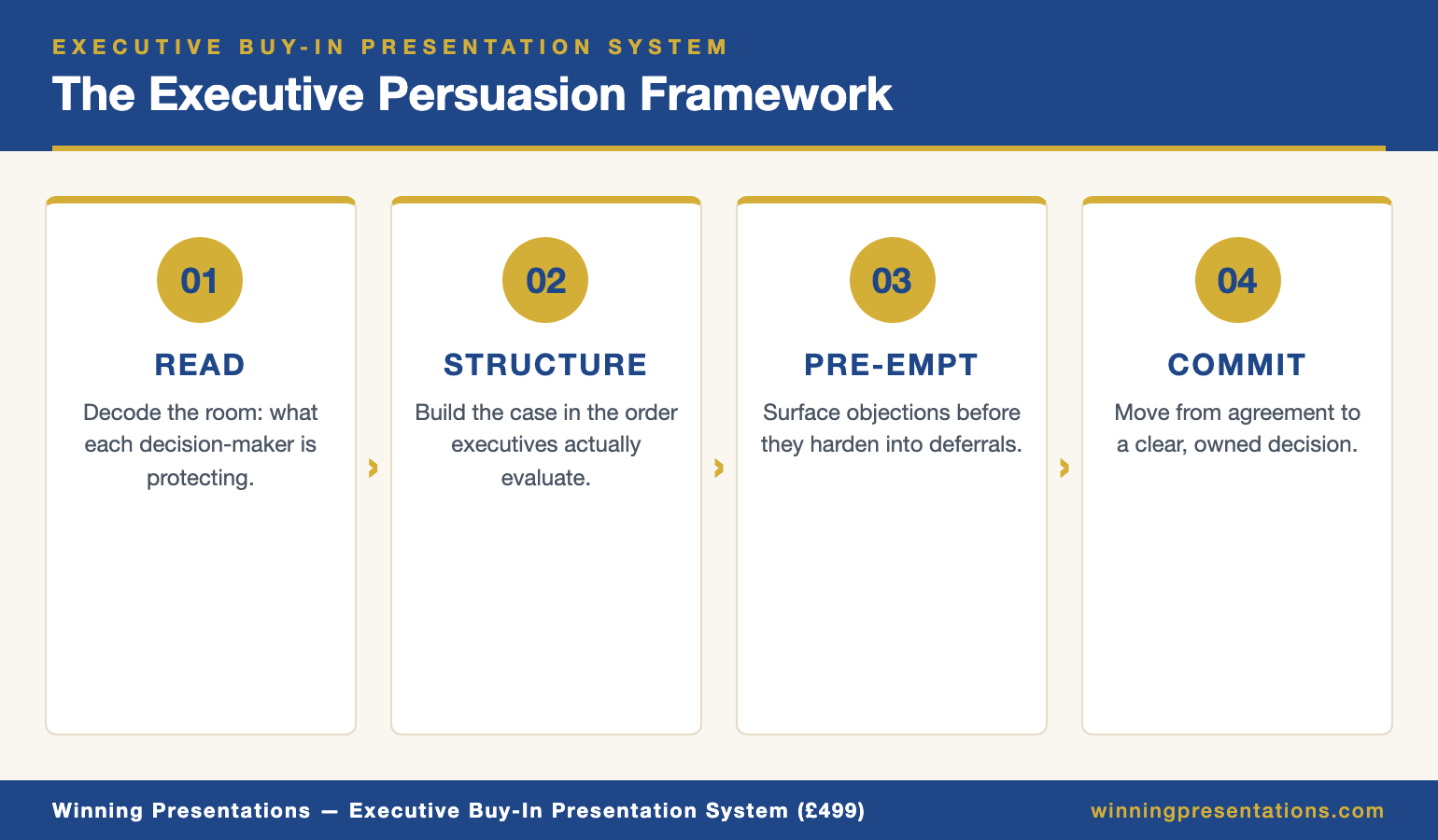
Quick answer: Stakeholder alignment presentation training teaches senior professionals how to structure and deliver presentations that bring multiple decision-makers to a shared position — rather than simply informing them and hoping for consensus. Effective training addresses the architecture of the argument, the sequencing of information for different stakeholder priorities, and the handling of resistance and competing agendas. The Executive Buy-In Presentation System is a self-paced programme designed for exactly this context — building presentations that move rooms to a clear yes.

Lucinda had been the Group Head of Compliance for three years. Her presentations were thorough — well-researched, carefully evidenced, meticulously structured. She could answer any question thrown at her. But her proposals kept stalling. Not rejected — stalled. The board would thank her for the work, acknowledge the risk, and then defer the decision to the next meeting. After the third deferral of a critical regulatory remediation programme, she asked the Chief Risk Officer for honest feedback. His answer was blunt: “Everyone in that room agrees with your analysis. The problem is they each think someone else should fund it.” The issue was not the quality of her case. It was the absence of alignment — she was presenting to a room of individual decision-makers who had not been brought to a shared position on ownership, cost allocation, or timeline before she opened her slides. When she restructured her approach — mapping each stakeholder’s specific concern, addressing the cost question explicitly before the meeting, and designing the presentation to move from shared problem to shared commitment — her next proposal was approved in a single session. No deferrals. Same data. Different architecture.

Looking for stakeholder alignment presentation training? The Executive Buy-In Presentation System is a self-paced programme for senior professionals who present to boards and committees. New cohorts open monthly. Explore the programme →

What Stakeholder Alignment Actually Means at Senior Level

Stakeholder alignment is one of those phrases that sounds straightforward until you try to do it in a room where the stakeholders have competing priorities, different risk tolerances, and unequal influence over the final decision. At junior levels, alignment usually means getting people to agree with your recommendation. At senior level, it means something considerably more complex: bringing decision-makers to a shared position on what the problem is, who owns the solution, what resources are required, and what timeline is acceptable — before the formal decision point.

The distinction matters because most presentation training treats alignment as a delivery problem. It assumes that if you present clearly enough, with compelling enough data and confident enough body language, the room will align. That assumption breaks down the moment you have a CFO concerned about capital allocation, a COO focused on operational disruption, and a non-executive director asking about regulatory risk — all in the same meeting, all with legitimate but different lenses on the same proposal.

Genuine stakeholder alignment presentation training addresses this complexity directly. It teaches you to design presentations that acknowledge competing priorities rather than ignoring them, that sequence information to build shared understanding before requesting a shared decision, and that handle the political dimension of multi-stakeholder rooms without pretending it does not exist.

Understanding the psychology behind stakeholder buy-in is foundational here — it explains why rational arguments alone rarely move a room when the decision requires multiple people to agree, each of whom has different criteria for what constitutes a good outcome.

Stakeholder alignment failure points: four common reasons executive presentations stall — competing priorities, unclear ownership, absent pre-alignment, and mixed decision criteria — shown as stacked diagnostic cards

Why Standard Presentation Training Fails on Alignment

Most presentation training — even training marketed as “executive” — is built around a single-audience model. It teaches you to identify your audience, understand their needs, and structure your message accordingly. That works when your audience is functionally homogeneous: a team of engineers, a marketing committee, a group of analysts who share the same framework for evaluating information.

It breaks down in the rooms where senior professionals actually present. A board is not a single audience. It is a collection of individuals with different functional responsibilities, different appetites for detail, different political positions, and different definitions of success. Presenting to a board as though it were a single audience with a single set of needs is one of the most common structural errors at director level and above.

Standard training also tends to focus on the presentation itself — the forty-five minutes in the room — as though that is where alignment happens. In practice, alignment at senior level is largely determined before the slides are opened. The conversations that happen in corridors, in one-to-one briefings, in pre-reads and preparatory calls — these are where positions are tested, objections are surfaced, and the ground is prepared for what happens in the formal session.

Stakeholder alignment presentation training that ignores this pre-meeting architecture is addressing only half the problem. It is teaching you to perform well in the room while leaving unaddressed the work that determines whether the room is ready to decide.

Build the Case. Align the Room. Secure the Decision.

The Executive Buy-In Presentation System teaches senior professionals how to structure and deliver presentations that move boards and committees to a clear yes. Self-paced, £499, new cohorts open monthly. Optional Q&A calls are fully recorded — watch back anytime.

Explore the Programme →

Built from 25 years of corporate banking experience at JPMorgan Chase, PwC, RBS, and Commerzbank

What Effective Stakeholder Alignment Training Actually Covers

Training that genuinely addresses stakeholder alignment — rather than just using the phrase in its marketing — covers several areas that standard presentation courses typically omit.

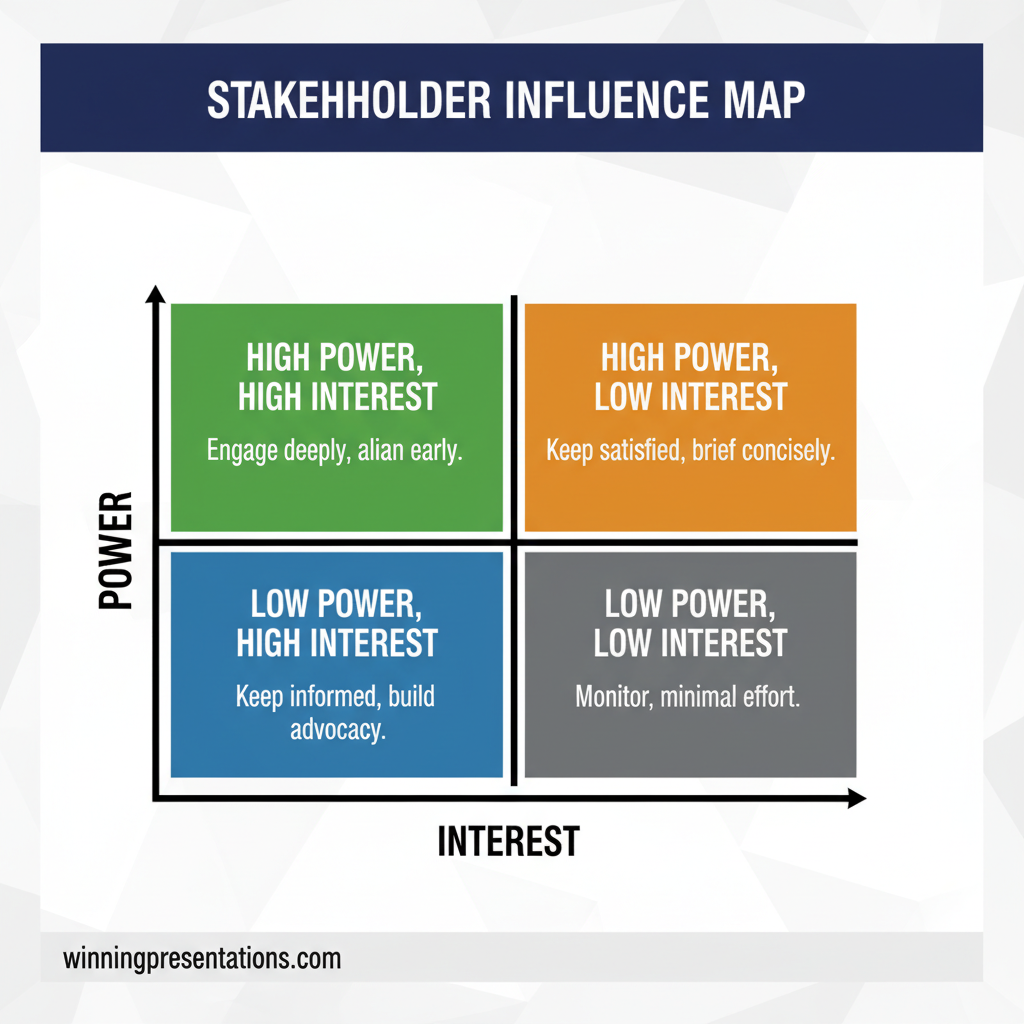
Stakeholder mapping for decision rooms. This is not the generic stakeholder analysis taught in project management courses. It is specific to presentation contexts: who in the room has formal decision authority, who has informal veto power, who is the swing vote, and what does each person need to hear before they can commit. This mapping directly informs how you sequence your slides and where you place your key asks.

Argument architecture for multi-stakeholder audiences. When your audience includes a finance director, a chief operating officer, and two non-executive directors, you cannot build a single linear argument and expect it to land with all of them. Effective training teaches you to construct presentations with a shared narrative that branches into different value propositions — addressing financial return, operational feasibility, strategic fit, and risk mitigation within the same presentation structure without losing coherence.

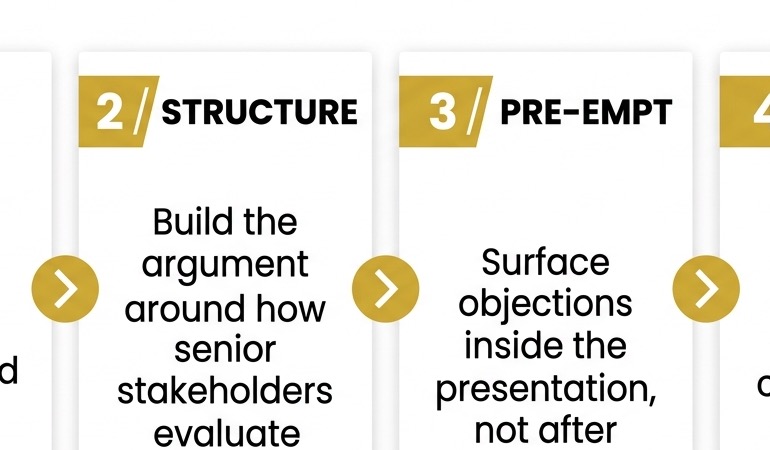
Objection anticipation and pre-emption. At board level, the most dangerous objections are the ones that are not voiced in the room but discussed afterwards. Training that addresses alignment teaches you to identify likely objections, address them proactively within the presentation, and create space for the room to surface concerns rather than suppress them.

Decision facilitation. There is a specific skill in moving a room from discussion to decision. Many senior professionals are comfortable presenting information but less practiced at the moment where the presentation transitions from informing to asking. Alignment training addresses this explicitly — how to frame the ask, when to make it, and how to handle the silence that follows.

The Executive Buy-In Presentation System covers each of these areas as part of a structured, self-paced curriculum — designed for professionals who need a systematic approach rather than ad hoc advice.

The Pre-Meeting Architecture Most Training Ignores

If you have presented at board or committee level more than a few times, you will recognise this pattern: the presentation goes well, the questions are answered competently, but no decision is made. The chair says something like, “Thank you — let us reflect on this and return to it at the next meeting.” Two months later, you are back with the same deck, updated numbers, and the same result.

This is almost always an alignment failure, not a presentation failure. The room was not ready to decide because the pre-meeting work was not done — or was not done effectively. Pre-meeting architecture is the structured preparation that happens before the formal presentation, and it is where most alignment is actually achieved or lost.

Effective pre-meeting architecture includes several elements. First, identifying the two or three stakeholders whose position will determine the outcome — and having direct conversations with them before the meeting. Not to lobby, but to understand their specific concerns, test your framing with them, and adjust your presentation accordingly. Second, ensuring the chair knows what you are going to ask and is prepared to facilitate a decision — a surprised chair will almost always defer. Third, circulating a pre-read that sets up the key question clearly, so the room arrives having thought about the decision rather than hearing the information for the first time.

The article on stakeholder alignment before major proposals covers this process in more detail — the specific steps that transform a presentation from an information event into a decision event.

Training that addresses this pre-meeting layer gives you a systematic approach to the work that happens before the slides. It is not a substitute for a good presentation — you still need to be clear, well-structured, and confident in the room. But it is the preparation that makes the difference between a presentation that informs and one that decides.

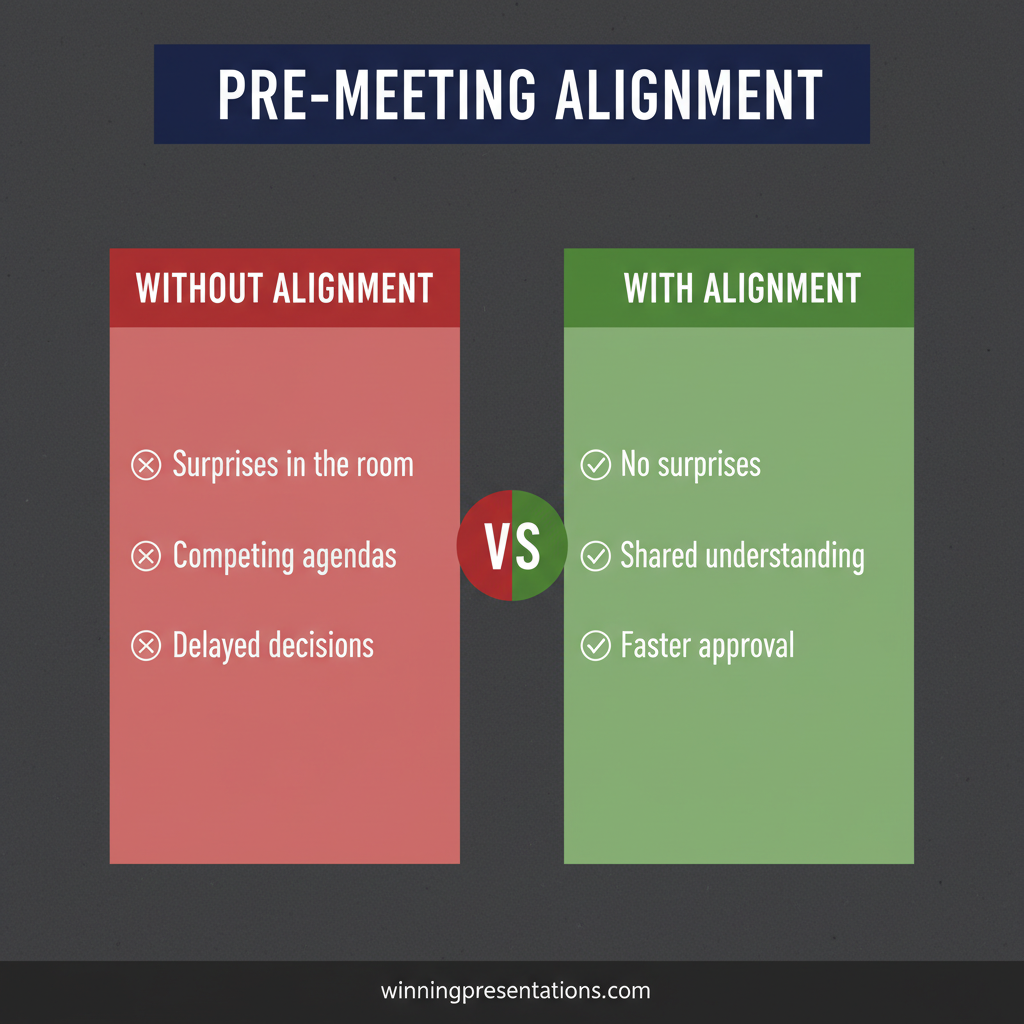
Pre-meeting alignment roadmap showing five stages: stakeholder mapping, one-to-one briefings, chair preparation, pre-read circulation, and decision-ready presentation — shown as a sequential roadmap

What to Look For in a Programme

If you are evaluating stakeholder alignment presentation training, there are several indicators that distinguish genuinely useful programmes from generic presentation skills courses.

Board-level specificity. Does the programme address the particular dynamics of multi-stakeholder decision rooms — boards, investment committees, executive leadership teams? Or is it generic “persuasive presentation” training repackaged with the word “stakeholder” in the title? The specificity of the examples, case studies, and frameworks will tell you quickly.

Structural method, not just delivery coaching. Delivery is important, but alignment is a structural problem. Look for a programme that teaches you how to build the architecture of your argument for a multi-stakeholder room — not just how to speak more confidently or design cleaner slides.

Pre-meeting preparation. If the training starts when you open your slides, it is missing the most important part. A programme that includes systematic pre-meeting preparation — stakeholder mapping, one-to-one conversations, chair briefing — addresses the full process of alignment, not just the visible portion.

Facilitator credibility. The person who designed and facilitates the programme should have direct experience of the environments they are teaching for. Ask about their background. Have they operated in the kinds of rooms their participants present to? Do they understand the political and interpersonal dynamics that make multi-stakeholder alignment genuinely difficult?

For a broader discussion of what effective board-level preparation looks like, the article on board presentation best practices covers the structural and strategic preparation that separates presentations which earn decisions from those that earn deferrals. You may also find the related discussion on boardroom presentation skills useful if you are building capability across multiple presentation types.

The Executive Buy-In Presentation System

A self-paced programme for senior professionals who present to boards, committees, and decision-making groups. Learn to build the case, align the room, and secure the decision. £499 — new cohorts open monthly. Optional Q&A calls are fully recorded.

Explore the Programme →

Designed by Mary Beth Hazeldine — 25 years in corporate banking, 16 years training senior professionals

Frequently Asked Questions

What is stakeholder alignment presentation training?

Stakeholder alignment presentation training is a specialised form of executive communication development that focuses on the specific challenge of presenting to multi-stakeholder decision rooms — boards, investment committees, executive leadership teams. Unlike generic presentation skills training, it addresses how to structure arguments for audiences with competing priorities, how to manage pre-meeting preparation to build alignment before the formal session, and how to facilitate the transition from information sharing to decision-making. It is most relevant for directors, heads of function, and senior leaders who present regularly to groups where the decision requires multiple people to agree.

How is stakeholder alignment training different from standard presentation coaching?

Standard presentation coaching typically addresses delivery skills — confidence, vocal projection, slide design, audience engagement — and is built around a single-audience model. Stakeholder alignment training addresses the structural and strategic challenge of presenting to a room where different decision-makers have different priorities, different information needs, and different criteria for what constitutes a good outcome. It covers argument architecture for multi-stakeholder audiences, pre-meeting preparation and stakeholder mapping, objection anticipation, and decision facilitation — areas that standard coaching rarely touches.

Can stakeholder alignment presentation skills be learned online?

Yes — effectively, if the programme is well-designed. The structural and strategic elements of stakeholder alignment — how to map a decision room, how to sequence an argument for multiple audiences, how to prepare for pre-meeting conversations — translate well to online learning. A self-paced programme with a structured curriculum allows participants to work through material at their own speed and apply frameworks to their actual upcoming presentations. The key is that the programme provides a systematic method, not just general advice. Optional live Q&A sessions, when available and recorded for later viewing, add an additional layer of support without requiring fixed attendance.

Who benefits most from stakeholder alignment presentation training?

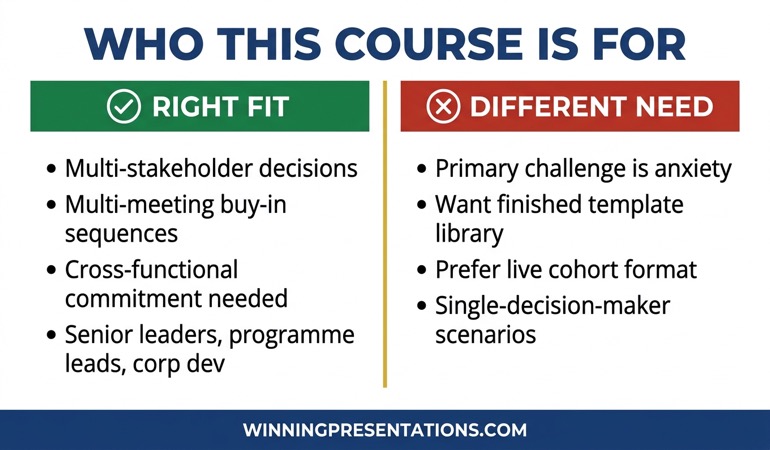
The professionals who benefit most are typically directors, heads of function, or senior leaders who present regularly to boards, committees, or executive leadership teams — and who find that their proposals are being deferred rather than decided. They are usually technically competent presenters whose challenge is not delivery but architecture: how to build a case that moves a room of decision-makers with competing priorities to a shared commitment. If your presentations are well-received but rarely result in same-meeting decisions, stakeholder alignment training is likely to address the gap that delivery coaching alone will not.

The Winning Edge

Weekly insights on executive presentations, board communication, and high-stakes delivery — for senior professionals.

Subscribe Free

About the author

Mary Beth Hazeldine, Owner & Managing Director, Winning Presentations. With 25 years of corporate banking experience at JPMorgan Chase, PwC, Royal Bank of Scotland, and Commerzbank, she has spent 16 years training senior professionals to present with greater clarity and confidence at board and executive committee level.

23 Apr 2026
Senior executive presenting pilot results to a steering committee in a polished boardroom, confident and authoritative, editorial photography style

Pilot to Contract Presentation: How to Convert a Successful POC Into a Full Programme

Quick Answer

A pilot to contract presentation succeeds when it reframes your results as proof of commercial value — not just technical success. Structure it around three questions every decision-maker is silently asking: Did it do what we needed? Can it scale? What does the business case look like at full deployment? Answer those three questions clearly, and the path from POC to signed contract becomes considerably shorter.

Priya had spent four months running a technology pilot that had exceeded every success metric.

Adoption rates were up 34 percentage points above the baseline. User satisfaction scores were the highest her company had seen in three years. The internal team who’d trialled the system had stopped using the old process entirely — not because they were required to, but because the new approach was simply better.

And yet, when she stood in front of the steering committee to present the results and seek approval to roll out across all twelve business units, the room went quiet in the wrong way. The CFO leaned back. The Chief Operations Officer asked whether this had been tested at sufficient scale. The head of IT raised procurement complexity. After forty-five minutes, the committee agreed to “think about it” and reconvene in six weeks.

Priya’s pilot hadn’t failed. Her presentation had. She had built a case for the pilot’s success but had forgotten to build the case for the contract. Those are two entirely different presentations.

Presenting pilot results to a sceptical committee this month?

The Executive Slide System gives you the templates and frameworks to structure your business case — so decision-makers can see exactly what a full deployment looks like and why it makes commercial sense.

Explore the Executive Slide System →

Why Successful Pilots Still Stall at Contract

The assumption behind most pilot presentations is that strong results speak for themselves. If the numbers are good, the contract should follow naturally. In practice, the opposite is frequently true: the better a pilot performs, the more complex the commercial conversation becomes.

There are three reasons a successful pilot stalls at the contract stage. First, the decision-making group often changes. The person who approved the pilot was typically a programme sponsor or operational lead. The full contract requires sign-off from finance, procurement, legal, and often the board — people who were not in the room during the pilot and have no emotional investment in its success.

Second, a pilot is a controlled environment. Stakeholders who weren’t involved know this, and they’re right to ask what happens when the constraints are removed: more users, more data, more edge cases, more integration complexity. Your pilot deck almost certainly doesn’t address this.

Third — and this is the one most presenters miss — decision-makers who weren’t involved in the pilot don’t just need to understand the results. They need to understand what they’re agreeing to. Scale, cost, implementation timeline, internal resource requirements, and ongoing support are all live questions. Your presentation needs to answer them before they’re asked.

The pilot programme results presentation is a technical document. The pilot to contract presentation is a commercial document. Most teams only build the first one.

The Three Questions Every Decision-Maker Is Asking

Before you design a single slide, write down the three questions that are running through every stakeholder’s mind in that room. Every element of your presentation should exist to answer one of these questions directly.

Question 1: Did it do what we actually needed?

This sounds obvious, but many pilot presentations report what happened rather than what was needed. If the business case for the pilot was “improve time-to-value for new client onboarding,” your results slide needs to show time-to-value data — not a selection of positive metrics that weren’t part of the original brief. Decision-makers who weren’t part of the pilot will look for the specific success criteria that were agreed upfront. If your results section doesn’t map directly to those criteria, you’ll face the question: “But does this actually solve the original problem?”

Question 2: Can it scale — and what does that involve?

The single biggest gap in pilot to contract presentations is the absence of a credible scale plan. Stakeholders who didn’t run the pilot need to see that you have thought through what deployment at full scale actually means: volume of users, integration points, implementation phases, internal change management requirements, and the realistic timeline for each. Without this, a successful pilot becomes a liability — it shows the thing works in a lab but doesn’t explain how it works in production.

Question 3: What is the business case at full deployment?

The ROI or business value calculation needs to be recalculated at scale, not extrapolated from the pilot. If the pilot involved fifty users and showed a specific efficiency gain, that gain at five hundred users is not simply ten times larger — there will be integration costs, change management overhead, and a transition period before the full value is realised. Decision-makers need to see a business case that accounts for full deployment costs, implementation timeline, and the point at which the investment becomes accretive. An honest, conservative model is significantly more persuasive than an optimistic extrapolation.

The Deck That Gets Your Pilot Approved at Scale

Structuring a pilot to contract presentation is one of the hardest things to get right — because it requires you to write for an audience who wasn’t in the room. The Executive Slide System — £39, instant access — gives you the templates and frameworks designed for exactly this scenario:

  • Slide templates for programme approval and rollout business cases
  • AI prompt cards to build your scale analysis and ROI model slide by slide
  • Stakeholder-readiness frameworks for presenting to new decision-makers
  • Executive summary templates that answer the three critical questions upfront

Get the Executive Slide System →

Designed for executives presenting commercial decisions to approval committees.

The Slide Structure That Converts POC Results

A pilot to contract presentation follows a different logic from a standard project update or results deck. Rather than moving chronologically through what happened, it moves commercially — from where we are now to what we’re recommending and why that recommendation makes financial and operational sense.

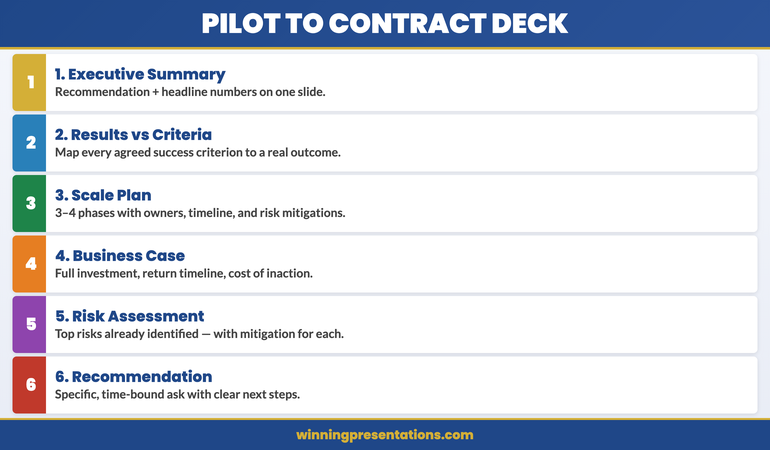
Here is a proven structure for this type of deck:

Slide 1 — Executive summary

This is your entire case on one slide: the original problem, the pilot result against each agreed success criterion, your recommendation (full deployment or a defined next phase), and the headline business case. Decision-makers who are pressed for time should be able to form a view from this slide alone. Everything that follows is supporting evidence.

Slides 2–3 — Results against original success criteria

Map every stated success criterion from the pilot approval to a specific result. Show the baseline, the target, and the actual outcome. If you exceeded some criteria and fell short on others, say so clearly. A presentation that only shows the wins loses credibility; a presentation that names the limitations and explains them builds it.

The Pilot to Contract Presentation framework showing 6 slides: Executive Summary, Results Against Criteria, Risk Assessment, Scale Plan, Business Case, and Recommendation

Slides 4–5 — Scale plan and implementation roadmap

Break deployment into three to four phases. Show what is required internally at each phase: resource, budget, timeline, and who owns what. Include the risks at each phase and how they will be mitigated. Decision-makers who were not involved in the pilot are particularly concerned about the transition — they have seen technology deployments fail at scale before. Your job is to show them you have thought through the entire journey, not just the destination.

Slides 6–7 — Business case at full scale

Build the investment case using the data you have, not the projections you’d like. Show the total cost of full deployment (including internal resource, change management, and integration), the expected return timeline, and the cost of inaction or delay. A well-constructed business case slide answers the question: “What happens if we don’t do this?” as clearly as “What happens if we do.”

Slide 8 — Risk assessment

This is a slide most presenters leave out, and its absence is noticed. Show the top four to six risks for full deployment and your mitigation approach for each. This is not an invitation for the committee to find problems — it’s a signal that you’ve already found them and planned for them. Committees approve proposals from people who demonstrate they understand the risks, not people who pretend the risks don’t exist.

Slide 9 — Recommendation and next steps

End with a specific, time-bound recommendation: what you are asking them to approve, by when, and what happens next if they do. Ambiguous endings are the enemy of contract approvals. “We recommend proceeding to full deployment by Q3, with phase one sign-off required by 30 April to maintain the implementation timeline” gives the committee something to say yes to.

The approach mirrors what the best stakeholder buy-in frameworks recommend: answer the questions in the room before they’re asked, then make the decision easy to say yes to.

If you need templates for any of these slide types, the Executive Slide System includes ready-to-use frameworks for programme approval decks, business case slides, and rollout roadmaps.

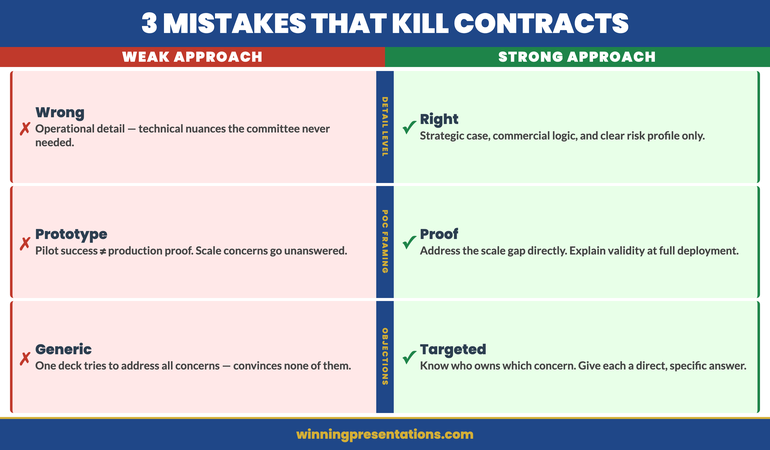
The Three Mistakes That Kill the Contract at the Finish Line

After reviewing dozens of pilot presentations, the patterns that cause contract stalls are remarkably consistent. Here are the three that come up most often.

Mistake 1: Presenting to the wrong level of detail

Pilot teams are close to the work. They know the nuance, the edge cases, the workarounds, and the technical challenges they overcame. The approval committee needs none of this. They need the strategic case, the commercial logic, and the risk profile. A presentation filled with operational detail signals to senior decision-makers that the presenter doesn’t understand the difference between informing and persuading. Strip it back. If the detail is needed, put it in the appendix and reference it only if asked.

Mistake 2: Treating the pilot as a proof of concept when the committee sees it as a prototype

In technical teams, “proof of concept” means the thing works. In commercial decision-making, it means “we tried something on a small scale to learn whether it was worth investing in at full scale.” Those are different definitions. When you present the results, explicitly address the prototype concern: yes, this was tested at limited scale; here is why the results are directionally valid at full deployment; here are the known differences and how we will manage them.

Mistake 3: Not knowing who owns the objection

The CFO’s concern about the business case is different from the COO’s concern about implementation complexity, which is different from the IT director’s concern about integration. A single presentation that tries to address all concerns simultaneously often addresses none of them convincingly. Where possible, identify who in the room holds which concern before you present, and ensure you have a specific, direct answer for each. The proof of concept presentation strategy that works is one tailored to the audience in the room, not the audience you imagined when you built the slides.

Three common pilot to contract presentation mistakes: wrong detail level, prototype perception gap, and unaddressed stakeholder objections — comparison of weak vs strong approaches

Handling Q&A When Stakeholders Push Back on Scale

Even a well-structured pilot to contract presentation will draw questions at the scale stage. Here is how to handle the most common challenges.

“Has this been tested at the scale you’re proposing?”

Don’t attempt to argue that the pilot is equivalent to full scale — it isn’t, and the committee knows it. Instead, acknowledge the scale difference directly and explain the basis for your confidence: benchmarking against similar implementations, vendor track record at scale, technical architecture analysis, or a phased deployment plan that limits exposure at each stage. The honest answer is almost always more persuasive than the defensive one.

“What happens if the integration is more complex than expected?”

Show your risk slide. If you don’t have a risk slide, promise one for the next conversation. More importantly, name the specific integration risks you have already identified, explain the mitigation approach for each, and be clear about what would trigger a pause or reassessment. Decision-makers are not asking because they want to stop the project — they are asking because they want to know you have a plan if something goes wrong.

“Can we see a cheaper or faster alternative?”

This question often signals that the business case hasn’t landed rather than genuine interest in alternatives. Before your next slide, restate the cost of inaction: what does the current process cost per year, what is the competitive risk of not deploying, and how does that compare to the investment you are proposing? If there are genuine alternatives worth considering, include them in an alternatives slide and explain why you have recommended this approach over the others.

See also how today’s related articles tackle adjacent challenges: structuring a technology roadmap presentation for the board, eliminating the habits that undermine your delivery credibility, and building a structured system to improve presentation skills at work.

Stop Losing Contracts After a Successful Pilot

The Executive Slide System — £39, instant access — includes the business case and programme approval templates that turn a successful pilot into a signed contract. Stop rebuilding these slides from scratch every time.

Get the Executive Slide System →

Designed for executives presenting commercial decisions to approval committees.

Frequently Asked Questions

How long should a pilot to contract presentation be?

For a steering committee or board approval, twelve to fifteen slides is the right target. The executive summary, results against criteria, scale plan, business case, risk assessment, and recommendation account for eight to ten core slides, with a further two to four for supporting analysis or appendix material. Anything longer and you risk losing the narrative; anything shorter and you risk leaving material questions unanswered. The goal is a deck that can be presented in twenty to thirty minutes with time left for Q&A.

What is the difference between a pilot results presentation and a pilot to contract presentation?

A pilot results presentation documents what happened and whether the pilot met its objectives. A pilot to contract presentation uses those results as evidence for a commercial recommendation. The results deck looks backwards; the contract deck looks forwards. Many teams make the mistake of delivering the same deck for both purposes, which leaves decision-makers without the information they need to approve the next stage.

How do you present a pilot that only partially met its objectives?

Directly and confidently. Identify the criteria that were met and those that weren’t. For the gaps, explain what caused them, whether they were within or outside the scope of the pilot, and how the full deployment plan addresses them. A partial success presented honestly is more persuasive than a selective success that leaves the committee wondering what you’re not telling them. Decision-makers have seen optimistic pilots before — the ones that build trust are the ones that acknowledge reality.

The Winning Edge — Weekly Presentation Intelligence

Every Thursday, I share one framework, one real-world example, and one practical technique drawn from 24 years of presenting in boardrooms across three continents. Join The Winning Edge newsletter →

Not ready for the full system? Start here instead: download the free Executive Presentation Checklist — a one-page reference covering the structure, opening, and slides every senior presentation needs before it goes to a committee.

About the Author

Mary Beth Hazeldine is the Owner & Managing Director of Winning Presentations. With 24 years of corporate banking experience at JPMorgan Chase, PwC, Royal Bank of Scotland, and Commerzbank, she advises executives across financial services, healthcare, technology, and government on structuring presentations for high-stakes funding rounds and approvals.

Book a discovery call | View services

23 Apr 2026
Male technology leader presenting a digital roadmap to a board in a modern boardroom, projected slides visible, editorial photography style

Technology Roadmap Presentation: How to Get Board and Executive Buy-In

Quick Answer

A technology roadmap presentation succeeds at board level when it frames technology decisions as business decisions. Executives don’t approve IT roadmaps — they approve investments in business capability, risk reduction, and competitive advantage. Structure your deck around those three levers, not around technical architecture, and the conversation shifts from “do we understand this?” to “when do we start?”

Henrik had prepared for six weeks.

The technology roadmap he was presenting covered the next three years of the company’s IT infrastructure: legacy system migration, cloud consolidation, cybersecurity uplift, and three new customer-facing platforms. He had worked with his team to cost every workstream, build the implementation timeline, and map out the interdependencies between each phase.

The board gave him twelve minutes before the chair interrupted. “Henrik, I appreciate the detail. But what I really need to understand is — if we approve this, what does the business look like in three years that it doesn’t look like today?”

Henrik hadn’t built that slide. He had built a technology roadmap. The board was asking for a business transformation story. Those are not the same presentation, even when they cover the same material.

That question — “what does the business look like in three years?” — is the question your technology roadmap presentation must answer before the chair has to ask it.

Taking a technology investment to the board this quarter?

The Executive Slide System gives you the templates to present technical decisions in the language executives actually use to approve investments — business capability, risk, and competitive positioning.

Explore the Executive Slide System →

Why Technology Roadmaps Fail at Board Level

The most common reason a technology roadmap presentation fails with a board or executive committee is not the technology. It’s the framing. Technical leaders build roadmaps from the inside out — starting with what the current architecture looks like, what needs to change, and how those changes will be implemented. Boards think from the outside in — starting with where the business needs to go and working backwards to what capabilities are required to get there.

When a technology roadmap is presented in technical sequence, it requires the board to do the translation work: to take what they’re being shown about infrastructure and API consolidation and reverse-engineer the business implication. Most boards won’t do that work. They’ll ask for a summary, defer the decision, or approve a smaller scope than you needed — because the full case didn’t land.

The fix is not to simplify the roadmap. It’s to reframe how the roadmap is presented. The technical detail should be available — in an appendix, in supporting slides, in a pre-read. But the main deck should tell the business story, with technology appearing as the mechanism that enables it rather than the subject of the presentation.

The approach that consistently works with boards is the same one that underpins effective digital transformation board presentations: lead with the outcome, justify with the evidence, close with the decision.

Translating Technical Decisions Into Business Language

Every major item on a technology roadmap maps to one of three business concerns: capability (what we can do), risk (what could hurt us), or efficiency (how much it costs to operate). Your job before you build a single slide is to make this mapping explicit — for yourself first, and then for your audience.

Capability language describes what the business will be able to do after the investment that it cannot do today. “We will be able to launch new products in six weeks instead of six months.” “Our sales team will have real-time visibility of customer activity across all channels.” “We will be able to process transactions in markets we are currently locked out of.” This is the language that makes boards lean forward.

Risk language describes what the business is exposed to if it does not invest. “Our current system has not received security patches since 2019 — every day it runs is a regulatory risk.” “We are operating on hardware for which spare parts are no longer available.” “Three of the five engineers who understand this architecture are planning to retire in the next two years.” Boards have strong risk appetite awareness. A well-framed risk case often moves faster than a capability case.

Efficiency language describes the cost of the current state versus the cost of the future state. “Our current architecture requires 14 separate integrations to do what a modern platform does natively.” “We are paying for five different systems that do essentially the same thing.” “Each new feature requires four weeks of development time because of the current technical debt.” This is the most straightforward translation — it’s a cost reduction story with a capital investment requirement.

Once you have mapped your roadmap to these three languages, building the board-facing deck becomes considerably more straightforward. Every technical decision has a business translation, and every business translation belongs in the main deck.

The Deck That Gets Technology Investment Approved

Translating a technical roadmap into a business case is one of the hardest things IT and technology leaders have to do. The Executive Slide System — £39, instant access — is built for exactly this challenge:

  • Slide templates for technology investment and digital transformation cases
  • Business case frameworks that translate technical decisions into board language
  • AI prompt cards to build ROI models and risk assessments slide by slide
  • Executive summary templates that lead with outcome, not architecture

Get the Executive Slide System →

Designed for executives presenting investment decisions to boards and senior committees.

The Slide Structure That Earns Executive Approval

The most effective technology roadmap presentations for boards follow a structure that starts with the strategic context, moves to the business case, and arrives at the technical plan — rather than the other way around.

Technology roadmap presentation structure showing 5 steps: Strategic Context, Business Case, Roadmap Overview, Investment Requirements, and Governance

Slide 1 — Strategic context

Where is the business now, and where does it need to be? This slide establishes the business direction that the technology roadmap is responding to. It should reference the organisation’s strategic priorities — not the IT strategy — and show the gap between current technical capability and what will be needed. Boards approve technology investments they can see are connected to business direction. They stall on investments that appear to be driven by internal IT preference.

Slides 2–3 — The business case

This is the capability, risk, and efficiency case translated into financial and operational terms. What is the cost of the current state? What does the improved future state deliver? What is the investment required, and over what timeline does the return accrue? Include a single summary table that shows the key numbers — total investment, operating cost change, expected capability outcomes, and risk reduction. Boards make investment decisions from this table. Everything else in the deck supports it.

Slide 4 — Roadmap overview

Show the three-year roadmap as a visual — phased by year, with each phase labelled by the business outcome it enables rather than the technical workstream it contains. “Year 1: Remove critical security risk and consolidate platforms” is more useful for a board than “Year 1: Network segmentation, patch management uplift, and SaaS consolidation.” The technical detail sits in supporting slides. The overview slide is for decision-making, not education.

Slide 5 — Investment requirements by phase

Break the total investment by year and by category: capital, operating, internal resource, and external partners. Show the dependencies — which phases are required before others can proceed, and what happens to the timeline and cost if phases are deferred or descoped. This slide is where boards often want to negotiate; having the dependency logic visible makes those conversations considerably more productive.

Slide 6 — Governance and oversight

How will the programme be governed? Who is accountable for each phase? What are the decision points at which the board will be asked to review progress? Boards are more willing to approve large investments when they can see they will have meaningful oversight of how the investment is being spent. A clear governance model signals maturity and professionalism; its absence raises the question of whether the technology leader has done this before.

Slide 7 — Recommendation and immediate next steps

As with any executive decision deck, end with the specific ask. “We are requesting approval of phase one investment of £X, with a programme review at the six-month stage before phase two funding is released.” This gives the board a bounded decision — they are not being asked to commit to the full three-year investment upfront, they are being asked to approve the first phase with defined review points.

The board presentation best practices that apply to technology roadmaps are the same as for any major investment: answer the strategic question first, justify the numbers clearly, and give the board a decision they can make in the room.

The Executive Slide System includes the investment case and roadmap slide templates that make this structure straightforward to build, even when you’re working with complex multi-year programmes.

How to Present Prioritisation Decisions Without Losing Credibility

One of the most delicate elements of any technology roadmap presentation is explaining why certain investments have been prioritised and others deferred. Boards understand that not everything can happen at once. What they are less tolerant of is a prioritisation rationale that appears arbitrary, politically driven, or disconnected from business need.

The strongest approach is to make your prioritisation criteria explicit before you show the roadmap. State the two or three criteria by which investments have been ranked: typically some combination of business impact, risk reduction, technical dependency (some things must happen before others), and investment required. Show the board your prioritisation matrix — which investments score highest across all criteria, which were deferred because they scored lower or are dependent on earlier phases, and which were excluded entirely and why.

This approach does two things. First, it demonstrates that the roadmap is the output of a disciplined process, not a wish list. Second, it gives board members a framework for asking questions: “Why does this score lower than that on business impact?” is a much more productive conversation than “Why isn’t X on the roadmap?”

Where items have been deferred due to budget rather than priority, say so directly. “We have included this in a future phase not because it’s lower priority but because the investment profile of phase one is at the limit of what we believe the organisation can absorb in a single year.” This is the kind of transparency that builds credibility with boards rather than eroding it.

Technology roadmap prioritisation framework showing four criteria: Business Impact, Risk Reduction, Technical Dependency, and Investment Required with scoring examples

Handling the Questions Boards Always Ask

Technology roadmap presentations generate a predictable set of board questions. Preparing for these in advance significantly reduces the risk of the presentation stalling.

“What happens if we only fund phase one?”

Have a clear answer for the partial investment scenario. What does phase one deliver in isolation? Is it useful on its own or is it a prerequisite for the phases that follow? If phase one is only valuable as the foundation for subsequent investment, say that directly — and explain what the cost is of then having to decommission or restart if the subsequent phases are not approved. This prevents boards from approving a small piece and then finding the full investment is required anyway.

“Have you considered buying rather than building?”

This is almost always worth including proactively in the deck. Show the build versus buy analysis — what you considered, why you selected the approach you’re recommending, and what the cost, capability, and risk trade-offs are. Boards that raise this question themselves feel it hasn’t been considered. Boards that see you’ve already addressed it feel confident the recommendation is robust.

“How do we know the costs won’t escalate?”

Reference your contingency provision and your governance model. Technology programmes routinely cost more than estimated — boards know this. What they want to see is that you have built this reality into your investment case rather than assumed everything will go to plan. A programme with a fifteen to twenty per cent contingency provision and a defined process for managing scope changes is more credible than one that presents a single-point estimate.

See also today’s related articles on converting a successful pilot into a contract, eliminating the delivery habits that undermine your credibility, and building lasting presentation capability at work.

Stop Watching Technology Budgets Stall in “Further Review”

The Executive Slide System — £39, instant access — gives you the business case templates and investment frameworks that translate technical decisions into the language boards use to approve spending. Build your next technology roadmap presentation in a fraction of the time.

Get the Executive Slide System →

Designed for executives presenting investment decisions to boards and senior committees.

Frequently Asked Questions

How do you present a multi-year technology roadmap without overwhelming the board?

Focus the main deck on the first phase and the high-level arc of the full programme. Show what the board is being asked to approve now, what they will see at each review point, and what the three-year destination looks like. The detail behind each subsequent phase belongs in supporting slides or a pre-read document. Boards that feel overwhelmed by detail defer decisions; boards that see a clear first phase with defined review points are considerably more likely to approve.

What is the right level of technical detail for a board technology presentation?

Almost none in the main deck. Board members are not evaluating your technical choices — they are evaluating the business logic of the investment. Technical architecture diagrams, system integration maps, and development methodology detail belong in appendix slides that you reference if specific questions arise. The main deck should be comprehensible to a non-technical director who is asking: “Does this make business sense?”

How do you handle a board member who is a technology expert and wants more detail?

Acknowledge their expertise and offer a deeper technical conversation outside the board session. In the main presentation, keep the business framing intact — changing pace and detail level for one board member risks losing the rest. Offer to send supporting technical documentation in advance of the next meeting, or propose a separate technical deep-dive with the interested director. This respects their interest while maintaining a presentation that works for the full board.

The Winning Edge — Weekly Presentation Intelligence

Every Thursday, frameworks and techniques from 24 years of presenting in boardrooms. Join The Winning Edge →

Not ready for the full system? Download the free Executive Presentation Checklist — a one-page reference for the structure and slides every board presentation needs.

About the Author

Mary Beth Hazeldine is the Owner & Managing Director of Winning Presentations. With 24 years of corporate banking experience at JPMorgan Chase, PwC, Royal Bank of Scotland, and Commerzbank, she advises executives across financial services, healthcare, technology, and government on structuring presentations for high-stakes funding rounds and approvals.

Book a discovery call | View services

17 Apr 2026
A senior female executive in a one-to-one conversation with a male board member in a glass-walled office, building alignment before a formal meeting, confident and collaborative tone, editorial photography style

Stakeholder Alignment Presentation: The Pre-Meeting That Wins Approvals

Quick Answer: Most approvals are decided before the formal presentation begins. A stakeholder alignment session — a structured pre-meeting with key decision-makers — lets you surface objections privately, refine your narrative based on what you hear, and arrive in the room with commitments already secured. The formal presentation then becomes a ratification exercise rather than a persuasion exercise. This approach works for board approvals, finance committee requests, and any high-stakes executive decision.

Astrid had thirty minutes in front of the investment committee. She had rehearsed the deck twenty times. Her financial model was solid, her slides were clear, and her executive sponsor believed in the project. When the committee chair asked a single question — “What does the operations director think about the implementation timeline?” — the presentation stalled.

The operations director hadn’t been consulted. He sat in the room, visibly uncomfortable. The committee read the room, delayed the decision, and asked for a revised proposal that incorporated operational input.

Three weeks later, Astrid submitted the same project with one structural difference: she had spent the preceding fortnight meeting individually with every committee member and the operations director. By the time she walked into the formal presentation, every objection had already been heard, addressed, and in most cases resolved. The formal presentation took nineteen minutes. The approval was unanimous.

If you’re preparing for a high-stakes approval

The Executive Slide System includes scenario playbooks and slide templates for executive approval presentations — including the alignment and pre-meeting frameworks that help you structure what you learn before the formal session.

Explore the System →

Why the Decision Is Made Before You Present

Senior decision-makers rarely change their minds in a committee room. By the time the formal meeting convenes, most members have already formed a view — based on conversations in corridors, emails exchanged with colleagues, and assumptions built from prior context. The formal presentation is where those views are tested, not formed.

This is not cynicism about the process. It reflects how experienced executives make high-stakes decisions: they gather information in advance, test their instincts with trusted colleagues, and arrive in the meeting with a working hypothesis. Your presentation either confirms or challenges that hypothesis. If you’ve done no work to shape it in advance, you’re working against a position that was set before you entered the room.

The most effective executives understand this dynamic and work with it rather than against it. They treat the formal presentation as the final step in a longer engagement process, not the first and only opportunity to make their case.

The pre-presentation alignment session is the mechanism that makes this possible. It is not manipulation — it is thorough preparation. Every concern that surfaces in a private conversation is one that won’t derail the formal meeting. Every commitment secured informally is one that reinforces the approval in the room. And every stakeholder who feels heard in advance is one who arrives in the meeting inclined to support rather than question.

Executive Slide System

Structure Your Approval Presentation to Match the Work Done Before the Room

The Executive Slide System — £39, instant access — gives you slide templates for board, finance committee, and investment committee presentations, plus scenario playbooks for navigating stakeholder alignment before high-stakes approvals. Designed for executives who want to arrive in the formal meeting with the decision already moving in their direction.

  • Slide templates for approval and board presentations across executive scenarios
  • AI prompt cards to map stakeholder concerns before the alignment session
  • Framework guides for structuring the narrative around what you hear pre-meeting
  • Scenario playbooks for investment committee, board, and finance committee contexts

Get the Executive Slide System →

Designed for high-stakes approval presentations where preparation matters more than performance.


Stakeholder Alignment Dashboard infographic showing four metric categories: Decision-Makers to Brief, Concerns to Surface, Commitments Secured, and Objections Outstanding — a pre-presentation tracking framework

Who to Meet and What to Ask Them

Not every stakeholder needs a dedicated pre-meeting. The goal is to meet the people whose support is essential and whose concerns, if left unaddressed, could derail the formal presentation. For most approval presentations, that list is shorter than it appears.

Start with the decision-makers — the people who will vote, recommend, or formally approve. Understand their current view on the topic before you attempt to inform it. Have they been involved in similar decisions before? Do they have a prior position on this type of investment or initiative? Is there a competing proposal that complicates their thinking?

Next, identify the influencers — the people whose opinion the decision-makers trust. In a finance committee context, this is often the CFO’s direct advisers or the head of internal audit. In a board context, it may be the senior independent director or a non-executive with a strong view on capital allocation. These people may not have a vote, but their informal influence on the final outcome can be decisive.

Finally, identify the potential blockers — the people whose opposition, if expressed in the formal meeting, could damage the proposal even if they are in the minority. Understanding a blocker’s concern before the meeting gives you the opportunity to address it privately, which is almost always more productive than managing it in public.

In each pre-meeting, ask three questions. What do they already know about the proposal? What concerns do they have about it? And what would they need to see to be comfortable supporting it? These questions are not a sales pitch — they are information-gathering. The goal is to understand, not to convince. Convincing comes later, in how you update the presentation.

For the framework behind pre-decision conversations, see The Pre-Decision Conversation: How Executives Secure Approval Before the Meeting.

Running the Alignment Session Effectively

An alignment session is a conversation, not a presentation. Executives who use the pre-meeting to walk through their slides — treating it as a rehearsal — miss the point. The slide deck is not what you bring to this meeting. What you bring is curiosity and good questions.

Keep the meeting short: thirty minutes is usually sufficient. Open by explaining your purpose directly — you are seeking input before the formal session to ensure the presentation addresses the right questions. Most decision-makers respect this directness. It signals that you are thorough, not that you are uncertain.

Listen more than you speak. When a concern surfaces, resist the instinct to immediately counter it. Instead, explore it: “That’s useful to know — can you say more about what’s driving that concern?” Understanding the root of an objection is more valuable than overcoming its surface expression. An objection that sounds financial may actually be about trust. An objection about timing may actually be about resource competition.

Take notes, and be transparent about doing so. “I want to make sure I capture this accurately before I revise the presentation” signals that the conversation will have a real impact on what the committee sees. This is important: if decision-makers sense that the pre-meeting is performative rather than genuinely informative, they stop sharing real concerns.

Close each session by confirming what you’ve heard and what changes you plan to make. “Based on what you’ve shared, I’ll strengthen the implementation timeline and add more detail on the alternatives we considered. Does that address the main concerns you raised?” This gives the stakeholder the opportunity to confirm or correct your understanding before you do the work.

If you’re rebuilding a formal approval presentation around what you’ve heard in pre-meeting conversations, the Executive Slide System includes slide templates and AI prompt cards designed to help you translate stakeholder concerns into a presentation narrative that addresses them structurally, not just rhetorically.


Stakeholder Alignment Roadmap infographic showing five stages: Map the Stakeholders, Schedule Pre-Meetings, Surface Concerns, Update the Narrative, and Enter the Room with Commitments Secured

What to Do With What You Hear

The alignment session has value only if it changes something. If you leave every pre-meeting with the same deck and the same narrative, you’ve gathered information that you didn’t act on — which is worse than not gathering it, because it signals to stakeholders that the consultation was cosmetic.

After each pre-meeting, categorise what you’ve heard. Some concerns will be addressed by adding or clarifying information — a new slide, an updated data source, a clearer explanation of a financial assumption. These are structural changes, and they make the presentation more complete. Make them before the formal session.

Other concerns will reflect a disagreement about the underlying business case — a stakeholder who genuinely believes the investment is premature, or that a different approach should be considered. These cannot be resolved with a slide change. They require a direct conversation about the merits, and in some cases, the involvement of a more senior sponsor to navigate the impasse. Identify these early, because they need more time than a slide revision.

Some concerns will be about perception rather than substance — a stakeholder who hasn’t been involved in previous discussions and feels left out, or one who is concerned about credit and visibility when the project succeeds. These are relationship issues, and they are resolved through the pre-meeting process itself: the act of consulting them is the resolution. Make sure they know their input shaped the final presentation.

Keep a simple log of what you heard, what you changed, and what remains unresolved. This is useful for two reasons. It ensures that nothing gets lost between conversations. And if the decision is contested in the formal meeting, your log gives you the basis to say with confidence: “I discussed this with [stakeholder] two weeks ago, and here is how I addressed that concern in the revised presentation.” For related thinking on managing structural change presentations, see Restructuring Presentation: Rebuilding Trust Through Transparent Communication.

Aligning Across Competing Interests

The most challenging stakeholder alignment situations are those where key decision-makers have competing interests — where what one stakeholder needs to hear directly contradicts what another needs to hear. A proposal that involves resource reallocation is a classic example: the function gaining resources welcomes it, while the function losing resources opposes it.

The response here is not to tell different stakeholders different things — that collapses the moment the formal meeting convenes. The response is to find the common ground between competing interests and build the presentation narrative around it.

What both stakeholders share, despite competing interests, is typically a concern about the broader organisational outcome. The function losing resources still cares about the company’s performance. The disagreement is about means, not ends. A presentation that frames the proposal in terms of the shared goal — rather than the redistribution of resources — gives both stakeholders something they can support.

Where interests are genuinely irreconcilable, the alignment session’s value is in surfacing the conflict before the formal meeting rather than discovering it in public. A committee where two factions are in open disagreement is difficult to present to. A committee where the chair knows the disagreement exists and has managed it in advance is a different environment. Use the pre-meeting process to give the chair the information they need to manage the room, as well as to manage your own presentation.

Using the Formal Presentation to Confirm, Not Persuade

When the alignment process has been done well, the formal presentation shifts in character. It becomes a confirmation exercise — a structured walk through the proposal that gives the committee confidence that everything has been considered, rather than a persuasion exercise where the outcome is uncertain.

This changes the tone and the pacing. A confirmation presentation can afford to be shorter, because most of the information has already been shared in pre-meetings. It can acknowledge concerns explicitly — “I know some of you have raised questions about the implementation timeline, so I’ve added a new slide that addresses this directly” — because the concerns are already known. And it can invite a more collaborative discussion, because the presenter isn’t guarding against ambushes.

The questions that arise in a confirmation presentation are also different in character. They tend to be sharper and more specific — looking for the final detail that will complete the picture — rather than broad and exploratory. This is a good sign. It means the committee is doing the final check before committing, not starting the analysis from scratch.

The goal is to make the formal presentation feel inevitable in the best sense: the logical outcome of a rigorous process rather than a surprise outcome from a single event. For guidance on how executive presence supports this dynamic in the room, see Executive Presence in Presentations: The Quality That Closes the Room.

Need the Templates, Not Another Framework?

Slide Templates for Executives Who Present to Senior Decision-Makers

The Executive Slide System — £39, instant access — includes ready-to-use templates for board, finance committee, and investment approval presentations, plus AI prompt cards to structure your narrative around what stakeholders actually need to hear.

Get the Executive Slide System →

Frequently Asked Questions

How many pre-meetings is too many before a formal presentation?

There is no fixed upper limit, but the quality of pre-meetings matters more than the number. Five shallow conversations that don’t surface real concerns are less valuable than two deep ones that reveal the actual objections. As a working guide, prioritise the three to five people whose support is essential and whose concerns are most likely to surface in the formal meeting. Beyond that core group, judge based on the political complexity of the specific approval and the time available.

What if a key stakeholder refuses to meet before the formal session?

A refusal to meet is itself useful information. It may signal opposition, disengagement, or a prior commitment to a competing proposal. If a critical decision-maker declines a pre-meeting, work through your executive sponsor to understand their position and whether there is a backstory that you need to account for. It may also be worth adjusting the formal presentation to explicitly invite that stakeholder’s input — framing their engagement as essential to the process rather than assuming their alignment.

Is it appropriate to share draft slides in a pre-meeting?

In most cases, no. Sharing draft slides in a pre-meeting shifts the conversation from concerns to critique — stakeholders start commenting on slide design rather than sharing their underlying concerns about the proposal. The exception is when a specific stakeholder is a subject-matter expert whose input on a particular section of the deck would meaningfully improve it. In that case, share only the relevant section and frame it as a request for input rather than a preview of the full presentation.

The Winning Edge — Free Weekly Newsletter

Practical frameworks for executives who present to boards, finance committees, and senior leadership. Every Thursday.

Subscribe to The Winning Edge →

Not ready for the full system? Start here instead: download the free Executive Presentation Checklist — a one-page reference covering the structural elements decision-makers look for in board and approval presentations.

About the Author

Mary Beth Hazeldine is Owner & Managing Director of Winning Presentations. With 25 years of corporate banking experience at JPMorgan Chase, PwC, Royal Bank of Scotland, and Commerzbank, she advises executives across financial services, healthcare, technology, and government on structuring presentations for high-stakes funding rounds and approvals.

02 Feb 2026
Two executives in private one-on-one meeting discussing presentation champion strategy and stakeholder buy-in

The Champion Strategy: How to Get Someone Fighting FOR Your Proposal

I watched a brilliant proposal die in 47 minutes.

The presenter had done everything right. Clear recommendation. Solid data. Compelling ROI. She’d rehearsed until her delivery was flawless. The CFO asked two questions, nodded thoughtfully, and said, “Let’s table this for now.”

Afterwards, I asked her: “Who in that room was already fighting for this before you walked in?”

She looked confused. “What do you mean? I was presenting it. I was fighting for it.”

That was the problem.

The most important person for your proposal’s success isn’t you. It’s your champion—the person who fights for your idea when you’re not in the room. Without one, even perfect presentations fail. With one, even mediocre presentations often succeed.

Quick answer: A presentation champion is someone with influence in the decision-making group who advocates for your proposal before, during, and after your presentation. The champion strategy involves identifying the right person, enrolling them in your idea through one-on-one conversations (never in the group meeting), and equipping them to defend your proposal when you’re not present. This approach works because executive decisions rarely happen in presentations—they happen in hallway conversations, pre-meetings, and informal discussions where your champion speaks for you. This article explains how to identify, approach, and activate your champion.

⚡ Presenting This Week? The 15-Minute Champion Check

If you have a presentation coming up and haven’t thought about champions, ask yourself:

  1. Who in the room already wants this to succeed? (Not who should—who actually does?)
  2. Have you talked to them one-on-one? If not, schedule 15 minutes today.
  3. Do they know what objections to expect? Brief them on likely pushback and how to respond.
  4. Can they speak first or second? Champions are most effective when they establish momentum early.

This won’t replace proper champion development, but it dramatically improves your odds. For the complete system, keep reading.

Why Champions Matter More Than Presentation Skills

Here’s an uncomfortable truth I learned after 24 years in corporate banking: executive decisions rarely happen in presentations.

By the time you stand up to present, most decision-makers have already formed opinions. They’ve talked to colleagues. They’ve heard informal assessments. They’ve developed positions based on conversations you weren’t part of.

Your presentation doesn’t create the decision. It confirms or challenges decisions that were already forming.

This is why brilliant presenters with weak proposals sometimes win, while mediocre presenters with strong proposals sometimes lose. The presentation is visible. The pre-work is invisible. And the pre-work usually matters more.

A champion changes this dynamic. When you have someone in the room who’s already committed to your success, they do things you can’t:

  • They advocate for your idea in conversations you’re not invited to
  • They counter objections before they solidify into opposition
  • They lend their credibility to your proposal
  • They signal to others that supporting this idea is safe
  • They follow up after the meeting to keep momentum

Without a champion, you’re alone. With a champion, you have an ally inside the decision-making system.

For more on why good presentations still fail, see my article on how to get executive buy-in.

What Makes Someone a Champion

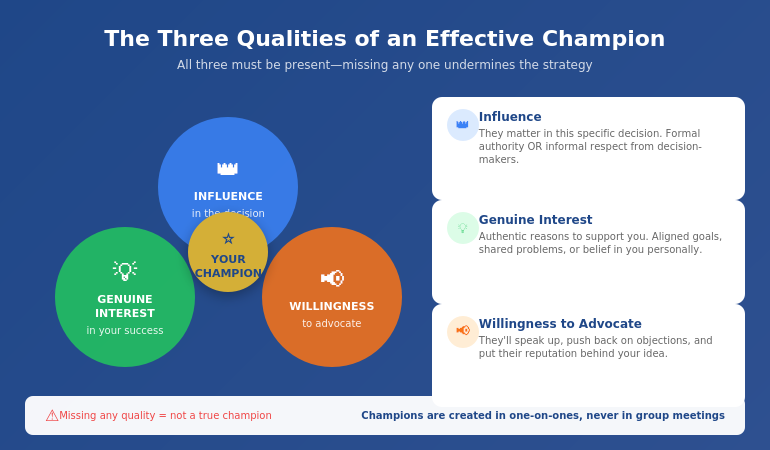
Not everyone can be your champion. The right champion has three characteristics:

1. Influence in the Decision

Your champion needs to matter in this specific decision. That might mean formal authority (they’re a decision-maker) or informal influence (decision-makers respect their judgment). Often, the most effective champions aren’t the most senior people—they’re the people whose opinions carry weight with the actual decision-makers.

2. Genuine Interest in Your Success

Champions work best when they have authentic reasons to support your proposal. Maybe it aligns with their goals. Maybe it solves a problem they care about. Maybe they believe in you personally. The motivation matters because champions often need to spend political capital defending your idea—they won’t do that for something they don’t actually believe in.

3. Willingness to Advocate

Some people might want your proposal to succeed but won’t actively fight for it. A true champion is willing to speak up, push back on objections, and put their reputation behind your idea. This requires a certain personality type—not everyone is comfortable in that role.

The intersection of these three qualities is rare. You might find someone influential who doesn’t care about your proposal. Or someone who cares deeply but lacks influence. Or someone with both but who avoids advocacy. Your job is to find the person who has all three—or to develop those qualities in a potential champion.

Venn diagram showing the three qualities of an effective presentation champion: influence, genuine interest, and willingness to advocate

🎯 Master the Buy-In System

The Executive Buy-In Presentation System teaches the complete internal advocate approach—plus stakeholder mapping, objection handling, and the pre-meeting tactics that determine whether your proposal succeeds or fails.

What you’ll learn:

  • The Champion Identification Framework
  • The Enrollment Conversation script
  • Stakeholder mapping for complex decisions
  • How to neutralise blockers before they block
  • The Follow-Through System for post-presentation momentum

Join the Executive Buy-In System → £199

Self-study programme with modules + templates + live Q&A calls. Study at your own pace.

How to Identify Your Champion

Finding your champion requires honest assessment of the decision-making landscape. Here’s the process I teach:

Step 1: Map the Decision-Makers

List everyone who will influence this decision. Include formal decision-makers (those who sign off) and informal influencers (those whose opinions matter). For each person, note:

  • Their likely position on your proposal (supportive, neutral, opposed, unknown)
  • Their level of influence in this specific decision
  • Their relationship with you (strong, moderate, weak, none)

Step 2: Identify Potential Champions

From your map, look for people who are:

  • Already supportive or leaning supportive (you need genuine interest)
  • Influential enough to matter (their voice carries weight)
  • Accessible to you (you can actually have conversations with them)

The best champions often aren’t obvious. They might be one level below the top decision-maker but highly trusted. They might be from a different department but respected for their judgment. They might be a peer who happens to have the CEO’s ear.

Step 3: Assess Willingness

Before approaching a potential champion, consider: Would this person actually advocate for a proposal? Some people avoid taking positions. Others speak up but only for their own initiatives. Look for people with a track record of supporting good ideas—even when they weren’t the originator.

Step 4: Choose Wisely

Having multiple champions can be powerful, but start with one. Choose the person who best combines influence, genuine interest, and willingness. You can expand later—but a strong single champion often outperforms multiple weak ones.

For more on stakeholder analysis, see my guide on stakeholder buy-in psychology.

📋 Note: The complete stakeholder mapping system—including templates for identifying champions and planning your approach—is covered in the Executive Buy-In System programme.

The Enrollment Conversation

You cannot create an internal advocate in a group meeting. This is perhaps the most important thing I can tell you about the sponsor approach.

Group meetings are the worst place to build support. People are cautious. They’re watching others. They’re protecting themselves. No one wants to be the first to champion an idea that might fail publicly.

Champions are created in one-on-one conversations—ideally before the formal presentation is even scheduled.

Here’s the enrollment conversation structure I teach:

1. Open with Genuine Curiosity

Don’t pitch. Ask questions. “I’m working on a proposal for [X] and I’d value your perspective. What would you need to see for something like this to work?”

This does two things: it shows respect for their judgment, and it reveals what they actually care about—information you can use to shape your proposal.

2. Listen More Than You Talk

Let them share concerns, questions, and suggestions. Take notes. Ask follow-up questions. The more they talk, the more invested they become—and the more you learn about how to position your proposal for success.

3. Incorporate Their Input

After the conversation, actually use their feedback. When people see their ideas reflected in your proposal, they feel ownership. Ownership drives advocacy.

4. Make the Ask

Once you’ve had substantive conversations and incorporated input, you can make the explicit ask: “This is going to the steering committee next month. Would you be willing to support it? I think your perspective on [their area of expertise] could really help.”

Notice the ask is specific. You’re not asking them to “help” vaguely—you’re asking for explicit support in a specific context.

5. Equip Them

Champions can only advocate effectively if they have the right information. Share your key points, anticipated objections, and responses. Make it easy for them to defend your proposal without needing you present.

💡 The Enrollment Conversation Is Where Champions Are Made

The scripts and practice scenarios for these conversations are detailed in the Executive Buy-In System. But even without formal training, the principles above will dramatically improve your approach: genuine curiosity, active listening, incorporation of feedback, specific asks, and proper equipping.

Activating Your Champion

Having a champion isn’t enough. You need to activate them effectively. Here’s how:

Before the Presentation

Brief them on the landscape. Who else will be in the room? What positions have people already taken? What objections are likely? Your champion should walk in informed, not surprised.

Agree on their role. Will they speak early to establish momentum? Will they address specific objections? Will they stay quiet unless needed? Different situations call for different approaches. Discuss and agree.

Share your materials in advance. Your champion should see your presentation before the meeting. They might catch issues, suggest improvements, or simply feel more confident advocating for something they’ve reviewed.

During the Presentation

Don’t look to them for rescue. Your champion shouldn’t be your safety net for a poorly prepared presentation. Do your job well; let them amplify your success rather than compensate for your failures.

Create openings. When appropriate, you can create natural moments for your champion to contribute: “Sarah has been thinking about the operational implications—Sarah, what’s your view?” This gives them a platform without making their support seem staged.

After the Presentation

Debrief immediately. What worked? What didn’t? What follow-up is needed? Your champion often has insights into room dynamics that you missed while presenting.

Keep them informed. As the decision progresses, keep your champion updated. They may have opportunities to advocate in conversations you’re not part of—but only if they know what’s happening.

Thank them genuinely. Champions spend political capital on your behalf. Acknowledge that investment, regardless of the outcome.

For more on the pre-meeting strategy, see my guide on pre-meeting executive alignment.

🎯 The Complete Buy-In System

Stop leaving buy-in to chance. The Executive Buy-In Presentation System teaches everything in this article—plus stakeholder mapping, objection handling, political navigation, and follow-through tactics—in a structured programme with templates, scripts, and live support.

The programme includes:

  • The Champion Identification Framework
  • Enrollment Conversation scripts
  • Stakeholder mapping templates
  • Objection pre-emption strategies
  • The Follow-Through System
  • Live Q&A calls for your specific situations

Join the Executive Buy-In System → £199

Self-study programme with live Q&A support. Study at your own pace.

Frequently Asked Questions

What is a champion in business presentations?

A presentation champion is someone with influence in the decision-making group who actively advocates for your proposal. Unlike a passive supporter who might vote yes if asked, a champion proactively speaks up for your idea, counters objections, and uses their credibility to build support—both in formal meetings and in informal conversations where decisions often really happen.

How do you get executive buy-in for a proposal?

Executive buy-in requires working outside the presentation itself. Identify stakeholders before you present, have one-on-one conversations to understand concerns and incorporate feedback, cultivate a champion who will advocate for you, and address objections before they surface publicly. The presentation confirms momentum you’ve already built—it rarely creates new support from scratch.

Why do good presentations get rejected?

Most rejected presentations fail for political reasons, not content reasons. The presenter had no champion advocating for them. Key stakeholders had concerns that weren’t addressed beforehand. Opposition formed in private conversations. Decision-makers had already decided before the presentation started. Strong content matters, but it can’t overcome weak stakeholder groundwork.

What if I don’t know anyone senior enough to be my champion?

You don’t necessarily need someone senior—you need someone influential in this specific decision. That might be a peer who’s highly respected, someone from a related department whose opinion carries weight, or your direct manager who can advocate upward. Start building relationships before you need them. The best time to develop potential champions is when you don’t have an immediate ask.

How do I approach a potential champion without seeming political?

Lead with genuine curiosity rather than asking for support. “I’d value your perspective on this challenge” is authentic relationship-building. “Will you support my proposal?” feels transactional. Build the relationship through substantive conversations about the work. The ask for support comes later, naturally, after you’ve demonstrated respect for their judgment and incorporated their thinking.

What if my champion can’t attend the actual presentation?

Champions are often more valuable outside the presentation than inside it. They can advocate in pre-meetings, informal conversations, and follow-up discussions. If your champion can’t attend, ask them to speak with key decision-makers beforehand, and keep them informed so they can continue advocating as the decision progresses through other forums.

How far in advance should I start building champion relationships?

Ideally, you’re building relationships continuously—not just when you need something. For a specific proposal, start cultivating your champion at least 2-4 weeks before the formal presentation. This gives time for multiple conversations, incorporating feedback, and allowing your champion to do their own informal advocacy. Last-minute champion recruitment rarely works.

📧 The Winning Edge Newsletter

Weekly insights on executive presentations, stakeholder management, and what actually works in corporate decision-making.

Subscribe Free →

📋 Free: Executive Presentation Checklist

A pre-presentation checklist that includes the champion check, stakeholder assessment, and objection preparation. Use it before every important presentation.

Download Free Checklist →

About the Author

Mary Beth Hazeldine is the Owner & Managing Director of Winning Presentations. With 24 years of corporate banking experience at JPMorgan Chase, PwC, Royal Bank of Scotland, and Commerzbank, she has navigated complex stakeholder environments and delivered high-stakes presentations in boardrooms across three continents.

A qualified clinical hypnotherapist and NLP practitioner, Mary Beth combines executive communication expertise with evidence-based techniques for managing presentation anxiety. She works with senior teams on high-stakes funding rounds and executive approvals.

Book a discovery call | View services

Your Next Step

Before your next important presentation, ask yourself: Who is my champion?

If you can’t name someone specific—someone who will actively advocate for your proposal in conversations you’re not part of—you have work to do before you work on your slides.

The internal advocate approach isn’t about politics or manipulation. It’s about recognising how decisions actually get made in organisations, and working with that reality rather than against it.

Strong proposals deserve strong advocates. Find yours.

Related: If your preparation process needs work too, see today’s companion article on the preparation order that doubles approval rates—because even with a champion, your content still needs to be right.

28 Jan 2026
Professional woman having one-on-one stakeholder conversation with hand gesture, engaging colleague in discussion

Stakeholder Buy-In Psychology: Why Alignment Creates Agreement and Enrollment Creates Champions

The CFO said yes in our one-on-one. Then he stayed silent in the steering committee while someone else killed the project.

I’d done everything right — or so I thought. I’d had the pre-meeting conversations. I’d addressed concerns. I’d gotten explicit agreement from every key stakeholder. On paper, I was “aligned.”

But when a skeptical VP raised objections in the room, nobody defended my proposal. The people who’d nodded along in private sat quietly while the project got “tabled for further review.” It never came back.

That’s when a mentor taught me the distinction that changed everything: I’d achieved alignment, but not enrollment. And in stakeholder buy-in psychology, that difference is everything.

Quick Answer: Alignment means stakeholders agree with your position — they won’t actively oppose you. Enrollment means stakeholders feel ownership of the idea — they’ll defend it, champion it, and drive it forward even when you’re not in the room. The psychology is different: alignment asks “will you accept this?” while enrollment asks “what would make this yours?” Enrollment is harder to achieve but dramatically more durable.

If you’re presenting to executives, boards, or steering committees — passive agreement isn’t enough. You need people who will speak up when objections arise. That requires understanding the psychology of genuine buy-in.

Need real buy-in this week? Try the enrollment shift.

Instead of asking “Do you agree with this?” ask:

  1. “What would need to be true for this to work for you?”
  2. “What concerns would you want addressed before you’d champion this?”
  3. “If we solve [their concern], would you be willing to speak to that in the meeting?”

You’re not asking them to accept your idea — you’re inviting them to shape it and own it. For the structured framework, see the Executive Buy-In Presentation System.

Why Alignment Isn’t Enough

I learned this lesson painfully at RBS during a major technology initiative.

We needed approval for a significant system upgrade. I spent weeks building the business case, meeting with stakeholders, addressing objections. By the time I walked into the executive committee, I had verbal agreement from everyone who mattered.

The presentation went smoothly — until a board member who’d missed our earlier conversations raised a concern about implementation risk. I started to respond, but something worse happened: silence. The executives who’d agreed with me privately said nothing. They let me defend the proposal alone.

The project was delayed six months while we “further evaluated risks.” Half the team moved on to other priorities. The momentum never recovered.

Later, I asked my CFO why he hadn’t spoken up. His answer was honest: “I agreed it was a good idea. But I didn’t feel like it was my idea. I wasn’t going to spend political capital defending someone else’s project.”

That was the moment I understood: agreement isn’t commitment. Alignment isn’t enrollment.

The Psychology of Enrollment

The distinction between alignment and enrollment comes down to ownership psychology:

Alignment means: “I won’t block this.”

  • Stakeholder has accepted your reasoning
  • They’ve agreed the proposal makes sense
  • They’ll vote yes if asked directly
  • But they feel no personal stake in the outcome

Enrollment means: “I want this to happen.”

  • Stakeholder sees the proposal as partly theirs
  • Their input shaped the direction
  • Success reflects well on them
  • They’ll defend it when challenged

4-quadrant stakeholder map showing High Power/High Interest as Key Players, High Power/Low Interest as Keep Satisfied, Low Power/High Interest as Keep Informed, Low Power/Low Interest as Monitor

The psychological research on this is clear: people defend ideas they feel ownership over, not ideas they merely accept. When stakeholders contribute to a proposal — when their concerns shape it, when their language appears in it — they experience what psychologists call the “IKEA effect”: they value it more because they helped build it.

For the tactical side of stakeholder engagement, see our guide to stakeholder mapping for presentations.

How do you get stakeholder buy-in?

True stakeholder buy-in requires enrollment, not just alignment. Instead of presenting your finished idea and asking for agreement, involve stakeholders early: ask what would make the proposal work for them, incorporate their concerns into your approach, and give them ownership of specific elements. When stakeholders feel the idea is partly theirs, they’ll defend it actively — not just accept it passively.

⭐ Turn reluctant stakeholders into active advocates

The Executive Buy-In Presentation System is a self-paced programme with 7 modules covering the psychology, conversation frameworks, and presentation structure that move senior stakeholders from passive agreement to active championship. £499, lifetime access to materials.

What’s covered:

  • The psychology of ownership and why it drives genuine buy-in
  • Enrollment conversation frameworks with exact language
  • How to work with skeptics so they champion the proposal
  • Stakeholder mapping and champion activation

Explore the Buy-In System on Maven →

Self-paced with monthly cohort enrolment. Optional recorded Q&A calls available.

How to Enroll Instead of Align

The shift from alignment to enrollment requires changing your approach at every stage:

1. Start Earlier

Alignment happens at the end: you build your proposal, then seek agreement. Enrollment happens at the beginning: you involve stakeholders while the proposal is still taking shape.

The enrollment question isn’t “Do you agree with this?” It’s “What would need to be true for you to champion this?”

2. Seek Input, Not Just Feedback

There’s a difference between asking stakeholders to review a finished proposal and asking them to help shape one. When you ask for feedback on something complete, they’re evaluating your work. When you ask for input on something developing, they’re contributing to shared work.

3. Make Their Concerns Central

When a stakeholder raises a concern, don’t just address it — feature it. “Sarah raised an important point about implementation risk, so we’ve built in these safeguards…” Now Sarah hears her concern taken seriously, sees her name attached to the solution, and has a stake in the proposal’s success.

4. Give Them Lines to Say

Enrolled stakeholders need talking points. Before the meeting, brief your champions: “If the CFO raises budget concerns, it would be helpful if you mentioned the ROI projections we discussed.” You’re not asking them to lie — you’re making it easy for them to support you publicly.

5. Let Them Take Credit

Enrollment requires ego generosity. When the proposal succeeds, share credit liberally. “This wouldn’t have happened without Sarah’s insight on implementation” makes Sarah more likely to champion your next initiative.

For the pre-meeting conversation tactics, see our detailed guide on pre-meeting executive alignment.

What is the psychology of buy-in?

The psychology of buy-in centers on ownership. People defend and champion ideas they feel they helped create — what psychologists call the “IKEA effect.” When stakeholders contribute concerns, shape solutions, or see their language in proposals, they experience psychological ownership. This transforms them from passive evaluators (“I agree this makes sense”) into active champions (“I want this to succeed”).

No deadlines, no mandatory attendance. The Executive Buy-In Presentation System — 7 self-paced modules, £499, lifetime access to materials.

Explore the Buy-In System →

The Enrollment Conversation Framework

Here’s the exact conversation structure I use to move from alignment to enrollment:

Phase 1: Open with Curiosity (2 minutes)

Don’t pitch. Ask about their world first:

  • “What’s top of mind for you right now?”
  • “What pressures are you facing this quarter?”
  • “What would make your life easier?”

This isn’t small talk — it’s intelligence gathering. You’re learning what they care about so you can connect your proposal to their priorities.

Phase 2: Share the Problem, Not the Solution (3 minutes)

Describe the problem you’re trying to solve. Then pause. Let them react:

  • “We’re seeing X issue. Does that match what you’re experiencing?”
  • “How does this problem affect your team?”
  • “What have you tried so far?”

If they start solving the problem with you, you’ve begun enrollment. They’re no longer evaluating your idea — they’re contributing to a shared challenge.

Phase 3: Co-Create the Direction (5 minutes)

Share your emerging thinking, but frame it as incomplete:

  • “One direction we’re considering is X. What would make that work for you?”
  • “What concerns would you want addressed before you’d feel confident in this?”
  • “What am I missing from your perspective?”

Write down their input. Reference it back to them. “So if I understand correctly, you’d want to see Y before moving forward…”

Phase 4: Ask for Championship (2 minutes)

This is the enrollment ask — and most people skip it:

  • “If we address [their concern], would you be willing to speak to that in the steering committee?”
  • “Would you be comfortable being the voice for [specific element] in the meeting?”
  • “Can I count on you to support this if [condition they named] is met?”

The explicit ask transforms passive agreement into active commitment. They’ve now made a promise, and people generally keep promises they’ve made directly.

Stakeholder engagement flow showing: Map stakeholders, Identify key players, Have pre-meeting conversations, Shape presentation to concerns, Activate champions, Present with alignment

Why do stakeholders resist change?

Stakeholders resist change when they feel it’s being done to them rather than with them. Resistance often signals unaddressed concerns, fear of being blamed if things go wrong, or simply not feeling heard. The enrollment approach reduces resistance by involving stakeholders early, incorporating their concerns, and giving them ownership of the solution — transforming them from targets of change into co-creators of it.

⭐ Stop guessing what your stakeholders need to say yes

The Executive Buy-In Presentation System is the self-paced framework for decoding resistance and building the case that addresses it — 7 modules, monthly cohort enrolment, optional recorded Q&A. £499, lifetime access.

Explore the Buy-In System on Maven →

Self-paced with monthly cohort enrolment.

Why Enrollment Fails (And How to Fix It)

Even when people try enrollment, they often undermine it:

Mistake #1: Asking for Input Too Late

If your proposal is 90% complete when you ask for input, stakeholders know they’re just being consulted for appearance. They’ll give token feedback but won’t feel ownership. Enrollment requires involving people when things are still genuinely malleable.

Mistake #2: Ignoring the Input You Receive

Nothing destroys enrollment faster than asking for input and then ignoring it. If you can’t incorporate someone’s suggestion, explain why — and find something else of theirs you can include. They need to see their fingerprints on the final product.

Mistake #3: Treating Enrollment as Manipulation

Enrollment isn’t a trick. If you’re cynically going through the motions to manufacture buy-in, stakeholders will sense it. Genuine enrollment requires actually being open to others’ input changing your approach. If you’re not willing to be influenced, don’t pretend to be.

Mistake #4: Forgetting to Make the Explicit Ask

Many people do the enrollment work but never ask for championship. They assume that if someone contributed, they’ll naturally support. But the explicit ask — “Will you speak to this in the meeting?” — transforms implicit goodwill into explicit commitment.

Mistake #5: Hoarding Credit

If you take all the credit when the proposal succeeds, you’ve taught stakeholders that supporting you doesn’t benefit them. Generous credit-sharing builds long-term enrollment — people will champion your next initiative because championing the last one felt good.

For the presentation structure that reinforces enrollment, see our guide to executive presentation structure.

A Major Project: What I Did Differently

Six months after my failure, I had another significant proposal to bring forward. Same executive committee. Same political dynamics. Different approach.

This time, I started enrollment three weeks before the meeting:

With the CFO: Instead of presenting my budget analysis, I asked what would make him confident in the ROI. He mentioned concerns about assumptions. I asked him to help me stress-test them. When he contributed to the financial model, it became partly his model.

With the skeptical VP: I met with him early and asked directly: “What would need to be true for you to support this?” He named three conditions. I built all three into the proposal and told him I’d done so. Then I asked: “Would you be willing to confirm these safeguards are adequate in the meeting?” He agreed.

With the CTO: I asked her to validate the technical approach. When she suggested a modification, I adopted it and credited her publicly: “Maria’s recommendation to phase the implementation addresses the risk concern.”

The Result:

When I presented, the CFO spoke first: “I’ve reviewed the financials with [me] — the assumptions are solid.” The VP who’d killed my previous project said: “I was initially skeptical, but the safeguards address my concerns.” The CTO nodded along.

Approved in the first round. No “further review.” No six-month delay.

Same committee that had killed my previous proposal. The difference was enrollment.

⭐ Built on 25 years in corporate banking

The Executive Buy-In Presentation System is the self-paced framework developed across 25 years in corporate banking and 16 years coaching senior professionals across financial services, insurance, consulting, and technology. £499, lifetime access to materials.

What you get:

  • 7 self-paced modules covering psychology, conversations, and structure
  • Enrollment conversation frameworks with exact language
  • Stakeholder mapping and champion activation tools
  • Bonus Q&A calls (optional, fully recorded — watch back anytime)
  • Lifetime access to materials

Explore the Buy-In System on Maven →

Self-paced with monthly cohort enrolment — new cohort opens every month.

Frequently Asked Questions

What’s the difference between alignment and enrollment?

Alignment means stakeholders agree with your position — they’ll vote yes but won’t actively champion it. Enrollment means stakeholders feel ownership of the idea — they’ll defend it when challenged, speak up in meetings, and drive it forward even without your prompting. The key difference is psychological ownership: enrolled stakeholders feel the proposal is partly theirs.

How do you enroll resistant stakeholders?

Start by understanding their resistance. Ask: “What would need to be true for you to support this?” Their answer reveals their real concerns. Address those concerns visibly in your proposal, credit them for the insight, and ask explicitly: “If we address this, would you be willing to champion it?” Resistance often transforms into championship when stakeholders feel genuinely heard and see their concerns taken seriously.

Is this manipulation?

Enrollment isn’t manipulation — it’s collaboration. You’re not tricking stakeholders into supporting something against their interests. You’re genuinely incorporating their concerns and giving them ownership of solutions. The approach requires actually being open to their input changing your proposal. If you’re only pretending to listen, that’s manipulation — and stakeholders will sense it.

How long does enrollment take vs alignment?

Enrollment requires more upfront investment — typically 2-3 weeks of conversations before a major presentation, versus a few days for alignment. But the ROI is dramatically better: enrollment leads to faster approvals, fewer delays, and decisions that stick. Alignment often creates “false yes” situations where apparent agreement dissolves under pressure, causing months of rework.

Get Weekly Executive Buy-In Insights

Strategies for stakeholder psychology, decision-getting, and presenting with authority — from 25 years in corporate banking.

Subscribe to The Winning Edge →

📋 Not ready for the course? Take the checklist.

A quick-reference guide covering executive presentation structure, stakeholder engagement, and decision-getting. Use it before your next high-stakes presentation.

Download Free Checklist →

Your Next Step

Before your next important presentation, pick one key stakeholder and try the enrollment approach:

  1. Meet them before your proposal is finalized
  2. Ask: “What would need to be true for you to champion this?”
  3. Incorporate their answer visibly
  4. Ask explicitly: “Will you speak to this in the meeting?”

One enrolled champion changes the dynamics of the entire room. Start there.

P.S. Before you enroll stakeholders, you need to map them. I wrote a detailed guide on stakeholder mapping for presentations — including the 4-quadrant framework that shows who to focus on.

P.P.S. And if fear of judgment affects how you show up in stakeholder conversations, check out how to handle fear of being judged when speaking — it’s about rewiring the evaluation anxiety.

About Mary Beth Hazeldine
Owner & Managing Director of Winning Presentations. 25 years in corporate banking at JPMorgan Chase, PwC, RBS, and Commerzbank taught me that the best presentations fail without enrollment. The psychology of buy-in is the skill that separates proposals that get approved from proposals that get “tabled for further review.”

27 Jan 2026
Professional woman in navy blazer presenting confidently in executive boardroom, gesturing while making a point to colleagues

How to Get Executive Buy-In for Your Presentations: The Psychology Most Professionals Get Wrong

“Let’s take this offline.”

Four words. That’s all it took to kill a £4 million project I’d spent three months preparing.

The logic was solid. The data was compelling. The slides were polished. And yet the steering committee smiled politely, asked reasonable questions, and then… nothing. No decision. No approval. Just “let’s discuss further.”

It took me years — and hundreds more presentations — to understand why. The problem wasn’t my idea. It wasn’t my data. It wasn’t even my delivery. The problem was that I was structuring my message in a way that triggered doubt instead of confidence.

If you’ve ever struggled to get executive buy-in for your presentations — even when your recommendations are sound — you’re probably making the same mistake.

Quick Answer: Executives decide in the first 2-3 minutes of your presentation, then spend the rest looking for reasons to trust or doubt that initial instinct. When you lead with context, build to your recommendation, and back it up with extensive data, you’re accidentally signalling uncertainty. The unspoken question in their mind: “If they need this much explanation, is the recommendation actually solid?” Getting buy-in requires structuring your message to work with executive decision psychology, not against it.

Presenting for a decision this week? Check these first.

  1. Can you state your recommendation in one sentence? If not, you’re not ready.
  2. Is it on slide 1? Not slide 10. Not after “context.” Slide 1.
  3. Do you know the one concern they’ll have? Address it before they raise it.
  4. What’s the specific decision you need? Not “thoughts” — a decision.

If any answer is unclear, you’re at risk of “let’s discuss further.” For the structured framework, see the Executive Buy-In Presentation System.

Why Good Ideas Get Rejected

I spent 25 years in corporate banking — at JPMorgan Chase, PwC, Royal Bank of Scotland, and Commerzbank. I’ve sat on both sides of the table: the nervous presenter hoping for approval, and the senior stakeholder deciding whether to say yes.

Here’s what I learned from the decision-maker’s chair:

Most presentations that fail aren’t bad. They’re structured wrong.

The presenter builds carefully to their recommendation. Context first. Background. Analysis. Options considered. And finally — after 15 or 20 slides — the recommendation.

It feels logical. It feels thorough. It feels like you’re building a case.

But to the executive, it feels like something else entirely: uncertainty.

The unspoken question forming in their mind: “If this recommendation were solid, why would they need all this explanation?”

For more on why traditional structure fails with executives, see our guide to the Pyramid Principle.

How Executives Actually Decide

Research and experience confirm the same thing: senior people decide early.

Within the first 2-3 minutes of your presentation, they’ve formed an initial judgment. The rest of the time, they’re looking for reasons to trust that instinct — or doubt it.

This changes everything about how you should structure your message.

If you lead with context and build to your recommendation, you’re giving them 15 minutes of reasons to doubt before they even hear what you’re proposing.

If you lead with your recommendation and immediately address their likely concern, you’re giving them reasons to trust from the start.

The executive’s internal process:

  1. Initial judgment (first 2-3 minutes): “Does this feel right?”
  2. Confirmation seeking (next 10-15 minutes): “Can I trust this instinct?”
  3. Risk assessment (throughout): “What could go wrong if I say yes?”
  4. Decision: “Is ‘yes’ the safe choice?”

Your job isn’t to impress them. It’s to make “yes” feel like the obvious, low-risk choice.

How do you get executive buy-in for a project?

Executive buy-in requires structuring your presentation around how senior people actually decide — not how you naturally want to explain. Lead with your recommendation (not context), address their likely concern before they raise it, provide 1-2 proof points that reduce perceived risk, and make the decision you need crystal clear. Executives say yes when “yes” feels safe, not when they’re impressed by your analysis.

Diagram showing how executives decide: initial judgment in first 3 minutes, then confirmation seeking, with traditional vs buy-in structure compared

⭐ Build the case your stakeholders can’t dismiss

The Executive Buy-In Presentation System is a self-paced framework — 7 modules walking you through the structure, psychology, and delivery that get senior approval. Monthly cohort enrolment, optional recorded Q&A calls. £499, lifetime access to materials.

What’s covered:

  • The slide structure that aligns with how executives actually decide
  • Stakeholder analysis and concern-mapping before the meeting
  • How to choose proof that reassures rather than defends
  • Frameworks for handling pushback without getting defensive

Explore the Buy-In System on Maven →

Self-paced with monthly cohort enrolment.

The 4 Things That Trigger Doubt

Through hundreds of presentations — both giving and receiving — I’ve identified four patterns that accidentally signal uncertainty to executives:

1. Too Much Context

When you spend the first 5-10 minutes on background, you’re signalling that the recommendation needs extensive justification. Executives read this as: “They’re not confident enough to lead with the answer.”

2. Too Much Proof

Counter-intuitive, but piling on data often increases doubt instead of reducing it. It feels defensive. The executive wonders: “If this were obviously right, why would they need 15 supporting charts?”

3. Building to the Recommendation

The classic “options analysis” approach — where you present Option A, Option B, Option C, then reveal your recommendation — gives executives 20 minutes of uncertainty before they know what you actually think. By then, doubt has taken root.

4. Over-Explaining Your Credibility

Spending time establishing why you’re qualified to make this recommendation actually undermines your credibility. Senior professionals let their work speak for itself. Over-explaining signals insecurity.

For more on the structural mistakes that kill executive presentations, see our guide to executive presentation structure.

Why do executives say no to good ideas?

Executives rarely reject ideas because the ideas are bad. They reject them because the presentation triggered doubt — too much context, too much defensive proof, building to the recommendation instead of leading with it. When executives feel uncertain, the safe choice is “not yet” or “let’s discuss further.” Good ideas get approved when they’re presented in a way that makes “yes” feel low-risk.

Work at your own pace. Keep the materials forever. Executive Buy-In Presentation System — 7 modules, £499, self-paced with monthly cohort enrolment.

Explore the Buy-In System →

The Buy-In Structure That Works

Once you understand how executives decide, the structure becomes clear:

The Executive Buy-In Blueprint:

  1. Recommendation first (Slide 1). State what you’re proposing in one clear sentence. No preamble. No context. The answer.
  2. Stakes (Slide 2). Why this matters now. What’s at risk if we don’t act, or what we gain if we do.
  3. Their likely concern (Slide 3). Name the objection they’re probably already thinking. Address it before they raise it.
  4. 1-2 proof points (Slides 4-5). Not 10 charts. One or two pieces of evidence that directly address the concern you just named.
  5. The decision needed (Slide 6). Be specific. Not “your thoughts” — the actual decision. “I’m asking for approval to proceed with a £200K pilot in Q2.”
  6. Appendix. Everything else goes here. Available if they ask, not cluttering your core argument.

This structure works because it aligns with how executives actually process information. They know your answer immediately, which lets them spend the rest of the time confirming it’s sound — rather than wondering what you’re going to say.

For more on presenting to senior leadership, see our guide on how to present to a board of directors.

The Executive Buy-In Blueprint showing 6-slide structure: Recommendation, Stakes, Their Concern, Proof, Decision, Appendix

How do you present to senior leadership effectively?

Present to senior leadership by leading with your recommendation, not building to it. State your answer on slide 1, address their likely concern on slide 3, provide minimal proof that reduces perceived risk, and make your decision request specific and clear. Senior leaders decide early and spend the rest of the time confirming. Structure your presentation to support that confirmation, not create doubt.

⭐ Stop rewriting your proposal three times only to hear “we’ll think about it”

The Executive Buy-In Presentation System teaches the structure that gets decisions, not delays — 7 self-paced modules with optional recorded Q&A calls. £499, lifetime access.

Explore the Buy-In System on Maven →

Self-paced with monthly cohort enrolment.

Handling Pushback Without Getting Defensive

Even with perfect structure, you’ll face tough questions. Sceptical executives. Unexpected challenges.

How you respond determines whether you win the room or lose it.

Most professionals get defensive under pressure — justifying, over-explaining, or backing down too quickly. All of these destroy credibility.

The Pressure Response Framework:

When you face pushback, there are four types of pressure behind it:

  • Clarity pressure: “I don’t understand” → They need you to simplify, not elaborate
  • Risk pressure: “What if this fails?” → They need reassurance, not more data
  • Control pressure: “Why wasn’t I consulted?” → They need to feel included, not convinced
  • Status pressure: Challenging to look tough → They need acknowledgment, not argument

Recognising which type of pressure you’re facing changes how you respond. Most defensive reactions come from treating all pushback the same way.

And sometimes the right answer is: “I don’t know — I’ll find out and come back to you.” Said with calm confidence, this builds credibility. Said defensively, it destroys it.

Is This System Right For You?

The Executive Buy-In Presentation System is designed for professionals who present when decisions matter:

Qualification chart showing who the Executive Buy-In Presentation System is designed for

If you recognised yourself in the left column, this system will change how your presentations land — and how often you hear “approved” instead of “let’s discuss further.”

⭐ Built on 25 years in corporate banking

The Executive Buy-In Presentation System is the structured framework developed across 25 years in corporate banking and 16 years coaching senior professionals across financial services, insurance, consulting, and technology. £499, lifetime access to materials.

What you get:

  • 7 self-paced modules covering psychology, structure, and delivery
  • Frameworks for stakeholder analysis and concern-mapping
  • Approaches for handling pushback with calm authority
  • Bonus Q&A calls (optional, fully recorded — watch back anytime)
  • Lifetime access to all materials

Explore the Buy-In System on Maven →

Self-paced with monthly cohort enrolment — new cohort opens every month.

Frequently Asked Questions

How is this different from presentation skills training?

This course doesn’t teach you how to present — it teaches you how to win decisions. Presentation skills courses focus on delivery, design, and communication. This course focuses on how executives actually decide, and how to structure your message so “yes” feels like the obvious choice. Presentation skills are the vehicle; winning decisions is the destination.

What if I’m already confident but decisions still stall?

This is exactly who the course is for. Confidence isn’t usually the problem — structure is. Many capable, confident presenters unknowingly trigger doubt through too much context, too much proof, or leading with the wrong information. If you’re confident but decisions still stall, get delayed, or don’t go your way, the issue is almost certainly structural, not personal.

How much time does the course require?

The Executive Buy-In Presentation System is self-paced — you set the pace. The video content totals around 4-5 hours, designed to be watched in focused 30-minute sessions between meetings. Most professionals complete the modules alongside their normal work. The frameworks are designed to save preparation time on every presentation thereafter.

Does this work across different industries?

Yes. The system applies across industries because it’s based on how senior people make decisions — not on specific content. Whether you’re in banking, consulting, tech, healthcare, or government, the psychology of executive decision-making is the same. If you present to people more senior than you, this system is relevant.

Get Weekly Executive Communication Insights

Frameworks and techniques for winning decisions — from 25 years in corporate banking.

Subscribe to The Winning Edge →

Your Next Step

The next time you present for a decision, try one thing differently: put your recommendation on slide 1.

Not after context. Not after options. Slide 1.

Then watch how the energy in the room changes. Executives lean in differently when they know what you’re proposing from the start.

That one shift won’t fix everything. But it will show you how much of the problem was structural all along.

P.S. If you’re making a presentation this week, check out the presentation habit that’s quietly killing careers — it’s related to the structural mistake we covered here.

P.P.S. If anxiety is part of your presentation challenge, I wrote about how to speak confidently in meetings — including the nervous system reset that helps even when stakes are high.

About Mary Beth Hazeldine
Owner & Managing Director of Winning Presentations. 25 years in corporate banking at JPMorgan Chase, PwC, RBS, and Commerzbank. Qualified clinical hypnotherapist. I’ve sat on both sides of the table — the nervous presenter and the senior decision-maker — and I teach what actually works to win the room.