

Quarterly Business Review Presentation: How to Structure a QBR That Drives Renewals
Quick Answer
A quarterly business review presentation works when it leads with outcomes the client cares about, not activity metrics you want to report. The structure should open with a value statement your client can repeat to their own leadership, move through results that prove the relationship is working, and close with a forward-looking plan that makes renewal feel like the obvious next step — not a decision that needs debating.
In this article
Priya had run the same client account for three years. Her QBR presentations were thorough — forty slides of utilisation data, SLA compliance, ticket volumes, and response times. Every metric green. Every chart trending in the right direction.
The client’s procurement team still put the contract out to tender.
When Priya asked her sponsor what went wrong, the answer was disarmingly simple: “I couldn’t explain to my board why we were spending £2.3 million a year with you. Your QBR told me what your team did. It never told me what that meant for our business.”
That distinction — between activity and value — is where most QBR presentations go wrong. The data is accurate. The formatting is clean. But the story the slides tell is about the vendor’s performance, not the client’s outcomes. And when renewal conversations start, performance metrics are not what decision-makers use to justify spend.
Running a client QBR this month?
Before you build another forty-slide activity report, check whether your QBR structure leads with client outcomes — not your delivery metrics. Three quick questions to pressure-test your deck:
- Can your sponsor repeat your value statement to their CFO in one sentence?
- Does every metric connect to a business outcome your client is measured on?
- Does your final slide position renewal as a logical next step, not a separate conversation?
Why Most QBR Presentations Fail to Protect Revenue
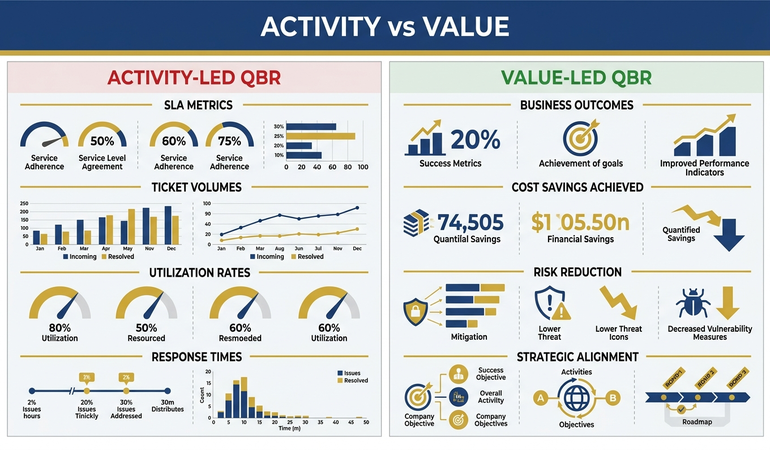
The standard quarterly business review follows a predictable pattern: executive summary, SLA performance, operational highlights, roadmap, and next steps. It is a reporting exercise disguised as a strategic conversation, and it leaves the most important question unanswered — why should this relationship continue?
When clients evaluate whether to renew, they rarely look at your SLA compliance. They look at whether your partnership contributed to outcomes their leadership team cares about: cost reduction, revenue growth, risk mitigation, or competitive advantage. A QBR that only reports activity forces the client’s sponsor to translate your metrics into business value themselves. Most sponsors do not bother. They simply pass the data to procurement and let the tender process decide.
The structural problem is that most QBR presentations are designed for the vendor’s benefit, not the client’s. They showcase what your team delivered. They prove your people were busy. They demonstrate adherence to contractual obligations. None of which answers the question a CFO asks when a seven-figure contract comes up for renewal: “What are we getting for this money that we couldn’t get elsewhere?”
Value-led QBRs answer that question before it is asked. They reframe every metric as a client outcome, every operational highlight as a business impact, and every roadmap item as a strategic investment in the client’s priorities. The difference is not cosmetic — it changes which conversations happen in the room and which happen after you leave.
The Value-First QBR Structure That Changes the Conversation
A value-first client review follows a different logic from the standard reporting template. Instead of building from activity data to a conclusion, it opens with the conclusion and uses data to support it. This is not a minor structural adjustment — it changes what the client remembers and what they take away.
The structure works in five sections, each serving a specific purpose in the renewal conversation:
Section 1: The Value Statement (1 slide). One sentence that summarises what your partnership delivered this quarter in terms the client’s board would recognise. Not “we resolved 4,200 tickets with 99.7% SLA compliance” but “this quarter, your infrastructure downtime cost your European operations less than it did in any quarter since 2023.” The value statement is the slide your sponsor will screenshot and forward to their CFO. Build it for that audience, not yours.
Section 2: Outcome Evidence (3-4 slides). Each slide connects one operational metric to one client business outcome. The structure is simple: here is what we did, here is what it meant for your business, here is how we measured the impact. Three to four of these slides are enough. More than five and you are back to reporting activity.
Section 3: Risk and Mitigation (1-2 slides). What went wrong, what you did about it, and what you changed to prevent recurrence. Clients respect transparency about problems more than they respect a clean dashboard. This section builds trust precisely because it does not pretend everything was perfect.
Section 4: Forward Investment (2-3 slides). This is not your product roadmap — it is a proposal for how the partnership evolves to serve the client’s next set of priorities. Frame each item as an investment in their strategic goals, not as an upsell opportunity. The language matters: “support your APAC expansion” lands differently from “extend our geographic coverage.”
Section 5: The Renewal Frame (1 slide). A single slide that positions continuation as the natural next step. No pricing, no contract details, no pressure. Just a clear statement of what the next quarter looks like if the partnership continues — and, implicitly, what happens if it does not.
This five-section structure typically fits in twelve to fifteen slides. It replaces the forty-slide activity report with a focused conversation about value, and it gives your sponsor the material they need to justify the spend internally.
Need to Build a QBR That Actually Protects Revenue?
Most client review presentations report activity. The ones that protect revenue lead with value. The Executive Slide System — £39, instant access — gives you the frameworks to structure client-facing presentations that drive decisions:
- Slide templates for client review meetings and account presentations
- AI prompt cards to translate operational metrics into client value statements
- Executive summary frameworks that sponsors can forward to their leadership
- Scenario playbooks for renewal and expansion conversations
Get the Executive Slide System → £39
Designed for account managers and client directors presenting to senior stakeholders.
The Opening Slide Your Client Will Show Their CFO
The first slide of a client QBR sets the frame for everything that follows. If it opens with “Q1 2026 Performance Summary,” the frame is reporting. If it opens with “This Quarter, Your European Risk Exposure Dropped to Its Lowest Level Since 2021,” the frame is value.
The difference matters because whoever controls the frame controls what gets discussed. A reporting frame invites questions about metrics, exceptions, and methodology. A value frame invites questions about how to do more of what is working. Both conversations take the same amount of time, but only one leads to renewal.
Building an effective opening slide requires understanding what your client’s leadership measures success by — not what you measure success by. This usually means translating your delivery metrics into their strategic KPIs. Your team resolved incidents faster. Their customers experienced fewer disruptions. Your consultants delivered more billable hours. Their transformation programme hit its milestones. Your engineers optimised the platform. Their cost per transaction dropped.
The translation is not difficult, but it requires asking one question most account teams never ask: “What does your sponsor get evaluated on?” Once you know their performance criteria, every operational metric becomes a value metric — and the opening slide writes itself.
Keep the value statement to one sentence. If it requires two slides to explain, you are describing the evidence, not the value. Save the evidence for section two. The opening slide should be short enough that your sponsor can repeat it from memory when their CFO asks, “How’s the [vendor] relationship going?”
If you are structuring a client review meeting this quarter, the Executive Slide System (£39) includes the executive summary frameworks that help you build value-first opening slides — the kind your sponsor forwards to their own leadership.
How to Present Results Without Drowning in Dashboards
The instinct in most QBR presentations is to include every metric because leaving one out might suggest you are hiding something. The result is twelve slides of dashboards that nobody reads and everybody endures. The client scans for red indicators, asks about anything flagged amber, and ignores the rest. Your forty minutes of preparation condense into ninety seconds of exception management.
A better approach treats the results section as an evidence brief for the value statement, not a comprehensive data dump. Each slide in this section should answer one question: “Here is one way our partnership made a measurable difference to your business this quarter.”
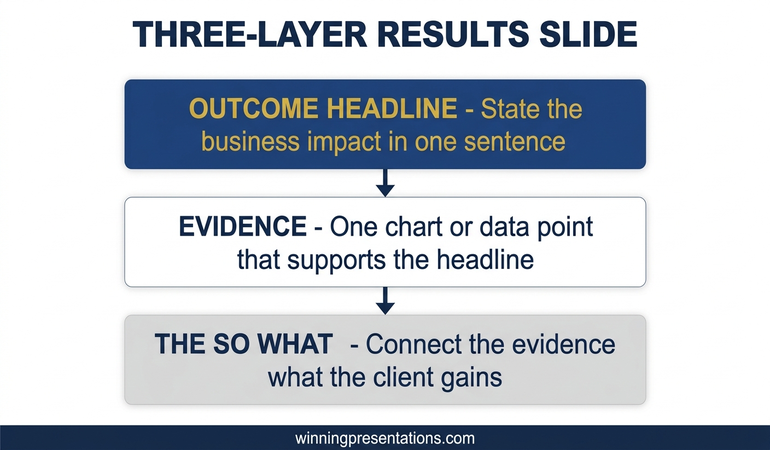
Structure each results slide using a three-layer format:
Layer 1 — The Outcome Headline. State the business impact in one sentence. “Your European contact centre handled 18 per cent more volume with no increase in average handling time” is an outcome headline. “Contact Centre Performance Q1” is a label. Use the outcome.
Layer 2 — The Evidence. One chart or data point that supports the headline. Keep it simple. If you need to explain the methodology before the audience can interpret the chart, the chart is too complex. A bar chart comparing this quarter to last quarter, a single KPI with a directional arrow, or a before-and-after comparison — any of these work. Dashboard screenshots do not.
Layer 3 — The “So What.” One sentence connecting the evidence to what the client gains. “This freed your team to focus on the APAC migration without additional headcount.” The “so what” is the line that makes the metric matter to someone who does not manage your account day to day.
Three to four of these three-layer slides replace twelve dashboard slides and take less time to present. More importantly, they leave the client with a clear narrative: here is what the partnership delivered, expressed in language their board understands.
Turning the QBR Into an Expansion Conversation
The difference between a QBR that protects revenue and one that grows it comes down to how you handle the final section. Most QBR presentations end with “next steps” — a list of operational items that belong in a project plan, not a strategic conversation with a client’s leadership team.
The expansion conversation works differently. Instead of listing what you plan to do next quarter, you propose how the partnership could evolve to address the client’s emerging priorities. This requires knowing what those priorities are — which means the pre-QBR preparation matters as much as the deck itself.
Before building the forward-looking section, identify one or two strategic priorities your client’s organisation has announced publicly or discussed in previous meetings. These might include geographic expansion, digital transformation, regulatory compliance, cost optimisation, or talent development. Then frame your forward investment slides around how your existing capabilities could support those priorities — not as a sales pitch, but as a natural extension of work you are already doing.
The language matters enormously here. “We could expand our managed services to cover your APAC region” sounds like an upsell. “Supporting your APAC expansion with the same model that reduced European downtime by 30 per cent” sounds like a strategic partnership. Both describe the same commercial outcome, but only one positions you as a partner rather than a vendor trying to grow their contract.
Close the QBR with a single renewal frame slide. This slide does not discuss pricing, contract terms, or negotiation. It simply states what the next quarter looks like if the partnership continues — and leaves the commercial conversation for a separate meeting. Combining the strategic discussion with the commercial discussion in the same room, in front of the same audience, almost always diminishes both. Keep them separate, and the strategic conversation does the selling for you.
If your next client review is an opportunity to secure a renewal — or position an expansion — see how other account managers have approached this in our guide to structuring client retention presentations that protect and grow revenue.
Stop Building QBRs That Get Forwarded to Procurement
The Executive Slide System — £39, instant access — includes the client-facing presentation frameworks that turn quarterly reviews into renewal conversations. Templates for value statements, outcome evidence slides, and forward investment proposals — structured so your sponsor champions your partnership internally.
Get the Executive Slide System → £39
Designed for account managers presenting to senior client stakeholders.
Frequently Asked Questions
How long should a QBR presentation be?
A value-led QBR typically requires twelve to fifteen slides, which takes thirty to forty-five minutes to present with discussion. This is deliberately shorter than the traditional forty-slide activity report. The goal is a strategic conversation, not a data review. If your QBR runs longer than forty-five minutes, you are probably presenting too many metrics and not enough outcomes. Cut the dashboard slides and replace them with three to four outcome evidence slides that connect your delivery to the client’s business priorities.
Should I include SLA performance data in my QBR?
Include SLA data only if it tells a value story. “99.7 per cent SLA compliance” is a contractual obligation — it proves you did what you were paid to do, which is table stakes. But “SLA compliance meant your customer-facing systems experienced zero unplanned downtime during your peak trading period” is a value statement. If you can translate an SLA metric into a business outcome, include it. If you cannot, move it to an appendix and reference it only if someone asks.
What is the best way to handle negative results in a QBR?
Address problems directly in a dedicated risk and mitigation section. State what happened, what you did about it, and what you changed to prevent recurrence. Clients respect transparency about problems more than they respect a clean dashboard. Hiding issues damages trust more than the issues themselves — and if the client already knows about a problem, omitting it from the QBR signals that you either do not take it seriously or hoped they would not notice. Neither interpretation helps your renewal position.
The Winning Edge — Weekly Presentation Intelligence
Every Thursday, I share one framework, one real-world example, and one practical technique drawn from 24 years of presenting in boardrooms across three continents. Join The Winning Edge newsletter →
Not ready for the full system? Start here instead: download the free Executive Presentation Checklist — a one-page reference covering the structure, opening, and critical elements every client-facing presentation needs.
If your quarterly review is leading into a contract renewal discussion, see our guide to structuring contract renewal presentations that convert existing relationships into multi-year commitments.
About the Author
Mary Beth Hazeldine is the Owner & Managing Director of Winning Presentations. With 24 years of corporate banking experience at JPMorgan Chase, PwC, Royal Bank of Scotland, and Commerzbank, she advises executives across financial services, healthcare, technology, and government on structuring presentations for high-stakes funding rounds and approvals.