Tag: quarterly business review

03 Mar 2026
Executive presenting a client retention quarterly review in a modern boardroom with value metrics on screen showing client ROI progress

The Client Retention Quarterly: The Presentation Format That Stops Churn Conversations

The account manager ran through 47 slides. Usage dashboards. Feature adoption rates. Roadmap previews. The client nodded politely for 40 minutes, asked zero questions, and churned 60 days later.

Quick Answer: A client retention quarterly presentation reframes your QBR from a review of what you delivered into a demonstration of what they gained. Most QBRs focus inward — features shipped, tickets resolved, usage metrics. Retention-focused QBRs focus outward — mapping every metric against the client’s original business case and the outcomes they were promised. The format shift is simple. The impact on churn is significant.

🚨 Running a client quarterly review this month?

Quick diagnostic:

  • Does your QBR deck start with your product metrics or their business objectives?
  • Can the client see their ROI in the first three slides?
  • Would a new stakeholder (who didn’t buy the product) understand the value from your deck alone?

→ If you answered “no” to any of these, your QBR format needs restructuring. The Executive Slide System (£39) includes the client-facing slide frameworks that keep retention conversations anchored to value.

We worked with a SaaS account team presenting quarterly reviews to enterprise clients. Their close rate on new business was strong — they’d tripled conversions by restructuring their sales deck. But retention was bleeding. Clients signed, onboarded, and then quietly disengaged over 6–12 months.

The problem wasn’t the product. It was the QBR. Every quarterly review opened with platform metrics: logins, tickets resolved, features shipped. The client heard: “Here’s what we did.” What they needed to hear: “Here’s what you gained.”

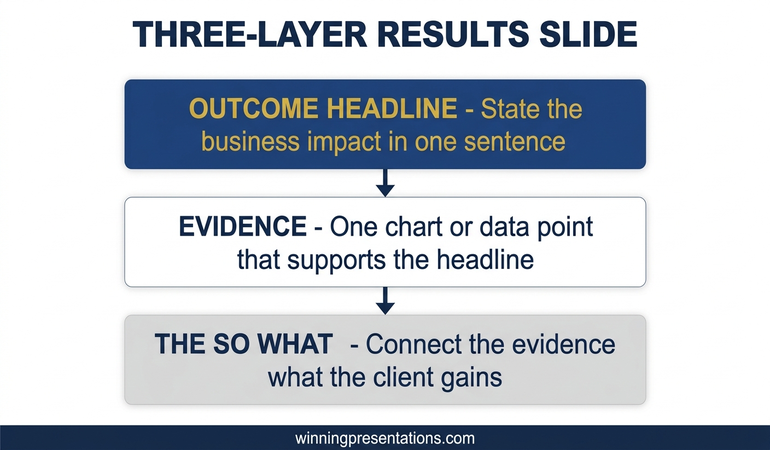
We restructured the QBR to lead with the client’s original business case. Slide one: their stated objectives at point of purchase. Slide two: measurable progress against those objectives. Slide three: the gap between where they are and where they want to be — with a clear path forward.

Retention improved within two quarters. Not because the product changed, but because the presentation format changed the conversation from “what we delivered” to “what you achieved.”

Why Most QBRs Accelerate Churn Instead of Preventing It

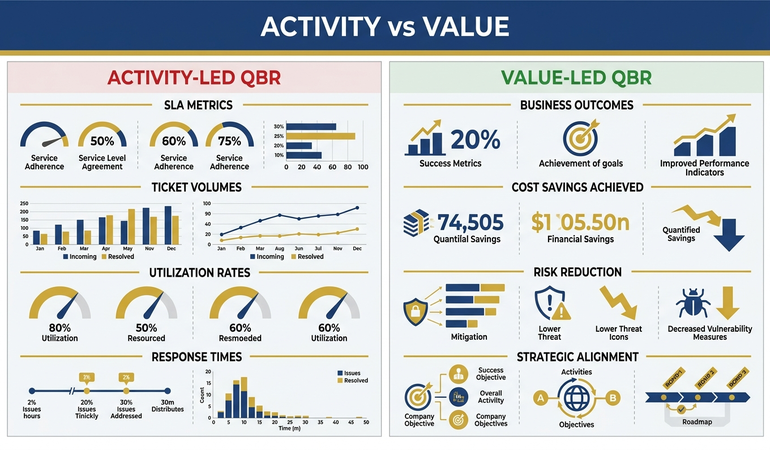
The standard QBR format is inward-facing. It reports on your activity: features released, support tickets closed, adoption metrics. This feels productive to your team, but it creates a dangerous disconnect for the client.

When a client sees your activity metrics without context, they process it as noise. Worse, they mentally translate your reporting into a question: “Is this worth what we’re paying?” If you haven’t answered that question explicitly — with their numbers, their objectives, their business case — they’ll answer it themselves. And the answer is often “not sure.”

That uncertainty is where churn begins. Not with a complaint. Not with a dramatic exit. With quiet disengagement that starts in the QBR meeting where value wasn’t demonstrated. If your client presentation skills focus on reporting rather than demonstrating value, the format is working against you.

The retention-focused QBR prevents this by anchoring every metric to the client’s original investment thesis. Usage went up 30%? That maps to their objective of reducing manual processing time. Support tickets dropped? That maps to their objective of operational efficiency. Every data point earns its place by connecting to something the client already cares about.

Infographic showing the 6-slide client retention QBR format with value mapping structure from client objectives to measurable outcomes

The Retention-First QBR Format (6 Slides)

This format works because it starts with the client’s world, not yours. Every slide exists to answer one question: “What has this investment done for us?”

Slide 1: Their objectives (restated). Open with the exact business objectives they described during the sales process. Quote their language. Reference their original success criteria. This immediately signals: “We remember why you bought this.”

Slide 2: Progress against those objectives. Map measurable outcomes to each stated objective. Use their KPIs, not yours. If they cared about time-to-market, show time-to-market improvement. If they cared about cost reduction, show cost reduction.

Slide 3: The value gap. Show the distance between current progress and their full objective. This is where you demonstrate that continuing — and investing further — closes the gap. It reframes the conversation from “should we renew?” to “how do we finish what we started?”

Slide 4: What we did (brief). Now — and only now — you show your activity. Features, support, adoption. But framed as: “Here’s what we did to drive the outcomes on slide 2.” Context transforms reporting into evidence.

Slide 5: What’s next (their roadmap, not yours). Present the next quarter’s plan mapped to their remaining objectives. Not your product roadmap — their achievement roadmap, powered by your product.

Slide 6: The ask. Whether it’s renewal, expansion, or simply continued engagement, make the request explicit and tie it to objective completion. This mirrors the QBR presentation template approach — every slide earns its place through relevance to the client’s goals.

Build Client-Facing Decks That Prove Value in the First 3 Slides

Your QBR deck should make retention obvious before the client has to ask. The Executive Slide System includes:

  • Client-facing slide frameworks that anchor every metric to business objectives
  • The value-mapping structure that turns activity reports into outcome evidence
  • QBR templates designed for retention conversations, not internal reporting
  • The expansion bridge format that converts satisfied clients into growth conversations

Get the Executive Slide System → £39

Used by account teams managing quarterly reviews for enterprise clients across SaaS, consulting, and professional services.

Mapping Metrics to Their Business Case

Value mapping is the core skill that separates retention QBRs from activity reports. Every metric you present needs a direct line back to something the client stated they wanted.

Start with their original proposal or sales deck. Pull the exact objectives, success criteria, and KPIs that were promised or discussed during the buying process. These become your QBR skeleton.

Build a value map for each objective. For each client objective, identify: the metric that measures progress, the baseline at point of purchase, the current state, and the target. Present all four in a single visual — this makes progress undeniable and gaps motivating rather than discouraging.

Translate your metrics into their language. “Daily active users increased 40%” means nothing to a CFO who bought your product to reduce operational costs. “The teams using your platform daily increased 40%, which correlates with the 22% reduction in manual processing time against your target of 30%” means everything. Same data, different framing. The framing makes it retention-positive. Techniques for building client stories into your presentation pitch apply directly to how you narrate the value map.

If you can’t connect a metric to their business case, remove it from your QBR. Unreferenced metrics dilute the value narrative and give the client data to be confused by rather than convinced by.

Stop Running QBRs That Leave Clients Questioning Their Investment

When your slides demonstrate value in the client’s language, the renewal conversation happens naturally. The Executive Slide System gives you the frameworks to restructure client-facing presentations around outcomes, not activity.

Get the Executive Slide System → £39

Includes the client value-mapping template used by account teams to reduce churn through better quarterly presentations.

The Expansion Bridge: Turning Retention Into Growth

The most effective client retention quarterly presentations don’t just prevent churn — they create expansion opportunities. The expansion bridge works because it uses the value gap (Slide 3) as a natural conversation starter.

When a client sees they’ve achieved 60% of their original objective, the question shifts from “should we continue?” to “how do we reach 100%?” And if reaching 100% requires additional investment — more seats, more features, more support — the client is already motivated by their own data.

Structure the expansion bridge in three parts: (1) acknowledge what’s been achieved, (2) quantify the remaining gap, and (3) present the investment required to close it. This isn’t upselling. It’s objective completion. The difference in framing matters enormously.

If you’re also managing how the account manager handles live objections during these conversations, the perfectionism trap in presentation preparation is worth understanding — over-preparation often makes the Q&A portion of client reviews worse, not better.

Is This Right For You?

✓ This is for you if:

  • You run quarterly business reviews for enterprise or mid-market clients
  • Your QBR deck currently leads with product metrics rather than client outcomes
  • Client churn has increased despite consistent product delivery
  • You want to create natural expansion conversations within your existing review cadence

✗ This is NOT for you if:

  • Your clients are on month-to-month contracts where formal QBRs don’t apply
  • You’re preparing a one-off sales presentation rather than a recurring review
  • Your churn is driven by product issues that no presentation format can solve

24 Years of Boardroom Presentations — The Frameworks That Keep Clients Invested

Every client-facing presentation either builds confidence in the relationship or erodes it. After two decades of delivering high-stakes presentations to executives across banking, consulting, and technology, I’ve distilled the structural patterns that work into a system you can use immediately. The Executive Slide System gives you:

  • The value-mapping slide structure that connects every data point to the client’s business case
  • The expansion bridge format that turns retention reviews into growth conversations
  • Client-facing templates designed for recurring presentations, not one-off pitches
  • The presentation structure executives actually respond to — tested across hundreds of high-stakes meetings

Get the Executive Slide System → £39

The same frameworks used to prepare presentations for JPMorgan Chase, PwC, and Royal Bank of Scotland — adapted for client retention quarterly reviews.

Frequently Asked Questions

How long should a client retention quarterly presentation be?

Six slides maximum for the core presentation. Most QBRs run 30–45 minutes, so your deck should take 15–20 minutes to present, leaving the remaining time for discussion and questions. Shorter decks focused on client outcomes generate better conversations than longer decks packed with your activity metrics. Every slide that doesn’t connect to their objectives dilutes the value narrative.

What if the client’s original objectives have changed since they signed?

This is actually a positive signal — it means the client is engaged enough to refine their goals. Start the QBR by confirming their current objectives before presenting progress. If objectives have shifted, map your new metrics to the new objectives. This flexibility demonstrates partnership, not just vendor performance. The worst thing you can do is present against objectives the client no longer cares about.

Can this format work for smaller accounts without formal QBRs?

Yes, adapt it. For smaller accounts, condense to three slides: their objective, your progress against it, and the next step. Send it as a pre-read before a 15-minute check-in call. The principle — anchoring to their business case rather than your metrics — works regardless of account size or meeting formality.

📬 Want these insights in your inbox? Presentation strategies for executives managing high-stakes client communications, twice weekly. Subscribe to Winning Presentations insights.

🆓 Free resource: 7 Presentation Frameworks for Confident Delivery — the structural templates that keep every slide focused on what your audience actually needs to hear.

Related articles from today: If over-preparation is draining your team before client reviews, read why perfectionism makes presentation anxiety worse. And when your QBR includes a live Q&A, prepare for compound questions — the multi-part queries that derail retention conversations.

About the Author

Mary Beth Hazeldine is the Owner & Managing Director of Winning Presentations. With 24 years of corporate banking experience at JPMorgan Chase, PwC, Royal Bank of Scotland, and Commerzbank, she has delivered high-stakes presentations in boardrooms across three continents.

A qualified clinical hypnotherapist and NLP practitioner, Mary Beth combines executive communication expertise with evidence-based techniques for managing presentation anxiety. She has trained thousands of executives and supported high-stakes funding rounds and approvals.

Book a discovery call | View services

Your next QBR is either proving value or accelerating churn. The retention-first format restructures that conversation around what the client gained, not what you delivered. Get the Executive Slide System before your next client review.

18 Jan 2026
OKR update presentation template showing the 7-slide executive format for quarterly reviews

OKR Update Presentation Template: Get Leadership Decisions in 10 Minutes

The best OKR update presentation template uses exactly 7 slides: Executive Summary, OKR Scorecard, Top 3 Wins, Top 3 Risks, Resource Needs, Next Quarter Preview, and Decision Request. This structure takes leadership from “where are we?” to “here’s what I need from you” in under 10 minutes. Most OKR (Objectives and Key Results) updates fail because they report data instead of driving decisions. The template below fixes that.

If you want this as a ready-to-use slide deck you can reuse every quarter, the Executive Slide System includes these layouts—just add your content and present.

Three years ago, I watched a Head of Product at a fintech company present their Q3 OKR update to the executive committee. She had 34 slides. Every objective. Every key result. Every percentage point of progress.

The CFO checked his phone at slide 6. The CEO interrupted at slide 11 to ask, “What do you actually need from us?”

She didn’t have an answer ready.

After the meeting, she asked me to help rebuild her OKR update presentation template from scratch. We stripped it down to 7 slides. The next quarter, she got her headcount request approved in 8 minutes. The CEO said it was “the clearest update I’ve seen all year.”

That’s not because she had less to say. It’s because she structured what she said around what leadership needed to decide—not what she needed to report.

Here’s the exact OKR update presentation template I’ve refined across hundreds of executive updates.

⭐ Build Your Next OKR Deck in 20 Minutes (Not 3 Hours)

Stop rebuilding slides from scratch every quarter. Get exec-ready templates you can fill in and present today.

The Executive Slide System includes:

  • Executive summary, status update, and decision request layouts
  • RAG dashboards and scorecard formats
  • Risk and mitigation slide structures

Get the Executive Slide System — £39 →

Built from 24 years of executive presentations in banking. Used in QBRs, steering committees, and board meetings.

Why Most OKR Updates Waste Leadership’s Time

The typical OKR update treats executives like a tracking system. Here’s every objective. Here’s the percentage. Here’s the colour code.

But executives aren’t tracking systems. They’re decision-makers with 47 other things competing for their attention.

When you present OKRs as data, you force leadership to do the mental work of figuring out what matters. Most won’t. They’ll nod, check their phones, and forget everything by the next meeting.

The shift that changes everything: present OKRs as decisions, not data.

Every slide should answer one of three questions:

  • What do you need leadership to know?
  • What do you need leadership to decide?
  • What do you need leadership to do?

If a slide doesn’t answer one of those questions, cut it.

This is the same principle behind effective QBR presentations—the format changes, but the executive expectation stays the same: tell me what matters and what you need.

The 7-Slide OKR Update Structure

Here’s the exact slide order for an OKR update presentation template that executives actually want to see:

Slide Purpose Time
1. Executive Summary Overall status + the one thing they must know 60 sec
2. OKR Scorecard RAG status for all objectives (one view) 90 sec
3. Top 3 Wins What’s working + why it matters 90 sec
4. Top 3 Risks What’s at risk + your mitigation plan 2 min
5. Resource Needs What you need to stay on track 90 sec
6. Next Quarter Preview Where you’re heading + key milestones 60 sec
7. Decision Request The specific ask with clear options 60 sec

Total: 7 slides. Under 10 minutes. Room for questions.

Notice what’s missing: no deep dives into individual key results, no historical trend charts, no appendix slides you “probably won’t need.” If leadership wants detail, they’ll ask. Your job is to give them the clearest possible view of status and decisions.

Want these slides ready to fill in?

The Executive Slide System includes executive summary, scorecard, and decision request layouts—formatted and ready to customise.

Get the Templates — £39 →


7-slide OKR update presentation structure showing the executive-ready flow from summary to decision request

Slide-by-Slide Breakdown: What Goes Where

Slide 1: Executive Summary

This is the only slide that matters if leadership has 60 seconds. Structure it as:

  • Headline: One sentence status (e.g., “Q4 OKRs: On Track with One Risk Requiring Decision”)
  • Overall RAG: Green, Amber, or Red with one-line explanation
  • The One Thing: The single most important item leadership must know or decide today

The executive summary slide format I teach follows the same principle: lead with the answer, not the journey.

Slide 2: OKR Scorecard

One slide. All objectives. RAG status visible at a glance.

  • Objective name (short)
  • Progress percentage or status indicator
  • RAG colour (Green/Amber/Red)
  • One-word trend arrow (↑ improving, → stable, ↓ declining)

Do not explain every item. Let leadership scan and ask about what concerns them.

Slide 3: Top 3 Wins

Three accomplishments. Each one gets:

  • What happened (one sentence)
  • Why it matters to the business (one sentence)
  • Who contributed (optional, builds team credibility)

Wins aren’t bragging—they’re proof that your team delivers. Executives need this context when allocating resources.

Slide 4: Top 3 Risks

This is where credibility lives. Executives distrust updates that are all green.

  • Risk: What might go wrong
  • Impact: What happens if it does
  • Mitigation: What you’re doing about it
  • Ask: What you need from leadership (if anything)

If you’re presenting OKR updates and feeling nervous about surfacing risks, that anxiety is worth addressing. The strategies for managing presentation anxiety before big meetings can help you show up with confidence—even when delivering difficult news.

⭐ Get Leadership Saying “Yes” Faster

The exact slide layouts that make your updates clear, credible, and impossible to ignore.

The Executive Slide System includes:

  • Executive summary templates that open with impact
  • RAG scorecard and dashboard layouts
  • Risk, mitigation, and decision request structures

Get the Slide Templates — £39 →

Join leaders who present updates that get decisions, not blank stares.

Slide 5: Resource Needs

Be specific. “We need more support” means nothing. Instead:

  • “We need 1 additional engineer for 6 weeks to hit the Q1 launch”
  • “We need £15K additional budget for the customer research study”
  • “We need a decision on vendor selection by February 1”

Tie every resource ask to a specific OKR outcome. Executives approve resources when they see clear ROI.

Slide 6: Next Quarter Preview

Show leadership you’re thinking ahead:

  • Top 3 priorities for next quarter
  • Key milestones and dates
  • Dependencies on other teams or decisions

Keep this forward-looking, not defensive. You’re demonstrating strategic thinking.

Slide 7: Decision Request

End with clarity. What specific decision do you need?

  • State the decision in one sentence
  • Provide 2-3 options if relevant
  • Include your recommendation
  • Specify the deadline for the decision

If you don’t need a decision this quarter, say so: “No decisions required—update only.” That clarity is equally valuable.

Skip the formatting guesswork

The Executive Slide System includes decision request layouts with the exact structure that gets approvals faster.

Get the Templates — £39 →

Writing the OKR Executive Summary That Hooks Leadership

The executive summary slide determines whether leadership pays attention or mentally checks out.

Here’s the formula I’ve refined across hundreds of OKR updates:

Headline: [Quarter] OKRs: [Overall Status] + [One Key Insight]

  • “Q4 OKRs: On Track, Revenue Objective Exceeding Target by 12%”
  • “Q4 OKRs: Amber Status, Engineering Capacity Risk Requires Decision”
  • “Q4 OKRs: Strong Progress with One Dependency Escalation”

The headline tells leadership exactly what to expect. No suspense. No “let me walk you through this.” Answer first, context second.

Below the headline, include:

  • Overall RAG with explanation: “Amber: 4 of 5 objectives on track, 1 at risk due to vendor delay”
  • Key number: One metric that captures progress (e.g., “78% of key results on track vs 65% last quarter”)
  • The ask: What you need from this meeting (decision, awareness, or support)

Executives should be able to read this slide, understand your status, and know what’s coming—all in under 30 seconds.

For a deeper dive into structuring executive updates beyond OKRs, see the complete executive presentations guide.

People Also Ask

How long should an OKR update presentation be?

Keep OKR update presentations to 7-10 slides and under 15 minutes including questions. Executives have limited time and attention. A focused 10-minute update that drives a decision is more valuable than a 45-minute data review that gets forgotten.

What should I include in an OKR executive summary?

Include three elements: overall RAG status with a one-line explanation, the single most important insight or risk, and what you need from leadership (decision, awareness, or resources). The executive summary should answer “how are we doing and what do you need to know” in 30 seconds.

How do I present OKRs that are off track?

Lead with transparency—executives respect honesty over spin. State the status clearly, explain the root cause in one sentence, present your mitigation plan, and specify what support you need. Hiding bad news destroys credibility; owning it and showing a path forward builds trust.

3 Mistakes That Kill OKR Credibility

Mistake 1: Presenting Data Without Decisions

An OKR update that’s all status and no asks wastes everyone’s time. Even if you don’t need approval for anything, tell leadership what you need them to know and why it matters for upcoming decisions.

Mistake 2: Hiding Bad News in Appendix Slides

Executives notice when risks are buried. Surface problems early, own them, and show your plan. The leaders I’ve worked with at JPMorgan, PwC, and Commerzbank all said the same thing: they trust people who bring them problems with solutions, not people who pretend problems don’t exist.

Mistake 3: Using OKR Software Screenshots as Slides

Screenshots from Lattice, Culture Amp, or Asana look lazy. They’re designed for tracking, not presenting. Rebuild key information into clean slides with consistent formatting. It takes 20 minutes and signals that you respect leadership’s time.

⭐ Stop Rebuilding OKR Decks From Scratch Every Quarter

Get the templates that make you look prepared, credible, and strategic—every time you present to leadership.

The Executive Slide System includes:

  • Executive update and status report layouts
  • Scorecard and dashboard formats that communicate at a glance
  • Decision request templates that get approvals

Get the Executive Slide System — £39 →

Built from 24 years of executive presentations. Ready to customise and present in minutes.

Frequently Asked Questions

Can I use this template for monthly OKR check-ins, not just quarterly?

Yes. For monthly updates, compress slides 3-4 (wins and risks) into a single “Highlights and Risks” slide. Monthly updates should be even shorter—5 slides maximum. The structure stays the same: status, what’s working, what’s at risk, what you need.

What if my organisation uses a specific OKR format I have to follow?

Use this 7-slide structure as your presentation layer on top of whatever tracking format your organisation requires. The tracking system captures the data; your presentation translates that data into decisions. You can reference the official OKR system in an appendix if leadership wants to drill down.

How do I handle OKR updates when different objectives are owned by different people?

One presenter should own the deck and narrative, even if content comes from multiple contributors. Collect inputs in advance, synthesise into the 7-slide structure, and present as a unified story. Multiple presenters for a single OKR update creates confusion and wastes time.

Should I send the deck in advance or present it live first?

Send it 24 hours before if your organisation’s culture expects pre-reads. This lets leadership arrive with questions ready instead of processing information in real time. If presenting live first, still share the deck immediately after so leadership has a reference for follow-up decisions.

Get Weekly Executive Presentation Insights

Join leaders who receive one actionable tip every week for presenting to executives with confidence and clarity.

Subscribe to The Winning Edge →

Your Next Step

You now have the exact OKR update presentation template that executives want: 7 slides, under 10 minutes, focused on decisions instead of data.

The structure is simple. Executive Summary → Scorecard → Wins → Risks → Resources → Next Quarter → Decision Request.

Your next OKR update doesn’t have to be another data dump that gets forgotten. Make it the one that gets decisions.

Not ready to buy today? Start with this free resource:

Download the Executive Presentation Checklist to ensure your next OKR update meets leadership expectations—before you walk into the room.

Download Free Checklist →

10 Dec 2025
QBR presentation template 2026 - 8-slide structure for quarterly business reviews that drive action with the So What framework

QBR Presentation Template: How to Run Quarterly Business Reviews That Drive Action [2026]

📅 Last Updated: January 2026 — Includes AI prompts to build your QBR deck in 30 minutes

Last quarter, a VP of Operations walked into her QBR expecting the usual: present the numbers, answer a few questions, leave. Instead, she walked out with a £200K budget increase she hadn’t even planned to ask for.

The difference? She stopped presenting data and started presenting insight.

I’ve delivered hundreds of quarterly business reviews across 25 years in corporate banking — at JPMorgan Chase, PwC, Royal Bank of Scotland, and Commerzbank. I’ve watched executives tune out within three slides. And I’ve seen the same executives lean forward, engaged, asking how they can help.

The difference is never the data. It’s always the structure.

This is the QBR presentation template that turns quarterly reviews into quarterly wins — the same structure my clients use to run QBRs that actually drive action.

Need a Faster Way to Build Executive Slides?

Most executives spend hours on slides that still miss the mark. The Executive Slide System gives you a structured framework for building slides that land with senior audiences — without starting from scratch every time.

Explore the System →

What You’ll Learn in This Guide

  • The 8-slide QBR template that keeps executives engaged
  • Why most quarterly business reviews bore leadership (and how to fix yours)
  • The “So What?” framework that turns data into decisions
  • How to use AI tools like Copilot to build your QBR in 30 minutes
  • Real before/after examples from client transformations

Running a QBR in the next 30 days?

The Executive Slide System includes a complete 8-slide QBR template built around the structure in this guide — plus AI prompt cards so you can customise it to your team’s numbers in under an hour.

Why Most QBR Presentations Fail

I’ve sat through hundreds of quarterly business reviews. The pattern is always the same:

Slide after slide of metrics. Charts showing what happened. Tables comparing this quarter to last quarter. Thirty minutes of “here’s what we did” followed by executives checking their phones.

The problem isn’t the data. It’s the structure.

Most QBRs are built as status reports. But executives don’t need status reports — they have dashboards for that. What they need is insight and direction.

The question isn’t “What happened?” It’s “What does this mean, and what should we do about it?”

Related: Why Most QBR Presentations Bore Leadership (And How to Fix Yours)

Built for High-Stakes Presentations

Build a QBR Deck That Gets You Resources, Not Just Nods

The Executive Slide System (£39, instant access): includes the QBR template and 16 other executive presentation structures — each designed to drive decisions, not just inform.

Designed for executives who present quarterly business reviews to boards, leadership teams, and key stakeholders.

Get the Executive Slide System →

“Win the room. Every time.” — weekly tactics on executive presentations, Copilot for PowerPoint, and the psychology of persuasion. Free, from Mary Beth Hazeldine.

Send me the free newsletter →

The QBR Presentation Template: 8 Slides That Drive Action

8-slide QBR presentation template showing executive summary, scorecard, wins, misses, key insights, next quarter priorities, risks, and the ask

This template flips the traditional QBR on its head. Instead of starting with data, you start with insight. Instead of ending with “any questions?”, you end with a decision.

Slide 1: Executive Summary (The Only Slide That Matters)

If your executives only see one slide, this is it. Most QBRs bury the lead under 20 slides of context. Don’t.

What to include:

  • Quarter performance in one sentence (hit/miss/exceeded)
  • The single most important insight
  • Your recommendation or ask
  • What you need from leadership

Example: “Q4 exceeded target by 12% (£2.4M vs £2.1M goal). Customer acquisition cost dropped 23% due to referral programme. Recommend doubling referral budget in Q1. Need approval for £50K incremental spend.”

That’s 38 words. An executive can read it in 10 seconds and know exactly where you stand and what you need.

Slide 2: Scorecard — Goals vs. Actuals

One slide. One table. No narrative yet — just the numbers.

Format:

  • Metric | Target | Actual | Variance | Status (🟢🟡🔴)
  • Keep to 5-7 key metrics maximum
  • Use colour coding ruthlessly (green/yellow/red)

This slide answers: “Did we hit our numbers?” Nothing more.

Pro tip: Resist the urge to explain variances here. That comes next. The scorecard should be scannable in 5 seconds.

Slide 3: What Worked (Green Items Deep Dive)

Pick your biggest win and explain why it happened. Not what happened — why.

Structure:

  • The result (quantified)
  • The driver (what caused it)
  • The insight (what we learned)
  • The implication (what this means for next quarter)

Example: “Referral revenue up 47%. Driver: We simplified the referral process from 5 steps to 2. Insight: Friction was killing conversions. Implication: Apply same friction analysis to onboarding flow in Q1.”

See the difference? You’re not just reporting — you’re extracting meaning.

Slide 4: What Didn’t Work (Red Items Deep Dive)

This is where most presenters get defensive. Don’t be. Executives respect honesty more than spin.

Structure:

  • The miss (quantified)
  • Root cause (not excuses — actual cause)
  • What we’re doing about it
  • When we expect to see improvement

What NOT to do: “We missed target due to market conditions.” That’s an excuse, not an insight.

What TO do: “We missed target by 15%. Root cause: Our Q3 pipeline was 30% smaller than needed due to August hiring freeze. Action: Added 2 SDRs in October. Expect pipeline recovery by mid-Q1.”

Want the ready-made QBR slide layouts? The Executive Slide System includes the complete 8-slide QBR structure with AI prompts to customise it for your team.

Stop Building Your QBR Deck From Scratch

The Executive Slide System includes a complete 8-slide QBR template — each slide structured around the format above. Pair it with 30 AI prompt cards that generate your content in minutes.

Executive Slide System — £39, instant access.

  • 8-slide QBR template with decision-first structure built in
  • AI prompts to populate each slide from your performance data
  • Plus 9 more templates: board, budget, investor pitch, and more

Designed for VPs and directors who run quarterly reviews with senior leadership.

Slide 5: Key Insights — The “So What?” Slide

This is the slide most QBRs miss entirely. You’ve shown the data. Now tell them what it means.

Format: 3-4 bullet points, each structured as:

  • Observation: What we noticed
  • Implication: What it means for the business

Example insights:

  • “Enterprise deals are taking 40% longer to close → Need to revisit our enterprise sales process”
  • “Support tickets dropped 30% after knowledge base update → Self-service is working; invest more here”
  • “Top 10% of customers drive 60% of revenue → Concentrate retention efforts on this segment”

This slide demonstrates that you’re not just tracking numbers — you’re thinking strategically.

Slide 6: Next Quarter Priorities

Based on your insights, what are you going to do about it?

Format:

  • 3-5 priorities maximum (more than 5 means no priorities)
  • Each priority linked to an insight from the previous slide
  • Owner assigned
  • Success metric defined

Example:

  • Priority: Reduce enterprise sales cycle
  • Why: 40% longer close times killing forecast accuracy
  • Owner: Sarah (VP Sales)
  • Success metric: Reduce average cycle from 90 to 65 days

Slide 7: Risks & Dependencies

What could derail your plan? Executives appreciate foresight.

Format:

  • Risk description
  • Likelihood (High/Medium/Low)
  • Impact (High/Medium/Low)
  • Mitigation plan

Keep to 3-4 risks. More than that, and you look like you’re hedging everything.

Include dependencies on other teams or decisions: “Q1 plan assumes marketing budget approval by January 15.”

Slide 8: The Ask

End with what you need from leadership. Be specific.

Types of asks:

  • Budget approval: “Requesting £50K for expanded referral programme”
  • Headcount: “Need approval for 2 additional engineers”
  • Decision: “Need direction on whether to pursue Enterprise or SMB focus”
  • Support: “Need executive sponsor for cross-functional initiative”

If you don’t need anything, say so: “No approvals needed. Presented for visibility and alignment.”

Then stop talking. Let them respond.

The “So What?” Framework: Turning Data Into Decisions

Every executive I’ve trained learns this framework. It’s the single most powerful tool for turning quarterly business review slides into action.

The rule: Every piece of data must survive three “So what?” questions. If it can’t, cut it.

Here’s how to run a QBR using this framework:

“Revenue was £2.4M this quarter.”
So what?
“That’s 12% above target.”
So what?
“It means our new pricing strategy is working.”
So what?
“We should expand it to the enterprise segment in Q1.”

Now you have an insight worth presenting. You’ve turned a data point into a quarterly business review example that drives a decision.

If you can’t get past “so what?” after three iterations, the data point doesn’t belong in your QBR slides.

I’ve used this framework in hundreds of QBRs. It works for sales quarterly reviews, marketing QBRs, product reviews — any context where you’re presenting performance data to leadership.

QBR Presentation Mistakes to Avoid

Mistake #1: Starting with History

“Before we look at Q4, let me recap Q3…”

No. Executives don’t need a recap. They were there for Q3. Start with this quarter’s results and look forward, not backward.

Mistake #2: Too Many Metrics

If you’re showing 20 KPIs, you’re showing zero insights. Five to seven metrics that actually matter beats a dashboard dump every time.

Ask yourself: “If I could only show three numbers, which would they be?” Start there.

Mistake #3: Charts Without Context

A chart that says “Revenue by Region” with no annotation is useless. Every chart needs a headline that tells me what to notice.

Bad: “Revenue by Region Q4”
Good: “EMEA Revenue Up 34% — Driven by New Partnership”

The headline does the work. The chart provides evidence.

Mistake #4: Ending with “Any Questions?”

That’s not an ending — it’s a surrender. End with your ask, your recommendation, or your key insight. Make them remember something specific.

Mistake #5: Reading the Slides

If you’re reading your slides aloud, you’ve already lost. Your slides are the evidence. Your voice provides the insight, context, and conviction.

Related: Executive Presentation Skills: How CEOs Actually Present

💡 Pro Tip: Rehearse your QBR out loud once. Time yourself. If you’re over 20 minutes of talking, you have too much content. Cut ruthlessly. Executives would rather have 15 focused minutes than 45 unfocused ones.

The executives who consistently get approvals follow a structured structure. The Executive Slide System gives you that structure with before/after examples for every slide type.

Using AI to Build Your QBR Faster

A good QBR takes 4-6 hours to build manually. With AI tools like PowerPoint Copilot, you can get a solid first draft in 30-45 minutes.

Here’s my workflow:

Step 1: Generate the Structure

“Create an 8-slide QBR presentation structure for [department/team] covering Q4 performance. Include executive summary, scorecard, wins analysis, misses analysis, key insights, next quarter priorities, risks, and asks.”

Step 2: Build the Scorecard

“Create a scorecard table with these metrics: [list your 5-7 KPIs]. Include columns for Target, Actual, Variance, and Status. Use green/yellow/red indicators.”

Step 3: Extract Insights

“Based on this data [paste your numbers], generate 3-4 strategic insights using the format: Observation + Implication. Focus on what this means for next quarter.”

Step 4: Generate Risk Assessment

“Generate 3 potential risks for [your Q1 plan] with likelihood, impact, and mitigation strategies.”

The AI handles the structure and first draft. You add the judgment, context, and conviction.

Related: Best Copilot PowerPoint Prompts That Actually Work

QBR Presentation Example: Before & After

Here’s a real transformation from a client — Sarah, VP of Customer Success at a B2B SaaS company.

Before: Sarah’s Original QBR

  • Title: “Q4 2025 Customer Success Review”
  • 14 slides of metrics: NPS, CSAT, churn rate, ticket volume, response times…
  • Every chart labelled descriptively: “NPS by Month”, “Churn by Segment”
  • No clear takeaway or recommendation
  • Ended with “Questions?”
  • Result: CEO asked “So what do you need from us?” — Sarah didn’t have an answer ready

QBR transformation case study showing Sarah VP of Customer Success going from 14-slide data dump with no decision to 8-slide template with £50K budget approved

After: The Transformed QBR

  • Title: “Q4: Churn Down 23% — Proposing £50K Knowledge Base Investment”
  • 8 slides following the template structure
  • Executive summary stated: Churn dropped because self-service support reduced friction. Recommended expanding knowledge base to cover enterprise tier.
  • Every chart had an insight headline: “Enterprise Churn Dropped 31% After Dedicated CSM Assignment”
  • Clear ask on final slide: £50K budget + 1 headcount for Q1
  • Result: Budget approved in the meeting. CEO added: “Why didn’t we do this sooner?”

The content was mostly the same data. The structure made it actionable.

Sarah now uses this template every quarter. Her QBRs finish early, and she’s been promoted twice since.

QBR Presentation Checklist

Before you present, verify:

  • ☐ Executive summary on slide 1 with clear insight and ask
  • ☐ Scorecard limited to 5-7 metrics with colour coding
  • ☐ Wins explained with “why” not just “what”
  • ☐ Misses addressed honestly with root cause and action plan
  • ☐ Every data point passes the “So What?” test
  • ☐ Next quarter priorities linked to this quarter’s insights
  • ☐ Risks identified with mitigation plans
  • ☐ Clear ask on final slide
  • ☐ Presentation under 20 minutes
  • ☐ Chart headlines tell the story (not just describe the chart)

A QBR that drives action takes 4-6 hours to build manually. With the right template, it takes an afternoon.

The Executive Slide System gives you the QBR template above as a ready-made PowerPoint file — plus AI prompts that generate your narrative, risks, and priorities in minutes.

Executive Slide System — £39, instant access.

Designed for executives who present where decisions are made.

Structure That Commands Attention

Your Next QBR, Structured in 30 Minutes

The Executive Slide System (£39) gives you the exact narrative flow for QBR presentations — plus 51 AI prompts to customise each section for your audience and context.

Get the Executive Slide System →

Want the complete toolkit?

QBR slides are one piece of the executive presentation cycle. The Complete Presenter Bundle pulls all seven products together — slides, Q&A, anxiety, storytelling, delivery, openers, cheat sheets — for £99 (save £91.97 vs buying separately). Lifetime access.

Get the Complete Presenter Bundle — £99 →

Frequently Asked Questions

How long should a QBR presentation be?

8-12 slides maximum. If your meeting is 60 minutes, aim for 15-20 minutes of presentation and 40 minutes of discussion. The discussion is where decisions get made.

What should I include in quarterly business review slides?

Every QBR deck needs these elements: executive summary with your ask, scorecard showing goals vs actuals, analysis of what worked and what didn’t, key insights, next quarter priorities, risks, and a clear ask. The 8-slide template above covers all of these.

How do I run a QBR that executives actually care about?

Start with insight, not data. Lead with your recommendation on slide 1. Use the “So What?” framework on every data point. End with a specific ask. Most importantly, make it a conversation about the future, not a report on the past.

Should I send the QBR deck in advance?

Yes. Send it 24-48 hours before. This lets executives come with informed questions rather than processing raw data in the meeting. Some will read it; some won’t. Accommodate both.

What if I have bad news to deliver?

Deliver it early, directly, and with a plan. Don’t bury bad news on slide 15. Executives respect honesty. What they don’t respect is spin or surprises.

Related: How to Present Bad News Without Killing Your Career

Do you have quarterly business review examples I can follow?

The Sarah case study above is a real example. The key transformation: she stopped presenting “what happened” and started presenting “what this means and what we should do.” Her QBR went from 14 slides of data to 8 slides of insight — and got her budget approved on the spot.

How do I handle executives who want more detail?

Build an appendix with supporting data. Say: “I have the detailed breakdown in the appendix if you’d like to review it.” Most won’t. But those who want it can access it without derailing the main presentation.

What’s the biggest QBR mistake you see?

Presenting data without insight. A QBR that’s just “here’s what happened” is a wasted opportunity. Every number should lead to an implication. Every implication should lead to an action.

How do I make my QBR more engaging?

Start with a story or a surprise. “We expected Q4 to be our weakest quarter. Instead, it was our strongest. Here’s why.” That’s more engaging than “Let me walk you through Q4 results.”

📧 The Winning Edge Newsletter

Weekly insights on executive presentations, QBR strategies, and what’s actually working in boardrooms right now.

Subscribe Free →

QBR Templates for Different Contexts

The 8-slide structure adapts to different types of quarterly reviews:

Sales QBR: Focus on pipeline, win rates, deal velocity, and forecast accuracy. Your “ask” is usually headcount or budget.

Marketing QBR: Focus on lead generation, CAC, attribution, and campaign performance. Link everything to revenue impact.

Product QBR: Focus on feature delivery, user adoption, NPS, and roadmap progress. Your “ask” is usually resources or priority decisions.

Operations QBR: Focus on efficiency metrics, SLAs, cost per transaction, and process improvements. Link to customer satisfaction and margin.

The structure stays the same. The metrics change.

Related Resources

🎁 Free: Executive Presentation Checklist

The 12-point checklist I use before every executive presentation. One page. Covers structure, timing, and the mistakes that get decks rejected.

Download Free Checklist →

No email required. Instant download.

About the Author

Mary Beth Hazeldine spent 25 years in corporate banking at JPMorgan Chase, PwC, Royal Bank of Scotland, and Commerzbank. She’s delivered hundreds of QBRs and now teaches executives to run quarterly reviews that drive decisions and secure resources. She now runs Winning Presentations, training executives to communicate with impact — and helping them use AI tools like Copilot to create better presentations in less time.

01 Dec 2025
QBR presentation template - quarterly business review slide with metrics, wins, challenges, and next steps

Why Most QBR Presentations Bore Leadership (And How to Fix Yours)

Your QBR presentation is either building your career or stalling it.

There’s no middle ground. After 25 years presenting quarterly business reviews at JPMorgan Chase, PwC, Royal Bank of Scotland, and Commerzbank — and 16 years training executives on presentations — I’ve seen how quickly leadership forms opinions based on how you present your numbers.

A good QBR presentation demonstrates strategic thinking. A bad one makes leadership question whether you understand your own business.

Most QBR presentations are bad. Here’s why — and how to fix yours before the next quarter.

QBR presentation template - quarterly business review slide with metrics, wins, challenges, and next steps
A QBR presentation structure that keeps executives engaged

Preparing a QBR right now?

The Executive Slide System includes QBR and board-ready slide templates that translate your performance data into the narrative structure leadership actually wants to see.

Explore the Executive Slide System →

Why Most QBR Presentations Fail

The fundamental problem with most QBR presentations is that they report what happened instead of what it means.

Leadership doesn’t need you to read numbers off a slide. They can see the numbers. They need you to interpret them — to explain causation, context, and consequence.

“Revenue was £4.2M” is a data point.

“Revenue was £4.2M — 12% above target — driven by the Enterprise expansion we launched in July” is insight.

One informs. The other demonstrates that you understand your business. That’s the difference between a forgettable QBR presentation and one that builds your reputation.

The Three QBR Presentation Mistakes

Mistake 1: Leading with data instead of narrative. Sometimes the bigger problem is that the decision was already made before you walked in — and your QBR format made it worse. Sometimes the bigger issue is that the decision was already made before you presented.

When your first slide is a wall of numbers, you’re signalling that the next 30 minutes will be a data dump. Executives immediately disengage because they know they’ll hear the same information they already saw in the pre-read.

Your QBR presentation should lead with the story. What happened this quarter? Was it good or bad? Why? Then use data to support the narrative — not replace it.

Mistake 2: Hiding bad news (or burying it on slide 18).

Executives can smell spin from a mile away. When you lead with wins and bury challenges at the end of your QBR presentation, you lose credibility. They start wondering what else you’re hiding.

Worse: if they discover a problem you glossed over, they’ll never fully trust your quarterly reviews again.

Be direct. “We missed our customer retention target. Here’s why, and here’s what we’re doing about it.” That earns respect.

Mistake 3: No clear ask.

A QBR presentation isn’t just a report — it’s an opportunity. What do you need from leadership? Budget approval? Headcount? A decision on strategy?

If you walk out of a quarterly business review without having asked for something, you’ve wasted 30 minutes of executive time on a meeting that could have been an email.

The QBR Presentation Structure That Works

Here’s the quarterly business review structure I’ve used and taught for over two decades. It consistently keeps leadership engaged:

1. Headline Metrics (30 seconds)

Open your QBR presentation with 4-6 key numbers. Not 12. Not 20. The metrics that matter most.

The Executive Slide System includes a QBR template that follows this exact structure — so you can build your next review in under an hour.

Each metric should have three elements:

  • The number itself
  • The target or benchmark (so they know if it’s good or bad)
  • A visual indicator (green/amber/red, arrow up/down)

This takes one slide. Executives can see the health of the business in 10 seconds. That’s the point.

Example QBR headline metrics:

Metric Actual Target Status
Revenue £4.2M £3.8M 🟢
Gross Margin 42% 45% 🟡
New Customers 127 100 🟢
Customer Churn 8.3% 5% 🔴

Four numbers. Instant understanding. Now they’re ready to hear the story.

2. Performance Narrative (2-3 minutes)

This is where most QBR presentations fail — and where great ones shine.

Don’t explain what the numbers are. Explain why they are what they are.

“Revenue was up 12%” is reporting.

“Revenue was up 12%, driven by three factors: the Enterprise deal we closed in July contributed £400K; our pricing adjustment in August increased average deal size by 8%; and the marketing campaign generated 40% more qualified leads than Q2” is analysis.

The second version shows you understand causation. That’s what leadership wants to see in a QBR presentation.

Structure your narrative as:

  • Overall: Was it a good quarter or a bad quarter? Say it plainly.
  • What drove the results: 2-3 primary factors, with specifics.
  • What surprised you: Anything unexpected — good or bad.

3. Wins (2 minutes)

Specific achievements with impact quantified.

Not “We had some great wins this quarter.” That’s meaningless in a QBR presentation.

Instead:

  • “Closed £1.2M Enterprise deal with [Company] — largest in company history”
  • “Reduced customer onboarding time from 6 weeks to 2 weeks”
  • “Launched mobile app — 15,000 downloads in first month”

Each win should have a number attached. Numbers make wins credible. Without numbers, wins feel like spin.

Limit to 3-4 wins. More than that dilutes impact. Pick the ones that matter most to the business strategy.

4. Challenges (2 minutes)

This is where you build trust in your QBR presentation — or destroy it.

Be direct about what didn’t work. Then immediately pivot to what you’re doing about it.

Structure for each challenge:

  • The challenge (specific and honest)
  • Root cause (show you understand why it happened)
  • Mitigation (what you’re doing to fix it)
  • Timeline (when you expect improvement)

Example:

“Customer churn hit 8.3% this quarter — above our 5% target. Root cause: we identified that 60% of churned customers cited slow support response times. We’ve already hired two additional support staff, implemented a new ticketing system, and expect to see churn return to target by end of Q1.”

That’s accountability. Executives respect it.

What NOT to do in a QBR presentation:

  • “Churn was a bit elevated due to market conditions” — vague, externalises blame
  • “We’re looking into the churn issue” — no action, no timeline
  • Skip challenges entirely — destroys credibility

5. Next Quarter Focus (2 minutes)

Three priorities. Not seven. Three.

Each priority in your QBR presentation should have:

  • A specific outcome (not an activity)
  • A measurable target
  • An owner

Weak: “Continue to focus on customer retention”

Strong: “Reduce churn to 5% by end of Q1. Owner: Sarah. Key actions: New onboarding programme launches Jan 15, support SLA reduced to 4 hours.”

The strong version tells leadership exactly what you’ll deliver and who’s responsible. It gives them something concrete to check next quarter.

Want a ready-made QBR presentation template with this structure? The Executive Slide System — £39, instant access — includes the QBR template and 9 more executive presentation frameworks.

The QBR template is one of 10 executive presentations in The Executive Slide System, complete with AI prompts to generate your content in minutes. Structured for executives who need to turn data into strategic conversations at quarterly reviews.

The QBR Presentation Narrative Arc

Notice the structure follows a story:

  1. Setup: Here’s where we are (headline metrics)
  2. Context: Here’s how we got here (performance narrative)
  3. Highs: Here’s what went well (wins)
  4. Lows: Here’s what didn’t (challenges)
  5. Resolution: Here’s where we’re going (next quarter focus)

This is a story. Stories are engaging. Data dumps are not.

Executives stay engaged with your QBR presentation because they’re following a narrative, not watching you read numbers off slides.

10 executive presentation templates - QBR, budget request, board meeting, investor pitch, strategic recommendation slides
The QBR is one of 10 executive presentation types — each requires a different structure

Timing Your QBR Presentation

If you have 30 minutes:

  • Headline metrics: 2 minutes
  • Performance narrative: 5 minutes
  • Wins: 4 minutes
  • Challenges: 5 minutes
  • Next quarter focus: 4 minutes
  • Discussion/Q&A: 10 minutes

Notice: only 20 minutes of presentation. The rest is discussion.

If your QBR is being presented in a hybrid room with remote and in-person stakeholders, the hybrid presentation guide covers the structural adjustments that keep both audiences engaged.

That’s intentional. Executives want to ask questions, probe challenges, and discuss strategy. If you talk for 28 minutes and leave 2 minutes for questions, you’ve delivered a lecture, not a business review.

The 60/40 rule for QBR presentations: 60% presentation, 40% discussion. If you’re not hitting that ratio, you’re talking too much.

How to Handle Hard Questions in Your QBR

Good QBR presentations invite tough questions. Here’s how to handle them: If your QBR involves a risk committee, see our guide on preparing for the questions that expose blind spots. If your QBR involves a risk committee, see our guide on preparing for the questions that expose blind spots.

“Why did we miss the target?”

Don’t get defensive. Acknowledge the miss, explain root cause, describe what you’re doing about it. “You’re right, we missed by 15%. The primary driver was [X]. We’ve already started [Y] and expect to recover by [Z].”

“What would you do differently?”

This is a test. They want to see if you’ve reflected. Have an answer ready. “In hindsight, we should have [X] earlier. We’ve built that into our Q1 planning.”

“Is this team capable of delivering?”

Don’t take it personally. Answer with evidence. “We delivered [X] and [Y] this quarter despite [challenge]. I’m confident in the team, and I’m adding [resource] to address the gap in [area].”

“What’s the risk we miss again?”

Be honest. “There’s risk in [specific area]. We’re mitigating it by [action]. If [trigger] happens, we’ll [contingency].” Executives respect risk awareness more than false confidence.

QBR Presentation Checklist

Run through these questions before you present your quarterly business review:

QBR Pre-Flight Checklist

  1. ☐ Can leadership see overall business health in the first 30 seconds?
  2. ☐ Does every number have a target/benchmark for comparison?
  3. ☐ Have I explained why results happened, not just what happened?
  4. ☐ Are my wins specific and quantified?
  5. ☐ Have I been honest about challenges — with mitigation plans?
  6. ☐ Are next quarter priorities specific, measurable, and owned?
  7. ☐ Have I left time for discussion (at least 30% of the meeting)?
  8. ☐ Do I have an ask for leadership?

If you answer “no” to any of these, fix it before presenting your QBR.

The QBR Presentation That Changed My Perspective

Early in my career at JPMorgan, I watched a division head present a brutal quarter. Revenue down 20%. Major client lost. Two key hires had quit.

I expected him to spin it. He didn’t.

He opened with: “This was a bad quarter. We underperformed, and I’m accountable.” Then he spent 20 minutes explaining exactly what went wrong, why, and what he was doing to fix it. He ended with a specific ask for headcount to rebuild the team.

The CEO’s response? “Thank you for the honest assessment. Let’s get you those resources.”

That’s when I learned: QBR presentations aren’t about making yourself look good. They’re about giving leadership the information they need to make good decisions. Sometimes that means delivering bad news well.

Executives can handle bad quarters. What they can’t handle is being surprised — or worse, discovering you hid something.

FAQs About QBR Presentations

How long should a QBR presentation be?

For a 30-minute meeting, keep your QBR presentation to 8-12 slides. You want 60% presenting, 40% discussion. More slides means less time for the strategic conversation that makes quarterly reviews valuable.

Should I send my QBR presentation as a pre-read?

Yes, but send a condensed version. Include headline metrics and the performance narrative. Save wins, challenges, and next steps for the live discussion — that’s where you demonstrate strategic thinking.

What if my quarter was genuinely bad?

Lead with honesty. “This was a difficult quarter” followed by clear analysis of why and what you’re doing about it. Executives respect accountability. What destroys trust is discovering you minimised problems.

How do I handle a QBR when I’m new to the role?

Acknowledge it: “This is my first QBR in this role. I’ve spent [X weeks] understanding the business. Here’s what I’ve found.” Then present your analysis. Being new doesn’t excuse you from having a point of view.

What metrics should I include in my QBR presentation?

Include the 4-6 metrics leadership actually uses to evaluate business health. If you’re unsure, ask your manager before the QBR: “What numbers do you look at first?” Those are your headline metrics.

The Winning Edge — Free Weekly Newsletter

Every Thursday, one executive communication tactic you can use immediately. No fluff. No theory. Just what works in real boardrooms.

Subscribe Free

Transform Your Next QBR Presentation

Your next quarterly business review is an opportunity:

  • To demonstrate strategic thinking
  • To build trust through transparency
  • To secure resources for next quarter
  • To show leadership you understand your business

Don’t waste it on a data dump.

Lead with insight. Be honest about challenges. Ask for what you need.

That’s how QBR presentations become career accelerators instead of calendar fillers.

The Executive Slide System complete package - 10 PowerPoint templates, 30 AI prompts, and quick start guide for executive presentations

Get the QBR Template (Plus 9 More Executive Presentations)

Stop building quarterly business reviews from scratch. Get the QBR structure above as a ready-made PowerPoint template, plus AI prompts that generate your content in minutes.

The same frameworks my clients use to present at board level. Designed for directors and VPs preparing for high-stakes quarterly business reviews

GET INSTANT ACCESS →

The Executive Slide System — £39, instant access. 10 templates • 30 AI prompts • Instant download • 30-day guarantee


Related: How to Create Executive Presentations That Get Approved in 2025 — the complete guide covering all 10 executive presentation types, including the QBR structure with AI prompts.