07 Apr 2026

How to Use Your Voice to Command a Room Without Shouting

Quick answer: Vocal authority in presentations is not about volume — it is about control of five specific variables: pace, pitch, pause, projection, and resonance. Under pressure, most executives lose control of all five simultaneously, which creates the impression of uncertainty even when the content is strong. Each variable can be trained individually, and the combination creates the quality that audiences describe as a speaker who “commands the room.”

Astrid had spent eleven years in investment banking before moving into a strategy director role at a European infrastructure fund. She was technically exceptional — her analytical rigour was well-regarded across the firm, and her written work was consistently cited as a reference by colleagues. But in rooms with more than six people, something changed. Her voice rose slightly. Her pace quickened. Her sentences — clear and authoritative on paper — became hedged and breathless in delivery.

A senior partner raised it with her directly: “Your content is excellent. But when you present it, you sound like you’re asking for permission.” Astrid was startled. She had not been aware of the shift. She had been focused entirely on the content — on the accuracy of her numbers, the logic of her argument, the completeness of her analysis. She had given almost no attention to the instrument she was using to deliver it.

What followed was six months of deliberate work on her vocal delivery — not elocution lessons or theatrical coaching, but specific, functional adjustments to the way she managed pace, pitch, and pause under conditions that mirrored the presentations she gave at work. The partner who had flagged the issue told her, nine months later, that something fundamental had shifted. “You walk in and people assume you know what you’re talking about before you’ve said a word.”

That is the effect of vocal authority. It operates as a pre-content signal — shaping how the audience receives the words before they have processed what those words mean.

Does your voice give you away under pressure?

Conquer Speaking Fear is a structured programme that addresses the physical and psychological dimensions of presentation anxiety — including the vocal changes that happen when your nervous system interprets the room as a threat.

Explore the Programme →

Why Your Voice Changes Under Pressure

The voice is directly controlled by the body’s stress response. When the nervous system perceives a high-stakes situation — a large audience, a sceptical board, a question you weren’t expecting — it releases adrenaline and cortisol. These hormones prepare the body for rapid action, and the changes they produce are useful in a physical emergency. In a presentation, they are largely unhelpful.

The laryngeal muscles — which control the tension and position of the vocal cords — respond to stress by tightening. This raises pitch. The diaphragm, which controls breath support for the voice, becomes less effective as shallow chest breathing replaces the deep diaphragmatic breathing that supports full vocal resonance. The result is a voice that is higher, thinner, faster, and quieter — regardless of the speaker’s intention to sound confident.

The problem is compounded by self-awareness. Many experienced presenters can hear the change happening in real time — the slightly higher note, the quickening pace — and their awareness of it creates a secondary layer of anxiety that reinforces the vocal change. This is the voice-pressure cycle: stress changes the voice, awareness of the change creates more stress, which changes the voice further.

Understanding this mechanism is important because it clarifies what training can and cannot achieve. You cannot eliminate the stress response entirely, and attempting to do so is counterproductive. What you can do is build the technical habits — breath control, pace awareness, physical positioning — that allow you to maintain vocal quality even when the stress response is active. For broader context on managing physical presentation symptoms, see this guide on why your voice goes higher when you’re nervous and how to fix it.

The Mechanics of Vocal Authority

Vocal authority is not a single quality — it is the auditory impression created by the combination of several technical elements working in alignment. When these elements are in alignment, audiences describe the speaker as authoritative, confident, or commanding. When they are out of alignment, the same content — presented with the same intention — reads as uncertain, apologetic, or unconvincing.

Breath is the foundation. Everything else in vocal delivery depends on the quality of the breath support beneath it. Diaphragmatic breathing — drawing air into the lower lungs rather than the upper chest — produces a fuller, more resonant sound and allows the speaker to maintain a steady pace without running out of breath mid-sentence. Most people breathe diaphragmatically when at rest. Under pressure, they revert to chest breathing without noticing. Retraining this default is the single most impactful investment in vocal quality.

Resonance amplifies authority. Resonance refers to where in the body sound vibrates before it leaves the mouth. A voice that resonates in the chest cavity produces a fuller, lower, more substantial sound than a voice that resonates primarily in the head or nasal cavity. Chest resonance reads as authority. Head resonance reads as uncertainty or youth. Physical relaxation — particularly in the jaw, neck, and shoulders — is prerequisite for chest resonance; tension collapses it.

Pace is the clearest signal of confidence. Research in communication consistently shows that slower delivery is associated with higher perceived credibility and authority. The optimal pace for high-stakes executive presentations is slower than most people’s natural conversational rate — and significantly slower than their pressurised presenting rate. A pause of two to three seconds between major points feels uncomfortably long to the speaker and authoritative to the audience. For broader context on pacing and executive attention, see this analysis of how pacing affects executive engagement in presentations.

The Five Voice Variables Executives Must Master

Each of the five variables below can be worked on independently. The sequence moves from the most foundational (breath) to the most contextual (reading the room), because changes to earlier variables often resolve problems in later ones.
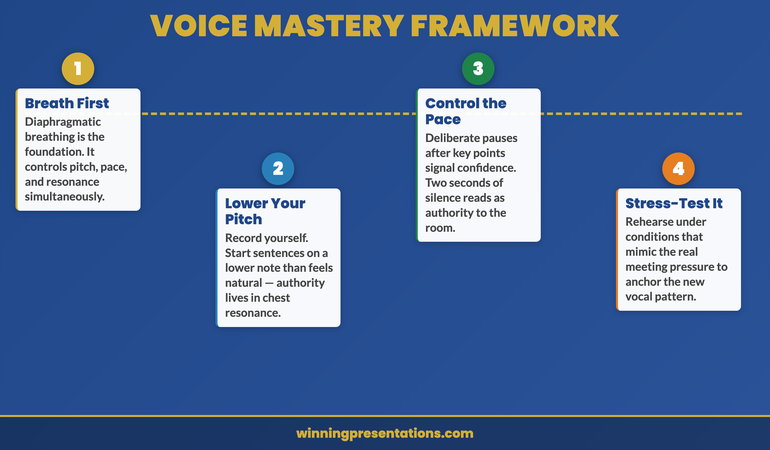
Five-stage roadmap for developing vocal authority in executive presentations

Variable one — Breath control. Practise diaphragmatic breathing as a deliberate routine before every presentation. Place one hand on your chest and one on your abdomen. A correct breath expands the abdomen without moving the chest. Three deep diaphragmatic breaths immediately before speaking — particularly before a high-stakes moment — activate the parasympathetic nervous system and provide the breath support the voice needs to function at its best.

Variable two — Pitch management. Record yourself presenting and listen back specifically for pitch. Most people are surprised by how much higher their pitch is under pressure than in ordinary conversation. To lower pitch deliberately, begin sentences on a lower note than feels natural, and resist the upward inflection at the end of statements that makes assertions sound like questions. The latter — sometimes called “uptalk” — is one of the most common authority-eroding vocal habits in executive presentations.

Variable three — Pace and pause. Mark deliberate pauses into your presentation notes or slides — not as reminders to pause, but as specific positions in the content where a pause creates meaning. After a key statistic. After a critical recommendation. After a question to the room. These pauses do triple duty: they give the audience time to process, they give you time to breathe, and they signal confidence in the material.

Variable four — Volume and projection. Projection is not shouting — it is directing the voice toward the back of the room while maintaining full resonance and control. The most common projection problem in executive presentations is not insufficient volume but insufficient direction: the speaker addresses the person nearest to them rather than projecting to the room as a whole. Speaking slightly past the audience — imagining an audience member a metre behind the furthest row — naturally increases both volume and clarity.

Variable five — Resonance and release. Physical tension is the primary enemy of resonance. Jaw tension, shoulder elevation, and neck stiffness all reduce the space available for vocal resonance and produce a thinner, tighter sound. A physical warm-up that includes jaw release, shoulder rolls, and neck mobilisation — done privately before the presentation — removes much of this tension before you enter the room.

Conquer Speaking Fear

A structured 30-day programme that addresses presentation anxiety at the physiological and psychological level — including the nervous system patterns that change your voice under pressure.

  • 30-day structured programme for systematic anxiety reduction
  • Nervous system regulation techniques for high-stakes presentations
  • Clinical hypnotherapy methods for rewiring the threat response
  • Practical drills designed for corporate presentation contexts

Get Conquer Speaking Fear — £39

Designed for executives whose anxiety affects their delivery under pressure.

Practical Drills You Can Do Before Any Presentation

The most effective vocal preparation combines physiological preparation — activating the breath and releasing tension — with cognitive familiarisation — running through the opening material until the initial sentences feel automatic. The following sequence takes approximately eight minutes and can be done in a private space immediately before the presentation.

Two minutes — physical release. Standing, roll both shoulders back slowly five times. Gently rotate the neck in each direction. Release the jaw by opening the mouth wide and then allowing it to close naturally — without pressing the teeth together. These movements address the primary tension sites that restrict vocal resonance.

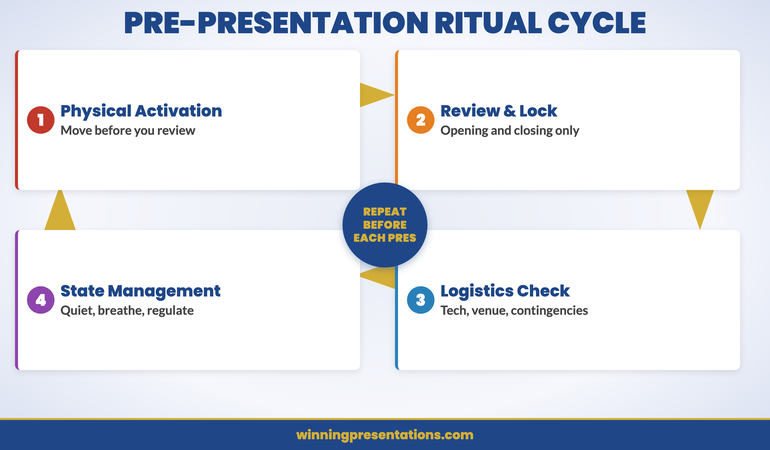
Two minutes — breath activation. Three full diaphragmatic breaths: four counts in through the nose, hold for two, eight counts out through the mouth. On the exhalation, allow the abdomen to fully deflate. This activates the diaphragm and signals to the nervous system that the situation is manageable rather than threatening. For a full pre-presentation routine, see this framework for the pre-presentation ritual used by high-performance presenters.

Two minutes — vocal warm-up. Hum quietly at a comfortable pitch, feeling the vibration in the chest. Then speak your opening sentence aloud — at the pace you intend to use in the room, not faster. Repeat the opening sentence three times, focusing specifically on the pitch of the first word. Starting a sentence on a lower note than feels natural is one of the fastest ways to drop perceived register.

Two minutes — intention setting. Speak your opening two minutes aloud in full, as if you were in the room. Not as a rehearsal focused on accuracy — as a familiarisation run focused on physical delivery. The goal is to have the first two minutes feel familiar in the body before you enter the room, so that the nervous system has a prior reference for this specific act of speaking in this specific context.

For executives whose anxiety has a deeper physiological component, Conquer Speaking Fear provides a structured 30-day programme for rewiring the nervous system’s response to high-stakes speaking situations.

The Most Common Voice Mistakes Under Pressure

The following patterns appear consistently across executives who self-report difficulty with vocal authority. Each is a response to pressure rather than an intentional choice — which is why awareness alone is rarely sufficient to change them. Each requires a specific corrective practice.
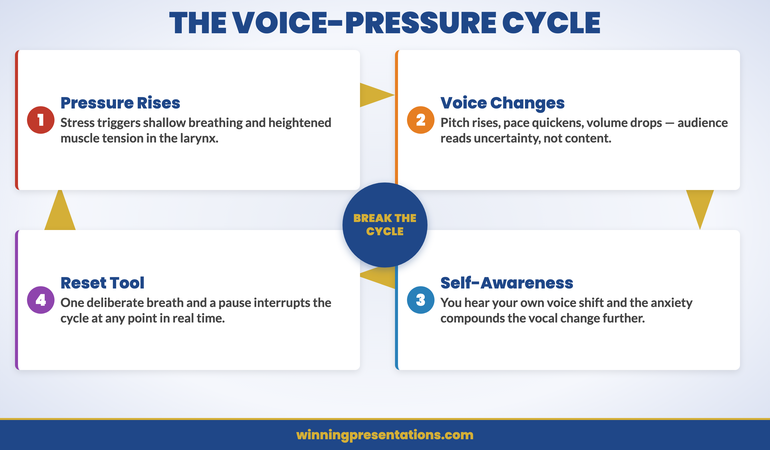
The voice-pressure cycle showing how stress affects vocal quality and how to break the pattern

Rising inflection on statements. When the voice rises at the end of a declarative sentence, the sentence reads as a question — as if the speaker is seeking validation rather than making an assertion. This pattern is particularly damaging in recommendation and conclusion slides, where the executive needs to project certainty. The corrective is deliberate: end every statement with a downward inflection, even if it feels unnatural in practice sessions.

Filler vocalisations between sentences. “Um,” “er,” “so,” and “you know” are auditory signals of cognitive searching — they indicate to the listener that the speaker is uncertain about what comes next. The corrective is not silence; it is the pause. A two-second pause while the speaker transitions to the next point reads as deliberation and authority. The same transition filled with “um” reads as uncertainty. The distinction is almost entirely in the intention to pause rather than fill.

Trailing volume at the end of sentences. Many pressurised speakers begin a sentence at an appropriate volume and then allow the final clause to drop — both in pitch and in volume — as they run out of breath. The last few words of a sentence often carry its most important information: the verb, the number, the specific recommendation. Allowing them to trail off undermines the clarity of the message and signals to the audience that the speaker is uncertain about those specific words.

Pace acceleration through transitions. The space between slides — the moment of transition from one topic to the next — is where pace most commonly accelerates. The speaker feels exposed in the gap and rushes to fill it. This is precisely where a deliberate pause is most effective: it signals to the audience that the transition is intentional, creates anticipation for what follows, and gives the speaker a moment to breathe before beginning the next section.

Reading the Room Through Your Voice

Experienced presenters use their voice not only to deliver content but to read and manage the room. This is an advanced skill — one that requires the foundational vocal habits to be sufficiently automated that the speaker has cognitive bandwidth to observe audience response and adjust in real time.

Volume as a tool for re-engagement. When an audience becomes distracted — when people begin checking phones or having side conversations — the instinctive response is to speak louder. The counterintuitive but more effective response is to drop volume significantly. A dramatic reduction in volume forces the audience to lean in and focus, in a way that increased volume does not. This technique requires confidence, because it feels risky in the moment — but it is remarkably effective for recapturing attention.

Pace as a signal of complexity. When you reach the section of the presentation that contains the most complex or consequential information, slow down further than you think necessary. The additional slowness is a signal to the audience: this matters, pay attention. It also ensures that the audience has time to process before you move on — which reduces the likelihood of questions that reveal they missed a critical point.

Pitch variation to sustain engagement. Monotone delivery — a voice that remains at a constant pitch throughout the presentation — is fatiguing to listen to. Deliberate pitch variation — slightly higher for questions or provocations, slightly lower for conclusions or recommendations — maintains audience engagement over the duration of the presentation. This variation needs to be intentional; under pressure, most people’s pitch variation collapses toward monotone.

How Voice Training Connects to Confidence

There is a bidirectional relationship between vocal quality and confidence. Most people experience this unidirectionally: they believe that if they felt more confident, their voice would improve. This is true — but the reverse is also true, and often more actionable. When the voice functions well under pressure, the speaker receives immediate positive feedback from their own perception of the room’s response — and confidence builds in real time.

This feedback loop is why vocal training has a disproportionate impact on overall presentation confidence relative to the narrowness of its focus. Working specifically on breath control, pitch, and pace produces not only better vocal delivery but also a reduction in the anxiety symptoms that interfere with delivery — because the speaker has a reliable tool they can use to manage the physiological pressure response in the room.

The most effective vocal training for executive presenters combines technical practice — deliberate work on each of the five variables — with exposure to increasingly challenging contexts. Recording practice presentations and listening back with specific focus on one variable at a time accelerates the feedback cycle. Working with a Q&A simulation exercise — where a colleague challenges your answers under conditions that mirror the real room — builds the specific resilience that Q&A situations demand. See the companion piece on building hostile questioner resilience through simulation for a structured method for the Q&A context.

Address the Anxiety Behind the Voice

Conquer Speaking Fear is a structured 30-day programme that works at the nervous system level — addressing the physiological patterns that change your voice, your pace, and your presence under pressure.

View Conquer Speaking Fear — £39

Designed for executives whose anxiety affects their delivery under pressure.

Frequently Asked Questions

Can vocal authority be learned, or is it something you either have or don’t?

Vocal authority is a technical skill with a strong learned component. While some individuals have a naturally resonant voice or a slower default pace, the specific combination of habits that creates the impression of authority — controlled breath, deliberate pace, downward inflection on statements, intentional pausing — can be developed through specific practice. The timeframe varies: most executives who work consistently on these five variables report noticeable change within four to six weeks of deliberate practice.

Is it worth recording yourself to improve your voice?

Yes — with one important caveat. The first time most people hear a recording of themselves presenting, they experience a strong negative reaction to the sound of their own voice. This is normal and does not indicate that the voice is objectively poor. After one or two exposures, the initial aversion subsides and you can listen analytically — focusing on specific variables rather than on the global impression. A useful practice is to record a two-minute section of a presentation, then listen back twice: once for pace, once for inflection. Focusing on one variable at a time produces more actionable feedback than a general impression.

What should I do if my voice visibly shakes during a presentation?

A shaking voice is a physiological stress response — it is caused by tension in the laryngeal muscles, which are activated by adrenaline. The single most effective in-the-moment intervention is a deep diaphragmatic breath before continuing. This does not eliminate the adrenaline, but it provides the breath support that compensates for some of the tension. Slowing your pace simultaneously reduces the load on the vocal system and gives the muscles more time to recover between words. Over time, systematic desensitisation — deliberate exposure to high-stress presenting contexts — reduces the severity of the physiological response in familiar contexts.

The Winning Edge — Weekly Newsletter

Executive presentation strategy, delivered every Thursday. Practical frameworks for delivery, confidence, and high-stakes communication.

Subscribe to The Winning Edge

About the Author

Mary Beth Hazeldine is Owner & Managing Director of Winning Presentations. With 24 years of corporate banking experience at JPMorgan Chase, PwC, Royal Bank of Scotland, and Commerzbank, she advises executives across financial services, healthcare, technology, and government on structuring presentations for high-stakes funding rounds and approvals. Connect at winningpresentations.com.

07 Apr 2026

Team Performance Review Presentation: The Difficult Conversation Deck

Quick answer: A team performance review presentation becomes a senior leadership concern when individual underperformance has operational consequences the board or executive committee needs to understand. The most effective structure separates context from judgement, uses specific dated evidence rather than impressions, and frames the conversation around forward expectations rather than backward blame — protecting both the individual and the organisation’s credibility.

Henrik had managed the same regional sales team for four years. He knew his people well — knew their habits, their strengths, their reasons for every missed quarter. When his Head of Sales asked him to present to the executive committee on his team’s performance, Henrik assumed it would be a routine briefing: numbers, trends, actions taken.

What he had not anticipated was the level of specificity the committee would demand. The Managing Director wanted to understand why the same two members of the team had missed target for three consecutive quarters, what actions had been taken, what the timeline for resolution looked like, and what the contingency plan was if performance did not improve. Henrik had taken those actions. He had documented conversations, adjusted targets, provided coaching. What he hadn’t done was structure that information in a way that was legible to an executive audience.

His deck, built as a team-wide performance summary, didn’t answer the questions the committee was actually asking. By the third slide, the MD had stopped referring to the deck and was asking Henrik questions directly. The conversation became reactive rather than structured — and the impression Henrik left was of someone who understood the problem but had not thought through the resolution.

Presenting on team performance at executive level requires a different structure from managing team performance at operational level. The audience is asking different questions, with different authority, and different consequences attached to the answers.

Preparing for a leadership presentation on team performance?

The Executive Slide System includes slide templates and scenario playbooks designed for sensitive operational presentations — including performance conversations that need to hold up under board-level scrutiny.

Explore the System →

When a Conversation Becomes a Presentation

Most team performance conversations happen in one-to-ones, performance review meetings, and informal corridor discussions. These are bilateral conversations between a manager and a team member. They require different skills — active listening, empathy calibration, clear boundary-setting — but they don’t typically require a formal presentation structure.

A team performance review becomes a presentation when one of three conditions applies. First, when the performance issue has escalated to the point where senior leadership or the board needs to be informed — either because of operational risk, regulatory exposure, or reputational concern. Second, when an HR or legal process requires a documented record of performance management actions, and a formal presentation constitutes that record. Third, when a restructuring or team change is being proposed and the performance context provides the operational rationale for the structural decision.

In all three cases, the audience is no longer the individual being managed — it is a leadership or governance body that needs to understand the situation, assess the risk, and make a decision. The skills required shift from interpersonal management to executive communication. The structure of your deck needs to match that shift.

When Team Performance Becomes a Senior Leadership Issue

Senior leadership takes an interest in team performance when it ceases to be a management problem and becomes an organisational risk. Understanding the thresholds at which this transition occurs helps you anticipate when a formal presentation will be required — and prepare accordingly rather than reactively.

Revenue or delivery risk. When underperformance in a team threatens a client commitment, a revenue forecast, or a regulatory deadline, it becomes visible at board or executive committee level. The question the board asks is not “what is wrong with this person?” — it is “what is the impact on our commitments and what is the plan to manage it?”

Regulatory or compliance exposure. In regulated industries, individual performance failures can create regulatory risk — particularly if the individual has client-facing, authorised, or sign-off responsibilities. A presentation to the board’s risk or audit committee may be required to demonstrate that the organisation identified the issue, managed it appropriately, and has controls in place to prevent recurrence.

Precedent or culture concern. When a senior or long-serving team member is underperforming and leadership is considering action, the board may be briefed because the decision creates a precedent — particularly in a restructuring context. For guidance on the broader restructuring presentation, see this framework for presenting restructuring decisions while maintaining team trust.

In each scenario, the presentation requirement emerges quickly — often within days of a decision being made to escalate. Having a clear structural template prepared in advance reduces the risk of a poorly composed deck under time pressure.

The Four Components of an Effective Performance Review Deck

The structure below works across the full range of team performance presentation contexts — from board briefings to HR panel reviews to executive committee updates. Each component serves a specific function in the executive’s understanding of the situation.

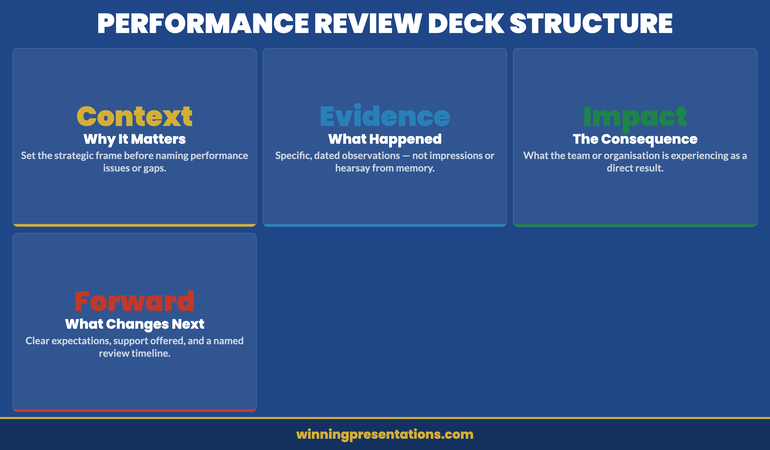
Four-component framework for structuring an executive team performance review presentation

Component one — Context. Before naming the performance issue, establish the strategic frame. What is the team’s role in the organisation? What are their key deliverables? What targets or standards apply? This component ensures that the executive audience has a common reference point before evaluating the performance data. It also signals that your presentation is objective rather than personal — you are presenting against agreed standards, not individual preference.

Component two — Evidence. Present specific, dated observations of the performance concern. The most credible evidence is quantitative — missed targets, delivery failures, client complaints, safety incidents. Where quantitative data is unavailable, use dated written records: meeting notes, email exchanges, formal review documentation. Impressions and recollections carry little weight with an executive audience and invite challenge.

Component three — Impact. Translate the performance data into organisational consequence. What is the team, the client relationship, or the broader organisation experiencing as a result of the underperformance? Impact is the bridge between the individual’s behaviour and the leadership body’s remit. Without a clear impact statement, the board or executive committee has no basis for involvement — the issue remains a line-management matter.

Component four — Forward path. Close with clear expectations for the period ahead, the support being offered, and the review timeline. The forward path demonstrates that you have moved from diagnosis to management — and gives the leadership body something to endorse rather than a problem to resolve for you. A specific timeline with named review points is more credible than a general commitment to improve the situation.

The Executive Slide System

Slide templates and scenario playbooks designed for executive presentations that require precise framing — including sensitive operational and people decisions.

  • Slide templates designed for operational review and leadership briefings
  • AI prompt cards to structure difficult-topic presentations quickly
  • Framework guides for presenting sensitive decisions to executive audiences
  • Scenario playbooks for board updates, HR escalations, and risk briefings

Get the Executive Slide System — £39

Designed for executives presenting operational and people decisions to senior leadership.

Delivering Difficult Messages Without Losing Authority

The most common failure mode in team performance presentations is over-softening. The presenter, uncomfortable with the difficult message, introduces so many qualifications and contextual caveats that the core message becomes unclear. An executive audience that cannot determine whether you are describing a serious performance concern or a temporary dip in a capable team member’s output cannot make the decision they need to make.

Be specific about the standard that was missed. “Performance has been below expectations” tells the board very little. “Sales conversion was 32% against a team target of 55% across Q1 and Q2” gives them something concrete to evaluate. Specific evidence is not harsher than vague evidence — it is more honest, and it protects you from the accusation of subjective judgement.

Separate the person from the position. The most professionally robust performance presentations focus on the role’s requirements and the observed gap — not on the individual’s character, motivation, or attitude. “The role requires X. The observed performance on X has been Y for the following documented period” is more defensible and more persuasive than any formulation that attributes the gap to the individual’s personal qualities.

Present the management actions you have taken. An executive audience needs to understand what you, as the presenting leader, have done to address the performance concern before bringing it to their attention. The implicit question behind every escalated performance presentation is: “Has the manager done everything within their authority to resolve this?” If the answer is yes, the escalation is credible. If the answer is not yet, the board will question why the matter has been escalated prematurely.

The Executive Slide System includes scenario playbooks for operational presentations to senior leadership, including frameworks for structuring sensitive people decisions.

Managing Defensive Reactions in the Room

Performance presentations to a leadership or governance body can generate defensive reactions — not always from the individual being discussed, but from other leaders in the room who have their own stake in the situation. A long-serving team member may have advocates at executive level. A performance concern that reflects on the quality of previous leadership decisions may be met with resistance from those who made those decisions. Being prepared for these dynamics is as important as being prepared for the content.

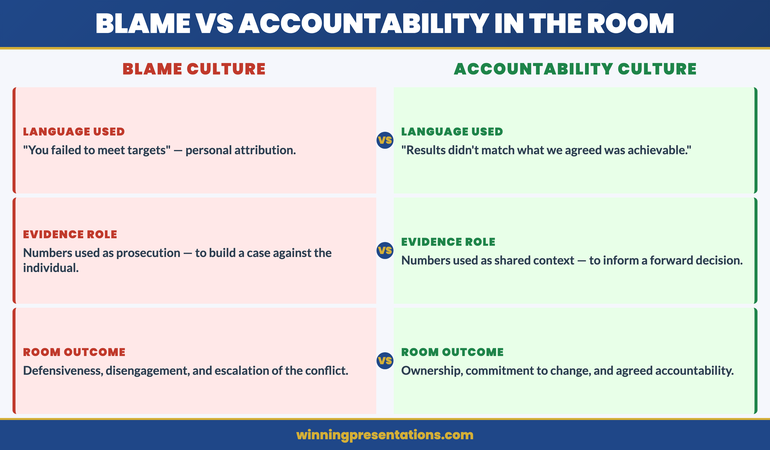
Contrast between blame culture and accountability culture approaches to team performance presentations

Distinguish between a response that seeks information and one that seeks to discredit. A question like “what support has been offered?” is information-seeking — the executive wants to know whether due process has been followed. A question like “isn’t this a management problem rather than a performance problem?” is often an attempt to redirect accountability. The first deserves a direct, detailed answer. The second deserves a measured response that acknowledges the management dimension while maintaining the performance narrative.

Never make commitments in the room that you haven’t modelled. Under social pressure from a defensive executive, the impulse to concede — to agree that more time should be given, or that the targets should be reviewed — can feel like a way to reduce conflict in the moment. It is rarely a sound operational decision. If you need to consider a proposed change to the performance management plan, commit to modelling the impact and returning within a specific timeframe, rather than agreeing on the spot.

Bring the conversation back to organisational impact. When the room becomes focused on the individual’s personal circumstances or on historical decisions, the most effective re-framing is to return to the organisational impact statement. “I understand the context. The question for this committee is what we do about the fact that [named outcome] is at risk.” This shifts the frame from blame to decision — which is where executive committees are most effective. The principles here align with those in the companion piece on presenting redundancy announcements to affected teams.

The Post-Presentation Follow-Up That Makes It Stick

The performance review presentation creates commitments — from you, from the individual concerned (if present), and from the leadership body. The post-presentation follow-up determines whether those commitments are honoured or allowed to fade. There are three elements to an effective follow-up process.

A written record of decisions made. Within 24 hours of the presentation, send a summary of the decisions taken and actions agreed in the meeting. This serves as a contemporaneous record — which matters both for due process and for accountability. The summary should be factual and outcome-focused, not a narrative account of the discussion.

A direct conversation with the individual. If the individual was not present in the executive presentation, they need to be informed of the leadership body’s assessment and decisions as soon as possible — typically within the same working day. The individual should hear the outcome directly from their manager, not through informal channels. The conversation should align precisely with the written record: the same language, the same commitments, the same timeline.

A structured review checkpoint. The performance improvement plan that follows should have a named review date — typically 30, 60, or 90 days, depending on the severity of the concern. This checkpoint should be diarised at the time of the presentation, with the expectation that you will return to the executive body with a progress update at that point. This creates accountability for both the manager and the individual, and demonstrates to the board that the issue is being actively managed rather than filed.

Protecting Yourself Legally and Professionally

Performance presentations at executive level create a paper trail that may become relevant in subsequent employment proceedings. The way you present the information — and the language you use — has implications that extend beyond the meeting. There are four principles that protect your professional and legal position.

Use documented evidence only. Do not include in your presentation any assertion, characterisation, or concern that does not exist in a contemporaneous written record. The moment an executive presentation introduces information that was never documented at the time it occurred, you create credibility risk — and potentially legal risk if the matter escalates to an employment tribunal.

Involve HR before the presentation. HR should be consulted on both the process and the content of any performance presentation to a leadership body. This is not bureaucratic caution — it is risk management. HR will often identify procedural gaps that, if not addressed before the presentation, create grounds for challenge later.

Be consistent in application. An executive audience will assess whether your performance management approach has been applied consistently across the team. If the individual being discussed has been managed more leniently or more harshly than colleagues in comparable situations, this inconsistency will be visible — and will invite questions about whether the performance concern reflects a genuine standard gap or a management preference. The broader context of leadership credibility in high-stakes presentations is covered in the guide to building credibility in your first board presentation in a new role.

Do not speculate about outcome. In the presentation itself, do not reference possible termination, demotion, or other employment outcomes unless these have been agreed in advance with HR and legal as appropriate disclosures. Speculating about employment consequences in an executive presentation — even informally — can prejudice a subsequent process.

Structure Your Next Leadership Briefing

The Executive Slide System includes framework guides for structuring operational presentations — including sensitive situations that need to hold up under board-level and HR scrutiny.

View the Executive Slide System — £39

Designed for executives preparing operational briefings for senior leadership.

Frequently Asked Questions

Should the individual being reviewed be present in an executive-level performance presentation?

This depends on the nature and purpose of the presentation. If the purpose is to brief a leadership body on an operational risk situation, the individual is typically not present — the presentation is a management briefing, not a performance review meeting. If the presentation is part of a formal HR process and the individual has a right to attend or be represented, HR will advise on the appropriate protocol. As a general principle, decisions about individual presence should be made with HR guidance before the presentation, not during it.

How do I present performance concerns without being accused of bias or discrimination?

The most effective protection against bias accusations is a structure that is entirely evidence-based and explicitly linked to agreed standards. When every assertion in your presentation can be traced to a documented record, a named target, or a published standard, the presentation becomes an analysis of a gap rather than a judgement about a person. Consistency is equally important: ensure that the performance management approach you describe has been applied in the same way to comparable situations across the team.

What should I do if the executive committee disagrees with my assessment?

Listen carefully to the basis of their disagreement. If they have information you do not — about the individual’s context, about commitments made at a higher level, about strategic considerations that affect the assessment — that information is relevant and you should factor it in. If the disagreement is about the interpretation of evidence that you and HR are confident in, present the evidence clearly and request that any decision to deviate from the recommended management approach be made explicit and minuted. You are not required to change your assessment in response to social pressure, but you are required to implement whatever decision the governance body makes within its authority.

The Winning Edge — Weekly Newsletter

Executive presentation strategy, delivered every Thursday. Practical frameworks for high-stakes operational and leadership conversations.

Subscribe to The Winning Edge

Free resource: Executive Presentation Checklist — a practical pre-meeting audit for high-stakes leadership presentations.

About the Author

Mary Beth Hazeldine is Owner & Managing Director of Winning Presentations. With 24 years of corporate banking experience at JPMorgan Chase, PwC, Royal Bank of Scotland, and Commerzbank, she advises executives across financial services, healthcare, technology, and government on structuring presentations for high-stakes funding rounds and approvals. Connect at winningpresentations.com.
07 Apr 2026

Zero-Based Budget Presentation: Justify Every Line to Finance

Quick answer: A zero-based budget presentation requires you to justify every line of expenditure as if it were a new request — not a continuation of last year’s spend. The most effective structure leads with the business outcome each line of spending supports, layers evidence for the lines most likely to face scrutiny, and frames the final slide as a binary decision with named consequences on both sides.

Valentina had three months to prepare. As Head of Operations for a mid-sized healthcare technology firm, she had presented budget requests before — always with a roll-forward from the prior year, always with a modest increase ask, always with a CFO who pushed back on the headline number and then approved most of it anyway. This year was different.

The board had mandated a zero-based budget process across the business. Every department would start from zero. Every pound would need justification. The CFO had warned his team that he expected operational rigour, not PowerPoint creativity. Valentina’s first draft — which looked like every budget deck she had ever produced — came back with a single comment: “This doesn’t tell me why. Start again.”

The second version took a different approach. Instead of opening with a summary of last year’s spend and this year’s request, Valentina opened with the operational outcomes her department was responsible for delivering — and then showed the dependency map between each outcome and each line of expenditure. By the third slide, the CFO had stopped making notes and started asking questions. That was the shift. Questions meant he was thinking about approval, not rejection.

Zero-based budgeting presentations fail when they are structured like traditional budget decks. They succeed when they are structured like investment proposals — where every line earns its place through a direct link to business value.

Preparing for a budget approval meeting?

The Executive Slide System includes slide templates and framework guides designed for high-scrutiny financial presentations — structured to help you lead with business outcomes and build your evidence layer efficiently.

Explore the System →

Why Zero-Based Budgeting Changes the Presentation Challenge

In a traditional incremental budget review, the implicit question the presenter is answering is: “Is this year’s increase reasonable?” The prior year’s spend is treated as a baseline that has already been approved and therefore doesn’t need re-justification. Your task is to explain the delta.

Zero-based budgeting removes that baseline. The implicit question becomes: “Does this spend need to exist at all?” That is a fundamentally different challenge — and it requires a fundamentally different deck structure.

The risk for most budget presenters is that they approach zero-based reviews using the same architecture as traditional reviews. They lead with total spend, break it down by category, attach a growth percentage, and wait for questions. This structure fails in a zero-based environment because it answers the wrong question. It tells the finance team what you want to spend. It doesn’t tell them why each element needs to exist.

The zero-based budget presentation is closer in structure to a capital expenditure proposal than a standard departmental review. Both require you to justify spending as if it were new. Both benefit from a dependency-based argument structure rather than a category-summary format.

The Problem With Traditional Budget Decks

Most budget presentations are built around three implicit assumptions that zero-based processes invalidate:

Assumption one: prior approval implies ongoing necessity. In a traditional review, last year’s approved budget line carries an implicit endorsement. In a zero-based review, it carries no weight at all. If you can’t justify why the line exists from first principles, the finance team is entitled to cut it entirely.

Assumption two: category headers are self-explanatory. Headings like “personnel costs,” “software licences,” and “professional services” communicate what the money is spent on, not why the organisation needs to spend it. Finance teams conducting a genuine zero-based review will push beneath every category header to understand the operational rationale. Your deck should anticipate that push, not wait for it.

Assumption three: the total is the primary focus. In a zero-based environment, the individual lines matter more than the total. A finance team will often accept a higher total if each line has a credible business case, and reject a lower total if several lines appear unjustified. Presenting the total first invites the wrong conversation — a negotiation about the headline number rather than an evaluation of each component’s merit.

Understanding these assumptions allows you to invert the structure of your deck: lead with operational outcomes, link each spend line to a named outcome, and surface the total only after the dependency map is established.

The Five Slides Every ZBB Presentation Needs

The structure below has been designed for budget presentations where every line must earn its place. It works in CFO reviews, board budget sessions, and investment committee meetings where detailed scrutiny is expected.

Five-step framework for structuring a zero-based budget presentation for executive scrutiny

Slide one — Operational outcomes. List the three to five measurable outcomes your department is responsible for delivering in the coming year. These are the anchors for everything that follows. Every line of expenditure will be linked back to one of these outcomes. If you cannot connect a spend line to a named outcome, that line belongs in a separate conversation.

Slide two — Dependency map. Show visually how each outcome depends on specific categories of spend. This is the intellectual core of the zero-based argument. The finance team can see that removing a budget line doesn’t just save money — it removes a capability that supports a named business outcome.

Slide three — Line-by-line justification. For each budget line, provide: what it funds, which outcome it supports, what the operational impact would be if it were removed, and any market comparators or benchmarks that contextualise the cost.

Slide four — Flexion points. Pre-identify the lines where you have genuine flexibility — where reduced funding would reduce service levels rather than eliminate a capability. Offering controlled flexion is strategically effective: it demonstrates rigour and gives the finance team a managed choice rather than an adversarial negotiation.

Slide five — Decision frame. Present the final slide as a binary: fund at this level and deliver these outcomes, or fund at a reduced level and accept these named consequences. A clean decision frame is more persuasive than a plea — it positions your ask as a business decision, not a departmental request.

The Executive Slide System

Slide templates and framework guides designed for executive presentations that require financial justification and board-level scrutiny.

  • Slide templates designed for budget approval and financial review meetings
  • AI prompt cards to structure financial arguments quickly and clearly
  • Framework guides for presenting numbers to mixed executive audiences
  • Scenario playbooks for CFO, board, and investment committee decks

Get the Executive Slide System — £39

Designed for executives preparing for high-scrutiny financial presentations.

How to Justify Each Line Without Losing the Room

The risk in detailed budget presentations is that justification becomes a recitation. The presenter reads through each line in order, the finance team becomes passive, and by the time the high-scrutiny items appear the room has lost engagement. The most effective zero-based budget presenters sequence their justification by risk, not by category.

Prioritise the lines most likely to face challenge. Before the meeting, identify the two or three expenditure lines that are most likely to prompt sceptical questions. These are typically: new spend categories with no prior year comparator, lines that have grown significantly relative to the business, and costs that are difficult to benchmark externally. Cover these early — when the room is still engaged and you have the most credibility to defend them.

Use a consistent justification structure. For each line, use the same three-part format: what it funds, what operational outcome it supports, and what would change if it were removed. Consistency allows the finance team to evaluate each line on the same basis, which reduces the likelihood of tangential discussions about format rather than substance.

Separate baseline from growth. Even in a zero-based process, it is worth distinguishing between spend that maintains an existing capability and spend that funds new or expanded capabilities. Finance teams understand that some expenditure simply keeps the lights on. Presenting this distinction honestly prevents unnecessary scrutiny of maintenance costs that are not in dispute. For guidance on structuring financial forecasts more broadly, see this analysis of revenue forecast presentation structure.

Speak to consequences, not to effort. The instinct when defending a budget line is to describe how much work it represents or how carefully it was costed. Finance teams are rarely moved by evidence of effort. What moves them is clarity about the operational consequence of removing the line. “If this line is cut, we lose the capability to X, which affects outcome Y by Z” is a more effective justification than any description of how the number was calculated.

The Executive Slide System includes slide templates structured specifically for budget justification and financial approval presentations, with a dependency-map format built in.

Handling Finance Team Scrutiny in the Room

The finance team’s role in a zero-based budget review is to challenge assumptions and test the rigour of your justification. Experienced budget presenters treat this scrutiny as a feature of the process rather than an obstacle to their ask. The way you handle challenge in the room often matters more than the quality of your deck.

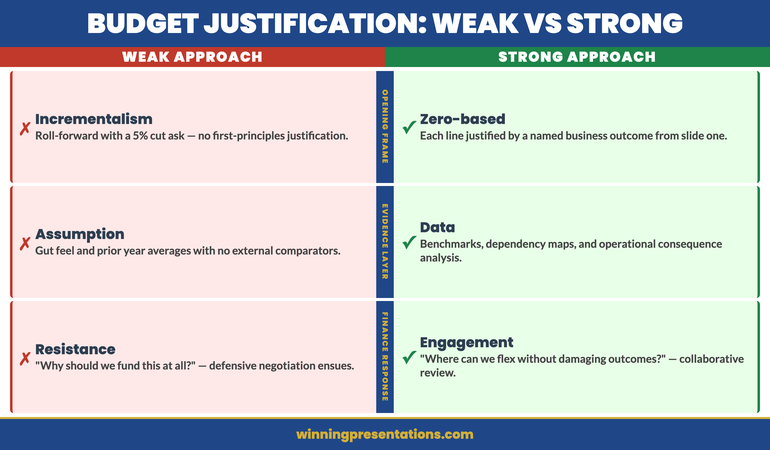
Comparison of weak versus strong approaches to budget justification in executive meetings

Anticipate the three most likely challenge questions. Before the meeting, write out the three questions you most hope the finance team does not ask. These are your highest-risk areas. Then prepare clear, direct answers — ideally supported by a backup slide in an appendix — so that when these questions arise you can answer them without hesitation or visible discomfort. Hesitation in a budget meeting is read as uncertainty about the justification.

Distinguish between questions that seek information and questions that signal scepticism. A question like “what would be the impact of reducing this line by 20%?” is typically exploratory — the finance team wants to understand the flexibility in the model. A question like “can you walk me through how you arrived at this number?” often signals that the number looks high. Reading the intent behind a question allows you to calibrate your response appropriately. For a more detailed treatment of reading hostile questions, see the companion article on preparing for hostile questioner scenarios.

Never concede on a line you haven’t analysed. In a budget meeting, there is social pressure to appear flexible when challenged. The impulse to say “we could probably reduce that” in response to scrutiny is understandable, but it is also dangerous. Agreeing to reduce a line you have not modelled creates a commitment you cannot necessarily honour and signals that the original ask was not fully thought through. If you need time to model the impact of a proposed reduction, say so and commit to a specific follow-up timeline. For context on how governance bodies interpret budget proposals, see this overview of governance update presentation structure.

What the CFO Is Actually Evaluating

Understanding what the CFO is evaluating — and what they are not evaluating — changes how you structure your preparation. Most budget presenters over-prepare on the numbers and under-prepare on the narrative. A CFO conducting a zero-based budget review is typically evaluating four things simultaneously:

Rigour of thinking. Have you genuinely started from zero, or have you repackaged last year’s spend with better-sounding labels? A CFO who has run multiple zero-based budget cycles can identify cosmetic zero-basing quickly. The test is whether you can explain the rationale for each line in plain language without reference to what was previously approved.

Calibration of the ask. Is the total consistent with what the finance team would expect given the operational scope of the department? A CFO isn’t just evaluating whether each individual line is justified — they’re also assessing whether the aggregate feels calibrated. An aggregate that feels high will invite more detailed scrutiny even if each line appears justifiable in isolation.

Quality of trade-off analysis. The best budget presentations include explicit trade-off analysis: what would the organisation gain from funding option A versus option B, and what would it forgo? A CFO wants to make a well-informed allocation decision, not simply accept or reject your proposal. Offering a structured trade-off gives them the material to make that decision — and makes you a more credible partner in the process.

Your credibility as an operational leader. The budget presentation is also a proxy for how well you understand your own function. A Head of Operations who can explain every significant line of their budget — its purpose, its dependency, its flexibility — signals operational competence that extends beyond the budget itself. This is also why the team performance review presentation that often follows a budget cycle matters: it shows whether operational commitments made during the budget process were delivered. See the companion piece on structuring a team performance review presentation for guidance on that conversation.

Building Your Evidence Layer Before the Meeting

The evidence layer in a zero-based budget presentation is the set of materials you have prepared to substantiate each justification — not all of which will appear in the main deck, but all of which you should be able to produce immediately if challenged. A strong evidence layer has three components:

External benchmarks. For your highest-cost lines, identify external comparators that contextualise the spend. Industry salary benchmarks, software licence cost comparisons, contractor day-rate market data — these allow you to position your spend relative to a reference point the finance team can validate independently. Benchmarks are more persuasive than self-referential justifications because they anchor the argument in market reality rather than internal preference.

Operational dependency documentation. For any line that might appear discretionary, document the specific operational process it supports. This is particularly important for overheads and enabling functions — costs that don’t produce a visible output but that underpin capabilities the business depends on. A clear dependency document answers the question “what would actually happen if we cut this?” before it is asked.

Appendix slides for the most likely challenge scenarios. Prepare three to five supplementary slides that address the questions most likely to come up in a detailed review. These are not part of the main presentation — they sit in an appendix and are surfaced only if the specific question arises. The discipline of preparing these slides also forces you to think through the most challenging aspects of your justification before you are in the room.

The presenter who arrives with an evidence layer — even if most of it is never shown — projects a qualitatively different level of preparation from the one who has only the deck. Finance teams notice the difference.

Build Your Next Budget Deck With the Right Structure

The Executive Slide System includes framework guides for structuring financial approval presentations — so you can build a dependency-based argument without starting from a blank slide.

View the Executive Slide System — £39

Designed for executives preparing high-scrutiny financial presentations.

Frequently Asked Questions

What is the difference between a zero-based budget presentation and a standard budget review?

A standard budget review typically treats the prior year’s spend as a baseline and focuses on justifying increases or decreases relative to that baseline. A zero-based budget presentation requires you to justify every line of expenditure as if it were a new request — with no assumed entitlement to prior year spend levels. This means structuring your deck around business outcomes and dependency maps rather than category summaries and year-on-year variances.

How should I handle a line that is difficult to justify in isolation but necessary as part of a broader function?

The key is to make the dependency visible rather than asserting it. If a line is genuinely necessary as part of a broader operational capability, your deck should show the full capability — not just the individual line — and demonstrate that the capability would be impaired without it. Dependency mapping is the most effective tool for this: it shows the finance team that the line isn’t discretionary, it is load-bearing.

What should I include in my appendix for a zero-based budget presentation?

Your appendix should contain the detailed justification for the three to five lines most likely to face scrutiny — including external benchmarks, operational dependency documentation, and the modelled impact of any proposed reduction. You should also include a sensitivity analysis showing how your total changes under two or three different funding scenarios. These materials should be prepared in advance and be immediately available if challenged, even if they are never formally presented.

The Winning Edge — Weekly Newsletter

Executive presentation strategy, delivered every Thursday. Practical frameworks for high-stakes meetings — no filler, no motivational content.

Subscribe to The Winning Edge

Free resource: Executive Presentation Checklist — a practical pre-meeting audit for high-stakes presentations.

About the Author

Mary Beth Hazeldine is Owner & Managing Director of Winning Presentations. With 24 years of corporate banking experience at JPMorgan Chase, PwC, Royal Bank of Scotland, and Commerzbank, she advises executives across financial services, healthcare, technology, and government on structuring presentations for high-stakes funding rounds and approvals. Connect at winningpresentations.com.

06 Apr 2026
An executive presenting with calm authority at a boardroom table while a committee member leans forward with a pointed question, editorial photography style

Fishing Questions in Presentations: How to Respond Without Being Pinned Down

A fishing question is not asked because the questioner wants information. It is asked because the questioner wants a commitment — on record, in a room full of witnesses — before you are in a position to give one responsibly. Recognising a fishing question when it arrives, and responding in a way that is honest without being pinned down, is one of the most practically valuable Q&A skills an executive can develop.

Rafaela had been presenting the preliminary findings of a regulatory review to a committee that included two members with strongly opposing positions on the outcome. The presentation was going well — the data was solid, the structure was clear, and the room seemed engaged. Then one of the committee members, a senior partner who had been quiet throughout, leaned forward and asked: “So based on what you’ve found, would you say this falls within acceptable parameters or not?” Rafaela knew the question immediately for what it was. The analysis was not yet complete. She had flagged that explicitly in the introduction. But the question was framing the preliminary data as if it were a conclusion, and asking her to confirm a verdict that would effectively end the debate before the final report was delivered. A simple yes or no would have been wrong — not because she was hiding anything, but because the analysis genuinely did not support a definitive conclusion yet. What she needed was a response that was truthful, specific, and firm without being dismissive of the question. What she gave instead was a hedged non-answer that left the room uncertain about whether she was evading or genuinely uncertain. The committee member pressed again. She felt the moment slip. This guide covers what she should have done instead.

Facing high-stakes Q&A sessions where the questions are designed to corner you? The Executive Q&A Handling System gives you a structured system for predicting and responding to the questions that executives find hardest to handle. Explore the System →

What Fishing Questions Are — and How to Recognise Them

A fishing question has a specific structural signature: it frames a binary or forced choice and presents it as a neutral request for your assessment. “Would you say this is a risk or not?” “Is this on track or not?” “Do you think this is acceptable?” The framing appears reasonable — it sounds like the questioner is simply asking for your professional opinion. What it is actually doing is asking you to adopt a position publicly, in conditions that are designed to make the position hard to walk back.

The recognition signals are consistent. First, the question arrives before the relevant analysis is complete or before you are in a position to answer definitively. Second, it offers a binary or forced choice that does not reflect the genuine complexity of the situation. Third, it is asked in front of an audience — because a commitment made privately carries far less weight than one made in a room. Fourth, the questioner already has a preferred answer, and the question is structured to produce it.

Not every blunt or direct question is a fishing question. “What do you think will happen to margin in Q3?” is a direct question that deserves a direct answer. A fishing question is characterised by the mismatch between the certainty implied by its framing and the certainty that your evidence actually supports. When someone asks you to confirm a conclusion that your analysis does not yet justify, that is a fishing question — regardless of how reasonable it sounds.

The distinction matters because the response to a genuine direct question and the response to a fishing question are different. Responding to a genuine question with the caution appropriate for a fishing question signals evasiveness. Responding to a fishing question with the directness appropriate for a genuine question hands the questioner exactly what they were angling for.

Prepare for the Questions Designed to Corner You

The Executive Q&A Handling System gives you a structured approach to predicting, preparing for, and responding to the most challenging executive Q&A scenarios — including the fishing questions, stress tests, and loaded questions that catch executives off guard.

  • ✓ System for predicting and preparing for difficult Q&A questions
  • ✓ Response frameworks for high-stakes executive questioning
  • ✓ Scenario playbooks for board, investor, and committee Q&A

Get the Q&A Handling System → £39

Designed for executives managing high-stakes Q&A sessions

Why Fishing Questions Work: The Psychology of Public Commitment

Fishing questions exploit a well-documented psychological dynamic: public commitments are sticky. Once you have stated a position in front of a group, you are motivated — consciously and unconsciously — to maintain consistency with that position. This is not a weakness. It is a social and professional norm that makes functioning organisations possible. But it can be leveraged against you by a questioner who understands its power.

The dynamic operates in two directions. If you answer “yes, this is within acceptable parameters,” and the final analysis reveals it is not, you are now on record as having misjudged the situation. If you answer “no, it is not acceptable,” you may have committed to a position that the full data does not support, foreclosing options that the complete analysis might have kept open. The questioner wins either way — they have created a record that serves their position, and they have done it using your words.

The social pressure of the room amplifies this dynamic. When a question is asked in front of an audience, silence feels evasive, qualification sounds weak, and refusal to engage appears defensive. The questioner has created conditions in which the most comfortable response — giving a direct answer — is also the most dangerous one. This is why fishing questions are effective: not because they are logically compelling, but because they make the responsible answer psychologically difficult to deliver.

Understanding this mechanism is the first step toward managing it. When you recognise that the discomfort you feel is a function of the question’s design rather than a signal that you should comply with its framing, you can respond from a position of clarity rather than pressure. For a wider framework on recognising questions that are designed to set you up before they are even fully asked, our guide to recognising loaded questions in presentations covers the full taxonomy of adversarial question types.

The Response Framework: Honest, Specific, and Not Pinned Down

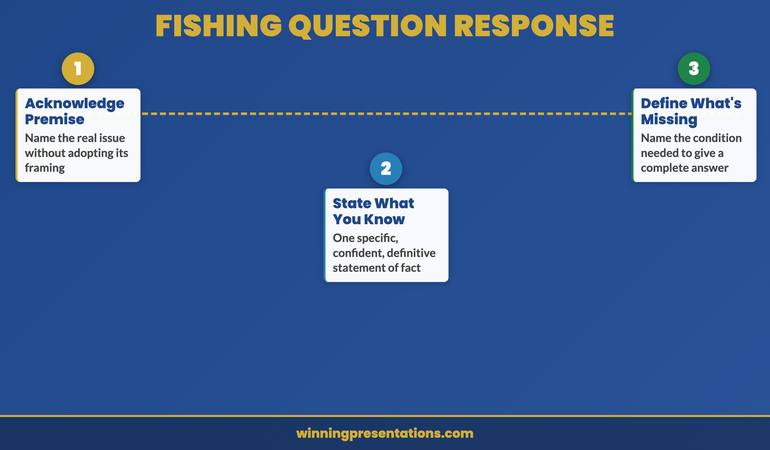
The effective response to a fishing question has three components, delivered in sequence. The first is an acknowledgement of the question’s premise — not agreement with its framing, but recognition that a real issue is being pointed at. “That is a central question, and it is one I want to answer accurately.” This buys a moment and signals engagement rather than evasion.

The second component is a statement of what you can say definitively, based on what you know. Not a hedge, not a qualification — a specific statement of fact. “What I can tell you with confidence is that the data we have reviewed to date shows X.” This demonstrates that you are not avoiding the question, you are giving the questioner the most accurate information available. Specificity is credibility. A vague non-answer and a precisely framed limitation are received very differently by a room.

The third component is a statement of what would be required to answer the full question. “A definitive assessment of whether this falls within acceptable parameters requires the completion of the analysis in section four, which we expect to have by the end of this month.” This is not a delay tactic. It is a statement of epistemic honesty — you are telling the room what you do not yet know and what would change that. This framing converts apparent evasion into professional rigour.

Together, these three components produce a response that is honest, specific, and firm without handing the questioner the commitment they were seeking. The key is the absence of hedging language in the second component. “What I can tell you with confidence is…” is a strong statement. “I think, based on what we have seen so far, it might suggest…” is a weak one that signals uncertainty and invites the questioner to push harder.

The Executive Q&A Handling System provides the full response architecture for fishing questions and other adversarial Q&A patterns, with scenario playbooks for the contexts where these question types most frequently appear.

Fishing question response framework infographic: three steps — acknowledge the premise, state what you know definitively, and specify what is needed for a complete answer

Common Forms of the Fishing Question and How Each Works

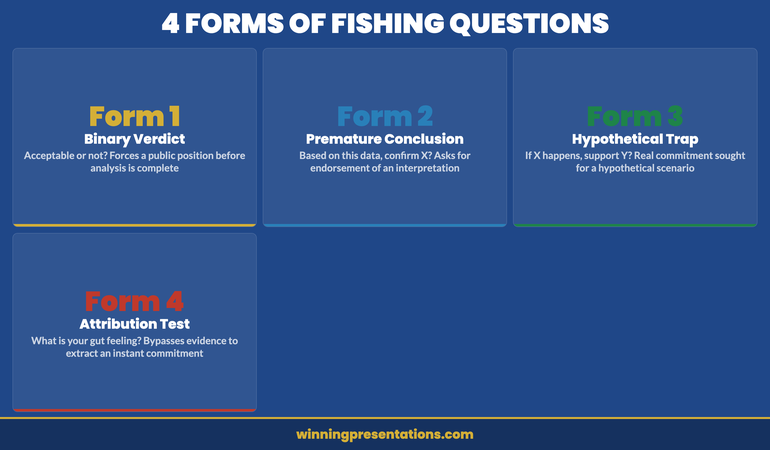
Fishing questions appear in several recurring forms, each with a slightly different mechanism. Recognising the form helps you identify the intent faster, which gives you more time to compose the response before the pressure of the room builds.

The binary verdict request. “Is this acceptable or not?” “Is this on track or not?” This is the most direct form. It offers two options and implies that a refusal to choose one is itself a choice — specifically, a suspicious one. The effective response names the binary as a false choice: “The right answer to that question is more nuanced than a yes or no, and I want to give you the accurate one.”

The premature conclusion invitation. “So based on what you’ve shown us, would you say this confirms X?” This form presents a tentative interpretation as if it flows naturally from your data, and invites you to confirm it. The problem is that the interpretation may go further than your data supports. The response: “The data is consistent with X as one interpretation, but it is also consistent with Y — the full analysis will allow us to distinguish between them.”

The hypothetical commitment trap. “If the final figures come in below target, would you support restructuring?” This asks you to commit to a future action based on a hypothetical — which is doubly problematic, because the hypothetical may not materialise, but the commitment is real and immediate. The response: “I would want to see the complete picture before making a recommendation on restructuring. What I can say is that if figures come in below target, we will need a structured response, and I am prepared to be part of developing that.”

The attribution test. “You’re the expert here — what’s your gut feeling?” This flatters you into bypassing analytical rigour and substituting intuition for evidence. The answer your gut provides is then on the record, divorced from any analytical caveat. The response: “My professional assessment is that we need the full analysis before I can be confident in a recommendation — and a gut feeling in a situation this consequential is not a substitute for that.”

Four common forms of fishing questions in executive presentations: binary verdict, premature conclusion, hypothetical commitment, and attribution test — with response approaches for each

When the Questioner Presses After Your First Response

A skilled fishing questioner will press after your first response. They know that most people will hold their ground once but will concede under repeated pressure — particularly in a public setting where silence is uncomfortable and the questioner appears persistent. The second press is often the moment that matters most.

When a questioner presses, resist the instinct to soften your position or offer additional qualification. Softening signals that your first response was not fully confident, and invites a third attempt. Instead, hold your original framing and restate the key point more briefly: “As I said, I cannot give you a definitive answer on this until the analysis is complete. I understand that is frustrating, and I will make sure you have the full picture as soon as it is available.” Brevity signals confidence. A longer explanation of why you cannot answer suggests you feel you need to justify the position, which creates the impression that it is negotiable.

If the questioner continues to press, naming the dynamic is a legitimate tool — used carefully, and without accusation. “I notice we are coming back to this question, and I want to be transparent about why I am holding the same position: the analysis is not yet at the stage where I can responsibly give you the answer you are looking for. That is not evasion — it is professional accuracy.” This shifts the frame from “the presenter is being difficult” to “the presenter is being rigorous,” and it does so in a way that the room can follow.

For guidance on the structured short-answer approach that works in high-pressure Q&A, our guide to the short answer framework for executive Q&A covers the technique of answering completely and confidently in fewer words — which is the single most effective defence against a questioner who uses repetition as pressure. And for the critical period after a difficult Q&A session, our guide to Q&A follow-up in the 48-hour decision window covers how to manage the aftermath when commitments were sought but not given.

Walk Into Every Q&A Session With a System

The Executive Q&A Handling System gives you the structured approach to predict, prepare for, and respond to every difficult question type — including fishing questions, stress tests, and loaded questions. £39.

Get the System Now → £39

Frequently Asked Questions

Is it ever appropriate to answer a fishing question directly?

Yes — when your analysis is complete and your evidence supports a definitive answer. A fishing question is only problematic when it asks you to commit to a position that your evidence does not yet justify. If you have the full data and the answer is clear, give it directly and with confidence. The distinction is not about the form of the question — it is about the relationship between the question’s framing and the state of your analysis. When the evidence supports the answer, there is no reason to withhold it.

How do I avoid appearing evasive when I decline to give a direct answer?

The key is specificity. Evasion sounds vague: “It is complicated, there are a lot of factors…” Professional accuracy sounds precise: “What I can confirm is X. What I cannot yet confirm is Y, because we do not have the Z data.” Specificity about what you know and what you do not know reads as rigour, not evasion. Vagueness reads as evasion regardless of your intent. Always name the specific thing you cannot yet confirm and the specific condition that would allow you to confirm it.

Can I prepare for fishing questions before a presentation?

Yes — and this is one of the highest-value forms of Q&A preparation. Before any high-stakes presentation, identify the two or three questions where someone who disagreed with your preliminary findings or wanted to force a premature conclusion would most likely press you. For each one, prepare your three-component response in advance: what you can confirm, what you cannot, and what would change that. Practising this structure before the session means that when the fishing question arrives, you are not improvising under pressure — you are delivering a prepared response that sounds thoughtful and confident because it is.

The Winning Edge

Weekly insights on executive presentations, Q&A strategy, and boardroom communication.

Subscribe Free

If the morning of a Q&A-heavy presentation is a source of anxiety for you, our guide to the morning presentation protocol covers the two-hour routine that builds readiness and manages the physiological stress response before you walk into the room.

About the author

Mary Beth Hazeldine, Owner & Managing Director, Winning Presentations. With 24 years of corporate banking experience at JPMorgan Chase, PwC, Royal Bank of Scotland, and Commerzbank, she advises executives across financial services, healthcare, technology, and government on structuring presentations for high-stakes funding rounds and approvals.

06 Apr 2026
An executive in smart business attire walking purposefully through a bright modern lobby, calm and composed expression, early morning light, editorial photography style

Morning Presentation Protocol: What to Do in the Two Hours Before You Present

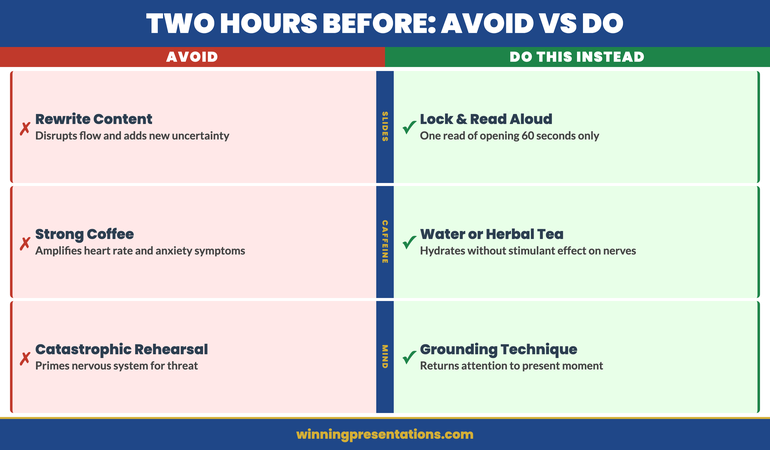
What you do in the two hours before a high-stakes presentation matters more than most people realise. By the time you walk into the room, the window for preparation has closed. The anxiety management techniques, the physical regulation, the mental framing — all of it has to happen before that moment. A structured morning protocol is not a luxury for performers and athletes. It is a practical, evidence-based approach to ensuring that the version of yourself that walks into the room is the one you intended to bring.

Astrid had given hundreds of presentations over a fifteen-year career in healthcare management. She was competent, prepared, and well-regarded. But the morning of a significant board presentation, her routine collapsed. She woke early and immediately began reviewing her slides — forty minutes of anxious re-reading that convinced her three sections were unclear. She rewrote them. Then she was late leaving the house, arrived at the venue with ten minutes to spare, grabbed a coffee, and sat in the boardroom trying to remember which version of slide fourteen she had updated. By the time the room filled, her heart was racing and her mouth was dry. The presentation went reasonably well — she was experienced enough to recover — but it was not her best work. She knew it. What she did not know was that the problem was not the slides, or the venue, or the nerves. It was the absence of a deliberate morning protocol. What she had done in those two hours had amplified her anxiety rather than managed it. When she eventually built a structured morning routine — consistent, timed, and designed around her nervous system rather than her slide deck — her presentations changed significantly.

Struggling with anxiety on the day of a big presentation? Conquer Speaking Fear is a structured 30-day programme that addresses the nervous system patterns behind presentation anxiety — so the morning of a high-stakes presentation stops feeling like a crisis. Explore the programme →

Why the Two Hours Before Presenting Matter Most

The nervous system does not respond to logic in the way we would like it to. In the hours before a high-stakes event, your body is already preparing its stress response — regardless of how experienced or well-prepared you are. Cortisol rises, muscle tension increases, and attention narrows. These are physiological processes, not character weaknesses. The question is not whether they happen. The question is whether you have a structured approach to working with them.

What distinguishes executives who consistently perform well under pressure from those who find high-stakes presentations draining and inconsistent is not talent. It is routine. When the two hours before a presentation are unstructured — filled with last-minute review, anxious checking, caffeine, and hurried logistics — the nervous system’s stress response compounds without interruption. When those same two hours are deliberately structured around physical regulation, cognitive preparation, and practical readiness, the presentation experience changes fundamentally.

There is also a practical dimension. The two-hour window is the last point at which you can do anything useful. After that window closes, the logistics are fixed and the slides are final. What remains is your state — your focus, your physical regulation, your relationship to the material. Managing your state is not a soft skill. It is the most high-leverage activity available to you in those final hours.

The pre-presentation rituals that athletes use before high-stakes performance follow exactly this logic — the research on elite performance preparation maps closely to what works for executives facing important presentations.

Stop Dreading Presentation Day. Start Managing It.

Conquer Speaking Fear is a structured 30-day programme that uses nervous system regulation and clinical hypnotherapy techniques to address presentation anxiety at its root — so you walk into high-stakes rooms feeling ready, not wired.

  • ✓ 30-day structured programme for presentation anxiety
  • ✓ Nervous system regulation techniques for high-pressure scenarios
  • ✓ Clinical hypnotherapy approaches adapted for executive contexts

Get Conquer Speaking Fear → £39

Designed for executives managing presentation anxiety

The Four-Phase Morning Protocol

The morning presentation protocol divides the two-hour window into four distinct phases, each with a specific purpose. The phases are designed to move from physical regulation through to mental focus, ending with a period of deliberate quiet before you enter the room. This sequence is not arbitrary — each phase prepares the conditions for the next.

Phase one: Physical activation (T minus 120 to 90 minutes). The first thirty minutes of the protocol addresses your body before your mind. Physical movement — a brisk walk, light exercise, or stretching — changes the neurochemical environment of anxiety. Movement processes the stress hormones that have been building since you woke and introduces endorphins that reduce subjective anxiety. This is not a training session. Fifteen to twenty minutes of moderate movement is sufficient. The key is doing it before engaging with any presentation material.

Phase two: Review and lock (T minus 90 to 60 minutes). The second phase is for content, not creation. If you have not finished preparing by this point, you are in a different kind of problem. This phase is for one final, structured review of your opening and closing only — not the full deck. Read your opening paragraph aloud. Say your closing sentence. These are the moments that shape first and last impressions, and they benefit from one deliberate rehearsal. After this review, the slides are locked. No more changes.

Phase three: Practical logistics (T minus 60 to 30 minutes). The third phase handles everything that needs to be in place before you leave for the venue: technology checked, slides saved to multiple locations, travel confirmed, contingency plans noted. Practical readiness removes the background hum of logistical anxiety that can occupy mental bandwidth during the presentation itself. If you will be presenting in a room you do not know, arrive early enough to check the AV setup, test your slides on the room screen, and stand at the front before anyone else arrives. Physical familiarity with a space significantly reduces situational anxiety.

Phase four: State management (T minus 30 to 0 minutes). The final thirty minutes before presenting are reserved for deliberate state management. This means quiet — no email, no phone calls, no last-minute preparation. Use this time for breathing techniques, a short mindfulness practice, or simply sitting in a calm environment and allowing your nervous system to settle. The goal is not to eliminate activation — some level of physiological arousal is useful for performance. The goal is to bring that activation to a level you can work with rather than a level that works against you.

The four-phase morning presentation protocol infographic: physical activation, review and lock, practical logistics, and state management with timing guidance

The Nervous System Reset: Physical Techniques That Work

The physical techniques that are most effective for pre-presentation anxiety management are those that directly engage the parasympathetic nervous system — the branch responsible for the rest-and-digest state that counterbalances the fight-or-flight response. These techniques work because they change your physiology, not just your thoughts about your physiology.

Controlled breathing is the most accessible and fastest-acting of these techniques. Breathing with a longer exhale than inhale — for example, four counts in and six counts out — activates the vagal nerve and shifts the nervous system toward a calmer baseline. This is not a new-age practice. It is physiology. The vagal nerve is the direct pathway between your breath and your autonomic nervous system, and it responds consistently to specific breathing patterns. Five minutes of extended-exhale breathing during phase four of the morning protocol can meaningfully change your physiological state before you walk in.

Progressive muscle relaxation — the sequential tensing and releasing of major muscle groups — is particularly effective for presenters whose anxiety manifests physically: tight shoulders, clenched jaw, tension in the hands and forearms. Ten minutes of systematic relaxation removes the physical tension that often remains even after breathing exercises have addressed the heart rate. It also directs attention to the body rather than the catastrophising thoughts that tend to dominate anxious minds in the final minutes before a presentation.

Grounding techniques — deliberate sensory engagement with the present environment — are useful for managing the mind’s tendency to project into the presentation room before the body has arrived there. For a detailed breakdown of grounding techniques specifically adapted for executives, our guide to grounding techniques for presentation anxiety covers the evidence-based approaches that work in professional settings.

For those whose anxiety involves persistent negative thought patterns — catastrophic predictions, harsh self-judgement, fixed beliefs about their performance under pressure — the techniques covered in our guide to cognitive restructuring for presentation anxiety address the mental layer that physical techniques alone cannot always reach.

If you want to build morning protocol management into a consistent practice, Conquer Speaking Fear provides the structured 30-day framework that takes these individual techniques and builds them into a coherent approach to managing presentation anxiety over time.

What to Avoid in the Two Hours Before You Present

The morning protocol is as much about what you do not do as what you do. Several common pre-presentation behaviours reliably increase anxiety rather than managing it, and most executives do them habitually without recognising the pattern.

Rewriting slides. Making changes to your presentation material in the two hours before delivery introduces a specific kind of anxiety: uncertainty about your own content. You no longer know which version of slide six you are presenting. The muscle memory of your flow is disrupted. If the changes were significant enough to be necessary this morning, the preparation process had a problem that no last-minute revision will fix. If they were not significant enough to be necessary, you have introduced uncertainty for no benefit. Lock the slides before the protocol begins.

Excessive caffeine. Caffeine is a stimulant that increases heart rate, heightens physical arousal, and can amplify the physiological symptoms of anxiety — the shaking hands, the dry mouth, the racing pulse. For presenters who already manage moderate to high pre-presentation anxiety, a strong coffee in the final hour before presenting is contraindicated by basic physiology. Caffeine consumed more than ninety minutes before presenting has a different effect; it is the timing that matters. In the final hour, a glass of water serves you better than an espresso.

Catastrophic rehearsal. Running through worst-case scenarios in your head — the slide clicker failing, the room going cold, the senior stakeholder asking the question you cannot answer — is a form of mental rehearsal that primes your nervous system for threat rather than performance. The mind does not distinguish cleanly between imagined and real scenarios. When you rehearse disaster, you trigger the same physiological response the real disaster would produce. Use the final thirty minutes for deliberate positive rehearsal, or for state management techniques, not for anticipatory problem-solving that generates anxiety without solutions.

Seeking reassurance. Calling a colleague to talk through your nerves, or asking a peer to quickly review your slides, feels helpful but often has the opposite effect. It externalises your confidence and makes it contingent on someone else’s response. It also invites feedback — and any critical feedback received in the final hour before presenting cannot be acted on, but it can unsettle you. Build your confidence in the preparation period. Protect it in the final two hours.

Four behaviours to avoid before presenting: rewriting slides, excessive caffeine, catastrophic rehearsal, and seeking reassurance, with better alternatives for each

Building the Protocol Into a Repeatable Routine

The morning protocol works best when it becomes automatic. The more consistent the routine, the less cognitive bandwidth it requires — and the more reliable the state it produces. Elite performers in every discipline report that pre-performance routines become conditioning: the body learns to associate the ritual with a particular state, and begins to produce that state in response to the ritual itself.

Building this kind of conditioned response requires consistency. The first few times you use the morning protocol, it will feel deliberate and slightly artificial. By the tenth presentation, it will feel natural. By the twentieth, it will be a trigger — and the physiological calm it produces will begin to appear earlier in the sequence, before you have even completed the protocol, simply because the familiar routine signals to the nervous system that this is a manageable situation.

Adapt the protocol to your specific circumstances. If you present remotely, your logistics phase looks different — the technology checks happen at your desk rather than in a venue. If your presentations often require same-day travel, build the physical activation phase into your journey rather than your morning routine. The structure matters more than the specific implementation. What you are creating is a reliable sequence that moves you, consistently, from anxious to ready.

Track what works. After each presentation, spend five minutes noting which parts of the morning felt effective and which did not. Anxiety patterns are individual — what regulates one person’s nervous system may not work for another. The protocol is a starting framework. Your version of it should be personalised over time based on what your own data tells you about your own pattern. And if you are working on a presentation that involves a challenging Q&A session, our guide to managing fishing questions during presentations covers how to handle the Q&A scenarios that most reliably spike anxiety.

Build the Foundation That Makes Morning Protocols Work

Conquer Speaking Fear gives you the 30-day structured programme to address the nervous system patterns that make presentation anxiety so persistent — so your morning protocol has solid ground to work with, not just a surface fix. £39.

Get Conquer Speaking Fear → £39

Frequently Asked Questions

What if I only have thirty minutes before my presentation, not two hours?

With thirty minutes, prioritise state management over content review. Skip the review phase entirely — the slides are done and re-reading them now will either confirm what you already know or introduce new uncertainty, neither of which is useful. Use the available time for breathing techniques and physical regulation: a short walk, extended-exhale breathing, and grounding. The logistics check should have been completed earlier. In thirty minutes, the most valuable thing you can do is manage your nervous system, not your slides.

Does the morning protocol work for presentations later in the day, not just morning presentations?

Yes — the protocol is named for the most common scenario (a morning presentation) but applies equally to afternoon or evening presentations. The key is the two-hour window before your presentation time, regardless of when that falls in the day. For afternoon presentations, schedule the physical activation phase immediately after lunch rather than at the start of the day. Avoid heavy meals in the two hours before presenting — digestion competes with the physical energy you need for delivering effectively under pressure.

I tend to feel more anxious when I try to relax before presenting. Is that normal?

Yes — this is a recognised phenomenon called relaxation-induced anxiety, and it is more common among high performers than is widely acknowledged. If deliberate relaxation techniques increase your anxiety, the issue is often the contrast between your activated state and the target calm state, which registers as a loss of control. In this case, redirect from relaxation to focused activation: a brisk walk, light movement, or deliberate mental rehearsal of a confident moment. The goal is not a specific state — it is your optimal performance state, which for some people involves a higher level of activation than the standard protocol assumes. Track what works for you specifically over time.

The Winning Edge

Weekly insights on executive presentations, presentation anxiety, and boardroom communication.

Subscribe Free

If your pre-presentation anxiety is compounded by the prospect of difficult questions, our guide to fishing questions in presentations covers how to recognise and respond to the Q&A tactics that most reliably put executives on the back foot.

About the author

Mary Beth Hazeldine, Owner & Managing Director, Winning Presentations. With 24 years of corporate banking experience at JPMorgan Chase, PwC, Royal Bank of Scotland, and Commerzbank, she advises executives across financial services, healthcare, technology, and government on structuring presentations for high-stakes funding rounds and approvals. A qualified clinical hypnotherapist and NLP practitioner, she brings a nervous-system-informed approach to presentation anxiety that goes beyond technique.

06 Apr 2026
A senior executive at a polished boardroom table reviewing a concise follow-up slide deck, with a glass office background and navy blue document folders, editorial photography style

Follow-Up Deck: Why Approvals Die After the Meeting and How to Fix It

Most approvals do not die in the meeting. They die in the three days afterwards, when the decision-maker returns to a full inbox, the urgency fades, and your proposal becomes one of twelve things waiting for attention. A well-structured follow-up deck is the single most underused tool for keeping executive approvals alive — and most executives never build one.

Ngozi had presented her transformation programme to the executive committee on a Tuesday. The room had been engaged. The CFO asked detailed questions about the cost model. The CEO nodded through the implementation timeline. At the end, the chair said the words every presenter dreads: “Thank you, Ngozi — we’ll come back to you on this.” By Friday, she had heard nothing. By the following Wednesday, two committee members had left for conferences. A month later, her proposal was still listed as “under review.” She had done everything right in the meeting. What she had not done was send a follow-up deck. Instead, she had sent a two-paragraph email with a PDF attachment of her original slides. The email got a read receipt but no response. The proposal stalled not because the committee disagreed — they had signalled support — but because no one had given them a clear, decision-ready document to move forward with. When she finally sent a structured follow-up deck six weeks later, it was approved within forty-eight hours.

Preparing a post-meeting deck for a stalled approval? The Executive Slide System includes decision-focused templates designed for high-stakes executive approval presentations. Explore the System →

Why Approvals Stall After Successful Meetings

The moment an executive presentation ends, the executive committee disperses back into their own priorities. A positive meeting creates intent, but intent is not a decision. Without something concrete to act on, that intent degrades. The half-life of a “we’ll come back to you on this” is shorter than most presenters realise.

Three dynamics work against you in the post-meeting window. First, decision-making friction: even supportive executives need a trigger to commit formally. Your original slides were designed for a live presentation — they do not function as a standalone decision document. Second, stakeholder drift: committee members who were aligned on Tuesday may have heard a counterargument by Thursday. Without a written reference point, the alignment you built in the room has nowhere to anchor. Third, competing priorities: the urgency your proposal felt in the room evaporates when the committee chair’s diary fills with unrelated crises.

The follow-up deck solves all three. It provides a trigger — a concrete document that moves the process forward. It anchors alignment — a written record of the direction the meeting was heading. And it reintroduces urgency — not through pressure, but through a clear next step with a defined timeline.

Understanding the pre-decision conversation that precedes executive approval is equally important — the follow-up deck works best when the right groundwork has been laid before the meeting, not improvised afterwards.

Build the Deck That Closes the Approval Gap

The Executive Slide System gives you templates for every stage of the executive approval journey — from the initial presentation to the follow-up deck that turns a promising meeting into a signed decision.

  • ✓ Slide templates for executive and board approval scenarios
  • ✓ AI prompt cards to build decision-ready decks fast
  • ✓ Framework guides for high-stakes approval presentations

Get the Executive Slide System → £39

Designed for executives preparing high-stakes presentations

What a Follow-Up Deck Contains — and What It Isn’t

A follow-up deck is not a compressed version of your original presentation. It is a different document with a different purpose. Where the original presentation was designed to persuade, the follow-up deck is designed to decide. These are distinct tasks that require distinct structures.

An effective follow-up deck for executive approval contains five components. The first is a decision summary — a single slide or opening section that restates what the committee is being asked to approve, in plain language. Avoid the qualifying language you might have used in the live presentation. “We are proposing a phased investment in infrastructure modernisation” becomes “The committee is asked to approve a £1.2M infrastructure investment with implementation beginning May 2026.” Clarity is not aggression. It is respect for the committee’s time.

The second component is a concise rationale update — two to three slides maximum that distil the business case to its essential logic. These are not a replay of your full argument. They are a written anchor that reminds decision-makers why the proposal was compelling. Include any new information that emerged during the meeting — questions that were asked and answered, concerns that were addressed, or data points that were requested and can now be provided.

The third component is a risk and mitigation summary. Committee members often stall not because they disagree, but because they cannot articulate a response to objections they anticipate from colleagues. A clear risk table — three to five rows covering the most likely concerns with specific mitigations — gives your supporters the language they need to champion the proposal in conversations you are not part of.

The fourth component is the implementation overview. A single timeline slide showing the first ninety days — milestones, owners, decision points — converts abstract approval into concrete commitment. Executives who approve a vague proposal often feel exposed. Executives who approve a specific plan feel informed. The difference is consequential.

The fifth component is the next-step request. This is the most frequently omitted section, and its absence is why so many follow-up decks fail to accelerate a decision. State clearly what you are asking the committee to do, by when, and how they should signal their response. “Please confirm approval by email to [chair] by April 10 to allow the project team to begin procurement” is actionable. “We welcome any questions” is not.

The five components of an effective executive follow-up deck: decision summary, rationale update, risk and mitigation, implementation overview, and next-step request

Timing and Delivery: When to Send It and How

The follow-up deck should be sent within twenty-four to forty-eight hours of the meeting. This is not a guideline — it is a strategic imperative. Within that window, the meeting is still recent, the committee’s impressions are still fresh, and you have the highest probability of capturing attention before competing priorities crowd your proposal out.

Waiting a week to prepare a polished document is a common mistake. A clean, clear five-slide deck sent the morning after a meeting outperforms a beautifully designed twelve-slide document sent five days later. The follow-up deck’s job is to maintain momentum, and momentum is time-sensitive.

Delivery should be direct, not through an assistant. Send it personally to the meeting chair with the committee members copied. The covering note should be one paragraph: acknowledge the meeting, state what is attached, and name the specific response you are requesting. Do not write a summary of your proposal in the email body — that is what the deck is for. Do not ask if there are any questions — that invites delay rather than decision.

The structure of high-stakes decision slides follows a specific logic that applies equally to live presentations and follow-up decks — the principles of decision architecture do not change because the medium has shifted from live to asynchronous.

If you are preparing multiple executive presentations for different stakeholders in parallel, the Executive Slide System provides the structural templates that allow you to build each deck — presentation and follow-up — from a consistent, decision-tested framework.

Structuring the Decision Summary Slide

The decision summary slide is the most important slide in your follow-up deck. It is the slide the committee chair will use to introduce the item in any subsequent discussion, and it is the slide that will be referenced when the approval is communicated to the wider organisation. Getting it right is not optional.

The decision summary should contain four elements only. The first is the ask: a single sentence naming what is being approved, in specific terms. Quantify wherever possible — amount, timeline, scope. The second is the rationale: one or two sentences giving the business case in plain language. This is not a condensed version of your full argument. It is the sentence a committee member would say if asked to explain the decision to a colleague who was not in the room.

The third element is the key condition: if there is a circumstance or assumption that makes the proposal viable, state it here. “Subject to legal review of the contract terms” or “Contingent on Q2 budget reforecast confirming £400K headroom.” This does not weaken the proposal — it demonstrates that you understand the constraints the committee is working within. Decision-makers who see their real-world constraints acknowledged are far more comfortable committing.

The fourth element is the decision date: the specific date by which you need a response for the implementation timeline to hold. This is not a deadline you are imposing. It is a project-management reality you are communicating. Frame it as information, not pressure: “Approval by April 14 allows the procurement process to begin within budget cycle.”

Decision summary slide structure for executive follow-up decks showing the four essential elements: ask, rationale, key condition, and decision date

Maintaining Momentum With Stakeholders After You Send It

Sending the follow-up deck is not the end of your approval management process. It is the beginning of a structured follow-up sequence that keeps the proposal visible without becoming intrusive. Most executives send the deck and then wait passively. This is where proposals stall.

If you have not received a response within forty-eight hours of sending the deck, a single follow-up is appropriate. This is not a chaser. It is a value-add: “I wanted to check whether any additional information would be useful before the committee considers the proposal.” This phrasing invites engagement without creating pressure. If there are open questions, this is when they surface — and surfacing them now is better than discovering them after the decision window has closed.

Identify the internal champions from your original meeting — the committee members who were visibly supportive — and maintain direct contact with them. These are the people who will advocate for the proposal in conversations you are not invited to. Giving them easy-to-use language — a clear one-paragraph summary they can share informally — is one of the most effective forms of approval management. It is also one of the least practised.

If your proposal contains a third-party dependency — a vendor quote that expires, a regulatory window that closes, a budget cycle that resets — communicate this proactively. Do not wait for the deadline to arrive and then rush to inform the committee. Flag it in your follow-up correspondence with enough lead time for the committee to act. This is not about creating artificial urgency. It is about ensuring that legitimate constraints are visible before they create problems.

For the complete board presentation follow-up protocol, including email templates and the twenty-four-hour action checklist, that guide covers every step of the post-presentation process. And if your proposal involves expanding an existing client relationship, our guide to upsell presentations covers how to make the expanded case when the client already knows and trusts you.

Structure Your Follow-Up Deck for Faster Approval

The Executive Slide System gives you the decision-focused templates and frameworks to build the follow-up deck that moves stalled proposals to approval — for £39.

Get the System Now → £39

Frequently Asked Questions

How long should a follow-up deck be after an executive presentation?

Five to seven slides is the right range for most executive follow-up decks. The purpose is not to re-present your full case — it is to make the decision easy to take. A decision summary, a condensed rationale, a risk overview, an implementation timeline, and a clear next-step request cover the essential ground without adding reading time the committee does not have. Longer decks signal that you are not sure what the decision-maker actually needs — and that uncertainty becomes their reason to delay.

Should the follow-up deck be different from the original presentation?

Yes — significantly. The original presentation was designed for live delivery, with slides that support spoken explanation. The follow-up deck must be self-explanatory, readable in isolation, and structured for a committee reading it asynchronously rather than listening in real time. Every slide must be able to stand alone without narration. This typically means more text on each slide than you would include in a live presentation, with section headers that tell the reader exactly what the slide is doing in the argument.

What if the committee has already asked for more information before deciding?

If the committee requested specific additional information during the meeting, your follow-up deck must address each request explicitly — with a slide that names the question that was asked, and provides the answer. Do not bury the responses in an appendix. Put them in the main body of the deck with a clear label: “Requested: Cost model breakdown for Phase 2.” This signals that you listened, you acted, and you are organised. More importantly, it removes the committee’s stated reason for deferring and creates a clear path to decision.

The Winning Edge

Weekly insights on executive presentations, slide strategy, and boardroom communication.

Subscribe Free

Preparing a high-stakes approval deck? Download the Executive Presentation Checklist — a structured framework for building decision-ready slides from first draft to final review.

If the approval you are chasing relates to a client account, our guide to the upsell presentation covers how to structure the expanded case for existing clients who are ready to grow.

About the author

Mary Beth Hazeldine, Owner & Managing Director, Winning Presentations. With 24 years of corporate banking experience at JPMorgan Chase, PwC, Royal Bank of Scotland, and Commerzbank, she advises executives across financial services, healthcare, technology, and government on structuring presentations for high-stakes funding rounds and approvals.

05 Apr 2026
Executive presenter making deliberate eye contact with a board member during a high-stakes presentation, confident posture, engaged audience

Eye Contact in Presentations: The 3-Second Rule That Changes How Executives Read You

Quick Answer

The 3-second rule for eye contact in presentations means holding deliberate eye contact with one person for roughly three seconds — long enough to complete a thought — before moving to another. This prevents the scanning and darting that signals anxiety, and it distributes your attention purposefully across the room, including to the people who are most sceptical. Executives read your eye contact behaviour as a direct signal of whether you believe what you are saying.

Henrik is a VP at a pharmaceutical company. He had prepared meticulously for a major leadership presentation — the data was solid, the narrative was clear, and he knew every number on every slide. Afterwards, the feedback stopped him cold: he had “seemed uncertain.” His coach watched the recording with him and spotted the issue within two minutes. Henrik had spent the entire presentation making eye contact with the three people nodding along at the left side of the table. He had barely glanced at the two board members on the right — the sceptics, the ones who were quietly deciding whether his budget proposal was credible. He had read the room, chosen the safe faces, and without realising it, he had signalled to the decision-makers that he either did not see them or did not want to. His certainty about the content never reached the people who mattered most.

Want a structured approach to building presentation confidence?

If you recognise the pattern Henrik experienced — knowing your material but still not landing as confidently as you should — there is a structured programme built specifically for executives navigating that gap. It works on the physical and psychological roots of presentation anxiety, not just the surface technique.

Explore the Programme →

What Eye Contact Signals to an Executive Audience

When you present to a senior audience, the content you deliver accounts for only part of how you are judged. Executives — particularly those who regularly sit in on high-stakes decisions — are experienced observers of other people. They have learned, often without consciously articulating it, to read delivery as a signal of conviction.

Eye contact is one of the clearest signals available to them. When a speaker holds steady, distributed eye contact, the room interprets it as ownership of the material. When a speaker scans nervously, looks repeatedly at their slides, or gravitates only toward friendly faces, the room reads it as discomfort — and discomfort in the presenter creates doubt about the content.

This matters enormously in executive and board-level settings, where the audience is making ongoing assessments throughout your presentation rather than waiting for the end. They are not passively receiving information. They are evaluating whether they trust the person delivering it. This is why your opening moments carry so much weight — and why eye contact behaviour from the first thirty seconds shapes the credibility you carry for the rest of the room.

There is also a subtler signal at work. When you make sustained eye contact with someone, it implies you are speaking directly to them — that you expect them to engage, to respond, to be part of the conversation. Executives are accustomed to being addressed this way. When a presenter fails to include them visually, it can read, consciously or not, as a lack of confidence in what is being said.

The inverse is equally important: the two board members Henrik was avoiding noticed, even if they never mentioned it. Sceptics who are not included in a speaker’s eye contact pattern often become more entrenched in their scepticism. They have been, in effect, dismissed.

The 3-Second Rule: Why It Works and How to Apply It

The 3-second rule is straightforward: when making eye contact in a presentation, hold your gaze with one person for approximately three seconds — enough to complete a sentence or a thought — before moving to someone else. It is not a rigid count. The goal is to match a complete idea to a complete moment of connection.

Why three seconds? Less than that and the contact reads as a glance — it feels rushed and superficial. The audience member does not feel genuinely addressed. More than five or six seconds and the contact starts to feel intense or confrontational, which is equally counterproductive. Three seconds is the natural duration of genuine conversational engagement. It is what happens automatically between two people having a focused discussion. Replicating it in a presentation setting makes the room feel like a conversation rather than a broadcast.

Applying it requires deliberate zone management. A useful way to think about your room is in three zones:

  • Decision-Makers Zone: The people with direct authority over the outcome — budget holders, senior sponsors, the most sceptical voices. Aim to spend approximately 40% of your eye contact time here, even if — especially if — they are not visibly receptive.
  • Nodders Zone: The engaged, visibly supportive faces. These feel natural to return to. Limit yourself to around 30% of your eye contact time here. They are already on your side.
  • Peripheral Zone: Colleagues, observers, junior stakeholders. Include them at around 30%, particularly during moments where you are building general credibility rather than pushing for a specific decision.

The practical discipline is to resist the gravitational pull of the nodders. It is entirely human to seek the safe face when you are under pressure. But doing so consistently tells the decision-makers that you are managing your own anxiety rather than engaging with them — which is precisely the opposite impression you want to create. Deliberate eye contact during an eye contact presentation is an act of attention directed outward, not inward.

One refinement worth noting: when you are presenting data or referencing a slide, it is acceptable to glance at the screen briefly. The error is staying there. Executives are reading your slides differently from how you expect, which means your job is to bridge the visual information to your verbal argument — and that bridge is built through eye contact, not through reading aloud.


Dashboard infographic showing the eye contact zone strategy for presentations with percentage time allocations for decision-makers, nodders, and peripheral audience members

Conquer Speaking Fear — £39

Build the Delivery Confidence That Lets Your Expertise Actually Land

Knowing your material is not the same as being able to deliver it under pressure. Conquer Speaking Fear is a 30-day programme that works on the nervous system roots of presentation anxiety — drawing on techniques from clinical hypnotherapy and nervous system regulation — so that your capability as a speaker matches the depth of your expertise.

  • Addresses the physiological and psychological components of presentation anxiety
  • Uses nervous system regulation techniques developed from clinical hypnotherapy practice
  • Structured as a 30-day programme with a clear, progressive framework
  • Designed for the specific pressures of executive and leadership-level presenting
  • Works on the internal experience of presenting, not just surface-level technique

Get Conquer Speaking Fear → £39

Designed for executives managing presentation anxiety and delivery pressure.

The Common Eye Contact Mistakes Executives Make

Most executives making eye contact errors are not aware they are doing it. The mistakes tend to cluster into a few recurring patterns.

Defaulting to the slide. The slide becomes a refuge when anxiety rises. Looking at the screen gives the speaker a brief pause from the pressure of being observed. Done occasionally, it is fine. Done repeatedly, it signals that the presenter does not fully own the material — that they need the slide as a prompt rather than as a visual support for an argument they could make without it.

The lighthouse sweep. Some speakers attempt to cover the room by scanning continuously from left to right and back again. This feels inclusive in theory, but in practice no individual ever feels addressed. The effect is impersonal and often reads as rehearsed in an unconvincing way. It is eye contact that avoids actual contact.

Locking in on one person. Some speakers — particularly those who are anxious — find one sympathetic face and stay there. This person becomes uncomfortable; everyone else feels excluded. If that one person happens to be a junior colleague rather than a decision-maker, the power dynamics in the room shift in an unhelpful direction.

Avoiding the sceptics entirely. This is Henrik’s mistake, and it is the most costly. Sceptics are sceptical precisely because they have unanswered questions or concerns. When a speaker visually excludes them, they receive a secondary signal that the speaker is either unaware of their concerns or unwilling to engage with them. Neither reading helps the presenter’s case. By contrast, deliberate and steady eye contact with a sceptic communicates: I see you. I am not afraid of your scrutiny.

Breaking eye contact at the wrong moment. The moment a speaker looks away tends to be interpreted as a signal — especially when it happens immediately after a key claim or recommendation. Looking down as you deliver your conclusion reads, unconsciously, as lack of conviction. The recommendation lands, then the speaker retreats from it. Holding eye contact through the delivery of a key point is one of the most direct ways to signal that you stand behind it.

If you are also working on avoiding the over-explanation habits that undermine credibility, eye contact discipline reinforces that work. The two behaviours are connected: over-explaining often comes with the same anxious avoidance pattern that produces poor eye contact.

How to Use Eye Contact When the Room Turns Hostile

There are presentations where the atmosphere shifts. A question is asked with an edge. Two board members exchange a look. Someone pushes back on your data. The room — or part of it — turns.

This is precisely the moment when instinct and good practice diverge most sharply. The instinctive response to hostility is to look away — to break contact, reduce the confrontational feeling, and regroup. But breaking eye contact in that moment sends a signal: that you are unsettled, that the challenge has found its target.

The discipline required is to maintain steady eye contact with the person who has challenged you while you formulate your response. Not a stare — that reads as aggression. But the same three-second conversational contact you would use with anyone else in the room. It communicates that you have heard the challenge, that you are taking it seriously, and that you are not rattled by it.

When answering a difficult question, direct the opening of your answer to the person who asked it, then broaden your gaze to include the wider room as you develop your response. This does two things: it honours the questioner while simultaneously making your answer a contribution to the whole room, not just a defence directed at one person. It reduces the adversarial dynamic without conceding ground.

If a question is genuinely difficult and you need a moment to think, it is completely acceptable to say so. The error is saying so while looking at the floor. Pausing while maintaining a composed, outward gaze signals that you are thinking carefully, not that you have been caught out.

Preparing for exactly this kind of pressure is one of the reasons executives benefit from working on the anxiety response that underpins delivery, not just the technique layer. When the nervous system is calmer under pressure, the physical signals — including eye contact — become far easier to manage.

If you have recently delivered a high-stakes presentation and are thinking about how to manage the follow-up conversation with decision-makers, the board presentation follow-up protocol covers the steps that typically happen after the room.

If the anxiety response in high-pressure presentations is something you recognise in yourself, Conquer Speaking Fear addresses exactly that, using nervous system regulation and clinical hypnotherapy techniques structured across thirty days.

Practising Eye Contact Before High-Stakes Presentations

Knowing the 3-second rule intellectually and executing it under pressure are two different skills. Like any physical component of presentation delivery, eye contact benefits from deliberate rehearsal — not just running through your content, but specifically practising the act of looking at people.

The most effective practice method is to rehearse in front of actual people rather than a mirror. A mirror changes the dynamic significantly: you are watching yourself, which is the opposite of the outward attention eye contact requires. If you can rehearse with a small group — even two or three colleagues — you can practise zone management in a realistic context.

If live rehearsal is not possible, the following framework helps structure your practice:

  1. Map your room in advance. Before a high-stakes presentation, identify where the decision-makers, nodders, and peripheral audience members will sit. Have a plan for where your eye contact will begin and how it will move.
  2. Anchor your opening in a person, not a slide. Start by addressing a specific individual with your first sentence. This sets the conversational tone from the outset.
  3. Practise completing full thoughts per person. Rehearse delivering single sentences or short ideas to one imagined person before moving. Get comfortable with the rhythm of thought-and-release rather than scan-and-move.
  4. Record yourself. Even a phone recording of a rehearsal can reveal patterns you are not aware of — including how often you look at your notes, your slides, or the floor.
  5. Practise under mild pressure. If the anxiety itself disrupts your eye contact, practising in entirely comfortable conditions will not prepare you for the real thing. Find ways to rehearse with a slightly raised heart rate — presenting to a slightly larger group than is comfortable, or in a less familiar environment.

The goal is not to make eye contact feel effortful and deliberate on the day — it is to practise until the deliberate choices become second nature. The technique should be invisible to your audience. They should experience you as engaged and present, not as someone executing a method.


Stacked cards infographic showing the five-step eye contact framework for presentations from mapping the room to returning to sceptics

Conquer Speaking Fear — £39

Systematic Confidence for the Moments That Count

Technical rehearsal takes you a certain distance. Conquer Speaking Fear takes you further — building the internal stability that lets you hold eye contact with a sceptic, absorb a difficult question, and deliver your recommendation with composure. It is a 30-day programme using nervous system regulation and techniques drawn from clinical hypnotherapy, structured for the specific challenges of executive-level presenting.

Get Conquer Speaking Fear → £39

Frequently Asked Questions

How long should eye contact last in a presentation?

Aim for approximately three seconds of eye contact per person — long enough to complete a sentence or a clear thought before moving on. Less than that reads as a glance; more than five or six seconds can feel intense or confrontational. The three-second duration naturally mirrors the rhythm of genuine conversational engagement, which is why it tends to feel credible to an executive audience.

Should you make eye contact with difficult or sceptical audience members?

Yes — and it is worth making a deliberate effort to do so, because the instinct under pressure is to avoid sceptical faces. Decision-makers who are sceptical are exactly the people whose confidence you need to build. Deliberately including them in your eye contact pattern signals that you are not unsettled by their scrutiny, which often does more to address their concerns than the content alone. Avoiding them tends to entrench rather than reduce their scepticism.

What if nerves make it difficult to maintain eye contact during a presentation?

This is common and it has a physical basis: when the nervous system is in an anxious state, looking at people can feel more exposing. Surface techniques help — practising zone management, rehearsing under mild pressure, anchoring your opening in a specific person. But if anxiety is disrupting your delivery more broadly, working on the underlying nervous system response tends to produce more sustainable results than technique adjustments alone. A structured programme focused on the physiological roots of presentation anxiety addresses this at the level where it originates.

Free Weekly Insights

The Winning Edge Newsletter

Each week: one practical idea for senior presenters. Delivery, structure, stakeholder handling, and the internal work that makes the difference. No filler.

Subscribe to The Winning Edge →

Mary Beth Hazeldine

Mary Beth Hazeldine is a presentation skills coach and the founder of Winning Presentations. She works with executives and senior leaders on the delivery, structure, and confidence challenges that arise in high-stakes presenting. Her programmes draw on her background in clinical hypnotherapy and nervous system regulation to address the anxiety that technical preparation alone does not resolve. She writes regularly on executive communication, presentation delivery, and the psychology of credibility.

05 Apr 2026
Chief Communications Officer presenting to a board of directors in a crisis briefing room, calm and authoritative expression, slides on screen showing incident timeline

Data Breach Communication: How to Present to Your Board in the First 48 Hours

Quick Answer

In the first 48 hours after a data breach is discovered, your board presentation must do four things: confirm what is known, be honest about what is not yet known, set out the immediate containment steps, and give the board a clear timeline for the next update. Structure and calm matter as much as content — your board will judge your organisation’s competence partly by how well you present under pressure.

Priya had been Chief Communications Officer for six years. She had handled product recalls, leadership transitions, and a difficult regulatory inquiry. None of it prepared her for what happened on the Tuesday morning when the IT security lead called her at 5:47 AM.

Thirty-six hours later, she was standing in front of the full board of a mid-size financial services firm. In her hand was a single printed page — a holding statement drafted by Legal, cautious to the point of saying almost nothing. The board chair’s first question was blunt: “How many customer records were accessed?” Priya didn’t know. The forensic team hadn’t finished. The incident was still live.

What she did next — and how she structured that conversation without a single prepared slide — shaped how the board perceived her firm’s response for months afterwards. She had one chance to demonstrate that the organisation was in control, even when the situation was not. The problem was not a lack of information. It was the absence of a framework for presenting with incomplete information under acute pressure.

Presenting in a crisis requires structure — especially when everything feels uncertain

The Executive Slide System gives you a clear framework for structuring high-stakes presentations — including the kind where you’re expected to project calm authority before you have all the answers. It’s built for executives who need to communicate credibly under pressure.

Explore the System →

Why the First Communication Is the Most Important Presentation You’ll Ever Give

When a data breach becomes known inside an organisation, a clock starts running. It is not just the regulatory clock — though that matters enormously, particularly under UK GDPR, which requires notification to the Information Commissioner’s Office within 72 hours of becoming aware of a breach that poses a risk to individuals. There is also a credibility clock.

Your board, your leadership team, your regulators, and eventually your customers will form their initial judgement of your organisation’s competence based heavily on how you communicate in the first two days. The quality of your actual response matters, of course. But the perception of that response — shaped almost entirely by how you present it — can either reinforce or undermine confidence in everything that follows.

This is not a comfortable truth. Most organisations invest heavily in incident response plans, cyber insurance, and forensic retainers. Very few invest equivalent effort in preparing their senior communicators to stand in front of a board and speak clearly and credibly when the information is fragmentary and the pressure is extreme.

The first board communication after a breach does several things simultaneously. It establishes the facts as currently understood. It demonstrates that the organisation has a response structure and is following it. It sets expectations for what will be known, and when. And — critically — it positions the leadership team as the source of authoritative information, rather than allowing rumour, speculation, or press reports to fill the vacuum.

Boards that lose confidence in their leadership during a crisis often point not to the breach itself — breaches happen, and most directors understand this — but to the communication. Evasiveness, over-qualification, contradictory information given at different meetings, and a failure to give the board a clear picture of what is being done: these are the things that damage trust. A structured, honest, well-presented briefing — even when it contains significant gaps — is almost always received better than one that appears to be withholding.

Understanding board presentation best practices in non-crisis contexts will help you build the muscle memory you need before a crisis arrives. The same principles — clarity, hierarchy of information, a single clear ask — apply under pressure, but they are significantly harder to execute when the room is tense and you have been awake for 30 hours.

What Your Board Needs Before the Public Statement Goes Out

Before any external statement is issued — whether to regulators, customers, or the media — your board needs to have been briefed. This is not merely good governance, though it is that. It is also essential for ensuring that board members are not blindsided by information they should have had first.

The board briefing prior to a public statement needs to cover a specific set of information, delivered in a specific order. Getting the sequence right matters because it affects how the board processes what you are telling them.

Start with what you know for certain. State the nature of the incident as you currently understand it. When was it discovered? By whom? What systems or data appear to have been affected? Resist the temptation to speculate about cause or extent until you have information to support those statements. The board will respect precision over comprehensiveness at this stage.

Be explicit about what you do not yet know. This is the section most presenters instinctively want to minimise, and it is precisely the section that builds the most credibility when handled well. “We do not yet know how many customer records were accessed — the forensic team expects to have an initial figure by [date]” is far more credible than a vague answer that implies you are holding something back. Name the unknowns. Give the timeline for resolving them. Assign ownership.

Describe the immediate containment steps. What has been done in the hours since discovery? Systems isolated, credentials reset, external forensic support engaged, legal counsel notified — give the board a concrete picture of activity. This is what demonstrates that the organisation is responding, not simply reacting.

Outline the regulatory position. Under UK GDPR, the 72-hour notification window applies where the breach is likely to result in a risk to the rights and freedoms of individuals. Your board needs to know where you are in that window, what decision has been made about notification, and who is responsible for that communication. If your Data Protection Officer or external legal counsel has been engaged, say so.

Set out the communication plan. Who will be notified, in what order, and by when? Your board should not be guessing at whether customers have already been told. The communication sequence — board first, then regulator, then affected individuals if required, then broader disclosure if needed — should be clear and documented.

Give the board a specific next touchpoint. When will they receive the next update? What will that update contain? “We will reconvene at 9am Thursday with a full forensic assessment and a draft regulatory notification for board review” is a sentence that closes a briefing with authority. It tells the board you have a plan, and it gives them a concrete anchor point for the next conversation.

If you present governance updates to your board regularly, the structure here mirrors the approach outlined in this guide to governance update presentations: lead with what the board needs to act on, be precise about risk, and give them a clear forward view.


Contrast panels infographic comparing reactive versus structured approaches to data breach crisis communication across first briefing, handling unknowns, and board response

Structure Your Crisis Presentation Before the Crisis Arrives

The Executive Slide System gives you the slide frameworks, narrative guides, and AI prompt cards to build high-stakes presentations with confidence — so when the pressure is highest, your structure is already in place.

  • Ready-to-use slide templates for executive and board-level presentations
  • AI prompt cards to develop your narrative quickly under time pressure
  • Framework guides for structuring complex, sensitive messages clearly
  • Designed for senior leaders who need to communicate with authority at short notice

Get the Executive Slide System → £39

The Four Slides You Need in the First 48 Hours

When time is short and information is incomplete, the instinct is often to either over-prepare (producing a lengthy deck that buries the key messages) or under-prepare (walking in with nothing, hoping to talk through it). Neither serves the board well.

A first 48-hour data breach presentation should be short, structured, and honest about its own incompleteness. Four slides — used well — is the right length for this briefing. Here is what each slide should contain.

Slide 1: Situation Summary

One headline sentence describing the incident. Date and time of discovery. Systems or data categories believed to be affected. Current status of the incident (contained, partially contained, ongoing). This slide should take under two minutes to present. It is the anchor for everything that follows.

Slide 2: Known / Not Yet Known

A simple two-column layout. On the left: what is confirmed. On the right: what is under investigation, with the expected timeline for clarity. This is the most important slide in the deck. It demonstrates intellectual honesty, shows that the investigation is structured and progressing, and prevents the board from drawing conclusions based on incomplete information. Do not pad the “known” column. Boards are experienced enough to spot it.

Slide 3: Immediate Response Actions

A chronological list of the steps taken since discovery — systems isolated, external forensic firm engaged, legal counsel notified, ICO notification window tracked, customer communications team on standby. Each action should have an owner and, where relevant, a timestamp. This is your evidence that the organisation is not in panic mode. It shows structure and accountability.

Slide 4: Next Steps and Communication Plan

Who will be notified, in what order, and by when. The date and format of the next board update. Any decisions the board needs to make today — and only decisions the board genuinely needs to make today. This slide should close with a single clear statement of what you are asking the board to do or approve. If you need nothing from them at this stage other than awareness, say that explicitly.

For guidance on how to structure executive-level communication more broadly, the framework in this guide to executive presentation structure applies directly to crisis briefings — particularly the principle of leading with the decision or action required rather than the background narrative.

Presenting With Incomplete Information

The hardest part of any crisis presentation is not knowing what to say. It is knowing how to say what you do not know in a way that preserves credibility and maintains the trust of the room.

Most senior executives are trained — formally or culturally — to have answers. Walking into a board meeting without full information feels like a failure, even when it is simply the reality of an ongoing incident investigation. The instinct to compensate by over-qualifying, hedging every sentence, or filling gaps with speculation is understandable. It is also counterproductive.

There is a significant difference between “We don’t know” (which sounds like confusion) and “We don’t yet know, and here is how and when we will find out” (which sounds like control). The second formulation is almost always available, and almost always more effective. Every gap in your knowledge should be accompanied by a timeline and an owner. This is not spin — it is accurate representation of how incident investigations actually work.

Your physical presence matters in this room, particularly given the emotional atmosphere that typically surrounds a breach disclosure. The board will be watching closely — not just for what you say but for whether you appear in command of the situation. How you use eye contact during a high-pressure presentation can significantly affect how your message lands: deliberate, calm eye contact signals authority, while rapid or avoidant eye movement can read as evasiveness even when you are being entirely transparent.

Handling questions you cannot answer is a distinct skill. A direct, simple response is always better than a lengthy deflection. “I don’t have that figure yet — I expect to have it by Thursday morning, and I’ll update you immediately when I do” is a complete answer. It respects the question, is honest about the limitation, and commits to a specific action. It does not require you to apologise for the gap.

Be careful with language that inadvertently implies certainty you do not have. “It appears that no financial data was accessed” means something very different from “We have confirmed that no financial data was accessed.” The former is appropriate early in an investigation. The latter should only be used when it is true. Boards — and regulators — will notice the distinction.

One further practical note: keep a record of what you said in each board session during a live incident. As information develops and your briefings evolve, you need to be able to demonstrate that your communications were consistent and that any changes to your position were driven by new evidence, not by a desire to manage perception.

The Executive Slide System includes frameworks and AI prompt cards specifically designed to help you build a clear, structured presentation quickly — useful when you have very little time and very high stakes.

The Regulatory Notification Presentation

Where a breach is notifiable to the ICO — or, in a cross-border incident, to multiple data protection authorities — there is often a secondary presentation requirement: briefing the board on the regulatory notification before it is submitted, and in some cases briefing regulators directly.

The board briefing prior to regulatory notification is structurally similar to the initial crisis briefing but with an additional dimension: the board needs to understand and, in most organisations, formally note or approve the decision to notify. This meeting should not be the first time the board hears the details of the breach. It should be the meeting at which they receive the full picture and confirm the regulatory approach.

Your presentation at this stage should include a summary of the forensic findings to date; the legal basis for the notification decision; the proposed content of the notification (or the notification itself, if complete); any customer communication that will accompany or follow the regulatory notification; and the proposed timeline for all of the above.

Where regulators themselves request a direct briefing — which is more common in sectors such as financial services and healthcare — the communication principles are similar but the audience is different. Regulators are interested in the facts, your assessment of harm to data subjects, the steps taken to contain and remediate the breach, and the measures being put in place to prevent recurrence. Tone matters: calm, factual, and forward-looking is almost always more effective than defensive or apologetic.

The structure of the data breach presentation you give to regulators should follow the same logical flow as your board presentations: situation, response, forward plan. Regulators are experienced with breaches and will assess your organisation’s competence in part by how well you understand and can articulate your own incident. A disorganised, inconsistent, or clearly improvised presentation will raise concerns that go beyond the incident itself.

Finally, consider the sequencing carefully. In most cases the correct order is: board first, then regulator, then affected individuals (if required under UK GDPR Article 34), then broader disclosure if applicable. Deviations from this sequence — particularly if the board learns about a regulatory notification from the ICO rather than from their own leadership team — can cause lasting damage to the relationship between board and management that outlasts the incident itself.


Cycle infographic showing the data breach response cycle with four phases: Contain, Assess, Communicate, and Recover

When the Stakes Are Highest, Structure Is Everything

Clarity under pressure is a skill — and like any skill, it is built in advance. The Executive Slide System gives you the tools to structure a compelling, credible executive presentation quickly, whether you have two weeks to prepare or two hours.

Get the Executive Slide System → £39

Frequently Asked Questions

How long should a board data breach presentation be in the first 48 hours?

At this stage, shorter is almost always better. A four-slide deck covering the situation summary, the known and not-yet-known, the immediate response actions, and the next steps and communication plan is the right length for a first 48-hour briefing. The goal is clarity and control, not comprehensiveness. The board will have questions — leave time for those. A presentation that runs for 40 minutes before questions are allowed creates frustration in an already pressured room.

What should I say when the board asks a question I cannot yet answer?

Answer directly, without hedging or over-qualifying. A simple format works well: “I don’t have that information yet. We expect to have it by [specific date/time], and [named person] is responsible for that part of the investigation. I’ll update the board as soon as we do.” Resist the temptation to speculate or to soften the uncertainty with language that implies more knowledge than you have. Boards respond well to honest precision and poorly to evasion, even well-intentioned evasion.

Do I need slides for a crisis presentation, or can I present verbally?

Slides are strongly advisable, even in a crisis — particularly for a board audience. They give the board a visual anchor, ensure consistency of information across multiple attendees, and create a record of what was presented and when. A brief, well-structured deck signals preparation and control. If slides genuinely cannot be produced in time, a one-page written summary distributed before the meeting achieves some of the same benefit. Presenting entirely verbally in a high-stakes crisis briefing places significant demands on your delivery and makes it harder for the board to retain and act on the information.

Get practical executive communication advice, weekly

The Winning Edge is a short, practical newsletter for senior leaders who want to communicate with more clarity and confidence — in the boardroom, in crisis moments, and in every high-stakes conversation in between. No fluff. No filler. Just ideas you can use.

Subscribe to The Winning Edge →

Not ready for the full system? Start here instead: download the free Executive Presentation Checklist — a one-page framework for structuring any high-stakes board presentation.

About the author: Mary Beth Hazeldine is a presentation coach and the founder of Winning Presentations. She works with senior leaders and executives on how to communicate with clarity and authority in high-stakes environments — including board briefings, regulatory meetings, and crisis situations. She is the creator of the Executive Slide System and writes The Winning Edge newsletter.