05 Apr 2026
Executive at a boardroom table reviewing a follow-up slide deck after a board meeting, with printed action items and a laptop open to a presentation

Board Presentation Follow-Up: The 24-Hour Protocol That Keeps Decisions Moving

Quick Answer: An effective board presentation follow-up sends a concise recap email within 24 hours, attaches a short follow-up deck of four slides, and documents every commitment, outstanding question, and next action with a named owner and deadline. Acting inside this window keeps board momentum alive and reduces the risk of decisions drifting or stalling between meetings. The protocol below shows you exactly what to include and how to frame it.

Valentina had just delivered what felt like the best presentation of her career. Forty minutes in the boardroom, a capital investment proposal that had taken her team six weeks to build, and a room of non-executive directors who had asked all the right questions. She left feeling confident — and sent a three-line email that evening: “Thank you for your time today. Happy to answer any further questions. Best, Valentina.”

Three months later, the investment was still awaiting sign-off. Two board members had forgotten the key financial assumption that underpinned the whole case. A third had circulated a competing proposal. Valentina’s capital request eventually went through — but the delay cost her team an entire planning cycle, and the project launched six months behind the original schedule.

The presentation itself was not the problem. The follow-up was. And Valentina is far from alone in making that mistake.

If you want a structured approach to every stage of a board presentation — including the follow-up — in one place, the Executive Slide System gives you the slide frameworks, email templates, and meeting structures that keep governance presentations moving from room to resolution. Explore the System →

Why Board Decisions Rarely End in the Meeting Room

There is a persistent misconception that a well-received board presentation produces a decision on the day. In practice, formal governance processes rarely work like that. Board members vote, deliberate, or defer — but even a positive room requires a paper trail before approval becomes official. Understanding this dynamic is the first step to managing it.

Boards operate on cycles. Minutes need to be written and circulated. Approvals may require a quorum that was not present. Legal, finance, or risk sign-offs often run in parallel and are not complete on the meeting date. Presenters who treat the meeting as the finish line are almost always disappointed.

What actually moves a decision forward after the room empties is a clear record of where things stand: what was agreed, what remains open, who owns each outstanding item, and what the next formal trigger will be. Without that record, the natural entropy of a busy board agenda — three weeks of emails, two additional meetings, one director on annual leave — erodes whatever momentum you created in the room.

The other factor worth understanding is that board members form their final views over time, not at a single moment. They may leave your presentation broadly supportive but want to check a financial model, speak with a colleague, or review a comparable case before they commit. A well-structured board presentation follow-up gives them the information they need to do exactly that — on your terms, not through recalled fragments of memory.

This is also why the 24-hour window matters so much. Research into decision-making and memory recall consistently shows that detail fades quickly after a meeting. Acting within a day keeps your framing intact and your narrative in the driving seat. Leave it three days, and a competing narrative may already be forming.

For executives new to formal governance settings, it is also worth noting that boards distinguish between a presenter who is thorough and one who is needy. The goal of your follow-up is not to lobby or apply pressure. It is to serve the board’s decision-making process — providing clarity, removing obstacles, and making it easy for members to act. That framing will shape every element of the protocol that follows.

The 24-Hour Window: What to Send and Why Timing Matters

Your follow-up email is not a thank-you note. It is a governance document. It should go out within 24 hours of the meeting — ideally the same evening or early the following morning — and it should do three things clearly: confirm what was discussed and agreed, identify what remains open, and state the next step with a specific date.

Keep the email itself short. Two to three short paragraphs, plus a structured list, is the right length for a busy non-executive director. You are not re-presenting; you are leaving a clean record. Attach the follow-up deck (covered in the next section) and reference it explicitly so board members know the fuller picture is available without having to ask for it.

A strong follow-up email has five elements:

  • Opening line: A single sentence confirming the meeting date, the subject matter, and your thanks for the board’s time. Factual and brief.
  • Decisions and agreements: A numbered list of anything that was formally agreed, endorsed in principle, or noted for the record. Be precise — “the board approved the capital request subject to finance committee review” is useful; “the board was supportive” is not.
  • Outstanding items: A separate numbered list of questions raised that require further information, plus who is responsible for providing it and by when.
  • Next steps: One or two sentences naming the next formal action, who owns it, and when it will happen. If there is a follow-up meeting, confirm the proposed date.
  • Attached follow-up deck: A brief note that the attached slides summarise the key data and provide the supporting detail the board may wish to review before the next meeting.

Copy the company secretary or governance lead, as appropriate. This creates an audit trail that supports the formal minutes process and signals that you are operating within, rather than around, proper governance channels. If your organisation uses a board portal such as Diligent or BoardVantage, upload the follow-up deck there as well so that all members have easy access regardless of their email habits.

One thing to avoid is the instinct to over-explain or re-argue your case in the follow-up email. If the board asked a difficult question in the room, the place to address it properly is in the follow-up deck or a dedicated briefing note — not in a rambling paragraph that reads as defensive. Clarity and economy of language are the hallmarks of an executive who understands how boards work.
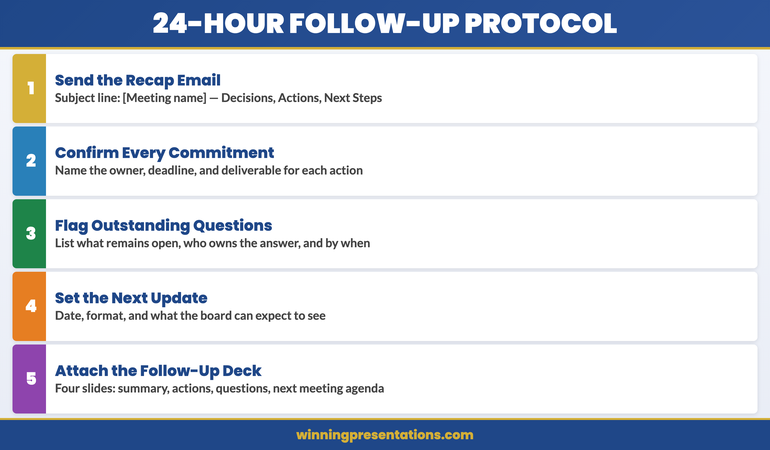
Stacked cards showing the five steps of a board presentation follow-up protocol: opening confirmation, decisions list, outstanding items, next steps, and attached deck

Turn Your Board Presentation Into a Decision — Not Just a Meeting

The Executive Slide System gives you a complete set of slide frameworks and communication templates for every stage of a board presentation — from your opening slide through to the follow-up deck that keeps decisions moving.

  • ✓ Slide-by-slide frameworks for board and governance presentations
  • ✓ Follow-up deck templates with pre-built slide structures
  • ✓ Prompt cards to structure your narrative and handle board questions

Get the Executive Slide System → £39

Designed for executives preparing high-stakes presentations

Building the Follow-Up Deck: Four Slides That Do the Work

The follow-up deck is not a repeat of your original presentation. It is a working document — designed to be read rather than presented, and built to serve the board’s decision-making process rather than to impress. Four slides is typically the right length. Longer than six slides and busy directors will not read it.

Here is what each of the four slides should contain:

Slide 1: Decision Status. A one-slide summary of where the decision stands. Include the motion or request as originally framed, the board’s response (approved, deferred, subject to conditions, or pending further information), and any formal conditions attached to an in-principle approval. This slide becomes part of the governance record and should be precise enough to stand alone as a reference document.

Slide 2: Actions and Owners. A table or structured list showing every action arising from the meeting. Each row should have: the action, the named owner (an individual, not a team or department), the delivery date, and a status column that you will update at the next meeting. Resist the temptation to be vague — “further analysis” is not an action; “finance team to provide revised three-year model incorporating 8% interest rate assumption by [date]” is.

Slide 3: Outstanding Questions. A dedicated slide for every question raised in the meeting that you were unable to answer fully in the room. For each item, note the question as asked, your proposed response or the additional work required to provide one, and the date by which you will provide it. This slide demonstrates competence rather than weakness — it shows the board that you have listened, recorded accurately, and are managing the process rigorously.

Slide 4: Proposed Next Step. A single slide stating clearly what needs to happen next for the decision to progress. This might be a follow-up meeting with a specific agenda, a paper to be tabled at the next scheduled board meeting, a finance committee review, or a bilateral conversation with the chair. Include a proposed date, a named facilitator, and a one-sentence summary of what the next step is designed to achieve. Make it easy for the board to say yes.

The deck should be formatted consistently with your original presentation — same fonts, same colour scheme, same level of visual polish. Sending a scrappy Word document after a polished board presentation creates an impression of inconsistency that can undermine the credibility you built in the room.

If your original presentation referenced data that has since been updated — a market figure, a cost estimate, a regulatory change — this is the right place to note the revision. Do not wait for the next full presentation to introduce material changes. A brief note on Slide 1 or Slide 3 keeps the record clean and demonstrates that you are actively managing the information, not just responding to prompts.

For a deeper look at how to structure what goes into the presentation before the follow-up, the board presentation 15-minute framework covers how to build a tight, decision-focused narrative that makes the follow-up process significantly simpler.

How to Frame Outstanding Questions Without Looking Unprepared

One of the most common anxieties executives have about the follow-up process is how to handle the questions they could not answer in the room. The instinct is to either over-explain why the information was not available, or to avoid referencing the gap altogether and hope it goes away. Neither approach serves you well.

The board is not expecting you to know everything. What it is expecting is that you know what you do not know, that you have a clear plan to address it, and that you will follow through. An executive who says “I don’t have that figure to hand but I will provide a detailed breakdown by Thursday” is demonstrating exactly the kind of rigour that builds board confidence. An executive who fumbles for an answer, gives an estimate with no acknowledgement of its limitations, or fails to follow up at all is the one who loses credibility.

When framing an outstanding question in your follow-up deck or email, use this structure: restate the question as it was asked, confirm the date by which you will provide the answer, and — where possible — give a brief indication of what type of answer to expect. For example: “Q: What is the projected impact on working capital in Year 2? We will provide a detailed working capital model incorporating the revised revenue assumptions by [date]. The preliminary estimate is within the range discussed at the meeting, pending confirmation from the finance team.”

That level of transparency does something important: it removes uncertainty from the board member’s perspective. They know the question has been heard, they know when they will have an answer, and they have a rough anchor for what to expect. That is a far more reassuring position than silence.

There is also a category of question that is better addressed through a bilateral conversation before the follow-up deck goes out. If a board member raised a concern that is sensitive — a governance issue, a conflict of interest question, or a concern about the competence of a named individual — it is usually more productive to speak with them directly before responding in writing to the full board. Use your judgement, but do not let that bilateral conversation become a substitute for the written record: once the conversation has happened, the key point and any agreed action should still appear in the follow-up documentation.

For a broader view of how seasoned executives manage their relationship with a board throughout the full presentation lifecycle, the guide on how to present to a board of directors covers the interpersonal and structural dimensions that the follow-up process sits within.

If you are preparing presentations that require both a strong initial structure and a robust follow-up process, the Executive Slide System includes ready-to-use frameworks for both stages.

The Follow-Up Meeting: Structure That Gets a Decision

Not every board presentation requires a dedicated follow-up meeting — some decisions are resolved through the paper trail alone, or picked up at the next scheduled board meeting. But when a follow-up meeting is needed, how you structure it determines whether you leave with a decision or another round of deferral.

The single most important principle for a follow-up meeting is to treat it as a working session, not a presentation. The board has already seen your slides. What they need now is a forum to ask the remaining questions, review the responses you have prepared, and reach a conclusion. Coming into the room with another 30-slide deck signals that you have not internalised that distinction — and it is one of the most common ways executives inadvertently reset the clock on a decision.

A well-structured follow-up meeting has three phases:

Phase 1: Orientation (5 minutes). Open with a brief verbal summary of where the decision stands, what has happened since the last meeting, and what you are asking the board to do today. Do not re-present the original case. One paragraph or three bullet points on a single slide is sufficient. The goal is to give board members who have reviewed your follow-up deck a rapid anchor, and to bring anyone who has not read it up to speed quickly.

Phase 2: Outstanding items (15-20 minutes). Work through the outstanding questions slide from your follow-up deck. For each item, briefly state the question, present your response, and then open the floor. Manage this section actively — you want dialogue, not a lecture. If a question generates significant discussion, note it explicitly and propose a way to resolve it: “This seems to be the key point of contention. Can we agree to [specific action] and come back to the board with a final recommendation by [date]?” Having a clear resolution mechanism for each item keeps the meeting from running indefinitely.

Phase 3: Decision and next step (5-10 minutes). Close by explicitly asking for a decision or a clearly defined next step. Too many follow-up meetings end with vague affirmation — “very helpful, we will consider” — rather than a concrete outcome. You can facilitate a cleaner close by framing a direct question: “Based on the responses provided today, is the board in a position to approve the capital investment? If not, what specific information or conditions would allow you to do so?” That framing forces a concrete answer and, if the answer is still a deferral, gives you precise guidance on what the final hurdle is.

Following the follow-up meeting, send a second, shorter version of the follow-up email within 24 hours. Update the decision status, close out any action items that have been resolved, and document the specific conditions or information required if a final decision is still outstanding. This layered documentation approach — original follow-up, then updated follow-up after subsequent meetings — creates a clean governance record that protects you if the decision later comes under scrutiny.

For executives who also manage ongoing client or stakeholder presentations alongside their board responsibilities, the approach to structuring a client account review presentation uses a similar decision-facilitation framework and may offer useful parallels.
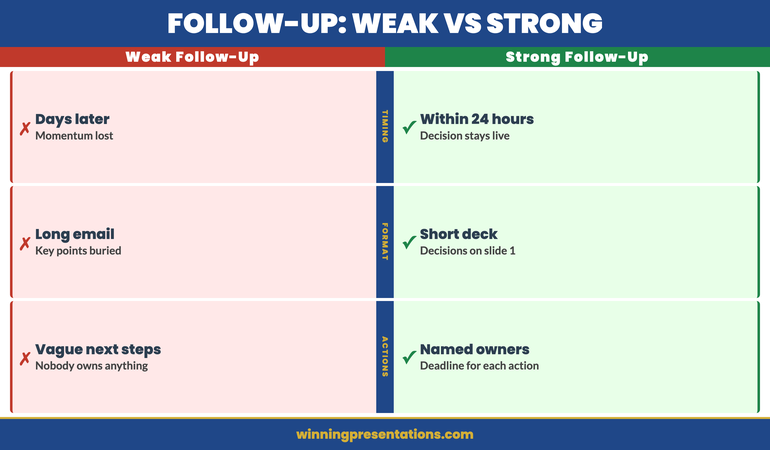
Split comparison showing weak board presentation follow-up on the left (vague email, no deck, no actions) versus a strong structured follow-up on the right (24-hour email, four-slide deck, named owners)

Already Have the Deck — But the Follow-Up Is Where Things Stall?

The Executive Slide System includes the follow-up slide structures and communication frameworks that most presentation tools leave out — so you can manage the full cycle from first slide to final approval.

Get the Executive Slide System → £39

Designed for executives preparing high-stakes presentations

Frequently Asked Questions

How long should a board presentation follow-up email be?

A follow-up email to the board should be concise — typically two to three short paragraphs plus a structured list of decisions and actions. The purpose of the email is to leave a clear record, not to re-present your case. Most of the substantive detail belongs in the attached follow-up deck, which board members can review at their own pace. A long email is unlikely to be read carefully by time-pressed directors and can come across as over-eager rather than thorough. Aim for something that can be read and understood in under two minutes. Reference the attached deck explicitly so members know where the fuller picture is.

What should you do if the board deferred a decision rather than approving it?

A deferral is not a rejection — but it does require active management. The first step is to understand precisely why the decision was deferred. If the chair or a board member gave explicit reasons, document them exactly as stated. If the deferral was less specific, it is appropriate to follow up directly with the chair or company secretary to understand what information or conditions would allow the board to reach a decision at the next meeting. Once you have that clarity, your follow-up deck should explicitly address each condition or information gap, and your proposed next step should map directly to removing each outstanding obstacle. Treat the deferral as a checklist, not a setback — and your follow-up process as the mechanism for working through that checklist systematically.

How many times should you follow up after a board presentation before it becomes counterproductive?

There is no fixed number, but the guiding principle is that each follow-up communication should add new information or move the process forward — it should never simply repeat what has already been said. A structured board presentation follow-up typically involves an initial 24-hour email with follow-up deck, a second update after any subsequent follow-up meeting, and then a brief status note at each scheduled board meeting until the decision is closed. Beyond that, if a decision has been in limbo for several board cycles, the right move is usually a direct conversation with the chair to understand whether the proposal needs to be restructured or whether there are governance or priority factors that are not visible to you. Persistent written follow-up without new substance quickly becomes noise — and erodes the credibility you are trying to protect.

Get The Winning Edge

Weekly insights on executive presentations, stakeholder strategy, and high-stakes communication — straight to your inbox.

Subscribe to The Winning Edge →

Not ready for the full system? Start here instead: download the free Executive Presentation Checklist — a one-page checklist covering the essentials before your next board meeting.

About Mary Beth Hazeldine

Mary Beth Hazeldine is Owner & Managing Director of Winning Presentations. With 24 years of corporate banking experience at JPMorgan Chase, PwC, Royal Bank of Scotland, and Commerzbank, she advises executives across financial services, healthcare, technology, and government on structuring presentations for high-stakes funding rounds and approvals.

Book a discovery call | View services

04 Apr 2026
Executive confidently responding to data questions during a board presentation with financial charts visible on screen, editorial photography

Data Questions in Presentations: How to Defend Your Numbers Under Pressure

Data questions in presentations are rarely about the data. They are about trust. When a board member challenges your numbers, they are testing whether you understand the assumptions behind them, the limitations within them, and the decisions they should and should not support. Here is how to defend your data under pressure without losing credibility or the room.

Ingrid was presenting the quarterly revenue forecast to the executive committee of a mid-market technology firm. Slide six showed a projected twelve percent growth in recurring revenue, driven by three new enterprise contracts expected to close in the next quarter. The CFO leaned forward. “Ingrid, the pipeline conversion rate you’ve used here is forty-two percent. Our actual conversion rate for the last four quarters has averaged thirty-one percent. Walk me through why you’ve used a different number.” She had used the higher figure because it reflected the conversion rate for enterprise deals specifically, which historically closed at a higher rate than the blended average. But she hadn’t flagged the distinction on the slide or in the supporting notes. She knew the answer—but the ten seconds it took her to locate the rationale in her memory felt, to the room, like hesitation. The CFO’s eyebrows rose. The CEO looked down at his notes. Ingrid recovered well, explaining the enterprise-specific rate and offering to share the supporting data by email. But the damage was subtle and real: for the remainder of the presentation, every number was scrutinised more carefully. She had been credible at slide five. By slide seven, she was being audited. The issue wasn’t the data. It was the gap between her preparation and her presentation of it.

Preparing for a data-heavy presentation with Q&A? The Executive Q&A Handling System includes frameworks and response structures designed for high-scrutiny presentation environments.

Why Data Challenges Are About Trust, Not Accuracy

When someone challenges a number in your presentation, the instinct is to defend the number. This is almost always the wrong response. The question behind the question is not “Is this number correct?” It is “Do you understand what this number means well enough for me to trust the decision you’re asking me to make?”

Data questions in presentations serve a governance function. The board member or senior executive who challenges your figures is not trying to embarrass you. They are building their own confidence that the data has been properly interrogated before it reaches them. Your job is not to prove the number is right. Your job is to demonstrate that you understand its provenance, its limitations, and its implications for the decision at hand.

This reframing changes your preparation entirely. Instead of preparing to defend every number, prepare to explain the three to five numbers that are most likely to be challenged—the ones with the biggest assumptions, the widest confidence intervals, or the greatest impact on the recommendation. Know the source. Know the methodology. Know the alternative interpretation. And know what your recommendation would be if the number were materially different.

The executive who responds to a data challenge with “The number is correct—it comes from our CRM” is defending accuracy. The executive who responds with “That number reflects our enterprise conversion rate over the last six quarters. If we used the blended rate instead, the forecast would be eight percent rather than twelve. My recommendation wouldn’t change, but the confidence interval would widen” is demonstrating mastery. The first response ends the question. The second response earns trust.

Handle Data Scrutiny With Authority

The Executive Q&A Handling System gives you response frameworks and preparation structures for high-scrutiny presentations—so you defend your numbers with the confidence the room expects.

  • ✓ Q&A response frameworks for executive settings
  • ✓ Preparation templates for data-heavy presentations
  • ✓ Techniques for handling hostile and unexpected questions

Get the Q&A Handling System → £39

Designed for executives who face data scrutiny in high-stakes presentations

Assumption Transparency: The Defence That Prevents the Attack

The most effective defence against data questions is to answer them before they’re asked. Assumption transparency—stating your key assumptions on the slide rather than hiding them in a footnote or an appendix—removes the adversarial dynamic entirely. When you proactively disclose that “this forecast uses enterprise-specific conversion rates (42%) rather than the blended rate (31%),” you’ve eliminated the challenge before the CFO can formulate it.

This approach works because it reverses the power dynamic. When the audience discovers an assumption themselves, it feels like catching you out. When you disclose it proactively, it feels like rigour. The data is identical. The perception is entirely different. Transparency converts a potential weakness into a credibility signal.

The practical implementation is an “Assumptions” callout box on any slide that presents modelled, projected, or estimated data. Keep it brief—three to five key assumptions, each in a single line. Position it at the bottom of the slide in a visually distinct format (grey text, smaller font, clearly labelled). This tells the audience: “I’ve thought about what underpins these numbers, and I’m confident enough to show my working.”

The assumptions you choose to disclose also signal what you consider material. Listing every assumption suggests you’re unsure which ones matter. Listing three tells the audience these are the ones you’ve stress-tested because they have the greatest impact on the recommendation. This selectivity is itself an act of expertise—it shows you can distinguish between assumptions that affect the decision and assumptions that are technically interesting but practically irrelevant.

Assumption transparency framework showing proactive disclosure versus reactive defence in data presentations

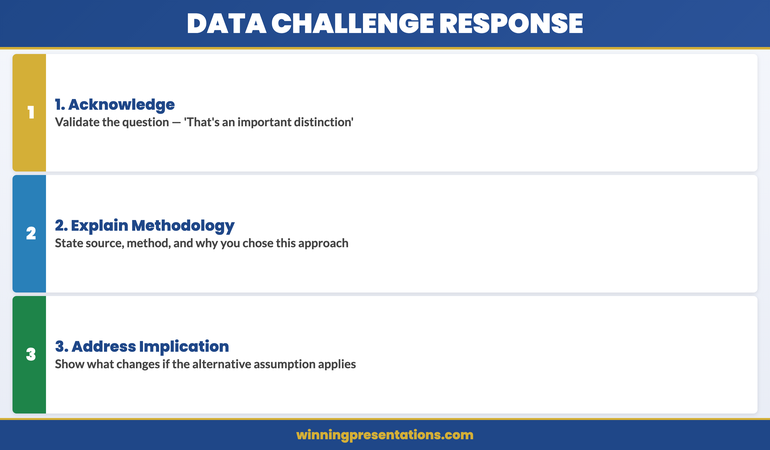
The Three-Part Response to Any Data Challenge

When a data question arrives—and it will, regardless of your preparation—use a three-part response structure that maintains credibility while addressing the challenge directly.

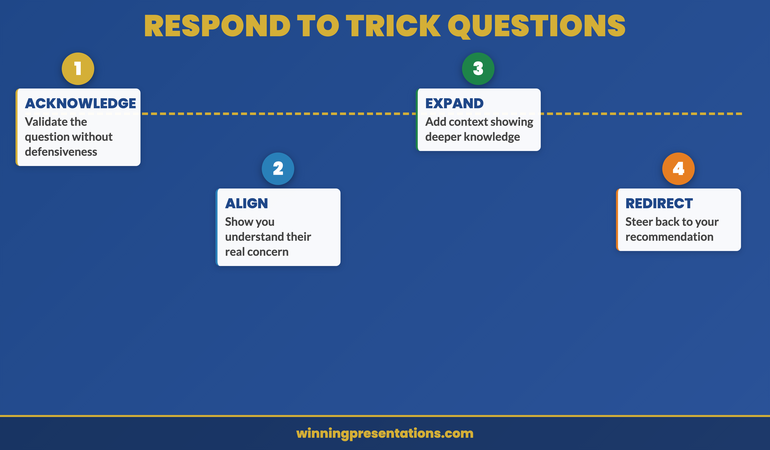
Part 1: Acknowledge the question’s legitimacy. “That’s an important distinction” or “You’re right to question that assumption.” This is not flattery—it is professional respect. It tells the questioner that you understand why the data point matters, which immediately reduces the adversarial temperature. A defensive response—“The data is sound”—escalates. An acknowledging response—“That’s a fair challenge”—de-escalates.

Part 2: Explain the methodology. State the source, the methodology, and the reason you chose this approach over alternatives. Be specific and brief. “We used the enterprise-specific conversion rate because the three pipeline deals are all enterprise contracts. The blended rate includes SME deals, which convert at a lower rate and aren’t represented in this quarter’s pipeline.” This takes fifteen seconds and demonstrates mastery.

Part 3: Address the implication. State what would change if the alternative assumption were used. “If we applied the blended rate, the projection would drop from twelve to eight percent growth. The recommendation to proceed with the hiring plan would still hold, though the timing would shift by one quarter.” This is the element that builds the most trust, because it shows you’ve already considered the alternative the questioner is proposing. You haven’t just defended your number—you’ve demonstrated that the decision is robust regardless. For more on the bridging technique for difficult questions, that guide covers how to redirect challenging questions without appearing evasive.

The three-part structure works because it addresses all three layers of the data challenge simultaneously: the emotional layer (acknowledgement), the technical layer (methodology), and the decision layer (implication). Most presenters only address the technical layer—and that’s why data challenges feel so uncomfortable. When you address all three, the questioner feels heard, informed, and reassured.

Anticipating Data Questions Before They Arrive

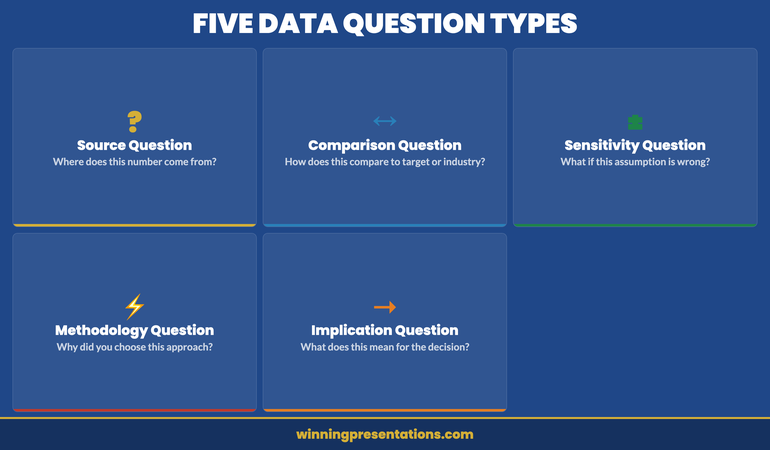
The most predictable data questions follow a pattern. For any presentation containing numerical analysis, audit each slide against five question types that appear in virtually every executive Q&A.

The Source Question: “Where does this number come from?” Prepare a one-sentence answer for every significant data point: the system, the report, the date range, and any manual adjustments. If you had to manipulate the data—filtering outliers, annualising partial data, converting currencies—disclose the methodology proactively or prepare the answer for Q&A.

The Comparison Question: “How does this compare to [last quarter / the industry / the target]?” Prepare context for every headline number. A twelve percent growth figure means nothing without comparison. Twelve percent against a target of fifteen is underperformance. Twelve percent against an industry average of four is outperformance. The questioner wants to calibrate your number against a reference point. Provide it before they ask.

The Sensitivity Question: “What happens if this assumption is wrong?” This is the data question that separates adequate presenters from authoritative ones. Prepare a sensitivity range for your three to five most impactful assumptions. Know what changes—and what doesn’t—when each assumption shifts by a material amount. For techniques on buying time during Q&A, that guide covers legitimate strategies for creating thinking space when unexpected questions arrive.

If you regularly present data-heavy material to senior audiences, the Executive Q&A Handling System provides the preparation frameworks that ensure you’ve anticipated the questions before you enter the room.

Five predictable data question types in executive presentations with preparation strategies

Recovering Credibility After a Data Stumble

If you’ve been caught off-guard by a data question—a number you can’t explain, an assumption you didn’t anticipate, a comparison you haven’t prepared—the recovery is more important than the stumble. How you handle the next sixty seconds determines whether the audience writes off the moment or writes off your presentation.

The recovery protocol has three steps. First, resist the urge to guess. An incorrect improvised answer is far more damaging than an honest acknowledgement. “I don’t have that specific breakdown in front of me” is a temporary gap. “I believe the number is roughly…” followed by an incorrect estimate is a credibility collapse.

Second, commit to a specific follow-up. Not “I’ll look into that”—which sounds vague and may never happen—but “I’ll send the detailed breakdown to the committee by end of business today.” The specificity of the commitment signals accountability. The timeline signals urgency. Together, they convert a moment of weakness into a demonstration of professional discipline.

Third, move forward with the presentation. Do not apologise repeatedly, do not circle back to the point, and do not let the stumble colour the rest of your delivery. The audience takes their cue from you. If you treat the moment as a minor administrative gap, they will too. If you treat it as a catastrophe, they will begin scrutinising every subsequent number with renewed suspicion. The stumble matters far less than the signal you send about it. For approaches to handling particularly hostile questions in board meetings, that guide covers the specific dynamics when data challenges carry political intent.

Prepare for Every Data Challenge Before You Enter the Room

Stop dreading Q&A. The Executive Q&A Handling System gives you the frameworks to anticipate, structure, and deliver authoritative responses to data scrutiny—for £39.

Get the Q&A Handling System → £39

Frequently Asked Questions

How do I handle a data question when the questioner has better data than I do?

Acknowledge their data immediately: “That’s a useful data point—thank you. My analysis used [source/timeframe]. If your figures reflect [their likely source], the difference may be [methodology/scope/date range]. I’d like to reconcile the two datasets after this meeting so we’re working from a single source going forward.” This response does three things: it validates their contribution, explains the discrepancy without being defensive, and proposes a constructive resolution. The worst response is to argue that your data is right and theirs is wrong—even if that’s true.

Should I include an appendix with detailed data for Q&A?

Always. An appendix with supporting detail is your safety net for data questions. Structure it as a set of backup slides that mirror your main presentation: for each core slide, prepare one or two appendix slides with the underlying data, the methodology note, the sensitivity analysis, or the comparison benchmarks. When a question arrives, you can say “I have the detailed breakdown—let me pull up the supporting slide.” This signals preparedness and converts Q&A from an interrogation into a collaborative data review.

What if a data challenge reveals a genuine error in my presentation?

Acknowledge it immediately, thank the person who spotted it, and assess the impact on your recommendation in real time. “You’re right—that should be thirty-one percent, not forty-two. Let me quickly assess whether that changes the recommendation.” If the recommendation holds, say so: “The conclusion is the same, but the margin is tighter. I’ll circulate corrected figures after the meeting.” If the error materially changes the recommendation, say that too: “This changes the picture. I’d like to revise the analysis and bring an updated recommendation to next week’s meeting.” Honesty in the moment of error builds more trust than a flawless presentation built on unchallenged assumptions.

The Winning Edge

Weekly insights on Q&A handling, executive presentations, and boardroom communication.

Subscribe Free

If data scrutiny also triggers anxiety about your credibility as a presenter, our guide to imposter syndrome in presentations covers the psychological patterns that make high performers feel like frauds under pressure.

About the author

Mary Beth Hazeldine, Owner & Managing Director, Winning Presentations. With 24 years of corporate banking experience at JPMorgan Chase, PwC, Royal Bank of Scotland, and Commerzbank, she advises executives across financial services, healthcare, technology, and government on structuring presentations for high-stakes funding rounds and approvals.
04 Apr 2026
Professional woman standing at a podium looking composed but internally conflicted, corporate presentation setting, editorial photography

Imposter Syndrome in Presentations: Why High Performers Feel Like Frauds at the Podium

Imposter syndrome in presentations does not target the unprepared. It targets the competent—the executives who know enough to recognise the gap between what they understand and what the audience expects. The paradox is that the more you know, the more exposed you feel. Here is why imposter syndrome intensifies at the podium and what to do when it arrives.

Beatriz had been promoted to Head of Strategy at a consumer goods company six months earlier, following a decade in management consulting. She was presenting the annual strategic review to the executive committee—twelve people she’d worked alongside for half a year. She knew the material. She’d built the analysis herself. But standing at the front of the room, she felt a familiar constriction in her chest: the conviction that someone was about to ask a question that would reveal she didn’t belong here. That the consulting background was a costume, and the strategy role was borrowed. She delivered the presentation competently—steady voice, clear slides, controlled pace. Afterwards, the CEO told her it was one of the strongest strategy reviews he’d seen. She nodded, smiled, and spent the following weekend replaying every answer she’d given in Q&A, searching for the moment she’d been exposed. She never found it, because it didn’t happen. But the search itself was exhausting. Beatriz didn’t need better slides. She needed to understand why her brain was running an audit she’d never pass.

Does presentation anxiety feel out of proportion to your preparation? The Conquer Speaking Fear programme addresses the psychological patterns that drive presentation anxiety for experienced professionals.

Why Presentations Trigger Imposter Syndrome More Than Other Work

In written work, you can edit. In meetings, you can defer. In one-to-one conversations, you can redirect. A presentation offers none of these escape routes. You are standing in front of an audience, delivering content you cannot take back, being evaluated in real time by people whose opinions affect your career. For someone whose internal narrative already questions their legitimacy, a presentation is the highest-stakes version of the test they’ve been dreading.

Imposter syndrome in presentations is amplified by a specific cognitive distortion: the belief that the audience knows more than you do. In a boardroom presentation, you’re often speaking to people with decades of experience. Your brain interprets their seniority as superior knowledge—forgetting that you were asked to present precisely because you have expertise they lack. The finance director isn’t presenting the strategic review because strategy isn’t their domain. You are presenting it because it is yours. But imposter syndrome flattens that distinction and tells you that everyone in the room could do what you’re doing, only better.

The second amplifier is visibility. Imposter syndrome thrives in private—the quiet conviction that you’re somehow less capable than your role implies. In daily work, this stays manageable because there’s no single moment of exposure. A presentation creates exactly that moment. Every eye is on you. Every hesitation is observed. Every answer is assessed. The internal experience is of a spotlight focused on the gap between who you are and who the audience expects you to be. This is why competent professionals who manage perfectly well in meetings, workshops, and negotiations can feel genuinely terrified when asked to present.

Understanding this mechanism matters because it changes the intervention. The solution is not more preparation—you’re already well-prepared. The solution is recognising that the fear signal is being generated by a threat-detection system that has misidentified the situation. You are not being exposed. You are being consulted. The physiological response is identical, but the interpretation changes everything.

Present With Authority When Your Inner Voice Says You Can’t

Conquer Speaking Fear addresses the psychological patterns that drive presentation anxiety for experienced professionals—including the imposter cycle that preparation alone can’t fix.

  • ✓ Evidence-based anxiety reduction frameworks
  • ✓ Cognitive reframing techniques for high achievers
  • ✓ Practical pre-presentation routines that build confidence

Get Conquer Speaking Fear → £39

For professionals whose anxiety is out of proportion to their preparation

The Competence Gap Illusion: What Your Brain Gets Wrong

The Dunning-Kruger effect is usually cited to explain why incompetent people overestimate their abilities. The less-discussed corollary is equally important: competent people systematically underestimate theirs. When you know a subject deeply, you become acutely aware of its complexity, its ambiguities, and the limits of your understanding. This awareness—which is actually a sign of expertise—feels like evidence of inadequacy.

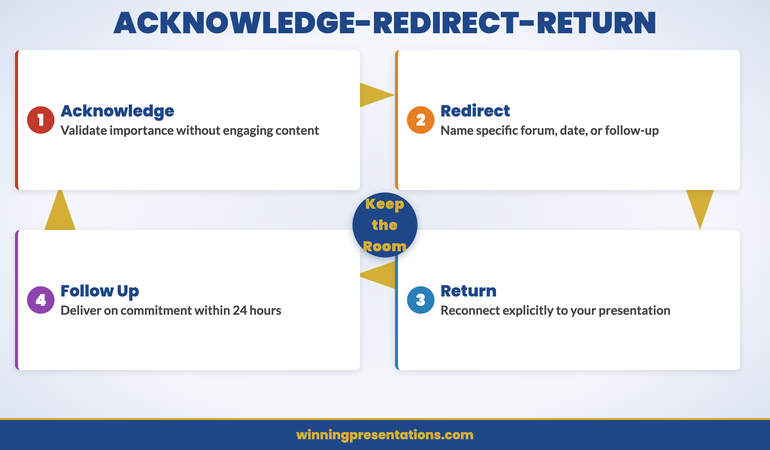
In a presentation context, this manifests as the conviction that someone in the audience will ask a question you can’t answer, and that this single moment will invalidate everything you’ve said. What your brain fails to calculate is the probability. You’ve prepared extensively. You know the subject. The chance of a genuinely unanswerable question is low—and the appropriate response to one is not shame but honest acknowledgement. “I don’t have that specific data to hand—I’ll follow up with you this afternoon” is a perfectly professional answer that no reasonable audience member would interpret as incompetence.

The competence gap illusion also distorts your assessment of the audience. You assume they process information the way you do—noticing every nuance, every simplification, every point where you chose to summarise rather than elaborate. They don’t. Your audience is processing at a much higher level: Does this person seem credible? Is the recommendation clear? Do I trust this analysis? They’re evaluating your authority, not auditing your footnotes.

The practical intervention is a pre-presentation reality check. Before you stand up to speak, write down three things you know about this topic that nobody else in the room knows in as much depth. Not impressive things—just specific things. The regulatory change you researched last week. The client conversation that shaped your recommendation. The data point that surprised even you. These are your anchors. When imposter syndrome whispers “you don’t belong here,” these anchors remind you that you were invited for a reason. For more on the perfectionism and anxiety cycle that feeds imposter syndrome in presentations, that guide examines why the pursuit of a flawless delivery often intensifies the anxiety it’s trying to prevent.

The competence gap illusion showing how expertise creates awareness of complexity that feels like inadequacy

Reframing Authority: You Were Invited to Speak for a Reason

Imposter syndrome tells you that you’re at the front of the room by accident—that circumstances conspired to put you here, and discovery is imminent. The structural reality is different. Someone decided this meeting needed a presentation. Someone decided you were the person to deliver it. Someone scheduled the room, invited the attendees, and allocated time on the agenda for your content. None of these decisions were accidental.

This reframe is not positive thinking. It is factual analysis. The question is not “Am I good enough to present this?” The question is “Why did a rational group of professionals decide I should present this?” The answer is always some version of: because you have knowledge, access, analysis, or perspective that the room needs. Your role is not to prove you belong. Your role is to deliver the content they asked for.

A useful cognitive shift is to move from “I am the expert” to “I am the messenger.” The first framing invites scrutiny of your credentials. The second invites scrutiny of your message—which is where you want the attention. You are not standing at the front of the room to demonstrate your intelligence. You are standing there to communicate findings, recommendations, or analysis that the audience needs to make a decision. This repositioning reduces the personal stakes dramatically. If the audience challenges your recommendation, they’re challenging the analysis—not your right to be there.

The Over-Preparation Trap: When More Work Makes It Worse

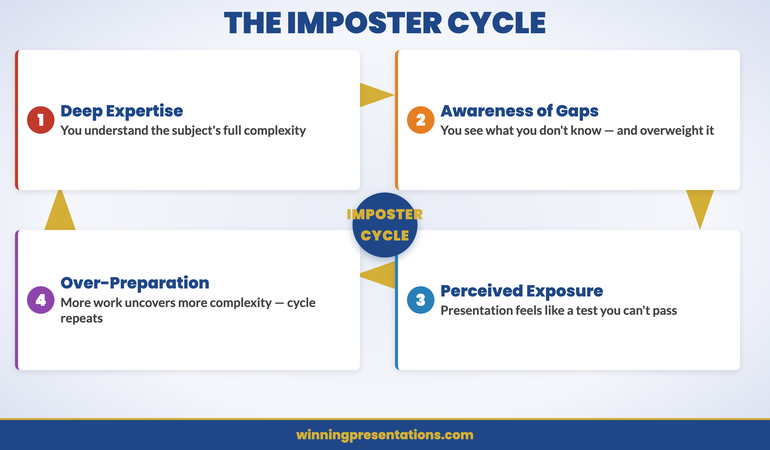
Imposter syndrome creates a paradoxical relationship with preparation. The more anxious you feel, the more you prepare. The more you prepare, the more complexity you uncover. The more complexity you uncover, the more exposed you feel. And the more exposed you feel, the more you prepare. This cycle can consume entire weekends before a Monday presentation.

The trap is that over-preparation reinforces the underlying belief. Each additional hour of work sends a signal to your brain: “This is so important and so precarious that I need to keep working.” Your nervous system interprets excessive preparation as confirmation that the threat is real. A presentation you’ve prepared for ten hours feels more dangerous than one you’ve prepared for three—not because the content is riskier, but because your behaviour has told your brain the stakes are higher.

The intervention is a preparation boundary. Set a fixed number of hours for preparation and stop when you reach it. If the content isn’t ready in that time, the issue is scope—you’re trying to cover too much—not effort. Reduce the scope rather than extending the hours. A presentation that covers three points thoroughly is more authoritative than one that covers seven points superficially. Your audience will remember your clarity, not your comprehensiveness.

The most effective preparation for imposter-syndrome-driven anxiety is rehearsal, not research. Rehearse the opening sixty seconds until it feels automatic. Rehearse transitions between sections. Rehearse the close. When you stand up to present, the first words should come without thought—because those first sixty seconds set the tone for how your brain processes the rest of the presentation. If the opening is smooth, your nervous system recalibrates: “This is going well. Reduce the alert level.” The cognitive restructuring approach offers additional techniques for interrupting the thought patterns that drive this cycle.

If your anxiety pattern includes physical symptoms alongside the imposter narrative, Conquer Speaking Fear addresses both the cognitive and physiological dimensions of presentation anxiety.

The over-preparation trap cycle showing how excessive preparation reinforces imposter syndrome in presentations

Practical Anchors for the Ten Minutes Before You Present

Imposter syndrome peaks in the ten minutes before you speak. The gap between sitting in the audience and standing at the front is where the anxiety compounds. These practical anchors are not about eliminating the feeling—they’re about preventing it from controlling your delivery.

Anchor 1: The Evidence List. Before the meeting, write three specific contributions you’ve made to the content you’re presenting. Not “I worked hard on this”—specific, verifiable contributions. “I identified the supplier risk that saved the project £180K.” “I conducted the twelve stakeholder interviews that shaped this recommendation.” “I built the financial model from the raw data.” Read the list silently. These are facts, not affirmations.

Anchor 2: The Role Clarity Statement. Remind yourself of your role in one sentence: “I am here to present the findings from the strategic review so the committee can make a decision.” This strips away the identity threat. You’re not being evaluated as a person. You’re performing a function. The function has a clear purpose. Your job is to serve that purpose, not to prove yourself.

Anchor 3: The Permission to Be Imperfect. Give yourself explicit permission to not know everything. Before you walk to the front, say internally: “If someone asks a question I can’t answer, I will say ‘I’ll follow up on that’ and the meeting will continue.” This pre-authorises the response that imposter syndrome tells you is forbidden. In practice, “I’ll follow up on that” is one of the most professional responses in any executive meeting—it signals honesty and discipline. For more on the self-compassion approach to presentation anxiety, that guide covers how reducing self-criticism before a presentation produces a measurably calmer delivery.

Break the Imposter Cycle Before Your Next Presentation

Conquer Speaking Fear gives you the cognitive and physiological frameworks to present with authority—even when your inner voice is running a different script. For £39.

Get Conquer Speaking Fear → £39

Frequently Asked Questions

Does imposter syndrome ever go away completely?

For most professionals, it doesn’t disappear—it becomes manageable. The goal isn’t to eliminate the feeling but to change your relationship with it. Experienced presenters who experience imposter syndrome learn to notice it arriving, acknowledge it as a familiar pattern rather than a truthful assessment, and proceed with the presentation regardless. Over time, the intensity diminishes because your brain accumulates evidence that the feared outcome—being exposed as a fraud—never actually materialises. Each successful presentation is a data point against the narrative.

Why does imposter syndrome seem worse in senior roles?

Seniority increases both visibility and accountability. In a junior role, a weak presentation is forgotten quickly. In a senior role, it becomes part of how colleagues assess your leadership capability. The stakes feel genuinely higher—and they are, to some degree. But imposter syndrome exaggerates the risk dramatically. A mediocre strategy review won’t end your career. An honest answer of “I’ll look into that” won’t undermine your authority. Your brain is conflating “this matters” with “this could destroy me,” and the distinction between those two is where the work lies.

Should I tell my audience that I’m nervous?

Generally, no. Your audience processes your nervousness differently than you do. What feels to you like visible anxiety often reads to the audience as focused energy. Announcing nervousness redirects the audience’s attention from your content to your emotional state—which is the opposite of what you want. The exception is if you’re in a context where vulnerability is expected and valued, such as a personal development workshop or a leadership team offsite focused on authenticity. In a standard executive presentation, keep the focus on the message and let your delivery speak for itself.

The Winning Edge

Weekly insights on executive presentations, confidence building, and boardroom communication.

Subscribe Free

If your imposter syndrome also triggers anxiety about handling questions after the presentation, our guide to defending your data in presentations covers the Q&A strategies that maintain authority under scrutiny.

About the author

Mary Beth Hazeldine, Owner & Managing Director, Winning Presentations. With 24 years of corporate banking experience at JPMorgan Chase, PwC, Royal Bank of Scotland, and Commerzbank, she advises executives across financial services, healthcare, technology, and government on structuring presentations for high-stakes funding rounds and approvals.

04 Apr 2026
Finance executive presenting a strategic cost reduction plan to the executive committee in a corporate setting, professional editorial photography

Cost Reduction Presentation: How to Frame Budget Cuts as Strategic Investment

A cost reduction presentation fails the moment the audience hears it as bad news. The executive who frames budget cuts as strategic reallocation—redirecting resources from diminishing returns to higher-yield investments—earns approval. The one who frames them as austerity earns resistance. Here is how to structure the slides that make savings feel like strategy.

Kwadwo had been asked to present a £3.2 million reduction to the operations budget at the quarterly executive committee meeting. His first draft opened with a waterfall chart showing where every pound would be removed—headcount, travel, external consultants, software licences. He rehearsed it on a Tuesday evening, and his wife—a former operations director herself—listened from the kitchen doorway. “You’ve just told twelve senior people that everything they built last year was wasteful. They’ll spend the entire meeting defending their budgets instead of approving yours.” He rewrote the presentation overnight. The new version opened with a single slide showing the three strategic priorities the CEO had announced in January, followed by a comparison: current spend allocation versus the allocation required to fund those priorities. The £3.2 million wasn’t a cut—it was a reallocation from activities that no longer served the stated strategy to investments that would accelerate it. The executive committee approved the plan in forty minutes. The original version would have triggered forty minutes of arguments.

Building a cost reduction deck for the executive committee? The Executive Slide System includes strategic reframing templates and decision frameworks for high-stakes finance presentations.

The Reallocation Frame: Why Language Determines Approval

The difference between a cost reduction presentation that earns swift approval and one that triggers prolonged debate is almost entirely a matter of framing. When you present cuts, every line item has a defender in the room. When you present reallocations, every line item has a strategic justification that the audience has already endorsed.

The reallocation frame works because it borrows authority from decisions the executive team has already made. If the CEO announced three strategic priorities at the start of the year, your savings plan should map directly to those priorities. The question shifts from “Why are you cutting my budget?” to “How does our current spend support the strategy we all agreed to?” The first question is personal and adversarial. The second is structural and collaborative.

Build your opening slide around a simple visual: two columns. The left column shows current spend by category. The right column shows the spend allocation required to fund the stated strategic priorities. The gap between the two is your savings target. This single slide does more persuasive work than any waterfall chart because it makes the cuts feel inevitable rather than arbitrary. The audience sees the misalignment and reaches the conclusion before you state it.

Avoid the trap of opening with the savings number. Leading with “We need to find £3.2 million in savings” puts the audience on the defensive immediately. Leading with “The board approved three strategic priorities in January—here’s what it costs to fund them, and here’s where we’re currently spending that money on activities that predate the strategy” creates alignment before the number appears. The savings figure should arrive as a logical consequence of strategic alignment, not as an opening demand.

Frame Your Cost Reduction as Strategic Reallocation

The Executive Slide System gives you reframing templates and decision frameworks—so your savings presentation earns approval instead of resistance.

  • ✓ Presentation templates for executive finance scenarios
  • ✓ AI prompt cards to build structured decks fast
  • ✓ Framework guides for high-stakes decision presentations

Get the Executive Slide System → £39

Designed for executives preparing high-stakes presentations

Connecting Every Saving to a Strategic Priority

The most common failure in cost reduction presentations is presenting savings by department or cost category. When you show a slide that reads “Marketing: -£400K / IT: -£600K / Operations: -£1.2M,” you’ve created three adversaries in the room. The marketing director, the CTO, and the COO are now calculating what they’ll lose, not what the organisation will gain.

The structural fix is to present savings by strategic priority, not by cost centre. Instead of “IT reduction: £600K,” present it as “Digital transformation acceleration: £600K redirected from legacy infrastructure maintenance to cloud migration.” The number is identical. The emotional response is entirely different. The CTO is no longer defending a cut—they’re participating in an investment.

For each savings line, build a three-column structure: the current spend being redirected, the strategic priority it now funds, and the expected return. This converts every line from a loss into an investment thesis. The executive committee is no longer approving cuts. They’re approving a portfolio rebalance. And portfolio rebalancing is the language of strategy, not austerity.

This approach also provides natural defence against the inevitable question: “Why this line item and not another?” When every saving is connected to a strategic priority, the answer is structural rather than political: “We redirected this spend because it was the clearest misalignment with the priorities the board approved in January.” This is a far stronger answer than “We chose this because it had the least operational impact,” which implies the decision was arbitrary and could have been made differently. For more on structuring restructuring presentations that maintain team trust, that guide covers the communication architecture for organisational change.

Strategic reallocation framework for cost reduction presentations showing current spend versus strategic priority alignment

Addressing the People Impact Without Losing the Room

If your cost reduction includes headcount changes, the room will be thinking about it from the moment you start speaking—regardless of which slide you put it on. Acknowledging the people impact early, directly, and with a clear plan is essential. Burying it in the appendix or saving it for Q&A signals avoidance, and avoidance destroys credibility in executive meetings.

The approach that works is to dedicate one slide—not more—to the people impact framework. State three things: the scope (how many roles are affected), the support plan (redeployment, retraining, enhanced severance), and the timeline (when affected individuals will be informed, by whom, and through what process). This slide should be factual, respectful, and brief. It is not the place for emotional language or corporate euphemisms. “We are reducing thirty-two roles across three departments” is direct and honest. “We are right-sizing our organisation to unlock strategic agility” is evasive and will irritate everyone in the room.

Position this slide after the strategic alignment section and before the implementation timeline. This placement matters. By the time the audience reaches the people impact slide, they’ve already accepted the strategic logic for the reallocation. The question is no longer “should we do this?” but “how do we do this responsibly?” That’s a much more constructive conversation.

If the cost reduction does not involve headcount changes, say so explicitly. A single line—“This reallocation programme does not affect any current roles”—removes the concern that has been lurking in every audience member’s mind since the meeting invitation landed. For guidance on the specific communication challenges when reductions do involve job losses, our guide to redundancy announcement presentations covers the full communication sequence from board approval to individual notifications.

The Implementation Timeline That Builds Confidence

Executive committees approve cost reductions more readily when they can see exactly how and when the savings will materialise. An implementation timeline that shows quarterly milestones—with specific savings targets at each stage—converts an abstract number into a credible delivery plan.

Structure the timeline in three phases. Phase one (months one to three): quick wins that demonstrate momentum. These are savings that require no structural change—contract renegotiations, discretionary spend freezes, duplicate licence elimination. Showing early results builds organisational confidence that the plan is achievable. Phase two (months four to six): structural changes that require planning and coordination—team reorganisations, process automation, vendor consolidation. Phase three (months seven to twelve): strategic investments that the savings fund—the initiatives that connect the cost reduction to the organisation’s growth agenda.

The three-phase structure is important because it tells a story of progression: from discipline to transformation to growth. The committee sees not just where money is being saved, but where it is going. This is the final piece of the reallocation frame. The cost reduction presentation doesn’t end with savings—it ends with investment. And investment is the language of leadership.

If you’re preparing a finance presentation that requires this kind of strategic reframing, the Executive Slide System includes the structural templates that ensure every slide advances the decision, not just the data.

Three-phase implementation timeline for cost reduction presentations showing quick wins, structural changes, and strategic investments

The Governance Slide: Tracking Savings Delivery

The final slide before Q&A should address the question every executive committee member is silently asking: “How will we know this is working?” Present a governance framework that specifies four elements: what will be measured, how often it will be reported, who owns the delivery, and what triggers escalation.

A simple tracking structure works best. Monthly reporting on savings realisation versus target, with a RAG status for each savings line. Quarterly reviews at the executive committee to assess whether the reallocation is achieving its strategic objectives—not just whether the number has been met. An escalation protocol that defines the threshold at which a shortfall triggers a revised plan rather than a request for more time.

This governance slide achieves two things. First, it demonstrates that you’ve thought beyond the approval—you’ve planned the delivery. Second, it gives the committee a reason to approve today rather than requesting further analysis. The governance framework provides the safety net that allows the committee to say yes without feeling they’ve relinquished oversight. In crisis communication contexts where the financial situation demands urgent board-level transparency, our guide to presenting a data breach to the board demonstrates similar governance framing under pressure.

Build a Cost Reduction Deck the Committee Approves Fast

Stop presenting cuts. Start presenting strategic reallocation. The Executive Slide System gives you the templates and frameworks to build savings presentations that earn approval—for £39.

Get the System Now → £39

Frequently Asked Questions

Should I present the total savings number on the first slide?

No. Leading with the savings number triggers defensive responses before you’ve established the strategic logic. Open instead with the strategic priorities the organisation has already approved, then show the misalignment between current spend and those priorities. The savings number should arrive as a natural consequence of strategic realignment—typically on the third or fourth slide. By that point, the audience has already accepted the rationale, and the number feels like a logical outcome rather than an arbitrary target.

How do I handle pushback from department heads whose budgets are being cut?

Anticipate it by engaging department heads individually before the presentation. Share the strategic framing privately and ask for their input on implementation—not on whether the cuts should happen. This converts potential adversaries into collaborators. In the meeting itself, if pushback occurs, redirect to the strategic alignment frame: “The question isn’t whether marketing should keep this budget. The question is whether this spend serves the priorities we all committed to in January.” This makes the challenge about strategy, not territory.

What if the cost reduction was mandated from above with no strategic framing?

Create the strategic frame yourself. Even a top-down directive to “reduce costs by fifteen percent” can be connected to organisational priorities. The CEO didn’t mandate the cut in a vacuum—there’s a revenue shortfall, a margin pressure, or a board directive driving it. Find that connection and build your presentation around it. If you can’t identify a strategic link, frame the savings as funding a specific initiative: “This reallocation creates the capacity to invest in [initiative] without requesting additional budget.” The committee will respond better to “we’re funding growth” than “we’re following orders.”

The Winning Edge

Weekly insights on executive presentations, slide strategy, and boardroom communication.

Subscribe Free

Preparing a savings proposal for the board? Download the Executive Slide System checklist for a quick framework to structure your cost reduction presentation.

If your cost reduction programme also involves presenting to external stakeholders or pitching for new vendor contracts, our guide to vendor selection presentations covers the deck architecture that wins final shortlist meetings.

About the author

Mary Beth Hazeldine, Owner & Managing Director, Winning Presentations. With 24 years of corporate banking experience at JPMorgan Chase, PwC, Royal Bank of Scotland, and Commerzbank, she advises executives across financial services, healthcare, technology, and government on structuring presentations for high-stakes funding rounds and approvals.
04 Apr 2026
Executive presenting a vendor selection pitch to a procurement committee in a modern glass boardroom, professional corporate photography

Vendor Selection Presentation: How to Win the Final Shortlist Meeting

A vendor selection presentation is not a product demonstration. It is a risk-reduction exercise for the buying committee. The team that wins the final shortlist meeting is rarely the one with the most features or the lowest price—it is the one that makes the decision feel safe. Here is how to structure your slides so the room chooses you with confidence.

Chiara had been through six months of relationship building, two discovery workshops, and a pilot programme that generated measurable results. Her company was one of three vendors on the final shortlist for a £2.8 million enterprise contract. She walked into the selection meeting with a forty-slide deck that recapped every feature, every integration point, every case study. The procurement lead stopped her at slide twelve. “We’ve seen the capabilities. What we need to understand is what happens in month three when our legacy system migration stalls and your implementation team is stretched across four other clients.” Chiara didn’t have a slide for that. She improvised an answer—competent but generic. The contract went to a competitor whose entire presentation had been built around three questions: what could go wrong, what would they do about it, and who specifically would be responsible. Chiara’s deck had been a capability showcase. The winner’s deck had been a risk mitigation plan. She never made the same mistake again.

Preparing for a vendor selection meeting? The Executive Slide System includes decision-focused templates and frameworks designed for high-stakes client presentations.

Why Buying Committees Choose Safety Over Capability

Every vendor on the final shortlist can do the job. That is why they are on the shortlist. By the time the selection committee sits down for the final vendor selection presentation, capability differentiation has already been assessed through RFP responses, reference calls, and pilot results. The committee is no longer asking “can they do it?” They are asking “what happens if it goes wrong?”

This shift matters because it changes the purpose of your presentation entirely. A capability presentation says: “Here is what we can do for you.” A risk-reduction presentation says: “Here is what we will do when things don’t go to plan.” The first invites comparison. The second invites trust. And trust is the currency that decides final shortlist meetings.

Buying committees are composed of people who will be held accountable for the decision. The IT director who champions a vendor that fails will carry that failure for years. The procurement lead who approves a contract that overruns will face scrutiny at every quarterly review. These individuals are not optimising for the best possible outcome. They are optimising for the least painful failure. Your presentation must speak to that psychology.

The structural implication is straightforward: lead with risk, not with capability. Show the committee that you have anticipated what could go wrong, that you have specific plans for each scenario, and that named individuals on your team are accountable for delivery. This reframes your vendor selection presentation from a sales pitch into a governance conversation—and governance conversations are where procurement committees feel most comfortable making decisions.

Structure Your Vendor Pitch for Decision-Ready Clarity

The Executive Slide System gives you presentation templates and decision frameworks—so your shortlist meeting earns approval by addressing risk before the committee raises it.

  • ✓ Presentation templates for executive and client scenarios
  • ✓ AI prompt cards to build structured decks fast
  • ✓ Framework guides for high-stakes decision presentations

Get the Executive Slide System → £39

Designed for executives preparing high-stakes presentations

The Three-Slide Framework That Wins Final Shortlists

The most effective vendor selection presentations can be distilled to three core slides that address the committee’s actual decision criteria. Everything else—features, architecture, pricing detail—is supporting material for Q&A.

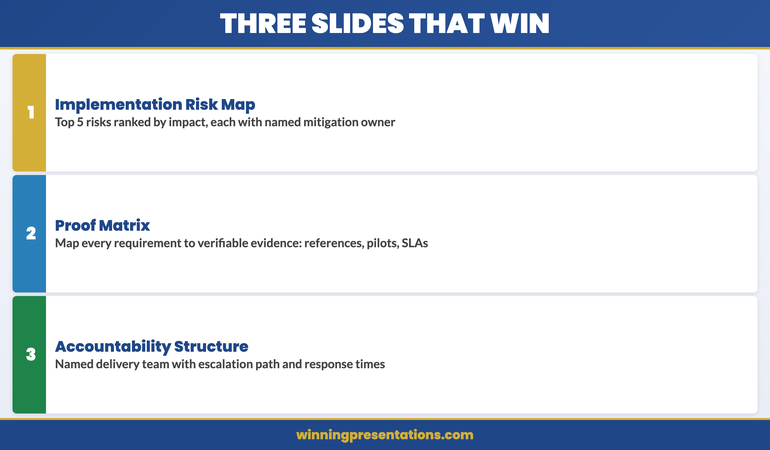
Slide 1: The Implementation Risk Map. List the five most likely risks to successful delivery, ranked by probability and impact. For each risk, provide a specific mitigation with a named owner from your team. This slide does more than demonstrate preparedness. It tells the committee you have done this before—because only experienced teams know which risks actually materialise. Generic risk statements like “timeline overrun” signal inexperience. Specific risks like “data migration from legacy ERP systems typically encounters schema mismatches in the first two weeks” signal expertise.

Slide 2: The Proof Matrix. Map each of the committee’s stated requirements to a specific piece of evidence: a reference client, a pilot result, a benchmark metric, or a contractual commitment. The key word is “specific.” Claiming you have “extensive experience in financial services” is a feature. Stating that “Zurich Financial completed their implementation in fourteen weeks against a sixteen-week target, with the project lead available as a reference” is proof. The proof matrix converts assertions into verifiable claims.

Slide 3: The Accountability Structure. Show who will be responsible for delivery. Not a generic organisational chart—a specific team structure with named individuals, their relevant experience, and their availability commitment. Include the escalation path: who the client calls when something goes wrong, and the guaranteed response time. This slide answers the committee’s most important unspoken question: “When this gets difficult, who will actually fix it?” For more on structuring your pipeline review presentations, that guide covers how sales leaders can track and present deal progress systematically.

Three-slide framework for winning vendor selection presentations showing risk map, proof matrix, and accountability structure

Building a Proof Architecture That Survives Scrutiny

Claims without evidence are noise in a vendor selection meeting. Procurement committees are trained to discount assertions and weigh verifiable proof. Your presentation needs a deliberate proof architecture—a systematic approach to backing every significant claim with evidence the committee can independently verify.

The hierarchy of proof in procurement is consistent across industries. Contractual commitments carry the most weight—service level agreements, penalty clauses, and performance guarantees that create financial accountability. Reference calls rank second—direct conversations with comparable clients who can describe their actual experience. Pilot results rank third—measurable outcomes from work you have already done for this specific client. Case studies and credentials rank lowest—useful for context but insufficient for decision-making.

Structure your evidence accordingly. For every critical requirement, present the highest-ranking proof available. If you can offer a contractual guarantee, lead with it. If your strongest evidence is a reference client, prepare that client for a follow-up call and state this explicitly in the presentation: “Our reference contact at [company] is available this week for a direct conversation.” Offering the committee immediate access to verification demonstrates confidence. Promising to “arrange references after the meeting” signals that you are still preparing your case.

The proof architecture also protects you from the most common selection meeting trap: the hypothetical scenario. Committees will test vendors with questions like “What would you do if our data migration took three times longer than planned?” A proof-based response references a specific instance where you managed a similar challenge: “When we implemented at [comparable client], the initial data migration estimate was twelve weeks. Actual migration took nineteen weeks due to legacy schema complexity. Here’s how we managed the overrun without impacting the go-live date.” Hypothetical answers lose to historical proof every time.

Presenting Through the Procurement Lens

The procurement representative in a vendor selection meeting has different priorities from the business sponsor. The sponsor cares about capability and outcomes. Procurement cares about contract risk, total cost of ownership, and vendor stability. Your vendor selection presentation must satisfy both audiences simultaneously, and the structure must make it obvious that you understand what procurement values.

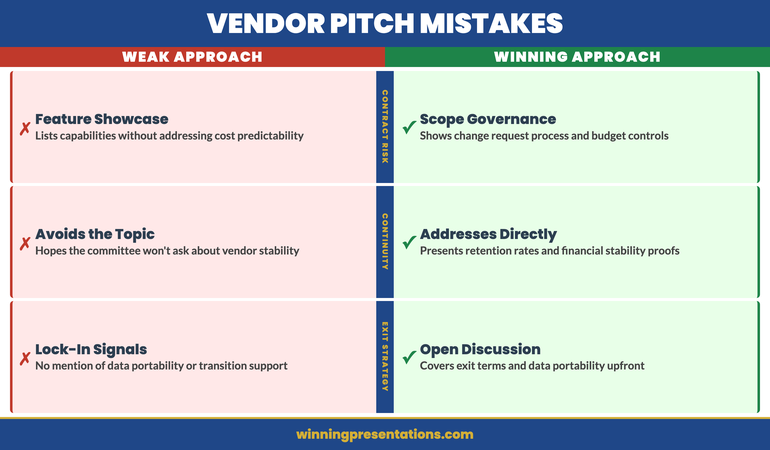
Three procurement priorities shape every shortlist decision. First, contract predictability: will the total cost match the proposal? Procurement teams are evaluated on budget adherence, not on the quality of the vendor they select. Address this by including a slide on scope governance—how you manage change requests, how you price out-of-scope work, and how you prevent the “scope creep to budget overrun” pattern that procurement has seen repeatedly from other vendors.

Second, vendor continuity: will your organisation still exist and still care about this client in three years? For established companies, this is straightforward—reference your tenure and client retention rates. For smaller firms, address it directly: explain your financial stability, your growth trajectory, and the contractual protections you offer for business continuity. Avoiding this topic does not make it disappear. It simply means the committee will discuss it after you leave the room, without your input.

Third, exit strategy: what happens if the relationship needs to end? Procurement professionals always want to know the exit terms before they sign. Include a brief slide on data portability, transition support, and contract termination terms. This may feel counterintuitive—discussing the end of the relationship before it begins—but it signals maturity and reduces the committee’s perception of lock-in risk. The vendor who openly discusses exit terms appears confident. The vendor who avoids the topic appears dependent. For more on handling client escalation presentations, that guide covers the communication approach when existing relationships face pressure.

If you’re structuring a vendor deck for the first time, the Executive Slide System provides the structural templates that ensure every slide addresses a decision criterion, not just a feature.

Procurement priorities in vendor selection presentations showing contract predictability, vendor continuity, and exit strategy

Closing the Decision Without Closing the Sale

The final minutes of a vendor selection presentation determine whether the committee leaves the room ready to decide or ready to deliberate further. Deliberation is not your friend. Every additional week of deliberation introduces new variables—budget freezes, stakeholder changes, competitor counter-offers—that reduce your probability of winning. Your closing must create the conditions for an immediate decision.

Do not ask for the business. The committee knows you want the contract. A closing that says “We’d love to work with you” adds no information and sounds like every other vendor. Instead, close with a decision architecture. Present the committee with a clear next step that is easy to say yes to: “We propose a two-week contract review period, with our legal team available for mark-up sessions starting Monday. If the committee is aligned on vendor selection today, we can have a signed agreement within three weeks.”

This framing works because it removes the committee’s biggest friction point: the gap between “we’ve decided” and “we’ve signed.” By presenting a specific, time-bounded implementation pathway, you convert the decision from abstract to concrete. The committee is no longer voting on whether they like your company. They are agreeing to a specific next step with a defined timeline.

End with a single summary slide that restates three things only: the business outcome you will deliver, the named person who will be accountable, and the proposed timeline to value. No feature recaps, no benefit lists, no “why us” statements. The summary exists to give the committee a clear, simple framework for their deliberation. When the chair turns to the room after you leave and asks “What do we think?”—your summary slide should be the frame through which they discuss their decision. If it is clear enough, they’ll use your language. And when a committee uses your language to discuss the decision, you have already won. For guidance on structuring the contract renewal presentation that follows a successful vendor selection, that guide covers the annual review framework that retains long-term clients.

Win the Shortlist Meeting With a Decision-Ready Deck

Stop presenting features. Start presenting risk mitigation. The Executive Slide System gives you the templates and frameworks to build vendor presentations that close—for £39.

Get the System Now → £39

Frequently Asked Questions

How long should a vendor selection presentation be?

The core presentation should be fifteen to twenty minutes, leaving forty to fifty minutes for committee questions. Most selection meetings are scheduled for sixty to ninety minutes. The committee has already reviewed your written proposal—they do not need a comprehensive recap. A shorter presentation signals confidence and leaves more time for the governance-style Q&A where decisions actually form. Aim for ten to twelve slides: three core slides (risk map, proof matrix, accountability structure), supported by a brief context opener, a financial summary, and a decision-close slide.

Should I address competitor weaknesses in a vendor presentation?

Never directly. Committees view negative selling as a sign of insecurity. Instead, address competitor weaknesses indirectly by strengthening your own proof in the areas where competitors are weak. If you know a competitor lacks implementation capacity, emphasise your named delivery team and their availability. If a competitor has no comparable reference clients, lead with your proof matrix showing specific, verifiable references. The committee will draw the comparison themselves—and a conclusion they reach independently is far more persuasive than one you hand them.

What is the biggest mistake vendors make in final shortlist presentations?

Presenting the same deck they used for the initial pitch. The audience, the context, and the decision criteria have all evolved since the first meeting. The initial pitch was about establishing capability and generating interest. The final shortlist meeting is about reducing risk and facilitating a decision. Vendors who recycle their pitch deck force the committee to do the translation work—mapping features to risks, promises to proof, and enthusiasm to accountability. The vendor who builds a presentation specifically for the selection committee’s decision framework demonstrates that they understand the buying process, not just the product.

The Winning Edge

Weekly insights on executive presentations, slide strategy, and boardroom communication.

Subscribe Free

Building a vendor pitch deck? Download the Executive Slide System checklist for a quick framework to structure your next shortlist presentation.

If your vendor relationship also requires managing internal cost pressures, our guide to cost reduction presentations covers the slide architecture that frames budget cuts as strategic investment.

About the author

Mary Beth Hazeldine, Owner & Managing Director, Winning Presentations. With 24 years of corporate banking experience at JPMorgan Chase, PwC, Royal Bank of Scotland, and Commerzbank, she advises executives across financial services, healthcare, technology, and government on structuring presentations for high-stakes funding rounds and approvals.
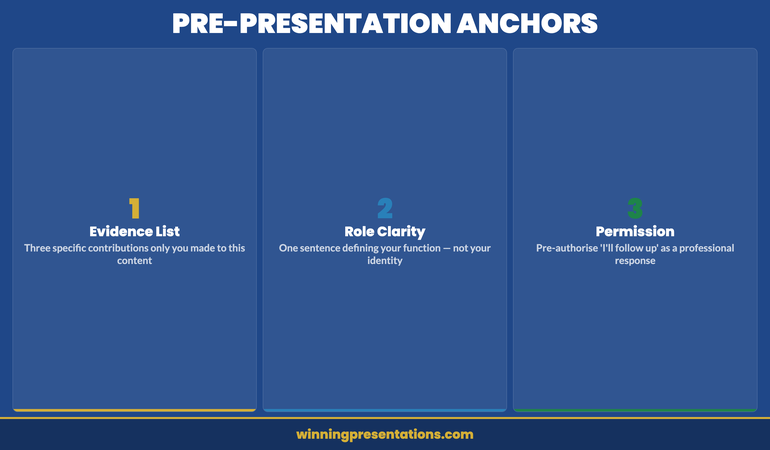
03 Apr 2026
Executive presenter confidently responding to a question from a senior colleague during a boardroom presentation

Off-Topic Questions in Presentations: How to Redirect Without Losing the Room

Off-topic questions in presentations are rarely accidental. They signal that someone in the room has an agenda that doesn’t align with yours, a concern that your presentation hasn’t addressed, or a need to demonstrate their own knowledge. How you redirect determines whether the room stays with you or fractures into competing conversations. Here’s how to handle it with authority and respect.

Soren was presenting a supply chain resilience update to the operations committee when the CFO interrupted with a question about headcount reductions in the logistics team. It had nothing to do with supply chain resilience—it was a budget question that belonged in the financial review the following week. But Soren had been in enough of these meetings to understand what was really happening. The CFO wasn’t confused about the agenda. He was signalling to the committee that cost management was his priority, regardless of the topic on the table. Soren had a choice: answer the headcount question and lose fifteen minutes of his allocated time, or dismiss it and create an adversary. He did neither. “That’s an important question, and I want to give it the detail it deserves,” he said. “The headcount numbers sit within the broader workforce planning paper for next week’s financial review. I’ll make sure you have the breakdown before that meeting. Can I continue with the resilience framework for the remaining time?” The CFO nodded. Soren kept the room. Crucially, he followed up the next morning with the headcount data. The CFO never interrupted him again.

Want a structured approach to handling difficult Q&A? The Executive Q&A Handling System includes frameworks for redirecting, bridging, and managing challenging questions in high-stakes meetings.

Why Off-Topic Questions Happen: The Four Hidden Motives

Understanding why someone asks an off-topic question changes how you respond. Most presenters treat off-topic questions as confusion—the asker didn’t understand the scope, didn’t read the agenda, or simply drifted. That’s occasionally true. More often, off-topic questions are strategic, and recognising the strategy allows you to respond with precision rather than frustration.

Motive 1: Territory marking. The asker wants to signal their own priority to the room. The CFO’s headcount question in Soren’s meeting wasn’t about headcount—it was about asserting that financial discipline is never off the table. Responding to the content of the question misses the real communication. Acknowledging the importance of the topic whilst redirecting to the appropriate forum addresses the motive without derailing your presentation.

Motive 2: Genuine concern that your presentation hasn’t addressed. Sometimes the off-topic question is a signal that your scope was too narrow for the audience. If three people in the room are worried about budget implications and your presentation only covers operational metrics, the “off-topic” budget question is actually the most important question in the room. Recognise this and adapt. “I can see the cost dimension is important to this group. Let me address that briefly before continuing.”

Motive 3: Status assertion. Some stakeholders ask off-topic questions to demonstrate their breadth of knowledge or their seniority. The question is not seeking information—it’s seeking acknowledgement. The response that works here is brief validation followed by a redirect: “You’re raising an important point about regulatory implications. That’s being addressed separately by the compliance team. Let me continue with the operational framework.”

Motive 4: Deliberate disruption. Occasionally, a stakeholder uses off-topic questions to derail a presentation they oppose. This is the most difficult motive to address because responding to each question consumes time, which is exactly the disruptor’s objective. The technique here is pattern recognition: after the second off-topic question from the same person, name the pattern gently. “I notice we’re pulling into several areas outside today’s scope. Can I suggest we complete the resilience framework first, then open the floor for broader discussion?”

Handle Every Q&A Scenario With Confidence

The Executive Q&A Handling System gives you frameworks for redirecting off-topic questions, bridging to your key messages, and managing challenging Q&A dynamics in high-stakes meetings.

  • ✓ Question redirection and bridging frameworks
  • ✓ Scenario guides for difficult Q&A situations
  • ✓ Preparation templates for anticipating challenging questions

Get the Q&A Handling System → £39

Designed for executives who face challenging Q&A sessions

The Acknowledge-Redirect Framework

The most effective technique for handling off-topic questions in presentations is the three-step Acknowledge-Redirect-Return framework. It takes ten to fifteen seconds when executed well, and it accomplishes three objectives simultaneously: it respects the asker, it protects your time, and it keeps the room focused.

Step 1: Acknowledge. Validate the question’s importance without engaging with its content. “That’s an important area.” “I can see why that’s on your mind.” “Good question—it connects to a broader issue.” The acknowledgement must be genuine, not dismissive. A perfunctory “good question” followed by an immediate redirect reads as patronising. Take half a second to make eye contact with the asker and ensure your tone conveys respect.

Step 2: Redirect. Name where and when the question will be addressed. Not “we’ll get to that later” (vague and often untrue) but “that sits within the workforce planning review next Thursday” or “I’d like to address that with you directly after the meeting, because it deserves more time than I can give it here.” Specificity is the difference between a redirect that satisfies and one that frustrates.

Step 3: Return. Explicitly bring the room back to your presentation. “Let me continue with the third element of the resilience framework.” Use a transitional phrase that reconnects to where you were, not where the question took you. This signals to the entire room that the presentation has a structure and that structure is being protected.

Soren’s response to the CFO followed this framework precisely. He acknowledged the importance (“That’s an important question”), redirected to a specific forum (“the financial review next week”), offered a concrete follow-up action (“I’ll make sure you have the breakdown”), and returned to his topic (“Can I continue with the resilience framework?”). The whole exchange took twenty seconds. For more on the bridging technique that underpins this framework, our guide on the bridging technique for difficult questions covers the full methodology.

The Acknowledge-Redirect-Return framework for handling off-topic questions in three clear steps

The Parking Lot Technique: When and How to Use It

The “parking lot” is a well-known facilitation technique: capture off-topic questions on a visible list (a whiteboard, a shared document, a slide) and commit to addressing them at a specific time. It works in workshop and training settings. It can also work in executive presentations, with modifications.

In executive settings, a literal parking lot list can feel patronising—senior leaders don’t appreciate seeing their questions written on a board to be dealt with later. The modification is to use a verbal parking lot: acknowledge the question, state that you’re noting it for the post-meeting follow-up, and then actually follow up. The “noting it” must be visible—write it down in your own notes so the asker sees the physical act of recording. This transforms the parking lot from a dismissal into a commitment.

When to use the parking lot: when the off-topic question is genuinely important but would consume more than two minutes of your allocated time. When not to use it: when the question is from the most senior person in the room (they expect an immediate response, even if brief), or when the question reveals a fundamental concern about your proposal that the room needs to hear addressed. Parking lot the former and you’ve protected your time. Parking lot the latter and you’ve avoided a conversation the room was ready to have.

The critical discipline is follow-through. If you park a question and never return to it, you’ve taught the room that the parking lot is where questions go to die. Send a follow-up email within 24 hours addressing every parked question in detail. This builds a reputation as someone who respects questions enough to answer them properly, even when the meeting didn’t allow time.

When the Off-Topic Question Comes From Someone Senior

Redirecting a peer is straightforward. Redirecting your CEO, your board chair, or your most important client requires a different calibration. Senior stakeholders operate with an implicit understanding that their questions take priority, regardless of the agenda. Dismissing their off-topic question—even politely—can be interpreted as poor political judgement.

The technique here is the “brief answer plus redirect.” Give a concise, thirty-second response to the substance of the question, then redirect to the appropriate depth. “The short answer is that headcount is flat year-on-year, with a reallocation of three roles from warehouse to analytics. The detailed breakdown is in next week’s workforce paper, and I’ll send you the summary tonight. Shall I continue with the resilience metrics?” You’ve answered the question, demonstrated knowledge, committed to follow-up, and asked permission to continue. The senior stakeholder feels heard. The room stays on track.

What you must never do is ignore the political dimension. If the CEO asks about headcount during your supply chain presentation, the correct response is not “that’s off-topic.” It’s politically astute to treat the CEO’s question as worthy of a brief answer, even if it technically doesn’t belong. The room is watching how you handle the power dynamic, not just how you handle the content. Handle it well and you build credibility. Handle it badly—either by capitulating entirely or by being dismissively efficient—and you lose political capital regardless of how good your presentation is.

Our guide on handling all-hands Q&A ambush scenarios covers the additional complexity of managing off-topic questions in large-audience settings, where senior stakeholders may use questions to make statements rather than seek answers.

For a complete library of Q&A handling frameworks—including redirection, bridging, and managing senior stakeholder dynamics—the Executive Q&A Handling System provides the structured approach that turns difficult Q&A sessions into opportunities to demonstrate executive judgement.

The Follow-Up That Prevents Repeat Offenders

The most overlooked element of handling off-topic questions in presentations is what happens after the meeting. Most presenters redirect the question, finish the presentation, and move on. The asker is left with an unresolved question and a memory of being redirected. Next meeting, they ask again—often more insistently.

Soren’s follow-up the next morning was the decisive action. By sending the CFO the headcount breakdown before the financial review, he accomplished three things. First, he honoured his commitment—which builds trust. Second, he provided the information in a format the CFO could review at his own pace—which is more useful than a rushed verbal answer in the wrong meeting. Third, he demonstrated that he takes the CFO’s priorities seriously—which transformed a potential adversary into a neutral participant.

Build a follow-up discipline: within 24 hours of any meeting where you redirect a question, send a targeted response to the person who asked it. Not a mass email to all attendees—a direct message to the individual. “Following up on your question about headcount during yesterday’s resilience review—here’s the breakdown.” This personal attention costs five minutes and prevents the question from resurfacing in your next three meetings.

For persistent off-topic questioners—people who consistently raise the same tangential concerns—a pre-meeting conversation is the structural fix. “I know workforce planning is a priority for you. I’m covering resilience metrics tomorrow. Would it be helpful if I included a one-slide summary of how workforce changes affect resilience, so we address both in one session?” This transforms the off-topic question into an on-topic element, satisfying the asker’s need without disrupting the flow. Our guide on trick questions in presentations covers the related skill of recognising when a question is testing your credibility rather than seeking information.

Master the Q&A That Makes or Breaks Your Presentation

Off-topic questions, hostile challenges, and senior stakeholder dynamics—the Executive Q&A Handling System gives you the frameworks for every scenario, for £39.

Get the System Now → £39

FAQ: Off-Topic Questions in Presentations

What if the off-topic question is actually more important than my presentation topic?

This happens more often than presenters acknowledge. If the room visibly engages with the off-topic question—heads nodding, other people adding to it—the room is telling you what matters to them right now. In this situation, rigid adherence to your agenda is counterproductive. Acknowledge the shift: “It’s clear this is the priority for this group right now. Let me address it directly, and we can return to the resilience framework in the remaining time or schedule a follow-up session.” Adapting to the room’s energy is a leadership skill, not a presentation failure.

How do I redirect without sounding dismissive?

Tone and specificity are the two factors. A dismissive redirect sounds like: “That’s not what we’re covering today.” A respectful redirect sounds like: “That’s an important area—the compliance team is working on that and I know they’re presenting next week. I’ll make sure your question is flagged for their session. Can I continue with the third element?” The difference is validation (important area), a specific alternative forum (compliance team, next week), a concrete action (I’ll flag it), and a request rather than a command (Can I continue?). All four elements together prevent the perception of dismissal.

Should I set ground rules about questions at the start of my presentation?

In workshop or training settings, yes—ground rules are appropriate. In executive meetings, explicit ground rules about questions can sound controlling and may undermine your credibility with senior participants. A better approach is to set implicit expectations through your introduction: “I’ll cover the resilience framework in three sections over the next twenty minutes, and I’d welcome questions on each section as we go.” This implicitly defines the scope without restricting anyone. If someone goes off-topic despite this framing, the Acknowledge-Redirect framework handles it. The introduction simply makes your redirect more natural: “That’s outside the resilience scope I outlined, but I’ll follow up directly.”

The Winning Edge

Weekly insights on executive presentations, Q&A strategy, and boardroom communication.

Subscribe Free

If you’re also managing the physical anxiety that off-topic questions can trigger, our guide to grounding techniques for presentation anxiety covers the sensory anchoring methods that keep you composed when the unexpected arrives.

About the author

Mary Beth Hazeldine, Owner & Managing Director, Winning Presentations. With 24 years of corporate banking experience at JPMorgan Chase, PwC, Royal Bank of Scotland, and Commerzbank, she advises executives across financial services, healthcare, technology, and government on structuring presentations for high-stakes funding rounds and approvals.

03 Apr 2026
Professional woman standing calmly in a corporate corridor, eyes closed, practising grounding before a presentation with a conference room visible in the background

Grounding Techniques for Presentation Anxiety: How to Anchor Yourself Before You Speak

Grounding techniques work for presentation anxiety because they interrupt the physiological cascade that makes speaking feel dangerous. Your nervous system cannot simultaneously process a threat response and a deliberate sensory focus. That neurological fact is what makes grounding practical, not theoretical—and why it works in the final minutes before you step up to present.

Nalini was standing in the corridor outside the executive conference room, waiting for her slot in the quarterly review. She’d presented to this group before—twelve times, in fact—and each time the anxiety arrived with identical precision: racing heartbeat at the fifteen-minute mark, shallow breathing at ten minutes, and a dissociative fog at five minutes that made her notes look like a foreign language. She’d tried deep breathing. She’d tried positive self-talk. Neither penetrated the fog. That morning, before leaving home, she’d read about a sensory grounding technique: name five things you can see, four you can touch, three you can hear. Standing in that corridor, she tried it. Blue carpet. Fire extinguisher. Her colleague’s navy jacket. The exit sign. A crack in the ceiling tile. She pressed her fingertips against the cool wall. Rubbed the edge of her notebook. Touched the fabric of her jacket sleeve. Felt the weight of her shoes on the floor. She heard the air conditioning. A door closing down the hall. Someone’s phone vibrating. By the time the door opened, the fog had lifted. Her heart was still beating fast, but she could read her notes. She walked in and delivered the presentation—not perfectly, but clearly. The difference was that she’d given her nervous system something to do other than panic.

Struggling with pre-presentation anxiety? Conquer Speaking Fear includes a structured anxiety management framework with grounding, breathing, and cognitive techniques designed specifically for executives who present under pressure.

Why Grounding Works When Deep Breathing Alone Doesn’t

Deep breathing is the default advice for presentation anxiety, and it helps many people—but not everyone. The reason is neurological. When the sympathetic nervous system is fully activated—the fight-or-flight response that makes your heart race and your palms sweat—the prefrontal cortex (responsible for rational thought and voluntary breath control) has reduced influence. Telling someone in acute anxiety to “breathe deeply” is like telling someone mid-panic to “calm down.” The instruction requires the very cognitive control that anxiety has compromised.

Grounding techniques take a different route. Instead of trying to override the nervous system through conscious breath control, they engage the sensory cortex—the brain regions that process what you see, hear, touch, and smell. These regions remain active even during acute anxiety because they process incoming sensory data automatically. By deliberately directing attention to sensory input, you’re using a neurological pathway that anxiety hasn’t shut down. The effect is a reduction in the intensity of the threat response, not through willpower, but through sensory competition.

This is why grounding techniques for presentation anxiety are particularly effective in the acute phase—the last ten to fifteen minutes before you speak, when anxiety typically peaks. At this point, cognitive strategies (positive affirmations, logical reframing, content review) often fail because the cognitive system is overwhelmed. Sensory grounding bypasses the overwhelmed system entirely.

It’s also worth noting that grounding doesn’t eliminate anxiety. It reduces it to a manageable level—from the paralysing fog Nalini described to the elevated alertness that actually improves performance. The goal is not calm. The goal is functional arousal: enough activation to be sharp and present, without enough to impair speech, memory, or cognitive flexibility.

Take Control of Presentation Anxiety Before It Controls You

Conquer Speaking Fear gives you a structured anxiety management framework—grounding protocols, breathing techniques, and cognitive reframing tools designed specifically for executives who present under pressure.

  • ✓ Pre-presentation anxiety management protocols
  • ✓ Nervous system regulation techniques for speakers
  • ✓ Cognitive reframing frameworks for high-stakes situations

Get Conquer Speaking Fear → £39

Designed for professionals who present under pressure

The Five-Senses Method: A Complete Pre-Presentation Protocol

The 5-4-3-2-1 technique is the most widely used grounding method in clinical anxiety management, and it translates directly to the pre-presentation context. The protocol takes three to five minutes and can be done silently, standing in a corridor, sitting at a conference table, or waiting in a virtual meeting lobby.

Five things you can see. Name them silently and specifically. Not “the room” but “the silver pen on the table.” Specificity forces the visual cortex to engage actively rather than passively. Four things you can physically feel. The texture of your jacket. The pressure of your feet on the floor. The temperature of the air on your skin. The weight of your watch. Three things you can hear. Background noise you’d normally filter out—air conditioning, a distant conversation, traffic. Two things you can smell. Coffee. The leather of your notebook. Your own perfume or aftershave. One thing you can taste. The mint you had earlier. The residual flavour of your morning tea.

The sequence matters because it progresses from the easiest sensory channel (vision, which requires no physical action) to the hardest (taste, which requires deliberate attention to a subtle sensation). By the time you reach the final sense, your attention has been fully redirected from internal anxiety to external reality. The fog lifts—not because the anxiety is gone, but because your sensory cortex is now processing real data instead of imagined threats.

If you’re interested in complementary techniques, our guide on the body scan technique for presentation reset covers a longer protocol that works well when you have fifteen to twenty minutes before presenting. The five-senses method is the rapid-deployment version for when you have five minutes or less.

The 5-4-3-2-1 grounding technique protocol for pre-presentation anxiety showing sensory countdown

Physical Anchors You Can Use in the Room Without Anyone Noticing

The five-senses method works best in private—standing in a corridor, sitting alone before others arrive. But anxiety doesn’t always cooperate with your schedule. Sometimes it spikes mid-meeting, during the presenter before you, or whilst you’re being introduced. You need grounding techniques that work invisibly, in full view of your audience.

Feet on the floor. Press both feet flat against the floor with deliberate pressure. Feel the weight of your body transferring through your legs into the ground. This activates proprioceptive feedback—your body’s awareness of its own position in space—which counteracts the dissociative “floating” sensation that anxiety produces. Nobody can see you doing this. It works whether you’re standing at a lectern or sitting at a table.

Fingertip contact. Press your thumb firmly against your index finger, or press all five fingertips against the table surface. The tactile feedback creates a physical anchor point that your attention can return to whenever anxiety pulls you towards catastrophic thinking. Some executives use a small object—a smooth stone, a pen cap, a ring they rotate—as a consistent physical anchor across multiple presentations.

Temperature shift. Hold a glass of cold water in both hands for ten to fifteen seconds. The temperature change activates the vagus nerve—the primary pathway between your brain and your gut—which triggers a parasympathetic response (the “rest and digest” system that counteracts fight-or-flight). This is why a sip of water before speaking helps more than hydration alone would explain. The cold sensation is doing neurological work.

These micro-techniques can be combined. Press your feet into the floor whilst holding cold water. Touch a physical anchor object whilst listening to the ambient sounds in the room. The more sensory channels you engage simultaneously, the stronger the grounding effect. The research on box breathing for executive presentations shows how breathing and physical grounding work together to regulate the nervous system more effectively than either technique alone.

When to Ground: The Three Critical Windows Before You Present

Timing matters. Grounding at the wrong moment is less effective than grounding at the right one. Presentation anxiety follows a predictable curve, and there are three windows where intervention has the greatest impact.

Window 1: The morning of the presentation (60–120 minutes before). This is when anticipatory anxiety begins—the “I have to present today” awareness that colours your entire morning. A full body scan or extended grounding session (ten to fifteen minutes) during this window reduces the baseline anxiety level, so the peak is lower when it arrives. Think of this as lowering the starting point of the anxiety curve.

Window 2: The transition period (10–20 minutes before). This is when you’re physically moving towards the presentation space—walking to the meeting room, logging into the virtual platform, arriving at the venue. Anxiety accelerates during transitions because your body is moving towards the perceived threat. The five-senses method works powerfully here because you’re in a transitional environment with abundant sensory input to anchor to.

Window 3: The final sixty seconds. This is the acute peak. You’re about to be introduced, or you’re about to unmute your microphone, or you’re about to stand up. At this point, complex techniques fail. You need a single-move anchor: feet pressed into the floor, one deep breath through the nose, and a deliberate focus on the first sentence of your presentation. Not the whole presentation—just the first sentence. Narrowing your cognitive focus to one sentence prevents the overwhelm that comes from contemplating the entire performance ahead.

Nalini’s breakthrough came from using all three windows. She did a body scan before leaving home (Window 1), used the five-senses method in the corridor (Window 2), and pressed her feet into the floor as the door opened (Window 3). No single technique was transformative. The combination across three windows was.

For executives who want a complete anxiety management protocol they can practise and refine, Conquer Speaking Fear provides the full framework—grounding, breathing, cognitive reframing, and in-the-moment recovery techniques—in a structured programme designed for professionals who present regularly.

Three critical grounding windows before a presentation showing timing and techniques

Combining Grounding With Breathing and Cognitive Reframing

Grounding is most powerful when combined with two complementary techniques: controlled breathing and cognitive reframing. Think of these as three systems working together. Grounding manages the sensory system. Breathing manages the autonomic nervous system. Cognitive reframing manages the narrative system—the story your mind tells about what’s about to happen.

A practical combined protocol for the ten minutes before a presentation: Begin with two minutes of sensory grounding (the five-senses method). Then shift to two minutes of controlled breathing—inhale for four counts, hold for four, exhale for six (the extended exhale activates the parasympathetic response). Then spend one minute on a single cognitive reframe: replace “I’m about to be judged” with “I’m about to share information that helps these people make a decision.” This reframe shifts the narrative from performance evaluation to professional service, which reduces the perceived social threat.

The sequence matters. Grounding first, because it reduces the physiological intensity enough for breathing to work. Breathing second, because it further calms the autonomic system and restores prefrontal cortex function. Cognitive reframing last, because it requires the prefrontal cortex to be online—which the first two steps have enabled. Attempting cognitive reframing when the nervous system is fully activated is why positive affirmations often feel hollow during acute anxiety. The brain knows you’re lying to it. After grounding and breathing, the reframe feels plausible because the threat level has genuinely decreased.

Self-compassion is also a useful complement to grounding. Our guide on self-compassion and presentation anxiety covers the research showing that treating yourself with kindness during anxious moments reduces cortisol more effectively than self-criticism or forced confidence. Combined with grounding, it creates an internal environment where your nervous system can settle rather than escalate.

Stop Fighting Your Anxiety. Start Managing It.

Grounding, breathing, and cognitive reframing work best as a structured system. Conquer Speaking Fear gives you the complete framework—practised by executives who present under pressure every week—for £39.

Get the Programme Now → £39

FAQ: Grounding Techniques for Presentation Anxiety

How long do grounding techniques take to work?

The five-senses method typically reduces acute anxiety intensity within three to five minutes. Physical anchoring techniques (feet on the floor, fingertip pressure) can produce a noticeable shift within thirty to sixty seconds. The speed depends on how activated your nervous system is when you begin—the earlier you start, the faster the response. Grounding doesn’t need to eliminate anxiety completely; even a partial reduction is enough to restore functional cognitive capacity for presenting.

Can grounding help during a presentation, not just before it?

Yes. Physical anchoring techniques—pressing feet into the floor, touching a pen or table edge, feeling the weight of your body in the chair—work during the presentation itself. The key is that they require no visible action. You can ground silently whilst maintaining eye contact and speaking. If you feel anxiety spiking mid-presentation, take a deliberate sip of water (activating temperature-based grounding) and press your feet into the floor. These two actions together take three seconds and can reset your nervous system enough to continue.

Do grounding techniques work for virtual presentations too?

They work equally well, though the sensory inputs differ. For virtual presentations, ground to your physical environment: the texture of your desk, the temperature of the room, the feel of your keyboard, the sounds in your home. You can also use the additional advantage of having your lower body completely invisible—press both feet flat, grip the edge of your desk, or hold a cold glass of water. The dissociative fog that anxiety produces is actually more common in virtual settings because the screen creates an artificial distance from the audience. Grounding to your physical space counteracts this by anchoring you in your body rather than in the screen.

The Winning Edge

Weekly insights on executive presentations, confidence building, and managing speaking anxiety.

Subscribe Free

If you’re also navigating the challenge of maintaining composure when unexpected questions arise, our guide to handling off-topic questions in presentations covers the techniques for redirecting without losing your anchor.

About the author

Mary Beth Hazeldine, Owner & Managing Director, Winning Presentations. With 24 years of corporate banking experience at JPMorgan Chase, PwC, Royal Bank of Scotland, and Commerzbank, she advises executives across financial services, healthcare, technology, and government on structuring presentations for high-stakes funding rounds and approvals.
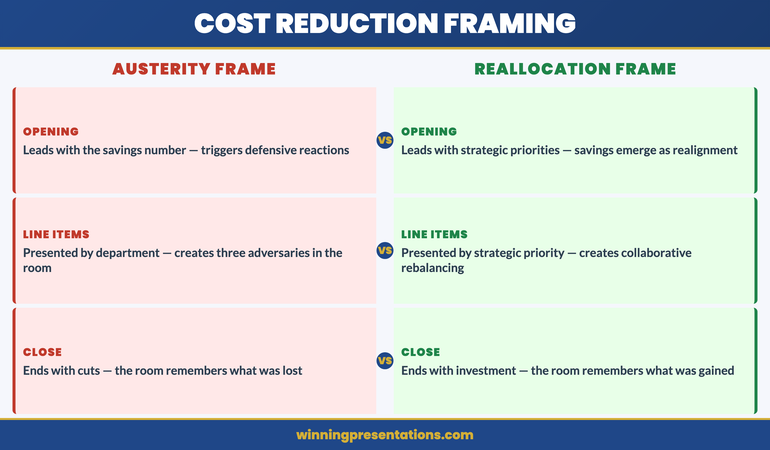
03 Apr 2026
Executive leader addressing a small group of team members in a glass-walled meeting room during an organisational change discussion

Stakeholder Change Presentation: How to Communicate Organisational Restructuring Without Losing Trust

A stakeholder change presentation is the moment where leadership credibility is either built or broken. The restructuring decision has already been made. What remains is whether the people affected trust the reasoning, understand the timeline, and believe the leadership team is acting with integrity. Here’s how to structure the communication that preserves trust.

Dimitri had been given seventy-two hours to prepare the restructuring announcement. The pharmaceutical division he led was merging two research units into one, eliminating fourteen roles and creating nine new ones. His instinct was to lead with the strategic rationale—market pressures, patent cliff, the need to consolidate pipeline investment. His head of HR stopped him. “They won’t hear the strategy,” she said. “They’ll hear ‘fourteen people are losing their jobs.’ Start there.” Dimitri rewrote the entire presentation overnight. He opened by acknowledging the human cost directly, naming the support provisions before explaining the structural logic. He held separate thirty-minute sessions with each affected team rather than one all-hands announcement. The feedback afterwards was not “we agree with the decision”—it was “we understand why, and we trust the process.” Three months later, the merged unit was outperforming both predecessor teams. The people who stayed attributed it to how Dimitri handled the first conversation.

Preparing a restructuring communication? The Executive Slide System includes templates and frameworks for high-stakes organisational communications that maintain stakeholder confidence.

Why the Human Cost Must Come Before the Strategy

The most common error in stakeholder change presentations is leading with the strategic rationale. Market conditions have shifted. The competitive landscape demands a response. The organisation must evolve. All of this may be true, and none of it matters to the person sitting in the audience wondering whether they still have a job next month.

When people are anxious—and restructuring announcements generate acute anxiety—their cognitive processing narrows to a single question: “What does this mean for me?” Until that question is addressed, everything else is noise. The strategic rationale, the market analysis, the competitive pressures—none of it registers until the listener’s personal uncertainty is acknowledged.

Open with three things in this exact order. First, a direct acknowledgement that this announcement affects people’s lives and livelihoods. Not corporate-speak—plain language. “I know this is difficult. Some of you will be directly affected by these changes, and I want to address that before I explain the reasoning.” Second, the specific support provisions: redundancy terms, redeployment opportunities, career transition support, timelines for individual conversations. Third, and only third, the strategic context that explains why this restructuring is happening.

This ordering is counterintuitive for executives who think strategically. It feels as though you’re leading with bad news rather than building a logical case. That’s precisely the point. Stakeholders experiencing change don’t process logic until their emotional response has been acknowledged. Research in organisational psychology consistently shows that perceived procedural fairness—how the change is communicated and implemented—matters more to long-term trust than the change itself. Your stakeholder change presentation sets the perception of fairness from the opening sentence.

Communicate Change With Clarity and Credibility

The Executive Slide System gives you restructuring communication templates and decision frameworks—so your stakeholder presentation maintains trust whilst delivering difficult messages with precision.

  • ✓ Board-ready templates for organisational change scenarios
  • ✓ AI prompt cards to structure sensitive communications fast
  • ✓ Framework guides for high-stakes leadership presentations

Get the Executive Slide System → £39

Designed for executives preparing high-stakes presentations

Audience Segmentation: One Message Does Not Fit All Stakeholders

A restructuring affects multiple audiences, each with different concerns, different information needs, and different levels of vulnerability. Presenting the same message to all of them—a single all-hands announcement—is efficient and almost always damaging. The people being made redundant, the people staying in restructured roles, the people unaffected but watching, the leadership team responsible for implementation, and the external stakeholders (clients, investors, partners) all need different communications.

For the directly affected group, the presentation must be personal, specific, and delivered in a small-group or individual setting. They need to hear what is happening to their role, what the timeline is, what support is available, and who their point of contact will be for questions. A large-audience announcement denies them the dignity of a personal conversation and creates a public spectacle of private distress.

For the people remaining in restructured roles, the presentation focuses on what changes for them: new reporting lines, new responsibilities, revised team structures, and the timeline for stabilisation. Their primary anxiety is not about redundancy—it’s about whether the organisation they’re staying in will function well enough to justify staying. Address that directly.

For the broader organisation—the people not directly affected—the presentation must explain why the restructuring happened, what the organisation looks like afterwards, and what it means for them operationally. Their anxiety is lower but their cynicism is often higher: they’re watching how leadership treats the affected colleagues, and that observation shapes their long-term trust. If you’ve read our guide on restructuring presentations and team trust, you’ll recognise the critical role that visible fairness plays in organisational recovery.

Stakeholder audience segmentation framework for restructuring communications showing three audience groups and their communication needs

Framing the Strategic Rationale Without Corporate Jargon

Once the human cost is acknowledged and the support provisions are clear, the strategic rationale must follow. But the language matters enormously. Corporate jargon in a restructuring announcement—“right-sizing,” “synergy realisation,” “operational efficiency”—reads as evasion. It signals that the leadership team is hiding behind terminology rather than being direct about what’s happening and why.

The rationale should be expressed in three plain sentences. Sentence one: what has changed in the market or the organisation that made this restructuring necessary. Sentence two: what the restructured organisation will look like and why that structure is better positioned. Sentence three: what the leadership team has already done to minimise the impact on people. Three sentences. If you can’t explain the rationale in three sentences, you either don’t understand it fully or you’re trying to obscure something.

Avoid two common traps. The first is over-explaining—providing so much market context and competitive analysis that the rationale gets lost in data. Stakeholders experiencing change don’t need an MBA case study. They need to understand the logic simply enough to explain it to their families. The second trap is euphemism. Don’t say “we’re creating a more agile organisation” when you mean “we’re removing a layer of management.” Don’t say “some roles will be impacted” when you mean “fourteen people will be made redundant.” Direct language hurts in the moment but builds trust over time.

The most effective restructuring communicators—and Dimitri’s approach illustrates this—treat the rationale as context for a decision that’s already been made, not as justification for it. There’s a difference. Justification implies the leadership team is seeking approval from the audience. Context implies they’ve made a difficult decision and they’re explaining their reasoning honestly. Stakeholders respect the latter even when they disagree with the outcome.

The Timeline Slide: Certainty Where Possible, Honesty Where Not

After a restructuring announcement, the single most destructive force is uncertainty about timing. People can absorb bad news. They cannot absorb indefinite ambiguity. The timeline slide in your stakeholder change presentation must be as specific as possible about dates, and completely honest about what isn’t yet decided.

Structure the timeline in three phases. Phase one: what happens this week. Individual consultation meetings scheduled, support resources activated, FAQ document distributed. Phase two: what happens over the next thirty days. Consultation period, role confirmation for restructured positions, redeployment opportunities communicated. Phase three: what happens by ninety days. New structure operational, integration milestones, first review checkpoint.

For elements where dates are genuinely uncertain—regulatory approvals, union consultation outcomes, client contract negotiations—say so explicitly. “We expect this to be resolved by mid-May, but we’ll confirm the date by the end of next week” is far better than a vague “in due course.” Ambiguity in timelines is interpreted as either incompetence or concealment, regardless of the actual reason.

One detail that many leaders overlook: commit to a specific communication rhythm after the announcement. “I will send an update email every Friday until the restructuring is complete.” This single commitment reduces anxiety disproportionately, because it assures people that silence is not abandonment. The announcement presentation is the beginning of the communication, not the entirety of it. Our guide on how leaders can use redundancy announcement presentations covers the specific language and sequencing that preserves dignity during the most difficult conversations.

If you’re structuring a change communication for the first time, the Executive Slide System provides the structural templates that ensure every stakeholder audience receives the right message at the right moment.

Three-phase timeline framework for restructuring communication covering this week, thirty days, and ninety days

Preparing for the Questions You Hope Nobody Asks

In restructuring communications, the Q&A session is where trust is won or lost. The presentation itself is a controlled environment—you’ve chosen the words, the sequence, the framing. The questions that follow test whether the presentation was honest or merely polished.

Prepare for five categories of questions. The “why me” question: “How were the affected roles selected?” Your answer must reference objective criteria—not performance, not politics. Structural logic: “These roles existed to serve a function that the new structure addresses differently.” The “what next” question: “What happens if I don’t accept the redeployment offer?” Have the answer ready with specifics. The “trust” question: “How do we know there won’t be another round in six months?” Be honest: “I can’t guarantee that no further changes will ever be needed, but this restructuring is designed to be stable for [timeframe].” The “leadership accountability” question: “Are senior leaders being affected too?” If yes, say so specifically. If no, explain why—honestly. The “real reason” question: “Is this really about strategy, or is it about cutting costs?” Do not deflect. “Cost reduction is part of the rationale, yes. We need to operate within [budget/margin]. The structural changes also position us for [strategic goal]. Both are true.”

The questions you hope nobody asks are exactly the ones you must prepare for most thoroughly. If you’re visibly uncomfortable or evasive when they surface, every other message in your presentation unravels. Our guide on town hall presentations that rebuild trust covers the Q&A preparation framework in detail, including how to handle emotional responses without shutting them down.

After the Presentation: Follow-Through That Rebuilds Trust

The presentation is the beginning, not the end. What happens in the seventy-two hours after a restructuring announcement determines whether the trust you’ve worked to preserve actually survives. Three actions are non-negotiable.

Action 1: Individual conversations within 48 hours. Every affected person must have a private, face-to-face (or video) conversation with their direct manager or a senior leader within two working days. Not an email. Not a group session. A personal conversation where their specific situation is discussed, their questions are answered, and they are treated as an individual, not a headcount number.

Action 2: Written summary within 24 hours. Distribute a written document that captures everything said in the presentation. People under stress do not retain verbal information well. The written summary serves as a reference they can return to once the initial shock subsides. Include all support provisions, timelines, contact details, and the strategic rationale in plain language.

Action 3: Visible leadership presence. In the days following the announcement, the leadership team must be visibly present. Not hiding in offices. Not travelling. Walking the floor, eating in the canteen, being available for informal conversations. This is not about having more formal meetings. It’s about demonstrating that the leaders who made this decision are not detaching from its consequences.

Dimitri did all three. Within forty-eight hours, every affected team member had a private conversation. A written FAQ was distributed the same afternoon. Dimitri ate lunch in the main canteen every day for three weeks. Trust isn’t built by presentations. It’s built by what leaders do after the presentation ends.

Lead Through Change With Structured, Honest Communication

Restructuring requires precision in every slide and every word. The Executive Slide System gives you the communication frameworks, stakeholder templates, and scenario guides you need—for £39.

Get the System Now → £39

FAQ: Stakeholder Change Presentations

Should I announce a restructuring in one large meeting or multiple smaller sessions?

Multiple smaller sessions, segmented by audience. The directly affected group should hear the news in a small-group or individual setting before the wider organisation. This prevents the public spectacle of people learning their role is at risk in front of hundreds of colleagues. The broader all-hands session should follow within hours, not days—delays create a rumour vacuum that’s worse than the announcement itself. The key principle is that no stakeholder should learn about changes to their own role from someone outside their direct leadership chain.

How do I handle tears or emotional reactions during the presentation?

Do not rush past them, minimise them, or pretend they aren’t happening. Pause. Acknowledge the emotion directly: “This is a difficult conversation and your reaction is completely understandable.” Offer the person the option to continue or step out for a moment. Do not move to the next slide whilst someone is visibly distressed—it signals that the agenda matters more than the people. Have tissues, water, and a private space available. If the session is derailed by strong emotion, call a brief pause rather than pushing through. Emotional responses are not obstacles to the communication—they are part of it.

What if I don’t have all the answers at the time of the announcement?

Say so honestly, and commit to a specific date when you will have the answer. “I don’t have that information yet—we’re still working through the consultation process. I’ll have an answer by next Friday and will communicate it directly.” This is far better than guessing, hedging, or deflecting. Stakeholders during restructuring have finely calibrated sensors for evasion. An honest “I don’t know yet” followed by a specific commitment builds more trust than a vague reassurance that turns out to be inaccurate.

The Winning Edge

Weekly insights on executive presentations, slide strategy, and boardroom communication.

Subscribe Free

Leading through organisational change? Download the Executive Slide System checklist for a quick restructuring communication framework.

If your restructuring is driven by a merger or acquisition, our guide to mergers and acquisitions presentations covers the board-level deal presentation that typically precedes stakeholder communications.

About the author

Mary Beth Hazeldine, Owner & Managing Director, Winning Presentations. With 24 years of corporate banking experience at JPMorgan Chase, PwC, Royal Bank of Scotland, and Commerzbank, she advises executives across financial services, healthcare, technology, and government on structuring presentations for high-stakes funding rounds and approvals.
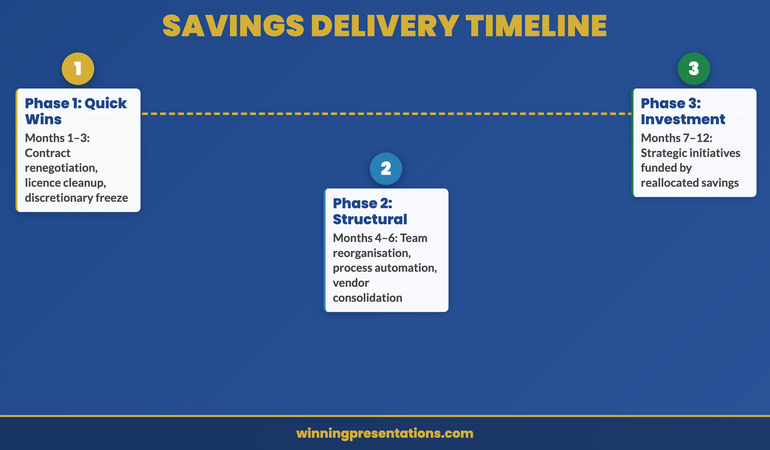
03 Apr 2026
Senior executive presenting M&A deal rationale to corporate board members in a modern glass boardroom with presentation screen showing financial charts

The M&A Presentation Structure That Earns Board Approval in One Meeting

A mergers and acquisitions presentation succeeds or fails before the first slide appears. The board’s decision hinges not on the financial model—they’ve seen that in the papers—but on how clearly you frame the strategic rationale, the integration risks you’ve anticipated, and the governance questions you’ve already answered. Here’s how to structure the deck that moves the room to approval.

Elara had spent four months leading the corporate development team through due diligence on a mid-market logistics acquisition. The numbers were compelling—a 22% margin uplift, geographic expansion into three underserved markets, and a management team willing to stay through integration. She’d built a seventy-slide deck that documented every financial assumption. Walking into the boardroom, she placed her laptop on the table and opened the presentation. The chair stopped her before slide three. “Elara, we’ve read the papers. Tell us what keeps you awake about this deal.” She paused. Then she closed the laptop and spoke for twelve minutes about three integration risks the data couldn’t fully resolve: cultural alignment between the two organisations’ sales teams, a key client contract with a change-of-control clause, and the target’s dependency on a single technology vendor. The board approved the acquisition that afternoon—not because the slides were persuasive, but because Elara demonstrated she understood where the real governance risk sat.

Preparing an M&A presentation for the board? The Executive Slide System includes board-ready templates and decision frameworks designed for high-stakes deal presentations.

The Strategic Rationale Slide: Why This Deal, Why Now

Every mergers and acquisitions presentation must open with a single slide that answers two questions: why this target, and why now. Not why the target is available, not why the price is attractive, not why the advisory team recommends proceeding. The board needs to understand how this acquisition connects to the strategic plan they’ve already approved. If the deal doesn’t advance a priority the board has already endorsed, you’re asking them to approve a new strategy and a new acquisition simultaneously. That’s two governance decisions in one meeting, and boards resist it instinctively.

The strategic rationale slide should contain no more than four elements: the specific strategic objective this deal accelerates, the capability or market gap it fills, the competitive window that makes timing critical, and the alternative if the board declines. That last element—the cost of inaction—is what separates a compelling rationale from a descriptive one. Boards are not persuaded by opportunity alone. They are moved by the consequence of missing it.

Frame the rationale in terms the board already uses. If the strategic plan references “geographic diversification,” your slide should use that exact phrase—not a paraphrase. If the annual risk assessment identified “single-market dependency,” connect the acquisition to that risk directly. You are not introducing a new argument. You are showing the board that this deal is the logical next step in a strategy they’ve already endorsed.

Where presenters frequently go wrong is leading with the target’s financial attractiveness. Revenue multiples, EBITDA margins, and synergy projections belong later in the deck. The first slide is about governance alignment: does this deal fit our stated direction? If the answer is clearly yes, the rest of the presentation is about execution. If the answer is ambiguous, no amount of financial modelling will compensate.

⭐ Maven Flagship — Executive Buy-In

Build the case your stakeholders can’t dismiss

The Executive Buy-In Presentation System is a self-paced framework — 7 modules walking you through the structure, psychology, and delivery that get senior approval. Monthly cohort enrolment, optional recorded Q&A calls.

£499, lifetime access.

Enrol in the Executive Buy-In System →

Framing Integration Risk Without Undermining the Deal

The integration risk section is where most M&A presentations either build or destroy credibility. Present too many risks and the board questions your conviction. Present too few and the board questions your judgement. The calibration is precise: you need to show that you’ve identified and categorised every material risk, then demonstrate that the mitigation plan for each one is specific, costed, and owned by a named individual.

Structure integration risks in three tiers. Tier one risks are deal-breakers if unresolved—regulatory clearance, change-of-control clauses on critical contracts, key person dependencies. These must be addressed before the board votes. Tier two risks are material but manageable—technology integration timelines, workforce harmonisation, brand migration. These require a mitigation plan with milestones. Tier three risks are known unknowns—cultural friction, customer retention during transition, competitor response. These require monitoring frameworks, not mitigation plans.

The slide discipline here is critical. One slide per tier. Each risk on the slide should have three columns: the risk, the mitigation, and the owner. Not a paragraph of explanation—a single line per risk. Boards process risk visually, not narratively. A wall of text about integration challenges reads as uncertainty. A structured table reads as preparedness.

What Elara understood instinctively—and what many corporate development leaders miss—is that discussing integration risk openly is not a sign of weakness. It’s a signal that you’ve stress-tested the deal. Boards approve acquisitions when they believe the presenting team has anticipated what could go wrong and has a plan. They reject acquisitions when they suspect the presenting team is too enthusiastic to see the risks clearly.

Three-tier integration risk framework for M&A board presentations showing deal-breaker, material, and known-unknown risk categories

The Financial Summary Board Members Actually Read

Your due diligence team has built a financial model with dozens of scenarios, sensitivity analyses, and synergy waterfall charts. The board will not read it in the meeting. They may have glanced at it in the board papers. What they will focus on during your mergers and acquisitions presentation is one slide: the deal economics summary.

This slide needs six numbers and nothing else: the enterprise value, the equity consideration, the implied multiple (and the comparable range), the expected synergy value (net of integration costs), the payback period, and the accretion or dilution impact in year one. These six numbers allow every board member—regardless of their financial fluency—to assess whether the deal makes economic sense relative to the strategic rationale you’ve already presented.

Resist the temptation to include the full synergy bridge, the DCF assumptions, or the sensitivity matrix on this slide. Those belong in the appendix for board members who want to interrogate the model during Q&A. The summary slide exists to establish economic credibility in under sixty seconds. If a board member needs more detail, they’ll ask. If they don’t ask, the summary was sufficient.

A useful benchmark: if you can’t explain the financial case in three sentences that match the six numbers on the slide, the model is too complex for governance-level decision-making. Simplify until the strategic logic and the financial logic align in a single narrative. For a deeper look at how to structure due diligence presentation slides, that guide covers the full deck architecture from term sheet to board vote.

Pre-Empting the Three Governance Questions Every Board Asks

Regardless of the target, the sector, or the deal size, three governance questions appear in virtually every board discussion of an acquisition. If your presentation addresses these proactively, the Q&A session shifts from interrogation to confirmation. If you leave them for the board to raise, you’re playing defence.

Question 1: “What happens if integration takes twice as long as planned?” This is a question about resilience, not pessimism. Build one slide that shows the financial impact of a 24-month integration timeline versus your base case 12-month scenario. Show what changes in terms of synergy realisation, cash flow, and the point at which the deal becomes value-neutral. If the deal still makes strategic sense at double the integration timeline, your governance case is robust. If it doesn’t, you need a different mitigation argument.

Question 2: “Who is accountable for integration delivery?” Boards want a name, not a committee. Your presentation should include a single slide with the integration governance structure: the named integration lead, the reporting line to the board, the milestone framework, and the escalation triggers. Abstract governance charts with dotted lines and matrix structures do not satisfy this question. A board member who asks “who is accountable?” wants to hear a first name and a surname, and they want to know that person has the authority and the bandwidth to deliver.

Question 3: “What’s our walk-away point?” Every acquisition has a price at which the deal no longer makes strategic sense. Your presentation must include a clear statement of the walk-away threshold—the valuation, the regulatory condition, or the due diligence finding that would cause you to recommend withdrawal. Boards respect this discipline. It demonstrates that you’re advising the board, not advocating for a deal you want to close. The investor relations presentation format guide covers similar governance framing for shareholder-facing communications.

Addressing these three questions proactively does more than save time. It signals to the board that you understand governance is about protecting downside, not celebrating upside. That distinction is what separates M&A presentations that earn approval from those that earn further diligence requests.

If you’re building an acquisition deck for the first time, the Executive Slide System provides the structural templates that ensure governance alignment is built into every slide, not bolted on afterwards.

Three governance questions every board asks in M&A presentations covering integration timeline, accountability, and walk-away point

Structuring the Deal Timeline and Decision Architecture

The deal timeline slide is not a Gantt chart. It is a decision map. Each milestone on the timeline should correspond to a board decision point—not a workstream activity. The board doesn’t need to know when the data room closes or when HR harmonisation workshops begin. They need to know when they’ll be asked to make a binding commitment, when regulatory filing occurs, when the shareholder vote is scheduled, and when completion is expected.

Structure the timeline as a horizontal flow with four to six decision gates. At each gate, state the board action required: conditional approval, regulatory filing authorisation, final binding approval, or post-completion review. Between each gate, note the key dependency that must be resolved before the next decision. This gives the board a clear picture of their governance obligations over the deal lifecycle.

A common mistake is presenting the timeline as a fait accompli—as though the deal will inevitably proceed to completion. Boards resist this framing because it removes their governance role. Instead, frame each decision gate as a genuine checkpoint where the board has the authority and the information to proceed, pause, or withdraw. Even if you expect straightforward approval at each gate, the framing matters. It reassures the board that they’re governing the process, not rubber-stamping it.

Include a final slide that specifies the board action requested today. Not “approve the acquisition”—that’s the outcome, not the action. Instead: “Authorise management to proceed to binding due diligence and regulatory pre-filing, with final approval subject to [specific conditions].” This precision gives the board a clear governance mandate and protects them from the perception of having approved a deal prematurely.

Why Most M&A Presentations Lose the Board Before Slide Ten

The pattern is remarkably consistent across sectors. The corporate development team builds a comprehensive deck—thirty to fifty slides covering market analysis, competitive positioning, target financials, synergy detail, integration planning, and risk assessment. They present it sequentially, starting with market context. By slide eight, the chair interrupts. The conversation shifts to the three or four questions the board actually cares about. The remaining forty slides sit untouched.

This happens because most M&A presentations are structured as arguments—building a logical case from context to conclusion. Board presentations should be structured as decisions—starting with the conclusion and supporting it with targeted evidence. The board paper has already provided the argument. The presentation exists to address governance concerns, demonstrate preparedness, and request a specific action.

The structural fix is straightforward. Lead with the recommendation slide: “We recommend the board authorises [specific action].” Follow immediately with the strategic rationale slide. Then the deal economics summary. Then the integration risk framework. Then the governance questions you’ve pre-empted. Then the deal timeline with decision gates. Then the requested board action. That’s seven slides. Everything else is appendix material for Q&A.

If your mergers and acquisitions presentation cannot be delivered in seven slides and fifteen minutes, you’re presenting information, not facilitating a decision. Boards don’t reject deals because the presentation was too short. They reject deals because the presenter couldn’t distinguish between what the board needed to know and what the corporate development team wanted to share. The difference between these two is the difference between a board paper and a board presentation—and understanding when each is appropriate.

The seven-slide structure forces discipline. Every slide earns its place by answering a governance question. Every number connects to a strategic rationale. Every risk has a mitigation and an owner. If you can’t fit the case into seven slides, the deal logic isn’t clear enough yet—and that’s a signal worth heeding before you enter the boardroom.

Build an M&A Deck the Board Approves in One Meeting

Stop building fifty-slide decks the board won’t read. The Executive Slide System gives you the seven-slide governance framework, decision templates, and scenario guides that accelerate board approval—for £39.

Get the System Now → £39

FAQ: Mergers and Acquisitions Presentations

How many slides should an M&A board presentation have?

Seven core slides is the benchmark for governance-level M&A presentations: recommendation, strategic rationale, deal economics, integration risk framework, pre-empted governance questions, deal timeline with decision gates, and requested board action. Supporting detail—financial models, sensitivity analyses, market comparables—belongs in an appendix that board members can reference during Q&A. The core presentation should be deliverable in fifteen minutes, leaving the majority of the meeting for board discussion and governance scrutiny.

Should I present synergy projections in the main deck or the appendix?

The net synergy number belongs on the deal economics summary slide in the main deck—the board needs this to assess whether the acquisition price is justified. The detailed synergy waterfall, individual synergy line items, and the assumptions behind each projection belong in the appendix. Presenting synergy detail in the main deck invites line-by-line scrutiny that derails the governance conversation. Presenting only the net figure keeps the discussion at strategic level whilst giving financially oriented board members the option to probe deeper during Q&A.

What’s the biggest mistake in M&A presentations to the board?

Presenting the deal as though approval is a foregone conclusion. Boards govern by exercising independent judgement, and a presentation that reads as advocacy rather than governance advice triggers resistance. The fix is structural: include a clear walk-away threshold, present genuine alternative options (including “do nothing”), and frame every recommendation as “we advise the board to consider” rather than “we recommend the board approves.” This may sound like a semantic distinction, but it signals respect for the board’s governance role—and boards reward that respect with trust.

The Winning Edge

Weekly insights on executive presentations, slide strategy, and boardroom communication.

Subscribe Free

Building your first M&A deck? Download the Executive Slide System checklist for a quick framework to structure your acquisition presentation.

If your acquisition also involves managing stakeholder anxiety during organisational change, our guide to stakeholder change presentations covers the communication architecture that maintains trust through transition.

About the author

Mary Beth Hazeldine, Owner & Managing Director, Winning Presentations. With 24 years of corporate banking experience at JPMorgan Chase, PwC, Royal Bank of Scotland, and Commerzbank, she advises executives across financial services, healthcare, technology, and government on structuring presentations for high-stakes funding rounds and approvals.

02 Apr 2026
Executive responding to a challenging question during a board presentation

Trick Questions in Presentations: How to Respond When They Already Know the Answer

When an executive asks you a question they clearly already know the answer to, they are not seeking information. They are testing your credibility, your composure, and your ability to think on your feet. The response framework in this article will show you exactly how to turn that test into proof of your competence.

Henrik arrived at the quarterly audit committee review with his balance sheet slides prepared to the minute. Three months into his role as finance director, he was about to present the company’s year-end position. Five minutes in, one of the senior audit committee members raised his hand: “Henrik, I notice your cash reserves have declined. What contingency measures do you have in place?” Henrik felt his chest tighten. The questioner was the chair of the audit committee. He would absolutely know about the contingency strategy—it had been discussed at their planning meeting in January. This wasn’t a genuine question. This was a test. Henrik paused. His instinct was to launch into defensive detail, to prove he’d done the work. Instead, he slowed down, met the questioner’s eyes, and gave a response that acknowledged the real question being asked. The room shifted. By the end of the presentation, that same audit committee member stopped him afterwards to say, “That’s exactly the kind of thinking we need in this chair.” Henrik had passed the test—not because he had the right answer, but because he’d recognised what was actually being asked.

Facing difficult questions in executive settings? The Executive Q&A Handling System includes preparation frameworks and response strategies built for exactly this kind of high-stakes Q&A situation.

Why Executives Ask Questions They Already Know the Answer To

Before you can respond effectively to a trick question, you need to understand what is actually happening when an executive asks you something they already know the answer to. This is a fundamentally different interaction than a genuine information-seeking question.

In corporate contexts, questions serve multiple purposes beyond information exchange. They are tools for assessment, credibility testing, relationship signalling, and power dynamics. When someone in an executive setting asks you a question they already know the answer to, they are running one of three diagnostics:

  • Are you prepared? Can you articulate your thinking clearly, or are you winging it?
  • Can you stay composed under pressure? Do you panic, become defensive, or deflect?
  • Do you understand the bigger context? Can you see beyond the surface of what’s being asked to the underlying concern?

Most professionals interpret these as genuine questions and respond with either defensive detail (“Let me explain exactly what happened…”) or vague reassurance (“Don’t worry, we’ve got it covered”). Both responses fail the test because they miss what the questioner is actually evaluating. They’re not checking your knowledge of the facts. They’re checking your judgment and your character.

The questioner wants to see whether you will pause, recognise the real question, and respond with clarity and confidence. This is why the executives you see handling difficult Q&A with grace are not necessarily the ones with the most information. They are the ones with the psychological awareness to understand what test they are being given.

The Executive Q&A Handling System

If you are regularly presenting to executive audiences, you are likely facing trick questions—whether you recognise them as such or not. The Executive Q&A Handling System is a preparation framework designed specifically for senior-level presentations where the stakes are credibility and influence.

This system includes:

  • A structured approach to pre-meeting preparation that identifies likely questions and the psychology behind them
  • Response frameworks for handling questions where the questioner already knows the answer
  • Techniques for staying composed when you’re being tested, not informed
  • Methods for reading the room to spot credibility challenges before the question is asked
  • Recovery strategies for when a response doesn’t land as intended

This is not theoretical. It’s built from the patterns we see in rooms where executives succeed, and where they stumble. You learn the psychology of the questioner’s intent, not just what words to say.


Get the Executive Q&A Handling System → £39

The Three Types of Trick Question in Executive Settings

Not all trick questions are created equal. Understanding which category a question falls into will help you diagnose what the questioner is really asking—and respond appropriately. Here are the three patterns that appear repeatedly in executive presentations:

The Consistency Test
The questioner has heard you say something before, or they have read something in your written materials, and they want to hear whether you will say the same thing now, under pressure. This is often phrased as an innocent question (“So how exactly does that process work?”), but the questioner is checking whether you will contradict yourself or suddenly shift your position. The underlying concern is trust. If you tell a different story under pressure, why should they believe anything you say?

The Competence Challenge
The questioner already understands the technical answer, but they want to see whether you can articulate it clearly and confidently. This is most common in highly technical presentations to expert audiences. A board member asks your CFO a detailed question about revenue recognition. The board member is not seeking education—they are checking whether your CFO truly understands the material, or whether they are relying on someone else’s analysis.

The Values Check
The questioner knows what you are going to say, but they want to watch how you say it and what emphasis you place. They are assessing whether your stated values align with your actual priorities. For example: “How are you thinking about risk in this proposal?” The questioner may already know your risk assessment, but they are checking whether risk genuinely matters to you, or whether it is something you pay lip service to while rushing toward a deadline.

Each of these requires a slightly different response strategy. The Consistency Test requires calm clarity. The Competence Challenge requires precision and confidence. The Values Check requires authentic emphasis on what genuinely matters to you. When you misidentify the type of trick question, your response lands wrong—even if your facts are correct.

hree types of trick questions in executive presentations showing the credibility test, the loyalty probe, and the knowledge trap

The Acknowledge-and-Expand Response Framework

Here is the framework that changes how you respond to trick questions in presentations. It’s built on one simple principle: respond to what is actually being asked, not what is literally being said.

Step 1: Pause and Acknowledge
When you hear the question, resist the urge to answer immediately. Pause. Look at the questioner. Breathe. This pause accomplishes three things: it signals that you are taking the question seriously, it gives your nervous system a moment to settle, and it gives your brain time to diagnose what is really being asked.

Your acknowledgement should be brief and genuine. “That’s a good question. Let me think about what you’re really asking here.” This tells the questioner that you are not going to give a rote answer. You are going to engage with the intent behind the question.

Step 2: Name the Real Question
If you can identify the real question—the test being administered—name it directly. Not aggressively. Not defensively. Simply: “I think you’re asking whether we have genuinely thought through the risk, or whether risk is something we’re paying lip service to.” Or: “You want to know that I can articulate this clearly, without hedging.” This signals that you understand the psychology of the moment. It also disarms the trick, because once it is named, it stops being a trick. It becomes a conversation between two adults.

Step 3: Answer Both the Literal and the Psychological Question
Now provide your answer. Clarity first. Then confidence. Then, if applicable, acknowledgement of the concern beneath the question. For a Competence Challenge, you might say: “The revenue recognition standard for performance obligations requires us to… [clear, precise answer]… and I understand why that matters to you—it’s the difference between someone who can manage the detail and someone who is just executing someone else’s strategy.” You have now answered the literal question (the technical detail) and the psychological question (yes, I understand this and I own it).

Step 4: Close with Confidence
End your response with a statement that acknowledges you have understood and addressed the real concern: “So yes, we have thought this through at that level.” Or: “I hope that demonstrates we understand the nuance here.” Then stop. Do not over-explain. Do not defend further. Let your answer sit.

The Acknowledge-and-Expand framework works because it addresses what executives actually care about in Q&A: seeing that you can think under pressure and respond to the real question, not just the surface words. This is the foundation of handling objections and difficult questions with authority.

Reading the Room: Recognising a Test Before You Walk Into It

The best time to prepare for a trick question is before you walk into the room. If you can identify which questions are likely to be traps, you can rehearse your response and manage your nervous system in advance.

Start with the agenda and the audience list. Which topics on your agenda are most likely to trigger credibility testing? What concerns does this particular group have that they might test you on? Have you presented to any of these people before? How did they question you last time?

Then, think about the psychology of the room. Is someone in this meeting competing with you for influence? Is someone new to the group trying to establish credibility by challenging the presenter? Is there a topic that is historically contentious in this organisation? Trick questions often come from people who are either protecting territory or trying to establish authority. Once you understand the dynamics, you can predict with reasonable accuracy which questions are likely to be tests and which are genuine.

The most predictive factor is this: if a question covers something that was already clearly stated in your written materials or in earlier parts of your presentation, and someone asks it again in the Q&A, it is likely a trick question. They are not seeking information they do not have. They are testing something else. Prepare your response with that in mind.

For more on this preparation work, see our guide to reading the room before you enter.

Preparation Matters More Than Instinct

Many professionals believe that handling trick questions is about quick thinking or natural charisma. It is not. It is about preparation. When you know what questions are likely to come, and you have rehearsed your response framework, you stop relying on instinct (which often leads to defensiveness under pressure) and you start relying on strategy.

The Executive Q&A Handling System includes a pre-meeting briefing template that helps you map out the psychology of the audience, predict likely trick questions, and rehearse responses before you present. This is what separates professionals who remain calm in difficult Q&A from those who freeze or become defensive.

What to Do When You Get the Trick Question Wrong

Even with excellent preparation, there will be times when you misread the situation or give a response that does not land as intended. This happens to experienced presenters. The question is not whether you will ever get it wrong. The question is what you do in the moment when you realise you have.

The instinct, when you have given a wrong answer, is to double down or to apologise excessively. Neither works. Instead, use this recovery sequence:

Pause and Acknowledge the Miss
If you have said something that clearly did not land, or you have heard a follow-up question that tells you your response missed the mark, do not pretend it did not happen. Pause and acknowledge: “I don’t think I answered the question you actually asked.” Or: “Let me come back to that—I think I answered the wrong thing.” This signals that you are paying attention and that you care about being understood.

Reframe and Try Again
Now ask a clarifying question or rephrase what you think the real question is: “Are you asking whether this approach will work in our specific context, or whether the general methodology is sound?” This gives you another chance to identify the real question. Often, the questioner will help you. They will say yes, that is what I was asking. Now you answer the right question.

Move Forward Without Belaboring It
Once you have recovered, move forward. Do not apologise multiple times. Do not spend the next five minutes trying to convince the questioner that your original answer was actually okay. You have acknowledged the miss and answered more accurately. That is enough. The room will respect you more for recovering gracefully than if you had answered perfectly the first time.

This recovery sequence also demonstrates one of the most valuable qualities in executive Q&A: the ability to think and adapt in real time. Sometimes your recovery itself becomes proof of your competence.

Building a Pre-Meeting Intelligence Briefing for Q&A

This is the preparation system that professionals who handle trick questions with confidence use before every executive presentation. It takes about 20 minutes and it is worth ten times that in improved outcomes.

Step 1: Map the Audience Psychology
For each person in the meeting, write down: their primary concern about your topic, their historical relationship to you, and any territory they are protecting. A CFO’s primary concern may be cost control. A head of operations may be concerned about implementation risk. A board member may be concerned about whether the leadership team is aligned. These concerns shape the questions they ask.

Step 2: Identify Trigger Topics
Which parts of your presentation are most likely to trigger testing questions? Usually these are the parts where someone’s interests or priorities could be affected. If you are proposing a change to process, the person who built the current process may ask a trick question to test your thinking. If you are asking for budget, the person holding the budget may test your depth of preparation.

Step 3: Predict the Likely Trick Questions
For each trigger topic, write down the most likely question and what it is really testing. For example: “Likely question: How does this change affect the current team structure? Real question being asked: Are you thinking about the human side of this, or just the process?”

Step 4: Rehearse Your Response Using the Acknowledge-and-Expand Framework
For your top three predicted trick questions, rehearse your response out loud. Use the four-step framework: pause, acknowledge the real question, answer both levels, close with confidence. Do this once. Just once, out loud. You do not need to memorise your response. You just need to know you can deliver it.

This briefing system transforms trick questions from threats into expected elements of the conversation. You walk into the room knowing what to expect, knowing why someone might ask it, and knowing how you will respond. That confidence shows. And that is when trick questions stop being a problem and start being an opportunity to demonstrate your credibility.

Four-step framework for responding to trick questions showing acknowledge, align, expand, and redirect sequence

If you are presenting to an executive audience in the next few weeks, the Executive Q&A Handling System provides a structured preparation template for exactly this kind of pre-meeting intelligence work.

Frequently Asked Questions

What if I genuinely do not know the answer to the trick question?

If you do not know the answer, the trick question framework still applies. Pause, acknowledge what you are being asked, and say honestly: “That is a fair question and I do not have that level of detail immediately available. Here is what I do know… [answer what you do know clearly] …and I will get you the specific data point you are asking for.” This response demonstrates competence and honesty. It often lands better with executives than someone who tries to bluff their way through an answer they do not have. The credibility test is not about knowing everything. It is about knowing what you know and being clear about what you do not.

How do I know if I am reading the trick question correctly?

You do not need to read it perfectly. The Acknowledge-and-Expand framework is specifically designed to handle uncertainty. By pausing, acknowledging the question, naming what you think is being asked, and inviting the questioner to confirm, you give yourself multiple chances to get it right. If you have misread the situation, the questioner will correct you. “Not quite—what I am actually asking is…” That correction gives you the information you need to answer the right question. The executives who handle this well are not mind-readers. They are good listeners who are willing to check their assumptions.

Can you teach yourself to recognise trick questions, or is this something you either have or you do not?

This is absolutely teachable. It requires three things: understanding the psychology of why executives ask questions they already know the answer to, learning the response framework, and rehearsing your application of it in realistic scenarios. The pattern recognition improves with practice. After you have handled three or four trick questions using the Acknowledge-and-Expand framework, you will start to spot them coming. You will recognise the tone, the timing, the setup. Your nervous system will settle because you will have a strategy. This is not about having a special talent. It is about systematic preparation.

Stay Ahead of Difficult Questions

Every week, The Winning Edge shares practical frameworks for handling executive Q&A, managing audience dynamics, and presenting with authority. Framework-driven. Real-world focused. No theory without application.


Join The Winning Edge

Related Reading

If trick questions trigger anxiety, you may find value in our guide to managing presentation anxiety through cognitive restructuring. This article focuses on the psychological patterns that make difficult Q&A feel threatening and how to reframe your relationship to audience testing.

The Real Power of Recognising a Trick Question

Henrik’s story at the beginning of this article was not about having the perfect answer. He had the same facts everyone else in the room had. The difference was that he recognised what was being tested and he responded to the real question. That one moment of psychological awareness—understanding that the audit committee member was not seeking information but testing credibility—changed how he was perceived in that room.

This is what separates the executives you see handling difficult Q&A with grace from those who struggle. They are not necessarily smarter or more prepared in the traditional sense. They are more psychologically aware. They understand that a question is not just words. It is a test. And they have frameworks for responding to the test, not just the words.

When you can do this consistently—when you can pause, recognise what is really being asked, and respond with clarity and confidence—you stop seeing trick questions as threats. They become what they actually are: invitations to demonstrate your competence and your character. And that is when your credibility in the room shifts fundamentally.

About Mary Beth Hazeldine

Mary Beth Hazeldine is the Owner and Managing Director of Winning Presentations. With 24 years of corporate banking experience at JPMorgan Chase, PwC, Royal Bank of Scotland, and Commerzbank, she advises executives across financial services, healthcare, technology, and government on structuring presentations for high-stakes funding rounds and approvals. She is a qualified clinical hypnotherapist and NLP practitioner whose approach integrates psychology-based communication strategy with practical executive presentation technique.