02 Apr 2026
Professional woman reframing anxious thoughts before a high-stakes presentation

Cognitive Restructuring for Presenters: How to Rewrite the Anxiety Script Running in Your Head

Quick Answer: Cognitive restructuring is the process of identifying the automatic negative thoughts that fuel presentation anxiety—“I’ll forget my words,” “They’ll judge me,” “I’ll embarrass myself”—and replacing them with realistic, balanced alternatives. This technique, drawn from cognitive behavioural therapy, interrupts the anxiety cycle before it starts. Unlike positive thinking, which asks you to ignore reality, cognitive restructuring for presenters means examining the evidence and building a more accurate internal script.

Meet Priya: The Consultant Who Realised Her Enemy Was Her Own Thinking

Priya had held her position as a senior consultant at a management consultancy for seven years. She was known for smart analysis and solving complex client problems. Yet every time she had to present to the executive suite, she felt her stomach drop. Not because she lacked expertise—she knew her material cold. The terror came from a script running silently in her head: “They’ll see through me. One tough question and I’ll panic. Everyone else makes this look easy, so there must be something wrong with me.”

Her company invested in a high-profile presentation skills programme. She learned gesture control, story structure, vocal variety. The techniques were sound. But on the morning of her next boardroom presentation, the same script played before she opened her mouth. The anxiety hadn’t changed because she’d never examined the thoughts beneath it.

When she finally worked with someone trained in cognitive behavioural techniques, Priya’s breakthrough came not from practising hand movements. It came from writing down the exact thoughts triggering her anxiety, then asking: “Is this actually true? What evidence do I have? And what’s a more accurate version of this story?” Within weeks, the anxiety didn’t disappear—but the grip it had on her thinking loosened. She could present because she’d rewritten the script.

Cognitive restructuring is a clinically validated technique for managing the automatic thoughts that sustain anxiety. If you’ve tried breathing exercises or practice alone and the fear remains, this approach works differently—it targets the root rather than the symptom. In this article, you’ll learn exactly how to identify your anxiety thoughts and build a more realistic internal narrative before your next presentation.

Jump to a section:

What Cognitive Restructuring Actually Means (Without the Jargon)

Cognitive restructuring is the structured process of catching your automatic negative thoughts, examining whether they’re actually true, and replacing them with more accurate ones. That’s it. No mystical thinking, no forced positivity. Just rigorous thinking applied to the thoughts driving your anxiety.

Here’s the mechanism: When you face a presentation trigger—a boardroom invite, a virtual meeting with stakeholders—your brain automatically generates thoughts. These thoughts happen so fast you often miss them. But they’re powerful. If the thought is “I’ll fail and lose respect,” your nervous system treats that as a genuine threat and floods your body with anxiety chemicals. The anxiety then feels like evidence that the thought is true, when actually the anxiety is just your nervous system responding to a thought, not to reality.

Cognitive restructuring interrupts that loop. You write down the automatic thought, you examine the actual evidence, and you build a replacement thought that’s both more realistic and less anxiety-inducing. The goal is not to trick yourself into positivity. The goal is accuracy.

This technique comes directly from cognitive behavioural therapy (CBT), which is one of the most rigorously tested psychological treatments for anxiety disorders. When we apply CBT principles specifically to presentation anxiety, we’re not guessing—we’re using a framework that has been validated in thousands of research studies and clinical settings.

The Anxiety Management System Built from Clinical Hypnotherapy

Cognitive restructuring works best within a broader nervous system regulation framework. The Conquer Speaking Fear programme combines thought restructuring with clinical hypnotherapy-based techniques for lasting change.

  • ✓ 30-day structured programme for presentation anxiety
  • ✓ Nervous system regulation techniques from clinical practice
  • ✓ Built for executives who have tried other approaches

Get Conquer Speaking Fear → £39

Designed for executives managing high-stakes presentation anxiety

The Four Automatic Thoughts That Drive Presentation Anxiety

Most presentation anxiety springs from four core automatic thoughts. These aren’t facts—they’re stories your brain tells when faced with performance pressure. Recognising them is the first step in restructuring them.

1. “I will forget my words or go blank.” This thought often combines a real phenomenon (you might lose your place momentarily) with a catastrophic conclusion (this means you’re incompetent and should have never agreed to present). Even experienced presenters sometimes lose their flow. The anxiety thought treats a momentary lapse as a referendum on your capability.

2. “They are judging me harshly.” This thought assumes mind-reading: you believe the audience is evaluating you negatively without actual evidence. Often this thought is rooted in audience judgment anxiety, where you imagine the audience has far higher standards for you than they actually do, and far less interest in your performance than you assume.

3. “Something will go wrong and everyone will see my anxiety.” This is vulnerability panic—a secondary anxiety about your anxiety. You fear that your physical symptoms (trembling hands, racing heart, dry mouth) will be visible and will confirm that you don’t belong at that table.

4. “I’m not as capable as everyone thinks.” This is the imposter thought. You’ve succeeded in your role, but you attribute that success to luck, lower standards, or others not noticing your inadequacy. A presentation feels like an exposure risk where “they’ll finally see the truth.”

Notice that none of these thoughts are about the actual presentation content. They’re about your self-image under pressure. Cognitive restructuring for presenters means targeting these meta-narratives, not rehearsing your script further.

The Evidence Technique: Cross-Examining Your Own Assumptions

Here’s the core of cognitive restructuring practice. When you identify an automatic anxiety thought, you examine it using structured questioning. This isn’t about arguing yourself into positivity. It’s about truth-testing.

Step One: Write down the automatic thought exactly as it arises. Not a summary—the specific, vivid thought. “I’ll go completely blank and they’ll realise I’m a fraud” is more useful than “I’ll be bad.”

Step Two: Ask for evidence that supports this thought. What’s the actual evidence? Not your anxiety feeling (anxiety feels like evidence but isn’t), but concrete examples. “I once forgot a phrase in a smaller meeting” is evidence. “I feel terrified right now” is not.

Step Three: Ask for evidence against this thought. When have you successfully presented? What feedback have you received? How many times have you recovered from a mistake? What qualifications do you actually hold that your audience values? This step isn’t forced positivity—you’re simply asking for the full picture rather than only the anxiety-coloured version.

Step Four: Develop a balanced alternative thought. This replacement thought should be accurate, evidence-based, and helpful to your performance. If the automatic thought is “I’ll freeze and they’ll judge me as incompetent,” a balanced alternative might be: “I know the material. I’ve presented to senior audiences before. If I stumble, I can pause and reconnect. One mistake won’t erase my credibility.” Notice this isn’t “Everything will be perfect”—it’s realistic and it doesn’t require denying risk.

The replacement thought works because it’s true in a way that your anxiety thought isn’t. Your anxiety thought selects only threat-related information. Your restructured thought includes the full reality: risk exists, and so does your capacity to handle it.
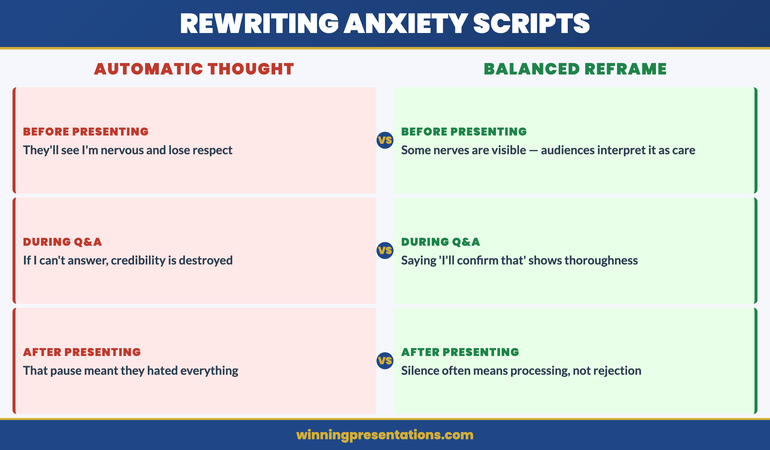
Side-by-side comparison of automatic anxiety thoughts versus balanced reframes across three presentation scenarios

Building a Realistic Replacement Script Before Your Next Presentation

Once you’ve identified and restructured individual thoughts, the next step is building an integrated replacement script—the accurate internal narrative you’ll hold before and during your presentation.

Rather than relying on affirmations or generic confidence statements, this script is highly specific to your actual situation, your actual skills, and your actual audience. Here’s the framework:

Opening line (grounding): “I’ve been invited to present because I have expertise relevant to this group.” This isn’t false confidence—it’s a fact. You wouldn’t be presenting if you didn’t have something valuable to offer.

Capacity line (realistic): “I know this material. I may not deliver it perfectly, but I can adapt and recover if needed.” This acknowledges that perfection isn’t the goal. Clarity and connection are.

Audience line (perspective): “This audience is hoping I succeed. They’ve chosen to spend their time listening to me. They are not looking for reasons to dismiss me.” This counters the default anxiety assumption that audiences are hostile or hypervigilant.

Body response line (physiology): “My anxiety symptoms are uncomfortable but not dangerous. My racing heart is my nervous system preparing me, not a sign of failure. I can perform well while my body is activated.” This is crucial for managing the physical symptoms of anxiety without being derailed by them.

Action line (agency): “I am choosing to do this. I have planned. I have prepared. I will trust that preparation and move forward.” This reframes the presentation from something happening to you to something you are doing intentionally.

You don’t memorise this as a script. You develop it, you believe it because it’s evidence-based, and then before your presentation, you review it silently. The effect is that when your automatic anxiety thoughts arise during the presentation, they’re competing with an established, credible alternative narrative. You’ve already pre-answered the anxiety’s objections with truth.

Why Positive Thinking Fails and Balanced Thinking Works

This is critical: cognitive restructuring is not positive thinking. And that’s why it actually works.

Positive thinking asks you to replace “I’ll fail” with “I’ll be perfect.” Your brain immediately detects this as false. You’re anxious because some part of you knows that perfectionism isn’t realistic. So when you try to force positive thoughts, you create a conflict. Your anxiety gets worse because now you’re not only anxious about the presentation—you’re anxious about failing to maintain your positive mindset.

Balanced thinking, by contrast, says: “Risk exists. Mistakes happen. I’m still capable, and I’ve handled difficulty before. Imperfection is tolerable.” This is both realistic and anxiety-reducing because you’re not fighting against what you actually believe.

The psychological principle here is consistency. When your thoughts, your beliefs, and your narrative align, your nervous system settles. When they conflict—when you’re saying affirmations that you don’t believe while your deeper mind is screaming warnings—your system stays activated. Cognitive restructuring works because the replacement thought is something your intelligent brain can actually accept as true.

Why restructured thoughts stick when affirmations don’t: Your automatic anxiety thoughts have been reinforced by years of presentations, performance situations, and social evaluation. Simply replacing them with generic positivity creates cognitive dissonance. Restructured thoughts work because they’re built on evidence, they acknowledge realistic constraints, and they’re specific to your actual situation. Your brain recognises them as truth, not denial.

Address Both the Thoughts and the Nervous System

Cognitive restructuring targets thought patterns. The Conquer Speaking Fear programme adds clinical hypnotherapy-based nervous system regulation — so you’re working on both sides of the anxiety equation.

Get Conquer Speaking Fear → £39

When Cognitive Restructuring Alone Is Not Enough

Cognitive restructuring is powerful. And for some people, especially those with moderate presentation anxiety, it’s sufficient. But it’s important to be honest about its limits.

If your anxiety is severe—if you’re experiencing panic attacks before presentations, if you’re avoiding presentations altogether, or if you’ve been struggling with this for years despite trying multiple approaches—cognitive restructuring alone may not resolve it quickly enough. Here’s why:

Anxiety is not purely cognitive. It’s also neurobiological. Your nervous system may have been conditioned by repeated stressful presentations, public criticism, or early performance pressure to activate strongly in presentation contexts. Thought work alone won’t retrain your nervous system in those cases. You need nervous system regulation techniques alongside the cognitive work.

This is where clinical approaches like hypnotherapy and guided nervous system regulation become important. These techniques work directly with your physiological anxiety response—they calm your nervous system so that your restructured thoughts can take hold without being drowned out by activation and fear.

Additionally, if your anxiety stems from deeper beliefs about your worth or competence (not just thoughts about presentations, but fundamental self-doubt), cognitive restructuring may need to be paired with longer-term identity work. A trained therapist or coach experienced in performance anxiety can help you determine whether thought restructuring is sufficient or whether you need a broader programme.

The marker of whether you need more support is simple: If you’ve done cognitive restructuring work and your anxiety remains severe or disruptive, then the issue is likely at the nervous system level, and that requires a different toolkit. It doesn’t mean cognitive restructuring didn’t work—it means you’re dealing with a biologically entrenched pattern that needs regulation alongside restructuring.
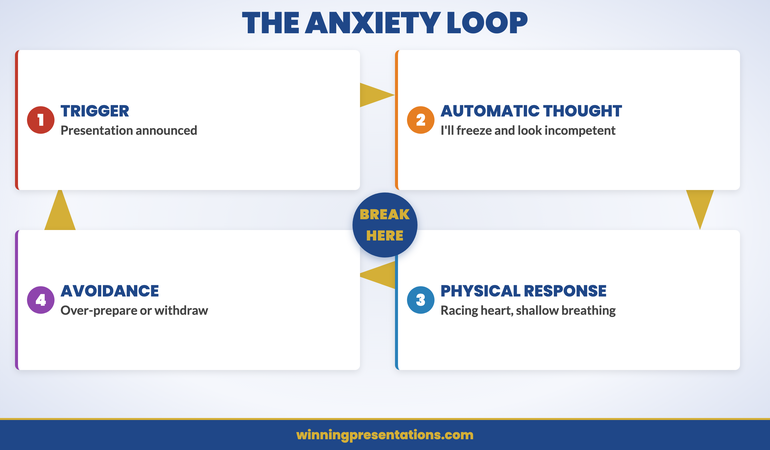
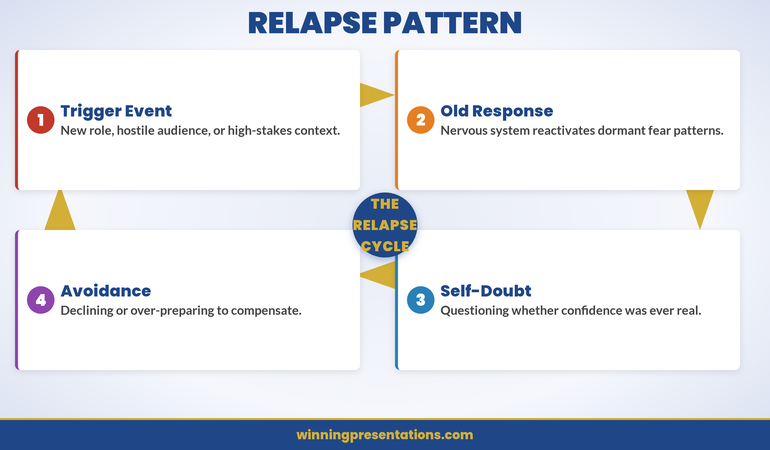
The presentation anxiety loop showing trigger, automatic thought, physical response, and avoidance cycle with break point

Frequently Asked Questions

Does cognitive restructuring mean I’ll never feel anxious before presentations?

No. The goal of cognitive restructuring is not anxiety elimination—it’s anxiety management. You may still feel nervous before a presentation. The difference is that your nervous system won’t be amplifying a false narrative. The anxiety becomes appropriate to the situation rather than catastrophic. This is actually healthy. A degree of alertness before performance is natural and even helpful. What changes is the quality and intensity of anxiety.

How long before restructured thoughts become automatic?

It varies. If you practise cognitive restructuring consistently before presentations for 3-4 weeks, your brain begins to recognise the restructured thought as credible. After 8-12 weeks of regular practice, the alternative narrative becomes more automatic. This depends on how ingrained your original anxiety thought is and how consistently you apply the technique. The more you practice, the faster your brain rewires.

Can I combine cognitive restructuring with other anxiety management techniques?

Absolutely. Cognitive restructuring works best alongside breathing practices, somatic awareness, and nervous system regulation. The thought work addresses the cognitive driver of anxiety. Breathing and somatic techniques address the physiological component. Together, they’re more powerful than either alone. Many executives find that once they’ve restructured their thoughts, they can then use body-based techniques more effectively because they’re not fighting against a catastrophic narrative simultaneously.

Stay Connected: The Winning Edge Newsletter

Cognitive restructuring is one of seven core techniques for managing presentation anxiety. To receive weekly insights on anxiety management, thought patterns, and evidence-based approaches to executive confidence, subscribe to The Winning Edge. You’ll get practical frameworks, psychology-based strategies, and real approaches to the anxiety that gets in the way of your best work.

Free resource: Download the Executive Summary Checklist for Track B: a structured guide to preparing your nervous system and your thoughts before high-stakes presentations.

Related Reading

Once you’ve begun restructuring your automatic thoughts, the next layer is understanding the loops that sustain anxiety—particularly how handling difficult questions becomes easier when your underlying anxiety narrative is less active. Explore that article to see how thought restructuring applies in real-time, in-presentation scenarios.


About the Author

Mary Beth Hazeldine is the Owner and Managing Director of Winning Presentations. With 24 years of corporate banking experience at JPMorgan Chase, PwC, Royal Bank of Scotland, and Commerzbank, she advises executives across financial services, healthcare, technology, and government on structuring presentations for high-stakes funding rounds and approvals. She is a qualified clinical hypnotherapist and NLP practitioner whose approach integrates psychology-based anxiety management with practical presentation technique.

02 Apr 2026
Executive presenting 90-day plan to leadership team in a contemporary boardroom

The 90-Day Presentation: How to Structure Your First Major Update in a New Executive Role

Your 90-day presentation is the moment you move from onboarding to leadership authority. Structure it correctly, and you’ll establish credibility that shapes your entire tenure. Get it wrong, and you risk appearing unprepared or unrealistic.

The Story: Tomás Takes the Stage

Tomás had spent four years building relationships across his organisation before promotion. When he was named Vice President of Commercial Operations at a mid-sized pharmaceutical firm, his peers expected he’d walk into that boardroom knowing exactly what needed fixing. Instead, Tomás sat silent for the first six weeks—listening to sales team frustrations, observing regulatory handoffs, reviewing contract approvals that were taking far too long.

On day 89, he faced the C-suite and board. Not with a 100-day plan ready to execute, but with five core observations and three strategic recommendations rooted in what he’d actually learned. His presentation wasn’t polished theatre. It was structured evidence of thoughtfulness. By the end of that 45-minute session, the CFO had already committed budget to pilot his first initiative. The CEO asked him to lead a cross-functional task force by week two.

The difference wasn’t that Tomás had all the answers. It was that he’d structured his first major update as a credible peer raising intelligent questions—not a new executive trying to prove his worth on day one.

Preparing your first leadership update? The Executive Slide System includes templates and frameworks built for exactly this kind of executive transition moment.

Jump to Section

Why the 90-Day Presentation Defines Your Leadership Trajectory

In your first three months, you’re invisible to most of the organisation. You’re absorbing context, reading files, asking questions that might sound naive but are actually crucial. Your team watches. Your peers wait. The board assumes you’re still learning the lay of the land.

Then comes day 90. You’re asked for your perspective. Whether it’s a formal board update, a CEO one-on-one, or an all-hands presentation on your strategic priorities, this moment is when the organisation decides if you’re a peer-level thinker or still on-ramping.

A weak 90-day presentation signals that you’re still figuring things out. A strong one—and this is critical—doesn’t claim you have all the answers. Instead, it demonstrates that you’ve listened, synthesised what you’ve heard, and formed intelligent hypotheses about what the organisation should address first.

This is your inflection point. The 90-day presentation isn’t about dazzling the room with strategy you invented in week two. It’s about proving you think like the people in the room think. That you ask good questions. That you understand what matters.

Master Your 90-Day Leadership Moment

Your first major update sets the tone for your entire tenure. The Executive Slide System gives you field-tested templates and frameworks specifically designed for executives making their mark in the critical first three months.

  • ✓ Executive presentation templates for leadership updates
  • ✓ AI prompt cards to structure your message fast
  • ✓ Scenario guides for high-stakes executive meetings

Get the Executive Slide System → £39

Designed for executives preparing high-stakes presentations

The Three-Phase Framework: Listen, Diagnose, Propose

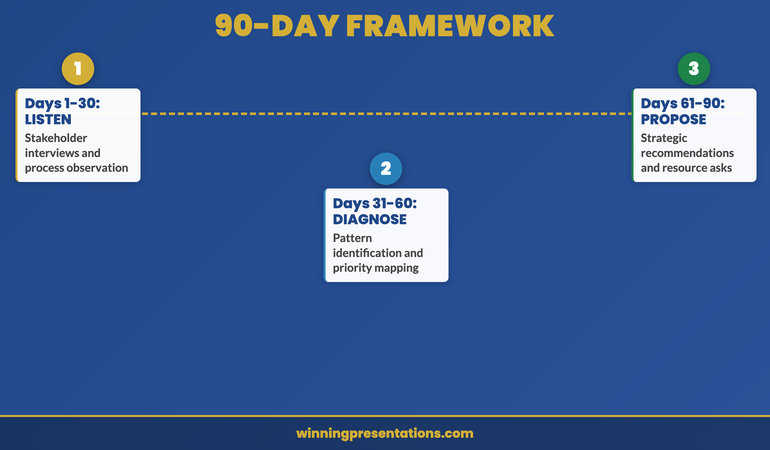
Every strong 90-day presentation follows the same psychological progression. The audience needs to believe three things: that you’ve actually listened to what matters in the organisation, that you understand the real constraints and opportunities, and that your recommendations are grounded in what you’ve learned—not in what you brought with you from your previous role.

Phase One: Listening. Dedicate your first 15 slides to demonstrating what you’ve learned. Not in a patronising way. Instead, show the organisation through your own observations. “In my first six weeks, I attended 34 meetings across sales, operations, and regulatory. I noticed three patterns that surprised me…” This isn’t padding. It’s proof that you’re not parachuting in with a pre-made plan.

Phase Two: Diagnosis. Move from observations to analysis. This is where you name the real constraints the organisation faces. Not problems—constraints. The difference matters. A problem implies fault. A constraint is real, acknowledged, and strategic. “Our contract approval cycle is 47 days longer than industry benchmark. We’ve acknowledged this drives customer churn. Here’s what I learned about why that cycle exists…” Now you’re thinking like a peer, not a critic.

Phase Three: Proposal. Only after listening and diagnosing do you recommend action. And here’s the discipline: propose no more than three initiatives in your 90-day presentation. Each one should be connected to what you’ve learned. Each one should address a constraint the organisation already knows is real. This isn’t about being ambitious. It’s about being credible.

Three-phase 90-day framework roadmap showing Listen phase days 1-30, Diagnose phase days 31-60, and Propose phase days 61-90

What to Include (And What to Leave Out) at Day 90

Your instinct at day 90 will be to show how much you’ve learned and how much value you’re going to bring. That instinct will almost always lead you to overstuff your presentation. A new role presentation that tries to prove everything becomes credible about nothing.

What to include: Observations from your listening phase, three core constraints you’ve identified, your strategic priorities aligned to those constraints, resource requirements for your first initiatives, and a timeline for early wins. Include metrics that matter to the organisation—not vanity metrics you can control, but real measures of progress.

What to leave out: Criticism of decisions made before you arrived. Comparisons to how your previous organisation did things. More than three recommendations. Promises about outcomes you can’t guarantee. Detailed execution plans that suggest you’ve known what to do since week two. Any data you haven’t verified. Jargon your audience doesn’t use.

The 90-day presentation lives or dies on discipline. Every slide should answer one of two questions: either “What did I learn?” or “What should we do about it?” If a slide doesn’t answer those questions, remove it.

This is where executive presentation structure becomes your strategic tool. When you’re under pressure to prove yourself, a strong framework keeps you focused on what actually matters to your audience.

Structuring Slides for a Leadership Audience That Already Has Opinions

Here’s what you’re working against: your audience has already formed opinions about what needs to change in your area. The CEO has a view. The board has a view. Your peers have a view. You’re not presenting to blank slates.

This changes how you structure every slide. You can’t be subtle or indirect. You need to surface disagreement early, acknowledge what your audience already believes, and then show why your perspective adds clarity or reveals something they hadn’t considered.

Start each section not with your conclusion, but with the conventional wisdom. “Most organisations in our sector assume they need to upgrade technology first. In my assessment, we need to redesign process before we invest in tools.” Now you’ve signalled that you understand the existing opinion and you’re offering a different lens. That’s peer-level thinking.

Use a slide structure that builds credibility. Lead with what you’ve learned. Then surface the tension between what you’ve heard and what the data suggests. Then propose your recommendation. The audience follows your reasoning because you’ve shown them the thinking, not just the conclusion.

Consider how strategy presentations to CEOs work. They don’t ask for acceptance. They make a case. Your 90-day presentation should do the same.

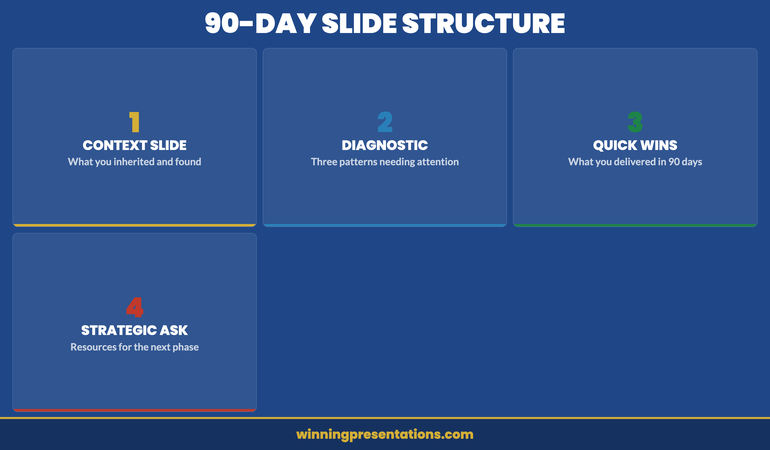
Four-slide structure for a 90-day presentation covering context, diagnostic, quick wins, and strategic ask

The Credibility Trap: Proving Yourself Without Overpromising

The moment you step into a new executive role, you feel pressure to prove you deserve the position. You want to show confidence. You want to demonstrate you’ve got a plan. You want to protect yourself by overstating what you can deliver.

Every one of those instincts will undermine your 90-day presentation. Executives can smell desperation to prove value. They see overpromising as a red flag. And they don’t trust executives who claim certainty after 90 days in a role.

The counterintuitive path to credibility in your first three months is to be intellectually honest about what you still need to learn. “I’ll have clarity on our supply chain constraints in week 16. For now, here’s what I can see…” That’s credible. It says: I’m competent enough to know what I don’t know yet.

Build your 90-day presentation on what you’ve validated, not what you hope. Show quick wins you can deliver—not because you’re trying to prove yourself, but because you’ve listened to what matters most to your team and your board. When you deliver against those commitments, you’ll have earned trust that lasts for years.

This is where many executives stumble. They read the pressure to perform, and they respond by overstating their confidence or their roadmap. Instead, let your first leadership update answer a simpler question: Do I understand this organisation well enough to be a credible peer? If your presentation answers yes, you’ve won.

Final Preparation: Questions Over Answers

In your final week before the presentation, shift your preparation focus. Stop refining your recommendations. Instead, prepare for questions you’ll be asked and make sure you know why your audience will ask them.

Your board might ask: “Why shouldn’t we hire external talent to lead this transformation?” Your team might ask: “How does this align with what corporate told us about our direction?” Your peers might ask: “What happens if this timeline slips?” These aren’t gotcha questions. They’re tests of whether you’ve thought through the real tensions in your strategy.

Prepare answers that show you’ve wrestled with these questions, not that you have perfect solutions. “That’s a fair question. Here’s why I think internal development serves us better in this case, and here’s where I think we might prove that wrong…” That’s executive-level dialogue.

By the time you present, your slides should feel almost incidental. You should be able to have a strategy conversation with your audience because you’ve done the listening and the thinking. The presentation is just the structure. The real work is the thinking behind it.

Ready to Structure Your Leadership Moment?

The Executive Slide System includes scenario templates, AI prompt cards, and frameworks specifically designed for the presentations that define your executive career.

Get Instant Access → £39

Frequently Asked Questions

How long should a 90-day presentation be?

Between 35 and 50 minutes, including questions. If you’re presenting to your CEO, assume 20–30 minutes. If it’s a board update, 45 minutes is standard. The key is finishing before your audience runs out of energy, not filling time with slides. A crisp 30-minute presentation that builds a compelling case beats a 60-minute marathon every time.

What if the board expects me to have a detailed 12-month plan by day 90?

Show them what you can validate in three months, then surface the assumptions you’re still testing. “Here are my core priorities for months 4–6, and here’s what I need to learn to refine them.” You’re not avoiding accountability. You’re being transparent about how you actually make decisions. Most experienced boards will respect that more than a plan you’ve invented with confidence you don’t yet have.

Should I include slides about my background or my previous achievements?

No. Your new organisation already knows who you are. They hired you. A 90-day presentation isn’t about establishing who you were—it’s about demonstrating who you are in their context. Use your credibility strategically. Reference specific experience only when it helps you explain a decision you’ve made about their organisation.

Move from Onboarding to Leadership Authority

Your 90-day presentation is a threshold moment. It’s where you stop being the new executive and start being a trusted leader. If you structure it right—grounding every recommendation in what you’ve learned, showing intellectual honesty about what you still need to discover, and demonstrating that you think like the peers in the room—you’ll have influence that lasts for years.

The pattern Tomás followed works because it respects how executives think. You observe. You synthesise. You propose. You don’t oversell. You earn trust by being thoughtful, not by being brilliant.

If you’d like a comprehensive template for building this kind of leadership presentation, the first presentation after promotion framework will accelerate your preparation.

Stay ahead on executive communication. Join The Winning Edge, our newsletter for leaders navigating high-stakes presentations and board-level communication.

Free resource: Download our Executive Slide System checklist to structure your first leadership update in minutes.

Related Reading: Discover how non-executive directors structure board presentations for maximum influence and credibility.

About the Author

Mary Beth Hazeldine, Owner & Managing Director, Winning Presentations. With 24 years of corporate banking experience at JPMorgan Chase, PwC, Royal Bank of Scotland, and Commerzbank, she advises executives across financial services, healthcare, technology, and government on structuring presentations for high-stakes funding rounds and approvals.

02 Apr 2026
Non-executive director preparing for first board meeting in a modern corporate boardroom

Non-Executive Director Board Presentation: What to Prepare for Your First Meeting

Your first board meeting as a non-executive director is not a presentation you deliver—it’s a performance you shape. The difference between earning credibility and appearing out of your depth comes down to preparation strategy, not slide polish. Here’s what actually matters.

Annika arrived at her first board meeting as a newly appointed NED at a mid-cap technology firm feeling confident. She’d spent the previous week refining a ten-slide deck on her area of expertise—cybersecurity governance. She’d colour-coded the risk matrix, added trend analysis charts, even included a benchmarking comparison. Within two minutes of the chair opening the meeting, she realised her error. The board wasn’t waiting for a lecture. They were watching to see whether she understood the rhythm of governance, whether she listened before speaking, and whether her questions raised the calibre of discussion. Her perfect slides sat unopened whilst the chair moved straight to strategic priorities. Annika spent the first meeting listening, asking two precisely angled questions, and learning the board’s decision-making patterns. By month three, her contribution was so trusted that the board sought her perspective first on governance matters.

Already preparing for your first board? The Executive Slide System includes board-ready templates and scenario guides built for exactly this situation.

Why Most Non-Executive Directors Over-Prepare the Wrong Material

The instinct is understandable but misplaced. New NEDs often treat their first meeting like an audition. They prepare comprehensive presentations, position papers, or detailed briefings—everything they’d present in an executive role. But a non-executive director board preparation process is fundamentally different. The board chair and executive team have already synthesised the data. What the board needs from you is not information but perspective—independent assessment shaped by governance duty, not operational pressure.

Most first-meeting mistakes stem from confusing two separate preparation tracks: operational mastery and governance readiness. Operational mastery is deep subject knowledge. Governance readiness is understanding the board’s decision-making context, the strategic tensions in the room, and the questions that matter at board level. New NEDs frequently invest 80% of preparation energy in operational detail and 20% in governance positioning. This ratio is exactly backwards.

Consider what the chair is actually assessing during your first meeting. Are you asking questions that probe strategy rather than restate operational status? Can you spot the unspoken tensions between board members? Do you listen before you speak, or do you compete for airtime? Will you respect confidentiality and fiduciary duty? Can you challenge constructively without creating conflict? None of these signals come from a polished slide deck.

Master Your First Board Meeting as a Non-Executive Director

The Executive Slide System gives you board-ready templates, scenario guides, and decision-making frameworks—so your first contribution raises the quality of governance dialogue, not just fills airtime.

  • ✓ Board-ready presentation templates for governance updates
  • ✓ AI prompt cards to structure your governance perspective fast
  • ✓ Executive scenario guides for high-stakes board decisions

Get the Executive Slide System → £39

Designed for executives preparing high-stakes presentations

The Three Documents Every NED Must Read Before the Meeting

Board papers arrive in abundance. Most NEDs skim them. Smart ones prioritise ruthlessly. You need three documents, read thoroughly, before your first meeting. Everything else is supplementary.

Document 1: The Board Charter and Governance Framework. This defines your statutory and fiduciary responsibilities. Read it. Know it. Many NEDs skip this because it feels like compliance tedium. It’s not. The charter defines what “governance” actually means in your organisation—what decisions the board retains, which it delegates, where your scrutiny must be sharpest. You cannot ask intelligent governance questions without understanding these boundaries.

Document 2: The Last Three Board Minutes. Not to learn the detail, but to understand the rhythm and priorities. What topics consumed 80% of discussion time? What decisions took four meetings versus one? Where was there tension or disagreement? Where did the executives defer to the board for a decision? These patterns reveal where the real governance pressure sits. Your questions should align with these priorities, not drift into tangential areas.

Document 3: The Strategic Plan and Board Scorecard. The five-year strategy and the single-page metrics that the chair and executives track obsessively. You need to understand: What outcomes matter most? What are the three to four strategic risks the board is actively monitoring? What metrics would trigger a governance intervention? This becomes the lens through which you assess every board paper. A question about expense management that doesn’t connect to strategic risk is wasted airtime. A question that probes whether an initiative still aligns with strategy is governance.

These three documents take perhaps six to eight hours to read properly. That is your preparation. Not creating slides. Not drafting position papers. Reading, absorbing, and internalising the governance context.

Your First Board Contribution: When to Speak and When to Listen

The psychology of first impressions in the boardroom is unforgiving. Speak too much and you appear to lack confidence in your judgment—filling silence with noise. Speak too little and you appear uncertain of your role or value. Speak on the wrong topic and you reveal that you haven’t yet grasped what the board actually cares about.

Your first substantive contribution should come only after you’ve heard the full board discussion on a topic. Listen to how the chair frames the issue. Notice which executives are defensive and which are transparent. Observe which board members ask probing questions and which accept what they’re told. Then, when you speak, you’re adding to a conversation you understand, not inserting yourself into unfamiliar territory.

The first NED contribution that earns respect typically fits one of three patterns. First: you ask a clarifying question that surfaces an assumption the board hadn’t named. Not a challenge, not a directive—a genuine question that sharpens thinking. Second: you note a governance gap—something the board has discussed but not yet connected to fiduciary duty or risk policy. Third: you offer a perspective from your specific expertise that the internal team cannot, framed as context for the board’s decision rather than a recommendation.

Avoid at all costs: repeating what’s already been said, asking for information the board papers already provided, and offering opinions on operational detail. These signals tell the board that you’re not yet calibrated to governance level.

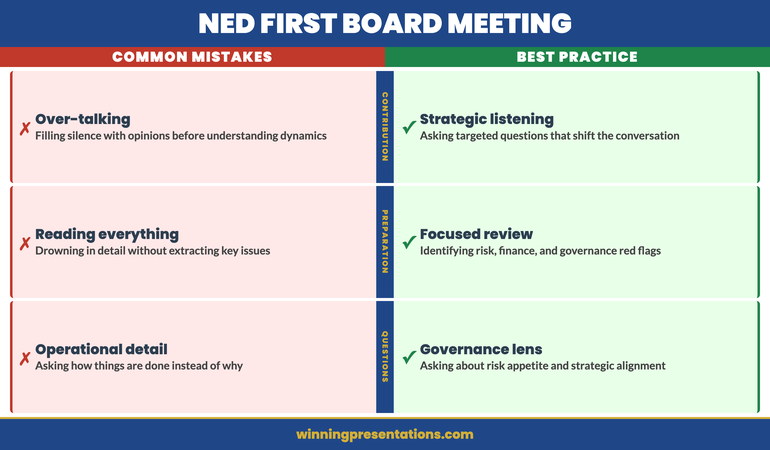
Comparison of common NED first board meeting mistakes versus best practice approaches across contribution,

Building a Board-Ready Slide for Your First Substantive Update

Eventually, you will have a governance topic to present—perhaps in month two or three, once you’ve established credibility. The slide discipline at board level is not what most executives expect. The mistake new NEDs make is assuming board presentations follow the same visual intensity as operational presentations. They don’t.

A board-ready slide is sparse by design. It contains a clear headline—usually a decision or governance question, not a topic name. It contains two to four data points that directly support that headline. It contains no decorative charts, gradients, or visual flourish. The entire purpose of the slide is to communicate one governance-level insight in under ninety seconds. Executives often treat slides as a prop for their narrative. Board members treat slides as a decision tool. The difference is vast.

Your first substantive update as a NED should follow this structure: one slide stating the governance issue, one slide showing the three strategic options with their board-level trade-offs, one slide naming your governance assessment and recommended board action. That’s it. No background. No process explanation. No “how we got here” narrative. The board already knows the operational history. They need your governance lens on what matters.

You can find detailed board-ready slide templates in the board presentation best practices guide, which walks through the specific templates that senior NEDs and chairs use routinely.

The Governance Lens: What Sets Non-Executive Questions Apart

One question reveals whether you’re operating at governance level or operational level: the questions you ask. An operational question asks “how?” A governance question asks “why should the board approve this, and what are we collectively risking if we don’t?” These sound different because they are different.

During the first meeting, you’ll hear executives present an update or a decision. Your peers will ask follow-up questions. Many of those questions are perfectly competent and miss the point entirely. They probe implementation detail, timeline nuance, or tactical adjustment. None of those move governance forward. A governance question at board level connects the proposal to four things: strategic alignment, risk appetite, fiduciary duty, and stakeholder impact. You don’t need to mention all four in one question. You need to ensure that every question you ask probes at least one of them.

For example: An executive proposes expanding into a new geographic market. An operational question is “What’s the timeline?” A governance question is “How does this expansion align with our strategic priority for profitability versus growth, and what’s our risk tolerance if the market adoption rate is half what we’ve forecast?” The governance question assumes knowledge of the board’s strategic priorities and risk framework. It surfaces the trade-off the board must own. It invites a discussion of governance, not implementation.

Questions framed this way—particularly in your first meeting—signal that you’ve done the homework, you understand the board’s strategic context, and you’re not here to micro-manage operations. You’re here to strengthen governance. That distinction, communicated in your first three questions, determines how the board perceives your value for the next three years.

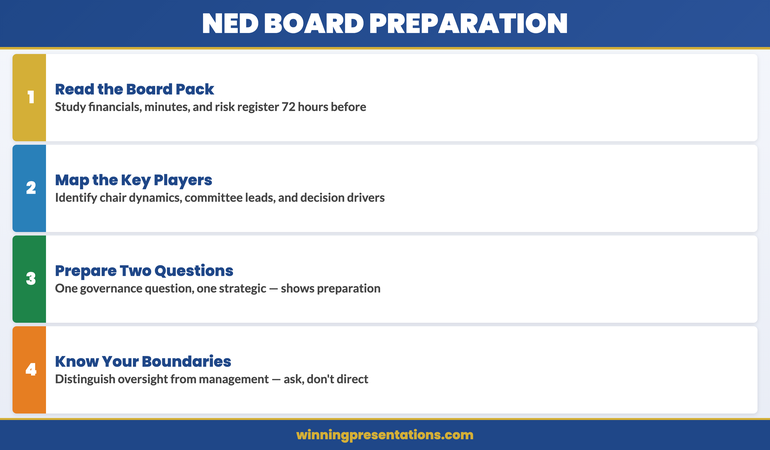
Four-step NED board preparation framework showing reading the board pack, mapping key players, preparing questions, and knowing governance boundaries

Common Mistakes That Undermine a Non-Executive Director’s First Board Impression

Mistake 1: Speaking Confidently About Things You Don’t Yet Understand. The boardroom rewards intellectual honesty. If you don’t understand the context of a decision, say so. Ask the question. Take the note. Don’t bluff. New NEDs who attempt to mask uncertainty by talking more actually reduce their credibility. A simple “I want to understand the risk assumption here before we move forward” signals competence and governance discipline.

Mistake 2: Treating Board Papers as Reference Material Rather Than Strategy Documents. Skim reading board papers is a common shortcut. Then you arrive at the meeting, and mid-discussion realise you’ve missed the thread. Someone refers back to a decision from three months ago. You don’t remember the context. You’re now operating blind. Read board papers with a notebook and a highlighter. Mark the three strategic tensions in each paper. Mark the sentences where the executive is asking for a board decision versus informing the board of a decision already made. These annotations take ten minutes and determine whether you’re engaged or adrift in the conversation.

Mistake 3: Assuming Your Expertise Automatically Translates to Board-Level Authority. Many new NEDs have deep expertise in their specialist domain—technology, finance, operations, healthcare. They assume this expertise gives them licence to direct or override in meetings. Wrong. Expertise is context. Governance is authority. The board values your expertise as perspective on governance matters, not as permission to make decisions or direct the executive team. The distinction matters intensely. Confuse them and you’ll be seen as boundary-crossing rather than governance-focused.

Mistake 4: Preparing to Present Rather Than Preparing to Govern. This is the Annika mistake at the start of this article. You spend weeks creating a beautiful presentation on your subject area. But your job as a NED is not to educate the board on your expertise. It’s to govern the organisation on behalf of shareholders or stakeholders. If your preparation is centred on “what can I teach this board,” you’ve misunderstood the role. Preparation should centre on “what governance questions does this organisation face, and how can I add clarity to the board’s decision-making?”

Mistake 5: Talking About Your Appointment or Your Perspective Without Being Asked. Some new NEDs spend their first meeting explaining their background or positioning their independent perspective. The board doesn’t care. They care about governance. Your independence and expertise will be evident through the questions you ask and the judgement you demonstrate. Talking about these things directly reads as insecurity.

If you want to dig deeper into the structure of board presentations and the difference between board papers and board presentations, this resource breaks down each format and when each one is appropriate.

Your First Board Needs Governance Clarity, Not Perfect Slides

Prepare strategically, ask questions that matter, and establish yourself as governance-focused from day one. The Executive Slide System includes everything you need—templates, scenario guides, and decision frameworks—for £39.

Get the System Now → £39

FAQ: Your First Board Meeting as a Non-Executive Director

What should I do if I disagree with a board decision in my first meeting?

Disagreement is governance. The mistake is how you express it. In your first meeting, if you have a genuine governance concern (not just a different opinion), state it clearly but briefly, then respect the board’s decision. Document your dissent in the minutes if you believe it’s a material risk. Do not debate at length or attempt to persuade. You’re establishing that you’ll contribute independent judgment, not that you’ll fight for your position. Over time, your judgment earns weight. In month one, respect the chair and the decision-making process, even if you’d choose differently.

How much should I prepare beyond reading the board papers?

Read the three core documents thoroughly (charter, recent minutes, strategic plan). Read the current month’s board papers carefully. Beyond that, do not prepare a presentation or briefing document. Do not draft remarks or position statements. Preparation beyond reading signals anxiety and misunderstanding of the role. Your preparation is intellectual, not creative. You’re building governance context, not a narrative.

What’s the difference between a good governance question and a bad one in the first meeting?

A good governance question surfaces a strategic trade-off, probes risk assumptions, or connects a proposal to the board’s fiduciary duty and strategic priorities. It assumes you’ve done the homework and understand context. A bad governance question asks for information that’s already in the papers, probes operational detail rather than governance, or attempts to demonstrate expertise rather than strengthen the board’s decision. The best first-meeting questions are short, assume knowledge, and invite the board to address a governance gap that’s real but unnamed.

The Winning Edge

Weekly insights on executive presentations, slide strategy, and boardroom communication.

Subscribe Free

New to governance presentations? Download the Executive Slide System checklist for a quick NED board preparation framework.

Once you’ve navigated your first board, the next challenge is embedding yourself in the governance rhythm. Many new NEDs ask how to transition from observation to meaningful contribution within the first ninety days. Our guide to presentations in your first ninety days covers the communication milestones that build your board credibility beyond the first meeting.

About the author

Mary Beth Hazeldine, Owner & Managing Director, Winning Presentations. With 24 years of corporate banking experience at JPMorgan Chase, PwC, Royal Bank of Scotland, and Commerzbank, she advises executives across financial services, healthcare, technology, and government on structuring presentations for high-stakes funding rounds and approvals.

01 Apr 2026

Box Breathing for Executives: Why Navy SEALs Use It Before High Stakes

Box breathing is a physiological reset button—a four-step technique that brings your nervous system back into balance within minutes. Navy SEALs use it before covert operations. Emergency room surgeons use it before complex procedures. And senior executives use it before board meetings, earnings calls, and regulatory hearings where composure determines the outcome. The technique is simple, evidence-backed, and discreet enough to use in a conference room lavatory or in the five minutes before you walk into a shareholder meeting.

The Story: Henrik’s Regulatory Hearing

Henrik sat in the corridor of the regulatory office with nine minutes to spare before presenting a critical approval hearing. As Chief Financial Officer of a pharmaceutical company, he’d presented to boards and regulators dozens of times—but this was different. A competitor’s recent failure in a similar category had made the regulator more scrutinising. His hands were cold. His jaw was tight. His voice, when he’d rehearsed it an hour earlier, had sounded thin and uncertain.

He’d tried everything: positive affirmations (felt hollow), visualisation (his mind wandered), pacing (made him more anxious). Then a former Navy officer on his executive advisory board had mentioned something in passing at a networking event: box breathing. Not meditation. Not mindfulness. Just a structured breathing pattern that resets the autonomic nervous system in under five minutes.

Henrik pulled up a quiet side room and spent four minutes doing exactly that. Four counts in. Four counts hold. Four counts out. Four counts hold. Repeat. When he walked into the hearing room, something had shifted. His voice was steady. His thoughts were clear. He moved through the presentation with the kind of composed authority the regulators needed to see. The approval came through three weeks later.

The reality of presentation anxiety

Anxiety before high-stakes presentations isn’t a personal failing—it’s a physiological response to perceived threat. Your body doesn’t distinguish between physical danger and reputational risk. When you’re about to present to a board or speak at a regulatory hearing, your sympathetic nervous system activates, flooding your system with cortisol and adrenaline. Box breathing counteracts this directly by engaging your parasympathetic nervous system. It’s not about feeling confident. It’s about getting your physiology out of the way so your competence can show.

The Neuroscience Behind Box Breathing

Your autonomic nervous system has two branches: the sympathetic (fight-or-flight) and the parasympathetic (rest-and-digest). When you’re facing a high-stakes moment, your sympathetic system dominates. Your breathing becomes shallow and rapid. Your heart rate climbs. Blood pools in your muscles instead of your prefrontal cortex. This is useful if you’re facing a predator. It’s catastrophic if you’re trying to communicate complex information clearly.

Box breathing works because extended exhalation—particularly the pause at the end of the breath—directly activates the vagus nerve, which controls parasympathetic activation. The equal counting pattern (four in, four hold, four out, four hold) creates a rhythm that your nervous system recognises and responds to. Within minutes, your heart rate variability improves, your cortisol begins to drop, and your prefrontal cortex—the part of your brain responsible for rational thought, composure, and articulation—comes back online.

This isn’t speculation or wellness theory. The physiological mechanisms have been studied in military contexts, clinical psychology, and sports performance for decades. The technique appears in trauma protocols, anxiety management programmes, and athlete preparation routines because it works at a biochemical level that doesn’t require belief or motivation. Your body simply responds.

The 4-4-4-4 Technique: Step by Step

Box breathing for executives is deliberately straightforward. There’s nothing to remember beyond counting. Here’s the method:

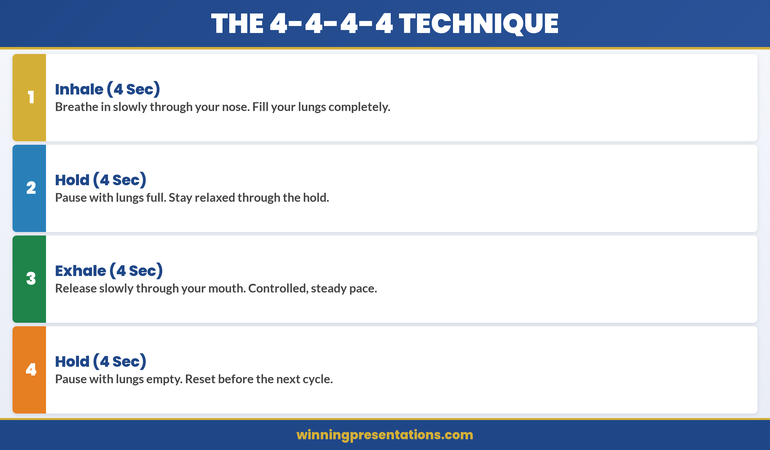
Step 1: Exhale completely
Before you begin the pattern, expel all the air in your lungs with a slow, deliberate exhale. This triggers an immediate parasympathetic response and signals to your body that you’re intentionally shifting your state.

Step 2: Inhale for four counts
Close your mouth if you’re in a shared space and breathe slowly through your nose. Count steadily: one, two, three, four. Inhale with intention but without strain.

Step 3: Hold for four counts
Once you’ve inhaled, pause without forcing. One, two, three, four. This pause is crucial—it allows your body to absorb the oxygen and signals a return to equilibrium.

Step 4: Exhale for four counts
Slowly release the breath over four counts through your mouth or nose. This is the longest part of your breathing cycle in terms of nervous system effect. Extended exhalation is where the parasympathetic activation happens.

Step 5: Hold for four counts
Pause again for four counts. You’ve completed one cycle of box breathing.

Repeat this cycle five to ten times. Three to five minutes is typically enough to restore composure before a presentation. Some executives do it for longer before particularly high-stakes moments, but diminishing returns set in after ten cycles.

The count can be adjusted if four feels uncomfortable. Some people use five or six counts per phase. The critical variables are that all four phases are equal in duration and that you’re breathing slowly and deliberately—roughly one full cycle every 20 seconds.

Ready to master your nervous system before high-stakes presentations?

Conquer Speaking Fear gives you box breathing, grounding techniques, and frameworks to manage anxiety when your reputation is on the line.

Take Control of Your Nervous System

Step-by-step box breathing technique diagram for executives before high-stakes presentations

Why Executives Resist Box Breathing

The most capable executives often resist breathing techniques, and it’s worth understanding why. There are three consistent objections.

First, it feels too simple. After years of building complex financial models and navigating geopolitical market dynamics, a four-count breathing pattern can feel trivial. The executive brain interprets simple as ineffective. But physiology doesn’t care about complexity. Your vagus nerve doesn’t require intellectual sophistication. It responds to the pattern regardless of whether you believe in it.

Second, there’s a perception problem. Some worry that using a breathing technique signals weakness or that they need external props to manage their state. The reality is inverted: controlling your physiology before a high-stakes moment is a mark of professionalism and preparation. Navy SEALs, emergency surgeons, and Olympic athletes aren’t weak. They’re disciplined about managing the variables they can control.

Third, they haven’t learned it during low-stakes moments. Attempting box breathing for the first time ten minutes before a regulatory hearing adds cognitive load when you can least afford it. The technique works best when it’s already familiar, when your body recognises the pattern and responds automatically. This is why rehearsal matters.

When to Use Box Breathing: Timing and Context

Box breathing isn’t a tool you pull out only in crisis. The executives who benefit most from it integrate it into routine preparation. Here are the most effective moments:

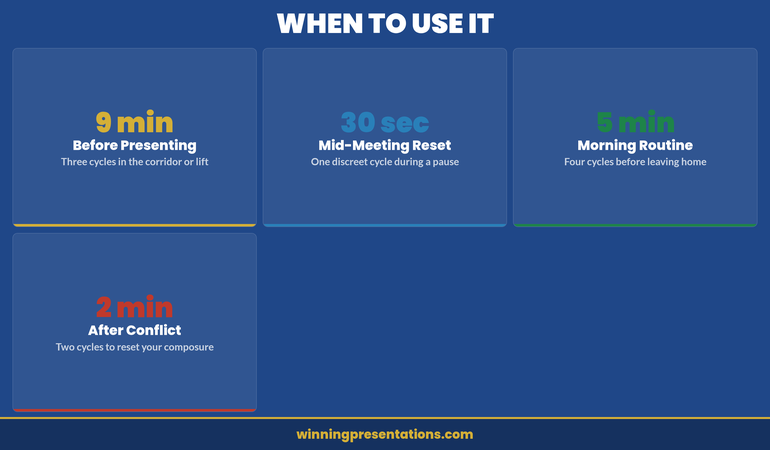
Fifteen to thirty minutes beforehand. This is the optimal window. Your nervous system has time to absorb the reset, but you’re close enough to the event that the effect persists. If you practise earlier, arousal will begin to climb again as you move closer. If you try it two minutes before, you might not have enough time to feel the shift.

During breaks in longer presentations or meetings. If you’re presenting for an hour with a break halfway through, use that break to do one or two cycles of box breathing. It resets your energy and brings you back into a composed state for the second half.

As part of your morning routine on presentation days. Starting the day with three to five minutes of box breathing sets your baseline lower. When the presentation happens later that day, you’re starting from a calmer physiological state, which means you don’t have as far to climb in terms of arousal.

In the moment, if you feel anxiety climbing during the presentation itself. If you’re mid-presentation and notice your heart rate rising or your thoughts becoming scattered, you can excuse yourself for 90 seconds, find a private space, do one or two cycles of box breathing, and return. The reset is noticeable even in such a compressed timeframe.

Adapting Box Breathing for Corporate Settings

The advantage of box breathing for executives is that it’s invisible. You’re not lighting scented candles. You’re not chanting. You’re not wearing any special equipment. You’re simply breathing in a particular pattern, which you can do anywhere without drawing attention.

In a conference room waiting for a board meeting to start, you can do two cycles of box breathing while reviewing your notes. In a client dinner before a major pitch, you can excuse yourself to the restroom for a discreet reset. Before stepping into a shareholder meeting, you can use the elevator ride as your practice window. The technique adapts to the environment because it requires nothing but your breath and your attention.

Some executives integrate it into their pre-presentation routine as casually as they’d check their slides or review their opening line—a standard part of preparation, not a special intervention. This normalisation is precisely what makes it sustainable over time.

If you’re concerned about appearing unusual, remember: most people are too focused on themselves to notice your breathing pattern. And if anyone does notice you taking slow, deliberate breaths before a presentation, the only conclusion they’ll draw is that you’re composed and in control.

Struggling with the structural side of your presentation?

Conquer Speaking Fear combines breathing techniques with frameworks for clarity and confidence under pressure.

Advanced Variations and Adaptations

Once you’re comfortable with the basic 4-4-4-4 pattern, several variations can be useful depending on your situation and what your nervous system needs in the moment.

Extended exhale. If you’re particularly activated, lengthen the exhale phase: 4 counts in, 4 counts hold, 6 counts out, 4 counts hold. The extended exhale amplifies parasympathetic activation. This is particularly useful if you’re feeling panic or very high arousal.

Variable pacing. You can adjust the base count from four to six or even eight, depending on your lung capacity and what feels natural. A 6-6-6-6 pattern gives you a longer cycle, which some people find more meditative. The absolute values matter less than the consistency—equal pacing across all four phases.

Layered breathing in the morning. Some executives combine box breathing with other techniques as part of their morning routine. Five minutes of box breathing, followed by a three-minute visualisation of the day’s presentations going well, followed by a grounding exercise (feet on the floor, five senses awareness). This layered approach creates a robust baseline of composure that persists throughout the day.

Real-time use during the presentation. As you become more practised, you can integrate subtle breathing patterns into your speaking without pausing. Between major points or while your audience is digesting information, you can use shortened versions of the pattern—2-2-2-2 or 3-3-3-3—to maintain a calm, centred state throughout the entire presentation.

Build your complete presentation confidence toolkit

Beyond breathing techniques, you need frameworks for handling objections, managing complex narratives, and staying composed under pressure. That’s what Conquer Speaking Fear covers.

Explore Conquer Speaking Fear

When and where executives can use box breathing in corporate settings

Frequently Asked Questions

How quickly does box breathing work?

Most people notice a physiological shift within 60–90 seconds of starting the technique. Heart rate decreases, breathing slows, and the subjective sense of calm increases. The speed of effect depends on your baseline arousal level and how practised you are. Regular practitioners report faster onset—sometimes within 30 seconds.

Can you do box breathing too much?

In practical terms, no. Box breathing is a self-regulating technique: once your nervous system reaches a calm baseline, the technique simply maintains that state. There’s no risk of over-calming yourself into lethargy before a presentation. If anything, regular practice trains your autonomic nervous system to return to baseline faster, which is a performance advantage.

What if I feel lightheaded during box breathing?

Lightheadedness usually means you’re breathing too deeply or holding too long. Reduce the count from 4 to 3 seconds, and ensure you’re breathing into your diaphragm rather than your chest. If lightheadedness persists, stop the technique and breathe normally. You may also be hyperventilating slightly—focus on the exhale being complete before starting the next inhale.

Does box breathing work if you don’t believe in it?

Yes. Box breathing works through direct physiological mechanisms—specifically, vagus nerve activation and CO2 regulation—not through placebo or belief. Your autonomic nervous system responds to the breathing pattern regardless of your cognitive stance. Sceptical executives often report being surprised by how quickly it works precisely because they didn’t expect it to.


Stay Composed Under Pressure

Box breathing is a tool for executives who want to control the variables they can influence. You can’t control whether the board will approve your proposal. You can’t control market conditions or regulatory decisions. But you can control your physiology in the minutes before you walk into the room. You can control whether your voice is steady, whether your thinking is clear, and whether your audience perceives you as composed and in command of the situation.

Those who integrate breathing techniques into their preparation routine aren’t less capable than those who don’t. They’re more disciplined. They treat their physiology the same way they treat their slides and messaging—as a critical component that requires planning and rehearsal.

Join The Winning Edge newsletter for weekly strategies on presentation structure, executive communication, and managing high-stakes moments.

Subscribe to The Winning Edge

Need to structure the presentation itself? The Executive Slide System gives you slide templates and frameworks for high-stakes executive scenarios.


See also from today:


Further reading on presentation anxiety:


About the Author

Mary Beth Hazeldine is the Owner & Managing Director of Winning Presentations. With 24 years of corporate banking experience at JPMorgan Chase, PwC, Royal Bank of Scotland, and Commerzbank, she advises executives across financial services, healthcare, technology, and government on structuring presentations for high-stakes funding rounds and approvals.

01 Apr 2026
Executive presenting a single summary slide to senior leadership in a year-end review meeting

Year-End Review Presentation: One Slide That Summarises Everything

Quick Answer: The most effective year-end review presentation distils your entire year’s performance into a single, strategically structured summary slide. This slide captures three critical elements—what you achieved, why it matters in context, and what comes next—whilst supporting appendices provide evidence without overwhelming decision-makers. When executives see one powerful summary first, they engage more thoughtfully and make better decisions.

The Story: When More Becomes Less

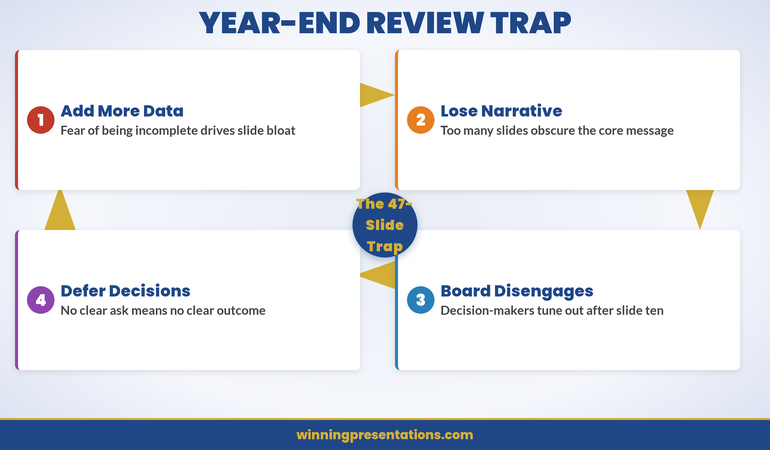
Tomás had spent three weeks assembling the perfect year-end presentation. As VP of Operations at a mid-sized logistics company, he’d meticulously documented every achievement: new warehouse efficiency metrics, cost reductions by division, team expansions, process improvements. He’d created gorgeous charts, compelling narratives, supporting evidence across 47 slides—enough material to tell the complete story of an extraordinary year.

The CEO gave him 15 minutes with the board. Two slides in, he saw the glaze. Nobody was following his narrative. They wanted the answer to one simple question: Where did we win, and what does it mean for next year?

That afternoon, Tomás redesigned everything around a single summary slide. On it: year-on-year performance against four critical metrics, a visual explanation of why those metrics shifted, and three explicit priorities for the next twelve months. He kept the 47 slides but repositioned them as evidence—appendix material that the board could explore if they wanted depth. When he presented the new structure, the CEO asked better questions. The board engaged differently. The decision happened faster.

Tomás discovered what every executive eventually learns: the slide that matters most isn’t buried in a narrative mountain. It stands alone, crystalline, at the beginning—telling the entire story in one breath.

The Executive Challenge

You have one chance to show your board or executive audience that you understand what matters. Most year-end presentations bury that message in layers of supporting detail. What if you reversed the structure—putting your most powerful insight first, then letting supporting slides provide the depth executives need to feel confident in your conclusion?

Why 47 Slides Kill Your Message

Executives rarely object to having information available. They object to being made to work too hard to find meaning. When you build a year-end review presentation as a chronological narrative—achievements one, achievements two, achievements three—you’re asking your audience to connect dots you should have already joined.

The cognitive load problem compounds over time. Each new metric, story, or data point increases the mental effort required to hold the previous points in working memory. By slide 20, your audience has forgotten what slide 5 was really saying. By slide 47, they’re exhausted.

Worse: when everything feels equally important, nothing is. Your board comes away remembering fragments rather than the coherent narrative of your performance and future direction. They can’t explain your year to their peers because you gave them 47 data points instead of one crystalline insight.

The One-Slide Revolution

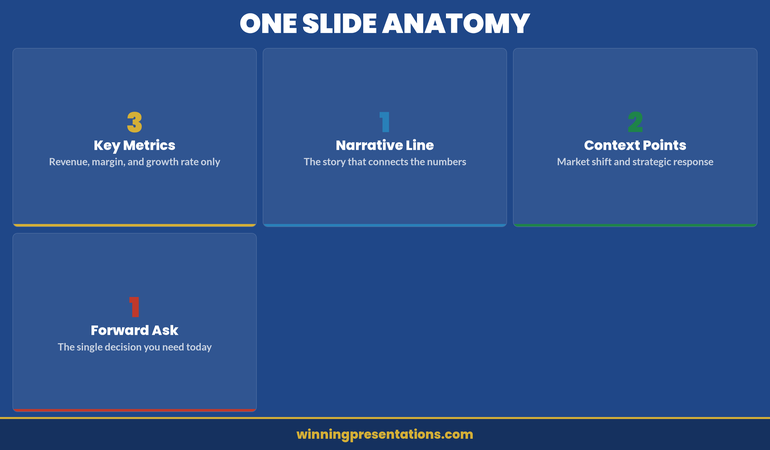
Your year-end review presentation must lead with clarity. One summary slide—properly constructed—can do the work of dozens. It compresses the year’s narrative into three elements: What happened (your performance against agreed metrics), Why it happened (the context and drivers), and What’s next (your strategic priorities). Everything else supports this framework. This approach isn’t about hiding detail. It’s about respecting your audience’s cognitive capacity and your credibility.

The Anatomy of One Powerful Summary Slide

A strategic summary slide has a precise internal architecture. It’s not a default template; it’s a carefully composed argument.

Section One: Performance Against Commitment sits at the top-left. You show 3–4 metrics you committed to at the start of the year against actual results. Think year-on-year growth, cost reduction, new customer acquisition—whatever your business measures. Use colour coding: green for outperformance, amber for on-track, red only if you must. Be honest. Boards respect accountability.

Section Two: The Context Layer occupies the top-right. This is crucial and often missing. You show the external or internal factors that shaped your performance. Market conditions? A product delay? A regulatory shift? Talent acquisition challenges? Don’t make excuses; explain causation. This section is where intelligent audiences learn that you understand the forces at play—not just the outcomes.

Section Three: Forward Direction sits below. You articulate 2–3 explicit priorities for the next 12 months. These should flow logically from your performance review. If you underperformed in customer retention, your next priority might be a retention-focused initiative. This section shows that you’re not just reflecting; you’re directing.

Anatomy of an effective year-end summary slide showing key components for executive review

The visual hierarchy matters enormously. Your metrics and context occupy roughly 60% of the slide. Your forward direction occupies 40%. This ratio reflects reality: most of the conversation will circle back to the question, “Given where we’ve been, where should we go?”

The Narrative Architecture Behind It

Why does this structure work? Because it mirrors how executive brains actually process information about performance.

When a board member looks at your summary slide, they’re answering a sequence of questions in real time. Did we hit our targets? Your performance section answers this in seconds. If we didn’t, why not? If we did, was it luck or skill? Your context section answers this. Now that I understand where we’ve been, where should we focus next? Your forward direction section answers this.

This narrative sequence is psychologically efficient. It moves from concrete (what happened) through explanatory (why it happened) to strategic (what we do about it). Your audience doesn’t have to guess the point. The point is evident.

The supporting slides you’ll present afterward hang on this framework like ornaments on a tree. When you say, “Here’s our detailed revenue breakdown by division,” your audience already knows why they’re looking at it—it’s evidence for the performance claims you made on your summary slide.

Inline Tip: When you structure your year-end review presentation this way, you’re not just making a better deck—you’re making your audience’s decision-making process visible. Executives can see exactly what they need to understand to assess your performance and set the next year’s direction. That transparency builds confidence.

Supporting Slides and the Appendix Role

Your 47 slides haven’t disappeared. They’ve simply been repositioned.

After your summary slide, you present detailed supporting evidence organised by theme. If your summary mentioned “operational efficiency improvements,” your next section unpacks that theme: new processes, adoption metrics, cost savings by initiative. If you mentioned “talent challenges,” your next section addresses hiring, retention, and capability development. This organisation makes the connection between your summary claims and your supporting detail explicit and easy to follow.

The appendix—slides 20–47—becomes genuinely optional. A CFO might drill into detailed financial forecasts. A board member focused on risk might skip to compliance and regulatory updates. But they’re choosing to explore based on interest, not drowning in mandatory detail.

This structure also works beautifully in writing. When you send your year-end review presentation ahead of a board meeting, executives can read your summary in two minutes. Those who want evidence can explore the supporting sections. Those who want everything can review the full appendix. Everyone gets what they need.

Common year-end review presentation mistakes and how to avoid them

Presenting to Different Audiences

Your board needs to see governance and strategy. Your team needs to see achievement and direction. A government regulator might need to see compliance and risk management. Can one presentation structure serve all these purposes?

Yes—if your summary slide is truly comprehensive. The metrics you choose, the context you highlight, and the priorities you set should be honest and complete enough that different audiences can extract what matters to them.

When you present to your team, you might dwell longer on the “context” section, helping people understand external pressures and industry shifts. This deepens their appreciation for organisational performance and their role in it. When you address the board, you might dwell on forward direction, using the appendix to justify why your priorities will create shareholder value.

The summary slide is the hinge. Everything else pivots around it.

Decision-Making Confidence

When executives see your year-end review presentation structured around one crystalline summary, they make better decisions. Not just because the data is different, but because they can hold the entire narrative in their minds. That clarity translates directly into confidence for better decisions, budgeting, and strategic alignment.

Get the Executive Slide System

Common Pitfalls and How to Avoid Them

Pitfall One: Trying to Fit Too Much Onto the Summary Slide. Resist the urge to show 8 metrics instead of 4, or 5 priorities instead of 3. Constraint forces clarity. If you can’t articulate why a metric matters, it shouldn’t be on your summary slide. Move it to supporting evidence. The summary’s power lies in its discipline.

Pitfall Two: Disconnecting Your Priorities From Your Performance. If your performance review showed underperformance in customer satisfaction but your forward priorities don’t address it, you lose credibility. Executives will assume you either didn’t notice or don’t care. Every priority should feel like a logical response to something on your performance or context section.

Pitfall Three: Making the Summary Too Jargon-Dense. Your summary slide is your moment to speak clearly to non-specialists on your team or board. Avoid acronyms without definition. Avoid industry-specific terminology without translation. If a smart 16-year-old couldn’t understand your summary slide, you’ve failed the clarity test.

Pitfall Four: Presenting It as Fixed. Your summary slide is the opening move in a conversation, not the final word. Invite questions. Be prepared to zoom into detail when someone asks. The most powerful executives are those who can hold the high-level narrative and zoom into granular evidence simultaneously. Your presentation structure should support that flexibility.

Frequently Asked Questions

Should my summary slide include financial data?

Only if your department directly owns a P&L or budget line. If you do, include the headline figure and variance. If you don’t, reference the financial impact of your work indirectly: cost saved, revenue enabled, risk avoided. The summary slide is about impact, not accounting.

How detailed should my context section be?

One slide, maximum. Context exists to orient the audience, not to relitigate the year. State the strategic priority, the operating conditions that shaped your results, and move on. If context takes more than 90 seconds to deliver, you’re over-explaining.

What if my actual performance doesn’t support a confident forward look?

Be honest. A year-end review that inflates next year’s outlook destroys credibility when Q1 results arrive. Present realistic targets with clear dependencies. The board respects realism far more than optimism. If your forward look is cautious, explain why and what would need to change for the outlook to improve.

Should I include a year-end review presentation before my board meeting or after?

Before. The year-end review sets the context for next year’s strategy discussion. If the board doesn’t have a clear view of where you’ve been, they can’t meaningfully evaluate where you’re going. Present the review first, then move to strategy.


Getting this right changes how your organisation thinks about annual reviews. Instead of a retrospective checklist, your executive summary becomes a strategic document—one that shows your board not just where you’ve been, but where you’re going and why. The clarity that summary slide creates ripples outward. Your team understands priorities more clearly. Your stakeholders support your direction more confidently. Your board makes better decisions.

Start with your summary slide. Let everything else hang from it. You’ll be amazed at how much more effective your entire approach becomes.

The Winning Edge Newsletter

Join executives, board members, and presentation leaders who get a fortnightly email about structuring presentations for high-stakes moments. Plus templates, frameworks, and thinking on governance and executive communication. Subscribe to The Winning Edge.

Download the Executive Presentation Checklist to validate your year-end review structure.


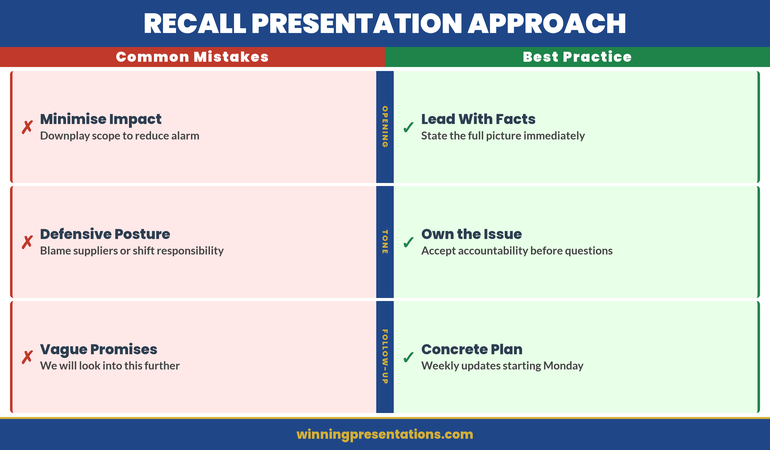
Read Next: Product Recall Presentation: How to Communicate Crisis With Clarity — when stakes are highest and time is shortest, the structure of your presentation determines whether your organisation controls the narrative or the narrative controls you.


Mary Beth Hazeldine is the Owner & Managing Director of Winning Presentations. With 24 years of corporate banking experience at JPMorgan Chase, PwC, Royal Bank of Scotland, and Commerzbank, she advises executives across financial services, healthcare, technology, and government on structuring presentations for high-stakes funding rounds and approvals.

01 Apr 2026
Executive presenting crisis communication plan to board during an urgent product recall meeting

Product Recall Presentation: Transparency That Preserves Trust

Quick Answer

A product recall presentation must lead with the problem, not the solution. Most executives bury the severity in slide 3 and spend 20 minutes on mitigation. Instead, structure transparency-first: what happened, who it affects, timeline to resolution, and what you’re doing next. This approach preserves stakeholder trust because it treats the board as partners in crisis response, not an audience to manage.

Table of Contents

The Moment Everything Changed

Adaeze had been Head of Operations at a mid-sized medical devices company for seven years. The Friday morning email from Quality Assurance landed at 6:47 a.m.: a batch of 4,200 cardiac monitoring devices carried a firmware fault that could delay alarm notifications by up to 18 seconds. The risk was real, albeit rare—but in cardiac care, 18 seconds matters.

She had 72 hours to present to the board. Not to request permission to issue a recall. To explain the recall that was happening whether the board liked it or not, and to demonstrate that management had a plan the board could trust. Adaeze’s instinct was to minimize the language—”isolated issue,” “proactive measure,” “limited scope.” But she knew that approach would backfire. The board would ask harder questions. Regulators would later find evidence of soft language in board materials. And customers would learn the truth from someone else first.

Instead, she flipped the structure. She led with the problem. She named the risk. She showed the board her remediation plan not as a defence, but as evidence that management had already thought six moves ahead. By the time she finished, the board wasn’t managing crisis. They were supporting a leadership team that had already started managing it.

A product recall is your moment to demonstrate that leadership means accountability, not spin. The executives who survive crises aren’t the ones who minimise the problem—they’re the ones who own it completely and show the board a credible path forward. This article walks you through the structure that turns a crisis presentation from defensive to authoritative.

Why Most Recall Presentations Fail

The pattern is predictable. An executive stands up to brief the board on a product recall. Slide 1 is a cheerful title slide. Slide 2 frames it as “an abundance of caution.” Slide 3 finally names the issue—buried in the third bullet point. Slide 4 launches into mitigation strategy. Slide 5 shows the timeline. Slide 6 introduces the communications plan.

Meanwhile, the board is thinking: You waited until slide 3 to tell me what actually happened? Why should I trust your judgment on what happens next?

Most recall presentations fail because they prioritise soft-pedalling over clarity. They front-load context and caution language. They bury the severity. They spend 60% of the time on mitigation and 10% on what actually happened. And because the board can smell that sequencing choice, they lose confidence in the presenter’s judgment before the substantive slides begin.

The board doesn’t need you to make the recall sound better. They need you to make the recall understandable, and to show that you’ve thought through the consequences. That requires leading with the problem, not the solution.

Master the Structure for Every Crisis Moment

Whether it’s a recall, a data breach, or a restructuring announcement, the structure that works is transparency first, then solutions. The Executive Slide System gives you the frameworks for framing crisis moments with authority—so your board hears leadership, not damage control.

Build presentations that preserve stakeholder trust and communicate with clarity under pressure.

The Transparency-First Structure

Here’s the reframe: a product recall presentation is not a crisis update. It’s a situation briefing where you, the executive, are already three steps ahead. You’ve already decided the recall is necessary. You’ve already mapped the consequences. You’ve already drafted the plan. The board’s role is to understand the decision and support the execution.

That mindset changes everything. It changes what you lead with. It changes the language you use. It changes the board’s perception of your judgment.

The transparency-first structure works like this:

  1. Situation: What happened, when, how many units, who it affects. State it plainly. No understatement.
  2. Risk Assessment: What’s the actual hazard? Is there a reported incident? What’s the severity window? (72 hours, 30 days, ongoing?)
  3. Regulatory Landscape: What agencies are involved? What are we required to do? What are we choosing to do beyond requirement?
  4. Our Response Plan: What happens next, in sequence, with owners and timelines.
  5. Stakeholder Communication: Who else knows? Who do we tell, and in what order?
  6. Financial Impact & Recovery: What’s the cost? What’s the insurance position? What’s the timeline to normalcy?

Notice what’s absent from this structure: the soft language, the hedging, the “we believe there is a low probability” phrasing. You’re not downplaying. You’re owning. And paradoxically, that ownership builds more trust than any amount of minimisation language ever could.

What to Include on Each Slide

Slide 1: The Situation (Full context)

This is not a title slide. This is your opening move. Use a stark, direct headline: “Batch X4420 Cardiac Monitoring Devices—4,200 Units Affected—Immediate Action Required.” Include the discovery date, the affected customer base (by geography, by customer type), and the nature of the defect in plain language. One visual: a map or a simple count showing distribution. The board should grasp the scope in 90 seconds.

Slide 2: Risk Profile

What is the actual risk to patients or users? Don’t say “low risk”—define it. “Firmware delay of up to 18 seconds in alarm notification. No reported incidents to date. Estimated probability of adverse event: 0.02% per device per annum, based on comparable defects.” This is where you show you’ve done the analysis. Include any reported incidents (be honest if there are none, be serious if there are any).

Slide 3: Regulatory Requirement vs. Our Choice

What does the FDA (or equivalent) require? Class I recall? Notification? What are we doing that goes beyond requirement? This is where you show judgment. Most companies do the minimum. You’re doing the recall because it’s right, not because you’re forced to. Frame it that way.

Slide 4: Response Plan Timeline

This is a Gantt chart or a simple sequencing: Day 1 (today), notify Key Opinion Leaders and major customers. Day 2, regulatory submission. Day 3, public announcement. Week 1, field replacement programme begins. Week 4, 80% replacement target. Week 8, full resolution. Own the timeline. Show who’s accountable for each phase.

Slide 5: Communications Cascade

Who are we telling, in order of priority? Customers (direct contact), key stakeholders, regulators, public (press release), internal teams. What’s the message for each audience? Show the board that you’ve already drafted the customer-facing letter, the investor call script, the internal memo. This prevents panic and shows preparation.

Slide 6: Financial Impact

Be precise. Replacement cost: £X. Logistics: £Y. Customer compensation (if applicable): £Z. Insurance recovery: £A. Net impact: £(X+Y+Z-A). Timeline to resolution (and profitability recovery). This is not a forecast—it’s the plan. The board respects precision more than optimism.

Four elements of an effective ten-minute department update: one headline, three metrics, one decision, and one action

Designing Your Slides for Authority

The visual design of a recall presentation signals either panic or control. Use a clean, minimal template. Navy and white. One accent colour (gold, if you want to match Winning Presentations brand). No animations. No stock photos of smiling people. Use actual data, actual timelines, actual photographs of the affected product if it helps clarity.

One tactical point: if you have 4,200 units affected, show 4,200 on the slide. Don’t round to “approximately 4,000.” The precision signals that you’ve counted them, that you know exactly what you’re dealing with. When the board sees that precision, they believe you.

Quick recommendation: Before you build your slides, draft the customer notification letter. Get it approved by legal and communications. Then build your presentation around the facts you’ve committed to in writing. This forces rigorous thinking and ensures your presentation can’t later be accused of overstating or understating the problem.

Managing Hostile Questions and Pressure

Some board members will be angry. They’ll ask why this wasn’t caught sooner. They’ll worry about liability. They’ll question the cost. They’ll ask what happens if the recall doesn’t solve the problem. This is inevitable. Plan for it.

The principle: answer the hostile question by affirming what you’ve already decided. “You’re right to ask why this wasn’t caught sooner. That’s exactly why we’ve already commissioned a root-cause analysis with an external auditor. That report is due in four weeks, and we’ll present findings and corrective actions to this board in May.” Don’t defend the past. Own the investigation. Move to the future.

Similarly, if a board member questions the financial impact, don’t negotiate. Restate the figure. “The gross cost is £2.4 million. Insurance is covering 70% of that. We’re absorbing £720,000. And we’re recovering that through operational efficiencies on three other projects we’re pausing.” You’ve already done the math. You’re not discovering it in real time.

The most dangerous questions are the ones that betray lack of confidence in your strategy: “What if more defects emerge?” “What if customers sue?” “What if the regulator disagrees with our timeline?” For each, you should have a contingency prepared. “If additional defects emerge in the analysis phase, we’ll expand the recall scope and accelerate the timeline. We’ve already identified suppliers for a 50% acceleration if required. If customers sue, we have product liability coverage up to £15 million. If the regulator challenges our timeline, we’ve built a seven-day buffer into every phase so we can accelerate without affecting quality of replacement.”

Contingencies signal that you’re not naive. You’ve war-gamed the worst case. That’s what a board wants to hear.

Crisis Presentations Demand Speed and Structure

You don’t have time to start from scratch. The Executive Slide System includes pre-built frameworks for product recalls, data breaches, layoffs, and other crisis moments. Customize in minutes. Present with confidence.

The Follow-Up Communication Plan

Your board presentation is the beginning, not the end. Within 24 hours of board approval, every relevant stakeholder group needs the same core message—delivered via their preferred channel.

For customers: a direct email or phone call from someone with authority. Not “We’re issuing a recall.” But “We discovered a potential firmware issue in your batch. Here’s what we’re doing, here’s how we’re replacing it, here’s what you need to do in the next seven days.”

For investors: a calm, factual update in your next investor call or quarterly filing. “We’ve initiated a product recall affecting 4,200 units. The financial impact is £720,000 net. This does not materially affect FY2026 guidance.” The calm tone matters as much as the fact.

For regulators: proactive submission of your corrective action plan. Don’t wait for them to ask questions. Show them you’ve thought three moves ahead.

For employees: an internal memo that explains the recall in the context of your company values. “We discovered this issue. We’re fixing it comprehensively. This is what we stand for.” Employees will hear the news from outside sources if you don’t tell them first.

Comparison of time-wasting versus action-driving department update presentations across opening, data, and closing approaches

Frequently Asked Questions

How much detail should I include on each slide if the board only has 45 minutes?

Aim for 6–8 slides maximum, with 3–4 minutes per slide. The detail should live in your speaker notes and in the appendix. The board needs the architecture of your thinking on the main slides, not every number. That said, don’t shy away from the key figures: unit count, financial impact, timeline, and contingency plan. Those four things should be crystal clear on the main deck.

Should I acknowledge my team’s role in missing this defect?

Briefly, yes. Not as a defensive gesture, but as an acknowledgement that you’re investigating. “Our quality team did not flag this issue in our standard testing protocol. As part of this recall, we’re conducting a comprehensive root-cause analysis to understand why, and we’ll present those findings and our remediation plan to the board in May.” This shows accountability without dwelling on blame. The board wants forward motion, not a guilt spiral.

How do I handle the board if they want to delay the recall announcement?

You can’t. From a regulatory and ethical standpoint, once a defect is identified that poses a risk, the clock starts. Delaying actually increases your liability, not decreases it. If the board pushes back, reframe: “I understand the instinct to manage the announcement. But the faster we act, the more control we retain. If regulators find out we delayed, that’s a much bigger story. If customers discover the defect from a third party before we tell them, that’s reputational damage we can’t recover from. Speed is our advantage here.”

What if the recall is bigger than initially estimated?

You’ll discover this during or after your board presentation. Have a protocol ready: “If we find that this affects a larger batch than initially identified, we notify the board within 24 hours with an updated presentation. We’ve built flexibility into our remediation plan so we can scale the response without delay.” Again, the board respects preparation. If you’ve already thought about how to handle expansion, they’ll trust the escalation when it happens.

Get executive presentation strategies delivered to your inbox weekly.

The Winning Edge newsletter covers frameworks for high-stakes presentations, board meetings, and crisis communication. Strategic, practical, no filler.

Subscribe to The Winning Edge

Download the Executive Presentation Checklist to validate your crisis presentation before you present to the board.

Related Articles

Read next: Board Paper vs Board Presentation: When to Use Each

For other crisis communication frameworks, see:

What to Do Next

If you’re facing a crisis in the next week or month, start with the customer notification letter. Get it approved by legal and communications first. Then structure your communications around the facts in that letter. This forces clarity and ensures consistency across all stakeholders.

The transparency-first approach isn’t soft. It’s the hardest thing you can do as an executive—because it means owning the problem completely, not managing how others perceive it. But it’s also the approach that preserves trust, accelerates resolution, and positions your leadership as credible when the crisis passes.

Mary Beth Hazeldine is the Owner & Managing Director of Winning Presentations. With 24 years of corporate banking experience at JPMorgan Chase, PwC, Royal Bank of Scotland, and Commerzbank, she advises executives across financial services, healthcare, technology, and government on structuring presentations for high-stakes funding rounds and approvals.

01 Apr 2026
Professional man in a navy suit reviews documents at a desk with a laptop in a modern office.

Board Paper vs Board Presentation: Know the Difference

A board paper is a written document submitted in advance that makes a case through evidence, context, and recommendation. A board presentation is a live conversation where visual support and executive summary matter more than comprehensive detail. The confusion costs organisations millions in poor governance decisions because boards receive the wrong format for their decision-making context.

Last month, Kwasi—a finance director at a mid-cap healthcare organisation—prepared what he believed was a comprehensive presentation on a proposed acquisition. He loaded 47 slides with financial models, regulatory timelines, and risk scenarios. He began his board presentation by saying, “I know there’s a lot here, so let me walk you through everything.” Midway through slide 12, the chair interrupted: “Kwasi, we didn’t need the detail. We needed your recommendation and the three key risks. You’ve buried the decision.” That 90-minute meeting should have taken 20 minutes. The board approved the acquisition anyway—but Kwasi had wasted the board’s time and undermined his own credibility because he’d confused a board paper with a board presentation. The paper existed (a 30-page investment memorandum, circulated days earlier). What the board needed was a live conversation structured around decision-making, not a slide-by-slide recitation of existing documents.

A practical resource for boards

Many governance professionals conflate these two formats, or worse, create only one when they need both. The problem is structural: boards need written evidence (the paper) and live dialogue (the presentation) to make sound decisions. Understanding the distinction clarifies not just what you write and speak—but how you think about board communication. This article walks you through both formats, including when to use each and how to structure them so your board actually makes better decisions faster.

cisions faster.

The Fundamental Difference Between Format and Purpose

A board paper and a board presentation serve fundamentally different cognitive and procedural purposes, even when they address the same topic.

A board paper is a written artefact of record. It exists to create a shared information base, build a case through evidence and reasoning, and allow board members to review independently before a meeting. Board papers typically run 8–30 pages. They include:

  • Executive summary or recommendation at the start
  • Detailed background context
  • Financial, legal, or regulatory implications
  • Risk analysis and mitigation strategies
  • Appendices with supporting data, external advice, or comparative analysis

A board paper is asynchronous: board members read it independently, sometimes days before the meeting. It must be self-contained because the author isn’t present to explain.

A board presentation is a live conversation with visual support. It exists to facilitate discussion, answer questions in real time, test assumptions, and build consensus around a decision. Board presentations typically run 15–40 minutes (not hours). They include:

  • A clear, concise recommendation at the start
  • Three to five key supporting points (not 30)
  • Visual aids that summarise, not enumerate
  • Invitation to questions and challenge
  • A closing decision frame (“We recommend approval, pending your questions about risk mitigation”)

A board presentation is synchronous: it depends on the presenter being present to respond, clarify, and address concerns. The visuals are memory aids for what the presenter is saying, not substitutes for the paper.

The psychological difference is critical. Reading demands sustained cognitive effort; the reader controls the pace. Speaking in real time demands attention but allows the presenter to prioritise, respond to non-verbal cues, and adjust based on the room’s reaction. A board that reads a paper first, then hears a presentation, has processed the information twice—once independently and once collaboratively. This redundancy is deliberate: it drives better decisions because it creates multiple moments for challenge and clarity.

Clarify your board communication structure today

The Executive Slide System gives you a tested framework for designing both board papers and presentations that boards actually engage with. No vagueness. No buried recommendations. Just clarity.

Get the Executive Slide System

Infographic comparing board paper format versus board presentation structure for governance meetings

When Each Format Is Appropriate

The choice between paper and presentation (or both) depends on the decision’s complexity, the board’s time availability, and the level of detail required for accountability.

Use a board paper when:

  • The decision involves complex financial, legal, or regulatory detail that requires deep scrutiny (acquisitions, material contracts, governance policy changes)
  • Board members must form an independent opinion before the meeting (regulatory best practice increasingly demands this)
  • You need a record of the information considered and the reasoning for the decision (audit trail)
  • Multiple stakeholders need to review the information asynchronously (board secretary, external counsel, auditors)
  • The decision is significant enough to warrant 30+ minutes of pre-meeting preparation from each director

Use the live presentation format when:

  • You’re presenting a recommendation that’s already backed by a written paper (the norm for most board meetings)
  • The recommendation needs live challenge or testing of assumptions
  • Time is limited and the decision is straightforward (board approval of a standard-form report, for instance)
  • The board has already reviewed detailed information and now needs to discuss and decide
  • You need to calibrate the board’s appetite for risk in real time based on their questions

Use both when: The decision is high-stakes, the paper is substantial (15+ pages), and the recommendation involves judgment calls. This is the norm for public company boards, private equity boards, and governance committees. The paper provides the evidence; the presentation surfaces assumptions and tests the logic.

The hybrid approach—where a board paper is circulated days in advance and a presentation follows at the meeting—remains the governance gold standard, particularly in regulated industries. It creates space for independent thought and collective challenge.

If you’re managing complex board communications, the Executive Slide System walks you through structuring written and live formats for maximum board engagement.

The Cost of Confusing the Two Formats

In practice, three mistakes dominate. Each one costs boards time, decision quality, or both.

Mistake one: Presenting the paper. This is Kwasi’s error. The presenter walks the board through a 25-page document, slide by slide, as though reading aloud is live discussion. The board already reviewed the written material. What they now need is clarification, challenge, and decision-making dialogue. Instead, they get a recitation. The result: wasted time, diminished credibility for the presenter, and a board that feels talked at rather than engaged with.

Mistake two: Creating a presentation without a paper. Some organisations skip the board paper entirely, assuming a good presentation is enough. This works for low-stakes decisions (approval of a standard report format, routine governance item). But for any decision with material implications, it shifts the burden of synthesis entirely to the board members during the meeting. They cannot form an independent view beforehand. They must absorb unfamiliar detail while also responding to live discussion. The decision quality suffers. And there’s no written record of the information that informed the decision—a problem during audits or if the decision comes under later challenge.

Mistake three: Confusing brevity with clarity. Some executives, trying to avoid Kwasi’s error, strip presentations down to four slides with almost no information. The board then feels they’re being patronised or hidden from the truth. Or they’re forced to pester the presenter for clarifications that should have been in the paper. The line between “appropriately concise” and “unhelpfully vague” is real but easily crossed.

The cost is real. Poor board communication leads to rushed decisions, unvetted assumptions, delayed approvals, and reduced board confidence in the executive team. Over time, it erodes the board’s ability to govern effectively.

How to Structure Board Papers for Maximum Impact

A board paper should guide the reader to a clear recommendation within the first two pages, then build the case. The structure matters more than the length.

Start with the executive summary. This is not an overview. It’s a one-page argument: what you’re recommending, why, the key evidence, and the risks you’ve considered. A competent board member should be able to read this page, ask intelligent questions, and vote based on the executive summary plus the detail they choose to explore. Many papers bury the recommendation on page 8. That’s a structural failure. The reader should know within 30 seconds what you’re proposing.

Follow with background and context. Assume the reader doesn’t know this space as well as you do. Provide the history, the regulatory landscape, or the market context that explains why this decision matters now. This is where you build credibility through evidence, not rhetoric.

Present the case in a logical sequence. Don’t arrange information by data source (financials, then legal, then operations). Arrange it by argument. If the decision hinges on three factors, present them in order of importance or logical dependency. Use clear headings. Use data visualisation where a table would burden the reader. A board member with limited time should be able to skim headings and grasp the argument.

Acknowledge risks and mitigation explicitly. A good board paper doesn’t pretend the option is risk-free. It identifies material risks and explains how you’d mitigate them. This is where boards actually trust executives—when they show they’ve thought critically about downside. A recommendation with no acknowledged risk looks naive.

Close with a clear decision frame. “We recommend approval of the acquisition, subject to no material changes to the vendor’s financial position between now and close, and contingent on the indemnity language reflecting the discussion at the last board meeting.” This is not vague. It’s precise. It tells the board exactly what they’re approving and what triggers a re-discussion.

Build board papers that actually drive decisions

The Executive Slide System includes a board paper template and checklist that ensures you structure recommendations for maximum clarity and board confidence. No guesswork. No wasted words.

Explore the System

Decision framework for choosing between board paper and board presentation formats

How to Structure Board Presentations for Decision-Making

A board presentation should assume the audience has read the paper (or at least the executive summary). Its job is to answer questions, test assumptions, and facilitate a decision. The structure is radically different from a typical corporate slide deck.

Start by stating your recommendation clearly. Not as a conclusion after 20 minutes of building. As the first thing you say. “We recommend approval of this acquisition, subject to the indemnity and earn-out terms outlined in the paper.” Then: “I’m here to answer your questions and address any concerns about the logic or the risks.” This positions you as confident and decision-oriented, not as someone who needs to talk the board into compliance.

Prepare for three categories of questions. Boards ask about assumptions (Is the revenue projection realistic?), risks (What if the vendor’s key customers leave?), and trade-offs (Why not explore an acquisition at a lower valuation?). Your presentation should signal that you’ve anticipated these. Have a slide or two on key assumptions and sensitivity. Have a slide on risks and mitigation. Have a slide on alternatives considered. But don’t present these unprompted. Present them only as they’re relevant to the discussion.

Use visuals as anchors, not scripts. Each slide should support what you’re saying, not duplicate it. If you’re discussing three market drivers for the acquisition, a simple visual showing those three drivers gives the board something to focus on while you explain the logic. A slide with 15 bullet points forces the board to read or listen—not both. Most choose to read, which means they’re not hearing you.

Build in space for dialogue. A 40-minute session should include 15–20 minutes of unstructured conversation, not just Q&A at the end. Early on, invite challenge: “Before I move to the financial detail, does anyone want to push back on the market assumptions?” This shows confidence and signals that you’re interested in collective intelligence, not rubber-stamp approval.

Close with a decision frame and next steps. “We need board approval to proceed with the vendor due diligence. The timeline is tight—we need approval today to keep to our close deadline. If there are any remaining concerns, I’d like to hear them now.” This is executive-level communication: clear, time-bound, and action-oriented.

Handling the Hybrid Scenario

Most high-stakes board decisions use both a paper and a presentation. This is the governance default for good reason: it allows boards to prepare independently and then deliberate collectively. But it creates a co-ordination challenge.

First, ensure the paper is circulated at least three working days before the board meeting. This gives directors time to read without rushing. It also signals that you’re serious about giving them space to form an independent view.

Second, before you present, confirm that all directors have received the paper and had a chance to review it. If someone hasn’t, adjust your presentation: briefly summarise the key argument and focus on the points most likely to generate discussion.

Third, start your presentation by stating what’s different from the paper. “Since the paper was circulated, we’ve received legal feedback on the vendor’s indemnity language. I want to walk you through that change and what it means for the board’s decision.” This respects the board’s preparation work and makes clear you’re not wasting their time repeating information they already have.

Finally, recognise that board members will interrupt or ask questions mid-presentation. This is a feature, not a bug. It means they’re engaged. Your job is to answer clearly and briefly, then continue. If a question reveals a gap in the paper, acknowledge it: “That’s a fair point that we should have addressed in more detail. Here’s my thinking…” This builds credibility far more than a defensive response would.

Frequently Asked Questions

Should every board decision have both a paper and a presentation?

Not always. Routine approvals often need only a paper. Complex or contested decisions benefit from both. The decision on format should be driven by two factors: how much context the board needs to process the decision, and whether the decision requires real-time discussion to reach alignment. If the answer to either is yes, a presentation adds value.

How long should the formal session actually be?

For a board presentation, 15–20 minutes including Q&A is the norm. A board paper has no fixed length but should respect the reader’s time: 3–5 pages of substantive content, with appendices for technical detail. If your paper exceeds 8 pages, you have included operational detail that belongs elsewhere.

What if the board hasn’t read the paper before the meeting?

Assume they haven’t. Structure your presentation so it stands alone. The paper provides depth for those who have read it; the presentation provides the decision framework for those who haven’t. If you rely on the paper being read, you’ll lose half the room before you’ve started.

Can I use the same slides for both the paper and the presentation?

No. A board paper is a written document designed to be read. A presentation is a visual aid designed to support spoken delivery. The formats, information density, and narrative flow are fundamentally different. Repurposing one as the other produces a document that fails at both jobs.

Subscribe to The Winning Edge

Practical insights on board communication, governance, and executive presence delivered fortnightly to your inbox.

Join The Winning Edge

Download the Executive Presentation Checklist to validate your approach before the next board meeting.

Related article from today

How to structure a product recall presentation so regulators and stakeholders understand your response plan. Read the article

Your next step: Audit your current board papers and presentations against the criteria in this article. Are you presenting the paper, or are you presenting to the board? Are your papers structured to guide the reader to your recommendation, or do they bury it? One structural change—moving the recommendation to page one, for instance—can shift how boards receive and engage with your communications.

About the author

Mary Beth Hazeldine is the Owner & Managing Director of Winning Presentations. With 24 years of corporate banking experience at JPMorgan Chase, PwC, Royal Bank of Scotland, and Commerzbank, she advises executives across financial services, healthcare, technology, and government on structuring presentations for high-stakes funding rounds and approvals.