31 Mar 2026
Executive boardroom prepared for a succession planning discussion with leadership pipeline slides on screen

Succession Planning Presentations: The Format That Makes the Conversation Productive

Succession planning presentations fail when they’re built like status updates. You walk into the room with slides about the timeline, the candidate profile, and the transition plan, but what you get back is hesitation, questions you didn’t anticipate, and a “let’s revisit this later” that means the board has reservations you never heard.

Jump to: What makes these presentations different | The five-section structure | Handling objections | Building credibility | Common missteps

The problem is structural. Ines, a Chief Operating Officer at a financial services firm, spent six weeks preparing a succession plan for her retiring Head of Operations. She’d done the hard work: identified the internal candidate, mapped the knowledge transfer, assessed the risk. But when she presented to the board, the conversation stalled. Board members asked for more detail on capability gaps. They wanted to see the bench. They wondered whether promoting from within was even the right move. Ines walked out having to restart the conversation entirely.

What Ines lacked wasn’t information—it was structure. A succession planning presentation isn’t a briefing. It’s a persuasion architecture. It needs to surface stakeholder concerns early, build confidence in your reasoning, and move people from scepticism to alignment. That’s a different format entirely.

Struggling with high-stakes presentations? The Executive Slide System is built for moments like this. Learn the framework that structures difficult conversations—succession, restructuring, investment cases—so stakeholders hear your reasoning first, not your conclusion. Explore the system →

What makes succession planning presentations different

Succession planning sits in a narrow band of corporate conversation. It’s not a routine update. It’s not a crisis. It sits between approval-seeking and reputation-building, where the stakes feel high to everyone in the room because people’s careers are on the line—yours included.

The listeners—board members, senior executives, investors—are thinking three things simultaneously: Is this person ready? Is this process sound? And am I comfortable with the risk? They’re not hostile. They’re protective. They want to buy in, but they’re also doing their job by stress-testing your recommendation.

A standard presentation format doesn’t account for this. It leads with the conclusion (promote candidate X), then supports it with evidence (credentials, track record, transition plan). But that reverses how people actually evaluate succession moves. They evaluate from risk down to recommendation. They ask themselves: What could go wrong? How have you thought about alternatives? Why this person, not someone else?

The succession planning presentation format inverts this. It leads with the stakes and the risks, shows how you’ve thought them through, builds confidence in your process, and then presents the recommendation as the logical outcome of sound reasoning.

Executive Slide System £39

Master the exact format financial services, healthcare, and technology leaders use to gain alignment on succession, restructuring, and major decisions. Includes templates, framework guides, and real-world examples.

View System (£39) →

The five-section structure that builds alignment

The productive succession planning presentation has five sections. Each one serves a specific function in moving stakeholders from scepticism to agreement.

1. The Context & Constraints
Start by naming the decision that needs to be made and the timeline you’re working within. Be explicit about constraints: regulatory requirements, board expectations, market conditions. This grounds the conversation in reality and shows you’ve already done the systems thinking. It also signals that this isn’t a whim—it’s a necessary move aligned with business strategy.

2. The Risks & Mitigations
Name the specific risks stakeholders are thinking about but haven’t said out loud. Loss of institutional knowledge. Capability gaps. Retention risk among other candidates. Market disruption during transition. Then, for each risk, articulate how you’ve thought about mitigation. Not as bullet points that wave them away, but as genuine strategies. This is where you build credibility. You’re not hiding the hard problems—you’re showing you’ve already solved them mentally.

3. The Evaluation Process
Walk through how you evaluated options. Did you consider internal candidates, external candidates, or both? What criteria did you use? How did you weight them? This section is about transparency of thinking. It reassures stakeholders that you haven’t rushed to a conclusion. The recommendation that follows will land more firmly because people have seen the methodology.

4. The Recommended Candidate & Case
Now you present the recommendation. Lead with why this person solves the strategic problem you named at the start. Not their CV, not a skills matrix, but the argument: What does this organisation need from this role in the next three years, and why is this person the best positioned to deliver it? This is where you connect dots between capability and strategy.

5. The Transition & Success Metrics
Close with the practical plan: the transition timeline, who they’ll work with, the key milestones, and the metrics you’ll use to measure success in the first 100 days, first year. This moves people from abstract approval to concrete execution. It says: I’m not just recommending this person, I’m committing to making them successful.
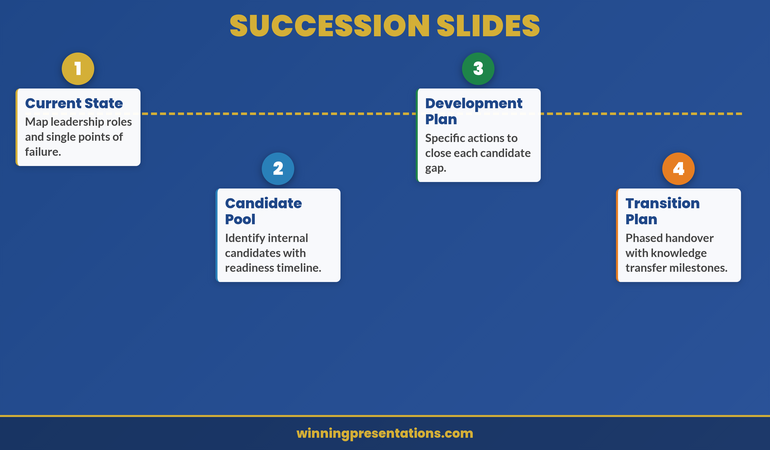
Succession planning slide structure showing four elements: current state, candidate pool, development plan, and transition plan

Within this five-section framework, your slides need to cover four concrete deliverables that the board expects to see. The first is the current state: a clear map of leadership roles and single points of failure. If one person’s departure would cripple an entire function, that’s the urgency the board needs to feel. Don’t assume they already understand the risk. Show them the org chart with the gaps circled.

The second deliverable is the candidate pool: who are the internal candidates, and what’s the readiness timeline for each? This isn’t a list of names with job titles. It’s an honest assessment of who could step into the role in six months, who needs twelve months of development, and who’s a longer-term prospect. Readiness timelines force you to be specific, and specificity is what gives the board confidence that you’ve thought beyond the immediate vacancy.

The third is the development plan: specific actions to close each candidate’s gaps. Not “we’ll provide coaching and mentoring” — that’s generic and the board will hear it as wishful thinking. Instead: “Priya needs exposure to regulatory reporting. We’re placing her on the compliance steering committee for Q2 and Q3 and assigning her to lead the next FCA submission.” That’s a plan the board can evaluate and hold you accountable for.

The fourth is the transition plan: a phased handover with knowledge transfer milestones. When does shadowing begin? When does the outgoing leader step back from day-to-day decisions? When is the new leader accountable for outcomes? Milestones create checkpoints where the board can assess whether the transition is on track — and that mechanism of oversight is often what converts their hesitation into approval.

Handling objections before they arise

The most powerful move in a succession planning presentation is to voice objections yourself before anyone else does. Not all of them—that would seem defensive—but the critical ones.

For example: “Some of you may be thinking we should look outside the organisation. Here’s why I’ve chosen to recommend from within, and here’s what I’ve validated about external alternatives.” This isn’t you being defensive. It’s you being thorough. It shows you’ve already tested your own recommendation and it held up. It also gives you control of the conversation. You’re bringing objections into the open where you can address them, rather than having them linger unspoken in the back of stakeholders’ minds.

The key is specificity. Don’t say “some people worry about capability.” Say “the role requires deep knowledge of our derivatives operations, and I want to address whether John’s background in equities is a limitation.” Now you’re talking about a real concern, and your answer carries weight.

This technique—naming and mitigating objections in your presentation—is covered in depth in our first board presentation guide, which walks through how to build board confidence in high-stakes moments.

When you present the Executive Slide System, you’ll see this principle embedded throughout. It’s the difference between a presentation that feels defensive and one that feels authoritative.

The role of confidence and credibility

A succession planning presentation is also a test of your credibility as a leader. Stakeholders are evaluating not just your candidate, but your judgment. Are you thoughtful? Have you considered second and third-order consequences? Do you understand the political landscape? Can people trust you with a decision this important?

This is why the structure matters so much. The format I’ve outlined—starting with context and constraints, moving through risks and evaluation process, then to recommendation—builds credibility with every section. You’re not asking stakeholders to trust you on assertion. You’re showing them your thinking. You’re letting them see that you’ve thought hard, evaluated fairly, and arrived at a conclusion that’s justified.

Equally important is tone. Succession planning presentations can’t be soft. But they can’t be rigid either. They need to be direct, precise, and conversational. You’re talking to peers who have legitimate concerns. Treat them that way. Acknowledge the weight of the decision. Show that you’ve felt the responsibility and done the work accordingly.
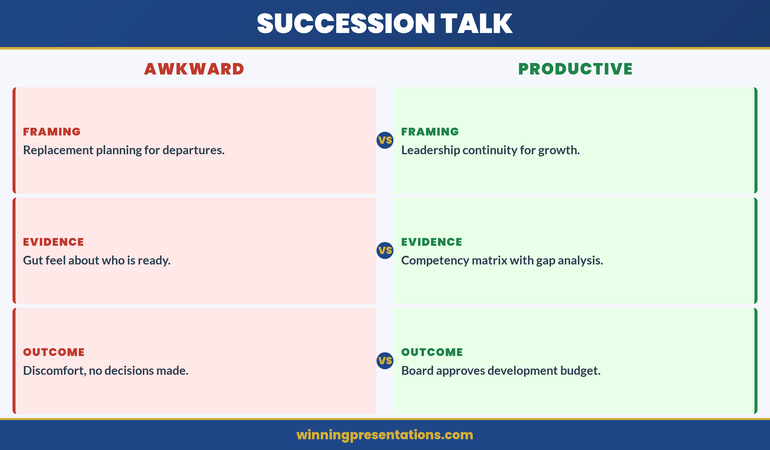
Comparison of awkward versus productive succession planning conversations across framing, evidence, and outcome

The difference between an awkward succession conversation and a productive one comes down to three dimensions. The first is framing. Awkward conversations frame succession as replacement planning for departures — someone is leaving, and we need to fill the gap. That framing carries anxiety because it centres on loss. Productive conversations frame succession as leadership continuity for growth — we’re building the next generation of capability because the organisation is evolving. That framing carries momentum. The board responds differently when the narrative is about growth rather than risk management.

The second dimension is evidence. Awkward succession presentations rely on gut feel about who is ready — “I’ve worked with James for five years and I believe he’s the right person.” That’s an assertion, not evidence. Productive presentations use a competency matrix with gap analysis: here are the five capabilities the role requires, here is where each candidate stands against them, and here are the gaps we’ve identified with specific development actions to close them. The matrix transforms a subjective opinion into a defensible process. Boards can challenge a gut feeling. They struggle to challenge a rigorous framework.

The third dimension is outcome. Awkward succession conversations end in discomfort and deferred decisions — no one wanted to say no, but no one was ready to say yes. Productive succession conversations end with the board approving a development budget, endorsing a transition timeline, or requesting a follow-up in 90 days with specific milestones. The difference isn’t the quality of the candidate. It’s the quality of the presentation structure that carried them there.

Common missteps in succession planning presentations

Most succession planning presentations fail not because the recommendation is weak, but because the format doesn’t create the conditions for stakeholders to feel confident in the decision.

Misstep 1: Leading with the candidate
You put the person’s photo and credentials on slide two. But stakeholders need to understand the problem and the decision context first. They need to know why this decision matters to the organisation. Only then does the candidate’s background become relevant.

Misstep 2: Treating risks as obstacles to get past, not problems to solve
When you name a risk and then quickly move on, stakeholders hear “this person has a gap and we’re hoping it doesn’t matter.” When you name a risk and articulate a specific mitigation strategy, they hear “we’ve thought about this and we have a plan.” The second builds confidence.

Misstep 3: Being vague about the evaluation process
“We looked at both internal and external candidates and decided that internal was the right move.” Too vague. Better: “We identified six candidates who met our criteria for the role. Four were internal, two external. We evaluated them against three dimensions: technical depth, leadership capability, and cultural fit. Here’s the outcome of that evaluation and why the recommendation emerged from that process.” Now people see you’ve been rigorous.

Misstep 4: Skipping the transition plan
The recommendation is the easy part. The transition is where things actually happen or fall apart. Stakeholders know this. When you walk through your transition plan—who the candidate will shadow, what handover looks like, what support you’re putting in place—you signal that you’re not just promoting someone and hoping for the best. You’re engineering a successful transition.

Ready to master executive-level presentations? The Executive Slide System includes real templates for succession planning, investment cases, and restructuring announcements. Learn the framework used by leaders in financial services, healthcare, and technology.

View System (£39) →

Common questions

Should I present the internal candidate’s main competitor as an alternative?

Only if you’re genuinely unsure which is the stronger recommendation, or if board members have specifically asked you to compare. If you’ve already concluded internally, presenting a serious alternative can confuse the conversation and make stakeholders worry you lack conviction. Instead, acknowledge that other candidates were considered and articulate why your recommendation emerged. You’ve done the hard comparison work already—stakeholders don’t need to see someone else in the presentation for it to feel like a fair process.

How much detail should I include about the candidate’s weaknesses?

Only the material ones—gaps that might genuinely affect success, paired with mitigation. Don’t list every small area for development. That reads as defensive list-making and undermines your recommendation. Instead, select one or two genuine capability gaps, name them clearly, and articulate how they’ll be addressed: through mentorship, external coaching, paired leadership, etc. This shows you’ve thought about development, not that you’ve settled for a mediocre candidate.

What if the candidate is a controversial choice?

If the recommendation is genuinely controversial—because of a past mistake, a difficult relationship, or a different career path—you need to address it directly in your presentation. Don’t hide it and hope board members don’t notice. Name the concern, acknowledge why it’s a fair thing to worry about, then articulate why you believe it’s not a disqualifying factor. Show what’s changed, what you’ve learned, or why the role is a different context. This gives stakeholders permission to move past their hesitation.


A succession planning presentation isn’t a status update. It’s a moment to demonstrate your judgment, your process, and your commitment to making the right decision for the organisation. When you structure it properly—moving from context to risks to evaluation to recommendation to transition—you create the conditions for stakeholders to hear your reasoning, evaluate it fairly, and move from scepticism to alignment.

The format works because it respects how senior leaders actually evaluate succession decisions. They don’t decide from conclusions down—they evaluate from risks up. Give them what they need, in the order they need it, and they’ll buy in.

Stay ahead in executive communication

Get insights on structuring high-stakes presentations, board conversations, and funding pitches. Delivered to your inbox weekly.

Join The Winning Edge →

Prefer a checklist? Download our Executive Presentation Checklist (free) and audit your next high-stakes presentation against the framework senior leaders expect.

See related articles: Learn how to structure a department update presentation or master your lateral move presentation.

Start with your transition narrative. Build the case from there.


Mary Beth Hazeldine is Owner & Managing Director of Winning Presentations. With 24 years of corporate banking experience at JPMorgan Chase, PwC, Royal Bank of Scotland, and Commerzbank, she advises executives across financial services, healthcare, technology, and government on structuring presentations for high-stakes funding rounds and approvals.

30 Mar 2026
Executive at a podium handling a Q&A session with composure and confidence

Buying Time in Q&A: Ethical Techniques When You Need Thirty Seconds to Think

When you’re caught off guard in Q&A, the pause itself is not weakness—it’s strategy. Ethical buying time techniques include acknowledging the question, restating it for clarity, or offering a structured response timeline. The executives who own their silence outperform those who rush to fill it.

Osman, a finance director at a healthcare group, was midway through a board Q&A when a shareholder asked about a regulatory change he hadn’t anticipated. His first instinct was to speak faster, to fill the silence with half-formed thoughts. But he stopped himself. He took a three-second pause, restated the question aloud, and said: “That’s a crucial point. Let me give you the precision this deserves.”

That silence wasn’t a gap in his knowledge. It was permission to think like a leader. The board saw a director who wouldn’t sacrifice accuracy for speed. That pause changed how they perceived his credibility for the rest of the meeting.

Feeling unmoored in live Q&A?

Pausing under pressure is a learnable skill, not a confidence deficit. The right framework transforms that thirty-second gap from terrifying to tactical. You’ll learn how in this article—and in the full system, how to structure your thinking so confident pauses become your signature move.

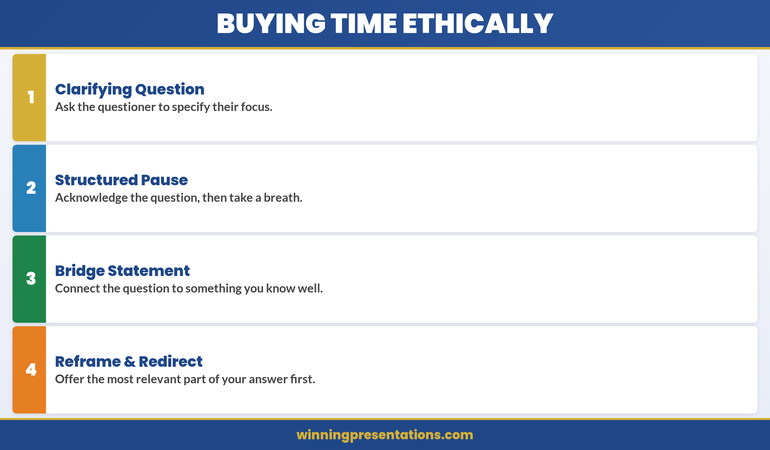
Acknowledge, Pause, Reframe

The moment a question lands, your instinct is often to answer instantly. But the most executive move is to signal that you’ve heard it, create space for thought, and then respond from a position of composure.

The technique: Acknowledge the question explicitly. Say: “That’s an excellent point,” or “I appreciate you raising that.” This does three things simultaneously. It buys you two to three seconds of thinking time. It signals to the room that you respect the question. And it shifts the emotional tone from you being caught off guard to you being thoughtful.

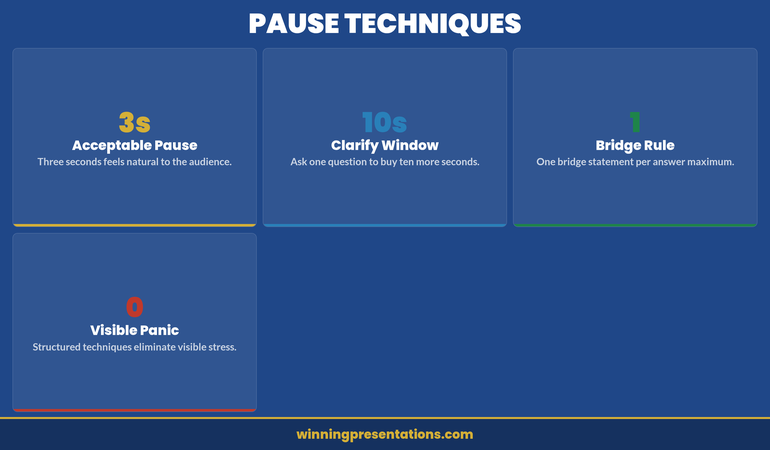
Then pause. Not uncomfortably long—just long enough for your breathing to settle and your thoughts to coalesce. Two to four seconds feels eternal when you’re standing there, but it reads as confidence to the audience.

Finally, reframe. You’re not answering the surface question; you’re answering the underlying concern. This layer of thinking—turning “Why didn’t you hit the Q3 target?” into “What does our revised pathway to that target look like?”—is what distinguishes senior executives from those who merely survive Q&A.

Master the System

The Executive Q&A Handling System teaches you five frameworks for managing pressure, structuring your thinking in real time, and owning the room. Every technique in this article is part of a complete system you’ll use in your next high-stakes Q&A.

Buy Now — £39

The Clarification Pause

If you genuinely don’t understand the question, clarification is both honest and strategic. It’s a legitimate pause-builder that serves everyone in the room.

The technique: Ask for clarity without apology. “To make sure I address this precisely, are you asking about our timeline, or the resource allocation?” You’re not stalling; you’re being professional. You’re ensuring your answer lands where it matters.

This approach works because it invites the questioner to refine their thinking too. Often, in the process of clarifying, both you and the audience understand the real issue more sharply. That clarity is gold in executive Q&A.

The clarification pause also sets a tone: you value precision over speed. You’d rather take an extra moment than give a half-answer. That’s how senior leaders think.

Four ethical techniques for buying time in Q&A: clarifying question, structured pause, bridge statement, and reframe and redirect

Related reading: When You Don’t Know the Answer in a Presentation explores how to handle questions that truly lie outside your scope—a different challenge, but one that shares the same foundation of honest pause.

Structured Response Buying Time

The most elegant time-buying technique is also the most useful: signposting your response structure aloud before you deliver the substance.

The technique: Say: “I’ll address this in three parts—the context, the decision, and the timeline.” Now you’ve bought yourself thinking time, but you’ve also given the audience a roadmap. They know where you’re going, so when you pause between sections, they understand it as intentional, not hesitant.

This is not filler. This is architecture. You’re showing the rigour behind your thinking, and the audience trusts structured thinking.

Where buying time becomes ethical, here, is that your structure is genuine. You’re not inventing three parts to stall; you’re using structure to organise a response that actually has three components. The buying time is the bonus.

Pro move: As you walk through each section, your thinking sharpens. By part three, you’re not buying time any longer—you’re in command. This is the difference between feeling rescued by a technique and owning it.

The system I teach in the Executive Q&A Handling System walks you through how to recognise which technique to deploy in real time, so you’re never deciding how to buy time while under pressure.

Body Language That Buys Credibility

The pause itself is only half the message. How you hold your body during that pause determines whether the room interprets it as thoughtfulness or uncertainty.

The non-negotiables: Keep your posture open. Don’t fold your arms or shift your weight. Maintain eye contact with the questioner. If you drop your gaze, the room reads it as evasion, not reflection.

Your breathing matters. Most executives hold their breath during a pause, which makes them physically tense. Breathe. Slowly. This settles your nervous system and keeps your thinking clear. It’s also visible to an attentive audience—they’ll see composure, not panic.

One more thing: nod slightly as you take the pause. It signals, “I heard you, I’m considering this seriously.” That’s a non-verbal form of acknowledgement, and it costs nothing.

For a deeper dive into how your physical presence shapes perception in Q&A, the bridging technique article covers how to use stance and gesture as strategic tools, not just accessories to your words.

Q&A pause techniques dashboard showing acceptable pause duration, clarify window, bridge rule, and visible panic reduction

Ready to stop fearing the pause?

The Executive Q&A Handling System (£39) includes video modules on timing, scripting, and real-world scenarios. Build the confidence that transforms pressure into presence.

Access the System

When Buying Time Becomes Stalling

There’s a line between ethical pause and evasion. Know where it is.

Buying time is legitimate when:

  • You’re gathering your thoughts to give a more accurate answer.
  • You’re signalling that the question deserves serious consideration, not a throwaway response.
  • You’re using the pause to listen more deeply to what the questioner is actually asking.
  • You’re creating space for your own nervous system to settle so you can think clearly.

Buying time becomes stalling when:

  • You’re using the pause to dodge a question you don’t want to answer.
  • You’re repeating the question three times just to fill silence.
  • You’re offering non-answers cloaked in strategic language.
  • You’re buying time so frequently that the audience stops believing you’re ever thinking and starts suspecting you’re always hiding.

The distinction matters. Boards and senior leadership teams can smell the difference. They’ve been in rooms with hundreds of executives. They know a genuine pause from theatre.

The strongest executives use buying time tactically, not as a default. They know when to pause and when to answer sharply. The short answer framework covers exactly when a quick, crisp response is more powerful than a measured one.

Frequently Asked Questions

How long should a pause actually be?

Two to four seconds feels like an eternity when you’re standing in front of a room. It reads as composure to the audience. Anything longer than five seconds starts to feel intentional avoidance. The sweet spot is where you’ve caught your breath, reset your thinking, and are ready to speak with precision—usually somewhere in that two-to-four window.

What if I pause and my mind genuinely goes blank?

That’s anxiety, not a technique failure. If you’ve paused and your mind hasn’t returned, acknowledge it. “That’s a good question. Let me circle back to that after I finish this thought,” or “I want to give you a proper answer rather than rush this—let me follow up with you tomorrow.” Honesty in that moment is more credible than desperate filler words. The system walks you through how to prepare so your mind has something to work with, even under pressure.

Is buying time a sign of weakness?

No. It’s a sign that you value accuracy over speed. In executive environments, that’s strength. The executives who lose credibility are the ones who speak first and think second. Buying time—strategically—is how senior leaders protect their authority in real time.

Stay Sharp

New frameworks for high-stakes presentations land in The Winning Edge every week. Subscribe and never feel unprepared in Q&A again.

Subscribe Now

The executives who command boardrooms aren’t the ones who never need to pause. They’re the ones who’ve made peace with silence and turned it into their most powerful tool.

Mary Beth Hazeldine is Owner & Managing Director of Winning Presentations. With 24 years of corporate banking experience at JPMorgan Chase, PwC, Royal Bank of Scotland, and Commerzbank, she advises executives across financial services, healthcare, technology, and government on structuring presentations for high-stakes funding rounds and approvals.
30 Mar 2026
Quiet moment of reflection before a high-stakes presentation showing a calm professional environment

Self-Compassion for Presentation Anxiety: The Research-Backed Technique Sceptical Executives Trust

Self-compassion quiets the inner critic that drives presentation anxiety. Rather than pushing harder through fear, this evidence-based technique teaches you to respond to mistakes and pressure the way you’d support a trusted colleague. For executives who’ve resisted breathing exercises and affirmations, self-compassion offers something different: a research-backed permission structure to be human during high-stakes moments.

Linh’s Turning Point: From Perfectionist Sabotage to Measured Presence

Linh, a finance director at a multinational bank, had mastered every technical skill. She prepared meticulously. Yet every presentation triggered a spiral: one stumbled phrase, and her internal voice became ruthless. That was sloppy. You should know this cold. Everyone’s thinking you’re not qualified. The harder she pushed to be perfect, the more anxious she became. By her third major presentation in two months, she was considering stepping back from client-facing work altogether—a career-limiting decision she wasn’t ready to make. During a coaching conversation, Linh learned that her perfectionism wasn’t a strength; it was fuel for anxiety. When she began practising self-compassion—acknowledging her nerves as normal, treating herself with the same grace she’d extend to her team—her presentation quality actually improved. The permission to be imperfect freed her from the paralysis of perfectionism.

Rescue Block: You Don’t Have to Be Perfect to Perform Well

Presentation anxiety often masquerades as a motivation problem. In reality, it’s your nervous system perceiving a threat. Self-compassion interrupts that threat signal by validating your experience and reminding you that struggle is part of being human. This isn’t about lowering standards—it’s about building psychological safety so you can access your best thinking under pressure.

What Self-Compassion Actually Means for Presenters

Self-compassion isn’t self-pity or weakness. Kristin Neff, the leading researcher in this field, defines it as three interlocking elements: mindfulness of your difficulty (noticing anxiety without exaggerating it), common humanity (recognising that struggle is universal, not a personal failing), and self-kindness (responding to yourself with the same dignity you’d offer a colleague).

For presentation anxiety, this translates into a specific mental shift. Instead of I’m panicking, I must be terrible at this, the self-compassionate response is: My nervous system is activated. This is what anxiety feels like. I can move forward anyway. That distinction might seem subtle, but the neurological impact is measurable. The inner critic—which intensifies the fight-or-flight response—quiets. Your prefrontal cortex, the rational planning centre, can remain engaged.

Ready to Stop Fighting Your Anxiety?

Conquer Speaking Fear teaches you how. In six modules, you’ll learn the neuroscience of anxiety, practical de-escalation techniques, and the mindset shifts research shows actually work for executives who’ve tried everything else.

Conquer Speaking Fear — £39

Six modules. Lifetime access. No assumptions about your comfort level.

Why Research Backs This Approach

The evidence for self-compassion in anxiety management is robust. Longitudinal studies show that individuals who practise self-compassion report lower trait anxiety, reduced avoidance behaviour, and faster recovery from setbacks. Neuroscience explains why: when you respond to yourself with kindness, you activate the parasympathetic nervous system—your rest-and-digest state—which directly counteracts the arousal of anxiety.

What makes this particularly relevant for presentation anxiety is the mechanism. Traditional anxiety management (grounding techniques, breathing exercises) works by managing the physical symptoms. Self-compassion works by changing your relationship to those symptoms. You’re not trying to eliminate the nervousness; you’re teaching your brain that nervousness doesn’t mean failure. For sceptical executives, this distinction matters. You’re not engaging in sentiment or positive thinking. You’re applying a neurologically sound response to psychological distress.

Research also shows that self-compassion buffers against perfectionism—the cognitive pattern that magnifies presentation anxiety in high-achieving professionals. When you can acknowledge a mistake without catastrophising, you remain calmer and more focused. Your audience doesn’t experience your anxiety; they experience your stability.

The Three Pillars in Practice

Mindfulness: Notice Without Narration

Before a presentation, you’ll likely experience physical sensations: elevated heart rate, tension in your chest, a tightness in your throat. Mindfulness means noticing these without the story. Instead of My heart is racing—I’m going to panic, try: I notice my heart is beating faster. That’s what my body does when it’s preparing. You’re describing the sensation, not interpreting it as catastrophe.

Common Humanity: You’re Not Alone in This

Anxiety thrives on the belief that your experience is abnormal or unique. In reality, every presenter experiences nervousness. Even seasoned executives, award-winning speakers, and confident performers report pre-presentation anxiety. The difference is they’ve learned not to treat it as evidence of inadequacy. When you remind yourself—This is what anxiety feels like for humans. I’m not broken—you reduce the secondary anxiety (anxiety about being anxious) that compounds the original fear.

Self-Kindness: The Internal Tone That Matters

This is where most executives get stuck. Self-kindness can sound soft or indulgent. In practice, it’s rigorous. It means asking: What would I need right now if I were a colleague I valued? The answer might be a pause, a glass of water, a reminder of your competence, or permission to feel uncertain. You’re not rewarding yourself for being anxious; you’re treating anxiety as a problem that warrants care, not punishment.

You can practise these three elements together in a simple structured exercise, which brings us to your practical toolkit.

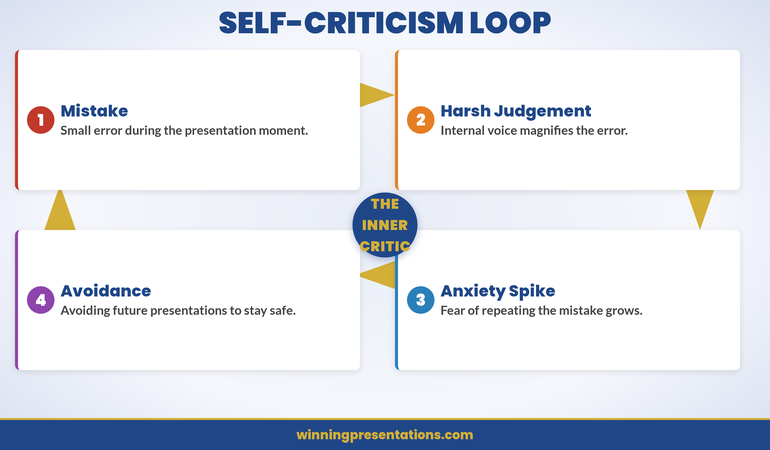
The self-criticism cycle showing four stages: mistake, harsh judgement, anxiety spike, and avoidance

Your 90-Second Exercise Routine

The most effective self-compassion practice for presentation anxiety is the pause-name-soothe sequence. You can do this in 90 seconds, anywhere—in the car park before you present, in the bathroom at the conference, even during a difficult Q&A moment.

Step 1: Pause (20 seconds)
Stop what you’re doing. Notice your breath without changing it. Count the exhales: one, two, three. This brief pause activates your awareness and signals to your nervous system that you’re choosing a response, not being hijacked by panic.

Step 2: Name (30 seconds)
Silently or aloud, name what you’re experiencing. Use simple, non-dramatic language: I’m feeling anxious. My chest is tight. I’m having the thought that I might forget what I’m saying. By naming, you’re engaging your language centres and creating distance from the raw emotion. You’re no longer the anxiety; you’re observing it.

Step 3: Soothe (40 seconds)
Place your hand on your heart or cross your arms over your chest in a gentle self-hug. Speak to yourself as you would a nervous colleague: This is hard right now. That’s okay. I’ve prepared well. I can move forward even with these feelings. The physical touch activates the soothing system; the words reinforce kindness. Research shows this combination is more effective than either element alone.

You can practise this routine during low-stress moments so it’s available when you need it. Many executives practise once daily for a week before a high-stakes presentation, then on-demand before the actual event.

Level Up Your Preparation

Conquer Speaking Fear walks you through this routine with video guidance, then shows you how to integrate it with your broader presentation strategy. You’ll also learn why your anxiety has a particular pattern—and how to interrupt it.

Conquer Speaking Fear — £39

Contrast between self-criticism and self-compassion responses after mistakes, before speaking, and after feedback

Why Sceptical Executives Resist (And How to Overcome It)

You might be thinking: This sounds nice, but will it actually work for me? Won’t I just feel silly talking to myself?

That resistance is predictable. High-achieving professionals have often built their identity on rational problem-solving and self-reliance. Self-compassion can feel like emotional indulgence. Here’s what the research shows: the executives who resist self-compassion are often the same ones whose perfectionism is driving their anxiety. The resistance itself is part of the pattern.

The reframe: self-compassion is strategic, not sentimental. When you reduce the internal criticism that amplifies anxiety, you access clearer thinking. Your prefrontal cortex isn’t hijacked by the threat-detection system. You make better decisions during presentations, field difficult questions more calmly, and recover more quickly from mistakes. This is performance optimisation through psychological stability.

Second concern: Won’t this make me complacent about improving? In fact, self-compassion strengthens motivation for improvement. When you’re not berating yourself for mistakes, you can examine them objectively. What went wrong? What can I adjust? This is the mindset that drives learning. Harsh self-criticism, by contrast, often leads to avoidance (you stop doing presentations) or defensive rigidity (you ignore feedback).

A practical starting point: try the 90-second routine once. Notice what happens. Most executives report a measurable shift in their nervous system activation within three or four practises. That’s not placebo; that’s neurobiology.

For guided video walkthroughs of the 90-second routine and integration strategies, see the full training in Conquer Speaking Fear.

Integrating Self-Compassion Into Your Prep

Self-compassion works best when it’s woven into your broader preparation strategy. Here’s how:

During Content Development
If you notice perfectionist thinking (This section isn’t excellent yet), pause and apply self-compassion. I’m working through this. Draft work is supposed to feel rough. I can refine it. This keeps perfectionism from sabotaging your creative process.

During Practice Sessions
If you stumble during a run-through, notice the urge to self-criticise. Instead, treat the mistake as data: I found something to improve. That’s valuable. You’re building the neural pathways that support learning.

Immediately Before Presenting
Use the 90-second routine. Pair it with a pre-presentation ritual (a specific phrase, a particular movement) so your nervous system learns to associate the ritual with calm focus.

After the Presentation
This is crucial. Instead of replaying every imperfection, practise self-compassion. I did difficult work today. I handled some parts well and some parts less well. That’s the nature of live performance. I learned something. This prevents the post-presentation anxiety spiral that can make future presentations feel higher-stakes.

Build Your Slides with Confidence

Preparation reduces anxiety. The Executive Slide System (£39) includes slide templates and frameworks specifically designed to minimise preparation stress and build presenter confidence.

The Bottom Line: Permission to Perform

Self-compassion for presentation anxiety isn’t about becoming comfortable with nervousness. It’s about building a relationship with your anxiety that doesn’t amplify it. When you stop treating nervousness as evidence of inadequacy, your nervous system downregulates. You become more present, more flexible, and more effective.

For executives, this is particularly valuable because you’re operating in high-stakes environments where stakes feel personal. A misspoken phrase in a board presentation isn’t just a communication hiccup; your mind frames it as a threat to your professional standing. Self-compassion interrupts that narrative. It tells your nervous system: You’re safe. You can think clearly. You can keep going.

That’s not motivational poster sentiment. That’s applied neuroscience.

Frequently Asked Questions

Q: If I practise self-compassion, won’t I lower my standards?
A: No. Research shows the opposite: self-compassion is associated with higher intrinsic motivation and better long-term performance. When you’re not distracted by self-criticism, you can focus on what actually matters—clear communication and audience connection.

Q: How long before I notice a difference?
A: Most people report a noticeable shift in their nervous system activation within three to four practises of the 90-second routine. Deeper integration into your presentation anxiety pattern usually takes two to four weeks of consistent practise.

Q: Can I do this alongside other anxiety management techniques?
A: Yes. Self-compassion complements breathing exercises, preparation, and other evidence-based approaches. Think of it as a complementary layer: it changes how you relate to anxiety, whilst other techniques manage the physical symptoms.

Stay Ahead of Presentation Anxiety

New techniques, research insights, and executive-focused strategies delivered to your inbox. Join The Winning Edge newsletter.


Related Articles
How to Run a Project Kickoff Presentation That Gets Buy-In
The Contract Renewal Presentation: Authority, Nuance, and Closing Power
Buying Time in Q&A: Three Techniques That Sound Natural

Self-compassion isn’t a luxury for presenters—it’s a strategy for sustained performance under pressure.


About the Author

Mary Beth Hazeldine is Owner & Managing Director of Winning Presentations. A qualified clinical hypnotherapist and NLP practitioner who overcame five years of severe presentation anxiety, she combines 24 years of corporate banking experience at JPMorgan Chase, PwC, Royal Bank of Scotland, and Commerzbank with evidence-based techniques for managing presentation fear.

30 Mar 2026
Executive preparing a contract renewal presentation deck in a client-facing conference room

The Contract Renewal Presentation: Why Best Clients Need More Than Thanks

Your contract renewal is not a thank-you meeting. It’s a strategic milestone where clients reassess their commitment, compare alternatives, and decide whether the partnership still delivers value. Without a proper presentation—one that demonstrates growth, protects shared interests, and invites genuine collaboration—you risk losing revenue or worse: a client who leaves quietly.

Henrik ran a financial services firm with three enterprise clients. One was due for renewal—they’d been together for five years, smooth sailing, regular invoices paid on time. When renewal month arrived, Henrik scheduled a “quick check-in call” and sent the updated contract terms. Two weeks later, the client replied: “We’re exploring other providers.” Henrik was stunned. He’d assumed loyalty. He’d skipped the presentation entirely, treating the renewal like an administrative box to tick. By the time he realised the mistake, the client had already spoken to two competitors. The relationship recovered, but he lost negotiating leverage and nearly lost the contract. Henrik learned that season what every executive who sells knows: silence kills deals. Renewal presentations aren’t optional. They’re your chance to reframe the partnership, demonstrate value that’s easy to overlook, and remind clients why they chose you.

If you’re facing renewal season unprepared

The Executive Slide System gives you a tested framework for renewal conversations that defend value, reset expectations, and position growth

Six slide templates, three complete renewal scenarios, speaker notes, and video walkthroughs. Build your presentation in an hour, deliver with confidence, protect your pipeline.

Get the Executive Slide System — £39

Why Renewal Presentations Fail

Renewal presentations fail for three reasons. First: they’re positioned as updates, not conversations. You arrive with your terms, your timelines, your assumptions—and the client feels transacted rather than partnered. Second: they skip the strategic narrative. You talk about features, response times, or pricing, but you never explain how the work has evolved, what you’ve learned about their business, or how the relationship has grown. Third: they ignore the client’s perspective entirely. Nobody renews because you need the revenue. Clients renew when they see a reason.

A contract renewal is a 360-degree assessment. The client is asking: Has our problem changed? Have you kept pace with our business? Could we get better terms elsewhere? Is this relationship still worth the cost? If your presentation doesn’t answer those questions deliberately and with evidence, the client will find answers from someone else.

Contract renewal presentation dashboard showing four key components: value slides, forward plan, risk slides, and decision ask

Renew with strategy, not hope

The Executive Slide System: Six templates designed specifically for renewal conversations

  • Value Summary slide (what you’ve delivered and learned)
  • Growth & Evolution slide (how the relationship has matured)
  • Partnership Roadmap slide (next chapter positioning)
  • Investment & Terms slide (pricing reframed as value)
  • Risk Mitigation slide (why switching is costly)
  • Commitment & Close slide (call to action that feels collaborative)

Get the System — £39

The Three Pillars of Renewal Strategy

A renewal presentation must rest on three pillars: value delivered, partnership growth, and forward vision.

Pillar 1: Value Delivered. Before you discuss the next contract, you need to remind the client what the last one achieved. Not in abstract terms—in their terms. Did you help them reduce cost? Improve speed? Manage risk? Lower headcount? Avoid a crisis? Quantify it. Show them the value stream they’ve received. Make it visible so they cannot claim they’re unsure what they paid for. This is where your case study data lives: project timelines, cost savings realised, hours saved, risks prevented, revenue influenced. If you don’t have this data, you’re already behind. Start collecting it now.

Pillar 2: Partnership Growth. Show how the relationship has evolved. You understand their business better. Your approach is more refined. You’ve anticipated problems before they appear. You’ve brought in new expertise. You’ve expanded into new areas that compound value. This pillar is about positioning renewal not as “the same as last time” but as “a mature, deepening partnership.” It also demonstrates investment on your side—you’ve grown your team, your capabilities, or your focus to serve them better. That investment justifies the renewal.

Pillar 3: Forward Vision. Finally, the renewal isn’t just about protecting the past; it’s about building the future. What’s the next chapter? How will the partnership evolve? What opportunities exist that you couldn’t see five years ago? What threats are on the horizon that you can help them navigate? Position the renewal as the gateway to that next phase, not as a reboot of the old one. This pillar turns the renewal from a defensive conversation into an offensive one—it shifts the client from “Do I keep this?” to “What’s possible if we do?”

Structuring Your Deck for Maximum Impact

A renewal deck is not a product pitch. It’s a narrative that flows from past success into future opportunity. Here’s the structure that works:

Opening Slide: Start with a partnership statement, not a sales statement. “Five years in, and we’ve learned more about your business than we thought possible—and we want to share what that means for the road ahead.” This sets a collaborative tone immediately.

The Context Slide: Remind them of the original challenge. Why did they engage you? What was the business problem? This resets the frame—it forces them to remember why they made the choice in the first place and how far they’ve come.

Value Delivered Slides (2–3): Walk through the key achievements. Use data where you can; use testimony where you can’t. Show the cost, the risk, the headache you’ve eliminated or reduced. Don’t bury numbers; lead with them. “We’ve saved your finance team 2,000 hours annually in manual reconciliation”—that’s a headline, not a footnote.

The Partnership Growth Slide: Explicitly call out how the relationship has matured. New capabilities you’ve built. Deeper understanding you’ve gained. Proactive recommendations you’ve made. This is your moment to prove investment and differentiate from a commoditised alternative.

Forward Vision Slides (2–3): Paint the next chapter. What are the emerging priorities in their industry? How is your expertise evolving to meet them? What new opportunities could unfold if the partnership continues and deepens? This is where you move from defensive to aspirational.

Investment & Terms Slide: Present the financial terms. If there’s a price increase, justify it explicitly: inflation, enhanced capability, market rates, expanded scope. Frame it as investment in mutual growth, not revenue extraction. Never apologise for a price increase; instead, explain the value that justifies it. Quarterly client retention presentations often use this structure to reset value annually before renewal pressure builds.

The Commitment Slide: Close with a call to action that feels collaborative, not transactional. “Let’s move forward with renewed commitment to delivering even greater value.” It’s about partnership, not paperwork.

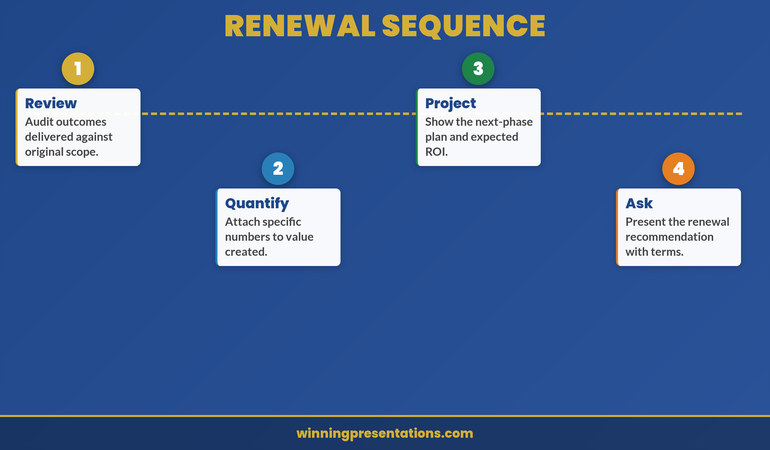
Four-stage renewal presentation sequence: review outcomes, quantify value, project next phase, and present the ask

The best renewal presentations balance data with narrative. Show the numbers, but tell the story. Client story presentations use the same principle: metrics prove it happened; stories prove it matters.

Handling Pushback on Price and Terms

Price pushback is inevitable. It’s not always a sign that the client wants to leave; it’s often a sign that you haven’t made the value visible enough. Here’s how to respond:

Acknowledge it directly. “I appreciate the sensitivity around cost. Let’s talk about what you’re getting and whether it aligns with your budget.” Don’t defend the price defensively; instead, reframe it as an investment question.

Separate value from cost. “In the first three years, we delivered £X in documented value. This year’s investment is 15% of that. How does that sit with your expected return?”

Offer options, not discounts. If the client is price-sensitive, discuss scope reduction, milestone-based engagement, or phased implementation rather than simply cutting your rate. This protects margin and forces clarity about what they actually need.

Reference the switching cost. “If you move to another provider, there’s onboarding time, learning curve, and risk of disruption. What’s the true cost of that transition?” Make the switching decision emotionally and financially expensive.

Ask for their perspective. “What would make this investment feel right to you?” This opens a negotiation. You might discover that the issue isn’t really price—it’s that they don’t feel like a priority, or they’ve had a bad experience, or their business is under pressure and they’re looking for line-item cuts. Once you know the real objection, you can address it.

Don’t wing renewal conversations

The Executive Slide System includes three complete renewal scenarios with speaker notes and response frameworks

Ready-to-adapt templates for B2B services, technology partnerships, and managed service renewals. Video walkthroughs of how to handle each slide. Timing guidance so you know where to breathe and where to press.

Access Now — £39

The Psychology of Renewal Conversations

The psychology of renewal is different from the psychology of a new sale. New prospects are shopping; renewal clients are already inside the relationship. They know your weaknesses. They’ve had a bad experience, or three. They’re comparing you to what they’ve imagined they could get elsewhere. Your job isn’t to convince them to take a chance; it’s to prove that taking a chance on someone else is riskier than staying with you.

This means your tone matters enormously. You’re not pitching; you’re recommitting. You’re not selling; you’re inviting them deeper into partnership. The best renewal presentations have a tone of confidence without arrogance, of investment without desperation. You’re saying: “We believe in this partnership, we’ve proven our value, and we want to go further together. Here’s why that’s in your best interest.”

Practical psychology pointers: First, lead with gratitude. “We’ve learned more about your business in five years than in the first six months—and that learning has shaped everything we do for you.” Gratitude disarms defensiveness. Second, use specific language. Don’t say “we’ve been responsive.” Say “When you needed a solution for Q3 reforecasting in 48 hours, we delivered.” Specificity proves attention. Third, acknowledge the relationship’s reality. “We’ve had rough patches, and we’ve fixed them. That’s a relationship that works.” Acknowledging friction actually builds credibility; it shows you see them, not just the revenue.

Finally, make silence costly. Don’t present and then disappear. “I’ll send the deck over. Let’s schedule a follow-up for next Thursday to discuss questions.” That keeps momentum. Client presentation skills often overlook this: the renewal conversation doesn’t end with the deck; it ends when the contract is signed and the next partnership chapter has begun.

Frequently Asked Questions

How far in advance should you present a renewal?

Ideally, 6–8 weeks before the contract expires. This gives the client time to review, raise questions, and consider options without feeling rushed. It also gives you time to respond if they push back. Fewer than four weeks out, and you’re in a reactive conversation. More than 12 weeks, and they may forget about it until it’s urgent.

What if the client says they want to explore other options?

That’s not a rejection; that’s a signal that you haven’t made your value clear enough. Ask what they want to explore and why. “What’s important to you that you feel we’re not delivering?” Listen harder than you’ve ever listened. You may discover you need to compete on capability, price, service level, or relationship depth. Once you know, you can respond. But respond fast. “I appreciate you exploring alternatives. Let’s set up a call next week so I can address your concerns directly.” This keeps you in the game.

Should the renewal presentation always include the same stakeholders?

No. The renewal conversation should include whoever holds the renewal decision. That might be procurement (focused on cost), operations (focused on capability), finance (focused on ROI), or the executive sponsor (focused on strategy). Present to all of them, or tailor your message to each. A procurement-focused renewal deck emphasises cost of ownership. An executive-focused one emphasises strategic partnership and forward vision. Know your audience, and build your deck accordingly.


Don’t let your renewal be a formality. The contract renewal presentation is your most powerful tool for protecting revenue, deepening relationships, and reshaping how clients see you. Build it with the same care you’d build a pitch to a prospect. In fact, build it with more care. Prospects are optimistic. Renewal clients know your true value and your true flaws. A renewal won is a client secured for the next chapter.

Join The Winning Edge

Every week: executive presentation frameworks, client conversation strategies, and insights from 24 years in corporate banking. Straight to your inbox.

Subscribe to The Winning Edge

Download the Executive Presentation Checklist (free) to prepare for your next renewal conversation with confidence.

Cross-references from today:


Mary Beth Hazeldine is Owner & Managing Director of Winning Presentations. With 24 years of corporate banking experience at JPMorgan Chase, PwC, Royal Bank of Scotland, and Commerzbank, she advises executives across financial services, healthcare, technology, and government on structuring presentations for high-stakes funding rounds and approvals.

30 Mar 2026
Project kickoff meeting with team gathered around a presentation screen showing a clear project timeline

How to Run a Project Kickoff Presentation That Aligns Teams

A structured kickoff meeting creates alignment from day one by clarifying objectives, roles, timelines, and dependencies. Delivered with clear communication and discipline, it prevents costly misunderstandings and sets the foundation for team cohesion and accountability throughout the project lifecycle.

When Kwame took over a financial systems migration for a mid-sized bank, his team had been handed a vague mandate: “Upgrade the core ledger platform.” No shared timeline. No defined scope. No clarity on how decisions would be made. Three months in, the project fractured. Developers and infrastructure teams were working towards different assumptions. Budget holders were caught off-guard by delays. A single, structured kickoff—delivered in the first week—would have caught these conflicts before they cost time and credibility. Instead, Kwame spent weeks unpicking misalignments that a clear kickoff meeting could have prevented entirely. The lesson stayed with him: the initial alignment session is not an admin formality. It’s the moment leadership either builds alignment or inherits chaos.

Struggling to structure your kickoff? Many leaders treat the kickoff as a procedural checkbox rather than a strategic moment to reset expectations and build shared understanding. If your teams have ever worked at cross-purposes on a project, this initial alignment meeting is where that friction begins—or gets prevented.

Objective Clarity: What Success Looks Like

The first responsibility of any kickoff is to articulate what done looks like. Too many projects suffer from scope creep and misaligned priorities because the team never heard a single, unambiguous statement of objectives.

Structure this section in three layers. Start with the business case: why this project exists and what value it creates. Then move to project scope: what is included, what is explicitly out of scope, and the success criteria by which progress will be measured. Finally, address constraints: budget, schedule, resource availability, regulatory requirements, or technical dependencies that will shape execution.

The disciplines that matter most are clarity over brevity. Your team will not be offended by explicitness; they will be relieved by it. A structured kickoff that spends three minutes on this section—with concrete examples and non-negotiable boundaries—prevents weeks of navigating ambiguity later.

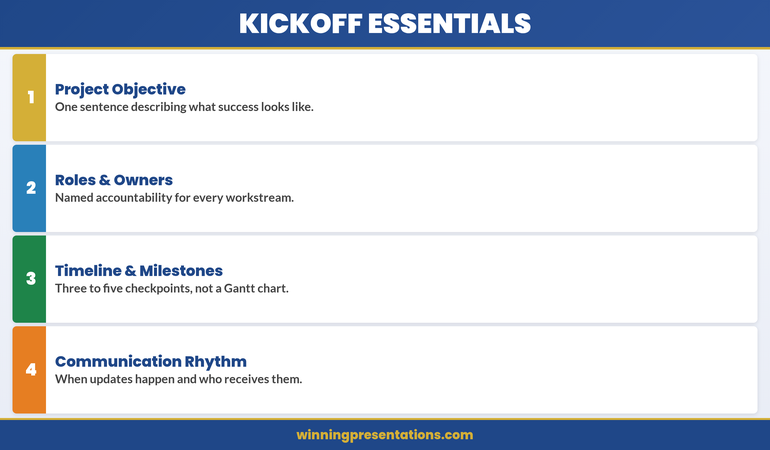
Four essential elements of a project kickoff presentation: project objective, roles and owners, timeline and milestones, and communication rhythm

Build Kickoff Presentations That Land

Structure your slides to establish clarity, credibility, and shared accountability from the first moment. The Executive Slide System gives you templates and frameworks for every element—from objective clarity to stakeholder alignment to decision rights.

Get the System — £39

Team Roles and Accountability Structures

The second pillar of any effective kickoff is clarity about who does what. Ambiguity about roles creates both resentment and inefficiency: people either duplicate work or assume someone else is handling a critical task.

Use a RACI matrix or role grid within your presentation. For each major workstream or function, define who is Responsible (does the work), Accountable (makes the final call), Consulted (provides input), and Informed (receives updates). Be explicit about interdependencies: which teams need to coordinate, and what decisions require sign-off from which stakeholders.

Address escalation paths early. If a blocker arises—a dependency fails, a resource becomes unavailable, or priorities shift—who decides how to respond? Naming this in the kickoff removes the friction of figuring it out under pressure later. The discipline is clarity about authority, not the specific person in a role.

Many teams skip this step because it feels administrative. That’s a mistake. The teams that recover fastest from obstacles are the ones that know, in advance, who decides and how escalation works. Your initial meeting should be that reference point.

Timeline, Dependencies, and Constraints

The third pillar must establish the rhythm of the project: key milestones, delivery dates, decision gates, and review points. These are not optional; they are the skeleton that holds the project together.

Map the critical path visibly. What tasks are sequential? Where can work happen in parallel? Which decisions must land before downstream work can begin? Highlight any external dependencies—approvals from regulatory bodies, third-party deliverables, resource constraints—that could affect timing. Be honest about risk: if you are uncertain about a delivery date, say so and explain what would unlock that certainty.

The teams that trust their leaders are the ones whose leaders are honest about constraints and timelines. A kickoff presentation that acknowledges real trade-offs—scope versus speed, quality versus cost—builds credibility far more than optimistic over-promises ever will.

Include a simple visual timeline or Gantt-style chart that every team member can reference. This becomes your single source of truth for scheduling, dependencies, and deliverables.

Comparison of weak versus strong project kickoff presentations across objective clarity, role definition, and closing approach

If you’re building this from scratch, the frameworks inside the Executive Slide System will accelerate your preparation and ensure you don’t miss critical elements.

Communication Cadence and Escalation Paths

Projects live or die by communication discipline. Your kickoff presentation must establish how often teams will synchronise, what gets reported, and where escalation happens. Without this structure, communication either becomes excessive and chaotic, or falls away entirely until problems surface too late to fix.

Define the cadence: weekly stand-ups for core team members, biweekly executive updates, monthly steering committee reviews. Be clear about what each meeting covers. Stand-ups are about blockers and coordination; steering updates are about progress, risks, and business impact. Make this distinction explicit, because conflating them leads to either too much detail at the top or too little coordination at the working level.

Address escalation thresholds. What constitutes a blocker that needs immediate attention? If a delivery date is at risk by more than one week, does that trigger escalation? If budget variance exceeds 10%, who gets informed and when? Being specific here removes guesswork and ensures that problems don’t fester silently until they become crises.

Document how team members provide updates: email, shared spreadsheet, project management tool, or presentation. Consistency in format saves time and reduces the burden on whoever synthesises information for leadership.

Templates That Work

The Executive Slide System includes ready-made frameworks for kickoff presentations, stakeholder alignment slides, and decision-gate templates.

Explore — £39

Stakeholder Engagement and Decision Rights

Many kickoff presentations fail because they do not explicitly map stakeholder engagement. Who are the sponsors? The approvers? The influencers whose buy-in matters? And how will each group be involved in decision-making as the project unfolds?

Use a stakeholder mapping framework as part of your kickoff. Segment stakeholders by their level of interest and influence. High-influence, high-interest stakeholders typically need steering-group involvement and regular executive briefings. High-influence but lower-interest stakeholders need selective updates and a clear escalation path. The discipline is acknowledging that different stakeholders need different communication approaches.

Be explicit about decision rights: which decisions can the project team make independently? Which require steering group approval? Which need sign-off from finance, legal, or other functional leaders? Clarifying this at the kickoff prevents two months of work being derailed because someone assumed they had authority they did not actually have.

A kickoff that treats stakeholder engagement as an afterthought is one that will revisit stakeholders repeatedly, creating friction and slowing progress. Front-load this work in your initial alignment meeting, and the project moves faster.

Frequently Asked Questions

How long should a kickoff meeting be?

A focused kickoff typically runs 45 to 90 minutes, depending on project complexity and team size. The rule of thumb: spend 15 minutes on objectives, 15 on roles and accountability, 15 on timeline and dependencies, 10 on communication cadence, and 10 on stakeholder engagement. If you have a large steering group or multiple workstreams, add time accordingly. The discipline is not brevity for its own sake, but clarity: never rush this material to fit a shorter window.

What if the team has already started work before the kickoff?

It is never too late to conduct a structured kickoff, even mid-project. If work has begun before alignment was established, the kickoff becomes a reset: an opportunity to surface misalignments, redefine scope, and rebuild shared understanding. Be honest about why the kickoff is happening now. Many teams will appreciate the clarity, even if the timing is not ideal. The cost of the reset is usually far lower than the cost of continuing in misalignment.

How do I handle disagreement about scope or timeline in the kickoff?

Disagreement in a kickoff is healthy and necessary. It means people care and are thinking critically. The discipline is to address disagreement in the meeting, not to let it fester. Use the kickoff as the forum to work through trade-offs: What happens if we accelerate the timeline? What does that mean for scope or quality? If a key stakeholder disputes the scope, that conversation needs to happen now, with the full team present, so that everyone leaves with the same understanding. A kickoff that surfaces conflict and resolves it is far more valuable than one that papers over disagreement.

Get executive presentation insight in your inbox. Subscribe to The Winning Edge for frameworks, case studies, and strategies to lead with impact.

Download the Executive Presentation Checklist (free) to prepare for your next kickoff.

Related: After you master the kickoff, learn how to structure presentations for other critical moments. Read The Contract Renewal Presentation to apply the same frameworks to stakeholder updates and approval scenarios.

Your next kickoff meeting is an opportunity to either build the foundation for team success or inherit months of misalignment and rework. Choose clarity.

Mary Beth Hazeldine is Owner & Managing Director of Winning Presentations. With 24 years of corporate banking experience at JPMorgan Chase, PwC, Royal Bank of Scotland, and Commerzbank, she advises executives across financial services, healthcare, technology, and government on structuring presentations for high-stakes funding rounds and approvals.
29 Mar 2026
Abstract representation of audience-specific presentation anxiety showing different meeting environments

Why You Freeze With Some Audiences but Not Others (And How to Fix It)

Some presentations trigger panic. Others leave you calm. The difference isn’t about your skill—it’s about how your nervous system perceives threat in that specific audience. When you face authority figures, experts, or people who can judge your competence, your amygdala fires differently. Understanding this mismatch between actual and perceived threat is the first step to managing audience-specific presentation anxiety across all contexts.

The board meeting that broke Sarah’s confidence

Sarah had delivered presentations to her team every week for three years. Direct reports, peers, even senior managers from other divisions—no problem. Then came the board observation meeting. The same slide deck. The same room. But this time, six non-executive directors sat at the table, including the Chair of the audit committee. Sarah’s mouth went dry halfway through slide three. Her voice tightened. She stumbled over numbers she’d rehearsed a hundred times. Later, her manager asked what happened. “I know this material inside out,” Sarah said. “But something about their faces… I just froze.” She wasn’t nervous about her knowledge. She was terrified about their judgment of her. That fear was specific. It attached itself to that particular audience, not to presenting itself.

Anxiety isn’t your weakness—it’s your system trying to protect you.

When your nervous system flags certain audiences as “high stakes,” it floods you with cortisol and adrenaline. This response made sense when stakes meant survival. Today, it misfires in boardrooms and client pitches. The good news: your threat-detection system is retrainable. Understanding which audiences trigger your amygdala—and why—is where recovery begins.

Why anxiety spikes with certain audiences

Your presentation anxiety isn’t universal. It discriminates. You might be composed delivering to your own team but panic in front of your CEO. You might sail through client workshops but freeze at industry conferences. The variation isn’t random—it reflects how your amygdala categorises different audiences on a single dimension: perceived threat.

Threat here doesn’t mean physical danger. It means evaluation risk. Can this audience judge my competence? Can they make decisions that affect my career? Can they publicly question my credibility? The higher your brain scores a group on these metrics, the more your threat-detection system activates.

Research in social neuroscience shows that audiences triggering evaluative anxiety activate different neural pathways than general presentation nerves. Your anterior insula lights up—the region processing interoception and social pain. Your dorsolateral prefrontal cortex—the thinking part—dims. You’re not becoming less intelligent. You’re becoming less able to access your own knowledge because your limbic system has hijacked executive function.

This explains why Sarah could present the same figures to her team confidently but stumbled in front of the board. The content didn’t change. The audience’s perceived power to judge her did.

Stop freezing in front of authority

The Conquer Speaking Fear programme combines clinical hypnotherapy protocols with NLP techniques to rewire how your nervous system responds to evaluative audiences. You’ll identify your specific audience triggers, reset your threat response, and build confidence across all contexts—from boardrooms to industry stages.

Perfect for professionals who perform confidently in low-stakes settings but freeze when judgment matters.

Conquer Speaking Fear — £39

The three audience threat profiles

Not all evaluation-focused audiences trigger the same response. Your nervous system distinguishes between different types of judges, each activating different fear narratives.

Authority-based threat: Audiences you perceive as hierarchically above you—your boss, your board, your client’s C-suite. The fear narrative is: “They can diminish me.” Your body floods with cortisol. Your vocal cords tighten. You’re not afraid of speaking; you’re afraid of revealing inadequacy to someone with power over your standing.

Expert-based threat: Audiences who know your field as well as (or better than) you do. Industry conferences, peer-group presentations, specialist seminars. The fear narrative is: “They’ll spot the gaps.” Your perfectionism amplifies. You scrutinise every word choice. You triple-check data. The irony: experts are often the least judgmental audiences, because they know how rare expertise actually is.

Social-accountability threat: Audiences linked to your identity or relationships. Presenting to your industry peers where reputation matters. Pitching to a community you’re part of. The fear narrative is: “This defines how I’m seen.” You’re not afraid of incompetence; you’re afraid of perception shift. This is why some professionals dread industry conference talks but breeze through client presentations.

Most people experience all three, but one typically dominates. Identifying which threat profile activates your anxiety is diagnostic. It tells you exactly where your nervous system is misfiring.

Four audience-specific anxiety triggers: authority threat, expert threat, social threat, and status threat

Diagnostic: recognising your triggers

Before you can retrain your response, you need precision diagnosis. Vague anxiety (“I’m nervous about presentations”) doesn’t change. Specific anxiety (“I freeze when an audience includes people who can evaluate my technical credibility”) does—because specificity lets you design targeted intervention.

Ask yourself:

  • Who exactly makes you anxious? Not “senior people”—which people? Your CEO? Specific clients? Competitors? A particular personality type?
  • What do you fear they’ll think? That you’re incompetent? Unprepared? Not credible? That you don’t belong? The specific narrative matters because it points to the specific reset technique you need.
  • When does it hit? Before you start (anticipatory)? When you see their faces? When asked a question? During specific sections? Timing tells you whether you’re managing threat perception or just missing preparation.
  • What does it feel like in your body? Throat tightness? Racing heart? Trembling hands? Blank mind? Your somatic signature tells you which part of your nervous system to target in retraining.

Sarah’s diagnosis: She froze specifically in front of the audit chair (authority + expertise + social accountability). The fear narrative was: “They’ll find me technically wanting.” The somatic signature was vocal cord shutdown. That specificity allowed her to design a reset protocol targeting executive presence, not general presentation confidence.

If you’re curious whether your anxiety pattern matches audience threat profiles documented in clinical neuroscience, subscribe to The Winning Edge newsletter for self-diagnostic frameworks and real case studies showing exactly how people like you identified their specific triggers.

Reset techniques that work

Once you’ve identified your specific audience threat profile, retraining becomes systematic rather than general. Your goal isn’t to eliminate nervousness—that’s neither possible nor desirable. Nervous energy sharpens focus. Your goal is to lower the threshold at which your threat-detection system fires, and to keep your prefrontal cortex online even when it does.

Reframing the audience: Before a high-stakes presentation, spend 3–5 minutes reframing the audience from “judges” to “listeners seeking your perspective.” This isn’t positive thinking; it’s threat-perception recalibration. You’re literally telling your amygdala: these people are not here to diminish you; they’re here to understand you. Neuroimaging shows this cognitive reframe reduces amygdala activation within minutes.

Tactical breathing: Your sympathetic nervous system (fight-or-flight) and parasympathetic nervous system (calm-and-focus) speak the same language: breathing. A 4-6-8 breathing pattern—inhale four counts, hold six, exhale eight—immediately shifts your autonomic balance. The longer exhale tells your vagus nerve it’s safe to downregulate. Use this 2–3 minutes before entering the room, not just when you feel panic starting.

Audience connection protocol: For authority-based threat specifically, spend the first 60 seconds establishing human connection, not credentials. Ask a question. Make eye contact. Notice something human about the room. This deactivates the hierarchical frame and resets threat perception from “powerful judge” to “person like me.”

Preparation anchoring: The irony: over-preparation can amplify anxiety because it keeps you focused on what could go wrong. Strategic preparation anchors your confidence to specific moments you’ve rehearsed. Practise your opening sentence 50 times. Practise your three key transitions. Practise your close. Not the whole deck—the moments where your nervous system typically hijacks your voice. This specificity creates embodied memory that survives amygdala activation.

Clinical protocol meets practical tools

Conquer Speaking Fear embeds these reset techniques into a structured 8-week programme. Each module targets a specific audience threat profile and includes guided hypnotherapy sessions to rewire how your amygdala responds to evaluation contexts. You’ll work through your exact fear narrative and replace it with evidence-based confidence protocols.

Want the slides too?

Preparation reduces anxiety. The Executive Slide System (£39) includes confident-presenter templates designed to minimise preparation stress.

Building audience-confidence protocols

The difference between professionals who manage presentation anxiety and those who don’t isn’t talent or intelligence. It’s systematic protocol. They build audience-specific confidence routines and rehearse them until they’re automatic.

The 48-hour reframe: 48 hours before a high-stakes presentation, stop revising content and start reframing context. Write down: (1) What specifically about this audience triggers me? (2) What evidence contradicts that fear? (3) What’s my specific goal—not perfection, but clear communication? This cognitive work is as important as slide refinement.

The morning protocol: On presentation day, before you enter the space: 4-6-8 breathing (3 cycles), one specific thing you want to communicate clearly, one physical grounding exercise (feet on ground, palms together). These three elements prime your parasympathetic system and keep your prefrontal cortex online.

The entrance frame: Don’t walk in thinking “Will they judge me?” Walk in thinking “What does this audience need to understand?” This tiny perspective shift—from self-focus to audience-focus—remaps your neural activity from fear-processing regions to empathy-processing regions. Your amygdala quiets; your mentalising network engages.

Sarah used all three. Within four presentations, her audience-specific anxiety halved. Not because she became a different presenter. Because her nervous system learned the audit committee was an audience to communicate with, not a tribunal to fear.

Four-step reset technique for managing audience-specific presentation anxiety: identify, map, reframe, and anchor

The neuroscience of performance under pressure

Your nervous system doesn’t distinguish between real threat and perceived threat. Both activate identical pathways. This is why telling yourself “there’s nothing to fear” doesn’t work—your amygdala doesn’t listen to logic. It listens to pattern and context.

When you practise your reset protocol specifically with that audience context in mind, you’re not building confidence in a general sense. You’re building what neuroscientists call “context-dependent learning”—your nervous system learns: “This audience context, plus this breathing pattern, plus this reframe = safety.” When you show up, your body recognises the pattern and downregulates automatically.

This is why glossophobia in executives often persists despite decades of presentation experience. They’ve rehearsed content, not context. They’ve built confidence for generic presentations, not for the specific audiences that activate their threat response. The moment they face their particular fear-trigger audience, all that experience becomes inaccessible.

The solution isn’t more rehearsal. It’s informed rehearsal—practising your reset protocols in the exact context where your anxiety fires. This is what systemic presentation anxiety management looks like at the neuroscientific level.

Frequently asked questions

Why do I present confidently to my team but panic in front of my boss?

Your team has no formal power to evaluate your professional standing. Your boss does. Your amygdala correctly identifies the hierarchical difference and activates differently. This isn’t weakness; it’s your threat-detection system working. The reset involves reframing authority from “judge of my competence” to “audience seeking my perspective,” then rehearsing that reframe in the boss’s presence until your nervous system learns the pattern is safe.

Can I ever eliminate presentation anxiety entirely?

No—nor should you want to. Nervous system activation is what keeps you sharp and responsive. The goal isn’t zero anxiety; it’s anxiety within your window of optimal performance. Some professionals perform best with moderate nervous activation. The problem is when activation tips into dysregulation—when your prefrontal cortex goes offline and your amygdala hijacks your voice. That’s when specific audience threat is costing you. Managing audience-specific anxiety means staying in your optimal zone across all contexts.

How long does it take to rewire my response to a specific audience?

Context-dependent learning typically stabilises within 4–6 weeks of consistent protocol practise with that specific audience context. Some people see measurable shifts within days. The variation depends on how deeply your amygdala has encoded the threat association—5 years of authority-based fear takes longer to rewire than 5 months. But the timeline is measured in weeks and months, not years, when you use evidence-based techniques rather than just exposure.

Stay on top of presentation confidence

Subscribe to The Winning Edge for weekly insights on managing presentation anxiety, building executive presence, and communicating with impact—whether you’re addressing your team or your board.

Subscribe to The Winning Edge

If audience-specific anxiety is rooted in evaluative fear, you might also benefit from understanding how presentation anxiety can derail your career progression and the deeper dynamics of the audience-judgment anxiety loop. Both articles explore the psychological mechanisms at work when certain audiences trigger disproportionate fear responses. For the neuroscientific foundations, see our article on glossophobia in executives.

Audience-specific presentation anxiety isn’t a character flaw. It’s your nervous system applying an outdated survival mechanism to modern professional contexts. Once you understand which audiences trigger your amygdala and why, retraining becomes systematic and measurable. You’ll present with equal confidence whether you’re addressing your team or your board—because you’ll have taught your threat-detection system the truth: competent communication is safe.

About the author

Mary Beth Hazeldine is Owner & Managing Director of Winning Presentations. A qualified clinical hypnotherapist and NLP practitioner who overcame five years of severe presentation anxiety, she combines 24 years of corporate banking experience at JPMorgan Chase, PwC, Royal Bank of Scotland, and Commerzbank with evidence-based techniques for managing presentation fear.

29 Mar 2026
CFO reviewing revenue forecast presentation slides with financial projections and scenario analysis

The Revenue Forecast Presentation: The Slide Structure CFOs Trust

A revenue forecast presentation that performs demands three essentials: transparent methodological grounding, scenario-based branching that accounts for variability, and monthly-to-quarterly reconciliation showing your assumptions hold. This structure is what CFOs and board finance committees examine first before approving budget allocations.

Last quarter, Rajesh—Finance Director at a mid-cap tech firm—presented his revenue forecast to a sceptical board. His first three slides covered product mix assumptions, but the CFO stopped him: “Where’s your monthly waterfall? How do these line-item projections reconcile with quarterly targets?” Rajesh hadn’t considered that CFOs don’t just want the number; they need the audit trail. By restructuring his deck around transparent methodology first, then scenario branching, and finishing with month-by-month reconciliation, his next forecast earned board approval on first pass. The difference? He’d moved from presenting outcomes to presenting the thinking behind them.

Struggling to articulate your forecast assumptions clearly?

Too many finance decks fail because the methodology slides are either missing or buried. This creates credibility gaps and stalls decision-making. The Executive Slide System teaches you how to structure methodology and scenario analysis so CFOs see your work, not just your conclusions. No vague assertions. No hand-waving on key drivers. Pure transparency.

Opening with Executive Context

Your revenue forecast presentation must begin where CFOs naturally ask: “What are we forecasting and why now?” An executive context slide—often your second slide—sets the frame. It answers: What is the forecast period? Which business segments are in scope? What external or internal triggers prompted this update? Are we forecasting organic growth, post-acquisition integration, or market recovery?

This slide is not the entire forecast. It’s the boundary condition. CFOs use it to establish expectations. If your context slide is vague—”We’re forecasting next quarter’s revenue”—you lose the first vote of confidence. If it’s precise—”Q2 revenue forecast, organic growth only, excludes pending acquisition synergies, incorporates January pricing increase and February market headwinds”—CFOs immediately understand what you’re measuring and why assumptions matter.

The best context slides use a three-column table: Period (Q2 2026), Scope (Segments A, B, C), Drivers (Pricing +3%, Volume ±2%, FX headwind -1%). This format makes assumptions transparent before you justify them.

Revenue forecasting demands structure—and structure demands the right toolkit.

The Executive Slide System (Track A) gives you the exact slide sequence, layout templates, and annotation guidance that builds CFO confidence. Learn how to layer methodology, scenario analysis, and reconciliation into a coherent narrative. Move from defending outcomes to demonstrating rigorous thinking.

Plus: Scenario templates. Reconciliation walkthroughs. CFO credibility checklist.

Anchoring with Methodology & Transparency

After context, CFOs expect methodology. This is the slide that separates forecasts driven by rigorous analysis from those built on rough estimates. A methodology slide answers: How did we model revenue? Did we use trend extrapolation, driver-based bottom-up builds, or hybrid approaches? Were historical volatility bands considered? How sensitive is the forecast to key assumptions?

Many teams skip this slide, assuming CFOs want speed. Wrong. CFOs want confidence, and confidence comes from transparency about method. A three-minute walk through your methodology—”We built this from segment-level volume and price assumptions, validated against 18-month trend analysis, and stress-tested against ±15% demand variance”—creates immediate credibility. It signals rigour.

The strongest methodology slides use visual hierarchy: (1) Primary model type (bottom-up by product line), (2) Data inputs (actual volumes, pricing schedules, churn rates), (3) Validation checks (trend variance, peer benchmarking, sensitivity analysis). This structure shows you haven’t just guessed; you’ve measured, validated, and pressure-tested your work.

Contrast panel comparing forecast approaches CFOs distrust versus trust across numbers, narrative, and credibility dimensions

Scenario Analysis: Base, Upside, Downside

The revenue forecast presentation that performs moves beyond a single “best estimate.” CFOs and boards expect scenario branching—base case, upside case, and downside case—because certainty is a fiction. Real forecasts acknowledge variability and prepare contingencies.

Your base case should reflect realistic assumptions: achieved pricing, historical volume trends, known market conditions. Upside cases (representing perhaps 20% probability) might assume stronger-than-expected customer adoption or higher average transaction value. Downside cases (also ~20% probability) account for market headwinds, competitive pressure, or slower sales cycles.

The critical insight: Don’t present three separate forecasts as though they’re equally likely. Present them as branches from shared assumptions, with clearly stated probability weightings or sensitivity ranges. A CFO-grade scenario slide might show: Base revenue £2.4M (55% probability), Upside £2.7M (+12%, strong customer demand), Downside £2.1M (-12%, market delays). This format demonstrates you’ve thought through variability and prepared the organisation for multiple outcomes.

Too many forecasts fail because teams present only the optimistic case. Boards see this as amateur risk assessment. Scenario branching signals maturity and builds trust in your numbers, because you’re not hiding downside.

Explicit Assumptions & Key Drivers

Every revenue forecast rests on assumptions. The strongest presentations surface these explicitly and defend them with evidence. Your assumptions might include: customer retention rate (92%, derived from 12-month historical data), average contract value (£8,500, based on current mix and pipeline), sales cycle length (45 days, from recent closures), or market growth rate (7%, per analyst forecasts).

The presentation architecture should dedicate one or more slides to assumptions. For each key assumption, show: the assumption itself, the source (historical data, market research, management judgement), the sensitivity (how much does forecast move if this assumption shifts by ±10%?), and mitigation (what flags would trigger an assumption revision?). This level of transparency transforms a forecast from “here’s our guess” to “here’s our educated forecast, and here’s how we’ll know if it’s wrong.”

Key drivers often fall into three categories: Volume drivers (customer acquisition, retention, churn), Price drivers (average contract value, pricing power, discounting trends), and Mix drivers (product/segment composition, geography distribution). For each, show the historical trend, current setting, and forecast assumption. If forecast assumes 5% volume growth but historical trend was flat, flag the difference and justify it.

Different angle: Assumptions aren’t liabilities—they’re your credibility foundation.

When CFOs see explicitly stated, evidenced assumptions, they see an organisation that understands its own business. Learn how to surface, defend, and monitor key drivers so your forecast earns board approval and builds confidence for future updates.

Monthly-to-Quarterly Reconciliation

This is where many revenue forecast presentations collapse. Teams present quarterly totals without showing the monthly waterfall underneath. CFOs immediately ask: “How does Q2 total of £2.4M decompose month by month? If May drives £900K but June drops to £600K, why? What’s the underlying pattern?” Without this reconciliation, your forecast appears disconnected from operational reality.

The strongest presentations include a monthly waterfall or bridge showing: Opening balance (revenue recognised year-to-date), add new customer revenue, add expansion from existing accounts, subtract churn or downgrades, equals closing balance (quarterly forecast). This format shows CFOs that your quarterly number isn’t a guess; it’s the sum of understood monthly flows.

For revenue forecasts, this might also include a run-rate analysis: “If March closes at £850K and April achieves our target of £880K, then May and June momentum at 3% growth each would deliver the £2.4M quarterly total.” This level of granularity transforms the forecast from abstract projection to operational roadmap.

When CFOs see monthly reconciliation, they see an organisation that has thought through seasonal patterns, sales cycles, and operational flow. They’re more likely to trust the quarterly estimate because it’s grounded in a credible monthly narrative.

Quarterly forecast cycle showing four stages: collect, model, present, and calibrate

Variance Monitoring & Contingency Planning

The final critical component of a revenue forecast presentation is your contingency architecture. This answers: How will we monitor whether the forecast is tracking? What variance thresholds would trigger a revised forecast? What contingency actions would we execute if downside scenarios begin materialising?

A variance monitoring slide might specify: “We will review actual revenue versus forecast weekly. If cumulative variance exceeds ±5% by end of month 1, we will conduct deep-dive analysis and communicate revised outlook. If variance exceeds ±10%, we will trigger contingency pricing review or sales acceleration programme.” This signals to CFOs that you’re not hoping your forecast is correct; you’re actively managing toward it.

Contingency planning builds trust because it demonstrates you’ve considered failure modes. “If customer acquisition lags by 15%, we have three contingencies: (1) accelerate existing customer expansion, (2) implement promotional pricing, (3) defer non-critical investment.” This isn’t pessimism; it’s operational maturity. CFOs respect forecasters who’ve prepared for multiple scenarios.

When you close a revenue forecast presentation with clear variance metrics and articulated contingencies, you signal that this isn’t a one-off presentation—it’s the beginning of an ongoing dialogue between finance and operations. That’s exactly the confidence CFOs need to approve budgets and commit resources.

Additionally, consider how to present to a CFO more broadly. Understanding your audience’s information priorities ensures your forecast structure aligns with their decision-making requirements. Similarly, reviewing a quarterly forecast presentation simplified can help you strip away non-essential detail and focus CFO attention on what matters most.

Ready to upgrade your forecast presentation architecture? The Executive Slide System (£39) teaches you the exact slide sequence, annotation methods, and confidence-building frameworks that CFOs expect. You’ll learn how to layer transparency into every slide—from methodology to monthly reconciliation—so your forecast earns approval on first pass.

FAQ: Revenue Forecast Presentations

How many scenarios should I present—base, upside, downside, or more?

Three primary scenarios (base, upside, downside) are the standard. More than three introduces complexity and dilutes focus. Probability-weight your cases: base case typically 50–60%, upside and downside each 20–25%. If you present a wide range (e.g., base £2.4M, upside £3.2M, downside £1.6M), CFOs may question whether you truly understand your business. Narrow the range and defend the bounds with evidence.

Should I present forecast variance (versus prior quarter) on the same slide or separately?

Variance from prior forecast should be a separate section, ideally with a reconciliation bridge. This answers: “Why did you change your forecast from last quarter?” If you gloss over variance, CFOs will stop you. A good bridge shows what assumptions changed (new data, market shift, operational performance) and quantifies the impact of each change. This transparency prevents the perception that you’re guessing differently.

What’s the difference between a revenue forecast presentation and a budget presentation?

A revenue forecast is your projection of likely outcomes given current market conditions and operational capacity. A budget is your plan for how to allocate resources to achieve (or exceed) that forecast. Forecasts are data-driven and revised frequently. Budgets are commitments and typically set annually. A strong revenue forecast presentation builds credibility for the budget conversation that follows. CFOs use forecast credibility to validate budget requests: “If revenue will be £2.4M, then a 22% operating expense budget is reasonable.”

Stay ahead with weekly insight on executive communication.

Finance leaders and operators trust The Winning Edge for actionable guidance on presenting to boards, CFOs, and investors. Structured, direct, no fluff.

Join The Winning Edge

Free download: Executive Presentation Checklist (Track A). Ensure every forecast slides hits CFO credibility standards.

You may also be interested in: The Governance Update Presentation, Data Breach Presentation to Your Board, or Presentation Anxiety: Speaking to Specific Audiences.

Revenue forecasts win approvals when they’re transparent, scenario-grounded, and operationally grounded. Build that structure into every slide, and CFOs will trust your numbers.

Mary Beth Hazeldine is Owner & Managing Director of Winning Presentations. With 24 years of corporate banking experience at JPMorgan Chase, PwC, Royal Bank of Scotland, and Commerzbank, she advises executives across financial services, healthcare, technology, and government on structuring presentations for high-stakes funding rounds and approvals.
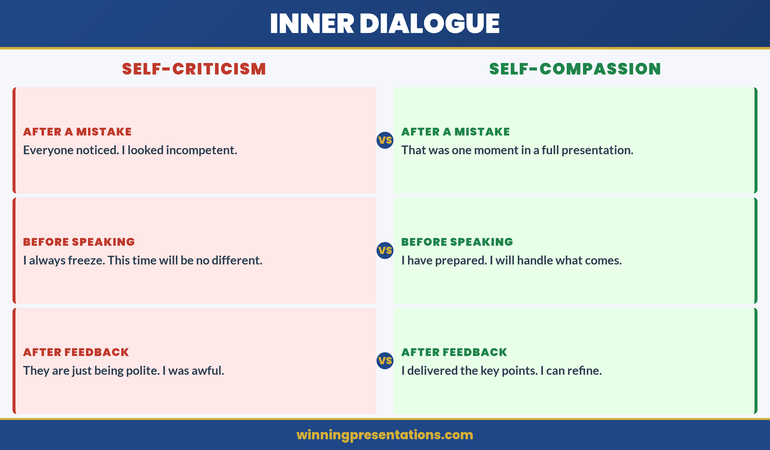
29 Mar 2026
Crisis boardroom briefing setting with urgent presentation slides on screen during a data breach response

The Data Breach Presentation: How to Brief the Board When Security Has Failed

A data breach presentation to the board must prioritise transparency, containment status, and remediation roadmap. Structure your briefing with immediate facts first, then severity assessment, affected parties, response measures, and governance improvements—delivered with composure and accountability, not excuses.

I remember sitting with the CRO of a mid-sized fintech company the morning their payment processing systems were compromised. His instinct was to minimise the incident, talk about their strong security posture, and focus on the rapid remediation. But the board didn’t need reassurance—they needed truth. When he pivoted to a clear, facts-first briefing that acknowledged the breach severity, explained exactly how it happened, and outlined the decisive steps already underway, the room shifted. The board moved from alarm to alignment. That presentation became the template I’ve now refined across banking, healthcare, and technology firms facing their own security crises. The lesson: transparency and accountability rebuild trust faster than any defensive narrative.

The Challenge

You’re in crisis mode. Incident response teams are working round the clock, legal and compliance are engaged, but now you face the board. This presentation sets the tone for the organisation’s response and determines whether leadership retains stakeholder confidence. Get it wrong, and you compound the crisis. Get it right, and you lead recovery.

How to Structure a Data Breach Presentation

The moment you call a data breach presentation, the board expects a specific framework. This isn’t the place for storytelling or gradual reveals. Your structure must signal control, transparency, and a clear remediation path.

Begin with what happened: the discovery method, date detected, and date of incident. Follow with scope: how many records, which systems, which customer populations. Then move to response: what’s been done since discovery, what’s in progress, what external parties have been engaged. Finally, present governance: the investigation findings, root cause, and prevention measures being implemented.

Each section must answer the question the board is actually asking: Is this controlled? Do we understand it? Are we managing the fallout? What have we learned?

Your slides should be clean, data-heavy, and devoid of jargon. Board members want to understand the incident without needing a security degree. If you can’t explain your response in plain English, you haven’t thought it through well enough.

Master Board Presentations Under Pressure

The Executive Slide System gives you frameworks for every high-stakes conversation—including crisis management. Slide templates, speaker notes, and board communication protocols designed for banking, healthcare, and regulated industries.

Executive Slide System — £39

Includes crisis communication templates

Opening with the Facts: What Happened and When

Your opening slide should contain three elements: the discovery date, the incident date, and the notification status. Don’t bury these. Put them at the top in large text. Boards appreciate efficiency.

For example: “Breach discovered 14 March 2026. Incident occurred 7–12 March 2026. Regulatory notification completed 15 March. Customer notifications in progress.” That’s it. One slide. One minute of your time.

Then explain how you discovered the breach. Was it a third-party security researcher? Your own monitoring systems? A customer report? An attack pattern? The method matters because it tells the board whether your detection capabilities are strong or weak. Be honest. If you relied on external discovery, acknowledge it and explain what’s being upgraded in your monitoring infrastructure.

Next, outline the attack vector. How did they get in? Vulnerable plugin? Credential compromise? Supply chain weakness? Social engineering? Don’t speculate. Present only what your forensic investigation has confirmed. If the root cause isn’t yet clear, say so. Speculating damages credibility more than admitting you’re still investigating.

Finally, confirm whether the breach has been contained. Is the attack surface still open, or has it been sealed? Are you confident the attacker no longer has access? This single answer determines whether the board moves to the next question or stops you with follow-ups. If containment is partial or uncertain, be explicit about it and explain the timeline to full containment.

Scope and Impact: Who and What Was Affected

After establishing what happened, the board needs to understand the size of the problem. This section requires precision. Vague numbers erode trust faster than difficult truths.

Present the affected data categories clearly: customer names and email addresses (number of records), payment card information (last four digits only, ideally), NHS numbers, employee data, or proprietary information. Be specific about each category. A breach affecting customer emails is materially different from one affecting payment cards, and the board needs to distinguish.

If the breach is geographically dispersed, break it down by region. GDPR-regulated data? HIPAA-covered records? Payment Card Industry data? This determines your notification and regulatory burden, and the board needs to see that you’ve already mapped these obligations.

Include a timeline slide showing the discovery window and remediation milestones. Boards want to see momentum. If your timeline shows discovery on day one and containment on day two, that’s strong positioning. If it shows a month-long gap between incident and discovery, the board will ask harder questions about your monitoring.

Data breach board briefing dashboard showing four critical elements: core slides, update cycle, decision ask, and stakeholder groups

Don’t speculate about impact. If you don’t know whether customers have suffered fraud, say so. If no fraudulent transactions have been reported yet, that’s worth noting, but don’t claim it as evidence of safety. Fraudsters often sit on stolen data for months before monetising it. Responsible communication means saying what you know and don’t know, and explaining your monitoring for future misuse.

Close this section by explicitly confirming whether this is your organisation’s first breach, or whether there are previous incidents in your history. Boards need to see whether this is an isolated incident or a pattern of security weaknesses. If it’s your second breach in three years, that changes the narrative significantly, and the board will expect more aggressive remediation and governance changes.

Immediate Response and Containment Measures

This is where you demonstrate leadership. The board is watching to see whether your organisation has a rehearsed, competent response or whether you’re improvising under pressure.

List the actions taken immediately upon discovery: isolation of affected systems, engagement of external forensic investigators, notification of your insurer, engagement of breach counsel, and escalation to the board and audit committee. If you’ve already done these things, say so with dates. If you’re still in the process, say that too.

Introduce your response team: Who is the incident commander? Who is leading the forensic investigation? (Name the external firm if you’ve engaged one—it signals seriousness.) Who is managing regulatory notification? Who is handling customer communications? Boards trust clarity. If the response is fragmented or unclear, confidence drops.

Then outline the ongoing remediation: system hardening, patching, access reviews, enhanced monitoring, infrastructure changes. Give timeline estimates for each. Be realistic. If you’re six weeks into a twelve-week remediation, say so. Overpromising fixes erodes trust.

Close by addressing cyber insurance. Have you made a claim? What is your coverage limit? What portion of costs will be covered? Boards care deeply about financial impact, and insurance is often the most material mitigation. If your coverage is inadequate for this incident, the board needs to know now and understand why you’ll be proposing coverage increases before the next renewal.

Present with Executive Clarity

The difference between a crisis that destroys confidence and one that proves your leadership is how you present it. The Executive Slide System includes dark mode templates, data visualisation examples, and voice patterns for high-stress briefings—tested with C-suite executives and board chairs across banking and healthcare.

Executive Slide System — £39 →

External Communication and Regulatory Reporting

The board must understand your communication obligations and strategy before the breach becomes public. Present your notification timeline, template letters (redacted for the board), and the sequence in which stakeholder groups will be informed.

In the UK, GDPR requires notification to the Information Commissioner’s Office within 72 hours if there is high risk to individuals. Are you meeting this deadline? If not, explain why not and when you will. If the breach isn’t reportable to the ICO, explain that too—it shows you’ve done a legal assessment rather than over-reporting.

For payment card data, PCI-DSS requires notification to card networks and potentially customers. Are you engaging payment processors and card schemes? Have you involved your acquiring bank? The board needs to see that you understand your contractual and regulatory obligations.

Present your customer communication strategy. Will you email, phone, or offer a portal where customers can check whether their data was involved? Will you offer free credit monitoring? The board will want to know your cost estimate for this. If you’re committing to paid identity protection for affected customers, that’s a material expense and requires board visibility.

Also address media strategy. Have you engaged a PR agency? What is your public statement? Will the CEO do interviews, or will you refer all inquiries to a designated spokesperson? The board will want to know whether you’re being transparent with the press or defending the breach defensively. Transparency usually plays better with media and the public.

Finally, address staff communication. Employees often hear about breaches through news first, which damages morale. Have you prepared an all-hands briefing explaining what happened, whether employee data was involved, and what the organisation is doing to prevent recurrence? This matters more than many executives realise. Your people need to believe you’re taking this seriously.

Recovery and Prevention: The Path Forward

The final section is the pivot from crisis to leadership. Boards remember organisations that not only survive breaches but demonstrate they’ve learned from them and made meaningful improvements.

Present your investigation findings: the root cause, the failure points, and the systemic weaknesses this breach has exposed. Don’t soft-pedal this. If your monitoring was inadequate, say so. If your patch management was slack, admit it. If you had a known vulnerability that wasn’t prioritised, own it. Boards respect organisations that face difficult truths rather than make excuses.

Then outline your remediation roadmap. What specific changes are being made to prevent recurrence? Upgraded security monitoring? Enhanced access controls? Penetration testing? A new Chief Information Security Officer? Updated incident response playbooks? Each item should have a owner, a timeline, and a success metric.

Address governance improvements. Will the board now receive monthly cyber updates rather than quarterly? Will you establish a board-level cyber committee? Will CISO reporting change? These changes signal that leadership takes the risk seriously and is willing to restructure governance to match.

Also present your cyber insurance and risk transfer strategy going forward. Are you increasing coverage? Changing providers? Adding additional coverage for extortion or reputation damage? Regulatory and compliance presentations often gloss over insurance, but the board will expect a clear strategy here.

Four-stage breach response roadmap: contain, assess, communicate, and recover

Finally, present your communication plan for this conversation. How will you communicate the board’s confidence in the response to employees, customers, and investors? If the board passes a resolution affirming management’s handling of the incident, that’s a signal to the market that governance is strong. Include this in your planning.

Close this section—and the core content—with a personal commitment from the executive leading the response. The board needs to hear that someone is personally accountable and will see this recovery through. Not a vague “the team is committed” statement, but a clear “I am leading this and I will report monthly on our progress” commitment. This transforms the conversation from a crisis briefing to a leadership moment.

If you’re preparing for a board briefing after a breach and need to sharpen your messaging, the Executive Slide System includes crisis communication templates and speaker notes tested in actual board rooms.

Frequently Asked Questions

How much detail should you provide about the attack vector?

Provide enough detail so the board understands the risk, but not so much that you’re revealing operational security information. Say “a vulnerability in our third-party email plugin” rather than the specific CVE number or patch details. The board needs to know the category of failure (third-party risk, credential compromise, supply chain) so they can understand your remediation approach. Your detailed forensic report goes to audit committee members with restricted distribution, not the full board.

What if the breach is ongoing and you haven’t yet achieved full containment?

Be transparent about the containment status and timeline. “We have contained the payment processing vulnerability as of this morning. We are still monitoring the attacker’s activity on one legacy system, which we expect to fully isolate by end of week.” Boards understand that some breaches take time to fully contain. What they won’t tolerate is discovering later that you misrepresented the containment status in this briefing. Err toward transparency every time.

Should you recommend board-level changes to cyber governance, or wait for the board to ask?

Recommend them proactively. You have the information; the board is responding to you. If you believe monthly cyber updates are warranted, propose them. If your CISO should report directly to the board rather than the CIO, recommend it. This positions you as forward-thinking and accountable, not defensive. The board may reject your proposals, but they’ll respect that you thought through the governance implications of this breach rather than hoping they won’t notice the gaps.

Strengthen Your Board Communication

Subscribe to The Winning Edge for frameworks on high-stakes presentations, board confidence, and executive communication under pressure.

Join the Newsletter

Get the Executive Presentation Checklist free—15-point quality control framework for any board presentation.

More in This Series

Today’s articles cover governance updates, revenue forecasts, and managing presentation anxiety for challenging audiences. All part of the crisis and difficult presentation cluster.

A data breach presentation is not the moment to defend your past decisions. It is the moment to prove you can lead through a crisis with transparency, accountability, and strategic vision. Get those three elements right, and the board will support your recovery.

Mary Beth Hazeldine is Owner & Managing Director of Winning Presentations. With 24 years of corporate banking experience at JPMorgan Chase, PwC, Royal Bank of Scotland, and Commerzbank, she advises executives across financial services, healthcare, technology, and government on structuring presentations for high-stakes funding rounds and approvals.

29 Mar 2026
Boardroom setting for a governance update presentation with non-executive directors reviewing slides

The Governance Update That Made Non-Executive Directors Lean In

Non-executive directors evaluate governance updates through the lens of risk, compliance, and organisational culture. They want clarity on board effectiveness, regulatory adherence, and the controls you’ve put in place—not lengthy operational detail. A well-structured update demonstrates that your organisation operates with transparency and deliberate oversight.

When Annika presented the governance update to her insurance company’s board, she’d prepared a 25-slide deep-dive on policy changes, committee attendance rates, and internal audit findings. Halfway through the second slide, the board chair interrupted: “Annika, we don’t need the granular data. Tell us what’s broken and what you’re doing about it.”

That five-minute conversation redirected her entire approach. She scrapped the presentation and rebuilt it around three themes: emerging risks, governance responses, and board-level assurance. The revised briefing took 12 minutes. Directors asked deeper questions. The conversation became strategic. What Annika learned that day is what non-executive directors have consistently told us: they’re not looking for comprehensiveness; they’re looking for clarity about what matters.

Struggling to pitch governance effectively to your board?

The Executive Slide System is built for exactly this moment. It includes a complete governance update framework, slide templates designed for director-level communication, and a step-by-step checklist to ensure you cover the issues that actually matter to your board. Hundreds of executives have used it to transform board conversations from operational updates into strategic dialogue.

What Non-Executive Directors Actually Want

Non-executive directors sit on boards for a single reason: to provide independent oversight and assurance. When evaluating your update, they’re asking three questions internally: Are we protected? Are we compliant? Is the executive team in control?

This is fundamentally different from what executives want to hear. An operational update highlights wins, progress, and momentum. A governance update addresses gaps, controls, and assurance. The best directors understand that governance doesn’t prevent success—it protects the organisation while success is being built.

This update must therefore start with this reframe. You’re not asking directors to approve operations; you’re inviting them into a transparent conversation about how the organisation manages risk. That transparency builds trust faster than any performance metric ever will.

The Three-Part Structure Framework

Every effective governance update follows the same underlying architecture, regardless of industry or organisation size. Mastering this structure is the quickest path to credibility.

Part 1: What’s Changed. Begin with the regulatory, market, or operational landscape shifts that have occurred since the last update. This establishes context. Directors need to understand what new risks or obligations have emerged. Be specific. “Regulatory environment remains stable” signals that you haven’t been paying attention. “Three new sector-specific compliance requirements from FCA took effect in Q1; we’ve mapped impact across finance, operations, and technology” signals rigour.

Part 2: What We’re Doing About It. Now present your response. Which controls have been tightened? Which processes have been redesigned? Which gaps remain visible to you, and what’s your timeline for closure? This is where directors assess executive competence. They’re listening for self-awareness, not defensiveness.

Part 3: What You Need to Know. Close with the items that require board attention: decisions you’re asking for, emerging risks you’re flagging early, or assurance you’re providing. This is your call to action. Directors leave feeling they’ve learned something and contributed something.

This three-part framework transforms the update from a compliance checkbox into a strategic conversation. It respects directors’ time, appeals to their decision-making authority, and positions you as a leader who thinks beyond the operational moment.

Four key expectations non-executive directors have for governance update presentations: strategic alignment, risk visibility, compliance status, and financial oversight

Stop Winging Board Presentations

The Executive Slide System gives you pre-built frameworks for governance, risk, finance, and strategy presentations. Every template is tested with real boards. Every slide follows the principles that make directors lean in.

Used by 300+ executives across banking, insurance, healthcare, and government.

Get the System — £39

Instant access. Lifetime updates.

Risk and Compliance: The Core of Your Story

If the three-part framework is the skeleton of your update, risk and compliance are the organs. They’re what directors care about most—and where many executives stumble.

The mistake most leaders make is presenting risk as a list. “Operational risk: medium. Reputational risk: low. Technology risk: medium.” Directors find this useless. A list doesn’t tell them what’s being done, why it matters, or whether they should worry.

Instead, present risk as narrative. Take your three or four most material risks and tell the story for each: What triggered this risk? How is it being managed? What’s the downside if controls fail? What’s the timeline for resolution? This approach transforms a compliance checkbox into a credible conversation about executive judgment.

On compliance, the principle is the same. Rather than listing policies or audit findings, centre your update around control effectiveness. Are the controls working? Have they been tested? What do auditors tell us? When controls fail, what’s the remediation? This is what matters to a director’s mind.

One additional note: directors despise surprise. If you’re aware of a control gap, tell them early and with a plan. If you’re managing a regulatory investigation, signal it proactively. Any update that raises flags early builds far more trust than one that tries to hide complexity and gets caught out later.

Board Effectiveness and Culture

Many governance updates stop at risk and compliance. The best ones go further. They address board effectiveness and organisational culture—the softer governance issues that often matter more than hard controls.

This might include: board composition and succession planning, diversity and inclusion progress, executive talent retention, or cultural health indicators. It might include anonymised whistleblowing data, employee engagement scores, or feedback from external stakeholders. The underlying message is the same: we understand that governance is about people and culture, not just policy.

Directors consistently report that they want more conversation about culture. They recognise that weak culture drives risk; strong culture mitigates it. When your update includes a thoughtful section on how you’re building and maintaining the right organisational culture, you’re speaking directly to what directors care about most.

This is also where you demonstrate leadership maturity. Executives who only present hard numbers and policies often appear defensive. Executives who reflect openly on culture, succession, and people dynamics appear thoughtful. This update is a chance to show directors that you’re thinking about the long term, not just the short term.

Comparison of weak versus strong governance update presentations across structure, tone, and outcome dimensions

The Critical Mistakes Directors Notice

We’ve sat with hundreds of directors in preparation meetings. When we ask them what weaknesses they see in these updates, the same patterns emerge repeatedly.

Mistake 1: Too Much Detail. Your presentation should run 15-20 minutes. If you need slides for every policy change, every audit recommendation, and every committee meeting, you’ve built a reference document, not a briefing. Directors can read a dashboard; they come to a meeting to think.

Mistake 2: Defensive Tone. When you present control gaps, do it matter-of-factly. Spending time explaining why the gap exists or defending past decisions signals weakness. Gap identified. Plan in place. Timeline set. Move forward. That’s the tone directors respect.

Mistake 3: No Clear Ask. Many of these presentations float without a landing. Directors don’t know what you want them to do. Do you need their approval for a new policy? Do you need their perspective on a trade-off? Do you need them to monitor a particular risk going forward? Close with clarity. It should end with a concrete next step.

Mistake 4: Mixing Governance with Operations. This briefing is not the place to sell your strategy or celebrate wins. Save that for your business update. The focus here is assurance and oversight. When you blur those lines, directors lose trust in your judgment about what actually matters.

Avoiding these mistakes alone puts you in the top quartile of executives. Most leaders haven’t thought carefully about any of them.

If you’re presenting to a board where governance has been an afterthought, the Executive Slide System includes a complete governance module that walks you through structure, messaging, and common director objections.

Preparing Your Presentation

Preparation is where most executives go wrong. They start writing slides before they’ve done the thinking. Reverse that. Think first.

Spend an hour identifying your genuine material risks and the status of your key controls. Not every risk is material to a board. Not every control is worth mentioning. Ruthless prioritisation separates executive-level governance from noise.

Then, have a conversation with your board chair or senior independent director. Share your proposed agenda and ask: What would help your board feel assured about governance this quarter? What keeps you awake at night? What questions do directors want answered? This conversation is worth far more than guessing.

Finally, build your briefing around the answer. Not around what you think should matter, but around what your board actually cares about. That alignment is what transforms a presentation into a conversation.

The Executive Slide System Includes:

  • Governance update templates with real board feedback
  • Risk communication frameworks that directors actually engage with
  • Step-by-step checklist to ensure you cover critical governance areas
  • Common director objections and how to address them
  • Lifetime access and quarterly updates

Explore the Executive Slide System — £39

Frequently Asked Questions

How long should this briefing be?

Between 15 and 20 minutes is optimal. This leaves time for questions and dialogue. If you need more than 20 minutes, you’ve included detail that doesn’t belong in a board presentation. Move granular content to written reports or appendices. Your briefing should highlight; a supporting document can detail.

Should I present governance updates in every board meeting?

Not necessarily. Some boards have a dedicated governance committee that reviews governance between board meetings. For full board meetings, governance can be a standing item, but it needn’t be a full presentation every time. Quarterly is common; some boards do it semi-annually. Alignment with your board’s cycle and governance committee structure matters more than frequency. What matters is consistency and visibility.

What if a director asks a question I can’t answer during the briefing?

Say so directly. “That’s an excellent question. I don’t have that data with me; let me investigate and come back to you within a week.” Then do it. Directors respect executives who admit knowledge gaps and follow up. They’re suspicious of those who bluff. Transparency about what you don’t know is part of demonstrating governance competence.

Get Board-Ready Insights Every Week

The Winning Edge newsletter shares governance, strategy, and risk communication strategies built on 24 years of board experience. Join 800+ executives.

Subscribe to The Winning Edge

Download the Executive Presentation Checklist — a free framework to prepare for any board presentation.

Related Reading

After you’ve mastered the governance update, explore how to present a data breach to your board — another critical conversation where structure and tone determine whether directors feel assured or alarmed.

Your next governance update is an opportunity to reframe how your board thinks about oversight. Structure it right, and you’ve not just informed them—you’ve built trust.

Mary Beth Hazeldine is Owner & Managing Director of Winning Presentations. With 24 years of corporate banking experience at JPMorgan Chase, PwC, Royal Bank of Scotland, and Commerzbank, she advises executives across financial services, healthcare, technology, and government on structuring presentations for high-stakes funding rounds and approvals.

28 Mar 2026
Steering committee meeting setting with a decision-focused presentation displayed on a conference room screen

Steering Committee Presentation: How to Drive Decisions Instead of Status Updates

A steering committee meeting that ends with polite nods and no decisions isn’t a successful meeting. It’s a failure disguised as information sharing. You walked in hoping to move something forward — approval for a budget, consensus on a direction, commitment to a timeline — and you walked out with nothing but “We’ll take it under advisement.”

Tomás was a programme director at a mid-sized insurance company. His infrastructure modernisation project had been running for nine months. Every quarter, he presented to the steering committee — a mix of the CTO, CFO, two divisional heads, and an external adviser. Every quarter, he walked in with a 30-slide deck covering timelines, risks, resource allocation, vendor updates, and technical architecture changes.

Every quarter, the committee listened politely, asked a few clarifying questions, and deferred the decisions he needed. Budget reallocation? “Let’s revisit next time.” Vendor contract extension? “We need more data.” Timeline adjustment? “Send us a paper and we’ll discuss offline.”

After the third round of deferrals, Tomás asked the CTO directly: “What would it take to get a decision in the room?” The CTO’s answer was blunt: “Stop telling us what’s happening and start telling us what you need us to decide. We’re a committee, not an audience.”

Tomás rebuilt his next presentation from scratch. He opened with the decision: “I need approval today to extend the vendor contract by six months and reallocate £340,000 from the contingency budget.” He supported it with three slides of evidence and one slide of risk. The committee approved it in eleven minutes. Nine months of deferrals ended because the presentation changed from a status report to a decision request.

If you want a structured approach to steering committee presentations that moves from discussion to decision without requiring hours of debate prep, there’s a framework specifically designed for this governance scenario.

Explore the System →

Why Steering Committees Default to Inaction

Steering committees are designed for deliberation, not decisive action. They’re made up of people pulling in different directions — each with their own priorities, risk tolerances, and read on the situation. By design, they move slowly.

Most presentations to steering committees treat this as a limitation to work around. They load the presentation with data, hoping that overwhelming evidence will force consensus. Instead, they create decision paralysis. The more information in the room, the more angles to debate, the easier it is to defer.

The fix isn’t more information. It’s structural clarity. When a steering committee presentation is built to move from “Here’s the situation” to “Here’s the decision required” to “Here’s why we decide now,” the committee feels the momentum. They move with you.

The Decision-First Framework

Open your steering committee presentation with the decision, not the context. This is counterintuitive. You want to explain the background first, right? Wrong. Say it upfront: “We’re asking for approval to restructure the product roadmap to include three quarters focused on infrastructure modernisation before resuming feature velocity.”

That first statement does three things: it signals what you want, it anchors the conversation, and it gives committee members a framework for all the information that follows.

Then you provide the case — but the case is now in service of that decision, not the decision emerging from the case. Every data point, every risk statement, every timeline now answers the question “Why should we approve this now?” rather than wandering into general context.

Your structure becomes: Decision → Why (context and data) → Timeline (when we need approval) → Next Steps (what happens if approved). Done.

How to Build the Case (Without Overwhelming)

Once you’ve stated the decision, resist the urge to present every consideration. Steering committees often weaponise information. The more you offer, the more they pick through looking for a reason to say no.

Instead, present exactly three categories of evidence: What’s Changed (Why we can’t stay where we are), What We Learned (Why this is the right direction), and What We Risk (What happens if we don’t move).

What’s Changed: This is trend data. User sentiment shifted. Competitive pressure increased. Internal metrics show decline in a core area. Keep this factual and recent. “We’ve seen a 22% increase in support tickets related to infrastructure stability over the past two quarters.”

What We Learned: This is context from customer conversations, market signals, or team intelligence. “Three of our largest customers flagged that they’re considering alternatives because our platform doesn’t scale cleanly past 10,000 concurrent users.”

What We Risk: This is the consequence of inaction. “If we don’t address this in the next twelve months, we’ll lose market position in the enterprise segment where our highest-margin deals are concentrated.”

Three categories. No more. Committee members can hold that in their heads while they’re forming an opinion.

Then close with the resource request — the fourth element of the decision framework. Name the budget, people, and timeline you need. Not vaguely: “We’ll need additional resources.” Specifically: “We need £340,000 from the contingency budget, a six-month vendor contract extension, and two additional engineers starting in Q2.” When you state the resource request in concrete terms, you give the committee something tangible to approve. When you leave it abstract, you give them something to defer.

The resource request also functions as a credibility signal. A presenter who can quantify exactly what they need — the budget figure, the headcount, the timeline — demonstrates that they’ve done the planning work. A presenter who says “we’ll figure out the details later” signals that the project isn’t ready for approval. The committee will sense that gap instantly, and they’ll use it as the reason to defer.

Decision framework for steering committee presentations with four components: decision statement, evidence summary, risk assessment, and resource request

Need the Decision Framework for Steering Presentations?

The Executive Slide System includes governance-specific templates that open with the decision, structure the case in three evidence categories, and include contingency language for objections. You control the narrative momentum because your structure makes it clear when the decision point arrives.

Designed for executives managing steering committees, governance meetings, and high-stakes approval scenarios.

Get the System (£39)

The Risk Statement That Changes Minds

The most persuasive element of a steering committee presentation is not your opportunity case. It’s your risk statement.

Most presenters bury risk at the bottom or avoid it entirely, hoping the committee won’t think of it. Committee members always think of it. By not saying it first, you look like you’re hiding something.

Instead, surface the risk clearly: “If we restructure now, we’ll push feature releases back by two quarters. That affects bookings targets for Q3 and Q4. Here’s how we’ve modelled for that impact.” You’ve named the biggest concern and shown you’ve thought it through. The committee relaxes. You come across as realistic, not reckless.

The risk statement that moves a steering committee isn’t about minimising risk. It’s about demonstrating you’ve seen it clearly and have a plan to manage it.

Comparison of status update versus decision session approaches for steering committee presentations

The difference between a status update and a decision session is structural, not stylistic. In a status update, the presenter opens with a report: “Here’s what happened since last time.” In a decision session, the presenter opens with a decision ask: “I need approval for X by this date.” That single shift changes every dynamic in the room. Committee members stop listening passively and start evaluating actively.

The second structural difference is evidence density. Status updates present every metric on every dimension — comprehensive coverage that creates decision paralysis. Decision sessions present focused proof: the three data points that support the recommendation. Not everything the committee could know, but everything they need to know to decide. When you narrow the evidence, you narrow the debate. That’s how decisions happen.

The third difference is the close. Status updates end open-ended: “Any thoughts or questions from the group?” That’s an invitation to wander. Decision sessions close with a commitment ask: “Can I proceed with this plan by Friday?” You’re not asking for reactions. You’re asking for a vote. If the committee isn’t ready to vote, you’ll find out why — and that information is more valuable than another round of polite nods.

Handling Objections Before They Derail You

Steering committees are full of people who’ve been in business long enough to imagine everything that could go wrong. If you don’t anticipate their objections and address them preemptively, they will use them to stall.

Before you walk in, identify the three objections most likely to derail the decision. Not every possible objection — the three that would actually make a committee member vote no.

Then, buried in your supporting slides (not your main narrative), answer each one directly. “We know some will worry that pulling engineering off features breaks our competitive momentum. We’ve modelled this: we’ll slow feature velocity but maintain our infrastructure stability advantage, which actually strengthens our defensibility in the mid-market segment where we’ve been losing ground.”

When an objection lands in the discussion, you can calmly reference the slide you prepared. You look organised. You look like you’ve thought through the hard questions. That shifts the vote.

Securing Commitment in Real Time

Many steering committee presentations end with “We’ll circle back with a recommendation.” Translation: “This didn’t land, and now we’re all pretending we need more time.”

If you’re presenting a decision, ask for it. “Are we moving forward with this restructure? Or do we need more information?” Force the conversation to the decision line. You’ll find out in that moment whether you have the votes, or whether you need to negotiate.

If you don’t have the votes, it’s better to know now and adjust than to walk out thinking you have consensus and discovering later that you don’t. Steering committees are often more swayed by seeing consensus form in real time than by any data in your presentation.

The moment the first committee member says “I’m in,” others follow. They’re watching each other as much as they’re listening to you. Your job is to move the conversation to that first decision.

If you’re preparing for a steering committee presentation and want the decision-first structure, objection-handling slides, and commitment language already built in, the Executive Slide System includes governance-specific templates designed for exactly this scenario.

Ready to Move Steering Committees to Decision?

The Executive Slide System includes contingency slides for common steering committee objections, timing frameworks that show when a decision is urgent, and language patterns for moving from discussion to commitment. You’ll spend less time managing debate and more time executing once the decision is made.

Designed for executives, programme managers, and functional leaders who regularly present to governance bodies.

Explore the System (£39)

Questions About Steering Committee Presentations

What if a steering committee member raises a completely new concern mid-presentation?
Acknowledge it. Don’t dismiss it or get defensive. Say: “That’s a fair point. That’s not a concern we’ve modelled for in depth. If this committee sees that as critical to the decision, let’s table the approval until we’ve looked at it.” You’ve shown respect for their input and bought time to strengthen your case on that angle.

How do I handle a steering committee that’s split and won’t coalesce around a decision?
Identify which committee member is the opinion leader. Usually it’s the chair or the longest-tenured member. Address the core disagreement directly with that person: “I hear concern about [X] and support for [Y]. What would it take for us to move forward?” You’re not debating the full committee. You’re negotiating with the person who can move votes.

Should I bring detailed financial projections to a steering committee meeting?
Bring them as a backup, but don’t lead with them. Lead with the decision and the case. If a committee member asks about the financials, you have them. If they don’t ask, you’ve kept the conversation at the strategic level where it needs to be.

What’s the ideal length for a steering committee presentation?
Fifteen minutes maximum for your main presentation, plus thirty minutes for questions and discussion. If you need more than fifteen minutes to state your case, you’re overcomplicating it. The decision should be clear by minute ten.

More on Decision-Focused Presentations

See also: Investor Update Presentations: How to Structure for Confidence and Clarity for similar decision frameworks applied to investor relations scenarios.

Join The Winning Edge Newsletter

Get structure-first presentation insights delivered to your inbox. Real frameworks, no fluff.

Subscribe to The Winning Edge →

Not ready for templates yet? Start with the free checklist.

Download the Executive Presentation Checklist →
Free. Covers 16 structural elements every executive presentation needs.

Steering committees are built to deliberate. Your job is to structure the presentation so they deliberate toward a decision, not away from one.


Mary Beth Hazeldine is Owner & Managing Director of Winning Presentations. With 24 years of corporate banking experience at JPMorgan Chase, PwC, Royal Bank of Scotland, and Commerzbank, she advises executives across financial services, healthcare, technology, and government on structuring presentations for high-stakes funding rounds and approvals.