

The Lateral Move Presentation: How to Pitch a Career Shift to Leadership
A lateral move presentation is the career conversation most professionals get wrong — because they pitch it as a personal desire instead of a business case. The executives approving your transfer aren’t evaluating your ambition. They’re evaluating the cost of losing you from one team and the value of gaining you in another. This article gives you the slide framework that reframes a sideways career move as a strategic decision leadership wants to say yes to.
Quick Navigation
- Why Most Internal Transfer Pitches Fail
- Building the Business Case (Not the Personal Case)
- The Five-Slide Framework
- The Transition Plan That Removes the Objection
- When and How to Have the Conversation
- Frequently Asked Questions
The Story: Linnea’s Move From Compliance to Product Strategy
Linnea had spent seven years in regulatory compliance at a fintech company. She was good at it — good enough that her manager kept expanding her remit. But for two years, she’d been drawn to product strategy. She understood regulatory constraints better than anyone on the product team, and she kept spotting opportunities they missed because they didn’t understand the compliance landscape.
Her first attempt at a lateral move was a conversation with her VP: “I’d like to explore moving to the product team.” The VP nodded, said he’d think about it, and nothing happened for four months. When Linnea followed up, she learned the VP had mentioned it to the CPO, who’d said: “We can’t afford to lose someone from compliance right now.”
That response told Linnea everything. The VP hadn’t pitched a business case. He’d conveyed a personal request. The CPO heard “Linnea wants to leave” and instinctively protected the existing team structure.
Linnea changed approach. She built a five-slide deck that reframed the entire conversation. Not “I want to move” but “Here’s how my compliance expertise in the product team eliminates the regulatory review bottleneck that’s delayed three launches this year.” She presented it to the CPO directly. The move was approved within two weeks — not as a favour, but as a strategic decision that made the CPO look smart for reorganising the talent she already had.
Building a lateral move proposal?
Explore the Executive Slide System → business case templates designed for internal career conversations.
Why Most Internal Transfer Pitches Fail
Most lateral move presentations fail because they’re framed as personal career aspirations. That framing creates three problems simultaneously:
Your current manager hears a retention risk. The moment you signal “I want to move,” your manager’s first thought isn’t your development — it’s the hole you’ll leave. If they’re a good manager, they’ll support you. If they’re a typical manager, they’ll slow-play the request or raise concerns about timing.
The receiving team sees a favour, not a gain. When a transfer comes across as “This person wants to join your team,” the receiving manager evaluates you as someone who needs something. When it comes across as “This person’s regulatory expertise eliminates a bottleneck that’s cost you three quarters of delayed launches,” the same manager evaluates you as an asset they’d be foolish to refuse.
Senior leadership sees disruption, not strategy. Internal moves always create short-term disruption. Unless you provide a clear business rationale and a credible transition plan, leadership will default to the status quo. Inertia wins when the only argument for change is personal preference.
The common mistake: presenting the lateral move as a conversation about your career, when it needs to be a conversation about the company’s talent allocation.
Building the Business Case: From Personal Desire to Strategic Reallocation
A successful lateral move presentation answers three questions from leadership’s perspective — not yours:
What problem does this solve for the receiving team? Identify a specific, measurable gap. Not “I could add value” but “The product team has missed three regulatory review deadlines in the past 12 months because they lack in-house compliance expertise. My move eliminates that bottleneck.”
What’s the cost of not making this move? Quantify it. Revenue delayed. Projects stalled. External consultants hired to fill the gap you could fill. The more specific you are about what the organisation is currently losing, the more obvious the decision becomes.
What’s the transition plan for the team you’re leaving? This is the objection killer. Most transfer requests stall because leadership worries about the gap you’ll create. If you present a credible 90-day transition plan — including who picks up your responsibilities, what documentation you’ll create, and how you’ll support the handover — you remove the primary blocker before it’s raised.
The approach is similar to how you’d build a skip-level presentation — you’re speaking to someone who cares about organisational outcomes, not individual preferences.
Slide Templates for Career-Defining Conversations
A lateral move pitch needs the right visual structure to land as a business case, not a personal request. Pre-built slide layouts provide the framework so you can focus on the argument that addresses leadership’s concerns.
- ✓ Executive proposal templates for internal career conversations
- ✓ Messaging frameworks for business case development
- ✓ Slide layouts designed for senior leadership audiences
- ✓ Framework guides for internal transfer proposals
Explore the Executive Slide System →
Designed for business case development
The Five-Slide Framework for a Lateral Move Presentation
This framework is designed for a 15-minute conversation with the decision-maker — typically the head of the receiving team or a shared senior leader. Keep it tight. Five slides. No filler.
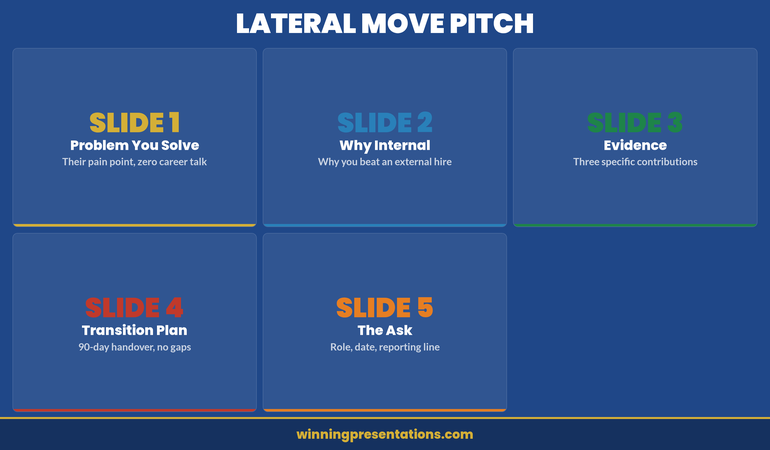
Slide 1: The Problem I Can Solve. Open with the receiving team’s specific challenge. Not your desire to move — their pain point. “The product team has spent £85,000 on external regulatory consultants this financial year. Three product launches were delayed by an average of six weeks due to compliance review bottlenecks.” One slide, two to three data points, zero mention of your career.
Slide 2: Why This Requires an Internal Solution. External hires and consultants are the default alternative. Explain why an internal transfer is superior: institutional knowledge, existing relationships, lower ramp-up time, cultural fit. “An external hire takes 6–9 months to understand our regulatory landscape. I already have seven years of context and relationships with every compliance stakeholder.”
Slide 3: What I Bring (Evidence, Not Claims). Three specific examples of work you’ve already done that demonstrates your capability in the new role. Not hypothetical value — actual contributions. “I identified the API data retention issue in Q2 that would have blocked the enterprise launch. I drafted the simplified compliance checklist that the product team now uses for every sprint review. I built the regulatory impact assessment template that cut review time from three weeks to five days.”
Slide 4: The Transition Plan. This is where most lateral move presentations either excel or collapse. Show a 90-day plan that addresses: who takes over your current responsibilities, what documentation and training you’ll complete before moving, how you’ll remain available for compliance questions during the transition, and what the handover timeline looks like week by week.
Slide 5: The Ask. Be specific. “I’m proposing a move to the product strategy team, reporting to [name], effective [date], with a 90-day transition period starting [date]. I’ve briefed [current manager] on the transition plan.” The specificity signals that you’ve thought this through — you’re not floating an idea, you’re presenting a decision-ready proposal.
The Executive Slide System includes proposal templates that give this five-slide structure the right visual weight for a senior leadership audience.
The Transition Plan That Removes the Objection
The single biggest reason lateral moves get blocked isn’t that leadership thinks you’re wrong for the new role. It’s that they can’t see how to fill the hole you’d leave. Your transition plan is the objection-removal device.
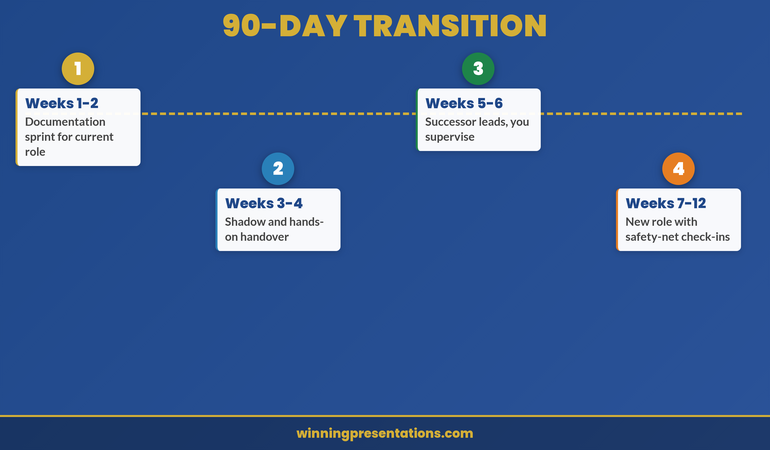
Weeks 1–2: Documentation Sprint. Write the operational playbooks for your current role. Not theoretical manuals — practical guides that answer “What does Monday look like? What happens when X occurs? Who do you call when Y breaks?” These documents should enable someone to cover 80% of your responsibilities within a week of receiving them.
Weeks 3–6: Shadowing and Handover. Identify the person (or people) who’ll absorb your responsibilities. Work alongside them. Let them handle the work while you supervise. This is the equivalent of a co-pilot taking the controls while the captain watches — you’re building their confidence and competence simultaneously.
Weeks 7–12: Clean Transition with a Safety Net. You’re now in the new role, but you remain available for questions from your former team. Set clear boundaries: “I’ll hold a 30-minute weekly check-in for the first month, and I’m available on Slack for urgent questions.” This isn’t about doing two jobs. It’s about demonstrating that you haven’t abandoned the team you’re leaving.
If you’ve ever built a compensation discussion presentation, you’ll recognise the same dynamic: the person you’re presenting to needs to feel that approving your request doesn’t create a bigger problem than the one it solves.
When and How to Have the Conversation
Timing a lateral move presentation is as important as the content. Get it wrong and even a perfect deck gets shelved.
Present after a visible win, not during a lull. If you’ve just delivered a successful project, your credibility is at its peak. That’s when leadership is most open to hearing proposals. Pitching during a quiet period signals restlessness. Pitching after a win signals ambition backed by evidence.
Talk to the receiving team leader first. Before presenting to anyone, have an informal conversation with the person who’d be your new manager. Not a formal pitch — a coffee conversation: “I’ve been thinking about how my compliance background could help with the regulatory review bottleneck. Would you be open to exploring that?” If they’re enthusiastic, you have an internal sponsor. If they’re lukewarm, you know to adjust your approach.
Brief your current manager before the formal pitch. Blindsiding your manager is the fastest way to turn a supporter into a blocker. Have the conversation early: “I’m considering proposing a move to the product team. I’ve built a transition plan and I wanted your input before I present it.” Most managers will be more supportive when they feel consulted rather than bypassed.
Understanding how to structure your arguments for leadership audiences applies whether you’re pitching a career move or building any executive presentation structure — the principles of clarity, evidence, and audience-first framing are the same.
Is This Right For You?
✓ You’re planning a lateral move within your organisation and want a structured approach
✓ You’ve tried the informal “I’d like to explore a move” conversation and it went nowhere
✓ You want slide templates that position your transfer as a business decision, not a favour
✗ You’re looking for interview preparation for external roles — this is specifically for internal moves
✗ Your organisation has a formal internal transfer process that doesn’t involve presentations
Frequently Asked Questions
Should I use a presentation for an internal transfer or just have a conversation?
Both — but the presentation changes the conversation from a casual request to a business proposal. A verbal conversation says “I’d like to move.” A five-slide deck says “Here’s my analysis, evidence, and transition plan.” The deck signals that you’ve done the work, which makes approval easier for the decision-maker. Even if you only share it on-screen during a 15-minute meeting, the structure forces clarity.
What if my manager blocks the move?
A strong transition plan is your best defence against a blocking manager. Most managers block transfers because they fear the operational gap, not because they want to limit your career. Address that fear directly: show exactly who covers what, when the handover completes, and how you’ll support the transition. If your manager still blocks you after seeing a credible plan, escalate to HR or a senior sponsor — most organisations have internal mobility policies that prevent indefinite blocking.
How do I present a lateral move without looking disloyal to my current team?
Frame it as talent optimisation, not escape. “I’ve built strong systems in my current role that can operate without me — and I’ve identified a gap in the product team where my regulatory expertise creates more value for the company.” This positions you as someone who’s thinking about organisational effectiveness, not someone who’s running from their current responsibilities. The transition plan reinforces this: it shows you care about what happens after you leave.
The Winning Edge — Weekly Presentation Intelligence
Frameworks, slide strategies, and executive communication insights delivered every week. Trusted by professionals who present to boards, clients, and senior leadership.
Free resource: Download the Executive Presentation Checklist — a quick-reference guide for structuring any high-stakes executive deck.
If you’re also facing a client escalation presentation, the same accountability-first framing applies — different audience, same commitment to clarity and directness.
Your lateral move deserves more than a casual conversation that gets forgotten. Build a five-slide deck using the framework above, and ensure the business case is clear enough that leadership sees it as a strategic decision, not a personal favour.
About the Author
Mary Beth Hazeldine is Owner & Managing Director of Winning Presentations. With 24 years of corporate banking experience at JPMorgan Chase, PwC, Royal Bank of Scotland, and Commerzbank, she advises executives across financial services, healthcare, technology, and government on structuring presentations for high-stakes funding rounds and approvals.