Tag: presentation anxiety symptoms

29 Apr 2026
Professional woman in a navy blazer stands at a glass office door with a tablet, ready to greet visitors outside a boardroom.

Stomach Churning Before Presentations: Why Your Body Reacts First and How to Reset It

Quick Answer

Stomach churning before presentations is your autonomic nervous system diverting blood away from digestion toward your muscles and heart. It is not a sign that something is wrong — it is your body’s preparation response. Vagus nerve activation, diaphragmatic breathing, and targeted pre-presentation protocols can reduce the gut response within minutes.

Nalini had given presentations to investor groups before. She was a portfolio director at a mid-cap asset management firm — pitching was part of the job. She knew her numbers. She trusted her analysis.

But her stomach had its own opinion about presenting.

It started the morning of her quarterly review to the investment committee. She woke at five thirty with a low wave of nausea that did not go away. By the time she arrived at the office, the churning had settled into a dull, grinding discomfort just below her ribs. She skipped breakfast. She drank water and immediately regretted it. Sitting outside the boardroom, she could feel the muscles in her abdomen tightening and releasing in slow, involuntary contractions, as if her body was bracing itself against something she could not see.

She presented well. The committee approved her recommendations. Afterwards, a colleague asked how she stayed so composed. Nalini smiled and said nothing. She did not mention the twenty minutes she had spent in the bathroom beforehand, or the tin of ginger pastilles she kept in her handbag for exactly these mornings, or that the churning did not stop until forty minutes after the meeting ended. Her preparation was thorough. Her body did not care.

Does your stomach react before every important presentation?

If you are looking for a structured approach to managing the physical side of presentation anxiety — not just the mental preparation — this may help:

  • Does the nausea start hours before you present?
  • Have you stopped eating breakfast on presentation days?
  • Does the churning persist even after presentations that go well?

Explore Conquer Speaking Fear →

Why Your Stomach Reacts Before Your Mind Does

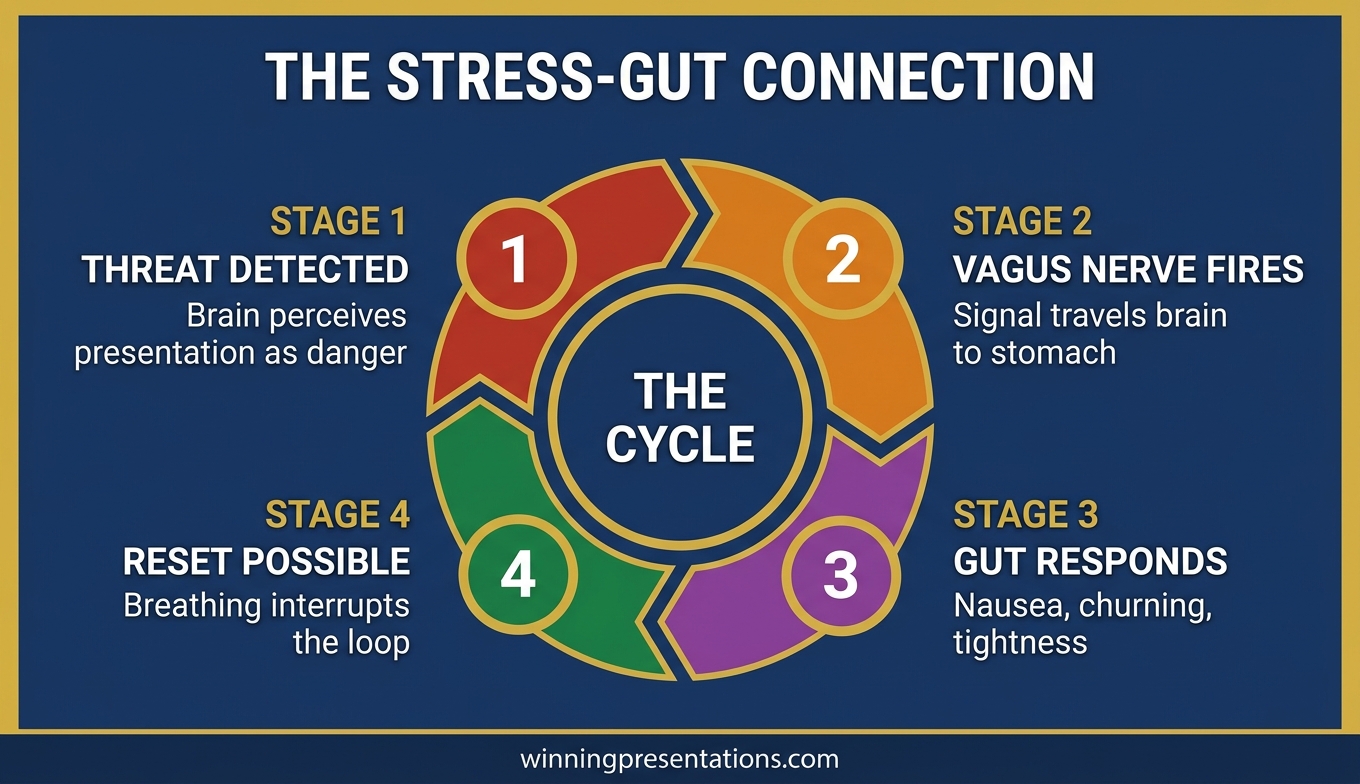
The stomach churning you feel before a presentation is caused by your autonomic nervous system detecting the situation as a threat and preparing your body to respond. This fight-or-flight response does not distinguish between a genuine physical danger and a boardroom full of senior leaders waiting for your update. The physiological cascade is the same: adrenaline surges, heart rate increases, and blood flow is redirected away from digestion toward the muscles needed for action.

Your gastrointestinal system is one of the first casualties. The stomach slows its normal contractions, the gut lining produces less protective mucus, and the smooth muscles of the intestinal wall begin to spasm. The result is the churning, nausea, and cramping that so many professionals experience before presenting.

The reason your stomach reacts before your mind catches up is that the gut contains over 100 million neurons and communicates with the brain via the vagus nerve. This gut-brain axis operates faster than conscious thought. Your stomach knows you are nervous before you have finished forming the thought. This is why intellectual confidence (“I know this material”) does not prevent the physical response. The two systems operate on different channels. For executives dealing with the anticipatory build-up that starts hours before, see our guide to anticipatory anxiety before presentations.

Why does my stomach churn before public speaking?

Your stomach churns because your autonomic nervous system activates the fight-or-flight response, redirecting blood away from digestion. The gut-brain axis — connected via the vagus nerve — registers the presentation as a threat faster than your conscious mind does, triggering nausea and abdominal discomfort even when you feel mentally prepared.


Diagram showing the gut-brain axis and vagus nerve connection explaining why the stomach reacts to presentation anxiety before conscious thought

Your Stomach Is Telling You Something. Here Is How to Respond.

The physical symptoms of presentation anxiety are not character flaws — they are nervous system patterns that can be managed with the right approach. Conquer Speaking Fear — £39, instant access — is a neuroscience-based programme designed for professionals whose bodies react to presenting even when their preparation is thorough:

  • Nervous system regulation techniques to reduce the gut-level stress response before you present
  • Cognitive reframing protocols that change how your brain categorises the presentation situation
  • Physical symptom management strategies for nausea, stomach discomfort, and visible tension

Get Conquer Speaking Fear →

Designed for executives whose knowledge is never the issue — but whose body has its own agenda on presentation day.

The Vagus Nerve Connection: Your Gut-Brain Shortcut

The vagus nerve runs from the brainstem through the neck, chest, and abdomen. It is the primary communication channel between your brain and your gut. When your sympathetic nervous system activates the stress response, the vagus nerve’s calming influence is suppressed — a state called reduced vagal tone. The stomach loses its steady rhythm and begins to churn, cramp, or simply refuse to function.

The useful insight is that the vagus nerve carries signals in both directions. Stimulating it from the body side sends calming signals back to the brain, even when your conscious mind is still anxious. This is why cold water on the wrists, slow breathing, and gentle humming can reduce stomach symptoms within minutes. They activate the vagus nerve directly, bypassing conscious thought.

Vagal tone is also trainable. Executives who regularly practise diaphragmatic breathing or cold exposure tend to experience reduced baseline activation over time. The stomach still reacts, but the intensity diminishes and recovery time shortens. For professionals whose physical symptoms persist after presenting, see our guide to post-presentation anxiety and heart racing.

A Pre-Presentation Protocol for Stomach Calm

A structured protocol targeting gut symptoms works on three levels: reducing sympathetic activation, stimulating the vagus nerve, and managing the practical realities of an unsettled stomach.

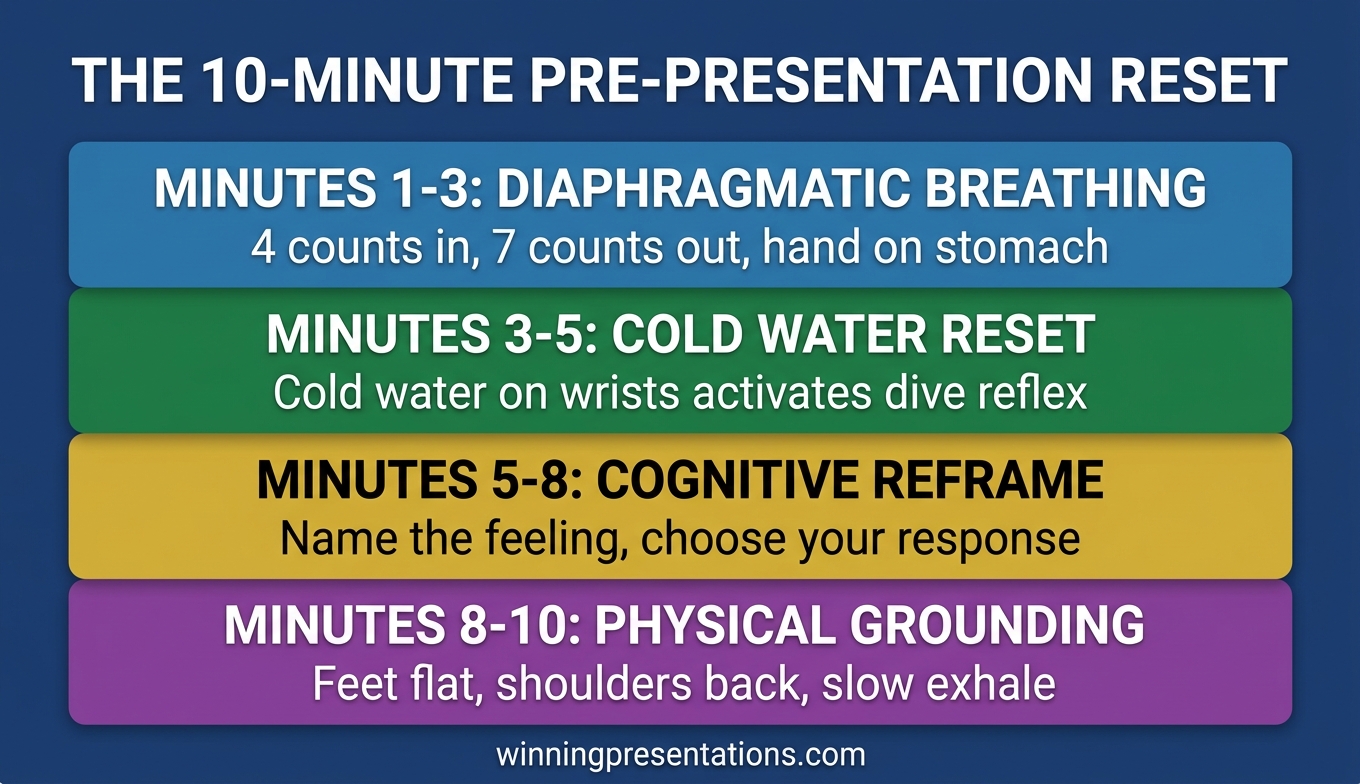
Two hours before: eat strategically. An empty stomach amplifies nausea — acid with nothing to work on creates its own discomfort. Eat something bland: plain toast, a banana, a handful of oats. Avoid caffeine, dairy, and anything acidic. If you cannot face food, ginger tea can settle the stomach without requiring you to eat.

Thirty minutes before: cold water vagus nerve activation. Run cold water over the insides of your wrists for sixty seconds. The temperature change stimulates the vagus nerve through the skin, sending a calming signal to the brainstem. If possible, splash cold water on your face — the dive reflex this triggers is one of the fastest routes to parasympathetic activation.

Fifteen minutes before: the 4-7-8 breathing sequence. Inhale for four counts, hold for seven, exhale slowly for eight. Repeat four times. The extended exhale directly stimulates vagal tone and signals your autonomic nervous system that the threat has passed.

Five minutes before: abdominal self-massage. Place your hand flat on your abdomen and make slow, gentle clockwise circles. This mimics the natural direction of digestive movement and can ease cramping. It also provides a grounding physical sensation that redirects attention from catastrophic thinking to the present moment.

How do I stop feeling sick before a presentation?

Eat something bland two hours before (an empty stomach worsens nausea), use cold water on your wrists to stimulate the vagus nerve, practise extended-exhale breathing (4-7-8 pattern), and apply gentle clockwise abdominal massage. These techniques activate the parasympathetic nervous system, counteracting the stress response causing your nausea.

Breathing Techniques That Settle the Gut

Breathing sits on the boundary between voluntary and involuntary control. When you consciously override its automatic pattern, the rest of your nervous system follows. The key principle: a longer exhale activates the parasympathetic nervous system, sending a direct signal through the vagus nerve that the body is safe and can resume normal digestion.

Box breathing (4-4-4-4). Inhale for four counts, hold for four, exhale for four, hold for four. Repeat for two minutes. This establishes a rhythm that overrides rapid, shallow stress breathing. Use it as a baseline technique when you need to stabilise quickly.

Extended exhale breathing (4-2-8). Inhale for four counts, hold for two, exhale for eight. This pattern maximises vagal stimulation by doubling the exhale. It is more effective at settling stomach symptoms specifically. Practise sitting down, as deep parasympathetic activation can occasionally cause light-headedness.

Physiological sigh (double inhale + long exhale). Take a quick inhale through the nose, immediately followed by a second shorter inhale on top, then a slow exhale through the mouth. This pattern is particularly effective at calming the diaphragm — the muscle sitting directly above the stomach. When the diaphragm relaxes, mechanical pressure on the stomach decreases, reducing the sensation of churning.

For executives whose physical responses extend beyond the stomach to authority-related tension, see our article on fear of authority when presenting.

If you want a structured programme combining these breathing techniques with cognitive reframing and pre-presentation protocols designed for executive environments, the Conquer Speaking Fear programme (£39) provides the complete framework.


Three breathing techniques for settling stomach symptoms before presentations showing box breathing, extended exhale, and physiological sigh patterns

Cognitive Reframing for Physical Symptoms

What makes stomach churning worse is the story you tell yourself about it. “If I am this nervous, I must not be ready.” “Other people do not feel this way.” These interpretations amplify the physical symptoms by registering as additional threat, which triggers more sympathetic activation, which worsens the gut response.

From “I am nervous” to “My body is preparing.” The physiological responses to excitement and anxiety are nearly identical. When you label the stomach sensation as preparation rather than fear, the brain does not escalate the threat response. This is not positive thinking — it is accurate reinterpretation.

From “Something is wrong with me” to “This is universal.” Most professionals experience stomach symptoms before high-stakes presentations. They simply do not discuss it. Normalising the response removes the additional anxiety of believing you are uniquely flawed.

From “I cannot present like this” to “I have done this before.” Most executives with stomach churning before presentations have a track record of presenting successfully despite the symptoms. Directing attention to that evidence counters the catastrophic prediction that the physical sensation will derail performance.

A Preparation Protocol Beyond Deep Breathing

This article gives you techniques for the moment. Conquer Speaking Fear — £39, instant access — gives you the complete preparation system: nervous system regulation, cognitive reframing, physical symptom management, and pre-presentation protocols designed for executives who present in high-stakes environments.

Get Conquer Speaking Fear →

For professionals who want to change the pattern, not just manage the moment.

Building Your Personal Preparation Routine

These techniques work best when practised regularly, not improvised on the day. A consistent preparation routine trains your nervous system to respond differently to the anticipation of presenting.

Start with one technique and build. Choose the one that resonates — extended exhale breathing, cold water vagal activation, or the cognitive reframe — and use it before your next three presentations. Once it becomes automatic, add a second element.

Practise on low-stakes days. Use your chosen technique before team meetings or phone calls. The more your nervous system practises shifting from sympathetic to parasympathetic activation, the faster it will make that shift on presentation day.

Accept that the sensation may not fully disappear. Some activation before a high-stakes presentation is both normal and useful — it sharpens focus and improves recall. The goal is to bring it to a level where it serves your performance rather than dominating your attention.

Can presentation anxiety cause actual stomach problems?

Yes. Repeated stress activation can cause genuine gastrointestinal discomfort including nausea, cramping, acid reflux, and appetite changes. The gut-brain axis means chronic stress affects digestive function over time. These symptoms are physically real but driven by nervous system activation rather than digestive illness. Managing the stress response through breathing, vagal stimulation, and cognitive reframing reduces their frequency and intensity.

Frequently Asked Questions

Should I eat before a presentation if my stomach is churning?

Yes, but eat strategically. An empty stomach amplifies nausea because acid has nothing to work on. Eat something bland two hours before — plain toast, a banana, or porridge. Avoid caffeine, dairy, and citrus. If you cannot eat, sip ginger tea or warm water with honey. The goal is to give your digestive system a manageable task that reduces churning without overwhelming a stomach already under stress.

Why does my stomach only churn before important presentations but not regular meetings?

Your brain assigns different threat levels to different situations. A routine team meeting registers as low-stakes, so digestion continues normally. A presentation to the board or an investor committee registers as high-stakes, triggering a stronger fight-or-flight response and greater blood diversion from digestion. The churning correlates with perceived stakes, not actual danger — which is why cognitive reframing can reduce the gut response even when the audience stays the same.

How long before a presentation should I start my calming routine?

Begin two hours before with strategic eating, then use active techniques — cold water, breathing exercises, abdominal massage — in the final thirty minutes. Starting earlier is counterproductive because the anxiety has not yet peaked. Starting later than fifteen minutes before does not allow the parasympathetic nervous system to fully engage. The sweet spot is a graduated approach: gentle preparation two hours out, active regulation in the final half hour.

The Winning Edge — Weekly Presentation Intelligence

Every Thursday, I share one framework, one real-world example, and one practical technique drawn from 24 years of presenting in boardrooms across three continents. Join The Winning Edge newsletter →

Once your pre-presentation routine is in place, make sure your content preparation matches your physical preparation. See our guide to structuring a risk committee presentation for a framework that reduces preparation anxiety by giving you a clear structure to follow.

Also published today: how to structure an annual budget presentation that builds stakeholder confidence from the opening slide.

About the Author

Mary Beth Hazeldine is the Owner & Managing Director of Winning Presentations. With 24 years of corporate banking experience at JPMorgan Chase, PwC, Royal Bank of Scotland, and Commerzbank, she advises executives across financial services, healthcare, technology, and government on structuring presentations for high-stakes scenarios.

Book a discovery call | View services

24 Mar 2026
Executive preparing backstage before presentation with water glass and calm breathing technique

Dry Mouth Before Presenting: Why It Happens and the 3-Minute Fix

Your mouth goes dry. Three seconds into your deck, and you’re reaching for water that’s nowhere near you. The more you think about it, the worse it gets. Dry mouth presenting is one of the most common physical symptoms executives report—and it’s entirely manageable once you understand what’s happening.

Dry mouth before presenting isn’t a character flaw. It’s your sympathetic nervous system responding to perceived threat. The good news: there’s a 3-minute protocol that actually works, and you can deploy it the moment you feel it happening.

Contents

Why Dry Mouth Happens During Presentations

When you step in front of an audience, your amygdala registers threat. Your body floods with cortisol and adrenaline. Your sympathetic nervous system—the fight-or-flight branch—takes over.

One of the first physiological changes: reduced saliva production. Your mouth redirects resources away from digestion and non-essential functions. Blood flow concentrates where you’ll need it for survival: heart, lungs, large muscles. Salivary glands are deprioritised. The result is the sticky, cottony sensation that makes speaking feel like pushing through concrete.

This is not a flaw in your system. It’s ancient programming designed to help you survive. But in a boardroom, it works against you.

The trigger is anticipatory anxiety. Your mind projects into the future—what if I stumble? What if they ask a question I can’t answer?—and your body responds as if the threat is happening now. Over 72% of executives report presentation physical symptoms before they step onto a stage. Dry mouth is the most underestimated of them all.

Why? Because most people don’t know how to address it until the moment it’s happening. And by then, they’re improvising instead of executing a protocol.

Control Your Nervous System Before You Present

Your mouth is dry because your sympathetic nervous system is in overdrive. The Calm Under Pressure guide contains nervous system regulation protocols designed for high-stakes presentations.

  • ✓ Breathing techniques designed to activate your parasympathetic nervous system
  • ✓ Pre-presentation hydration and salivary gland activation protocols
  • ✓ In-the-moment recovery techniques you can use during your presentation

Get Calm Under Pressure

Designed for executives facing presentation pressure

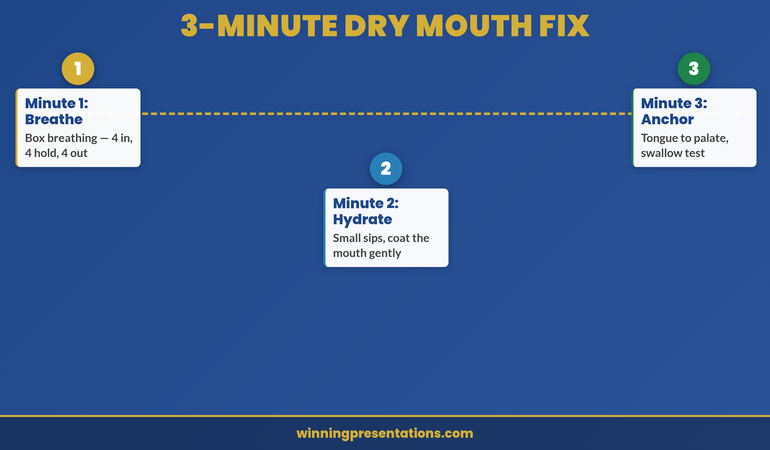
The 3-Minute Protocol: Your Recovery Roadmap

You have three minutes before you present. Here’s the exact sequence that works.

Minute 1: Sympathetic Reset

Do box breathing. Breathe in for a count of 4, hold for 4, exhale for 4, hold for 4. Repeat four times. This activates your vagus nerve—the “off switch” for fight-or-flight. Your heart rate drops. Your nervous system begins to recognise safety. Your salivary glands start to reactivate.

The science is solid: controlled breathing directly signals your parasympathetic nervous system. Within 60 seconds, your body chemistry begins to shift from cortisol-dominant to a calmer state.

Minute 2: Physical Rehydration

Drink water. Not a sip—a full glass if you have it. Water does two things: it directly hydrates your mouth, and the act of swallowing stimulates your salivary glands. If water isn’t available, place your tongue on the roof of your mouth and move it in small circles. This activates the palatal glands. It feels odd. It works.

Some executives keep a lozenge in their pocket. Sucking a lozenge stimulates saliva production faster than water alone. Choose something sugar-free so your mouth doesn’t become sticky again mid-presentation.

Minute 3: Mental Anchor

Shift your focus. Stop thinking about your dry mouth. Instead, run through your opening line. Say it aloud, quietly. Feel yourself speaking with authority. Your mind and body are linked—when you speak with confidence in rehearsal, your nervous system registers safety. Your salivary glands stay engaged.

This is the critical shift. You’re no longer in panic mode. You’re in preparation mode. Your body recognises the difference.

Priya, a VP of Strategy at a tech firm, used this protocol 45 minutes before a Series B funding pitch to investors worth £8.2m. She’d struggled with dry mouth before every major presentation for years. “I did the box breathing in the lift, drank a full glass of water in the washroom, and then stood outside the conference room and ran through my first minute of the pitch aloud,” she told me. “By the time I walked in, my mouth felt normal. I didn’t think about it once during the presentation. That pitch closed in 18 days.”

The protocol works because it addresses both the physiology and the psychology. You’re not just hydrating your mouth—you’re signalling safety to your nervous system and reclaiming your focus.

Need nervous system techniques for presenting?

The Calm Under Pressure guide includes evidence-based protocols for managing physical symptoms of presentation anxiety.

Timeline showing the 3-minute protocol: minute 1 box breathing, minute 2 hydration, minute 3 mental anchor

Stop Treating Dry Mouth as Your Problem

Dry mouth presenting is a symptom of nervous system activation. The Calm Under Pressure guide contains full protocols for managing the 6 most common presentation physical symptoms—dry mouth, shaking hands, voice cracking, heart racing, and more.

  • ✓ Before-presentation nervous system reset techniques
  • ✓ During-presentation recovery manoeuvres
  • ✓ Post-presentation nervous system reset to prevent spiralling

Get Calm Under Pressure

Evidence-based practice and executive coaching approaches.

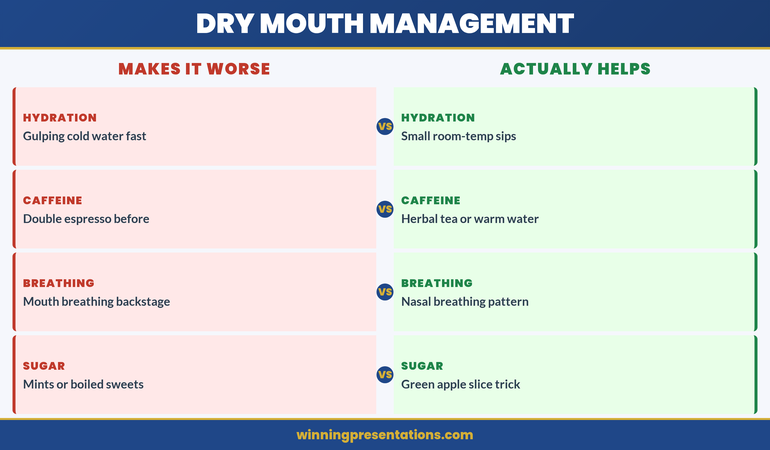
What NOT to Do (The Mistakes That Backfire)

Don’t Use Caffeine

Coffee and tea dry your mouth further. They also spike cortisol, making your nervous system more reactive. If you’re struggling with dry mouth, caffeine 90 minutes before your presentation is self-sabotage. Stick to water.

Don’t Mouth-Breathe Before You Present

Breathing through your mouth dries your mouth and signals your nervous system that you’re in danger. Nose breathing activates your parasympathetic nervous system. The 3-minute protocol uses nose breathing deliberately for this reason.

Don’t Skip the Swallow Test

Before you step in front of your audience, swallow deliberately. If you can’t swallow easily, your nerves are still in control. Go back to your protocol. Do another round of box breathing. Give your nervous system five more minutes if you need them. A dry swallow on camera is worse than taking 300 seconds to prepare properly.

Don’t Rely on Sugar

Boiled sweets feel like they work because they trigger saliva production quickly. But the sugar rush also spikes blood glucose, which triggers cortisol release. You’ll feel better for 90 seconds, then worse. If you use a lozenge, use sugar-free only.

Managing Dry Mouth Once You’re Presenting

You’ve done the protocol. You step in front of the room. And halfway through your third slide, the dryness returns.

This is normal. It happens because the moment you’re presenting, your sympathetic nervous system reactivates. You’re managing threat in real time. The key is to have a 90-second recovery you can deploy without stopping your presentation.

The Pause Technique: Stop speaking. Swallow deliberately. Take a breath in through your nose. Reach for water if it’s available and take a sip—not a huge gulp, just enough to wet your mouth. Swallow again. Then resume speaking. The entire sequence takes 8–10 seconds. Your audience interprets this as a thoughtful pause, not panic.

The Tongue Anchor: If you don’t have water, use your tongue. Place it on the roof of your mouth. This stimulates your palatal glands immediately. You can do this whilst speaking—your audience won’t see it. Within 10 seconds, saliva production increases noticeably.

Both techniques break the feedback loop: dry mouth → panic about dry mouth → more dryness. You interrupt the cycle by introducing a physical action that rehydrates and signals safety.

See also: How to Fix Your Voice Getting Higher When You’re Nervous. Dry mouth often accompanies voice cracking and pitch elevation. These physical symptoms are linked—managing one often helps manage the others.

Long-Term Fixes That Reduce Recurrence

Hydration Baseline

The week before a major presentation, drink 2.5 litres of water daily minimum. This primes your salivary glands and ensures your nervous system isn’t already working from a deficit. Dehydration amplifies presentation anxiety. Most executives don’t hydrate deliberately enough.

Nervous System Conditioning

Practise box breathing daily, not just before presentations. Five minutes a day, five days a week, for six weeks. This trains your parasympathetic nervous system to activate more readily. Over time, your body learns to downregulate threat faster. Dry mouth becomes less severe and less frequent.

This is not meditation or relaxation. It’s nervous system fitness. You’re building capacity.

Presentation Practice Under Pressure

Practice your presentation in front of people. Not in front of the mirror. In front of 2–3 colleagues who will ask questions and challenge you. This exposes your nervous system to the actual threat stimulus in a controlled environment. Over time, your body habituates. Presentations feel less threatening. Your sympathetic activation weakens.

This is why executives who present weekly are rarely bothered by dry mouth. They’ve desensitised their threat response.

Post-Presentation Recovery

After you present, your nervous system stays elevated for 30–90 minutes. Most executives ignore this. They crash into their next task without recovering properly. This means your nervous system stays in a heightened state heading into your next high-stakes situation. Over time, this creates cumulative anxiety.

After you present, spend five minutes in deliberate recovery: box breathing, a walk outside, or a conversation with a trusted colleague. This signals to your nervous system that the threat has passed. You recover properly. Your baseline anxiety drops.

For more on this, read Post-Presentation Anxiety: Why Your Heart Is Still Racing After.

Long-term nervous system management cycle: daily hydration, conditioning, practice under pressure, post-presentation recovery

Frequently Asked Questions

Q: Does anti-anxiety medication help with dry mouth presenting?

Medication can help with overall presentation anxiety. However, many anti-anxiety medications actually worsen dry mouth as a side effect. If you’re considering medication, discuss this with your doctor. The behavioural protocols (box breathing, nervous system conditioning) often work as well or better without medication side effects.

Q: Can I prevent dry mouth by eating before I present?

Light eating can help—a banana, a handful of nuts, or a piece of toast 60–90 minutes before you present provides steady glucose and prevents blood sugar drops that amplify anxiety. However, eating right before you present can make you feel sluggish or create additional anxiety about your breath. Eat early. Present later.

Q: What if I don’t have time for the full 3-minute protocol?

Do box breathing. It’s the most important element. 90 seconds of box breathing—just four rounds—will shift your nervous system state meaningfully. If you have one more minute, add water. If you have a third minute, add the mental anchor. But even one minute of box breathing is better than nothing.

Q: Does dry mouth presenting mean I’m not cut out for public speaking?

No. The most seasoned executives still experience dry mouth before high-stakes presentations. It’s not a sign of weakness—it’s a sign that your nervous system recognises that the moment matters. What separates confident presenters from anxious ones isn’t the absence of dry mouth. It’s having a protocol to manage it before it manages you.

The Winning Edge

Weekly presentation strategies for executives who present under pressure.

Subscribe Free

Dry mouth presenting is one of the most correctable presentation symptoms you’ll face. You’re not powerless. You have a nervous system you can regulate, a protocol that works, and the capacity to present with vocal control. The 3-minute fix isn’t magic—it’s applied neuroscience.

Use it before your next presentation. Then read about Restructuring Your Presentation Team for Trust and Impact to ensure the content you’re delivering lands with the same confidence as your delivery.

About the Author

Mary Beth Hazeldine is Owner & Managing Director of Winning Presentations. With 24 years of corporate banking experience at JPMorgan Chase, PwC, Royal Bank of Scotland, and Commerzbank, she advises executives across financial services, healthcare, technology, and government on structuring presentations for high-stakes funding rounds and approvals.

Book a discovery call | View services

15 Mar 2026
Professional woman at a podium taking a deep breath before presenting, modern conference room setting, navy and gold corporate aesthetic, calm confidence before high-stakes presentation

Why Your Voice Gets Higher When You’re Nervous (And the Fix)

Quick Answer: Your voice pitch rises when you’re nervous because the fight-or-flight response triggers involuntary tension in your vocal cords. The muscles that control pitch (the cricothyroid and interarytenoid muscles) constrict under nervous system activation, forcing your cords to vibrate faster and produce higher frequencies. This is not a confidence problem — it’s a physiology problem. The tactical fix is a three-step breathing and laryngeal reset you can execute in under 90 seconds, even minutes before you present.

🚨 Presenting this week and your voice pitch goes up when you’re nervous? The Rescue Block: Stop voice pitch rise in 90 seconds. → Get the Calm Under Pressure guide — £19.99, instant access for the exact in-the-moment laryngeal reset technique.

I watched an executive vomit in a bin outside the boardroom before presenting to the board. For three years, this happened. Nobody knew.

What she didn’t tell anyone was that when she walked into the room, her voice came out nearly two octaves higher than her speaking range. The nausea was the physical manifestation of the same nervous system state that locked her throat. The high-pitched voice was its audible signature.

She managed to control the vomiting through breathing work. But the voice pitch — that stayed until she understood what was actually happening at the laryngeal level. Once she did, she had a fix that took 90 seconds and actually worked.

The reason her voice got higher wasn’t because she lacked confidence. It wasn’t psychological. It was mechanical.

The Physiology: Why Fight-or-Flight Makes Your Voice Go High

When you experience presentation nerves, your nervous system activates the fight-or-flight response. This is automatic. Your amygdala detects threat — in this case, an audience, evaluation, stakes — and launches a cascade of physiological changes designed to protect you: your heart rate rises, your breathing becomes shallow, your muscles tense, your blood vessels constrict.

Your larynx — the voice box containing your vocal cords — is not exempt from this response. It is, in fact, one of the first places the tension appears because it is exquisitely sensitive to nervous system state. When you are calm, the muscles around your vocal cords are relaxed and supple. When you are nervous, they contract involuntarily.

This is where pitch rise begins. The vocal cords are two tissue folds suspended horizontally across your larynx. When air from your lungs passes through them, they vibrate. The speed of vibration determines frequency: slower vibration = lower pitch, faster vibration = higher pitch. The tension in and around the vocal cords controls that speed.

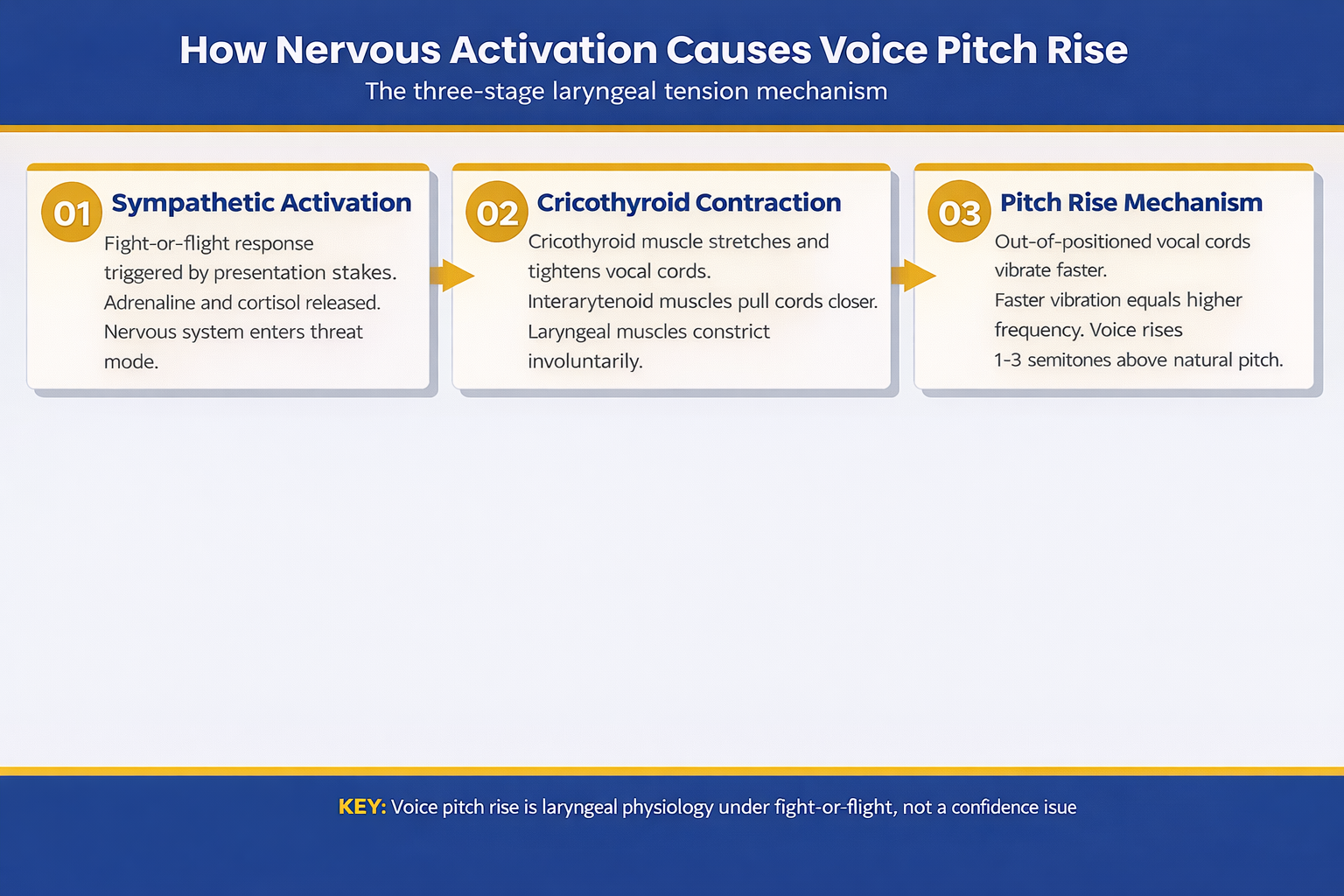
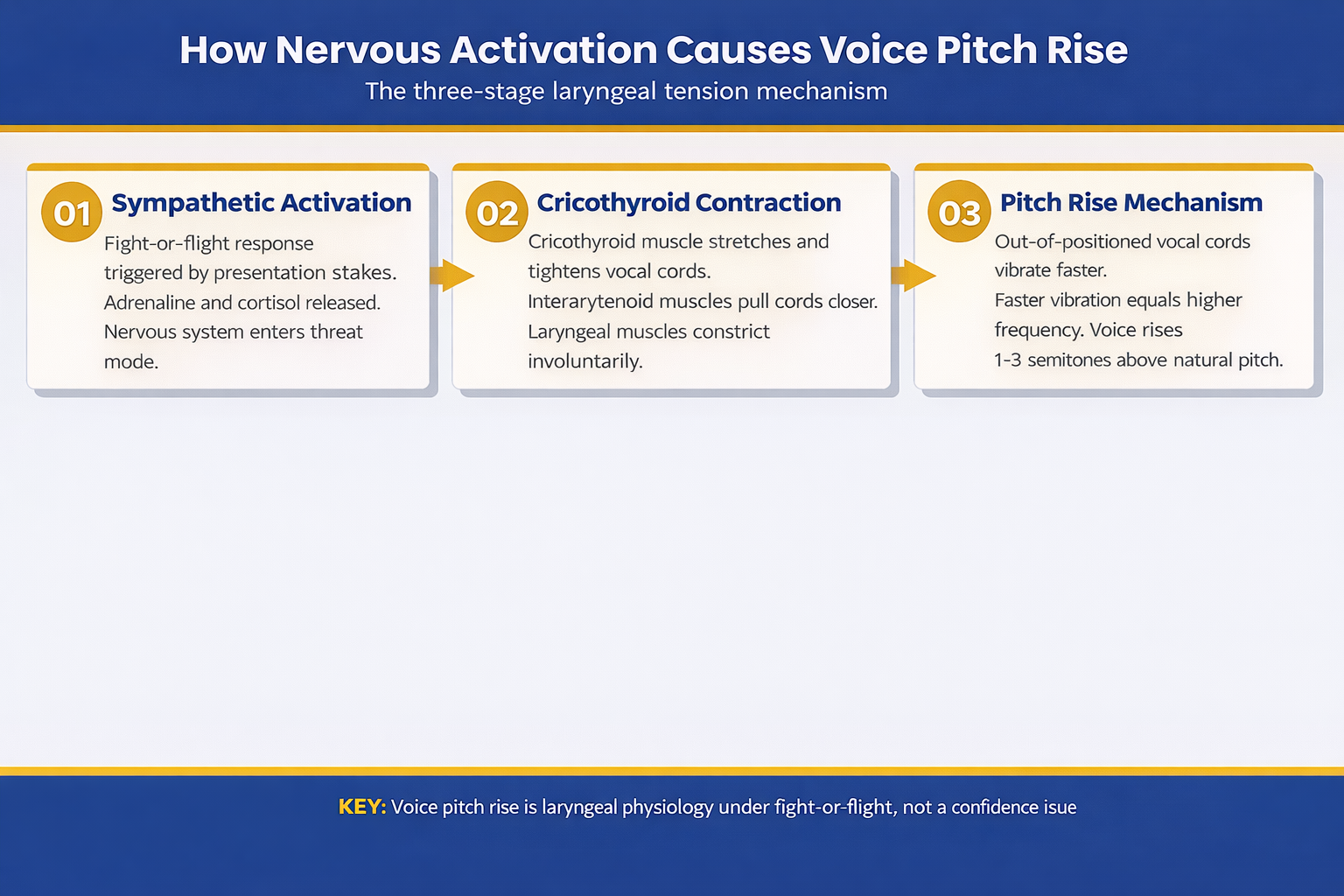
Under nervous activation, several things happen simultaneously. The cricothyroid muscle — the muscle that stretches and tenses the vocal cords — contracts. The interarytenoid muscles, which bring the cords closer together, also tense. The muscles of your neck and throat tighten. The result is that your vocal cords are pulled taut, positioned closer together, and vibrating faster under the same breath pressure. Faster vibration equals higher frequency. Higher frequency equals your voice going up by one, two, even three semitones.

This is not weakness. This is not lack of confidence. This is pure laryngeal mechanics under sympathetic nervous system activation.

Vocal Cord Tension Under Nervous Activation — The Mechanism

To understand the fix, you need to understand the precise sequence of what tightens and why. The nervous system has two branches: the parasympathetic (rest-and-digest) and the sympathetic (fight-or-flight). When you present, your sympathetic nervous system dominates. This triggers the release of adrenaline and cortisol, which signal your muscles to contract and prepare for threat response.

Your laryngeal muscles respond to this signal immediately. The cricothyroid muscle, which is innervated by the external branch of the superior laryngeal nerve, shortens and stretches your vocal cords. The lateral cricoarytenoid muscles adduct — bring together — your vocal cords. The thyroarytenoid muscles, which control the internal tension of the cords themselves, constrict. All of this happens without your conscious awareness or permission.

The result is that your vocal range compresses. The lower frequencies become unavailable. When you try to speak at your normal pitch, the tightened cords cannot drop that low. Your voice defaults to whatever pitch the tension allows — which is higher. You feel like you are forcing out sound. The audience hears a thin, tight, higher-pitched version of your voice.

Many people interpret this as a confidence issue or a sign they should not be presenting. Neither is true. What it actually signals is that your nervous system is activated — which is normal — and your laryngeal muscles have responded to that activation — which is also normal. The problem is not your voice or your ability. The problem is that nobody taught you how to reset the tension so you can speak from your natural pitch even when the nervous system is alert.

Three-stage laryngeal tension mechanism infographic showing Sympathetic Activation, Cricothyroid Contraction, and Pitch Rise Mechanism explaining how nervous system activation causes vocal cord tension and voice pitch increase during presentations

Drop Your Voice Pitch Back to Normal in 90 Seconds — Even When You’re Nervous

Voice pitch rise is a laryngeal tension problem, not a confidence problem. Calm Under Pressure (£19.99, instant access) provides a parasympathetic reset sequence that releases the cricothyroid and interarytenoid muscles in 90 seconds or less — executed right before you present or even in the moment if needed.

  • The three-step laryngeal release sequence (breathing pattern + neck release + vocal warm-up) that resets pitch to your natural range
  • The exact timing: when to execute this reset for maximum effect (spoiler: not five minutes before, not one hour before)
  • The fail-safe reset you can do silently even if you’re already at the podium
  • Real scenario: presenter goes from 145 Hz (pitch-shifted) back to 110 Hz (natural) in two minutes

Get Calm Under Pressure → £19.99

The in-the-moment physical symptom management system. Used by executives in banking, consulting, and corporate leadership for shaking, sweating, blushing, nausea, and voice issues.

The 90-Second Laryngeal Reset: The Fix That Works in the Moment

The key to releasing laryngeal tension is to activate your parasympathetic nervous system — the brake pedal to fight-or-flight. When parasympathetic tone increases, adrenaline and cortisol decrease, muscle tension releases, and your laryngeal muscles return to rest. This is not visualisation or positive self-talk. It is direct nervous system intervention.

The technique has three components. First is breathing. A specific pattern signals safety to your brainstem: a 4-count inhale through your nose, a 6-count exhale through your mouth. This longer-exhale ratio is the single most effective breathing pattern for downregulating the sympathetic nervous system. Do this for six breaths. Your shoulders will drop. Your chest will feel less tight.

The second component is a direct release of laryngeal tension. Place two fingers on the area directly under your chin, between the angle of your jaw. You are feeling the mylohyoid muscle. Press gently upward and toward the back of your neck, holding for three seconds. Release. Repeat four times. This specific pressure point releases reflex tension in the intrinsic laryngeal muscles. The pressure itself is neurologically connected to the cricothyroid and thyroarytenoid muscles through fascial and muscular chains. Many people feel their throat open immediately after this step.

The third component is a vocal warm-up that resets your pitch baseline. Hum three times, starting high and sliding down to your natural range. This is not singing. You are simply moving your vocal cords through their full range and allowing them to settle into their resting frequency. After the parasympathetic downregulation and the direct laryngeal release, your vocal cords will return to their natural tension state, and this hum will anchor that lower, natural pitch.

Execute all three steps once. The entire sequence takes 90 seconds. Many people report an immediate two-to-four semitone drop in their speaking pitch — enough to restore their voice to its natural range even though they are still nervous.

The mechanism is not magical. It is nervous system physiology. By downregulating the sympathetic response and releasing the reflex tension in your laryngeal muscles, you have restored the conditions under which your voice operates at its natural pitch. The nervousness remains — your heart rate is still elevated, your attention is heightened — but your voice is no longer a hostage to that nervousness.

This reset sequence is one of six in-the-moment physical symptom techniques covered in the Calm Under Pressure guide — £19.99, instant access, which handles shaking, sweating, blushing, nausea, racing heart, and voice pitch issues for presentations happening this week or this month.

Before You Present: The Foundation Reset

The 90-second reset works in the moment. But the larger framework is to build parasympathetic tone throughout the days before your presentation. A nervous system that is already downregulated — more parasympathetic baseline, less sympathetic reactivity — will show less laryngeal tension even in a high-stakes moment. This is cumulative.

In the week before your presentation, prioritise sleep. A nervous system that has not slept well is hypervigilant, triggers fight-or-flight more easily, and maintains higher baseline tension. Even one night of poor sleep — six hours or less — materially increases how tight your voice will sound. If you have a presentation on Friday, your sleep Tuesday through Thursday matters more than anything you do on presentation day morning.

The second priority is reducing decision fatigue and external stress. Your nervous system has a limited capacity for managing threats. If you are managing five other urgent issues that week, your sympathetic nervous system is already partially activated. When you walk into your presentation, it only takes a small additional stimulus to tip into full fight-or-flight response. Clear your calendar for the 72 hours before your presentation where possible. It sounds like a luxury. It is actually nervous system management.

The third priority is vocal warm-up. Not an hour before. Thirty minutes before. Do the hum sequence three times with longer duration — eight-second hums instead of three-second ones. This familiarises your vocal cords with their natural frequency and primes them to settle into that range when presentation nerves hit. Some people add gentle neck rolls and shoulder rolls. The point is proprioceptive awareness: you are signalling to your nervous system, “I notice my voice, my neck, my larynx,” which is protective. Dissociation — pretending the physical symptoms are not happening — amplifies the nervous system’s fear response. Directed attention to the actual physical mechanisms dampens it.

The fourth element is what you consume. Avoid caffeine for four hours before you present. Caffeine increases heart rate and nervous system arousal — exactly the state that tightens your larynx. Dehydration also increases laryngeal tension because your vocal cords require moisture to vibrate smoothly. Drink water consistently through the day you present. Not right before — that causes bloating and pressure in your chest. Consistent, moderate hydration throughout the morning.

How This Works Across Different Presentation Scenarios

The pitch-rise mechanism is the same across all presentation contexts, but the intensity varies. A formal board presentation typically generates higher sympathetic activation than an internal team meeting. A competitive pitch in front of unfamiliar stakeholders triggers more laryngeal tension than a presentation to your own department. The fix works across all of these, but your recovery window varies slightly.

In a high-stakes scenario — board meeting, investor pitch, customer presentation with decision-makers present — you can expect the sympathetic activation to be significant. Your laryngeal tension will be substantial. The 90-second reset will give you a meaningful drop in pitch, but you should plan for the reset to be executed 15–20 minutes before you speak, not five minutes before. This allows your nervous system to restabilise slightly after the reset. If you execute the reset too close to speaking, you may find your pitch starts to rise again during your introduction. Give yourself the buffer.

In a lower-stakes presentation — team update, internal training, a presentation to a friendly audience — the sympathetic activation is typically moderate. The pitch rise is less severe. The 90-second reset executed five minutes before you speak is usually sufficient.

If you are already speaking and discover mid-presentation that your voice pitch is higher than you want it to be, you can execute a silent version of the reset. The breathing pattern (4-count inhale, 6-count exhale) can be done while standing at the podium without the audience noticing. Pause between slides or during a moment when someone else is speaking, and execute six breaths. The pressure-point release under the chin is subtle enough to do without being visible if you are positioned behind a lectern. The hum is obviously not silent, but you can substitute a brief throat clear — the act of moving your vocal cords through that range has a similar resetting effect, even without the hum.

Comparison infographic showing pre-presentation foundation reset techniques versus in-the-moment voice recovery techniques with timing guidance for each approach to controlling nervous voice pitch

Stop Sounding Nervous Even Though You Are — The Laryngeal Reset That Actually Works

If your voice pitch rises when you present, you’ve probably tried relaxation, positive self-talk, and “just breathing.” Those address the general anxiety state. This addresses the specific laryngeal mechanism — the three-muscle sequence that forces your voice higher under nervous activation. This is the tactical fix for presentations happening within weeks or days.

  • The neurological reason why standard relaxation advice fails for voice pitch (hint: you are trying to calm your amygdala when you actually need to release laryngeal muscle tension)
  • The exact three-step reset: breathing pattern, pressure-point release, vocal reset — no equipment, no setup, executable anywhere
  • The timing formula: when to execute this reset based on your presentation type and stakes level
  • The silent version: how to execute the reset while you’re already presenting if needed

In-the-moment physical symptom management for presentations. Six techniques for shaking, sweating, blushing, nausea, racing heart, and voice control.

Your Voice Reveals What Your Words Won’t — Unless You Know This

Calm Under Pressure gives you a neuroscience-based system for managing physical stress responses, including vocal pitch control, breathing regulation, and in-the-moment recovery techniques — £19.99, instant access.

Get the Programme →

Designed for executives who want to stop dreading presentations

Common Questions About Voice Pitch and Presentation Nerves

Is voice pitch rise a sign that I’m not confident enough to be presenting?
No. Voice pitch rise is a laryngeal tension response to sympathetic nervous system activation. Even the most experienced executives — CEOs, board members, politicians — experience vocal cord tension under high-stakes presentation conditions. The difference is that some have learned to manage the laryngeal mechanism, while others haven’t. Confidence and vocal control are separate skill sets. You can be genuinely confident in your content and still experience voice pitch rise because your nervous system is doing exactly what it’s supposed to do: responding to threat perception with fight-or-flight activation. The fix is not confidence building. It’s laryngeal release.

Why doesn’t breathing alone fix the voice pitch problem?
Breathing addresses overall nervous system state, which is valuable. But voice pitch rise is a local laryngeal tension problem. Your cricothyroid and interarytenoid muscles are contracting under nervous system signal, pulling your vocal cords taut and forcing them to vibrate faster. Deep breathing will downregulate your sympathetic nervous system and reduce the intensity of that contraction, but it doesn’t directly release the reflex tension in those specific muscles. You need the combination: breathing (parasympathetic downregulation) plus direct laryngeal release (pressure-point reset) plus vocal calibration (hum to reset pitch baseline). That combination addresses the mechanism directly.

Can I use this technique if I have a voice condition like vocal strain or hoarseness?
If you have chronic vocal issues, this technique may still help with the tension component, but you should check with a speech-language pathologist before using a new vocal approach. The laryngeal release is safe and used in clinical speech therapy, but a baseline assessment from a professional ensures you’re not masking an underlying condition that needs different treatment. The Calm Under Pressure guide includes a note about this as well.

Voice Pitch Rise Versus Other Voice Symptoms

Presentation nerves affect your voice in several different ways, and it’s important to understand which symptom you’re actually experiencing because the fixes differ. Voice pitch rise — your voice going higher than normal — is distinct from voice shaking (tremor), voice cracking (pitch breaks), or voice hoarseness (quality degradation). Each has a different mechanism and requires a different technique.

Voice pitch rise is caused by laryngeal muscle tension that increases cord vibration frequency. Voice shaking is caused by oscillation in the muscles controlling your airflow — you sound wobbly or tremulous. Voice cracking is caused by your vocal folds suddenly separating during speech, often as your pitch is changing. Voice hoarseness is caused by swelling or inflammation of the vocal cords themselves, often from tension held over hours or days.

If you experience voice pitch rise but not tremor, your primary intervention is the laryngeal reset. If you experience tremor alongside pitch rise, you are probably dealing with whole-body nervous system activation that requires breath and postural work as well as laryngeal release. If you experience cracking and pitch breaks, the issue is often vocal fatigue or inadequate warm-up in addition to nervousness. If you experience hoarseness after presenting, the issue is likely sustained tension and inadequate hydration.

Many people experience more than one of these simultaneously. The Calm Under Pressure guide addresses all six physical symptoms (shaking, sweating, blushing, nausea, racing heart, and voice control) with integrated techniques that work together.

Is This Right for You?

This is for you if:

  • Your voice pitch noticeably rises when you’re nervous or presenting, and you want to control it in the moment
  • You’ve tried relaxation techniques and they haven’t solved the pitch-rise problem specifically
  • You have a presentation coming up in the next 4–8 weeks and you need a quick, practical fix rather than a long-term anxiety programme
  • You want to understand the physiology so you can trust the technique and use it with confidence

This is NOT for you if:

  • Your primary issue is chronic presentation anxiety or fear of presenting (you’d benefit more from Conquer Speaking Fear, the 30-day programme)
  • Your voice pitch rise is caused by a medical condition rather than nervousness (check with your doctor first)
  • You’re looking for public speaking coaching or slide design advice (this is specifically a physical symptom management technique)

What Happens After You Master the Reset

Once you have the laryngeal reset technique working, you can use it for any high-stakes presentation scenario. The mechanism remains the same — parasympathetic downregulation plus direct laryngeal release plus vocal calibration — regardless of the context. A board presentation. A competitive pitch. A presentation to a new client. A sales demo. A performance review presentation. Anywhere you would normally experience voice pitch rise, this reset prevents it.

Over time, as you use the reset technique repeatedly, you build a kind of nervous system adaptation. The reset becomes faster. Your body begins to anticipate the sequence and respond more readily. Some people report that after using the technique for three or four presentations, the pitch rise becomes less severe in the first place. This is because your nervous system begins to associate presentation contexts with the reset sequence — and because you’re proving to yourself repeatedly that the symptom is manageable. Perceived control reduces actual nervous system reactivity.

The second benefit is confidence in your voice. Many people who experience voice pitch rise develop voice self-consciousness — they monitor their voice constantly during presentations, which makes the anxiety worse. Once you have a reliable reset technique, you stop monitoring. You know that if pitch rise shows up, you can handle it. That internal permission removes a layer of performance anxiety that was never about your actual ability to present.

📊 Want the slides too?

Frequently Asked Questions

How quickly does the laryngeal reset work? Can I use it minutes before I speak?

The reset works in 90 seconds, and you can execute it as close to your presentation as you need. However, the timing matters slightly based on presentation intensity. For high-stakes scenarios (board meetings, investor pitches, competitive reviews), execute the reset 15–20 minutes before you speak. This allows your nervous system a brief stabilisation window. For lower-stakes presentations, five to ten minutes is fine. If you’re already presenting and need to use the reset, execute the breathing pattern first — that provides immediate parasympathetic signal — then the pressure-point release, then the vocal hum or throat clear. The whole sequence still works even if you’re mid-presentation, though the pitch-reset effect may be slightly less dramatic.

Is the laryngeal reset technique safe to use repeatedly before multiple presentations?

Yes. The technique uses only parasympathetic downregulation, gentle physical pressure, and normal vocal warm-up — all safe and commonly used in clinical speech therapy. You can use it before every presentation without concern. In fact, the more you use it, the more your nervous system learns to respond to it. Some people report that after using the reset for three or four presentations, the pitch rise becomes less severe in the first place because your body begins to anticipate and prepare for the reset.

What if I have a chronic voice condition or have been told my voice is naturally high-pitched?

The reset technique addresses tension-induced pitch rise specifically — the rise caused by laryngeal muscle contraction under nervous activation. If your natural speaking pitch is simply higher, this technique will not lower your baseline pitch permanently. However, it can still help you access the lower end of your natural range and prevent additional pitch rise from nervousness on top of your baseline. If you have a diagnosed vocal condition, check with a speech-language pathologist before using new vocal techniques. The laryngeal release is used clinically and is safe, but professional guidance ensures you’re not masking an underlying issue.

Can I combine this technique with other anxiety management approaches like meditation or medication?

Absolutely. The laryngeal reset is a physical, local technique that works on the laryngeal muscles directly. It complements, not replaces, broader anxiety management. If you’re using breathing meditation, therapy, or medication for presentation anxiety, this technique sits alongside those approaches. You would use the broader anxiety tools for general nervous system management (meditation helps with overall calm, therapy addresses underlying anxiety patterns, medication regulates neurotransmitters), and you would use the laryngeal reset for the specific symptom of voice pitch rise. They work together.

The Winning Edge — Executive Presentation Insights

Weekly strategies for executives who present at board level, in competitive reviews, and in high-stakes leadership meetings. No filler. No theory. Practical frameworks from 25 years in the room.

Subscribe Free →

Also published today:

For further reading on presentation physical symptoms, see Voice Cracking During Presentations: Why It Happens and the Fix, Voice Shaking When Speaking: The Nervous System Mechanism and the Recovery Technique, and High-Stakes Presentation Nerves: Managing Physical Symptoms in Board-Level Moments.

Your voice pitch rises when you present because your laryngeal muscles tense under fight-or-flight activation. That is physiology, not a lack of capability. The fix is a 90-second reset that releases that tension and restores your voice to its natural pitch, even while you remain nervous. Master the laryngeal reset sequence in the Calm Under Pressure guide — £19.99, instant access before your next presentation.

Not ready for the full system? Start here: download the free 7 Presentation Frameworks — practical structures you can apply to your next presentation immediately.

About the Author

Mary Beth Hazeldine is the Owner & Managing Director of Winning Presentations. A qualified clinical hypnotherapist and NLP practitioner with 25 years of corporate banking experience at JPMorgan Chase, PwC, Royal Bank of Scotland, and Commerzbank, she combines executive communication expertise with evidence-based techniques for managing presentation anxiety and physical symptoms.

She has supported executives and their presentations for high-stakes funding rounds, board approvals, and competitive pitches across three continents. Her work in presentation anxiety management draws directly from her personal experience: she overcame five years of severe presentation terror using the techniques she now teaches.

Book a discovery call | View services

06 Mar 2026
Executive preparing to present in corporate corridor using calming techniques before high-stakes boardroom presentation

The Physical Symptom Hierarchy: What to Fix First When Everything Hits at Once

She vomited before every board meeting for three years. Nobody in her company knew.

When multiple physical symptoms hit before a presentation—shaking hands, racing heart, nausea, sweating, voice cracking—trying to fix everything at once makes every symptom worse. The presentation physical symptoms priority framework uses a clinical triage approach: stabilise breathing first (it controls the nervous system), then address the most visible symptom second (it reduces the shame spiral), then manage remaining symptoms with targeted techniques. This hierarchy works because physical presentation symptoms are cascading—they share a common root in the fight-or-flight response, and treating them in the right order creates a chain reaction of relief.

🚨 Presentation this week and symptoms already building?

Quick self-check: Can you identify your dominant symptom right now? (The one you notice first, not the one that bothers you most.) That’s your starting point.

  • Breathing disrupted → Start with the 4-7-8 pattern (60 seconds)
  • Hands shaking → Isometric press technique (press palms together under the table, 10 seconds)
  • Nausea → Cold water on wrists + controlled exhale (90 seconds)

→ Need the complete symptom-by-symptom toolkit? Get Calm Under Pressure (£19.99)

The Executive Who Vomited Before Every Board Meeting

A C-suite executive I worked with had a secret she kept from her entire organisation for three years. Before every major presentation—board meetings, investor updates, all-hands announcements—she would excuse herself to the bathroom and vomit.

Nobody knew. She was considered one of the most composed presenters in the company. Her team described her as “calm under pressure.” Her board colleagues said she was “naturally confident.”

The nausea was just the beginning. Her hands would shake so badly she couldn’t hold notes. Her heart rate would spike above 140 bpm—she knew because she tracked it on her watch. She’d sweat through her jacket. Her voice would catch on the first few words.

She’d tried everything. Breathing exercises. Visualisation. Beta blockers (prescribed, never taken—she was afraid of feeling “medicated” in front of the board). The problem wasn’t lack of techniques. The problem was that every technique she’d found addressed one symptom. When all five hit at once, she didn’t know where to start.

That’s when we developed the triage approach. Not a single technique for a single symptom. A priority system for when your body throws everything at you simultaneously.

Within six weeks, she went from vomiting before every board meeting to managing her symptoms in under 90 seconds. The nausea didn’t disappear entirely. But it dropped from debilitating to manageable. And the cascade—the shaking, the sweating, the voice cracking—reduced dramatically once she stopped trying to fight everything at once.

The 60-Second Resets That Stop Physical Symptoms Before They Cascade

  • Symptom-Specific Techniques: Targeted 60-second resets for shaking, sweating, nausea, racing heart, voice cracking, and facial flushing—each with a different physiological mechanism
  • The Triage Sequence: The exact order to address symptoms when multiple hit at once, based on clinical nervous system regulation
  • Pre-Presentation Protocol: A 90-second routine to run before walking into any high-stakes meeting—works in a bathroom, a corridor, or your car
  • In-the-Moment Recovery: What to do when symptoms spike mid-presentation without the audience noticing
  • Evidence-Based Techniques: From clinical hypnotherapy and NLP, adapted specifically for executive presentation environments

Download Calm Under Pressure → £19.99

Evidence-based techniques from clinical hypnotherapy and NLP, adapted for high-pressure executive environments

Why Fixing Everything at Once Makes Every Symptom Worse

When your body goes into fight-or-flight before a presentation, the symptoms feel simultaneous and overwhelming. Your hands shake. Your stomach churns. Your heart races. Your palms sweat. Your throat tightens.

The natural response is to try to fight all of it. You grip the lectern to stop the shaking. You swallow hard to settle the nausea. You try to slow your breathing. You wipe your palms. You clear your throat.

But here’s what’s actually happening physiologically: all of these symptoms share a single root cause. Your sympathetic nervous system has activated the fight-or-flight response, flooding your body with adrenaline and cortisol. Every symptom is a downstream effect of that one activation.

When you try to address each symptom individually and simultaneously, you’re fighting five fires with five separate hoses—while ignoring the gas main that’s feeding all of them. Worse, the act of frantically trying to control everything creates additional stress, which intensifies the original fight-or-flight response. You’re adding fuel to the fire you’re trying to extinguish.

The triage approach works because it addresses symptoms in the order that creates the maximum cascade of relief. Fix the right symptom first, and the others reduce on their own.

The Physical Symptom Triage Framework

The triage framework prioritises presentation physical symptoms into three tiers, each building on the previous one:

Tier 1: Breathing (always first). Breathing is the only part of the fight-or-flight response you can consciously override. It’s the master switch for the entire nervous system. Address this first, regardless of which symptom feels most urgent.

Tier 2: Most visible symptom (second). After breathing is stabilised, address whichever symptom is most visible to the audience. Not the most uncomfortable—the most visible. Because visible symptoms create a shame feedback loop that re-triggers the fight-or-flight response. Breaking that loop prevents the cascade from restarting.

Tier 3: Remaining symptoms (last). Once breathing and the visible symptom are managed, the remaining symptoms typically reduce on their own. If they don’t, apply targeted techniques for each one. But many presenters find that Tiers 1 and 2 handle most of the cascade.

This hierarchy is based on how the nervous system actually works, not on which symptom feels worst. The symptom that feels most urgent (nausea, for many people) is often not the symptom to address first. Breathing controls the nervous system. Visibility controls the psychological spiral. Everything else is downstream.

The Physical Symptom Triage Framework infographic showing three tiers: Tier 1 Breathing (the master switch), Tier 2 Most Visible Symptom (breaking the shame loop), and Tier 3 Remaining Symptoms (targeted techniques)

Need the complete technique for each symptom tier?

Calm Under Pressure includes the full triage protocol with 60-second resets for every symptom—designed for executives who need results in the corridor before the boardroom.

Download Calm Under Pressure → £19.99

Tier 1: Breathing (The Master Switch)

Breathing is the only autonomic function you can consciously control. When you deliberately slow your exhale, you activate the parasympathetic nervous system—the body’s braking system. This directly reduces heart rate, lowers cortisol, and begins to calm every downstream symptom.

The key isn’t deep breathing. It’s slow exhale breathing. Many people take deep inhales when anxious, which actually increases the oxygen-carbon dioxide imbalance and can make dizziness and tingling worse.

The 4-7-8 Pattern (60 Seconds)

Inhale through your nose for 4 counts. Hold for 7 counts. Exhale through your mouth for 8 counts. The extended exhale is the critical element—it’s what triggers the parasympathetic response. Two cycles of this pattern (about 60 seconds) measurably reduces heart rate and begins to calm the cascade.

You can do this in a bathroom stall, in a corridor, sitting at the table before the meeting starts, or even during someone else’s presentation. It’s invisible to others and it works within 60 seconds. For a deeper dive into this approach, see our guide on managing a panic attack before a presentation.

Why Breathing Must Always Come First

If you try to address shaking before breathing, the adrenaline keeps the shaking going. If you try to settle nausea before breathing, the cortisol keeps the stomach churning. Every other technique works better once the nervous system is partially deactivated. Breathing is the prerequisite, not one option among many.

I’ve watched executives try every symptom-specific technique without addressing breathing first. It’s like trying to mop a floor while the tap is still running. The 60-second breathing pattern doesn’t eliminate symptoms entirely—but it reduces the intensity enough that Tier 2 techniques become effective.

Tier 2: Your Most Visible Symptom

After breathing is stabilised, address whichever symptom the audience can see. This is counterintuitive—most people want to fix the symptom that feels worst. But visible symptoms create a psychological feedback loop that invisible symptoms don’t.

Here’s the loop: you notice your hands are shaking. You think “They can see my hands shaking.” That thought triggers shame and self-consciousness, which re-activates the fight-or-flight response, which makes everything worse. The visible symptom isn’t just a physical problem—it’s a psychological re-trigger.

By addressing the most visible symptom second, you break the shame loop before it can restart the cascade. Here are the targeted techniques for the most common visible symptoms:

Shaking Hands

The isometric press technique: press your palms firmly together under the table for 10 seconds. This engages the large muscle groups in your arms and shoulders, which burns off excess adrenaline and temporarily stops the fine-motor tremor. You can also press your fingertips firmly into the table surface or grip a pen tightly for 5 seconds, then release. The release is what creates the calming effect. If you need more techniques for shaking hands during presentations, we’ve covered the full range of approaches.

Voice Cracking or Shaking

The vocal warm-up: hum quietly before speaking (even silently, just vibrating your throat). This relaxes the vocal cords, which tighten under adrenaline. Take a sip of room-temperature water (cold water tightens the throat). Start your first sentence with a low, slow delivery—then let your natural pace return. The first 10 seconds set the tone for the rest.

Facial Flushing

The cold-point technique: before entering the room, press cold water (or a cold object) against your wrists and the back of your neck. These are pulse points where blood vessels are close to the skin surface. Cooling these areas reduces peripheral vasodilation—the mechanism that causes blushing. It won’t eliminate flushing entirely, but it reduces the intensity enough that most people won’t notice.

Visible Sweating

Sweating is partially managed by Tier 1 breathing (reduced cortisol = reduced sweating). For visible sweating, preparation is your best tool: wear fabrics that don’t show moisture, keep a handkerchief in your pocket, and use clinical-strength antiperspirant on your palms 30 minutes before the meeting. Our full guide to managing sweating during presentations covers additional strategies for different environments.

Stop Fighting Five Symptoms With Five Separate Techniques

  • The Complete Triage Protocol: The exact sequence for when everything hits at once—breathing, visible symptom, then targeted recovery
  • 60-Second Resets: One technique per symptom, each designed to work in the corridor before the boardroom

Download Calm Under Pressure → £19.99

Created by a clinical hypnotherapist who spent 5 years terrified of presenting

Tier 3: Managing What Remains

After Tiers 1 and 2, most presenters find that remaining symptoms have dropped from debilitating to manageable. The nervous system activation has reduced (Tier 1), and the psychological shame loop has been broken (Tier 2). What remains is residual adrenaline—which actually has benefits if it’s at a low enough level.

A mild level of arousal improves focus, sharpens thinking, and adds energy to your delivery. The goal isn’t to eliminate all physical sensations—it’s to bring them below the threshold where they interfere with performance.

Residual Nausea

If nausea persists after breathing stabilisation, try the ginger technique: a small piece of crystallised ginger or a ginger sweet 20 minutes before the presentation. Ginger has established anti-nausea properties. Combine with sipping room-temperature water (not cold—cold can tighten the stomach).

Residual Racing Heart

If your heart rate remains elevated after the 4-7-8 breathing, try the dive reflex: splash cold water on your face or press a cold, damp cloth against your cheeks and forehead. This triggers the mammalian dive reflex, which naturally slows heart rate. It’s remarkably effective and works within seconds.

Residual Tension and Restlessness

Excess adrenaline creates a feeling of restless energy. The progressive muscle release works well: tense every muscle in your body for 5 seconds (clench fists, tighten shoulders, squeeze legs together), then release everything at once. The contrast between maximum tension and complete release activates the parasympathetic response. This works standing, sitting, or even mid-presentation (subtly tensing and releasing your leg muscles under the table).

Symptom-by-Symptom Quick Reference infographic showing targeted techniques for six presentation symptoms: shaking (isometric press), voice cracking (vocal warm-up), flushing (cold-point technique), sweating (preparation strategy), nausea (ginger technique), and racing heart (dive reflex)

Want the full technique guide for each physical symptom?

Calm Under Pressure covers every symptom with step-by-step instructions, timing guidance, and the clinical evidence behind each technique.

Download Calm Under Pressure → £19.99

Why do I get multiple physical symptoms before presentations?

Multiple physical symptoms happen because they all share one root cause: the fight-or-flight response. When your nervous system perceives the presentation as a threat, it floods your body with adrenaline and cortisol. This single activation causes shaking (muscle tension), sweating (thermoregulation), nausea (blood diverted from digestion), racing heart (increased blood flow), and voice changes (throat muscle tension). They feel like separate problems, but they’re one response with multiple symptoms.

Should I take beta blockers for presentation anxiety?

Beta blockers reduce physical symptoms (especially racing heart and tremor) by blocking adrenaline’s effect on the body. They’re prescribed by doctors for performance anxiety and can be effective for some people. However, they don’t address the root cause—the nervous system’s threat response. Many executives prefer behavioural techniques because they build long-term resilience rather than masking symptoms. This is a conversation to have with your GP, who can advise based on your specific situation.

Can physical presentation symptoms get worse with age?

They can, particularly if untreated. Each difficult presentation experience strengthens the neural pathway between “presentation” and “threat.” Over years, the fight-or-flight response can become faster and more intense—what started as mild nerves at 30 becomes debilitating symptoms at 45. The good news is that this sensitisation is reversible with targeted nervous system regulation techniques, regardless of how long the pattern has been established.

Is Calm Under Pressure Right For You?

✓ This is for you if:

  • You experience physical symptoms (shaking, sweating, nausea, racing heart, voice cracking) before or during presentations
  • You’ve tried breathing exercises or relaxation techniques but find they don’t work when multiple symptoms hit at once
  • You need techniques that work quickly—in the corridor, at the table, during the meeting
  • You want evidence-based approaches, not generic “just relax” advice

✗ This is NOT for you if:

  • Your challenge is psychological (imposter syndrome, fear of judgement) rather than physical symptoms—Conquer Speaking Fear addresses the root cause
  • You rarely experience physical symptoms and your anxiety is primarily cognitive

Created by a Clinical Hypnotherapist Who Spent 5 Years Terrified of Presenting

  • The Complete Symptom Triage: The exact priority order for addressing multiple physical symptoms simultaneously—breathing first, visible symptoms second, targeted techniques third
  • Six Symptom-Specific Resets: Individual 60-second techniques for shaking, sweating, nausea, racing heart, voice cracking, and facial flushing
  • Pre-Presentation Protocol: The 90-second routine to run before any high-stakes meeting—designed for executives who present in boardrooms, not therapists’ offices
  • In-Meeting Recovery: Techniques for when symptoms spike mid-presentation—invisible to the audience, effective within seconds
  • The Science Behind Each Technique: Clinical evidence from hypnotherapy and NLP so you understand why each technique works and can trust it under pressure

Download Calm Under Pressure → £19.99

I kept beta blockers in my desk for 3 years. I found something better. — Mary Beth Hazeldine

📊 Want the slides too?

Preparation reduces anxiety. The Executive Slide System (£39) includes confident-presenter templates designed to minimise preparation stress.

Frequently Asked Questions

Q: What if breathing exercises don’t work for me?

A: Most people who say breathing exercises don’t work are doing them incorrectly—usually taking deep inhales without the extended exhale. The critical element is the exhale length: it must be longer than the inhale. The 4-7-8 pattern works because the 8-count exhale directly activates the vagus nerve and parasympathetic response. If you’ve tried this and still struggle, the issue may be timing—you need to start earlier, ideally 15-20 minutes before the presentation, not in the final moments before speaking.

Q: My symptoms are getting worse over the years. Is that normal?

A: Unfortunately, yes. Without intervention, the neural pathway between presentations and the threat response strengthens over time. Each negative experience reinforces the pattern, making symptoms faster and more intense. This is called sensitisation. The triage framework works to interrupt this pattern by creating new neural associations between presentations and successful regulation. With consistent practice, the sensitisation can reverse—even after decades of worsening symptoms.

Q: Can I use these techniques during a live presentation or only beforehand?

A: Both. The pre-presentation protocol (90 seconds, run beforehand) handles the anticipatory spike. But symptoms can also surge mid-presentation—especially during Q&A or when something unexpected happens. The in-meeting techniques (subtle isometric presses, controlled exhales between sentences, grounding through foot pressure) are designed to be invisible to the audience. Nobody will know you’re doing them.

Get Evidence-Based Presentation Insights Every Week

The Winning Edge newsletter shares clinical techniques, executive strategies, and real recovery stories for professionals who present under pressure. Subscribe for free.

Subscribe to The Winning Edge

🆓 Free resource: Executive Presentation Checklist — a free guide to strengthen your presentation preparation.

About the Author

Mary Beth Hazeldine is the Owner & Managing Director of Winning Presentations. With 24 years of corporate banking experience at JPMorgan Chase, PwC, Royal Bank of Scotland, and Commerzbank, she has delivered high-stakes presentations in boardrooms across three continents.

A qualified clinical hypnotherapist and NLP practitioner, Mary Beth combines executive communication expertise with evidence-based techniques for managing presentation anxiety. She has trained thousands of executives and supported presentations for high-stakes funding rounds and approvals.

Book a discovery call | View services

Your next presentation is on your calendar. The symptoms are coming. But now you know the order: breathing first, visible symptom second, everything else follows. Download Calm Under Pressure and have the complete triage protocol ready before the adrenaline starts. Ninety seconds. That’s all you need.