
Tag: change management

28 Apr 2026
Business meeting: a presenter explains a flowchart on a blue screen to colleagues around a large conference table.

Restructuring Presentation: How to Brief Your Board on Organisational Change

Quick answer: A restructuring presentation should open with the strategic rationale for change, move into the proposed structure with clear reporting lines, outline the implementation timeline with decision gates, and close with a risk assessment that shows the board you have anticipated the hardest questions. Keep the deck under 15 slides and lead with the business case, not the org chart.

Benedikt had led transformation programmes across two continents, but when the CEO asked him to present the restructuring case to the board, he found himself staring at a blank slide deck for three days. The problem was not a lack of information. He had the financial models, the headcount projections, the market analysis. What paralysed him was the knowledge that twelve non-executive directors would be evaluating not just his proposal, but his judgement. Every slide would signal whether he understood the human cost of what he was recommending. Every data point would be weighed against the reputational risk the board was being asked to accept.

He spent the first two days building a 38-slide deck that walked through every scenario. Then his CFO looked at it and said: “This is a data dump, not a decision framework.” That feedback changed everything. Benedikt stripped the deck back to 14 slides, led with the strategic case, and built the rest around the three decisions the board actually needed to make. The restructuring was approved in a single session.

If you are preparing to present organisational change to your board, the structure of your argument matters more than the volume of your evidence. Here is how to build that structure.

Building a restructuring deck from scratch?

The Executive Slide System gives you ready-made templates for board-level restructuring presentations, including strategic rationale slides, implementation timelines, and risk frameworks you can adapt in minutes.

Explore the System →

Why Most Restructuring Presentations Fail at Board Level

The most common mistake in a restructuring presentation is treating it as a status update. Executives walk into the boardroom with slides that describe what is changing: new reporting lines, merged departments, headcount reductions. But the board does not need a description of the change. They need a decision framework that tells them why this change is necessary now, what happens if they delay, and what the organisation looks like on the other side.

Board members sit across multiple organisations. They have seen restructurings that saved a business and restructurings that accelerated its decline. The difference almost always comes down to whether the presenter understood what the board was actually evaluating: not the org chart, but the quality of thinking behind it.

Three patterns consistently undermine board confidence:

  • Leading with the solution before the problem. When the first slide shows the new org chart, the board immediately starts poking holes. They have not yet accepted the premise that change is necessary.
  • Treating headcount numbers as self-explanatory. “We are reducing from 340 to 285” tells the board nothing about capability retention, institutional knowledge, or delivery risk.
  • Hiding the hard questions. If your deck does not address the worst-case scenario, the board will assume you have not thought about it.

When you are presenting change to stakeholders, the sequence of your argument is your most powerful tool. The board needs to arrive at the decision you are recommending through their own reasoning, not because you told them the answer on slide two.

Executive Slide System

26 templates, 93 AI prompts, 16 scenario playbooks.

Build your restructuring deck in one sitting instead of three painful weeks.

£39 — Instant Access

Building the Strategic Rationale Your Board Needs First

Before you open your slide software, answer one question: why now? The board will ask this within the first five minutes, and if your answer is weak, nothing else in the deck will recover their confidence. “Because the market has shifted” is not sufficient. You need to connect the restructuring to a specific strategic pressure that the board already recognises.

The strategic rationale section of your deck should follow a tight three-part structure:

1. The current state and its limitations. Use no more than two slides to show where the organisation sits today. Focus on the structural constraints that are limiting performance or creating risk. This is not a SWOT analysis. It is a diagnosis of why the current structure cannot deliver the next phase of strategy.

2. The strategic imperative. One slide that connects the structural limitation to a business outcome the board cares about. Revenue at risk. Regulatory exposure. Competitive positioning. This slide is the hinge of your entire presentation. If the board accepts this premise, the rest of the deck flows logically.

3. The cost of inaction. Boards are loss-averse. Show them what happens if the organisation does nothing for 12 months. Quantify it where you can, but even a qualitative assessment of competitive erosion or talent flight is more persuasive than silence.

Notice that you have not yet shown the new org chart. That is deliberate. The board needs to accept the problem before they will evaluate the solution fairly.
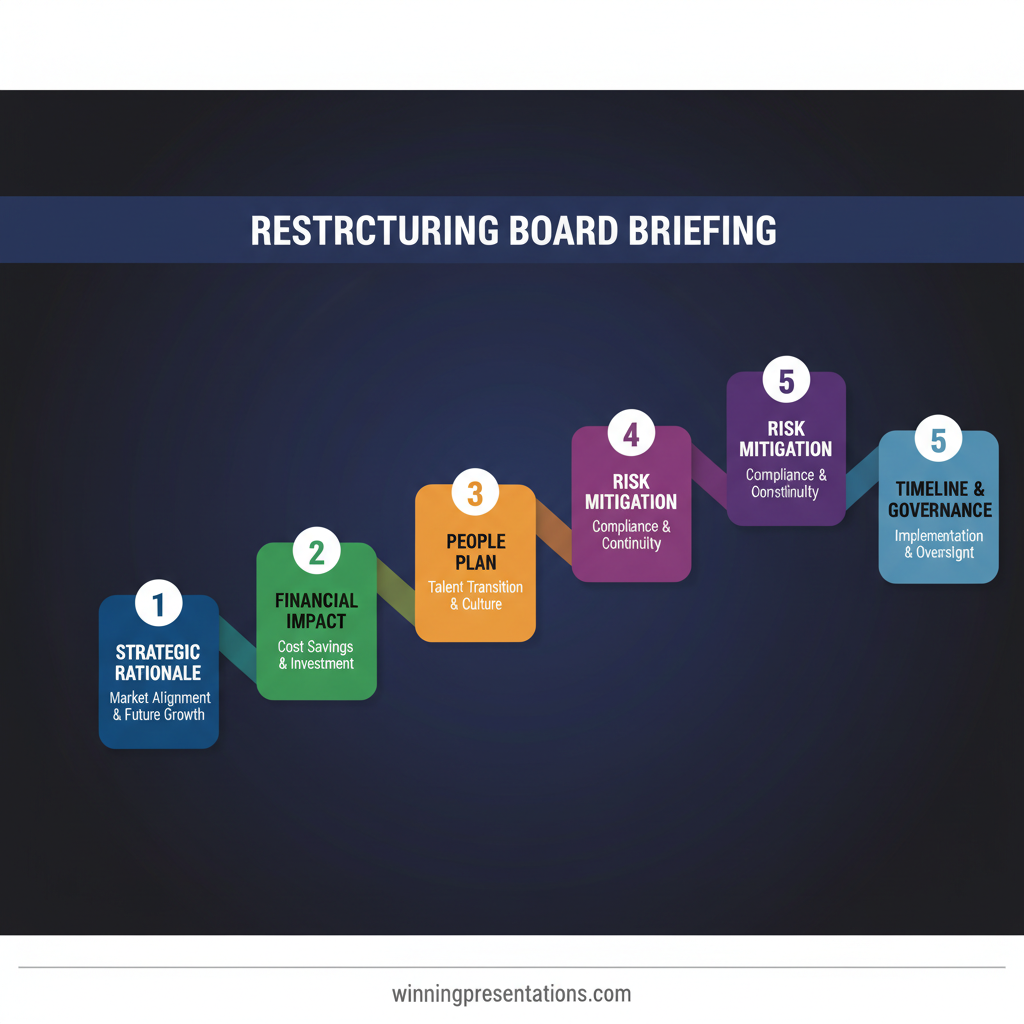

Infographic showing the three-part strategic rationale structure for a board restructuring deck: current state, strategic imperative, and cost of inaction

Structuring the Implementation Timeline and Decision Gates

Once your board accepts the strategic case, their next concern is execution risk. They want to know that you have a plan that can be paused, adjusted, or reversed if assumptions prove wrong. This is where your timeline slide becomes critical.

A strong implementation timeline does three things simultaneously. It shows the sequence of changes, it identifies the decision points where the board retains control, and it makes visible the dependencies between workstreams. The worst version of this slide is a Gantt chart with forty rows. The best version is a phased roadmap with three to four stages, each ending at a board review gate.

Here is a framework that works across most organisational restructurings:

  • Phase 1: Design and consultation (weeks 1-6). Finalise the target operating model. Begin formal consultation where required. Board gate: approve the final structure before any announcements.
  • Phase 2: Communication and selection (weeks 7-12). Internal announcement. Role matching and selection processes. Board gate: review any escalated cases or legal risks before proceeding.
  • Phase 3: Transition and stabilisation (weeks 13-20). New structure goes live. Performance monitoring against baseline metrics. Board gate: six-week review of operational stability.

The decision gates are what separate a credible plan from an optimistic one. When you are presenting difficult news to senior leadership, showing that you have built in checkpoints tells the board you understand that not every assumption will hold. It gives them confidence to approve the overall direction while retaining oversight of the details.

One detail that is easy to overlook: your timeline must account for legal and regulatory requirements. Employment law consultation periods, union engagement, regulatory notifications. If these are missing, your board’s legal counsel will flag them immediately, and you will look underprepared.

The Executive Slide System includes phased timeline templates with built-in decision gates that you can adapt to your restructuring scope.

The Risk Assessment Slide That Earns Board Confidence

Most presenters treat the risk slide as an obligation. They list four or five risks, assign traffic-light ratings, and move on. This approach signals to the board that you are going through the motions rather than genuinely engaging with what could go wrong.

A risk assessment that earns confidence does something different. It shows the board that you have already stress-tested your proposal against the scenarios they are most worried about. Structure it around three categories:

Execution risks: What happens if the consultation process takes longer than planned? What if key talent leaves during the transition? What is the minimum team capability you need to maintain business-as-usual operations during the change?

Reputation and stakeholder risks: How will clients react? What is the communications plan for external stakeholders? If the restructuring becomes public before you are ready, what is the holding statement?

Financial risks: What are the one-off costs? What if the projected savings take six months longer to materialise? Where is the break-even point?

For each risk, show the mitigation. Not a vague “we will monitor this” but a specific action with an owner. Boards do not expect zero risk. They expect you to have thought about it with the same rigour you applied to the benefits case.

One technique that works particularly well: include a “what we decided not to do” slide. Show the board the alternatives you considered and why you rejected them. This demonstrates the depth of your analysis without adding slides to the main proposal.

Turn your restructuring rationale into a board-ready deck

The Executive Slide System includes risk assessment frameworks, stakeholder mapping templates, and scenario playbooks designed for organisational change presentations. 26 templates, 93 AI prompts, 16 scenario playbooks.

£39 — Instant Access

Delivering the Restructuring Message Without Losing the Room

The slides are only half the challenge. How you deliver a restructuring case determines whether the board engages with your proposal or retreats into scepticism. The stakes are high enough that your delivery needs to match the gravity of the decision without tipping into anxiety.

Start by acknowledging the weight of the decision. A single sentence at the opening: “I understand this decision affects people’s livelihoods, and I have approached this work with that in mind.” This is not performative empathy. It signals to the board that you are not treating headcount as an abstraction, which is a concern that sits behind many of their questions.

Control your pacing. The natural instinct when presenting difficult content is to speed up, to get through the uncomfortable slides quickly. Do the opposite. Slow down on the rationale slides. Pause after the cost-of-inaction slide. Give the board time to process before you move to the solution.

Anticipate the challenge questions and build your responses into the deck itself. If you know the chair is concerned about talent retention, include a slide on your retention strategy. If the audit committee will focus on restructuring costs, have a detailed cost waterfall ready as a backup slide. The best board presentations are the ones where the presenter appears to have read the room before entering it.

If the pressure of the room itself concerns you, that is worth addressing separately. Presenting restructuring proposals is among the most high-pressure scenarios an executive faces, and the physical symptoms of that pressure, the racing heart, the dry mouth, can undermine your credibility even when your content is strong. There are specific techniques for managing presentation anxiety that apply directly to board-level delivery.

Finally, close with a clear ask. Do not end on a summary slide. End on a decision slide: “I am asking the board to approve the restructuring framework, delegate implementation authority to the executive team, and schedule a Phase 1 review in six weeks.” Give them something specific to vote on. Ambiguity at the close is what sends proposals back for “further work.”
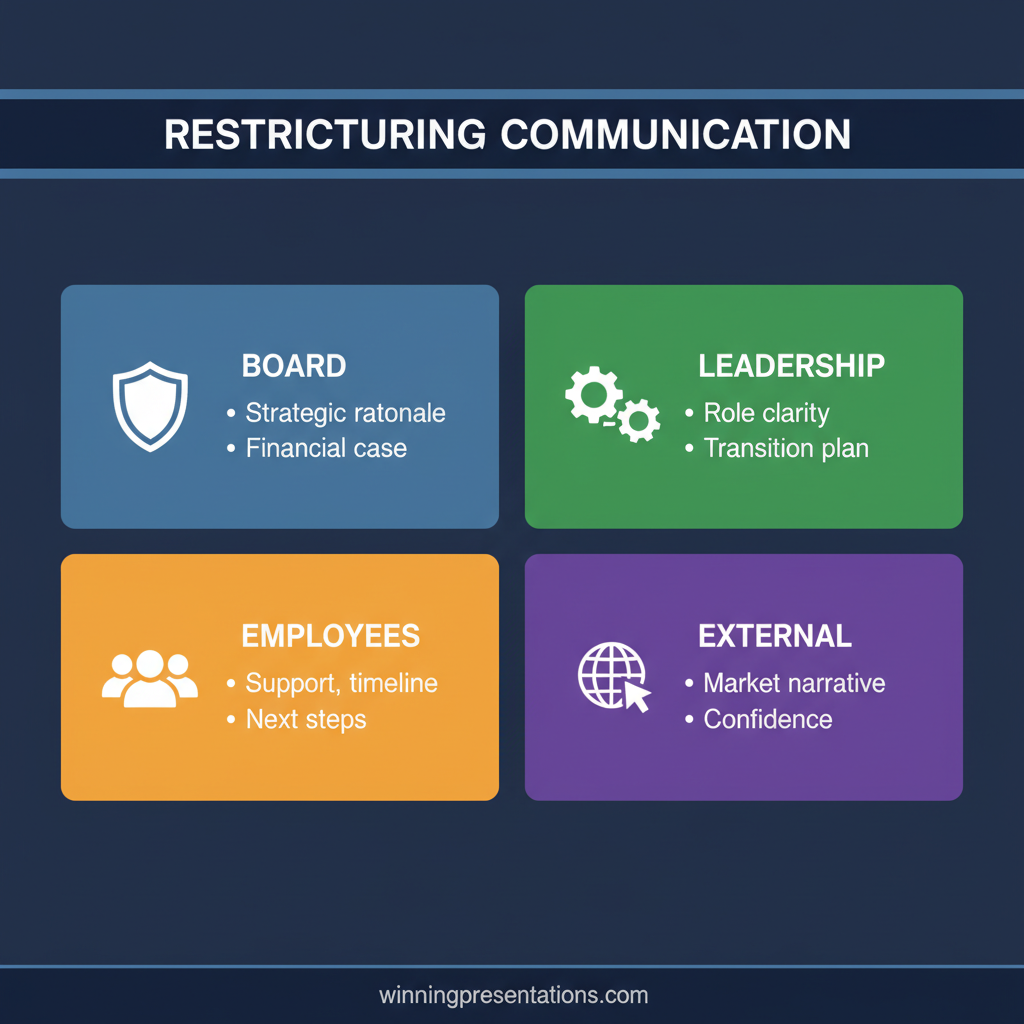

Infographic showing a board-level organisational change delivery checklist with pacing, empathy, and decision-slide guidance

Frequently Asked Questions

How many slides should a restructuring presentation have?

Aim for 12 to 15 slides in the main deck, with an additional five to eight backup slides for detailed questions. Board members lose focus after 20 minutes of slides, so your core argument needs to be tight. Use the backup deck for detailed financial models, legal timelines, and scenario analyses that you expect specific board members to request.

Should I share the restructuring deck with the board before the meeting?

Yes, with caveats. Send the deck 48 hours before the meeting with a one-page cover note summarising the proposal and the decision you are seeking. This gives non-executive directors time to prepare their questions, which actually works in your favour. Surprises in the boardroom create resistance. Pre-reading creates informed challenge, which is easier to manage and produces better decisions.

How do I handle board members who oppose the restructuring during the presentation?

Acknowledge the concern without becoming defensive. Use the “what we decided not to do” slide to show that you considered alternatives. If a board member raises a scenario you have not addressed, say so honestly: “That is a fair challenge. I would like to come back with analysis on that specific point before the next gate.” Boards respect intellectual honesty far more than forced confidence. The worst response is dismissing the concern or insisting your analysis already covers it when it clearly does not.

Join The Winning Edge

Weekly strategies for executives who present at board level. Tactical, concise, no fluff.

Subscribe Free

Want a quick-reference checklist before your next board presentation? Download the free Executive Presentation Checklist.

Mary Beth Hazeldine | Owner & Managing Director, Winning Presentations. With 24 years of corporate banking experience at JPMorgan Chase, PwC, Royal Bank of Scotland, and Commerzbank, she advises executives across financial services, healthcare, technology, and government on structuring presentations for high-stakes funding rounds and approvals.

03 Apr 2026
Executive leader addressing a small group of team members in a glass-walled meeting room during an organisational change discussion

Stakeholder Change Presentation: How to Communicate Organisational Restructuring Without Losing Trust

A stakeholder change presentation is the moment where leadership credibility is either built or broken. The restructuring decision has already been made. What remains is whether the people affected trust the reasoning, understand the timeline, and believe the leadership team is acting with integrity. Here’s how to structure the communication that preserves trust.

Dimitri had been given seventy-two hours to prepare the restructuring announcement. The pharmaceutical division he led was merging two research units into one, eliminating fourteen roles and creating nine new ones. His instinct was to lead with the strategic rationale—market pressures, patent cliff, the need to consolidate pipeline investment. His head of HR stopped him. “They won’t hear the strategy,” she said. “They’ll hear ‘fourteen people are losing their jobs.’ Start there.” Dimitri rewrote the entire presentation overnight. He opened by acknowledging the human cost directly, naming the support provisions before explaining the structural logic. He held separate thirty-minute sessions with each affected team rather than one all-hands announcement. The feedback afterwards was not “we agree with the decision”—it was “we understand why, and we trust the process.” Three months later, the merged unit was outperforming both predecessor teams. The people who stayed attributed it to how Dimitri handled the first conversation.

Preparing a restructuring communication? The Executive Slide System includes templates and frameworks for high-stakes organisational communications that maintain stakeholder confidence.

Why the Human Cost Must Come Before the Strategy

The most common error in stakeholder change presentations is leading with the strategic rationale. Market conditions have shifted. The competitive landscape demands a response. The organisation must evolve. All of this may be true, and none of it matters to the person sitting in the audience wondering whether they still have a job next month.

When people are anxious—and restructuring announcements generate acute anxiety—their cognitive processing narrows to a single question: “What does this mean for me?” Until that question is addressed, everything else is noise. The strategic rationale, the market analysis, the competitive pressures—none of it registers until the listener’s personal uncertainty is acknowledged.

Open with three things in this exact order. First, a direct acknowledgement that this announcement affects people’s lives and livelihoods. Not corporate-speak—plain language. “I know this is difficult. Some of you will be directly affected by these changes, and I want to address that before I explain the reasoning.” Second, the specific support provisions: redundancy terms, redeployment opportunities, career transition support, timelines for individual conversations. Third, and only third, the strategic context that explains why this restructuring is happening.

This ordering is counterintuitive for executives who think strategically. It feels as though you’re leading with bad news rather than building a logical case. That’s precisely the point. Stakeholders experiencing change don’t process logic until their emotional response has been acknowledged. Research in organisational psychology consistently shows that perceived procedural fairness—how the change is communicated and implemented—matters more to long-term trust than the change itself. Your stakeholder change presentation sets the perception of fairness from the opening sentence.

Communicate Change With Clarity and Credibility

The Executive Slide System gives you restructuring communication templates and decision frameworks—so your stakeholder presentation maintains trust whilst delivering difficult messages with precision.

  • ✓ Board-ready templates for organisational change scenarios
  • ✓ AI prompt cards to structure sensitive communications fast
  • ✓ Framework guides for high-stakes leadership presentations

Get the Executive Slide System → £39

Designed for executives preparing high-stakes presentations

Audience Segmentation: One Message Does Not Fit All Stakeholders

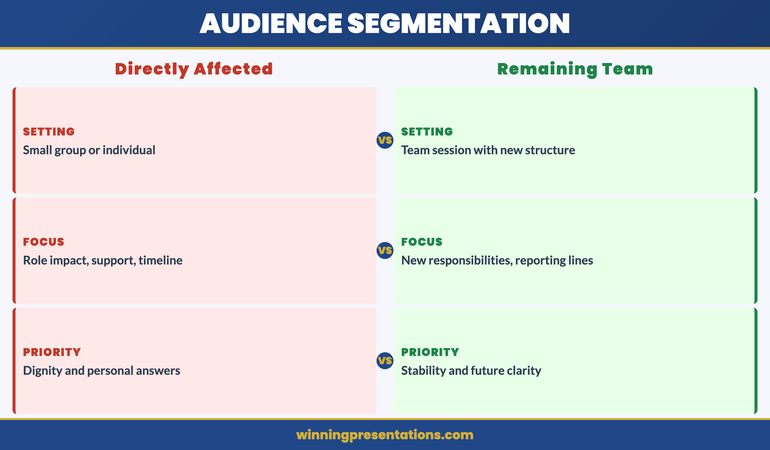
A restructuring affects multiple audiences, each with different concerns, different information needs, and different levels of vulnerability. Presenting the same message to all of them—a single all-hands announcement—is efficient and almost always damaging. The people being made redundant, the people staying in restructured roles, the people unaffected but watching, the leadership team responsible for implementation, and the external stakeholders (clients, investors, partners) all need different communications.

For the directly affected group, the presentation must be personal, specific, and delivered in a small-group or individual setting. They need to hear what is happening to their role, what the timeline is, what support is available, and who their point of contact will be for questions. A large-audience announcement denies them the dignity of a personal conversation and creates a public spectacle of private distress.

For the people remaining in restructured roles, the presentation focuses on what changes for them: new reporting lines, new responsibilities, revised team structures, and the timeline for stabilisation. Their primary anxiety is not about redundancy—it’s about whether the organisation they’re staying in will function well enough to justify staying. Address that directly.

For the broader organisation—the people not directly affected—the presentation must explain why the restructuring happened, what the organisation looks like afterwards, and what it means for them operationally. Their anxiety is lower but their cynicism is often higher: they’re watching how leadership treats the affected colleagues, and that observation shapes their long-term trust. If you’ve read our guide on restructuring presentations and team trust, you’ll recognise the critical role that visible fairness plays in organisational recovery.

Stakeholder audience segmentation framework for restructuring communications showing three audience groups and their communication needs

Framing the Strategic Rationale Without Corporate Jargon

Once the human cost is acknowledged and the support provisions are clear, the strategic rationale must follow. But the language matters enormously. Corporate jargon in a restructuring announcement—“right-sizing,” “synergy realisation,” “operational efficiency”—reads as evasion. It signals that the leadership team is hiding behind terminology rather than being direct about what’s happening and why.

The rationale should be expressed in three plain sentences. Sentence one: what has changed in the market or the organisation that made this restructuring necessary. Sentence two: what the restructured organisation will look like and why that structure is better positioned. Sentence three: what the leadership team has already done to minimise the impact on people. Three sentences. If you can’t explain the rationale in three sentences, you either don’t understand it fully or you’re trying to obscure something.

Avoid two common traps. The first is over-explaining—providing so much market context and competitive analysis that the rationale gets lost in data. Stakeholders experiencing change don’t need an MBA case study. They need to understand the logic simply enough to explain it to their families. The second trap is euphemism. Don’t say “we’re creating a more agile organisation” when you mean “we’re removing a layer of management.” Don’t say “some roles will be impacted” when you mean “fourteen people will be made redundant.” Direct language hurts in the moment but builds trust over time.

The most effective restructuring communicators—and Dimitri’s approach illustrates this—treat the rationale as context for a decision that’s already been made, not as justification for it. There’s a difference. Justification implies the leadership team is seeking approval from the audience. Context implies they’ve made a difficult decision and they’re explaining their reasoning honestly. Stakeholders respect the latter even when they disagree with the outcome.

The Timeline Slide: Certainty Where Possible, Honesty Where Not

After a restructuring announcement, the single most destructive force is uncertainty about timing. People can absorb bad news. They cannot absorb indefinite ambiguity. The timeline slide in your stakeholder change presentation must be as specific as possible about dates, and completely honest about what isn’t yet decided.

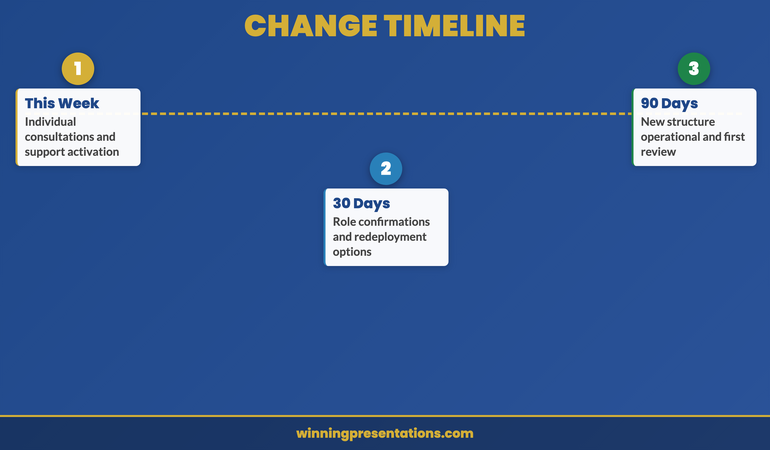
Structure the timeline in three phases. Phase one: what happens this week. Individual consultation meetings scheduled, support resources activated, FAQ document distributed. Phase two: what happens over the next thirty days. Consultation period, role confirmation for restructured positions, redeployment opportunities communicated. Phase three: what happens by ninety days. New structure operational, integration milestones, first review checkpoint.

For elements where dates are genuinely uncertain—regulatory approvals, union consultation outcomes, client contract negotiations—say so explicitly. “We expect this to be resolved by mid-May, but we’ll confirm the date by the end of next week” is far better than a vague “in due course.” Ambiguity in timelines is interpreted as either incompetence or concealment, regardless of the actual reason.

One detail that many leaders overlook: commit to a specific communication rhythm after the announcement. “I will send an update email every Friday until the restructuring is complete.” This single commitment reduces anxiety disproportionately, because it assures people that silence is not abandonment. The announcement presentation is the beginning of the communication, not the entirety of it. Our guide on how leaders can use redundancy announcement presentations covers the specific language and sequencing that preserves dignity during the most difficult conversations.

If you’re structuring a change communication for the first time, the Executive Slide System provides the structural templates that ensure every stakeholder audience receives the right message at the right moment.

Three-phase timeline framework for restructuring communication covering this week, thirty days, and ninety days

Preparing for the Questions You Hope Nobody Asks

In restructuring communications, the Q&A session is where trust is won or lost. The presentation itself is a controlled environment—you’ve chosen the words, the sequence, the framing. The questions that follow test whether the presentation was honest or merely polished.

Prepare for five categories of questions. The “why me” question: “How were the affected roles selected?” Your answer must reference objective criteria—not performance, not politics. Structural logic: “These roles existed to serve a function that the new structure addresses differently.” The “what next” question: “What happens if I don’t accept the redeployment offer?” Have the answer ready with specifics. The “trust” question: “How do we know there won’t be another round in six months?” Be honest: “I can’t guarantee that no further changes will ever be needed, but this restructuring is designed to be stable for [timeframe].” The “leadership accountability” question: “Are senior leaders being affected too?” If yes, say so specifically. If no, explain why—honestly. The “real reason” question: “Is this really about strategy, or is it about cutting costs?” Do not deflect. “Cost reduction is part of the rationale, yes. We need to operate within [budget/margin]. The structural changes also position us for [strategic goal]. Both are true.”

The questions you hope nobody asks are exactly the ones you must prepare for most thoroughly. If you’re visibly uncomfortable or evasive when they surface, every other message in your presentation unravels. Our guide on town hall presentations that rebuild trust covers the Q&A preparation framework in detail, including how to handle emotional responses without shutting them down.

After the Presentation: Follow-Through That Rebuilds Trust

The presentation is the beginning, not the end. What happens in the seventy-two hours after a restructuring announcement determines whether the trust you’ve worked to preserve actually survives. Three actions are non-negotiable.

Action 1: Individual conversations within 48 hours. Every affected person must have a private, face-to-face (or video) conversation with their direct manager or a senior leader within two working days. Not an email. Not a group session. A personal conversation where their specific situation is discussed, their questions are answered, and they are treated as an individual, not a headcount number.

Action 2: Written summary within 24 hours. Distribute a written document that captures everything said in the presentation. People under stress do not retain verbal information well. The written summary serves as a reference they can return to once the initial shock subsides. Include all support provisions, timelines, contact details, and the strategic rationale in plain language.

Action 3: Visible leadership presence. In the days following the announcement, the leadership team must be visibly present. Not hiding in offices. Not travelling. Walking the floor, eating in the canteen, being available for informal conversations. This is not about having more formal meetings. It’s about demonstrating that the leaders who made this decision are not detaching from its consequences.

Dimitri did all three. Within forty-eight hours, every affected team member had a private conversation. A written FAQ was distributed the same afternoon. Dimitri ate lunch in the main canteen every day for three weeks. Trust isn’t built by presentations. It’s built by what leaders do after the presentation ends.

Lead Through Change With Structured, Honest Communication

Restructuring requires precision in every slide and every word. The Executive Slide System gives you the communication frameworks, stakeholder templates, and scenario guides you need—for £39.

Get the System Now → £39

FAQ: Stakeholder Change Presentations

Should I announce a restructuring in one large meeting or multiple smaller sessions?

Multiple smaller sessions, segmented by audience. The directly affected group should hear the news in a small-group or individual setting before the wider organisation. This prevents the public spectacle of people learning their role is at risk in front of hundreds of colleagues. The broader all-hands session should follow within hours, not days—delays create a rumour vacuum that’s worse than the announcement itself. The key principle is that no stakeholder should learn about changes to their own role from someone outside their direct leadership chain.

How do I handle tears or emotional reactions during the presentation?

Do not rush past them, minimise them, or pretend they aren’t happening. Pause. Acknowledge the emotion directly: “This is a difficult conversation and your reaction is completely understandable.” Offer the person the option to continue or step out for a moment. Do not move to the next slide whilst someone is visibly distressed—it signals that the agenda matters more than the people. Have tissues, water, and a private space available. If the session is derailed by strong emotion, call a brief pause rather than pushing through. Emotional responses are not obstacles to the communication—they are part of it.

What if I don’t have all the answers at the time of the announcement?

Say so honestly, and commit to a specific date when you will have the answer. “I don’t have that information yet—we’re still working through the consultation process. I’ll have an answer by next Friday and will communicate it directly.” This is far better than guessing, hedging, or deflecting. Stakeholders during restructuring have finely calibrated sensors for evasion. An honest “I don’t know yet” followed by a specific commitment builds more trust than a vague reassurance that turns out to be inaccurate.

The Winning Edge

Weekly insights on executive presentations, slide strategy, and boardroom communication.

Subscribe Free

Leading through organisational change? Download the Executive Slide System checklist for a quick restructuring communication framework.

If your restructuring is driven by a merger or acquisition, our guide to mergers and acquisitions presentations covers the board-level deal presentation that typically precedes stakeholder communications.

About the author

Mary Beth Hazeldine, Owner & Managing Director, Winning Presentations. With 24 years of corporate banking experience at JPMorgan Chase, PwC, Royal Bank of Scotland, and Commerzbank, she advises executives across financial services, healthcare, technology, and government on structuring presentations for high-stakes funding rounds and approvals.
28 Jan 2026
Professional woman having one-on-one stakeholder conversation with hand gesture, engaging colleague in discussion

Stakeholder Buy-In Psychology: Why Alignment Creates Agreement and Enrollment Creates Champions

The CFO said yes in our one-on-one. Then he stayed silent in the steering committee while someone else killed the project.

I’d done everything right — or so I thought. I’d had the pre-meeting conversations. I’d addressed concerns. I’d gotten explicit agreement from every key stakeholder. On paper, I was “aligned.”

But when a skeptical VP raised objections in the room, nobody defended my proposal. The people who’d nodded along in private sat quietly while the project got “tabled for further review.” It never came back.

That’s when a mentor taught me the distinction that changed everything: I’d achieved alignment, but not enrollment. And in stakeholder buy-in psychology, that difference is everything.

Quick Answer: Alignment means stakeholders agree with your position — they won’t actively oppose you. Enrollment means stakeholders feel ownership of the idea — they’ll defend it, champion it, and drive it forward even when you’re not in the room. The psychology is different: alignment asks “will you accept this?” while enrollment asks “what would make this yours?” Enrollment is harder to achieve but dramatically more durable.

If you’re presenting to executives, boards, or steering committees — passive agreement isn’t enough. You need people who will speak up when objections arise. That requires understanding the psychology of genuine buy-in.

Need real buy-in this week? Try the enrollment shift.

Instead of asking “Do you agree with this?” ask:

  1. “What would need to be true for this to work for you?”
  2. “What concerns would you want addressed before you’d champion this?”
  3. “If we solve [their concern], would you be willing to speak to that in the meeting?”

You’re not asking them to accept your idea — you’re inviting them to shape it and own it. For the structured framework, see the Executive Buy-In Presentation System.

Why Alignment Isn’t Enough

I learned this lesson painfully at RBS during a major technology initiative.

We needed approval for a significant system upgrade. I spent weeks building the business case, meeting with stakeholders, addressing objections. By the time I walked into the executive committee, I had verbal agreement from everyone who mattered.

The presentation went smoothly — until a board member who’d missed our earlier conversations raised a concern about implementation risk. I started to respond, but something worse happened: silence. The executives who’d agreed with me privately said nothing. They let me defend the proposal alone.

The project was delayed six months while we “further evaluated risks.” Half the team moved on to other priorities. The momentum never recovered.

Later, I asked my CFO why he hadn’t spoken up. His answer was honest: “I agreed it was a good idea. But I didn’t feel like it was my idea. I wasn’t going to spend political capital defending someone else’s project.”

That was the moment I understood: agreement isn’t commitment. Alignment isn’t enrollment.

The Psychology of Enrollment

The distinction between alignment and enrollment comes down to ownership psychology:

Alignment means: “I won’t block this.”

  • Stakeholder has accepted your reasoning
  • They’ve agreed the proposal makes sense
  • They’ll vote yes if asked directly
  • But they feel no personal stake in the outcome

Enrollment means: “I want this to happen.”

  • Stakeholder sees the proposal as partly theirs
  • Their input shaped the direction
  • Success reflects well on them
  • They’ll defend it when challenged

4-quadrant stakeholder map showing High Power/High Interest as Key Players, High Power/Low Interest as Keep Satisfied, Low Power/High Interest as Keep Informed, Low Power/Low Interest as Monitor

The psychological research on this is clear: people defend ideas they feel ownership over, not ideas they merely accept. When stakeholders contribute to a proposal — when their concerns shape it, when their language appears in it — they experience what psychologists call the “IKEA effect”: they value it more because they helped build it.

For the tactical side of stakeholder engagement, see our guide to stakeholder mapping for presentations.

How do you get stakeholder buy-in?

True stakeholder buy-in requires enrollment, not just alignment. Instead of presenting your finished idea and asking for agreement, involve stakeholders early: ask what would make the proposal work for them, incorporate their concerns into your approach, and give them ownership of specific elements. When stakeholders feel the idea is partly theirs, they’ll defend it actively — not just accept it passively.

⭐ Turn reluctant stakeholders into active advocates

The Executive Buy-In Presentation System is a self-paced programme with 7 modules covering the psychology, conversation frameworks, and presentation structure that move senior stakeholders from passive agreement to active championship. £499, lifetime access to materials.

What’s covered:

  • The psychology of ownership and why it drives genuine buy-in
  • Enrollment conversation frameworks with exact language
  • How to work with skeptics so they champion the proposal
  • Stakeholder mapping and champion activation

Explore the Buy-In System on Maven →

Self-paced with monthly cohort enrolment. Optional recorded Q&A calls available.

How to Enroll Instead of Align

The shift from alignment to enrollment requires changing your approach at every stage:

1. Start Earlier

Alignment happens at the end: you build your proposal, then seek agreement. Enrollment happens at the beginning: you involve stakeholders while the proposal is still taking shape.

The enrollment question isn’t “Do you agree with this?” It’s “What would need to be true for you to champion this?”

2. Seek Input, Not Just Feedback

There’s a difference between asking stakeholders to review a finished proposal and asking them to help shape one. When you ask for feedback on something complete, they’re evaluating your work. When you ask for input on something developing, they’re contributing to shared work.

3. Make Their Concerns Central

When a stakeholder raises a concern, don’t just address it — feature it. “Sarah raised an important point about implementation risk, so we’ve built in these safeguards…” Now Sarah hears her concern taken seriously, sees her name attached to the solution, and has a stake in the proposal’s success.

4. Give Them Lines to Say

Enrolled stakeholders need talking points. Before the meeting, brief your champions: “If the CFO raises budget concerns, it would be helpful if you mentioned the ROI projections we discussed.” You’re not asking them to lie — you’re making it easy for them to support you publicly.

5. Let Them Take Credit

Enrollment requires ego generosity. When the proposal succeeds, share credit liberally. “This wouldn’t have happened without Sarah’s insight on implementation” makes Sarah more likely to champion your next initiative.

For the pre-meeting conversation tactics, see our detailed guide on pre-meeting executive alignment.

What is the psychology of buy-in?

The psychology of buy-in centers on ownership. People defend and champion ideas they feel they helped create — what psychologists call the “IKEA effect.” When stakeholders contribute concerns, shape solutions, or see their language in proposals, they experience psychological ownership. This transforms them from passive evaluators (“I agree this makes sense”) into active champions (“I want this to succeed”).

No deadlines, no mandatory attendance. The Executive Buy-In Presentation System — 7 self-paced modules, £499, lifetime access to materials.

Explore the Buy-In System →

The Enrollment Conversation Framework

Here’s the exact conversation structure I use to move from alignment to enrollment:

Phase 1: Open with Curiosity (2 minutes)

Don’t pitch. Ask about their world first:

  • “What’s top of mind for you right now?”
  • “What pressures are you facing this quarter?”
  • “What would make your life easier?”

This isn’t small talk — it’s intelligence gathering. You’re learning what they care about so you can connect your proposal to their priorities.

Phase 2: Share the Problem, Not the Solution (3 minutes)

Describe the problem you’re trying to solve. Then pause. Let them react:

  • “We’re seeing X issue. Does that match what you’re experiencing?”
  • “How does this problem affect your team?”
  • “What have you tried so far?”

If they start solving the problem with you, you’ve begun enrollment. They’re no longer evaluating your idea — they’re contributing to a shared challenge.

Phase 3: Co-Create the Direction (5 minutes)

Share your emerging thinking, but frame it as incomplete:

  • “One direction we’re considering is X. What would make that work for you?”
  • “What concerns would you want addressed before you’d feel confident in this?”
  • “What am I missing from your perspective?”

Write down their input. Reference it back to them. “So if I understand correctly, you’d want to see Y before moving forward…”

Phase 4: Ask for Championship (2 minutes)

This is the enrollment ask — and most people skip it:

  • “If we address [their concern], would you be willing to speak to that in the steering committee?”
  • “Would you be comfortable being the voice for [specific element] in the meeting?”
  • “Can I count on you to support this if [condition they named] is met?”

The explicit ask transforms passive agreement into active commitment. They’ve now made a promise, and people generally keep promises they’ve made directly.

Stakeholder engagement flow showing: Map stakeholders, Identify key players, Have pre-meeting conversations, Shape presentation to concerns, Activate champions, Present with alignment

Why do stakeholders resist change?

Stakeholders resist change when they feel it’s being done to them rather than with them. Resistance often signals unaddressed concerns, fear of being blamed if things go wrong, or simply not feeling heard. The enrollment approach reduces resistance by involving stakeholders early, incorporating their concerns, and giving them ownership of the solution — transforming them from targets of change into co-creators of it.

⭐ Stop guessing what your stakeholders need to say yes

The Executive Buy-In Presentation System is the self-paced framework for decoding resistance and building the case that addresses it — 7 modules, monthly cohort enrolment, optional recorded Q&A. £499, lifetime access.

Explore the Buy-In System on Maven →

Self-paced with monthly cohort enrolment.

Why Enrollment Fails (And How to Fix It)

Even when people try enrollment, they often undermine it:

Mistake #1: Asking for Input Too Late

If your proposal is 90% complete when you ask for input, stakeholders know they’re just being consulted for appearance. They’ll give token feedback but won’t feel ownership. Enrollment requires involving people when things are still genuinely malleable.

Mistake #2: Ignoring the Input You Receive

Nothing destroys enrollment faster than asking for input and then ignoring it. If you can’t incorporate someone’s suggestion, explain why — and find something else of theirs you can include. They need to see their fingerprints on the final product.

Mistake #3: Treating Enrollment as Manipulation

Enrollment isn’t a trick. If you’re cynically going through the motions to manufacture buy-in, stakeholders will sense it. Genuine enrollment requires actually being open to others’ input changing your approach. If you’re not willing to be influenced, don’t pretend to be.

Mistake #4: Forgetting to Make the Explicit Ask

Many people do the enrollment work but never ask for championship. They assume that if someone contributed, they’ll naturally support. But the explicit ask — “Will you speak to this in the meeting?” — transforms implicit goodwill into explicit commitment.

Mistake #5: Hoarding Credit

If you take all the credit when the proposal succeeds, you’ve taught stakeholders that supporting you doesn’t benefit them. Generous credit-sharing builds long-term enrollment — people will champion your next initiative because championing the last one felt good.

For the presentation structure that reinforces enrollment, see our guide to executive presentation structure.

A Major Project: What I Did Differently

Six months after my failure, I had another significant proposal to bring forward. Same executive committee. Same political dynamics. Different approach.

This time, I started enrollment three weeks before the meeting:

With the CFO: Instead of presenting my budget analysis, I asked what would make him confident in the ROI. He mentioned concerns about assumptions. I asked him to help me stress-test them. When he contributed to the financial model, it became partly his model.

With the skeptical VP: I met with him early and asked directly: “What would need to be true for you to support this?” He named three conditions. I built all three into the proposal and told him I’d done so. Then I asked: “Would you be willing to confirm these safeguards are adequate in the meeting?” He agreed.

With the CTO: I asked her to validate the technical approach. When she suggested a modification, I adopted it and credited her publicly: “Maria’s recommendation to phase the implementation addresses the risk concern.”

The Result:

When I presented, the CFO spoke first: “I’ve reviewed the financials with [me] — the assumptions are solid.” The VP who’d killed my previous project said: “I was initially skeptical, but the safeguards address my concerns.” The CTO nodded along.

Approved in the first round. No “further review.” No six-month delay.

Same committee that had killed my previous proposal. The difference was enrollment.

⭐ Built on 25 years in corporate banking

The Executive Buy-In Presentation System is the self-paced framework developed across 25 years in corporate banking and 16 years coaching senior professionals across financial services, insurance, consulting, and technology. £499, lifetime access to materials.

What you get:

  • 7 self-paced modules covering psychology, conversations, and structure
  • Enrollment conversation frameworks with exact language
  • Stakeholder mapping and champion activation tools
  • Bonus Q&A calls (optional, fully recorded — watch back anytime)
  • Lifetime access to materials

Explore the Buy-In System on Maven →

Self-paced with monthly cohort enrolment — new cohort opens every month.

Frequently Asked Questions

What’s the difference between alignment and enrollment?

Alignment means stakeholders agree with your position — they’ll vote yes but won’t actively champion it. Enrollment means stakeholders feel ownership of the idea — they’ll defend it when challenged, speak up in meetings, and drive it forward even without your prompting. The key difference is psychological ownership: enrolled stakeholders feel the proposal is partly theirs.

How do you enroll resistant stakeholders?

Start by understanding their resistance. Ask: “What would need to be true for you to support this?” Their answer reveals their real concerns. Address those concerns visibly in your proposal, credit them for the insight, and ask explicitly: “If we address this, would you be willing to champion it?” Resistance often transforms into championship when stakeholders feel genuinely heard and see their concerns taken seriously.

Is this manipulation?

Enrollment isn’t manipulation — it’s collaboration. You’re not tricking stakeholders into supporting something against their interests. You’re genuinely incorporating their concerns and giving them ownership of solutions. The approach requires actually being open to their input changing your proposal. If you’re only pretending to listen, that’s manipulation — and stakeholders will sense it.

How long does enrollment take vs alignment?

Enrollment requires more upfront investment — typically 2-3 weeks of conversations before a major presentation, versus a few days for alignment. But the ROI is dramatically better: enrollment leads to faster approvals, fewer delays, and decisions that stick. Alignment often creates “false yes” situations where apparent agreement dissolves under pressure, causing months of rework.

Get Weekly Executive Buy-In Insights

Strategies for stakeholder psychology, decision-getting, and presenting with authority — from 25 years in corporate banking.

Subscribe to The Winning Edge →

📋 Not ready for the course? Take the checklist.

A quick-reference guide covering executive presentation structure, stakeholder engagement, and decision-getting. Use it before your next high-stakes presentation.

Download Free Checklist →

Your Next Step

Before your next important presentation, pick one key stakeholder and try the enrollment approach:

  1. Meet them before your proposal is finalized
  2. Ask: “What would need to be true for you to champion this?”
  3. Incorporate their answer visibly
  4. Ask explicitly: “Will you speak to this in the meeting?”

One enrolled champion changes the dynamics of the entire room. Start there.

P.S. Before you enroll stakeholders, you need to map them. I wrote a detailed guide on stakeholder mapping for presentations — including the 4-quadrant framework that shows who to focus on.

P.P.S. And if fear of judgment affects how you show up in stakeholder conversations, check out how to handle fear of being judged when speaking — it’s about rewiring the evaluation anxiety.

About Mary Beth Hazeldine
Owner & Managing Director of Winning Presentations. 25 years in corporate banking at JPMorgan Chase, PwC, RBS, and Commerzbank taught me that the best presentations fail without enrollment. The psychology of buy-in is the skill that separates proposals that get approved from proposals that get “tabled for further review.”