Tag: career development

24 Apr 2026

Avoiding Presentations at Work: The Career Cost of Saying No

Quick Answer

Avoiding presentations at work protects you from short-term discomfort but creates long-term career damage that is difficult to reverse. Every declined opportunity narrows the roles, projects, and promotions available to you β€” and the pattern is visible to colleagues and managers even when you believe it’s hidden. The way out is not forcing yourself into a high-stakes presentation. It is building a structured, graduated approach that rebuilds your capacity in controlled conditions first.

Nadia had been a senior analyst at a consulting firm for four years when she realised she had turned down every presentation opportunity that came her way.

Not obviously. She never said “I’m too frightened to present.” She said things that sounded reasonable: “Ravi knows the client better β€” he should lead.” “I think it’s stronger if we keep it to one presenter.” “I’m deep in the modelling this week, can someone else take the Friday slot?” Each excuse was plausible. Each one was believed. And over four years, each one quietly moved her name off the list of people considered for client-facing roles.

Nadia found out about the career cost during her annual review. Her manager said she was “technically outstanding” but lacked “executive presence.” She hadn’t been considered for the principal promotion because, in the words of her skip-level manager, “we’ve never seen her present.” They hadn’t. Because she had made sure of it.

I hear some version of this story at least once a month. The details change β€” the industry, the level, the specific excuse. The pattern is always the same.

Recognise this pattern in yourself?

Conquer Speaking Fear is a structured 30-day programme that breaks the avoidance cycle using nervous system regulation β€” not willpower. It works with your biology, not against it.

Explore the Conquer Speaking Fear programme β†’

What Presentation Avoidance Actually Looks Like

Presentation avoidance rarely looks like refusal. It looks like delegation, strategic timing, and reasonable explanations that happen to keep you away from the front of the room every time.

The most common patterns are surprisingly consistent across industries and seniority levels:

Volunteering for the preparation instead of the delivery. You do all the analytical work, build all the slides, write the speaking notes β€” and then hand the finished deck to a colleague “because they’re the relationship lead” or “because they know the audience.” The work gets done. The credit goes to the person who presented it.

Engineering scheduling conflicts. You book a call, a client meeting, or a site visit that overlaps with the presentation you were asked to do. The conflict is real β€” you created it deliberately, but nobody else knows that.

Suggesting a different format. “Could we do this as a written briefing instead?” “Would a pre-read with a Q&A be more efficient?” Both suggestions sound like process improvement. Both remove the need for you to stand up and present.

The invisible ceiling. Over time, the avoidance becomes self-reinforcing. You turn down opportunities. Colleagues stop asking. Your manager learns that you prefer “behind the scenes” work and starts assigning you accordingly. You have effectively told the organisation that you are not a presenter β€” without ever saying the words. The opportunities narrow. And because it happened gradually, it doesn’t feel like a decision. It feels like the way things are.

If any of these patterns feel familiar, you are not alone. The fear of presenting to authority figures drives many of these behaviours β€” even when the presenter is technically more senior than they realise.

The Career Cost Nobody Warns You About

The damage from presentation avoidance is not dramatic. It is cumulative, quiet, and often invisible until it’s too late to reverse easily.

You lose visibility with decision-makers. In most organisations, the people who decide promotions, project assignments, and leadership appointments are not the people who read your reports. They are the people who see you present. If they never see you present, you do not exist in the context that matters for advancement. No amount of technical excellence compensates for this.

Your expertise becomes invisible. A senior analyst who never presents their own findings is perceived differently from one who does β€” even if the findings are identical. Presenting your work is not showing off. It is how knowledge becomes influence. Without it, your analysis goes into someone else’s presentation and carries their name, their framing, and their career benefit.

You get typed as “not ready.” Managers use shorthand for who is ready for the next level, and “hasn’t presented” is one of the most common disqualifiers. It is rarely stated explicitly because it sounds harsh. Instead, it surfaces as vague feedback: “needs more executive presence,” “not quite ready for client-facing work,” “strong contributor but needs to develop leadership skills.” All of these can mean: “We haven’t seen them present, and we need to before we can promote them.”

The cost compounds over time. A missed presentation in year one is recoverable. A pattern of avoidance over three to five years changes how the organisation sees you permanently. Colleagues who started at the same level and accepted the presentation opportunities are now two levels ahead β€” not because they were smarter, but because they were visible. That gap widens every year, and closing it becomes progressively harder.

Career cost of avoiding presentations roadmap showing progressive impact over five stages: Lost Visibility, Invisible Expertise, Typed as Not Ready, Compounding Gap, and Narrowed Options

Break the Avoidance Pattern β€” On Your Own Terms

Conquer Speaking Fear β€” Β£39, instant access β€” is a structured 30-day programme built on nervous system regulation techniques from clinical hypnotherapy. It is designed specifically for professionals who have tried willpower and found it doesn’t hold:

  • A graduated exposure framework that rebuilds confidence without the deep end
  • Nervous system regulation techniques for the physical symptoms that drive avoidance
  • Daily exercises designed for professionals with limited time
  • Techniques drawn from clinical hypnotherapy and NLP practice

Get the Conquer Speaking Fear Programme β†’

Designed for executives and professionals who know avoidance is limiting their careers.

Why Avoidance Works in the Short Term and Fails in the Long Term

Avoidance persists because it works β€” immediately and reliably. The moment you successfully avoid a presentation, the anxiety drops. The relief is real, and your nervous system learns to associate avoidance with safety. This is not a character flaw. It is how the threat response works.

The problem is that avoidance doesn’t just remove the anxiety temporarily. It strengthens the belief that the anxiety was justified. Every time you avoid a presentation and feel relief, your brain records: “The thing I feared was real, and escaping it was the right decision.” Over time, this makes the next presentation opportunity feel even more threatening β€” because the pattern has been reinforced, not challenged.

This is what psychologists call the avoidance-anxiety cycle. The anxiety creates the avoidance. The avoidance validates the anxiety. Each repetition makes the cycle harder to break. A presentation that would have felt manageable three years ago now feels impossible β€” not because you’ve become less capable, but because the avoidance has trained your nervous system to treat presenting as a genuine threat.

The critical insight is that willpower does not break this cycle. Telling yourself to “just do it” doesn’t address the nervous system response that made you avoid it in the first place. What breaks the cycle is graduated exposure in controlled conditions β€” starting with presentations that are low-stakes enough that your nervous system can complete them without triggering the full threat response, and building from there.

The experience of rebuilding presentation confidence after a period of avoidance is different from building it for the first time. You are not learning a new skill. You are unwinding a learned response.

Breaking the Avoidance Pattern Without the Deep End

The worst advice someone avoiding presentations can receive is “just sign up for a big one and push through.” This approach has a dismal success rate, because a single overwhelming experience typically reinforces the avoidance rather than breaking it. The nervous system doesn’t learn “I survived” β€” it learns “that was as bad as I feared, and I should avoid it even harder next time.”

The approach that works is graduated, structured, and deliberately boring at the start. Here is a practical framework:

Week 1–2: Speak without presenting. Contribute verbally in meetings where you are already comfortable. Ask a question. Offer a data point. Make a comment that requires the room to look at you for ten to fifteen seconds. This is not a presentation. It is practice being visible, and it starts to challenge the association between attention and threat.

Week 3–4: Present informally to a safe audience. Walk a trusted colleague through a piece of analysis at your desk. Talk a small group through a process you know well. Choose an audience where the stakes are genuinely zero β€” no evaluation, no judgement, no career implications. The goal is to complete a verbal delivery without your nervous system escalating. If it does escalate, that is information, not failure.

Week 5–6: Take a low-visibility speaking slot. A five-minute update in a team meeting. A short walkthrough of a project status. Something where you are presenting, but the content is routine and the audience is familiar. This is the stage where most people discover that the anticipated anxiety is worse than the actual experience β€” but only because the stakes are genuinely low.

Week 7–8: Accept a real presentation with preparation support. This is the first genuinely public presentation, and it should be one where you have time to prepare and where the audience does not include anyone who intimidates you significantly. Run through it once with a colleague beforehand. The goal is not a perfect presentation. The goal is a completed one.

This graduated approach works because it gives the nervous system time to learn that presenting is not the threat it has been coded as. Each step builds evidence against the fear β€” but only if the steps are small enough that the fear doesn’t overwhelm the experience. The imposter syndrome that drives presentation avoidance responds to the same logic: small, repeated evidence that you can do this is more powerful than one dramatic success.

If you want a structured version of this progression, the Conquer Speaking Fear programme walks you through a 30-day graduated exposure framework with daily nervous system regulation exercises designed to break the avoidance cycle at its root.

Breaking the avoidance pattern: comparison of avoidance cycle (anxiety, avoidance, relief, reinforced fear) versus recovery path (graduated exposure, controlled success, reduced threat response)

What to Do When You Can No Longer Say No

Sometimes the avoidance runway runs out. You are assigned a presentation that you cannot delegate, defer, or restructure into a written format. This happens more often at career transition points β€” promotions, new roles, client-facing assignments β€” where presenting is no longer optional.

If you are in this position, here is what to prioritise in the days before the presentation:

Over-prepare the opening two minutes. The first two minutes are when the physical symptoms peak β€” the heart rate, the dry mouth, the voice catching. If you know the opening so well that you can deliver it on autopilot, you give your nervous system time to settle without the cognitive load of trying to remember what comes next. Script the first three to four sentences word for word. After that, you can shift to notes or a natural flow.

Practise the physical, not just the content. Stand up. Speak out loud. Walk through the room where you will present, if possible. The nervous system responds to environmental cues, and rehearsing in the actual space reduces the novelty signal that triggers the threat response. If you can’t access the room, practise standing in a similar configuration. The body needs to rehearse, not just the mind.

Tell one person. This is counterintuitive, but telling a trusted colleague “I find this difficult” often reduces the intensity of the anxiety. The avoidance pattern thrives on secrecy β€” the belief that nobody can know. Sharing it with one person breaks that isolation and, in most cases, the response is supportive rather than judgmental. You may also find that the colleague has a similar experience they have never shared either.

See also how today’s related articles tackle adjacent challenges: delivering difficult financial news under pressure, adapting presentations for unfamiliar audiences, and building structured boardroom presentation skills.

Ready to Stop the Pattern?

Conquer Speaking Fear β€” Β£39, instant access β€” is a 30-day programme that uses nervous system regulation techniques from clinical hypnotherapy to break the avoidance cycle at its source. It is designed for professionals who have tried willpower and need a different approach.

Get the Conquer Speaking Fear Programme β†’

Designed for professionals who know avoidance is holding their career back.

Frequently Asked Questions

Is it normal to avoid presentations at work?

It is extremely common. Research consistently shows that public speaking is one of the most widely reported workplace anxieties, and avoidance is the most common coping strategy. The challenge is that avoidance is also the strategy that causes the most long-term career damage, because it is invisible β€” neither the person avoiding nor their colleagues typically recognise the cumulative cost until it has already shaped career trajectory significantly.

Can you have a successful career without presenting?

In some specialist roles, yes β€” but the ceiling is significantly lower. Almost every leadership role, client-facing role, and cross-functional role requires the ability to present. If you cannot or will not present, you limit yourself to roles where someone else presents your work for you. This is viable early in a career but becomes increasingly restrictive as seniority increases. Most professionals who avoid presentations do not choose a different career path β€” they simply stop advancing at the point where presenting becomes required.

How long does it take to overcome presentation avoidance?

With a structured approach, most professionals see meaningful progress within four to six weeks. This does not mean the anxiety disappears entirely β€” it means the avoidance behaviour stops, and the anxiety becomes manageable enough that you can present despite it. A graduated exposure framework typically starts to produce results within the first two weeks, as the nervous system begins to recalibrate its threat assessment. Full confidence rebuilding takes longer β€” typically three to six months of regular, positive presentation experiences.

The Winning Edge β€” Weekly Presentation Intelligence

Every Thursday, I share one framework, one real-world example, and one practical technique drawn from 25 years of banking and 16 years of training executives to present with confidence. Join The Winning Edge newsletter β†’

About the Author

Mary Beth Hazeldine is the Owner & Managing Director of Winning Presentations. A qualified clinical hypnotherapist and NLP practitioner, she spent five years struggling with severe presentation anxiety before developing the nervous system regulation techniques she now teaches. With 25 years of banking experience at JPMorgan Chase, PwC, Royal Bank of Scotland, and Commerzbank, she advises executives across financial services, healthcare, technology, and government on overcoming presentation fear and building lasting confidence.

Book a discovery call | View services

19 Apr 2026

Internal Transfer Pitch: The Presentation That Gets You to the Role You Want

Quick Answer

An internal transfer pitch succeeds when it is structured as a business case rather than a personal preference statement. The decision-maker needs to see three things: what the organisation gains by approving the move, what you bring that is directly relevant to the new role, and what the cost or risk of not moving you is. An internal pitch that frames itself around your career goals is a request. One that frames itself around organisational value is a proposal.

TomΓ‘s had been in the same division for eight years. When a senior role opened in a part of the business he had been angling towards for two years, he put himself forward, prepared a thorough self-assessment, and requested time with the divisional director to discuss it.

The conversation lasted 11 minutes. The director told him the role would be filled externally.

What went wrong was not TomΓ‘s’s track record, which was strong. What went wrong was the structure of what he said. He spent the 11 minutes explaining why he wanted the role. The director spent those same 11 minutes silently calculating what losing TomΓ‘s from his existing team would cost him. Neither of them was having the conversation the situation required.

Internal transfer pitches fail in this way constantly. The candidate frames the conversation around their development. The decision-maker evaluates it through the lens of organisational disruption. Those two frames are not compatible, and without a structure that addresses both, the conversation ends in a polite “we’ll let you know” that usually means no.

Need a presentation structure for a high-stakes career conversation?

The Executive Slide System includes proposal templates and framework guides designed for making the business case in internal and external career-stage presentations.

Explore the System →

Why Internal Pitches Fail When External Pitches Would Succeed

The most counterintuitive aspect of an internal transfer pitch is that your existing relationship with the organisation makes the conversation harder, not easier. External candidates start from zero. You start from a set of existing perceptions, existing dependencies, and existing political dynamics that shape how every word you say is received.

Your current manager hears your transfer pitch as a signal that their team is about to lose a high-performer. The hiring manager in the new division may have concerns about whether you can reposition yourself from a known role into an unknown one. The HR function is evaluating whether approving your move sets a precedent they are comfortable with. None of these stakeholders are against you, but none of them are reading your pitch as a neutral observer.

This means the internal pitch requires a more sophisticated structure than an external interview. An external candidate needs to establish credibility, demonstrate capability, and close on the opportunity. An internal candidate needs to do all three of those things and also address the costs and concerns that come with internal movement. The pitch has to make it easy for multiple stakeholders to say yes, not just the hiring manager.

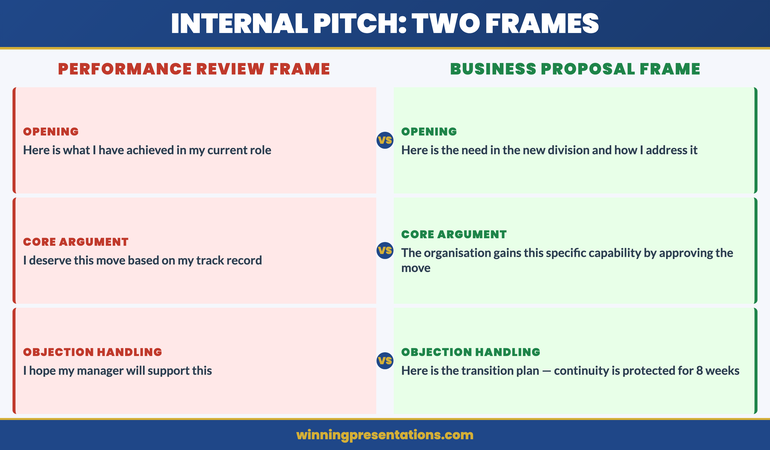
The failure mode for most internal pitches is treating the conversation as if it were a performance review rather than a business proposal. The structure of a performance review is backward-looking: here is what I have done, here is how well I have done it, here is why I deserve the next thing. The structure of a business proposal is forward-looking: here is the problem that needs solving, here is my capability to solve it, here is what the organisation gets by backing this move. The second frame is far more persuasive in a decision setting.

Internal pitch frame comparison: Performance Review frame (backward-looking: what I have done) versus Business Proposal frame (forward-looking: what the organisation gains)

The Three Elements Every Internal Pitch Must Address

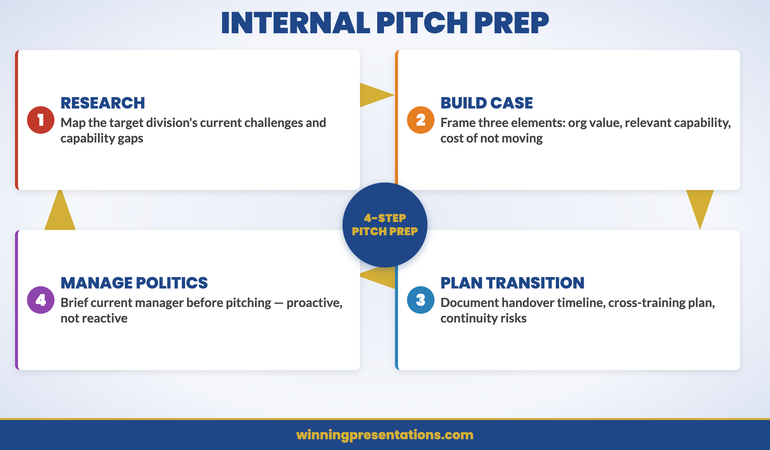
An internal transfer pitch that earns approval addresses three questions in sequence. These questions correspond to the concerns of the different stakeholders involved in the decision.

1. What does the organisation gain? This is the organisational value question, and it is the frame that makes an internal pitch a business proposal rather than a personal request. The answer should connect your specific skills and experience to a named need in the target role or division. Not “I have strong analytical capability” but “the new division is building a client-facing data function and I have spent three years building exactly this capability on the service delivery side, which is the experience they currently lack on the team.”

2. What do you bring that is directly relevant? This is not your full CV. It is the two or three pieces of your existing experience that are most directly transferable to the requirements of the new role. Be specific about the capability, and be explicit about the mechanism of transfer — not just “I have done X” but “the X I did on Project Meridian translates directly to the Y challenge I understand the new team is facing.” Internal decision-makers are generally more sceptical about transferability than external ones, because they have a clearer picture of the gap between your current role and the new one.

3. What is the cost or risk of the move not happening? This is the element most often absent from internal pitches, and it is the one that converts a polite conversation into a decision moment. The cost of the move not happening is rarely about you personally — it is about the organisational opportunity that is left unaddressed. “Without someone with this profile in the new team, the risk is that the function is built by people who understand the technology but not the client relationship dynamics. That is a gap that costs significantly more to correct after the fact.” This reframes the decision from “should we approve TomΓ‘s’s transfer?” to “what does it cost us not to put the right person in this role?”

How to Frame the Move as a Business Decision

The business case frame for an internal transfer pitch requires you to research the target role with the same rigour you would apply to any significant business proposal. Before the conversation with the decision-maker, you should be able to answer three questions about the division you are moving into: what are the current performance challenges, what capability does the team currently lack, and what is the strategic priority that the role is expected to support?

This information is almost always available if you look for it. Department heads discuss their challenges in all-hands meetings and in conversations with peers. Annual reports and strategy presentations are public. If you have a contact in the division, a single conversation will surface the specific pressure points the team is dealing with. The point is to do this research before the pitch, so your opening framing is not “I would like to move to your team” but “I understand the team is building out its [specific capability] function, and I have direct experience in that area from my current role.”

This opening immediately repositions the conversation. Instead of a candidate asking for a favour, you are a senior professional who has identified a specific organisational need and is presenting a solution. That is the frame in which business proposals are evaluated, and it is far more likely to generate a substantive conversation than a general expression of interest.

The political dimension of an internal transfer pitch is real and ignoring it does not make it disappear. Your current manager will find out about the pitch, if not from you then from the person you are pitching to. Managing that conversation proactively is always better than having it reactively.

The timing of when you inform your current manager is a judgment call that depends on the strength of your relationship and the culture of your organisation. In most settings, informing them before rather than after the pitch is the right move, framed as a professional courtesy rather than a request for permission. “I wanted you to hear this from me directly before I speak with anyone else: I am going to explore the opportunity in [division]. I am not planning to leave the team immediately — this is a longer-term development move — and I want to make sure we handle any transition in a way that does not leave the team exposed.”

This conversation also gives you an opportunity to address the most immediate concern your current manager has: continuity. If you can demonstrate that you have a clear transition plan before the pitch even happens, you remove the most significant source of resistance to an internal move. A manager who knows the handover will be handled well is far less likely to block or slow an internal transfer than one who feels the departure will be disruptive and unplanned.

The broader political landscape also includes relationships with peers who may be affected by the move or who have competing interests in how the new role is filled. It is worth thinking through who the decision influences and ensuring none of them are surprised in a way that creates unnecessary friction.

Presenting Your Transition Plan

Including a transition plan in your internal pitch is one of the most effective ways to signal that you are thinking about this as a business decision rather than a personal one. Most internal candidates do not do this. The ones who do demonstrate a level of organisational maturity that sets them apart from those who present only their own interests.

A transition plan for an internal pitch addresses three things: who takes over your current responsibilities, over what timeline, and what the risk to the current team’s output is during the transition period. It does not need to be detailed. A single slide or a two-paragraph summary is sufficient. The purpose is not to hand over the operational planning to the current manager — it is to demonstrate that you have already considered the disruption your departure causes and have a structured approach to minimising it.

“I would expect a transition of approximately eight weeks. In that time, I would document the [specific process] and cross-train Ngozi, who already has the background to take it on. The two areas of highest continuity risk are [X] and [Y], and I have a plan for both.” That is a transition plan. It takes two minutes to deliver and it removes the primary objection that most internal decision-makers have.

Once the transfer is approved and you are into the new role, the 90-day presentation framework for a new role covers how to structure your first significant update to the new team’s leadership — a presentation that signals you have arrived with a plan and are already making an impact. And for anyone stepping into a board-facing role for the first time, preparing for your first board presentation in a new role addresses the specific challenges of presenting to a board that does not yet have a relationship with you.

Build the Slides for Your Internal Pitch

The Executive Slide System — £39, instant access — includes proposal and initiative templates designed for making the business case in high-stakes internal conversations, including career-stage and role transition presentations.

  • Initiative Proposal slide template adaptable for internal transfer business cases
  • Strategic Recommendation template for framing the organisational value argument
  • AI prompt cards to draft your three-element pitch narrative in under 20 minutes
  • Framework guides for presenting transition plans and capability transfer arguments

Get the Executive Slide System →

Designed for executives making the business case in high-stakes internal conversations.

Handling the Objections That Always Come Up

Three objections appear consistently in internal transfer conversations. Preparing for them before the pitch is not optional.

“We need you where you are.” This is the most common objection and the most straightforward to handle, because the transition plan directly addresses it. “I understand that, and I have thought about the handover carefully. Here is how I would ensure continuity in my current role…” If you have done the transition planning work, this objection collapses on contact. If you have not, it is fatal.

“You don’t have experience in [specific area].” This is a capability gap objection. The response is to acknowledge the gap directly and then reframe it: “You are right that I have not done X in this context. What I have done is Y, which required the same underlying judgment in a different environment. I am confident the learning curve on the technical aspect of X is manageable; the harder part is the [specific judgment or relationship skill], and that is where my existing experience is directly relevant.” Acknowledging the gap first makes you more credible, not less.

“The hiring decision has not been finalised yet.” This is a timing objection, and it requires a specific response: “I understand. I am not asking for a decision today. I am asking for your awareness that I am interested and that I believe I can make a strong business case for the move. Can we schedule 20 minutes when the process is at the right stage for you to discuss it formally?” This keeps the conversation alive without pressuring a decision that has not yet been reached.

For the pitch structure itself, the executive presentation outline framework covers the sequencing principles that make a business case land well with senior decision-makers, whether the pitch is for an internal move, an external role, or a project proposal. And if you are doing this presentation virtually — which is increasingly common for internal conversations across different office locations — the virtual presentation energy guide covers the camera-presence techniques that ensure you read as authoritative and confident even through a screen.

If you are building the supporting slides for your internal pitch, the Executive Slide System includes initiative proposal templates and AI prompt cards for making the business case quickly.

Internal transfer pitch objection handling infographic: three common objections and the response structure for each β€” We need you where you are, capability gap, and timing

Ready to Build the Slides for Your Business Case?

The Executive Slide System — £39, instant access — includes proposal templates and AI prompt cards you can use to build a structured internal pitch deck in under an hour.

  • Initiative Proposal and Strategic Recommendation templates
  • AI prompt cards for making the capability and business value arguments quickly

Get the Executive Slide System →

Designed for executives making high-stakes internal cases under time pressure.

Frequently Asked Questions

Should I prepare a formal presentation for an internal transfer pitch, or keep it conversational?

It depends on the culture of your organisation and the seniority of the decision-maker. At director level and above, a brief structured document or slide deck signals that you are treating this as a professional business proposal rather than an informal request — which is the right impression to create. At manager level, a well-prepared verbal conversation with a clear structure may be more appropriate. In all cases, the structure of what you say should follow the business case framework: organisational value, relevant capability, cost of not moving. Whether you use slides or not, that is the argument that needs to be made.

How do I pitch for a lateral move when I am already at a senior level?

Lateral moves at senior levels require the most careful framing, because the default assumption is that a senior professional who wants to move sideways is either dissatisfied in their current role or unable to progress vertically. The pitch needs to address this assumption directly. Frame the lateral move in terms of breadth of experience that prepares you for a specific future progression, or in terms of the strategic value to the organisation of having your specific capability in the new function. “I have taken my current division as far as I can in the current structure. Moving to the international team gives me the cross-regional experience that will make me a stronger candidate for the MD role when it becomes available” is a credible lateral pitch for a senior executive.

What if my current manager has already told me they will not support the move?

This is a common and genuinely difficult situation. The first step is understanding the specific objection your current manager has — whether it is genuinely about team continuity, or whether it reflects a different concern (e.g., they do not want to lose you from their headcount, or they have a relationship with the hiring manager that makes this awkward). Once you understand the actual objection, you can address it directly. If the objection is about continuity, a detailed transition plan is the most effective tool. If the objection is more political, you may need to involve HR or a senior sponsor to navigate the decision above the level of the immediate manager.

How long should an internal transfer pitch meeting be?

Twenty to thirty minutes is the appropriate range for an initial pitch conversation. This is long enough to present the business case, address the primary objections, and agree a next step, and short enough to respect the decision-maker’s time and signal that you have prepared efficiently. If the conversation runs beyond 30 minutes, it is usually a good sign — it means the decision-maker is engaged enough to explore the details. The worst outcome is a 10-minute conversation that ends politely, because it means you did not get deep enough into the case for the decision-maker to form a view.

The Winning Edge — Weekly Executive Communication Insights

Each Thursday: one high-stakes communication technique, one real case study, one action you can apply before your next meeting.

Subscribe to The Winning Edge →

Download the free Executive Presentation Checklist — a one-page structure review for any high-stakes meeting.

About the Author

Mary Beth Hazeldine is the Owner & Managing Director of Winning Presentations. With 25 years of corporate banking experience at JPMorgan Chase, PwC, Royal Bank of Scotland, and Commerzbank, she has delivered high-stakes presentations in boardrooms across three continents.

A qualified clinical hypnotherapist and NLP practitioner, Mary Beth advises executives across financial services, healthcare, technology, and government on structuring presentations for high-stakes funding rounds and approvals.

Book a discovery call | View services

21 Mar 2026
Executive presenting confidently in a glass-walled boardroom, screen behind showing clean structured slide with key metrics, senior leaders listening attentively

Promotion Business Case Presentation: The 4-Slide Structure That Wins Committee Approval

Claire was Head of Digital at a UK retail group. She’d submitted for Director three times and been rejected three times. β€œNot quite ready,” the feedback always said. No specific gaps, no roadmap to yes. On her fourth submission, she stopped writing a detailed CV and started building a business case presentation instead. Four slides. No prose. Just quantified impact: Β£2.1M in revenue from her team’s initiatives. Three cross-functional projects delivered. Headcount grown from 4 to 11 people under her management. The committee approved her promotion in the first meeting. Effective date six weeks later.

Quick answer: A promotion business case presentation stops the committee from evaluating you against abstract criteria and forces them to evaluate you against the numbers you’ve already delivered and the scope you’re ready for. Most promotion candidates submit a CV (which invites comparison and judgment) or a rambling narrative (which buries the business case in words). Instead, build four slides: The Commercial Impact you’ve delivered, The Scope you’re ready for, The Gap you’ve already closed, and Why Now. Each slide answers one specific question. Together, they answer the only question that matters: β€œIs this person clearly ready, or are we still waiting?”

Promotion decision meeting this month?

Most candidates prepare what they’ve done. Few prepare what they’re ready to do. If you’re walking into a promotion committee meeting with a CV or a vague narrative, you’re accepting the rejection you’ve already received twice.

  • Quantify exactly what you’ve delivered in the current role
  • Define the scope you’re ready for at the next level
  • Show the specific gaps you’ve already closed
  • Explain why the committee should move now, not wait

β†’ Skip ahead to the four-slide business case structure below.

The Fourth Submission That Worked

Claire had done everything right the first three times. Her CV was polished. She’d taken every leadership course available. She’d mentored junior team members. Her manager called her β€œa natural leader.” But the promotion committee saw the CV and asked: β€œCompared to other candidates at her level, is she exceptional?” That question invited comparison. Comparison invites hesitation.

Before the fourth submission, Claire rebuilt her approach entirely. She stopped thinking about proving she’d β€œearned” the promotion through tenure and effort. She started thinking like she was already in the role, and the committee needed a business case for moving her now. She quantified. She showed scope. She closed perceived gaps. She explained risk: the talent she’d develop was being poached by other teams because she wasn’t promoted. One presentation. Four slides. No hedging. The committee didn’t compare her to other candidates. They compared her to the cost of losing her. Promotion approved.

Why CVs Fail and Business Cases Win

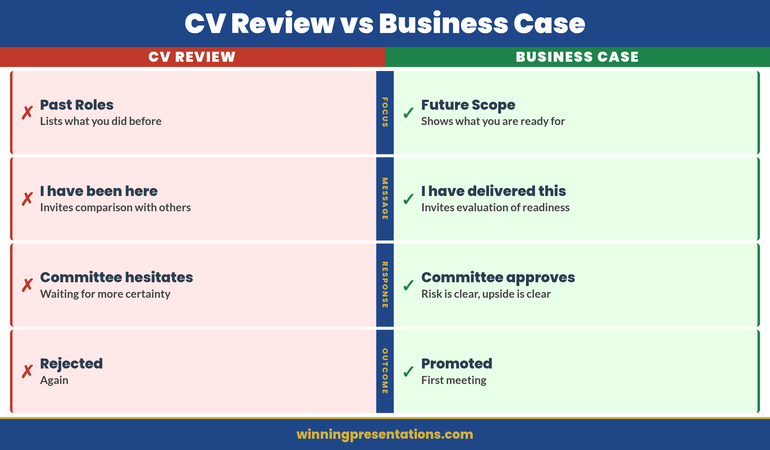
The promotion decision is not a comparison decision. It never should be. But a CV invites comparison. So does a narrative summary of what you’ve done. Here’s why:

CVs Are Backward-Looking

A CV lists past roles, responsibilities, and achievements. The implicit message is: β€œI’ve been here a long time doing this very well.” The committee hears: β€œAre they better than other candidates who’ve also been somewhere a long time?” Suddenly you’re in a comparison tournament. If another strong candidate is being considered, you both look similar. Hesitation sets in.

Business Cases Are Forward-Looking

A business case says: β€œHere’s what I’ve delivered in the current role. Here’s what I’m ready to deliver at the next level. Here’s what could go wrong if you wait. Let’s decide now.” The committee isn’t comparing you. They’re evaluating risk and opportunity. Very different mental frame.

CVs Invite Questions You Can’t Answer

A CV prompts the committee to ask: β€œIs this person leadership material? Are they visionary? Will they grow into the role?” These are judgment questions. You can’t answer them with facts. You can only hope the committee sees it the way you do.

Business Cases Answer Questions Before They’re Asked

A business case says: β€œI’ve already led projects of this scale. I’ve managed budgets of this size. I’ve handled this type of stakeholder complexity. I’ve closed this gap. Here’s the evidence.” No speculation. No hopes. No judgment requiredβ€”just an evaluation of readiness based on demonstrated scope.


CV Review vs Business Case comparison infographic contrasting backward-looking evaluation versus forward-looking scope demonstration across four dimensions (Focus, Message, Response, Outcome)

The Four Slides: Structure That Works

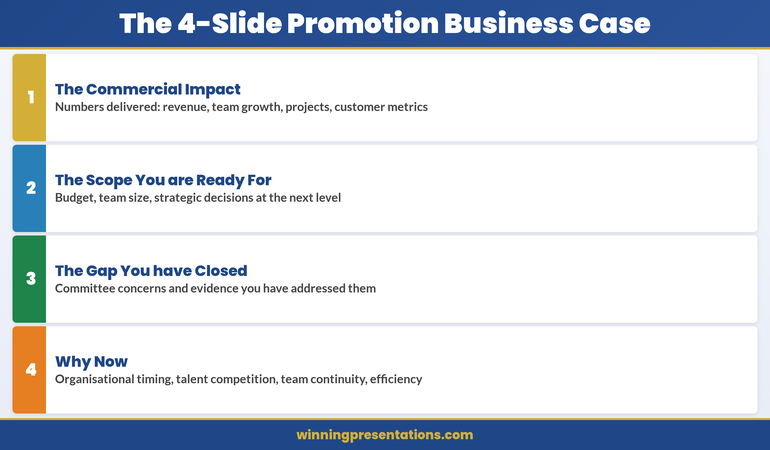
A promotion business case has exactly four slides. Not three (too little scope), not five (too much detail). Four slides answer four specific questions the committee is asking (whether they say it aloud or not):

  1. Slide 1 β€” Commercial Impact: What have you actually delivered? (Numbers only.)
  2. Slide 2 β€” Scope: What are you ready to lead? (Bigger picture.)
  3. Slide 3 β€” Gap: What did you need to learn? And have you learned it? (Addressing doubt.)
  4. Slide 4 β€” Why Now: What’s the cost of waiting? (Creating urgency.)

This structure works because it doesn’t ask the committee to evaluate you. It asks them to evaluate your readiness. Completely different exercise.

Promotion Committee This Month? Build the Business Case, Not the Narrative

If your committee meeting is coming up and you’re still working from a CV or a verbal narrative, the Executive Slide System gives you the exact four-slide business case structure to build instead. It includes:

  • The four-slide business case structure for promotion committees (commercial impact, scope, gaps closed, why now)
  • Worked examples showing how to quantify impact at executive level
  • Decision-slide frameworks designed for internal committee presentations
  • Templates ready to adapt to your organisation, role, and committee

Get the Executive Slide System β†’ Β£39

Informed by real-world executive presentation experience across investment banking, SaaS, and consulting β€” including internal promotion contexts.

Slide 1: The Commercial Impact You’ve Delivered

This slide answers: β€œWhat has this person actually delivered?” Not in prose. Not in a list of responsibilities. In numbers.

What Numbers Go Here?

Revenue driven. Cost reduced. Headcount managed. Projects completed on time or early. Customer retention improvement. Market share gained. Team size growth. Budget managed without overspend. Retention of top talent you’ve developed. Any metric that matters to your organisation’s financial or operational success.

If you’re in a function that doesn’t directly drive revenue (HR, Finance, Operations), quantify the impact you’ve had on the business that relies on you: β€œReduced hiring cycle time from 14 weeks to 7 weeks, enabling 40 critical hires in year two. Prevented Β£1.2M in turnover costs through culture initiatives.”

How Many Numbers?

Three to five numbers. No more. Each number should be large enough to be noteworthy and specific enough to be credible. β€œBig revenue” is vague. β€œΒ£2.1M in revenue from digital commerce initiatives, 180% year-on-year growth” is specific.

Present Them Minimally

One number per line. No paragraphs. No explanation. The slide is pure fact. The explanation comes in the presentation moment, face to face.

Example Slide 1 (Digital Leader, Retail Group):

  • Β£2.1M revenue from digital commerce initiatives (Year 1–2)
  • Team scaled from 4 to 11 people (net retention 94%)
  • 3 cross-functional projects delivered on time: Platform migration, Customer data integration, Omnichannel pricing
  • Average digital customer NPS: +28 points year-on-year

This slide doesn’t prove Claire deserves a promotion. It proves she’s already delivered at the scope of the role she wants.

Slide 2: The Scope You’re Ready For

This slide answers: β€œWhat would this person be responsible for at the next level?” Again, no narrative. Just scope.

What Scope Information Goes Here?

Team size. Budget responsibility. Revenue or P&L ownership. Number of stakeholders. Strategic decisions you’d make. Cross-functional responsibilities. Geographic scope. Customer base. Market segment. Anything that defines the size and scale of the role you’re applying for.

Make It Comparative

Show current scope and next-level scope side by side. β€œCurrently manage 11 people, Β£2.8M annual budget. Director role would manage 28–35 people, Β£7–9M annual budget, and P&L responsibility for three business units.” This makes the leap clear without being grandiose.

Example Slide 2 (Digital Director Role):

Dimension Current (Head of Digital) Next Level (Director)
Team size 11 28–35
Budget authority Β£2.8M (operational) Β£7–9M (P&L)
Strategic decisions Digital strategy execution P&L strategy, portfolio, resource allocation across 3 units
Stakeholder groups Marketing, IT, Finance, Operations Board, CEO, CFO, three business unit heads, external investors

The committee now sees that you’ve already led projects at 40–60% of the next-level scope. You’re not asking them to take a massive bet. You’re asking them to expand a proven track record.

Slide 3: The Gap You’ve Already Closed

This slide addresses the silent question every committee has: β€œWhat concerns do we have, and have they already been addressed?” Don’t wait for them to say it. Say it first.

What Gaps Commonly Come Up?

For first-time directors: β€œHave they managed a larger team?” or β€œHave they handled a serious people issue?” For cross-functional promotions: β€œDo they understand the P&L?” For external hires seeking rapid advancement: β€œDo they know our culture?” For technical leaders moving to management: β€œCan they lead non-technical people?”

Think back to feedback you’ve received. Think about what the next-level role requires that you haven’t yet formally held. That’s the gap.

Show the Evidence You’ve Already Closed It

Don’t say, β€œI’m ready to manage a larger team.” Say, β€œI’ve managed the Platform Migration project, which required me to coordinate 22 people across three departments for six months. Delivered on time, no overruns, 96% of team stayed post-project.”

Example Slide 3 (Digital Leader, potential gaps and evidence):

  • Gap: Can you handle P&L responsibility? β†’ Evidence: Managed Β£2.8M annual budget with zero overruns for two years. Drove cost negotiations that saved 18% vs. year one. Forecast accuracy 94%.
  • Gap: Can you lead at board level? β†’ Evidence: Presented quarterly business reviews to CFO and CEO for 18 months. Lead quarterly board updates on digital KPIs (8 presentations, zero rework requests).
  • Gap: Can you make the hard people decisions? β†’ Evidence: Led the reorganisation of the digital team (11 people, reallocation of three, one exit managed professionally). Retained 100% of high performers during restructuring.
  • Gap: Can you develop the next generation? β†’ Evidence: Promoted two team members to senior roles. One is now leading the platform team. 94% of team stayed, suggesting effective development and engagement.

The committee stops worrying about gaps. They start thinking about timing.


The 4-Slide Promotion Business Case structure infographic showing stacked cards: The Commercial Impact, The Scope You are Ready For, The Gap You have Closed, Why Now

Slide 4: Why Now

This is the most underrated slide. It answers: β€œWhy should we move now instead of waiting six months, a year, or until a formal opening exists?”

Reasons to Move Now

Organisational timing: β€œWe’re about to launch the omnichannel initiative. The role I’m being considered for will own it. Waiting six months means losing momentum and delaying revenue impact.”

Market competition: β€œTwo competitors have hired directors into similar roles in the last quarter. Talent in this space is moving fast. If we wait, the best people available now might not be available in six months.”

Risk of attrition: β€œI’ve had three conversations in the last two months about external opportunities. I’m not looking, but I’m being sought out. A decision now sends a clear signal about career progression in this organisation.”

Team stability: β€œIf this role opens formally, I’d be a candidate. So would external hires. A decision now avoids the chaos of a competitive internal process that could destabilise the team.”

Capability readiness: β€œI’ve deliberately taken on stretch assignments in the last 18 months to prepare for this role. I’m at peak readiness now. Waiting longer doesn’t add capabilityβ€”it just delays momentum.”

Frame It as Mutual Benefit, Not Threat

The worst version of Slide 4 is: β€œI have other offers, so decide now or lose me.” The best version is: β€œHere’s why moving now benefits the organisation more than waiting.” These are genuinely different messages.

Example Slide 4 (Digital Leader):

  • Organisational: Omnichannel strategy launch (Q2) requires director-level ownership. Director structure in place now ensures strategic alignment from day one.
  • Talent landscape: Digital director roles in retail are tight. Three director-level hires completed by competitors in the last quarter. First-mover advantage matters.
  • Team continuity: Current structure has been stable for 18 months. Promoting internally ensures zero transition risk and maintains momentum.
  • Cost: Internal promotion costs 60% less than external recruitment for this level.

The committee hears: β€œThis is smart business.” Not: β€œHurry or I leave.”

Unsure how to quantify your impact?

Many executives underestimate what they’ve delivered because they focus on activity instead of outcome. The Executive Slide System includes a metrics framework that walks you through finding and framing the numbers that matter most for your role.

Common Mistakes That Sink Promotion Cases

Mistake 1: Burying Impact in Narrative

You say: β€œI’ve managed several large projects, led a team through significant growth, and delivered strong results.”

The committee hears: β€œMaybe.”

Say instead: β€œΒ£2.1M revenue, team grew from 4 to 11, three projects on time.”

The committee hears: β€œClearly.”

Mistake 2: Confusing Current Scope With Next-Level Scope

You say: β€œAs director, I’d continue what I’m doing now, but at a larger scale.”

The committee worries: β€œSo you’d be doing the same job, bigger. Who develops the next generation of heads of function?”

Say instead: β€œCurrently I execute digital strategy. As director, I’d own digital strategy and P&L for three business units, allocate resources across portfolios, and report to the CEO quarterly.”

The committee hears: β€œYou’ve thought about the leap.”

Mistake 3: Ignoring the Gaps They’re Worried About

You present your four slides. The committee thinks: β€œWhat about P&L? Has she handled a board-level conversation? Can she manage a larger team?”

These worries sit silent. Unanswered. They become reasons to delay the decision.

Say it first. Show the evidence. Close the gap before they voice it. They can’t worry about something you’ve already addressed.

Mistake 4: Creating Urgency by Threat

You say: β€œI’ve had offers from other companies, so I need a decision by Friday.”

The committee hears: β€œYou’re a flight risk. If we promote you and you leave anyway, we’ve wasted time.”

Say instead: β€œThe omnichannel initiative launches in Q2. This director role needs to own that strategy from day one. A decision in March means we’re ready; a decision in May means we’re playing catch-up.”

The committee hears: β€œYou’re thinking about the business, not just yourself.”

Mistake 5: Not Presenting It as a Presentation

You email four slides with a cover letter to the committee.

The committee reads it in their calendar between two other emails. The four slides sit in isolation without context.

Insist on 15 minutes in the room. Present the four slides. Let them ask questions. The presentationβ€”your presence, your clarity, your composureβ€”is half the power. The slides are the other half.

When Your Manager’s Advocacy Isn’t Enough, the Business Case Has to Speak for Itself

Most candidates wait for their manager to make the case in the room. When the committee meets without you, your manager’s opinion becomes the only evidence. The Executive Slide System gives you the specific slide formats that shift the conversation from advocacy to documented impact β€” the promotion business case, the decision-slide structure, and the quantified impact framework.

Get access to: Promotion business case frameworks, decision-slide structures, and the exact formats for presenting quantified impact to senior committees.

Get the System β†’ Β£39

How to Present Your Four Slides

The four slides are useless if they sit in an inbox. They’re powerful if you present them in person, face to face, to the decision-making committee.

Book 15 Minutes

Not 30. Not 45. Fifteen. Long enough to present clearly. Short enough that it feels confident, not defensive. β€œI’d like 15 minutes with the promotion committee to walk through my business case for the director role.”

Start With the Rescue

Before the first slide, say: β€œI’m not here to ask you to compare me to other candidates. I’m here to show you why moving now is better for the business than waiting. I’ve organised this around four questions I know you’re asking: What have I delivered? What am I ready for? Have I closed the gaps you’re worried about? Why should we move now? Let’s walk through them.”

You’ve just told them the meeting won’t be self-aggrandising or political. It will be clear and business-focused. That’s the tone that wins.

Present Without Over-Explaining

Show Slide 1. Say: β€œHere’s what I’ve delivered in the current role. Four key metrics: revenue, team growth, projects, customer impact. Any questions?” Wait for them. Let them ask. Then move to the next slide.

You’re not performing. You’re having a business conversation. They’ll respect that.

End With Openness

After Slide 4, say: β€œThat’s the case. What questions do you have?” Sit down. Let them ask. Don’t keep talking. Silence here is not awkwardβ€”it’s them processing. Let them process.

When They Say They’ll Think About It

They will. Say: β€œI appreciate that. Is there anything you’d like me to clarify or any information I should get you before you decide?” This is not pushy. It’s professional. You’re saying: β€œI’ve made the case clearly. If there are gaps in the case, I want to fill them.”

Know Your Committee Before You Present

The four slides work, but only if you know who you’re presenting to. Before you schedule that 15-minute meeting, know:

  • Who has final say? (CEO, CFO, Board of people?)
  • What does each person care about most? (CFO cares about cost and P&L. CEO cares about strategy. Your boss cares about continuity.)
  • What concerns might each person have? (Frame Slide 3 to address each person’s specific concern.)
  • Have you worked with them before, or is this your first high-stakes interaction? (If it’s your first, prove you can handle board-level presence.)

Understanding your audience before you present is the foundation of every executive presentation. Your promotion business case is no exception.

Is This Right For You?

This four-slide business case approach is right for you if you can answer YES to at least two of these:

  • βœ“ You’ve been told β€œnot quite ready” before, and you want to change that conversation from judgment to business reality
  • βœ“ You’ve delivered measurable impact in your current role, but the committee doesn’t seem to see it
  • βœ“ You’re being considered for promotion but haven’t had the chance to present your case directly to the decision-makers
  • βœ“ You’re worried that without a structured argument, the committee will compare you to other candidates and hesitate

This approach is NOT right for you if:

  • βœ— You’re in a role where you haven’t yet delivered any measurable impact (in that case, focus on delivering first, then building the case)
  • βœ— The organisation doesn’t have formal promotion committees (in that case, the conversation is one-on-one, not structural)
  • βœ— You’ve already been told you’re promoted pending a formal announcement (you don’t need to persuade; you need to transition)

Frequently Asked Questions

Should I include these four slides in my official application, or present them separately?

Separate. Your official applicationβ€”CV, cover letter, formβ€”follows the organisation’s process. The four-slide business case is what you present to the decision-making committee after your application is accepted. It’s not a replacement. It’s the tool you use in the meeting to move from β€œmaybe” to β€œyes.”

What if I’m being promoted internally and the committee already knows my work?

They know your role. They might not know the quantified impact. Many executives don’t realise how much revenue their team drove or how many people they’ve successfully developed until they start looking for the numbers. Even if the committee knows you well, the numbers create clarity that relationships alone can’t. Show the slides anyway. It changes the conversation from β€œwe like working with you” to β€œyou’ve demonstrably delivered at the next level’s scope.”

What if I can’t quantify some of my impact?

Quantify what you can. For the rest, show evidence of scope. If you’ve managed a project that involved coordinating 20 people for six months, that’s scope, not a number. If you’ve led a cross-functional initiative that touched three departments, that’s scope. Numbers are better, but scope is credible too. Just make sure every slide has either a number or a significant scope indicator. Don’t leave a slide blank because you β€œdidn’t have numbers.”

Should I mention other job offers to create urgency?

No. Frame urgency around the business case (Slide 4) instead. β€œThe omnichannel initiative launches in Q2” is urgency. β€œI have another offer” is a threat. The committee might promote you, but you’ll start the role with a damaged relationship because they felt pressured. Use business urgency instead.

What’s Inside the Executive Slide System

The Executive Slide System gives you slide structures, templates, and decision frameworks for the executive presentation scenarios you face most often β€” including the promotion business case, the budget briefing, the governance reset, and the stakeholder presentation.

What you get:

  • Slide templates for 12 executive scenarios (including the complete four-slide promotion business case)
  • Decision-slide frameworks designed for committee presentations
  • Worked examples from real executive presentations (SaaS, consulting, financial services)
  • Pre-briefing strategy guides
  • One-time price: Β£39

Get the Executive Slide System β†’ Β£39

The Presentation Is Only the Beginning

The four slides win the committee’s approval. But that approval only happens if you’ve done the work before you walk into the room.

Build your case over weeks, not days. Collect the numbers. Run the projects. Develop the people. Close the gaps. The four slides are the summary of work you’ve already been doing. They’re not magic. They’re clarity.

When Claire walked into her fourth promotion committee meeting, the four slides weren’t new to her. She’d been building that case for 18 months through the projects she’d taken on, the metrics she’d tracked, the scope she’d deliberately expanded. The four slides just made it visible.

That’s when the committee saw what had been true all along: she was already ready.

Get weekly guidance on executive presentations

Every Monday, a short email with the presentation strategy that moves decisions. Join 2,400+ executives.

Subscribe to the Newsletter

πŸ†“ Free resource: Executive Presentation Checklist β€” a free guide to strengthen your presentation preparation.

Related: Why Your Evaluation Presentation Needs Structure

The same principle applies to technology evaluations and other high-stakes business decisions. The technology evaluation presentation that gets both IT and Finance to say yes follows a similar framework: show impact, define scope, prove readiness, create urgency. Different context, same structure.

About Mary Beth Hazeldine

Mary Beth spent 16 years in investment banking and corporate finance at RBS, where she made and lost pitches at every level. She’s sat in promotion committees. She’s submitted CVs and been rejected. She’s also seen what worksβ€”and what doesn’t. Now she helps executives build presentations that change decisions. She’s based in Edinburgh and works with leaders across SaaS, consulting, and financial services.

Your promotion business case doesn’t prove you deserve the role. It proves the organisation deserves the upside of moving you now.

27 Jan 2026
Professional woman having moment of realization at boardroom table while reviewing presentation on laptop

The Presentation Habit That’s Quietly Killing Your Career

She got the promotion. He had the better slides.

I watched this play out at JPMorgan Chase more times than I can count. The analyst with the comprehensive 40-slide deck passed over. The one with 12 slides and a clear recommendation? Fast-tracked to VP.

The difference wasn’t talent. It wasn’t data quality. It wasn’t even presentation confidence.

It was a single presentation career mistake that most professionals don’t even know they’re making β€” one that quietly signals to leadership: “This person isn’t ready.”

Quick Answer: The presentation habit killing most careers is building slides bottom-up (data β†’ analysis β†’ conclusion) instead of top-down (recommendation β†’ supporting evidence β†’ details if needed). Bottom-up signals you haven’t done the executive thinking. Top-down signals you’re ready for leadership.

πŸ“… Presenting This Week? Use This 6-Slide Structure:

  1. Slide 1: Your recommendation + the ask
  2. Slide 2: Stakes β€” why this matters now
  3. Slides 3–5: Three proof points (one per slide)
  4. Slide 6: Decision needed + next steps
  5. Appendix: All supporting detail (only if asked)

This structure works for board updates, steering committees, budget requests, and any decision-seeking presentation.

Want the complete structure with copy/paste templates?

Get the Executive Slide System β†’ Β£39

The Invisible Mistake Nobody Tells You About

In my 24 years in corporate banking β€” at JPMorgan Chase, PwC, Royal Bank of Scotland, and Commerzbank β€” I sat through thousands of presentations. And I noticed something that changed how I coach executives today.

The people who got promoted didn’t have better data. They didn’t have fancier slides. They didn’t even have more confidence.

They structured their presentations differently.

Specifically: they led with their recommendation. Not their process. Not their analysis. Not their methodology. Their conclusion β€” slide one.

Meanwhile, talented professionals with years of expertise were building decks the “logical” way: background, then analysis, then findings, then finally β€” on slide 37 β€” what they actually recommended.

And leadership tuned out long before they got there.

This is the presentation habit that’s quietly killing careers. It’s invisible because everyone does it. It feels right because it mirrors how we think. And nobody tells you it’s wrong because they’re doing it too.

Why This Happens (And Why It’s Not Your Fault)

You were trained to present bottom-up.

School taught you to show your work. University rewarded methodological rigour. Your first job praised thorough analysis.

So you build presentations the same way you build reports:

  • Start with context
  • Walk through the data
  • Explain your analysis
  • Finally, share your conclusion

This is bottom-up thinking. And it’s career poison in executive settings.

Here’s why: executives don’t have time to follow your journey. They need your destination β€” then they’ll decide if they want the map.

When you present bottom-up, you’re asking leadership to hold 15 minutes of context in their heads before they understand why it matters. Most won’t. They’ll check email, interrupt with questions, or mentally check out.

Then they’ll remember you as “the one who couldn’t get to the point.”

What presentation mistakes hurt your career?

The most damaging presentation mistake is structural, not cosmetic. Building presentations bottom-up (data first, conclusion last) signals to leadership that you haven’t done the executive thinking. It suggests you’re presenting your process rather than your judgement β€” which is exactly what leaders are evaluating when considering promotions.

What Executives Actually See When You Present

When you present bottom-up, executives don’t see thorough analysis.

They see someone who:

  • Can’t prioritise. If everything gets equal airtime, nothing is important.
  • Hasn’t formed a judgement. Walking through data without a clear recommendation suggests you want them to decide for you.
  • Doesn’t understand their time. Executives operate in 15-minute windows. Burying your point on slide 30 signals you don’t get that.
  • Isn’t ready for leadership. Leaders make recommendations. Analysts present data.

This is brutal, but it’s real.

I’ve sat in rooms where promotion decisions were made, and I’ve heard the exact words: “Great analyst, but not strategic enough yet.” What that often means: “Their presentations don’t lead with insight.”

Comparison showing bottom-up versus top-down presentation structure and how executives perceive each approach

Why do some presenters never get promoted?

Many talented professionals plateau because their presentation structure signals “analyst” rather than “leader.” They present their thinking process (how they got to the answer) instead of their strategic judgement (what should happen and why). This structural choice β€” often unconscious β€” shapes how leadership perceives their readiness for senior roles.

The Shift That Changes Everything

Top-down presentation structure is the opposite of how most people present β€” and exactly how executives think.

Bottom-up (what most people do):

  1. Background and context
  2. Methodology and approach
  3. Data and analysis
  4. Findings and insights
  5. Recommendation (finally)

Top-down (what gets you promoted):

  1. Recommendation and ask
  2. Key supporting points (3 maximum)
  3. Evidence for each point
  4. Appendix for details (if asked)

The shift feels uncomfortable at first. You’ll worry you’re not being thorough. You’ll feel exposed leading with your conclusion before you’ve “earned” it.

That discomfort? It’s the feeling of presenting like a leader.

If you’re finding that speaking confidently in meetings is also a challenge, the structure shift actually helps β€” when you know exactly what you’re arguing for, confidence follows.

⭐ Stop Signalling “Not Ready” β€” Start Presenting Like a Leader

The Executive Slide System gives you the exact structure that signals strategic thinking β€” built from 24 years in corporate banking and 15+ years coaching executives.

Includes:

  • Top-down slide structure template
  • Executive summary framework
  • Before/after transformation examples
  • Decision-slide formula

Get the Executive Slide System β†’ Β£39

Built for board updates, steering committees, and CFO decision meetings.

How to Fix This (Starting With Your Next Deck)

You don’t need to overhaul everything. You need to change your starting point.

Step 1: Write your recommendation before you open PowerPoint

One sentence. What do you want them to decide, approve, or do? If you can’t articulate this clearly, you’re not ready to build the deck.

Step 2: Identify your 3 supporting points

Not 7. Not 12. Three. If you have more, you haven’t prioritised. Executives remember threes.

Step 3: Build the deck backwards

Start with your recommendation slide. Then your three supporting points. Then evidence for each. Everything else goes in the appendix β€” where it belongs.

Step 4: Apply the “slide 1 test”

If an executive only saw your first slide and nothing else, would they understand what you’re asking for and why? If not, restructure.

This approach mirrors the Pyramid Principle that consulting firms like McKinsey have used for decades. It’s not new β€” but it’s rarely taught outside elite environments.

Want the exact templates to make this shift immediate?

Get the Executive Slide System β†’ Β£39

How do executives structure presentations differently?

Executives use top-down structure: recommendation first, supporting points second, evidence third, details in appendix. This approach respects the audience’s time, demonstrates strategic judgement, and signals leadership readiness. It’s the opposite of the bottom-up academic approach most professionals default to.

The 4-step process to fix presentation structure showing write recommendation first then identify 3 supporting points then build deck backwards then apply slide 1 test

⭐ Your Next Presentation Could Change How Leadership Sees You

One presentation with the right structure can shift perception faster than a year of good work. The Executive Slide System shows you exactly how.

What you’ll implement immediately:

  • The “recommendation-first” opening template
  • The 3-point evidence structure
  • The appendix strategy that shows depth without burying your point

Get the Executive Slide System β†’ Β£39

Based on real boardroom experience β€” not theory.

Is This Right For You?

This structural shift isn’t for everyone. Here’s how to know if it applies to you:

Qualification chart showing who the Executive Slide System is for and who it is not for

Recognised yourself in the “yes” column?

Get the Executive Slide System β†’ Β£39

The uncomfortable truth: if you’ve been presenting the same way for years without the career progress you expected, the structure is likely the issue. Not your data. Not your confidence. Your structure.

For more on building executive-grade presentation structure, see our complete guide to executive presentation structure.

⭐ Transform How Leadership Perceives You β€” Starting This Week

The Executive Slide System is the complete structure transformation I wish I’d had in my first decade in banking. It would have saved years of invisible career damage.

Inside:

  • The top-down structure template (copy/paste ready)
  • Real before/after examples from client transformations
  • The decision-slide formula that gets “yes”
  • Executive summary framework for any presentation type

Get the Executive Slide System β†’ Β£39

Built from 24 years in corporate banking + 15 years coaching executives on high-stakes presentations.

Frequently Asked Questions

Can one presentation habit really affect promotion decisions?

Yes. Promotion decisions often hinge on perceived “executive presence” and “strategic thinking” β€” both of which are heavily influenced by how you structure presentations. When you present bottom-up, you signal analyst-level thinking even if your content is brilliant. When you present top-down, you signal leadership readiness. I’ve seen this pattern repeatedly across 24 years in corporate banking.

How do I know if I’m making this mistake?

Open your last presentation. Look at slide 1. Does it state your recommendation and ask? Or does it say “Agenda,” “Background,” or “Overview”? If your conclusion appears after slide 10, you’re presenting bottom-up. If executives regularly interrupt you mid-presentation asking “what’s the bottom line?” β€” that’s another clear signal.

What if my company culture expects detailed, thorough slides?

You can still be thorough β€” just restructure the order. Lead with your recommendation, provide your three key supporting points, then include all the detail in an appendix. This approach gives executives what they need immediately while proving you’ve done the deep work. It’s not less thorough; it’s better organised.

How long does it take to change this habit?

The structural shift can happen with your very next presentation β€” it’s a framework change, not a skill that takes months to develop. The discomfort of leading with your recommendation typically fades after 2-3 presentations. Most professionals I’ve coached report noticeable changes in how leadership responds within their first month of using top-down structure.

Get Weekly Executive Presentation Insights

Actionable presentation strategies delivered every Tuesday β€” from someone who’s been in the room where decisions are made.

Subscribe to The Winning Edge β†’

Your Next Step

The presentation habit that’s killing careers is structural, not cosmetic. It’s invisible because it feels logical. And it’s fixable β€” starting with your next deck.

Write your recommendation before you open PowerPoint. Lead with your ask. Structure top-down.

One presentation built this way can shift how leadership perceives you more than a year of good work presented the wrong way.

For more on crafting the critical first slide, see our guide to the executive summary slide.

P.S. If anxiety is also affecting your presentations, I wrote about how to speak confidently in meetings even when anxious β€” the structure shift actually helps with confidence too.

About Mary Beth Hazeldine
Owner & Managing Director of Winning Presentations. 24 years in corporate banking at JPMorgan Chase, PwC, RBS, and Commerzbank. Qualified clinical hypnotherapist. I help executives transform their presentations from forgettable to career-defining.

22 Dec 2025
Presentation skills for meetings - how to speak up with confidence without rambling or freezing

Presentation Skills for Meetings: How to Speak Up Without Rambling, Freezing, or Being Ignored

The practical techniques that help you contribute confidently in meetings β€” from someone who spent 24 years in corporate banking

Most presentation skills advice assumes you’re standing at the front of a room with slides. But that’s not where most professionals struggle.

The real challenge is presentation skills for meetings β€” speaking up without rambling, contributing when all eyes turn to you unexpectedly, making your point when you haven’t prepared a deck.

I watched this play out hundreds of times during 24 years in banking. Smart people with good ideas who couldn’t land them in meetings. They’d either freeze, ramble, or get talked over β€” and wonder why they weren’t getting promoted.

The good news: these skills are learnable. Here’s what actually works.

🎁 Free Download: The Executive Presentation Checklist β€” works for formal presentations and high-stakes meetings.

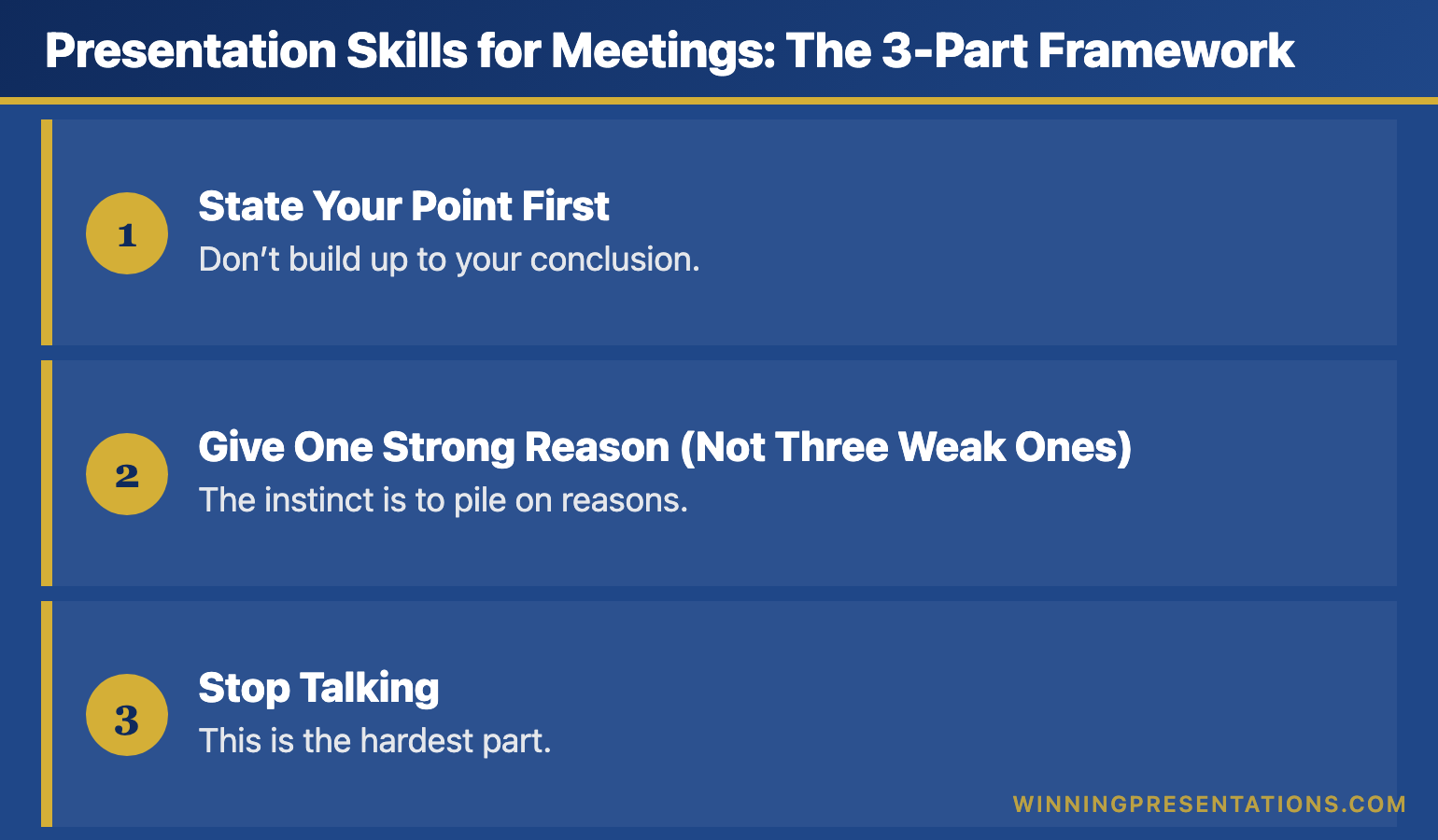
Presentation Skills for Meetings: The 3-Part Framework

When you’re asked to contribute β€” or when you want to jump in β€” most people fail because they start talking without knowing where they’re going.

Use this structure instead:

1. State Your Point First

Don’t build up to your conclusion. Start with it.

Instead of: “Well, I’ve been thinking about this, and there are a few factors to consider, and when you look at the data from last quarter…”

Say: “I think we should delay the launch by two weeks. Here’s why.”

This immediately tells everyone what you’re arguing for. They can listen to your reasoning with context instead of wondering where you’re heading.

2. Give One Strong Reason (Not Three Weak Ones)

The instinct is to pile on reasons. Resist it. More reasons often dilute your point rather than strengthen it.

Pick your single strongest reason and state it clearly. If someone asks for more, you can add. But lead with your best shot.

3. Stop Talking

This is the hardest part. When you’ve made your point, stop. Don’t backfill with “but I could be wrong” or “just a thought” or additional caveats that undermine what you just said.

Silence after your point isn’t awkward β€” it’s confident.

Related: Business Presentation Skills: What Actually Matters in Corporate Environments

Meeting Presentation Skills: Handling Being Put on the Spot

Someone asks you a question you weren’t expecting. All eyes turn to you. Your mind goes blank.

Here’s the recovery:

Step 1: Buy 3 seconds. “That’s a good question β€” let me think for a moment.” This is completely acceptable and looks thoughtful, not unprepared.

Step 2: Repeat the question back. “So you’re asking whether we should prioritise the US market first?” This confirms you understood and gives you more processing time.

Step 3: Give a partial answer if needed. “I don’t have the full picture, but my initial view is X. I can confirm the details by end of day.”

Saying “I don’t know, but I’ll find out” is infinitely better than rambling through a non-answer.

Related: How to Calm Nerves Before a Presentation

Want to Build These Skills Systematically?

AI-Enhanced Presentation Mastery covers meeting contributions, formal presentations, and handling tough Q&A β€” with live coaching and feedback.

Presale: Β£249Β (60 seats) β€” 8 modules Jan–April 2026.Β See the curriculum β†’

Three Meeting Presentation Mistakes That Kill Your Credibility

1. Thinking out loud. Processing your thoughts verbally might work with friends. In meetings, it sounds like you don’t know what you think. Do your thinking before you speak, even if it’s just 5 seconds of mental organisation.

2. Over-qualifying everything. “This might be wrong, but…” or “I’m not sure if this is relevant…” These phrases tell people to discount what comes next. If you’re not confident in your point, don’t make it. If you are, don’t undermine it.

3. Repeating what someone else said. Adding “I agree with Sarah” and then restating Sarah’s point adds nothing. Either add a new angle or stay quiet. Agreement without addition is just noise.

Related: How to Present Like a CEO

How to Prepare Your Presentation Skills Before Important Meetings

Most people prepare content. Better approach: prepare contributions.

Before any meeting where you might need to speak:

  • Identify 1-2 points you could make β€” even if you don’t use them
  • Anticipate 2-3 questions you might be asked β€” and sketch answers
  • Know your numbers β€” the specific data points relevant to your area

Five minutes of this preparation transforms your confidence. You’re not scripting β€” you’re priming your brain so you’re not starting from zero when called upon.

Related: Presentation Structure: 7 Frameworks That Actually Work

Frequently Asked Questions About Presentation Skills for Meetings

How do I interrupt without being rude?

Wait for a breath, then say the person’s name: “Sarahβ€”” and pause. They’ll stop. Then make your point quickly. Don’t apologise for interrupting; just add value.

What if I’m too junior to speak up?

You’re not. The question is whether you have something worth saying. If you have data, a question, or a perspective that hasn’t been raised, your seniority doesn’t matter. Just be concise and factual rather than opinionated.

How do I sound more confident than I feel?

Slow down, lower your pitch slightly, and eliminate filler words (um, like, kind of). These three changes have more impact than any mindset trick. Confidence is performed before it’s felt.


Your Next Step

Presentation skills for meetings improve fastest with a framework and practice. Start here:

πŸ“– Go deeper: Business Presentation Skills: What Actually Matters in Corporate Environments β€” the complete guide to the skills that get you promoted.

🎁 Get the checklist: Executive Presentation Checklist β€” free, works for meetings and formal presentations.

πŸŽ“ Build the skills: AI-Enhanced Presentation Mastery β€” 8 modules Jan–April 2026, presale Β£249, 60 seats.


Mary Beth Hazeldine spent 24 years in corporate banking at JPMorgan, PwC, Royal Bank of Scotland, and Commerzbank. She now trains professionals in the presentation skills that matter for career growth β€” including the ones you need in meetings, not just on stage.

22 Dec 2025
Business presentation skills guide - what actually matters in corporate environments from 24 years in banking

Business Presentation Skills: What Actually Matters in Corporate Environments (From 24 Years in Banking)

The presentation skills that get you noticed, promoted, and trusted β€” and the ones that don’t matter nearly as much as you think

[IMAGE: business-presentation-skills-corporate-guide.png]

Alt text: Business presentation skills guide – what actually matters in corporate environments from 24 years in banking

Most business presentation skills advice is written by people who’ve never sat through a 7am credit committee meeting where careers hang in the balance.

I have. For 24 years.

At JPMorgan, PwC, Royal Bank of Scotland, and Commerzbank, I watched hundreds of professionals present. Some got promoted. Some got ignored. Some got shown the door. The difference wasn’t charisma or confidence or “executive presence” β€” at least not in the way most training programs define it.

The difference was a specific set of business presentation skills that nobody explicitly teaches. Skills that matter when the CFO is checking her phone, when the board has 47 slides to get through before lunch, when your recommendation needs sign-off from people who’ve heard a hundred pitches this quarter.

This guide covers what I learned β€” and what I now teach to executives who need results, not applause.

🎁 Free Download: The Executive Presentation Checklist β€” the pre-presentation checklist I use with C-suite clients. 2 pages, printable.

Why Most Business Presentation Skills Training Misses the Point

Here’s what most presentation training focuses on:

  • Eye contact and body language
  • Voice projection and pacing
  • Slide design principles
  • How to “engage” your audience
  • Managing nervousness

These aren’t wrong. But they’re about 20% of what determines whether your presentation actually works in a corporate environment.

The other 80%? Nobody talks about it.

The skills that actually matter in business:

  • Knowing what to leave out
  • Reading the room before you’ve said a word
  • Structuring for decision-makers who won’t read your slides
  • Handling questions that are really objections
  • Recovering when things go sideways
  • Making the ask without apologising for it

I learned these the hard way. Five years as a terrified junior banker, presenting to credit committees and client meetings, watching what worked and what didn’t. Then 19 more years refining them. Now I train executives who don’t have five years to figure it out themselves.

Related: How to Create Executive Presentations That Get Results

The Business Presentation Skills That Actually Get You Promoted

Let me be specific. These are the skills I’ve seen separate people who advance from people who stall.

1. Structuring for Skimmers (Not Readers)

Here’s a truth nobody tells you: executives don’t read your slides. They skim. They jump to the recommendation. They flip to the financials. They look for the one number that matters.

Most presenters structure for narrative flow β€” “let me take you on a journey.” Corporate decision-makers don’t want journeys. They want answers.

What works instead:

  • Lead with your recommendation (not your process)
  • Put the “so what” in slide titles, not buried in bullets
  • Design every slide to be understood in 5 seconds if someone jumps to it
  • Include an executive summary that actually summarises

I once watched a brilliant analyst lose a promotion because his presentations required too much work to understand. His analysis was better than anyone else’s. But the partners couldn’t figure out what he was recommending without reading 40 slides. His colleague, with simpler analysis but clearer structure, got the nod.

Related: Presentation Structure: 7 Frameworks That Actually Work

2. Reading the Room Before You Start

The first 30 seconds of any business presentation should be spent reading, not speaking.

Who’s checking their phone? Who’s leaning back? Who asked to be here versus who was told to attend? Who’s the actual decision-maker versus the most senior person in the room? (Not always the same.)

I learned this at RBS during a client pitch. I’d prepared for the CFO, who was technically the decision-maker. But within 30 seconds, I could see the Head of Operations was the one everyone looked at before responding. I pivoted my entire presentation to address her concerns. We won the work.

If I’d stuck to my script, we’d have lost.

What to look for:

  • Who do people glance at before speaking?
  • Who’s taking notes versus who’s waiting for it to end?
  • What’s the energy in the room β€” rushed, sceptical, engaged, distracted?
  • Did something happen before you walked in that changed the dynamic?

This isn’t mystical. It’s pattern recognition. And it’s trainable.

3. Answering the Question Behind the Question

In business presentations, questions are rarely just questions. They’re concerns wearing a question’s clothing.

“How did you arrive at that number?” often means “I don’t trust that number.”

“What’s the timeline?” often means “This sounds like it’ll take forever.”

“Who else has done this?” often means “I’m nervous about being first.”

The skill isn’t answering the literal question. It’s identifying the concern underneath and addressing that.

Example from my banking days:

A board member asked, “What’s the competitive landscape?” The literal answer would have been a market overview. But I could tell from his tone he was really asking, “Are we too late?” So I answered that question: “We’re not first, but here’s why being second actually works in our favour…”

He nodded and moved on. If I’d given the literal answer, he’d have asked three more questions trying to get to what he actually wanted to know.

Related: How to Present Like a CEO: Executive Presentation Skills for Leadership

Business presentation skills that matter: structure for skimmers, read the room, answer the real question, know what to cut, make the ask

4. Knowing What to Cut

Every presentation is too long. Every single one.

The skill isn’t adding more content. It’s having the judgment to remove content that doesn’t serve your goal β€” even if it took you hours to create.

I’ve seen presentations fail because someone included every piece of analysis they did, rather than just the analysis that mattered. I’ve seen pitches lose momentum because the presenter couldn’t bear to cut their favourite slide.

The rule I use: If a slide doesn’t directly support your recommendation or answer a question someone will definitely ask, cut it. Move it to the appendix. Better yet, delete it entirely.

One of my clients β€” a biotech executive β€” had a 60-slide investor pitch. We cut it to 12. He was terrified. Then he raised Β£4.2 million. The investors told him it was the clearest pitch they’d seen all quarter.

Cutting isn’t about dumbing down. It’s about respecting your audience’s time and attention.

5. Making the Ask Without Apologising

This is where most business presentations fall apart.

You’ve done the analysis. You’ve built the case. You’ve handled the questions. And then, when it’s time to ask for what you want β€” the budget, the approval, the decision β€” you soften it.

“So maybe we could consider…”

“If you think it makes sense…”

“I was hoping we might…”

This kills more presentations than bad slides ever will.

The business presentation skill that separates senior people from junior people is the ability to make a clear ask without hedging, apologising, or leaving room for ambiguity.

What works:

“I’m recommending we approve the Β£2.3 million budget for Q2 implementation. I need your sign-off today to hit the timeline.”

What doesn’t:

“So that’s the proposal. Let me know what you think, and maybe we can discuss next steps when you have time?”

The first one might get a no. But at least you’ll know where you stand. The second one gets a “let’s circle back” β€” which is a no that wastes another three weeks.

Want Slides That Match These Skills?

The Executive Slide System gives you templates and frameworks for the business presentations that matter β€” board updates, budget requests, strategic recommendations.

What’s included:

  • 12 executive slide templates (PowerPoint/Google Slides)
  • The CFO-approved budget request format
  • Board presentation structure guide
  • Before/after examples from real clients

Β£39 β€” Get the Executive Slide System β†’

The Business Presentation Skills That Don’t Matter as Much as You Think

Controversial opinion: some “essential” presentation skills are overrated in corporate settings.

Perfect Delivery

I’ve seen people with mediocre delivery get promoted because their thinking was sound. I’ve seen polished presenters get ignored because their content was empty.

In business, clarity beats charisma. Every time.

That doesn’t mean delivery doesn’t matter. But if you’re spending 80% of your prep time on how you’ll say things and 20% on what you’ll say, you’ve got it backwards.

“Engaging” Your Audience

Most advice about audience engagement assumes you’re giving a keynote or a TED talk. In a corporate setting, your audience doesn’t want to be engaged. They want to make a decision and get on with their day.

Don’t ask rhetorical questions. Don’t pause for dramatic effect. Don’t try to make them laugh. Just be clear, be direct, and be done.

The most “engaging” thing you can do in a business presentation is respect their time by finishing early.

Memorising Your Script

Memorised presentations sound memorised. And in business settings, they fall apart the moment someone asks a question that takes you off script.

What works better: knowing your material so well that you could present it in any order, answer any question, and still hit your key points. That’s different from memorisation. It’s internalisation.

How to Develop Business Presentation Skills (A Realistic Framework)

Most people try to improve their business presentation skills by:

  1. Reading a book
  2. Maybe attending a workshop
  3. Going back to presenting exactly the same way

That doesn’t work. Here’s what does.

Step 1: Get Honest Feedback on One Specific Thing

Not “how was my presentation?” β€” that gets you vague reassurance.

Ask: “Did you know what I was recommending within the first two minutes?” or “Was there a point where you got lost?” or “What would you cut?”

Specific questions get useful answers.

Step 2: Watch People Who Are Good at This

Not TED talks. Not keynote speakers. Watch people in your organisation who consistently get buy-in. Notice what they do:

  • How do they structure?
  • How do they handle pushback?
  • How do they make the ask?
  • What don’t they do that you expected them to?

The patterns will emerge.

Step 3: Practice the Hard Parts, Not the Easy Parts

Most people practice their opening (easy) and ignore their Q&A (hard). They rehearse their slides (easy) and wing their recommendation (hard).

Flip it. Spend your practice time on:

  • Answering the three toughest questions you might get
  • Making your ask clearly and without hedging
  • Explaining your recommendation without slides

If you can do those three things well, the rest takes care of itself.

Related: Why Most Presentation Skills Training Fails (And What Actually Works)

The Business Presentation Skills Gap Nobody Talks About

Here’s something I’ve observed across 24 years and thousands of presentations: there’s a specific gap between “competent presenter” and “presenter who gets results.”

Competent presenters can:

  • Create reasonable slides
  • Speak clearly
  • Answer basic questions
  • Get through their material

Presenters who get results can do all that, plus:

  • Adapt in real-time based on room dynamics
  • Make complex recommendations feel simple
  • Handle hostile questions without getting defensive
  • Close with a clear ask that gets a clear answer

That gap is where careers accelerate or plateau. And most presentation training never addresses it.

Close the Gap Over 4 Months

AI-Enhanced Presentation Mastery is my course for professionals who want to level up their business presentation skills β€” with proven frameworks, AI tools to cut prep time, and live coaching.

8 self-paced modules (January–April 2026):

  • The AVP Framework: Structure that guides audiences to yes
  • The S.E.E. Formula: Messaging that resonates and drives action
  • Your AI Playbook: Customised prompts that save 10+ hours weekly
  • Data Storytelling: Turn numbers into narratives that guide decisions
  • 2 live coaching sessions in April with personalised feedback
  • Master Prompt Pack, templates, and lifetime access

Presale price: Β£249 (increases to Β£299, then Β£499)

60 seats total.

See the full curriculum β†’

Frequently Asked Questions About Business Presentation Skills

What’s the most important business presentation skill?

Clarity. The ability to make your point understandable in 30 seconds, even if your supporting material takes 30 minutes. If someone asks “what’s the bottom line?” and you can’t answer in one sentence, you’re not ready to present.

How do I improve my business presentation skills quickly?

Focus on structure first. Most presentation problems are structure problems in disguise. Use a proven framework (Situation-Complication-Resolution, Problem-Solution-Benefit, or the Pyramid Principle), lead with your recommendation, and cut anything that doesn’t directly support your ask. You’ll see improvement immediately.

How do I handle nervousness in business presentations?

Preparation beats breathing exercises. When you know your material cold β€” especially your recommendation, your key numbers, and your answers to likely questions β€” nervousness drops naturally. The remaining nervousness actually helps; it keeps you sharp. Don’t try to eliminate it entirely.

What’s the difference between presenting to executives vs. regular meetings?

Executives have less time, more context, and higher expectations for directness. Lead with the ask, not the background. Assume they’ve read nothing. Be ready to present your entire recommendation in 60 seconds if they cut you off. And don’t fill silence β€” if they’re thinking, let them think.

How long should a business presentation be?

Shorter than you think. In my experience, the right length is about 60% of the time slot you’ve been given. If you have 30 minutes, prepare for 18-20 minutes of presenting and 10-12 minutes for questions. If you finish early, everyone’s happy. If you run over, you’ve failed before you’ve even made your ask.


Your Next Step: Build Business Presentation Skills That Get Results

You’ve just read what most presentation training won’t tell you. But knowing isn’t the same as doing.

Choose your path:

🎁 START FREE: Download the Executive Presentation Checklist β€” a pre-presentation checklist for high-stakes business presentations.

πŸ“˜ GET THE TEMPLATES (Β£39): The Executive Slide System gives you the slide structures that work in corporate environments β€” board presentations, budget requests, strategic recommendations.

πŸŽ“ BUILD THE SKILLS (Β£249): Join AI-Enhanced Presentation Mastery β€” 8 modules over 4 months with frameworks, AI tools, and live coaching to close the gap between competent and compelling. January cohort, 60 seats, early bird ends December 31st.

Business presentation skills compound. Every presentation you give is practice for the next one. The question is whether you’re practising the right things.


Mary Beth Hazeldine spent 24 years in corporate banking at JPMorgan, PwC, Royal Bank of Scotland, and Commerzbank before founding Winning Presentations. She’s trained over 5,000 executives in the presentation skills that actually matter in corporate environments β€” the ones that get budgets approved, deals closed, and careers advanced.