

Contract Renewal Presentation: The Slide Structure That Converts Renewals Into Upsells
Quick Answer
A contract renewal presentation succeeds when it reframes the conversation from “should we continue?” to “what should we do next together?” The structure should demonstrate accumulated value the client would lose by switching, introduce a forward-looking partnership vision, and position the commercial terms as details that follow a strategic decision — not the decision itself.
In this article
- The switching-cost mistake that loses winnable renewals
- The four-section renewal framework
- Building the accumulated value slide that makes switching feel expensive
- How to introduce expansion without sounding like a sales pitch
- Handling procurement pressure during renewal conversations
- Frequently asked questions
Daniel had been told the renewal was “straightforward.” The client was happy. The relationship was strong. His sponsor had said — twice — that there was “no reason to go to market.”
Then procurement got involved.
Within two weeks, what had been a formality turned into a competitive process. Two alternative vendors were invited to present. Daniel’s renewal presentation — a summary of delivery highlights and proposed pricing for the next term — was suddenly being compared against fresh pitches from competitors who had nothing to defend and everything to promise.
Daniel lost the contract. Not because his team had underperformed, but because his renewal presentation looked backward while the competitors’ pitches looked forward. His slides proved what he had done. Their slides showed what the client could become. By the time procurement made its recommendation, the decision was about future value, not past performance — and Daniel’s deck had nothing to say about the future.
Presenting a contract renewal to a client this quarter?
Before you build another backward-looking performance summary, check whether your deck answers the one question procurement will ask: why is continuing with you more valuable than starting with someone new? Quick pressure test:
- Does your opening slide demonstrate accumulated value the client would lose by switching?
- Does your proposal include a forward vision that competitors cannot replicate?
- Is the renewal positioned as a strategic decision, not a procurement transaction?
The Switching-Cost Mistake That Loses Winnable Renewals
Most renewal presentations make the same structural error: they present renewal as a continuation of the current arrangement rather than an investment in future outcomes. This framing hands the initiative to procurement, whose job is to evaluate whether the same outcomes could be achieved at a lower price with a different vendor.
When your renewal deck is a performance summary followed by pricing, you are implicitly telling the client that the value proposition is the same as it was when the original contract was signed. You are asking them to pay the same amount (or more) for something they already have. From procurement’s perspective, this is an invitation to negotiate — or to benchmark against alternatives.
The vendors who win against incumbents in renewal situations rarely win on capability. They win on narrative. Their pitch decks show a trajectory — where the client is now, where they could be, and how the partnership will get them there. The incumbent’s deck shows a flat line: here is what we did, here is the price to keep doing it. Trajectory beats flat line in almost every competitive evaluation.
The fix is to treat a renewal deck the way you would treat a new business pitch — but with one advantage your competitors cannot replicate. You have institutional knowledge, established relationships, embedded processes, and a demonstrated delivery history. These are switching costs that make your partnership more valuable over time, not less. But they only work in your favour if you make them visible in the deck.

The Four-Section Renewal Framework
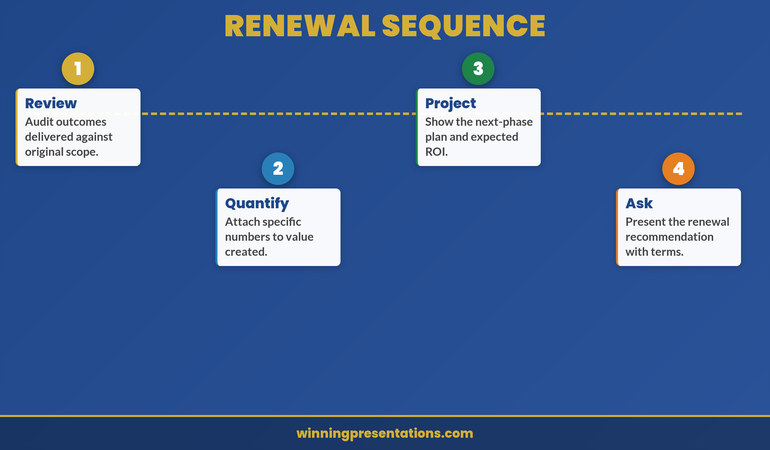
A renewal presentation that protects and grows revenue follows four sections, each designed to address a different stakeholder concern in the room. Your sponsor needs ammunition to justify the renewal internally. The business owner needs confidence that the partnership will evolve with their priorities. Procurement needs evidence that the commercial terms represent fair value. And the executive sponsor — if one is present — needs a thirty-second summary they can endorse without reading the detail.
Section 1: Accumulated Value (2-3 slides). This is not a performance summary. It is a quantification of what the client would lose by switching vendors. Accumulated value includes institutional knowledge, embedded processes, trained teams, integrated systems, and relationship capital. Frame it as investment already made — investment that would need to be repeated from scratch with a new vendor. “Your team has invested 400 hours training alongside our consultants to build the operating model that reduced cycle time by 23 per cent. A new vendor would restart that investment from zero.”
Section 2: Forward Vision (3-4 slides). Present a partnership roadmap that connects to the client’s strategic priorities for the next twelve to twenty-four months. This section differentiates you from competitors because you can ground your forward vision in specific knowledge of the client’s organisation, challenges, and aspirations. A competitor’s forward vision is generic; yours can be precise. Use that advantage.
Section 3: Partnership Evolution (2 slides). Show how the relationship will deepen or expand in the next contract term. This is where upsell opportunities live, but they should be framed as natural extensions of established capability, not additional line items. “Building on the European operating model to support your planned APAC expansion” is evolution. “Adding APAC coverage as an optional add-on” is a price list.
Section 4: Commercial Framework (1 slide). Keep the commercial terms to a single slide that references the strategic value demonstrated in sections one through three. The pricing should feel like a detail that follows a strategic decision, not the centrepiece of a negotiation. If the first three sections have done their work, the commercial discussion becomes shorter and less adversarial.
Need to Win a Contract Renewal Against Competitors?
Incumbents lose renewals when their decks look backward while competitors look forward. The Executive Slide System — £39, instant access — gives you the slide frameworks designed for high-stakes client conversations:
- Slide templates for client renewal and expansion presentations
- AI prompt cards to structure accumulated value and switching cost arguments
- Executive summary frameworks for partnership roadmap proposals
- Scenario playbooks for competitive renewal situations
Get the Executive Slide System → £39
Designed for account directors and client managers defending and growing key accounts.
Building the Accumulated Value Slide That Makes Switching Feel Expensive
The accumulated value slide is the most important slide in a renewal presentation because it reframes the decision from “should we renew?” to “can we afford not to?” Most vendors skip this slide entirely, moving straight from performance metrics to pricing. That is a missed opportunity to make the switching cost tangible.
Accumulated value falls into five categories, and your slide should reference at least three:
Institutional knowledge. Your team understands the client’s organisation, politics, processes, and unwritten rules. A new vendor would need six to twelve months to develop the same understanding — during which productivity drops and mistakes increase.
Embedded processes. Your systems, workflows, and reporting structures are integrated into the client’s operations. Replacing them requires migration, retraining, and parallel running — all of which consume the client’s time and budget.
Relationship capital. Your team has built trusted relationships with stakeholders across the client’s organisation. Those relationships enable faster decision-making, smoother escalation, and more effective collaboration. They cannot be replicated by a new vendor’s “dedicated account team” promise.
Risk reduction. The current partnership is a known quantity. A new vendor is an unknown — and unknowns carry risk. Frame the stability of the existing relationship as a risk management advantage, especially for clients in regulated industries or critical operational environments.
Momentum. You are mid-stream on initiatives that are delivering results. Switching vendors means pausing or restarting those initiatives, delaying the outcomes the client’s leadership is expecting. Quantify the delay: “Transitioning to a new vendor would set the APAC rollout back by an estimated four to six months.”
If you are building a contract renewal deck this quarter, the Executive Slide System (£39) includes the frameworks to structure these accumulated value arguments — so your renewal presentation makes switching feel like the expensive option.
How to Introduce Expansion Without Sounding Like a Sales Pitch
The renewal meeting is the best time to introduce expansion — and the worst time to make it feel like a sales pitch. The line between “strategic partnership discussion” and “upsell attempt” is thin, and most account teams cross it by leading with what they want to sell rather than what the client wants to solve.
The approach that works is to anchor every expansion suggestion to a client priority that has already been discussed. If the client mentioned APAC expansion in a previous QBR, propose support for that expansion. If they are dealing with regulatory changes, propose compliance support. If they are under cost pressure, propose efficiency improvements that reduce their total spend while increasing your scope.
Frame each expansion item as a natural evolution: “Based on what we have built together in Europe, we could extend the same model to support your APAC operations as they scale.” This language positions expansion as continuity, not addition. The client hears “more of what is already working” rather than “more things to buy.”
Limit expansion proposals to two or three items. More than that and the presentation starts to feel like a product catalogue. Each item should include a clear connection to a client priority, a brief description of what it involves, and a reference to existing work that proves you can deliver it. Pricing details belong in a follow-up document, not in the renewal presentation itself.
For a deeper framework on positioning additional services within existing client relationships, see our guide to structuring upsell presentations that grow accounts without damaging trust.
Handling Procurement Pressure During Renewal Conversations
Procurement’s role in a renewal is to ensure the client gets fair value. That objective is legitimate, and resisting it makes you look defensive. The better strategy is to redefine what “fair value” means before procurement applies its own definition — which is usually “same service, lower price.”
When procurement enters the renewal conversation, the frame shifts from strategic value to commercial comparison. Your job is to keep both frames active. Acknowledge the commercial comparison, but ensure the strategic value is visible in every document procurement receives. If the only material procurement has is your pricing proposal, they will evaluate you on price alone. If they also have your accumulated value summary and forward partnership vision, they have to factor those into their recommendation.
Three tactics for managing procurement involvement:
Provide procurement with your value narrative, not just your pricing. Send the accumulated value summary and forward vision slides as part of your commercial submission. This gives the procurement team context they can include in their evaluation report — and it ensures the decision-makers see your strategic argument even if they were not in the room for the presentation.
Quantify the cost of switching. Procurement evaluates alternatives on like-for-like cost. If you can demonstrate that switching involves transition costs, productivity losses, and delayed initiatives, the like-for-like comparison becomes less favourable for competitors. Make these costs specific and credible.
Separate the strategic conversation from the commercial one. Present your renewal vision to the business stakeholders first, then engage procurement on commercial terms. This sequence ensures the business stakeholders have already endorsed the strategic value before procurement starts negotiating price. A procurement team is less likely to recommend switching when the business has already signalled its preference to continue.
Turn Your Next Renewal Into a Multi-Year Commitment
The Executive Slide System — £39, instant access — gives you the renewal and client presentation frameworks that turn routine contract conversations into strategic partnership discussions. Stop letting procurement reduce your relationship to a price comparison.
Get the Executive Slide System → £39
Designed for account directors and client managers defending key accounts.
Frequently Asked Questions
When should I start preparing a renewal presentation?
Begin preparation three to four months before the contract expiry date — not three to four weeks. This gives you time to gather outcome data, build the accumulated value narrative, and engage your sponsor before procurement enters the process. Early preparation also allows you to position the renewal as a strategic conversation rather than a transactional one. If procurement has already launched a competitive process, your structural advantage as the incumbent is significantly reduced.
Should I include pricing in a contract renewal presentation?
Include pricing only as a single summary slide at the end, and only if you are presenting to a combined strategic and commercial audience. If the audience is primarily business stakeholders, keep pricing out of the deck entirely and address it in a separate commercial document. The goal of the renewal presentation is to establish strategic value. Once value is established, the commercial conversation happens in a different context — ideally one where the business stakeholders have already endorsed continuation.
How do I handle a client who wants to benchmark us against competitors?
Accept the benchmarking process gracefully — resisting it signals that you are not confident in your value proposition. Then ensure the benchmarking criteria include factors that favour incumbents: transition risk, accumulated knowledge, embedded processes, and relationship capital. Provide procurement with a switching cost analysis alongside your commercial proposal. Competitors can match your pricing, but they cannot replicate your institutional knowledge or eliminate the transition risk. Make those factors part of the evaluation, not just the price.
The Winning Edge — Weekly Presentation Intelligence
Every Thursday, I share one framework, one real-world example, and one practical technique drawn from 24 years of presenting in boardrooms across three continents. Join The Winning Edge newsletter →
Not ready for the full system? Start here instead: download the free Executive Presentation Checklist — a one-page reference covering the structure, opening, and critical elements every client-facing presentation needs.
If you are preparing for a quarterly client review before the renewal conversation, see our guide to structuring quarterly business review presentations that demonstrate value and set the stage for renewal.
About the Author
Mary Beth Hazeldine is the Owner & Managing Director of Winning Presentations. With 24 years of corporate banking experience at JPMorgan Chase, PwC, Royal Bank of Scotland, and Commerzbank, she advises executives across financial services, healthcare, technology, and government on structuring presentations for high-stakes funding rounds and approvals.