Quick answer: If you’re experiencing fear of public speaking at work with a presentation tomorrow, the next 24 hours matter more than you think. What you do today—not what you did last week—determines whether you walk in nervous or confident. The day-before protocol: lock your content by noon, do one physical run-through, prepare for three questions, stop rehearsing by 8pm, and protect your sleep. This sequence has helped executives manage presentation fear for over 15 years.
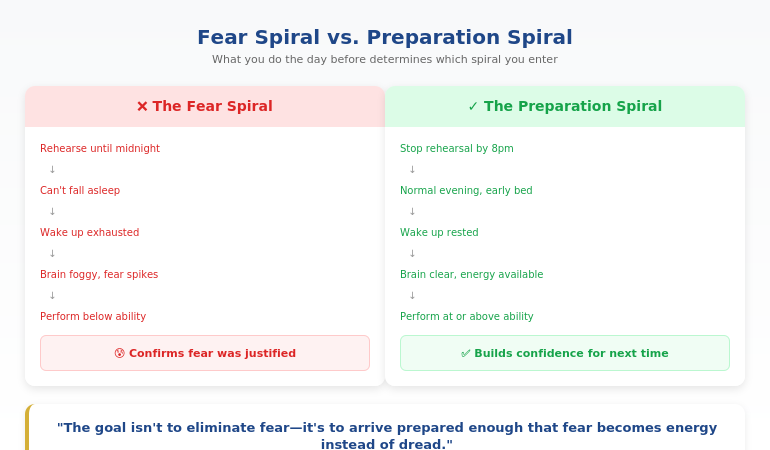
The goal isn’t to eliminate fear. It’s to arrive prepared enough that fear becomes useful energy instead of paralysing dread.
⚡ Presentation tomorrow? Here’s your day-before protocol:
By noon: Lock your content. No more edits after this.
Afternoon: One full run-through standing up, out loud
Before dinner: Write down 3 questions you might get. Prepare answers.
By 8pm: Stop all rehearsal. Your brain needs processing time.
Evening: Normal routine. Early bed. No alcohol.
If you’re presenting in the next 48 hours, follow this protocol exactly.
In this article:
The Night Before That Changed Everything
I spent five years terrified of presenting at work. Not just nervous—terrified. The kind of fear that kept me awake the night before, made me nauseous in the morning, and had me rehearsing obsessively until minutes before I had to speak.
The turning point came when I had a board presentation I couldn’t escape. I’d tried everything: more preparation, positive thinking, even beta blockers. Nothing worked.
Then a mentor gave me advice that seemed wrong: “Stop preparing by 8pm. Go to bed early. Trust that you know enough.”
I didn’t believe her. But I was desperate. I followed her protocol exactly.
The next morning, something was different. I wasn’t calm—but I wasn’t paralysed either. The fear was still there, but it felt like energy instead of dread. I delivered that presentation better than any before it.
That day-before protocol became the foundation of everything I now teach about managing fear of public speaking at work.
⭐ Transform Your Presentation Fear Into Confidence
Get the complete system for managing speaking anxiety at work—from the day-before protocol to in-the-moment techniques that actually work.
Inside Conquer Speaking Fear:
- The day-before protocol (expanded with timing)
- Morning-of nervous system reset techniques
- What to do when fear spikes mid-presentation
- Long-term confidence building exercises
Get Conquer Speaking Fear → £39
Created by a clinical hypnotherapist who personally overcame 5 years of presentation terror. Refined through 15+ years coaching executives in high-stakes workplace presentations.
Why the Day Before Matters More Than You Think
Most people with fear of public speaking at work focus on the wrong timeframe. They think confidence comes from weeks of preparation or years of practice.
It doesn’t. Confidence comes from arriving rested, prepared enough, and not over-rehearsed.
Here’s what actually happens in your brain the day before a presentation:
Your brain is consolidating. Everything you’ve prepared needs time to move from active memory to accessible memory. This happens during sleep and during breaks from rehearsal. When you rehearse until midnight, you’re actually interfering with this process.
Your nervous system is calibrating. The activities you do the day before set your baseline for the next morning. If you spend the evening anxious and rehearsing, you’ll wake up with elevated cortisol. If you spend the evening calm and confident, you’ll wake up closer to that state.
Your fear is looking for evidence. Anxiety makes you hyper-aware of anything that confirms your fear. The day before, your brain is scanning for signs that tomorrow will go badly. What you focus on expands.
This is why the day-before protocol works. It’s not about positive thinking—it’s about giving your brain and nervous system what they need to function well under pressure.
For deeper techniques on calming your nervous system, see the complete guide to calming nerves before a presentation.
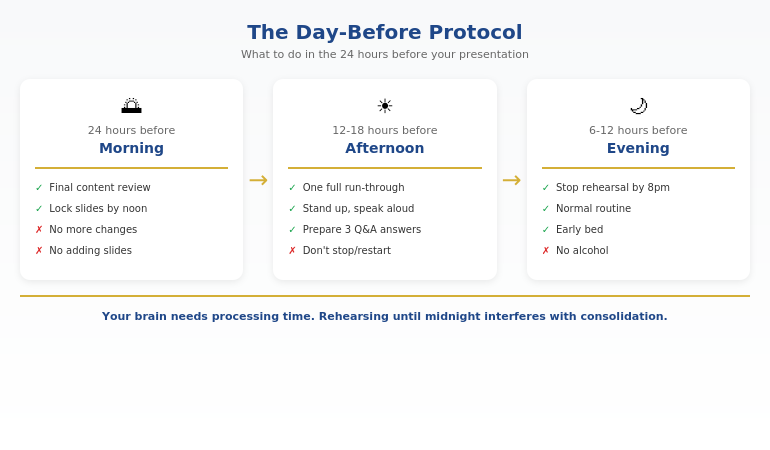
The Day-Before Protocol (Hour by Hour)
Morning (24 hours before):
Do your final content review. Make any last edits to slides or notes. But set a hard deadline: no changes after noon. The urge to keep tweaking is anxiety disguised as productivity. It doesn’t help—it keeps you in “preparation mode” instead of letting you shift to “ready mode.”
If you find yourself wanting to add slides or change your structure, resist. You know enough. More content won’t make you feel more confident—it will make you feel more overwhelmed.
Afternoon (12-18 hours before):
Do one complete run-through. Stand up. Speak out loud. Time yourself if the presentation has a time limit. Don’t stop and restart—go all the way through, mistakes and all.
This isn’t about perfecting your delivery. It’s about proving to your brain that you can get through the whole thing. One complete run-through does more for confidence than ten interrupted rehearsals.
After the run-through, write down three questions you might be asked. For each one, prepare a 30-second answer. Not scripted—just the key points you’d hit. This removes the fear of “what if they ask something I can’t answer.”
Evening (6-12 hours before):
Stop all rehearsal by 8pm. This feels wrong when you’re anxious. Your brain will tell you that more practice equals more safety. It’s lying.
What your brain actually needs is processing time. The material you’ve prepared needs to consolidate. Rehearsing until midnight prevents this and guarantees you’ll feel foggy tomorrow.
Do your normal evening routine. Watch something easy. Talk to someone about anything except the presentation. Go to bed at your usual time or slightly earlier. No alcohol—it disrupts sleep architecture and you’ll wake up groggier.
Want the complete day-before system? Conquer Speaking Fear includes the expanded protocol plus techniques for when anxiety spikes anyway. See what’s included →
The 3 Mistakes That Make Fear Worse
Most advice about fear of public speaking at work focuses on what to do. But avoiding what makes fear worse is equally important.
Mistake 1: Rehearsing until you “feel ready”
You will never feel ready. That’s not how anxiety works. Anxious people don’t rehearse until they feel confident—they rehearse until they’re exhausted and the presentation happens anyway.
The feeling of readiness doesn’t come from more rehearsal. It comes from deciding you’ve prepared enough and trusting that decision. Set a cutoff time and honour it.
Mistake 2: Trying to eliminate the fear
Fear before a work presentation is normal. Trying to make it disappear completely is a losing battle that makes you feel worse when it doesn’t work.
The goal is to be functional with the fear, not fearless. Some of the best presenters I’ve trained still feel nervous before every presentation. They’ve just learned that the fear doesn’t predict failure.
Mistake 3: Running through worst-case scenarios
Your brain thinks this is protective. “If I imagine everything that could go wrong, I’ll be prepared for it.” But what actually happens is you rehearse failure instead of success.
Every time you visualise blanking, stumbling, or being judged, you’re training your brain to expect that outcome. Visualisation works—which is exactly why negative visualisation is so damaging.
If you notice yourself running worst-case scenarios, redirect to “good enough” scenarios instead. Not perfect—just adequate. “I’ll get through it. Some parts will be better than others. I’ll handle the questions.”
⭐ Break the Fear Spiral Before Your Next Presentation
Learn the techniques that transform presentation dread into manageable nerves—and eventually, into confidence you can rely on.
What you’ll learn:
- How to stop the mental rehearsal of failure
- The nervous system reset that works in 60 seconds
- What to do when fear spikes mid-presentation
- Building long-term speaking confidence
Get Conquer Speaking Fear → £39
Instant download. Use the techniques before your next presentation.
This pays for itself the first time you present without the paralysing dread.
What to Do the Morning Of
If you’ve followed the day-before protocol, you’ll wake up in better shape than usual. But the morning still matters.
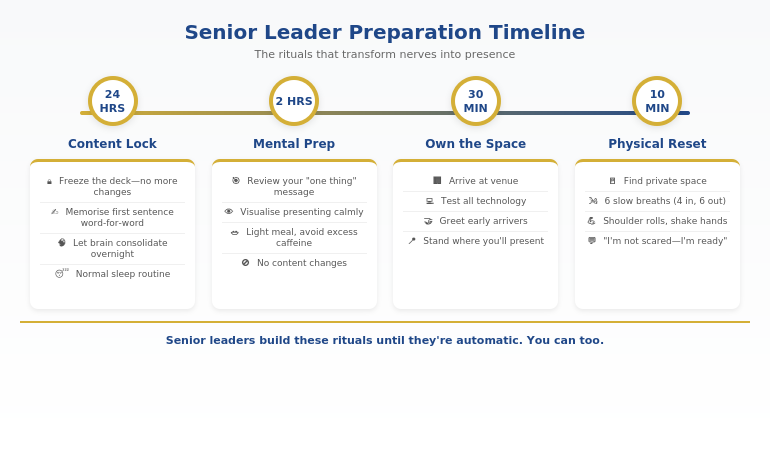
First 30 minutes:
Don’t check your slides immediately. Your brain needs time to wake up before diving into work mode. Do your normal morning routine first.
When you feel yourself starting to worry, notice it without fighting it. “There’s the worry. That’s normal.” Fighting anxiety makes it stronger. Acknowledging it lets it pass.
1-2 hours before:
Do a brief review of your opening and closing. These are the parts that matter most and that people remember. Don’t rehearse the whole thing again—just remind yourself how you’ll start and how you’ll end.
If you have backup slides or notes, make sure they’re accessible. Knowing you have a safety net reduces anxiety even if you never use it.
30 minutes before:
Do the physiological reset: slow exhale (longer than your inhale), relax your shoulders, unclench your jaw. Your body and mind are connected—calming one calms the other.
Arrive early if possible. Being rushed adds stress. Having a few minutes to settle into the space helps your nervous system recognise it as safe.
Right before:
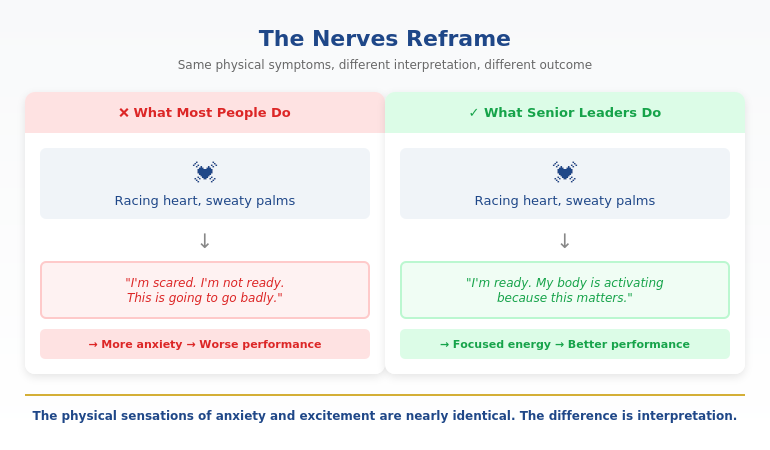
Remember: the fear you’re feeling is the same physiological response as excitement. Your body can’t tell the difference—only your interpretation does. You can reframe “I’m terrified” as “I’m activated and ready.”
For more on building lasting confidence, see the complete guide to presentation confidence.
Struggling with workplace presentations? Conquer Speaking Fear covers the complete system—from long-term confidence building to in-the-moment techniques. Download now →
Related: If you’re presenting to senior leaders or a board, fear often spikes because the stakes feel higher. See board presentation best practices for what actually works in those high-pressure situations.
Common Questions About Fear of Public Speaking at Work
How do I stop being scared of public speaking at work?
You don’t stop being scared—you learn to function with the fear. Fear of public speaking at work is one of the most common workplace anxieties, and trying to eliminate it completely usually backfires. Instead, focus on being prepared enough that fear becomes useful energy rather than paralysing dread. The day-before protocol (lock content by noon, one run-through, stop rehearsing by 8pm, protect sleep) helps more than any amount of positive thinking.
Why do I get so nervous presenting at work?
Workplace presentations trigger fear because they combine public performance with professional consequences. Your brain perceives social evaluation as a threat—and at work, that evaluation can affect your career, income, and standing with colleagues. This fear response is normal and shared by most professionals. The difference between nervous presenters and confident ones isn’t the absence of fear—it’s having techniques to manage it. For lasting change, explore how to overcome fear of public speaking through deeper methods.
What helps with presentation anxiety at work?
Three things help most: adequate preparation (but not over-preparation), a consistent pre-presentation routine, and reframing the fear as activation rather than threat. The day-before protocol is particularly effective because it addresses both the mental and physical aspects of anxiety—stopping rehearsal early lets your brain consolidate learning, while protecting sleep keeps your nervous system regulated.
⭐ Present at Work Without the Paralysing Dread
The complete system for managing speaking fear—from preparation to delivery to long-term confidence building.
Inside Conquer Speaking Fear:
- The day-before protocol (expanded with timing)
- Morning-of nervous system techniques
- What to do when fear spikes mid-presentation
- Building confidence that lasts
- Reframing techniques from clinical hypnotherapy
Get Conquer Speaking Fear → £39
Created by a clinical hypnotherapist who overcame 5 years of presentation terror. Instant download.
FAQ
Should I take something to calm my nerves before presenting?
Some people use beta blockers (like propranolol) for physical symptoms—they block the racing heart and shaky hands without affecting mental clarity. If you’re considering this, talk to a doctor. However, medication addresses symptoms, not the underlying fear. The techniques in this article help you need less intervention over time. Avoid alcohol or sedatives—they impair performance even when they reduce anxiety.
What if I can’t sleep the night before?
One night of poor sleep won’t ruin your presentation. The fear of not sleeping is often worse than the actual sleep loss. If you’re lying awake, don’t fight it—get up, do something boring in dim light, and return to bed when drowsy. Avoid screens. Even rest without sleep helps more than anxious tossing. Following the day-before protocol (stopping rehearsal by 8pm, normal evening routine) significantly improves sleep quality.
How do I handle fear that spikes during the presentation?
Pause. Take a sip of water. This buys you 2-3 seconds and looks completely natural. During that pause, take one slow breath and ground yourself by feeling your feet on the floor. The fear spike usually passes in 10-15 seconds if you don’t fight it. Saying “let me think about that for a moment” is always acceptable and gives you time to reset.
Will the fear ever go away completely?
For most people, no—and that’s okay. What changes is your relationship with the fear. Instead of dreading it for weeks, you’ll feel it briefly and move through it. Instead of it controlling your performance, you’ll perform well despite it. Many confident speakers still feel nervous before every presentation—they’ve just learned that the feeling doesn’t predict failure.
📧 The Winning Edge Newsletter
Weekly insights on managing presentation anxiety, building speaking confidence, and communicating effectively at work. Practical techniques from a clinical hypnotherapist with 24 years in corporate banking.
Your Next Step
If you have a presentation at work tomorrow, follow the day-before protocol:
- Lock your content by noon—no more edits
- Do one complete run-through standing up, out loud
- Write down three possible questions and prepare brief answers
- Stop all rehearsal by 8pm
- Normal evening routine, early bed, no alcohol
The fear won’t disappear. But you’ll arrive tomorrow with a regulated nervous system, consolidated preparation, and enough energy to convert fear into presence.
For the complete system—day-before protocol, morning-of techniques, and long-term confidence building—get Conquer Speaking Fear.
About the Author
Mary Beth Hazeldine is the Owner & Managing Director of Winning Presentations and a former corporate banker with 24 years of experience at JPMorgan Chase, PwC, Royal Bank of Scotland, and Commerzbank. She has trained thousands of executives on high-stakes presentation skills and helped clients secure more than £250 million in funding and budget approvals.
Mary Beth is also a qualified clinical hypnotherapist and NLP practitioner who spent 5 years struggling with presentation terror before developing the techniques she now teaches. The day-before protocol in this article comes from that personal experience—and has been refined through working with executives facing the same fear.