Q&A Preparation for Executive Presentations: The System Most Senior Presenters Skip
If you’re searching for a structured approach to Q&A preparation for executive presentations, you’ve almost certainly noticed the pattern: presenters rehearse the slides for hours, then walk into the room having done little or no dedicated preparation for the part of the meeting that actually decides their credibility. The Executive Q&A Handling System (£39) is a structured preparation toolkit built for senior professionals who need to walk in ready for the questions — not just the presentation. This page explains what the system covers, who it’s designed for, and how to use it before your next high-stakes meeting.
If you’d like a ready-made framework for preparing the Q&A portion of an executive presentation — anticipated questions, bridge statements, composure protocols — the Executive Q&A Handling System walks through the full preparation method. Instant access, self-paced.
Why Q&A Preparation Is the Piece Senior Presenters Quietly Skip
Ask a senior professional how they prepared for their last board presentation or executive steering committee, and you’ll hear a detailed account of the slides: data pulled, storyline shaped, rehearsals run. Ask how they prepared for the Q&A afterwards and the answer is much shorter. Most presenters prepare the presentation thoroughly and treat the Q&A as improvisation.
That asymmetry rarely makes sense on reflection. The presentation is the part the presenter controls. The Q&A is where credibility, judgement, and command of the material are actually judged — and a strong presentation followed by a shaky Q&A leaves the room with a weaker impression than an adequate presentation followed by composed answers.
The reason dedicated preparation tends to get skipped isn’t laziness — it’s the absence of a repeatable method. Rehearsing slides is obvious work. Preparing for Q&A feels abstract, because executives don’t know in advance exactly what will be asked. Without a concrete structure for anticipating, rehearsing, and framing answers, most senior presenters fall back on general subject-matter knowledge and hope it’s enough. It usually is — until the one question lands that it isn’t.
A Structured Preparation Method for Executive Q&A
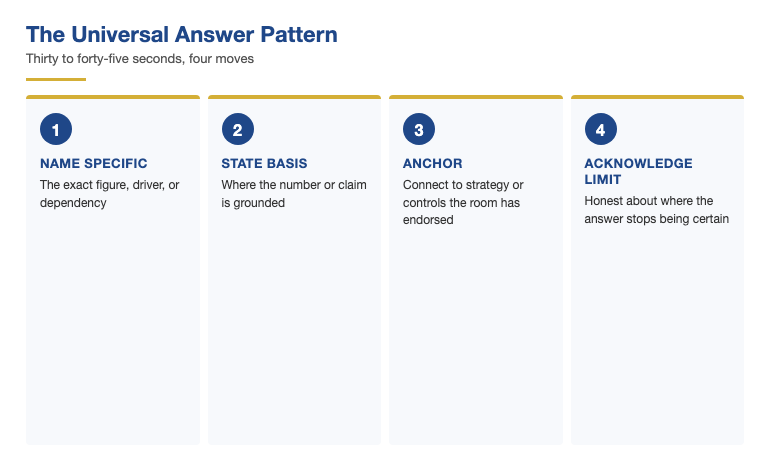
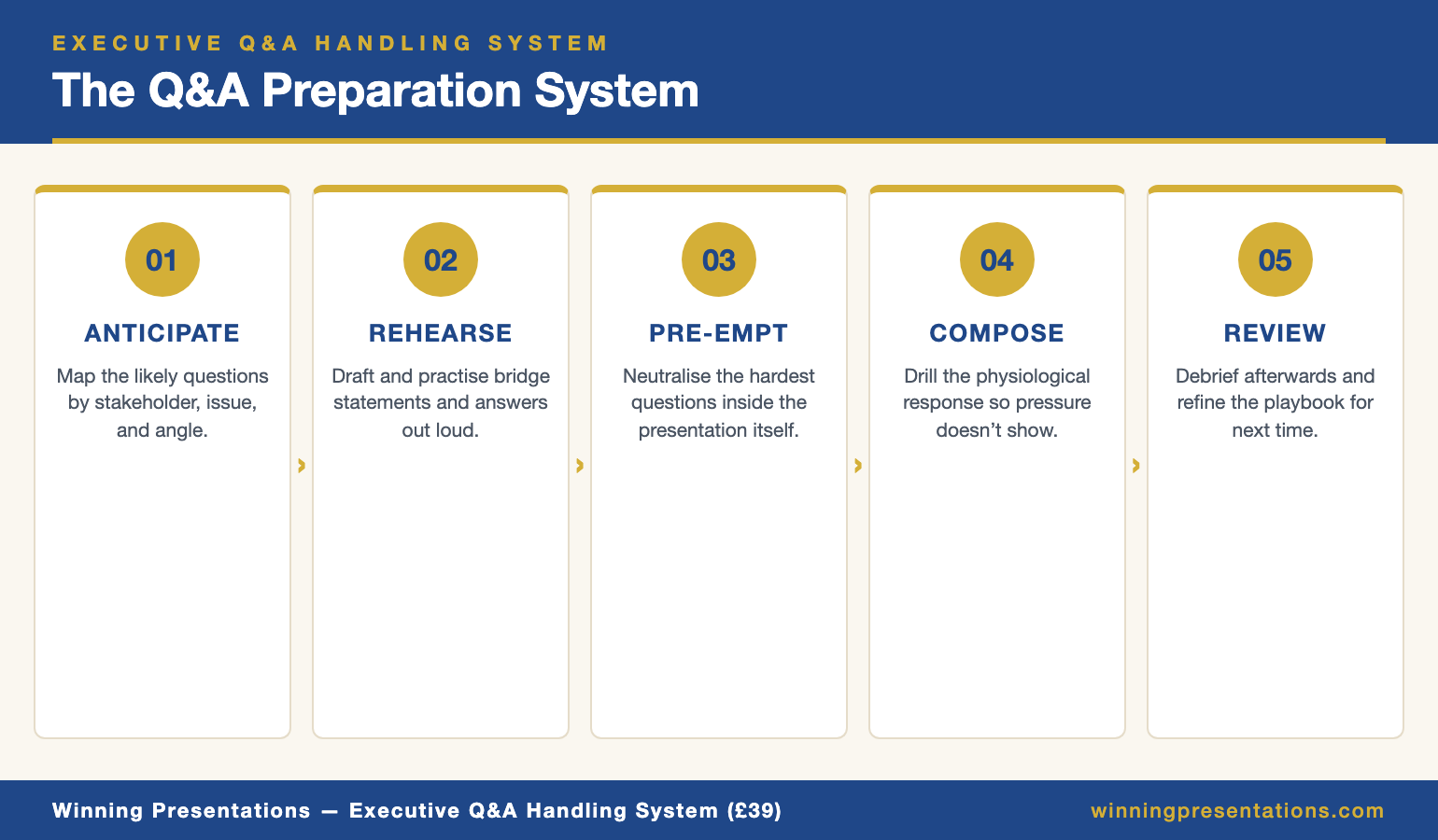
The Executive Q&A Handling System exists to replace that improvisation with a concrete preparation routine. Rather than generic advice about “staying calm” or “thinking on your feet,” the system walks through the specific pre-meeting work of mapping likely questions, drafting and rehearsing answers, building bridge statements for predictable difficult territory, and managing the physiological response when a question lands harder than expected.
The system is drawn from Mary Beth Hazeldine’s 24 years working with senior professionals in financial services and corporate leadership — environments where executive Q&A sessions decide whether budgets are released, strategies are backed, and proposals move forward. The frameworks are refined for the specific dynamics of senior-audience Q&A: scarce time, high stakes, adversarial questioning, and the career implications of how composed you appear under pressure.
Preparation, done properly, turns most of the Q&A from surprise into anticipation. The questions that feel hostile in the moment are usually predictable in the hours beforehand, and the answers that sound articulate under pressure are almost always the ones drafted and rehearsed before the meeting. The system is built on that premise: the Q&A performance that looks like confidence in the room is preparation done in the study the day before.
Walk In Prepared for the Questions, Not Just the Slides
Most senior presenters rehearse the presentation and improvise the Q&A. The Executive Q&A Handling System (£39) gives you a structured preparation method — question anticipation, bridge statement frameworks, composure protocols, and scenario playbooks for board, investor, and procurement Q&A. Designed to be used in the hours before a high-stakes meeting so the Q&A feels rehearsed rather than improvised.
- Question anticipation framework for mapping likely challenges by stakeholder
- Bridge statement library for redirecting difficult questions without appearing evasive
- Composure protocols for managing the physiological response under pressure
- Scenario-specific playbooks for board, investor, and procurement Q&A
Get the Executive Q&A Handling System → £39
Designed for executives preparing for high-stakes Q&A in boardrooms, investor panels, and procurement reviews.
What You Get
- Question anticipation framework — a method for mapping the most likely questions ahead of the meeting by stakeholder, issue, and angle
- Bridge statement library — structured phrasings for redirecting hostile or loaded questions back to your key message without appearing defensive
- Objection-handling methodology — a step-by-step approach for processing challenges in real time, so hard questions don’t derail the room
- Composure protocols — practical techniques for managing the physiological stress response when a question catches you off guard
- Deflection techniques — methods for handling questions you cannot or should not answer directly, without damaging your credibility
- Scenario-specific playbooks — tailored preparation routines for board Q&A, investor panels, procurement reviews, and internal stakeholder sessions
£39 — instant access, no subscription.
Stop dreading the question you can’t predict.
The system turns most of the surprise into anticipation: rehearsed bridge statements, pre-drafted answers to the hardest questions, and a composure routine for the ones you didn’t see coming.
Is This Right for You?
This system is built for professionals who present to senior decision-makers and know the Q&A is where their performance is actually weighed — executives, directors, and senior managers in corporate, financial services, consulting, healthcare, technology, or public-sector environments. It’s particularly suited to anyone who has walked out of a meeting thinking the presentation went well but the Q&A went shakily, and wants a concrete preparation method rather than general advice.
It is not a general presentation skills course. If your main gap is slide structure, narrative flow, or managing nerves before you speak, other resources will serve you better. The Executive Q&A Handling System is narrowly focused on the Q&A portion — the preparation work in advance, the frameworks for handling challenges in the moment, and the scenario-specific playbooks for the rooms where difficult questions are most likely.
Instant access. Self-paced. No subscription.
Download the Executive Q&A Handling System now and use it before your next high-stakes meeting. Gumroad 30-day refund if it isn’t the right fit.
Frequently Asked Questions
How far in advance should I start Q&A preparation for an executive presentation?
For a significant board, investor, or committee presentation, a dedicated Q&A preparation session one or two days beforehand works well — the question anticipation work benefits from sitting overnight, as the harder questions often surface on a second pass. For routine senior updates, thirty focused minutes the day before is usually enough. What matters is that Q&A preparation happens as dedicated work, not as an afterthought squeezed into the final slide rehearsal.
Can I use this system alongside my existing presentation preparation routine?
Yes. The system is designed to slot into whatever preparation approach already works for you. Most senior professionals have a strong method for preparing the presentation itself; the gap is usually the Q&A. The frameworks are self-contained and can be used as a dedicated Q&A preparation layer that runs alongside your existing slide and narrative preparation.
How is this different from general media training or communication coaching?
Media training focuses on journalists and public-facing interviews. Communication coaching covers a broad range of skills. This system is narrowly focused on one situation — the Q&A portion of an executive presentation — with techniques built for the specific dynamics of senior-audience questioning: time pressure, adversarial angles, and the career implications of how composed you appear.
Does this work for virtual and hybrid executive presentations?
Yes. The preparation method is the same regardless of format. The system includes guidance for managing Q&A dynamics in virtual settings, where lost body language cues and the difficulty of reading the room create additional challenges. The core frameworks transfer cleanly to video calls.
What if my Q&A sessions are sector-specific (board, investor, procurement)?
The system includes scenario-specific playbooks for board Q&A, investor panels, procurement reviews, and internal stakeholder sessions. The underlying frameworks — question anticipation, bridge statements, objection handling, composure management — are transferable across sectors. The playbooks show how to apply them in the specific settings where senior professionals most often face difficult questioning.
Is the Executive Q&A Handling System a course or a toolkit?
It’s a structured toolkit — frameworks, templates, and protocols you can apply immediately. No video lectures to work through sequentially. You access the materials, identify which frameworks apply to your situation, and use them as a preparation layer before your next high-stakes presentation.
The Winning Edge Newsletter
One short email each Thursday on handling Q&A, structuring high-stakes presentations, and making your case land in front of senior audiences. Written for executives, by executives.
About the Author
Mary Beth Hazeldine is Owner & Managing Director of Winning Presentations. With 24 years of corporate banking experience at JPMorgan Chase, PwC, Royal Bank of Scotland, and Commerzbank, she advises executives across financial services, healthcare, technology, and government on structuring high-stakes presentations and Q&A sessions for senior approvals. Winning Presentations was founded in 1990 and has supported executive communication at HSBC, Morgan Stanley, BNP Paribas, UniCredit, and MFS Investment Management.