

Pitch Rejection Recovery: How Founders Rebuild Confidence After the 20th No
Quick Answer: Pitch rejection recovery is not about grit or mindset resets. After twenty nos, a founder’s nervous system has quietly learned that the pitch meeting equals social threat. The voice cracks, the apology creeps into the first sentence, the deck gets blamed. Recovery means separating the pitch from the founder and walking into meeting twenty-one with a regulated baseline, not borrowed confidence.
JUMP TO:
- Why pitch rejection breaks confidence even for experienced founders
- What twenty nos actually do to your nervous system
- The first sign your confidence is collapsing (and you don’t know it)
- The recovery framework: separating the pitch from the founder
- Pre-pitch protocols that work after a streak of rejections
- The conversation to have with yourself before pitch twenty-one
- FAQ
Tomás had pitched his fintech to twenty investors. Eighteen polite nos, two ghosts. When he opened the laptop in front of investor twenty-one, his voice cracked in the first sentence. He heard himself apologise before the deck had loaded — “sorry, one second, let me just pull this up” — and again five seconds later for the slide taking too long to render. Neither apology was necessary. Both told the partner across the table that the founder believed, below conscious thought, he had already lost this meeting.
He walked out thinking the deck had let him down again. We rebuilt the deck, then did the work that mattered: three sessions on what his body had learned to do in pitch rooms, and why meeting twenty-one had felt like a fight his nervous system had already lost before the first slide.
He got a term sheet from pitch twenty-four. Not because the cycle shifted. Because he walked in as a founder, not a man bracing for the twenty-first no.
If the next pitch meeting feels heavier than it should
Conquer Your Fear of Public Speaking is a neuroscience-based programme for acute presentation anxiety — built around nervous system regulation, cognitive reframing and the pre-presentation protocols that actually hold up in high-stakes rooms. Designed for professionals whose work depends on performing under pressure.
Why pitch rejection breaks confidence even for experienced founders
Founders know, intellectually, that investor rejection is a funding statistic. Most experienced founders will say they are prepared for twenty nos. On paper, a numbers game.
What that framing misses is that pitch meetings are not emails — they are rooms. A founder walks in, speaks for twenty minutes about something they have built, and watches a partner or committee decide. When the answer is no — even a kind, well-reasoned no — the body does not process it as a statistic. It processes it as a social verdict.
Repeat that twenty times in eight weeks and you have a professional who is functionally fine, still running the company, but whose nervous system has quietly classified the pitch meeting as a threat context. The founder walks in, and the room feels harder than the room actually is. This is not weakness. It is what happens when a high-performing body is asked to walk back into the same room it associates with rejection, week after week, and perform as if the room is neutral.
The public speaking confidence guide covers how performance anxiety builds in professionals whose work is substantively strong. The fundraising version is particularly acute because the stakes are binary and the feedback is slow.
CONQUER YOUR FEAR OF PUBLIC SPEAKING — £39
When the room has started feeling heavier than the deck deserves
Conquer Your Fear of Public Speaking is a neuroscience-based programme for acute presentation anxiety. It covers nervous system regulation, cognitive reframing, physical symptom management and the pre-presentation protocols that work under genuine pressure — including after a streak of rejections has trained the body to brace. £39, instant access.
Designed for professionals whose work depends on performing in rooms where the stakes are real and the feedback is public.
What twenty nos actually do to your nervous system
The founder body does not know rejection is statistical. It knows that the last twenty times it walked into a pitch room, the experience ended in social disapproval. The nervous system is a pattern-matching machine. After the fourth or fifth repetition, it starts pre-loading the threat response before the room has even started.
In practical terms, this shows up as a baseline shift:
- Faster heart rate on the walk to the meeting, not during the pitch. The body is rehearsing the threat before it arrives.
- Dry mouth in the first sixty seconds, not there in the first ten pitches. The sympathetic nervous system has learned the context.
- Micro-apologies at the start of the deck. “Sorry, one moment.” These are not manners — the body is hedging in advance of the anticipated no.
- Slight voice tremor on the first sentence, stabilising by sentence four. A signature of a nervous system that has classified the room as threatening.
- Difficulty reading the room. The partner’s neutral face reads as disengaged. The founder is interpreting through the filter of expected rejection.
None of this means the founder is not cut out for fundraising. It is the physical cost of asking a body to perform confidence twenty times in a row in a context that keeps ending in a no.
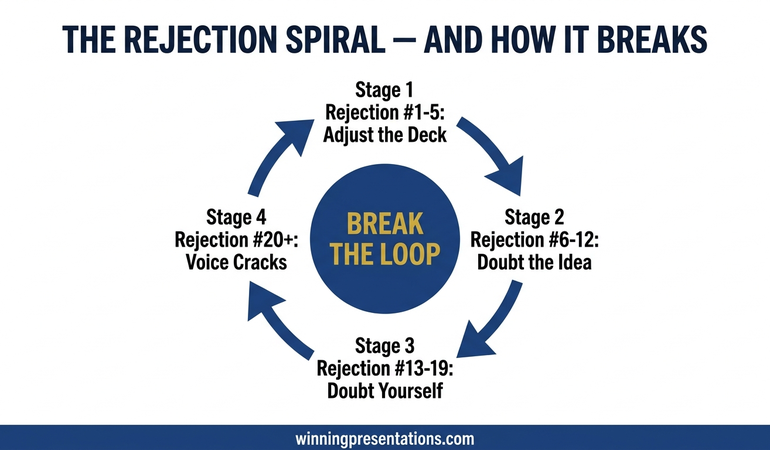
The first sign your confidence is collapsing (and you don’t know it)
Most founders only notice the collapse after it has cost them a round. The earlier signal, the one that tells you erosion is underway while you still have meetings in the pipeline, is linguistic. Not a feeling — a word.
The first word that appears in the opening sentences, uninvited, is usually just, sorry, quickly, hopefully or roughly. “I’ll just walk you through the traction.” “Sorry the slides are a bit dense.” “Hopefully you can see where this is going.”
None of these words appeared in the same founder’s pitch at meeting one or three. They arrive around pitch nine or ten. By pitch fifteen, they are automatic. The founder does not hear them. The investor does, and the unconscious read is: the person across from me does not fully believe they belong in this conversation.
The fix is not rehearsal. Rehearsal alone does not hold up under real-room pressure once the baseline has shifted. The fix is to treat the return of those words as a warning light — the nervous system is compensating and the underlying state needs attention before the next pitch. The presentation anxiety resource covers how linguistic markers correlate with measurable physical state.
The recovery framework: separating the pitch from the founder
The most important move in recovering confidence after a rejection streak is not positive self-talk. It is a structural separation between two questions the founder has been collapsing into one.
The collapsed question: Am I being rejected?
The two real questions inside it:
- Is this pitch, in this room, for this investor, a fit? This is what the investor is actually answering. Stage, thesis, portfolio conflict, cheque size, timing. Most nos are this kind of no.
- Am I, as a founder, capable of leading this company? Not the question the investor was asked. They did not evaluate it. They may have formed a private view, but it was not what the meeting decided.
A founder through twenty rejections has almost certainly started hearing every no as an answer to question two. That is the mechanism that breaks confidence. The recovery framework is the deliberate act of separating the two questions after every pitch.
In practice: a ten-minute debrief after each meeting, run to structure. What was the fit question — stage, thesis, cheque, timing? What was the founder-readiness question, and what evidence did they engage with? Which answer did the no refer to? Written down. Re-read before the next pitch.
This is slow work. It is also the only reliable way to stop pitch twenty-one inheriting the weight of the previous twenty. The build presenter confidence resource covers how professional confidence is maintained under repeated exposure to visible judgement. The partner article on handling hostile investor questions covers a different skill: responding when the room is deliberately testing you.
Pre-pitch protocols that work after a streak of rejections
Rehearsing the deck harder does not solve a regulation problem. Once the nervous system pre-loads threat before a pitch, the work that matters happens in the ninety minutes before the meeting, not the hour spent memorising slide transitions.
Four protocols that hold up in real rooms:
The physical reset, ninety minutes out. A twenty-minute walk at a pace where you can speak in full sentences but not sing. Drops baseline cortisol and gives the autonomic nervous system a genuine shift before the room. Coffee is counterproductive in this window for a founder already running hot.
The four-by-four breath, four minutes out. In for four, hold for four, out for four, hold for four. Four rounds. Done in the car, lift or waiting area. Not meditation — a deliberate intervention in the respiratory rhythm your body has associated with the pitch room, interrupting the threat response before it peaks.
The one-sentence anchor. A single factual sentence, written the night before, said out loud in the ninety seconds before the meeting. Not a mantra. “We have thirty-one paying customers and a four-hundred-person waiting list.” The purpose is to start the meeting from a founder’s voice rather than the apologetic voice rejection has been training.
The first-sentence rule. Your first sentence cannot contain just, sorry, quickly, or any hedge. Pre-written, rehearsed, delivered before the deck opens. “I’m raising a three million seed round to scale the customer operations platform we’ve built.” Spoken cleanly, that sentence closes the door on the previous twenty meetings.
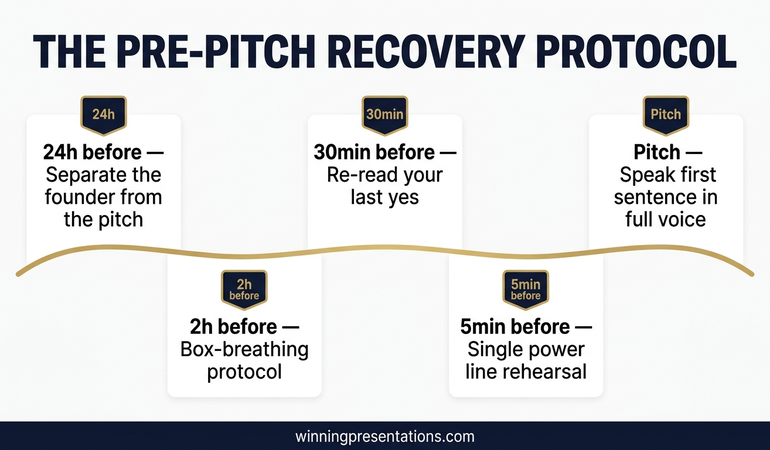
These protocols are not motivational — they are mechanical. A founder using them consistently is not pretending the previous twenty nos did not happen; they are intervening in the physical and linguistic signatures those twenty nos have built into the body.
The conversation to have with yourself before pitch twenty-one
Most founders go into pitch twenty-one with one of two internal conversations. Either “I have to nail this one” — which loads the meeting with pressure it cannot hold — or “I’ve got nothing left to lose” — which reads across the table as detachment.
Neither serves the room. A more useful conversation, the evening before:
- This pitch will be evaluated on fit, not on me. The partner is deciding whether their fund can write this cheque at this stage for this thesis. My job is to give them the clearest possible view of what I am building.
- I know my numbers. I know my market. I know the next twelve months. Stated factually. The working-memory check that keeps the pitch grounded in evidence rather than performance.
- If this is a no, it is data about fit, not a verdict on me. Written down. Re-read before and after the meeting.
- My confidence does not come from this meeting. It comes from what I have built, the customers I already have, the team I have assembled. The meeting is a conversation about whether to add this investor to that list. Not a test of whether the list is real.
That last point matters most. The room does not lend confidence — it tests it. A founder who walks in with confidence sourced from the evidence of the company is harder to destabilise. The work is quiet. It happens between meetings. It shows up as a founder who walks into pitch twenty-one and does not apologise in the first sentence, because there is nothing to apologise for.
FOR THE NEXT PITCH AFTER A DIFFICULT STREAK
The programme built for professionals performing under repeated pressure
Conquer Your Fear of Public Speaking covers the full protocol referenced above — nervous system regulation, cognitive reframing, physical symptom management and pre-meeting preparation designed for acute presentation anxiety. The approach works as well for founders pitching investor twenty-one as it does for senior leaders returning to a hostile boardroom. £39, instant access, no subscription.
Frequently Asked Questions
Is rejection harder for first-time founders?
Usually yes. Experienced founders have lived through rejection streaks and have internal evidence that they pass. First-time founders have no comparable reference point, so every no carries more weight. They also often have a smaller professional identity outside the company, which means the pitch meeting is doing more psychological work than it should. Building the founder-versus-pitch separation deliberately matters more for first-time founders.
How long until confidence rebuilds?
Linguistic markers (hedges, apologies) clean up within two to three weeks once the regulation work and debrief protocol are in place. The deeper baseline — heart rate on the walk in, dry mouth in the first minute — takes longer: four to six pitches delivered from a regulated state before the body updates its prediction. A single good meeting does not overwrite twenty difficult ones.
Should I take a break from fundraising?
Sometimes, but rarely the way founders ask it. A full pause often extends the anxiety because the nervous system does not get the chance to learn a new pattern. Better: a structured ten-to-fourteen-day pause to run the debrief protocol, rebuild the first-sentence discipline, and return via a smaller, lower-stakes meeting before the next high-stakes pitch.
What about pitching with a co-founder when you’ve lost confidence?
It helps or harms depending on handover discipline. Help: the co-founder takes the first three minutes while the primary pitcher regulates, with a rehearsed transition. Harm: the co-founder senses the primary is struggling and starts compensating mid-sentence, reading across as a team not on the same page. If confidence is low, reassign the opening to the co-founder for the next three meetings, then return to lead once the baseline is back.
The Winning Edge — weekly
One short note every Thursday on what actually moves boards, investors and senior stakeholders. No filler.
Partner post: Once the baseline is regulated, the next skill is handling the sceptical investor whose questions are designed to test rather than understand. The hostile investor question guide covers the response technique that works when the room is pushing back hard.
Your next step: Before the next pitch in your calendar, read the first three sentences of your opening out loud. Count the hedges. If there is a just, a sorry, a quickly or a hopefully, that is the signal. The deck is probably fine. The opening is where twenty nos have been leaking into the room before the conversation starts.
About the Author
Mary Beth Hazeldine, Owner & Managing Director of Winning Presentations, advises executives across financial services, healthcare, technology and government on structuring presentations for high-stakes funding rounds, board approvals and stakeholder buy-in. With 24 years of corporate banking experience at JPMorgan Chase, PwC, Royal Bank of Scotland and Commerzbank, she works at the intersection of finance, language and decision psychology.