

Remote Pitch Deck Delivery: Why Your Slides Work But Your Zoom Doesn’t
Quick Answer: Remote pitch deck delivery fails when presenters treat the call like an in-person meeting with a screen attached. The shift is to deliver the deck as the audience reads it, not as you talk over it — shorter segments, named questions, decision-first slides, and presence on camera that reads as senior. The same deck converts up to twice as well with the right delivery shape.
JUMP TO:
Tomás had pitched the same Series B deck twelve times in person before lockdown made every meeting remote. He kept the slides identical. He kept his script identical. The conversion rate halved. He came to me convinced the market had turned. The deck had not changed. The audience had not changed. The only variable was the delivery medium. He was being measured against founders who had adapted to remote pitching, and he had not.
I asked him to send a recording of his last two pitches. Within ninety seconds I could see the problem on both. He was running the room exactly as he had in person. Long opening. Slow build. Holding the headline number until slide eight. Reading off the slides instead of using them as anchors. Letting investors sit in passive mode until he asked for “any questions” at the end — by which point three of the four were already half-checking other tabs.
The deck was strong. The remote pitch deck delivery was not. Six weeks later he closed the round. Same deck. Different shape of delivery.
If your conversion rate dropped when meetings moved to Zoom
The Executive Slide System includes pitch and investor scenario playbooks built for remote delivery — the segment structure, decision-first slide order and Q&A management for audiences you cannot read in the room.
Why strong decks fail in remote delivery
A pitch deck has two jobs. The first is to be the document an investor or buyer reads on their own time. The second is the artefact you walk through in the live meeting. In person, those two jobs blend. Your physical presence carries the meeting and the deck supports you. Remote, those two jobs split apart. The deck has to do more, and you have to do it differently.
Three structural reasons strong decks fail in remote pitch deck delivery:
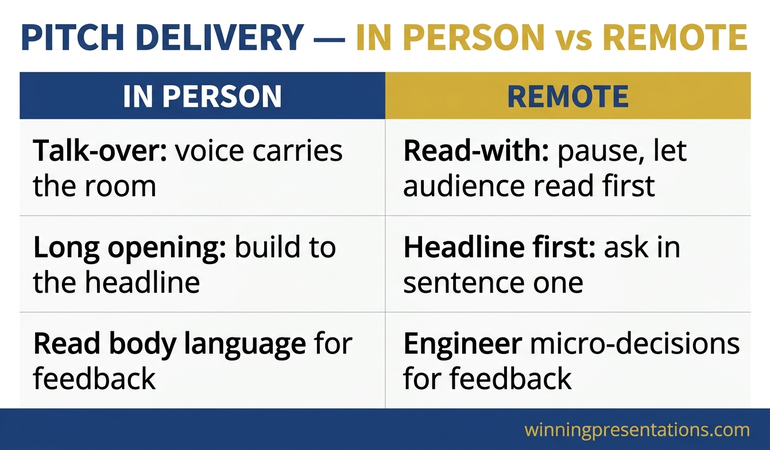
Talk-over delivery. The presenter narrates over each slide as if it is a teleprompter. The investor splits attention between the slide and the voice and ends up half-following both. In person, the room itself anchors attention. On screen, you are competing with email, Slack and the investor’s own to-do list.
Long opening. A pitch in person can spend three minutes on context before the headline. On Zoom, the investor has decided whether to lean in by the end of slide three. If the headline number is on slide eight, you have lost most of the room before they reach it.
No micro-decisions. In person, an investor’s nod or frown across a table tells you to slow down or push forward. On screen, those signals are gone. If you do not engineer micro-decisions into the body of the pitch — small questions that require a response — you arrive at the close with no read on whether the room is converging or drifting.
The fix is not to write a different deck. It is to deliver the same deck differently.
Deliver the deck as a reader, not a talker
The single largest shift is to stop reading the slide and start reading the slide with the audience. In person, presenters can talk and the room follows the voice. Remote, the audience is going to read the slide whether you like it or not. The presenter who fights this is talking over their own document.
The technique:
- When a new slide appears, stay silent for three to four seconds. Let the room read the title and headline.
- Then speak to the slide as if explaining what the audience has just read — not as if reading it for them. “What you can see on this slide is the gross retention curve over the last eighteen months. The reason it matters is…”
- End each slide with a single sentence that bridges to the next, before changing the slide. “And that retention curve is what gives us confidence in the unit economics on the next view.”
This delivery shape mirrors how the audience actually consumes a remote presentation. The first time most investors will see your slide is the moment you share it on screen. They are reading. You are speaking. Aligning these two flows is the foundation of everything else.
THE EXECUTIVE SLIDE SYSTEM — £39
Stop relying on physical presence to carry weak slide structure
The Executive Slide System is 26 presentation templates, 93 AI prompts, 16 scenario playbooks, a master checklist and a framework reference. The investor pitch and remote sales playbooks are built for delivery shape, not just slide content. £39, instant access.
Get the Executive Slide System →
Designed for executives pitching investors, partners and remote buying committees over video.
The 90-second segment rule
Attention on a remote call is not a continuous resource. It is a series of attention windows that reopen every 60 to 90 seconds. The presenter who recognises this structures the pitch into 90-second segments rather than seven-minute blocks.
A practical pattern that works for a 25-minute remote pitch:
- 0:00–1:00 — Headline ask, headline number, structure of the meeting (no slides yet).
- 1:00–5:00 — The opportunity (3 slides, 90 seconds each, micro-question after slide 3).
- 5:00–10:00 — Traction and proof (3 slides, micro-question after slide 6).
- 10:00–15:00 — The team and the moat (2 slides, named question to a specific investor).
- 15:00–18:00 — Financial ask and use of funds (2 slides, decision framing).
- 18:00–25:00 — Q&A and close (no slide deck on screen during Q&A).
The deliberate beat changes — presenter speaking, presenter pausing, named question, brief discussion — reset attention every few minutes. The pattern matters more than the precise timing.
The virtual presentation energy framework covers in detail how presenters maintain pace and vocal variety across longer remote sessions.
Executive presence through a webcam
An investor or remote buyer is making two decisions during your pitch. The first is whether they believe the business. The second is whether they believe in you running it. The second decision is harder to win on screen because most of the signal humans use to read seniority — physical presence, room command, posture — is reduced to a head-and-shoulders rectangle.
What carries presence through a webcam:
Eye-level camera, front lighting, upper-third framing. The same physical setup rules from the boardroom apply. A laptop on a desk angled up makes you look junior, regardless of the deck content. A backlit silhouette signals that you have not prepared for the medium. Fix the setup once and it carries forever.
Stillness above the shoulders. On a remote call, exaggerated head movement reads as nervous energy and small movements read as authority. Hold your head still while you speak. Move when you make a deliberate point. Stop moving when you finish a sentence. The contrast carries weight.
Slow vocal delivery on the headline numbers. Investors form a numerical impression of your seriousness within seconds of you stating your headline ask. Say the number slowly. Pause after it. “We’re raising six million pounds … to take us to a thirty-six month runway.” A rushed number sounds tentative. A measured number sounds inevitable.
Minimal filler. “Like” and “you know” carry less in person because the body is doing the work. On screen, every filler word is amplified. Record yourself, count the fillers in three minutes, and halve them through deliberate practice. This single change shifts perceived seniority more than any deck redesign.
If you are also running asynchronous parts of the pitch process — sending a recorded walkthrough before or after the live call — the asynchronous presentation recording guide covers the related delivery patterns for pre-recorded video.
Handling Q&A when you cannot see the room
Q&A is the most variable part of remote pitch deck delivery. In person, a presenter can read the room and adjust the depth of an answer in real time. On screen, you have to engineer the read.
Three techniques that work:
Stop sharing the deck during Q&A. When a question comes, share back to your camera, not to a slide. The room reconnects with you as a person. The deck reappears only if a specific question requires a specific slide as reference. Defaulting back to a wide-shot of you signals confidence.
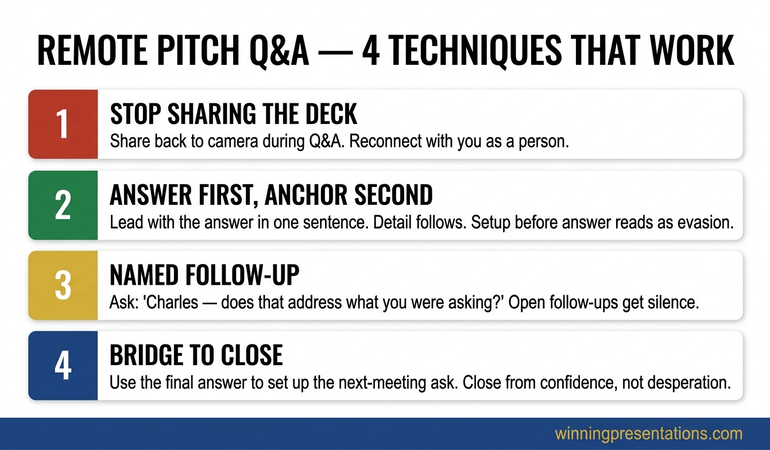
Answer first, anchor second. The natural instinct under pressure is to set up the answer before delivering it. Resist. Lead with the answer in one sentence. Then anchor it with the relevant detail. “Our gross margin is 71% on the SaaS line. The reason it’s not higher is the embedded onboarding cost — we’ll improve it to 78% by phasing onboarding into a self-serve flow next quarter.” Investors trained on remote pitches expect the answer first; everything before the answer reads as evasion.
The named follow-up. After answering, name the questioner and check the answer landed. “Charles — does that address what you were asking?” This does two things. It confirms whether you need to go deeper, and it pulls Charles into a brief active exchange that signals to the rest of the room that you are listening. Open follow-ups (“any other questions?”) get silence on Zoom. Named follow-ups get conversation.
For investor-specific Q&A patterns where the room includes both lead and supporting investors, the investor update deck structure covers how the Q&A flow shapes follow-on engagement.
The remote close that earns a follow-up meeting
A remote pitch rarely closes a deal in the room. The aim of the call is to earn the next meeting — the partner meeting, the diligence call, the term-sheet conversation. Treat the close as a structured ask for that next step rather than a vague “what are your next steps?”
The remote close that works:
- Summarise in three sentences. The opportunity, the ask, the milestone you would deliver against capital. No more than fifteen seconds.
- Name the next meeting you are asking for. “I’d like to propose a 30-minute follow-up next week to walk through the financial model with whoever on your team would do diligence.”
- Close the loop on documents. “I’ll send the deck and the data room link within the hour. What else would be useful in advance of the next call?”
- Quiet the room and stop talking. Once you have asked for the next step, stop. Do not fill the silence by re-pitching. The investor’s response — “next Tuesday works” or “let me check with Sarah” — tells you whether they are converging.
Tomás used this exact close pattern on the call that became his lead. The follow-up was scheduled before he hung up the call. Two meetings after that, the term sheet arrived. Same deck. Different remote pitch deck delivery.
FOR THE NEXT REMOTE PITCH ON YOUR CALENDAR
The complete scenario library for remote investor and buyer audiences
The Executive Slide System gives you 26 templates, 93 AI prompts and 16 scenario playbooks — including the investor pitch playbook with the 90-second segment pattern, the answer-first Q&A structure and the named-follow-up close referenced above. £39, instant access, no subscription.
Frequently Asked Questions
Should I send the deck before the call?
Yes — with a short cover note framing the headline ask, the structure of the meeting and what you would like the investor to read in advance. Many funds now expect to read the deck first so the live call is dialogue. Plan for that pattern. If they have read it, do not walk slide-by-slide; walk to the headlines and the decision points.
How do I keep energy up across multiple remote pitches in a day?
Treat each pitch as a discrete event. Stand up between calls. Take a breath, drink water, walk for two minutes. The vocal flatness that creeps into the third pitch of the day is what costs the conversion. Pace yourself like an athlete in a long match, not a meeting marathon runner.
What if the investor turns their camera off during the pitch?
Continue as if they are present and engaged. Address questions to them by name. Speak to the camera. The investor turning off their video may be in a meeting transition, dealing with a child, or simply preferring the format. None of those are signals about your pitch — do not let the absence of their face change yours.
How long should a remote pitch be?
Plan for 60% of the in-person equivalent. A 40-minute in-person pitch becomes a 25-minute remote pitch with extended Q&A. The reduction is not in content density — it is in pacing, transition and the time spent on slides the audience can read for themselves.
Presentation playbooks, delivered Thursdays
The Winning Edge newsletter covers the structures real executives use for high-stakes meetings — remote, hybrid and in person. One issue per week, typically read in four minutes.
Not ready for the full system? Start here instead: download the free Executive Presentation Checklist — a one-page structural review for any deck you are about to deliver remotely.
Partner post: The same delivery shape works for board calls, with one important structural difference. The virtual board meeting presentation guide covers that scenario.
Your next step: Before your next remote pitch, record a five-minute walkthrough of your headline slide and the next two. Watch it back at 1.25x speed. If the pace bores you, it is boring an investor at the same setting they probably listen at.
About the Author
Mary Beth Hazeldine is Owner & Managing Director of Winning Presentations Ltd. With 24 years of corporate banking experience at JPMorgan Chase, PwC, Royal Bank of Scotland, and Commerzbank, she advises executives across financial services, healthcare, technology, and government on structuring presentations for high-stakes funding rounds and approvals.