

Why “Can You See My Screen?” Triggers More Panic Than the Whole Presentation
Quick answer: The can you see my screen anxiety spike that hits senior presenters at the share-screen moment is not about the tech. It is the convergence of three structural threats firing in the same six seconds: a competence threat (the room perceives the presenter as not in control of basic technology), witness amplification (every attendee is staring at the same problem in unison), and unbounded duration (the presenter does not know when the failure will end or whether they can fix it). The three threats together produce a panic spike that is disproportionate to the actual stakes of the technical problem. The recovery protocol is to name the failure, anchor the timeline, and continue the presentation without the screen for the next ninety seconds — in that order. Senior presenters who pre-rehearse those three moves walk out of the panic spike in under fifteen seconds. Senior presenters who improvise spend the next ten minutes presenting from inside it.
JUMP TO:
- The three threats firing in the same six seconds
- The competence threat the room reads in three seconds
- Witness amplification and the synchronised stare
- The unbounded duration that keeps the panic open
- The recovery protocol senior presenters pre-rehearse
- One thing to do before the next virtual presentation
- Frequently asked questions
In March 2020, a few weeks into the first lockdown wave, I was on a Zoom call observing a head of business development at a UK fintech presenting the funding round narrative to a panel of three investors. He was experienced, well-prepared, and had presented the same material in person to two earlier investor groups in February. The Zoom call was his first virtual investor pitch. About eight minutes in, after the opening framing and the first two slides, he reached for the share-screen button to bring up the financial pages. The screen-share dialog opened, he selected the wrong window, the dialog closed without sharing, and the investor panel saw his thumbnail-sized preview of his own laptop’s open windows for about three seconds before the dialog opened again. He apologised, fumbled the second selection, and shared an Excel sheet from a different deal that was open in the background. He apologised again, closed the share, re-opened the dialog, found the right deck, and shared it. The entire sequence took maybe forty seconds. By the time the deck appeared on screen his face had gone red, his voice had dropped a half-octave, his pace had picked up to fill the air, and his next eight minutes of presentation were delivered from inside a panic spike that the investor panel could see clearly. The funding round closed at the lower end of the previously discussed range. The presenter told me afterwards he could not remember the specific words he had said during the second half of the call. The actual technical problem had been resolved in forty seconds. The anxiety it triggered lasted the rest of the meeting.
(This article was created with AI assistance; all stories and insights are based on 35 years of real client work.)
This piece walks through the structural reason senior presenters experience a disproportionate panic spike at the can you see my screen moment, and the recovery protocol that compresses the spike to under fifteen seconds. The anxiety is not about the technology; senior presenters who manage complex contracts, negotiate term sheets, and chair difficult board sessions are not lacking technical competence in a meaningful sense. The anxiety is about the structural collision of three simultaneous threats that the virtual share-screen moment uniquely produces, all firing in the same six seconds. Understanding the three threats — competence, witness amplification, unbounded duration — is the first step in pre-rehearsing the recovery moves that the panic spike will otherwise consume in real time. The presenters who walk out of the spike quickly do so because they have practised exactly three moves. The presenters who get stuck inside it do so because they are trying to invent those moves under maximum cognitive load.
Before the next virtual presentation, a five-minute share-screen rehearsal pays back ten times.
The Virtual Presentation Quick-Start Checklist covers the share-screen pre-check, the second-monitor setup, and the window-close discipline that prevents the most common share-screen failures before they happen. Free download, no email gate.
The three threats firing in the same six seconds
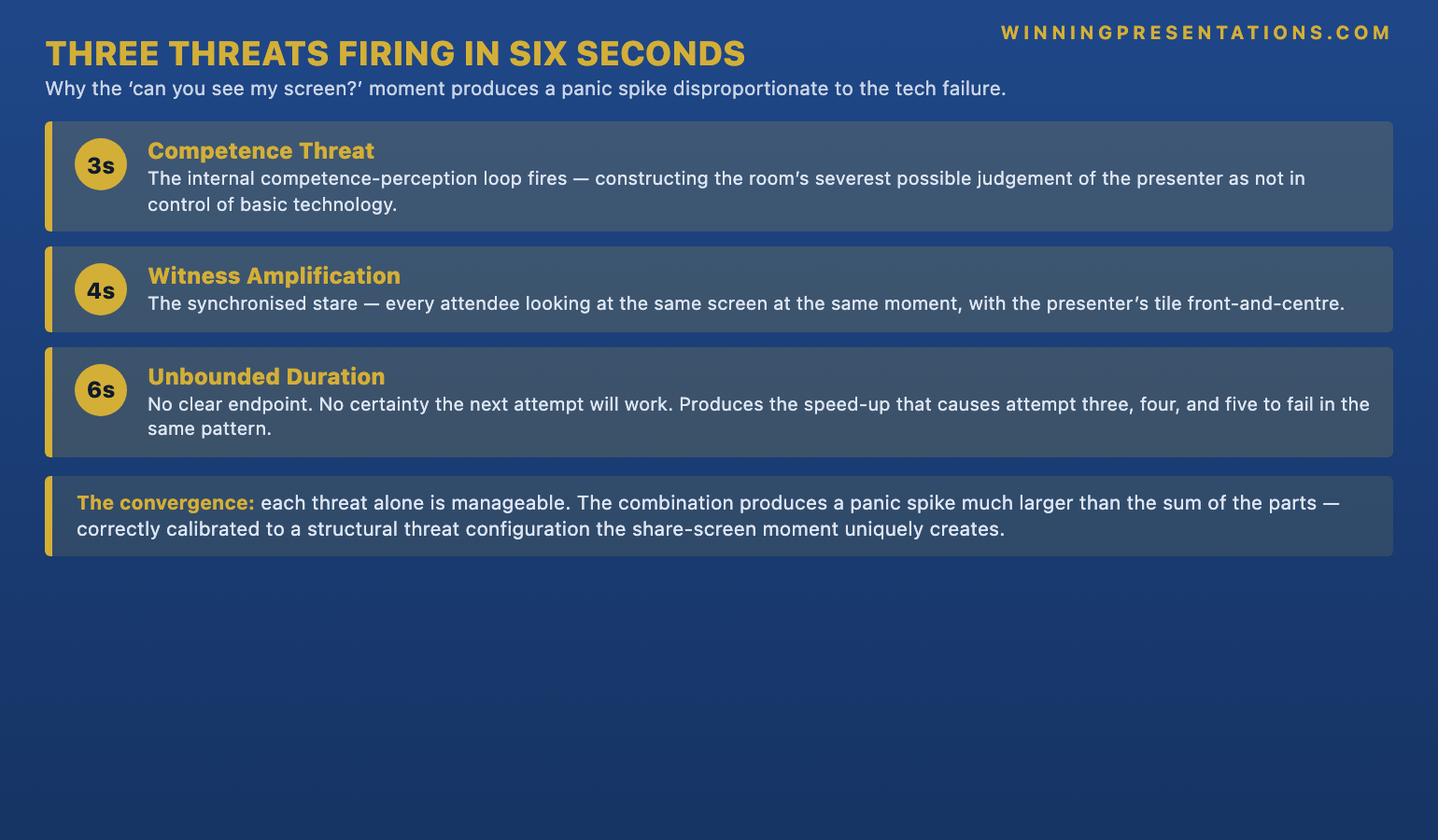
The disproportionate panic spike at the share-screen moment is not one anxiety; it is the simultaneous firing of three structurally different threats that, individually, the presenter could handle, but that converge in the same six-second window with a cumulative effect much larger than any of them alone. The first is the competence threat: the room is watching the presenter struggle with a piece of basic technology that the room considers a baseline professional skill. The second is the witness amplification: every attendee on the call is staring at the same problem at the same time, with the presenter’s tile front-and-centre and the failure visible in unison. The third is the unbounded duration: unlike the recoverable hiccups in an in-person meeting (a clicker that briefly fails, a slide that needs to be advanced manually), the share-screen failure has no clear endpoint and the presenter does not know whether the next attempt will work either.
Each threat individually is manageable. A competence threat alone — for instance, a senior presenter pronouncing a technical term incorrectly — produces a small, brief discomfort that the presenter can absorb without anyone noticing. Witness amplification alone — for instance, twelve people watching the presenter take a sip of water mid-sentence — produces no anxiety at all because there is nothing to witness. Unbounded duration alone — for instance, a quiet pause while the presenter checks a note — produces no anxiety because the duration is under the presenter’s control. The share-screen failure is the structural configuration that combines all three. The room is watching, the failure is visible, and the duration is uncontrolled. The combined effect on the nervous system is much larger than the sum of the parts, and it is the combination — not the technology itself — that produces the panic spike.
This is why presenters who are otherwise calm under pressure can still be ambushed by the share-screen moment. The presenter who handled a hostile board question last Tuesday with composure was managing a single threat (a difficult question), with witness amplification but bounded duration (the question would end). The presenter who managed a tough negotiation last week was managing the competence threat (the room evaluating their position) without acute witness amplification (the negotiation was a back-and-forth between two people, not a synchronised stare). The share-screen failure converges all three at once, and the nervous system responds with the panic spike calibrated to the convergence rather than to any one of the threats. The presenter’s internal experience is of being overwhelmed by something small; the actual experience is of being correctly calibrated to a structural threat configuration that the situation has uniquely produced. The broader pattern of how Zoom destroys composure for presenters who were fine in boardrooms covers the same convergence effect across other moments in the virtual format.
The competence threat the room reads in three seconds
The competence threat is the fastest of the three to fire. Within about three seconds of the failed share-screen attempt, the presenter has internally registered that the room is now evaluating their technical competence. The internal monologue is something like: they can see I can’t share my screen, this is the most basic Zoom skill, the senior person on this call probably last had to share a screen six years ago and even she would have got it right first time, they’re going to think I’m not in control of the presentation. The internal monologue is, structurally, a competence-perception loop: the presenter is constructing the room’s likely judgement of themselves and feeling the consequences of that constructed judgement in real time, without any external feedback from the room itself.
The constructed judgement is almost always more severe than the actual room’s judgement. Senior committees who watch a presenter struggle with a screen share for forty seconds do not, in fact, downgrade the presenter’s overall competence in any meaningful way. They register a minor inconvenience, they wait for the share to work, and they re-engage with the substance as soon as the deck appears. The presenter’s constructed version of the committee’s judgement is a much sharper, more permanent, more reputation-damaging assessment than the committee actually makes. The mismatch between the constructed judgement and the actual one is the gap that produces most of the competence-threat anxiety. The presenter is reacting to an imagined judgement that the room is not, in fact, making.
The competence threat compounds because the presenter is the only person on the call who is running the competence-perception loop. The committee is half-watching, half-on-email, half-waiting for the deck. The presenter is generating, in real time, a vivid internal version of the committee’s severest possible read of the moment. The presenter’s nervous system responds to the constructed read, not the actual one. Within ten seconds of the share-screen failure, the presenter’s heart rate has elevated, their breathing has shallowed, their voice has tightened, and their pace has picked up — all responses to the constructed judgement, none of them visible signals the room would have generated by itself. The visible signals the presenter is now generating — tighter voice, faster pace, slight flush in the face — are what the committee actually reads, and what the committee uses to downgrade their assessment, slightly, of the presenter’s composure. The downgrade is real but it is in response to the visible panic, not to the original technical failure. The competence threat creates the visible signals that justify the original threat in the committee’s eyes.
Witness amplification and the synchronised stare
The second threat that fires in the same six seconds is witness amplification — the cognitive load of being aware that every other attendee on the call is staring at the same problem at the same time. In a physical room, a small technical hiccup like a clicker briefly failing is experienced asynchronously: some people in the room notice, others are looking at their notes, some are still processing the previous slide. The witness load is distributed in time and attention. On Zoom, every attendee is looking at the same screen at the same moment, and the share-screen failure occupies that screen for every one of them in unison. The presenter is acutely aware of this. The synchronised stare is a real cognitive feature of the virtual format and it amplifies any visible failure by a factor proportional to the number of attendees on the call.
The synchronised-stare effect is why the share-screen failure on a four-person investor call feels harder than the share-screen failure on a twenty-person internal team call. The investor call has fewer people but each person’s attention is dedicated to the presenter; the team call has more people but their attention is more diffuse. The presenter’s nervous system reads the dedicated attention as higher witness load even when the absolute number is lower. The structural rule is that witness amplification scales with attention density, not headcount, and the highest-stakes calls (board approvals, investor pitches, executive committee reviews) are typically also the highest attention-density calls, which is why the share-screen failure feels disproportionately bad in exactly the contexts where the stakes are highest.
The amplification effect also persists for several seconds after the technical failure is resolved. The presenter has the share working, the deck is visible, the committee has visibly moved on to engaging with the substance — but the presenter’s nervous system is still in the elevated state produced by the witness-amplified failure of thirty seconds ago. The next several minutes of the presentation are delivered from inside the residual elevation. The voice stays tight, the pace stays elevated, the recovery from the panic spike happens in the background while the presenter continues to talk. By the time the nervous system has returned to baseline, the presenter has often delivered five or six minutes of content at a markedly different quality from the version they intended. The physical reset technique senior leaders use mid-presentation covers the recovery moves that work at the body level once the panic spike has fired.
The recovery protocol is learnable. The panic spike is not a permanent feature of presenting on Zoom.
Conquer Your Fear of Public Speaking is the structured programme senior professionals use to convert the panic spikes — share-screen failures, hostile questions, late slide changes, last-minute deck swaps — from session-derailing events into fifteen-second resets that the audience never sees. The programme is built on the same anxiety-pattern work used in the in-person seminars Mary Beth has run with senior executives for 16 years. Includes the share-screen recovery protocol, the pre-call preparation routine, and the in-meeting reset techniques that work whether the format is in-person, virtual, or hybrid.
- Self-paced video lessons covering the structural anatomy of presentation anxiety and the specific reset techniques for each pattern
- Workbook materials including the share-screen pre-rehearsal sequence, the panic-spike reset script, and the post-event review questions
- Practical drills designed to be run in the days before a high-stakes virtual session, not theoretical content
- Instant download, lifetime access — usable across every presentation cycle, not just the one in front of you now — £39
The unbounded duration that keeps the panic open
The third threat is the unbounded duration of the share-screen failure. In a physical room, technical hiccups have natural endpoints — the clicker works on the next click, the slide advances on the second press, the laptop wakes from sleep within five seconds. The presenter knows the failure will end soon and the threat is bounded by an estimated endpoint within a few seconds. On Zoom, the share-screen failure has no natural endpoint. The first attempt failed; the second attempt might fail too; the third might fail because the wrong window was selected; the fourth might fail because the audio share toggle was on; the fifth might require closing and reopening the platform entirely. The presenter, in the middle of this sequence, has no way to estimate when the failure will end. The unbounded duration is what keeps the panic spike open across multiple failed attempts.
The unbounded-duration threat is also what causes the most damaging behavioural response: the speed-up. The presenter, faced with a failure of indeterminate duration, instinctively tries to compress every other variable they can control — their words, their pace, their attempts to recover. The instinct is wrong. Compressing the recovery attempts is what causes the third, fourth, and fifth failures because each attempt is made in a more hurried state than the last. The presenter who shares the wrong window on attempt two, the wrong application on attempt three, and the wrong screen on attempt four is not making four independent mistakes; they are making one mistake (speed-up under uncertainty) repeated four times. The unbounded duration is what produces the speed-up, and the speed-up is what produces the cascade of further failures, and the cascade is what extends the duration further. The whole loop is structurally self-reinforcing unless the presenter breaks it deliberately.
The break has to be a deliberate slow-down at the moment when every instinct is to speed up. This is what makes the recovery protocol counterintuitive and hard to do under panic without rehearsal. The protocol asks the presenter to do the opposite of what the nervous system is demanding in that moment. Senior presenters who execute the protocol in real time have rehearsed it enough times that the rehearsed response is faster than the instinctive one. Senior presenters who have not rehearsed it cannot, under panic, generate the counterintuitive response and instead default to the speed-up that worsens the problem. The protocol is not optional knowledge; it is a rehearsed muscle memory or it is not available when needed.
The recovery protocol senior presenters pre-rehearse
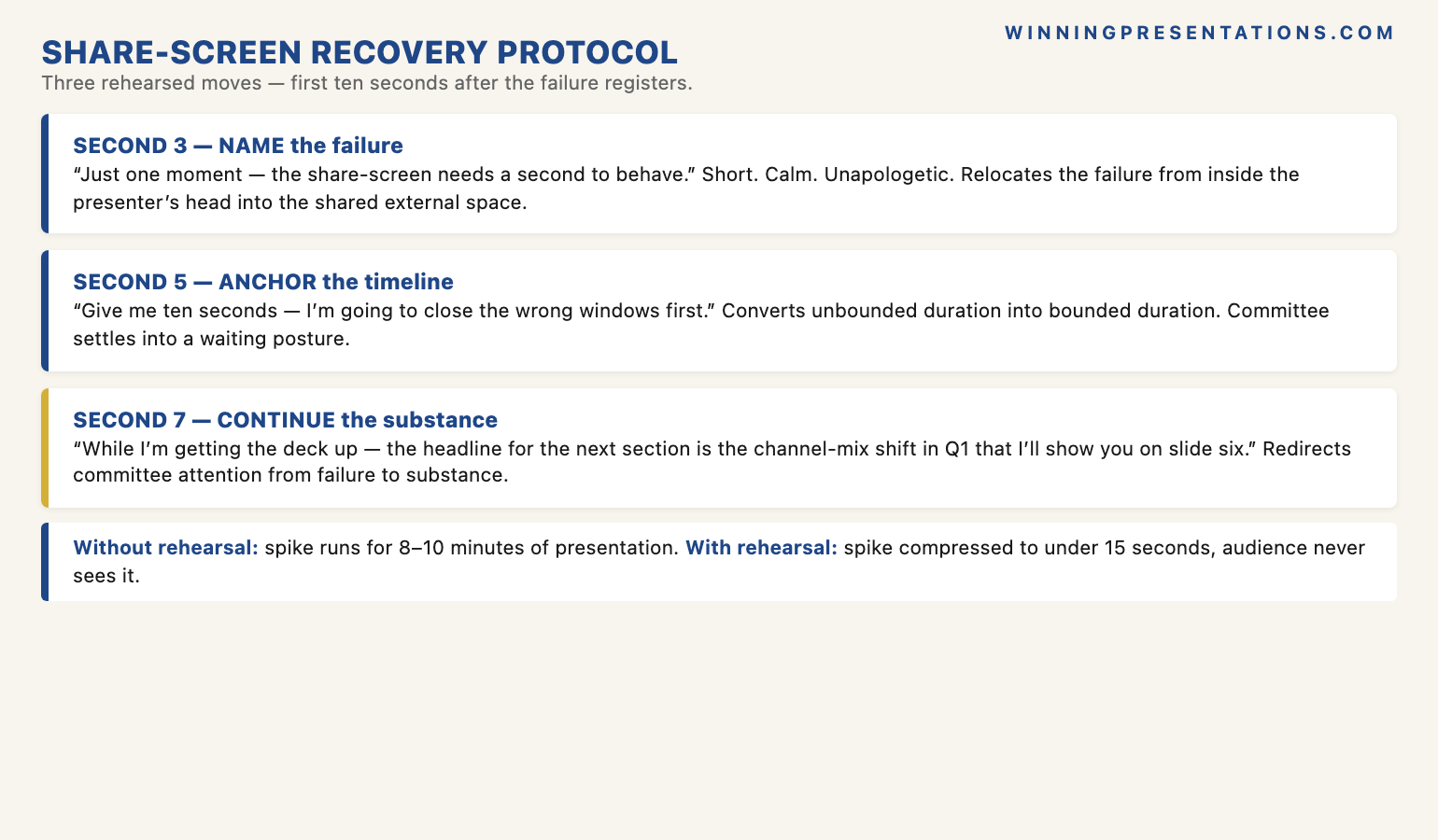
The recovery protocol is three moves executed in order in the first ten seconds after the share-screen failure registers. Move one is to name the failure aloud, calmly, in one short sentence: “Just one moment — the share-screen needs a second to behave.” Naming the failure aloud accomplishes two things at once: it confirms to the committee that the presenter is aware of the problem (which prevents the committee from filling the silence with their own speculation about what is going wrong), and it relocates the failure from inside the presenter’s head into the shared external space of the meeting, which reduces the competence-threat amplification by about half. The naming sentence has to be calm, short, and unapologetic. Apologies (“I’m so sorry, I can’t get this to work”) amplify the competence threat by signalling that the presenter is treating the failure as a serious capability gap; calm names treat it as a routine technical hiccup that the meeting can absorb.
Move two is to anchor the timeline with a bounded estimate. “Give me ten seconds, I’m going to close the wrong windows first and then bring up the deck.” The bounded estimate is what converts the unbounded duration into a bounded one. The committee now knows the failure has a ten-second endpoint and can settle into a waiting posture rather than continuing to speculate about whether the call is about to fall apart. The estimate does not need to be exactly accurate; it needs to be plausible. If the actual recovery takes fifteen seconds rather than ten, the committee will absorb the small overshoot without any change in their posture because the estimate established the bounded frame. If no estimate was given, the committee starts to wonder around second seven or eight whether the call is salvageable, and the wondering compounds the threat by producing visible attention drift the presenter will then see when they look up.
Move three is the continuation: the presenter explicitly continues the substantive content while resolving the technical problem in parallel. “While I’m getting the deck up, the headline for the next section is the channel-mix shift in Q1 that I’ll then show you on slide six.” The continuation is what prevents the share-screen failure from becoming a content interruption. The committee continues to receive the substantive thread of the presentation while the technical problem is resolved in the background. The presenter’s pace returns to baseline because they are talking about content they know rather than struggling with software they do not. The witness amplification reduces because the committee’s attention has been redirected from the failure to the substance. By the time the deck appears on screen, the committee’s attention is already where the deck needs it to be. The protocol takes about ten seconds and recovers the rest of the call. The mechanics of presenting effectively when the screen-share is the variable covers the upstream preparation that prevents many of the failures in the first place.
The structured framework for senior professionals who refuse to let virtual panic spikes derail high-stakes presentations.
Designed for senior professionals who present at the executive level — investor pitches, board reviews, committee approvals, partner sessions — the Conquer Your Fear of Public Speaking programme covers the structural anatomy of presentation anxiety and the rehearsed recovery protocols for the specific spike patterns that show up in virtual formats. Built on 24 years in corporate banking and 16 years coaching senior professionals across financial services, insurance, consulting, and technology. Self-paced video lessons, practical workbook, instant download, lifetime access. £39.
One thing to do before the next virtual presentation
The day before the next virtual presentation, run a five-minute share-screen rehearsal. Open the meeting platform, start a test session on your own, and deliberately practise the share-screen sequence three times: open the dialog, find the right window among the open ones, share, confirm the deck is visible, stop the share. Then deliberately fail the sequence once: pick the wrong window, watch yourself recover. On the failure, run the recovery protocol aloud: name the failure (“Just one moment — the share-screen needs a second to behave”), anchor the timeline (“Give me ten seconds”), and continue the substance (“While I’m getting the deck up, the headline for the next section is…”). The five-minute rehearsal is the difference between executing the protocol in real time under panic and trying to remember it from cold. If you walk into the next high-stakes virtual presentation having done the rehearsal, the can you see my screen moment becomes a fifteen-second pause that the room absorbs without consequence. If you walk in without it, the same moment becomes the eight minutes the funding round narrative was lost inside.
Frequently asked questions
I’ve been presenting on Zoom for five years and still get this panic spike — shouldn’t it have worn off by now?
The panic spike does not wear off with exposure because it is a response to a structural threat configuration that genuinely is present every time the share-screen moment occurs. Repeated exposure to a real threat does not desensitise the nervous system to it; what reduces the response is the rehearsed availability of a recovery move that the nervous system can default to. Presenters who have done thousands of Zoom calls without rehearsing the recovery protocol continue to experience the spike because they have never installed the alternative response. Presenters who have done dozens of calls but rehearsed the protocol three or four times stop experiencing the spike, because the nervous system reaches for the rehearsed response before the panic loop fully fires. Exposure alone is not the variable; rehearsed counter-response is. This is also why some otherwise very experienced senior presenters continue to dread the share-screen moment after years of virtual work — the dread is correct, and the only fix is the protocol.
What if the failure is genuinely catastrophic — the laptop crashes, the platform locks up, or I lose internet entirely?
The protocol still applies, with a longer timeline anchor. “Just one moment — the laptop has frozen and I’m going to need about a minute to restart. While I’m doing that, the headline for the next ten minutes of content is…” The structural function of the protocol is independent of how long the recovery actually takes; it converts the unbounded duration into a bounded one and continues the substantive thread in parallel. A one-minute laptop restart with the protocol in place is absorbed by the committee without consequence. A twenty-second screen-share fumble without the protocol can derail the rest of the call. The protocol scales with the size of the failure; the discipline is the same. The catastrophic failure also benefits from a phone-as-backup plan rehearsed in advance — dialling into the same call audio-only while the laptop restarts — which converts an apparent total failure into a recoverable interruption.
Does the recovery protocol work the same way on a hostile-room call as it does on a friendly one?
The protocol works the same way but the witness amplification is higher on hostile-room calls, which means the protocol matters more. On a friendly internal call, a fumbled share-screen recovers easily even without the protocol; the room is forgiving and the substantive content lands regardless. On a hostile call — an investor panel with one sceptical voice, a board with an opposing chair, a regulatory meeting with adverse counsel — the share-screen failure feeds the existing predisposition of the difficult attendees to discount the presenter’s position. The protocol’s job in the hostile case is to deny the difficult attendees the additional ammunition the unrecovered failure would have given them. The same three moves apply; the stakes of executing them well are higher.
If I know the protocol intellectually but still freeze in the moment, what am I missing?
Intellectual knowledge of the protocol is not enough; what matters is rehearsed availability under panic. The nervous system, under acute threat, does not reach for new information — it reaches for the most-rehearsed response in its repertoire. If the most-rehearsed response is the speed-up-and-apologise pattern from twenty previous failures, that is what the system will produce no matter what the conscious mind knows. The fix is to physically rehearse the protocol aloud, three or four times, in a deliberate failure scenario, in the days before the high-stakes call. The rehearsal installs the protocol in the same response layer that produces the freeze, which is the only layer that runs in real time when the panic fires. Reading the protocol in this article and walking into the next call without rehearsing it aloud will not change the outcome. Rehearsing it aloud once will change the outcome. Rehearsing it three times will change it reliably.
The Winning Edge — weekly newsletter
The Winning Edge is a weekly (Thursday) newsletter for senior professionals who present at the executive level. One short email a week, focused on the structural patterns behind the moments that derail senior presenters — panic spikes, hostile questions, hybrid attention drift, share-screen failures — and the rehearsed responses that resolve them quickly. Subscribe to The Winning Edge →
For the broader picture across slides, storytelling, confidence, and delivery, the Complete Presenter bundle of seven products is the single-resource bundle most senior professionals find useful as a one-time investment — £99, lifetime access, every product included.
About the author
Mary Beth Hazeldine is Owner & Managing Director of Winning Presentations Ltd. With 24 years of corporate banking experience at JPMorgan Chase, PwC, Royal Bank of Scotland, and Commerzbank, she works with senior professionals across financial services, insurance, consulting, and technology on the rehearsed recovery protocols that compress the panic spikes of high-stakes virtual presentations — share-screen failures, hostile questions, late deck swaps — from session-derailing events into fifteen-second resets the audience never sees.