
Board-Ready Executive Slide Templates: The 5-Section Structure Senior Leaders Use
Quick Answer
Board-ready slide templates work when they enforce a five-section decision flow: context, options, recommendation, risk, decision. Each section maps to one slide. Anything beyond those five lives in the appendix. Templates without that structure look polished but read as opinion. Templates with it read as a board paper that happens to be a deck.
On this page
Astrid had been a finance director for nine years before she chaired her first board paper. She inherited a 41-slide deck from her predecessor — beautiful, branded, full of tables. She added two slides and presented it. Forty minutes in, the chair tapped his pen and said, “I cannot find the recommendation. Where is it?”
Astrid found it on slide 33. The chair never turned to it. The vote was deferred.
The deck was not the problem. The structure was. The board had no map for navigating it. Polished slides without a decision-grade structure feel like a presentation given to the board. A board-ready deck is a presentation written for the way boards make decisions — and that decision flow is consistent across financial services, biotech, SaaS, and government.
If your board pack reads as a status update rather than a decision brief
A structured slide framework gives the chair a map. Board members stop hunting for the recommendation and start interrogating the case for it. That is the conversation you want.
Why most board templates fail in the room
Walk through any FTSE finance team’s shared drive and you will find the same artefact: a 30-slide template with a navy and gold cover, an “Executive Summary” slide, a project timeline, eight pages of detail, an “Appendix” tab, and a closing “Thank You” slide. Boards do not respond to that structure. Three reasons:
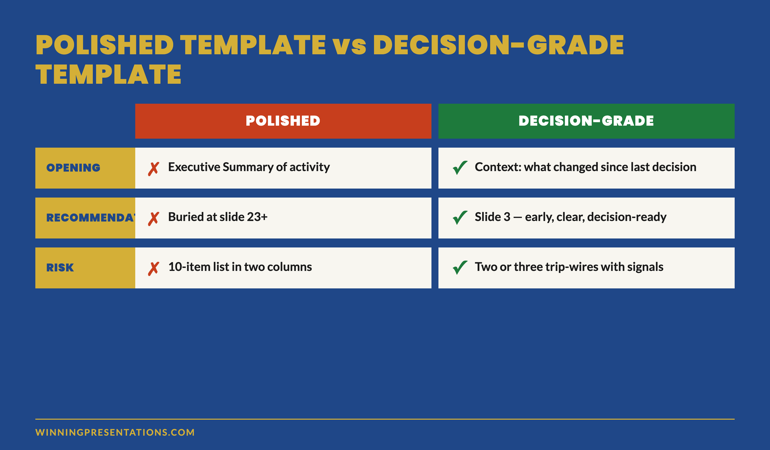
The “Executive Summary” is rarely a summary of a decision. It tends to be a summary of activity — what was done, what was found, what is planned. Boards do not approve activity. They approve recommendations. A deck that opens with activity puts the cognitive burden on the board to derive the recommendation from the data. Most chairs will not do that work in real time, and most decisions get deferred while the chair “reflects.”
Detail comes before decision. The standard template puts slides 5–22 in the body — context, market analysis, financials, scenarios, sensitivity tables. The recommendation arrives at slide 23 or later. By then, board members have already formed an opinion based on the detail. Whether that opinion matches your recommendation is a coin flip.
The risk slide is the wrong shape. Most templates include a “Risks & Mitigations” slide that lists six to ten items in two columns. Boards do not need a list. They need the two or three risks that could materially break the recommendation — and the specific point at which each one would force a re-vote.
The 5-section structure that boards trust
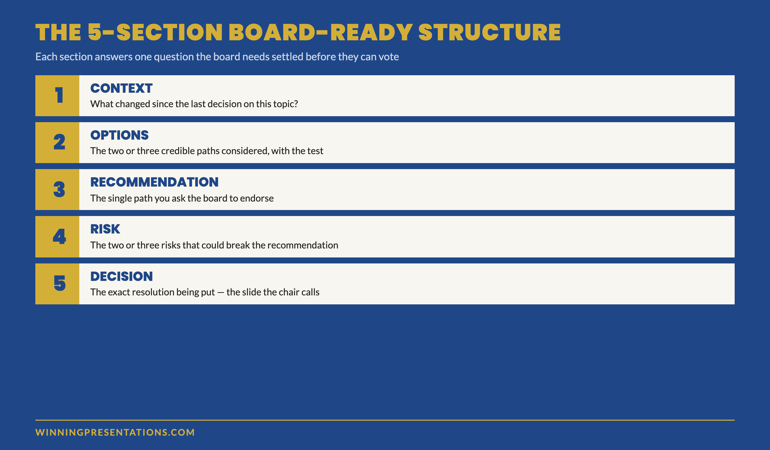
The structure that holds up across boardrooms — from credit committees to scientific advisory panels — is a five-section decision flow. Each section earns its slides by answering a single question the board needs settled before they can vote.
Section 1 — Context (1 slide). What changed since the last decision on this topic? Not “what is the market doing.” What new information forces this conversation now. Boards do not want background. They want the trigger.
Section 2 — Options (1 slide). The two or three credible paths considered, named clearly, with the criteria used to compare them. Not a long list. Boards want the shortlist and the test that produced it.
Section 3 — Recommendation (1 slide). The single path you are asking the board to endorse. The expected outcome stated as a process commitment, not an outcome guarantee. The investment, the timeline, and the decision required — all on one slide.
Section 4 — Risk (1 slide). The two or three risks that could materially break the recommendation. The specific signal that would trigger a return to the board. Boards approve recommendations more readily when they see the trip-wires already drawn.
Section 5 — Decision (1 slide). The exact wording of the resolution being put. The conditions attached. The timeline for the next reporting back. This is the slide the chair calls the vote on.
Five sections. Five primary slides. Everything else — supporting analysis, financial models, scenario tables, regulatory references — sits behind those five in an indexed appendix.
Build slides that get past slide 3
Stop assembling decks the night before the board meeting
- 26 templates covering board context slides, options matrices, recommendation pages, risk frames, and decision slides
- 93 AI prompts to draft executive copy fast — for ChatGPT or Copilot
- 16 scenario playbooks for common board situations: budget, strategic, performance, change
- Master checklist + framework reference — work in 30 minutes, not 3 hours
Executive Slide System — £39, instant access, 30-day refund if it does not fit your next board pack.
Get the Executive Slide System →
Designed for senior professionals in banking, biotech, SaaS, and government.
Section by section: what each slide must show
Context slide — the trigger, not the background
The mistake is to treat the context slide as a chance to reset shared memory. Boards do not need that. Most board members read the pre-read; the ones who didn’t will skim the deck during the meeting. What they need from the context slide is the answer to one question: why is this on the agenda now?
Three lines is enough. The change in the operating environment. The internal trigger (a target missed, a milestone reached, a covenant approached). The window in which a decision must be made. Anything more pushes the decision later in the deck and steals slides from where they matter.
Options slide — the shortlist with the test
Boards distrust a single option presented as the only sensible path. Even if the recommendation is obvious, the options slide proves that alternatives were considered and ruled out for stated reasons. Two or three options. The test used to compare them — financial return, risk profile, strategic fit, time to value. The two columns or three columns that show how each option scored on the test.
This slide is also where the board first sees the option you will recommend. The visual treatment should make it obvious which option you are about to put forward — bold border, brand colour, lead column. The board reads ahead; do not pretend the recommendation is a surprise.
Recommendation slide — process promise, not outcome guarantee
The recommendation slide is the one most often rewritten the night before. It is also the one boards remember. Three elements:
- The recommendation in one sentence — a verb, an object, a scope.
- The expected outcome stated as a process commitment (“Build the case for funding by Q3,” not “Secure £4.2M by Q3”).
- The decision the board is being asked to make — an exact resolution.
Process promises age well. Outcome guarantees do not. A senior professional once told a board their proposal would “deliver £8M in cost reduction within 12 months.” It delivered £6.4M. The board approved the next round anyway, but the chair raised the gap in every subsequent meeting for two years. The phrasing on a single slide created a narrative the work itself never escaped.
For senior leaders writing this slide for the first time, structured slide frames make the difference between a recommendation that reads as a request and one that reads as a decision-grade proposition. The Executive Slide System includes a recommendation page template that enforces process language and an exact-resolution line.
Risk slide — the trip-wires, drawn
The risk slide is not the place for a comprehensive list. Boards know operational risk lists exist; the risk officer files them. The board risk slide names the two or three risks that could break the recommendation and — critically — the signal that would trigger a return to the board. “Customer concentration above 35%” is a signal. “Market conditions change” is not.
Structuring the risk slide this way pre-empts the board’s instinct to add conditions to the approval. If the trip-wires are already drawn, the chair’s instinct shifts from “what conditions should we attach” to “do we accept these as the relevant trip-wires.” That is a faster vote.
Decision slide — the resolution and the next return
The final slide carries three things: the exact wording of the resolution being put, the conditions attached (if any), and the date the topic returns to the board. That date matters. A clean approval with a six-month return date reads as a decision. A clean approval with no return date reads as a sign-off — and chairs are increasingly reluctant to sign off without a follow-up commitment.
Appendix discipline: where everything else goes
The five-section structure forces a discipline most decks lack: anything that is not part of the decision flow goes into the appendix. The appendix is not a graveyard for material the team did not have time to integrate. It is an indexed reference that the chair or a board member can navigate to during Q&A.
Three rules for appendix discipline:
- Index by question, not topic. The appendix table of contents should read “If asked about competitor pricing — page 12. If asked about regulatory implications — page 18.” Board members search by their question, not by your topic structure.
- One concept per page. A multi-concept appendix page slows navigation. The chair flips three pages back to find the bullet that answers the question, by which time the moment has passed.
- Hyperlink the index. If the deck is shared as PDF, the index links should jump to the relevant page. Boards will not flip through a 40-page appendix to find a number; they will give up and move on.
Build the slide your CFO actually reads
If you are rebuilding board packs from scratch every quarter, the time cost is the silent killer. The Executive Slide System gives you 26 templates and 16 scenario playbooks for board, budget, performance, and strategic decisions — £39, instant access.
Get the Executive Slide System →
Designed for senior professionals presenting to boards, investment committees, and executive sponsors.
Frequently asked questions
How long should a board-ready deck be?
Five primary slides — one per section — plus an indexed appendix that can run to 30 or 40 pages without harm. The discipline is in the front five. A board pack with 8 primary slides usually has 3 it does not need; a pack with 12 has 7. If the chair has to scroll past a slide without commenting on it, the slide should not have been there.
What if our board explicitly asks for the financial detail in the body?
Then the financial detail belongs on a single page in section 3 (Recommendation), summarised to the three numbers the board cares about — investment, payback, sensitivity. The full model stays in the appendix. Some boards will push back on this discipline at first. After two cycles, most chairs prefer it because the meetings get shorter.
Does this work for non-financial decisions, like a strategic pivot or an organisational change?
Yes. The five sections are decision-shape, not finance-shape. A strategic pivot uses the same context-options-recommendation-risk-decision flow; the supporting evidence in the appendix is qualitative rather than quantitative. The structure also works for scientific advisory boards, regulatory submissions presented to a steering committee, and major procurement decisions.
How do I retrofit an existing 30-slide deck into the 5-section structure?
Open the existing deck and label every slide with the section it belongs to: Context, Options, Recommendation, Risk, Decision, or Appendix. Most slides will be appendix. Pull one slide for each of the five primary sections and write it from scratch — do not try to merge existing slides. The five new slides become the body; everything else moves to the appendix in the order it appeared.
The Winning Edge — weekly newsletter for senior presenters
One framework, one micro-story, one slide pattern — every Thursday morning, ten minutes’ read. For the senior professionals presenting to boards, investment committees, and executive sponsors who get my best material before it appears anywhere else.
Not ready for the full system? Start here instead: download the free Executive Presentation Checklist — a one-page reference for the five-section structure, with the questions to test each slide before the meeting.
For the next article in this batch on quarterly review structure, see the four-section quarterly review framework.
Mary Beth Hazeldine — Owner & Managing Director, Winning Presentations Ltd. With 24 years of corporate banking experience at JPMorgan Chase, PwC, Royal Bank of Scotland, and Commerzbank, she advises senior professionals across financial services, healthcare, technology, and government on structuring presentations for board approvals, funding rounds, and high-stakes stakeholder decisions.