Tag: senior leadership presentations

13 May 2026

Board-Ready Executive Slide Templates: The 5-Section Structure Senior Leaders Use

Quick Answer

Board-ready slide templates work when they enforce a five-section decision flow: context, options, recommendation, risk, decision. Each section maps to one slide. Anything beyond those five lives in the appendix. Templates without that structure look polished but read as opinion. Templates with it read as a board paper that happens to be a deck.

Astrid had been a finance director for nine years before she chaired her first board paper. She inherited a 41-slide deck from her predecessor — beautiful, branded, full of tables. She added two slides and presented it. Forty minutes in, the chair tapped his pen and said, “I cannot find the recommendation. Where is it?”

Astrid found it on slide 33. The chair never turned to it. The vote was deferred.

The deck was not the problem. The structure was. The board had no map for navigating it. Polished slides without a decision-grade structure feel like a presentation given to the board. A board-ready deck is a presentation written for the way boards make decisions — and that decision flow is consistent across financial services, biotech, SaaS, and government.

If your board pack reads as a status update rather than a decision brief

A structured slide framework gives the chair a map. Board members stop hunting for the recommendation and start interrogating the case for it. That is the conversation you want.

Explore the Executive Slide System →

Why most board templates fail in the room

Walk through any FTSE finance team’s shared drive and you will find the same artefact: a 30-slide template with a navy and gold cover, an “Executive Summary” slide, a project timeline, eight pages of detail, an “Appendix” tab, and a closing “Thank You” slide. Boards do not respond to that structure. Three reasons:

The “Executive Summary” is rarely a summary of a decision. It tends to be a summary of activity — what was done, what was found, what is planned. Boards do not approve activity. They approve recommendations. A deck that opens with activity puts the cognitive burden on the board to derive the recommendation from the data. Most chairs will not do that work in real time, and most decisions get deferred while the chair “reflects.”

Detail comes before decision. The standard template puts slides 5–22 in the body — context, market analysis, financials, scenarios, sensitivity tables. The recommendation arrives at slide 23 or later. By then, board members have already formed an opinion based on the detail. Whether that opinion matches your recommendation is a coin flip.

The risk slide is the wrong shape. Most templates include a “Risks & Mitigations” slide that lists six to ten items in two columns. Boards do not need a list. They need the two or three risks that could materially break the recommendation — and the specific point at which each one would force a re-vote.
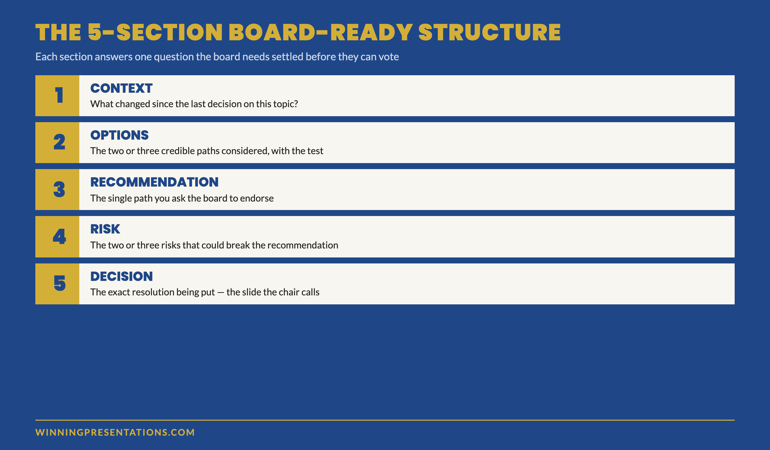
The 5-Section Board-Ready Structure infographic showing context, options, recommendation, risk and decision sections with the page positions in a typical 8-page board pack

The 5-section structure that boards trust

The structure that holds up across boardrooms — from credit committees to scientific advisory panels — is a five-section decision flow. Each section earns its slides by answering a single question the board needs settled before they can vote.

Section 1 — Context (1 slide). What changed since the last decision on this topic? Not “what is the market doing.” What new information forces this conversation now. Boards do not want background. They want the trigger.

Section 2 — Options (1 slide). The two or three credible paths considered, named clearly, with the criteria used to compare them. Not a long list. Boards want the shortlist and the test that produced it.

Section 3 — Recommendation (1 slide). The single path you are asking the board to endorse. The expected outcome stated as a process commitment, not an outcome guarantee. The investment, the timeline, and the decision required — all on one slide.

Section 4 — Risk (1 slide). The two or three risks that could materially break the recommendation. The specific signal that would trigger a return to the board. Boards approve recommendations more readily when they see the trip-wires already drawn.

Section 5 — Decision (1 slide). The exact wording of the resolution being put. The conditions attached. The timeline for the next reporting back. This is the slide the chair calls the vote on.

Five sections. Five primary slides. Everything else — supporting analysis, financial models, scenario tables, regulatory references — sits behind those five in an indexed appendix.

Build slides that get past slide 3

Stop assembling decks the night before the board meeting

  • 26 templates covering board context slides, options matrices, recommendation pages, risk frames, and decision slides
  • 93 AI prompts to draft executive copy fast — for ChatGPT or Copilot
  • 16 scenario playbooks for common board situations: budget, strategic, performance, change
  • Master checklist + framework reference — work in 30 minutes, not 3 hours

Executive Slide System — £39, instant access, 30-day refund if it does not fit your next board pack.

Get the Executive Slide System →

Designed for senior professionals in banking, biotech, SaaS, and government.

Section by section: what each slide must show

Context slide — the trigger, not the background

The mistake is to treat the context slide as a chance to reset shared memory. Boards do not need that. Most board members read the pre-read; the ones who didn’t will skim the deck during the meeting. What they need from the context slide is the answer to one question: why is this on the agenda now?

Three lines is enough. The change in the operating environment. The internal trigger (a target missed, a milestone reached, a covenant approached). The window in which a decision must be made. Anything more pushes the decision later in the deck and steals slides from where they matter.

Options slide — the shortlist with the test

Boards distrust a single option presented as the only sensible path. Even if the recommendation is obvious, the options slide proves that alternatives were considered and ruled out for stated reasons. Two or three options. The test used to compare them — financial return, risk profile, strategic fit, time to value. The two columns or three columns that show how each option scored on the test.

This slide is also where the board first sees the option you will recommend. The visual treatment should make it obvious which option you are about to put forward — bold border, brand colour, lead column. The board reads ahead; do not pretend the recommendation is a surprise.

Recommendation slide — process promise, not outcome guarantee

The recommendation slide is the one most often rewritten the night before. It is also the one boards remember. Three elements:

  • The recommendation in one sentence — a verb, an object, a scope.
  • The expected outcome stated as a process commitment (“Build the case for funding by Q3,” not “Secure £4.2M by Q3”).
  • The decision the board is being asked to make — an exact resolution.

Process promises age well. Outcome guarantees do not. A senior professional once told a board their proposal would “deliver £8M in cost reduction within 12 months.” It delivered £6.4M. The board approved the next round anyway, but the chair raised the gap in every subsequent meeting for two years. The phrasing on a single slide created a narrative the work itself never escaped.

For senior leaders writing this slide for the first time, structured slide frames make the difference between a recommendation that reads as a request and one that reads as a decision-grade proposition. The Executive Slide System includes a recommendation page template that enforces process language and an exact-resolution line.

Risk slide — the trip-wires, drawn

The risk slide is not the place for a comprehensive list. Boards know operational risk lists exist; the risk officer files them. The board risk slide names the two or three risks that could break the recommendation and — critically — the signal that would trigger a return to the board. “Customer concentration above 35%” is a signal. “Market conditions change” is not.

Structuring the risk slide this way pre-empts the board’s instinct to add conditions to the approval. If the trip-wires are already drawn, the chair’s instinct shifts from “what conditions should we attach” to “do we accept these as the relevant trip-wires.” That is a faster vote.
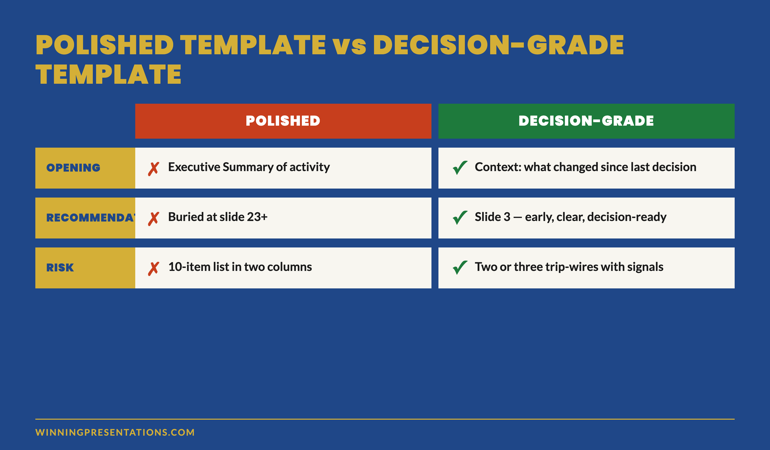
Board Pack Structure: Polished Template vs Decision-Grade Template comparison showing the structural differences side by side across cover, summary, recommendation position and risk format

Decision slide — the resolution and the next return

The final slide carries three things: the exact wording of the resolution being put, the conditions attached (if any), and the date the topic returns to the board. That date matters. A clean approval with a six-month return date reads as a decision. A clean approval with no return date reads as a sign-off — and chairs are increasingly reluctant to sign off without a follow-up commitment.

Appendix discipline: where everything else goes

The five-section structure forces a discipline most decks lack: anything that is not part of the decision flow goes into the appendix. The appendix is not a graveyard for material the team did not have time to integrate. It is an indexed reference that the chair or a board member can navigate to during Q&A.

Three rules for appendix discipline:

  1. Index by question, not topic. The appendix table of contents should read “If asked about competitor pricing — page 12. If asked about regulatory implications — page 18.” Board members search by their question, not by your topic structure.
  2. One concept per page. A multi-concept appendix page slows navigation. The chair flips three pages back to find the bullet that answers the question, by which time the moment has passed.
  3. Hyperlink the index. If the deck is shared as PDF, the index links should jump to the relevant page. Boards will not flip through a 40-page appendix to find a number; they will give up and move on.

Build the slide your CFO actually reads

If you are rebuilding board packs from scratch every quarter, the time cost is the silent killer. The Executive Slide System gives you 26 templates and 16 scenario playbooks for board, budget, performance, and strategic decisions — £39, instant access.

Get the Executive Slide System →

Designed for senior professionals presenting to boards, investment committees, and executive sponsors.

Frequently asked questions

How long should a board-ready deck be?

Five primary slides — one per section — plus an indexed appendix that can run to 30 or 40 pages without harm. The discipline is in the front five. A board pack with 8 primary slides usually has 3 it does not need; a pack with 12 has 7. If the chair has to scroll past a slide without commenting on it, the slide should not have been there.

What if our board explicitly asks for the financial detail in the body?

Then the financial detail belongs on a single page in section 3 (Recommendation), summarised to the three numbers the board cares about — investment, payback, sensitivity. The full model stays in the appendix. Some boards will push back on this discipline at first. After two cycles, most chairs prefer it because the meetings get shorter.

Does this work for non-financial decisions, like a strategic pivot or an organisational change?

Yes. The five sections are decision-shape, not finance-shape. A strategic pivot uses the same context-options-recommendation-risk-decision flow; the supporting evidence in the appendix is qualitative rather than quantitative. The structure also works for scientific advisory boards, regulatory submissions presented to a steering committee, and major procurement decisions.

How do I retrofit an existing 30-slide deck into the 5-section structure?

Open the existing deck and label every slide with the section it belongs to: Context, Options, Recommendation, Risk, Decision, or Appendix. Most slides will be appendix. Pull one slide for each of the five primary sections and write it from scratch — do not try to merge existing slides. The five new slides become the body; everything else moves to the appendix in the order it appeared.

The Winning Edge — weekly newsletter for senior presenters

One framework, one micro-story, one slide pattern — every Thursday morning, ten minutes’ read. For the senior professionals presenting to boards, investment committees, and executive sponsors who get my best material before it appears anywhere else.

Subscribe to The Winning Edge →

Not ready for the full system? Start here instead: download the free Executive Presentation Checklist — a one-page reference for the five-section structure, with the questions to test each slide before the meeting.

For the next article in this batch on quarterly review structure, see the four-section quarterly review framework.

Mary Beth Hazeldine — Owner & Managing Director, Winning Presentations Ltd. With 24 years of corporate banking experience at JPMorgan Chase, PwC, Royal Bank of Scotland, and Commerzbank, she advises senior professionals across financial services, healthcare, technology, and government on structuring presentations for board approvals, funding rounds, and high-stakes stakeholder decisions.

28 Apr 2026
Man in a navy suit stands at the head of a conference table addressing colleagues in a boardroom with a city skyline outside the window? (informative)

Senior Stakeholder Management Presentation Skills: How to Influence Decision-Makers at Board Level

Quick Answer

Senior stakeholder management presentation skills determine whether your recommendation is approved, deferred, or quietly shelved. The difference between executives who consistently secure buy-in and those who face repeated deferrals is rarely the quality of the analysis — it is the ability to map the room, pre-align key decision-makers, structure an argument that addresses competing priorities, and handle objections without losing the thread. These are learnable skills that follow a structural logic most professionals have never been taught.

Beatriz had spent three months building the business case for a regional expansion across Southern Europe. The analysis was thorough — market sizing, competitive landscape, regulatory mapping, a detailed financial model with three scenarios. When she presented to the investment committee, the CFO interrupted on slide six to ask whether the working capital requirement had been stress-tested against the group’s existing covenant structure. It had — on slide twenty-two. The Chief Operating Officer wanted to know about local hiring timelines. That was in the appendix. The committee chair, who had seemed supportive in corridor conversations, said nothing at all. The proposal was deferred for further review, which in practice meant it would compete with the next quarter’s priorities and likely lose. Beatriz had built the right case. She had presented it to the wrong version of the room — the version she imagined rather than the one that actually existed, with its competing concerns, unspoken priorities, and pre-formed positions she had never mapped.

Preparing a high-stakes presentation that requires executive buy-in? The Executive Buy-In Presentation System teaches the complete framework for structuring presentations that secure approval from senior decision-makers. Explore the Programme →

Why Senior Stakeholder Presentations Fail at Board Level

The most common reason a stakeholder management presentation fails is that the presenter treats the room as a single audience. A board or investment committee is not one audience — it is a collection of individuals with different mandates, different risk tolerances, and different definitions of what constitutes a good decision. The CFO evaluates financial exposure. The COO assesses operational feasibility. Non-executive directors look for governance risk. The chair is often managing a broader agenda that includes priorities the presenter knows nothing about.

When a presenter builds one argument for this collection of perspectives, the result is a presentation that partially satisfies everyone and fully convinces no one. The analysis might be sound, the recommendation might be correct, but the structure fails because it does not address what each stakeholder needs to hear in order to support the decision.

A second failure pattern is the assumption that the presentation itself is where the decision is made. In most board-level settings, the formal presentation is closer to a ratification event than a persuasion opportunity. The actual influencing happens before the meeting — in one-to-one conversations, in pre-reads, in the informal exchanges that shape a stakeholder’s position before they sit down. Executives who rely solely on the quality of their slides are operating with only part of the influence system.

The third pattern is failing to anticipate the objections that will arise from each stakeholder’s specific mandate. Understanding the psychology behind stakeholder buy-in reveals that objections are rarely about the content itself — they are about the stakeholder’s need to demonstrate due diligence in their area of responsibility. A finance director who does not challenge the cost assumptions is not doing their job. A risk committee chair who does not probe the downside scenario is failing in their governance role. Anticipating these challenges is not pessimism — it is stakeholder literacy.

Frameworks for Stakeholder Alignment

Effective stakeholder alignment begins with a structured map of the decision landscape. Before building a single slide, the presenter needs to answer four questions about every stakeholder who will be in the room: What is their primary concern? What would cause them to object? What would make them actively support the recommendation? And what is their relationship to the other stakeholders in the room?

The first framework is priority mapping. Each stakeholder operates within a mandate that determines what they pay attention to. A Chief Financial Officer will evaluate any proposal through the lens of capital allocation, return on investment, and covenant compliance. A Chief Technology Officer will assess technical feasibility and integration risk. Mapping these priorities before the presentation allows the structure to address each one explicitly rather than hoping the general argument covers them all.

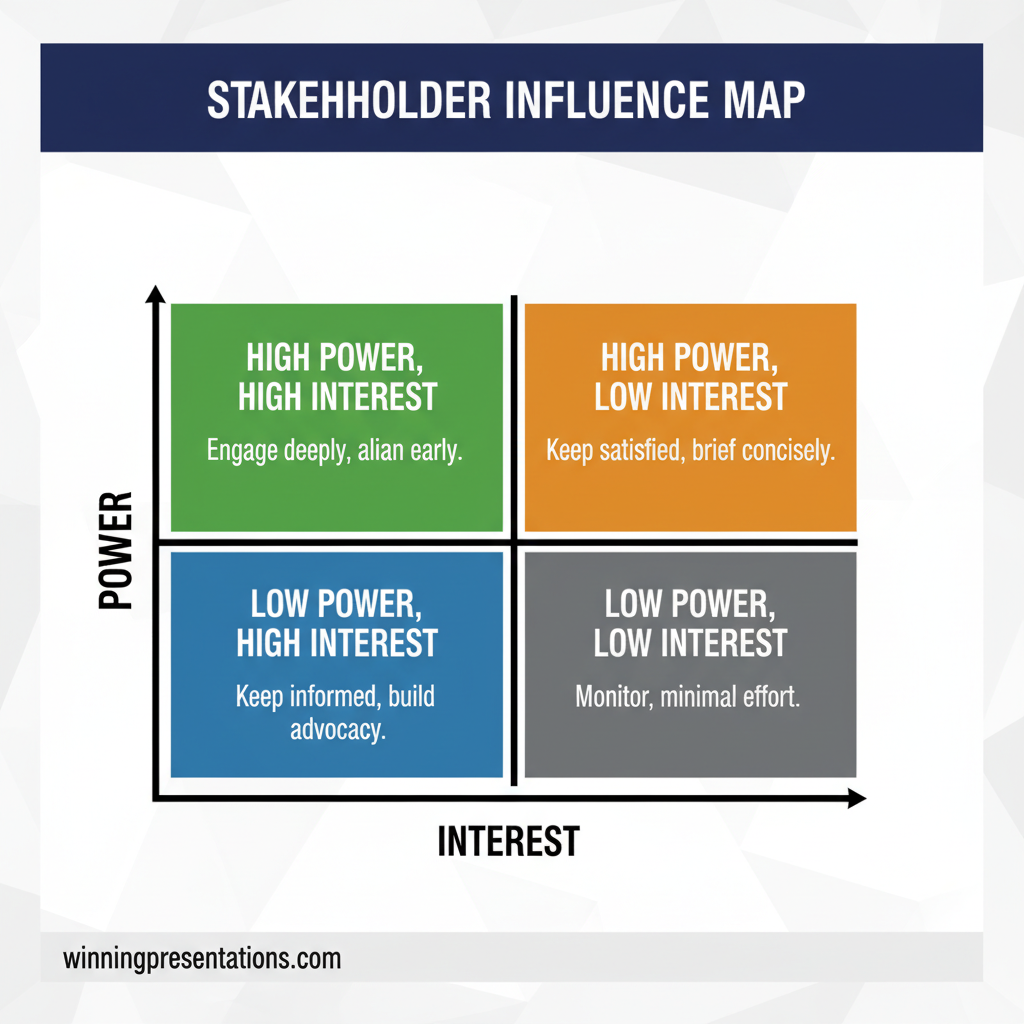
The second framework is influence architecture. Not all stakeholders carry equal weight in a decision. In most boardroom settings, one or two voices carry disproportionate influence — the committee chair, the longest-serving non-executive, or the person who most recently experienced a failure in the area under discussion. Identifying these influence centres and structuring the argument to address their specific concerns first is not manipulation — it is strategic communication. A presentation that wins the support of the two most influential voices in the room is more likely to succeed than one that distributes its persuasion effort equally across all attendees.

The third framework is concession mapping. Before entering the room, experienced presenters identify what they are willing to concede and what is non-negotiable. This is not a defensive posture — it is preparation for the negotiation that high-stakes presentations inevitably become. Knowing in advance that you can offer a phased implementation timeline but cannot reduce the budget below a certain threshold gives you structured flexibility rather than improvised compromise.

Understanding how to build a board presentation structure that accommodates these multiple stakeholder perspectives is the bridge between strategic analysis and practical execution.

Secure Executive Buy-In With a Structured Framework

The Executive Buy-In Presentation System is a self-paced programme that teaches the complete framework for structuring presentations that win approval from senior stakeholders. £499 — new cohorts open monthly, with optional Q&A calls (all recorded).

  • ✓ Stakeholder mapping and influence architecture frameworks
  • ✓ Decision-framing techniques for board-level audiences
  • ✓ Objection anticipation and handling strategies
  • ✓ Self-paced modules with optional live Q&A calls (recorded)

Explore the Programme →

Self-paced · new cohorts monthly · designed for senior executives

Infographic showing three stakeholder alignment frameworks: priority mapping, influence architecture, and concession mapping — with key questions for each

Objection Handling in Board Settings

Board-level objections are fundamentally different from the pushback you encounter in team meetings or management presentations. In a boardroom, objections serve a governance function. Non-executive directors are required to challenge — it is part of their fiduciary duty. A proposal that receives no challenge is more likely to concern the chair than one that generates robust questioning. Understanding this dynamic changes how you prepare for and respond to objections.

The first principle of board-level objection handling is anticipation over reaction. For every stakeholder in the room, you should be able to predict their most likely objection based on their mandate and their known concerns. A finance director will challenge the cost assumptions. A risk committee member will probe the downside scenario. The chair may raise a timing concern related to other strategic priorities. Preparing a structured response to each anticipated objection — with supporting data readily accessible — transforms what feels like an attack into a demonstration of thoroughness.

The second principle is acknowledgement before response. When a senior stakeholder raises an objection, the instinct to defend immediately is strong — and almost always counterproductive. Acknowledging the concern first (“That is a valid concern, and it is one we have modelled explicitly”) signals that you have taken the stakeholder’s perspective seriously before you present your response. This sequence — acknowledge, validate, respond with evidence — reduces the adversarial dynamic and repositions the exchange as collaborative problem-solving.

The third principle is structured concession. Not every objection requires you to hold your ground. Some objections are invitations to negotiate, and the ability to concede on secondary points while holding firm on the core recommendation is a skill that distinguishes experienced boardroom presenters from those who treat every challenge as an attack on their proposal. Knowing which elements are negotiable — and preparing those concessions in advance — gives you the flexibility to accommodate concerns without undermining the recommendation.

For a deeper exploration of how alignment conversations before the meeting shape the objection landscape during it, the guide on stakeholder alignment presentation training covers the pre-meeting strategies that reduce the intensity and unpredictability of boardroom challenges.

The Executive Buy-In Presentation System teaches these objection-handling frameworks as part of its structured approach to securing approval from senior decision-makers.

Building Pre-Meeting Alignment

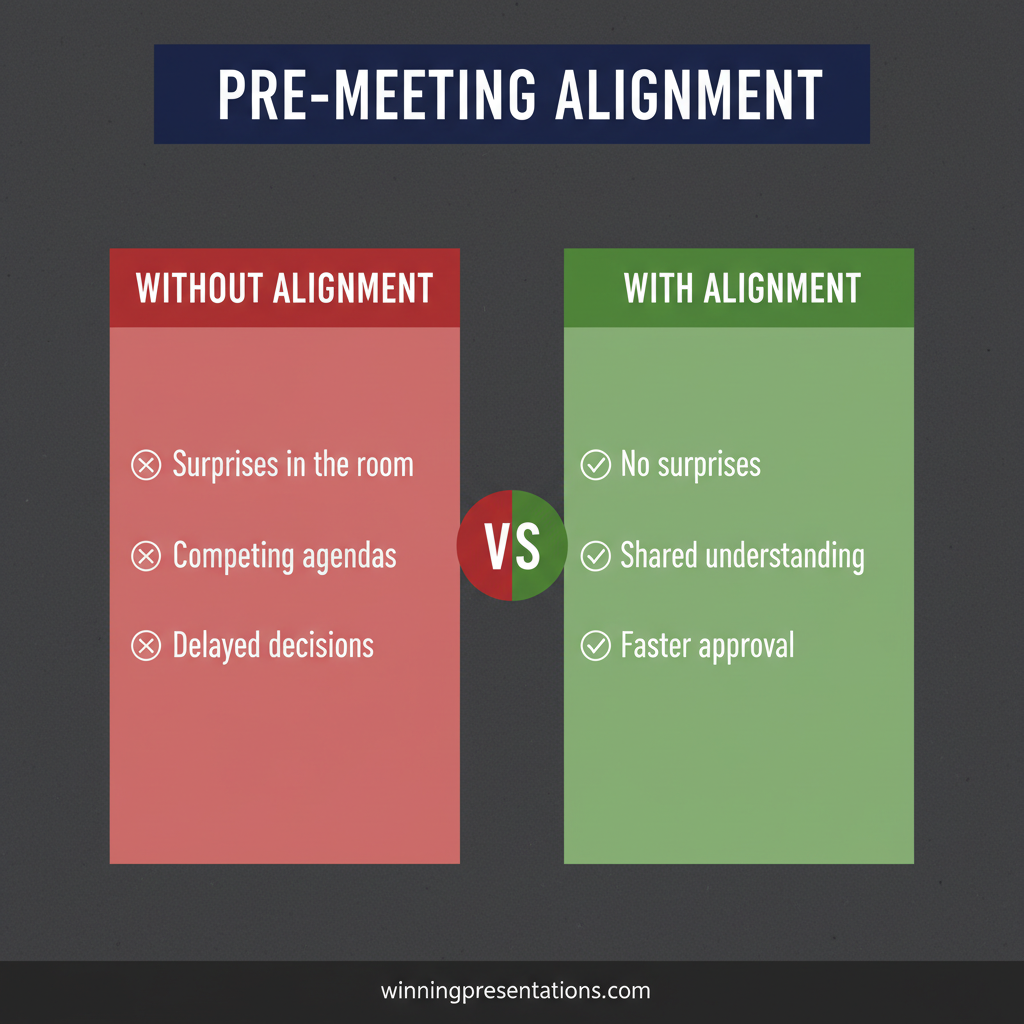
The most effective approach to presenting to senior stakeholders begins weeks before the presentation itself. Pre-meeting alignment is the process of having individual conversations with key stakeholders to understand their concerns, incorporate their perspective into the materials, and build informal support for the recommendation before the formal meeting takes place.

This is not lobbying. It is intelligence gathering and relationship management. A fifteen-minute conversation with the CFO before the board meeting — in which you share the headline financial assumptions and ask whether anything concerns them — achieves two things simultaneously. First, it surfaces objections you can address in the presentation rather than being caught off guard. Second, it signals respect for the CFO’s expertise, which makes them more likely to be constructive rather than adversarial in the formal setting.

The timing matters. For significant decisions, the optimal window is two to three weeks before the formal presentation — early enough to make meaningful changes, late enough that the proposal is sufficiently developed to discuss credibly.

The structure of the pre-meeting conversation follows a specific pattern. Open with the headline recommendation. Share the one or two data points most relevant to that stakeholder’s mandate. Ask directly: “Is there anything in this approach that concerns you?” Then listen. The purpose is to understand, not to sell. The persuasion happens when you incorporate their feedback into the presentation and they see that their perspective has been taken seriously.

Turn Stakeholder Complexity Into a Structured Advantage

The Executive Buy-In Presentation System covers the full influence process — from stakeholder mapping through pre-meeting alignment to boardroom delivery. Self-paced, with optional Q&A calls (recorded). £499.

Explore the Programme →

Self-paced · new cohorts open monthly · all sessions recorded

Measuring Influence Effectiveness

Stakeholder influence is difficult to measure because the most important outcomes are often invisible. Nevertheless, there are practical indicators that allow you to assess whether your ability to influence senior stakeholders through presentations is improving over time.

The first indicator is objection predictability. If the objections raised during the presentation are ones you anticipated and prepared for, your stakeholder mapping is working. If the challenges come from directions you did not expect, it signals a gap in your understanding of the room’s priorities. Over multiple presentations, tracking the ratio of anticipated to unanticipated objections provides a clear measure of your stakeholder literacy.

The second indicator is decision velocity. Decisions that are approved in the first meeting represent a different level of influence effectiveness than decisions that require multiple presentations, revised papers, and additional committee sessions. If your proposals consistently require follow-up sessions, the issue is likely structural — either the argument is not framed clearly enough for a first-meeting decision, or the pre-meeting alignment was insufficient to build the support needed for immediate approval.

The third indicator is stakeholder feedback quality. When senior stakeholders engage with constructive, specific questions rather than broad, sceptical challenges, it indicates the presentation has earned their intellectual respect. “Have you considered the impact on the European subsidiary?” is qualitatively different from “I am not sure this has been fully thought through.” The former suggests engagement; the latter suggests the argument has not landed.

For presentations involving significant capital expenditure or technology investment, the structural requirements are even more demanding. The guide on technology investment presentations applies these same stakeholder management principles to one of the most challenging approval scenarios — where technical complexity and financial risk intersect in front of a non-technical board.

Infographic showing three indicators of influence effectiveness: objection predictability, decision velocity, and stakeholder feedback quality — with measurement approaches

Frequently Asked Questions

What is the difference between stakeholder management and stakeholder engagement?

Stakeholder management is the strategic process of identifying, analysing, and influencing the people who have decision-making authority over your initiative. Stakeholder engagement is the broader relationship-building activity that supports it. In presentation contexts, the distinction matters because management requires you to map power dynamics, anticipate objections, and structure your argument around what each stakeholder needs to hear — not simply keep them informed. Effective presentations to senior stakeholders are built around the decision architecture of the room, while engagement activities happen before and after the formal presentation itself.

How do you handle conflicting stakeholder priorities in a single presentation?

When stakeholders in the room hold different priorities — a CFO focused on cost containment and a CTO focused on capability — the presentation must acknowledge both without appearing to favour one. The most effective approach is to frame the recommendation in terms that satisfy the shared objective (usually organisational risk reduction or strategic positioning) and then address each stakeholder’s specific concern in dedicated sections. Pre-meeting alignment conversations reduce the likelihood of open conflict during the presentation, but the structure must still accommodate divergent priorities visibly.

How far in advance should you begin stakeholder alignment before a board presentation?

For significant decisions — budget approvals, strategic pivots, organisational restructures — stakeholder alignment should begin at least two to three weeks before the formal presentation. This allows time for individual conversations with key decision-makers, the incorporation of their concerns into your materials, and the informal building of support before the formal meeting. Attempting to align stakeholders in the room itself is one of the most common causes of deferred decisions at board level.

Can stakeholder management presentation skills be learned online?

The structural and strategic elements of presenting to senior stakeholders — stakeholder mapping, objection anticipation, pre-meeting alignment frameworks, and decision architecture — can be learned effectively through self-paced online programmes. The Executive Buy-In Presentation System, for example, teaches the complete framework for securing executive-level buy-in through structured modules that cover stakeholder analysis, persuasion architecture, and objection handling. The advantage of self-paced learning is that participants can apply each framework to their own real stakeholder scenarios as they progress, rather than practising on hypothetical cases.

Join The Winning Edge

Weekly strategies for executive presentations, stakeholder influence, and board-level communication — delivered every Thursday.

Subscribe to The Winning Edge →

Your next step: Before your next high-stakes presentation, map every stakeholder who will be in the room. Write down their primary concern, their most likely objection, and the one thing that would make them actively support your recommendation. Then have a fifteen-minute conversation with the two most influential voices before the meeting. That single action will change what happens when you present.

Mary Beth Hazeldine | Owner & Managing Director, Winning Presentations. With 24 years of corporate banking experience at JPMorgan Chase, PwC, Royal Bank of Scotland, and Commerzbank, she advises executives across financial services, healthcare, technology, and government on structuring presentations for high-stakes funding rounds and approvals.

25 Jan 2026
Professional woman presenting confidently to senior leadership in a boardroom, projecting calm authority

Presenting to Senior Leadership: How to Sound Calm and Credible

The CEO leaned back in his chair. I was three sentences into my presentation, and I could already feel my voice starting to shake.

I knew my material. I’d rehearsed for hours. But none of that mattered—because the moment I saw seven senior executives staring at me, my body decided this was a survival situation.

Quick answer: Presenting to senior leadership triggers a specific kind of anxiety—not just fear of public speaking, but fear of being judged by people who control your career. The solution isn’t more preparation or “power poses.” It’s rewiring the automatic responses that make you sound nervous even when you know your content cold. This article shows you the exact techniques that create calm authority under executive scrutiny.

When you can present calmly to senior leadership:

  • Your recommendations get taken seriously (not dismissed as “nervous energy”)
  • You’re trusted with higher-stakes opportunities
  • You stop dreading the meetings that could advance your career

Written by Mary Beth Hazeldine — Owner & Managing Director of Winning Presentations, qualified clinical hypnotherapist, and someone who spent 5 years terrified of presenting before discovering what actually works. Last updated: January 2026.

🚨 Presenting to LEADERSHIP this week? Use this 60-second reset:

  1. Before you enter: 3 slow breaths (4 counts in, 7 counts out)
  2. First sentence: Speak 30% slower than feels natural
  3. Eye contact: Pick ONE friendly face for your first 10 seconds

This won’t eliminate nerves—but it will prevent them from showing.

These techniques have been used by senior professionals presenting to CFOs, MDs, and Executive Committees in high-stakes approval meetings—the same situations where careers are made or stalled.

→ Want the complete system for calm executive presence? Get Conquer Speaking Fear (£39) — includes the pre-meeting protocol and in-the-moment techniques.

📅 Have a leadership presentation in the next 7 days?

The techniques in this article take one focused practice session to internalise. Most professionals report feeling noticeably calmer in their very next executive presentation.

That presentation to the CEO? I got through it. But I could hear how shaky I sounded. I watched my credibility drain away with every rushed sentence and nervous hedge.

Afterward, a colleague took me aside. “You knew your stuff,” she said. “But you didn’t sound like you believed it.”

She was right. And that’s when I realised: presenting to senior leadership isn’t about knowing more. It’s about appearing calm enough for them to trust what you know.

Over the next five years, I studied everything—from nervous system regulation to clinical hypnotherapy—to understand why some people project calm authority while others (like me) fell apart under executive scrutiny. What I discovered changed not just my presentations, but my entire career.

Why Senior Leadership Presentations Feel Different

You might present confidently to your team, your peers, even large audiences. But the moment you’re in front of the C-suite, something shifts.

This isn’t weakness. It’s biology.

The “Evaluation Threat” Response

Research on social stress shows that being evaluated by high-status individuals triggers a stronger threat response than almost any other social situation. Your brain registers senior leaders not just as an audience, but as people who can affect your livelihood.

This activates the sympathetic nervous system—the same fight-or-flight response you’d have if facing physical danger. Blood flows away from your prefrontal cortex (where clear thinking happens) and toward your muscles (preparing you to run).

The result: you know your material, but you can’t access it smoothly. Words come out wrong. You rush. You hedge. You sound exactly as nervous as you feel.

📚 Research note: The “social evaluative threat” response is well-documented in stress research. The Trier Social Stress Test—which simulates evaluation by high-status observers—consistently produces stronger cortisol spikes than other stressors. Studies on anxiety and working memory show that threat-state arousal specifically impairs verbal fluency and recall, explaining why you can “know” your material but struggle to access it under scrutiny.

The Stakes Amplifier

When presenting to senior leadership, the stakes feel magnified because they often are:

  • Career advancement decisions get made based on these impressions
  • Budget approvals depend on your perceived competence
  • Your reputation with decision-makers is being established

Your nervous system isn’t overreacting. It’s responding accurately to a high-stakes situation. The problem is that the response—rushing, hedging, avoiding eye contact—undermines the very outcome you’re trying to achieve.

For more on managing nerves, see the 5-minute reset that actually works.

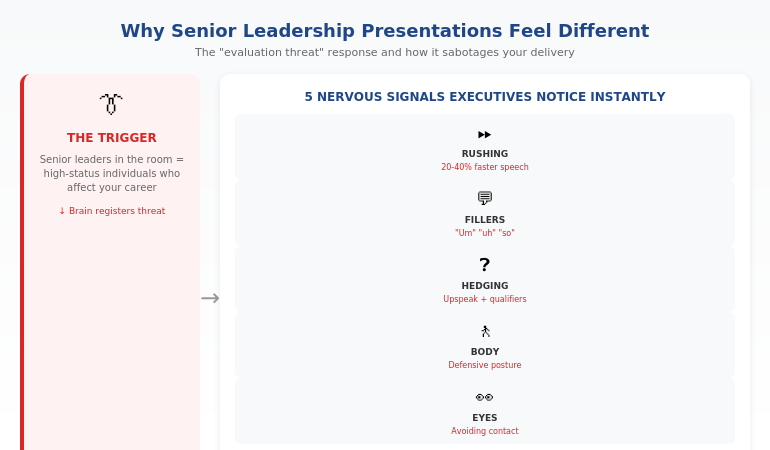
Diagram showing the evaluation threat response when presenting to senior leadership and how it affects your voice, body language, and thinking

The 5 Nervous Signals Executives Notice Instantly

Senior leaders have sat through thousands of presentations. They’ve developed an unconscious radar for nervousness—and when they detect it, they discount what you’re saying.

Here’s what they notice before you’ve finished your first sentence:

Signal 1: Speech Speed

Nervous presenters rush. They speak 20-40% faster than their normal conversational pace, cramming words together as if trying to finish before something bad happens.

Executives interpret this as: “They’re not confident in what they’re saying” or “They’re trying to get through this before I can ask questions.”

The tell: If you finish your opening faster than you did in rehearsal, you’re rushing.

Signal 2: Filler Words

“Um,” “uh,” “so,” “like,” “you know”—these multiply under pressure. One or two are human. A pattern of them signals that you’re searching for words because anxiety is blocking access to your prepared content.

The tell: Filler words cluster at the beginning of sentences and during transitions.

Signal 3: Upspeak and Hedging

Ending statements as questions (“We should invest in this initiative?”) or adding hedges (“I think maybe we could potentially consider…”) signals uncertainty.

Senior leaders want confident recommendations. When you hedge, they hear: “I’m not sure about this, and neither should you be.”

The tell: Your voice rises at the end of declarative statements.

Signal 4: Defensive Body Language

Crossed arms, hands in pockets, weight shifting from foot to foot, avoiding the centre of the room—all signal discomfort.

Executives read this as: “They don’t want to be here” or “They’re hiding something.”

The tell: You’re standing differently than you would in a casual conversation with friends.

Signal 5: Eye Contact Avoidance

Looking at your slides, at the floor, at the back wall—anywhere but at the people you’re presenting to.

This is the most damaging signal because it breaks connection. When you avoid eye contact, it makes trust harder to establish—executives instinctively wonder what you’re uncertain about.

The tell: You’re not sure what colour eyes the most senior person in the room has.

⭐ Stop the Nervous Signals Before They Start

Conquer Speaking Fear gives you the techniques to rewire these automatic responses—so you project calm authority even when your nervous system is screaming.

What’s inside:

  • The pre-presentation protocol that calms your nervous system in 5 minutes
  • In-the-moment techniques for each of the 5 nervous signals
  • The “recovery moves” when nerves spike mid-presentation

Get Conquer Speaking Fear → £39

Developed from clinical hypnotherapy training and 5 years of personal research into presentation anxiety.

How to Project Calm Authority (Even When You’re Not Calm)

The goal isn’t to eliminate nervousness—that’s unrealistic for high-stakes situations. The goal is to prevent nervousness from showing.

The key insight: calm is a behaviour, not a feeling. You can act calm while feeling anxious—and when you act calm, executives perceive you as calm.

Here’s how:

Technique 1: The Deliberate Pause

When you feel the urge to rush, do the opposite: pause.

Before your first sentence, take a breath. Between major points, pause for a full second. When asked a question, pause before answering.

Pauses feel eternal to you but appear confident to your audience. Senior leaders interpret pauses as: “This person is thoughtful and in control.”

Practice: Rehearse with intentional 2-second pauses after every third sentence. It will feel awkward. It will look authoritative.

Technique 2: Lower Your Vocal Register

Anxiety raises your pitch. A higher voice signals stress to listeners at a subconscious level.

Before you speak, hum quietly at the lowest comfortable note in your range. This primes your voice to start lower.

When presenting, imagine you’re speaking from your chest rather than your throat. The difference is subtle but powerful.

Practice: Record yourself presenting. If your pitch rises during key moments, consciously drop it in your next rehearsal.

Technique 3: Strategic Eye Contact

Don’t try to make eye contact with everyone—that’s overwhelming. Instead, use the “triangle technique.”

Identify three people in the room: one friendly face, one neutral, one who seems skeptical. Rotate your eye contact among these three, spending 5-7 seconds with each.

This creates the impression of confident engagement without the cognitive load of tracking everyone.

Practice: In your next meeting (even a low-stakes one), practice the triangle. Notice how it changes your sense of connection.

Technique 4: The “Grounded Stance”

Plant your feet shoulder-width apart. Feel your weight distributed evenly. Keep your hands visible—either at your sides or gesturing naturally.

This physical stability creates psychological stability. When your body feels grounded, your mind follows.

Practice: Stand in the grounded stance for 60 seconds before your presentation. Notice how it changes your breathing.

Technique 5: The First Sentence Anchor

Memorise your first sentence word-for-word. Not your whole opening—just the first sentence.

When anxiety is highest (the first 30 seconds), you need something you can deliver automatically. A memorised first sentence gives you that anchor.

Practice: Say your first sentence 20 times until it requires zero thought. Then trust it in the room.

For more on building lasting confidence, see why “fake it till you make it” doesn’t work.

Want all 5 techniques plus the complete pre-presentation protocol? Conquer Speaking Fear (£39) includes step-by-step implementation guides for each one.

Before, During, and After: The Complete Protocol

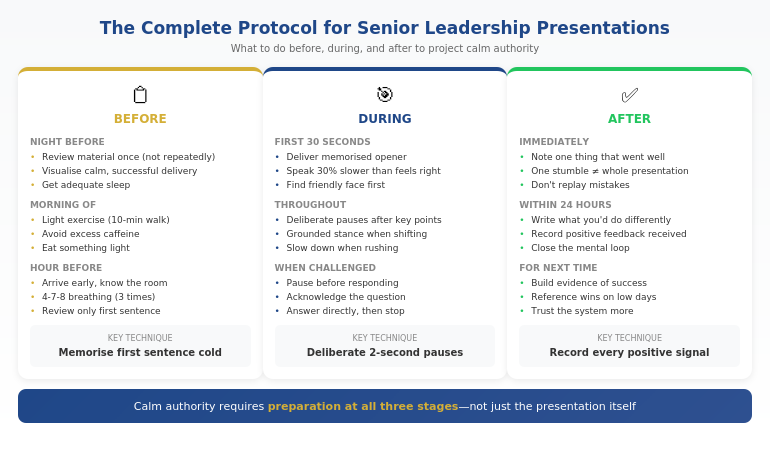
Calm authority when presenting to senior leadership requires preparation at three stages:

Before: The 24-Hour Protocol

The night before:

  • Review your material once (not repeatedly—that creates anxiety)
  • Visualise a successful presentation: see yourself calm, hear yourself clear
  • Get adequate sleep—anxiety spikes when you’re tired

The morning of:

  • Light exercise (even a 10-minute walk) burns off stress hormones
  • Avoid excessive caffeine—it amplifies anxiety symptoms
  • Eat something light so your blood sugar is stable

The hour before:

  • Arrive early and familiarise yourself with the room
  • Do the 4-7-8 breathing technique (4 counts in, 7 hold, 8 out) three times
  • Review only your first sentence and your key recommendation—nothing else

During: The In-the-Moment Techniques

Remember: the first 30 seconds set the tone for everything that follows.

First 30 seconds:

  • Deliver your memorised first sentence
  • Speak 30% slower than feels natural
  • Find your friendly face and make initial eye contact there

Throughout:

  • Use deliberate pauses after key points
  • Keep returning to the grounded stance when you feel yourself shifting
  • If you feel yourself speeding up, consciously slow down

When challenged:

  • Pause before responding (this looks thoughtful, not slow)
  • Acknowledge the question: “That’s an important point”
  • Answer directly, then stop talking—don’t over-explain

After: The Recovery Protocol

What you do after the presentation affects your confidence in the next one.

Immediately after:

  • Note one thing that went well (your brain will naturally focus on flaws—counteract this)
  • If you stumbled, remind yourself: one moment doesn’t define the presentation

Within 24 hours:

  • Write down what you’d do differently (then close that loop mentally)
  • If you received positive feedback, record it—you’ll need this evidence on low-confidence days

The complete before, during, and after protocol for presenting to senior leadership with calm authority

🎯 If you’re presenting to senior leadership this week, do this in the next 30 minutes:

  1. Write your recommendation in one sentence (if you can’t, you’re not ready)
  2. Memorise your first sentence word-for-word (this is your anchor)
  3. Practice deliberate 2-second pauses after every third sentence (it will feel awkward—that’s the point)
  4. Set a reminder to do the 4-7-8 breathing technique one hour before

This takes 30 minutes. It changes how you show up. The full system in Conquer Speaking Fear builds on these foundations.

⭐ The Complete Protocol — Ready to Implement

Conquer Speaking Fear includes the full before/during/after system, plus the specific techniques for each nervous signal. It’s everything I learned in 5 years of overcoming my own presentation terror—packaged so you can implement it before your next leadership presentation.

You’ll get:

  • The 24-hour preparation protocol
  • In-the-moment recovery techniques
  • The post-presentation confidence builder

Get Conquer Speaking Fear → £39

Developed from clinical hypnotherapy training and tested with hundreds of anxious presenters.

What to Say When Your Mind Goes Blank

It happens to everyone: you’re mid-sentence, and suddenly you have no idea what comes next. In front of senior leadership, this feels catastrophic.

Here’s how to recover:

Recovery Move 1: The Summary Bridge

When you lose your place, summarise what you just said:

“So to summarise that point: [restate the last thing you remember]. Now, moving to [look at your slide or notes for the next topic]…”

This buys you time while appearing organised. Senior leaders appreciate summaries—they’re processing a lot of information.

Recovery Move 2: The Strategic Question

If you’ve made a point and lost your thread, turn to your audience:

“Before I continue—are there questions on this section?”

This pause gives you time to recover while appearing collaborative. If they ask a question, answering it will often reconnect you to your material.

Recovery Move 3: The Honest Reset

If the blank is severe, acknowledge it simply:

“Let me pause and make sure I’m covering this clearly…”

Then glance at your notes, find your place, and continue. Senior leaders respect honesty more than struggling through a confused ramble.

Recovery Move 4: The Transition to Visuals

If you have slides, use them as your anchor:

“Let me walk you through what’s on this slide…”

Reading your slide isn’t ideal, but it’s far better than standing in silence. It keeps the presentation moving while you regain your footing.

For more recovery techniques, see what senior leaders actually do when nerves hit.

Ready to stop dreading leadership presentations? Conquer Speaking Fear (£39) gives you the complete system for calm authority under executive scrutiny.

Frequently Asked Questions

Why do I present fine to my team but fall apart with senior leadership?

It’s the “evaluation threat” response. Your brain perceives senior leaders as high-status individuals who can affect your career—triggering a stronger anxiety response than peer-level presentations. This is normal and biological, not a character flaw.

How much should I rehearse for a leadership presentation?

Rehearse until you know your material, then stop. Over-rehearsing creates a different kind of anxiety—the fear of forgetting your “perfect” version. Know your first sentence cold, know your key points, and trust yourself to fill in the details conversationally.

What if the CEO interrupts me with a tough question?

Pause before responding (this looks thoughtful). Acknowledge the question. Answer directly and concisely. If you don’t know the answer, say “I’ll need to verify that and follow up”—executives respect honesty over fumbled guesses.

Should I use notes when presenting to senior leadership?

Brief notes are fine—better than losing your place. Use a single page with key points only, not a script. Glance at it when needed; don’t read from it. Senior leaders care about your command of the material, not whether you reference notes.

How do I handle a hostile or skeptical executive?

Don’t take it personally—skepticism is their job. Stay calm, stick to facts, and don’t become defensive. If they push back, acknowledge their concern (“I understand that concern—here’s how we’ve addressed it…”) rather than arguing. Calm persistence wins.

What if I visibly blush, sweat, or shake during the presentation?

Physical symptoms are more noticeable to you than to your audience. If they do notice, projecting calm through your voice and posture matters more than controlling the symptom. The techniques in this article help prevent symptoms from escalating.

How long does it take to get comfortable presenting to senior leadership?

Most people see significant improvement within 3-5 presentations when using these techniques deliberately. You may never be “comfortable,” but you can become confident that you can manage your nerves effectively.

Does this work if you’re naturally anxious?

Yes—in fact, it works better for naturally anxious people than the standard advice (“just relax,” “be confident”). These techniques don’t require you to change your personality or pretend you’re not nervous. They work by giving your anxious energy somewhere productive to go: into deliberate pauses, into grounded posture, into that memorised first sentence. The anxiety is still there—but it’s channelled rather than displayed. Many of the professionals who’ve used these techniques describe themselves as “anxious people who’ve learned to present calmly.” That’s the goal.

Is This Right For You?

✓ This is for you if:

  • You present well to peers but struggle with senior leadership
  • Your nerves undermine your credibility in high-stakes meetings
  • You want techniques that work in the moment, not just theory
  • You’re tired of dreading presentations that could advance your career

✗ This is NOT for you if:

  • You already feel calm presenting to executives
  • Your main issue is slide design, not delivery anxiety
  • You’re looking for medication or therapy referrals
  • You’re not willing to practice techniques before presentations

⭐ I Spent 5 Years Terrified. Then I Found What Works.

That CEO presentation where my voice shook? It was rock bottom. But it started a 5-year journey into nervous system regulation, clinical hypnotherapy, and what actually creates calm authority. Everything I learned is in Conquer Speaking Fear—so you don’t have to spend years figuring it out yourself.

What you’ll get:

  • The complete pre/during/after protocol
  • Techniques for each of the 5 nervous signals
  • Recovery moves when things go wrong

Get Conquer Speaking Fear → £39

Developed from clinical hypnotherapy training and tested with hundreds of professionals who struggled with executive presentations.

📧 Optional: Get weekly confidence strategies in The Winning Edge newsletter (free).

Your Next Step

Your next leadership presentation is the easiest moment to reset how you’re perceived.

Before you present, run through the 60-second reset: three slow breaths, commit to speaking 30% slower, and identify your friendly face for initial eye contact.

These three techniques won’t eliminate nerves—but they’ll prevent nerves from showing. And when you appear calm, executives take you seriously.

The gap between “knowing your material” and “being trusted with bigger opportunities” is often just perceived composure. Close that gap before your next presentation.

For the complete system—including the 24-hour protocol, all 5 signal-blocking techniques, and recovery moves when things go wrong—get Conquer Speaking Fear (£39).

P.S. If your slides aren’t structured for executive decision-making, see how to build decision slides that get “yes” in 60 seconds.

About the Author

Mary Beth Hazeldine is the Owner & Managing Director of Winning Presentations and a qualified clinical hypnotherapist. The CEO presentation that opens this article is real—and the 5 years of terror that followed led to the techniques now in Conquer Speaking Fear.

After 24 years in corporate banking at JPMorgan Chase, PwC, Royal Bank of Scotland, and Commerzbank—where presenting to senior leadership was unavoidable—she’s helped hundreds of professionals transform their relationship with high-stakes presentations.

Book a discovery call | View services