

Executive Buy-In Training Programme Online: What Senior Leaders Need From a Modern Course
Quick Answer
A modern executive buy-in training programme online needs to teach four capability areas: stakeholder analysis, case construction, board-paper structure, and recovery moves under pressure. Generic presentation training does not cover these — it teaches delivery and slide design without addressing the psychology of senior decision-making. The right training is structured around how boards and exec sponsors actually decide, not how presenters traditionally present.
On this page
Ngozi runs a transformation function at a UK-listed retail group. She had presented six initiatives to her board over four years; four had been approved on first pass, two had been deferred indefinitely. Both deferrals had felt unfair at the time. Both, in hindsight, were the same structural failure: she had presented the case for the initiative without doing the stakeholder analysis that would have told her which board members were going to oppose it and why.
She booked herself onto three different presentation courses over six months. The first taught slide design. The second taught speaking confidence. The third taught storytelling. None of them addressed what she actually needed — the buy-in psychology and structural moves that turn reluctant stakeholders into active advocates. She built that capability informally, painfully, over two more years and several more deferrals. By the time she had it, she could see why generic training had not helped.
Most online presentation training is built for the easier audience: people who need to deliver content competently to colleagues. Executive buy-in training is a different discipline. It is structured around the specific challenge of getting a senior decision through a room where some people in the room are going to push back hard.
If your initiatives keep getting deferred at the buy-in stage
The fix is not better slides or smoother delivery. It is the four-capability discipline that turns reluctant stakeholders into active advocates. Built around the psychology and structure that get senior approval — not generic presentation polish.
Why generic presentation training fails for buy-in
Generic presentation training optimises for a generalised audience: somebody learning how to give better talks. The pedagogy makes sense for that audience — clearer slides, more confident delivery, better storytelling. The problem is that none of those skills, individually or together, solve the buy-in problem. A presenter with beautiful slides, calm delivery, and compelling storytelling can still walk out of a board meeting with a deferred decision.
Three reasons generic training does not transfer:
It treats the audience as receptive. Generic courses assume the audience wants to hear what you have to say and is broadly aligned with your conclusion. Senior buy-in audiences are not. Some members are actively sceptical. Some have competing initiatives. Some have political reasons to slow your decision. Training that does not name this reality leaves the presenter unprepared.
It optimises for the speaker, not the room. Most presentation training improves the speaker’s experience — they feel more confident, more articulate, more polished. That is valuable, but it does not address the room. Buy-in is won by understanding what the specific stakeholders need to hear before they can say yes. That is room work, not speaker work.
It does not teach the recovery moves. When a board member raises an objection that lands, generic training has no answer beyond “stay calm and respond.” The structural moves — bridge statements, controlled concession, reframing the objection, deferring vs answering — are not part of the syllabus because the syllabus was not built around contested decisions.
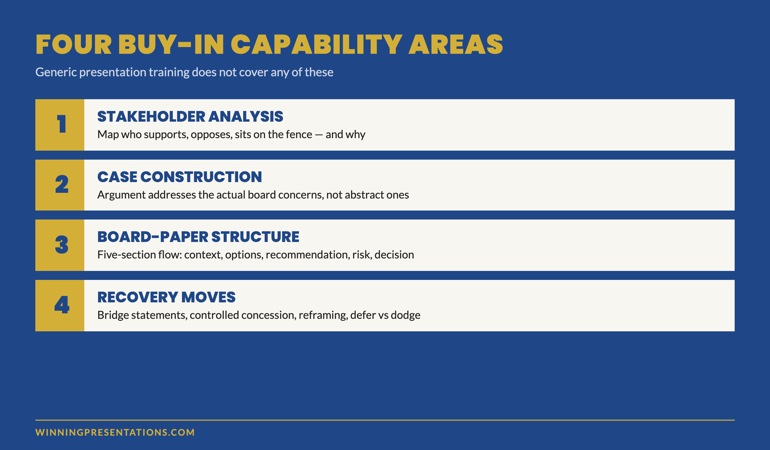
The four capability areas senior leaders need
The four capabilities that determine whether an executive decision lands or stalls are stakeholder analysis, case construction, board-paper structure, and recovery moves. They build on each other; weakness in any one undermines the others.
Capability 1 — Stakeholder analysis. Identifying who in the room will support, oppose, or sit on the fence — and why. Mapping the specific concern each opposing stakeholder is likely to raise. Sequencing the conversations before the meeting so the meeting itself is the formal ratification of work already done. Senior leaders who skip this work are presenting blind.
Capability 2 — Case construction. Building the structured argument that addresses the actual concerns identified in stakeholder analysis, not the abstract concerns implied by the topic. The case for a £4M transformation programme looks different when the dominant board concern is execution risk versus when it is opportunity cost. Generic training treats the case as a function of the topic; experienced practitioners treat it as a function of the room.
Capability 3 — Board-paper structure. The five-section flow boards trust — context, options, recommendation, risk, decision. Each section answering one question. The recommendation slide carrying process commitments, not outcome guarantees. The risk slide naming trip-wires rather than enumerating risks. Without this structure, even strong cases land as opinion rather than analysis.
Capability 4 — Recovery moves. The specific responses to in-the-room pressure: bridge statements when an objection cannot be answered immediately, controlled concession when a partial yes is the path forward, reframing techniques when a question lands askew, the difference between deferring an answer and dodging one. Recovery moves are what separate presenters who handle pressure from presenters who collapse under it.
Build the case your stakeholders cannot dismiss
Stop losing buy-in at the last minute
- 7 modules of self-paced course content covering stakeholder analysis, case construction, board-paper structure, and recovery moves
- Optional live Q&A and coaching calls with Mary Beth — fully recorded, watch back anytime
- No deadlines, no mandatory session attendance — work through the material at your own pace
- New cohort opens every month — enrol whenever suits you
Maven Executive Buy-In Presentation System — £499, lifetime access to materials, monthly cohort enrolment open.
Designed for senior professionals presenting decisions to boards, investment committees, and executive sponsors.
Programme format: what good online buy-in training looks like
Senior professionals do not have predictable calendars. The format of the training programme matters as much as the content. Three format characteristics distinguish programmes built for senior audiences:
Self-paced with monthly enrolment cohorts. Modules can be worked through when the calendar allows — early morning, weekends, on a long flight. New cohorts open every month so enrolment does not feel time-pressured. The “cohort” exists for community and shared discussion, not as a fixed-duration live programme. Senior professionals consistently prefer this format because they can match the pace to their workload.
Optional, recorded live elements. Q&A or coaching calls add value when the topic is dense or contested, but they should never be mandatory and should always be recorded. Senior professionals miss live calls regularly — board emergencies, client conflicts, family responsibilities. A programme that penalises missed live attendance excludes the people it is meant to serve. Recorded calls let participants engage with the live material on their own schedule.
Lifetime access to materials. The buy-in challenge does not end when the course does. Senior professionals return to the material repeatedly — before a difficult board meeting, before a contested funding decision, before a stakeholder presentation that has been deferred once already. Programmes that revoke access after a fixed window are mismatched with how the material is actually used.
For senior leaders who recognise themselves in the four-capability gap, the Executive Buy-In Presentation System teaches all four capabilities across 7 self-paced modules with optional recorded Q&A calls.
Evaluation questions before you enrol
Five questions to ask of any executive buy-in training programme online before committing:
- Does it teach stakeholder analysis as a discrete capability, or assume the participant will do it themselves? Programmes that assume the latter are leaving the most important work uncovered.
- Does it cover board-paper structure specifically, or just generic slide design? Boards trust specific structures (context, options, recommendation, risk, decision). Generic slide-design training does not produce board-grade decks.
- Does it teach recovery moves under pressure? Look for explicit modules on bridge statements, controlled concession, reframing, and deferring vs answering. If those terms are absent from the syllabus, the recovery work is missing.
- Is the format compatible with senior calendars? Self-paced with optional recorded live elements is compatible. Mandatory weekly live attendance is not.
- Does the programme make outcome promises (“Get your board to approve any proposal”) or process promises (“Build the case your board cannot dismiss”)? Outcome promises are a red flag. The factors that determine whether a board approves a specific proposal are partly outside any course’s control. Process promises — what the course teaches you to do — are the honest claim.

Frequently asked questions
How long does the Executive Buy-In Presentation System take to complete?
The programme is self-paced. Most participants work through the 7 modules over four to eight weeks, fitting the material around their workload. There are no deadlines and no mandatory session attendance. New cohorts open every month for enrolment. Once enrolled, you have lifetime access to the materials and can return to specific modules as needed before high-stakes meetings.
Are the live Q&A calls required?
No. The live calls are optional and fully recorded. Senior professionals frequently cannot attend live; the recordings let you engage with the material on your own schedule. The course content stands independently — the live calls add depth and community for those who can attend, but completion does not depend on them.
Is this aimed at executives or at people working towards executive level?
Both, but the framing is different. Senior leaders who already present at executive level use the programme to refine the four capabilities and add structural moves to their existing toolkit. People working towards executive level use it to build the capabilities ahead of the meetings where they would otherwise be exposed. The material covers the same content; what changes is how each group uses it.
What if my organisation does not have a formal board — does this still apply?
Yes. The buy-in capabilities apply to any senior decision-making forum: investment committees, executive sponsor meetings, leadership team gatherings, partnership boards, scientific advisory groups. The structural moves are the same; the audience labels differ. The programme uses the term “board” as shorthand for any senior decision-making body the participant needs to win over.
The Winning Edge — weekly newsletter for senior presenters
One framework, one micro-story, one slide pattern — every Thursday morning, ten minutes’ read. Including the buy-in moves I am field-testing inside the Maven cohort each month.
For the partner article on the in-room skills boards expect from senior presenters, see board buy-in presentation skills training.
Mary Beth Hazeldine — Owner & Managing Director, Winning Presentations Ltd. With 24 years of corporate banking experience at JPMorgan Chase, PwC, Royal Bank of Scotland, and Commerzbank, she advises senior professionals across financial services, healthcare, technology, and government on stakeholder buy-in, board-paper structure, and high-stakes executive decision communication.