Tag: executive buy-in training

25 May 2026
Featured image for Executive Stakeholder Presentation Skills Training (Self-Paced, 2026)

Executive Stakeholder Presentation Skills Training (Self-Paced, 2026)

Quick answer: Executive stakeholder presentation skills training is the structured discipline of presenting to senior decision-makers — boards, executive sponsors, investment committees, reluctant stakeholders — in a way that secures approval. Generic presentation training does not cover it. The skills it requires are stakeholder analysis, case construction under scrutiny, structured Q&A handling, and the room-design work that makes the difference between a meeting that approves and a meeting that defers. The right programme is self-paced, structured, and built specifically for the senior context.

A senior professional presents differently from a mid-career one because the room is different. The audience is more senior, the scrutiny is sharper, the stakes are higher, and the social dynamics around the decision are more complex. Generic public-speaking training does not prepare anyone for this room. It teaches presence, voice, and slide design. Those are necessary. They are not sufficient. The room you walk into when you present to a board or executive committee requires a different skill set entirely — one built around stakeholder analysis, case construction, structured Q&A, and the discipline of designing a room before you walk into it.

Executive stakeholder presentation skills training is the discipline that covers this. It is narrower than general presentation training and considerably more specific. The buyers are usually senior professionals — directors, partners, VPs, MDs — who have realised that the presentation skills that worked at mid-career do not scale to the rooms they now present in. Some have tried general training and found it pitched too low. Some have tried executive coaching and found it expensive for the cadence at which they actually present. A structured self-paced programme sits between these two — designed for the senior context, available without retainer-level cost.

This article describes what the discipline covers, what to look for in a programme, and how the Executive Buy-In Presentation System fits the brief.

Looking for stakeholder presentation training right now?

The Executive Buy-In Presentation System is a self-paced programme for senior professionals who present to boards, executive sponsors, and reluctant stakeholders. 7 modules, monthly cohort enrolment, optional recorded Q&A. £499, lifetime access to materials.

Explore the system →

What executive stakeholder presentation training actually covers

A serious programme covers four areas. Each one is largely absent from generic presentation training and each one is essential at senior level.

Stakeholder analysis. The discipline of mapping the people who will be in or around the room — their influence, their current position, their likely objections, and the social structure that connects them. Senior decisions are rarely made by individuals in isolation. They are made by groups whose dynamics shape the outcome before anyone speaks. A programme that does not cover stakeholder analysis is teaching presentation skills in a vacuum. The actual presentation is one variable among several.

Case construction under scrutiny. Building a case that holds up under board-level questioning is a different discipline from building a case that lands well in a friendly room. The structural choices are different. The recommendations sit at different points in the deck. The objections are pre-empted in the body rather than deferred to Q&A. The opening does specific work — it anchors the proposal to strategic ground the room has already endorsed. Most generic training teaches the friendly version. Executive training teaches the structural version.

Structured Q&A handling. The questions a senior presenter receives are not the questions a junior presenter receives. They are sharper, more political, often deliberately uncomfortable, and frequently designed to test the presenter rather than the proposal. Comparison questions, prioritisation challenges, and trade-off provocations are routine. A structured programme covers the answer patterns that hold up — calm, decision-safe, anchored to strategy — and the delivery rules that make the answer land. Generic training rarely goes here.

Room design and political navigation. The room is not a neutral container. The chair, the sponsor, the supporters, the swing votes, the blockers — each one plays a role in how the meeting unfolds. A senior presenter has to design the room before walking into it. Pre-briefs, proxy champions, scrutiny absorption, post-meeting follow-up — these are the structural moves that determine whether a proposal survives the meeting. Generic training does not cover them. Executive training does, because at this level the proposal is rarely won by the deck alone.

Why generic presentation training does not work at this level

Most senior professionals have tried general presentation training at some point in their career. Many have found it useful at the time and inadequate later. The reason is structural. Generic training is designed for an audience that is decreasingly the audience a senior presenter actually faces.

The audience is wrong. Generic training teaches you to present to a polite, attentive room — typically a training-context audience that wants to engage with the material. A senior boardroom is structurally different. The audience is sceptical, time-pressed, and not always interested in being engaged. They want to make a decision. The skills that win a friendly room are different from the skills that earn approval in a sceptical one.

The content is too broad. Generic training covers the universal — voice, slide design, body language, story structure. All of these matter. None of them are the leverage point at senior level. The leverage at senior level is in the structure of the case, the design of the room, and the discipline of the Q&A. Generic training treats these as advanced topics that come at the end. Executive training treats them as the core curriculum.

The trainers are often pitched wrong. Many generic trainers have a TED-talk or keynote background. That experience is genuine, but it is the wrong kind of senior presentation experience. Keynote skills are different from boardroom skills. The presenter who is excellent at the inspirational closing speech may not have the structural muscle for the seventeen-minute investment-committee proposal where every minute is contested. Executive training requires trainers whose direct experience is in the senior boardroom context.

The format is poorly matched to senior schedules. Generic training is often delivered in workshops — full-day or two-day intensives. Senior professionals rarely have two consecutive days available, and intensive workshops do not build the kind of long-term structural capability that senior presenters need. Self-paced programmes with optional live components fit senior schedules far better, because the work can be done in fifteen-minute increments around the demands of the actual job.

The right format — what to look for

When evaluating an executive stakeholder presentation skills training programme, four format questions matter more than the marketing copy.

Is it self-paced? Senior schedules do not accommodate fixed weekly attendance. A programme that requires a two-hour live call every Wednesday at 5pm is structurally incompatible with the actual rhythm of senior work. Self-paced programmes — where the core content is recorded and any live components are optional and themselves recorded — are the only format that survives the calendar pressures of executive roles. A senior professional can complete a self-paced programme; many cannot complete a fixed-schedule one.

Is the content built specifically for senior context? Read the module list. If it covers voice, presence, slide design, and story structure, it is generic training relabelled as executive. If it covers stakeholder analysis, board dynamics, case construction under scrutiny, structured Q&A handling, and room design, it is built for the senior context. The module structure tells you which one you are buying. Marketing language is unreliable. The module list is honest.

Is there access after the cohort closes? Many programmes restrict access to the duration of the cohort — eight weeks, twelve weeks, whatever the marketing structure dictates. This is bad fit for senior buyers. The first time you complete the programme, you build initial capability. The third or fourth time you return to a specific module — usually before a high-stakes meeting — is when the capability becomes deep. Programmes that withdraw access after the cohort effectively prevent the second category of value. Look for lifetime access to materials.

Is the live component genuinely optional? Some programmes describe themselves as self-paced but require live attendance for credit, certification, or continued access. This is a hidden constraint that re-imposes the schedule problem. The right format treats live components as optional — useful when available, fully recorded when not, and never a barrier to completing the programme. Senior buyers should be able to complete the entire programme without ever attending a live session.

Self-paced executive stakeholder presentation skills training

The Executive Buy-In Presentation System — designed for senior professionals presenting to boards, sponsors, and reluctant stakeholders

The Executive Buy-In Presentation System is the structured framework for senior professionals who need to secure board-level approval. 7 modules, self-paced, with monthly cohort enrolment and optional recorded Q&A sessions available. Designed by Mary Beth Hazeldine on the basis of 25 years of corporate banking and 16 years of coaching senior professionals across financial services, insurance, consulting, and technology.

  • 7 self-paced modules covering stakeholder analysis, case construction, room design, structured Q&A, and the post-meeting work that protects approved decisions
  • Optional live Q&A / coaching calls — fully recorded, watch back at your own pace
  • No deadlines, no mandatory live attendance, lifetime access to all materials
  • Monthly cohort enrolment — enrol any time, start with the next cohort

£499 · Self-paced · Lifetime access to materials · Next cohort enrolment opens monthly

Join the next cohort →

The Executive Buy-In Presentation System

The Executive Buy-In Presentation System is built around the four areas described above — stakeholder analysis, case construction under scrutiny, structured Q&A handling, and room design. It is structured as 7 self-paced modules. Each module covers a specific structural capability and is paired with practical artefacts — frameworks, checklists, and the structures senior presenters apply directly to their next meeting.

The format is self-paced. Modules are recorded and available at any time. There are no deadlines and no mandatory live attendance. Optional live Q&A and coaching calls run periodically and are fully recorded so participants who cannot attend live can watch back at any time. The format is designed around the calendar realities of senior roles — a senior buyer can complete the programme in fifteen-minute increments around their actual work, and can return to specific modules indefinitely as new high-stakes meetings arise.

Enrolment runs monthly. A new cohort opens every month, which means there is no waiting for the next intake — enrol whenever it suits you and begin with the next monthly cohort. Lifetime access to materials means the programme stays useful for as long as the buyer continues to present at senior level, not just for the eight or twelve weeks of the initial cohort.

Pricing is £499. That is positioned at the lower end of meaningful executive training — substantially less than retainer-level 1:1 coaching, on the same order as a single high-stakes coaching engagement. The economics tend to favour the structured programme for senior professionals who present meaningfully four to twelve times a year, with 1:1 coaching reserved for the highest-stakes one-off events. Many participants use the programme as the structural framework and engage 1:1 coaching specifically for capital markets days, regulatory hearings, or activist investor pitches.

For senior professionals whose work also touches AI-generated or AI-assisted decks, a parallel programme — Maven AI-Enhanced Presentation Mastery — exists at the same price point with a different focus. The Buy-In programme is appropriate where the central challenge is securing approval from senior stakeholders. The AI-Enhanced programme is appropriate where the central challenge is using AI to produce executive-grade output. Many senior buyers eventually engage with both, but for stakeholder presentation skills specifically, the Buy-In programme is the direct fit.

Who the programme is and is not for

The right fit is senior professionals who present to boards, executive committees, sponsors, and reluctant stakeholders. Directors, partners, VPs, MDs, finance leaders, transformation programme leads, regulatory leads — anyone whose work involves regularly seeking approval at senior level. The programme assumes baseline presentation capability and builds on top of it. It is not designed to teach foundational presentation skills.

It is also a fit for senior professionals stepping up. A new director who has been promoted into a role that requires significantly more board-level presenting. A new partner who is now expected to lead investment committee discussions. A new MD whose team’s proposals now go through them rather than around them. The programme is structured for the transition from competent presenter to senior-context presenter, which is a real skill jump that most professionals make implicitly and slowly. The programme makes it explicit and faster.

It is not a fit for foundational presentation training. A junior professional learning to present for the first time, an early-career individual contributor wanting to improve workshop delivery, or anyone whose challenge is voice, presence, or basic deck design — the programme is too senior for that brief. Foundational training is widely available, often at lower cost, and is the right starting point. The Buy-In programme assumes the foundational ground is already in place.

It is also not a fit for keynote-style training. Senior professionals who need to deliver inspirational keynotes, large-stage public-speaking sessions, or media appearances need a different programme. The Buy-In programme is specifically about boardroom and executive-committee work — small-room, high-stakes, decision-driven contexts. Keynote-style speakers should look at programmes designed for that context.

For a wider perspective on how stakeholder presentation skills training fits inside the broader picture of board-level presentation work, see the related discussion of getting board approval through structured presentation training — which describes the broader context the Buy-In programme sits inside.

Companion templates for stakeholder-led decks

The Executive Slide System — board-ready slide structures for the cases the programme teaches you to build

Senior buyers often pair the programme with the Executive Slide System — 26 templates, 93 AI prompts, and 16 scenario playbooks for building board-ready slides that match the structures the programme covers. £39, instant download, lifetime access. Explore the slide system →

Frequently asked questions

Is the programme suitable for participants outside the UK?

Yes. The programme is delivered online, in English, and the structural content is designed for any senior corporate context — not just the UK market. Participants from financial services, insurance, consulting, technology, healthcare, and government across multiple geographies have used the programme. The boardroom dynamics, stakeholder structures, and Q&A patterns the programme covers are recognisable across most senior corporate environments. Local adjustments to language and tone are usually small.

How long does the programme take to complete?

Most participants complete the core content in three to five weeks at a pace of two to three hours a week. Because the programme is self-paced and access is lifetime, many participants do not actually complete it linearly — they complete the modules most relevant to their immediate work first, then return to specific modules before high-stakes meetings later. The programme is designed to be useful both as a linear curriculum and as a reference library returned to over time.

What does the £499 price include?

7 self-paced modules of course content, optional live Q&A and coaching sessions (fully recorded so non-attendance does not affect access), lifetime access to all course materials, and entry to the current monthly cohort. There is no subscription, no expiry, and no recurring fee. Once enrolled, materials remain accessible indefinitely. New cohort intakes do not require re-enrolment for previous participants.

How does this compare to 1:1 executive coaching?

The two are complementary rather than competitive. A 1:1 coach reads your specific deck and works on the meeting in front of you. A structured programme builds the framework that lets the coaching focus on the specific rather than the structural. Many senior buyers use the programme as the structural framework and engage 1:1 coaching specifically for the highest-stakes one-off events — capital markets days, regulatory hearings, activist investor pitches. The economics make the programme the better fit for the standing rhythm of senior presentation work, with 1:1 coaching reserved for the moments where marginal value is highest.

Maven cohort enrolment — open this month

Built on 25 years of corporate banking and 16 years of senior presentation coaching

Built on 25 years in corporate banking and 16 years coaching senior professionals across financial services, insurance, consulting, and technology. The Executive Buy-In Presentation System — 7 modules, self-paced, monthly cohort enrolment, optional recorded Q&A calls. £499, lifetime access.

  • 7 self-paced modules — work through at your own pace, no deadlines
  • Optional live Q&A calls — fully recorded, watch back any time
  • Monthly cohort enrolment — enrol any time, start with the next cohort
  • Lifetime access to all materials, no subscription, no expiry

£499 · Self-paced · Lifetime access · Next cohort enrolment opens monthly

Join the next cohort →

The Winning Edge — weekly

One short note each Thursday on board-level presentation patterns, structural shortcuts, and the behaviours senior presenters use under scrutiny. Written for professionals who do not have time for newsletters that read like newsletters.

Subscribe to The Winning Edge →

Want a starting point first? The free Executive Presentation Checklist covers the structural fundamentals senior presenters use before formal training.

For a related view of how stakeholder skills training connects to broader executive presentation work, see the discussion of executive presentation training online.

Next step: Look at the next senior presentation on your calendar. Identify which of the four executive skill areas — stakeholder analysis, case construction, structured Q&A, room design — is the weakest link for that meeting. Start there. The Executive Buy-In Presentation System is structured so you can begin with the module that addresses the immediate gap rather than working linearly.

Mary Beth Hazeldine is the Owner & Managing Director of Winning Presentations. With 25 years of corporate banking experience at JPMorgan Chase, PwC, Royal Bank of Scotland, and Commerzbank, she advises senior professionals across financial services, healthcare, technology, and government on structuring presentations for high-stakes board meetings, investment committees, and executive sessions. She speaks German and works extensively with the German-speaking financial markets.

13 May 2026
Featured image for Executive Buy-In Training Programme Online: What Senior Leaders Need From a Modern Course

Executive Buy-In Training Programme Online: What Senior Leaders Need From a Modern Course

Quick Answer

A modern executive buy-in training programme online needs to teach four capability areas: stakeholder analysis, case construction, board-paper structure, and recovery moves under pressure. Generic presentation training does not cover these — it teaches delivery and slide design without addressing the psychology of senior decision-making. The right training is structured around how boards and exec sponsors actually decide, not how presenters traditionally present.

Ngozi runs a transformation function at a UK-listed retail group. She had presented six initiatives to her board over four years; four had been approved on first pass, two had been deferred indefinitely. Both deferrals had felt unfair at the time. Both, in hindsight, were the same structural failure: she had presented the case for the initiative without doing the stakeholder analysis that would have told her which board members were going to oppose it and why.

She booked herself onto three different presentation courses over six months. The first taught slide design. The second taught speaking confidence. The third taught storytelling. None of them addressed what she actually needed — the buy-in psychology and structural moves that turn reluctant stakeholders into active advocates. She built that capability informally, painfully, over two more years and several more deferrals. By the time she had it, she could see why generic training had not helped.

Most online presentation training is built for the easier audience: people who need to deliver content competently to colleagues. Executive buy-in training is a different discipline. It is structured around the specific challenge of getting a senior decision through a room where some people in the room are going to push back hard.

If your initiatives keep getting deferred at the buy-in stage

The fix is not better slides or smoother delivery. It is the four-capability discipline that turns reluctant stakeholders into active advocates. Built around the psychology and structure that get senior approval — not generic presentation polish.

Explore the Executive Buy-In Presentation System →

Why generic presentation training fails for buy-in

Generic presentation training optimises for a generalised audience: somebody learning how to give better talks. The pedagogy makes sense for that audience — clearer slides, more confident delivery, better storytelling. The problem is that none of those skills, individually or together, solve the buy-in problem. A presenter with beautiful slides, calm delivery, and compelling storytelling can still walk out of a board meeting with a deferred decision.

Three reasons generic training does not transfer:

It treats the audience as receptive. Generic courses assume the audience wants to hear what you have to say and is broadly aligned with your conclusion. Senior buy-in audiences are not. Some members are actively sceptical. Some have competing initiatives. Some have political reasons to slow your decision. Training that does not name this reality leaves the presenter unprepared.

It optimises for the speaker, not the room. Most presentation training improves the speaker’s experience — they feel more confident, more articulate, more polished. That is valuable, but it does not address the room. Buy-in is won by understanding what the specific stakeholders need to hear before they can say yes. That is room work, not speaker work.

It does not teach the recovery moves. When a board member raises an objection that lands, generic training has no answer beyond “stay calm and respond.” The structural moves — bridge statements, controlled concession, reframing the objection, deferring vs answering — are not part of the syllabus because the syllabus was not built around contested decisions.

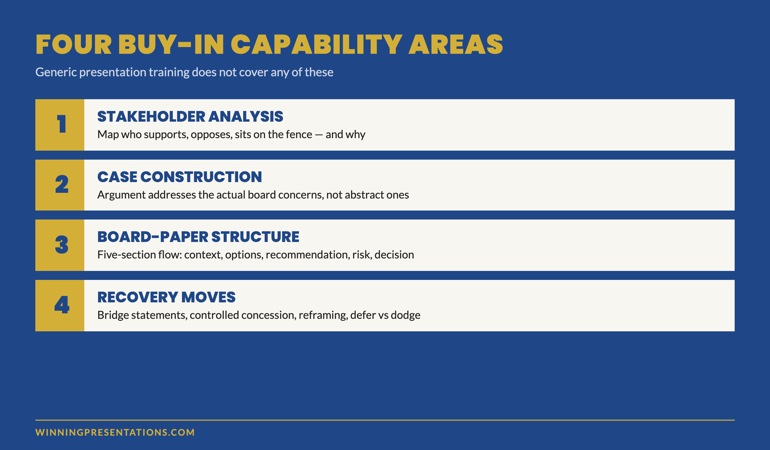
The Four Buy-In Capability Areas infographic showing Stakeholder Analysis, Case Construction, Board-Paper Structure, and Recovery Moves with what each capability covers and the gap that generic training leaves

The four capability areas senior leaders need

The four capabilities that determine whether an executive decision lands or stalls are stakeholder analysis, case construction, board-paper structure, and recovery moves. They build on each other; weakness in any one undermines the others.

Capability 1 — Stakeholder analysis. Identifying who in the room will support, oppose, or sit on the fence — and why. Mapping the specific concern each opposing stakeholder is likely to raise. Sequencing the conversations before the meeting so the meeting itself is the formal ratification of work already done. Senior leaders who skip this work are presenting blind.

Capability 2 — Case construction. Building the structured argument that addresses the actual concerns identified in stakeholder analysis, not the abstract concerns implied by the topic. The case for a £4M transformation programme looks different when the dominant board concern is execution risk versus when it is opportunity cost. Generic training treats the case as a function of the topic; experienced practitioners treat it as a function of the room.

Capability 3 — Board-paper structure. The five-section flow boards trust — context, options, recommendation, risk, decision. Each section answering one question. The recommendation slide carrying process commitments, not outcome guarantees. The risk slide naming trip-wires rather than enumerating risks. Without this structure, even strong cases land as opinion rather than analysis.

Capability 4 — Recovery moves. The specific responses to in-the-room pressure: bridge statements when an objection cannot be answered immediately, controlled concession when a partial yes is the path forward, reframing techniques when a question lands askew, the difference between deferring an answer and dodging one. Recovery moves are what separate presenters who handle pressure from presenters who collapse under it.

Build the case your stakeholders cannot dismiss

Stop losing buy-in at the last minute

  • 7 modules of self-paced course content covering stakeholder analysis, case construction, board-paper structure, and recovery moves
  • Optional live Q&A and coaching calls with Mary Beth — fully recorded, watch back anytime
  • No deadlines, no mandatory session attendance — work through the material at your own pace
  • New cohort opens every month — enrol whenever suits you

Maven Executive Buy-In Presentation System — £499, lifetime access to materials, monthly cohort enrolment open.

Explore the Programme →

Designed for senior professionals presenting decisions to boards, investment committees, and executive sponsors.

Programme format: what good online buy-in training looks like

Senior professionals do not have predictable calendars. The format of the training programme matters as much as the content. Three format characteristics distinguish programmes built for senior audiences:

Self-paced with monthly enrolment cohorts. Modules can be worked through when the calendar allows — early morning, weekends, on a long flight. New cohorts open every month so enrolment does not feel time-pressured. The “cohort” exists for community and shared discussion, not as a fixed-duration live programme. Senior professionals consistently prefer this format because they can match the pace to their workload.

Optional, recorded live elements. Q&A or coaching calls add value when the topic is dense or contested, but they should never be mandatory and should always be recorded. Senior professionals miss live calls regularly — board emergencies, client conflicts, family responsibilities. A programme that penalises missed live attendance excludes the people it is meant to serve. Recorded calls let participants engage with the live material on their own schedule.

Lifetime access to materials. The buy-in challenge does not end when the course does. Senior professionals return to the material repeatedly — before a difficult board meeting, before a contested funding decision, before a stakeholder presentation that has been deferred once already. Programmes that revoke access after a fixed window are mismatched with how the material is actually used.

For senior leaders who recognise themselves in the four-capability gap, the Executive Buy-In Presentation System teaches all four capabilities across 7 self-paced modules with optional recorded Q&A calls.

Evaluation questions before you enrol

Five questions to ask of any executive buy-in training programme online before committing:

  1. Does it teach stakeholder analysis as a discrete capability, or assume the participant will do it themselves? Programmes that assume the latter are leaving the most important work uncovered.
  2. Does it cover board-paper structure specifically, or just generic slide design? Boards trust specific structures (context, options, recommendation, risk, decision). Generic slide-design training does not produce board-grade decks.
  3. Does it teach recovery moves under pressure? Look for explicit modules on bridge statements, controlled concession, reframing, and deferring vs answering. If those terms are absent from the syllabus, the recovery work is missing.
  4. Is the format compatible with senior calendars? Self-paced with optional recorded live elements is compatible. Mandatory weekly live attendance is not.
  5. Does the programme make outcome promises (“Get your board to approve any proposal”) or process promises (“Build the case your board cannot dismiss”)? Outcome promises are a red flag. The factors that determine whether a board approves a specific proposal are partly outside any course’s control. Process promises — what the course teaches you to do — are the honest claim.

Five Evaluation Questions infographic showing the questions to ask before enrolling in any executive buy-in training programme, organised as a checklist with green checks and red flags

Frequently asked questions

How long does the Executive Buy-In Presentation System take to complete?

The programme is self-paced. Most participants work through the 7 modules over four to eight weeks, fitting the material around their workload. There are no deadlines and no mandatory session attendance. New cohorts open every month for enrolment. Once enrolled, you have lifetime access to the materials and can return to specific modules as needed before high-stakes meetings.

Are the live Q&A calls required?

No. The live calls are optional and fully recorded. Senior professionals frequently cannot attend live; the recordings let you engage with the material on your own schedule. The course content stands independently — the live calls add depth and community for those who can attend, but completion does not depend on them.

Is this aimed at executives or at people working towards executive level?

Both, but the framing is different. Senior leaders who already present at executive level use the programme to refine the four capabilities and add structural moves to their existing toolkit. People working towards executive level use it to build the capabilities ahead of the meetings where they would otherwise be exposed. The material covers the same content; what changes is how each group uses it.

What if my organisation does not have a formal board — does this still apply?

Yes. The buy-in capabilities apply to any senior decision-making forum: investment committees, executive sponsor meetings, leadership team gatherings, partnership boards, scientific advisory groups. The structural moves are the same; the audience labels differ. The programme uses the term “board” as shorthand for any senior decision-making body the participant needs to win over.

The Winning Edge — weekly newsletter for senior presenters

One framework, one micro-story, one slide pattern — every Thursday morning, ten minutes’ read. Including the buy-in moves I am field-testing inside the Maven cohort each month.

Subscribe to The Winning Edge →

For the partner article on the in-room skills boards expect from senior presenters, see board buy-in presentation skills training.

Mary Beth Hazeldine — Owner & Managing Director, Winning Presentations Ltd. With 24 years of corporate banking experience at JPMorgan Chase, PwC, Royal Bank of Scotland, and Commerzbank, she advises senior professionals across financial services, healthcare, technology, and government on stakeholder buy-in, board-paper structure, and high-stakes executive decision communication.

30 Apr 2026
Executive Influence Training Online: Build Credibility With Senior Stakeholders

Executive Influence Training Online: Build Credibility With Senior Stakeholders

Quick answer: Executive influence training online teaches senior professionals how to build credibility with stakeholders, anticipate objections, and engineer consensus in rooms where authority is shared rather than assigned. Genuine programmes cover stakeholder mapping, objection handling, credibility building, and presentation frameworks — not charisma tricks or manipulation tactics. Self-paced online formats suit senior executives better than residential workshops because they fit around board cycles, international travel, and unpredictable diary pressure.

Soraya Hashemi had been appointed Chief Commercial Officer at a FTSE 250 industrial group six weeks earlier, recruited from a competitor where she had spent fourteen years. On paper, the brief was straightforward: reset the commercial strategy and take three material investment cases to the board over her first twelve months. In practice, she discovered something no recruiter mentions at offer stage. The board that hired her was not the board she now had to influence.

Her first presentation was a pricing realignment case worth £48 million in projected margin recovery. The content was unimpeachable — she had built the same type of case four times at her previous organisation, each one approved within a single meeting. This time, the non-executive chair asked a procedural question she had not anticipated, the senior independent director raised a cultural concern about customer disruption, and a newly appointed director — an ex-regulator — probed the risk framework for thirty minutes. The case was deferred. Not rejected. Deferred pending further analysis.

The second presentation, two months later, was the same pattern in a different suit. Strong content. Weak buy-in. She left the meeting with another round of work, another deferral, and a creeping sense that the board did not yet trust her judgement at the level they trusted her predecessor’s.

What changed was not the quality of her analysis. What changed was that Soraya stopped presenting information and started engineering consensus. Before the third case, she spent three weeks having individual conversations with every board member — not selling the case, but understanding what each director was worried about, what past experiences shaped their instincts, and what evidence they would need to move from scepticism to support. By the time she presented, every objection she heard in the room had already been surfaced, absorbed, and addressed. The case was approved in forty minutes. The chair called it the most composed board paper he had seen all year.

The difference between presentation one and presentation three was not confidence or delivery. It was a skill Soraya had never been explicitly taught — the skill of building influence before you enter the room.

If you want to develop this skill systematically, the Executive Buy-In Presentation System is a self-paced online programme that teaches the influence architecture senior professionals rarely learn on the job. Enrolment is open — join at your own pace.

Explore the Buy-In System →

What Executive Influence Actually Is (And What It Isn’t)

The phrase “executive influence” carries baggage. For many senior professionals, it evokes images of corporate politics, backroom dealing, or charisma-driven persuasion that feels uncomfortably close to manipulation. That framing is misleading, and it causes capable executives to avoid developing a skill they genuinely need.

Executive influence is the ability to align stakeholders around a decision when you do not have unilateral authority to impose it. It is not about changing what people fundamentally believe. It is about helping them see how your proposal connects to what they already care about — their strategic priorities, their organisational concerns, their professional risks. When done well, influence feels like clarity, not pressure. Stakeholders leave the room feeling understood rather than sold to.

The distinction matters because manipulation and influence produce different long-term outcomes. Manipulation extracts a single decision at the cost of future trust. Influence accumulates credibility that compounds across every subsequent interaction. Senior stakeholders — board directors, C-suite peers, institutional investors — are generally sophisticated enough to detect the difference within minutes. Attempting to manipulate a room of experienced non-executive directors is a short career strategy.

Genuine influence rests on three foundations: accurate understanding of what each stakeholder actually needs from the decision, credible evidence that your proposal serves those needs, and a presentation architecture that makes the fit between the two impossible to miss. None of these foundations are glamorous. All of them are teachable. This is the underlying logic of stakeholder buy-in psychology — and it is the core of any executive influence training worth the investment.

Executive Influence Training, Engineered for Senior Professionals

The Executive Buy-In Presentation System is a self-paced online programme that teaches the influence architecture used by senior executives to move material decisions through boards, investment committees, and C-suite peer groups. Stakeholder mapping, objection handling, credibility construction, and decision-ready presentation frameworks — all delivered in modules you can work through around your diary.

£499, self-paced with optional live Q&A calls (all recorded). Enrolment is open — join at your own pace.

Enrol in the Buy-In System →

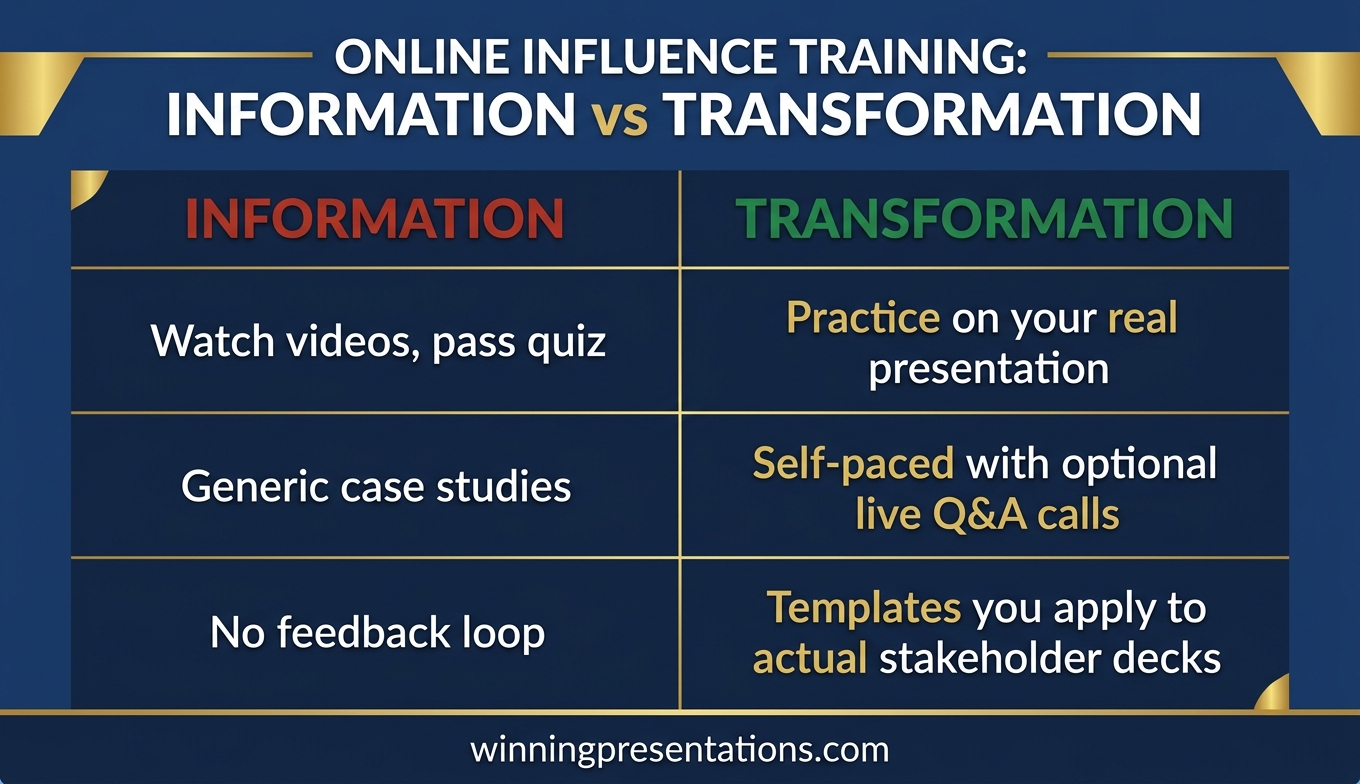
Why Online Training Beats In-Person for Senior Professionals

There is a lingering assumption in executive education that the best training must happen in a room — a residential programme at a business school, a three-day off-site with a named professor, a corporate university cohort that meets quarterly. For many learning contexts, in-person retains real advantages. For executive influence training specifically, the calculus has shifted.

Calendar reality. Senior professionals do not have consecutive uninterrupted days. Board cycles, earnings windows, regulatory deadlines, and international travel make three-day workshops a scheduling fantasy for most executives above director level. A self-paced online programme that accommodates ninety-minute working sessions between meetings is not a compromise — it is a better match for how senior careers actually operate.

Applied repetition. Influence skills mature through repeated application in live situations, not through a single intensive workshop followed by a certificate. Online training that you can revisit before a specific board meeting, investment committee, or C-suite peer conversation compounds value in a way that a one-off residential cannot. You learn the framework once and then return to the relevant module the week before you need it.

Evidence-based learning. In-person executive programmes tend to favour memorable stories and charismatic delivery. Online formats favour systematic coverage — frameworks with worked examples, templates with live use cases, recorded sessions you can reference at the point of need. For a discipline where precision matters more than inspiration, systematic coverage wins.

Privacy. Many senior executives are reluctant to practise influence skills in front of peers. A shadow board, a regulatory scrutiny case, a private equity management presentation — these are exactly the scenarios most in need of training, and exactly the scenarios no executive wants to rehearse in front of strangers on a residential programme. Self-paced online learning allows genuine practice in a private environment.

The shift is not that in-person has become ineffective. It is that online delivery has become structurally better matched to how senior professionals actually learn and apply new skills in their day-to-day work.


Comparison of online versus in-person executive influence training showing calendar flexibility, applied repetition, systematic coverage, and privacy advantages of self-paced online formats

What Genuine Executive Influence Training Covers

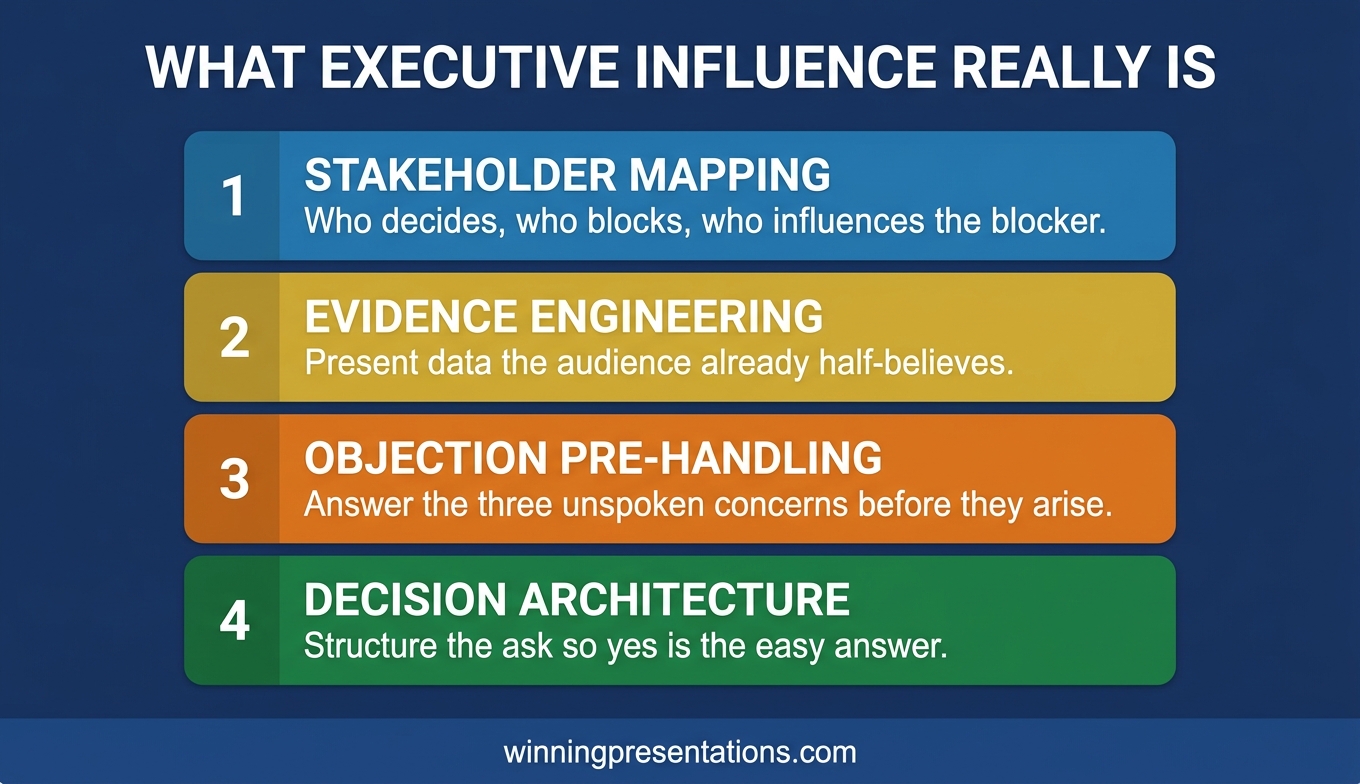
If you are evaluating executive influence training options, the syllabus matters more than the brand. Many programmes badge themselves as “executive influence” but cover little beyond generic communication skills repackaged for a premium audience. A credible syllabus addresses four specific domains:

Stakeholder mapping. Before you can influence a stakeholder, you need an accurate picture of their decision-making drivers, their information preferences, their past positions on similar issues, and the organisational pressures they are carrying. Training that teaches you to map this systematically — not just intuit it — is training that produces durable results.

Objection handling. Senior stakeholders raise objections in predictable structural categories: risk, cost, timing, precedent, alternatives, and fit with existing priorities. Training that teaches you to anticipate which category of objection each stakeholder will raise — and to build responses into the presentation itself rather than scrambling in Q&A — transforms how meetings unfold. This is one of the disciplines explored in depth in influencing senior executives.

Credibility building. Credibility is not a personality trait. It is a pattern of signals that stakeholders use to decide whether to trust your judgement. These signals include how you frame uncertainty, how you handle questions you cannot fully answer, how you position your recommendations relative to alternative options, and how you reference past decisions. Training that teaches credibility signalling explicitly is rare — and valuable.

Presentation frameworks. Influence is not delivered through free-form conversation. It is delivered through structured communications — board papers, investment cases, strategy proposals — that lead stakeholders through a sequence of logical steps towards the decision you are seeking. Training that gives you the underlying frameworks (not just templates) allows you to adapt to any high-stakes scenario rather than being trapped by a single format.

A programme missing any of these four domains is a communication course with an executive label, not genuine influence training.

If you want a structured approach to each of these domains, the Executive Buy-In Presentation System dedicates separate modules to stakeholder mapping, objection handling, credibility construction, and decision-ready presentation architecture.

Stakeholder Mapping: The Discipline Most Programmes Skip

Most executive training courses treat stakeholder analysis as a two-by-two matrix exercise — interest versus influence, plotted on a whiteboard. That is a useful starting point for junior managers. For executives operating at board level, it is woefully incomplete.

Effective stakeholder mapping at senior level answers four questions for each individual whose support matters:

What is their decision history? How have they voted or positioned themselves on comparable issues in the past twelve to twenty-four months? Past decisions are the single best predictor of future receptivity. A director who has consistently challenged capital commitments above a certain threshold will challenge yours too — unless you pre-empt the challenge in the paper itself.

What are they professionally carrying? Every senior stakeholder has a set of external pressures that shape their instincts — a recent audit finding, a regulatory examination, a personal reputation concern, a committee they sit on, a past failure they are determined not to repeat. Understanding these pressures lets you frame your proposal in language that addresses what they are actually worried about, rather than what you assume they should be worried about.

What is their information preference? Some directors read every appendix before the meeting. Others scan the executive summary and rely on the discussion. Some want financial modelling detail; others want strategic narrative. Matching your presentation density to each stakeholder’s preference is not about flattery — it is about reducing the cognitive load that produces defensive responses in governance settings.

Who do they take counsel from? Senior stakeholders rarely form positions alone. They consult informally with trusted peers, executive search contacts, ex-colleagues, and advisers. If you can identify who your key stakeholders listen to, you can often shape the informal context around your presentation in ways that make a positive outcome significantly more likely.

This depth of mapping takes time — typically two to three hours per stakeholder for a major decision. Executives who do not make time for it are relying on intuition in a context where the penalties for being wrong are asymmetric.

Building Credibility Before You Need to Use It

The hardest moment to build credibility is the moment you need it. By the time you are standing in front of a sceptical board with a £48 million case, your credibility balance is already fixed — you are spending it, not accumulating it. This is why the most effective executive influence training emphasises credibility construction as a continuous discipline, not a meeting-specific skill.

There are four credibility signals that senior stakeholders weigh unconsciously in every interaction:

Calibrated confidence. You demonstrate calibration when you distinguish explicitly between what you know, what you believe, and what you are uncertain about. “Our modelling indicates a 70 per cent probability of hitting plan, with the downside scenario driven primarily by supply chain concentration” is a calibrated statement. “We are confident in the plan” is not. Calibration builds credibility because it shows your judgement is trustworthy — you are not overselling.

Predictable follow-through. If you commit to a piece of analysis by a committee meeting, deliver it — and if you cannot, flag it early. Stakeholders accumulate a mental ledger of who delivers on commitments and who generates drift. A clean ledger is one of the quietest forms of credibility, and one of the most durable.

Appropriate challenge. Executives who agree with everything their board says lose credibility as fast as executives who challenge everything. The sweet spot is disagreeing rarely but substantively, with evidence, when the disagreement genuinely matters. A director who sees you push back thoughtfully on a peer’s position is more likely to trust your analysis of your own material. This is one of the dimensions covered in executive presence training.

Intellectual generosity. Acknowledging the strongest version of opposing arguments — rather than straw-manning them — signals that you have genuinely engaged with the decision on its merits. Senior stakeholders notice this instantly. The executive who can articulate the case against their own proposal more compellingly than the sceptics in the room almost always wins the room.

These signals are teachable, but they require the kind of systematic, repeated application that self-paced online training supports better than a single residential programme.


Four credibility signals used by senior stakeholders showing calibrated confidence, predictable follow-through, appropriate challenge, and intellectual generosity with worked examples

The Online Influence Training Senior Professionals Actually Use

The Executive Buy-In Presentation System is a self-paced online programme for executives who need to move material decisions through boards, investment committees, and C-suite peer groups. Modules on stakeholder mapping, credibility construction, objection handling, and decision-ready presentation frameworks — designed to be worked through around senior diaries.

£499, self-paced with optional live Q&A calls (all recorded).

Enrol in the Buy-In System →

How the Executive Buy-In System Teaches Influence

The Executive Buy-In Presentation System is built around a single operating premise: senior professionals do not need more theory about influence — they need a system they can apply to the specific meeting on their calendar next month. The programme is organised around the decisions executives actually face, not around abstract competencies.

Module architecture. The programme is structured as a sequence of self-paced modules covering stakeholder mapping, objection pre-empting, credibility construction, slide architecture for high-stakes scenarios, and recovery tactics when meetings go sideways. Each module combines a framework, worked examples from real executive scenarios, and a set of templates you can adapt to your specific context.

Optional live Q&A calls. Alongside the self-paced content, the programme includes optional live Q&A sessions where enrolled executives can bring their own upcoming presentations for critique. All sessions are recorded, so missing a call never means missing the content. This is not a live cohort with fixed attendance requirements — it is a structured self-paced system with live support attached.

Applied practice. Each module includes practice scenarios built from real-world executive contexts — board meetings, investment committees, regulatory hearings, C-suite peer conversations. Rather than abstract exercises, the scenarios are designed to be worked through using an actual upcoming meeting on your calendar, which means the training pays for itself on the first presentation where you apply it.

Revisitable reference. The programme is designed to be returned to repeatedly rather than consumed once. An executive preparing for a board transformation vote can revisit the objection-handling module. An executive entering a new company can return to the stakeholder mapping module in their first ninety days. The value compounds across years, not just weeks.

Enrolment is open on a rolling basis, which means you can join at the point you need the training — not when a residential calendar dictates. For senior professionals whose diaries are the binding constraint, that flexibility is often the difference between investing in development and postponing it indefinitely.

Frequently Asked Questions

What is executive influence training?

Executive influence training teaches senior professionals how to align stakeholders around a decision in settings where authority is shared rather than assigned — boards, investment committees, C-suite peer groups, and regulatory forums. Genuine training covers stakeholder mapping, objection handling, credibility building, and presentation architecture. It is distinct from generic communication or public-speaking training because it focuses on the specific dynamics of rooms where experienced decision-makers are evaluating both the content and the judgement of the person presenting.

How long does online executive influence training take?

Self-paced online programmes typically require twelve to twenty hours of focused study to work through the core content, spread over four to eight weeks depending on the learner’s diary. Senior executives usually consume the material in ninety-minute blocks between meetings rather than in full-day sessions. The genuine value of influence training accrues over the following six to twelve months as learners apply the frameworks to specific upcoming presentations and revisit the material at the point of need. Unlike a three-day residential, online training is not finished when the calendar says so — it is finished when you have applied it across enough scenarios to make the skills reliable.

Is executive influence training worth it?

For senior professionals whose career progression depends on moving material decisions through groups they do not directly control, the return on structured influence training is difficult to beat. A single board paper that moves from deferral to approval often represents more economic value than the cost of the training itself. The more relevant question is not whether training is worth it, but whether the specific programme you are considering teaches the four foundational disciplines — stakeholder mapping, objection handling, credibility construction, and presentation architecture — or whether it is a communication course with an executive label. If a syllabus does not explicitly address those four domains, the training will polish delivery without building the underlying capability senior stakeholders actually respond to.

How does online training compare to in-person executive coaching?

One-to-one executive coaching remains valuable for deeply personalised situations — a specific leadership transition, a public reputation challenge, a particular board dynamic. For the underlying skill of influence, self-paced online training typically offers better coverage at a fraction of the cost and with greater schedule flexibility. The most effective approach for many senior professionals is a hybrid: a structured online programme to build the frameworks and templates, supplemented by targeted one-to-one coaching around specific high-stakes situations. Online training builds the repeatable system. Coaching sharpens its application to a particular moment. They are complements, not substitutes.

Join The Winning Edge

Free weekly newsletter for executives who present at board and committee level. Practical frameworks, stakeholder influence strategies, and slide structure guidance — delivered every Thursday.

Subscribe Free →

Read next: If you are preparing to present to senior leadership specifically, see How to Present to Senior Management: A Framework for High-Stakes Meetings for a complementary guide on structuring communications that survive boardroom scrutiny.

Your next step: If you are evaluating executive influence training and want a programme built around the specific dynamics of senior stakeholder decision-making, explore the Executive Buy-In Presentation System. Enrolment is open — join at your own pace.

Mary Beth Hazeldine is the Owner & Managing Director of Winning Presentations. With 25 years of corporate banking experience at JPMorgan Chase, PwC, Royal Bank of Scotland, and Commerzbank, she advises executives across financial services, healthcare, technology, and government on structuring presentations for high-stakes scenarios where stakeholder buy-in determines the outcome.