

Summer Executive Presentation Retreat Online: The Self-Paced Alternative to a Week Away
Quick answer: If you are searching for a summer executive presentation retreat online, you are really after one thing: a quieter stretch in which to genuinely improve how you present, rather than just survive the next meeting. A residential week-away retreat can deliver an intense, motivating reset — but for most senior leaders it does not stick, because skill change comes from spaced repetition and real application, not a single immersive week that fades by autumn. Run the Retreat Test on any summer option before you book it: does the format let you practise repeatedly over time, or is it a one-shot intensive; can you actually clear the dates, or will a fragmented summer make a fixed week slip; and does the learning sit close to a real presentation you can apply it to? On all three, a self-paced online programme you work through over the summer — reinforced across weeks and applied to your own September board ask — usually beats a week away. For the executive presentation skill with the most leverage, securing buy-in from senior stakeholders, that self-paced programme is The Executive Buy-In Presentation System: seven modules, work at your own pace, optional recorded Q&A sessions, lifetime access.
JUMP TO:
In 2017 a senior leader I knew booked an expensive residential presentation retreat for the first week of August — a proper week away, coaches, a cohort of peers, the whole immersive experience. He came back genuinely transformed, or so it felt: full of new techniques, fired up, certain this was the thing that would finally change how he presented. I saw him again in November and asked how it had landed. He was sheepish. The week had been excellent and almost none of it had stuck. He could remember the feeling of the retreat far better than anything he had learned in it, because between August and November he had presented only a handful of times, never with the material fresh, never with anyone to reinforce it, and the new habits had quietly dissolved back into the old ones. The retreat had cost him a week and a significant fee, and what he had to show for it three months later was a good memory and a stack of notes he had not opened. The problem was not the retreat’s quality. It was the shape of how the learning was delivered.
(This article was created with AI assistance; all stories and insights are based on 35 years of real client work.)
His experience is the rule, not the exception, and it is worth understanding before you spend a summer and a budget on the wrong format. The instinct behind searching for a summer presentation retreat is sound: a quieter season is a genuine opportunity to work on how you present, and most senior people never make the time during the year. But the retreat format — an intense, one-time, away-from-work immersion — is built for memory and motivation, not for the spaced repetition and real application that actually change a skill. This piece sets out the Retreat Test, three questions that tell you whether a week away or a self-paced programme will serve you better; it identifies the single executive presentation skill most worth a summer’s focus; and it shows how a self-paced online programme, applied to a real presentation waiting for you in September, produces the change the residential week so often promises and so rarely delivers.
Before you commit a summer to improving how you present, it helps to see the structures the strongest presentations are built on.
The free 7 Presentation Frameworks Quick Reference Card lays the core structures — the shapes behind a persuasive, decision-carrying presentation — on a single page, so whichever way you choose to develop the skill, you start from the structures that actually move executive audiences. Free download, no email gate.
Why the week-away retreat fades by autumn
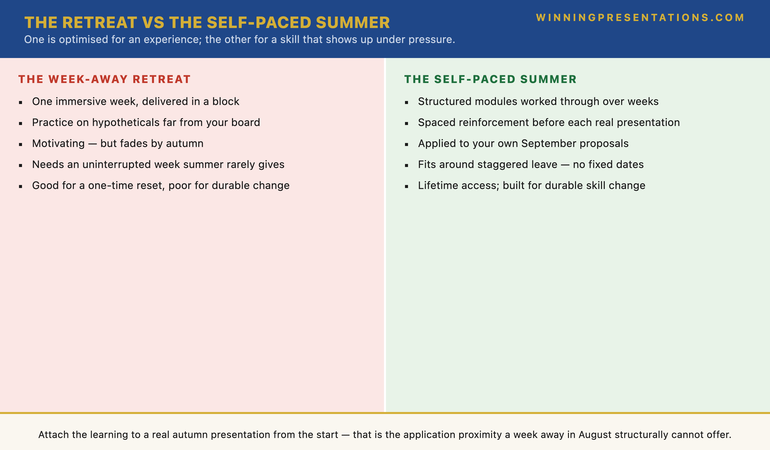
A residential retreat is optimised for an experience, and an experience is not the same thing as a skill change. For one immersive week you are away from your desk, surrounded by the subject, practising in a supportive environment — and it feels powerful precisely because it is concentrated. But concentration is also the weakness. Skills that involve judgement and habit, which executive presenting absolutely does, change through repetition spread over time, with gaps in which the new behaviour is tried, fails a little, and is adjusted. A single week gives you the input but none of the spacing. You leave with the techniques in short-term memory and no structured way to move them into the long-term habits that show up under pressure in a real meeting months later.
There is also the application gap. At a retreat you practise on exercises, hypotheticals, and the safe attention of a peer cohort — none of which is your actual board, your actual stakeholders, or the specific high-stakes presentation you will give in the autumn. The learning happens far from the place it has to be used, and the distance matters, because the hardest part of executive presenting is not knowing the technique but applying it to your particular room under real pressure. The retreat sends you home full of general capability and no rehearsal against the specific challenge you face, so when the September board meeting arrives, you reach for the old habits because the new ones were never grooved against anything that felt real. The psychology of persuading senior stakeholders is highly situation-specific, which is exactly why generic immersion transfers so poorly to your own room.
None of this means a retreat is worthless — for the right person and purpose it can be genuinely valuable, and we will come to who that is. It means the default assumption, that an intensive week is the most serious way to improve, is usually backwards. The most serious way to improve a judgement-and-habit skill is the least dramatic one: structured learning you return to repeatedly over weeks, applied to a real presentation you actually have to give. The summer is a good time for that not because it offers a clear week for immersion, but because it offers a stretch of lower pressure in which to work through material at your own pace and arrive at the autumn’s real presentations genuinely better prepared.
The Retreat Test: three questions
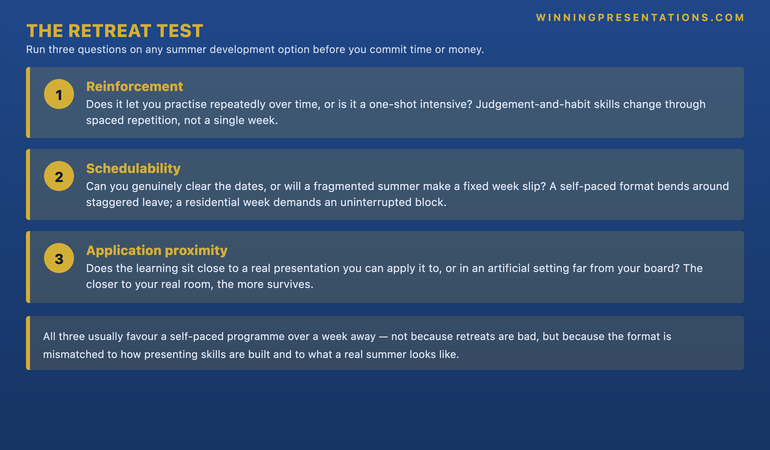
The Retreat Test is three questions you run on any summer development option — a residential retreat, a self-paced programme, a coaching arrangement — before you commit time or money. It is not designed to push you toward one answer; it is designed to match the format to how skills actually change and to the realities of your summer. Run all three honestly and the right choice usually becomes obvious.
Question one: reinforcement. Does the format let you practise the same things repeatedly over time, or is it a one-shot intensive? Judgement-and-habit skills need spaced repetition; a format that delivers everything in a single block and then leaves you alone is built for memory, not change. Question two: schedulability. Can you genuinely clear the dates a fixed format requires, or will a fragmented summer — staggered leave, family time, the things that fill the months — make a committed week slip or get half-attended? A self-paced format bends around a broken-up summer; a residential week demands the one thing a summer is least likely to give you, an uninterrupted block. Question three: application proximity. Does the learning sit close to a real presentation you can apply it to, or does it happen in an artificial setting far from your actual board? The closer the practice is to your real upcoming room, the more of it survives contact with that room. Training that is built around the real board presentations you give transfers in a way that immersive but abstract experiences do not.
The three questions tend to point the same way for most senior leaders, which is the useful part. Reinforcement favours a format you return to over weeks. Schedulability favours something that does not require clearing a fixed block out of a fragmented summer. Application proximity favours learning you can aim directly at your September presentations. On all three counts, a self-paced programme you work through across the summer outperforms a one-time week away — not because retreats are bad, but because the retreat format is mismatched to how presenting skills are actually built and to what a real summer looks like. The minority for whom a retreat genuinely wins are the people who specifically need to get away from work to focus at all, or who want a one-time motivational reset rather than durable skill change — a real need, but a different one from what most searchers are actually after.
Use the summer to genuinely change how you present — at your own pace, applied to your real autumn meetings.
The Executive Buy-In Presentation System is a self-paced programme for the highest-leverage executive presentation skill there is: securing genuine agreement from senior stakeholders, boards, and committees. Seven modules you work through over the summer at your own pace, returning to them as you build your real September presentations — the spaced reinforcement and application that a one-week retreat cannot give you.
- 7 self-paced modules on stakeholder analysis, case construction, and the structure of a persuasive ask
- Optional live Q&A sessions with Mary Beth — fully recorded, so you watch back whenever suits you
- New cohort opens every month; no deadlines, no mandatory attendance — built to fit around a real summer
- Lifetime access to all materials — £499
Which skill is actually worth the summer
If you are going to spend a summer improving how you present, the return depends enormously on which skill you choose, and most people choose by default rather than by leverage. Delivery polish — voice, gestures, slide design — is the usual target because it is visible and feels like “presentation skills,” but for a senior leader it is rarely where the leverage is. The skill with the highest return at executive level is the one that determines whether your presentations actually achieve anything: securing buy-in. Getting a room of senior, sceptical decision-makers to genuinely commit to a proposal is the difference between a polished presentation that gets a polite deferral and a less polished one that gets a yes — and it is a learnable structure, not a personality trait. For most senior leaders, a summer spent getting materially better at securing buy-in pays back across every important presentation they give for years.
This is worth dwelling on because it reframes what “getting better at presenting” should mean at your level. Early in a career, presenting well is about competence and confidence — not freezing, getting the structure right, looking the part. By the time you are presenting to boards and committees, those are table stakes, and the thing that actually distinguishes outcomes is whether you can move a room of senior people to a decision. That involves reading who really decides, constructing a case that survives scrutiny, anticipating and handling objections, and structuring an ask so the room commits rather than nods. It is a different and more advanced skill than delivery, and it is the one that a summer of focused work can shift in a way that genuinely changes your results. Developing buy-in as a deliberate, structured skill is what separates senior presenters whose proposals land from those whose proposals are merely admired.
Choosing buy-in as the summer’s focus also has a practical advantage: it is exactly the kind of skill that rewards the self-paced, application-close approach over the immersive retreat. Buy-in is situation-specific — your stakeholders, your board, your particular proposals — so it improves most when you learn the structure and immediately apply it to a real ask you are preparing, adjusting as you go. That is a poor fit for a one-week retreat far from your actual room, and an excellent fit for a self-paced programme you work through over the summer alongside the real September presentation you are building. The skill that matters most at your level is also the skill that most demands the format the retreat cannot provide, which is why the two questions — what to improve and how — resolve together.
A persuasive case still has to arrive as a deck the room can follow — and the summer is a good time to fix the slides too.
The Executive Slide System gives you 26 board-grade templates, 16 scenario playbooks, 93 AI prompts, and 7 checklists, so the buy-in case you build over the summer lands in a structure designed to get a decision rather than just inform. A practical companion to the strategy work, and the kind of thing you can put to use immediately. Instant access, lifetime use — £39.
What a self-paced programme looks like in practice
The phrase “self-paced online programme” sometimes conjures a folder of videos you never finish, which is a fair worry — plenty of online courses are exactly that. The version that works is structured: a defined set of modules that build on each other, designed to be worked through in sequence rather than grazed, with the flexibility to fit the pace around your summer rather than a fixed timetable that fights it. The Executive Buy-In Presentation System is built this way — seven modules covering the components of securing senior agreement, which you move through at your own pace, with optional live Q&A sessions that are fully recorded so you can watch them back whenever suits you rather than having to be present at a set time. A new cohort opens every month, so you can start whenever the summer gives you a window, and you keep lifetime access to the materials, which matters precisely because reinforcement happens over time and you will want to return to the modules as real presentations come up.
The self-paced structure is not a compromise on the retreat — it is the better fit for the three things the Retreat Test measures. On reinforcement, you can return to a module before each real presentation, so the learning is revisited rather than delivered once and forgotten. On schedulability, there is nothing to clear in your diary and nothing to slip; you work in the windows your fragmented summer actually has, and the lack of mandatory live attendance means a week of family time does not cost you the programme. On application proximity, the whole point is that you learn the structure and apply it immediately to your own upcoming asks, with the modules and the recorded Q&A there to consult as you build the real thing. It is worth being clear about what it is and is not: it is a self-paced course with optional, recorded sessions and lifetime access, not a live four-week bootcamp or a guarantee of a particular outcome — the result still depends on the work you put in and the rooms you face. What it gives you is the structure and the flexibility to do that work properly over a summer.
The contrast with my retreat-going acquaintance is the whole argument. He had a brilliant week and nothing to return to; the self-paced learner has a less dramatic summer and a programme they revisit each time a real presentation looms. In 2019 a director I worked with took the second path deliberately — she worked through a structured buy-in programme across July and August, not in one sitting but in pieces, returning to the relevant module each time she sat down to build her autumn proposals. By September she was not recalling a motivating week; she was applying a structure she had practised repeatedly against her own real asks, and the difference showed in the board meeting. The learning had stuck because the format let it stick. Structured buy-in training applied to real board presentations is what produced the durable change that the retreat had promised her colleague and failed to deliver.
Arrive at your autumn board meetings with the buy-in skill grooved against your own real proposals.
The Executive Buy-In Presentation System gives you the complete framework for securing agreement from senior stakeholders — the reading of the room, the construction of the case, and the structure of the ask — in a self-paced format built for exactly the spaced, applied learning a summer allows and a retreat cannot. Start with this month’s cohort and work it around whatever your summer looks like.
- The framework senior professionals use to turn reluctant stakeholders into active advocates
- Self-paced across 7 modules, with optional fully recorded Q&A sessions — no deadlines, no mandatory attendance
- New cohort every month; enrol when the summer gives you a window
- Lifetime access to all materials, so you return to it as each real presentation comes up — £499
The September application that makes it stick
The single move that turns a summer of learning into a durable change is to attach it to a real presentation waiting for you in the autumn. Abstract study fades; study aimed at a specific, real, looming task embeds, because you are not learning in general — you are solving a problem you actually have. So before the summer starts, identify the most important presentation you will give in September or October — the board ask, the funding case, the stakeholder pitch — and make it the thing you build toward as you work through the material. Each module is no longer information to absorb; it is a tool to apply to that specific upcoming room. This is exactly the application proximity the Retreat Test rewards, and it is the thing a week away in August structurally cannot offer, because the September presentation does not exist yet in any concrete form when you are sitting in the retreat.
The mechanism is straightforward but powerful. When you learn a buy-in technique and immediately ask “how does this change the case I am building for my September board?”, you do three things at once: you understand the technique more deeply because you are forced to make it concrete, you produce a better real presentation because you are applying current learning to it, and you groove the habit against a real stakes-bearing task so it survives into the room. A retreat gives you the first input and none of the application; the self-paced summer, aimed at a real autumn presentation, gives you all three. By the time September arrives you are not trying to remember what you learned — you have already used it, repeatedly, on the very thing you are about to present.
This is also why the lifetime-access point is more than a feature. Because the learning is meant to be applied to real presentations as they arise, you will want to return to the relevant material before each significant ask, not just over the one summer. The programme becomes a reference you consult whenever a high-stakes presentation comes up — revisit the stakeholder-analysis module before a contested board meeting, the objection-handling material before a tough committee — rather than a course you finish and shelve. That is the opposite of the retreat’s one-time model, and it is what makes the self-paced approach compound over time: each real presentation becomes both an application of the learning and a fresh rep that keeps it sharp, long after the summer that started it.
One thing to do before you book anything
Before you book a retreat, a course, or any summer development at all, do one concrete thing: write down the single most important presentation you will give in September or October, in one line, then run the three Retreat Test questions against whatever option you are considering — does it reinforce over time, can you actually schedule it, and does it let you apply the learning to that specific autumn presentation? If the honest answers favour a structured, self-paced programme you can work through around your summer and aim directly at that real presentation, choose that over the dramatic week away, however appealing the immersion sounds. The point of the summer is not to have a memorable learning experience; it is to walk into your autumn rooms genuinely better at getting a decision than you were in the spring. Pick the format that survives the journey from August to the boardroom, and attach it to a real presentation from the start.
Frequently asked questions
Is a self-paced online programme really as good as a residential retreat with live coaches?
For durable skill change in executive presenting, a well-structured self-paced programme is usually better, not merely as good — because it provides the spaced reinforcement and real-world application that a one-week retreat structurally cannot. The retreat’s advantage is intensity and the energy of being away from work; its disadvantage is that intensity fades and abstract practice transfers poorly to your real board. A self-paced programme with optional, recorded Q&A sessions lets you learn the structure, apply it immediately to your own upcoming presentations, and return to the material over time, which is how judgement-and-habit skills actually embed. The honest exception is the person who genuinely cannot focus without getting away from work, or who wants a motivational reset rather than lasting change — for them a retreat may fit better. For most senior leaders chasing real improvement, the self-paced, applied approach wins.
What if I’m worried I won’t actually finish a self-paced course over the summer?
That worry is well-founded for unstructured video libraries, which is why the structure and the application anchor matter so much. Two things keep a self-paced programme from drifting. First, attach it to a real September presentation from the start, so each module is a tool you need for a task you actually have rather than optional study you can defer indefinitely — a looming real deadline pulls you through the material far more reliably than good intentions. Second, choose a programme with a defined, sequenced module structure and lifetime access, so there is a clear path through it and no pressure to cram it into the one summer. The combination of a real application target and a clear structure is what turns “I’ll get to it” into steady progress. The flexibility that makes self-paced fit a fragmented summer is the same flexibility that lets it slip, so you offset that deliberately with the real-presentation anchor.
Why focus a summer on buy-in specifically rather than general presentation skills?
Because at senior level, buy-in is where the leverage is. General presentation polish — voice, slides, delivery — matters, but it is largely table stakes by the time you are presenting to boards and committees; what actually determines outcomes is whether you can move a room of senior decision-makers to commit. That is a specific, advanced, learnable skill: reading who decides, building a case that survives scrutiny, handling objections, and structuring an ask so the room agrees. A summer spent materially improving it pays back across every important presentation you give for years, in approvals secured rather than admiration earned. It is also the skill that most rewards the self-paced, application-close format, because it is situation-specific to your stakeholders and proposals. If you only improve one thing this summer, buy-in returns more than any amount of delivery polish.
How much time does a self-paced programme actually take over a summer?
Less than a residential week in total, and spread out so it fits around the summer rather than demanding a block. A self-paced programme has no fixed timetable, so the time is whatever you give it — an hour here, a module there, worked around leave and family time — and because there is no mandatory live attendance, nothing is lost if a week disappears to a holiday. The realistic commitment is modest and flexible: work through the modules over the quieter weeks at a pace that suits you, then return to the relevant material as your autumn presentations come up. The lifetime access means there is no rush to finish in one summer; the programme is there to be used over time. Compared with clearing a full uninterrupted week for a retreat, the self-paced format asks for less of your calendar and gives more back, because the hours are spent close to the real work.
The Winning Edge — weekly newsletter
The Winning Edge is a weekly (Thursday) newsletter for senior professionals who present to boards, committees, and investors. One short email a week on the structural moves that separate the proposals that get approved from the ones that get a polite “come back to us.” Subscribe to The Winning Edge →
For the full set of skills behind presenting at executive level — slides, storytelling, confidence, and delivery alongside buy-in — the seven-product Complete Presenter bundle brings them together as a single resource — £99 for everything, lifetime access.
About the author
Mary Beth Hazeldine is Owner & Managing Director of Winning Presentations Ltd. With 24 years of corporate banking experience at JPMorgan Chase, PwC, Royal Bank of Scotland, and Commerzbank, she advises senior professionals across financial services, insurance, consulting, and technology on the structural moves that turn a strong proposal into a decision a board can act on.