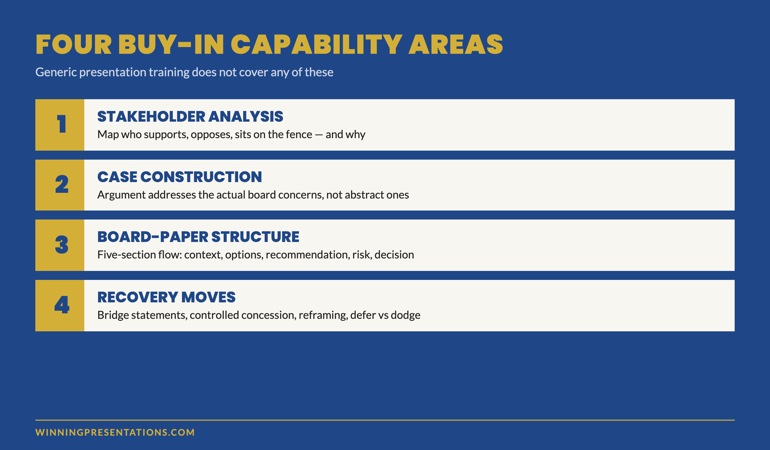
Quick answer: The Executive Buy-In Presentation System is a self-paced programme of 7 modules — stakeholder analysis, case construction, opening structure, the recommendation slide, the proof layer, the Q&A taxonomy, and the close. The output is not a polished deck; it is a working set of stakeholder maps, a one-line recommendation that holds under direct questioning, a structured opening, a proof layer that names its own counterevidence, and a rehearsed plan for the four hard questions the leader expects to be asked. A senior leader who works through the modules with one real upcoming board deck typically arrives at the meeting with that deck materially restructured around the buy-in target rather than the content the leader started with. Cohort enrolment is monthly and the materials are lifetime access; optional Q&A calls are fully recorded so attendance is never mandatory.
JUMP TO:
In early 2019 I was working with a senior commercial director who had been asked to take a major capital-allocation decision to her firm’s investment committee. She came to the session with a thirty-six-slide deck the analyst team had built. The deck was technically excellent, the financials checked out, and the recommendation was sound. She had three weeks. She wanted me to help her tighten the delivery. I asked her one question: “If the chair stops you after slide one and says ‘skip to the recommendation’, what do you say in the next sixty seconds?” She paused for a long time, started, stopped, restarted, and eventually said it depended on which chair. We had identified the problem in about ninety seconds. The deck was beautifully built but had been constructed in the wrong direction — it built up to a recommendation rather than starting from one. Every slide before slide thirty-two was load-bearing for an argument that no buy-in-stage audience was going to wait through.
The three weeks of work that followed were not deck work. They were buy-in work. We mapped the seven people on the committee one by one, sorting them into the ones already on side, the ones leaning against, and the two who would decide the room. We built a one-line recommendation that held under direct questioning. We rewrote the opening to start with the conclusion and the single proof point that pre-empted the strongest objection. We restructured the proof layer so each piece named its own counterevidence rather than waiting for the chair to surface it. And we drilled the four hard questions she was almost certainly going to be asked. The deck that walked into the room three weeks later had ten slides, not thirty-six. The committee approved the recommendation in fifty minutes and the chair said it was the cleanest paper he had seen that quarter. That sequence — stakeholder map, recommendation, opening, proof, Q&A taxonomy — is the structural skeleton of the Executive Buy-In Presentation System. The programme builds out each layer in a module of its own.
(This article was created with AI assistance; all stories and insights are based on 35 years of real client work.)
What people sometimes assume about the programme is that it is a deck-building course. It is not. The Executive Buy-In Presentation System is a course on restructuring the audience-target relationship before the deck is built — or more often, around an existing deck that has been built in the wrong direction. The deck is the artefact; the buy-in is the work. A senior leader who finishes the programme with a polished deck and an unmapped audience has missed the point. A leader who finishes with a slightly rough deck and a fully-mapped audience plus a tested recommendation will outperform the polished-deck version every time.
If you have a board meeting in the next eight weeks and the deck feels off:
The Executive Buy-In Presentation System gives you the 7 modules in a self-paced format — no deadlines, no mandatory live attendance, optional Q&A calls fully recorded. Monthly cohort enrolment, lifetime access to materials. Bring the real deck and rebuild it inside the framework.
The shift the programme is built around
Most senior leaders, when asked what they are preparing for a board meeting, describe a deck. They will name the slide count, the structure of the financials, the chart on slide twelve they are not sure about. The deck is the visible artefact and it is what fills the calendar block in the days before the meeting. The work that actually determines whether the recommendation gets approved is something different. It is the analysis of who in the room will support it, who will oppose it, who is undecided, and what each of those groups needs to hear in the first three minutes. That work usually does not happen. When it does, the deck almost always changes shape after it, sometimes dramatically. The Executive Buy-In Presentation System is built around the assumption that the buy-in work has not yet been done, and it walks the leader through doing it.
This is why the first module is not on slide structure. The first module is on stakeholder analysis — the discipline of mapping the room before mapping the deck. Senior leaders who have presented to the same committee many times often think they know the room implicitly and skip this work. They are usually wrong about at least one person, and the person they are wrong about is disproportionately likely to be the one who tips the room one way or the other. The module is not theoretical. The leader maps a real upcoming committee, person by person, and produces a written stakeholder map that lives alongside the deck for the rest of the preparation. That map is the document the leader returns to as the deck takes shape. Without it the deck builds itself around content. With it the deck builds itself around the audience.
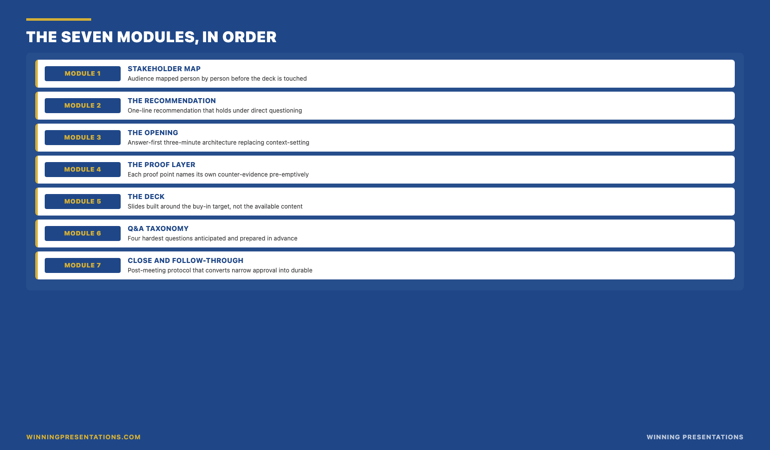
Modules 1–3: stakeholder map, recommendation, opening
Module one is stakeholder mapping. The leader produces a one-page map of the committee or board they are about to present to — each member named, sorted by current position (supportive, opposing, undecided), with the one or two factors that will most influence each one. The deliverable looks deceptively simple. The work behind it is what most senior leaders have never been pushed to do: forcing themselves to admit which committee members they actually understand and which ones they have been guessing about. The module is the foundation everything else is built on. A leader who does this module honestly often discovers that two of the seven people in the room are not who they assumed they were, and that the recommendation needs adjusting to address what those two actually need.
Module two is the recommendation. Not the content of the recommendation — the leader brings that — but the form of it. A recommendation that holds under direct questioning at slide one is structurally different from a recommendation that has built up over thirty slides of supporting analysis. The module walks the leader through compressing the recommendation into a single line that survives the chair asking “what are you actually proposing?” forty seconds in. The discipline is harder than it sounds. Most senior leaders, when forced to compress, produce a one-liner that hides important caveats, which then become liabilities under questioning. The module’s job is to teach the leader how to compress without losing structural integrity. The output is a recommendation line that a stakeholder can repeat back to a colleague after the meeting without distorting it.
Module three is the opening. Specifically, the first three minutes — the architecture that gets the recommendation, the stake, and the strongest pre-empted objection into the room before slide three. The module reframes the opening from “context-setting” into “answer-first, evidence-second, implications-third”, which is the pattern senior committees actually scan against. Most leaders open with context because that is how the deck was written. The module rewrites the opening to start where the audience is — with the decision they are being asked to make. By the end of module three the leader has restructured the first three slides of their real deck. The remaining four modules handle the rest.
Modules 4–7: proof, Q&A taxonomy, close, rehearsal
Module four is the proof layer. The shift is from “evidence in support” to “evidence that names its own counterevidence”. A board recommendation that presents only the supporting case looks defensive the moment the first counter-argument lands. A recommendation that names two or three real counter-arguments before the chair raises them looks rigorous and shifts the committee’s posture from challenging to evaluating. The module walks the leader through building this kind of pre-emptive proof structure for the specific recommendation in front of them. It is not a generic technique. It is a structural rebuild of the evidence layer of the deck so that the strongest objections from the stakeholder map are addressed in the proof itself, not deferred to Q&A. Most senior leaders, after this module, find they remove two or three slides from the deck because the content moves into the pre-empted-objection structure rather than living as standalone analysis.
Module five is the deck itself — the slide work that the first four modules have been quietly preparing the leader to do. By this point the stakeholder map exists, the recommendation is compressed, the opening is restructured, and the proof layer is pre-emptive. The deck more or less builds itself around those four pieces. The module covers slide structure, the small number of templates that handle most board-deck scenarios, and the discipline of cutting slides that do not earn their place under the buy-in target. The leader who works through module five with a real deck usually ends with a meaningfully shorter, structurally tighter version of what they came in with. The slide system the module references is available as a standalone product — the Executive Slide System (£39) — for leaders who want the templates and AI prompts the module five work draws on.
Module six is the Q&A taxonomy. The leader works through the eight categories of hard questions senior committees ask — verification, assumption, scope, motive, risk, stakeholder, timing, authority — and prepares a response stance for each. The module’s specific output is a prepared opening line for the four questions the leader expects to be asked, based on the stakeholder map from module one. The four questions are almost never wrong by more than one. Leaders who do this work walk into the meeting with the four hardest questions already absorbed and a response stance for each. Most of the audible composure that committee chairs read as authority comes from this module, because the leader is no longer doing live cognitive work in the room — she is retrieving prepared responses to questions she had correctly anticipated.
Module seven is the close and the follow-through. The close is the last ninety seconds of the presentation — the explicit ask, the decision frame, the implementation outline — structured so the committee can move directly from the close into the vote without ambiguity. The follow-through is the post-meeting protocol: the written summary that goes out within four hours, the captured action items, and the next-step alignment that holds the decision in place between the vote and the implementation. The follow-through is the module most leaders did not know they needed. It is also the one that converts narrow approvals into durable ones, and it is the work that frequently determines whether the recommendation survives the first three weeks after the committee meets.
Turn reluctant stakeholders into active advocates.
The Executive Buy-In Presentation System is a self-paced programme with 7 modules. Enrol with this month’s cohort, work through at your own pace — optional live Q&A calls are fully recorded so attendance is never mandatory. The framework you work through privately; the cohort enrolment puts you alongside other senior leaders working the same modules on different real decks. £499, lifetime access to materials.
- Module 1: stakeholder map — the audience mapped person by person before the deck is touched
- Module 2 & 3: one-line recommendation and answer-first opening that hold under direct questioning
- Module 4 & 5: pre-emptive proof layer and the slide structure that supports it
- Module 6 & 7: Q&A taxonomy with prepared responses and the post-meeting follow-through protocol
What a senior leader actually walks away with
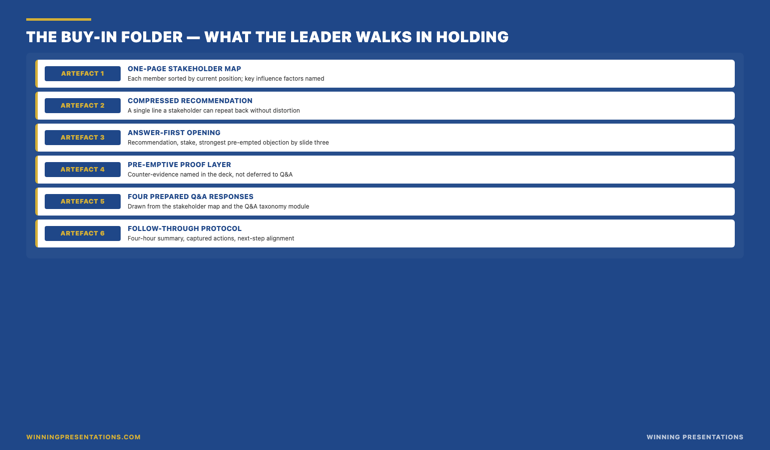
The artefact-set a leader has at the end of a working pass through the programme is small and concrete. It is one stakeholder map for the upcoming meeting, one written one-line recommendation, one restructured three-slide opening, one rebuilt proof layer with named counter-evidence, one materially shorter deck, four prepared question responses, and one post-meeting follow-through protocol. The whole set fits in a folder and most of it is plain text rather than slide work. That is the point. The leader who walks into a board meeting holding that folder of work is operating from a different structural position than the leader who walks in holding only a deck. The deck supports the meeting; the folder governs it. For a parallel walkthrough focused on the masterclass orientation of the programme, see the Executive Buy-In Masterclass online overview; for the wider context on the kind of training that produces this result, the board approval presentation training reference is the companion piece.
No deadlines, no mandatory attendance. Lifetime access to all materials.
The Executive Buy-In Presentation System — 7 self-paced modules, monthly cohort enrolment, optional recorded Q&A calls available. Work at your own pace; keep the materials forever. £499.
Frequently asked questions
Is the Executive Buy-In Presentation System worth it if I already have a strong deck for my next board meeting?
Probably more useful than you would guess. The strongest decks are usually the ones that have been beautifully built in the wrong direction — toward a recommendation that lives on slide thirty rather than slide one. The programme’s first three modules will likely surface a structural rebuild even on a deck that the leader and the analyst team are pleased with, because the rebuild is at the architecture level, not the polish level. Leaders who enrol with a strong deck and an upcoming meeting tend to get the most concrete return from the programme, because the work has a real artefact to attach to.
How does the self-paced format work in practice if I have a hard board meeting deadline?
The 7 modules are designed to be worked in sequence and the most common pattern is one module per week across seven weeks, but the timing is entirely flexible. A leader with a board meeting in three weeks would typically front-load the first four modules in the first ten days and use the remaining time for module five (the deck) and module six (Q&A rehearsal). A leader with eight weeks would space the modules more evenly. Optional Q&A calls happen monthly and are recorded so attendance is never required. The cohort enrolment is the thing that locks you in; the pace is yours.
What does the cohort enrolment actually give me, given the course is self-paced?
The framework you can work through privately. The cohort enrolment puts you alongside other senior leaders working the same modules on different real decks during the same window, which is where the parallel-track learning comes from — watching how someone in a different sector handles module four’s proof-layer rebuild on a deck that is structurally similar but contextually unfamiliar tends to surface insights private study cannot. The optional live Q&A calls are the surface where this happens most often, and the recordings preserve it for anyone who cannot attend live. The structural value of the cohort is the multi-deck exposure to the same framework being applied to different work.
Why is this priced at £499 rather than positioned as a low-cost course?
Because the leaders it is built for are presenting decisions to boards and investment committees where the cost of a deferred decision regularly runs into six or seven figures. A programme that materially improves the structural quality of those presentations earns its £499 on the first board meeting that lands cleaner than it otherwise would have. The pricing is calibrated to the buyer profile, not to the time investment alone. Leaders evaluating it as a generic professional-development purchase often find the framing strange; leaders evaluating it against the specific cost of a single deferred recommendation usually find the maths obvious.
The Winning Edge — weekly newsletter
The Winning Edge is a weekly newsletter for senior professionals who present at the executive level. One short email a week on the structural moves that separate decks committees back from decks they defer. Subscribe to The Winning Edge →
For the wider library of presentation assets that pair with the buy-in framework — the slide system, the Q&A taxonomy, the storytelling primer, and the delivery references — the Complete Presenter bundle (£99) collects them in one place.
About the author
Mary Beth Hazeldine is Owner & Managing Director of Winning Presentations Ltd. With 24 years of corporate banking experience at JPMorgan Chase, PwC, Royal Bank of Scotland, and Commerzbank, she advises executives across financial services, healthcare, technology, and government on structuring presentations for high-stakes funding rounds, board approvals, and strategic decisions.
Walk into your next board meeting with a folder, not just a deck. The folder holds the stakeholder map, the compressed recommendation, the answer-first opening, the proof layer that names its own counter-evidence, and the four prepared question responses. The deck supports the meeting; the folder governs it. The leader who builds the folder gets the decision. The leader who builds only the deck waits to find out.