Tag: speaking under pressure

30 Mar 2026
Executive at a podium handling a Q&A session with composure and confidence

Buying Time in Q&A: Ethical Techniques When You Need Thirty Seconds to Think

When you’re caught off guard in Q&A, the pause itself is not weakness—it’s strategy. Ethical buying time techniques include acknowledging the question, restating it for clarity, or offering a structured response timeline. The executives who own their silence outperform those who rush to fill it.

Osman, a finance director at a healthcare group, was midway through a board Q&A when a shareholder asked about a regulatory change he hadn’t anticipated. His first instinct was to speak faster, to fill the silence with half-formed thoughts. But he stopped himself. He took a three-second pause, restated the question aloud, and said: “That’s a crucial point. Let me give you the precision this deserves.”

That silence wasn’t a gap in his knowledge. It was permission to think like a leader. The board saw a director who wouldn’t sacrifice accuracy for speed. That pause changed how they perceived his credibility for the rest of the meeting.

Feeling unmoored in live Q&A?

Pausing under pressure is a learnable skill, not a confidence deficit. The right framework transforms that thirty-second gap from terrifying to tactical. You’ll learn how in this article—and in the full system, how to structure your thinking so confident pauses become your signature move.

Acknowledge, Pause, Reframe

The moment a question lands, your instinct is often to answer instantly. But the most executive move is to signal that you’ve heard it, create space for thought, and then respond from a position of composure.

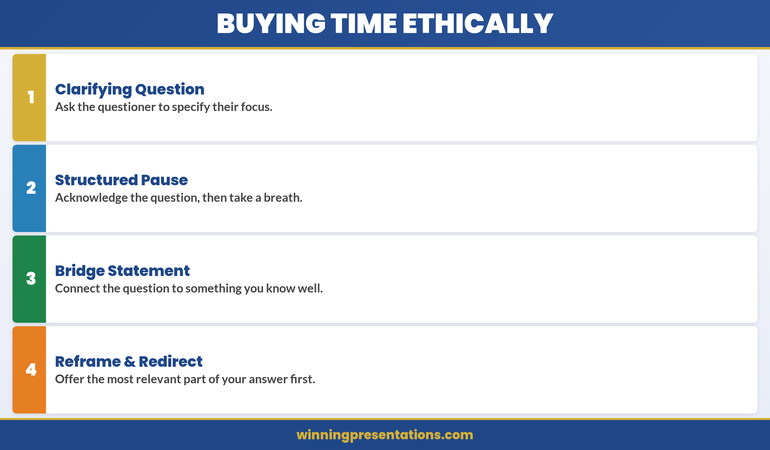
The technique: Acknowledge the question explicitly. Say: “That’s an excellent point,” or “I appreciate you raising that.” This does three things simultaneously. It buys you two to three seconds of thinking time. It signals to the room that you respect the question. And it shifts the emotional tone from you being caught off guard to you being thoughtful.

Then pause. Not uncomfortably long—just long enough for your breathing to settle and your thoughts to coalesce. Two to four seconds feels eternal when you’re standing there, but it reads as confidence to the audience.

Finally, reframe. You’re not answering the surface question; you’re answering the underlying concern. This layer of thinking—turning “Why didn’t you hit the Q3 target?” into “What does our revised pathway to that target look like?”—is what distinguishes senior executives from those who merely survive Q&A.

Master the System

The Executive Q&A Handling System teaches you five frameworks for managing pressure, structuring your thinking in real time, and owning the room. Every technique in this article is part of a complete system you’ll use in your next high-stakes Q&A.

Buy Now — £39

The Clarification Pause

If you genuinely don’t understand the question, clarification is both honest and strategic. It’s a legitimate pause-builder that serves everyone in the room.

The technique: Ask for clarity without apology. “To make sure I address this precisely, are you asking about our timeline, or the resource allocation?” You’re not stalling; you’re being professional. You’re ensuring your answer lands where it matters.

This approach works because it invites the questioner to refine their thinking too. Often, in the process of clarifying, both you and the audience understand the real issue more sharply. That clarity is gold in executive Q&A.

The clarification pause also sets a tone: you value precision over speed. You’d rather take an extra moment than give a half-answer. That’s how senior leaders think.

Four ethical techniques for buying time in Q&A: clarifying question, structured pause, bridge statement, and reframe and redirect

Related reading: When You Don’t Know the Answer in a Presentation explores how to handle questions that truly lie outside your scope—a different challenge, but one that shares the same foundation of honest pause.

Structured Response Buying Time

The most elegant time-buying technique is also the most useful: signposting your response structure aloud before you deliver the substance.

The technique: Say: “I’ll address this in three parts—the context, the decision, and the timeline.” Now you’ve bought yourself thinking time, but you’ve also given the audience a roadmap. They know where you’re going, so when you pause between sections, they understand it as intentional, not hesitant.

This is not filler. This is architecture. You’re showing the rigour behind your thinking, and the audience trusts structured thinking.

Where buying time becomes ethical, here, is that your structure is genuine. You’re not inventing three parts to stall; you’re using structure to organise a response that actually has three components. The buying time is the bonus.

Pro move: As you walk through each section, your thinking sharpens. By part three, you’re not buying time any longer—you’re in command. This is the difference between feeling rescued by a technique and owning it.

The system I teach in the Executive Q&A Handling System walks you through how to recognise which technique to deploy in real time, so you’re never deciding how to buy time while under pressure.

Body Language That Buys Credibility

The pause itself is only half the message. How you hold your body during that pause determines whether the room interprets it as thoughtfulness or uncertainty.

The non-negotiables: Keep your posture open. Don’t fold your arms or shift your weight. Maintain eye contact with the questioner. If you drop your gaze, the room reads it as evasion, not reflection.

Your breathing matters. Most executives hold their breath during a pause, which makes them physically tense. Breathe. Slowly. This settles your nervous system and keeps your thinking clear. It’s also visible to an attentive audience—they’ll see composure, not panic.

One more thing: nod slightly as you take the pause. It signals, “I heard you, I’m considering this seriously.” That’s a non-verbal form of acknowledgement, and it costs nothing.

For a deeper dive into how your physical presence shapes perception in Q&A, the bridging technique article covers how to use stance and gesture as strategic tools, not just accessories to your words.

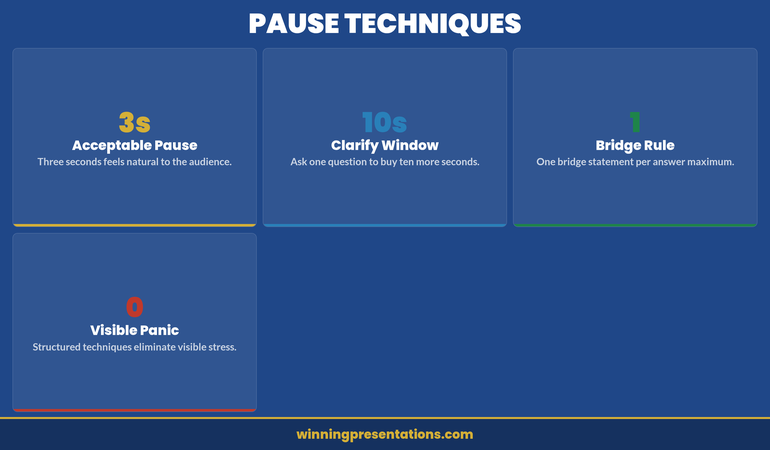
Q&A pause techniques dashboard showing acceptable pause duration, clarify window, bridge rule, and visible panic reduction

Ready to stop fearing the pause?

The Executive Q&A Handling System (£39) includes video modules on timing, scripting, and real-world scenarios. Build the confidence that transforms pressure into presence.

Access the System

When Buying Time Becomes Stalling

There’s a line between ethical pause and evasion. Know where it is.

Buying time is legitimate when:

  • You’re gathering your thoughts to give a more accurate answer.
  • You’re signalling that the question deserves serious consideration, not a throwaway response.
  • You’re using the pause to listen more deeply to what the questioner is actually asking.
  • You’re creating space for your own nervous system to settle so you can think clearly.

Buying time becomes stalling when:

  • You’re using the pause to dodge a question you don’t want to answer.
  • You’re repeating the question three times just to fill silence.
  • You’re offering non-answers cloaked in strategic language.
  • You’re buying time so frequently that the audience stops believing you’re ever thinking and starts suspecting you’re always hiding.

The distinction matters. Boards and senior leadership teams can smell the difference. They’ve been in rooms with hundreds of executives. They know a genuine pause from theatre.

The strongest executives use buying time tactically, not as a default. They know when to pause and when to answer sharply. The short answer framework covers exactly when a quick, crisp response is more powerful than a measured one.

Frequently Asked Questions

How long should a pause actually be?

Two to four seconds feels like an eternity when you’re standing in front of a room. It reads as composure to the audience. Anything longer than five seconds starts to feel intentional avoidance. The sweet spot is where you’ve caught your breath, reset your thinking, and are ready to speak with precision—usually somewhere in that two-to-four window.

What if I pause and my mind genuinely goes blank?

That’s anxiety, not a technique failure. If you’ve paused and your mind hasn’t returned, acknowledge it. “That’s a good question. Let me circle back to that after I finish this thought,” or “I want to give you a proper answer rather than rush this—let me follow up with you tomorrow.” Honesty in that moment is more credible than desperate filler words. The system walks you through how to prepare so your mind has something to work with, even under pressure.

Is buying time a sign of weakness?

No. It’s a sign that you value accuracy over speed. In executive environments, that’s strength. The executives who lose credibility are the ones who speak first and think second. Buying time—strategically—is how senior leaders protect their authority in real time.

Stay Sharp

New frameworks for high-stakes presentations land in The Winning Edge every week. Subscribe and never feel unprepared in Q&A again.

Subscribe Now

The executives who command boardrooms aren’t the ones who never need to pause. They’re the ones who’ve made peace with silence and turned it into their most powerful tool.

Mary Beth Hazeldine is Owner & Managing Director of Winning Presentations. With 24 years of corporate banking experience at JPMorgan Chase, PwC, Royal Bank of Scotland, and Commerzbank, she advises executives across financial services, healthcare, technology, and government on structuring presentations for high-stakes funding rounds and approvals.

20 Jan 2026
High-stakes presentation nerves - what senior leaders actually do to stay calm and present with confidence

High-Stakes Presentation Nerves: What Senior Leaders Actually Do

Quick answer: Senior leaders don’t eliminate high-stakes presentation nerves—they channel them. The executives who seem effortlessly calm have built preparation rituals that transform anxiety into focused energy. The key shift: they interpret racing heart and heightened alertness as “I’m ready” rather than “I’m afraid.” This reframe, combined with specific preparation habits, is what separates composed presenters from visibly nervous ones.

The techniques below come from watching hundreds of senior executives prepare for board meetings, investor pitches, and career-defining moments over 24 years in corporate banking.

⚡ High-stakes presentation in the next 24 hours? Do this now:

Tonight: Run through your opening 3 times out loud. Know your first sentence cold.

Morning of: 10 minutes of movement (walk, stretch). No new content review.

10 minutes before: Find a private space. Six slow breaths (4 counts in, 6 counts out).

Right before: Drink water. Slow your first two sentences deliberately.

The reframe: When you feel your heart racing, say to yourself: “This is my body getting ready to perform.”

The CFO Who Threw Up Before Every Board Meeting

Early in my banking career, I worked with a CFO who presented quarterly results to a FTSE 250 board. In the room, he was composed, authoritative, unshakeable. The board trusted him completely.

What I didn’t know until years later: he vomited before every single board meeting. Every quarter. For seven years.

He wasn’t fearless. He had a system.

The same ritual every time. The same preparation sequence. The same mental reframe that turned physical terror into focused energy.

When I started coaching executives on presentations, I discovered this wasn’t unusual. The most composed presenters aren’t the ones without nerves. They’re the ones who’ve built systems to channel them.

Here’s what those systems actually look like.


⭐ Calm Your Nervous System Before High-Stakes Moments

A hypnotherapist’s toolkit for stopping the physical symptoms of presentation anxiety.

Includes:

  • The 60-second reset that calms racing heart and shaking hands
  • Breathing techniques that work even when you’re already nervous
  • Pre-presentation routine you can do outside the boardroom

Get Calm Under Pressure → £19.99

Created by a clinical hypnotherapist who’s helped hundreds overcome presentation anxiety.

The Myth of the “Naturally Confident” Executive

Here’s what most people believe: some executives are just naturally confident. They were born with a presentation gene. The stakes don’t affect them the way they affect the rest of us.

After 24 years watching senior leaders prepare for high-stakes moments, I can tell you: this is completely wrong.

The executives who look effortlessly calm are often the most anxious beforehand. What they have isn’t an absence of nerves—it’s a system for managing them that’s become automatic.

What nervous professionals do:

  • Try to suppress or eliminate anxiety (impossible)
  • Over-prepare content until the last minute (increases stress)
  • Interpret physical symptoms as evidence they can’t handle it
  • Wing the opening because “I know this material”

What senior leaders do:

  • Accept that nerves are part of high-stakes performance
  • Stop content preparation 24 hours before
  • Interpret physical symptoms as readiness signals
  • Rehearse their opening until it’s automatic

The difference isn’t confidence. It’s preparation architecture.

If you want to overcome the fear of public speaking long-term, you need to build the same systems. But even for a single high-stakes presentation, these habits make a measurable difference.

The Nerves Reframe: Anxiety as Readiness

This is the single most important technique for managing high-stakes presentation nerves.

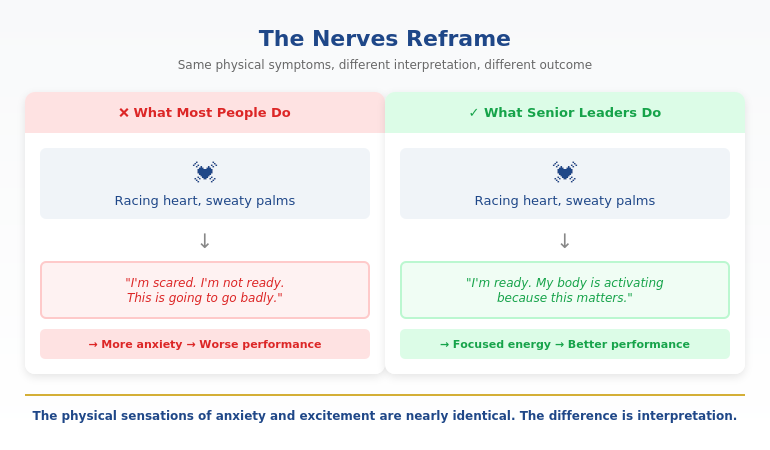
When you feel anxiety—racing heart, sweaty palms, shallow breathing—your brain is making an interpretation. It’s asking: “What does this physical state mean?”

Most people’s default interpretation: “I’m scared. I’m not ready. This is going to go badly.”

That interpretation makes everything worse. It triggers more stress hormones. It creates a feedback loop of escalating anxiety.

The reframe that senior leaders use:

When you feel those physical symptoms, consciously tell yourself: “This is my body getting ready to perform. These are readiness signals, not danger signals. My system is activating because this matters.”

This isn’t positive thinking. It’s physiologically accurate.

The physical sensations of anxiety and excitement are nearly identical: elevated heart rate, heightened alertness, increased blood flow. The difference is entirely in interpretation. Research shows that people who interpret pre-performance arousal as helpful actually perform better than those who try to calm down.


The Nerves Reframe showing how senior leaders interpret anxiety signals as readiness rather than fear

How to practice the reframe:

Next time you feel presentation nerves, say out loud (or silently): “I’m not scared—I’m ready. My body is activating because this matters. This energy is going to help me perform.”

It feels strange the first few times. After a dozen repetitions, it becomes automatic. Senior executives have done this reframe so many times it’s now their default interpretation.

For the complete protocol including the neurological basis and practice exercises, it’s covered in depth in Conquer Speaking Fear.

Want the complete Nerves Reframe Protocol? Conquer Speaking Fear includes step-by-step techniques for rewiring how your brain interprets anxiety—plus emergency protocols for when panic hits. See what’s included →

What Senior Leaders Actually Do (The Preparation Rituals)

Here’s what I’ve observed from watching hundreds of executives prepare for board meetings, investor presentations, and career-defining moments:

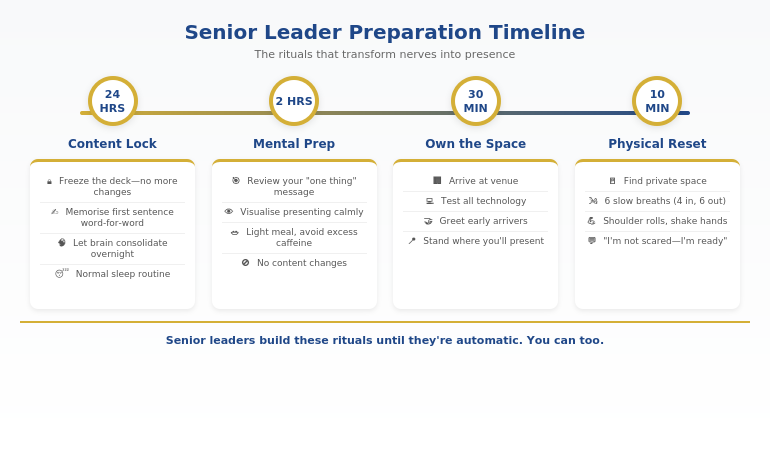
Ritual #1: Content lock 24 hours before

Senior executives stop changing their content a full day before presenting. No more tweaks. No more “one more data point.” The presentation is frozen.

Why this works: last-minute changes increase cognitive load and anxiety. Your brain needs time to consolidate. The executives who seem most natural have stopped thinking about content and started thinking about delivery.

Ritual #2: First sentence memorised word-for-word

Every senior leader I’ve worked with knows their first sentence cold. Not approximately—exactly. They could say it in their sleep.

Why this works: the first 10 seconds are when anxiety peaks. Having an automatic opening eliminates the “what do I say first?” panic. Once you’re past those first words, momentum takes over. Learn more about crafting a powerful executive presentation opening line.

Ritual #3: Physical reset before entering

Before walking into the room, senior leaders find a private space—bathroom, empty office, stairwell—for a 2-minute physical reset. This typically includes: 6 slow breaths, shoulder rolls to release tension, and 30 seconds standing in an expanded posture.

Why this works: physical state drives mental state. You can’t think your way to calm, but you can breathe your way there. For a complete pre-presentation reset routine, see how to calm nerves before a presentation.

Ritual #4: Arrival 15 minutes early

Executives arrive early enough to own the space. They test the technology. They stand where they’ll present. They greet early arrivers casually.

Why this works: arriving rushed puts you in reactive mode. Arriving early puts you in host mode. The psychological shift is significant.


Senior leader preparation timeline showing what executives do 24 hours, 2 hours, and 10 minutes before high-stakes presentations


⭐ High Stakes Trigger Your Nervous System — Here’s the Override

These techniques work at the physiological level, not just “think positive” advice.

Includes:

  • Vagus nerve activation that shifts you out of fight-or-flight
  • The grounding method that stops symptoms mid-presentation
  • Emergency reset when nerves spike unexpectedly

Get Calm Under Pressure → £19.99

Used by executives who present to boards, investors, and leadership teams.

The Day Of: Hour-by-Hour Protocol

Here’s the exact timeline senior leaders follow on presentation day:

Morning (3+ hours before):

  • Normal routine. Don’t disrupt sleep or eating patterns.
  • 10 minutes of physical movement—walk, stretch, light exercise.
  • One run-through of opening and closing only. No full rehearsal.
  • No content changes. The deck is locked.

2 hours before:

  • Review your “one thing”—the single most important message.
  • Visualise the room, the faces, yourself presenting calmly.
  • Light meal or snack. Avoid caffeine if you’re already anxious.

30 minutes before:

  • Arrive at the venue. Test technology. Claim the space.
  • Greet anyone who’s early. Small talk reduces your threat perception.

10 minutes before:

  • Find a private space. Bathroom stall works.
  • 6 slow breaths: 4 counts in, hold 2, 6 counts out.
  • Shoulder rolls. Shake out hands.
  • Say your opening sentence out loud once.
  • Reframe: “I’m not scared—I’m ready.”

1 minute before:

  • Stand tall. Shoulders back. Take up space.
  • Smile briefly—it releases tension.
  • Focus on serving your audience, not on your performance.

This protocol works because it shifts your focus from “how will I perform?” to “how will I serve?” Senior leaders have made this shift so many times it’s automatic. You can build the same pattern.

Want a printable version of this protocol? Conquer Speaking Fear includes the complete day-of timeline plus emergency techniques for unexpected situations. Download now →

Related: Once you’ve managed your nerves, make sure your opening line earns the attention you deserve. Read Executive Presentation Opening Line That Makes Executives Put Down Their Phones.

Common Questions About High-Stakes Presentation Nerves

How do you calm nerves before a high-stakes presentation?

The most effective approach is reframing, not calming. When you feel anxiety symptoms, interpret them as readiness signals rather than fear signals. Tell yourself: “My body is activating because this matters.” Combine this with physical reset techniques—6 slow breaths, shoulder rolls, expanded posture—in the 10 minutes before presenting. Trying to eliminate nerves entirely backfires; channeling them works.

Why do I get so nervous before important presentations?

Your nervous system is doing its job. High-stakes situations trigger a stress response designed to help you perform—increased alertness, faster processing, more energy. The problem isn’t the nerves; it’s interpreting them as “something is wrong.” Senior executives feel the same physical symptoms—they’ve just learned to interpret them as “I’m ready” rather than “I’m afraid.” Build presentation confidence by changing the interpretation, not fighting the sensation.

How do executives stay calm under pressure?

They don’t stay calm—they manage activation. The executives who seem effortlessly composed have built preparation rituals that become automatic: content lock 24 hours before, first sentence memorised, physical reset before entering, early arrival to own the space. They’ve also practiced the anxiety reframe so many times that “I’m ready” is now their default interpretation of nervous symptoms.


⭐ Ready to Eliminate Presentation Fear Permanently?

Go beyond managing symptoms — rewire how your brain responds to high-stakes situations entirely.

Includes:

  • The complete fear-to-confidence transformation system
  • Mental rehearsal techniques that build genuine confidence
  • Cognitive reframing methods from clinical hypnotherapy

Get Conquer Speaking Fear → £39

The complete system for professionals who want to present without fear — not just manage it.

FAQ

What if I’ve tried everything and still get nervous?

You’re not trying to stop being nervous—you’re trying to use the nervousness differently. The reframe technique doesn’t eliminate anxiety; it changes your relationship with it. If deep breathing hasn’t worked, it’s because you were trying to suppress symptoms rather than reinterpret them. The shift from “I need to calm down” to “this activation is helping me” is subtle but transformative.

How far in advance should I start preparing mentally?

Lock your content 24 hours before. Start the mental preparation—visualisation, reframe practice, physical routines—the morning of. Don’t over-prepare the day before; this increases rumination and anxiety. The goal is to arrive at your presentation with fresh energy and automatic habits, not exhausted from mental rehearsal.

Does this work for virtual high-stakes presentations?

Yes—with modifications. For virtual presentations, arrive at your setup 20 minutes early to test technology and settle in. Do your physical reset away from camera, then return with 2 minutes to spare. The reframe technique works identically. Virtual presentations often feel harder because you can’t read the room, so having automatic habits becomes even more important.

What if the nervousness is visible (shaking, sweating)?

Two approaches: manage the symptoms and reframe the visibility. For physical symptoms, the breathing reset helps (it activates your parasympathetic nervous system). But also know this: audiences notice visible nerves far less than you think. And mild nervousness often reads as “this person cares about this topic.” If symptoms are severe, the Calm Under Pressure guide covers specific techniques for physical symptom management.

📧 The Winning Edge Newsletter

Weekly techniques for confident presenting, managing nerves, and executive communication. Practical methods from a clinical hypnotherapist with 24 years in corporate banking—no generic advice, just what actually works under pressure.

Subscribe Free →

Your Next Step

Senior leaders don’t eliminate high-stakes presentation nerves. They build systems that transform anxiety into focused energy.

For your next important presentation: lock your content 24 hours before, memorise your first sentence, do the physical reset 10 minutes before, and practice the reframe—”I’m not scared, I’m ready.”

These aren’t tricks. They’re the exact preparation rituals I’ve observed from executives who present to boards, investors, and senior leadership regularly.

For the complete system—including the Nerves Reframe Protocol, day-of timeline, and emergency techniques—get Conquer Speaking Fear.

📋 Free Resource: Calm Under Pressure Quick Guide

Techniques for managing physical symptoms of presentation anxiety—shaking, sweating, racing heart. Perfect companion to the mindset techniques above.

Download Calm Under Pressure →

About the Author

Mary Beth Hazeldine is the Owner & Managing Director of Winning Presentations and a former corporate banker with 24 years of experience at JPMorgan Chase, PwC, Royal Bank of Scotland, and Commerzbank. She has trained thousands of executives on high-stakes presentation skills and helped clients secure more than £250 million in funding and budget approvals.

Mary Beth is also a qualified clinical hypnotherapist and NLP practitioner, specialising in helping professionals overcome presentation anxiety and speaking fear. After spending five years battling her own terror of presenting at JPMorgan, she developed the neuroscience-based techniques she now teaches to executives worldwide.

Book a discovery call | View services