Tag: remote presentation

22 Apr 2026
A professional woman presenting on a video call with camera on, well-lit home office setup, laptop with ring light visible, attentive expression, navy background, editorial photography style

Camera On or Off in Virtual Presentations

Quick Answer

Camera on is the default for any presentation where you are presenting, seeking a decision, or building trust. Camera off is appropriate when you are part of a large passive audience or when technical constraints make a poor image worse than no image. The question isn’t whether cameras help — they do. The question is when the discomfort around cameras is worth working through, and when the decision to turn off is covering something that needs addressing.

Nadia had been on camera in every client meeting for three years. Then she got a new manager who ran every call with his camera off. Within two months, half the team had stopped using cameras too.

She noticed something shift in the quality of those meetings. Decisions took longer. Follow-up questions went unanswered until email. People multitasked in ways they didn’t before.

Nobody said anything. Camera-off had become the culture. And the culture was costing them something real — not in visibility, exactly, but in attention, trust, and the subtle accountability that comes from being seen.

The debate about cameras in virtual presentations is often framed as a comfort issue. It is sometimes that. But more often it’s a signal issue — and understanding what your camera choice signals to others is more useful than any general rule about when to turn it on or off.

If virtual presentations trigger more anxiety than in-person ones, you’re not alone — and it’s fixable.

Conquer Speaking Fear addresses the patterns that make virtual presentations feel harder than they should — including camera anxiety, self-consciousness on screen, and the specific challenge of reading an invisible audience.

Explore Conquer Speaking Fear →

What turning your camera off actually signals

Most people think of camera use in terms of what it does for them — whether they feel comfortable on screen, whether their background is presentable, whether the lighting is good enough. That’s the wrong frame.

Camera use is a signal to others. And the signal it sends when you turn it off depends heavily on the context and your role in the meeting.

When a presenter turns their camera off, the audience receives one of three messages:

  • Technical necessity: bandwidth issues, poor lighting, technical failure. This is understood and accepted if acknowledged briefly.
  • Disengagement: the presenter doesn’t feel this interaction warrants full presence. This is not always the intended message, but it’s frequently the received one.
  • Avoidance: in presentations where the topic is difficult, or where the presenter is anxious, a switched-off camera can read as reluctance to be seen. Senior stakeholders notice this.

None of these perceptions is entirely fair. The person behind the camera-off screen may be intensely focused, technically constrained, or simply following what’s become their team’s default. But perception matters in presentations — and managing the signal you’re sending is part of the job.

Research into video call behaviour consistently shows that camera presence correlates with perceived engagement, trust, and commitment. This doesn’t mean camera-off makes you appear untrustworthy. It means that in high-stakes presentations — the ones where credibility is being assessed — the camera is doing more work than most people realise.
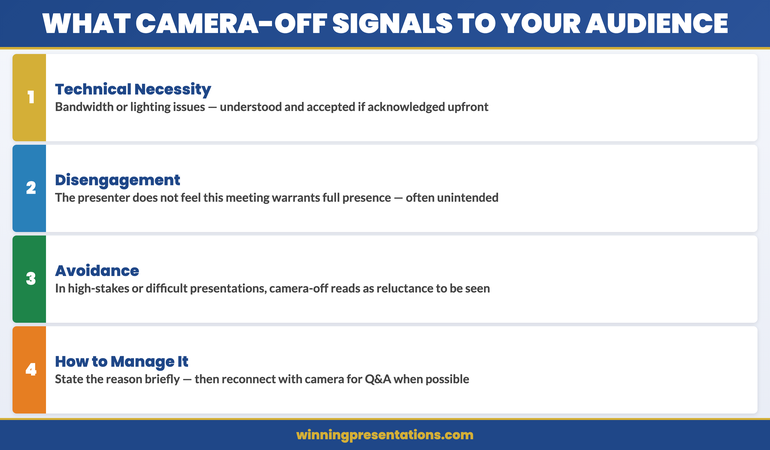
Stacked cards infographic showing the three signals sent by camera-off in presentations: technical necessity, disengagement, and avoidance — with guidance on each

When camera-on is non-negotiable

There are situations where presenting without camera is not a neutral choice. In these contexts, turning your camera off changes the nature of the interaction in ways that work against you.

When you are the primary presenter seeking a decision. If you’re presenting a proposal, requesting a budget, pitching a strategy, or asking for approval, your camera is part of your persuasive presence. The audience is not just evaluating your slides — they’re evaluating your confidence, your conviction, and your ability to respond to questions live. A camera-off presenter in this context appears either unprepared or evasive.

When you are managing a crisis or delivering difficult news. Camera presence in difficult conversations signals that you’re taking responsibility and engaging fully. A camera-off difficult conversation feels like a phone call with slides. It removes the human accountability that makes hard news easier to receive.

When you’re presenting to someone you haven’t met before. Trust is built through face-to-face interaction, even on a screen. The first impression you make to a new stakeholder, senior leader, or client group is shaped heavily by whether you’re visible. A first meeting with camera off creates a relationship deficit that takes subsequent meetings to recover.

When you’re in a small group presentation. In a meeting of three to six people, camera-off is conspicuous. In a large webinar of 100 people, camera-off is standard. The size of the audience changes what camera-off means.

Legitimate reasons to turn your camera off

There are contexts where camera-off is the right call — not because of anxiety or avoidance, but because it genuinely serves the interaction better.

When screen-sharing is the primary communication medium. If you’re conducting a technical walkthrough, demonstrating a product, or presenting a detailed document where the audience needs to focus on the screen content, your face in the corner can be a distraction rather than an aid. Some presenters prefer to turn camera off during the demonstration and on during the Q&A.

When bandwidth is genuinely degrading your image quality. A pixelated, freezing image is worse than no image. A face that breaks up every 30 seconds signals technical incompetence rather than presence. If your connection is poor, announce it clearly at the start — “I’m going to turn camera off to preserve audio quality, I’ll switch back on for Q&A” — and the choice becomes professional rather than evasive.

When you are a passive participant in a large meeting. In an all-hands presentation or a town hall where you’re not presenting, camera-off is standard. The etiquette scales with audience size. Above roughly 20 people, camera-off for non-presenters is normal and expected.

When team culture explicitly permits it and the stakes are low. Internal team catch-ups with an established team where camera-off is normalised carry different weight than a client presentation. Know the difference.

Virtual Presentations Feel Different Because They Are Different — Here’s How to Close the Gap

Conquer Speaking Fear — £39, instant access — addresses the specific patterns that make virtual presentations harder: camera anxiety, self-consciousness on screen, the absence of non-verbal feedback, and the feeling of presenting into a void. Built on clinical hypnotherapy and NLP, designed for professionals presenting under real pressure.

  • Techniques for managing camera anxiety and self-consciousness
  • Frameworks for reading virtual audiences without visible cues
  • Tools for building presence through a screen rather than despite it
  • Nervous system regulation approaches for high-stakes virtual presentations

Get Conquer Speaking Fear →

Designed for professionals who want to present with confidence in any format.

When camera anxiety is the real issue

There’s a pattern I see regularly: people who find every credible-sounding reason to turn their camera off — poor lighting, bandwidth, the meeting is too large, “I’m just listening today” — when the actual driver is anxiety about being seen on screen.

Camera anxiety is real. The experience of seeing yourself on screen while simultaneously trying to present is genuinely uncomfortable. You’re monitoring your own expression, your hair, whether your background looks acceptable, whether you look engaged or blank or nervous. It’s a cognitive load that doesn’t exist in in-person presentations.

The problem with using camera-off as a permanent solution to camera anxiety is that it removes the anxiety without resolving it. The anxiety remains — it just gets smaller, because you’re avoiding the trigger. And avoidance maintains anxiety rather than reduces it. Each time you turn the camera off to escape the discomfort, the next camera-on experience feels harder.

The more productive path is to address what’s driving the discomfort directly. For many people, camera anxiety is a form of self-consciousness — an intense self-focus on how you appear rather than what you’re communicating. This is the same pattern that underlies general presentation anxiety, and it responds to the same approaches: structured techniques for redirecting attention, nervous system regulation before presenting, and gradual exposure to the trigger under controlled conditions.

If you recognise this pattern in yourself, the article on presentation anxiety and remote cameras addresses this specifically.
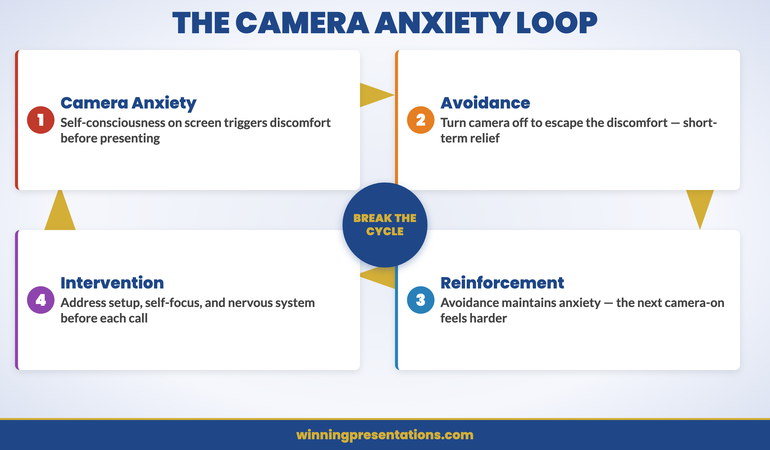
Cycle infographic showing the camera anxiety avoidance loop: camera anxiety, avoidance, short-term relief, reinforced anxiety, and the intervention point

The setup changes everything

Many camera decisions are driven by practical problems that are actually fixable. Before defaulting to camera-off, it’s worth considering whether the issue is technical rather than personal.

Lighting. The most common cause of a poor on-screen image is bad lighting, not poor equipment. If the primary light source is behind you (a window, a lamp), your face will be dark and your background will be washed out. A simple ring light or a repositioned desk lamp in front of you changes the image quality dramatically. This is a £30 fix that removes one of the most cited reasons for camera-off.

Camera angle. A laptop camera positioned below eye level produces an unflattering upward angle. Raising the laptop — even with a stack of books — brings the camera to eye level. At eye level, the image is more natural and the eye contact with the camera feels more direct. This is a two-minute adjustment that changes how you appear on screen.

Background. You don’t need a perfectly decorated office. You need a wall. A plain wall behind you with nothing distracting in frame creates a neutral, professional background. Virtual backgrounds work, but they introduce rendering artefacts that experienced viewers notice. A real background, even a simple one, is usually better.

When these three elements — lighting, angle, background — are addressed, most people find that camera-on feels significantly less uncomfortable. The discomfort was partly aesthetic, and the aesthetics are fixable.

For a complete guide to virtual presentation setup and how to maintain presence through a screen, the article on virtual presentation energy covers the physical and environmental factors in detail. And for managing the specific anxiety that comes from presenting content on screen, the article on screen sharing presentations addresses the moment-by-moment challenges.

If camera anxiety is part of a broader pattern of presentation fear, the structured approaches in Conquer Speaking Fear are designed to address the underlying patterns rather than just the surface symptoms.

Build Genuine Confidence in Virtual Presentations — Not Just Coping Strategies

Conquer Speaking Fear — £39, instant access — moves beyond tips and into the actual patterns that make presentations feel threatening. If virtual presenting feels harder than it should, this is the resource that addresses why — and what to do about it.

Get Conquer Speaking Fear →

Designed for professionals presenting under real pressure in any format.

Frequently Asked Questions

Is it rude to turn your camera off in a work meeting?

It depends on the meeting type and your role in it. If you’re presenting, leading, or actively participating in a small group, camera-off registers as disengagement to most colleagues. If you’re a passive participant in a large meeting, camera-off is standard. The social norm scales with meeting size and your role. When in doubt, camera on is the lower-risk default — it’s easier to turn off than to reverse the impression created by starting off screen.

Does camera-off affect how you’re perceived in virtual interviews or presentations to senior stakeholders?

Yes, meaningfully. Senior stakeholders in assessment contexts are evaluating your presence, confidence, and communication style — not just your content. Camera-off removes most of those signals. If technical issues prevent you from presenting with camera, acknowledge it directly at the start and offer to follow up with an in-person meeting or a call where you can be seen. Never leave camera-off unexplained in a high-stakes presentation.

What if my whole team has camera-off as the default — should I still turn mine on?

When you’re presenting, yes. When you’re participating as a listener in a team where camera-off is cultural, that’s a different consideration — you’re not going against convention in a meaningful way. But in any meeting where you are presenting, leading, or seeking something, camera-on is worth the discomfort. You will stand out — and standing out in those moments works in your favour.

The Winning Edge

Weekly insights on presenting with confidence and clarity — for professionals in every format. Every Thursday.

Subscribe Free →

Not ready for the full programme? Start here instead: download the free Virtual Presentation Checklist — a practical reference for setup, delivery, and follow-through in virtual presentations.

For the executive skill of opening virtual and in-person presentations with authority, see the guide on board presentation opening lines — the structures that establish credibility from your first sentence.

The camera question is, in the end, a question about presence. Turn yours on. Work on the setup until it feels comfortable. And if the discomfort is about more than lighting and angles, address that directly — because your virtual presence is now as important as your in-person one.

About the Author

Mary Beth Hazeldine is Owner & Managing Director of Winning Presentations. With 24 years of corporate banking experience at JPMorgan Chase, PwC, Royal Bank of Scotland, and Commerzbank, she advises executives across financial services, healthcare, technology, and government on structuring and delivering high-stakes presentations. She is a qualified clinical hypnotherapist and NLP practitioner, and draws on both disciplines in her approach to presentation confidence and anxiety.

18 Apr 2026

Asynchronous Presentation: How to Deliver Impact Without a Live Audience

Quick Answer: Recording an asynchronous presentation produces a specific kind of anxiety that live presenting does not — no audience feedback, no natural pacing cues, no recovery from a stumble. The result is often either a flat, over-rehearsed delivery that sounds scripted, or a fractured recording session full of restarts that never quite captures what you know you can do. The fix is a structured approach: script the architecture rather than the words, regulate your physical state before hitting record, and apply a clear protocol for when to continue versus when to re-record.

Ngozi was Head of Client Success at a SaaS company with teams across eight time zones. When her director asked her to record a 12-minute overview of Q1 client health metrics for a global leadership meeting, she assumed it would take an hour. Two and a half hours later, she had completed eight full takes and was still not happy with any of them.

The problem was not her knowledge of the material — she knew it precisely. It was the silence. In a live meeting, she could read the room: a nod told her to move on, a furrowed brow told her to explain further, a shift in posture told her she had the room’s attention. Recording herself for an audience she could not see produced a physical response she had not anticipated — a slight tightening in her voice, a tendency to rush through the data slides, and a persistent sense that she had somehow got the tone wrong even when the content was correct.

The restarts were making it worse. Each time she re-recorded, she became more self-conscious, not less. The ninth take was worse than the third. She stopped, spent fifteen minutes on a physical regulation routine she had learned from a coaching session, went back to her one-page script outline — not a word-for-word script, just the architecture of each section — and recorded it in one take that was good enough to send.

The leadership team’s response was warm and specific. The recording had landed. Not because it was technically perfect — there was one moment where she stumbled slightly and kept going — but because it felt real and considered. That is the standard an asynchronous presentation actually needs to meet.

If recording yourself triggers a physical anxiety response

The Calm Under Pressure programme is designed for in-the-moment physical symptom management during presentations — including the specific tension patterns that recording without a live audience tends to produce. It addresses the physical state, not just the mindset.

Explore the Programme →

Why Recording Yourself Creates a Different Kind of Anxiety Than Live Presenting

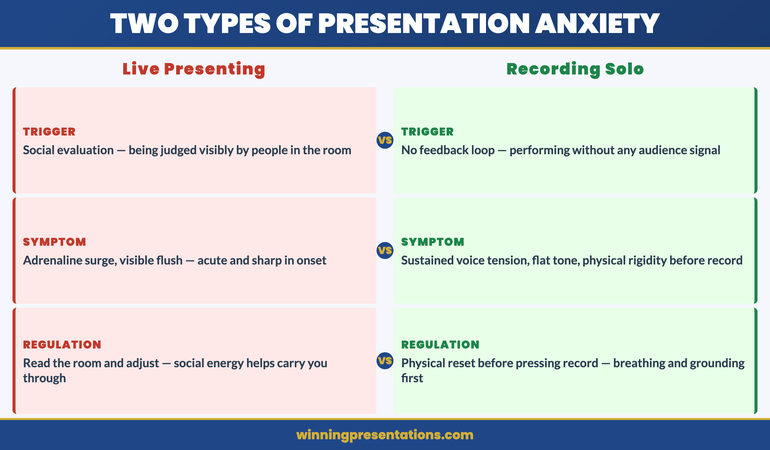
Live presenting produces anxiety primarily through social evaluation: the fear of being judged, of losing the room, of visibly struggling in front of people whose opinions matter. This is uncomfortable, but it comes with natural regulation mechanisms — you read the room, you adjust, you get into the flow of a conversation, and the social energy of the room often carries you through difficult moments.

Recording yourself without an audience removes all of those regulation mechanisms simultaneously. There is no room to read. There is no social energy to carry you. There is no feedback loop that tells you whether you are going well or badly — only your own internal critic, which has no information about how the recording is actually landing and tends to default to “worse than expected.”

The physical response to this is distinct from live presentation anxiety. Rather than the adrenaline surge of walking into a room, recording anxiety tends to manifest as a sustained physical tension — a slight tightness in the throat and chest, a flatness in vocal tone, a tendency toward over-precision in diction that makes delivery sound rehearsed rather than natural. Executives who present with considerable confidence in live settings often find that their recorded delivery sounds noticeably less authoritative than they know themselves to be. This is not a performance problem. It is a physiological response to an unnatural stimulus: performing without an audience for an audience you cannot see.

Understanding this distinction matters because the solution is different. Live presentation anxiety responds well to preparation and rehearsal. Recording anxiety responds better to physical regulation before recording and a structural approach to delivery that gives you something to navigate rather than a blank canvas to fill. The screen sharing and virtual presence framework covers the related challenge of delivering effectively on camera — many of the same principles apply here.

Calm Under Pressure

Manage the Physical Response That Undermines Your Recorded Delivery

Calm Under Pressure — £19.99, instant access — is designed for in-the-moment physical symptom management in presenting contexts. It addresses the specific physical patterns that recording without an audience tends to produce: voice tension, delivery flatness, and the physical spiral that makes restarts worse rather than better. Techniques designed for the moments before and during high-stakes presentation delivery.

  • In-the-moment physical regulation techniques for voice tension and delivery anxiety
  • Breathing and grounding frameworks for solo recording and virtual presentation environments
  • Physical symptom management for presenting without live audience feedback
  • Protocols for resetting your physical state when recording sessions are not going well

Get Calm Under Pressure →

Designed for executives who experience physical anxiety symptoms during presentations.


Asynchronous Presentation Anxiety infographic comparing Live Presentation anxiety triggers (social evaluation, losing the room, visible struggle) versus Recording anxiety triggers (no feedback loop, internal critic, sustained voice and physical tension) — with different regulation approaches for each

The Physical Setup That Reduces Delivery Anxiety

The physical environment in which you record has a measurable effect on delivery quality — not just for technical reasons, but because environmental signals shape your physiological state before you begin.

Camera position matters more than most executives realise. A camera positioned below eye level is the most common setup mistake in recorded presentations, and it produces a subtle but perceptible effect: the presenter appears to be looking slightly down, which reads as diminished authority or discomfort. Camera at eye level — which typically means elevating the laptop or external camera to head height — produces a noticeably different quality of presence on screen. You are speaking with your audience rather than at them or above them.

Lighting has a similar effect on the physical experience of recording. Poor lighting — particularly strong backlight from a window behind the presenter — forces a subtle physical tension as the camera struggles to compensate and the presenter senses that the image is not clear. A single key light source positioned in front of and slightly above the presenter reduces this tension significantly. Natural daylight from in front is ideal; a ring light is a reliable alternative. The practical principles behind virtual setup are covered in the hybrid meeting facilitation guide — the same environmental principles apply to async recording.

The two minutes before you hit record are as important as the setup itself. A brief physical regulation routine — slow breathing, a deliberate relaxation of the shoulders and jaw, and two or three slow exhales — reduces the physical tension that accumulates in the lead-up to recording. The goal is not to be relaxed in the way you might be in a casual conversation. The goal is to be in the physical state from which your natural authority emerges. Most people know what that state feels like. The regulation routine is designed to get you there intentionally rather than waiting to stumble into it.

How to Script Without Sounding Like You Are Reading

The instinct when recording an asynchronous presentation is to write a full script — every word, every transition, every data point — so that nothing gets missed and nothing sounds uncertain. The result is almost always a recording that sounds exactly like what it is: someone reading from a script. The fluency markers that indicate natural speech — the slight variation in sentence length, the occasional pause for thought, the natural emphasis that comes from actually thinking about what you are saying — are absent, and their absence is immediately perceptible to listeners.

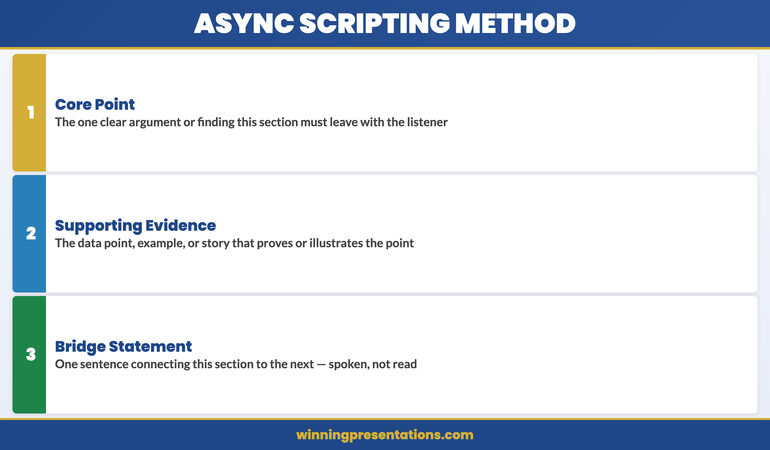
The alternative is not to record without preparation. It is to script the architecture rather than the words. For each section of your asynchronous presentation, prepare a one to three bullet point outline: the core point you are making, the supporting evidence or example you will use, and the bridging statement that moves you to the next section. That is your script. Within each section, you speak to those points rather than reading predetermined sentences.

This approach has a specific cognitive benefit. When you are working from an architectural outline rather than a word-for-word script, the process of expressing each point engages your thinking rather than your memory. Your delivery becomes the natural product of actually engaging with the material — which is exactly what your audience will perceive as authority and genuine expertise.

The exception to this principle is the opening statement. Writing and memorising a single strong opening sentence — delivered directly to camera — anchors the recording with presence and sets the tone for everything that follows. First impressions in recorded presentations are formed within the first ten seconds, and a confident, direct opening statement creates a frame that benefits every subsequent section. The principles behind effective opening delivery are covered in the Teams presentation delivery framework — the same opening principles apply across virtual and recorded formats.

If the physical symptoms of recording anxiety — voice tension, difficulty finding your natural delivery register, the restart spiral — are a consistent challenge, Calm Under Pressure addresses these at the physical level, with in-the-moment techniques designed for presenting contexts specifically.


Async Presentation Scripting Method infographic showing the architectural outline approach: for each section prepare Core Point, Supporting Evidence or Example, and Bridge to Next Section — contrasted with the full-script approach that produces robotic delivery

Your Voice Without an Audience: Why It Sounds Wrong and How to Fix It

Most people, when they first listen back to a recording of themselves presenting, have the same reaction: that does not sound like me. The voice sounds flatter, more monotone, more hesitant than the presenter believed they sounded while recording. This is not a delusion — it reflects something real about what happens to vocal delivery when the live audience is removed.

In a live presenting environment, your voice is shaped partly by the room’s response. You raise volume when the room gets quieter and you sense it is needed. You slow down when you see a furrowed brow. You lean into emphasis when a point lands and the room’s energy confirms that it has. These are not conscious decisions — they are automatic responses to social feedback that regulate your vocal delivery in real time.

Recording removes all of these regulation signals. The result is that voice tends to compress: the dynamic range narrows, the pace either rushes or stalls without natural audience pacing to guide it, and the emphasis becomes either over-performed (because the presenter is consciously trying to be expressive without feedback) or flat (because the effort of compensating has depleted the vocal presence that would otherwise emerge naturally).

The practical fix has two components. The first is physical: recording standing up rather than seated produces measurably better vocal quality for most people. Standing removes the subtle compression of the diaphragm that sitting produces, which allows the voice more physical resonance. The second is directional: speak to one person in your mind’s eye, not to an abstract audience. Identify a specific individual — a trusted colleague, a client whose opinion you respect — and speak to them directly. The voice naturally adjusts to direct conversation in ways that it does not adjust to broadcasting, and recorded presentations benefit from exactly that quality of directed, conversational engagement.

Managing the Urge to Restart: A Decision Framework

The restart spiral is the most common technical failure in asynchronous presentation recording. The presenter stumbles, stops, and starts again — and with each restart, the awareness of the stumble increases, the physical tension builds, and the subsequent take is marginally worse than the one before. After five or six restarts, the presenter is recording in a state of elevated anxiety that is audible in every take.

The instinct driving the restart spiral is the assumption that the recording needs to be perfect to be effective. This is not accurate. Listeners do not experience a slight stumble or an “um” in a recorded presentation the way presenters expect. What listeners notice is not individual errors — it is the overall quality of presence and the sense that the presenter actually knows what they are talking about. A recording with two minor stumbles delivered with genuine authority is significantly more effective than five careful restarts that produce technically perfect but lifeless delivery.

A clear decision framework for restarts reduces the spiral significantly. There are two situations in which a restart is warranted: you lose your place entirely and cannot recover the thread within three seconds, or you have said something factually incorrect that the audience will notice. Everything else — a filler word, a slight mis-step in phrasing, a pause that felt awkward — is not a restart. It is a moment of natural speech that most listeners will not consciously register.

If you do need to restart, build a full physical reset into the pause: stand up if you were seated, do a slow exhale, and physically shake out the tension in your hands and shoulders before sitting back down. Recording again immediately after a frustrating take compounds the physical tension that produced the problem in the first place. The reset is not a delay — it is the preparation for a take that is worth sending.

The Companion Message That Gets Your Recording Watched

An asynchronous presentation that no one watches has no impact, regardless of its quality. The single most underinvested element of async presentation preparation is the companion message — the text that accompanies the recording in the email, Teams message, or Slack post through which it is distributed.

The companion message serves three functions. First, it gives the recipient a reason to prioritise watching: not “please see attached recording” but “I have recorded a 12-minute overview of the Q1 client health metrics — the key finding is X, and I would like your view on Y before the leadership meeting on Thursday.” The reason to watch and the specific ask are both explicit. Second, it sets expectations: telling the recipient how long the recording is (“12 minutes”) and what decision you need from them by when removes the two most common friction points that cause async recordings to be deferred rather than watched. Third, it signals that you have not just offloaded information but prepared something worth their time.

The companion message should be no more than four sentences. One sentence that states the context and what the recording covers. One sentence with the key finding or recommendation. One sentence with the specific decision or input you need. One sentence with the deadline. Everything else is overhead that reduces the likelihood of the recording being watched promptly. If the asynchronous recording is followed by a live Q&A session, the STAR method for executive Q&A provides the structured response framework for handling the follow-up questions when you are eventually in the room with the audience.

Calm Under Pressure

Physical Symptom Management for Presenting Under Pressure

Calm Under Pressure — £19.99, instant access — gives you in-the-moment physical regulation techniques for the specific symptoms that undermine presentation delivery: voice tension, physical rigidity, the restart spiral, and the sustained anxiety of performing without live audience feedback. For virtual and recorded presenting contexts as well as live ones.

Get Calm Under Pressure →

Designed for executives who experience physical anxiety symptoms in presenting contexts.

Frequently Asked Questions

How do you make an asynchronous presentation sound natural?

The most reliable way to make a recorded asynchronous presentation sound natural is to script the architecture rather than the words. For each section, prepare a brief outline — the core point, the supporting evidence, and the transition to the next section — and speak to those points rather than reading from a full script. Full scripts produce delivery that sounds read because it is being read. The architectural outline gives you structure without suppressing the natural speech patterns that make delivery sound authoritative and genuine. The opening statement is an exception: write and memorise one strong opening sentence to deliver directly to camera. Everything after that should come from genuine engagement with your outline rather than precise recall.

How long should an asynchronous presentation be?

For most executive and business contexts, an asynchronous presentation should run between eight and fifteen minutes. Below eight minutes, the recording may not provide sufficient depth on complex topics. Above fifteen minutes, the likelihood of the full recording being watched in a single sitting drops significantly — most recipients will begin it, reach a natural break point, and not return. If your content genuinely requires more than fifteen minutes, break it into clearly labelled sections (each with its own short companion message) and allow recipients to watch sections in the order most relevant to them. Respecting your audience’s attention is a form of executive communication competence, and a concise recording that is watched in full is more effective than a comprehensive one that is watched in part.

What equipment do you actually need to record a professional asynchronous presentation?

For the majority of business contexts, the equipment you already have is adequate — with two adjustments. First, elevate your camera to eye level if you are using a laptop or built-in webcam; this single change has more impact on perceived authority than almost any other equipment decision. Second, address your lighting: ensure your light source is in front of you rather than behind you, and if possible use a simple ring light or position yourself facing a window. A good external microphone improves audio quality noticeably, and clean audio matters more than high-definition video for most business presentations. Beyond these adjustments, the quality of your delivery — preparation, physical state, scripting approach — has far greater impact on the recording’s effectiveness than the technical specifications of your equipment.

The Winning Edge

Weekly insights on executive presentations, delivered every Thursday. Practical frameworks, real scenarios, and no generic advice.

Subscribe to The Winning Edge →

About the Author

Mary Beth Hazeldine — Owner & Managing Director, Winning Presentations

With 25 years of corporate banking experience at JPMorgan Chase, PwC, Royal Bank of Scotland, and Commerzbank, Mary Beth Hazeldine advises executives across financial services, healthcare, technology, and government on structuring presentations for high-stakes funding rounds and approvals. She works directly with senior leaders to build the communication skills that hold up under pressure. Learn more at Winning Presentations.

08 Apr 2026

Screen Sharing Presentation: How to Present Online Without Losing the Room

Quick Answer

Screen sharing presentations create a distinct anxiety profile because you are simultaneously managing your slides, your camera presence, the technical environment, and an audience you largely cannot see — while knowing that any technical failure is immediately visible to everyone. The most effective way to manage this is through a structured pre-call setup routine that removes as many variables as possible before you start, combined with a clear protocol for handling the two most common disruptions: notification pop-ups and accidental tab-switching. Preparation reduces the cognitive load during the presentation and frees mental capacity for the actual content.

Marcus had presented to this group four times before — all in person, all fine. He knew the material. He knew the audience. The Teams call was a formality.

He started sharing his screen. The presentation loaded. He was halfway through slide three when a notification banner appeared across the top of his screen: a message from his manager asking about an unrelated project, visible to the entire call. He minimised it. Then a second notification. He tried to close it. His cursor moved to the wrong window. For seven seconds, everyone on the call watched him navigate his desktop while his presentation sat frozen on slide three.

He recovered. He made a brief, light acknowledgement and moved on. But the disruption broke his concentration, and the remaining twelve minutes felt fragmented. He left the call certain the presentation had not landed the way the in-person version always did.

The problem was not his nerves. It was his setup. He had prepared the content and not the environment. Those are two different preparation tasks — and in a screen sharing presentation, the second matters as much as the first.

Presenting via Teams, Zoom, or Google Meet this week?

Run through this quick check before you share your screen:

  • Have you enabled Do Not Disturb and closed every non-presentation window?
  • Do you have a clear protocol for what to say if a technical problem occurs?
  • Have you practised your recovery sentence for unexpected disruptions?

If virtual presenting still produces anxiety that preparation alone doesn’t resolve, Conquer Speaking Fear includes techniques for managing the specific anxiety patterns that online presenting triggers. Explore the programme →

Why Screen Sharing Creates a Different Kind of Anxiety

Presentation anxiety in general has a well-understood profile: fear of judgement, fear of blanking, fear of physical symptoms being visible to an audience. Virtual presentations share all of these triggers — and add several that are specific to the online environment.

In an in-person presentation, the slides are on a screen behind you. You turn to them occasionally but you are the focal point. Your face, your body language, and your voice carry the presentation. The slides are supporting material.

In a screen sharing presentation, your slides and your camera feed share the visual field simultaneously — or in some layouts, your camera is a small thumbnail while your slides dominate the screen. The audience is watching both you and your desktop environment in parallel. Any mistake on your desktop is as visible as any verbal stumble. This creates a second layer of performance anxiety that most in-person presenters have never experienced: the awareness that your entire digital workspace is on display.

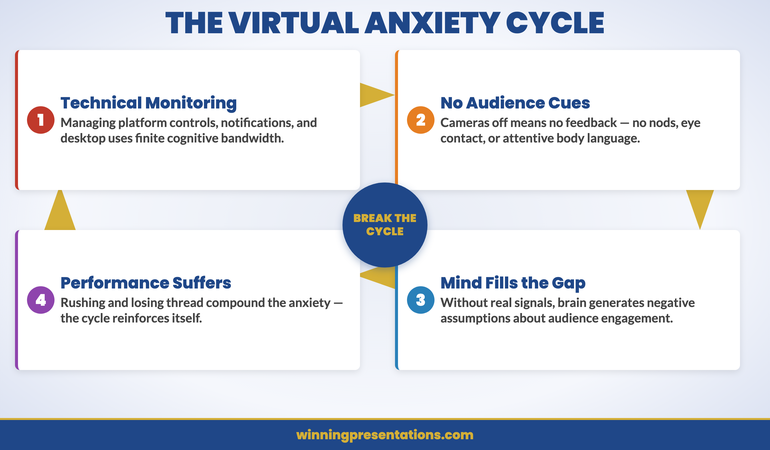
There is also the absence of the audience’s visual feedback. In a room, you can see faces. You can tell, in real time, whether people are following you, whether they are confused, whether they are engaged or distracted. On a call where twelve cameras are off, you are presenting into a void. This absence of feedback activates the brain’s threat detection system in a way that in-person presenting does not. Without the reassuring signals of nodding, eye contact, or attentive posture, the mind fills the gap with its own narrative — which is rarely a positive one.

For the broader anxiety landscape of remote presentations, see presentation anxiety and the remote camera: why online presenting feels different — and what to do about it.

The Visibility Problem: Why Camera and Screen Together Make Anxiety Worse

Diagram showing the dual attention split in screen sharing presentations: managing slides, camera, technical environment, and invisible audience simultaneously

The cognitive load of a screen sharing presentation is structurally higher than an in-person presentation, and understanding this is the first step to managing the anxiety it produces.

In an in-person presentation, your cognitive attention is split between: the content you’re delivering, your audience’s reactions, and your own physical state. Three streams.

In a screen sharing presentation, the streams multiply: the content you’re delivering, your camera appearance, your desktop environment, the platform controls (mute, camera, screen share), the chat window, your audience’s reactions (limited, mostly invisible), your own physical state, and the ongoing monitoring for technical problems. Seven or eight streams, many of which require active monitoring rather than passive awareness.

This cognitive overload is why experienced, confident in-person presenters sometimes find virtual presentations more anxiety-provoking, not less. They are not less skilled. They are managing a genuinely more complex environment with the same finite cognitive resources.

The solution is not to try harder to manage all the streams simultaneously — it is to reduce the number of streams that require active attention. Pre-call setup does this by eliminating the desktop and platform variables before the presentation begins. When your notifications are off, your non-presentation windows are closed, and your platform settings are confirmed, the number of streams requiring active monitoring during the presentation drops back towards the in-person baseline.

Present Online Without the Adrenaline Hijack

If preparation alone isn’t enough — if the anxiety about screen sharing presentations persists even when the setup is right — the root cause is usually nervous system dysregulation, not a skills gap. Conquer Speaking Fear addresses this directly.

  • 30-day programme using nervous system regulation techniques drawn from clinical hypnotherapy
  • Specific module on virtual and remote presentation anxiety — the cognitive patterns that online presenting triggers
  • In-the-moment reset techniques for managing anxiety when technical disruptions occur mid-presentation
  • Tools for rebuilding confidence after a difficult virtual presentation experience

Get Conquer Speaking Fear → £39

Designed for executives and senior professionals whose virtual presentation anxiety is affecting performance, preparation time, or willingness to present.

Pre-Call Setup That Reduces Presentation Anxiety

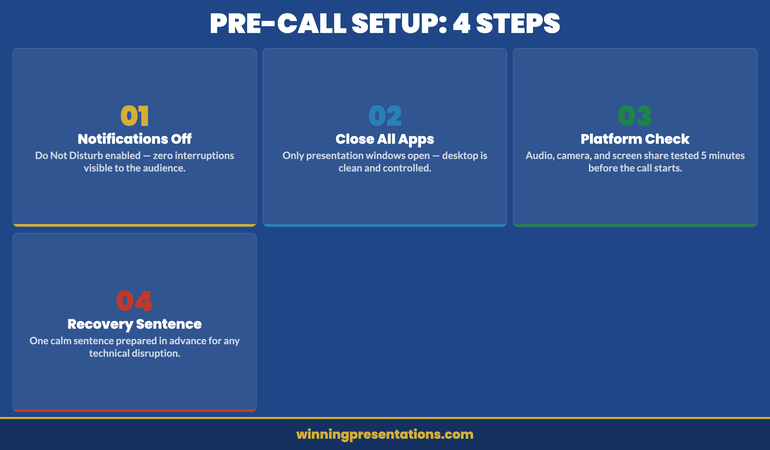
The most effective anxiety-reduction strategy for screen sharing presentations is environmental preparation — completing a systematic pre-call setup routine that removes the variables most likely to disrupt you. This is not the same as rehearsing the content. It is a separate preparation task that takes 10 minutes and pays disproportionate dividends during the call.

Notifications and distractions. Enable Do Not Disturb on your operating system before sharing your screen. On macOS this is in the menu bar; on Windows it is in the notification settings. Close every application that is not directly involved in the presentation: email, messaging apps, browser tabs unrelated to the presentation, and any background applications that generate notifications. This is the single most impactful preparation step, and the one most frequently skipped.

Browser and application organisation. If your presentation involves a browser or external applications, open only the tabs and windows you will need — in the order you will need them. Close everything else. If you need to switch between your slides and a live demonstration, practise the switch before the call so you know exactly which keyboard shortcut or window arrangement you’ll use.

Platform rehearsal. Know which screen you will share before the call begins. If you’re sharing a specific window rather than your full desktop, test that the window is the correct size and that the content is visible at the resolution your audience will see. Test your camera angle and lighting. Confirm your audio is working. Check that the mute and camera controls are where you expect them to be. Do this at least five minutes before the call starts — not as the call is beginning.

The recovery sentence. Prepare one sentence for technical disruptions that is calm, specific, and brief. “Bear with me one moment — I just need to re-share my screen.” Not an apology, not an explanation. One calm sentence, said with the same tone you’d use for any other transition. Knowing this sentence exists before you need it removes the cognitive burden of having to improvise it under stress.

For breathing and physical techniques to use in the minutes before any high-stakes presentation, see box breathing for executives: the 90-second technique for managing pre-presentation adrenaline.

If virtual presentation anxiety runs deeper than technical preparation can address — if it follows you from call to call regardless of how well you’ve set up — the Conquer Speaking Fear programme works at the nervous system level, not just the skills level.

Keeping Your Audience Engaged When You Can’t See Their Faces

Four audience engagement techniques for screen sharing presentations: verbal check-ins, structured questions, deliberate pausing, and explicit transitions

One of the most disorienting aspects of presenting to cameras-off audiences is the complete absence of the visual feedback signals that regulate a presenter’s confidence in the room. In person, a nodding head tells you the point has landed. A furrowed brow tells you to pause and clarify. Stillness tells you the audience is processing. None of these signals are available on a screen sharing call where the audience has turned their cameras off.

The adaptation is to build explicit verbal check-ins into the presentation structure — moments where you actively invite a signal from the audience rather than waiting for one to emerge organically. These are not interruptions to the flow. They are designed pauses that serve two purposes: they give the audience a moment to engage, and they give you a moment of feedback that helps regulate your own presentation state.

Structured questions. Build one or two specific questions into your presentation that invite a brief, typed response in the chat. “Before I move to the financial case — any questions on the scope so far? Drop them in the chat and I’ll address them as we go.” This creates a micro-interaction that activates the audience’s attention and gives you visible evidence that they are present and engaged.

Deliberate pacing. Without visual cues, it is easy to rush. The absence of feedback activates anxiety, and anxiety accelerates speech. Build deliberate pauses — three to five seconds — after key points. These feel long to you and natural to the audience. They create emphasis and give the audience time to process before you move to the next point.

Explicit transitions. In person, a physical movement — turning to the screen, stepping forward, picking up a marker — signals a transition. In a screen sharing presentation, these physical cues are invisible or reduced. Compensate with verbal transitions that are slightly more explicit than they would be in person: “I’m moving to the financial case now — this is the section where I’ll need your input.” Explicit transitions keep the audience oriented when the visual cues are absent.

What to Do When Technical Problems Strike Mid-Presentation

Technical failures during screen sharing presentations are common enough that they should be treated as an expected event rather than an emergency. The anxiety they produce is disproportionate to their actual impact — audiences are generally understanding about technology problems, and a calm, practised response to a disruption frequently enhances rather than damages credibility.

The key insight is that how you respond to a technical problem tells the audience something about how you handle pressure generally. An executive presenter who says “bear with me” calmly and resolves the issue within 30 seconds demonstrates composure. An executive presenter who apologises extensively, explains the technical details of what went wrong, and visibly flusters demonstrates the opposite.

Have a clear mental protocol in advance. If your screen share drops: say your recovery sentence, stop sharing, close any unnecessary applications, and restart the share from the specific window you need. If your audio drops: unmute and repeat the last sentence as if the interruption hadn’t happened. If you accidentally switch to the wrong window: name it briefly and navigate back without commentary. In all cases, the goal is to return to the presentation content as quickly as possible with minimal disruption to the audience’s attention.

What you should not do: laugh nervously for an extended period, explain the technical problem in detail, apologise more than once, or let the disruption change your pace or register for the remainder of the call. The audience’s anxiety about the disruption mirrors yours. Calm behaviour from you produces calm in the room.

For the cognitive patterns that amplify anxiety after disruptions — the mental replaying and self-criticism that follows a difficult virtual presentation — see cognitive restructuring for presentation anxiety: the technique that breaks the self-critical loop.

The Mental Reset for Virtual Presentations

The anxiety that virtual presentations produce often has a specific character: it is anticipatory rather than in-the-moment. The most intense anxiety tends to occur in the minutes before the call begins — while setting up, waiting for participants to join, and managing the technical environment. Once the presentation is actually underway, many presenters find the anxiety reduces significantly.

This pattern has a practical implication. The most productive use of the minutes before a screen sharing presentation is not additional rehearsal of the content — it is a deliberate physical and mental transition from setup mode to presentation mode.

A simple three-step reset: complete your technical setup at least five minutes before the call starts so you are not still managing the environment when participants begin to arrive. Take two or three slow, deliberate breaths — not as an anxiety management technique, but as a physical signal to your nervous system that the preparation phase is over and the performance phase has begun. Say your opening sentence aloud once, at the pace you intend to deliver it. This is not rehearsal. It is calibration — resetting your pace, your register, and your focus to the presentation rather than the environment.

The virtual presentation environment is genuinely more challenging than in-person, and the anxiety it produces is a rational response to that complexity — not a sign of weakness or inexperience. The most effective mindset is one of practical problem-solving: identify what specifically about virtual presenting triggers your anxiety, and address each element systematically. Some of those elements respond to preparation. Some of them — particularly the deeply embedded nervous system responses — require a different kind of work.

Today’s companion article on resource allocation presentations: structuring the case when budgets are contested covers the executive presentation skills that underpin strong virtual business case delivery.

Stop Dreading Every Virtual Presentation on Your Calendar

When anxiety about screen sharing presentations follows you regardless of preparation, the nervous system is the issue — not the setup. Conquer Speaking Fear addresses the root cause with clinical techniques adapted for executive settings.

Get Conquer Speaking Fear → £39

A 30-day programme using nervous system regulation from clinical hypnotherapy — structured for executives who cannot afford to keep dreading the next call.

Frequently Asked Questions

Should I ask the audience to turn their cameras on during a screen sharing presentation?

It depends on the meeting culture and the level of formality. In a smaller group where camera-on is the norm, a brief, non-pressuring invitation at the start of the call is reasonable: “Feel free to have your cameras on if you’re set up for it — it helps me gauge the room.” In a larger meeting or where camera-off is the established norm, asking audiences to turn cameras on can create friction that outweighs the benefit. The more productive adaptation is to build explicit verbal check-ins into the presentation structure so you are generating feedback signals regardless of camera status.

How do I manage the anxiety of not knowing whether my audience is paying attention?

The absence of visual feedback is one of the most specifically anxiety-provoking aspects of virtual presenting, and it activates a particular mental pattern: filling the silence with negative assumptions about the audience’s engagement. The most practical response is to create explicit feedback moments — questions in the chat, brief check-ins, or direct invitations to signal understanding — rather than waiting for organic feedback that may not come. This gives you real data to replace the assumptions your anxiety is generating.

What’s the best way to handle a technical failure during a screen sharing presentation?

Prepare one calm, specific recovery sentence before the call starts: “Bear with me — I just need to re-share my screen” or “Audio issue — give me a moment.” Deliver it at the same pace and register as the rest of your presentation. Resolve the issue as quickly as possible. Return to the content without commentary on what went wrong. Do not apologise more than once. The audience’s response to a technical failure mirrors your own — calm handling from you produces a calm response from them.

Why do I feel more anxious presenting virtually than in person, even though I’m more experienced now?

Virtual presentations create a genuinely higher cognitive load than in-person presentations — you are managing more simultaneous streams of information and doing so without the visual feedback signals that regulate confidence in a room. Many experienced presenters find virtual formats more anxiety-provoking precisely because they are competent enough in-person to notice the difference. If the anxiety is persistent and affecting your performance or willingness to take on virtual presenting opportunities, it is worth addressing at the nervous system level rather than through additional technical preparation alone.

The Winning Edge — Weekly Insights for Executive Presenters

Practical techniques for managing presentation anxiety, building confidence in virtual settings, and presenting at your best when it counts most. Delivered every Thursday.

Join The Winning Edge →

About the Author

Mary Beth Hazeldine is the Owner & Managing Director of Winning Presentations. With 24 years of corporate banking experience at JPMorgan Chase, PwC, Royal Bank of Scotland, and Commerzbank, she has delivered high-stakes presentations in boardrooms across three continents.

A qualified clinical hypnotherapist and NLP practitioner, Mary Beth advises executives across financial services, healthcare, technology, and government on managing presentation anxiety and building confidence for high-stakes speaking situations.

Book a discovery call | View services