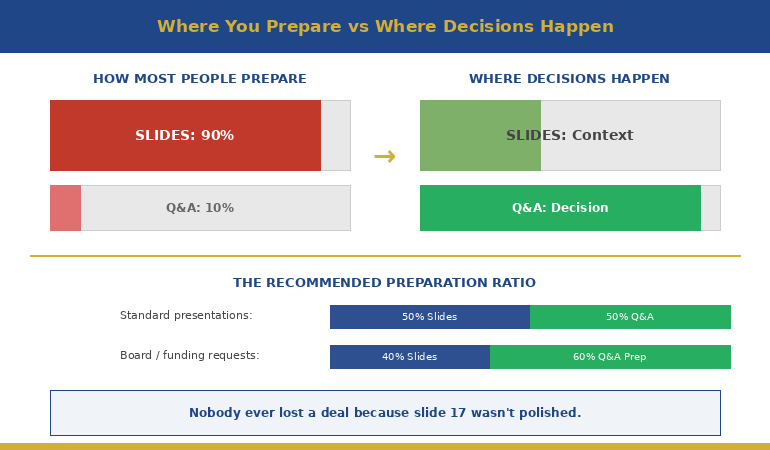
When nobody asks questions after your presentation, it rarely means unanimous agreement. It almost always means your audience disengaged before you finished. The silence feels comfortable in the moment — but the decision that follows is usually “deferred,” “let’s revisit,” or a quiet no. This article gives you three techniques to prevent post-presentation silence and one recovery protocol for when it’s already happened.
In this article:
Eight executives. Forty-five minutes. Zero questions.
I was 18 months into my role at JPMorgan Chase, presenting a credit facility to the investment committee. I’d prepared for weeks. The analysis was tight. The recommendation was clear. When I finished and said “any questions?” — silence. Complete, polite, devastating silence.
I walked out thinking it went well. No pushback meant agreement, right?
The decision came back “deferred” — which in investment banking means nobody cared enough to engage. My presentation hadn’t failed on content. It had failed on engagement. The committee hadn’t disagreed with me. They’d stopped listening to me somewhere around slide 11.
The second time I presented to that committee, I planted three decision hooks throughout the deck — specific moments designed to make them lean in. Five questions in Q&A. Approved same meeting.
That was the day I learned: silence after a presentation isn’t the absence of objections. It’s the absence of interest. And interest is something you have to engineer deliberately.
Committee or leadership presentation this week?
Quick diagnostic: count the moments in your deck where you deliberately invite the audience to react — not at the end, but during the presentation. If the answer is zero, silence in Q&A is almost guaranteed. A structured engagement protocol fixes this before you walk in. See the Executive Q&A Handling System →
Why Silence Is Worse Than Tough Questions
Most professionals fear hostile questions. They shouldn’t. The most dangerous Q&A outcome isn’t a difficult question — it’s no questions at all.
Here’s why. When someone asks a tough question, they’re telling you three things: they listened, they care about the outcome, and they’re mentally engaged with your recommendation. Even a hostile question is a form of investment. That person is spending cognitive energy on your proposal.
Silence means none of those things happened.
In 25 years of corporate banking — across JPMorgan Chase, PwC, Royal Bank of Scotland, and Commerzbank — I’ve sat in hundreds of committee meetings. The presentations that got approved almost always generated questions. The ones that got deferred or quietly rejected? Silence.
Why does nobody ask questions after my presentation?
There are three common reasons: your content was too dense for the audience to process in real time, your structure didn’t create natural engagement points, or your conclusion didn’t require a decision. In all three cases, the fix is structural — not about your delivery or confidence. You need to build question-generating moments into your deck, not hope they emerge after it.
The pattern across executive presentations is consistent: silence is almost never about content quality. It’s about structural engagement. A brilliant 35-slide analysis that doesn’t create tension, choice points, or moments of surprise will get silence every time — regardless of how good the data is.
This is exactly what kills engagement in most corporate presentations — the assumption that good content automatically produces good discussion.
The Silence Protocol: 3 Prevention Techniques
After that JPMorgan experience, I spent years studying what separated presentations that generated rich Q&A from those that got polite silence. The difference was never the presenter’s confidence or charisma. It was always structural.
The presentations that generated questions had something built into them — deliberate engagement architecture. I call these the three prevention techniques.
Each one works by creating what psychologists call “knowledge gaps” — moments where the audience’s brain recognises it needs more information. When you create enough of these gaps during your presentation, questions become inevitable. The audience isn’t choosing to engage. They can’t help it.

Technique 1: Decision Hooks
A decision hook is a moment in your presentation where you explicitly frame a choice — and then move on without resolving it completely.
Here’s what this looks like in practice. Instead of presenting your recommendation as a conclusion, you present it as one of two possible paths: “There are two ways we could approach this implementation — a phased rollout over 12 months, or a full deployment in Q3. I’m recommending the phased approach, and I’ll show you why in the next three slides.”
The audience now has something to evaluate. They’re not passively receiving information. They’re mentally testing your recommendation against the alternative you just planted. By the time you reach Q&A, at least one person will ask about the path you didn’t recommend.
Where to place decision hooks: Slide 3 (after your executive summary), at the midpoint of your presentation, and one slide before your recommendation. Three hooks is the minimum. I plant them at the same points where I’d forecast likely questions using a question map — because the same structural moments that generate questions are the ones where hooks land hardest.
The formula: “There are [two/three] ways to approach [specific decision]. I’m recommending [option] because [one-sentence reason]. Let me show you the evidence.”

Turn Post-Presentation Silence Into Engaged, Productive Questions
The Executive Q&A Handling System (£39, instant access) gives you the complete framework for engineering audience engagement — including the question forecasting method, decision hook templates, and the Headline → Reason → Proof → Close structure that creates natural question points throughout any presentation.
- The Question Forecasting method — predict and plant the exact questions your audience will ask
- Engagement trigger templates that create knowledge gaps your audience can’t ignore
- Recovery scripts for when silence has already happened (the “redirect and re-engage” protocol)
- The 4-part answer structure that turns every question into a credibility-building moment
Get the Executive Q&A Handling System → £39
Built from 25 years of investment committee presentations. £39, instant access — no subscription.
Technique 2: Open Loops
An open loop is a piece of information you introduce but don’t complete. Your audience’s brain will hold that loop open until it gets resolved — and if you don’t resolve it fully during the presentation, they’ll ask about it in Q&A.
This isn’t manipulation. It’s how the brain processes incomplete information. Psychologists call it the Zeigarnik effect: unfinished tasks create cognitive tension that demands resolution.
Here’s an example from a real client presentation. A director was presenting a restructuring plan to the board. Instead of laying out every detail sequentially, she opened with: “This restructuring will affect three departments — but the impact on each is very different. I’ll walk you through engineering and operations today. The third department is where the real decision sits, and I’ve saved it for the end.”
The board was leaning forward by slide 4. By the time she reached the third department, two members had already prepared questions. The Q&A ran 20 minutes — exactly what she wanted.
How to create open loops:
- The preview loop: “I’ll share the data that changed our recommendation — but first, let me show you what we originally assumed.”
- The exception loop: “This approach works in every scenario except one. I’ll get to that exception in a moment.”
- The contrast loop: “Our competitor took the opposite approach. The results are striking — and I’ll show you why our path is different.”
Each of these creates a gap your audience needs filled. And if you leave even one loop partially open, someone will ask about it. That’s not a risk — that’s the entire point.
Don’t want to write engagement triggers from scratch?
The Executive Q&A Handling System gives you the engagement trigger templates, decision hooks, and open-loop frameworks ready to use in any high-stakes presentation. £39, instant download — lifetime access.
Is silence after a presentation good or bad?
In almost every corporate context, silence after a presentation is a negative signal. It typically indicates one of three things: the audience didn’t understand enough to form questions, the content didn’t create enough engagement to provoke curiosity, or the decision-makers have already mentally checked out. The rare exception is when the recommendation is so clear and well-supported that immediate approval follows — but in 25 years, I’ve seen that happen perhaps five times. If silence is followed by “we’ll come back to you” rather than an immediate decision, it wasn’t agreement. It was disengagement.
Technique 3: Planted Controversy
This is the technique most executives resist — and the one that works most reliably.
A planted controversy is a moment where you deliberately present a counterargument to your own recommendation. Not to undermine yourself — to create intellectual tension that demands discussion.
Here’s why it works. When you present a recommendation with no counterpoint, the audience has nothing to push against. Agreement is passive. But when you say “The strongest argument against this approach is X — and here’s why I still recommend it,” you’ve given the audience something to evaluate. You’ve shown intellectual honesty. And you’ve created a natural question point.
At Commerzbank, I watched a risk director use this brilliantly. He was recommending a credit line extension that the committee was likely to reject. Instead of pretending the risk didn’t exist, he opened his recommendation slide with: “The obvious concern with this extension is the sector’s volatility over the past two quarters. If I were sitting where you are, I’d ask why we’re recommending increased exposure.”
He then answered his own planted question with three data points. The committee didn’t need to voice the objection — he’d already addressed it. But the technique had a secondary effect: it opened the door for more nuanced questions. Instead of “isn’t this too risky?” they asked “what’s the exit strategy if volatility continues?” — a far more productive conversation.
How to plant controversy effectively:
- Identify the strongest objection to your recommendation before you present
- State it directly: “The biggest risk with this approach is…”
- Answer it with evidence — but leave 10% of ambiguity
- That 10% becomes a Q&A question you’ve already prepared for
This technique connects directly to question forecasting — if you can predict what the audience will object to, you can plant that controversy deliberately and control the conversation.
Stop Hearing Silence After Every Presentation You Give
The silence problem isn’t about your delivery or your data. It’s about structure — and structure is fixable. The Executive Q&A Handling System (£39, instant access) gives you the complete engagement architecture so you never face dead silence again.
- Decision hook templates you can drop into any presentation in 10 minutes
- The open loop formula that makes your audience need to ask questions
- Planted controversy scripts for high-stakes committee presentations
- The complete recovery protocol for when silence has already happened
Get the Executive Q&A Handling System → £39
Designed for executives presenting to investment committees, boards, and senior leadership — where silence means a deferred decision. £39, instant access.
The Recovery: When Silence Has Already Happened
Prevention is ideal. But sometimes you’re standing at the front of a room and it’s already happened. You’ve said “any questions?” and you’re staring at eight faces that aren’t going to speak.
First: do not fill the silence yourself. The instinct is to keep talking — to summarise, to add caveats, to ramble into your own recommendation. Every word you say in that moment reduces the pressure on the audience to engage. The silence is uncomfortable for them too. Let it work.
Wait a full five seconds. It will feel like thirty. Then use one of these recovery lines:

The redirect: “Let me ask this a different way — if you were going to push back on one part of this recommendation, which part would it be?”
This works because it reframes the question from “do you have anything to say?” (which allows passivity) to “which specific thing would you challenge?” (which assumes engagement).
The specific question: “The implementation timeline is where I expect the most debate. What’s your reaction to the Q3 target?”
This works because it removes the paradox of choice. Instead of asking the audience to generate a question from nothing, you’re giving them a specific anchor to respond to.
The stakeholder call: “[Name], I know this affects your division directly — what’s your initial reaction?”
This works because it shifts from an open-room question (where diffusion of responsibility means nobody speaks) to a direct, personal invitation. One person speaking breaks the silence for everyone.
How do you encourage questions after a presentation?
The most effective way to encourage questions isn’t to ask for them differently at the end — it’s to build question-generating moments throughout the presentation itself. Decision hooks, open loops, and planted controversies all create cognitive gaps that the audience needs resolved. By the time you reach Q&A, the questions already exist in their minds. You don’t need to encourage them. You just need to create the space for them to emerge. If you’re already at the “any questions?” moment and facing silence, redirect with a specific prompt: “If you were going to challenge one part of this, which part would it be?” This reframes from passive to active and almost always breaks the silence.
Is This Right For You?
The Executive Q&A Handling System is built for you if:
- You present to committees, boards, or senior leadership where Q&A determines the outcome
- You’ve experienced post-presentation silence and the “deferred” decisions that follow
- You want to engineer engagement into your presentation structure rather than hope it happens
- You need recovery scripts for when silence has already occurred
It’s probably not right if you already get strong audience engagement and your Q&A sessions run long. In that case, you might benefit more from handling the difficult questions that do come up.
🎓 25 Years of Boardroom Q&A. One System.
The Executive Q&A Handling System is built from 25 years of corporate banking and 16 years coaching senior professionals across financial services, healthcare, technology, and government. Every framework — the engagement triggers, the silence prevention protocol, the recovery scripts — comes from real boardroom situations where the room’s response decided whether the proposal moved forward.
Designed for senior professionals who present to boards, investment committees, and executive sponsors where engagement signals decisions.
Get the Executive Q&A Handling System → £39
Instant download — lifetime access to every framework and template.
Frequently Asked Questions
What if the silence genuinely means they agree?
It’s possible but rare. In my experience, genuine agreement after a presentation is followed by an immediate decision — “approved,” “let’s proceed,” or a direct next-step conversation. If the silence is followed by “we’ll come back to you,” “let’s take this offline,” or “deferred for further review,” it wasn’t agreement. It was disengagement. The safest approach is to build engagement architecture into every presentation. If they genuinely agree, the techniques in this article won’t harm your outcome. If they don’t agree, the techniques will surface the real objections before the meeting ends.
Won’t planting controversy make me look uncertain about my own recommendation?
The opposite. Addressing the strongest counterargument to your own recommendation demonstrates intellectual honesty and thoroughness. Investment committees and senior leadership teams respect presenters who acknowledge risk rather than pretend it doesn’t exist. The key is in the execution: state the counterargument clearly, then answer it with evidence. You’re not expressing doubt — you’re showing you’ve already considered and resolved the most likely objection.
How many decision hooks is too many?
Three is the sweet spot for a 20–30 minute presentation. One after your executive summary, one at the midpoint, and one before your final recommendation. More than five and the audience feels manipulated — each hook creates cognitive work, and too many will exhaust rather than engage. Fewer than two and you’re relying on the content alone to generate questions, which rarely works in committee settings.
📬 The Winning Edge — Weekly Newsletter
One executive presentation insight per week. Real scenarios, real scripts, zero filler. Written for professionals who present to decision-makers.
📊 Presenting a budget defence this quarter? When finance wants to cut your team’s funding, the wrong slide structure guarantees you lose. Read: The Budget Defence Presentation: When Finance Wants to Cut Your Team’s Funding
Your next step: Before your next committee or leadership presentation, count the engagement moments in your deck. If you have fewer than three decision hooks, open loops, or planted controversies, add them now. The difference between silence and five productive questions isn’t talent or confidence — it’s structure.
About the Author
Mary Beth Hazeldine is the Owner & Managing Director of Winning Presentations. With 25 years in corporate banking — including roles at JPMorgan Chase, PwC, Royal Bank of Scotland, and Commerzbank — she advises executives across financial services, healthcare, technology, and government on high-stakes presentations and committee-level Q&A. A qualified clinical hypnotherapist and NLP practitioner, Mary Beth combines boardroom experience with evidence-based psychology to help professionals present with authority and close with confidence.