Tag: Q&A handling

13 Mar 2026
Professional woman at a boardroom table holding composed focus while facing a question from a male executive — Q&A under pressure

Loaded Questions in Presentations: Recognising the Setup Before You Fall Into It

The question sounded straightforward: “Given what you’ve told us today, would you say the previous approach was a mistake?” It was not straightforward. It was a closed frame with a false binary embedded in it — and the moment you answered either yes or no, you had accepted a premise that was never yours to accept.

The executive who fell into it gave a careful, nuanced answer. What she didn’t do was recognise the question type before she started speaking. By the time she realised the frame was wrong, the answer was already in the room, and the follow-up question was waiting.

Loaded questions in presentations are not rare. They are a consistent feature of high-stakes Q&A — particularly in board meetings, investor sessions, regulatory reviews, and any room where someone has an interest in the answer being something specific. The executives who handle them well don’t have better answers. They recognise the setup faster.

Quick answer: A loaded question contains a false premise, a false binary, or an embedded accusation that forces you to accept the questioner’s framing before you can answer. The recognition test is simple: before answering, ask yourself whether the question’s framing is yours. If you can’t answer yes or no without accepting a premise you don’t hold, the question is loaded. The deflection technique is to name the frame before answering it — not to challenge the questioner, but to set the terms of your response before you begin.

🚨 Preparing for a Q&A where loaded questions are likely? The Executive Q&A Handling System (£39) includes the loaded question recognition framework, the three deflection patterns that work in executive rooms, and the preparation method that anticipates traps before you’re in the room.

I spent 24 years in corporate banking at JPMorgan Chase, PwC, Royal Bank of Scotland, and Commerzbank. In that time I observed and participated in a significant number of Q&A sessions that were designed, explicitly or implicitly, to produce a particular answer. Regulatory reviews, board challenge sessions, investor Q&As before difficult announcements — these are environments where questions are not always requests for information. Sometimes they are frames.

The executives who handled them best were not the most combative. They were the most methodical. They had a recognition process that ran faster than their instinct to answer, and they deployed it in the pause before every response. That pause — brief, unhurried, apparently natural — was where the recognition happened. By the time they began speaking, they had already decided whether to answer the question as framed or to name the frame first.

This article covers the three types of loaded question, the recognition test that distinguishes them from legitimate challenge, and the deflection pattern that works in rooms where you cannot afford to seem evasive but also cannot afford to accept a false premise.


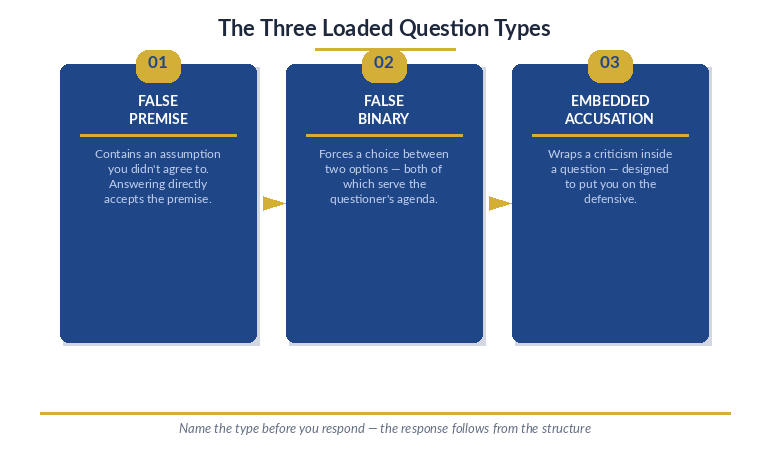
Three-part infographic showing the loaded question taxonomy: False Premise (contains an unaccepted assumption), False Binary (forces a two-option choice), and Embedded Accusation (criticism wrapped in a question)

The Three Types of Loaded Question

Not all difficult questions are loaded questions. A difficult question is one that requires a careful or uncomfortable answer. A loaded question is one where the framing itself is designed to constrain the answer — where accepting the question as posed means accepting a premise, a binary, or an implication that limits your options before you’ve said a word.

There are three types, and they operate differently. The false premise question contains a fact or assumption that is contestable, embedded inside what sounds like a straightforward enquiry. The false binary question presents two options as if they are the only options. The embedded accusation question wraps an implicit criticism inside a neutral grammatical structure so that answering it means implicitly accepting the criticism.

All three share a structural feature: they are more damaging when answered within the questioner’s frame than when answered outside it. The executive who recognises the type before answering can choose where to stand. The executive who answers within the frame has already conceded ground that may not be theirs to give.

The framework for handling difficult questions in presentations covers the broader category of challenging Q&A. Loaded questions are a specific subset that requires a specific recognition step before the handling technique applies.

🚨 Recognise the Trap Before You Walk Into It: The Executive Q&A Handling System

The Executive Q&A Handling System includes the complete loaded question framework — recognition, categorisation, and deflection — plus the preparation method that anticipates these questions before the session begins:

  • The three-type loaded question taxonomy with real examples from board, investor, and regulatory Q&A contexts
  • The recognition test — four questions that run in under five seconds and identify whether you’re inside a loaded frame
  • Three deflection patterns that work in executive rooms: reframe, acknowledge-and-replace, and explicit frame-naming
  • The preparation method for anticipating loaded questions before the session — including the stakeholder analysis that identifies who is likely to use them and why
  • Script templates for each deflection type — worded for executive contexts where you cannot appear evasive but cannot accept a false premise

Get the Executive Q&A Handling System → £39

Built from 24 years of observing Q&A sessions in banking boardrooms, investor meetings, and regulatory reviews — the environments where loaded questions are most consistently deployed.

The Recognition Test: Is the Frame Yours?

Before answering any question in a high-stakes Q&A, the recognition test runs as follows. Ask yourself: if I answer this question as posed — yes, no, or with the specific information requested — am I accepting a premise, a binary, or an implication that I would not otherwise accept?

If the answer is yes, the question is loaded. The framing does not belong to you, and accepting it will cost you something — credibility, flexibility, or the accuracy of your position — that may be more valuable than the question is worth to answer within its own terms.

The test takes less time to run than it takes to describe. With practice, it becomes automatic: a brief check, in the pause before you speak, that runs faster than your instinct to answer. The pause itself is useful — it signals that you are thinking about the question seriously rather than reacting to it, which is a credibility signal in itself. The pause is where the recognition happens. It is also where the answer is constructed.

Four specific signals indicate a loaded question: the word “still” (implying a prior behaviour or state you haven’t confirmed), the word “admit” (framing your answer as a concession), a question that begins with “given that” or “in light of” (embedding a premise before the actual question begins), and any question that presents exactly two options as the only available choices.

Heading into a session where loaded questions are predictable? The Executive Q&A Handling System (£39) includes the preparation template for anticipating loaded questions before the session — including the stakeholder analysis that identifies who is likely to use them and what their intent is.

Type 1: The False Premise Question

The false premise question embeds a contestable fact or assumption inside the question itself. Classic examples: “Now that the market has confirmed your original approach was too conservative, how are you adjusting?” — where “confirmed” is doing significant work. Or “Given that the board agreed to this approach in February, why have outcomes underperformed?” — where “agreed” may be a contested characterisation of a more complex discussion.

The mechanism is that the false premise is grammatically subordinate — it arrives inside a clause before the actual question begins, making it easy to miss when you’re processing the question. Your attention goes to the main clause; the premise slips through unexamined.

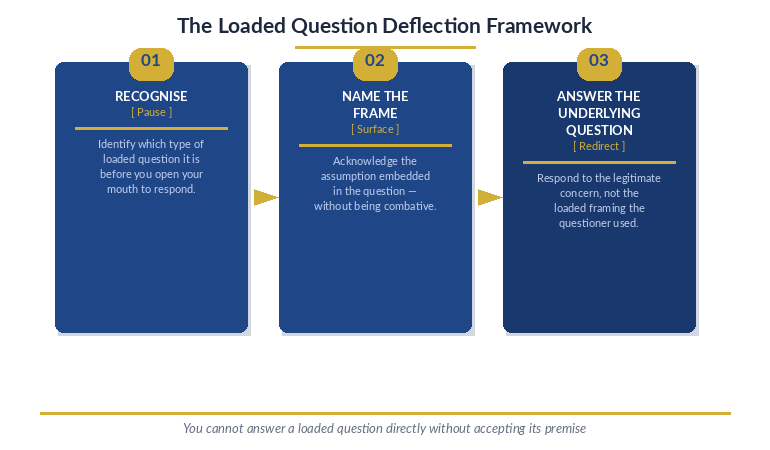
The deflection for a false premise question is to address the premise before addressing the question. Not aggressively — the framing does not need to be challenged as if the questioner is being dishonest. It simply needs to be placed differently before you continue. The pattern is: “I’d want to be careful about the framing there — [restatement of the accurate premise] — but to your underlying question: [answer].” This names the false premise without making the questioner defensive, places your own premise on record, and proceeds to answer the actual question, which demonstrates that you are not being evasive.


Three-step Loaded Question Deflection Framework: Recognise (identify the question type before responding), Name the Frame (surface the embedded assumption), Answer the Underlying Question (respond to the legitimate concern)

⚠️ Stop Accepting Frames That Aren’t Yours

Loaded questions are more damaging when answered within the questioner’s frame than when named and redirected. The Executive Q&A Handling System (£39) gives you the recognition test, the deflection scripts, and the preparation method that takes the trap away before the room sets it.

Get the Executive Q&A Handling System → £39

Used by executives preparing for board challenge sessions, investor Q&As, and regulatory reviews where questions are designed to produce specific answers.

Type 2: The False Binary Question

The false binary question presents two options as if they are the only options, when there is at least one other option the questioner has not offered. “Do you think the problem is in the strategy or the execution?” is a false binary if the honest answer is that the strategy and execution both contributed — or that neither is the primary problem, and the issue is something the question hasn’t named.

False binary questions are particularly common in investment and board contexts, where the questioner wants to establish accountability. The binary structure makes attribution easier: if you accept either option, the question has been answered in a way that assigns responsibility to one of two named causes. The option that assigns responsibility elsewhere — or that disputes the framing entirely — is never offered, because offering it would undermine the purpose of the question.

The deflection for a false binary is not to refuse to answer but to expand the option set before answering. The pattern is: “I don’t think it’s quite either of those — [name the third option or combination] — but if you’re asking where the most significant opportunity to improve is, that would be [answer].” This sidesteps the false binary, provides a more accurate answer, and demonstrates that you are engaging with the substance of what the questioner is actually trying to understand.

The short answer framework for executive Q&A is particularly useful here: the deflection and the answer combined should be shorter than the question was. Long responses to loaded questions create the impression that you are trying to talk your way out of something. Concise responses create the impression that you had the answer ready, which you did.

Type 3: The Embedded Accusation Question

The embedded accusation question wraps an implicit criticism inside neutral grammatical structure. “How are you planning to address the trust deficit that’s developed with the team?” embeds the accusation that a trust deficit exists. “What’s your explanation for the communication failures during the transition?” embeds the accusation that there were communication failures. Both are framed as requests for information; both contain an accusation in the subordinate clause that you would not accept if it were stated directly.

The embedded accusation is the most damaging of the three types because answering it within the frame means accepting the accusation. An answer that begins “To address the trust deficit…” has confirmed that the trust deficit exists. An answer that begins “The communication failures during the transition…” has confirmed that there were communication failures. The questioner has gotten the confirmation they wanted without having to make the accusation explicitly — and now the accusation is on record in your words, not theirs.

The deflection for an embedded accusation requires naming the assumption before responding. The pattern is: “I’d challenge the framing slightly — [specific restatement of the actual situation] — but your underlying concern is [acknowledgement], and here’s how I’d address that: [answer].” This does three things: it declines the embedded accusation, it demonstrates that you understand the concern behind the question, and it provides a substantive response that does not allow the questioner to claim you were being evasive.

The most common Q&A mistakes executives make in presentations include accepting frames they haven’t verified and providing long answers to deflect questions they should have deflected concisely. The embedded accusation type is where both mistakes are most likely to occur together.

Also published today: International Presentations: The Cultural Mistakes That Kill Deals Before Slide One — including how cultural context affects the Q&A dynamic and which loaded question types are most common by cultural profile.

Common Questions About Loaded Questions in Presentations

Is it always appropriate to name a loaded frame in a formal Q&A?
It depends on the room and the intent behind the question. In a regulatory review or a hostile board challenge, naming the frame directly — precisely but without aggression — is both appropriate and necessary. In an investor Q&A where the questioner is genuinely probing rather than trying to trap, naming the frame can come across as defensive. The recognition test helps here: if the framing genuinely limits your options in a way that would misrepresent your position, name it. If the framing is imprecise but the questioner’s intent is legitimate, you can widen the frame without naming it explicitly — just by answering from a broader position than the question offered.

What if I name a loaded frame and the questioner insists their framing is correct?
Acknowledge their view and hold your position. The pattern is: “I understand that’s how you’re reading it — my read of the situation is [restatement]. I’m happy to explain why I see it differently if that’s useful, but I wouldn’t want my answer to imply agreement with a characterisation I don’t hold.” This is firm without being combative, offers to continue the discussion, and makes clear that you’re not going to accept a premise under social pressure. Questioners who insist on their framing after this response are usually seeking confirmation, not information — and the room can see that.

How do I prepare for loaded questions before a session rather than handling them in the room?
The preparation method involves a stakeholder analysis for each person likely to ask questions: what is their current position relative to your presentation, what outcome serves their interests, and what framing of your work would produce that outcome? Once you have identified who might use a loaded question and what type it is likely to be, you prepare your recognition response and your deflection script in advance. The Executive Q&A Handling System includes a structured preparation template for this process — it takes 30–45 minutes and removes the most likely traps before you are in the room.

Is This Right For You?

This article and the Executive Q&A Handling System are for executives who face structured Q&A sessions where some participants are likely to use questions as framing tools rather than as genuine requests for information. Board challenge sessions, investor Q&As before difficult announcements, regulatory reviews, and competitive sales presentations all fit this profile.

If your Q&A sessions are largely collaborative — colleagues asking genuine questions about how to implement a proposal — the loaded question framework is less immediately relevant, though the recognition test is useful in any high-stakes room where you are accountable for your answers. If you are preparing for a session where you know from experience or context that some questions will be designed to constrain rather than to enquire, the preparation method and deflection scripts in the Executive Q&A Handling System will be the most efficient investment you can make before the meeting.

Frequently Asked Questions

Does the deflection technique work in writing as well as in spoken Q&A?
Yes, and in writing it is often more effective because you have more time to compose the response. Written loaded questions — in email, in committed papers, in written submissions to regulators — follow the same three-type structure. The false premise, false binary, and embedded accusation appear in written form as frequently as in spoken Q&A. The written deflection follows the same pattern: name the frame, restate the accurate position, and address the underlying question. In writing, the naming of the frame can be slightly more formal — “I note the question assumes X; the accurate position is Y” — because the written register supports more explicit framing without appearing combative.

Are there cultural differences in how often loaded questions are used?
Loaded questions are more common in adversarial cultural contexts — UK regulatory environments, US legal depositions, investment committee sessions with activist investors — and less common in consensus-oriented cultures where direct challenge is considered inappropriate. However, the false premise type appears across virtually all professional contexts, because it is often not intended as a trap — it is simply the questioner’s genuine belief. The recognition test does not assume bad intent: it identifies structural problems in framing regardless of motivation, which is why it is useful even when the questioner is not being deliberately manipulative.

About the Author

Mary Beth Hazeldine is the founder of Winning Presentations and has spent over two decades advising executives on high-stakes communication. Her background includes roles at JPMorgan Chase, PwC, Royal Bank of Scotland, and Commerzbank, where she participated in and prepared executives for board challenge sessions, investor Q&As, and regulatory reviews. She developed the Executive Q&A Handling System from the question patterns she observed consistently across those contexts, with particular focus on the recognition and deflection techniques that protect executives from accepting frames that are not theirs to accept.

The Winning Edge Newsletter

Practical executive presentation guidance, once a week. No padding, no noise — just the techniques that matter when the room is full of people whose questions are more than questions.

Subscribe Free →

12 Mar 2026
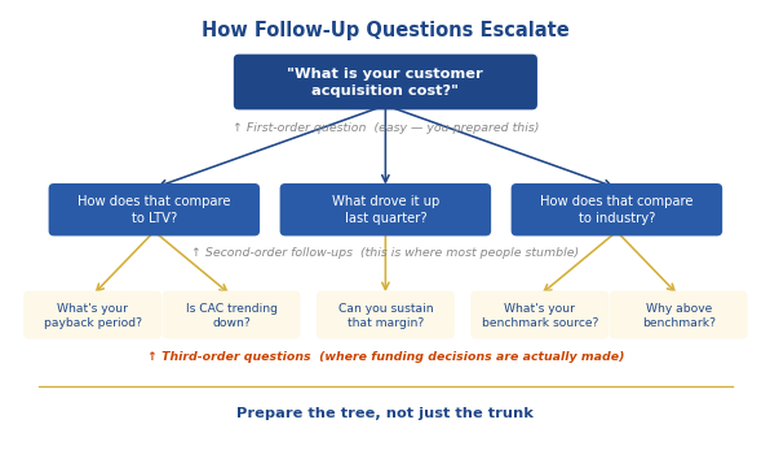
Investor Q&A follow-up questions that kill funding — second-order question map for founders preparing for investor conversations

Investor Q&A: The Follow-Up Questions That Kill Funding (And How to Prepare for Them)

Most investor presentations don’t collapse on the first question. They collapse on the second one.

The founder answers the opening question confidently — “what’s your customer acquisition cost?” — with a specific number and a clear explanation. Then the investor asks: “And how does that break down by channel?” Pause. Then: “What’s the trend over the last four quarters?” Another pause. Then: “What’s driving the increase in Q3?” By the fourth question, the founder is visibly reaching for data they don’t have immediately available. By the fifth, the room has reached a conclusion about how well the business is understood.

The first answer wasn’t wrong. The follow-ups revealed the boundaries of preparation. That’s where investor Q&A funding conversations are actually decided — not on whether you can answer the initial question, but on how far into the second order your preparation extends.

Quick answer: Investor Q&A follow-up questions follow predictable patterns. Every first-order question about metrics, strategy, or competitive positioning has three or four second-order follow-ups that experienced investors use to test the depth of understanding behind the initial answer. Preparing for the follow-ups — not just the opening questions — is what separates funded founders and executives from those who present well but leave investors uncertain. The preparation method is systematic: map each expected question, then generate the three most likely follow-ups for each, and prepare answers to all of them.

📋 Preparing for an investor Q&A this week? The Executive Q&A Handling System (£39) includes the investor Q&A framework with the second-order question map, preparation templates, and exact language for handling the questions most people aren’t ready for.

I spent 24 years in corporate banking at JPMorgan Chase, PwC, Royal Bank of Scotland, and Commerzbank. I have been in rooms where capital decisions were made — and in rooms where they weren’t, despite a strong headline pitch. The difference between those outcomes was rarely the first question and almost always what happened in the third and fourth.

Experienced investors are not trying to catch you out with follow-up questions. They’re trying to assess something specific: how deeply you understand your own business, and whether the answers you gave to the opening questions were genuinely grounded or were polished responses built for presentation rather than for interrogation.

The preparation framework that works isn’t “know your numbers.” Every funded founder knows their headline numbers. It’s “know the story behind every number, the story behind that story, and where the story breaks down.” That’s three levels deep. Most preparation stops at the first.


Investor Q&A follow-up question map showing first-order questions and three levels of second-order follow-ups across metrics, strategy, competitive, and risk categories

Why Follow-Up Questions Are Where Funding Is Decided

An investor who asks a follow-up question is not being difficult. They’re doing exactly what their role requires: assessing whether the person in front of them has the depth of understanding to manage the capital they’re being asked to commit.

The follow-up question serves a diagnostic function. If the first answer was memorised or prepared for the pitch, the follow-up will surface that. If the first answer was grounded in genuine understanding, the follow-up is easy — because the same understanding that produced the first answer produces the second one naturally, without additional preparation.

This is why investor Q&A preparation that only covers anticipated first-order questions consistently fails. Founders spend hours preparing answers to “what’s your CAC?” and “who are your main competitors?” and “what’s your burn rate?” — and are then derailed by “how does CAC vary by segment?” or “what’s your win rate against that competitor specifically?” or “at current burn, what’s your runway if the next round takes six months longer than expected?”

The follow-up isn’t harder to answer than the original question. It’s harder only if the answer to the original question was a prepared surface response rather than an expression of genuine understanding. The diagnostic function of the follow-up is precise: it distinguishes one from the other.

Today’s sister article on the investor relations presentation format covers how to structure the deck itself to prevent questions before they’re asked. This article covers the Q&A that follows — and specifically the follow-ups that most preparation misses.

📋 The Investor Q&A Framework That Prepares You Three Questions Deep

The Executive Q&A Handling System includes the investor Q&A preparation framework — the second-order question map, the preparation templates, and the exact language for handling follow-ups on metrics, strategy, competition, and risk:

  • The investor follow-up question map for each major Q&A category — what experienced investors ask second, third, and fourth
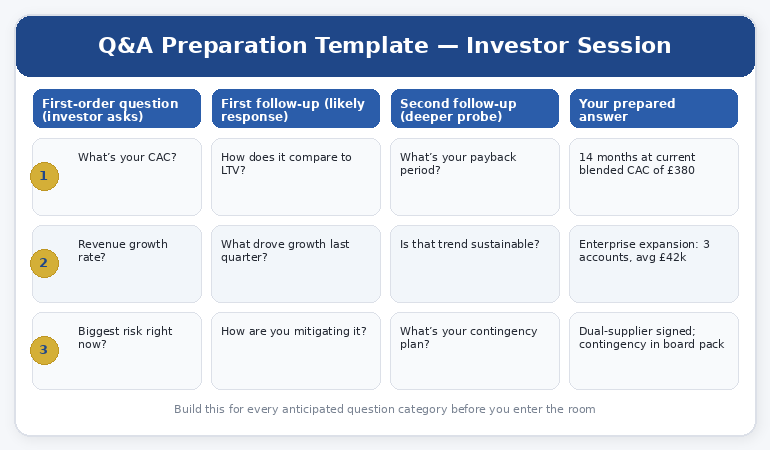
  • Preparation template: map your first-order answers and generate second-order questions systematically before the meeting
  • Language for handling questions where the honest answer isn’t the one you planned — without losing credibility
  • The bridging technique for redirecting follow-ups that are moving into territory you want to control
  • How to answer “I don’t know” in a way that builds rather than erodes investor confidence

Get the Executive Q&A Handling System → £39

Built from 24 years in corporate banking and executive Q&A preparation at JPMorgan Chase, PwC, and RBS — including preparing executives for investor presentations and funding rounds.

The Follow-Up Map: Metrics Questions

Every metric question an investor asks has a predictable set of follow-ups. Here are the most common, across the metrics categories that matter most in investor conversations.

Customer acquisition cost (CAC). First order: “What’s your CAC?” The follow-ups investors actually use: “How does that break down by channel?” “What’s the trend over the last four quarters?” “What’s driving the change?” “How does that compare to your LTV at different customer segments?” Preparation means knowing the channel breakdown, the trend, the driver, and the LTV-to-CAC ratio by segment — not just the headline CAC number.

Revenue growth. First order: “What’s your revenue growth rate?” Follow-ups: “New versus expansion revenue?” “Churn rate?” “Net revenue retention?” “What’s the growth rate of your top 10 accounts?” Most founders prepare the growth rate headline. Experienced investors are trying to understand whether that growth is healthy or fragile — new customer acquisition masking significant churn, or a stable expanding base. The follow-ups diagnose which.

Burn rate and runway. First order: “What’s your current burn?” Follow-ups: “How does that compare to six months ago?” “What are the main drivers of burn?” “What happens to burn if you hit your growth targets?” “What levers do you have if you need to extend runway?” Prepare the drivers, the sensitivity, and the optionality. Investors are stress-testing your understanding of the cash dynamics, not just the headline number.

Preparing for an investor meeting? The Executive Q&A Handling System (£39) includes the full investor follow-up question map across metrics, strategy, competitive, and risk categories.

The Follow-Up Map: Strategy Questions

Go-to-market strategy. First order: “What’s your GTM strategy?” Follow-ups: “What’s working best right now and why?” “What have you tried that hasn’t worked?” “What does the unit economics look like at scale?” “How does your GTM need to change when you move upmarket?” Most prepared answers describe the intended strategy. Investors want to know whether you’ve run it, what you’ve learned from running it, and whether your unit economics work beyond the current stage.

Pricing strategy. First order: “How did you arrive at that pricing?” Follow-ups: “Have you tested higher price points?” “Where do you lose deals on price?” “What’s the average contract value trend?” “How does your pricing compare to your top competitor in a head-to-head?” The follow-up questions are probing your pricing confidence — whether it’s based on customer research and competitive intelligence, or on a number that felt reasonable when you set it.

Expansion strategy. First order: “What’s your expansion plan?” Follow-ups: “What are the three biggest risks to the expansion timeline?” “What milestones do you need to hit before you can expand?” “Who else has expanded into that market and what happened to them?” “What does the team composition need to look like to execute?” Investors are looking for realistic planning versus aspirational planning. The follow-ups test whether you’ve worked the plan backwards from the risks.

The Follow-Up Map: Competitive Questions

Competitive positioning. First order: “Who are your main competitors?” The follow-ups: “What do customers choose them over you for?” “What’s your win rate against [specific competitor]?” “What would need to change for a customer to switch back to them?” “What are they doing now that concerns you?” Most competitive answers describe why you’re better. Investors want to understand whether you have accurate intelligence on your competitors’ strengths — not just their weaknesses.

Defensibility. First order: “What’s your competitive moat?” Follow-ups: “How long would it take a well-resourced competitor to replicate your key advantage?” “What assumptions is your moat argument dependent on?” “What happened to the last company that had this advantage?” The defensibility follow-up is almost always about identifying which assumptions the moat depends on. Prepare your moat argument and then prepare the honest answer to “what would need to be true for this advantage to erode?”


Investor Q&A preparation template showing how to map first-order questions to three levels of follow-up questions across competitive, risk, and metrics categories

⚠️ Stop Being Derailed by the Questions You Didn’t Prepare For

Most investor Q&A preparation covers the opening questions. The Executive Q&A Handling System (£39) includes the follow-up question maps that prepare you three levels deep — so you know exactly how to answer what comes after the first answer.

Get the Executive Q&A Handling System → £39

Used by executives and founders preparing for investor presentations, board meetings, and high-stakes funding conversations.

The Follow-Up Map: Risk Questions

Key person risk. First order: “What happens if you leave?” Follow-ups: “Who on your team could step up?” “What’s been documented so far?” “What would a succession plan look like?” “What would make you leave?” The key person question is expected. The follow-ups are probing whether you’ve actually thought about business continuity or whether “we’re building the team” is a placeholder answer.

Regulatory and legal risk. First order: “What are your main regulatory risks?” Follow-ups: “Have you had any regulatory interaction to date?” “What’s your current legal spend and what’s it for?” “What happens to your business model if [specific regulation] changes?” Prepare the honest answer to the regulatory question, then prepare the follow-up on what you’ve done about it, not just what the risk is.

Technology or execution risk. First order: “What’s the biggest technical risk to delivery?” Follow-ups: “What’s the fallback if that risk materialises?” “Have you had any incidents so far and how did you handle them?” “What does your testing and validation process look like?” Investors are testing whether you have realistic risk management or optimistic risk assessment. The follow-ups are designed to find out.

The CFO presentation framework uses the same principle: financial decision-makers always have prepared follow-ups for every first-order answer, and the presenter who knows what those follow-ups are enters the conversation at a significant advantage.

The Preparation System That Covers Second-Order Questions

The preparation method is straightforward once you understand what it’s for. It has four steps.

Step 1: List every question you expect. Not the questions you hope to get — every question that could reasonably arise across metrics, strategy, competitive positioning, team, and risk. This is your first-order question bank. Most founders have this. Most stop here.

Step 2: For each first-order question, generate three follow-ups. Ask yourself: if I give my planned answer to this question, what’s the next question an experienced investor would logically ask? Then ask it again: and if I answer that, what’s the next one? Three levels. Some questions will only have one or two logical follow-ups. Others will have five. The discipline of generating three forces you to think past your prepared surface answer.

Step 3: Prepare honest answers to the difficult follow-ups. Some of the follow-ups will surface genuine gaps — numbers you don’t know, assumptions you haven’t tested, risks you haven’t fully modelled. This is the most valuable part of the exercise: discovering your preparation gaps before the investor does. Where you have gaps, fill them. Where they can’t be filled before the meeting, prepare an honest, credible answer to “I don’t have that to hand, but here’s what I do know.”

Step 4: Run the preparation with a colleague who hasn’t seen it. The preparation that stays in your head isn’t tested. Having someone else ask you the first-order questions — then follow up unprompted — reveals whether your preparation is actually solid or whether it still has surface areas that look prepared but break down three questions in. The executive presentation structure that works in investor contexts is built to handle Q&A, not just delivery — and practising the Q&A is as important as rehearsing the deck.

Also published today: The Investor Relations Update Format That Prevents Awkward Questions — how to structure the deck itself so that many Q&A questions never need to be asked.

Common Questions About Investor Q&A Preparation

How many investor questions should I prepare for?
Prepare for every question you can anticipate, but the preparation that matters is the second-order follow-ups — not just additional questions. A bank of 40 first-order questions with no follow-up preparation is less valuable than 15 first-order questions, each with three follow-ups you’ve genuinely worked through. Quality of preparation depth matters more than quantity of questions covered.

What should I do when an investor asks a question I genuinely don’t know the answer to?
The honest answer is nearly always more effective than a deflection. The specific phrasing matters: “I don’t have that number with me, but I can tell you that [related thing you do know] — I’ll get you the exact figure after this meeting.” That response demonstrates honesty, demonstrates that related knowledge is solid, and demonstrates that you’ll follow through. What damages credibility is the visible search for an answer that isn’t there, or an answer that clearly isn’t what was asked.

How do investors use follow-up questions differently from opening questions?
Opening questions often probe what you know. Follow-up questions probe how you know it and how deeply. “What’s your CAC?” tests whether you have the number. “What’s driving the increase in Q3?” tests whether you understand why the number is what it is. Investors are assessing both layers simultaneously — but the follow-up is where the second layer is actually examined.

Is This Right For You?

✅ This is for you if:

  • You’re preparing for an investor presentation, board meeting, or funding conversation where Q&A is a significant part of the session
  • You’ve been caught out by follow-up questions in previous investor meetings and want to close those preparation gaps
  • You want a systematic method for preparing Q&A, not just a list of questions to memorise

❌ This is NOT for you if:

  • You’re preparing for an internal Q&A with colleagues rather than external investor scrutiny (the stakes and preparation depth differ)
  • You’re looking for guidance on the deck structure itself rather than the Q&A — that’s covered in the IR update format article published today

🏛️ The Q&A System Built From 24 Years of Watching What Investors Actually Test

The Executive Q&A Handling System is built on a simple premise: the questions that kill funding are not the ones you’ve prepared for. They’re the follow-ups that expose whether the prepared answers were grounded or polished:

  • The investor follow-up question map across metrics, strategy, competitive, and risk categories
  • The four-step preparation system for generating and answering second-order questions before the meeting
  • Language for handling difficult follow-ups — including the honest “I don’t know” that builds credibility rather than eroding it
  • The bridging technique for redirecting follow-ups into the territory you’ve prepared without appearing to deflect
  • Q&A preparation templates for the eight most common investor meeting formats

Get the Executive Q&A Handling System → £39

Built from 24 years in corporate banking at JPMorgan Chase, PwC, Royal Bank of Scotland, and Commerzbank — including preparing executives for investor Q&A, board scrutiny, and high-stakes funding conversations.

Frequently Asked Questions

How do follow-up questions in investor Q&A differ from those in a board presentation?

Board Q&A follow-ups are typically aimed at governance, accountability, and strategic direction — boards are testing whether management understands the decision they’re being asked to approve. Investor follow-ups are more specifically financial and risk-focused — investors are assessing whether the business model and management team warrant the capital commitment. The preparation principles are similar (prepare three levels deep, know the story behind every number), but the territory of the follow-ups is different. The investor Q&A preparation described in this article is specific to investor and fundraising contexts; for board Q&A preparation, the approach is adapted but the underlying method is the same.

What if an investor keeps following up with increasingly detailed questions I can’t fully answer?

The most effective response is to draw a clear line honestly: “That level of detail is in the data room rather than in my head — I’d rather give you accurate numbers than approximate ones. Can I get that to you by end of week?” This response is more credible than an attempted answer that turns out to be imprecise. Experienced investors understand that not every figure is memorised; what they’re assessing is whether the response to uncertainty is honest and organised, or defensive and evasive. The former is reassuring. The latter is not.

How long before a funding meeting should I start Q&A preparation?

The second-order question preparation is most effective when done at least five days before the meeting — not because the content changes, but because the follow-up mapping exercise surfaces preparation gaps that take time to close. If you identify a gap the day before the meeting, you may not be able to fill it; if you identify it a week out, you can get the number, build the analysis, or at least form a credible bridging response. The preparation itself takes three to four hours for a thorough investor meeting. The rehearsal — having a colleague ask first-order questions and follow up unprompted — needs a separate two-hour session.

Should I prepare differently for angel investors versus institutional VCs?

The depth of preparation required is broadly similar, but the territory of follow-up questions differs. Angel investors often focus heavily on founder background, motivation, and resilience — the follow-ups to “what’s your exit strategy?” or “why are you the right person to build this?” tend to be character and commitment-based. Institutional VCs are more likely to pursue financial model follow-ups, comparable transactions, and market sizing logic in detail. Preparing for both audiences requires the same systematic mapping approach, but with different follow-up question banks for each.

The Winning Edge — weekly insight on Q&A handling, executive presentations, and investor communication. Subscribe free →

Want everything in one place? The Complete Presenter Bundle (£99) includes the Executive Q&A Handling System, the Executive Slide System, Conquer Speaking Fear, and four additional products.

About the Author

Mary Beth Hazeldine is the Owner & Managing Director of Winning Presentations. With 24 years of corporate banking experience at JPMorgan Chase, PwC, Royal Bank of Scotland, and Commerzbank, she has delivered high-stakes presentations in boardrooms across three continents.

A qualified clinical hypnotherapist and NLP practitioner, Mary Beth combines executive communication expertise with evidence-based techniques for managing presentation anxiety. She has trained thousands of executives and supported high-stakes funding rounds and approvals.

Book a discovery call | View services

06 Mar 2026
Executive navigating political dynamics during high-stakes corporate committee presentation with stakeholders around a boardroom table

Political Questions in Presentations: When the Real Agenda Isn’t the Question Being Asked

Everyone said no to the £3M project. Then we discovered the real blocker wasn’t the CFO at all.

Political questions in presentations are questions designed to advance the questioner’s agenda rather than genuinely seek information. They disguise territorial disputes, power struggles, and personal grievances as legitimate inquiry. Recognising political questions requires understanding the difference between surface content (what’s being asked) and underlying intent (why it’s being asked). The framework for handling them involves three steps: identify the real agenda, acknowledge the surface question without being trapped by it, and redirect to the decision the room actually needs to make. Answering the literal question is almost always the wrong move—because the literal question was never the point.

🚨 Presenting to a politically complex room this week?

Quick diagnostic: Do you know which stakeholders in the room have competing interests? Can you name the one person most likely to ask a question that serves their agenda, not yours?

  • Map the room before you enter it—who gains and who loses from your proposal?
  • Prepare for “questions” that are actually statements disguised as inquiry
  • Have a bridge phrase ready: “That’s an important consideration. Here’s how it connects to the decision we’re making today…”

→ Need the complete Q&A preparation system? Get the Executive Q&A Handling System (£39)

The Stakeholder Map That Saved a £3M Project

A project director came to me after her third failed attempt to get a £3M technology investment approved. The steering committee kept rejecting it. She assumed the CFO was the blocker—he asked the toughest questions in every session.

We built a stakeholder map of the committee. Every member. Their stated position. Their likely real position. And crucially—what each person gained or lost if the project went ahead.

The real blocker wasn’t the CFO. He was actually neutral—his tough questions were genuine due diligence, the kind you’d expect from a finance leader evaluating a major investment. The real blocker was a VP of Operations who’d been asking seemingly reasonable questions in every meeting: “Have we considered the impact on the Leeds team?” “What’s the training burden for existing staff?” “Is this the right time given our current workload?”

Every question sounded operational. Every question was actually political. The VP felt bypassed in the project planning. Her team would absorb the implementation burden, but she hadn’t been consulted on the timeline or resource allocation. Her questions weren’t seeking information—they were signalling opposition through the acceptable language of operational concern.

One pre-meeting conversation fixed it. The project director met with the VP, acknowledged the implementation burden, adjusted the timeline to accommodate her team’s capacity, and gave her a formal role in the rollout governance. The VP’s questions in the next steering committee were supportive. The CFO’s due-diligence questions were answered. The £3M was approved.

Three presentations had failed because the project director was answering the literal questions instead of addressing the political dynamics behind them. The questions weren’t the problem. The hidden agendas were.

Walk Into Q&A Knowing the Political Landscape Before the First Question

  • Political Question Recognition: The framework for identifying when a question is serving the questioner’s agenda, not seeking genuine information
  • Stakeholder Mapping for Q&A: How to predict which questions will come from whom—and what they’re really asking—before you enter the room
  • Bridge Response Templates: Tested phrases for acknowledging political questions without being trapped by them
  • Hidden Agenda Playbook: Specific response strategies for territorial disputes, power positioning, and score-settling disguised as inquiry
  • Pre-Meeting Intelligence System: The preparation framework that lets you predict the political questions before they’re asked

Get the Executive Q&A Handling System → £39

Built from hundreds of executive presentations across banking, consulting, and corporate finance—where political Q&A is the norm, not the exception

How to Recognise a Political Question in Real Time

Political questions share characteristics that distinguish them from genuine inquiry. Learning to spot these patterns in real time is the first skill in navigating corporate Q&A:

The Question Contains Its Own Answer

“Don’t you think it’s risky to deploy this before we’ve resolved the integration issues with the Leeds team?” This isn’t a question—it’s a statement (“this is risky and premature”) wrapped in question form. If the questioner already has a position embedded in the question, they’re not seeking information. They’re making a case to the room.

The Question Addresses an Audience, Not the Presenter

Watch where the questioner looks when they ask. If they’re looking at you, they want an answer. If they’re looking at the committee chair, the CEO, or another stakeholder—they’re performing for that audience. The question is political theatre designed to signal their position to the decision maker.

The Question Raises Stakes Disproportionate to the Topic

“What happens to client confidence if this implementation fails?” This question escalates a routine project decision into a client-confidence conversation—a much higher-stakes frame than the actual risk warrants. Disproportionate escalation is a classic political move: it makes the decision feel more dangerous than it is, which benefits anyone who wants to delay or block it.

The Question References a Previous Decision or Conflict

“Is this going to be like the CRM migration that went over budget by 40%?” This isn’t about your project. It’s about a historical wound. The questioner is using your proposal as a vehicle to relitigate an old decision—perhaps one they opposed or were blamed for. The historical reference is the tell: they’re fighting a previous battle, not evaluating your proposal. Understanding the political stakeholder map is essential for predicting when these historical references will surface.

The Five Types of Political Questions

Political questions in presentations cluster into five categories. Recognising the type tells you both the hidden agenda and the correct response strategy:

1. The Territory Question

Surface: “How does this affect my team’s responsibilities?”

Hidden agenda: “Am I losing control, budget, or headcount?” Territory questions come from stakeholders who feel their domain is being encroached upon. The response must explicitly protect their territory or offer something in return.

2. The Credibility Test

Surface: “What’s your experience with implementations of this scale?”

Hidden agenda: “I don’t believe you can deliver this, and I want the room to doubt you too.” Credibility tests are designed to undermine your authority in front of decision makers. The response must demonstrate competence without being defensive. When someone contradicts your data in a presentation, it’s often a credibility test in disguise.

3. The Delay Tactic

Surface: “Shouldn’t we conduct a broader market review before committing?”

Hidden agenda: “I can’t openly oppose this, but I can slow it down until it loses momentum.” Delay tactics use reasonable-sounding process suggestions to kill momentum. They’re effective because saying “let’s do more research” sounds responsible—even when the real intent is obstruction.

4. The Score-Settler

Surface: “Is this similar to the approach that failed in Q3 last year?”

Hidden agenda: “I want to remind the room that your team / department / predecessor failed before.” Score-settlers use your presentation as an opportunity to rehash old grievances. The question isn’t about your proposal—it’s about establishing a narrative of past failure.

5. The Power Play

Surface: “I think we need to step back and consider whether this aligns with our strategic priorities.”

Hidden agenda: “I want to demonstrate that I operate at a higher strategic level than you.” Power plays reframe the conversation to assert the questioner’s seniority or strategic authority. They often come from people one or two levels above the presenter who want to remind the room of the hierarchy.

The Five Types of Political Questions infographic showing Territory Question, Credibility Test, Delay Tactic, Score-Settler, and Power Play—each with surface question and hidden agenda

Facing a politically complex Q&A session?

The Executive Q&A Handling System includes response templates for all five political question types—plus the pre-meeting intelligence framework that predicts them.

Get the Executive Q&A Handling System → £39

The Framework for Responding Without Taking the Bait

The natural response to a political question is to answer it literally. This is almost always wrong. Answering the surface question validates the hidden frame—you’re playing their game on their terms.

The three-step political question response framework:

Step 1: Acknowledge Without Validating

Show you’ve heard the question. Don’t dismiss it. But don’t accept the embedded premise either.

Instead of: “That’s a great question” (which validates the political frame)

Say: “That’s an important consideration” or “That touches on something we’ve built into the plan.”

The word “consideration” is powerful in political Q&A. It acknowledges the topic without agreeing it’s a problem. “Important question” implies the question is good. “Important consideration” implies you’ve already thought about it.

Step 2: Address the Hidden Agenda (Without Naming It)

Respond to what they actually care about, even though they didn’t explicitly state it.

Territory question (“How does this affect my team?”): “Your team’s role becomes more strategic in Phase 2. We’ve specifically designed the implementation to strengthen your team’s capabilities, not replace them.”

Delay tactic (“Shouldn’t we do more research?”): “We’ve completed the market review—findings are in the appendix. The risk of further delay is that [specific competitive or financial consequence]. The recommendation is to proceed with a controlled pilot that gives us real data within 8 weeks.”

Score-settler (“Is this like the CRM failure?”): “The CRM project taught us valuable lessons about phased rollout—which is exactly why this proposal includes built-in review gates at weeks 4, 8, and 12. We’ve incorporated those learnings into the governance structure.”

Step 3: Redirect to the Decision

After addressing the hidden concern, bring the room back to the actual decision. Political questions succeed when they derail the meeting into a tangent. Redirecting prevents this.

“The decision the committee needs to make today is [specific decision]. This proposal addresses [the concern raised] through [specific mechanism]. I’d recommend we focus on [the decision criteria] to make the best use of everyone’s time.”

The redirect isn’t aggressive. It’s professional. And it signals to the room that you understand the dynamics—which builds credibility with every other stakeholder watching. Understanding how executive questions function as trust tests helps you recognise when a question is genuine and when it’s political.

Stop Getting Ambushed by Political Questions You Didn’t See Coming

  • Question Prediction Framework: Anticipate the political dynamics and prepare responses before you enter the room
  • Bridge Response Library: Tested phrases for every type of political question—acknowledge, address, redirect

Get the Executive Q&A Handling System → £39

Walk into Q&A knowing the political questions before they’re asked

Navigating a high-stakes committee presentation?

The Executive Q&A Handling System includes the stakeholder mapping template—so you know who will ask what, and why, before the meeting starts.

Get the Executive Q&A Handling System → £39

Pre-Meeting Intelligence: Predicting Political Questions

The best response to a political question is one you’ve prepared before the meeting. Prediction is more valuable than reaction. Here’s the intelligence framework:

Map Who Gains and Who Loses

For every stakeholder in the room, answer two questions: “What does this person gain if my proposal is approved?” and “What does this person lose?” Anyone who loses—budget, headcount, influence, control, status—is a potential source of political questions.

Identify Historical Grievances

Has there been a failed project in this area before? Does your proposal resemble something that was previously rejected or went wrong? Historical grievances are the fuel for score-settling questions. Know the history and prepare to address it proactively.

Read the Pre-Meeting Signals

Before major presentations, stakeholders often signal their position through informal channels: corridor conversations, email tone, questions raised in pre-reads, last-minute attendee additions. These are intelligence signals. A stakeholder who asks detailed questions in the pre-read is either genuinely engaged or building their case for opposition. The tone and framing of those questions tells you which.

The Pre-Meeting Conversation

The most powerful tool for defusing political questions is a one-to-one conversation before the meeting. Meet with the stakeholder most likely to oppose. Ask directly: “What concerns do you have about this proposal?” In a private setting, most people will tell you the real issue—which they’d never state publicly in the meeting. That gives you the opportunity to address it privately, adjust your proposal, or prepare a specific response.

The £3M project I described earlier was approved not because the presentation got better. It was approved because a single pre-meeting conversation addressed the hidden political objection. The meeting itself became a formality.

Pre-Meeting Intelligence Framework infographic showing four steps: Map Who Gains and Loses, Identify Historical Grievances, Read Pre-Meeting Signals, and Have the Pre-Meeting Conversation

How do you handle a question designed to make you look bad?

Recognise it as a credibility test or score-settling attempt. Don’t become defensive—defensiveness confirms the narrative the questioner is trying to create. Instead, acknowledge the concern (“That’s an important consideration”), demonstrate competence with a specific, measured response, and redirect to the decision at hand. Your composure under the attack builds more credibility with the room than any verbal rebuttal could.

What if a senior stakeholder asks a political question and expects a direct answer?

Seniority doesn’t change the response framework—it changes the tone. With a senior stakeholder, acknowledge with more deference (“That’s exactly the kind of strategic consideration we need to address”), provide a concise response that addresses the hidden concern, and offer to discuss in more detail offline. The offline offer is powerful: it signals respect for their position while preventing the political dynamic from derailing the meeting.

Can you prevent political questions entirely through better preparation?

You can significantly reduce them through pre-meeting stakeholder conversations, but you can’t eliminate them entirely. Corporate politics exist in every organisation. The goal isn’t prevention—it’s preparation. When you’ve mapped the political landscape, predicted the likely questions, and prepared responses for each stakeholder’s concerns, political questions become manageable rather than ambush-like.

Is the Executive Q&A Handling System Right For You?

✓ This is for you if:

  • You present to senior committees where stakeholders have competing interests and political dynamics are significant
  • You’ve experienced Q&A sessions where questions felt designed to undermine your proposal rather than improve it
  • You want a systematic framework for predicting and preparing for political questions before major presentations
  • You’re tired of answering the literal question and realising afterwards that you missed the real agenda

✗ This is NOT for you if:

  • Your Q&A challenges are primarily about knowledge gaps (not knowing the answer) rather than political dynamics
  • You present primarily in collaborative settings where stakeholder alignment already exists

24 Years of Boardroom Q&A. Now a System You Can Use.

  • Political Question Recognition Guide: The five types of political questions with real examples, hidden agendas, and tested response strategies for each
  • Stakeholder Intelligence Template: The pre-meeting mapping tool that predicts who will ask what—and why—before you enter the room
  • Bridge Response Library: Dozens of tested phrases for acknowledging, addressing, and redirecting political questions without taking the bait
  • Pre-Meeting Conversation Scripts: How to have the one-to-one conversation that defuses political opposition before the presentation
  • Q&A Simulation Framework: Practice political Q&A scenarios with your team so nothing in the meeting feels unrehearsed

Get the Executive Q&A Handling System → £39

Built from hundreds of executive presentations at JPMorgan, PwC, RBS, and Commerzbank—where every Q&A is political

Frequently Asked Questions

Q: How do I tell the difference between a genuinely tough question and a political one?

A: Genuine questions seek specific information to improve decision quality. They ask “how” and “what”—”How does the implementation timeline account for Q4 capacity?” Political questions embed a position or agenda—”Don’t you think it’s premature to implement during Q4?” The test: if the question contains an implicit answer or conclusion, it’s political. If it’s genuinely open-ended, it’s authentic due diligence. Watch for embedded assumptions, historical references, and disproportionate escalation.

Q: Should I call out political questions directly?

A: Never publicly. Calling out a political question makes you look combative and embarrasses the questioner—who may have allies in the room. The goal is to address the hidden concern without naming it. “That’s an important consideration. We’ve built safeguards into the plan specifically for that scenario” addresses the concern without accusing anyone of political manoeuvring. If the dynamic is severe and recurring, address it privately after the meeting or through a pre-meeting conversation before the next one.

Q: What if the political question comes from the decision maker themselves?

A: Decision makers ask political questions for different reasons than other stakeholders. They may be testing whether you can navigate political complexity (a leadership competence test), gauging the room’s reaction to a provocative frame, or signalling their own concerns to the committee. The response framework remains the same—acknowledge, address the hidden concern, redirect—but add a closing question: “Would it be helpful if I addressed that in more detail offline, or does the committee have what it needs to proceed?” This gives the decision maker control while moving the meeting forward.

Get Strategic Q&A Insights Every Week

The Winning Edge newsletter shares Q&A frameworks, political navigation strategies, and real boardroom examples for executives who present in high-stakes environments. Subscribe for free.

Subscribe to The Winning Edge

About the Author

Mary Beth Hazeldine is the Owner & Managing Director of Winning Presentations. With 24 years of corporate banking experience at JPMorgan Chase, PwC, Royal Bank of Scotland, and Commerzbank, she has delivered high-stakes presentations in boardrooms across three continents.

A qualified clinical hypnotherapist and NLP practitioner, Mary Beth combines executive communication expertise with evidence-based techniques for managing presentation anxiety. She has trained thousands of executives and supported presentations for high-stakes funding rounds and approvals.
Book a discovery call | View services

Your next committee presentation has political dynamics. Every room does. The question is whether you walk in blind or walk in prepared. Get the Executive Q&A Handling System and know the political questions before they’re asked. Because the presenter who reads the room wins the room.

03 Mar 2026
Executive at a podium handling a complex multi-part question from the audience during a corporate presentation Q&A session

The Compound Question: When Someone Asks 4 Things at Once (And How to Answer Without Losing the Room)

“So what’s the timeline, and how does this affect the existing contracts, and have you factored in the regulatory changes, and what happens if the board doesn’t approve the budget?”

Quick Answer: A compound question is a multi-part question delivered as a single block. Most presenters attempt to answer all parts simultaneously, producing a rambling, unfocused response that satisfies none of the questions fully. The decomposition framework breaks the compound question into numbered components, confirms them with the questioner, and answers each one sequentially. This transforms a chaotic moment into a demonstration of structured thinking — which is often more impressive than the answers themselves.

🚨 Facing a Q&A session where executives will fire multi-part questions?

Quick check:

  • Do you lose track of which parts you’ve answered when someone asks several questions at once?
  • Do you default to answering the easiest part and hoping the questioner forgets the rest?
  • Does a compound question make you feel like you’ve lost control of the room?

→ That’s a technique gap, not a knowledge gap. The Executive Q&A Handling System (£39) includes the decomposition framework and response structures for every Q&A question type.

A client called me the day after a steering committee presentation. She’d prepared thoroughly — structure was solid, slides were clean, delivery was confident. Then a senior director asked: “Can you walk us through the risk profile, and explain how this compares to the Q3 approach, and tell us what happens to the existing vendor if we approve this, and give me the 12-month cost projection?”

She froze. Not because she didn’t know the answers — she knew every one of them. But the compound structure overwhelmed her working memory. She started answering the risk profile, drifted into the cost projection, circled back to the vendor question, and never addressed the Q3 comparison at all.

Afterwards, the director told her manager: “She seemed unsure of her material.” She wasn’t unsure. She was unprepared for that specific question format. And it cost her the committee’s confidence at the exact moment she needed it most.

Compound questions are the most common Q&A challenge in executive presentations — and the most underestimated. Here’s the framework that handles them cleanly every time.

Why Compound Questions Derail Presentations

Compound questions exploit a cognitive limitation: working memory. Most people can hold three to four items in active working memory simultaneously. When someone asks a four-part question, your brain attempts to hold all four parts while simultaneously formulating a response. That’s too many concurrent demands.

The result is predictable. You answer the first part (the one still freshest in memory), give a partial answer to the last part (the most recent), skip the middle parts entirely, and produce a response that feels incomplete to everyone in the room — including you.

Worse, the audience perceives this as a knowledge gap rather than a cognitive one. They don’t think “that question was complex.” They think “they didn’t seem to know the answer.” This perception matters because it affects credibility on every subsequent question. As research on handling difficult questions in presentations shows, the perception of competence during Q&A often matters more than the content of your answers.

The decomposition framework solves this by externalising the cognitive load — moving the question components from your working memory to a visible, structured format that both you and the audience can follow.

Infographic showing the 4-step decomposition framework for handling compound questions: pause, number, confirm, answer sequentially

The Decomposition Framework (4 Steps)

This framework works because it transforms a chaotic moment into a display of structured thinking. Executives notice the method, not just the answers.

Step 1: Pause and acknowledge. When you hear a compound question, don’t start answering immediately. Say: “That’s a great question — let me make sure I address each part.” This pause buys you processing time while signalling confidence to the room. Presenters who jump immediately into answering signal anxiety. Presenters who pause signal control.

Step 2: Number the components aloud. Break the question into its parts and state them back: “So if I’ve understood correctly, you’re asking three things: first, the timeline; second, the impact on existing contracts; and third, the regulatory considerations. Have I captured that correctly?” This does two things: it confirms you’ve listened carefully, and it creates a visible structure the room can follow.

Step 3: Confirm with the questioner. Always check: “Did I miss anything?” This ensures completeness and gives the questioner a moment to clarify. It also demonstrates respect — you’re treating their question as important enough to get right. If you’re managing questions from board directors who test your preparation, this confirmation step is particularly powerful.

Step 4: Answer each component sequentially. Address each numbered part in order: “Starting with the timeline…” When you finish one part, signal the transition: “Moving to the second point about existing contracts…” This sequential approach means the audience always knows where you are in the response. No one gets lost. No part gets skipped.

Handle Every Question Type — Including the Compound Ones That Derail Most Presenters

Compound questions are just one of the question types that catch presenters off guard. The Executive Q&A Handling System covers all of them:

  • The decomposition framework for multi-part questions (the method in this article, with additional variations)
  • Response structures for hostile questions, hypothetical traps, and “I don’t know” moments
  • The bridging technique for redirecting off-topic questions back to your message
  • Practice scenarios with model answers for each question type

Get the Executive Q&A Handling System → £39

Covers the full range of Q&A scenarios executives face — from compound questions to adversarial challenges.

Live Examples: Compound Questions Decomposed

Seeing the framework applied to real compound questions makes the technique concrete. Here are three common compound questions from executive presentations, decomposed.

Example 1 — Budget presentation: “What’s the total cost, how does it compare to last year’s budget, and what’s the ROI timeline?”

Decomposition: “Three parts: cost, year-on-year comparison, and ROI timeline. Starting with cost…” Each part gets a distinct, complete answer. The audience follows the numbered structure and hears three clear responses instead of one muddled one.

Example 2 — Strategy presentation: “How does this align with the board’s priorities, what’s the competitive landscape, and who’s the executive sponsor?”

Decomposition: “I’m hearing three questions: board alignment, competitive positioning, and sponsorship. Let me take them in order…” Note that this question has a natural priority order — board alignment first — which makes sequential answering even more effective.

Example 3 — Project update: “Where are we on the timeline, what are the risks, what resources do you need, and when’s the next milestone?”

Decomposition: “Four parts — let me number them. Timeline status, risks, resource needs, and next milestone. Starting with where we are on the timeline…” Four-part questions are the most challenging. Numbering them aloud is essential — without the visible structure, you’ll lose track by part three.

In each case, the decomposition itself demonstrates structured thinking. You might also want to prepare for compound questions using the question map prediction technique — anticipating which multi-part questions are likely based on your content.

Stop Losing Credibility When Someone Fires Multiple Questions at Once

Compound questions don’t require more knowledge — they require better structure. The Executive Q&A Handling System gives you the response frameworks that turn chaotic multi-part questions into demonstrations of your preparation and clarity.

Get the Executive Q&A Handling System → £39

Includes practice scenarios for the compound question format — so you’ve rehearsed the technique before it matters.

When to Answer Out of Order (Strategic Sequencing)

The default is to answer in the order the question was asked. But sometimes strategic resequencing makes your response stronger.

Lead with the strongest answer. If one of the components is a clear win — strong data, compelling evidence, unambiguous progress — answer that first. It builds credibility that carries through the weaker components. Signal the resequencing: “Let me start with the ROI question because the data there is most relevant to your decision…”

Group related components. If parts two and four are related but parts one and three are separate, combine the related parts: “Your second and fourth questions are connected, so let me address those together.” This shows sophisticated thinking and often produces a more coherent answer.

Defer complex components transparently. If one part requires detailed data you don’t have at hand, acknowledge it immediately: “The regulatory question is the most nuanced — I’ll give you a summary now and follow up with the detailed analysis by Thursday.” This is more credible than attempting a vague answer that undermines your other, stronger responses.

Is This Right For You?

✓ This is for you if:

  • You present to executives who ask complex, multi-part questions
  • You’ve experienced the moment of losing track mid-answer and want a systematic solution
  • Your Q&A performance matters as much as your presentation content
  • You want a technique you can apply immediately in your next presentation

✗ This is NOT for you if:

  • Your Q&A sessions rarely involve multi-part questions
  • Your challenge is anxiety about being questioned rather than the technique of answering
  • You’re looking for help with hostile or adversarial questions specifically (though the system covers those too)

24 Years of Executive Q&A — The System That Handles Every Question Type

In two decades of boardroom presentations across banking, consulting, and technology, I’ve faced every question type executives deploy. Compound questions. Hostile challenges. Hypothetical traps. “Why should we trust you?” moments. The Executive Q&A Handling System codifies the techniques that work:

  • The decomposition framework for compound questions (with advanced variations for 5+ part questions)
  • Response structures for every question type — including the ones designed to make you stumble
  • The credibility recovery technique for when you genuinely don’t know the answer
  • Practice scenarios modelled on real executive Q&A sessions across multiple industries

Get the Executive Q&A Handling System → £39

Built from real-world Q&A situations across JPMorgan Chase, PwC, Royal Bank of Scotland, and hundreds of executive coaching sessions.

Frequently Asked Questions

What if I can’t remember all the parts of a compound question?

This is exactly why the decomposition step matters. When you pause and number the components aloud, you’re creating an external memory structure that both you and the audience can reference. If you genuinely miss a part, the questioner will correct you during the confirmation step — which is why “Did I miss anything?” is non-negotiable. Writing the numbered parts on a notepad or whiteboard during the decomposition is also completely acceptable in executive settings. It signals thoroughness, not weakness.

Does numbering the parts out loud feel awkward or scripted?

The first time, slightly. By the second time, it feels natural — and the audience response is consistently positive. Executives particularly appreciate the structure because it demonstrates the kind of organised thinking they value. The alternative — a rambling, incomplete answer — feels far more awkward. Once you’ve experienced how smoothly the decomposition framework handles a four-part question, you won’t want to answer compound questions any other way.

How do I handle compound questions when someone is being intentionally difficult?

Some questioners use compound questions strategically — packing in enough parts to ensure you miss something, which they can then use to challenge your credibility. The decomposition framework neutralises this tactic because you explicitly name all parts before answering. If they’ve packed in a hidden challenge, naming it openly removes its power. For deliberately hostile compound questions, combine the decomposition framework with the bridging technique: decompose, answer the substantive parts, and bridge the loaded part back to your core message.

📬 Want these insights in your inbox? Presentation strategies for executives managing high-stakes communication, twice weekly. Subscribe to Winning Presentations insights.

Related articles from today: Compound questions often arise in client reviews — see how the client retention quarterly format structures QBRs to reduce challenging follow-ups. And if the anxiety around Q&A is worse than the questions themselves, understand why over-preparing makes presentation anxiety worse.

About the Author

Mary Beth Hazeldine is the Owner & Managing Director of Winning Presentations. With 24 years of corporate banking experience at JPMorgan Chase, PwC, Royal Bank of Scotland, and Commerzbank, she has delivered high-stakes presentations in boardrooms across three continents.

A qualified clinical hypnotherapist and NLP practitioner, Mary Beth combines executive communication expertise with evidence-based techniques for managing presentation anxiety. She has trained thousands of executives and supported high-stakes funding rounds and approvals.
Book a discovery call | View services

The next time someone fires four questions at once, you’ll have a system for it. Decompose, confirm, answer sequentially. The technique takes 30 seconds to learn and transforms how executives perceive your Q&A competence. Get the full Q&A handling system before your next presentation.

28 Feb 2026
Executive preparing for presentation Q&A at desk with laptop and data tablet in corporate office

Most Executives Don’t Prep for Q&A. Here’s the AI Workflow That Changes That in 10 Minutes.

She’d spent 14 hours on the deck. Every slide was polished. The data was bulletproof. The recommendation was clear. Then the CFO asked one question — “What happens to the margin if we delay by a quarter?” — and she froze. Not because she didn’t know the answer. Because she’d never thought about it. Fourteen hours on slides. Zero minutes on Q&A preparation.

Quick Answer: Most executives prepare extensively for their presentation and not at all for the Q&A that follows it. Yet Q&A is where decisions actually get made or killed. AI changes this equation dramatically: in 10 minutes, you can feed your presentation to ChatGPT or Claude, ask it to role-play as your toughest stakeholder, and generate 15-20 likely challenge questions with concise answers. The executives who do this have a structural advantage over everyone else in the room — because almost nobody does.

🚨 Presenting this week? Quick check: Can you name the three hardest questions your audience might ask? Can you answer each in under 15 seconds? If not, you’ve found your preparation gap — and AI can close it in 10 minutes.

📌 If you’d rather see the structured frameworks than build them from scratch:

The AI prompts and answer structures in this article pair directly with the Executive Q&A Handling System — designed for senior professionals facing high-stakes boardroom, investor, and panel Q&A.

In 25 years of corporate banking — at JPMorgan, PwC, RBS, and Commerzbank — I never once saw a presentation succeed or fail because of the slides. The slides got people to the table. The Q&A determined whether they left with a yes or a “let’s revisit.”

But here’s what I also noticed: even the most senior executives spent almost all their preparation time on the deck and almost none on the questions that would follow it. It wasn’t laziness. It was that Q&A prep felt impossible — how do you prepare for questions you can’t predict?

That changed when AI became genuinely useful. I started asking clients to feed their presentations to ChatGPT or Claude before presenting, with a simple instruction: “You are a sceptical CFO reviewing this proposal. What are your top 10 concerns?” The quality of the questions was startling. Not perfect — but 70-80% overlap with what actually got asked.

Now I recommend this to every executive I work with. It takes 10 minutes. It costs nothing. And it gives you the one advantage that almost nobody in the room has: you’ve already rehearsed the hard questions.

The Q&A Preparation Gap: Why Smart Executives Get Caught Off Guard

How do executives prepare for tough questions? The honest answer, from two decades of watching them: most don’t. They prepare the presentation. They rehearse the delivery. They might anticipate one or two obvious questions. But systematic Q&A preparation — the kind where you map every likely question, draft concise answers, and stress-test for follow-ups — almost never happens.

There’s a structural reason for this. Slide preparation feels productive. You can see the deck taking shape. You can measure progress. Q&A preparation feels abstract and unbounded — there are infinite possible questions, so where do you even start?

This is exactly where AI changes the equation. AI can’t predict every question. But it can do something humans struggle with: it can systematically assume different perspectives and generate questions from each one. A sceptical CFO asks different questions than a supportive COO. A technical architect challenges different assumptions than a commercial director. AI can role-play all of them in minutes.

The result isn’t perfect prediction. It’s coverage. Instead of walking in having thought about 2-3 obvious questions, you walk in having considered 15-20 questions across multiple stakeholder perspectives. That’s the difference between hoping you won’t be caught off guard and knowing you’re prepared for most of what’s coming.

If you’re new to predicting questions systematically, the Question Map method gives you the manual framework. What this article adds is the AI acceleration layer that makes it practical even when you’re short on time.

The 10-Minute AI Q&A Preparation Workflow

This workflow works with ChatGPT, Claude, Copilot, or any capable AI assistant. The principle is the same across tools — you’re using AI as a sceptical audience simulator.

Step 1: Feed it your context (2 minutes). You don’t need to upload your entire deck. Give the AI a brief: “I’m presenting a proposal to [audience] requesting [decision]. The key points are [3-4 bullet points]. The budget is [amount]. The timeline is [duration].” The more specific you are about the audience and the ask, the better the questions will be.

Step 2: Assign a stakeholder role (1 minute). This is the step most people skip, and it’s the one that transforms the output. Don’t just ask “What questions might they ask?” Instead: “You are a sceptical CFO who has seen three similar proposals fail. What are your top concerns about this proposal?” The role-play instruction generates questions that sound like the people in your actual room.

Step 3: Generate questions by role (3 minutes). Run the prompt for 2-3 different stakeholder types. The CFO asks about cost and ROI. The COO asks about implementation and resources. The CTO asks about technical feasibility. Each role generates 5-7 unique questions, giving you 15-20 total.

Step 4: Draft 15-second answers (3 minutes). For each question, ask the AI to help you draft a concise answer using your actual data. “Draft a 2-sentence answer to this CFO question using these facts: [your data].” The 15-second constraint is critical — long answers in Q&A signal uncertainty. Short, structured answers signal confidence.

Step 5: Stress-test with follow-ups (1 minute). Pick the 3 hardest questions and ask the AI: “If I gave this answer, what would the follow-up question be?” This catches the second-level challenges that most people are completely unprepared for.

The AI Q&A preparation workflow showing five steps: feed AI your deck, assign stakeholder roles, generate challenge questions, draft 15-second answers, and stress-test with follow-ups

Walk Into Q&A Having Already Rehearsed the Hard Questions

AI generates the questions. The Executive Q&A Handling System gives you the frameworks for answering them — so every response sounds confident, concise, and credible:

  • The structured response frameworks that turn any question into a 15-second confident answer — including the PREP, Bridge, and Redirect techniques
  • Stakeholder-specific question banks — the actual questions CFOs, COOs, and board members ask, mapped by scenario
  • The follow-up question defence — how to handle “but what about…” without losing composure
  • Recovery scripts for the questions you genuinely didn’t anticipate

Get the Executive Q&A Handling System → £39

Built from thousands of executive Q&A sessions across global banking and consulting — including the questions that derail proposals and the answers that save them.

The Role-Play Prompts That Generate Real Questions (Not Generic Ones)

The quality of AI-generated questions depends entirely on how you prompt. “What questions might be asked about this proposal?” gives you generic questions. Role-play prompting gives you questions that sound like they’re coming from the actual person who’ll be in the room.

Here are the prompt structures that consistently produce the most realistic questions:

The Sceptical Finance Prompt: “You are the CFO of a £500M company. You’ve seen proposals like this before and most have underdelivered on ROI. You are friendly but rigorous. Review this proposal and give me your top 7 concerns, phrased as questions you would ask in the meeting.”

The Political Challenger Prompt: “You are a senior VP whose own project competes for the same budget as this proposal. You need to look supportive in public but you want this proposal deferred. What questions would you ask that sound reasonable but are designed to create doubt?”

The Technically Sceptical Prompt: “You are the CTO. You’ve been burned by projects with unrealistic technical timelines. You want to support innovation but you won’t approve anything that your team can’t actually deliver. What are your concerns?”

Can ChatGPT help with presentation questions? Absolutely — and it’s most useful when you give it a specific persona rather than asking for generic questions. The persona instruction forces the AI to generate questions from a particular perspective, which is far more realistic than a neutral “what might they ask?” approach.

The political challenger prompt is the one most executives never think to use — but it generates the most dangerous questions. The ones that sound supportive on the surface but are designed to stall your proposal. If you understand why executives ask questions they already know the answer to, you’ll recognise these patterns immediately.

AI generates the questions, but you need frameworks for answering them under pressure. The Executive Q&A Handling System gives you the response structures that work when you’re standing in front of the room and need to sound confident in 15 seconds.

Drafting 15-Second Answers: The Structure That Sounds Confident

Here’s a pattern I’ve observed across thousands of executive Q&A sessions: the length of your answer is inversely correlated with how confident you sound. Short, structured answers signal “I’ve thought about this.” Long, wandering answers signal “I’m figuring this out as I speak.”

The 15-second answer structure is: Position → Evidence → Implication.

Position: A one-sentence direct answer. “Yes, the margin impact is approximately 3% in Q1, recovering to baseline by Q3.”

Evidence: One supporting fact. “That’s based on the ramp-up cost curve we modelled using last year’s implementation data.”

Implication: One sentence connecting back to the decision. “The 12-month ROI is still 2.4x, which is above our threshold.”

That’s a complete answer in three sentences. Under 15 seconds. The questioner feels heard, the room feels informed, and you sound like someone who has done the work.

Where AI helps: after generating your list of likely questions, ask the AI to draft a Position-Evidence-Implication answer for each one using your actual data. Then review and adjust for accuracy. You’re not reading these answers verbatim in the meeting — you’re rehearsing the structure so it comes naturally when you’re under pressure.

For more on what happens when Q&A goes wrong and how to recover, see the 4-part executive system for handling difficult questions.

The Stress-Test: Follow-Up Questions That Break Weak Answers

The first question rarely kills a proposal. It’s the follow-up that does. The CFO asks about margin impact — you answer well. Then she asks: “And what happens to that margin if adoption is 30% below your projection?” That’s where unprepared presenters crumble.

AI is exceptionally good at generating follow-up questions because you can give it your answer and ask: “What would a sceptical questioner say next?”

Here’s the stress-test workflow:

Pick your 3-5 hardest questions from the role-play exercise. These are the ones where your answer feels weakest or where the data is softest.

Give the AI your draft answer and ask: “I gave this answer to a sceptical CFO. What is her next question?” The AI will typically probe the weakest assumption in your answer.

Prepare a second-level answer for each follow-up. If you can survive two rounds of questioning on your hardest topics, you can survive the actual Q&A. Most challenges don’t go deeper than two levels.

How do you use AI to prepare for presentation Q&A? Use it as a role-playing partner. Feed it your presentation context, assign it stakeholder roles, generate questions, draft structured answers, then stress-test the weakest ones with follow-up prompts. The entire process takes 10-15 minutes and covers more ground than hours of solo preparation.

The AI generates the questions and helps draft answers. The Executive Q&A Handling System gives you the proven frameworks for when you’re in the room and need to respond with confidence — including recovery techniques for the questions AI didn’t predict.

Stop Dreading the Questions More Than the Presentation

The presentation is the easy part — you control the content. Q&A is where proposals live or die. The Executive Q&A Handling System gives you control of Q&A too:

  • Structured response frameworks — PREP, Bridge, and Redirect techniques that make any answer sound confident and concise
  • The follow-up defence system — how to handle persistent questioning without losing composure or credibility
  • Stakeholder question banks — the actual patterns CFOs, board members, and sceptical executives use when they challenge proposals
  • Recovery scripts for genuinely unexpected questions — so you never freeze, even when caught off guard

Get the Executive Q&A Handling System → £39

Created by a presentation specialist who has coached senior professionals through the Q&A moments that decide careers and budgets.

Why Q&A Prep Is the Fastest Competitive Advantage in Any Room

Think about the last meeting where someone got asked a hard question and answered it immediately, calmly, with specific data. How did that person look? Prepared. Credible. In command of the material. Now think about the last time someone stumbled — paused too long, gave a vague answer, or said “I’ll get back to you on that.” How did that land?

The difference between those two outcomes is almost never intelligence or expertise. It’s preparation. And what makes Q&A prep such a powerful advantage is that hardly anyone does it. Your colleagues are spending hours perfecting slides that everyone will forget. You’re spending 10 minutes preparing for the questions that will determine the outcome.

In banking, I watched this dynamic play out hundreds of times. Two equally qualified directors presenting to the same committee. One had anticipated the CFO’s margin question. One hadn’t. The one who had prepared didn’t just answer the question — she revealed that she’d modelled three scenarios. That single moment of preparation changed the committee’s confidence in her entire proposal.

AI makes this preparation accessible to everyone. You don’t need a coach or a colleague willing to role-play as a hostile questioner. You need 10 minutes and a prompt. The question is whether you’ll use those 10 minutes — because most of your competitors won’t.

Is the Executive Q&A Handling System Right for You?

This is for you if:

  • You prepare thoroughly for presentations but rarely prepare for Q&A — and you know it’s a gap
  • You’ve been caught off guard by a question that derailed your proposal or killed your confidence
  • You present to senior executives, board members, or finance leaders who ask challenging questions
  • You want structured frameworks for answering ANY question confidently, not just the ones AI predicts

This is NOT for you if:

  • You’re looking for AI prompt templates (this article covers that — the product covers the answering frameworks)
  • You never face Q&A in your presentations
  • You already have a systematic Q&A preparation process you’re happy with

From 25 Years of Executive Q&A at JPMorgan, PwC, RBS, and Commerzbank. Now a System You Can Use Before Every Presentation.

I’ve watched Q&A sessions save proposals and destroy them. The Executive Q&A Handling System is built from the patterns that separate the executives who command the room from the ones who lose it:

  • Every response framework, stakeholder question bank, and recovery technique — refined from senior-level presentations across financial services, consulting, and technology
  • The answer structures that consistently sound confident under pressure
  • Works alongside the AI preparation workflow in this article — AI predicts the questions, the system gives you the frameworks for answering them

Get the Executive Q&A Handling System → £39

Instant download. Prepare for your next Q&A today.

Frequently Asked Questions

Which AI tool is best for Q&A preparation?

ChatGPT (GPT-4), Claude, and Copilot all work well for this. The key isn’t the tool — it’s the prompting technique. Role-play prompts with specific stakeholder personas produce significantly better questions than generic “what might they ask?” prompts. Use whichever AI tool you’re most comfortable with and focus on the quality of your instructions.

What if the AI generates questions nobody actually asks?

Expect about 70-80% relevance from well-prompted AI. The remaining 20-30% might be unlikely questions, but they’re rarely useless — they often reveal assumptions in your proposal you hadn’t examined. The point isn’t perfect prediction. It’s coverage. Even if 5 of your 20 generated questions never get asked, you’ve still prepared for 15 more questions than you would have otherwise.

How do I prepare for truly unexpected questions?

You can’t predict every question, but you can prepare a universal response structure. The Position-Evidence-Implication framework works for ANY question, even unexpected ones. If you’ve practised structured responses to 15 predicted questions, the muscle memory carries over to the unpredicted ones. You won’t have the perfect answer, but you’ll have the right structure — and that’s what sounds confident.

Does this work for technical Q&A or only executive-level questions?

The AI role-play approach works for any audience type. For technical Q&A, assign the AI a technical role: “You are a senior architect who has implemented three similar systems and two of them failed. What are your concerns about this technical approach?” The principle is identical — persona-based prompting generates more realistic questions than generic prompting, regardless of the domain.

The Winning Edge Newsletter

Weekly strategies for executive presentations that get decisions, approvals, and buy-in. Practical, tested techniques for senior professionals.

Subscribe free →

Optional free resource: CFO Questions Cheatsheet — the 10 questions finance leaders always ask, with structured response templates.

Also today: If your company is going through a restructure and you’re preparing to present your team’s case, read the reorg presentation structure that protects your department — then use the AI Q&A workflow above to prepare for leadership’s follow-up questions.

Your next presentation has a Q&A at the end. Your colleagues won’t prepare for it. You can — in 10 minutes. Use the AI workflow above to predict the questions, then use the frameworks to answer them with confidence.

→ Get the Executive Q&A Handling System (£39) and walk into your next Q&A fully prepared.

About the Author

Mary Beth Hazeldine is the Owner & Managing Director of Winning Presentations. With 25 years of corporate banking experience at JPMorgan Chase, PwC, Royal Bank of Scotland, and Commerzbank, she has delivered high-stakes presentations in boardrooms across three continents.

A qualified clinical hypnotherapist and NLP practitioner, Mary Beth combines executive communication expertise with evidence-based techniques for managing presentation anxiety. She has coached senior professionals and supported presentations for high-stakes funding rounds and approvals.

Book a discovery call | View services

27 Feb 2026
A professional woman standing alone at the end of an empty corporate boardroom after her presentation, surrounded by vacant leather chairs, capturing the silence and isolation when no one asks questions

No Questions After Your Presentation? That Silence Isn’t Approval

When nobody asks questions after your presentation, it rarely means unanimous agreement. It almost always means your audience disengaged before you finished. The silence feels comfortable in the moment — but the decision that follows is usually “deferred,” “let’s revisit,” or a quiet no. This article gives you three techniques to prevent post-presentation silence and one recovery protocol for when it’s already happened.

Eight executives. Forty-five minutes. Zero questions.

I was 18 months into my role at JPMorgan Chase, presenting a credit facility to the investment committee. I’d prepared for weeks. The analysis was tight. The recommendation was clear. When I finished and said “any questions?” — silence. Complete, polite, devastating silence.

I walked out thinking it went well. No pushback meant agreement, right?

The decision came back “deferred” — which in investment banking means nobody cared enough to engage. My presentation hadn’t failed on content. It had failed on engagement. The committee hadn’t disagreed with me. They’d stopped listening to me somewhere around slide 11.

The second time I presented to that committee, I planted three decision hooks throughout the deck — specific moments designed to make them lean in. Five questions in Q&A. Approved same meeting.

That was the day I learned: silence after a presentation isn’t the absence of objections. It’s the absence of interest. And interest is something you have to engineer deliberately.

Committee or leadership presentation this week?

Quick diagnostic: count the moments in your deck where you deliberately invite the audience to react — not at the end, but during the presentation. If the answer is zero, silence in Q&A is almost guaranteed. A structured engagement protocol fixes this before you walk in. See the Executive Q&A Handling System →

Why Silence Is Worse Than Tough Questions

Most professionals fear hostile questions. They shouldn’t. The most dangerous Q&A outcome isn’t a difficult question — it’s no questions at all.

Here’s why. When someone asks a tough question, they’re telling you three things: they listened, they care about the outcome, and they’re mentally engaged with your recommendation. Even a hostile question is a form of investment. That person is spending cognitive energy on your proposal.

Silence means none of those things happened.

In 25 years of corporate banking — across JPMorgan Chase, PwC, Royal Bank of Scotland, and Commerzbank — I’ve sat in hundreds of committee meetings. The presentations that got approved almost always generated questions. The ones that got deferred or quietly rejected? Silence.

Why does nobody ask questions after my presentation?

There are three common reasons: your content was too dense for the audience to process in real time, your structure didn’t create natural engagement points, or your conclusion didn’t require a decision. In all three cases, the fix is structural — not about your delivery or confidence. You need to build question-generating moments into your deck, not hope they emerge after it.

The pattern across executive presentations is consistent: silence is almost never about content quality. It’s about structural engagement. A brilliant 35-slide analysis that doesn’t create tension, choice points, or moments of surprise will get silence every time — regardless of how good the data is.

This is exactly what kills engagement in most corporate presentations — the assumption that good content automatically produces good discussion.

The Silence Protocol: 3 Prevention Techniques

After that JPMorgan experience, I spent years studying what separated presentations that generated rich Q&A from those that got polite silence. The difference was never the presenter’s confidence or charisma. It was always structural.

The presentations that generated questions had something built into them — deliberate engagement architecture. I call these the three prevention techniques.

Each one works by creating what psychologists call “knowledge gaps” — moments where the audience’s brain recognises it needs more information. When you create enough of these gaps during your presentation, questions become inevitable. The audience isn’t choosing to engage. They can’t help it.


Diagram showing The Silence Protocol with three prevention techniques: decision hooks, open loops, and planted controversy, plus one recovery method for post-presentation silence

Technique 1: Decision Hooks

A decision hook is a moment in your presentation where you explicitly frame a choice — and then move on without resolving it completely.

Here’s what this looks like in practice. Instead of presenting your recommendation as a conclusion, you present it as one of two possible paths: “There are two ways we could approach this implementation — a phased rollout over 12 months, or a full deployment in Q3. I’m recommending the phased approach, and I’ll show you why in the next three slides.”

The audience now has something to evaluate. They’re not passively receiving information. They’re mentally testing your recommendation against the alternative you just planted. By the time you reach Q&A, at least one person will ask about the path you didn’t recommend.

Where to place decision hooks: Slide 3 (after your executive summary), at the midpoint of your presentation, and one slide before your recommendation. Three hooks is the minimum. I plant them at the same points where I’d forecast likely questions using a question map — because the same structural moments that generate questions are the ones where hooks land hardest.

The formula: “There are [two/three] ways to approach [specific decision]. I’m recommending [option] because [one-sentence reason]. Let me show you the evidence.”

Diagram showing where to place decision hooks in a presentation: after the executive summary at slide 3, at the midpoint, and before the recommendation, with the decision hook formula and three reasons why it works

Turn Post-Presentation Silence Into Engaged, Productive Questions

The Executive Q&A Handling System (£39, instant access) gives you the complete framework for engineering audience engagement — including the question forecasting method, decision hook templates, and the Headline → Reason → Proof → Close structure that creates natural question points throughout any presentation.

  • The Question Forecasting method — predict and plant the exact questions your audience will ask
  • Engagement trigger templates that create knowledge gaps your audience can’t ignore
  • Recovery scripts for when silence has already happened (the “redirect and re-engage” protocol)
  • The 4-part answer structure that turns every question into a credibility-building moment

Get the Executive Q&A Handling System → £39

Built from 25 years of investment committee presentations. £39, instant access — no subscription.

Technique 2: Open Loops

An open loop is a piece of information you introduce but don’t complete. Your audience’s brain will hold that loop open until it gets resolved — and if you don’t resolve it fully during the presentation, they’ll ask about it in Q&A.

This isn’t manipulation. It’s how the brain processes incomplete information. Psychologists call it the Zeigarnik effect: unfinished tasks create cognitive tension that demands resolution.

Here’s an example from a real client presentation. A director was presenting a restructuring plan to the board. Instead of laying out every detail sequentially, she opened with: “This restructuring will affect three departments — but the impact on each is very different. I’ll walk you through engineering and operations today. The third department is where the real decision sits, and I’ve saved it for the end.”

The board was leaning forward by slide 4. By the time she reached the third department, two members had already prepared questions. The Q&A ran 20 minutes — exactly what she wanted.

How to create open loops:

  • The preview loop: “I’ll share the data that changed our recommendation — but first, let me show you what we originally assumed.”
  • The exception loop: “This approach works in every scenario except one. I’ll get to that exception in a moment.”
  • The contrast loop: “Our competitor took the opposite approach. The results are striking — and I’ll show you why our path is different.”

Each of these creates a gap your audience needs filled. And if you leave even one loop partially open, someone will ask about it. That’s not a risk — that’s the entire point.

Don’t want to write engagement triggers from scratch?

The Executive Q&A Handling System gives you the engagement trigger templates, decision hooks, and open-loop frameworks ready to use in any high-stakes presentation. £39, instant download — lifetime access.

Get the Q&A Handling System →

Is silence after a presentation good or bad?

In almost every corporate context, silence after a presentation is a negative signal. It typically indicates one of three things: the audience didn’t understand enough to form questions, the content didn’t create enough engagement to provoke curiosity, or the decision-makers have already mentally checked out. The rare exception is when the recommendation is so clear and well-supported that immediate approval follows — but in 25 years, I’ve seen that happen perhaps five times. If silence is followed by “we’ll come back to you” rather than an immediate decision, it wasn’t agreement. It was disengagement.

Technique 3: Planted Controversy

This is the technique most executives resist — and the one that works most reliably.

A planted controversy is a moment where you deliberately present a counterargument to your own recommendation. Not to undermine yourself — to create intellectual tension that demands discussion.

Here’s why it works. When you present a recommendation with no counterpoint, the audience has nothing to push against. Agreement is passive. But when you say “The strongest argument against this approach is X — and here’s why I still recommend it,” you’ve given the audience something to evaluate. You’ve shown intellectual honesty. And you’ve created a natural question point.

At Commerzbank, I watched a risk director use this brilliantly. He was recommending a credit line extension that the committee was likely to reject. Instead of pretending the risk didn’t exist, he opened his recommendation slide with: “The obvious concern with this extension is the sector’s volatility over the past two quarters. If I were sitting where you are, I’d ask why we’re recommending increased exposure.”

He then answered his own planted question with three data points. The committee didn’t need to voice the objection — he’d already addressed it. But the technique had a secondary effect: it opened the door for more nuanced questions. Instead of “isn’t this too risky?” they asked “what’s the exit strategy if volatility continues?” — a far more productive conversation.

How to plant controversy effectively:

  • Identify the strongest objection to your recommendation before you present
  • State it directly: “The biggest risk with this approach is…”
  • Answer it with evidence — but leave 10% of ambiguity
  • That 10% becomes a Q&A question you’ve already prepared for

This technique connects directly to question forecasting — if you can predict what the audience will object to, you can plant that controversy deliberately and control the conversation.

Stop Hearing Silence After Every Presentation You Give

The silence problem isn’t about your delivery or your data. It’s about structure — and structure is fixable. The Executive Q&A Handling System (£39, instant access) gives you the complete engagement architecture so you never face dead silence again.

  • Decision hook templates you can drop into any presentation in 10 minutes
  • The open loop formula that makes your audience need to ask questions
  • Planted controversy scripts for high-stakes committee presentations
  • The complete recovery protocol for when silence has already happened

Get the Executive Q&A Handling System → £39

Designed for executives presenting to investment committees, boards, and senior leadership — where silence means a deferred decision. £39, instant access.

The Recovery: When Silence Has Already Happened

Prevention is ideal. But sometimes you’re standing at the front of a room and it’s already happened. You’ve said “any questions?” and you’re staring at eight faces that aren’t going to speak.

First: do not fill the silence yourself. The instinct is to keep talking — to summarise, to add caveats, to ramble into your own recommendation. Every word you say in that moment reduces the pressure on the audience to engage. The silence is uncomfortable for them too. Let it work.

Wait a full five seconds. It will feel like thirty. Then use one of these recovery lines:

he Silence Recovery Protocol showing Step 0 wait 5 seconds followed by three recovery options: The Redirect, The Specific Question, and The Stakeholder Call, each with the exact script to use and why it works

The redirect: “Let me ask this a different way — if you were going to push back on one part of this recommendation, which part would it be?”

This works because it reframes the question from “do you have anything to say?” (which allows passivity) to “which specific thing would you challenge?” (which assumes engagement).

The specific question: “The implementation timeline is where I expect the most debate. What’s your reaction to the Q3 target?”

This works because it removes the paradox of choice. Instead of asking the audience to generate a question from nothing, you’re giving them a specific anchor to respond to.

The stakeholder call: “[Name], I know this affects your division directly — what’s your initial reaction?”

This works because it shifts from an open-room question (where diffusion of responsibility means nobody speaks) to a direct, personal invitation. One person speaking breaks the silence for everyone.

How do you encourage questions after a presentation?

The most effective way to encourage questions isn’t to ask for them differently at the end — it’s to build question-generating moments throughout the presentation itself. Decision hooks, open loops, and planted controversies all create cognitive gaps that the audience needs resolved. By the time you reach Q&A, the questions already exist in their minds. You don’t need to encourage them. You just need to create the space for them to emerge. If you’re already at the “any questions?” moment and facing silence, redirect with a specific prompt: “If you were going to challenge one part of this, which part would it be?” This reframes from passive to active and almost always breaks the silence.

Is This Right For You?

The Executive Q&A Handling System is built for you if:

  • You present to committees, boards, or senior leadership where Q&A determines the outcome
  • You’ve experienced post-presentation silence and the “deferred” decisions that follow
  • You want to engineer engagement into your presentation structure rather than hope it happens
  • You need recovery scripts for when silence has already occurred

It’s probably not right if you already get strong audience engagement and your Q&A sessions run long. In that case, you might benefit more from handling the difficult questions that do come up.

🎓 25 Years of Boardroom Q&A. One System.

The Executive Q&A Handling System is built from 25 years of corporate banking and 16 years coaching senior professionals across financial services, healthcare, technology, and government. Every framework — the engagement triggers, the silence prevention protocol, the recovery scripts — comes from real boardroom situations where the room’s response decided whether the proposal moved forward.

Designed for senior professionals who present to boards, investment committees, and executive sponsors where engagement signals decisions.

Get the Executive Q&A Handling System → £39

Instant download — lifetime access to every framework and template.

Frequently Asked Questions

What if the silence genuinely means they agree?

It’s possible but rare. In my experience, genuine agreement after a presentation is followed by an immediate decision — “approved,” “let’s proceed,” or a direct next-step conversation. If the silence is followed by “we’ll come back to you,” “let’s take this offline,” or “deferred for further review,” it wasn’t agreement. It was disengagement. The safest approach is to build engagement architecture into every presentation. If they genuinely agree, the techniques in this article won’t harm your outcome. If they don’t agree, the techniques will surface the real objections before the meeting ends.

Won’t planting controversy make me look uncertain about my own recommendation?

The opposite. Addressing the strongest counterargument to your own recommendation demonstrates intellectual honesty and thoroughness. Investment committees and senior leadership teams respect presenters who acknowledge risk rather than pretend it doesn’t exist. The key is in the execution: state the counterargument clearly, then answer it with evidence. You’re not expressing doubt — you’re showing you’ve already considered and resolved the most likely objection.

How many decision hooks is too many?

Three is the sweet spot for a 20–30 minute presentation. One after your executive summary, one at the midpoint, and one before your final recommendation. More than five and the audience feels manipulated — each hook creates cognitive work, and too many will exhaust rather than engage. Fewer than two and you’re relying on the content alone to generate questions, which rarely works in committee settings.

📬 The Winning Edge — Weekly Newsletter

One executive presentation insight per week. Real scenarios, real scripts, zero filler. Written for professionals who present to decision-makers.

Subscribe Free →

📊 Presenting a budget defence this quarter? When finance wants to cut your team’s funding, the wrong slide structure guarantees you lose. Read: The Budget Defence Presentation: When Finance Wants to Cut Your Team’s Funding

Your next step: Before your next committee or leadership presentation, count the engagement moments in your deck. If you have fewer than three decision hooks, open loops, or planted controversies, add them now. The difference between silence and five productive questions isn’t talent or confidence — it’s structure.

About the Author

Mary Beth Hazeldine is the Owner & Managing Director of Winning Presentations. With 25 years in corporate banking — including roles at JPMorgan Chase, PwC, Royal Bank of Scotland, and Commerzbank — she advises executives across financial services, healthcare, technology, and government on high-stakes presentations and committee-level Q&A. A qualified clinical hypnotherapist and NLP practitioner, Mary Beth combines boardroom experience with evidence-based psychology to help professionals present with authority and close with confidence.

20 Feb 2026
Why Executives Ask Questions They Already Know the Answer To (And What They're Really Testing)

Why Executives Ask Questions They Already Know the Answer To (And What They’re Really Testing)

Quick answer: When executives ask questions during your presentation, they usually aren’t looking for information — they’re running a trust test. They want to know whether you understand the real issue, whether you’ve thought beyond your slides, and whether you stay composed under pressure. Once you learn to decode what’s actually being tested, handling executive questions becomes a completely different skill.

The Question That Wasn’t Really a Question

The CFO already knew the answer. I could see it on his face.

We were in a quarterly review at Royal Bank of Scotland. I’d just presented the client retention numbers — solid figures, well-structured slide. Then the CFO leaned forward and asked: “What’s driving the 3% attrition in the Northern portfolio?”

I knew the answer. He knew I knew the answer. He already had the regional breakdown on his desk — I’d seen it there when I walked in.

But I panicked. I started over-explaining. I gave him the complete history of the Northern portfolio, the market conditions, the competitive dynamics. By the time I finished, two minutes had passed and the room had glazed over.

A colleague presented after me. The CFO asked her a similar question. She said: “Two factors. The repricing in March caught three mid-tier clients off guard, and our response time on renewals was too slow. We’ve already addressed both — I can share the specifics if useful.”

Twelve seconds. She was done. The CFO nodded and moved on.

That’s when I understood something that took me years to fully appreciate across 24 years in corporate banking: executive questions during presentations are almost never about getting information. They’re about testing whether you understand the information well enough to be trusted with what comes next.

Once I learned to decode what executives are actually testing — rather than just answering what they’re literally asking — handling questions in board presentations and senior leadership meetings became the strongest part of my presentations, not the most feared.

Stop Guessing What Executives Actually Want to Hear

The Executive Q&A Handling System gives you frameworks for decoding questions, structuring 15-second answers, and recovering when you don’t know — without losing credibility.

Get the Q&A Handling System → £39

Built from 24 years of boardroom experience across banking and consulting environments.

Why Executive Questions Are Never Really About the Question

Here’s what most presenters get wrong: they hear a question and immediately try to answer it. They treat executive Q&A like an exam — as if the goal is to prove they know the material.

But executives rarely ask questions to learn basic facts. They have analysts, reports, and dashboards for that. They ask questions to evaluate you. Specifically, they’re evaluating three things: your depth of understanding, your judgement, and your composure. This is why getting executive buy-in depends as much on how you handle questions as on what’s in your slides.

I saw this dynamic play out hundreds of times across my banking career. A managing director at JPMorgan once told me something I never forgot: “I already know 80% of what’s in your presentation before you start. The questions are how I figure out the 20% that matters — and whether you know which 20% that is.”

That single insight changes everything about how you prepare for executive Q&A. You stop memorising facts and start thinking about what the questioner is actually evaluating.

The Trust-Test Framework showing three types of executive questions: Knowledge Test, Alignment Test, and Pressure Test with what each is really evaluating

The Trust-Test Framework: 3 Types of Executive Questions

Every question an executive asks during your presentation falls into one of three categories. Once you can identify which type you’re facing, the correct response becomes obvious.

Type 1: The Knowledge Test. This is the question from my CFO story. They already know the answer — they’re testing whether you do. The trap is over-explaining. When you give a two-minute answer to something that requires ten seconds, you signal insecurity. You’re telling the room: “I’m not confident enough to be brief.”

❌ Wrong response to a Knowledge Test: “Well, there are several factors at play here. If you look at the Northern portfolio historically, we’ve seen a trend since Q3 of last year where the mid-tier segment has been under pressure from competitor repricing, and additionally our internal response times on renewal processing have been impacted by the system migration…”

✅ Right response: “Two factors: competitive repricing in March and slow renewal response times. Both addressed — happy to go into specifics.”

The right response does three things: it proves you know the answer, it shows you can prioritise, and it hands control back to the executive. If they want more detail, they’ll ask. If they don’t, you’ve just demonstrated exactly the kind of judgement they were testing for.

Type 2: The Alignment Test. This is the question that sounds like a challenge but is actually a check on whether you’ve thought about the issue from their perspective. At PwC, I watched a partner ask a senior consultant: “How does this recommendation affect the timeline for the regulatory submission?” The consultant’s recommendation was sound. But the partner wasn’t questioning the recommendation — he was checking whether the consultant had considered the one thing keeping him up at night.

❌ Wrong response to an Alignment Test: “The timeline shouldn’t be affected. Our analysis shows that the current approach is the most efficient option based on the data.”

✅ Right response: “It adds approximately two weeks to the regulatory timeline. I’ve mapped out how to absorb that within the existing buffer — slide 8 has the detail if you’d like to see it.”

The Q&A Handling System teaches you to decode what’s really being asked — and respond in 15 seconds or less, every time.

Get the Q&A Handling System → £39

The wrong response defends your work. The right response acknowledges the executive’s concern, shows you’ve already thought about it, and offers proof. That’s the difference between someone who presents information and someone who demonstrates judgement.

Type 3: The Pressure Test. This is the question designed to see how you react when challenged. It might sound aggressive: “Why should we believe this forecast when the last one was 15% off?” It might sound sceptical: “Isn’t this just what we tried in 2023?” At Commerzbank, I watched a board member deliberately challenge a strong proposal just to see if the presenter would fold or hold.

❌ Wrong response to a Pressure Test: “Well, the circumstances were different then, and I think if you look at the methodology we’ve used this time, you’ll see that we’ve improved our approach significantly, and the margin of error is much lower now…”

✅ Right response: “Fair challenge. The 2023 forecast used a single-scenario model. This one stress-tests three scenarios — worst case still delivers 8% above breakeven. The methodology comparison is on slide 14 if that’s useful.”

Notice what the right response does: it doesn’t get defensive, it doesn’t apologise, and it doesn’t over-explain. It acknowledges the challenge (“Fair challenge”), gives the key differentiator in one sentence, provides proof, and offers more detail only if the executive wants it.

The Wrong vs. Right Pattern That Applies to Every Executive Question

Across all three trust-test types, the pattern is the same. Here’s the formula that works in every executive-level presentation:

❌ Wrong pattern: Hear question → feel threatened → start explaining → add context → add more context → hope the executive stops you → realise you’ve been talking for 90 seconds → trail off weakly.

✅ Right pattern: Hear question → identify the trust test → give the headline answer (one sentence) → offer proof or a slide reference → hand control back.

The entire right pattern takes 10-15 seconds. That’s not a guess — I’ve timed hundreds of executive Q&A sessions across my career. The answers that build the most trust are almost always under 20 seconds. The answers that destroy trust are almost always over 60 seconds.

Here’s one more wrong/right comparison that captures the principle perfectly:

❌ What most people do when a board member asks “What’s the risk here?”: They list every risk they can think of, show they’ve done thorough analysis, and end up making the proposal sound dangerous. Two minutes later, the room is more worried than when the question was asked.

✅ What experienced presenters do: “The primary risk is execution timing — specifically the Q3 integration window. We’ve built in a two-week buffer and a fallback option. The risk register is in the appendix.” Fifteen seconds. The board member nods. The proposal still has momentum.

Wrong versus right response pattern showing the long rambling answer compared to the Trust-Test response of headline answer plus proof plus control handback

Turn Q&A Into the Strongest Part of Your Presentation

The Executive Q&A Handling System includes frameworks for predicting questions, structuring 15-second answers, and handling “I don’t know” moments — all built for boardroom-level conversations.

Get the Q&A Handling System → £39

Built from 24 years in banking and consulting environments. Used in board meetings, steering committees, and investor presentations.

What to Say When You Genuinely Don’t Know the Answer

Not every question is a trust test you can decode and pass. Sometimes you genuinely don’t know the answer. And this is where most presenters make the worst mistake of all: they bluff.

I watched a VP at Commerzbank try to answer a technical question about derivatives exposure that he clearly didn’t have the numbers for. He improvised for about 45 seconds. The CFO let him finish, then said: “That’s not what I asked.” The room went silent. His credibility for the rest of the meeting was gone.

The correct response when you don’t know is the simplest one — and the one that actually builds trust:

❌ Wrong: “That’s a great question. I believe the figure is somewhere around… let me think… I want to say it’s approximately 12%, but I’d need to verify that. The general trend has been…”

✅ Right: “I don’t have that specific figure to hand. I’ll confirm it by end of day and send it through. What I can tell you now is that the overall trend supports the recommendation — the exact number won’t change the direction.”

That response does four things: it’s honest, it commits to a specific follow-up action, it gives the executive something useful right now, and it reframes the gap as non-critical to the decision. Executives respect all four of those things far more than a guess.

If you struggle with the pressure of these high-stakes moments — where your career credibility is on the line — you’re not alone. Many of the executives I work with find that having a reliable presentation structure for career-defining conversations reduces the anxiety of Q&A significantly.

Knowing what to say — and what NOT to say — when you don’t have the answer is one of the most valuable executive communication skills. The Q&A Handling System covers exactly this.

Get the Q&A Handling System → £39

Common Questions About Handling Executive Questions in Presentations

Why do executives ask questions they already know the answer to?

Executives use questions as trust tests — not information requests. They’re evaluating whether you understand the material deeply enough to be brief, whether you’ve considered their priorities, and whether you stay composed under challenge. The question itself is rarely the point. Your response reveals your judgement, your preparation, and your confidence — all of which influence whether the executive trusts you with bigger responsibilities and decisions.

How do you handle tough questions from senior leadership in a presentation?

Identify which type of trust test you’re facing: a Knowledge Test (they know the answer — be brief), an Alignment Test (they want to know you’ve considered their concern — acknowledge and show you’ve planned for it), or a Pressure Test (they’re challenging to see your composure — acknowledge the challenge, give one differentiator, offer proof). In all three cases, keep your answer under 20 seconds and hand control back to the questioner.

What do board members want to hear during presentation Q&A?

Board members want brevity, honesty, and evidence of judgement. They want to hear that you understand the core issue (not just the surface question), that you’ve considered the risks and trade-offs, and that you can distinguish between what matters and what doesn’t. The fastest way to build trust in board Q&A is to answer in one sentence, offer a proof point, and let the board member decide if they want more detail.

The Q&A Is Where Decisions Actually Get Made

Your slides set up the case. The Q&A is where the executive decides whether to trust it. The Executive Q&A Handling System gives you the frameworks to pass every trust test — whether you know the answer or not.

Get the Q&A Handling System → £39

Built from 24 years in banking and consulting. Used in board meetings, steering committees, and investor presentations.

Optional: The Q&A Handling System is also available as part of The Complete Presenter (£99) — seven products covering slides, storytelling, confidence, and delivery.

Frequently Asked Questions

What if the executive question is genuinely hostile — not a trust test?

Genuine hostility is rarer than people think, but it happens. The response is the same: acknowledge, answer briefly, and don’t get defensive. “I hear your concern. Here’s what the data shows…” works in hostile environments because it refuses to escalate. The executive either accepts your response or pushes further — but either way, the room sees you as composed. That composure is itself a trust signal, and it often matters more than the content of your answer.

Can I prepare for trust-test questions in advance?

Yes — and you should. Before any executive presentation, identify the three questions the most senior person in the room is most likely to ask. For each one, prepare a headline answer (one sentence), a proof point, and a slide reference. This takes ten minutes and eliminates 80% of Q&A anxiety. The remaining 20% is unpredictable, but the framework still applies: identify the trust test, give the headline, offer proof, hand back control.

Does this work in virtual presentations where you can’t read body language?

The Trust-Test Framework works regardless of format because it’s about the structure of your answer, not the visual cues you’re reading. In virtual settings, the framework actually matters more because you have fewer signals to work with. The 15-second answer discipline is especially critical on video calls where attention spans are shorter and rambling is more noticeable. One practical adjustment: pause for a beat before answering. On video, this reads as thoughtful rather than slow.

What if my boss is in the room and the executive’s question reveals something my boss didn’t want raised?

This is one of the most politically sensitive Q&A scenarios — and one of the most common. The framework still applies: answer honestly but briefly, and don’t volunteer additional context that expands the issue. “That’s something we’ve identified and are addressing — I can share the plan after this meeting” buys you time without lying, deflecting, or putting your boss in a difficult position. The key is to never throw anyone under the bus and never make up an answer to cover for a gap. Executives can spot both instantly.

📬 Get Weekly Presentation Intelligence

Q&A frameworks, executive communication strategies, and the techniques that work in real boardrooms — delivered every week. No fluff. No spam.

Join the Newsletter

Related: If you’re preparing to present to the person who controls your pay, the Q&A portion is often where the real conversation happens. Read Presenting to the Person Who Will Decide Your Bonus — the 6-slide structure that reframes the entire conversation.

Your next step: Before your next executive presentation, identify the three most likely questions from the most senior person in the room. For each one, write a headline answer in one sentence. That’s it. That ten-minute exercise will change how you experience Q&A — permanently.

Want the complete framework for handling any executive question — including the ones you can’t predict?

Get the Q&A Handling System → £39

About the Author

Mary Beth Hazeldine is the Owner & Managing Director of Winning Presentations. With 24 years of corporate banking experience at JPMorgan Chase, PwC, Royal Bank of Scotland, and Commerzbank, she specialises in executive-level presentation skills and Q&A preparation.

A qualified clinical hypnotherapist and NLP practitioner, Mary Beth combines executive communication expertise with evidence-based techniques for managing presentation anxiety. She has spent 15 years training executives and supporting high-stakes board presentations, steering committee updates, and decision meetings.

Book a discovery call | View services

13 Feb 2026
Executive facing boardroom questions after presentation with confident composed posture

The Presentation Was Perfect. The Q&A Lost the Deal.

Quick answer: Senior executives rarely make decisions during your slides. They use the presentation to gather context, then use Q&A to test your thinking, probe your assumptions, and decide whether they trust your judgement. Most presenters spend 90% of preparation on slides and 10% on Q&A. The ratio should be closer to 50/50. Below: the strategic Q&A preparation system that turns the most dangerous part of your presentation into the most persuasive.

47 Slides. Standing Ovation. Zero Approval.

A client of mine — a senior director at a financial services firm — spent three weeks building what he called the best presentation of his career. A £3.2M technology investment. Beautiful slides. Compelling narrative. Clear ROI. The kind of deck that makes you think, “This is going to be easy.”

He delivered it flawlessly. Twenty-two minutes, no stumbles, perfect pacing. The CFO nodded throughout. The CTO leaned forward twice. When he finished, there was a pause — the good kind, the kind that feels like the room is absorbing what you’ve said.

Then the CFO asked one question: “What happens to the existing vendor contract if we approve this in Q2 instead of Q1?”

He didn’t know. Not because the answer was complicated — it was a straightforward penalty clause he hadn’t reviewed. He said, “I’ll need to come back to you on that.” The CTO followed with, “And what’s the migration risk if we run both systems in parallel?” He wasn’t sure about that either.

Two questions. Two “I’ll come back to you” answers. The CFO said, “Let’s reconvene when you have the full picture.” The project was delayed four months. By the time he got back in the room, the budget had been reallocated.

His slides were perfect. His Q&A preparation was almost zero. And that’s where the deal died.

In 25 years of banking across JPMorgan Chase, PwC, RBS, and Commerzbank, I’ve watched this pattern repeat in boardroom after boardroom. The presentation goes well. The Q&A collapses. And the presenter walks away confused because they thought the hard part was the slides.

Looking for a structured way to prepare? The Executive Q&A Handling System walks through the question mapping, response architecture, and recovery scripts covered in this article — useful if you’d rather work from a system than build one from scratch.

🎯 Stop Losing Deals in Q&A

The Executive Q&A Handling System gives you the complete preparation framework for the part of your presentation that actually decides outcomes. Question mapping templates, the 3-part executive response structure, “I don’t know” recovery scripts, and hostile question deflection techniques — built from real boardroom situations across banking and consulting.

Designed for senior professionals preparing for board reviews, funding requests, and major proposals where Q&A decides the outcome.

Get the Executive Q&A Handling System → £39

Instant download — use it for your next Q&A this week.

Why Executives Actually Decide During Q&A (Not During Your Slides)

Here’s something most presenters don’t understand about senior audiences: they don’t use your presentation to make a decision. They use it to build a mental model of your proposal. The decision-making happens during Q&A.

There’s a reason for this. Senior executives sit through presentations all day. They’ve learned that slides represent the presenter’s best case — the version where everything works, the risks are manageable, and the ROI is compelling. Of course it looks good. You built it to look good.

What they can’t see in your slides is how you think under pressure. Whether you’ve considered the second-order consequences. Whether you understand the risks you didn’t put on the slide. Whether your confidence comes from deep understanding or surface preparation.

Q&A reveals all of this in minutes.

When a CFO asks “what happens if the timeline slips by six months?” she’s not looking for a perfect answer. She’s looking at how you respond. Do you have the number? Do you have a framework for thinking about it? Do you panic, deflect, or engage? That response tells her more about the viability of your proposal than your entire slide deck.

This is why the same presentation can succeed or fail depending entirely on what happens after “Any questions?” The slides get you to the table. The Q&A decides whether you leave with approval.

The 90/10 Preparation Mistake (And What the Ratio Should Be)

Most presenters spend roughly 90% of their preparation time on slides — designing, refining, rehearsing the narrative — and leave maybe 10% for thinking about questions. Often that 10% happens the night before, when you lie in bed imagining worst-case scenarios without actually preparing responses.

The problem isn’t that slides don’t matter. They do. A poor executive presentation structure will lose your audience before you reach Q&A. But once your slides are solid — clear structure, clear recommendation, clear ask — additional slide refinement produces diminishing returns. The marginal value of your twentieth revision of slide 14 is close to zero.

The marginal value of preparing for the CFO’s top three questions? Enormous.


Diagram showing presentation preparation ratio versus where executive decisions actually happen during Q&A

Here’s the preparation ratio I recommend to my clients: once your slides are structurally sound, split your remaining preparation time 50/50 between rehearsing the presentation and preparing for Q&A. For a high-stakes presentation — a board approval, a funding request, a major proposal — I’d go further: 40% slides, 60% Q&A preparation.

That feels counterintuitive. It felt counterintuitive to the senior director who lost the £3.2M deal too. But after working with hundreds of executives through high-stakes presentations, I can tell you: nobody ever lost a deal because slide 17 wasn’t polished enough. Plenty have lost deals because they couldn’t answer question two.

Don’t want to build the question map from scratch?

The Executive Q&A Handling System gives you the question mapping templates, response structures, and recovery scripts ready to run before any high-stakes presentation. £39, instant download — keep them for every future Q&A.

Get the Q&A Handling System →

The Question Map: Predicting What They’ll Ask

The biggest myth about Q&A is that questions are unpredictable. They’re not. In my experience, you can predict the majority of the questions you’ll receive — if you prepare systematically rather than hoping for the best.

I teach my clients a technique called Question Mapping. Before any high-stakes presentation, you build a map of likely questions organised by stakeholder and by category. Here’s how it works:

Step 1: List every person in the room and their primary concern.

The CFO cares about cost, risk, and return. The CTO cares about technical feasibility and integration. The COO cares about operational disruption. The CEO cares about strategic alignment and timing. Each person will ask questions through their lens. Knowing the lens tells you the question before it’s asked.

Step 2: For each person, write the three questions they’re most likely to ask.

Not the questions you’d like them to ask — the questions they’ll actually ask based on their role, their concerns, and any history you have with them. If the CFO challenged your timeline last time, she’ll challenge your timeline again. Prepare for that specific challenge.

Step 3: For each question, prepare your answer AND your evidence.

The answer is what you’ll say. The evidence is what you’ll show — a backup slide, a data point, a reference to a comparable situation. This is where appendix slides become essential. They’re not afterthoughts; they’re your Q&A arsenal.

Step 4: Identify the two or three questions you can’t answer yet — and prepare honest responses for those too.

Knowing what you don’t know is just as important as knowing what you do. We’ll cover how to handle these in a moment.

When my client lost the £3.2M deal, I asked him afterwards: “Did you do a question map?” He looked at me blankly. He’d spent three weeks on slides and zero minutes mapping the questions his audience was guaranteed to ask. The CFO’s question about the vendor contract penalty wasn’t obscure — it was the most obvious financial question in the room. Ten minutes of question mapping would have caught it.

Answer Architecture: The 3-Part Executive Response

Knowing what they’ll ask is half the battle. The other half is structuring your answer so it lands with a senior audience. Most people answer executive questions the way they’d answer in conversation — they think out loud, circle around the point, add context, and eventually arrive at the answer. For a peer, this is fine. For a CFO with six more meetings after yours, it’s fatal.

I teach a three-part response structure that works for virtually any executive question:

Part 1: Direct Answer (first sentence)

Start with the answer. Not the context, not the caveat, not the background. The answer. “The migration risk is moderate — we estimate two weeks of parallel running with a 15% contingency built in.” The executive now has what they need. Everything after this is supporting detail.

Part 2: One Supporting Point (second sentence)

Give one piece of evidence or reasoning that strengthens your answer. “We’ve based that on the migration timeline from the Singapore rollout last year, which had similar complexity.” One point. Not three. Not a data dump. One credible reference that shows your answer isn’t a guess.

Part 3: The Bridge (optional third sentence)

If it’s useful, connect back to a point from your presentation or redirect to a related strength. “That’s actually why we’ve built the phased approach I showed on slide 8 — it gives us an exit ramp at each stage.” This turns a defensive moment (answering a question) into an offensive one (reinforcing your proposal).

Three sentences. Sometimes two. Never seven. The discipline of brevity in Q&A communicates the same thing it communicates in your slides: you know what matters and you’re not afraid to be direct about it.

📊 Question Maps + Response Frameworks + Recovery Scripts

The Executive Q&A Handling System gives you the complete toolkit: question mapping templates for every stakeholder type, the 3-part response structure with worked examples, “I don’t know” recovery scripts, hostile question techniques, and preparation checklists you can run before any high-stakes presentation.

Get the Executive Q&A Handling System → £39

Instant download. Built from 25 years of real boardroom Q&A across JPMorgan Chase, PwC, RBS, and Commerzbank.

The Most Powerful Answer: “I Don’t Know, But…”

Here’s something that surprises most of my clients: the executives I’ve worked with over 25 years don’t expect you to know everything. What they can’t tolerate is pretending you do when you don’t.

When you bluff in Q&A, senior people can tell. They’ve sat through thousands of presentations. They know the difference between someone who’s genuinely confident in their answer and someone who’s constructing one in real time. Bluffing doesn’t just fail to convince them — it actively undermines every other answer you’ve given, including the ones you were right about.

“I don’t know” — when it’s honest — is a trust-building statement. But it needs a second half.

The formula: “I don’t have that figure yet. Here’s what I do know: [related fact]. I’ll have the specific answer to you by [date].”

Three elements: honest admission, related context that shows you understand the territory, and a specific commitment to follow up. The admission shows integrity. The related context shows competence. The commitment shows accountability. Together, they communicate something more valuable than the actual answer: that you’re someone who can be trusted with a £3.2M decision.

My client who lost the deal said “I’ll need to come back to you on that” — which is close but missing the middle element. He didn’t demonstrate that he understood the territory around the question. Compare that with: “I don’t have the exact penalty clause figure, but I know the contract has a 90-day notice period and we’d be within that window for a Q2 start. I’ll confirm the specific financial impact by Friday.”

Same honesty. Completely different impression. The first version says “I didn’t prepare for this.” The second says “I understand the landscape even though I’m missing one data point.”

For a deeper dive into handling the really difficult questions — the hostile ones, the ambush questions, the ones designed to put you on the spot — this guide covers specific techniques for those situations.

How do you prepare for Q&A after an executive presentation?

Use a Question Map: list every person in the room and their primary concern, write the three most likely questions each will ask, prepare direct answers with supporting evidence, and identify the questions you can’t answer yet. Aim to spend at least 50% of your remaining preparation time on Q&A once your slides are structurally sound.

Why do good presentations still fail to get approval?

Because executives don’t decide during slides — they decide during Q&A. Your slides present your best case. Q&A reveals how deeply you’ve thought about risks, alternatives, and second-order consequences. Two unanswered questions can undo twenty-two minutes of perfect delivery.

What’s the best way to answer questions from senior executives?

Use the 3-part structure: direct answer first (one sentence), one supporting point (evidence or reasoning), then an optional bridge back to your presentation. Keep responses under three sentences. Brevity in Q&A signals confidence and clarity — rambling signals uncertainty.

🎓 25 Years of Boardroom Q&A. One System.

The Executive Q&A Handling System is built from 25 years of corporate banking and 16 years coaching senior professionals across financial services, healthcare, technology, and government. Every framework — the question map, the 3-part response, the “I don’t know” recovery script — comes from real boardroom situations where Q&A decided whether the room said yes.

Designed for senior professionals who present to boards, investment committees, and executive sponsors where Q&A is the deciding moment.

Get the Executive Q&A Handling System → £39

Instant download — lifetime access to every framework and template.

Frequently Asked Questions

How long should I spend preparing for Q&A versus preparing slides?

Once your slide structure is solid, split remaining preparation time at least 50/50 between presentation rehearsal and Q&A preparation. For board-level or funding presentations, consider 40/60 in favour of Q&A. No executive ever rejected a proposal because slide 17 wasn’t polished — but many have rejected proposals because the presenter couldn’t answer question two.

What if I’m asked a question I genuinely haven’t thought of?

Use the “I don’t know, but…” formula: honest admission, one related fact that shows you understand the territory, and a specific commitment to follow up with the answer by a named date. This builds more trust than a bluffed answer that unravels under follow-up questioning.

Should I invite questions during the presentation or only at the end?

For senior audiences, invite questions throughout. Executives don’t wait well — if they have a question on slide 4, they won’t be listening to slides 5 through 20. Saying “I welcome questions at any point” also signals confidence. If the question is answered on a later slide, say so: “Great question — I cover that in two slides. Shall I jump ahead or continue?”

How do I handle it when the Q&A goes completely off-topic?

Acknowledge the question’s value, then redirect: “That’s an important point, and it deserves proper attention. Can I take that offline with you after this meeting so we can give it the time it needs? I want to make sure we cover [the decision you need] in the time we have left.” This respects the questioner while protecting your agenda.

📬 The Winning Edge Newsletter

Weekly executive presentation strategies — Q&A preparation, slide structures, and boardroom techniques that actually work. No filler.

Subscribe Free →

Related reading: The breathing technique that stopped my pre-presentation vomiting — managing the physical side of high-stakes presentations, including Q&A anxiety.

Your next step: Before your next presentation, take fifteen minutes and build a Question Map. List every person in the room, their primary concern, and the three questions they’re most likely to ask. Prepare a direct answer for each one. That fifteen minutes will do more for your outcome than another three hours of slide refinement. And if you want the complete Q&A preparation system — question maps, response frameworks, recovery scripts, and hostile question techniques — the Executive Q&A Handling System (£39) gives you everything you need to turn the most dangerous part of your presentation into the most persuasive.

About the Author

Mary Beth Hazeldine is the Owner & Managing Director of Winning Presentations. With 25 years of corporate banking experience at JPMorgan Chase, PwC, Royal Bank of Scotland, and Commerzbank, she has delivered high-stakes presentations in boardrooms across three continents.

A qualified clinical hypnotherapist and NLP practitioner, Mary Beth combines executive communication expertise with evidence-based techniques for managing presentation anxiety. She has trained senior professionals and executive audiences over many years and supported high-stakes funding and approval presentations throughout her career.

Book a discovery call | View services