
Tag: Q&A confidence

30 Mar 2026
Executive at a podium handling a Q&A session with composure and confidence

Buying Time in Q&A: Ethical Techniques When You Need Thirty Seconds to Think

When you’re caught off guard in Q&A, the pause itself is not weakness—it’s strategy. Ethical buying time techniques include acknowledging the question, restating it for clarity, or offering a structured response timeline. The executives who own their silence outperform those who rush to fill it.

Osman, a finance director at a healthcare group, was midway through a board Q&A when a shareholder asked about a regulatory change he hadn’t anticipated. His first instinct was to speak faster, to fill the silence with half-formed thoughts. But he stopped himself. He took a three-second pause, restated the question aloud, and said: “That’s a crucial point. Let me give you the precision this deserves.”

That silence wasn’t a gap in his knowledge. It was permission to think like a leader. The board saw a director who wouldn’t sacrifice accuracy for speed. That pause changed how they perceived his credibility for the rest of the meeting.

Feeling unmoored in live Q&A?

Pausing under pressure is a learnable skill, not a confidence deficit. The right framework transforms that thirty-second gap from terrifying to tactical. You’ll learn how in this article—and in the full system, how to structure your thinking so confident pauses become your signature move.

Acknowledge, Pause, Reframe

The moment a question lands, your instinct is often to answer instantly. But the most executive move is to signal that you’ve heard it, create space for thought, and then respond from a position of composure.

The technique: Acknowledge the question explicitly. Say: “That’s an excellent point,” or “I appreciate you raising that.” This does three things simultaneously. It buys you two to three seconds of thinking time. It signals to the room that you respect the question. And it shifts the emotional tone from you being caught off guard to you being thoughtful.

Then pause. Not uncomfortably long—just long enough for your breathing to settle and your thoughts to coalesce. Two to four seconds feels eternal when you’re standing there, but it reads as confidence to the audience.

Finally, reframe. You’re not answering the surface question; you’re answering the underlying concern. This layer of thinking—turning “Why didn’t you hit the Q3 target?” into “What does our revised pathway to that target look like?”—is what distinguishes senior executives from those who merely survive Q&A.

Master the System

The Executive Q&A Handling System teaches you five frameworks for managing pressure, structuring your thinking in real time, and owning the room. Every technique in this article is part of a complete system you’ll use in your next high-stakes Q&A.

Buy Now — £39

The Clarification Pause

If you genuinely don’t understand the question, clarification is both honest and strategic. It’s a legitimate pause-builder that serves everyone in the room.

The technique: Ask for clarity without apology. “To make sure I address this precisely, are you asking about our timeline, or the resource allocation?” You’re not stalling; you’re being professional. You’re ensuring your answer lands where it matters.

This approach works because it invites the questioner to refine their thinking too. Often, in the process of clarifying, both you and the audience understand the real issue more sharply. That clarity is gold in executive Q&A.

The clarification pause also sets a tone: you value precision over speed. You’d rather take an extra moment than give a half-answer. That’s how senior leaders think.
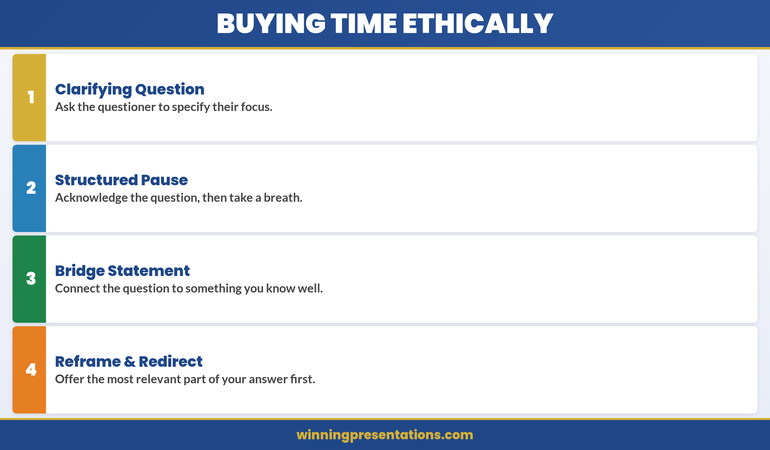
Four ethical techniques for buying time in Q&A: clarifying question, structured pause, bridge statement, and reframe and redirect

Related reading: When You Don’t Know the Answer in a Presentation explores how to handle questions that truly lie outside your scope—a different challenge, but one that shares the same foundation of honest pause.

Structured Response Buying Time

The most elegant time-buying technique is also the most useful: signposting your response structure aloud before you deliver the substance.

The technique: Say: “I’ll address this in three parts—the context, the decision, and the timeline.” Now you’ve bought yourself thinking time, but you’ve also given the audience a roadmap. They know where you’re going, so when you pause between sections, they understand it as intentional, not hesitant.

This is not filler. This is architecture. You’re showing the rigour behind your thinking, and the audience trusts structured thinking.

Where buying time becomes ethical, here, is that your structure is genuine. You’re not inventing three parts to stall; you’re using structure to organise a response that actually has three components. The buying time is the bonus.

Pro move: As you walk through each section, your thinking sharpens. By part three, you’re not buying time any longer—you’re in command. This is the difference between feeling rescued by a technique and owning it.

The system I teach in the Executive Q&A Handling System walks you through how to recognise which technique to deploy in real time, so you’re never deciding how to buy time while under pressure.

Body Language That Buys Credibility

The pause itself is only half the message. How you hold your body during that pause determines whether the room interprets it as thoughtfulness or uncertainty.

The non-negotiables: Keep your posture open. Don’t fold your arms or shift your weight. Maintain eye contact with the questioner. If you drop your gaze, the room reads it as evasion, not reflection.

Your breathing matters. Most executives hold their breath during a pause, which makes them physically tense. Breathe. Slowly. This settles your nervous system and keeps your thinking clear. It’s also visible to an attentive audience—they’ll see composure, not panic.

One more thing: nod slightly as you take the pause. It signals, “I heard you, I’m considering this seriously.” That’s a non-verbal form of acknowledgement, and it costs nothing.

For a deeper dive into how your physical presence shapes perception in Q&A, the bridging technique article covers how to use stance and gesture as strategic tools, not just accessories to your words.
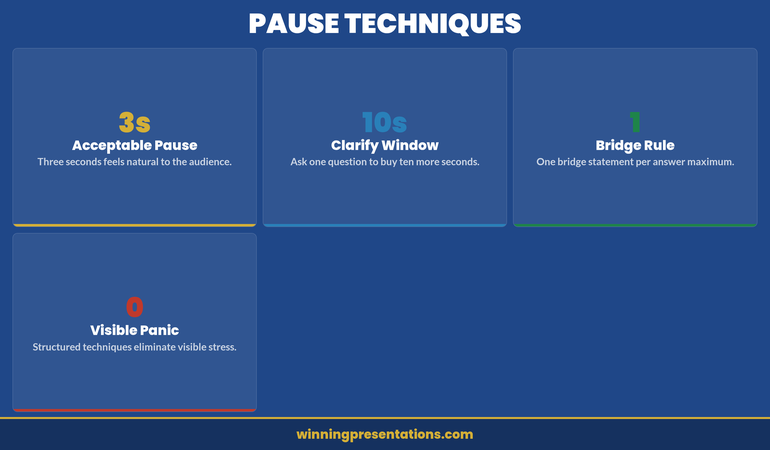
Q&A pause techniques dashboard showing acceptable pause duration, clarify window, bridge rule, and visible panic reduction

Ready to stop fearing the pause?

The Executive Q&A Handling System (£39) includes video modules on timing, scripting, and real-world scenarios. Build the confidence that transforms pressure into presence.

Access the System

When Buying Time Becomes Stalling

There’s a line between ethical pause and evasion. Know where it is.

Buying time is legitimate when:

  • You’re gathering your thoughts to give a more accurate answer.
  • You’re signalling that the question deserves serious consideration, not a throwaway response.
  • You’re using the pause to listen more deeply to what the questioner is actually asking.
  • You’re creating space for your own nervous system to settle so you can think clearly.

Buying time becomes stalling when:

  • You’re using the pause to dodge a question you don’t want to answer.
  • You’re repeating the question three times just to fill silence.
  • You’re offering non-answers cloaked in strategic language.
  • You’re buying time so frequently that the audience stops believing you’re ever thinking and starts suspecting you’re always hiding.

The distinction matters. Boards and senior leadership teams can smell the difference. They’ve been in rooms with hundreds of executives. They know a genuine pause from theatre.

The strongest executives use buying time tactically, not as a default. They know when to pause and when to answer sharply. The short answer framework covers exactly when a quick, crisp response is more powerful than a measured one.

Frequently Asked Questions

How long should a pause actually be?

Two to four seconds feels like an eternity when you’re standing in front of a room. It reads as composure to the audience. Anything longer than five seconds starts to feel intentional avoidance. The sweet spot is where you’ve caught your breath, reset your thinking, and are ready to speak with precision—usually somewhere in that two-to-four window.

What if I pause and my mind genuinely goes blank?

That’s anxiety, not a technique failure. If you’ve paused and your mind hasn’t returned, acknowledge it. “That’s a good question. Let me circle back to that after I finish this thought,” or “I want to give you a proper answer rather than rush this—let me follow up with you tomorrow.” Honesty in that moment is more credible than desperate filler words. The system walks you through how to prepare so your mind has something to work with, even under pressure.

Is buying time a sign of weakness?

No. It’s a sign that you value accuracy over speed. In executive environments, that’s strength. The executives who lose credibility are the ones who speak first and think second. Buying time—strategically—is how senior leaders protect their authority in real time.

Stay Sharp

New frameworks for high-stakes presentations land in The Winning Edge every week. Subscribe and never feel unprepared in Q&A again.

Subscribe Now

The executives who command boardrooms aren’t the ones who never need to pause. They’re the ones who’ve made peace with silence and turned it into their most powerful tool.

Mary Beth Hazeldine is Owner & Managing Director of Winning Presentations. With 24 years of corporate banking experience at JPMorgan Chase, PwC, Royal Bank of Scotland, and Commerzbank, she advises executives across financial services, healthcare, technology, and government on structuring presentations for high-stakes funding rounds and approvals.

11 Mar 2026
Executive hand resting on a polished conference table in a moment of pause, microphone in soft focus background, navy and gold tones, calm professional atmosphere

The Pause Before You Answer: Why the Best Q&A Performers Wait Three Seconds

I once had to present 200 redundancies to a room that didn’t know they were coming. The questions afterwards were the hardest I’ve ever faced. Not because they were complex — because they were human. Angry. Frightened. Personal.

The single thing that kept me from falling apart during that Q&A was a three-second pause before every answer. Not because I needed time to think. Because without the pause, my nervous system would have matched the room’s panic — and panic answers are always wrong.

That three-second gap is the most underrated technique in executive Q&A. Most people rush to answer because silence feels dangerous. It’s not. Silence is where authority lives.

Quick answer: The pause before answering in Q&A does three things simultaneously. It gives your prefrontal cortex time to override the amygdala’s fight-or-flight impulse (which produces reactive, defensive answers). It signals to the audience that you’re considering their question seriously rather than deflecting. And it creates a micro-rhythm that makes your answer land with more weight — because the room is already listening before you speak. Three seconds is the optimal interval: long enough to reset, short enough that it doesn’t feel like hesitation.

📋 Facing an executive Q&A session soon? The Executive Q&A Handling System (£39) includes the complete pause-and-respond framework — plus question prediction templates that let you prepare answers before the Q&A starts.

I’ve watched hundreds of Q&A sessions across banking, professional services, and technology. The pattern is almost universal: the presenter finishes their slides, opens the floor to questions, and the moment someone raises a hand, something shifts. The composure evaporates. The carefully structured delivery — clear points, measured pacing, confident tone — disappears. In its place: rapid-fire answers, defensive qualifications, and a subtle but unmistakable panic in the voice.

The executives who handle Q&A brilliantly all share one habit. They pause. Not a dramatic silence. Not a power move. A genuine, three-second space between the question and the answer. It looks like consideration. It feels like control. And it produces answers that are materially better than whatever would have come out of their mouths in the first 0.5 seconds.

I learned this the hard way. Early in my banking career, I treated every question as a test of speed — as though the faster I answered, the more competent I appeared. It took me years to understand that speed signals anxiety, not expertise. The most senior executives I’ve worked with across JPMorgan, PwC, and Commerzbank all do the same thing: they wait. And the room respects them for it.


The 3-second Q&A pause technique showing what happens neurologically: amygdala override, audience attention, and answer quality improvement

Why Rushing to Answer Destroys Your Credibility

When you answer a question the instant it’s asked, you send an unintended signal: I’m afraid of silence. The audience reads this as anxiety, not preparedness. Even if your answer is technically correct, the delivery undermines its authority.

Rushed answers have three structural problems. First, they tend to be longer than necessary — because you start talking before you’ve decided where the answer ends, so you ramble until you find a conclusion. Second, they’re more likely to be defensive — because your amygdala is in control, and the amygdala’s default mode is protect, not persuade. Third, they often miss the real question — because many executive questions contain a surface question and an underlying concern, and it takes a moment to hear both.

A finance director once asked me: “What happens if the market contracts by 15% next quarter?” On the surface, that’s a forecasting question. Underneath, it’s a risk tolerance question — she was asking whether I’d planned for downside scenarios. If I’d rushed to answer the surface question with numbers, I’d have missed the real ask. The three-second pause gave me time to hear both layers and respond to the concern, not just the data point.

Understanding how to handle difficult questions in presentations starts with this recognition: the question you hear isn’t always the question being asked. The pause is what lets you hear the difference.

🎯 The Q&A Framework That Turns Difficult Questions Into Career-Building Moments

The Executive Q&A Handling System gives you the complete pause-and-respond methodology — so you walk into Q&A with composure, not dread:

  • The 3-second pause protocol with specific anchoring techniques — so the pause feels natural, not awkward
  • Question prediction templates that let you prepare answers to the questions executives actually ask in your context
  • The surface-question / underlying-concern framework — so you answer what’s really being asked
  • Hostile question deflection patterns that maintain authority without creating conflict

Get the Executive Q&A Handling System → £39

Built from hundreds of executive Q&A sessions across banking, technology, and professional services — where the wrong answer to the wrong question ends careers.

The Neuroscience Behind the Three-Second Pause

When a question hits you unexpectedly, your amygdala activates before your prefrontal cortex can engage. The amygdala’s response is fast, emotional, and defensive. The prefrontal cortex’s response is slower, analytical, and strategic. In real-time: the amygdala produces an answer in 0.3 seconds. The prefrontal cortex needs 2-3 seconds to formulate one.

This is why rushed answers sound different from considered answers. They’re literally generated by a different part of your brain. The amygdala answer protects you: it deflects, qualifies, hedges, or counter-attacks. The prefrontal cortex answer persuades: it structures, contextualises, concedes where appropriate, and redirects to strength.

The three-second pause is the bridge between these two systems. It’s not “thinking time” in the conventional sense. It’s neurological switching time — the interval your brain needs to move from reactive mode to strategic mode. Without that interval, you’re answering from the part of your brain designed to deal with sabre-toothed tigers, not board members.

This is also why Q&A anxiety feels so intense. The rapid-fire nature of questions keeps your amygdala perpetually activated. Each question is a new micro-threat. The pause breaks that cycle — it gives your nervous system a reset between each trigger.

What the Audience Actually Sees When You Pause

Most people avoid the pause because they believe the audience will interpret silence as not knowing the answer. This is almost always wrong. Research into conversational dynamics consistently shows that brief pauses before responses are interpreted as thoughtfulness, not incompetence.

When you pause for three seconds before answering, here’s what the executive audience sees: someone who takes the question seriously enough to consider their response. Someone who isn’t flustered. Someone who has enough command of the material to choose their words rather than blurt them. That’s authority.

Compare this to the fast responder. The executive who answers before the questioner has finished speaking. What the audience sees: someone reactive. Someone who may have missed the nuance of the question. Someone who values speed over accuracy. That’s anxiety disguised as competence.

There’s a reason that every senior partner I worked with at PwC paused before answering client questions. It wasn’t because they were slow. It was because they understood that the pause itself communicates a message: your question deserves a considered response.

Want to predict the questions before they’re asked? The Executive Q&A Handling System includes question prediction templates for common executive meeting types — so you’ve rehearsed your paused, structured response before the Q&A begins.

Get the Executive Q&A Handling System → £39

How to Build the Pause Into Your Q&A Performance

Knowing you should pause and actually doing it under pressure are different things. The amygdala is fast, and it fights against the pause. Here’s how to train it.

Step 1: The Physical Anchor. When a question lands, do something physical before you speak. Shift your weight slightly. Place your hand on the table. Take one deliberate breath. This physical action occupies the 0.3 seconds your amygdala needs to fire — and by the time you’ve completed the action, your prefrontal cortex is online. The key is that the physical anchor is small enough to be invisible to the audience but definite enough to feel to you.

Step 2: The Silent Repetition. In the first second of your pause, silently repeat the last three words of the question. This serves two purposes: it confirms you heard the question correctly, and it keeps your brain processing the question rather than jumping to an answer. If the question was “What happens to margins if raw material costs increase by 20%?” — you silently repeat “increase by 20%” — and by the time you’ve done that, your answer has already begun to structure itself.

Step 3: The Opening Frame. Before the content of your answer, use a framing phrase: “That’s an important consideration.” “Let me address that directly.” “There are two dimensions to that question.” These phrases buy a further half-second and signal to the audience that a structured answer is coming. They’re not filler — they’re architecture.

Practise this sequence in low-stakes conversations first. A colleague asks you a question in a meeting — pause, anchor, repeat, frame, then answer. Within a week, the sequence will feel natural. Within a month, it will be automatic.


The 3-step pause technique: Physical Anchor, Silent Repetition, and Opening Frame — with timing breakdown

⏱️ Stop Giving Rushed Answers That Undermine Your Best Presentations

The Executive Q&A Handling System gives you the complete pause-to-respond methodology — so your Q&A performance matches the quality of your prepared slides:

  • The physical anchor + silent repetition + opening frame sequence — rehearsed and ready before your next Q&A

Get the Executive Q&A Handling System → £39

Used by presenters who deliver brilliant slides — then lose credibility in the Q&A because their answers don’t match their preparation.

Using the Pause With Difficult or Hostile Questions

The pause is useful for routine questions. It’s essential for difficult ones.

When someone asks a hostile question — one designed to challenge your competence, expose a weakness, or embarrass you in front of the room — your amygdala response is strongest. The urge to answer immediately is overwhelming. And the immediate answer is almost always the wrong one. It’s defensive. It’s emotional. It gives the hostile questioner exactly what they wanted: evidence that you’re rattled.

The three-second pause neutralises hostile questions by changing the dynamic. The questioner expects a reaction. When they get silence followed by a composed, structured answer, their strategy fails. The room’s attention shifts from the attack to your response. And because your prefrontal cortex had time to engage, your response addresses the substance of the question rather than its tone.

Here’s a practical example. A board member asks: “Isn’t this the same strategy that failed last year?” That’s hostile framing. The amygdala answer: “No, this is completely different because—” (defensive, reactive, already losing). The paused answer: “That’s a fair comparison to draw. The strategy shares one element with last year’s approach — the market targeting. The execution model, the pricing, and the team structure are new. Let me walk you through the three changes.” Same information. Completely different authority.

The complete guide to presentation Q&A covers the full taxonomy of difficult questions — but the pause is the foundation that every other technique builds on.

Facing hostile questions in your next Q&A? The Executive Q&A Handling System includes deflection patterns for the most common hostile question types — with specific language you can adapt to your context.

Get the Executive Q&A Handling System → £39

PAA: Quick Answers on Q&A Pausing

Won’t pausing before answering make me look like I don’t know the answer?
No — the opposite. Research shows brief pauses (2-4 seconds) are interpreted as thoughtfulness, not ignorance. What looks like not knowing the answer is rambling, filler words, and defensive qualifications — all of which happen when you rush. A confident pause followed by a structured answer signals command of the material.

How long is too long to pause before answering a question?
Beyond 5 seconds, the pause starts to read as hesitation rather than consideration. The optimal window is 2-4 seconds. Three seconds is the sweet spot — long enough for your prefrontal cortex to engage, short enough to feel natural. If you genuinely need more time, use a bridging phrase: “Let me think about the best way to frame this for you.”

Can I practise the pause technique alone, or do I need a coach?
You can build the core habit alone. Start in low-stakes conversations — colleague questions, team check-ins, informal discussions. The physical anchor (a small movement before speaking) and the silent repetition (repeating the last few words of the question internally) can both be practised without anyone knowing. Within a week of deliberate practice, the pause will feel less forced.

Is This Right For You?

✓ This is for you if:

  • You deliver strong presentations but your Q&A answers don’t match the quality of your prepared slides
  • You rush to answer questions and then wish you’d said something different
  • You’re facing an upcoming Q&A with senior executives and want a concrete technique to improve your composure

✗ This is NOT for you if:

  • Your Q&A challenge is primarily anxiety-related (physical symptoms, avoidance) — see Conquer Speaking Fear for root cause work
  • You already pause naturally and your challenge is structuring the answers themselves

💬 The Q&A System Built From Hundreds of Executive Sessions Across Three Continents

The Executive Q&A Handling System was built from real Q&A sessions in boardrooms where the wrong answer to one question can derail a project, a budget, or a career:

  • The full pause-and-respond protocol — physical anchor, silent repetition, opening frame — with practice exercises
  • Question prediction templates for board meetings, QBRs, investor sessions, and steering committees
  • Hostile question deflection patterns — including the specific language that neutralises aggressive framing
  • The surface-question / underlying-concern framework that reveals what the questioner really wants to know

Get the Executive Q&A Handling System → £39

Built from 24 years of executive Q&A sessions at JPMorgan Chase, PwC, RBS, and Commerzbank — where composure under questioning determines outcomes.

Frequently Asked Questions

What if I pause and then my mind goes blank?

This is the most common fear — and the pause actually prevents it. Mind-blanking in Q&A happens when the amygdala overwhelms your working memory. The pause gives your prefrontal cortex time to engage, which keeps your working memory functional. If you do blank after pausing, use the bridging phrase: “Let me make sure I address the right dimension of that question.” This buys another 3-5 seconds and often the answer surfaces during the bridge.

Does the three-second pause work in fast-paced meetings where multiple people are asking questions?

Yes — and it’s more important in fast-paced settings. When questions are coming rapidly, your nervous system escalates with each one. The pause resets the escalation. Even in a rapid-fire Q&A, a 2-second pause before each answer prevents the cumulative stress buildup that leads to deteriorating answer quality. The room actually benefits from the rhythm — it creates space for them to process your answers before the next question.

How do I handle follow-up questions that are fired immediately after my answer?

Apply the same pause. Follow-up questions are where most people lose composure — because the follow-up feels like the questioner wasn’t satisfied. Your amygdala interprets the follow-up as escalation. The pause disrupts that interpretation. It gives you time to recognise whether the follow-up is a genuine clarification (answer it directly) or a challenge to your competence (address the underlying concern, not the surface question).

📬 The Winning Edge

One email per week. Q&A strategies, executive communication techniques, and the mistakes I see in boardrooms across three continents. No fluff. Just what sharpens your edge.

Subscribe to The Winning Edge

Read next: If you’re presenting a quarterly forecast and the Q&A afterwards is what concerns you, read how to simplify your forecast slide so the Q&A has fewer surprises. And if presentation anxiety goes deeper than Q&A nerves, read the humiliation recovery story I’ve never told before.

Your next Q&A session is coming. Before you walk into it, try one thing: pause for three seconds before every answer. Not because you need time. Because the pause changes what comes out of your mouth — and how the room receives it. Three seconds. That’s all it takes to shift from reactive to authoritative.

About the Author

Mary Beth Hazeldine is the Owner & Managing Director of Winning Presentations. With 24 years of corporate banking experience at JPMorgan Chase, PwC, Royal Bank of Scotland, and Commerzbank, she has delivered high-stakes presentations in boardrooms across three continents.

A qualified clinical hypnotherapist and NLP practitioner, Mary Beth combines executive communication expertise with evidence-based techniques for managing presentation anxiety. She has trained thousands of executives and supported high-stakes funding rounds and approvals.

Book a discovery call | View services

25 Feb 2026
Executive pausing with raised finger during boardroom Q&A, composing a structured response to a question he wasn't expecting, presentation screen visible behind him

When You Don’t Know the Answer: The 3 Responses That Save You in Executive Q&A

Quick Answer: When you don’t know the answer in a presentation, the worst response is a rambling attempt to fill the silence. The best response is one of three scripts: the Honest Redirect (“I don’t have that number — I’ll confirm by end of day”), the Bridge (“That’s an important question — here’s what the data does show”), or the Scope Shift (“That falls outside what we analysed, but here’s what’s relevant to today’s decision”). Each takes under 15 seconds and preserves your credibility completely.

If you’ve ever hit the “don’t know the answer” presentation moment in executive Q&A, these three scripts solve it fast.

⏰ Presenting in the Next 24 Hours?

☐ Memorise the 3 response scripts below — pick one as your default

☐ Pre-write one follow-up sentence you can paste after the meeting (“Following up from today — [data point] is…”)

☐ Write “I will send by ___” on your notes so you never miss a commitment made in Q&A

At JPMorgan, I was presenting a risk assessment to the credit committee — twelve senior people, two managing directors, one question that changed how I handle Q&A forever.

“What’s the correlation between the counterparty’s default probability and the sector exposure in our current portfolio?”

I didn’t know. I had the counterparty analysis. I had the sector exposure data. But I hadn’t calculated the correlation between the two. It wasn’t in my model.

My mind went blank. Twelve faces waiting. The silence felt like it lasted a minute — it was probably four seconds.

What I wanted to say: “I don’t know.” What I almost said: a rambling attempt to sound knowledgeable that would have made everything worse.

What I actually said: “I don’t have that specific correlation calculated. I’ll run it and have it to you by end of day. What I can tell you is the sector exposure is concentrated in three counterparties representing 68% of the book — which is the more immediate risk.”

The managing director nodded. “That’s the number I actually need. Send me the correlation when you have it.”

I’d admitted I didn’t know — and answered the question they actually cared about. My credibility went up, not down.

Why Going Blank in Q&A Destroys More Credibility Than a Wrong Answer

Here’s the counterintuitive truth about Q&A: a wrong answer delivered confidently is recoverable. Going blank is not.

When you give a wrong answer, you can correct it later — “I misspoke on the margin figure; it’s 23%, not 28%.” The room accepts this. You’re human. You corrected it. Trust maintained.

When you go blank — the visible freeze, the “um,” the rambling non-answer that everyone in the room recognises as a stall — something different happens. The room doesn’t just question your knowledge of that specific topic. They question your competence. “If they didn’t know this, what else don’t they know?”

This is why the stakes of not knowing the answer in a presentation feel so disproportionate. It’s not about one question. It’s about the credibility cascade — the room’s trust in everything you’ve already said starts to erode.

But here’s the thing: it’s not the not-knowing that causes the damage. It’s the response to not knowing. The right response actually builds credibility. The wrong response destroys it.

What should you say when you don’t know the answer in a presentation?

Use one of three scripts depending on the situation: the Honest Redirect (admit + commit + bridge), the Bridge (acknowledge + pivot to what you do know), or the Scope Shift (reframe the question within your presentation’s scope). Each takes under 15 seconds, each preserves credibility, and each gives the room a substantive response instead of silence. The key is having the script ready before Q&A begins — so you’re choosing a response, not searching for one.

The 3 Responses That Preserve Credibility

In 25 years of presenting in banking — and 16+ years training executives since — I’ve found that every “don’t know” moment falls into one of three categories. Each has a specific response that works. The scripts are short, specific, and designed to be memorised before you walk into the room.

For handling difficult questions in presentation Q&A, the 4-part response system (Headline → Reason → Proof → Close) works. But “don’t know” moments are a specific subset — and they need specific scripts.

Response 1: The Honest Redirect

When to use it: You genuinely don’t have the data, but you can get it.

The script: “I don’t have [specific data point] in front of me. I’ll [specific action] and have it to you by [specific time]. What I can tell you is [the related data point that IS relevant to their decision].”

Why it works: Three things happen in this response. First, you demonstrate honesty (which builds trust). Second, you commit to a specific follow-up (which demonstrates reliability). Third, you bridge to something you DO know that’s relevant (which demonstrates competence). The room gets honesty, a commitment, and a useful answer — all in under 15 seconds.

Example: “I don’t have the year-on-year comparison for Q3 specifically. I’ll pull it from the dashboard and send it to you by 3pm. What I can tell you is the Q3 absolute figure was £2.1M, which is above the threshold we set in the business case.”

Critical rule: The follow-up must happen. If you say “by end of day,” it arrives by end of day. If you say “by 3pm,” it arrives by 3pm. One missed follow-up after an “I don’t know” moment erases the credibility you preserved in the room.

⭐ Walk Into Q&A With Response Scripts Ready — Not Just Slides

The Executive Q&A Handling System gives you the complete framework for handling every type of question — including the ones you can’t answer. Pre-built response scripts, bridging phrases, and the Headline → Reason → Proof → Close structure that keeps you in control for 20-45 seconds per answer.

Your Q&A toolkit:

  • “I Don’t Know” response frameworks — three scripts for three situations, ready to memorise
  • Bridging phrases — exact language for pivoting from unknown to known
  • Question forecasting framework — predict 80% of questions before you walk in
  • 7 question type handlers — ROI, Risk, Trade-off, Timing, Capability, Evidence, Political

Get the Executive Q&A Handling System → £39

Built from 25 years of high-stakes executive Q&A. £39, instant access.

Response 2: The Bridge

When to use it: You don’t have the specific answer they asked for, but you have related information that addresses their underlying concern.

The script: “That’s an important question. The specific [metric/data/detail] isn’t in this analysis, but what the data does show is [the related finding that addresses the concern behind their question].”

Why it works: Most questions aren’t about the literal data point. They’re about the concern the data point represents. When the CFO asks “What’s the ROI timeline?” they’re really asking “Is this a safe investment?” If you don’t have the exact ROI timeline but you have the payback period, the cost savings, or the comparable benchmark — that answers the real question.

Example: “The specific ROI timeline isn’t calculated in this model. What the data does show is a payback period of 14 months at current volumes, which compares to an 18-month average for similar implementations in the sector.”

When NOT to use it: Don’t bridge when the specific data point is clearly what they need and nothing else will do. If the CFO asks “What’s the exact spend to date?” and you don’t know, that’s an Honest Redirect, not a Bridge. Bridging away from a number they genuinely need reads as evasion.

Response 3: The Scope Shift

When to use it: The question falls outside the scope of your presentation — they’re asking about something you weren’t tasked with analysing.

The script: “That falls outside the scope of this analysis — we focused specifically on [your scope]. But the relevant finding for today’s decision is [the data point that connects their question to the decision at hand].”

Why it works: It sets a boundary without sounding defensive, and it redirects to the decision the room is there to make. Not every question needs an answer — some need a scope clarification.

Example: “The competitive analysis falls outside this review — we focused on internal process efficiency. But the relevant finding is that the current process costs £380K more than our internal benchmark, regardless of what competitors are doing.”

When NOT to use it: If the question IS relevant to the decision and you simply didn’t include it. In that case, use the Honest Redirect. Scope Shifting a legitimate question reads as deflection.


Don’t want to write the recovery scripts from scratch?

The Executive Q&A Handling System includes all three response scripts — Honest Redirect, Bridge, Scope Shift — plus the bridging phrases that connect them. £39, instant download — lifetime access.

Get the Q&A Handling System →

The 4 Responses That Make It Worse

“Great question.” This is a stall tactic that every executive recognises. The moment you say “great question,” the room knows you’re buying time. It adds nothing and signals that you’re struggling.

The ramble. Talking without direction in the hope that something relevant emerges. This is the most common response to not knowing — and the most damaging. Every second of unfocused talking erodes the structured credibility your presentation built.

“I think…” followed by a guess. If you’re guessing, the room is guessing too — about whether everything else in your presentation was also a guess. A confident “I don’t have that number” is worth ten uncertain “I think it’s roughly…”

The deflection. “That’s really more of a question for the finance team.” Unless it genuinely is outside your scope, redirecting to another team reads as finger-pointing. If you presented the data, you own the Q&A on that data.

For a comprehensive view of the common Q&A mistakes that destroy deals, see the full breakdown of executive Q&A errors.

Three response scripts for when you don't know the answer in a presentation showing Honest Redirect, Bridge, and Scope Shift with exact language

⭐ Stop Dreading the Question You Can’t Answer

The Executive Q&A Handling System was built for the 4-second moment when your mind goes blank and twelve faces are waiting. Pre-loaded response scripts, bridging language, and the Forecast → Build → Control → Protect framework that handles every question type.

Your “I don’t know” recovery toolkit:

  • Three “don’t know” response scripts — Honest Redirect, Bridge, and Scope Shift with exact language
  • Bridging phrase library — pivoting from unknown to known without sounding evasive
  • Executive response structure — Headline → Reason → Proof → Close for every answer type
  • Decision capture sheet — tracking commitments you make during Q&A so follow-ups happen

Get the Executive Q&A Handling System → £39

Built from 25 years of high-stakes executive Q&A. £39, instant access — no subscription.

How to Reduce “Don’t Know” Moments by 80%

The three response scripts handle the moment. But the best strategy is reducing how often that moment happens.

Most “don’t know” moments are predictable — because most executive questions fall into predictable patterns. In my experience, 80% of Q&A questions fall into four categories: challenge questions (questioning your data or assumptions), clarification questions (wanting more detail), scope creep questions (asking about things beyond your presentation), and political questions (testing your alignment with someone in the room).

Before any presentation, take 20 minutes and map the four question types against each major section of your deck. For each section, ask: “What would a sceptic challenge? What would need clarification? What adjacent topic might someone raise? What political angle could this trigger?”

Write two-sentence answers for the top five predicted questions. The ones you can’t answer in two sentences — those are your “don’t know” candidates. Now you can prepare for them specifically: either get the data, or pre-load the appropriate response script (Honest Redirect, Bridge, or Scope Shift).

Is This Right For You?

✓ This is for you if:

  • You’ve experienced the “blank mind” moment in Q&A and want it never to happen again
  • You want specific language to use when you don’t know the answer — not just “be honest”
  • You present to senior leadership and the stakes of fumbling a question are career-level

✗ This is NOT for you if:

  • Your presentations don’t include Q&A (rare in executive settings, but possible)
  • You’re looking for slide templates rather than Q&A frameworks (see the Executive Slide System)

🎓 25 Years of Boardroom Q&A. One System.

The Executive Q&A Handling System is built from 25 years of corporate banking and 16 years coaching senior professionals across financial services, healthcare, technology, and government. Every framework — the three response scripts, the bridging phrases, the prediction techniques — comes from real boardroom situations where the wrong answer (or no answer) cost the deal.

Designed for senior professionals who present to boards, investment committees, and executive sponsors where every answer carries weight.

Get the Executive Q&A Handling System → £39

Instant download — lifetime access to every framework and template.

Frequently Asked Questions

Is it ever okay to say “I don’t know” in a presentation?

Yes — but never as a standalone answer. “I don’t know” followed by silence is a credibility killer. “I don’t have that specific figure — I’ll confirm by 3pm, and here’s what the data does show” is a credibility builder. The admission of not knowing isn’t the problem. The absence of a follow-up, a bridge, or a next step IS the problem. Executives respect honesty. They don’t respect uncertainty that offers nothing in return.

What if the question is deliberately hostile?

Hostile questions and “don’t know” moments require different responses. If someone is testing you or trying to expose a weakness publicly, the Bridge response works best — acknowledge the question, then pivot to the strongest data point you have. For hostile questions specifically, the Executive Q&A Handling System includes a full section on managing politically motivated questions. For a broader overview, see the guide to handling difficult questions in presentations.

How do I follow up after admitting I don’t know?

Same day, without exception. If you committed to “by end of day,” it arrives before close of business. The follow-up should be brief: “Following up from today’s presentation — the Q3 year-on-year comparison is 12.4%, in line with the trend I described. Let me know if you need any additional detail.” Short, specific, and it demonstrates that you were listening, that you committed, and that you delivered. This single follow-up repairs any credibility gap from the moment itself.

What if I genuinely have no related information to bridge to?

Use the Honest Redirect without the bridge. “I don’t have that data. I’ll get it to you by [specific time].” Then move to the next question. A clean, confident admission with a specific follow-up commitment is always better than a forced bridge to something irrelevant. The room can tell when you’re bridging to unrelated data, and it looks worse than a simple “I’ll get back to you.”

📬 The Winning Edge — Weekly Newsletter

One executive presentation insight per week. Real Q&A scenarios, real response scripts, no filler. Written for professionals who present to people who ask hard questions.

Subscribe Free →

Read next: Q&A is only half the battle. If the slides themselves need work, read The Sandwich Feedback Trap: Why It Fails When You Critique Up (And the Mirror Structure That Works).

Read next: If AI is helping you build slides but the structure isn’t landing, read AI Can Write Your Slides. It Can’t Structure Your Argument.

Your next Q&A is coming. The question you can’t answer is coming too. Get the response scripts that turn “I don’t know” from a career risk into a credibility moment.

About the Author

Mary Beth Hazeldine is the Owner & Managing Director of Winning Presentations. With 25 years of corporate banking experience at JPMorgan Chase, PwC, Royal Bank of Scotland, and Commerzbank, she has delivered high-stakes presentations in boardrooms across three continents.

A qualified clinical hypnotherapist and NLP practitioner, Mary Beth combines executive communication expertise with evidence-based techniques for managing presentation anxiety. She advises executives across financial services, healthcare, technology, and government on high-stakes Q&A and presentation structure.

Read more articles at winningpresentations.com