
Tag: public speaking voice

07 Apr 2026

How to Use Your Voice to Command a Room Without Shouting

Quick answer: Vocal authority in presentations is not about volume — it is about control of five specific variables: pace, pitch, pause, projection, and resonance. Under pressure, most executives lose control of all five simultaneously, which creates the impression of uncertainty even when the content is strong. Each variable can be trained individually, and the combination creates the quality that audiences describe as a speaker who “commands the room.”

Astrid had spent eleven years in investment banking before moving into a strategy director role at a European infrastructure fund. She was technically exceptional — her analytical rigour was well-regarded across the firm, and her written work was consistently cited as a reference by colleagues. But in rooms with more than six people, something changed. Her voice rose slightly. Her pace quickened. Her sentences — clear and authoritative on paper — became hedged and breathless in delivery.

A senior partner raised it with her directly: “Your content is excellent. But when you present it, you sound like you’re asking for permission.” Astrid was startled. She had not been aware of the shift. She had been focused entirely on the content — on the accuracy of her numbers, the logic of her argument, the completeness of her analysis. She had given almost no attention to the instrument she was using to deliver it.

What followed was six months of deliberate work on her vocal delivery — not elocution lessons or theatrical coaching, but specific, functional adjustments to the way she managed pace, pitch, and pause under conditions that mirrored the presentations she gave at work. The partner who had flagged the issue told her, nine months later, that something fundamental had shifted. “You walk in and people assume you know what you’re talking about before you’ve said a word.”

That is the effect of vocal authority. It operates as a pre-content signal — shaping how the audience receives the words before they have processed what those words mean.

Does your voice give you away under pressure?

Conquer Speaking Fear is a structured programme that addresses the physical and psychological dimensions of presentation anxiety — including the vocal changes that happen when your nervous system interprets the room as a threat.

Explore the Programme →

Why Your Voice Changes Under Pressure

The voice is directly controlled by the body’s stress response. When the nervous system perceives a high-stakes situation — a large audience, a sceptical board, a question you weren’t expecting — it releases adrenaline and cortisol. These hormones prepare the body for rapid action, and the changes they produce are useful in a physical emergency. In a presentation, they are largely unhelpful.

The laryngeal muscles — which control the tension and position of the vocal cords — respond to stress by tightening. This raises pitch. The diaphragm, which controls breath support for the voice, becomes less effective as shallow chest breathing replaces the deep diaphragmatic breathing that supports full vocal resonance. The result is a voice that is higher, thinner, faster, and quieter — regardless of the speaker’s intention to sound confident.

The problem is compounded by self-awareness. Many experienced presenters can hear the change happening in real time — the slightly higher note, the quickening pace — and their awareness of it creates a secondary layer of anxiety that reinforces the vocal change. This is the voice-pressure cycle: stress changes the voice, awareness of the change creates more stress, which changes the voice further.

Understanding this mechanism is important because it clarifies what training can and cannot achieve. You cannot eliminate the stress response entirely, and attempting to do so is counterproductive. What you can do is build the technical habits — breath control, pace awareness, physical positioning — that allow you to maintain vocal quality even when the stress response is active. For broader context on managing physical presentation symptoms, see this guide on why your voice goes higher when you’re nervous and how to fix it.

The Mechanics of Vocal Authority

Vocal authority is not a single quality — it is the auditory impression created by the combination of several technical elements working in alignment. When these elements are in alignment, audiences describe the speaker as authoritative, confident, or commanding. When they are out of alignment, the same content — presented with the same intention — reads as uncertain, apologetic, or unconvincing.

Breath is the foundation. Everything else in vocal delivery depends on the quality of the breath support beneath it. Diaphragmatic breathing — drawing air into the lower lungs rather than the upper chest — produces a fuller, more resonant sound and allows the speaker to maintain a steady pace without running out of breath mid-sentence. Most people breathe diaphragmatically when at rest. Under pressure, they revert to chest breathing without noticing. Retraining this default is the single most impactful investment in vocal quality.

Resonance amplifies authority. Resonance refers to where in the body sound vibrates before it leaves the mouth. A voice that resonates in the chest cavity produces a fuller, lower, more substantial sound than a voice that resonates primarily in the head or nasal cavity. Chest resonance reads as authority. Head resonance reads as uncertainty or youth. Physical relaxation — particularly in the jaw, neck, and shoulders — is prerequisite for chest resonance; tension collapses it.

Pace is the clearest signal of confidence. Research in communication consistently shows that slower delivery is associated with higher perceived credibility and authority. The optimal pace for high-stakes executive presentations is slower than most people’s natural conversational rate — and significantly slower than their pressurised presenting rate. A pause of two to three seconds between major points feels uncomfortably long to the speaker and authoritative to the audience. For broader context on pacing and executive attention, see this analysis of how pacing affects executive engagement in presentations.

The Five Voice Variables Executives Must Master

Each of the five variables below can be worked on independently. The sequence moves from the most foundational (breath) to the most contextual (reading the room), because changes to earlier variables often resolve problems in later ones.
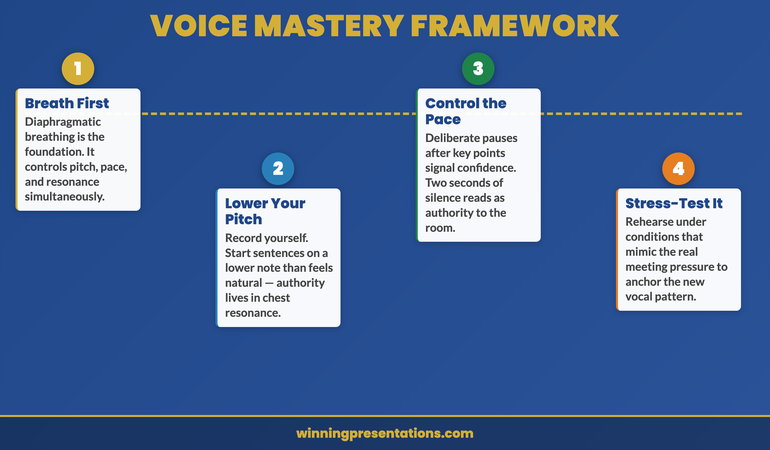
Five-stage roadmap for developing vocal authority in executive presentations

Variable one — Breath control. Practise diaphragmatic breathing as a deliberate routine before every presentation. Place one hand on your chest and one on your abdomen. A correct breath expands the abdomen without moving the chest. Three deep diaphragmatic breaths immediately before speaking — particularly before a high-stakes moment — activate the parasympathetic nervous system and provide the breath support the voice needs to function at its best.

Variable two — Pitch management. Record yourself presenting and listen back specifically for pitch. Most people are surprised by how much higher their pitch is under pressure than in ordinary conversation. To lower pitch deliberately, begin sentences on a lower note than feels natural, and resist the upward inflection at the end of statements that makes assertions sound like questions. The latter — sometimes called “uptalk” — is one of the most common authority-eroding vocal habits in executive presentations.

Variable three — Pace and pause. Mark deliberate pauses into your presentation notes or slides — not as reminders to pause, but as specific positions in the content where a pause creates meaning. After a key statistic. After a critical recommendation. After a question to the room. These pauses do triple duty: they give the audience time to process, they give you time to breathe, and they signal confidence in the material.

Variable four — Volume and projection. Projection is not shouting — it is directing the voice toward the back of the room while maintaining full resonance and control. The most common projection problem in executive presentations is not insufficient volume but insufficient direction: the speaker addresses the person nearest to them rather than projecting to the room as a whole. Speaking slightly past the audience — imagining an audience member a metre behind the furthest row — naturally increases both volume and clarity.

Variable five — Resonance and release. Physical tension is the primary enemy of resonance. Jaw tension, shoulder elevation, and neck stiffness all reduce the space available for vocal resonance and produce a thinner, tighter sound. A physical warm-up that includes jaw release, shoulder rolls, and neck mobilisation — done privately before the presentation — removes much of this tension before you enter the room.

Conquer Speaking Fear

A structured 30-day programme that addresses presentation anxiety at the physiological and psychological level — including the nervous system patterns that change your voice under pressure.

  • 30-day structured programme for systematic anxiety reduction
  • Nervous system regulation techniques for high-stakes presentations
  • Clinical hypnotherapy methods for rewiring the threat response
  • Practical drills designed for corporate presentation contexts

Get Conquer Speaking Fear — £39

Designed for executives whose anxiety affects their delivery under pressure.

Practical Drills You Can Do Before Any Presentation

The most effective vocal preparation combines physiological preparation — activating the breath and releasing tension — with cognitive familiarisation — running through the opening material until the initial sentences feel automatic. The following sequence takes approximately eight minutes and can be done in a private space immediately before the presentation.

Two minutes — physical release. Standing, roll both shoulders back slowly five times. Gently rotate the neck in each direction. Release the jaw by opening the mouth wide and then allowing it to close naturally — without pressing the teeth together. These movements address the primary tension sites that restrict vocal resonance.

Two minutes — breath activation. Three full diaphragmatic breaths: four counts in through the nose, hold for two, eight counts out through the mouth. On the exhalation, allow the abdomen to fully deflate. This activates the diaphragm and signals to the nervous system that the situation is manageable rather than threatening. For a full pre-presentation routine, see this framework for the pre-presentation ritual used by high-performance presenters.

Two minutes — vocal warm-up. Hum quietly at a comfortable pitch, feeling the vibration in the chest. Then speak your opening sentence aloud — at the pace you intend to use in the room, not faster. Repeat the opening sentence three times, focusing specifically on the pitch of the first word. Starting a sentence on a lower note than feels natural is one of the fastest ways to drop perceived register.

Two minutes — intention setting. Speak your opening two minutes aloud in full, as if you were in the room. Not as a rehearsal focused on accuracy — as a familiarisation run focused on physical delivery. The goal is to have the first two minutes feel familiar in the body before you enter the room, so that the nervous system has a prior reference for this specific act of speaking in this specific context.

For executives whose anxiety has a deeper physiological component, Conquer Speaking Fear provides a structured 30-day programme for rewiring the nervous system’s response to high-stakes speaking situations.

The Most Common Voice Mistakes Under Pressure

The following patterns appear consistently across executives who self-report difficulty with vocal authority. Each is a response to pressure rather than an intentional choice — which is why awareness alone is rarely sufficient to change them. Each requires a specific corrective practice.
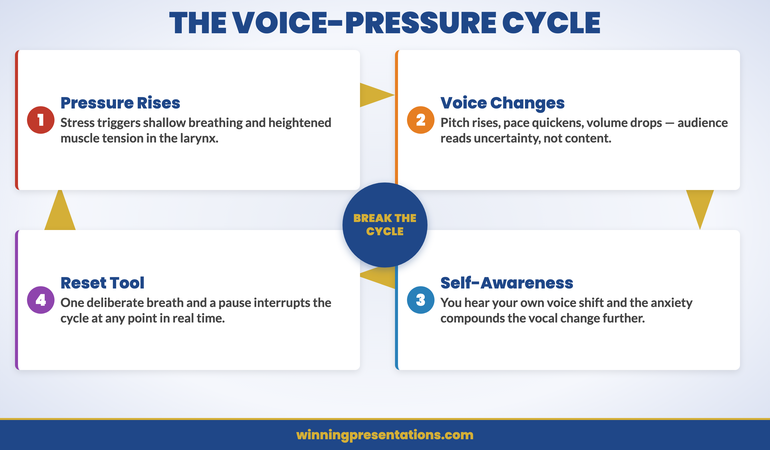
The voice-pressure cycle showing how stress affects vocal quality and how to break the pattern

Rising inflection on statements. When the voice rises at the end of a declarative sentence, the sentence reads as a question — as if the speaker is seeking validation rather than making an assertion. This pattern is particularly damaging in recommendation and conclusion slides, where the executive needs to project certainty. The corrective is deliberate: end every statement with a downward inflection, even if it feels unnatural in practice sessions.

Filler vocalisations between sentences. “Um,” “er,” “so,” and “you know” are auditory signals of cognitive searching — they indicate to the listener that the speaker is uncertain about what comes next. The corrective is not silence; it is the pause. A two-second pause while the speaker transitions to the next point reads as deliberation and authority. The same transition filled with “um” reads as uncertainty. The distinction is almost entirely in the intention to pause rather than fill.

Trailing volume at the end of sentences. Many pressurised speakers begin a sentence at an appropriate volume and then allow the final clause to drop — both in pitch and in volume — as they run out of breath. The last few words of a sentence often carry its most important information: the verb, the number, the specific recommendation. Allowing them to trail off undermines the clarity of the message and signals to the audience that the speaker is uncertain about those specific words.

Pace acceleration through transitions. The space between slides — the moment of transition from one topic to the next — is where pace most commonly accelerates. The speaker feels exposed in the gap and rushes to fill it. This is precisely where a deliberate pause is most effective: it signals to the audience that the transition is intentional, creates anticipation for what follows, and gives the speaker a moment to breathe before beginning the next section.

Reading the Room Through Your Voice

Experienced presenters use their voice not only to deliver content but to read and manage the room. This is an advanced skill — one that requires the foundational vocal habits to be sufficiently automated that the speaker has cognitive bandwidth to observe audience response and adjust in real time.

Volume as a tool for re-engagement. When an audience becomes distracted — when people begin checking phones or having side conversations — the instinctive response is to speak louder. The counterintuitive but more effective response is to drop volume significantly. A dramatic reduction in volume forces the audience to lean in and focus, in a way that increased volume does not. This technique requires confidence, because it feels risky in the moment — but it is remarkably effective for recapturing attention.

Pace as a signal of complexity. When you reach the section of the presentation that contains the most complex or consequential information, slow down further than you think necessary. The additional slowness is a signal to the audience: this matters, pay attention. It also ensures that the audience has time to process before you move on — which reduces the likelihood of questions that reveal they missed a critical point.

Pitch variation to sustain engagement. Monotone delivery — a voice that remains at a constant pitch throughout the presentation — is fatiguing to listen to. Deliberate pitch variation — slightly higher for questions or provocations, slightly lower for conclusions or recommendations — maintains audience engagement over the duration of the presentation. This variation needs to be intentional; under pressure, most people’s pitch variation collapses toward monotone.

How Voice Training Connects to Confidence

There is a bidirectional relationship between vocal quality and confidence. Most people experience this unidirectionally: they believe that if they felt more confident, their voice would improve. This is true — but the reverse is also true, and often more actionable. When the voice functions well under pressure, the speaker receives immediate positive feedback from their own perception of the room’s response — and confidence builds in real time.

This feedback loop is why vocal training has a disproportionate impact on overall presentation confidence relative to the narrowness of its focus. Working specifically on breath control, pitch, and pace produces not only better vocal delivery but also a reduction in the anxiety symptoms that interfere with delivery — because the speaker has a reliable tool they can use to manage the physiological pressure response in the room.

The most effective vocal training for executive presenters combines technical practice — deliberate work on each of the five variables — with exposure to increasingly challenging contexts. Recording practice presentations and listening back with specific focus on one variable at a time accelerates the feedback cycle. Working with a Q&A simulation exercise — where a colleague challenges your answers under conditions that mirror the real room — builds the specific resilience that Q&A situations demand. See the companion piece on building hostile questioner resilience through simulation for a structured method for the Q&A context.

Address the Anxiety Behind the Voice

Conquer Speaking Fear is a structured 30-day programme that works at the nervous system level — addressing the physiological patterns that change your voice, your pace, and your presence under pressure.

View Conquer Speaking Fear — £39

Designed for executives whose anxiety affects their delivery under pressure.

Frequently Asked Questions

Can vocal authority be learned, or is it something you either have or don’t?

Vocal authority is a technical skill with a strong learned component. While some individuals have a naturally resonant voice or a slower default pace, the specific combination of habits that creates the impression of authority — controlled breath, deliberate pace, downward inflection on statements, intentional pausing — can be developed through specific practice. The timeframe varies: most executives who work consistently on these five variables report noticeable change within four to six weeks of deliberate practice.

Is it worth recording yourself to improve your voice?

Yes — with one important caveat. The first time most people hear a recording of themselves presenting, they experience a strong negative reaction to the sound of their own voice. This is normal and does not indicate that the voice is objectively poor. After one or two exposures, the initial aversion subsides and you can listen analytically — focusing on specific variables rather than on the global impression. A useful practice is to record a two-minute section of a presentation, then listen back twice: once for pace, once for inflection. Focusing on one variable at a time produces more actionable feedback than a general impression.

What should I do if my voice visibly shakes during a presentation?

A shaking voice is a physiological stress response — it is caused by tension in the laryngeal muscles, which are activated by adrenaline. The single most effective in-the-moment intervention is a deep diaphragmatic breath before continuing. This does not eliminate the adrenaline, but it provides the breath support that compensates for some of the tension. Slowing your pace simultaneously reduces the load on the vocal system and gives the muscles more time to recover between words. Over time, systematic desensitisation — deliberate exposure to high-stress presenting contexts — reduces the severity of the physiological response in familiar contexts.

The Winning Edge — Weekly Newsletter

Executive presentation strategy, delivered every Thursday. Practical frameworks for delivery, confidence, and high-stakes communication.

Subscribe to The Winning Edge

About the Author

Mary Beth Hazeldine is Owner & Managing Director of Winning Presentations. With 24 years of corporate banking experience at JPMorgan Chase, PwC, Royal Bank of Scotland, and Commerzbank, she advises executives across financial services, healthcare, technology, and government on structuring presentations for high-stakes funding rounds and approvals. Connect at winningpresentations.com.

28 Jan 2026
I Used to Repeat Myself Three Times in Every Meeting. Then I Learned This. How to Project Your Voice Without Shouting (The Technique Most People Get Wrong) "Sorry, could you say that again?" I heard those words in every meeting for the first three years of my banking career. I'd make a point. Silence. Someone would lean in. I'd repeat myself — louder this time, voice straining. By the third repetition, whatever authority I had was gone. The advice I got? "Just speak up." "Be more confident." "Project from your diaphragm." None of it worked. Because how to project your voice has almost nothing to do with volume — and everything to do with where the sound actually comes from. Quick Answer: Voice projection isn't about speaking louder — it's about resonance. When you breathe from your diaphragm (not your chest), relax your throat, and direct sound forward, your voice carries naturally without strain. Most quiet speakers are chest-breathing and tensing their throat, which traps sound. Fix the breathing, and the voice follows. 🎤 Need to Be Heard in a Meeting Today? Try This 30-Second Reset: Before you speak: Take one slow breath into your belly (not chest) — feel your stomach expand Drop your shoulders — tension rises to throat when shoulders are tight Speak on the exhale — let the breath carry the sound out Aim your voice at the back wall — not at the person nearest you This isn't about being louder. It's about letting your natural voice come through instead of trapping it. In This Article: Why Your Voice Doesn't Carry (It's Not What You Think) The Difference Between Volume and Resonance The 3 Physical Shifts That Change Everything The Anxiety Connection Most People Miss Voice Projection on Zoom and Teams FAQ Why Your Voice Doesn't Carry (It's Not What You Think) The turning point came during a presentation skills workshop — not a voice training course. The facilitator watched me present for 60 seconds, then stopped me. "You're breathing into your chest," she said. "Your shoulders are up by your ears. Your throat is tight. No wonder your voice doesn't carry — you're strangling it before it leaves your mouth." She was right. Every time I got nervous (which was constantly), my body did three things automatically: Shallow chest breathing (less air = less power) Shoulders rising toward ears (tension travels up) Throat tightening (voice gets thin and trapped) I wasn't speaking quietly because I was timid. I was speaking quietly because anxiety was physically constricting my voice. The fix wasn't "speak louder." It was learning to release the tension so my natural voice could come through. The Difference Between Volume and Resonance Here's the distinction that changed everything for me: Volume is how loud the sound is at the source — pushing more air, straining your vocal cords. Resonance is how the sound vibrates and carries — using your chest, throat, and head as amplifiers. When you try to "speak up" by increasing volume, you strain. Your voice sounds forced. You tire quickly. And paradoxically, a strained voice often carries less well than a relaxed one. When you speak with resonance, your voice fills the room naturally. You don't feel like you're shouting. Listeners don't feel like they're being shouted at. The sound just... arrives. Think of the difference between a speaker who sounds effortlessly authoritative versus one who sounds like they're trying too hard. That's resonance versus volume. How can I project my voice without yelling? Project your voice by focusing on resonance, not volume. Breathe from your diaphragm (belly expands, not chest), relax your throat and jaw, and direct sound forward as if speaking to someone at the back of the room. This creates natural carrying power without strain. Yelling pushes air harder; projection uses your body as an amplifier. ⭐ Voice Problems Often Start With Anxiety If your voice gets quiet, tight, or shaky when you're nervous, the fix isn't vocal exercises — it's addressing what's causing the tension in the first place. Conquer Speaking Fear gives you the complete system for rewiring your nervous system response to speaking situations. What's inside: The "Calm Command" protocol for pre-presentation anxiety Breathing techniques that release throat tension (not just "breathe deep") How to reset your nervous system in 60 seconds The mental rehearsal method that builds lasting confidence Get Conquer Speaking Fear → £39 Created by a qualified clinical hypnotherapist who spent 5 years terrified of presenting. Instant download. The 3 Physical Shifts That Change Everything Voice projection comes down to three physical changes. Get these right, and your voice carries naturally: Shift #1: Diaphragmatic Breathing Most people breathe into their chest — especially when nervous. Chest breathing is shallow and gives you less air to work with. Your voice runs out of fuel mid-sentence. Diaphragmatic breathing means breathing into your belly. When you inhale, your stomach should expand outward. Your chest and shoulders stay relatively still. Try this now: Place one hand on your chest, one on your belly. Breathe in slowly. Which hand moves first? If it's your chest, you're chest-breathing. To fix it: Exhale completely first. Then let the inhale happen naturally — it will go deeper. Practice until belly-first breathing becomes automatic. For a deeper dive on breathing for presentations, see our guide to presentation breathing techniques. Shift #2: Release Throat Tension When you're nervous, your throat tightens. It's a primitive protective response — the body preparing for threat. But a tight throat traps sound and makes your voice thin and strained. To release throat tension: Yawn (seriously) — this opens the throat naturally Hum gently for 10 seconds — you should feel vibration in your chest Drop your jaw slightly — most people clench without realising Relax your tongue — let it rest at the bottom of your mouth Before important meetings, I still do a few gentle hums in private. It's the fastest way to open up the vocal pathway. Shift #3: Direct Sound Forward Many quiet speakers direct their voice downward — toward their notes, their laptop, the table. Sound goes where you send it. Instead, imagine you're speaking to someone at the back of the room. Not shouting at them — just including them in the conversation. Your voice will naturally carry further without strain. In a meeting room, pick a point on the far wall and speak toward it. On Zoom, speak toward your camera as if the listener is sitting a few meters behind your screen. Why is my voice so quiet when I speak? A quiet voice usually comes from one of three causes: shallow chest breathing (not enough air), throat tension (voice gets trapped), or directing sound downward instead of outward. All three are often triggered by nervousness. When you're anxious, your body tenses up — and a tense body produces a thin, quiet voice. Address the physical tension, and your natural voice volume returns. Nervous tension killing your voice? Fix the root cause. Get Conquer Speaking Fear → £39 The Anxiety Connection Most People Miss Here's what vocal coaches rarely tell you: for most professionals, voice projection problems are anxiety problems in disguise. When your nervous system perceives threat (and yes, a boardroom full of executives counts), it triggers a cascade of physical responses: Breathing becomes shallow and rapid Muscles tense — including throat, jaw, and shoulders Blood flow shifts away from non-essential functions Fine motor control decreases Your quiet, shaky voice isn't a skill problem. It's your body's threat response showing up in your vocal cords. This is why "just speak up" doesn't work. You can't willpower your way past a nervous system response. You have to work with your body, not against it. The most effective approach combines the physical techniques (breathing, throat release, direction) with methods that calm the underlying anxiety response. When you're not fighting your nervous system, your voice has room to come through. If your voice also shakes when you're nervous, see our specific guide on voice shaking when speaking. ⭐ Stop Fighting Your Nervous System Conquer Speaking Fear teaches you to work with your body's response instead of against it — so your voice comes through naturally, without strain or force. The system includes: Pre-presentation protocols that calm your nervous system In-the-moment resets when anxiety spikes Long-term rewiring techniques for lasting change The hypnotherapist's approach to speaking confidence Get Conquer Speaking Fear → £39 The same techniques I use with private clients. Instant digital download. Voice Projection on Zoom and Teams Virtual meetings add a layer of complexity. Your microphone captures sound differently than human ears in a room. Here's how to adapt: Microphone positioning matters more than volume Speaking louder into a badly positioned mic just creates distortion. Position your microphone 6-8 inches from your mouth, slightly below chin level. Let the mic do the amplification work. Test your levels before important calls Both Zoom and Teams have audio testing features. Use them. Many "quiet" speakers on calls simply have their input levels set too low. Speak toward the camera, not the screen Just like directing sound to the back of a room, speak toward your camera. This creates better mic pickup and — as a bonus — better eye contact with viewers. The resonance principles still apply Diaphragmatic breathing, throat release, and forward direction all improve your virtual presence. A resonant voice sounds more authoritative through speakers, not less. For complete guidance on virtual presence, see our guide to looking confident when presenting. How do speakers project their voice? Professional speakers project their voice through three techniques: diaphragmatic breathing (breathing into the belly for more air support), releasing throat and jaw tension (so sound isn't trapped), and directing their voice outward toward the back of the room. This creates resonance — natural carrying power — rather than strained volume. Most also manage their anxiety, since nervousness causes the physical tension that kills projection. Ready to speak with natural authority? Get Conquer Speaking Fear → £39 The Practice Routine That Builds Lasting Change These techniques work immediately, but lasting change requires practice. Here's the 5-minute daily routine I recommend: Morning (2 minutes): 10 belly breaths (hand on stomach, feel it expand) 30 seconds of gentle humming (feel chest vibration) Speak one sentence out loud, directing voice across the room Before any meeting (30 seconds): One slow belly breath Drop shoulders Quick throat release (small yawn or hum) First words aimed at far wall/back of camera Within 2-3 weeks of consistent practice, the new patterns start to become automatic. Within 2-3 months, they're your default. ⭐ The Complete System for Speaking Confidence Voice projection is one piece. Conquer Speaking Fear gives you the complete system — from managing pre-presentation nerves to rewiring your long-term relationship with speaking situations. Everything included: The "Calm Command" pre-presentation protocol Breathing and body techniques that release tension In-the-moment anxiety resets Mental rehearsal methods for lasting confidence The hypnotherapist's approach to fear rewiring Get Conquer Speaking Fear → £39 Instant download. Created from clinical hypnotherapy training and 24 years of corporate experience. Frequently Asked Questions Will this work if my voice is naturally soft? Yes. "Naturally soft" voices are almost always under-projected voices — not permanently quiet voices. When you breathe properly and release tension, even traditionally soft voices carry well. You're not trying to sound like a drill sergeant; you're trying to let your natural voice come through without restriction. Most people are surprised by how much presence their voice has when it's not being strangled by tension. Does voice projection work on Zoom and Teams? Absolutely — and it might matter even more virtually. Microphones don't compensate for mumbling or trailing off the way human listeners sometimes do. The resonance techniques (diaphragmatic breathing, open throat, forward direction) all translate to virtual settings. Pair them with proper mic positioning and input levels for best results. How long does it take to see results? The 30-second reset technique works immediately — try it in your next meeting. Building lasting change takes longer: 2-3 weeks of daily practice to start feeling natural, 2-3 months to become your default. The key is consistency. Five minutes of daily practice beats an hour once a week. What if my voice still shakes when I'm nervous? Voice shaking is a specific anxiety symptom that requires targeted techniques. The diaphragmatic breathing helps, but if shaking persists, you likely need to address the underlying nervous system response more directly. That's where the anxiety-management components of Conquer Speaking Fear come in — it's designed specifically for professionals whose physical symptoms don't respond to "just relax" advice. Get Weekly Speaking Confidence Insights Techniques for projecting presence, managing nerves, and speaking with authority — from a clinical hypnotherapist with 24 years in corporate banking. Subscribe to The Winning Edge → 📋 Free Resource: 7 Presentation Frameworks Structure your next presentation with proven frameworks — so you can focus on delivery instead of figuring out what comes next. Download Free Frameworks → Your Next Step The next time you need to speak up in a meeting: Take one belly breath before you start Drop your shoulders Aim your voice at the back wall You'll feel the difference immediately. And so will everyone in the room. P.S. Voice projection matters most in high-stakes situations. If you're presenting for approval, I wrote about the pre-meeting alignment strategy that gets decisions made before you even open your slides. P.P.S. If you're spending too long building presentations, check out how to cut presentation creation time without cutting quality — the system approach that saves hours every week. About Mary Beth Hazeldine Qualified clinical hypnotherapist, NLP practitioner, and Owner of Winning Presentations. I spent 5 years terrified of presenting — voice quiet, hands shaking, avoiding every speaking opportunity I could. Learning to project my voice was part of a larger journey that changed my career. Now I help professionals find their voice, literally and figuratively.

How to Project Your Voice Without Shouting (The Technique Most People Get Wrong)

“Sorry, could you say that again?”

I heard those words in every meeting for the first three years of my banking career. I’d make a point. Silence. Someone would lean in. I’d repeat myself — louder this time, voice straining. By the third repetition, whatever authority I had was gone.

The advice I got? “Just speak up.” “Be more confident.” “Project from your diaphragm.”

None of it worked. Because how to project your voice has almost nothing to do with volume — and everything to do with where the sound actually comes from.

Quick Answer: Voice projection isn’t about speaking louder — it’s about resonance. When you breathe from your diaphragm (not your chest), relax your throat, and direct sound forward, your voice carries naturally without strain. Most quiet speakers are chest-breathing and tensing their throat, which traps sound. Fix the breathing, and the voice follows.

🎤 Need to Be Heard in a Meeting Today? Try This 30-Second Reset:

  1. Before you speak: Take one slow breath into your belly (not chest) — feel your stomach expand
  2. Drop your shoulders — tension rises to throat when shoulders are tight
  3. Speak on the exhale — let the breath carry the sound out
  4. Aim your voice at the back wall — not at the person nearest you

This isn’t about being louder. It’s about letting your natural voice come through instead of trapping it.

Why Your Voice Doesn’t Carry (It’s Not What You Think)

The turning point came during a presentation skills workshop — not a voice training course.

The facilitator watched me present for 60 seconds, then stopped me. “You’re breathing into your chest,” she said. “Your shoulders are up by your ears. Your throat is tight. No wonder your voice doesn’t carry — you’re strangling it before it leaves your mouth.”

She was right. Every time I got nervous (which was constantly), my body did three things automatically:

  • Shallow chest breathing (less air = less power)
  • Shoulders rising toward ears (tension travels up)
  • Throat tightening (voice gets thin and trapped)

I wasn’t speaking quietly because I was timid. I was speaking quietly because anxiety was physically constricting my voice.

The fix wasn’t “speak louder.” It was learning to release the tension so my natural voice could come through.

The Difference Between Volume and Resonance

Here’s the distinction that changed everything for me:

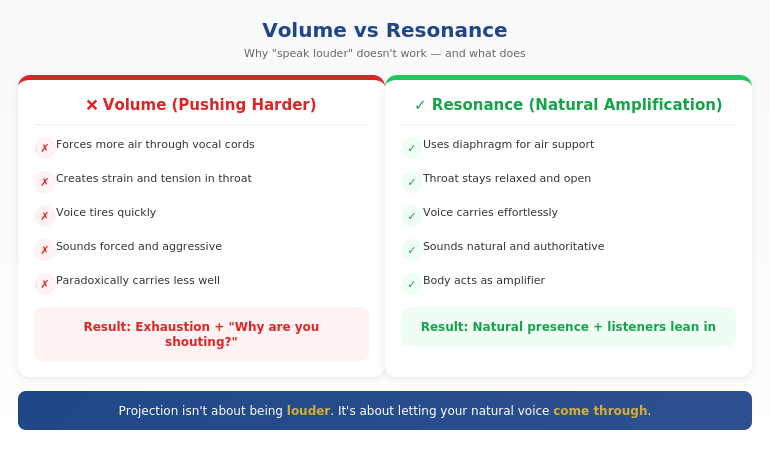
Volume is how loud the sound is at the source — pushing more air, straining your vocal cords.

Resonance is how the sound vibrates and carries — using your chest, throat, and head as amplifiers.

When you try to “speak up” by increasing volume, you strain. Your voice sounds forced. You tire quickly. And paradoxically, a strained voice often carries less well than a relaxed one.

When you speak with resonance, your voice fills the room naturally. You don’t feel like you’re shouting. Listeners don’t feel like they’re being shouted at. The sound just… arrives.

Think of the difference between a speaker who sounds effortlessly authoritative versus one who sounds like they’re trying too hard. That’s resonance versus volume.

How can I project my voice without yelling?

Project your voice by focusing on resonance, not volume. Breathe from your diaphragm (belly expands, not chest), relax your throat and jaw, and direct sound forward as if speaking to someone at the back of the room. This creates natural carrying power without strain. Yelling pushes air harder; projection uses your body as an amplifier.

Diagram showing volume vs resonance: volume creates strain and thin sound, resonance creates natural carrying power using diaphragm breathing

⭐ Voice Problems Often Start With Anxiety

If your voice gets quiet, tight, or shaky when you’re nervous, the fix isn’t vocal exercises — it’s addressing what’s causing the tension in the first place. Conquer Speaking Fear gives you the complete system for rewiring your nervous system response to speaking situations.

What’s inside:

  • The “Calm Command” protocol for pre-presentation anxiety
  • Breathing techniques that release throat tension (not just “breathe deep”)
  • How to reset your nervous system in 60 seconds
  • The mental rehearsal method that builds lasting confidence

Get Conquer Speaking Fear → £39

Created by a qualified clinical hypnotherapist who spent 5 years terrified of presenting. Instant download.

The 3 Physical Shifts That Change Everything

Voice projection comes down to three physical changes. Get these right, and your voice carries naturally:

Shift #1: Diaphragmatic Breathing

Most people breathe into their chest — especially when nervous. Chest breathing is shallow and gives you less air to work with. Your voice runs out of fuel mid-sentence.

Diaphragmatic breathing means breathing into your belly. When you inhale, your stomach should expand outward. Your chest and shoulders stay relatively still.

Try this now: Place one hand on your chest, one on your belly. Breathe in slowly. Which hand moves first? If it’s your chest, you’re chest-breathing.

To fix it: Exhale completely first. Then let the inhale happen naturally — it will go deeper. Practice until belly-first breathing becomes automatic.

For a deeper dive on breathing for presentations, see our guide to presentation breathing techniques.

Shift #2: Release Throat Tension

When you’re nervous, your throat tightens. It’s a primitive protective response — the body preparing for threat. But a tight throat traps sound and makes your voice thin and strained.

To release throat tension:

  • Yawn (seriously) — this opens the throat naturally
  • Hum gently for 10 seconds — you should feel vibration in your chest
  • Drop your jaw slightly — most people clench without realising
  • Relax your tongue — let it rest at the bottom of your mouth

Before important meetings, I still do a few gentle hums in private. It’s the fastest way to open up the vocal pathway.

Shift #3: Direct Sound Forward

Many quiet speakers direct their voice downward — toward their notes, their laptop, the table. Sound goes where you send it.

Instead, imagine you’re speaking to someone at the back of the room. Not shouting at them — just including them in the conversation. Your voice will naturally carry further without strain.

In a meeting room, pick a point on the far wall and speak toward it. On Zoom, speak toward your camera as if the listener is sitting a few meters behind your screen.

Why is my voice so quiet when I speak?

A quiet voice usually comes from one of three causes: shallow chest breathing (not enough air), throat tension (voice gets trapped), or directing sound downward instead of outward. All three are often triggered by nervousness. When you’re anxious, your body tenses up — and a tense body produces a thin, quiet voice. Address the physical tension, and your natural voice volume returns.

Nervous tension killing your voice? Fix the root cause.

Get Conquer Speaking Fear → £39

The Anxiety Connection Most People Miss

Here’s what vocal coaches rarely tell you: for most professionals, voice projection problems are anxiety problems in disguise.

When your nervous system perceives threat (and yes, a boardroom full of executives counts), it triggers a cascade of physical responses:

  • Breathing becomes shallow and rapid
  • Muscles tense — including throat, jaw, and shoulders
  • Blood flow shifts away from non-essential functions
  • Fine motor control decreases

Your quiet, shaky voice isn’t a skill problem. It’s your body’s threat response showing up in your vocal cords.

This is why “just speak up” doesn’t work. You can’t willpower your way past a nervous system response. You have to work with your body, not against it.

The most effective approach combines the physical techniques (breathing, throat release, direction) with methods that calm the underlying anxiety response. When you’re not fighting your nervous system, your voice has room to come through.

If your voice also shakes when you’re nervous, see our specific guide on voice shaking when speaking.

The anxiety-voice connection: threat response triggers shallow breathing, throat tension, and muscle tightening, which creates thin quiet voice

⭐ Stop Fighting Your Nervous System

Conquer Speaking Fear teaches you to work with your body’s response instead of against it — so your voice comes through naturally, without strain or force.

The system includes:

  • Pre-presentation protocols that calm your nervous system
  • In-the-moment resets when anxiety spikes
  • Long-term rewiring techniques for lasting change
  • The hypnotherapist’s approach to speaking confidence

Get Conquer Speaking Fear → £39

The same techniques I use with private clients. Instant digital download.

Voice Projection on Zoom and Teams

Virtual meetings add a layer of complexity. Your microphone captures sound differently than human ears in a room. Here’s how to adapt:

Microphone positioning matters more than volume

Speaking louder into a badly positioned mic just creates distortion. Position your microphone 6-8 inches from your mouth, slightly below chin level. Let the mic do the amplification work.

Test your levels before important calls

Both Zoom and Teams have audio testing features. Use them. Many “quiet” speakers on calls simply have their input levels set too low.

Speak toward the camera, not the screen

Just like directing sound to the back of a room, speak toward your camera. This creates better mic pickup and — as a bonus — better eye contact with viewers.

The resonance principles still apply

Diaphragmatic breathing, throat release, and forward direction all improve your virtual presence. A resonant voice sounds more authoritative through speakers, not less.

For complete guidance on virtual presence, see our guide to looking confident when presenting.

How do speakers project their voice?

Professional speakers project their voice through three techniques: diaphragmatic breathing (breathing into the belly for more air support), releasing throat and jaw tension (so sound isn’t trapped), and directing their voice outward toward the back of the room. This creates resonance — natural carrying power — rather than strained volume. Most also manage their anxiety, since nervousness causes the physical tension that kills projection.

Ready to speak with natural authority?

Get Conquer Speaking Fear → £39

The Practice Routine That Builds Lasting Change

These techniques work immediately, but lasting change requires practice. Here’s the 5-minute daily routine I recommend:

Morning (2 minutes):

  • 10 belly breaths (hand on stomach, feel it expand)
  • 30 seconds of gentle humming (feel chest vibration)
  • Speak one sentence out loud, directing voice across the room

Before any meeting (30 seconds):

  • One slow belly breath
  • Drop shoulders
  • Quick throat release (small yawn or hum)
  • First words aimed at far wall/back of camera

Within 2-3 weeks of consistent practice, the new patterns start to become automatic. Within 2-3 months, they’re your default.

⭐ The Complete System for Speaking Confidence

Voice projection is one piece. Conquer Speaking Fear gives you the complete system — from managing pre-presentation nerves to rewiring your long-term relationship with speaking situations.

Everything included:

  • The “Calm Command” pre-presentation protocol
  • Breathing and body techniques that release tension
  • In-the-moment anxiety resets
  • Mental rehearsal methods for lasting confidence
  • The hypnotherapist’s approach to fear rewiring

Get Conquer Speaking Fear → £39

Instant download. Created from clinical hypnotherapy training and 24 years of corporate experience.

Frequently Asked Questions

Will this work if my voice is naturally soft?

Yes. “Naturally soft” voices are almost always under-projected voices — not permanently quiet voices. When you breathe properly and release tension, even traditionally soft voices carry well. You’re not trying to sound like a drill sergeant; you’re trying to let your natural voice come through without restriction. Most people are surprised by how much presence their voice has when it’s not being strangled by tension.

Does voice projection work on Zoom and Teams?

Absolutely — and it might matter even more virtually. Microphones don’t compensate for mumbling or trailing off the way human listeners sometimes do. The resonance techniques (diaphragmatic breathing, open throat, forward direction) all translate to virtual settings. Pair them with proper mic positioning and input levels for best results.

How long does it take to see results?

The 30-second reset technique works immediately — try it in your next meeting. Building lasting change takes longer: 2-3 weeks of daily practice to start feeling natural, 2-3 months to become your default. The key is consistency. Five minutes of daily practice beats an hour once a week.

What if my voice still shakes when I’m nervous?

Voice shaking is a specific anxiety symptom that requires targeted techniques. The diaphragmatic breathing helps, but if shaking persists, you likely need to address the underlying nervous system response more directly. That’s where the anxiety-management components of Conquer Speaking Fear come in — it’s designed specifically for professionals whose physical symptoms don’t respond to “just relax” advice.

Get Weekly Speaking Confidence Insights

Techniques for projecting presence, managing nerves, and speaking with authority — from a clinical hypnotherapist with 24 years in corporate banking.

Subscribe to The Winning Edge →

📋 Free Resource: 7 Presentation Frameworks

Structure your next presentation with proven frameworks — so you can focus on delivery instead of figuring out what comes next.

Download Free Frameworks →

Your Next Step

The next time you need to speak up in a meeting:

  1. Take one belly breath before you start
  2. Drop your shoulders
  3. Aim your voice at the back wall

You’ll feel the difference immediately. And so will everyone in the room.

P.S. Voice projection matters most in high-stakes situations. If you’re presenting for approval, I wrote about the pre-meeting alignment strategy that gets decisions made before you even open your slides.

P.P.S. If you’re spending too long building presentations, check out how to cut presentation creation time without cutting quality — the system approach that saves hours every week.

About Mary Beth Hazeldine
Qualified clinical hypnotherapist, NLP practitioner, and Owner of Winning Presentations. I spent 5 years terrified of presenting — voice quiet, hands shaking, avoiding every speaking opportunity I could. Learning to project my voice was part of a larger journey that changed my career. Now I help professionals find their voice, literally and figuratively.

05 Jan 2026
Presentation voice tips - how to use pace, pitch, volume, and pauses for confident delivery

Presentation Voice Tips: How to Sound Confident and Commanding [2026]

Last updated: January 2026

The CFO leaned back and crossed his arms. “I don’t believe those numbers.”

The problem wasn’t the numbers — they were solid. The problem was how my client delivered them. Her voice stayed flat throughout, with no emphasis on the critical data points. Everything sounded equally important, which meant nothing sounded important.

We spent an hour on vocal delivery alone. Same presentation, same numbers — but this time she varied her pace, dropped her voice for authority on key figures, and paused before the recommendation. The CFO didn’t just believe the numbers. He championed the proposal.

Your voice is your primary delivery instrument. Even in a room where people can see you, research shows vocal variety carries more persuasive weight than body language. Master your voice, and you command attention whether presenting in a boardroom or on Zoom.

Here’s how to transform your presentation voice from forgettable to compelling.

🎁 Free resource: Download my 7 Presentation Frameworks PDF — includes vocal delivery cues for each framework.

Why Your Presentation Voice Matters

When content and delivery conflict, audiences believe delivery. You can say “this is urgent” — but if your voice is monotone, they hear “this is routine.”

Vocal variety does three things:

Signals importance. Changes in pace, pitch, and volume tell your audience what matters. Without variation, everything blurs together.

Maintains attention. Monotone voices are sleep-inducing. Variety keeps people engaged by creating auditory interest.

Conveys confidence. A varied, controlled voice signals that you’re comfortable with your material and in command of the room.

The Four Elements of Presentation Voice Tips

The four elements of presentation voice - pace, pitch, volume, and pause with examples
Master these four elements and your presentation voice transforms:

1. Pace: Speed as a Tool

Most presenters speak too fast when nervous. Rushing signals anxiety and prevents audiences from processing information.

The baseline: Aim for 120-150 words per minute — slower than normal conversation. This feels uncomfortably slow at first but sounds professional to listeners.

Faster for energy: Speed up slightly when describing exciting developments, building momentum, or conveying urgency.

Slower for importance: Slow down for key points, data, and recommendations. The pace change signals “this matters — pay attention.”

Practice tip: Record yourself and time a section. Most people discover they’re speaking 20-30% faster than they thought.

2. Pitch: High and Low for Effect

Pitch variation prevents monotone delivery and conveys different emotional tones.

Higher pitch: Conveys excitement, enthusiasm, and energy. Use for positive developments, opportunities, and calls to action.

Lower pitch: Conveys authority, seriousness, and gravitas. Use for important data, recommendations, and concluding statements.

The danger zone: Rising pitch at the end of statements (upspeak) makes everything sound like a question. It undermines authority. Statements should end with falling pitch.

Practice tip: Read the same sentence three ways — as a question, as an excited statement, as a serious declaration. Notice how pitch changes meaning.

3. Volume: Loud, Soft, and Strategic

Volume variation is the simplest technique with the most immediate impact.

Louder for emphasis: Increase volume on key words, phrases, and data points. “We saved them three MILLION pounds.”

Softer for intimacy: Drop your volume to draw people in. Softer delivery can be more powerful than shouting — it forces attention.

The contrast effect: A soft phrase after sustained volume creates dramatic impact. The sudden change commands attention.

Practice tip: Identify the three most important sentences in your presentation. Practice delivering them at different volumes to find what works.

Want a quick-reference for vocal techniques? My Public Speaking Cheat Sheets (£14.99) include a voice techniques card with specific examples for pace, pitch, and volume variation.

4. Pause: The Most Underused Tool

Silence is powerful. Most presenters fear it. That’s backwards — pause is your most effective vocal technique.

Pause before important points: Creates anticipation. “And the result was… [pause] …a 40% increase.”

Pause after important points: Lets them land. “We need to act now. [pause]” The silence gives weight to your words.

Pause instead of fillers: When you’d normally say “um” or “uh,” say nothing instead. Silence sounds confident; fillers sound uncertain.

The three-beat rule: Important pauses should last about three beats (roughly two seconds). This feels eternal to you but registers as deliberate to your audience.

Presentation Voice Tips for Common Problems

Problem: Monotone Delivery

You know you should vary your voice, but when presenting, everything flattens out.

The fix: Mark your notes with delivery cues. Underline words to emphasise. Write “PAUSE” in capital letters. Note “↑” for higher pitch, “↓” for lower. In practice, exaggerate these cues until variation feels natural.

Problem: Speaking Too Fast

Nerves accelerate your pace until words blur together.

The fix: Build deliberate pauses into your structure. End of each section = pause. Before each key point = pause. The pauses act as speed bumps, forcing you to slow down.

Problem: Voice Trails Off

You start sentences strong but lose volume and energy by the end.

The fix: Focus on landing the final word of each sentence. Think of each sentence as having a target you need to hit. The target is the last word, delivered with full voice.

Problem: Nervous Voice Quality

Your voice shakes, tightens, or sounds strained when presenting.

The fix: Breathe from your diaphragm, not your chest. Before presenting, take three deep breaths. When speaking, pause to breathe rather than rushing through without oxygen. Physical tension in shoulders and jaw transfers to voice — consciously relax them.

Voice Projection Without Shouting

Projection isn’t about volume — it’s about carrying power. A projected voice reaches the back of the room without strain.

Breath support: Project from your diaphragm, not your throat. Put your hand on your belly; it should move when you breathe and speak.

Open posture: Stand tall, shoulders back, chest open. This allows full breath and natural resonance.

Aim for the back: Visualise speaking to someone at the back of the room. This adjusts your projection naturally without forcing.

Resonance: A projected voice resonates in your chest, not just your throat. Hum to find your natural resonance point, then speak from there.

Presentation Voice Tips for Virtual Delivery

Virtual presentations require adjusted voice technique:

More variation, not less: Video flattens everything. Increase your vocal variety by 30% compared to in-person.

Microphone awareness: Don’t lean into the mic for emphasis — the volume spike is jarring. Keep consistent distance and use pitch and pace for variation instead.

Shorter phrases: Audio compression and latency make long sentences harder to follow. Keep sentences punchy and pause more frequently.

For the complete virtual guide, see: Virtual Presentation Tips

Presenting to executives? My Executive Slide System (£39) includes delivery notes for high-stakes presentations where your voice and presence matter most.

Practice Exercises for Presentation Voice

The volume range exercise: Pick a sentence. Say it at a whisper. Say it at normal volume. Say it loudly. Practice moving between all three fluidly.

The emphasis exercise: Take “I didn’t say she stole the money.” Say it seven times, emphasising a different word each time. Notice how meaning changes.

The pause exercise: Practice inserting three-second pauses before and after key statements. Time them. They will feel too long until you see how natural they sound on recording.

The recording exercise: Record yourself presenting for two minutes. Listen back without watching. Does your voice sound varied? Where does it flatten? What would you change?

Your Voice, Your Instrument

Your voice is the primary tool for presentation delivery. Body language supports it. Slides accompany it. But voice carries your message.

Start with one technique from this guide. Maybe it’s pausing more. Maybe it’s varying volume. Maybe it’s slowing your pace. Practice that one technique until it becomes natural, then add another.

For the complete delivery framework including body language and presence, see: How to Deliver a Presentation

For body language techniques that complement your voice, see: Presentation Body Language

Want live feedback on your presentation voice? My Executive Buy-In Presentation System includes practice sessions where you’ll receive real-time coaching on vocal delivery.

Free weekly tips: Join 2,000+ professionals getting my Wednesday newsletter. Subscribe here.


About the AuthorMary Beth Hazeldine is the Owner & Managing Director of Winning Presentations, where she’s helped thousands of professionals command the room for over 15 years. With 24 years in corporate banking at JPMorgan Chase, PwC, Royal Bank of Scotland, and Commerzbank, she brings real boardroom experience to every technique she teaches. Mary Beth is also a qualified clinical hypnotherapist, combining business expertise with the psychology of confidence and persuasion.

Frequently Asked Questions

How do I stop sounding monotone in presentations?

Practice deliberate contrast. Mark your notes for emphasis — underline words to stress, write “PAUSE” where needed. Record yourself and listen for variation. Exaggerate in practice until natural variation emerges.

How can I project my voice without shouting?

Projection comes from breath support, not volume. Breathe from your diaphragm, stand tall to open your chest, and speak to the back of the room. Shouting strains; projection carries.

What’s the ideal pace for a presentation?

Most people speak too fast when nervous. Aim for 120-150 words per minute — slower than conversation. Vary pace for effect: faster for excitement, slower for important points.

(This article was created with AI assistance; all stories and insights are based on 35 years of real client work.)