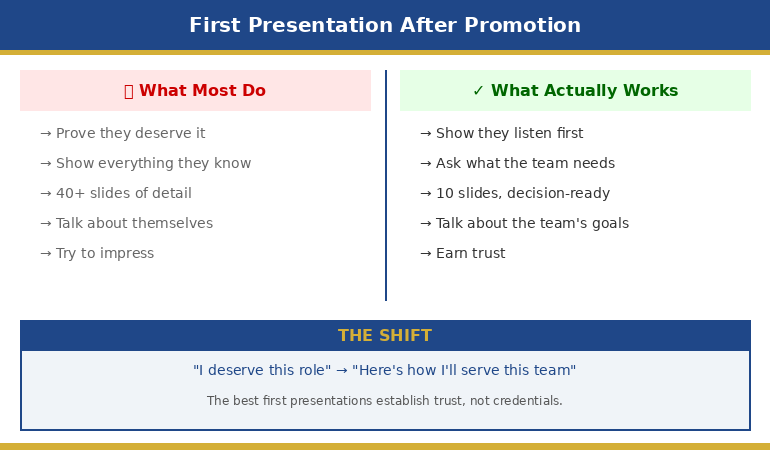
Claire was Head of Digital at a UK retail group. She’d submitted for Director three times and been rejected three times. “Not quite ready,” the feedback always said. No specific gaps, no roadmap to yes. On her fourth submission, she stopped writing a detailed CV and started building a business case presentation instead. Four slides. No prose. Just quantified impact: £2.1M in revenue from her team’s initiatives. Three cross-functional projects delivered. Headcount grown from 4 to 11 people under her management. The committee approved her promotion in the first meeting. Effective date six weeks later.
Quick answer: A promotion business case presentation stops the committee from evaluating you against abstract criteria and forces them to evaluate you against the numbers you’ve already delivered and the scope you’re ready for. Most promotion candidates submit a CV (which invites comparison and judgment) or a rambling narrative (which buries the business case in words). Instead, build four slides: The Commercial Impact you’ve delivered, The Scope you’re ready for, The Gap you’ve already closed, and Why Now. Each slide answers one specific question. Together, they answer the only question that matters: “Is this person clearly ready, or are we still waiting?”
Promotion decision meeting this month?
Most candidates prepare what they’ve done. Few prepare what they’re ready to do. If you’re walking into a promotion committee meeting with a CV or a vague narrative, you’re accepting the rejection you’ve already received twice.
- Quantify exactly what you’ve delivered in the current role
- Define the scope you’re ready for at the next level
- Show the specific gaps you’ve already closed
- Explain why the committee should move now, not wait
→ Skip ahead to the four-slide business case structure below.
The Fourth Submission That Worked
Claire had done everything right the first three times. Her CV was polished. She’d taken every leadership course available. She’d mentored junior team members. Her manager called her “a natural leader.” But the promotion committee saw the CV and asked: “Compared to other candidates at her level, is she exceptional?” That question invited comparison. Comparison invites hesitation.
Before the fourth submission, Claire rebuilt her approach entirely. She stopped thinking about proving she’d “earned” the promotion through tenure and effort. She started thinking like she was already in the role, and the committee needed a business case for moving her now. She quantified. She showed scope. She closed perceived gaps. She explained risk: the talent she’d develop was being poached by other teams because she wasn’t promoted. One presentation. Four slides. No hedging. The committee didn’t compare her to other candidates. They compared her to the cost of losing her. Promotion approved.
Why CVs Fail and Business Cases Win
The promotion decision is not a comparison decision. It never should be. But a CV invites comparison. So does a narrative summary of what you’ve done. Here’s why:
CVs Are Backward-Looking
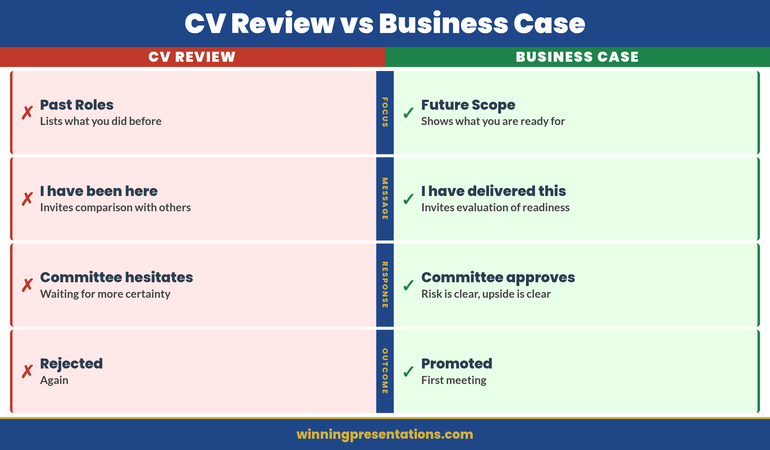
A CV lists past roles, responsibilities, and achievements. The implicit message is: “I’ve been here a long time doing this very well.” The committee hears: “Are they better than other candidates who’ve also been somewhere a long time?” Suddenly you’re in a comparison tournament. If another strong candidate is being considered, you both look similar. Hesitation sets in.
Business Cases Are Forward-Looking
A business case says: “Here’s what I’ve delivered in the current role. Here’s what I’m ready to deliver at the next level. Here’s what could go wrong if you wait. Let’s decide now.” The committee isn’t comparing you. They’re evaluating risk and opportunity. Very different mental frame.
CVs Invite Questions You Can’t Answer
A CV prompts the committee to ask: “Is this person leadership material? Are they visionary? Will they grow into the role?” These are judgment questions. You can’t answer them with facts. You can only hope the committee sees it the way you do.
Business Cases Answer Questions Before They’re Asked
A business case says: “I’ve already led projects of this scale. I’ve managed budgets of this size. I’ve handled this type of stakeholder complexity. I’ve closed this gap. Here’s the evidence.” No speculation. No hopes. No judgment required—just an evaluation of readiness based on demonstrated scope.
The Four Slides: Structure That Works
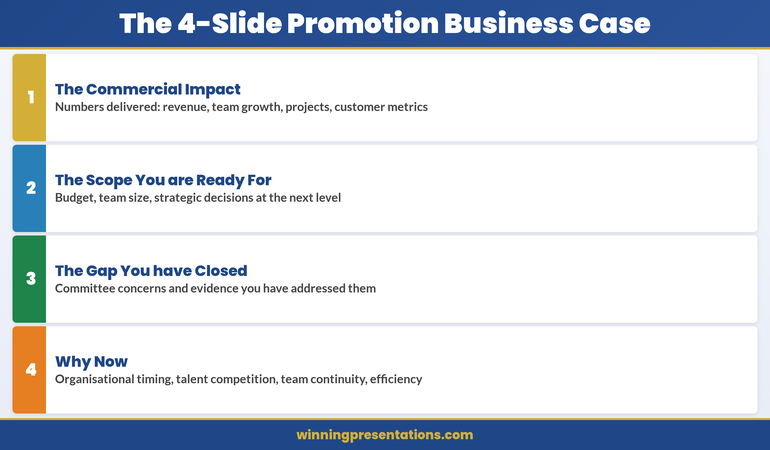
A promotion business case has exactly four slides. Not three (too little scope), not five (too much detail). Four slides answer four specific questions the committee is asking (whether they say it aloud or not):
- Slide 1 — Commercial Impact: What have you actually delivered? (Numbers only.)
- Slide 2 — Scope: What are you ready to lead? (Bigger picture.)
- Slide 3 — Gap: What did you need to learn? And have you learned it? (Addressing doubt.)
- Slide 4 — Why Now: What’s the cost of waiting? (Creating urgency.)
This structure works because it doesn’t ask the committee to evaluate you. It asks them to evaluate your readiness. Completely different exercise.
Promotion Committee This Month? Build the Business Case, Not the Narrative
If your committee meeting is coming up and you’re still working from a CV or a verbal narrative, the Executive Slide System gives you the exact four-slide business case structure to build instead. It includes:
- The four-slide business case structure for promotion committees (commercial impact, scope, gaps closed, why now)
- Worked examples showing how to quantify impact at executive level
- Decision-slide frameworks designed for internal committee presentations
- Templates ready to adapt to your organisation, role, and committee
Get the Executive Slide System → £39
Informed by real-world executive presentation experience across investment banking, SaaS, and consulting — including internal promotion contexts.
Slide 1: The Commercial Impact You’ve Delivered
This slide answers: “What has this person actually delivered?” Not in prose. Not in a list of responsibilities. In numbers.
What Numbers Go Here?
Revenue driven. Cost reduced. Headcount managed. Projects completed on time or early. Customer retention improvement. Market share gained. Team size growth. Budget managed without overspend. Retention of top talent you’ve developed. Any metric that matters to your organisation’s financial or operational success.
If you’re in a function that doesn’t directly drive revenue (HR, Finance, Operations), quantify the impact you’ve had on the business that relies on you: “Reduced hiring cycle time from 14 weeks to 7 weeks, enabling 40 critical hires in year two. Prevented £1.2M in turnover costs through culture initiatives.”
How Many Numbers?
Three to five numbers. No more. Each number should be large enough to be noteworthy and specific enough to be credible. “Big revenue” is vague. “£2.1M in revenue from digital commerce initiatives, 180% year-on-year growth” is specific.
Present Them Minimally
One number per line. No paragraphs. No explanation. The slide is pure fact. The explanation comes in the presentation moment, face to face.
Example Slide 1 (Digital Leader, Retail Group):
- £2.1M revenue from digital commerce initiatives (Year 1–2)
- Team scaled from 4 to 11 people (net retention 94%)
- 3 cross-functional projects delivered on time: Platform migration, Customer data integration, Omnichannel pricing
- Average digital customer NPS: +28 points year-on-year
This slide doesn’t prove Claire deserves a promotion. It proves she’s already delivered at the scope of the role she wants.
Slide 2: The Scope You’re Ready For
This slide answers: “What would this person be responsible for at the next level?” Again, no narrative. Just scope.
What Scope Information Goes Here?
Team size. Budget responsibility. Revenue or P&L ownership. Number of stakeholders. Strategic decisions you’d make. Cross-functional responsibilities. Geographic scope. Customer base. Market segment. Anything that defines the size and scale of the role you’re applying for.
Make It Comparative
Show current scope and next-level scope side by side. “Currently manage 11 people, £2.8M annual budget. Director role would manage 28–35 people, £7–9M annual budget, and P&L responsibility for three business units.” This makes the leap clear without being grandiose.
Example Slide 2 (Digital Director Role):
| Dimension | Current (Head of Digital) | Next Level (Director) |
|---|---|---|
| Team size | 11 | 28–35 |
| Budget authority | £2.8M (operational) | £7–9M (P&L) |
| Strategic decisions | Digital strategy execution | P&L strategy, portfolio, resource allocation across 3 units |
| Stakeholder groups | Marketing, IT, Finance, Operations | Board, CEO, CFO, three business unit heads, external investors |
The committee now sees that you’ve already led projects at 40–60% of the next-level scope. You’re not asking them to take a massive bet. You’re asking them to expand a proven track record.
Slide 3: The Gap You’ve Already Closed
This slide addresses the silent question every committee has: “What concerns do we have, and have they already been addressed?” Don’t wait for them to say it. Say it first.
What Gaps Commonly Come Up?
For first-time directors: “Have they managed a larger team?” or “Have they handled a serious people issue?” For cross-functional promotions: “Do they understand the P&L?” For external hires seeking rapid advancement: “Do they know our culture?” For technical leaders moving to management: “Can they lead non-technical people?”
Think back to feedback you’ve received. Think about what the next-level role requires that you haven’t yet formally held. That’s the gap.
Show the Evidence You’ve Already Closed It
Don’t say, “I’m ready to manage a larger team.” Say, “I’ve managed the Platform Migration project, which required me to coordinate 22 people across three departments for six months. Delivered on time, no overruns, 96% of team stayed post-project.”
Example Slide 3 (Digital Leader, potential gaps and evidence):
- Gap: Can you handle P&L responsibility? → Evidence: Managed £2.8M annual budget with zero overruns for two years. Drove cost negotiations that saved 18% vs. year one. Forecast accuracy 94%.
- Gap: Can you lead at board level? → Evidence: Presented quarterly business reviews to CFO and CEO for 18 months. Lead quarterly board updates on digital KPIs (8 presentations, zero rework requests).
- Gap: Can you make the hard people decisions? → Evidence: Led the reorganisation of the digital team (11 people, reallocation of three, one exit managed professionally). Retained 100% of high performers during restructuring.
- Gap: Can you develop the next generation? → Evidence: Promoted two team members to senior roles. One is now leading the platform team. 94% of team stayed, suggesting effective development and engagement.
The committee stops worrying about gaps. They start thinking about timing.
Building the case for your own promotion?
The Executive Presentation Starter Kit gives you the templates, checklists and prompts to walk into that committee prepared.
Slide 4: Why Now
This is the most underrated slide. It answers: “Why should we move now instead of waiting six months, a year, or until a formal opening exists?”
Reasons to Move Now
Organisational timing: “We’re about to launch the omnichannel initiative. The role I’m being considered for will own it. Waiting six months means losing momentum and delaying revenue impact.”
Market competition: “Two competitors have hired directors into similar roles in the last quarter. Talent in this space is moving fast. If we wait, the best people available now might not be available in six months.”
Risk of attrition: “I’ve had three conversations in the last two months about external opportunities. I’m not looking, but I’m being sought out. A decision now sends a clear signal about career progression in this organisation.”
Team stability: “If this role opens formally, I’d be a candidate. So would external hires. A decision now avoids the chaos of a competitive internal process that could destabilise the team.”
Capability readiness: “I’ve deliberately taken on stretch assignments in the last 18 months to prepare for this role. I’m at peak readiness now. Waiting longer doesn’t add capability—it just delays momentum.”
Frame It as Mutual Benefit, Not Threat
The worst version of Slide 4 is: “I have other offers, so decide now or lose me.” The best version is: “Here’s why moving now benefits the organisation more than waiting.” These are genuinely different messages.
Example Slide 4 (Digital Leader):
- Organisational: Omnichannel strategy launch (Q2) requires director-level ownership. Director structure in place now ensures strategic alignment from day one.
- Talent landscape: Digital director roles in retail are tight. Three director-level hires completed by competitors in the last quarter. First-mover advantage matters.
- Team continuity: Current structure has been stable for 18 months. Promoting internally ensures zero transition risk and maintains momentum.
- Cost: Internal promotion costs 60% less than external recruitment for this level.
The committee hears: “This is smart business.” Not: “Hurry or I leave.”
Unsure how to quantify your impact?
Many executives underestimate what they’ve delivered because they focus on activity instead of outcome. The Executive Slide System includes a metrics framework that walks you through finding and framing the numbers that matter most for your role.
Common Mistakes That Sink Promotion Cases
Mistake 1: Burying Impact in Narrative
You say: “I’ve managed several large projects, led a team through significant growth, and delivered strong results.”
The committee hears: “Maybe.”
Say instead: “£2.1M revenue, team grew from 4 to 11, three projects on time.”
The committee hears: “Clearly.”
Mistake 2: Confusing Current Scope With Next-Level Scope
You say: “As director, I’d continue what I’m doing now, but at a larger scale.”
The committee worries: “So you’d be doing the same job, bigger. Who develops the next generation of heads of function?”
Say instead: “Currently I execute digital strategy. As director, I’d own digital strategy and P&L for three business units, allocate resources across portfolios, and report to the CEO quarterly.”
The committee hears: “You’ve thought about the leap.”
Mistake 3: Ignoring the Gaps They’re Worried About
You present your four slides. The committee thinks: “What about P&L? Has she handled a board-level conversation? Can she manage a larger team?”
These worries sit silent. Unanswered. They become reasons to delay the decision.
Say it first. Show the evidence. Close the gap before they voice it. They can’t worry about something you’ve already addressed.
Mistake 4: Creating Urgency by Threat
You say: “I’ve had offers from other companies, so I need a decision by Friday.”
The committee hears: “You’re a flight risk. If we promote you and you leave anyway, we’ve wasted time.”
Say instead: “The omnichannel initiative launches in Q2. This director role needs to own that strategy from day one. A decision in March means we’re ready; a decision in May means we’re playing catch-up.”
The committee hears: “You’re thinking about the business, not just yourself.”
Mistake 5: Not Presenting It as a Presentation
You email four slides with a cover letter to the committee.
The committee reads it in their calendar between two other emails. The four slides sit in isolation without context.
Insist on 15 minutes in the room. Present the four slides. Let them ask questions. The presentation—your presence, your clarity, your composure—is half the power. The slides are the other half.
When Your Manager’s Advocacy Isn’t Enough, the Business Case Has to Speak for Itself
Most candidates wait for their manager to make the case in the room. When the committee meets without you, your manager’s opinion becomes the only evidence. The Executive Slide System gives you the specific slide formats that shift the conversation from advocacy to documented impact — the promotion business case, the decision-slide structure, and the quantified impact framework.
Get access to: Promotion business case frameworks, decision-slide structures, and the exact formats for presenting quantified impact to senior committees.
How to Present Your Four Slides
The four slides are useless if they sit in an inbox. They’re powerful if you present them in person, face to face, to the decision-making committee.
Book 15 Minutes
Not 30. Not 45. Fifteen. Long enough to present clearly. Short enough that it feels confident, not defensive. “I’d like 15 minutes with the promotion committee to walk through my business case for the director role.”
Start With the Rescue
Before the first slide, say: “I’m not here to ask you to compare me to other candidates. I’m here to show you why moving now is better for the business than waiting. I’ve organised this around four questions I know you’re asking: What have I delivered? What am I ready for? Have I closed the gaps you’re worried about? Why should we move now? Let’s walk through them.”
You’ve just told them the meeting won’t be self-aggrandising or political. It will be clear and business-focused. That’s the tone that wins.
Present Without Over-Explaining
Show Slide 1. Say: “Here’s what I’ve delivered in the current role. Four key metrics: revenue, team growth, projects, customer impact. Any questions?” Wait for them. Let them ask. Then move to the next slide.
You’re not performing. You’re having a business conversation. They’ll respect that.
End With Openness
After Slide 4, say: “That’s the case. What questions do you have?” Sit down. Let them ask. Don’t keep talking. Silence here is not awkward—it’s them processing. Let them process.
When They Say They’ll Think About It
They will. Say: “I appreciate that. Is there anything you’d like me to clarify or any information I should get you before you decide?” This is not pushy. It’s professional. You’re saying: “I’ve made the case clearly. If there are gaps in the case, I want to fill them.”
Know Your Committee Before You Present
The four slides work, but only if you know who you’re presenting to. Before you schedule that 15-minute meeting, know:
- Who has final say? (CEO, CFO, Board of people?)
- What does each person care about most? (CFO cares about cost and P&L. CEO cares about strategy. Your boss cares about continuity.)
- What concerns might each person have? (Frame Slide 3 to address each person’s specific concern.)
- Have you worked with them before, or is this your first high-stakes interaction? (If it’s your first, prove you can handle board-level presence.)
Understanding your audience before you present is the foundation of every executive presentation. Your promotion business case is no exception.
Is This Right For You?
This four-slide business case approach is right for you if you can answer YES to at least two of these:
- ✓ You’ve been told “not quite ready” before, and you want to change that conversation from judgment to business reality
- ✓ You’ve delivered measurable impact in your current role, but the committee doesn’t seem to see it
- ✓ You’re being considered for promotion but haven’t had the chance to present your case directly to the decision-makers
- ✓ You’re worried that without a structured argument, the committee will compare you to other candidates and hesitate
This approach is NOT right for you if:
- ✗ You’re in a role where you haven’t yet delivered any measurable impact (in that case, focus on delivering first, then building the case)
- ✗ The organisation doesn’t have formal promotion committees (in that case, the conversation is one-on-one, not structural)
- ✗ You’ve already been told you’re promoted pending a formal announcement (you don’t need to persuade; you need to transition)
Frequently Asked Questions
Should I include these four slides in my official application, or present them separately?
Separate. Your official application—CV, cover letter, form—follows the organisation’s process. The four-slide business case is what you present to the decision-making committee after your application is accepted. It’s not a replacement. It’s the tool you use in the meeting to move from “maybe” to “yes.”
What if I’m being promoted internally and the committee already knows my work?
They know your role. They might not know the quantified impact. Many executives don’t realise how much revenue their team drove or how many people they’ve successfully developed until they start looking for the numbers. Even if the committee knows you well, the numbers create clarity that relationships alone can’t. Show the slides anyway. It changes the conversation from “we like working with you” to “you’ve demonstrably delivered at the next level’s scope.”
What if I can’t quantify some of my impact?
Quantify what you can. For the rest, show evidence of scope. If you’ve managed a project that involved coordinating 20 people for six months, that’s scope, not a number. If you’ve led a cross-functional initiative that touched three departments, that’s scope. Numbers are better, but scope is credible too. Just make sure every slide has either a number or a significant scope indicator. Don’t leave a slide blank because you “didn’t have numbers.”
Should I mention other job offers to create urgency?
No. Frame urgency around the business case (Slide 4) instead. “The omnichannel initiative launches in Q2” is urgency. “I have another offer” is a threat. The committee might promote you, but you’ll start the role with a damaged relationship because they felt pressured. Use business urgency instead.
What’s Inside the Executive Slide System
The Executive Slide System gives you slide structures, templates, and decision frameworks for the executive presentation scenarios you face most often — including the promotion business case, the budget briefing, the governance reset, and the stakeholder presentation.
What you get:
- Slide templates for 12 executive scenarios (including the complete four-slide promotion business case)
- Decision-slide frameworks designed for committee presentations
- Worked examples from real executive presentations (SaaS, consulting, financial services)
- Pre-briefing strategy guides
- One-time price: £39
The Presentation Is Only the Beginning
The four slides win the committee’s approval. But that approval only happens if you’ve done the work before you walk into the room.
Build your case over weeks, not days. Collect the numbers. Run the projects. Develop the people. Close the gaps. The four slides are the summary of work you’ve already been doing. They’re not magic. They’re clarity.
When Claire walked into her fourth promotion committee meeting, the four slides weren’t new to her. She’d been building that case for 18 months through the projects she’d taken on, the metrics she’d tracked, the scope she’d deliberately expanded. The four slides just made it visible.
That’s when the committee saw what had been true all along: she was already ready.
Get weekly guidance on executive presentations
Every Monday, a short email with the presentation strategy that moves decisions. Join 2,400+ executives.
🆓 Free resource: Executive Presentation Checklist — a free guide to strengthen your presentation preparation.
Related: Why Your Evaluation Presentation Needs Structure
The same principle applies to technology evaluations and other high-stakes business decisions. The technology evaluation presentation that gets both IT and Finance to say yes follows a similar framework: show impact, define scope, prove readiness, create urgency. Different context, same structure.
About Mary Beth Hazeldine
Mary Beth spent 16 years in investment banking and corporate finance at RBS, where she made and lost pitches at every level. She’s sat in promotion committees. She’s submitted CVs and been rejected. She’s also seen what works—and what doesn’t. Now she helps executives build presentations that change decisions. She’s based in Edinburgh and works with leaders across SaaS, consulting, and financial services.
Your promotion business case doesn’t prove you deserve the role. It proves the organisation deserves the upside of moving you now.