Tag: presentation psychology

19 Mar 2026
Executive sitting alone at a conference table after a presentation replaying the moment in their mind with head slightly bowed and hand on forehead, empty boardroom with presentation screen dark behind them, navy and gold corporate aesthetic

The Shame Spiral After a Bad Presentation (And How to Stop It Before It Rewires Your Brain)

Quick Answer: The shame after a bad presentation isn’t just embarrassment — it’s a neurological loop where your brain replays the worst moments to “protect” you from future threat. Left unchecked, this spiral rewires your threat response and makes every future presentation feel more dangerous. The interruption: a structured cognitive debrief within 24 hours that separates what actually happened from what your shame is telling you happened.

You’re in the Shame Spiral Right Now If: You can replay the exact moment it went wrong. You keep hearing your own voice stumbling. You’re already dreading your next presentation and it’s not even scheduled. This is your threat detection system working overtime — and it’s solvable. The first step is understanding that your brain is lying about how bad it actually was.

See the cognitive interruption system →

I Was Terrified for Five Years

I know the shame spiral because I lived inside it for five years.

Early in my banking career, I froze during a quarterly review at JPMorgan Chase. Mid-sentence, my mind went blank. Not “lost my train of thought” blank — completely, devastatingly empty. I stood in front of 14 people and said nothing for what felt like a full minute. It was probably eight seconds. It felt like eight years.

I recovered. I got through the presentation. Nobody mentioned it afterwards. But that night, I replayed those eight seconds on a loop. I could hear the silence. I could see the faces. I could feel the heat rising in my chest. For the next five years, every time I stood up to present, my brain played that footage first — like a warning reel before the main feature.

That’s the shame spiral. It’s not embarrassment. It’s your nervous system encoding a single bad moment as evidence that presenting is dangerous. And unless you interrupt it, it gets louder every time.

What the Shame Spiral Actually Is (Neurologically)

Shame after a bad presentation isn’t a character flaw. It’s a neurological process with a specific mechanism — and once you understand the mechanism, you can interrupt it.

When something goes wrong during a presentation — you freeze, you stumble, you lose your place, someone asks a question you can’t answer — your amygdala tags that moment as a threat. Not an inconvenience. Not a learning opportunity. A threat. The same system that would tag a near-miss car accident or a predator in the wild.

Your brain then does something remarkably unhelpful: it replays the moment repeatedly to “consolidate the threat memory.” This is adaptive if you’re remembering where the predator was hiding. It’s catastrophic if you’re remembering the look on the CFO’s face when you lost your place on slide 7.

Each replay strengthens the neural pathway. The memory becomes more vivid, more emotionally charged, and — crucially — more distorted. Your brain doesn’t replay what actually happened. It replays an edited version with the contrast turned up: the silence was longer, the faces were more disapproving, the recovery was worse than it was. This is why people describe shame memories as feeling “more real than reality.” The replays are neurologically enhanced versions of the original event.

Left unchecked, this process consolidates into a conditioned response. Your brain learns: “presenting = danger.” The next time you stand up to speak, the threat detection fires before you’ve said a word. That’s where the nervous system’s memory of past presentations starts to dictate your future performance.

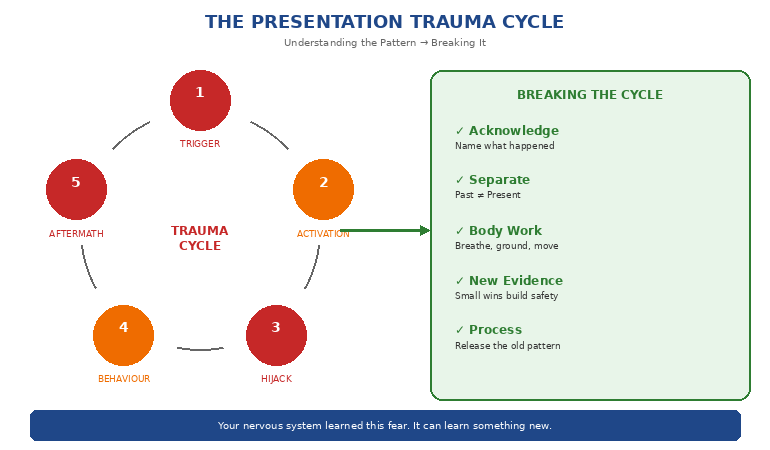
Four-stage shame spiral cycle infographic showing how a single bad presentation moment triggers threat encoding replay distortion and conditioned avoidance with intervention points at each stage

Why Your Brain Is Lying About How Bad It Was

Here’s the finding that changes everything: your memory of the presentation is almost certainly worse than what actually happened.

Research in cognitive psychology consistently shows that people overestimate how noticeable their mistakes were to others. It’s called the spotlight effect — the tendency to believe that others noticed your error far more than they actually did. In presentation contexts, this is amplified because the emotional intensity of the moment makes the memory feel more significant.

When I work with executives who are stuck in a shame spiral, I ask them to do one thing: check. Ask a colleague who was in the room. Not “how did I do?” (too vague) but “did you notice when I paused on the third section?” In nearly every case, the answer is some variation of: “I noticed a pause but I assumed you were gathering your thoughts. It didn’t seem like a problem.”

The gap between what you experienced internally and what the audience perceived externally is enormous. Your internal experience: racing heart, blank mind, hot face, certainty of failure. Their external observation: a brief pause, a professional recovery, a presenter who seemed thoughtful. The shame spiral is built on your internal experience, not the external reality.

This doesn’t mean your feelings aren’t valid. The distress is real. The shame is real. But the narrative your brain has constructed about the event — “everyone noticed, it was terrible, my credibility is destroyed” — is almost always factually wrong. Understanding this distinction is the first step in breaking the loop.

Break the Shame Loop Before It Becomes Permanent

Conquer Speaking Fear is a 30-day programme built from clinical hypnotherapy — the same techniques I used to break my own five-year shame spiral. It targets the neurological loop directly: threat encoding, replay distortion, and conditioned avoidance.

  • The cognitive interruption technique that stops shame replays within 24 hours
  • Nervous system regulation exercises that lower threat detection before presentations
  • The reality-check framework: separating what happened from what your brain says happened
  • Progressive exposure protocols that rebuild your relationship with presenting

Get Conquer Speaking Fear → £39

Built from clinical hypnotherapy and 24 years of presenting in high-stakes boardrooms where shame spirals were a professional hazard — not a theoretical concept.

The 24-Hour Debrief That Breaks the Loop

The shame spiral consolidates most aggressively in the first 24 hours after the event. This is your intervention window. After 24 hours, the distorted memory starts to feel like fact. Before 24 hours, you can still rewrite the narrative.

Here’s the structured debrief. Do it on paper, not in your head. Writing forces precision. Rumination thrives on vagueness.

Step 1: Write exactly what happened. Not what it felt like. Not what you think people thought. What actually, observably happened. “I paused for approximately five seconds after the third point. I then continued with the next section. I completed the presentation.” Facts only. No interpretation. No emotional language.

Step 2: Write the shame version. Now write what your brain has been telling you happened. “I froze for ages. Everyone stared. They thought I was incompetent. My career is over.” Get it all out. Seeing the shame narrative written down beside the factual account immediately reveals the distortion.

Step 3: Identify the gap. Where does the shame version diverge from reality? Usually at the interpretation: “everyone stared” (you don’t know what they were thinking), “they thought I was incompetent” (projection, not fact), “my career is over” (catastrophising, not reality).

Step 4: Write one thing that went well. Not a fake positive. One specific moment that was competent. “My opening data was clearly presented.” “I handled the Q&A well.” “I recovered and completed the presentation.” This anchors your memory in something true that counterbalances the shame distortion.

This debrief works because it engages your prefrontal cortex (rational processing) before the amygdala (threat processing) has time to fully consolidate the distorted version. You’re essentially writing a corrected record that your brain can reference instead of the shame-enhanced replay.

Stuck in the replay? Break it now.

Get the Full Interruption System → £39

How to Stop It Rewiring Your Future Presentations

The shame debrief handles the immediate crisis. But the deeper risk is what happens over weeks and months if the spiral isn’t fully resolved: avoidance behaviour.

Avoidance looks different for executives than it does for everyone else. You probably won’t stop presenting — your career won’t let you. Instead, you’ll compensate. You’ll over-prepare. You’ll add more slides than necessary. You’ll rehearse until the words feel robotic. You’ll arrive 30 minutes early and sit in your car feeling sick. The presentation will go fine — and you’ll credit the over-preparation, not your actual competence. The anxiety stays. It just gets managed more elaborately.

This is where the link between anxiety and over-preparing becomes dangerous. The over-preparation isn’t solving the problem. It’s teaching your brain that presenting requires extraordinary effort to survive — which reinforces the threat encoding.

Breaking this pattern requires graduated re-exposure. Not “just do more presentations” — that’s like telling someone with a fear of water to jump in the deep end. It means presenting in low-stakes situations where the outcome genuinely doesn’t matter, and then slowly increasing the stakes while your nervous system relearns that presenting isn’t dangerous.

Start with a two-minute update in a team meeting where you’re among peers. No judgment. No career stakes. Then a five-minute briefing to your manager. Then a 10-minute presentation to a slightly larger group. Each successful experience writes a new neural pathway that competes with the shame memory. Over time, the new pathways become stronger than the old one.

People Also Ask: How long does it take to recover from a bad presentation?

The acute shame typically peaks within 24–48 hours and fades over one to two weeks if you don’t reinforce it with rumination. The longer-term impact — avoidance behaviour, heightened anxiety before presenting — can last months or years without intervention. A structured debrief within 24 hours significantly accelerates recovery by preventing the distorted memory from consolidating.

People Also Ask: Why do I keep replaying my presentation mistakes?

Your amygdala tagged the moment as a threat and is replaying it to consolidate the “danger” memory. This is an adaptive survival mechanism that works well for physical threats but poorly for social situations. The replays feel involuntary because they are — your threat detection system runs below conscious control. Engaging your prefrontal cortex through a written debrief interrupts the automatic replay cycle.

People Also Ask: Is it normal to feel shame after presenting?

Extremely normal. Many of the most effective presenters experience it. The difference between those who recover quickly and those who develop avoidance is whether they interrupt the shame loop early. Executive-level presenters aren’t shame-free — they’ve developed systems for processing shame quickly so it doesn’t accumulate.

The System That Stops Shame From Becoming Permanent

Conquer Speaking Fear gives you the complete toolkit: the 24-hour debrief, the graduated re-exposure protocol, and the nervous system regulation techniques that prevent a single bad moment from becoming a career-long limitation.

  • 30-day progressive programme designed for working executives

Get Conquer Speaking Fear → £39

Designed for executives who present regularly and can’t afford to let one bad experience compound into chronic avoidance.

When Shame Is Actually Useful (And When It’s Destructive)

Not all post-presentation shame is destructive. There’s a distinction between productive discomfort and toxic rumination — and knowing which you’re experiencing changes your response entirely.

Productive discomfort sounds like: “I wasn’t prepared enough for that Q&A section. Next time I’ll anticipate three questions in advance.” It’s specific. It’s actionable. It leads to a concrete change in behaviour. This kind of discomfort is valuable — it’s how professionals improve.

Toxic rumination sounds like: “I’m terrible at presenting. Everyone saw me fail. I’ll never be credible in that room again.” It’s global (applies to all presenting, not this specific presentation). It’s identity-based (about who you are, not what you did). And it’s catastrophic (extrapolates from one moment to permanent conclusions).

The debrief helps you convert toxic rumination into productive discomfort. By writing down what specifically went wrong, you transform a vague cloud of shame into a specific, actionable note. “I lost my place” becomes “I need a clearer structure for my third section.” The shame dissolves because it has nowhere to hide once the problem is named precisely.

And when you are ready to step back into the room — whether that’s with slides or without — your format choice matters more than you might think. Knowing when to present without slides and when to use them can be the difference between feeling exposed and feeling in control.

The same principle applies to handling unexpected questions. When the Q&A catches you off guard, having a reliable answer structure prevents the moment from becoming a new shame trigger. An evidence-first answer framework gives you a recovery structure that works even when your brain is trying to shut down.

Comparison infographic showing productive discomfort versus toxic rumination with characteristics triggers and outcomes for each pattern after a difficult presentation

Reconnecting With Your Next Presentation

The shame spiral after a bad presentation is one of the most common experiences in professional life — and one of the least discussed. Executives don’t talk about it because admitting to shame feels like admitting to weakness. So the spiral continues privately, compounding with each presentation, building an invisible barrier between you and the confident communicator you know you can be.

The interruption is straightforward: debrief within 24 hours, separate facts from interpretation, identify one competent moment, and begin graduated re-exposure. The neuroscience supports it. The clinical techniques behind it work. And the executives I’ve watched use this approach consistently report that the shame fades faster each time until it barely registers.

Your brain encoded one bad moment as a permanent threat. You can re-encode it as a single data point in a career full of successful presentations. The first step happens on paper, within 24 hours, with four written steps. The Conquer Speaking Fear programme (£39) gives you the full system — the debrief, the re-exposure protocol, and the nervous system regulation that makes it stick.

If you’ve ever felt like imposter syndrome during presentations was related to your shame spiral — it is. The two feed each other. Breaking one often breaks both.

Ready to stop the replay?

Get Conquer Speaking Fear → £39

Is This Right For You?

✓ This is for you if:

  • You can’t stop replaying a specific presentation moment and it’s been more than 48 hours
  • You notice yourself over-preparing for presentations or finding reasons to avoid them
  • You’re a competent professional who presents regularly but one bad experience has shaken your confidence
  • You want a structured, evidence-based approach — not motivational platitudes

✗ Not for you if:

  • You’re experiencing acute distress that extends beyond presentations into other areas of your life — please speak with a mental health professional
  • The shame you’re experiencing is from constructive feedback that’s genuinely pointing to skill gaps — that’s productive discomfort, not a shame spiral
  • You’ve never actually had a bad presentation experience and you’re anticipating one — this article addresses post-event shame, not anticipatory anxiety

The Programme Built From the Shame Spiral I Lived In

Conquer Speaking Fear isn’t theoretical. It’s the system I built from five years of presentation terror, clinical hypnotherapy training, and working with thousands of executives who carried the same invisible weight. The shame spiral is solvable — not with willpower, but with the right neurological tools.

  • The 24-hour debrief template (structured, paper-based, clinically informed)
  • Nervous system regulation techniques from clinical hypnotherapy — not breathing exercises from a blog
  • Graduated re-exposure protocol designed for executives who can’t stop presenting while they recover
  • The reality-check framework that separates threat encoding from actual performance data

Get Conquer Speaking Fear → £39

Developed from clinical hypnotherapy and five years of personal presentation anxiety — then refined through working with executives across banking, consulting, and professional services who needed the shame to stop.

Want the slides too?

Preparation reduces anxiety. The Executive Slide System (£39) includes confident-presenter templates designed to minimise preparation stress.

Frequently Asked Questions

What if the presentation genuinely was bad — not just my perception?

Even objectively poor presentations rarely warrant the shame response your brain generates. If the presentation had genuine problems (wrong data, unprepared content, missed deadline), the appropriate response is a corrective action plan — not rumination. Write down what specifically went wrong, create a concrete plan to prevent it next time, and move forward. Shame doesn’t improve future performance. Specific plans do.

Should I apologise to the audience or pretend it didn’t happen?

Neither. Don’t bring it up unprompted — most audience members noticed far less than you think. If someone mentions it directly, acknowledge it briefly: “Yes, I lost my thread for a moment. The content in the second half covered the key points.” Then move on. Over-apologising reinforces the shame and makes the audience uncomfortable. Brief acknowledgement and forward movement signals confidence.

Can one bad presentation really affect my career?

Almost never in isolation. Careers are built on patterns, not single moments. The danger isn’t the bad presentation — it’s the avoidance behaviour that follows. If shame causes you to decline speaking opportunities, volunteer less in meetings, or over-prepare to the point of rigidity, the cumulative impact of those behaviours will affect your career far more than the original moment ever could.

How do I stop the physical symptoms (racing heart, nausea) that come with the shame replay?

The physical symptoms are your sympathetic nervous system responding to the threat memory. A structured breathing technique (inhale 4 counts, hold 4, exhale 6) engages your parasympathetic system and interrupts the physical escalation. Do this the moment you notice a replay starting — not after it’s been running for 20 minutes. Early intervention is far more effective than late-stage management.

Your Next Presentation Doesn’t Have to Carry This Weight

The shame spiral is telling you that you’re broken. You’re not. You’re a professional who had a difficult moment and whose brain is doing exactly what brains do — overprotecting you from a threat that no longer exists.

Paper. Pen. Four steps. Within 24 hours. That’s where the spiral breaks. Your next presentation is waiting — and it doesn’t have to carry the weight of the last one.

The Conquer Speaking Fear programme (£39) gives you the complete system to break the loop, rebuild your confidence, and present without the ghost of past mistakes following you into the room.

Stay Updated

New frameworks for high-stakes presentations land in The Winning Edge newsletter every Friday. Subscribe for frameworks you can use immediately.

🆓 Free resource: Free PDF — a free guide to strengthen your presentation preparation.

About the Author

Mary Beth Hazeldine is the Owner & Managing Director of Winning Presentations. With 24 years of corporate banking experience at JPMorgan Chase, PwC, Royal Bank of Scotland, and Commerzbank, she has delivered high-stakes presentations in boardrooms across three continents.

A qualified clinical hypnotherapist and NLP practitioner, Mary Beth combines executive communication expertise with evidence-based techniques for managing presentation anxiety. She has trained thousands of executives and supported high-stakes funding rounds and approvals.

Book a discovery call | View services

08 Mar 2026
Executive sitting alone in an empty boardroom reflecting on a past presentation experience with dramatic lighting

The Shame Cycle: Why One Bad Presentation Creates a Decade of Fear

You’ve replayed that moment a thousand times. Not the entire presentation—just the 47 seconds when your voice cracked, or you lost your place, or someone’s expression shifted. Eleven years later, you can still feel the heat rising in your chest.

This isn’t anxiety about the next presentation. This is something deeper: a shame spiral that has reorganised your relationship with speaking itself. One moment of perceived failure created a psychological feedback loop that rewired your threat response. And unless you understand the mechanism, it will keep working against you.

Quick Answer: Shame cycles perpetuate presentation fear because they collapse the distinction between a single failure and your identity as a presenter. Your nervous system learned to treat any speaking situation as dangerous, not because of present risk, but because of a moment that was internalised as evidence of your inadequacy. The fear persists because the shame narrative runs automatically beneath conscious awareness.

🚨 Still replaying a bad presentation from years ago?

Quick check: Can you recall the exact moment the shame started?

  • Name the specific thought that triggers the memory
  • Notice whether you feel it physically (chest, stomach, throat)
  • Ask: “Am I the same presenter I was then?”

→ Ready to break the cycle for good? Get Conquer Speaking Fear (£39)

The Audience Judgment Loop (11 Years)

A senior finance director stood to present quarterly results to the board. Thirty seconds in, the screen froze. In the silence, she heard someone sigh—a small, barely perceptible sound. Her mind immediately filled the gap: They think I’m incompetent. They’re judging me.

She recovered. The presentation continued. The results were approved. By every objective measure, it was fine.

But something had shifted. That sigh—real or imagined—had planted a seed of doubt. From that moment, every time she entered a boardroom, her nervous system returned to that moment. Before the next presentation, she felt the same quickening in her chest. During it, she was acutely aware of faces, of shifts in posture, of any expression that might signal disapproval. After it, she ruminated: Did they judge me? Are they still judging me?

She turned down promotions that required regular presentations. She delegated important updates to colleagues. She rehearsed obsessively, trying to eliminate any possible reason for judgment. None of it worked, because the shame wasn’t about the next presentation—it was about what that sigh had convinced her was true: I am not a credible presenter.

Eleven years later, a reframing technique broke the cycle. She learned to separate the event (the freeze) from the meaning her shame had assigned to it. When the intrusive thought returned, she now recognises it for what it is: a protection mechanism, not a truth. Within three months, the physical anxiety responses began to fade.

The Presentation Shame Cycle infographic showing five stages: The Event, Shame Response, Nervous System Lock, Avoidance Pattern, and Reinforcement — illustrating how one bad presentation moment creates years of fear through identity-level encoding and avoidance behaviour

Shame Collapses the Boundary Between Event and Identity

Anxiety and shame are neurologically distinct experiences, and this distinction is critical to understanding why presentation fear can persist for decades.

Anxiety is about anticipating a future threat: Something bad might happen. It’s responsive, proportional, and it decreases when the threat is removed or mastered.

Shame is about present identity: Something is wrong with me. It’s absolute, internalised, and it doesn’t respond to evidence of competence because shame logic doesn’t operate in the realm of logic.

When you have a bad presentation, a brief moment of anxiety is normal and adaptive. Your nervous system registers: “That didn’t go well. Let me adjust next time.” But when shame enters, something different happens. That single failure becomes a permanent data point about who you are. The thought evolves from “I performed poorly in that moment” to “I am a poor presenter” to “I am fundamentally inadequate when people are watching me.”

This is the mechanism that transforms a single bad presentation into a decade of fear. Shame doesn’t live in the past—it colonises the future. Every presentation becomes a test of your identity, not an opportunity to communicate. The stakes stop being about the message and become entirely about whether you’ll be exposed as a fraud.

Why this matters: Anxiety management techniques—breathing exercises, positive self-talk, preparation strategies—can reduce the intensity of anxiety. But they often fail with shame-based fear because shame isn’t a miscalibration of threat response. It’s a story you’ve internalised about who you are. Standard anxiety interventions treat the symptom (nervousness) without addressing the root (identity collapse).

How Your Nervous System Encoded the Fear

From a neurobiological perspective, what happened in your bad presentation was this: Your amygdala (threat detector) registered a mismatch between what you expected to happen and what actually occurred. Your voice didn’t steady. The pause stretched too long. Someone’s face showed something you couldn’t interpret.

That mismatch triggered a cascade. Your sympathetic nervous system activated—heart rate increased, blood vessels constricted, digestion paused. Your prefrontal cortex (the rational, thinking part of your brain) was partially offline, which is why logical reassurance doesn’t touch the fear. You were in threat mode.

Here’s the critical part: Your nervous system didn’t just register “that moment was uncomfortable.” It registered that being watched while speaking triggered a threat response, and it did so in an environment marked by judgment and evaluation. Over subsequent presentations, your amygdala learned to pattern-match: the sound of a boardroom, the sight of faces, the sensation of attention—all became early-warning signals that threat was imminent.

This is called trauma conditioning, and it doesn’t require a genuinely dangerous event. It requires a moment of felt exposure, vulnerability, and perceived judgment. Your nervous system treats shame the same way it treats physical threat because shame, neurologically, activates threat circuits. Your body doesn’t distinguish between “I might be attacked” and “I might be exposed as inadequate.”

What reinforces this conditioning? Every time you avoid a presentation opportunity, your nervous system receives confirmation: “See? That situation was dangerous. You were right to protect yourself.” Avoidance feels like relief in the moment, but it’s actually the most powerful teacher your nervous system has. It’s saying: “Your fear response works. Keep it.”

The Thought Loop That Won’t Break

One of the most insidious features of shame-based presentation fear is that it becomes self-perpetuating through the mechanism I call the Audience Judgment Loop.

The loop operates like this:

  1. Pre-presentation: You anticipate being judged. Anxiety rises.
  2. During presentation: Hypervigilance increases. You interpret neutral expressions as critical. You notice the one person checking their phone and miss the three nodding along. Your attention narrows to threat signals.
  3. Post-presentation: You recall selectively—the moments of uncertainty, the face you misread, the question you didn’t answer perfectly. You construct a narrative: “They were unimpressed. I could tell.”
  4. Rumination: For days or weeks, you replay specific moments, analysing what you said and what their reactions meant. Each replay strengthens the neural pathway that connects “presenting” with “being judged.”
  5. Next presentation: Your nervous system is now primed. You anticipate judgment again, hypervigilance increases again, you find confirming evidence again. The loop tightens.

This is why presenting more doesn’t always fix shame-based fear. More presentations can actually deepen the loop if you’re still operating under the shame narrative. You’re collecting more evidence for the story you’ve already internalised: “I am not a good presenter, and this next experience will prove it again.”

The PAA question: “Why doesn’t exposure therapy fix presentation shame?” Because exposure without reframing still treats the shame narrative as true. You’re still accepting the premise that your value as a presenter is on trial. What breaks the loop isn’t more exposure—it’s a shift in the meaning assigned to the experience.

Why Avoidance Deepens the Shame Cycle

One of the paradoxes of shame is that the most natural coping mechanism—avoidance—is also the one that strengthens it most powerfully.

When you avoid a presentation, decline a promotion, delegate the board update, or cancel the team briefing, you experience immediate relief. That relief feels like the right choice. Your nervous system says: “See? I protected you.” But you’re teaching your nervous system something false—that the threat was real and your fear response kept you safe.

More importantly, avoidance prevents disconfirmation. Your shame narrative survives because it never encounters counter-evidence. You never stand in front of an audience as the person you are now—with years of additional competence, with a different understanding of what really matters, with a different nervous system than the one that struggled through that single bad presentation. Instead, you remain psychologically frozen in that moment, with only the shame to keep you company.

Over time, this creates a secondary shame: shame about the avoidance itself. Executives find themselves ashamed not just of their presentation anxiety, but of the opportunities they’ve missed, the visibility they’ve sacrificed, the promotions they’ve declined. Shame compounds shame, and the fear becomes layered.

This is why breaking the shame cycle often requires not just a shift in perspective, but a structured approach that helps your nervous system reprocess the original event while you’re simultaneously changing your behaviour. Standard willpower-based approaches—”just do the presentation anyway”—often backfire because they don’t address the shame narrative. You’re still operating under the belief that you’re inadequate; you’re just fighting through it. That’s not freedom. That’s exhaustion.

Breaking the Cycle: The Reframing Technique That Works

From clinical hypnotherapy and neuroscience, we know that traumatic or shame-based memories aren’t fixed. They’re reconsolidated—re-stored in memory—each time you recall them. This means that how you recall a memory can change how it’s stored and how it affects you.

The technique that broke the eleven-year shame cycle for that finance director involved three elements:

1. Separation: Isolating the event (the presentation freeze) from the meaning (I am inadequate). This is harder than it sounds because shame collapses these two things. She had to learn to say: “A presentation didn’t go as planned. That’s data about that moment, not data about me.”

2. Context restoration: Reconnecting with the version of herself that existed before the shame narrative took hold. What did she know about her own competence before that sigh? What evidence of capability existed then that she’d discounted? What was true about her abilities in other areas? This wasn’t positive thinking—it was historical accuracy.

3. Nervous system reset: Practising the reframed perspective while simultaneously managing her nervous system’s response. This meant that when the intrusive thought (“They’re judging me”) arose, she didn’t fight it or try to reason it away. She acknowledged it, recognised it as a protection mechanism, and then consciously returned to the separated, contextualised version of the story. Over time, her nervous system learned that this particular trigger wasn’t actually dangerous.

This is not the same as “positive self-talk” or “reframing your thoughts.” Those interventions often fail because they ask you to believe something your nervous system doesn’t accept. This technique works because it aligns the conscious narrative with nervous system learning. Both change together.

PAA question: “Can I fix shame-based presentation fear on my own?” You can begin to recognise the mechanism. But the deepest shifts usually happen when you have a structured process and someone who can hold the framework while your nervous system is learning something new. That’s where the real work happens.

Infographic of the Shame Response vs. the Recovery Response showing that recovery separates the event from the identity while shame fuses them together.

Break the Bad Presentation Shame Cycle Once and For All

The difference between executives trapped in presentation anxiety for a decade and those who move past it isn’t talent, preparation, or courage. It’s the ability to separate a single failure from identity, and to reprocess that original event so your nervous system stops treating speaking as dangerous.

Conquer Speaking Fear teaches you exactly how:

  • The neurobiological mechanism behind shame spirals—and why standard anxiety management fails when shame is the root
  • The separation technique that breaks the “event = identity” collapse that keeps presentation fear alive
  • How to reframe the original bad presentation in a way that resets your nervous system’s threat response
  • The 3-element reprocessing protocol used in clinical hypnotherapy for trauma-based presentation anxiety
  • A 30-day progression that moves you from avoidance to intentional, low-stress presentation practice

Get Conquer Speaking Fear → £39

Includes video training, reframing worksheets, and the full 30-day progression. Used by executives at FTSE-listed companies and professional services firms.

The thought loop is running on autopilot right now.

The reframing technique works because it doesn’t ask you to override your nervous system—it teaches your nervous system that the threat isn’t real. The executives who’ve used this approach report that intrusive thoughts about past presentations fade within weeks, not years.

Get Conquer Speaking Fear → £39

Understanding the Maintenance Loops That Keep Shame Cycles Alive

Even when executives recognise that shame-based fear isn’t serving them, the cycle persists because it’s maintained by multiple reinforcing patterns.

Perfectionism as shame-avoidance: Many executives who have internalised shame about presentation ability respond by raising standards obsessively. Over-preparation, scripting every word, anticipating every possible question—these look like diligence, but they’re often shame-management strategies. The underlying belief is: “If I can’t be natural and confident, I’ll at least be flawless.” This strategy fails because no amount of preparation can defend against the shame thought, and the effort required to maintain it becomes exhausting.

Identity-protective behaviour: Once shame has collapsed the boundary between event and identity, your nervous system actively protects the identity you’ve internalised. You unconsciously seek out environments and roles where you don’t have to present. You interpret neutral feedback as confirming evidence of inadequacy. You dismiss positive responses (“They were just being polite”). These aren’t conscious choices—they’re protective behaviours generated by your nervous system to avoid the dissonance of succeeding while still believing you’re inadequate.

Rumination as pseudo-control: Replaying the bad presentation over and over feels productive—as if understanding what went wrong will prevent it from happening again. But rumination is actually your nervous system trying to solve an unsolvable problem: “How do I make sure I’m never exposed as inadequate again?” You can’t solve it because the real problem isn’t the presentation logistics. It’s the shame narrative. But your mind keeps trying, and rumination becomes a compulsive loop that strengthens the neural pathways connecting “presenting” with “threat.”

PAA question: “What happens if I keep avoiding presentations?” The brain has remarkable plasticity, but it also has impressive durability. The longer shame-based patterns run, the more deeply encoded they become. An executive who has avoided presenting for five years has more nervous system learning to undo than one who avoided for one year. The mechanism doesn’t change, but the timeframe for resolution typically does. This isn’t meant to create urgency—it’s meant to clarify that the earlier you interrupt the cycle, the less entrenched the pattern becomes.

Stop Ruminating. Stop Avoiding. Stop Carrying the Shame.

The exhaustion of shame-based presentation fear isn’t just about nervousness—it’s about the constant mental load of avoidance, the opportunity cost of missed promotions, and the grinding discomfort of having your behaviour controlled by a fear mechanism you don’t understand.

  • End the rumination loop that replays bad presentations for years after they occur
  • Reclaim career opportunities by addressing the root cause, not just managing symptoms

Get Conquer Speaking Fear → £39

Evidence-based framework from clinical hypnotherapy and trauma-informed coaching.

Shame makes you small.

It narrows your choices, dims your visibility, and tells you your fear is justified. Breaking the cycle doesn’t mean becoming a naturally confident presenter. It means reclaiming the choice to present or not, based on what’s right for your career—not what’s safe for your shame narrative.

Get Conquer Speaking Fear → £39

Is This Right For You?

Conquer Speaking Fear is designed for executives who:

  • Have a specific bad presentation they’re still replaying (months or years later)
  • Recognise that their nervousness about presenting is actually shame-based—a belief about their inadequacy, not genuine risk
  • Have avoided presentation opportunities as a result, and want to stop
  • Have tried standard anxiety techniques (breathing exercises, more practice, positive thinking) and found they didn’t touch the core fear
  • Want to understand the mechanism so they can stop being controlled by it

It’s probably not the right fit if:

  • You’re looking for slide design tips or presentation structure frameworks (try The Operational Review That Gets Action instead)
  • You experience generalised social anxiety that extends beyond presentations
  • Your presentation anxiety is secondary to untreated clinical anxiety or depression

If you’re in the last two categories, working with a clinical psychologist or therapist first is the more appropriate path. Conquer Speaking Fear is specifically designed to address the shame-based, presentation-specific fear mechanism.

Built on 24 Years of Corporate Experience and Clinical Training

This isn’t motivational advice or willpower strategies. Conquer Speaking Fear draws from my background as a clinical hypnotherapist and NLP practitioner, combined with 24 years delivering high-stakes presentations in banking, professional services, and corporate environments. I’ve trained hundreds of executives who were trapped in exactly this cycle. The framework that works is built on evidence, not inspiration.

  • Grounded in trauma-informed reprocessing techniques from clinical hypnotherapy
  • Designed specifically for the shame cycle that standard anxiety management misses
  • Includes the exact reframing protocol used with executives at FTSE-listed firms and Big Four professional services
  • The 30-day progression moves from understanding the mechanism to practising reframed thinking to intentional low-stress presentations
  • Comprehensive worksheets and video training mean you have the full context, not just inspiration

Get Conquer Speaking Fear → £39

Complete video training, reframing worksheets, 30-day progression, and lifetime access. Hundreds of executives have used this to move from avoidance to intentional presenting.

Want the slides too?

Preparation reduces anxiety. The Executive Slide System (£39) includes confident-presenter templates designed to minimise preparation stress.

Frequently Asked Questions

How is shame-based presentation fear different from regular presentation anxiety?

Regular presentation anxiety is about performance concerns: “Will I remember my points? Will the audience engage?” Shame-based fear is about identity: “I am fundamentally inadequate when people are watching.” Anxiety responds to reassurance and practice. Shame doesn’t, because shame isn’t a miscalculation of risk—it’s a belief about who you are. This distinction is why some executives can prepare perfectly and still feel terrified, while others feel nervous but not ashamed. The shame narrative bypasses all the logical reassurance.

Can I break a decade-long shame cycle in 30 days?

The nervous system can shift much faster than most people expect once you interrupt the reinforcing pattern. In my experience, executives report significant shifts within 3-4 weeks when they’re actively using the reframing technique and simultaneously changing behaviour (moving from avoidance toward intentional practice). That said, “breaking the cycle” doesn’t mean the intrusive thought disappears entirely—it means the thought loses its power. It becomes a passing neural pattern, not a truth about your identity. Full consolidation of the new pattern takes longer, typically 2-3 months of consistent practice. Conquer Speaking Fear is designed to support exactly this timeline.

What if I’ve been avoiding presentations for years? Is it too late?

It’s never too late. Your nervous system has remarkable plasticity. The longer the pattern has run, the more intentional the reprocessing needs to be—but the mechanism for breaking it is the same. If you’ve avoided for ten years, it may take longer than thirty days to feel fully confident, but you’ll likely notice shifts in how the shame thought affects you within the first 2-3 weeks. The critical part is interrupting the avoidance cycle simultaneously, even at small scale. Avoidance is the most powerful reinforcer of shame-based fear, and also the most powerful tool for breaking it once you reverse it.

Is this for me if I’m naturally nervous about public speaking?

If you’re naturally somewhat nervous but you don’t feel ashamed, and you’re willing to present despite the nervousness, then standard anxiety management and practice usually work fine for you. This programme is specifically for the subset of people whose nervousness is accompanied by shame—the belief that their inadequacy is being exposed. If you’re unsure whether shame is the driver, ask yourself: “Would I feel nervous if no one was watching?” If the answer is no, shame is likely the core mechanism, and Conquer Speaking Fear is for you. If yes, you might benefit more from general anxiety management techniques.

📬 The Winning Edge

Weekly strategies for executives who present under pressure. Evidence-based techniques, not motivational platitudes.

Subscribe Free →

Today’s Other Articles

About the Author

Mary Beth Hazeldine is the Owner & Managing Director of Winning Presentations. With 24 years of corporate banking experience at JPMorgan Chase, PwC, Royal Bank of Scotland, and Commerzbank, she has delivered high-stakes presentations in boardrooms across three continents.

A qualified clinical hypnotherapist and NLP practitioner, Mary Beth combines executive communication expertise with evidence-based techniques for managing presentation anxiety. She has trained thousands of executives and supported presentations for high-stakes funding rounds and approvals.

Book a discovery call | View services

15 Feb 2026
Professional sitting alone in quiet reflection before a high-stakes presentation — imposter syndrome moment in modern office

The Imposter Syndrome That Hits Hardest When You’re the Most Qualified Person in the Room

Quick answer: Imposter syndrome doesn’t fade as you get promoted — it often intensifies. The higher the stakes, the louder the voice that says “they’re about to find out.” This isn’t a confidence problem you can think your way out of. It’s a nervous system pattern that requires a nervous system intervention. This article explains why seniority makes imposter syndrome worse, why common advice fails, and the evidence-based reset that actually stops it before you present.

She was the most qualified person in the room and she knew it.

Twenty-two years of experience. Two promotions ahead of schedule. A track record that included the largest restructuring her division had ever completed. She’d been invited to present to the executive committee specifically because she was the acknowledged expert.

And forty-five minutes before the meeting, she was in a bathroom stall, hands shaking, rehearsing her opening sentence for the fourteenth time, absolutely certain they were about to discover she didn’t belong there.

She told me afterwards: “The bizarre thing is, I know I’m qualified. I can see it objectively. But the moment I stand up to present to senior people, something switches off the rational part of my brain and this voice starts saying: you got lucky, you’re not as good as they think, today’s the day they figure it out.

I’ve heard versions of this story repeatedly over the years — in 24 years of corporate banking at JPMorgan Chase, PwC, Royal Bank of Scotland, and Commerzbank, and then across 15 years as a clinical hypnotherapist specialising in presentation anxiety. Imposter syndrome doesn’t discriminate by competence. If anything, it targets the competent more relentlessly than anyone else.

Why Seniority Makes Imposter Syndrome Worse

Most people assume imposter syndrome fades with experience. The logic seems obvious: the more you achieve, the more evidence you accumulate that you’re competent. The voice should get quieter.

It doesn’t. For many senior professionals, it gets louder. Here’s why.

The stakes keep rising. When you were junior, a bad presentation meant embarrassment. Now it means losing a client, stalling a programme, or undermining your credibility with the board. Imposter syndrome feeds on consequence. The higher the stakes, the more ammunition it has.

The audience keeps getting more senior. You’ve mastered presenting to your peers. But every promotion puts you in front of a new audience — people who are more experienced, more powerful than the last group you got comfortable with. Imposter syndrome resets every time the room changes.

The breadth of expectation widens. As a subject matter expert, you understood your content deeply. As a senior leader, you’re expected to speak credibly about strategy, finance, operations, people — areas where you may feel less certain. The breadth of expectation at senior levels creates more surface area for doubt.

You have more to lose. Early in your career, failure is a learning experience. At VP level and above, failure feels existential. Your identity is more tightly bound to your professional role. The thought “what if they find out?” carries a weight at 45 that it didn’t carry at 28.

PAA: Why does imposter syndrome get worse with seniority?
Because the stakes, audience, and expectations all escalate with promotion. Each new level puts you in front of more senior people, across broader topics, with higher consequences. Imposter syndrome isn’t driven by incompetence — it’s driven by the gap between what you feel and what the situation demands. That gap widens as you climb.

Your Brain Is Lying to You. Here’s How to Stop It.

Conquer Speaking Fear is built for experienced professionals whose anxiety doesn’t match their ability. It combines clinical hypnotherapy techniques with NLP-based cognitive resets — a structured system for interrupting imposter syndrome before it hijacks your next presentation.

Get Conquer Speaking Fear → £39

Created by a clinical hypnotherapist who spent 5 years battling presentation terror in corporate banking — and 15 years teaching others how to overcome it.

The Three Triggers Before High-Stakes Presentations

Imposter syndrome before a presentation isn’t a single feeling. It’s a cascade — and understanding the sequence is the first step to interrupting it.

Trigger 1: The Comparison Spiral. This starts hours or days before the presentation. You think about who’s in the room. You compare yourself to them. You calculate all the ways they’re more experienced, more credible, more articulate. The comparison is always unfair — you’re measuring your internal doubt against their external composure. But the feeling is real: I don’t belong in this room.

Trigger 2: The Credibility Audit. As the meeting approaches, your brain starts questioning every piece of content. Is this data strong enough? Will they challenge this assumption? What if someone asks something I can’t answer? This isn’t constructive preparation — it’s your nervous system scanning for threats. The content hasn’t changed since you prepared it. Your perception of it has.

Trigger 3: The Physical Takeover. In the final minutes before presenting, the cognitive symptoms become physical. Racing heart. Shallow breathing. Tight throat. Shaking hands. At this point, rational self-talk is largely useless — your prefrontal cortex (the rational brain) has been overridden by your amygdala (the threat-detection system). This is why “just remember you’re qualified” doesn’t help when you’re already in fight-or-flight.

If you’ve experienced the physical takeover before high-stakes presentations, you know that the problem isn’t just in your head. It’s in your body. And the solution has to start there.


The 4-minute pre-presentation reset framework for imposter syndrome showing physiological sigh, peripheral vision, anchor state, and first-sentence rehearsal

🧠 Recognise this cascade? Conquer Speaking Fear (£39) includes specific techniques for interrupting each stage — before the physical symptoms take over.

Why “Just Remember Your Achievements” Doesn’t Work

The most common advice for imposter syndrome is some version of: make a list of your achievements, remind yourself of your qualifications, look at the evidence that you’re competent.

This advice is well-intentioned and almost completely ineffective — for a specific neurological reason.

When imposter syndrome activates before a presentation, your amygdala has already classified the situation as a threat. Once that happens, your prefrontal cortex — the part of your brain that processes rational evidence — is suppressed. Blood flow literally shifts away from the rational brain toward the survival brain.

Telling someone in an amygdala hijack to “remember their achievements” is like telling someone having a panic attack to “just calm down.” The instruction requires the exact cognitive function that the anxiety has disabled.

This is why so many intelligent, accomplished professionals feel stuck. They know they’re qualified. They can see the evidence. And it makes absolutely no difference when the nervous system takes over.

Other common advice that fails for the same reason:

“Fake it till you make it.” This adds a second layer of imposter syndrome. Now you’re not only feeling like a fraud — you’re deliberately acting like one. For people who value authenticity (which describes most senior professionals), this advice actively increases anxiety.

“Power posing.” The original research has been heavily contested in replication studies. Even if holding a pose for two minutes slightly shifts hormonal markers, it doesn’t address the underlying nervous system activation that drives imposter feelings. It’s a surface intervention for a deep-pattern problem.

“Visualise success.” Visualisation works well — when you’re already calm. When your nervous system is activated, trying to visualise a positive outcome while your body is signalling danger creates cognitive dissonance that can make anxiety worse.

The approaches that actually work target the nervous system first, the cognitive patterns second. That’s exactly how clinical hypnotherapy and NLP approach the problem — and it’s why I retrained in both disciplines after watching rational confidence-building approaches fail the presentation confidence needs of my clients for years.

Rational Self-Talk Can’t Fix a Nervous System Problem

Conquer Speaking Fear uses clinical hypnotherapy and NLP techniques to reset the nervous system pattern that drives imposter syndrome — not just manage the symptoms. Designed for senior professionals whose anxiety hasn’t responded to conventional advice.

Get Conquer Speaking Fear → £39

Created by a clinical hypnotherapist and NLP practitioner with 24 years of corporate banking experience. Evidence-based techniques designed for busy professionals — not therapy-style time commitments.

The Nervous System Approach That Actually Helps

The clinical approach to imposter syndrome works in the opposite direction from conventional advice. Instead of starting with thoughts (“remind yourself you’re qualified”), it starts with the body (“regulate your nervous system so your rational brain comes back online”).

This sequence matters. Once the nervous system is regulated, rational thinking returns naturally — and then the evidence of your competence actually lands.

Three evidence-based techniques that work at the nervous system level:

1. Physiological sigh (immediate reset). A double inhale through the nose followed by a long exhale through the mouth. Stanford neuroscientist Andrew Huberman’s research shows this is the fastest known way to downregulate the sympathetic nervous system in real time. One cycle takes about 8 seconds. Three cycles can shift your nervous system state measurably. Do this in the corridor before you walk into the room.

2. Peripheral vision activation (anxiety disruptor). Imposter syndrome narrows your visual focus — you literally get tunnel vision, focused on the threat. Deliberately softening your gaze to take in your peripheral vision activates the parasympathetic nervous system. This is an NLP technique I teach every executive I work with. Soften your eyes while looking straight ahead so you can see the edges of the room without moving your head. Hold for 30 seconds. The anxiety drops perceptibly.

3. Anchor state (conditioned confidence). This is a clinical hypnotherapy technique. Before the high-stakes presentation, you deliberately recall a specific moment when you felt genuinely competent and in control — not a vague memory, but a precise one. Where were you standing? What could you see? What did your body feel like? By associating a physical gesture (pressing thumb and forefinger together, for example) with that state, you create an anchor you can fire in the moments before presenting. With practice, the anchor activates the confident state in seconds.

These three techniques address the three triggers in reverse order: the physiological sigh stops the physical takeover, peripheral vision interrupts the credibility audit, and anchor state breaks the comparison spiral. Together, they take about 4 minutes.

PAA: How do you overcome imposter syndrome before a presentation?
Start with the body, not the mind. Use a physiological sigh (double inhale, long exhale) to downregulate the nervous system. Activate peripheral vision to disrupt the tunnel-focus of anxiety. Then fire an anchor state — a conditioned association between a physical gesture and a genuine memory of competence. This 4-minute sequence brings the rational brain back online so your actual qualifications can override the imposter voice.

PAA: Can imposter syndrome affect your presentation performance?
Yes — but not the way most people assume. Imposter syndrome rarely makes senior professionals incompetent. It makes them over-prepare, over-qualify every statement, speak faster, avoid eye contact, and hedge their recommendations. The audience sees someone who lacks conviction — not because they lack knowledge, but because their nervous system is overriding their confidence. Addressing the nervous system pattern restores the delivery that matches the expertise.

The 4-Minute Pre-Presentation Reset

Here’s the exact sequence I teach executives who experience imposter syndrome before high-stakes presentations. Do this in the 5 minutes before you enter the room.

Minutes 0-1: Three physiological sighs. Double inhale through the nose (two quick sniffs), then a long slow exhale through the mouth. Repeat three times. Your heart rate will start to slow by the second cycle.

Minutes 1-2: Peripheral vision hold. Stand still. Look straight ahead at a fixed point. Without moving your eyes, expand your awareness to include your full peripheral vision — the edges of the corridor, the ceiling, the floor. Hold this soft gaze for 60 seconds. You’ll feel the tension in your shoulders start to release.

Minutes 2-3: Anchor state activation. Press your thumb and forefinger together (or whatever physical anchor you’ve conditioned). Recall your specific competence memory — the boardroom where you nailed it, the client who said “that’s exactly what we needed,” the moment you knew your expertise made the difference. Stay in the memory for 30-45 seconds. Let the feeling settle into your body.

Minutes 3-4: First-sentence rehearsal. Say your opening sentence out loud, once, at the pace you want to deliver it. Not the whole presentation. Just the first sentence. This gives your voice a “warm start” and confirms to your nervous system that speaking is safe. The confidence from the first sentence carries into the second, and the second into the third.

Presenting this week and feeling the imposter voice already?

Try this tonight: practise the 4-minute reset sequence once, using a real presentation memory as your anchor. Tomorrow, do it again before your morning meeting — even if it’s low-stakes. By the time your high-stakes presentation arrives, the sequence will be familiar enough that your body responds automatically.

If you want the full system — including the conditioning protocol for building a permanent anchor state — Conquer Speaking Fear (£39) walks you through it step by step.

The reason this works when rational self-talk doesn’t: you’re resetting the nervous system before you ask the cognitive brain to do anything. By the time you reach the anchor state, your prefrontal cortex is back online. The evidence of your competence — the 22 years, the track record, the expertise — can finally be heard over the imposter voice.

If the fear of being judged has been running your presentation experience, this sequence changes the starting point. You walk in regulated, not reactive.

🧠 Want the full conditioning protocol? Conquer Speaking Fear (£39) includes the step-by-step anchor-building process, the pre-presentation reset sequence, and the long-term pattern interrupt that reduces imposter activation over time.

You’re Not a Fraud. Your Nervous System Is Just Louder Than Your CV.

Conquer Speaking Fear gives you the clinical techniques to reset imposter syndrome at the source — the nervous system patterns that rational self-talk can’t reach. Includes the anchor conditioning protocol, the pre-presentation reset sequence, and long-term pattern interrupts for professionals who are done letting anxiety override their expertise.

Get Conquer Speaking Fear → £39

Created by a clinical hypnotherapist and NLP practitioner. 24 years in corporate banking. 15 years helping executives present without the imposter voice running the show.

Frequently Asked Questions

Is imposter syndrome a sign that I’m not ready to present at this level?

No — it’s often a sign of the opposite. Research by psychologists Pauline Clance and Suzanne Imes, who first identified imposter syndrome, found it disproportionately affects high-achieving professionals. The pattern tends to intensify with competence, not incompetence. If you’re experiencing it before a senior presentation, it usually means you care about performing well and you’re self-aware enough to recognise the gap between how you feel and what the situation requires.

Can imposter syndrome actually be “cured,” or do I just learn to manage it?

Both are realistic outcomes. Many professionals find that nervous system techniques (like the 4-minute reset) reduce the intensity significantly — sometimes to the point where it no longer interferes with performance. Others find the voice never fully disappears but becomes quieter and easier to override. The goal isn’t to eliminate self-doubt entirely — some degree of it keeps you prepared. The goal is to stop it from controlling your delivery.

Does imposter syndrome affect men and women differently in presentations?

The original research focused on women, but subsequent studies have found imposter syndrome across all genders at similar rates in professional settings. What often differs is how it manifests: some professionals overcompensate by over-preparing (14-hour deck builds), while others withdraw by avoiding presentations entirely. Both are imposter-driven responses. The nervous system techniques work regardless of how the pattern presents itself.

What if I’ve tried therapy and it didn’t help with my presentation anxiety?

Traditional talk therapy is excellent for many things, but it primarily works at the cognitive level — exploring beliefs, reframing thoughts, building insight. If your imposter syndrome is a nervous system pattern (which presentation-specific anxiety usually is), you may need interventions that target the body first. Clinical hypnotherapy and NLP work at the subconscious and somatic level, which is why they’re often effective when talk therapy alone hasn’t resolved presentation-specific fear.

📬 The Winning Edge Newsletter

Weekly strategies for executive presentations, speaking confidence, and the psychology behind high-stakes communication. No fluff.

Subscribe free →

🎯 Free: Executive Presentation Checklist

The pre-presentation checklist I give every executive before a high-stakes meeting. Covers structure, messaging, and the confidence preparation steps that reduce anxiety before you walk in.

Download free →

Optional: Preparation reduces anxiety. If you also want executive slide templates, the Executive Slide System (£39) includes confident-presenter formats designed to minimise preparation stress.

Related: Imposter syndrome often spikes when you’re presenting results that could lead to a big decision. If you’re about to present pilot programme results to executives, the 8-slide pilot-to-rollout structure gives you a framework that reduces the “am I doing this right?” uncertainty — which is one of imposter syndrome’s favourite triggers.

Imposter syndrome isn’t a character flaw. It’s a nervous system pattern. And like any pattern, it can be interrupted, reconditioned, and eventually quietened — if you use the right techniques.

Start with the 4-minute pre-presentation reset. And if you want the full system for building a permanent anchor state and long-term pattern interrupt, Conquer Speaking Fear (£39) has everything you need.

About the Author

Mary Beth Hazeldine is the Owner & Managing Director of Winning Presentations. With 24 years of corporate banking experience at JPMorgan Chase, PwC, Royal Bank of Scotland, and Commerzbank, she spent five of those years battling severe presentation anxiety before retraining as a clinical hypnotherapist and NLP practitioner to understand — and overcome — the problem at its source.

Mary Beth now combines executive communication expertise with evidence-based anxiety techniques, helping senior professionals present with confidence in boardrooms, client meetings, and high-stakes pitches across three continents.

Book a discovery call | View services

13 Feb 2026
Executive reviewing printed presentation slides with pen while comparing to AI-generated deck on screen

Your AI Presentation Has Structure. It Doesn’t Have Persuasion. Here’s the Missing Layer.

Quick answer: AI tools are excellent at organising information into clear, logical structures. What they consistently fail to produce is persuasion — the layer that makes executives act, not just nod. The S.E.E. formula (Story-Evidence-Emotion) is the human review layer that transforms AI-structured content into presentations that drive decisions. Below: exactly how it works, why AI can’t do it for you, and how to apply it to any AI-generated deck in under 20 minutes.

⚡ Presenting this week? Do this on your next deck in 7 minutes:

  • Story: Add one specific client or internal example to each major section (2 min)
  • Evidence: Add a benchmark or consequence to every data point (3 min)
  • Emotion: On your recommendation slide, answer: “What do I need them to feel?” (2 min)

Want the full system with templates for each step? Get the S.E.E. Templates + Workflow →

The Board Said “So What?” After a Deck That Took 6 Hours to Build.

A client — head of strategy at a mid-sized financial services firm — came to me after what she described as “the most embarrassing board meeting of my career.” She’d used AI to build a 22-slide strategic review. The structure was immaculate. Clear sections. Logical flow. Data on every slide. The AI had done exactly what she’d asked: organise the quarterly results into a coherent deck.

She presented for eighteen minutes. The board listened politely. Then the chairman said five words that made her stomach drop: “What do you want us to do?”

She had the data. She had the structure. She had the logic. What she didn’t have was a reason for anyone in that room to care — or act. The deck was informative. It wasn’t persuasive. And in a boardroom, informative without persuasive is just a well-organised waste of everyone’s time.

When we audited the deck together, the problem was obvious. Every slide followed the same pattern: here’s what happened, here are the numbers, here’s the next slide. No context for why the numbers mattered. No connection to what the board actually cared about. No emotional stakes. The AI had produced a report disguised as a presentation.

This is the gap that nearly every AI-generated presentation falls into. Not a structure problem. A persuasion problem. And it’s a gap that AI can’t close on its own — because making AI slides persuasive requires something AI doesn’t have: knowledge of what your specific audience fears, wants, and needs to hear before they’ll say yes.

🎯 Learn the Complete S.E.E. Framework Inside the Course

AI-Enhanced Presentation Mastery teaches you the full S.E.E. formula (Story-Evidence-Emotion) alongside AVP structure, the 132 Rule, and the Insight-Implication-Action framework for data — the complete system for turning AI output into presentations that drive executive decisions. Self-study modules releasing through April 2026, plus live Q&A sessions. Join anytime — you get all released modules immediately.

Get the S.E.E. Templates + Full Workflow →

Presale pricing: £249 — moves to £299 early bird, then £499 full price. 60-seat cap.

The Structure-Persuasion Gap: Why AI Output Feels Flat

AI is remarkably good at one thing: organising information logically. Give it data, a topic, and a prompt, and it will produce sections, headings, bullet points, and a sequence that makes rational sense. This is genuinely useful — it handles the tedious structural work that used to take hours.

But structure and persuasion are different skills. Structure answers “What information goes where?” Persuasion answers “Why should anyone care?” A well-structured deck can be completely unpersuasive. An unstructured but emotionally compelling argument can move a room. The ideal presentation has both — and AI consistently delivers only the first.

Here’s why. Persuasion requires three things AI doesn’t have access to: the specific context your audience is operating in, the emotional stakes attached to the decision, and the proof points that this particular group of people will find credible. AI can’t know that the CFO is worried about Q3 cash flow, that the board rejected a similar proposal six months ago, or that the CEO responds to client stories but switches off during spreadsheet reviews. These are human-intelligence inputs, and they’re exactly what transforms a structured deck into a persuasive one.

The reason most AI presentations fail isn’t that the AI is bad. It’s that the human skips the layer that makes AI slides persuasive, assuming structure is enough.

The S.E.E. Formula: Story, Evidence, Emotion

The S.E.E. formula is the persuasion layer you apply after AI has handled the structure. It stands for Story, Evidence, Emotion — three elements that, when woven into an AI-structured deck, transform it from a report into an argument that moves people to act.

Think of it this way: AI builds the skeleton. S.E.E. adds the muscle, the nervous system, and the heartbeat.

Each element serves a different persuasion function. Story provides context and makes your point memorable. Evidence provides credibility and makes your case defensible. Emotion creates urgency and makes your audience care enough to decide. A presentation that has all three is extremely difficult to dismiss. A presentation missing any one of them has a predictable failure mode.


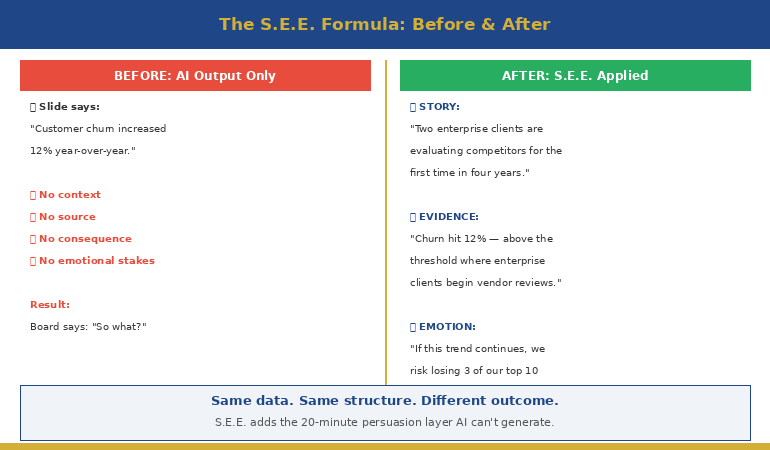
Side by side comparison of AI output before and after applying the S.E.E. formula showing transformation from facts to persuasion

Layer 1: Story — The Context AI Doesn’t Know

Story in a business presentation doesn’t mean “once upon a time.” It means context — the specific situation that makes your recommendation relevant, urgent, and grounded in reality.

AI output typically starts with the general: “Market conditions have shifted.” “Customer satisfaction has declined.” “Revenue targets are at risk.” These statements are accurate but they don’t anchor to anything your audience can feel. They’re abstract. And abstract doesn’t persuade.

The S.E.E. Story layer asks you to add one specific, concrete example to each major section of your deck. Not fiction — a real situation from your organisation that illustrates the point.

For example, instead of AI’s “Customer churn has increased 12% year-over-year,” the Story layer adds: “When I spoke with three of our enterprise clients last month, two mentioned they’re evaluating competitors for the first time in four years. One said — and I’m quoting directly — ‘Your platform used to be ahead. Now it’s keeping pace.’ That’s the shift the 12% represents.”

Now the board isn’t processing a number. They’re processing a threat. The data hasn’t changed. But the context makes it matter.

This is something AI fundamentally cannot generate — because it doesn’t know which clients you spoke to, what they said, or which anecdote will land with this particular audience. It’s human intelligence applied to AI structure.

📋 The S.E.E. formula is one of six frameworks inside the course.

AI-Enhanced Presentation Mastery includes the complete system: AVP structure, 132 Rule, S.E.E. formula, data storytelling frameworks, plus AI prompt templates for each. Study at your own pace — modules releasing through April 2026.

Get All 6 Frameworks + AI Prompt Packs →

Layer 2: Evidence — Turning Data Into Proof

AI is very good at including data. It’s surprisingly bad at turning data into proof. There’s a crucial difference.

Data is a number. Proof is a number plus its implication. AI will give you “NPS declined from 72 to 61.” That’s data. Proof sounds like: “NPS declined from 72 to 61 — a drop below the threshold where enterprise clients typically begin vendor reviews, based on our last three contract cycles.”

The Evidence layer in S.E.E. asks you to do three things with every data point AI generates:

First, contextualise it. What does this number mean relative to a benchmark your audience recognises? Industry average, last quarter, a target they set, a competitor’s performance. Data without context is just a number. Data with context is a signal.

Second, source it credibly. AI often presents data without attribution. Executives discount unsourced numbers. Add where the data came from — even “based on our Q3 finance review” adds credibility. If it’s external data, name the source. If it’s your own analysis, say so.

Third, connect it to consequence. What happens if this number continues? What happens if it reverses? The consequence is what transforms data from interesting to actionable. The Insight-Implication-Action framework from the course formalises this — every data point needs an insight (what it means), an implication (why it matters), and an action (what to do about it).

This evidence layer is where AI-enhanced presentations diverge from AI-generated ones. The AI handles the organisation. You handle the meaning.

Layer 3: Emotion — The Decision Trigger

This is the layer most professionals skip, and it’s the one that matters most for executive decisions.

Executives don’t make decisions based on logic alone. Research in decision science consistently shows that emotion drives action — logic justifies it afterward. A presentation that’s logically perfect but emotionally flat produces “let me think about it.” A presentation that creates the right emotional response — urgency, opportunity, risk — produces “let’s move on this.”

The Emotion layer isn’t about manipulation. It’s about connecting your recommendation to something your audience genuinely cares about. Every executive in every meeting has emotional stakes: protecting their team, delivering on promises they’ve made, avoiding the embarrassment of backing the wrong initiative, capitalising on an opportunity before a competitor does.

AI can’t identify these emotional stakes because they’re not in any dataset. They’re in the politics, relationships, and pressures of your specific organisation. Only you know that the VP of Operations is under pressure to show efficiency gains. Only you know that the CEO mentioned supply chain risk at the last all-hands meeting. Only you know that this proposal’s biggest blocker lost a similar bet two years ago and is risk-averse as a result.

The Emotion layer asks one question for each key slide: “What does my audience feel about this — and what do I need them to feel instead?” If the current state is complacency, you need urgency. If the current state is fear, you need confidence. If the current state is scepticism, you need proof that reduces perceived risk.

This is the layer that took my client’s deck from “so what?” to a follow-up meeting where the board asked her to accelerate the initiative. Same data. Same structure. Different emotional framing.

📊 The Full Persuasion System — Not Just One Formula

AI-Enhanced Presentation Mastery teaches S.E.E. alongside five other frameworks that work together: AVP for slide structure, 132 Rule for information sequencing, Insight-Implication-Action for data storytelling, plus customised AI prompt templates that make each framework faster to apply. 8 self-study modules + 2 live Q&A sessions.

Turn AI Slides Into Executive Decisions →

Presale pricing: £249 — moves to £499 full price soon. Join anytime — get all released modules immediately.

Applying S.E.E. to Any AI Deck in 20 Minutes

Here’s the practical workflow. You’ve used AI to build your deck — structure is solid, data is in place, flow makes sense. Now apply S.E.E. in three passes:

Pass 1: Story scan (5 minutes). Review each major section. For each one, ask: “Is there a specific, concrete example from our organisation that illustrates this point?” Write one sentence per section — a client conversation, an internal metric, a project outcome, a competitor move. You’re adding the anchor that makes abstract data feel real. If you can’t find a story, the section may be filler.

Your AI workflow handled the structure. This pass handles the meaning.

Pass 2: Evidence upgrade (5–10 minutes). Review every data point. For each one, add: context (vs what benchmark?), source (where did this come from?), and consequence (what happens if this continues?). Delete any data that doesn’t have a clear implication. More data with no context is worse than less data with clear meaning. Senior leaders don’t need all the information — they need the right information, framed so the conclusion is obvious.

Pass 3: Emotion check (5 minutes). For each key decision slide — recommendations, proposals, asks — answer: “What does my audience currently feel about this topic? What do I need them to feel? What one change to this slide creates that emotional shift?” Sometimes it’s reframing the opening line. Sometimes it’s adding a consequence slide. Sometimes it’s removing a defensive caveat that signals your own uncertainty.

Total time: roughly 20 minutes on top of whatever the AI took to generate the deck. That 20 minutes is the difference between “good presentation” and “approved.”

🔍 Want the complete workflow — AI structure + S.E.E. persuasion + templates?

The course includes before/after deck transformations, S.E.E. wording templates, and AI prompt packs designed to make each pass faster. Study at your own pace.

Get the Complete AI → Executive Workflow →

How do I make AI presentations more persuasive?

Apply the S.E.E. formula after AI handles structure: add Story (specific examples from your organisation), upgrade Evidence (contextualise every data point with benchmarks and consequences), and layer in Emotion (connect your recommendation to what your audience cares about). This 20-minute review transforms AI output from informative to actionable.

Why do AI-generated presentations feel flat?

AI excels at logical organisation but lacks access to three persuasion inputs: the specific context your audience operates in, the emotional stakes attached to the decision, and the proof points this particular group will find credible. Without these, AI produces structured reports rather than persuasive arguments.

What is the S.E.E. formula for presentations?

S.E.E. stands for Story-Evidence-Emotion. Story provides concrete, real-world context that makes abstract data feel tangible. Evidence transforms raw numbers into proof by adding benchmarks, sources, and consequences. Emotion connects your recommendation to what your audience fears, wants, or needs — the trigger that turns understanding into action.

🏆 AI-Enhanced Presentation Mastery: The Complete System

S.E.E. is one framework inside a complete course that transforms how you build presentations with AI. What’s included:

  • AVP framework — Action-Value-Proof slide structure
  • 132 Rule — information sequencing for how brains process
  • S.E.E. formula — Story-Evidence-Emotion persuasion layer
  • Insight-Implication-Action — data storytelling framework
  • AI prompt templates — customised for each framework
  • Before/after deck transformations — real examples
  • 8 self-study modules — releasing through April 2026
  • 2 live Q&A sessions — April 2026
  • Lifetime access — all recordings, templates, and future updates

Designed for busy professionals who create presentations regularly and want to save hours while dramatically improving impact.

Get the Complete AI Presentation System →

Presale pricing: £249 — moves to £499 full price soon. 60-seat cap. Join anytime — get all released modules immediately.

Frequently Asked Questions

Can I use the S.E.E. formula with any AI tool?

Yes. S.E.E. is a human review layer applied after AI generates the initial structure. It works with ChatGPT, Copilot, Claude, Gemini, or any other AI tool. The formula is tool-agnostic — it addresses the persuasion gap that all AI tools share.

How is S.E.E. different from general storytelling advice?

General storytelling advice tells you to “add stories” without specifying where, what kind, or how they interact with data and emotional framing. S.E.E. is a systematic three-pass review designed specifically for AI-generated business presentations, with each layer serving a distinct persuasion function.

Do I need presentation design skills for this?

No. S.E.E. operates at the messaging and content level, not the design level. You’re changing what the slides say and how the argument is framed — not formatting or layout. The AI handles structure and design; you handle persuasion.

How long does the full AI-Enhanced Presentation Mastery course take?

The course is 8 self-study modules released between January and April 2026, designed for busy professionals. Each module takes 60–90 minutes. You study at your own pace, with 2 live Q&A sessions in April for questions and feedback. Lifetime access means you can revisit any material whenever needed.

📬 The Winning Edge Newsletter

Weekly strategies for AI-enhanced presentations, executive communication, and confident delivery. No filler.

Subscribe Free →

📥 Free: Executive Presentation Checklist

A quick-reference checklist for reviewing any executive presentation before delivery — including a simplified S.E.E. review prompt.

Download Free Checklist →

Related reading: The presentation was perfect — the Q&A lost the deal — once your deck has the persuasion layer, prepare for the decision-making conversation that follows.

Your next step: Take the last AI-generated deck you built. Run the three S.E.E. passes: Story scan (add one concrete example per section), Evidence upgrade (contextualise every data point), Emotion check (connect each recommendation to what your audience cares about). Twenty minutes. And if you want the complete system — S.E.E. plus AVP, 132 Rule, data storytelling, and AI prompt templates for each — AI-Enhanced Presentation Mastery (£249) gives you everything in one self-study programme.

About the Author

Mary Beth Hazeldine is the Owner & Managing Director of Winning Presentations. With 24 years of corporate banking experience at JPMorgan Chase, PwC, Royal Bank of Scotland, and Commerzbank, she has delivered high-stakes presentations in boardrooms across three continents.

A certified hypnotherapist and NLP practitioner, Mary Beth combines executive communication expertise with practical techniques for managing presentation nerves. She has trained senior professionals and executive audiences over many years.

Book a discovery call | View services

12 Feb 2026
Professional reflecting on past presentation experience with contemplative expression

Presentation PTSD Is Real: Signs You’re Still Carrying an Old Failure

It was seven years ago. I still remember exactly what I was wearing.

The room had 40 people. I was presenting quarterly results to the leadership team. Slide 12 — a chart I’d built myself — had an error. The CFO spotted it immediately. “These numbers don’t add up,” he said. Not quietly. Not kindly.

For the next three minutes, I stood there while he picked apart my work in front of everyone. My face burned. My voice disappeared. I wanted the floor to open and swallow me whole.

That presentation ended my confidence for years. Every time I stood up to speak after that, I wasn’t in the current room — I was back in that room, waiting for someone to find the error, waiting for the humiliation to start again.

If you’ve had a presentation experience that still affects how you feel about speaking — even years later — you’re not being dramatic. Your nervous system is doing exactly what it’s designed to do. It’s trying to protect you from a threat it still believes is real.

I’m writing about this now because presentation anxiety is increasingly recognised as a genuine psychological response, not a character flaw. Recent understanding of how trauma affects the nervous system explains why “just get over it” doesn’t work — and what actually does.

Quick answer: Presentation trauma occurs when a difficult speaking experience becomes encoded in your nervous system as a threat. Signs include physical reactions (racing heart, sweating, nausea) that seem disproportionate to the current situation, avoidance behaviours, intrusive memories of past failures, and anticipatory anxiety that starts days before a presentation. Recovery involves recognising the pattern, working with your nervous system rather than against it, and gradually rebuilding positive associations with speaking. Some people notice shifts relatively quickly; deeper patterns can take longer. The key is that recovery is possible — your nervous system learned this response, and it can learn something new.

⏰ Presenting in the next 48 hours?

Three things to do right now to calm your nervous system:

  1. Tonight: Use a guided nervous system reset before bed (18–20 min)
  2. Tomorrow morning: Avoid caffeine; do 5 minutes of slow breathing
  3. Minutes before: Use a 90-second physical reset in the corridor

If you’d rather work from a structured system, the Conquer Speaking Fear programme includes guided audio for each of those three moments.

Note: This article discusses presentation-related anxiety and trauma responses. While these experiences are common and the techniques here help many people, persistent or severe symptoms may benefit from support with a qualified mental health professional. The term “PTSD” is used colloquially here to describe trauma-like responses to presentation experiences — clinical PTSD is a specific diagnosis that requires professional assessment.

As a certified hypnotherapist who now works with executives on presentation anxiety, I’ve heard hundreds of these stories. The details differ — a forgotten line, a hostile question, a technology failure, a panic attack — but the pattern is remarkably consistent.

Something happened. It felt terrible. And now, years later, it still controls how you feel about presenting.

The good news: this isn’t permanent. Your nervous system learned this fear response, and it can unlearn it. But first, you need to understand what’s actually happening.

Signs You’re Carrying Presentation Trauma

Presentation trauma doesn’t always announce itself obviously. Sometimes it shows up as “I just don’t like presenting” or “I’m not a natural speaker.” But there are specific signs that suggest you’re carrying something from the past:

1. Your Body Reacts Before Your Mind Does

You get an email about an upcoming presentation. Before you’ve even processed what it says, your heart rate increases. Your stomach tightens. Your palms get clammy.

This instant physical response — before conscious thought — is a hallmark of trauma. Your nervous system has flagged “presentation” as a threat and is activating your fight-or-flight response automatically.

2. The Fear Seems Disproportionate

You’re presenting to three friendly colleagues about a topic you know well. Objectively, the stakes are low. But your body is reacting like you’re about to face a firing squad.

When the fear response doesn’t match the actual situation, it’s often because your nervous system is responding to a past threat, not the current one.

3. You Have Intrusive Memories

When you think about presenting, your mind automatically goes to that time it went wrong. You can see it clearly — the faces, the room, the moment everything fell apart. These memories arrive unbidden and feel uncomfortably vivid.

4. You Avoid at All Costs

You’ve turned down opportunities, delegated important moments to others, or restructured your career to minimise presenting. The avoidance has become a pattern that shapes your professional life.

5. Anticipatory Anxiety Starts Days (or Weeks) Early

A presentation is scheduled for next Thursday. By Sunday, you’re already feeling anxious. By Wednesday night, you can’t sleep. The dread builds exponentially as the date approaches.

6. You Experience Shame, Not Just Fear

There’s a difference between “I’m afraid of presenting” and “I’m ashamed of how I present.” Trauma often carries shame — a feeling that you are fundamentally flawed, not just that the situation is scary.

🎯 Release Presentation Trauma With Guided Nervous System Work

Conquer Speaking Fear — £39, instant access — uses hypnotherapy and NLP techniques specifically designed to work with your nervous system, not against it. The programme includes three audio tools for different moments:

  • Full Guided Session (18-20 min): Deep nervous system reprogramming — use the night before
  • 90-Second Reset Audio: Quick calm-down for the corridor or bathroom — minutes before
  • Printable Pocket Card: 4-step physical reset — in the moment when you need it

Get Conquer Speaking Fear → £39

Instant download. Created by a certified hypnotherapist who spent five years terrified of presenting — and found a way out.

Why Your Nervous System Won’t “Just Let It Go”

If you’ve ever been told to “just relax” or “it’s not a big deal,” you know how unhelpful that advice is. Here’s why your nervous system doesn’t respond to logic:

The Amygdala Doesn’t Have a Calendar

Your amygdala — the brain’s threat-detection centre — processes experiences without timestamps. A humiliating presentation from 2018 feels just as threatening as one happening right now, because to your amygdala, there’s no difference between “this happened” and “this is happening.”

Emotional Memories Are Stored Differently

Traumatic experiences aren’t filed away like regular memories. They’re stored in a fragmented, sensory way — which is why a particular room layout, a certain type of projector, or even a specific smell can trigger the whole response pattern.

Your Body Keeps the Score

The fear isn’t just in your mind — it’s encoded in your body. Your posture, your breathing pattern, your muscle tension all hold the memory. This is why cognitive approaches (“think positive thoughts”) often fail. The body remembers what the mind tries to forget.

Avoidance Reinforces the Fear

Every time you avoid presenting, your nervous system gets confirmation: “See? That was dangerous. Good thing we escaped.” The avoidance provides temporary relief but strengthens the fear response long-term.

The Trauma Response Cycle

Understanding the cycle helps you interrupt it:

Stage 1: Trigger
Something reminds your nervous system of the original threat — a calendar invite, a request to present, even someone mentioning “presentation” in conversation.

Stage 2: Activation
Your fight-or-flight system activates. Heart rate increases, stress hormones release, blood flows away from your prefrontal cortex (thinking brain) toward your survival systems.

Stage 3: Hijack
Your rational mind goes offline. You can’t think clearly, can’t access your preparation, can’t remember that you’re actually safe. The past has hijacked the present.

Stage 4: Behaviour
You either fight (get defensive, speak too fast, overcompensate), flight (avoid, delegate, call in sick), or freeze (mind goes blank, voice disappears, body locks up).

Stage 5: Aftermath
Regardless of how the presentation actually went, you feel depleted, ashamed, and more convinced than ever that presenting is dangerous. The cycle reinforces itself.


Presentation trauma cycle showing trigger, response, and recovery pathway

Breaking the cycle means working with your body, not just your mind — the Conquer Speaking Fear programme (£39) is built around that principle, with guided audio that interrupts this exact pattern.

How to Release the Pattern

Recovery from presentation trauma isn’t about forcing yourself to present more (exposure therapy without proper support often makes things worse). It’s about working with your nervous system to create new associations.

Step 1: Acknowledge What Happened

Stop minimising. “It wasn’t that bad” or “I should be over it by now” keeps you stuck. Something happened that affected you. That’s real. Your response makes sense given what you experienced.

I spent years pretending my CFO moment didn’t bother me. Recovery only started when I admitted: that was humiliating, it hurt, and it changed how I felt about presenting.

Step 2: Separate Past from Present

When you notice the fear response activating, practice naming it: “This is my nervous system responding to 2018, not to today.” You’re not trying to make the feeling go away — you’re creating space between the trigger and your response.

Step 3: Work With Your Body

Because the trauma is stored in your body, body-based techniques are often more effective than cognitive ones:

  • Slow exhales: Longer exhales than inhales can help activate your parasympathetic nervous system
  • Grounding: Feel your feet on the floor, your weight in the chair — anchor yourself in the present moment
  • Movement: Shake out your hands, roll your shoulders — discharge the physical activation
  • Posture reset: Stand tall, open your chest — your body’s position affects your emotional state

Step 4: Create New Experiences

Your nervous system needs evidence that presenting can be safe. This doesn’t mean forcing yourself into high-stakes situations. It means starting small:

  • Speaking up in a meeting with one comment
  • Presenting to one trusted colleague
  • Recording yourself and watching without judgment
  • Gradually increasing the challenge as your nervous system adapts

Step 5: Process the Original Experience

Sometimes the old memory needs direct attention. Techniques like guided visualisation, timeline therapy, or working with a therapist can help you process what happened so it no longer controls your present.

This is where hypnotherapy-based approaches can be particularly effective — they work directly with the subconscious patterns that keep the trauma response active.

🧠 Nervous System Reprogramming for Presentation Trauma

Conquer Speaking Fear (£39, instant access) was created specifically for professionals carrying presentation trauma. The guided hypnotherapy session helps your nervous system release the old pattern and build new, calmer associations with speaking.

  • Work with your subconscious, not against it
  • Release the physical holding patterns
  • Build genuine confidence (not just “fake it”)
  • Three audio formats for different situations

Get Conquer Speaking Fear → £39

Instant download. Developed from hypnotherapy techniques that helped me release my own presentation trauma after five years of suffering.

Rebuilding Confidence After a Bad Experience

Once you’ve started releasing the trauma pattern, you can begin rebuilding genuine confidence:

Reframe the Original Story

The story you tell yourself about what happened matters. “I failed and everyone saw” is different from “I had a difficult experience and I survived it.”

My CFO story? I eventually reframed it: “I made an error, someone called it out publicly, and I handled a difficult moment without falling apart completely. I went back to work the next day. I kept presenting. I survived.”

Collect Counter-Evidence

Your brain has been selectively remembering the bad experience. Start noticing the neutral and positive ones. After each presentation — even a small one — note what went okay. Build a file of evidence that presenting doesn’t always mean disaster.

Prepare Differently

Trauma often creates over-preparation (spending 20 hours on a 10-minute presentation) or under-preparation (avoiding thinking about it until the last minute). Neither works.

Effective preparation for trauma recovery means: know your content well enough to feel secure, but accept that perfection isn’t the goal. Your safety doesn’t depend on getting everything right.

Build Physical Anchors

Create associations between specific physical actions and calm states. When you’re relaxed, practice a subtle gesture (touching your thumb to your finger, for example). Over time, this gesture can help trigger the calm state — giving you a tool you can use in the moment.

This anchoring technique is part of what makes nervous system-based approaches so effective for presentation anxiety.

What Recovery Actually Looks Like

Recovery from presentation trauma isn’t linear, and it doesn’t mean you’ll never feel nervous again. Here’s what realistic progress looks like:

Week 1-2: You start noticing the pattern — recognising when your nervous system is responding to the past rather than the present.

Week 3-4: The anticipatory anxiety begins to shorten. Instead of dreading a presentation for two weeks, you might dread it for a few days.

Month 2-3: You have a presentation that goes “okay” and notice it. The negative bias starts shifting.

Month 3-6: The physical symptoms become less intense. Your heart still races, but it doesn’t feel life-threatening. You can think while nervous.

Ongoing: Presenting becomes uncomfortable rather than terrifying. You can do it without it ruining your week. Eventually, some presentations feel almost… fine.

This timeline varies. Some people see significant shifts in weeks; others take longer. The key is that progress is possible — your nervous system can learn new patterns.

🎓 25 Years Coaching Senior Professionals Through Speaking Fear

Conquer Your Fear of Public Speaking is built from 16 years coaching senior professionals across financial services, consulting, healthcare, and technology — alongside 25 years of corporate banking experience. Every technique — the nervous system regulation work, the trauma-informed preparation rituals, the in-the-moment recovery scripts — comes from real client work with executives who came to speaking with histories that needed careful, not generic, approaches.

Designed for senior professionals whose speaking fear has roots in past experience, not just nerves — and who need approaches that respect that history.

Get Conquer Your Fear of Public Speaking → £39

Instant download — lifetime access to every framework and technique.

Frequently Asked Questions

Is “presentation PTSD” a real diagnosis?

The term is used colloquially to describe trauma-like responses to presentation experiences. Clinical PTSD is a specific diagnosis with defined criteria that requires professional assessment. However, the nervous system responses described in this article — hypervigilance, avoidance, intrusive memories, disproportionate fear responses — are real and well-documented, even if they don’t meet the clinical threshold for PTSD. Your experience is valid regardless of diagnostic labels.

How long does it take to recover from presentation trauma?

This varies significantly based on the severity of the original experience, how long ago it happened, and what support you have. Some people notice shifts within a few weeks; deeper patterns may take several months of consistent work. There’s no universal timeline — everyone’s nervous system responds differently. If you’re not seeing progress after sustained effort, consider working with a therapist who specialises in anxiety or trauma responses. The key is that recovery is possible — your nervous system learned this response, and it can learn a new one.

Should I force myself to present more to get over it?

Exposure without proper support can actually reinforce the trauma. Simply forcing yourself through more presentations while activated often strengthens the fear response. The goal is to present while regulated — which requires first developing tools to work with your nervous system. Gradual, supported exposure works; white-knuckling through high-stakes presentations usually doesn’t.

Can I fully recover, or will I always be anxious about presenting?

Most people don’t become completely anxiety-free — some presentation nerves are normal and even useful. What changes is the intensity and the control. Instead of anxiety hijacking your ability to think and speak, it becomes manageable background noise. Many people who’ve done this work eventually describe presenting as “uncomfortable but doable” rather than “terrifying and avoided at all costs.”

📬 PS: Weekly techniques for managing presentation anxiety and building genuine confidence. Subscribe to The Winning Edge — practical strategies from a hypnotherapist who’s been there.

Related: If presentation trauma is holding you back from career moments like requesting resources or budget, read The Headcount Request That Got Yes When Everyone Said No for a presentation structure that builds confidence through preparation.

That presentation from years ago — the one you still think about — doesn’t have to control your future.

Your nervous system is doing what it was designed to do: protect you from perceived threats. But the threat isn’t real anymore. The room is different. The audience is different. You are different.

Recovery is possible. Your nervous system learned to fear presenting, and it can learn something new.

It starts with acknowledging what happened, understanding why your body responds the way it does, and working with your nervous system rather than against it.

The past doesn’t have to own your present. You can let it go.

About the Author

Mary Beth Hazeldine is the Owner & Managing Director of Winning Presentations. With 25 years in corporate banking at JPMorgan Chase, PwC, Royal Bank of Scotland, and Commerzbank, she experienced presentation trauma firsthand — including five years of debilitating fear before finding techniques that actually worked.

Now a certified hypnotherapist and NLP practitioner, Mary Beth specialises in helping professionals release presentation anxiety at the nervous system level. She combines executive communication expertise with evidence-based approaches to fear and trauma recovery.

Book a discovery call | View services

06 Feb 2026
Senior executive in thoughtful pose considering a business decision in modern corporate office

Why Executives Say ‘Let Me Think About It’ (And How to Prevent It)

“Let me think about it” cost me six months and nearly derailed my career.

I’d just delivered what I thought was a flawless presentation to the executive committee at Commerzbank. Forty-five minutes of carefully constructed slides. Every question answered. Every objection pre-empted. The CFO nodded throughout. The COO asked thoughtful questions. I left feeling confident.

Then came the response: “This is excellent work. Let me think about it and we’ll circle back.”

They never circled back. Two months later, I followed up. “Still considering.” Three months: “The timing isn’t right.” Six months: the initiative quietly died, and I spent the next year rebuilding credibility.

It took years — and dozens of similar experiences across 25 years in corporate banking — to understand what “let me think about it” actually means. And more importantly, what causes it.

The answer changed how I approach every executive presentation.

Quick answer: “Let me think about it” rarely means an executive needs more time to consider your proposal. It usually signals one of five hidden barriers: insufficient information to decide confidently, unspoken political concerns, unclear personal benefit, fear of being wrong, or lack of urgency. The solution isn’t a better follow-up strategy — it’s preventing these barriers from forming before you present.

Presenting tomorrow and worried you’ll hear “let me think about it”?

If you can’t do the pre-work, use these three questions to force specificity in the room:

  1. “What would you need to see to decide today?” Surfaces hidden information gaps.
  2. “What concern would make ‘yes’ feel risky?” Brings objections into the open.
  3. “If I can address that concern now, can we move forward?” Forces a decision path.

These won’t guarantee a yes — but they prevent vague deferral. For the full framework, see the Executive Buy-In Presentation System.

What ‘Let Me Think About It’ Actually Means

Let’s be direct: “Let me think about it” is almost never what it sounds like.

Executives are paid to make decisions. They make dozens of them daily. If your proposal required genuine deliberation, they’d ask specific questions, request particular data, or schedule a follow-up with defined parameters. “Let me think about it” — with no specifics — means something else entirely.

Here’s what it usually means:

“I don’t have enough information to say yes confidently.” Something is missing. They can’t articulate what, but the decision doesn’t feel safe. So they defer.

“I have concerns I don’t want to raise in this forum.” There are political dynamics, relationship issues, or historical context that make a public “no” awkward. Deferral is the polite exit.

“I don’t see how this benefits me or my priorities.” Every executive has personal objectives — visibility, budget, headcount, strategic positioning. If your proposal doesn’t connect to those, it becomes low priority.

“I’m not sure this is the right call, and I don’t want to be wrong.” Risk aversion is real. When the upside isn’t clear and the downside could reflect poorly, deferral feels safer than decision.

“This doesn’t feel urgent enough to decide now.” Without a compelling reason to act today, everything can wait. And things that can wait often wait forever.

Notice what’s missing from this list: “I need time to carefully weigh the merits of your proposal.” That’s what we want to believe. It’s rarely what’s happening.

⭐ Build the case your stakeholders can’t defer

The Executive Buy-In Presentation System is a self-paced framework — 7 modules walking you through stakeholder analysis, case construction, and the presentation structures that get decisions rather than delays. £499, lifetime access to materials.

What’s covered:

  • Identifying the hidden barriers that cause decision stalling
  • Stakeholder psychology and political navigation approaches
  • Creating genuine urgency that makes “decide now” feel natural
  • Bonus Q&A calls (optional, fully recorded — watch back anytime)

Explore the Buy-In System on Maven →

Self-paced with monthly cohort enrolment.

The Five Hidden Reasons Executives Stall

Understanding why executives defer decisions is the first step to preventing it. Here’s what’s usually happening beneath the surface:

The 5 hidden reasons executives say let me think about it with prevention strategies

Reason 1: Information Asymmetry

You’ve spent weeks or months on this proposal. You know every detail, every implication, every edge case. The executive has spent 45 minutes listening to your summary. The information asymmetry is enormous.

When executives don’t have enough information to feel confident, they defer. Not because they want more data — but because the decision doesn’t feel “safe” yet. They can’t point to what’s missing, so they ask for time.

The fix: Don’t just present information. Transfer confidence. Help them see what you see. Make the decision feel as obvious to them as it does to you.

Reason 2: Political Complexity

Every proposal exists in a political context. Your initiative might threaten someone’s budget. It might contradict a position someone else has already taken. It might create winners and losers among the executive’s peers or reports.

Executives don’t want to create political problems for themselves. If saying yes creates conflict they’d rather avoid, they defer. The politics are invisible to you but very real to them.

The fix: Map the political landscape before you present. Understand who wins and loses. Pre-wire the people who might object. Make yes politically easy.

Reason 3: Missing Personal Connection

Every executive has personal priorities: what they’re trying to accomplish this quarter, what they want to be known for, what metrics they’re measured on. Your proposal might be objectively good for the company but irrelevant to their personal objectives.

Proposals that don’t connect to personal priorities become “important but not urgent.” And important-but-not-urgent proposals get deferred indefinitely.

The fix: Know what each decision-maker cares about. Frame your proposal in terms of their priorities, not just organisational benefit.

For more on connecting proposals to executive priorities, see my guide on how to present to a CFO.

Reason 4: Fear of Being Wrong

Executives are evaluated partly on judgment. Being wrong — especially publicly wrong — carries career risk. When the right decision isn’t obvious, deferral feels safer than commitment.

This is especially true for decisions that are visible, irreversible, or outside the executive’s core expertise. The less confident they feel, the more likely they are to defer.

The fix: Reduce perceived risk. Show what happens if it doesn’t work. Create off-ramps. Make saying yes feel safe.

Reason 5: Lack of Urgency

Without a compelling reason to decide now, executives will defer. It’s not malicious — it’s just how human attention works. Urgent things get attention. Non-urgent things wait.

If your proposal can be decided next week just as easily as today, it will be decided next week. Or next month. Or never.

The fix: Create genuine urgency. Not artificial scarcity, but real consequences of delay. What opportunity closes? What cost increases? What risk materialises?

How to Prevent Decision Stalling Before You Present

The best response to “let me think about it” is prevention. Here’s how to address each barrier before it forms:

For Information Asymmetry:

Don’t assume your presentation will transfer enough understanding. Preview your key insights with decision-makers before the formal meeting. When they’ve already processed the core information privately, the presentation becomes confirmation rather than revelation.

Also: present with recommendations, not options. Executives don’t want to make your decision for you. They want to approve a confident recommendation. Give them something to say yes to.

For Political Complexity:

Do the political work before you present. Talk to anyone who might object. Understand their concerns. Where possible, incorporate their input so they feel ownership. When potential blockers feel heard, they’re less likely to block.

Critically: don’t surprise anyone in the room. If someone is going to hear about your proposal for the first time during your presentation, you’ve already lost.

For Missing Personal Connection:

Research what each decision-maker cares about. What are they measured on? What do they want to be known for? What problems keep them up at night?

Then frame your proposal explicitly in those terms. “This addresses the customer retention issue you raised in Q3” is more compelling than “This improves customer retention.” Same proposal, different framing.

For Fear of Being Wrong:

Make saying yes feel safe. Show that you’ve considered what could go wrong. Present contingency plans. Propose pilot approaches that limit downside. Create checkpoints where the decision can be revisited.

The goal isn’t to eliminate risk — it’s to make the executive feel that saying yes is a reasonable, defensible choice. They need to be able to justify the decision if it doesn’t work out.

For Lack of Urgency:

Build real urgency into your proposal. What window is closing? What competitive advantage erodes with delay? What cost increases the longer we wait?

If there’s genuinely no urgency, consider whether this is the right time to present. Sometimes the answer is to wait for a moment when urgency naturally exists.

For more on structuring proposals that drive decisions, see my guide on the 3-slide system that gets executive decisions fast.

No deadlines, no mandatory attendance. Executive Buy-In Presentation System — 7 self-paced modules, £499, lifetime access to materials.

Explore the Buy-In System →

What to Do If You Hear It Anyway

Despite your best preparation, you might still hear “let me think about it.” Here’s how to respond:

Don’t accept vague deferral. Instead, ask: “I want to make sure I’ve addressed everything you need. What specifically would be helpful for you to consider?” This forces them to articulate the barrier — which gives you something to address.

Propose a specific next step. “Would it help if I sent over [specific information] and we reconnected on Thursday?” This creates a commitment rather than an open-ended deferral. A defined follow-up is better than “we’ll circle back.”

Ask about concerns directly. “I want to make sure there isn’t a concern I haven’t addressed. Is there anything about this that doesn’t sit right?” This gives them permission to voice the real objection.

Check for political dynamics. “Is there anyone else whose input would be valuable before we move forward?” This surfaces hidden stakeholders who might be influencing the decision.

Create a decision point. “I understand you want to consider this. Just so I can plan accordingly, when would you expect to have a view?” This creates mild accountability without being pushy.

The goal isn’t to pressure — it’s to understand. “Let me think about it” is a symptom. Your job is to diagnose the underlying barrier so you can address it.

For more on building executive buy-in, see my guide on how to get executives to say yes.

⭐ Stop rewriting your proposal three times only to hear “we’ll think about it”

The Executive Buy-In Presentation System teaches the structure that gets decisions, not delays — 7 self-paced modules with optional recorded Q&A calls. £499, lifetime access.

Explore the Buy-In System on Maven →

Self-paced with monthly cohort enrolment.

⭐ Built on 25 years in corporate banking

The Executive Buy-In Presentation System is the structured framework developed across 25 years in corporate banking and 16 years coaching senior professionals across financial services, insurance, consulting, and technology. £499, lifetime access to materials.

What you get:

  • 7 self-paced modules covering psychology, structure, and delivery
  • Frameworks for identifying real decision-makers and hidden barriers
  • Approaches for creating genuine urgency without manufactured scarcity
  • Bonus Q&A calls (optional, fully recorded — watch back anytime)
  • Lifetime access to all materials

Explore the Buy-In System on Maven →

Self-paced with monthly cohort enrolment — new cohort opens every month.

Frequently Asked Questions

Is “let me think about it” ever genuine?

Sometimes, yes — particularly for very large decisions with significant organisational impact. But even genuine deliberation should come with specifics: what they’re considering, what information would help, when they expect to decide. Vague deferral with no parameters is usually a polite no. If an executive genuinely needs time, they’ll tell you what they need time to consider.

How long should I wait before following up?

This depends on what you agreed in the meeting. If you proposed a specific check-in (“I’ll send the additional data and follow up Thursday”), honour that timeline. If the meeting ended with vague deferral, follow up within 3-5 business days with something valuable — new information, an article relevant to their concerns, clarification of a point raised. Don’t just ask “have you decided?” Give them a reason to re-engage.

What if they keep deferring despite my follow-ups?

Multiple deferrals usually mean one of two things: the proposal is genuinely low priority for them, or there’s a barrier they’re unwilling to articulate. At this point, it’s worth a direct conversation: “I want to respect your time. Should I interpret the timing as a signal that this isn’t a priority right now? I’d rather know than keep following up if the answer is no.” This gives them permission to say no, which is often better than indefinite limbo.

How do I create urgency without seeming manipulative?

Real urgency isn’t manufactured — it’s surfaced. What genuinely changes if you wait? Market conditions, competitive dynamics, cost increases, opportunity windows, resource availability? If there’s real urgency, articulate it clearly. If there isn’t, don’t fabricate it. Executives see through artificial scarcity, and it damages your credibility. Sometimes the honest answer is that there’s no urgency — in which case, consider waiting for a moment when urgency naturally exists.

Your Next Step

The next time you prepare a presentation, don’t just think about what you’ll say. Think about the five barriers that cause executives to defer.

What information might they be missing? What political dynamics exist? How does this connect to their personal priorities? What might make them afraid to say yes? Why should they decide now rather than later?

Address those questions before you present, and you’ll hear “let me think about it” far less often.

📧 Get the Winning Edge Newsletter

Weekly insights on executive communication, stakeholder psychology, and the dynamics of getting buy-in — from 25 years in corporate banking.

Subscribe free →

Related reading: Decision stalling often happens in recurring meetings like MBRs and QBRs. If your regular updates keep getting deferred, the problem might be structural. Read Monthly Business Reviews That Don’t Bore Everyone to Death for the 20-minute format that drives decisions rather than deferrals.

About the Author

Mary Beth Hazeldine is the Owner & Managing Director of Winning Presentations. With 25 years of corporate banking experience at JPMorgan Chase, PwC, Royal Bank of Scotland, and Commerzbank, she heard “let me think about it” more times than she can count — and eventually learned what it really meant.

Now she teaches senior professionals the stakeholder psychology and decision architecture that transforms deferrals into approvals. She combines executive communication expertise with evidence-based influence techniques.

28 Jan 2026
Professional woman having one-on-one stakeholder conversation with hand gesture, engaging colleague in discussion

Stakeholder Buy-In Psychology: Why Alignment Creates Agreement and Enrollment Creates Champions

The CFO said yes in our one-on-one. Then he stayed silent in the steering committee while someone else killed the project.

I’d done everything right — or so I thought. I’d had the pre-meeting conversations. I’d addressed concerns. I’d gotten explicit agreement from every key stakeholder. On paper, I was “aligned.”

But when a skeptical VP raised objections in the room, nobody defended my proposal. The people who’d nodded along in private sat quietly while the project got “tabled for further review.” It never came back.

That’s when a mentor taught me the distinction that changed everything: I’d achieved alignment, but not enrollment. And in stakeholder buy-in psychology, that difference is everything.

Quick Answer: Alignment means stakeholders agree with your position — they won’t actively oppose you. Enrollment means stakeholders feel ownership of the idea — they’ll defend it, champion it, and drive it forward even when you’re not in the room. The psychology is different: alignment asks “will you accept this?” while enrollment asks “what would make this yours?” Enrollment is harder to achieve but dramatically more durable.

If you’re presenting to executives, boards, or steering committees — passive agreement isn’t enough. You need people who will speak up when objections arise. That requires understanding the psychology of genuine buy-in.

Need real buy-in this week? Try the enrollment shift.

Instead of asking “Do you agree with this?” ask:

  1. “What would need to be true for this to work for you?”
  2. “What concerns would you want addressed before you’d champion this?”
  3. “If we solve [their concern], would you be willing to speak to that in the meeting?”

You’re not asking them to accept your idea — you’re inviting them to shape it and own it. For the structured framework, see the Executive Buy-In Presentation System.

Why Alignment Isn’t Enough

I learned this lesson painfully at RBS during a major technology initiative.

We needed approval for a significant system upgrade. I spent weeks building the business case, meeting with stakeholders, addressing objections. By the time I walked into the executive committee, I had verbal agreement from everyone who mattered.

The presentation went smoothly — until a board member who’d missed our earlier conversations raised a concern about implementation risk. I started to respond, but something worse happened: silence. The executives who’d agreed with me privately said nothing. They let me defend the proposal alone.

The project was delayed six months while we “further evaluated risks.” Half the team moved on to other priorities. The momentum never recovered.

Later, I asked my CFO why he hadn’t spoken up. His answer was honest: “I agreed it was a good idea. But I didn’t feel like it was my idea. I wasn’t going to spend political capital defending someone else’s project.”

That was the moment I understood: agreement isn’t commitment. Alignment isn’t enrollment.

The Psychology of Enrollment

The distinction between alignment and enrollment comes down to ownership psychology:

Alignment means: “I won’t block this.”

  • Stakeholder has accepted your reasoning
  • They’ve agreed the proposal makes sense
  • They’ll vote yes if asked directly
  • But they feel no personal stake in the outcome

Enrollment means: “I want this to happen.”

  • Stakeholder sees the proposal as partly theirs
  • Their input shaped the direction
  • Success reflects well on them
  • They’ll defend it when challenged

4-quadrant stakeholder map showing High Power/High Interest as Key Players, High Power/Low Interest as Keep Satisfied, Low Power/High Interest as Keep Informed, Low Power/Low Interest as Monitor

The psychological research on this is clear: people defend ideas they feel ownership over, not ideas they merely accept. When stakeholders contribute to a proposal — when their concerns shape it, when their language appears in it — they experience what psychologists call the “IKEA effect”: they value it more because they helped build it.

For the tactical side of stakeholder engagement, see our guide to stakeholder mapping for presentations.

How do you get stakeholder buy-in?

True stakeholder buy-in requires enrollment, not just alignment. Instead of presenting your finished idea and asking for agreement, involve stakeholders early: ask what would make the proposal work for them, incorporate their concerns into your approach, and give them ownership of specific elements. When stakeholders feel the idea is partly theirs, they’ll defend it actively — not just accept it passively.

⭐ Turn reluctant stakeholders into active advocates

The Executive Buy-In Presentation System is a self-paced programme with 7 modules covering the psychology, conversation frameworks, and presentation structure that move senior stakeholders from passive agreement to active championship. £499, lifetime access to materials.

What’s covered:

  • The psychology of ownership and why it drives genuine buy-in
  • Enrollment conversation frameworks with exact language
  • How to work with skeptics so they champion the proposal
  • Stakeholder mapping and champion activation

Explore the Buy-In System on Maven →

Self-paced with monthly cohort enrolment. Optional recorded Q&A calls available.

How to Enroll Instead of Align

The shift from alignment to enrollment requires changing your approach at every stage:

1. Start Earlier

Alignment happens at the end: you build your proposal, then seek agreement. Enrollment happens at the beginning: you involve stakeholders while the proposal is still taking shape.

The enrollment question isn’t “Do you agree with this?” It’s “What would need to be true for you to champion this?”

2. Seek Input, Not Just Feedback

There’s a difference between asking stakeholders to review a finished proposal and asking them to help shape one. When you ask for feedback on something complete, they’re evaluating your work. When you ask for input on something developing, they’re contributing to shared work.

3. Make Their Concerns Central

When a stakeholder raises a concern, don’t just address it — feature it. “Sarah raised an important point about implementation risk, so we’ve built in these safeguards…” Now Sarah hears her concern taken seriously, sees her name attached to the solution, and has a stake in the proposal’s success.

4. Give Them Lines to Say

Enrolled stakeholders need talking points. Before the meeting, brief your champions: “If the CFO raises budget concerns, it would be helpful if you mentioned the ROI projections we discussed.” You’re not asking them to lie — you’re making it easy for them to support you publicly.

5. Let Them Take Credit

Enrollment requires ego generosity. When the proposal succeeds, share credit liberally. “This wouldn’t have happened without Sarah’s insight on implementation” makes Sarah more likely to champion your next initiative.

For the pre-meeting conversation tactics, see our detailed guide on pre-meeting executive alignment.

What is the psychology of buy-in?

The psychology of buy-in centers on ownership. People defend and champion ideas they feel they helped create — what psychologists call the “IKEA effect.” When stakeholders contribute concerns, shape solutions, or see their language in proposals, they experience psychological ownership. This transforms them from passive evaluators (“I agree this makes sense”) into active champions (“I want this to succeed”).

No deadlines, no mandatory attendance. The Executive Buy-In Presentation System — 7 self-paced modules, £499, lifetime access to materials.

Explore the Buy-In System →

The Enrollment Conversation Framework

Here’s the exact conversation structure I use to move from alignment to enrollment:

Phase 1: Open with Curiosity (2 minutes)

Don’t pitch. Ask about their world first:

  • “What’s top of mind for you right now?”
  • “What pressures are you facing this quarter?”
  • “What would make your life easier?”

This isn’t small talk — it’s intelligence gathering. You’re learning what they care about so you can connect your proposal to their priorities.

Phase 2: Share the Problem, Not the Solution (3 minutes)

Describe the problem you’re trying to solve. Then pause. Let them react:

  • “We’re seeing X issue. Does that match what you’re experiencing?”
  • “How does this problem affect your team?”
  • “What have you tried so far?”

If they start solving the problem with you, you’ve begun enrollment. They’re no longer evaluating your idea — they’re contributing to a shared challenge.

Phase 3: Co-Create the Direction (5 minutes)

Share your emerging thinking, but frame it as incomplete:

  • “One direction we’re considering is X. What would make that work for you?”
  • “What concerns would you want addressed before you’d feel confident in this?”
  • “What am I missing from your perspective?”

Write down their input. Reference it back to them. “So if I understand correctly, you’d want to see Y before moving forward…”

Phase 4: Ask for Championship (2 minutes)

This is the enrollment ask — and most people skip it:

  • “If we address [their concern], would you be willing to speak to that in the steering committee?”
  • “Would you be comfortable being the voice for [specific element] in the meeting?”
  • “Can I count on you to support this if [condition they named] is met?”

The explicit ask transforms passive agreement into active commitment. They’ve now made a promise, and people generally keep promises they’ve made directly.

Stakeholder engagement flow showing: Map stakeholders, Identify key players, Have pre-meeting conversations, Shape presentation to concerns, Activate champions, Present with alignment

Why do stakeholders resist change?

Stakeholders resist change when they feel it’s being done to them rather than with them. Resistance often signals unaddressed concerns, fear of being blamed if things go wrong, or simply not feeling heard. The enrollment approach reduces resistance by involving stakeholders early, incorporating their concerns, and giving them ownership of the solution — transforming them from targets of change into co-creators of it.

⭐ Stop guessing what your stakeholders need to say yes

The Executive Buy-In Presentation System is the self-paced framework for decoding resistance and building the case that addresses it — 7 modules, monthly cohort enrolment, optional recorded Q&A. £499, lifetime access.

Explore the Buy-In System on Maven →

Self-paced with monthly cohort enrolment.

Why Enrollment Fails (And How to Fix It)

Even when people try enrollment, they often undermine it:

Mistake #1: Asking for Input Too Late

If your proposal is 90% complete when you ask for input, stakeholders know they’re just being consulted for appearance. They’ll give token feedback but won’t feel ownership. Enrollment requires involving people when things are still genuinely malleable.

Mistake #2: Ignoring the Input You Receive

Nothing destroys enrollment faster than asking for input and then ignoring it. If you can’t incorporate someone’s suggestion, explain why — and find something else of theirs you can include. They need to see their fingerprints on the final product.

Mistake #3: Treating Enrollment as Manipulation

Enrollment isn’t a trick. If you’re cynically going through the motions to manufacture buy-in, stakeholders will sense it. Genuine enrollment requires actually being open to others’ input changing your approach. If you’re not willing to be influenced, don’t pretend to be.

Mistake #4: Forgetting to Make the Explicit Ask

Many people do the enrollment work but never ask for championship. They assume that if someone contributed, they’ll naturally support. But the explicit ask — “Will you speak to this in the meeting?” — transforms implicit goodwill into explicit commitment.

Mistake #5: Hoarding Credit

If you take all the credit when the proposal succeeds, you’ve taught stakeholders that supporting you doesn’t benefit them. Generous credit-sharing builds long-term enrollment — people will champion your next initiative because championing the last one felt good.

For the presentation structure that reinforces enrollment, see our guide to executive presentation structure.

A Major Project: What I Did Differently

Six months after my failure, I had another significant proposal to bring forward. Same executive committee. Same political dynamics. Different approach.

This time, I started enrollment three weeks before the meeting:

With the CFO: Instead of presenting my budget analysis, I asked what would make him confident in the ROI. He mentioned concerns about assumptions. I asked him to help me stress-test them. When he contributed to the financial model, it became partly his model.

With the skeptical VP: I met with him early and asked directly: “What would need to be true for you to support this?” He named three conditions. I built all three into the proposal and told him I’d done so. Then I asked: “Would you be willing to confirm these safeguards are adequate in the meeting?” He agreed.

With the CTO: I asked her to validate the technical approach. When she suggested a modification, I adopted it and credited her publicly: “Maria’s recommendation to phase the implementation addresses the risk concern.”

The Result:

When I presented, the CFO spoke first: “I’ve reviewed the financials with [me] — the assumptions are solid.” The VP who’d killed my previous project said: “I was initially skeptical, but the safeguards address my concerns.” The CTO nodded along.

Approved in the first round. No “further review.” No six-month delay.

Same committee that had killed my previous proposal. The difference was enrollment.

⭐ Built on 25 years in corporate banking

The Executive Buy-In Presentation System is the self-paced framework developed across 25 years in corporate banking and 16 years coaching senior professionals across financial services, insurance, consulting, and technology. £499, lifetime access to materials.

What you get:

  • 7 self-paced modules covering psychology, conversations, and structure
  • Enrollment conversation frameworks with exact language
  • Stakeholder mapping and champion activation tools
  • Bonus Q&A calls (optional, fully recorded — watch back anytime)
  • Lifetime access to materials

Explore the Buy-In System on Maven →

Self-paced with monthly cohort enrolment — new cohort opens every month.

Frequently Asked Questions

What’s the difference between alignment and enrollment?

Alignment means stakeholders agree with your position — they’ll vote yes but won’t actively champion it. Enrollment means stakeholders feel ownership of the idea — they’ll defend it when challenged, speak up in meetings, and drive it forward even without your prompting. The key difference is psychological ownership: enrolled stakeholders feel the proposal is partly theirs.

How do you enroll resistant stakeholders?

Start by understanding their resistance. Ask: “What would need to be true for you to support this?” Their answer reveals their real concerns. Address those concerns visibly in your proposal, credit them for the insight, and ask explicitly: “If we address this, would you be willing to champion it?” Resistance often transforms into championship when stakeholders feel genuinely heard and see their concerns taken seriously.

Is this manipulation?

Enrollment isn’t manipulation — it’s collaboration. You’re not tricking stakeholders into supporting something against their interests. You’re genuinely incorporating their concerns and giving them ownership of solutions. The approach requires actually being open to their input changing your proposal. If you’re only pretending to listen, that’s manipulation — and stakeholders will sense it.

How long does enrollment take vs alignment?

Enrollment requires more upfront investment — typically 2-3 weeks of conversations before a major presentation, versus a few days for alignment. But the ROI is dramatically better: enrollment leads to faster approvals, fewer delays, and decisions that stick. Alignment often creates “false yes” situations where apparent agreement dissolves under pressure, causing months of rework.

Get Weekly Executive Buy-In Insights

Strategies for stakeholder psychology, decision-getting, and presenting with authority — from 25 years in corporate banking.

Subscribe to The Winning Edge →

📋 Not ready for the course? Take the checklist.

A quick-reference guide covering executive presentation structure, stakeholder engagement, and decision-getting. Use it before your next high-stakes presentation.

Download Free Checklist →

Your Next Step

Before your next important presentation, pick one key stakeholder and try the enrollment approach:

  1. Meet them before your proposal is finalized
  2. Ask: “What would need to be true for you to champion this?”
  3. Incorporate their answer visibly
  4. Ask explicitly: “Will you speak to this in the meeting?”

One enrolled champion changes the dynamics of the entire room. Start there.

P.S. Before you enroll stakeholders, you need to map them. I wrote a detailed guide on stakeholder mapping for presentations — including the 4-quadrant framework that shows who to focus on.

P.P.S. And if fear of judgment affects how you show up in stakeholder conversations, check out how to handle fear of being judged when speaking — it’s about rewiring the evaluation anxiety.

About Mary Beth Hazeldine
Owner & Managing Director of Winning Presentations. 25 years in corporate banking at JPMorgan Chase, PwC, RBS, and Commerzbank taught me that the best presentations fail without enrollment. The psychology of buy-in is the skill that separates proposals that get approved from proposals that get “tabled for further review.”