Tag: performance review

07 Apr 2026

Team Performance Review Presentation: The Difficult Conversation Deck

Quick answer: A team performance review presentation becomes a senior leadership concern when individual underperformance has operational consequences the board or executive committee needs to understand. The most effective structure separates context from judgement, uses specific dated evidence rather than impressions, and frames the conversation around forward expectations rather than backward blame — protecting both the individual and the organisation’s credibility.

Henrik had managed the same regional sales team for four years. He knew his people well — knew their habits, their strengths, their reasons for every missed quarter. When his Head of Sales asked him to present to the executive committee on his team’s performance, Henrik assumed it would be a routine briefing: numbers, trends, actions taken.

What he had not anticipated was the level of specificity the committee would demand. The Managing Director wanted to understand why the same two members of the team had missed target for three consecutive quarters, what actions had been taken, what the timeline for resolution looked like, and what the contingency plan was if performance did not improve. Henrik had taken those actions. He had documented conversations, adjusted targets, provided coaching. What he hadn’t done was structure that information in a way that was legible to an executive audience.

His deck, built as a team-wide performance summary, didn’t answer the questions the committee was actually asking. By the third slide, the MD had stopped referring to the deck and was asking Henrik questions directly. The conversation became reactive rather than structured — and the impression Henrik left was of someone who understood the problem but had not thought through the resolution.

Presenting on team performance at executive level requires a different structure from managing team performance at operational level. The audience is asking different questions, with different authority, and different consequences attached to the answers.

Preparing for a leadership presentation on team performance?

The Executive Slide System includes slide templates and scenario playbooks designed for sensitive operational presentations — including performance conversations that need to hold up under board-level scrutiny.

Explore the System →

When a Conversation Becomes a Presentation

Most team performance conversations happen in one-to-ones, performance review meetings, and informal corridor discussions. These are bilateral conversations between a manager and a team member. They require different skills — active listening, empathy calibration, clear boundary-setting — but they don’t typically require a formal presentation structure.

A team performance review becomes a presentation when one of three conditions applies. First, when the performance issue has escalated to the point where senior leadership or the board needs to be informed — either because of operational risk, regulatory exposure, or reputational concern. Second, when an HR or legal process requires a documented record of performance management actions, and a formal presentation constitutes that record. Third, when a restructuring or team change is being proposed and the performance context provides the operational rationale for the structural decision.

In all three cases, the audience is no longer the individual being managed — it is a leadership or governance body that needs to understand the situation, assess the risk, and make a decision. The skills required shift from interpersonal management to executive communication. The structure of your deck needs to match that shift.

When Team Performance Becomes a Senior Leadership Issue

Senior leadership takes an interest in team performance when it ceases to be a management problem and becomes an organisational risk. Understanding the thresholds at which this transition occurs helps you anticipate when a formal presentation will be required — and prepare accordingly rather than reactively.

Revenue or delivery risk. When underperformance in a team threatens a client commitment, a revenue forecast, or a regulatory deadline, it becomes visible at board or executive committee level. The question the board asks is not “what is wrong with this person?” — it is “what is the impact on our commitments and what is the plan to manage it?”

Regulatory or compliance exposure. In regulated industries, individual performance failures can create regulatory risk — particularly if the individual has client-facing, authorised, or sign-off responsibilities. A presentation to the board’s risk or audit committee may be required to demonstrate that the organisation identified the issue, managed it appropriately, and has controls in place to prevent recurrence.

Precedent or culture concern. When a senior or long-serving team member is underperforming and leadership is considering action, the board may be briefed because the decision creates a precedent — particularly in a restructuring context. For guidance on the broader restructuring presentation, see this framework for presenting restructuring decisions while maintaining team trust.

In each scenario, the presentation requirement emerges quickly — often within days of a decision being made to escalate. Having a clear structural template prepared in advance reduces the risk of a poorly composed deck under time pressure.

The Four Components of an Effective Performance Review Deck

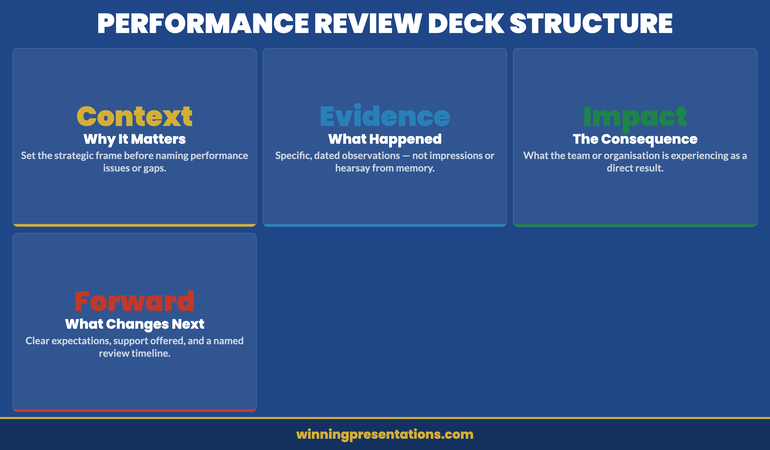
The structure below works across the full range of team performance presentation contexts — from board briefings to HR panel reviews to executive committee updates. Each component serves a specific function in the executive’s understanding of the situation.

Four-component framework for structuring an executive team performance review presentation

Component one — Context. Before naming the performance issue, establish the strategic frame. What is the team’s role in the organisation? What are their key deliverables? What targets or standards apply? This component ensures that the executive audience has a common reference point before evaluating the performance data. It also signals that your presentation is objective rather than personal — you are presenting against agreed standards, not individual preference.

Component two — Evidence. Present specific, dated observations of the performance concern. The most credible evidence is quantitative — missed targets, delivery failures, client complaints, safety incidents. Where quantitative data is unavailable, use dated written records: meeting notes, email exchanges, formal review documentation. Impressions and recollections carry little weight with an executive audience and invite challenge.

Component three — Impact. Translate the performance data into organisational consequence. What is the team, the client relationship, or the broader organisation experiencing as a result of the underperformance? Impact is the bridge between the individual’s behaviour and the leadership body’s remit. Without a clear impact statement, the board or executive committee has no basis for involvement — the issue remains a line-management matter.

Component four — Forward path. Close with clear expectations for the period ahead, the support being offered, and the review timeline. The forward path demonstrates that you have moved from diagnosis to management — and gives the leadership body something to endorse rather than a problem to resolve for you. A specific timeline with named review points is more credible than a general commitment to improve the situation.

The Executive Slide System

Slide templates and scenario playbooks designed for executive presentations that require precise framing — including sensitive operational and people decisions.

  • Slide templates designed for operational review and leadership briefings
  • AI prompt cards to structure difficult-topic presentations quickly
  • Framework guides for presenting sensitive decisions to executive audiences
  • Scenario playbooks for board updates, HR escalations, and risk briefings

Get the Executive Slide System — £39

Designed for executives presenting operational and people decisions to senior leadership.

Delivering Difficult Messages Without Losing Authority

The most common failure mode in team performance presentations is over-softening. The presenter, uncomfortable with the difficult message, introduces so many qualifications and contextual caveats that the core message becomes unclear. An executive audience that cannot determine whether you are describing a serious performance concern or a temporary dip in a capable team member’s output cannot make the decision they need to make.

Be specific about the standard that was missed. “Performance has been below expectations” tells the board very little. “Sales conversion was 32% against a team target of 55% across Q1 and Q2” gives them something concrete to evaluate. Specific evidence is not harsher than vague evidence — it is more honest, and it protects you from the accusation of subjective judgement.

Separate the person from the position. The most professionally robust performance presentations focus on the role’s requirements and the observed gap — not on the individual’s character, motivation, or attitude. “The role requires X. The observed performance on X has been Y for the following documented period” is more defensible and more persuasive than any formulation that attributes the gap to the individual’s personal qualities.

Present the management actions you have taken. An executive audience needs to understand what you, as the presenting leader, have done to address the performance concern before bringing it to their attention. The implicit question behind every escalated performance presentation is: “Has the manager done everything within their authority to resolve this?” If the answer is yes, the escalation is credible. If the answer is not yet, the board will question why the matter has been escalated prematurely.

The Executive Slide System includes scenario playbooks for operational presentations to senior leadership, including frameworks for structuring sensitive people decisions.

Managing Defensive Reactions in the Room

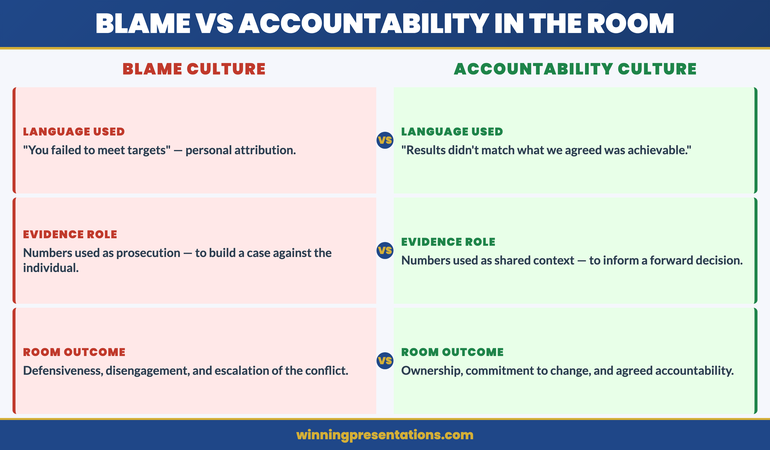
Performance presentations to a leadership or governance body can generate defensive reactions — not always from the individual being discussed, but from other leaders in the room who have their own stake in the situation. A long-serving team member may have advocates at executive level. A performance concern that reflects on the quality of previous leadership decisions may be met with resistance from those who made those decisions. Being prepared for these dynamics is as important as being prepared for the content.

Contrast between blame culture and accountability culture approaches to team performance presentations

Distinguish between a response that seeks information and one that seeks to discredit. A question like “what support has been offered?” is information-seeking — the executive wants to know whether due process has been followed. A question like “isn’t this a management problem rather than a performance problem?” is often an attempt to redirect accountability. The first deserves a direct, detailed answer. The second deserves a measured response that acknowledges the management dimension while maintaining the performance narrative.

Never make commitments in the room that you haven’t modelled. Under social pressure from a defensive executive, the impulse to concede — to agree that more time should be given, or that the targets should be reviewed — can feel like a way to reduce conflict in the moment. It is rarely a sound operational decision. If you need to consider a proposed change to the performance management plan, commit to modelling the impact and returning within a specific timeframe, rather than agreeing on the spot.

Bring the conversation back to organisational impact. When the room becomes focused on the individual’s personal circumstances or on historical decisions, the most effective re-framing is to return to the organisational impact statement. “I understand the context. The question for this committee is what we do about the fact that [named outcome] is at risk.” This shifts the frame from blame to decision — which is where executive committees are most effective. The principles here align with those in the companion piece on presenting redundancy announcements to affected teams.

The Post-Presentation Follow-Up That Makes It Stick

The performance review presentation creates commitments — from you, from the individual concerned (if present), and from the leadership body. The post-presentation follow-up determines whether those commitments are honoured or allowed to fade. There are three elements to an effective follow-up process.

A written record of decisions made. Within 24 hours of the presentation, send a summary of the decisions taken and actions agreed in the meeting. This serves as a contemporaneous record — which matters both for due process and for accountability. The summary should be factual and outcome-focused, not a narrative account of the discussion.

A direct conversation with the individual. If the individual was not present in the executive presentation, they need to be informed of the leadership body’s assessment and decisions as soon as possible — typically within the same working day. The individual should hear the outcome directly from their manager, not through informal channels. The conversation should align precisely with the written record: the same language, the same commitments, the same timeline.

A structured review checkpoint. The performance improvement plan that follows should have a named review date — typically 30, 60, or 90 days, depending on the severity of the concern. This checkpoint should be diarised at the time of the presentation, with the expectation that you will return to the executive body with a progress update at that point. This creates accountability for both the manager and the individual, and demonstrates to the board that the issue is being actively managed rather than filed.

Protecting Yourself Legally and Professionally

Performance presentations at executive level create a paper trail that may become relevant in subsequent employment proceedings. The way you present the information — and the language you use — has implications that extend beyond the meeting. There are four principles that protect your professional and legal position.

Use documented evidence only. Do not include in your presentation any assertion, characterisation, or concern that does not exist in a contemporaneous written record. The moment an executive presentation introduces information that was never documented at the time it occurred, you create credibility risk — and potentially legal risk if the matter escalates to an employment tribunal.

Involve HR before the presentation. HR should be consulted on both the process and the content of any performance presentation to a leadership body. This is not bureaucratic caution — it is risk management. HR will often identify procedural gaps that, if not addressed before the presentation, create grounds for challenge later.

Be consistent in application. An executive audience will assess whether your performance management approach has been applied consistently across the team. If the individual being discussed has been managed more leniently or more harshly than colleagues in comparable situations, this inconsistency will be visible — and will invite questions about whether the performance concern reflects a genuine standard gap or a management preference. The broader context of leadership credibility in high-stakes presentations is covered in the guide to building credibility in your first board presentation in a new role.

Do not speculate about outcome. In the presentation itself, do not reference possible termination, demotion, or other employment outcomes unless these have been agreed in advance with HR and legal as appropriate disclosures. Speculating about employment consequences in an executive presentation — even informally — can prejudice a subsequent process.

Structure Your Next Leadership Briefing

The Executive Slide System includes framework guides for structuring operational presentations — including sensitive situations that need to hold up under board-level and HR scrutiny.

View the Executive Slide System — £39

Designed for executives preparing operational briefings for senior leadership.

Frequently Asked Questions

Should the individual being reviewed be present in an executive-level performance presentation?

This depends on the nature and purpose of the presentation. If the purpose is to brief a leadership body on an operational risk situation, the individual is typically not present — the presentation is a management briefing, not a performance review meeting. If the presentation is part of a formal HR process and the individual has a right to attend or be represented, HR will advise on the appropriate protocol. As a general principle, decisions about individual presence should be made with HR guidance before the presentation, not during it.

How do I present performance concerns without being accused of bias or discrimination?

The most effective protection against bias accusations is a structure that is entirely evidence-based and explicitly linked to agreed standards. When every assertion in your presentation can be traced to a documented record, a named target, or a published standard, the presentation becomes an analysis of a gap rather than a judgement about a person. Consistency is equally important: ensure that the performance management approach you describe has been applied in the same way to comparable situations across the team.

What should I do if the executive committee disagrees with my assessment?

Listen carefully to the basis of their disagreement. If they have information you do not — about the individual’s context, about commitments made at a higher level, about strategic considerations that affect the assessment — that information is relevant and you should factor it in. If the disagreement is about the interpretation of evidence that you and HR are confident in, present the evidence clearly and request that any decision to deviate from the recommended management approach be made explicit and minuted. You are not required to change your assessment in response to social pressure, but you are required to implement whatever decision the governance body makes within its authority.

The Winning Edge — Weekly Newsletter

Executive presentation strategy, delivered every Thursday. Practical frameworks for high-stakes operational and leadership conversations.

Subscribe to The Winning Edge

Free resource: Executive Presentation Checklist — a practical pre-meeting audit for high-stakes leadership presentations.

About the Author

Mary Beth Hazeldine is Owner & Managing Director of Winning Presentations. With 24 years of corporate banking experience at JPMorgan Chase, PwC, Royal Bank of Scotland, and Commerzbank, she advises executives across financial services, healthcare, technology, and government on structuring presentations for high-stakes funding rounds and approvals. Connect at winningpresentations.com.

20 Feb 2026
Professional woman in navy blazer presenting compensation data on laptop screen to senior male executive in glass-walled boardroom

Presenting to the Person Who Will Decide Your Bonus (What Most Professionals Get Wrong)

Quick answer: Presenting to your boss about compensation is not a negotiation — it’s an executive presentation. The professionals who get better outcomes treat it like a boardroom pitch: lead with impact, not with an ask. Structure your slides using a Value-First framework that positions what you’ve delivered before the compensation question even surfaces. Most people do it backwards — they open with what they want instead of what they’ve earned.

The Compensation Conversation I Almost Ruined at JPMorgan

I walked into my manager’s office with a number in my head and nothing on paper.

This was early in my banking career at JPMorgan Chase. I’d delivered three major client presentations that quarter, each one securing significant renewals. I knew I deserved a better bonus. What I didn’t know was how to make that case without sounding like I was complaining.

So I did what most people do: I started talking about what I wanted. My manager listened politely, said he’d “look into it,” and nothing changed.

Six months later, a colleague in the same team got a significantly better outcome. The difference? She’d walked in with three slides. Not a deck — three slides. One showed her client retention numbers. One showed the revenue she’d influenced. The third showed her next-quarter pipeline. She never mentioned money once. Her manager brought it up.

That was the moment I understood: presenting to the person who decides your compensation isn’t a conversation. It’s a presentation. And the structure matters more than the ask.

After 24 years in corporate banking — across JPMorgan, PwC, Royal Bank of Scotland, and Commerzbank — I’ve seen this pattern play out in every team I’ve worked with. The people who present their value well get rewarded. The people who just “have a chat” get told to wait.

The difference isn’t talent or timing. It’s structure. And the professionals who consistently get recognised for their contributions all do the same thing: they present evidence before they present an ask. They make it easy for their manager to fight for them in the room where compensation decisions actually happen — which is rarely the room you’re sitting in. Here’s the framework I now teach to executives preparing for one of the highest-stakes presentations of their career — and one that most people never think to prepare for at all.

Stop Winging Your Most Important Presentation

The Executive Slide System gives you the exact slide structures that position your value before anyone has to ask. Built from 24 years of boardroom experience.

Get the Executive Slide System → £39

Built from 24 years in banking and consulting environments. Used in board updates, steering committees, and decision meetings.

Why Most Compensation Presentations Fail Before Slide 2

The biggest mistake isn’t asking for too much. It’s starting with the ask.

When you open a compensation conversation with “I’d like to discuss my bonus,” you’ve immediately put your manager in a defensive position. They’re now thinking about budget constraints, team equity, and how to manage your expectations — before you’ve given them a single reason to fight for you.

This is the same pattern I saw repeatedly across my years at PwC and Commerzbank. The professionals who struggled with compensation conversations all made the same structural error: they treated the meeting like a negotiation instead of a presentation.

Here’s what that looks like in practice:

❌ Wrong opening: “Thanks for making time. I wanted to discuss my compensation for this year. I’ve been here three years and I feel like my salary doesn’t reflect my contribution.”

✅ Right opening: “Thanks for making time. I put together a brief overview of what I’ve delivered this quarter and where I see the biggest opportunities next quarter. I’d value your perspective.”

The first version puts your manager on the back foot. The second gives them something to work with — and a reason to listen.

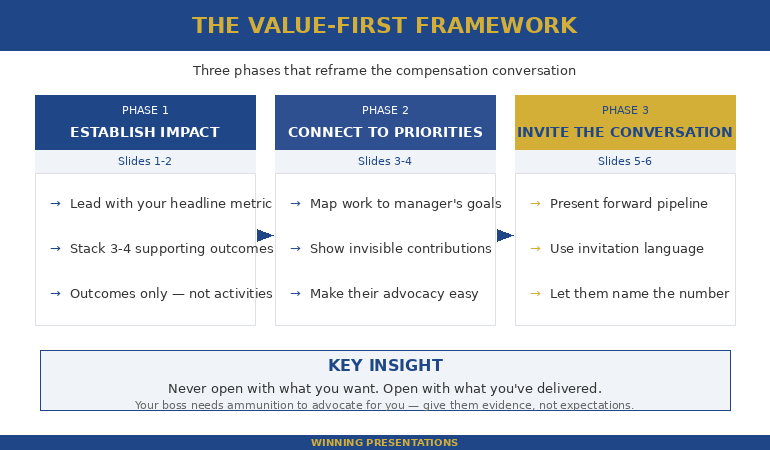
Value-First framework for presenting to boss about compensation showing three phases: establish impact, connect to priorities, then invite the conversation

The Value-First Framework for Presenting to Your Boss About Compensation

The framework that consistently works for compensation presentations has three phases — and none of them start with money.

Phase 1: Establish Impact (slides 1-2). Open with what you’ve delivered in the current period. Not activities — outcomes. Not “I worked on the Q3 client review.” Instead: “Q3 client review retained £1.2M in renewals.” If you don’t have revenue numbers, use time saved, problems prevented, or stakeholders influenced. Your boss thinks in these units.

Watch the difference:

❌ Wrong: “I’ve been really busy this quarter. I worked on the client review, the onboarding project, and helped with the team offsite.”

✅ Right: “Three outcomes this quarter: £1.2M in retained client revenue, 40% faster onboarding cycle, and the new team structure that reduced escalations by half.”

The first is a list of activities. The second is a portfolio of results. Your boss can take the second version into their own review meeting. They can’t do anything with the first.

Phase 2: Connect to Their Priorities (slides 3-4). Show how your work maps directly to what your manager is measured on. Every manager has 3-4 things their boss asks them about. If your contributions connect to those things, you’ve just made it easy for your manager to justify your compensation — not to you, but to the person above them.

This is exactly the kind of structure the Executive Slide System helps you build — slide-by-slide frameworks that make your case before anyone has to ask.

Get the Executive Slide System → £39

Phase 3: Invite the Conversation (slides 5-6). You don’t ask for a number. You present your forward-looking value and let the compensation discussion emerge naturally. “Given the pipeline I’m building for Q2, I’d value your perspective on how my contribution is being recognised.” That’s not an ask — that’s an invitation. It works because your boss has just seen the evidence.

The 6-Slide Structure That Reframes the Entire Conversation

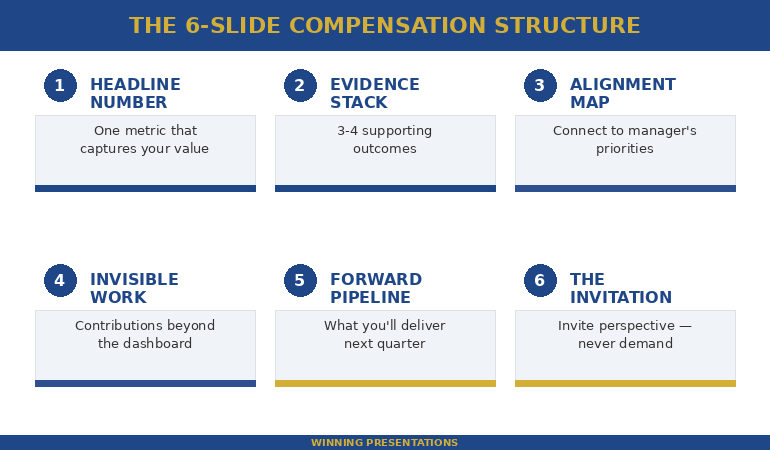
Here’s the exact slide-by-slide breakdown I recommend to executives preparing to present to the person who controls their compensation. Each slide has one job. No more.

Slide 1 — The Headline Number. One metric that captures your contribution this period. Not a paragraph. One number with context.

❌ Wrong slide 1 title: “Compensation Review Discussion — Q1 2026”

✅ Right slide 1 title: “£1.2M Retained Revenue From Three Client Renewals I Led”

The wrong version announces what you want. The right version announces what you’ve delivered. Your boss reads the second title and immediately thinks: “This person knows their value.” That’s the frame you want before a single word is spoken. This is your executive summary slide — the one that frames everything after it.

Slide 2 — The Evidence Stack. Three to four supporting outcomes that reinforce the headline. Each one should be a single line: metric + context.

❌ Wrong: A bulleted list of everything you worked on — “Participated in the Q3 client review process. Helped onboard new team members. Contributed to the offsite planning.”

✅ Right: Three lines only — “Client retention: 100% renewal rate (£1.2M). Onboarding: cycle reduced from 6 weeks to 3.5. Escalations: down 52% since new structure implemented.”

No explanations. No qualifiers. Your boss doesn’t need you to explain why retaining a client matters.

Slide 3 — The Alignment Map. Show how your outcomes connect to your manager’s stated priorities. If their boss asked them “what’s your team delivering?” — your slide should be the answer they’d give.

❌ Wrong: “My achievements this quarter” — a self-focused list with no connection to departmental goals.

✅ Right: A two-column slide: left column lists your manager’s stated Q1 priorities, right column shows your direct contributions to each one.

This is what separates professionals who get rewarded from those who get “we’ll revisit this next quarter.”

Slide 4 — The Invisible Work. Every professional does work that doesn’t show up in dashboards. Mentoring. Crisis management. Covering for absent colleagues. Political navigation. One slide acknowledging this work — with specifics — tells your boss you understand your full value, not just the measurable parts.

❌ Wrong: “I also do a lot of things that aren’t captured in my KPIs.”

✅ Right: “Three contributions beyond the dashboard: mentored two junior analysts through their first client presentations. Resolved the supply chain escalation before it reached the exec team. Stepped in to cover the Northern region when James was on leave for six weeks.”

Vague claims get nodded at. Specifics get remembered — and repeated upward.

Slide 5 — The Forward Pipeline. What are you set to deliver in the next quarter? This is the slide that changes the conversation from backwards-looking (“what have you done?”) to investment-oriented (“what will you do next?”). Managers who see a strong pipeline are more willing to invest in retaining you.

Slide 6 — The Invitation. No ask. No demand. Just: “I’d appreciate your perspective on how my contribution is being recognised going forward.”

❌ Wrong: “So based on all of this, I think a 15% increase is fair and I’d like to discuss how we make that happen.”

✅ Right: “I’d value your perspective on how this level of contribution is being reflected. I’m also happy to put together a summary you can share with [skip-level name] if that’s useful.”

The wrong version turns you into a negotiator. The right version turns you into a partner — and gives your boss a tool to advocate for you in the room you’re not in.

Six-slide compensation presentation structure showing Headline Number, Evidence Stack, Alignment Map, Invisible Work, Forward Pipeline, and Invitation slides

Build Your Compensation Presentation Tonight

The Executive Slide System includes ready-to-use frameworks for exactly this scenario — including slide structures for value positioning, stakeholder alignment, and decision presentations.

Get the Executive Slide System → £39

Built from 24 years of corporate banking experience and 15 years training executives for high-stakes conversations.

What to Say When Your Boss Says “The Decision Isn’t Mine”

This is the most common deflection — and the most misunderstood. When your boss says the compensation decision isn’t entirely theirs, they’re usually telling the truth. But they’re also telling you something else: they need ammunition.

The correct response is: “I understand it involves multiple stakeholders. Would it help if I put together a brief summary of my contributions this period that you could share?”

You’ve just offered to make their job easier. You’ve also ensured your value gets presented upward — in your words, not a second-hand summary that loses the impact.

This is the same dynamic I saw at Royal Bank of Scotland when working with directors who needed to justify team compensation to the executive committee. The directors who had structured summaries from their team members could advocate effectively. The ones who had to reconstruct contributions from memory couldn’t.

Having the right structure makes this effortless. The Executive Slide System gives you frameworks designed for presenting to senior decision-makers — including the people who control your pay.

Get the Executive Slide System → £39

One timing note: Present your value 4-6 weeks before the compensation cycle starts — not during it. By the time formal reviews begin, budgets are often already allocated informally. And if you’ve just delivered a visible win, don’t wait. Recency bias is real. Your boss’s memory of your value is at its peak right after a result, not three months later during the “proper” review window.

If the anxiety of these high-pressure conversations is what holds you back, you’re not alone — I spent five years terrified of exactly this kind of meeting before I found techniques that worked. Read more about managing high-stakes meeting nerves.

Common Questions About Presenting Your Value in a Pay Review

How do you present your case for a raise to your boss?

Present your case using a Value-First structure: lead with your measurable impact (revenue, savings, client retention), connect your contributions to your manager’s priorities, then invite the compensation conversation rather than making a direct demand. Three to six focused slides work better than a verbal request. Your boss needs evidence they can present upward — give them that evidence in a format they can use.

What should you include in a compensation presentation?

Include one headline metric that captures your contribution, three to four supporting outcomes with numbers, a slide showing how your work connects to your manager’s priorities, acknowledgement of your invisible contributions, your forward pipeline for next quarter, and a soft close that invites discussion. Avoid listing activities — focus on outcomes. Avoid comparing yourself to colleagues — focus on your own value. And keep it to six slides maximum.

How do you talk to your boss about a bonus without sounding entitled?

The key is structure. When you present documented evidence of your impact and then invite your boss’s perspective — rather than making demands — you position yourself as a professional seeking fair recognition, not someone complaining. The phrase “I’d appreciate your perspective on how my contribution is being recognised” works because it’s collaborative, not confrontational. It also gives your boss room to advocate for you rather than defend a position.

Your Next Compensation Conversation Deserves More Than a Chat

The Executive Slide System gives you proven slide frameworks for career-defining moments — including performance reviews, skip-level meetings, and compensation presentations. Built from 24 years of corporate banking experience.

Get the Executive Slide System → £39

Used in board updates, performance reviews, and compensation conversations across banking, consulting, and corporate teams.

Frequently Asked Questions

Can I use this 6-slide structure for a skip-level meeting?

Yes — and you should. Skip-level meetings are often even more important than direct manager conversations because the senior leader may have more influence over compensation decisions. Adjust the Alignment Map (slide 3) to reflect the skip-level leader’s priorities rather than your direct manager’s. Everything else applies exactly the same way. If anything, the structured approach matters more at skip-level because you have less time and need to make a stronger first impression.

What if I don’t have hard revenue numbers to show?

Revenue isn’t the only language bosses speak. Use time saved (“reduced reporting cycle from 3 days to 4 hours”), problems prevented (“identified the compliance gap before the audit”), stakeholders influenced (“aligned three department heads on the integration plan”), or quality improvements (“reduced client escalations by 60%”). The key is specificity. “I contributed to the project” is worthless. “I led the workstream that delivered the client migration two weeks early” is concrete evidence your boss can use.

What if my boss dismisses the presentation entirely?

This happens — and it usually means one of two things. Either the timing was wrong (present earlier in the cycle next time), or your boss genuinely doesn’t control compensation and hasn’t been transparent about it. In either case, the deck you prepared is not wasted. Ask if you can share it with HR or with the person who does influence the decision. Having a structured document of your contributions is always better than relying on memory — yours or theirs.

Should I include specific salary numbers in my slides?

No. Never put a specific number on a slide. The moment you anchor to a number, you’ve turned a value presentation into a negotiation — and you’ve likely anchored lower than what your boss might have offered. Your six slides are designed to build the case so compellingly that your boss initiates the compensation discussion. Let them name the number first. Your job is to make the case so strong that the number reflects your actual value.

📬 Get Weekly Presentation Intelligence

Slide structures, executive communication strategies, and career presentation techniques — delivered every week. No fluff. No spam. Just the frameworks that work in real boardrooms.

Join the Newsletter

📋 Free: Executive Presentation Checklist

A quick-reference checklist for any high-stakes executive presentation — including compensation conversations, board updates, and stakeholder reviews.

Download the Free Checklist

Related: If the anxiety of a salary or bonus conversation is what’s really holding you back, read How I Learned to Present Under Extreme Pressure — the techniques that helped me stay calm in the conversations that mattered most.

Your next step: Open a blank deck tonight. Create six slides using the structure above. You’ll be surprised how much easier the conversation feels when you have evidence on screen instead of nerves in your head.

Want the proven frameworks that make this effortless? Build your salary review presentation in under an hour.

Get the Executive Slide System → £39

About the Author

Mary Beth Hazeldine is the Owner & Managing Director of Winning Presentations. With 24 years of corporate banking experience at JPMorgan Chase, PwC, Royal Bank of Scotland, and Commerzbank, she has delivered high-stakes presentations in boardrooms across the UK and Europe.

A qualified clinical hypnotherapist and NLP practitioner, Mary Beth combines executive communication expertise with evidence-based techniques for managing presentation anxiety. She has spent 15 years training executives and supporting high-stakes board presentations, steering committee updates, and decision meetings.

Book a discovery call | View services

01 Feb 2026
Professional woman confidently presenting salary review data to manager in modern office meeting

The Salary Review Presentation: How One Slide Got My Client a 35% Raise

She walked into her salary review with 47 bullet points of accomplishments. She walked out with a 3% cost-of-living adjustment.

Six months later, she tried again—with one slide. She got 35%.

The difference wasn’t confidence. It wasn’t timing. It wasn’t even her track record (which was excellent both times).

It was the structure of what she showed her manager in the first 60 seconds.

Quick answer: The most effective salary review presentation uses a single “Value Proposition” slide that leads with your financial impact—not your accomplishments. Structure it as: (1) business problem you solved, (2) measurable outcome, (3) market rate comparison, (4) specific ask. This framing shifts the conversation from “why you deserve more” to “why paying you more is a smart business decision.”

Why Leading With Accomplishments Backfires

In my 24 years of corporate banking at JPMorgan Chase, PwC, and Royal Bank of Scotland, I watched hundreds of salary conversations go sideways.

The pattern was always the same: talented professionals would prepare exhaustively. Lists of projects. Metrics. Testimonials from colleagues. Training completed. Extra hours worked.

And their managers would nod politely, thank them for their contributions, and explain that “the budget is tight this year.”

Here’s what those professionals didn’t understand: accomplishments are past-tense. Managers fund future value.

When you lead with what you’ve done, you’re essentially saying: “I already gave you this value. Now pay me for it.” That’s not how business decisions work.

When you lead with what you’re worth to them going forward, you’re saying: “Here’s the return on investment you’ll get by keeping me engaged.”

One framing gets you gratitude. The other gets you money.

How do you present a salary increase request?

Present your salary request as a business case, not a personal appeal. Lead with the financial impact you create (revenue generated, costs saved, risks mitigated), compare it to market rates for similar roles, and make a specific ask. Keep it to one slide that takes 60 seconds to present—then stop talking and let them respond.

Value Proposition slide template showing four-part salary review structure: Problem, Outcome, Market, Ask

The One-Slide Format That Works

After testing dozens of approaches with clients, I’ve found that salary conversations work best when you present a single slide with four components:

Component 1: The Business Problem (One Line)

Start with a problem the company faced that you solved. Not a task you completed—a problem with stakes.

Weak: “Led the Q3 product launch”

Strong: “Q3 launch was at risk of missing deadline by 6 weeks, threatening £2.1M in committed revenue”

Component 2: The Measurable Outcome (One Line)

What happened because of your involvement? Use numbers.

Weak: “Successfully delivered on time”

Strong: “Delivered 2 weeks early. £2.1M revenue secured. Team retention at 100% (vs. 67% company average)”

Component 3: Market Rate Comparison (One Line)

This is the part most people skip—and it’s the part that makes the business case.

Research comparable roles on Glassdoor, LinkedIn Salary Insights, and industry surveys. Present the range.

Example: “Market rate for this role with my experience: £85,000-£105,000. Current compensation: £72,000.”

Component 4: The Specific Ask (One Line)

Don’t say “I’d like to discuss my compensation.” Make a specific request.

Example: “Requesting adjustment to £92,000, reflecting mid-market rate and contribution to date.”

That’s it. Four lines. One slide. Sixty seconds.

The structure works because it mirrors how executives make every other business decision: problem → solution → market context → action.

You can learn more about this decision-focused approach in my guide to the executive summary slide—the same principles apply.

Your Salary Conversation Deserves Better Than a Bullet List

The Executive Slide System includes the exact “Value Proposition” slide template I used with Sarah—plus 12 other executive-ready formats for every high-stakes conversation.

Get the Executive Slide System → £39

Built from 24 years in corporate banking + executive presentation coaching. Used in salary reviews, promotion cases, and budget approvals.

From 47 Bullets to One Slide: Sarah’s Story

Sarah was a senior product manager at a fintech company. Brilliant at her job. Consistently rated “exceeds expectations.” And stuck at the same salary for three years.

Her first attempt at a salary conversation was textbook “what not to do”:

  • 47 bullet points of accomplishments across 6 slides
  • 15 minutes of presenting
  • Ended with “I feel I deserve to be compensated fairly”

Her manager agreed she was valuable. Thanked her for her contributions. Offered 3%—the standard cost-of-living adjustment.

When Sarah came to me, she was ready to start job hunting. I asked her one question:

“What’s the single biggest business problem you solved this year, and what was it worth?”

After some digging, we found it: she’d prevented a product launch disaster that would have cost £1.8M in customer refunds and damaged a key partnership.

We built one slide:

VALUE PROPOSITION

Problem: June product launch facing critical API failure, putting £1.8M customer commitments at risk

Outcome: Identified root cause in 72 hours. Zero customer impact. Partnership renewed for 3 years (£4.2M TCV)

Market: Senior PM roles at comparable fintechs: £95,000-£115,000. Current: £78,000

Ask: Adjustment to £105,000 reflecting contribution and market positioning

She presented it in 45 seconds. Then stopped talking.

Her manager was silent for a moment. Then: “I didn’t realise the June situation was that close to disaster. Let me talk to the CFO.”

Two weeks later: £105,000. A 35% increase.

Same accomplishments. Same manager. Same budget constraints. Different frame.

Want to use the same structure Sarah did?

Get the Executive Slide System → £39

What slides should I include in a salary review presentation?

One slide is usually enough—and often more effective than a full deck. Include: (1) a specific business problem you solved, (2) the measurable financial outcome, (3) market rate data for comparable roles, and (4) your specific salary request. This structure takes 60 seconds to present and frames your value in terms managers can act on.

Timing and Delivery Tips

The slide is only half the equation. Here’s how to deploy it:

When to Present

Best timing: 2-3 weeks before your formal review cycle. This gives your manager time to advocate internally before budgets are locked.

Worst timing: During the review meeting itself. By then, decisions are usually already made.

Request a separate 15-minute meeting. Frame it as: “I’d like to share some thoughts on my role and compensation before our formal review. Can we find 15 minutes this week?”

How to Present

  1. Share the slide in advance — Email it 24 hours before with: “Here’s what I’d like to discuss tomorrow.”
  2. Present in 60 seconds or less — Walk through all four components. Don’t elaborate.
  3. Stop talking — The most important part. After your ask, be silent. Let them respond.

Most people fill the silence with justifications, caveats, and softening language. Don’t. Your slide makes the case. Now let them process it.

This approach aligns with how I teach executives to present to CFOs and other senior leaders—lead with the decision you need, then support it. You can see more on this in my guide to presenting to a CFO.

Stop Hoping Your Accomplishments Speak for Themselves

Get the Templates → £39

What to Say When They Push Back

Even with the right structure, you’ll face objections. Here’s how to handle the common ones:

“There’s no budget this year”

Response: “I understand budget constraints. Can we discuss what would need to happen for this to be possible in Q2? I’d like to understand the path forward.”

This keeps the conversation open and creates accountability for a timeline.

“You’re already well-compensated for your level”

Response: “I appreciate that perspective. The market data I’ve found suggests the range for this impact level is [X-Y]. Can you help me understand how you’re defining the level for my role?”

This shifts the conversation to the job scope, which often reveals that you’re operating above your official level.

“Let me think about it”

Response: “Of course. When would be a good time to follow up? I want to be respectful of your process while also planning my next steps.”

“Planning my next steps” is intentionally ambiguous. It creates gentle urgency without making threats.

How do you justify a pay raise to your boss?

Justify a pay raise by framing it as a business decision, not a personal request. Present the financial impact you create (specific problems solved, revenue protected, costs avoided), compare your compensation to market rates for similar roles, and make a specific ask. The strongest justification connects your continued engagement to future business outcomes.

Get the full objection-handling playbook + follow-up email templates

Get the Complete System → £39

The Psychology Behind the One-Slide Approach

There’s a reason this works, and it’s not manipulation. It’s alignment.

When you present 47 accomplishments, you’re asking your manager to do the work of synthesising them into a business case. Most won’t. They’ll default to the standard adjustment.

When you present one slide with a clear value proposition, you’re doing that work for them. You’re making it easy to say yes.

More importantly, you’re speaking the language they use for every other business decision: problem, solution, market context, action.

Your salary isn’t a reward for past behaviour. It’s an investment in future value. Frame it that way, and you stop competing for limited “merit increase” budget—you start competing for strategic investment budget.

That’s a much bigger pool.

For more on structuring executive-level conversations, see my guide to the executive presentation template.

Your Next Salary Conversation Is Too Important to Wing

The Executive Slide System includes 13 ready-to-use templates for salary reviews, promotion requests, budget approvals, and board presentations. Each one designed for the executive conversations that shape careers.

Get the Executive Slide System → £39

Includes Value Proposition slide, Executive Summary format, and Decision Slide framework—ready to customise in minutes.

Frequently Asked Questions

What if my company has a standard salary review process?

Use the one-slide approach before the formal process—ideally 2-3 weeks ahead. This gives your manager ammunition to advocate for you internally. The formal review then becomes a confirmation of what’s already been decided, not a negotiation from scratch.

How far in advance should I prepare my salary presentation?

Start gathering impact data continuously—don’t wait for review season. When it’s time to present, you should be able to build your one slide in under an hour because you already know your biggest wins. The research on market rates takes another 1-2 hours. Total preparation: half a day, not half a week.

What if my manager says there’s genuinely no budget?

Ask two questions: “What would need to change for this to be possible?” and “Can we agree on a timeline and criteria for revisiting this?” If they can’t answer either, that tells you something important about your future at the company. Sometimes the most valuable outcome of a salary conversation is clarity about whether to stay.

Can I use this approach for a promotion conversation too?

Absolutely—with one modification. For promotions, add a fifth component: “Evidence I’m already operating at the next level.” Use specific examples of decisions you’ve made, scope you’ve managed, or impact you’ve created that matches the job description for the higher role. The frame shifts from “I want to be promoted” to “I’m already doing the job—let’s align the title and compensation.”

📬 Get Weekly Executive Presentation Insights

Join 2,500+ professionals who receive my weekly newsletter on high-stakes presentations, executive communication, and career-advancing slides.

Subscribe to The Winning Edge →

Nervous about presenting your salary case? If the thought of this conversation is already triggering Sunday-night dread, read my companion article: The Sunday Night Presentation Dread: Why It Hits 48 Hours Early (And How to Stop It)

📋 Free Resource: Executive Presentation Checklist

Not ready to invest yet? Download my free checklist covering the 10 elements every executive presentation needs—including salary conversations.

Get the Free Checklist →

Your Next Step

Your salary review is coming. You have two choices:

Option one: Walk in with a list of accomplishments and hope your manager connects the dots. Get the standard 3% adjustment. Wonder why your peers seem to advance faster.

Option two: Walk in with one slide that frames your value in terms your manager can act on. Make a specific ask. Create a conversation about investment, not reward.

Sarah chose option two. It took her 45 seconds to present—and changed her career trajectory.

The slide structure is above. The templates are in the Executive Slide System. The only thing left is your decision.

About the Author

Mary Beth Hazeldine is the Owner & Managing Director of Winning Presentations. With 24 years of corporate banking experience at JPMorgan Chase, PwC, Royal Bank of Scotland, and Commerzbank, she has delivered high-stakes presentations in boardrooms across three continents.

A qualified clinical hypnotherapist and NLP practitioner, Mary Beth combines executive communication expertise with evidence-based techniques for managing presentation anxiety. She has trained thousands of executives and supported presentations that have secured high-stakes funding rounds and approvals.

Book a discovery call | View services