Quick answer: A change management presentation earns executive buy-in when it leads with the cost of standing still, frames the change as the lower-risk option, and gives senior stakeholders a specific role in how the change will land. Most change presentations fail because they pitch the solution before the audience has accepted the problem. This article walks you through the narrative structure, the resistance-handling moves, and the slide sequence that turns a scepticial leadership team into active sponsors.
In this article:
- Why Most Change Management Presentations Lose the Room
- The Four-Part Narrative That Earns Buy-In
- The Slide Structure That Supports the Argument
- Anticipating Resistance Before It Becomes a Blocker
- Giving Senior Stakeholders a Specific Role
- Six Mistakes That Undermine Change Credibility
- Frequently Asked Questions
Amani had been given forty-five minutes to brief the executive committee on a twelve-month operating model redesign. She had been preparing for three weeks. The deck was thorough: thirty-two slides covering current-state pain points, the proposed future state, benchmark data from three peer organisations, an implementation timeline, and a risk register. She walked in confident.
The COO stopped her at slide eight.
“Amani, I’m hearing a proposal. What I need to hear is a choice. You’re showing me where you think we should go. You haven’t shown me what happens if we don’t go there, and you haven’t shown me why standing still is more expensive than moving.”
She spent the next fortnight restructuring the entire presentation. The proposed future state moved from slide six to slide sixteen. The first ten minutes became an argument about the cost of inaction — attrition patterns, unit economics declining year-on-year, regulatory exposure growing. By the time the new model appeared, the committee were already asking how fast it could happen. The change itself had not changed. The order of the argument had.
That sequencing is what separates a change management presentation that earns commitment from one that triggers a debate.
If you are building a change management presentation and want a structured starting point for your slides, the Executive Slide System includes scenario-specific templates for stakeholder alignment conversations, along with AI prompts designed to help you frame complex change arguments in executive terms.
Why Most Change Management Presentations Lose the Room
A change management presentation is not really a presentation about change. It is an argument about risk, identity, and control. When an executive leadership team pushes back on a change proposal, they are rarely resisting the change itself. They are resisting the way the change has been framed.
Three framing problems appear in almost every change presentation that fails to land:
- The solution arrives before the problem has landed. Most decks spend too long explaining what the new operating model, system, or structure will look like, and not enough time making the audience feel the cost of the current state. The leadership team have not emotionally agreed there is a problem. Arguing for a solution before the problem is accepted feels premature.
- The change is positioned as ambitious, not conservative. Senior stakeholders see themselves as stewards of the organisation. Ambition feels like exposure. If the presenter positions the change as a bold move, the audience hears risk. If the presenter positions the change as the prudent response to a worsening situation, the audience hears governance.
- Stakeholders are told about the change instead of given a role in it. A change presentation that treats the leadership team as an audience creates spectators. A presentation that treats them as active sponsors creates co-owners. The board presentation 15-minute framework makes this point directly: decisions happen faster when the decision-makers see themselves in the change, not outside it.
Fixing these three framing problems does not require new data or a better change plan. It requires a different argument structure. That is what the rest of this article walks through.
Build a Change Case Your Leadership Team Can Commit To
The Executive Slide System gives you 26 board-ready slide templates, 93 AI prompts for structuring executive-level arguments, and 16 scenario playbooks covering the high-stakes presentation moments change leaders face most often — including operating model redesigns, organisational restructures, and cross-functional transformation programmes.
Executive Slide System — £39, instant access.
Get the Executive Slide System →
Instant download. 3 files. Use it for your next executive change briefing.
The Four-Part Narrative That Earns Buy-In
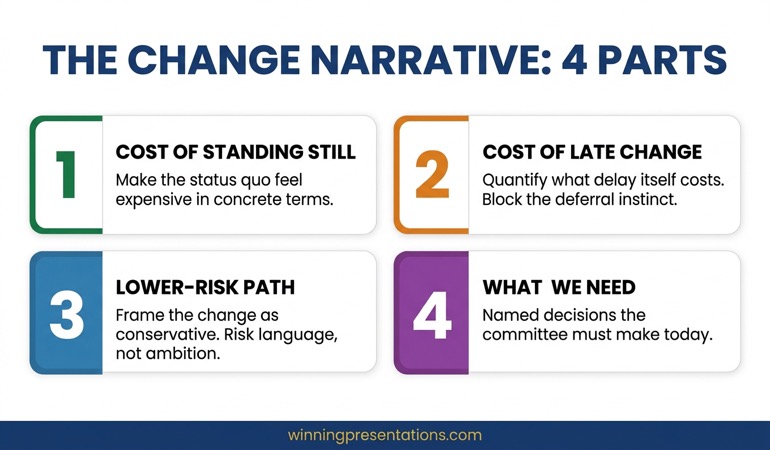
A change management presentation that earns executive commitment almost always follows the same four-part narrative. Each part does a specific persuasive job. Skipping any one of them creates the resistance pattern the presentation was built to avoid.
1. The cost of standing still. Open with a direct, specific description of what the organisation is losing right now by continuing with the current state. Not a generic “the market is changing” statement — a concrete financial, operational, or reputational cost that the leadership team can feel. Decline in unit economics, rising attrition, compliance exposure, customer experience gaps. The goal is to make the status quo feel more expensive than the change.
2. The cost of late change. Even when the leadership team agrees there is a problem, they will default to deferring the response. The second part of the narrative neutralises that instinct by quantifying what happens if the change is delayed by six or twelve months. Lost time is its own cost — describe it. This is the element most change decks omit, and its absence is why so many proposals get a “let us think about it” response.
3. The proposed change, framed as the lower-risk path. Only now does the actual change arrive. Describe the future state and the pathway to it. Crucially, frame the change as the conservative option: it reduces exposure, tightens control, de-risks a current vulnerability. Ambition language (“bold”, “transformative”, “breakthrough”) invites scrutiny. Risk-reduction language (“restore”, “protect”, “stabilise”) invites agreement.
4. What you need from the committee today. End with specific, named decisions the leadership team is being asked to make. Not an abstract “we need your support” — a concrete set of commitments: endorsement of the change case, approval of a phase-one budget, nomination of executive sponsors, agreement on the communication sequence. Giving the committee a clear ask transforms the presentation from a briefing into a decision point.
These four parts, in this order, do the persuasion work that generic change decks miss. The sequence matters more than the individual slides.
The Slide Structure That Supports the Argument
A forty-minute change management presentation does not need forty slides. It needs eight to twelve slides that each do a specific persuasive job, with supporting detail available in an appendix. Bloat is the enemy of buy-in: every additional slide increases the probability that the argument will lose momentum.
A decision-led change deck typically maps like this:
Slide 1: Executive summary and decisions requested. One page. Three decisions. This is the slide the committee will remember. The rest of the deck exists to support this slide.
Slide 2: The current-state cost, quantified. The financial or operational impact of the status quo, expressed in the committee’s native metrics. If they think in operating margin, show operating margin. If they think in customer outcomes, show customer outcomes.
Slide 3: The trajectory if nothing changes. A simple projection of the current-state cost over the next twelve to twenty-four months. This is what turns “we have a problem” into “we have a problem that will get worse”.
Slide 4: The proposed change, at one level of abstraction. Not the detailed target operating model. A single-page articulation of what changes and what stays the same. Your executive summary slide pattern works perfectly here: one clear statement, three supporting pillars.
Slide 5: Why this is the lower-risk path. The explicit risk-reduction argument. What exposures does the change reduce? What happens to them if the change is not made? This slide inoculates against the “but what if it goes wrong” challenge before it arrives.
Slide 6: Phased implementation and off-ramps. A phase-one commitment, with clear decision points before phase two is initiated. Leadership teams approve staged commitments far more readily than all-or-nothing investments.
Slide 7: Anticipated resistance and how it will be handled. Preempt the organisational pushback. Name the three or four groups most likely to resist and describe exactly how their concerns will be addressed.
Slide 8: What we need from you today. Return to the decisions requested. Name each sponsor role. Confirm the phase-one budget and timeline. Close the loop opened on slide one.
If your current change deck runs twenty-five slides and still feels short of answers, the problem is structure, not volume. The scenario playbooks and prompt cards inside the Executive Slide System are designed to compress a sprawling change narrative into the eight- to twelve-slide arc that executives can actually act on.
Anticipating Resistance Before It Becomes a Blocker
The most important resistance-handling move in a change management presentation happens before the question is asked. If the presenter can name the objection first, the dynamic shifts from defence to dialogue. That is why an explicit “anticipated resistance” slide is one of the most powerful persuasion tools in a change deck.
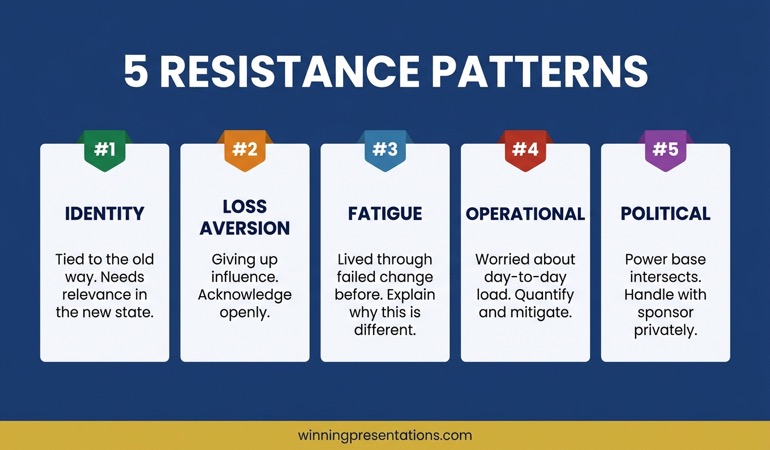
Most organisational change produces predictable resistance patterns. Naming them early builds credibility. Five recurring patterns show up in almost every significant change programme:
- Identity resistance. Individuals or teams whose professional identity is tied to the current way of working. Their concern is not workflow — it is relevance. Address it by naming how their expertise is carried forward into the new state.
- Loss aversion. Stakeholders who feel they are giving up influence, headcount, or perceived control. Address it by acknowledging the loss openly rather than minimising it.
- Fatigue resistance. Teams who have lived through previous change programmes that did not deliver. Address it by distinguishing specifically how this change is different from the ones they remember.
- Operational anxiety. Managers who are worried the change will distract from day-to-day delivery. Address it by quantifying the implementation load and naming the mitigations.
- Political resistance. Senior stakeholders whose power base intersects with the area being changed. Address it directly with the sponsor rather than in the open session — the presentation should acknowledge the sensitivity without naming individuals.
Including this slide in the change deck communicates something important to the executive committee: the presenter has thought about the human reality of the change, not just the structural logic. That impression of thoroughness often carries the rest of the argument.
Giving Senior Stakeholders a Specific Role
Change programmes rarely fail because the change itself was wrong. They fail because the senior leadership team never committed to a visible, specific role in making the change land. A good change management presentation closes by giving each relevant leader a named responsibility — and getting that commitment before the meeting ends.
The most effective role assignments follow three principles:
Specificity. “We need your support” is not a role. “We need you to host a monthly operational check-in with the project steering group and personally send the quarterly communication to the division” is a role. Vague asks produce vague commitments.
Visibility. Role assignments should be visible to the rest of the organisation. A CFO who commits to chairing the budget-realignment working group publicly has a different stake in the outcome than a CFO who has privately said yes.
Low friction. Each role should be achievable within the executive’s existing time commitments. A role that requires forty new hours per month will be declined quietly. A role that requires two hours of visible sponsorship per month will be accepted.
The work of securing these commitments often begins before the presentation itself — in the one-to-one conversations with each senior stakeholder in the week before the meeting. The presentation confirms publicly what has already been agreed privately. That pattern is developed in more detail in our guide to senior stakeholder management presentation skills.
Six Mistakes That Undermine Change Credibility
Across change programmes in financial services, healthcare, public sector transformation, and technology-driven operating model redesigns, the same presentation mistakes show up again and again. Each of them is easy to fix once it has been named.
- 1. Leading with the future state. The future state is slide sixteen, not slide one. Earn the right to show it by making the current-state cost feel real first.
- 2. Using ambition language instead of risk-reduction language. “Transformation” invites scrutiny. “Stabilisation” invites agreement. Word choice is argument choice.
- 3. Presenting a single option without alternatives considered. Executives distrust binary proposals. Show the two or three alternatives that were considered and why the recommended path is the strongest.
- 4. Treating resistance as something to manage later. If resistance is not named in the presentation, the committee will assume the presenter has not thought about it. Surface the pattern, describe the response.
- 5. Ending with “any questions?” End with a named ask. “We are asking the committee to endorse the change case, approve the phase-one budget, and confirm executive sponsors today.” Silence signals uncertainty; specificity signals control.
- 6. Presenting as the change programme rather than with the change programme. The presenter is not advocating for a proposal. The presenter is the voice of the committee’s own change programme. That subtle shift in positioning changes the room.
Fixing these six mistakes is often the fastest way to take a change proposal from contested to endorsed. None of them require the change plan to change. They only require the presentation to.
Is a Structured Slide System Right for You?
The Executive Slide System is designed for change leaders, programme directors, transformation officers, and senior managers who present to executive committees, sponsor groups, or cross-functional leadership forums on a recurring basis. If you build the same kind of change argument repeatedly and want a structured starting point rather than a blank slide, the templates and AI prompt cards will compress your preparation time significantly.
If your presentations are one-off events with no recurring executive audience, you may find more value in a single-scenario toolkit. The Executive Slide System is optimised for repeat presenters in executive settings.
Need the Templates, Not Another Article?
The Executive Slide System includes the four-part change narrative this article describes, applied to 16 real-world executive scenarios including operating model redesigns, restructures, cross-functional governance forums, and stakeholder alignment briefings. Executive Slide System — £39, instant access.
Get the Executive Slide System →
Designed for executive presentation scenarios.
Frequently Asked Questions
How long should a change management presentation be?
For an executive committee briefing, aim for an eight- to twelve-slide deck that can be presented in 20 to 25 minutes, leaving ample time for discussion and decision-making. Detailed supporting analysis belongs in an appendix. If the presentation runs longer than 30 minutes, the committee will run out of cognitive bandwidth before the decisions are made.
Should I share the deck with stakeholders before the meeting?
For a change management presentation, the pre-meeting one-to-one conversations matter more than the pre-read deck. Use the two to three days before the meeting to walk each key stakeholder through the argument privately, hear their objections in a low-stakes setting, and adjust the deck if needed. The formal deck can then be shared 24 to 48 hours before the meeting as a confirmation of what has already been discussed, not as a surprise.
What if the executive committee disagrees on whether the change is needed?
If the disagreement is about whether a problem exists, return to the cost-of-standing-still argument and strengthen the evidence. If the disagreement is about the proposed response, offer an alternative-path analysis that shows two or three options with clear trade-offs. Forcing the committee to pick between competing options is often more productive than trying to convince them of a single answer.
How do I present a change that will lead to redundancies?
Name the human impact explicitly and early in the deck. Avoid euphemisms. Describe how the affected individuals will be supported, what the transition timeline looks like, and how the communication will be handled. Executive committees respect presenters who acknowledge the cost honestly. They distrust presenters who bury the impact in process language.
Get The Winning Edge
A weekly note for executives who present to boards, executive committees, and senior stakeholders. Short, practical, and focused on what actually moves the decision.
Not ready for the full system? Start here instead: download the free Executive Presentation Checklist — a short pre-flight check that helps you spot weak arguments, missing risk framing, and status-heavy slides before your next change briefing.
Related reading: If you also present to governance committees focused on enterprise risk, see our guide to the risk committee presentation — it applies a similar risk-reduction framing to board-level oversight briefings.
Before your next executive change briefing, rebuild the opening ten minutes around the cost of standing still. Everything else follows from there.
About the Author
Mary Beth Hazeldine is Owner & Managing Director of Winning Presentations. With 24 years of corporate banking experience at JPMorgan Chase, PwC, Royal Bank of Scotland, and Commerzbank, she advises executives across financial services, healthcare, technology, and government on structuring presentations for high-stakes funding rounds, board reviews, and change programmes. Winning Presentations was founded in 1990 by David Gilgrist, author of Winning Presentations (Gower Publishing), and Nigel Dickinson.