Tag: investor presentation

14 Dec 2025
Investor pitch deck template - The Sequoia format that raised billions

Investor Pitch Deck Template: The Sequoia Format (With What They Cut)

📅 Updated: December 2025 | Based on 50+ funded pitch decks

The best investor pitch deck template follows the Sequoia format: 10 slides covering Company Purpose, Problem, Solution, Why Now, Market Size, Competition, Product, Business Model, Team, and Financials. Lead with your strongest story. Keep it under 15 slides. Make every slide answer one question: “Why should I invest?”

🎁 FREE DOWNLOAD

Investor Pitch Deck Checklist

10-slide framework + what investors look for on each slide. One page. Print before your pitch.

Download Free Checklist →

No spam. Unsubscribe anytime.


In 2019, I worked with a biotech founder developing a rare disease treatment who’d been rejected by 23 investors.

Her science was solid. Her market was massive. Her team had three PhDs. But she couldn’t get past the first meeting.

The problem wasn’t her company. It was her deck.

She’d built a 47-slide presentation that started with the molecular structure of her compound. By slide 8, investors’ eyes were glazed. She never got to the market opportunity.

We rebuilt her deck using the Sequoia format — 10 slides, story-first, problem-solution structure. She raised £3.2M in her next round.

The template I’m sharing today is the same structure we used. It’s based on the format Sequoia Capital recommends to their portfolio companies, refined through 50+ pitch decks I’ve helped create — including 12 that raised over £50M combined.

Why the Sequoia Format Works

Sequoia Capital has backed Apple, Google, Airbnb, Stripe, and WhatsApp. They’ve seen more pitch decks than almost anyone in venture capital.

Their recommended format isn’t arbitrary. It’s designed around how investors actually evaluate opportunities:

  1. Can I understand this in 3 minutes? — If your deck requires explanation, you’ve lost
  2. Is this a big market? — VCs need billion-dollar outcomes
  3. Why will this team win? — Ideas are cheap; execution is everything
  4. Why now? — Timing kills more startups than bad ideas

The 10-slide structure answers each of these questions in a logical sequence. Miss one, and the investor has a reason to say no.

The Sequoia 10-slide pitch deck structure from company purpose to financials

The 10-Slide Investor Pitch Deck Template

Slide 1: Company Purpose

The question it answers: What do you do in one sentence?

This slide should take 10 seconds to read and understand. If an investor can’t explain your company to their partner after seeing this slide, you’ve failed.

Include:

  • Company name and logo
  • One-line description (what you do, not how you do it)
  • Tagline if you have one that’s genuinely memorable

Example: “Stripe: Payments infrastructure for the internet”

Common mistake: Describing features instead of purpose. “AI-powered B2B SaaS platform leveraging machine learning” tells investors nothing. “We help retailers predict what customers will buy next” tells them everything.

Slide 2: Problem

The question it answers: What painful problem exists?

Make the investor feel the problem. Quantify it. Show that real people or companies are suffering right now — and willing to pay for a solution.

Include:

  • Clear problem statement
  • Who has this problem (be specific)
  • How big the problem is (quantified)
  • What they’re doing today (and why it’s not good enough)

Example: “UK retailers lose £2.3B annually to stockouts. Current forecasting tools are 60% accurate. Buyers spend 15 hours/week manually adjusting orders.”

Slide 3: Solution

The question it answers: How do you solve this?

Don’t describe every feature. Show the core insight — the thing you do differently that makes the problem go away.

Include:

  • Your solution in one sentence
  • How it works (high level)
  • The key insight that makes you different
  • Screenshot or visual if it helps understanding

Example: “Our AI predicts retail demand with 94% accuracy by analysing real-time signals competitors can’t access — social media, weather, local events.”

📄
Get the Complete Checklist

All 10 slides with what investors look for on each. One-page PDF you can reference while building your deck.

Download Free Checklist →

Slide 4: Why Now

The question it answers: Why is this the right moment?

This is the slide most founders skip — and it’s often the most important. Investors have seen similar ideas before. Why will yours work now when others failed?

Include:

  • Market shift (regulation, technology, behaviour change)
  • Why previous attempts failed and what’s different
  • Urgency — what happens if you wait?

Example: “Three things changed in 2024: (1) Real-time social data became accessible via API, (2) Retailers finally have clean POS data, (3) Post-pandemic, demand volatility is 3x higher than 2019.”

I worked with a fintech founder who had a brilliant product but kept getting “interesting, but not right now” responses. His Why Now slide said: “The market is growing.”

We rewrote it to: “Open Banking regulation just forced banks to share data. In 18 months, every bank will need what we’ve already built.”

He closed his round in 6 weeks.

Slide 5: Market Size

The question it answers: Is this big enough to matter?

VCs need billion-dollar outcomes. Your market needs to be large enough that capturing even a small share creates a significant company.

Include:

  • TAM (Total Addressable Market) — the entire market
  • SAM (Serviceable Addressable Market) — the part you could realistically reach
  • SOM (Serviceable Obtainable Market) — your target in the next 2-3 years
  • Source your numbers — “McKinsey estimates” beats “we think”

Common mistake: Absurd TAM claims. “The global retail market is £20 trillion” tells investors nothing. “UK mid-market retailers spend £400M annually on demand forecasting tools” is specific and credible.

Slide 6: Competition

The question it answers: Who else is solving this, and why will you win?

“We have no competition” is a red flag. Every company has competition — even if it’s the status quo of doing nothing.

Include:

  • Competitive landscape (2×2 matrix works well)
  • Key competitors and their approach
  • Your differentiation — what you do that they can’t easily copy
  • Why customers choose you over alternatives

Example positioning: “SAP and Oracle serve enterprise. Inventory Planner serves SMB. We’re the only solution built specifically for mid-market retailers (£10M-£500M revenue) with the accuracy they need at a price they can afford.”

Slide 7: Product

The question it answers: What have you actually built?

Show, don’t tell. Screenshots, demos, or visually striking representations of your product. This is where investors see if you can execute.

Include:

  • Product screenshots or demo
  • Key features (3-4 maximum)
  • What makes it delightful to use
  • Stage of development (MVP, beta, production)

Tip: If your product isn’t visual (APIs, backend infrastructure), show the customer-facing output or dashboard. Investors want to see what users experience.

Slide 8: Business Model

The question it answers: How do you make money?

Be specific. “SaaS subscription” isn’t enough. Show pricing, customer segments, and the unit economics that make this a good business.

Include:

  • Revenue model (subscription, transaction, marketplace, etc.)
  • Pricing and customer segments
  • Key metrics: CAC, LTV, payback period (if you have them)
  • Path to profitability

Example: “£2,000/month per retailer. Average contract: 24 months. Current CAC: £8,000. LTV:CAC ratio: 6:1. Payback: 4 months.”

Slide 9: Traction

The question it answers: Is this actually working?

Show momentum. Investors want to see that something is happening — customers, revenue, usage, partnerships. Even early traction is better than projections.

Include:

  • Key metrics (revenue, customers, users, growth rate)
  • Notable customers or logos
  • Month-over-month growth
  • Key milestones achieved

If you’re pre-revenue: Show other signals — waitlist size, LOIs, pilot agreements, engagement metrics. Anything that proves demand exists.

Slide 10: Team

The question it answers: Why will this team win?

At early stages, investors bet on teams as much as ideas. Show why your specific combination of people is uniquely positioned to solve this problem.

Include:

  • Founders with photos and titles
  • Relevant experience (keep it to 1-2 lines each)
  • Why this team for this problem
  • Key hires or advisors (if they add credibility)

Example: “CEO: 10 years at Tesco leading demand planning. CTO: Built recommendation engine at Amazon. Together: We’ve seen this problem from both sides.”

Slide 11: The Ask

The question it answers: What do you want from me?

Be specific about how much you’re raising, what you’ll use it for, and what milestones you’ll hit.

Include:

  • Amount raising
  • Use of funds (broad categories)
  • Milestones this gets you to
  • Timeline

Example: “Raising £2M Seed. 18-month runway. Milestones: 50 customers, £2M ARR, Series A ready.”

Related: 15 Killer Pitch Deck Templates That Raised £500M+

Before and after pitch deck transformation - from cluttered to clear investor-ready slides

Common Pitch Deck Mistakes

After helping build 50+ funded pitch decks, I see the same mistakes repeatedly:

Mistake 1: Starting with the solution

Your technology is not the story. The problem is the story. If investors don’t feel the pain, they won’t care about your cure.

Mistake 2: Claiming no competition

This tells investors you either don’t understand your market or you’re not being honest. Both are disqualifying.

Mistake 3: Financial hockey sticks with no basis

“We’ll hit £50M revenue in year 3” means nothing without showing how you’ll get there. Bottom-up projections beat top-down fantasies.

Mistake 4: Too many slides

If you can’t tell your story in 10-15 slides, you don’t understand your story well enough. Every slide that doesn’t strengthen the case weakens it.

Mistake 5: Reading your slides

Your deck is a visual aid, not a script. If everything you say is on the slide, why are you there?

Related: Why Your Investor Pitch Deck Isn’t Getting Meetings

Using AI to Build Your Pitch Deck

Tools like PowerPoint Copilot can accelerate pitch deck creation — but use them strategically.

What AI helps with:

  • First-draft structure and flow
  • Consistent formatting and design
  • Generating slide variations quickly
  • Refining language and clarity

What AI can’t do:

  • Know what makes your story compelling
  • Determine the right emphasis for your audience
  • Replace founder authenticity
  • Answer investor questions in the room

Use AI to save time on mechanics. Spend that saved time on what matters: refining your story and practising your delivery.

Related: Best Copilot PowerPoint Prompts That Actually Work

Beyond the Template

A template gives you structure. But structure alone doesn’t raise funding.

The founders who close rounds consistently have more than good slides. They have:

  • A compelling narrative — Every slide connects to one story
  • Confident delivery — They know their deck cold
  • Prepared Q&A — They’ve anticipated every hard question
  • Investor homework — They know who they’re pitching and why

The template is the foundation. Preparation is what builds on it.

⭐ RECOMMENDED

The Executive Slide System (£39)

Ready-to-use templates for investor pitches, board presentations, and executive updates — with the structures that get decisions.

  • Investor pitch deck template — Sequoia 10-slide format, ready to customise
  • 9 more executive templates — Board presentation, strategy deck, budget request, and more
  • Sequoia format built-in — 10-slide structure pre-designed
  • Before/after examples — See exactly how to transform weak slides
  • 30 AI prompts — Customise any template in minutes

Get the Executive Slide System — £39 →

Instant download. Use for unlimited presentations.

Free Checklist vs. Executive Slide System

What You Get Free Checklist Executive Slide System (£39)
10-slide Sequoia framework
Ready-to-use pitch deck template ✓ Fully designed
Before/after transformation examples ✓ Real examples
AI prompts for customisation ✓ 30 prompts
10 additional executive templates ✓ Full library
Outcome Know the structure Build your deck in hours

Start With the Free Checklist

The 10-slide framework with what investors look for on each. Print it before you start building.

Download Free Checklist →

Frequently Asked Questions

How many slides should an investor pitch deck have?

10-15 slides maximum. The Sequoia format uses 10 core slides plus an appendix for detailed financials, technical details, or additional team information. Every slide beyond 15 weakens your pitch.

Should I send the deck before or after the meeting?

It depends on the investor. Some prefer to see decks in advance; others want to hear you pitch live. Ask when you book the meeting. If in doubt, offer a teaser (3-5 slides) before and the full deck after.

What’s the most important slide in a pitch deck?

The Problem slide. If investors don’t believe the problem is real, painful, and large, nothing else matters. Spend 30% of your preparation time on this slide.

How do I present market size without looking unrealistic?

Use bottom-up analysis, not top-down. Instead of “1% of a £50B market,” show: “There are 5,000 potential customers × £20K average contract = £100M SAM.” Source your numbers from reputable research.

What if I don’t have traction yet?

Show other signals of demand: waitlist size, LOIs from potential customers, pilot agreements, advisor commitments, or early user engagement metrics. Something is better than projections.

📧
The Winning Edge Newsletter

Weekly insights on pitch decks, investor presentations, and what’s working in fundraising right now.

Subscribe Free →

Related Resources

About the Author

Mary Beth Hazeldine has helped clients raise over £250 million in funding over 35 years. With 24 years of corporate banking experience at JPMorgan Chase, PwC, Royal Bank of Scotland, and Commerzbank, she understands what investors look for from both sides of the table. She teaches at Winning Presentations.

11 Dec 2025
The 3Ps Framework - how my clients have raised £250M+ in funding - executive presentation coaching

The 3Ps Framework: How My Clients Have Raised £250M+ in Funding [2026]

📅 Last Updated: December 2025 — Now includes AI-enhanced coaching methods

If you want a ready-made framework for executive presentations: Explore The Executive Slide System →

Templates, AI prompts, and scenario playbooks for building board-ready slides.

Quick Answer: What Is Executive Presentation Coaching?

Executive presentation coaching transforms how leaders communicate high-stakes ideas. The most effective approach addresses three elements: your Proposition (what you’re actually saying), your Presentation (how you structure and visualise it), and your Personality (how you deliver it). This is the 3Ps Framework I’ve used to help clients raise over £250 million in funding — because slides alone don’t close deals. The person presenting them does.

🎓
Want to Master All Three Ps?

I’m teaching the complete 3Ps Framework in an 8-week live course starting January 2026. Limited to 60 executives who want to transform how they present to boards, investors, and leadership.

✓ Live weekly sessions
✓ Personal feedback on your decks
✓ AI-enhanced techniques
✓ Peer cohort of 60 executives

Join the January Cohort — £249 Early Bird

Early bird pricing ends January 15 • Regular price £499


The Presentation That Changed Everything

In 2018, I watched a client lose a £15 million funding round in 12 minutes.

His slides were beautiful. McKinsey would have approved. Every chart was perfect, every bullet point polished. He’d rehearsed for two weeks.

But when the lead investor asked, “Why should we back you instead of your three competitors?” — he froze. Stumbled through a generic answer about “market opportunity” and “strong team.”

The meeting ended politely. The money went elsewhere.

Three months later, he came back to me. Different approach. Same investor. Same ask.

This time, he got £18 million — more than he’d originally requested.

The slides were actually less polished than before. But everything else had changed. His proposition was sharper. His structure was tighter. And when that same question came — “Why you?” — he didn’t just answer it. He made them feel foolish for even asking.

That transformation is what I now call the 3Ps Framework. And after more than 16 years of executive presentation coaching — at JPMorgan Chase, PwC, Royal Bank of Scotland, and Commerzbank — I’ve seen it work hundreds of times.

Here’s how it works.

The 3Ps Framework - Proposition, Presentation, Personality - for executive presentation coaching

Presenting to a board or investor in the next 30 days?

Proposition, Presentation, and Personality all need to work together. The Executive Slide System gives you the slide frameworks and AI prompts to build the Presentation P — board-ready templates so you can invest your time in sharpening the other two.

The 3Ps Framework Explained

Most presentation training focuses on slides. Maybe some delivery tips. “Make eye contact.” “Don’t read from the screen.” “Use fewer bullet points.”

That’s like teaching someone to drive by explaining how the radio works.

The 3Ps Framework addresses what actually determines whether your presentation succeeds or fails:

P1: Proposition — What You’re Actually Saying

Before you open PowerPoint, you need to answer one question: What is your one irreducible point?

Not your three key messages. Not your five main themes. One point.

If someone walked out of your presentation and could only remember a single sentence, what would it be? If you can’t answer that clearly, neither can your audience.

The client who lost the £15 million? His proposition was muddled. He was trying to say too many things: market opportunity AND team strength AND product differentiation AND financial projections AND competitive moat. The investors heard noise.

Three months later, his proposition was razor-sharp: “We’re the only platform that reduces enterprise onboarding from 6 weeks to 3 days — and we’ve already structured it with enterprise clients.”

Everything else supported that single point. Nothing competed with it.

How to sharpen your proposition:

  • Write your presentation’s main point in one sentence (under 20 words)
  • Ask: “So what?” — keep asking until you reach the real value
  • Test it: Can someone repeat it back after hearing it once?
  • Kill anything that doesn’t directly support this point

P2: Presentation — How You Structure and Visualise It

Once your proposition is clear, the structure should serve it. Not the other way around.

Most executives build presentations backwards. They gather all their content, then try to organise it into slides. That’s why most decks feel like data dumps — because they are.

The better approach: Start with the decision you need, then build backwards.

What does your audience need to believe to say yes? What evidence would convince them? What objections will they have? In what order should they encounter these ideas?

This is where frameworks like the 4-Line Executive Summary and the 6-Slide Budget Template come from. They’re not arbitrary structures — they’re engineered to move people toward decisions.

Key principles:

  • Lead with your conclusion, not your process
  • Every slide should answer “So what?”
  • If a slide doesn’t advance your proposition, cut it
  • Design for scanning — executives read slides in 3 seconds

Related: Board Presentation Template: Complete Executive Guide

📧
Get Weekly Presentation Insights

Join executives getting my best frameworks, AI prompts, and presentation strategies every Thursday.

Subscribe to The Winning Edge →

P3: Personality — How You Deliver It

Here’s the uncomfortable truth: the same deck, delivered by two different people, will get completely different results.

The third P is the one most presentation training ignores — and it’s often the one that matters most.

Personality isn’t about being charismatic or extroverted. It’s about being congruent. Your words, your tone, your body language, and your conviction all pointing in the same direction.

When my client answered “Why you?” the first time, his words said one thing but his energy said another. He was reciting. The investors could feel the gap.

The second time, he’d internalised the answer. He believed it. He didn’t need to remember it — he just needed to say what was true. That’s congruence. And investors can smell the difference instantly.

What personality coaching actually addresses:

  • Handling pressure: How do you respond when challenged? Do you get defensive or curious?
  • Executive presence: Do you command the room or defer to it?
  • Authenticity: Are you performing or communicating?
  • Recovery: What happens when something goes wrong?

This is where my background in NLP and persuasion psychology becomes relevant. The techniques that work aren’t tricks — they’re about aligning your internal state with your external message.

💡
This Is What We Cover in the Course

The AI-Enhanced Presentation Mastery course teaches all three Ps over 8 weeks — with live coaching, real deck reviews, and techniques you can apply to your next presentation.

If you want to apply the 3Ps framework with ready-made slide templates, The Executive Slide System gives you 22 ready-made templates to start from.

Why Most Executive Presentation Training Fails

I’ve seen executives spend £10,000 on presentation training and come out no better than when they started. Here’s why:

Problem 1: It focuses on symptoms, not causes

“Don’t say ‘um'” doesn’t fix anything. It just makes people self-conscious about saying “um.” The real question is: why are they saying “um”? Usually because they’re uncertain about their content or uncomfortable with silence. Fix those, and the “ums” disappear naturally.

Problem 2: It’s generic

A board presentation is not an investor pitch is not a sales demo is not an all-hands update. They require different structures, different tones, different pacing. Generic “presentation skills” training treats them all the same.

Problem 3: It stops at slides

You can have perfect slides and still lose the room. Presentation training that doesn’t address proposition clarity and delivery congruence is missing two-thirds of what determines success.

Problem 4: No real practice

Watching videos and reading tips doesn’t build skill. Presenting does. Getting feedback does. Iterating does. Most training is passive consumption, not active practice.

Related: Why Most Presentation Training Fails (And What Actually Works)

Before and after results from 3Ps Framework executive presentation coaching

What Two Decades of High-Stakes Presentations Taught Me

Over more than 16 years of executive presentation coaching, I’ve seen what makes presentations persuade. Not because I’m magic — because the 3Ps Framework forces clarity that most presentations lack.

Here’s what the successful ones have in common:

They know their one point. Not three points. Not five. One irreducible idea that everything else supports. When investors leave, they remember that one thing.

They answer objections before they’re asked. Every smart investor has the same concerns: market size, competition, team, defensibility. The best presenters address these in their structure, so by the time Q&A arrives, the hard questions are already answered.

They’re comfortable with silence. When asked a tough question, they pause. Think. Then answer. Amateurs rush to fill space. Executives let the room breathe.

They ask for what they want. You’d be amazed how many pitch decks never clearly state the ask. How much money? For what? By when? In exchange for what? Clarity isn’t aggressive — it’s respectful of everyone’s time.

Proposition and Personality are yours to develop. The slides don’t have to be.

The Executive Slide System gives you 10 board-ready templates and 30 AI prompts so the Presentation P takes hours off your prep.

Executive Slide System — £39, instant access.

Designed for executives who present where decisions are made.

How AI Changes Executive Presentations

The 3Ps Framework was developed over 20 years. But AI — particularly tools like Copilot’s new Agent Mode — has changed how we apply it.

What AI does well:

  • First drafts of slide structures in minutes, not hours
  • Reformatting content for different audiences
  • Generating variations to test which framing works best
  • Consistency and formatting across large decks

What AI can’t do:

  • Sharpen your proposition (it doesn’t know what matters most)
  • Judge what will resonate with your specific audience
  • Replace your executive presence and delivery
  • Handle the Q&A after your presentation

The executives who will win in 2026 aren’t the ones avoiding AI or blindly trusting it. They’re the ones who use AI to accelerate the mechanical parts (P2: Presentation) so they can invest more time in the parts that actually differentiate them (P1: Proposition and P3: Personality).

Related: From 6 Hours to 30 Minutes: The AI Presentation Skills Executives Need

How to Apply the 3Ps Framework Today

You don’t need a course to start using this framework. Here’s how to apply it to your next presentation:

Step 1: Clarify your proposition (before opening PowerPoint)

  • Write your main point in one sentence, under 20 words
  • Ask yourself “So what?” until you reach the real value
  • Share it with someone outside your team — can they repeat it back?

Step 2: Structure your presentation around the decision

  • What do they need to believe to say yes?
  • What evidence supports each belief?
  • What objections will they have?
  • What’s the minimum number of slides to achieve this?

Step 3: Practice the human elements

  • Record yourself presenting to a wall — watch it back
  • Have someone ask you the three hardest questions — practise your responses
  • Notice where you feel uncertain — that’s where your proposition needs work

Frequently Asked Questions

What is executive presentation coaching?

Executive presentation coaching is specialised training that helps leaders communicate high-stakes ideas effectively. Unlike generic presentation skills training, executive coaching addresses the specific challenges of boardroom presentations, investor pitches, and strategic communications — including proposition clarity, deck structure, and delivery under pressure. The best coaching addresses all three elements: what you say, how you structure it, and how you deliver it.

How much does executive presentation coaching cost?

Executive presentation coaching ranges from £1,000 for individual 1:1 coaching programmes to £5,000+ for group workshops. The investment typically depends on the level of personalisation, the coach’s experience, and whether the coaching includes live deck reviews. Group cohort programmes (like the Maven course) offer a middle ground — more affordable than 1:1 coaching, but more personalised than generic workshops.

Can AI replace presentation coaching?

AI can accelerate slide creation and formatting, but cannot replace coaching for proposition clarity and delivery skills. Tools like Copilot are excellent for the “Presentation” part of the 3Ps Framework — generating first drafts, reformatting content, and ensuring consistency. But they can’t sharpen your core message or help you handle tough questions under pressure. The executives who succeed use AI to save time on mechanical tasks so they can invest more in the human elements that actually differentiate their presentations.

What’s the 3Ps Framework?

The 3Ps Framework is a methodology for executive presentations that addresses three elements: Proposition (your core message and value), Presentation (how you structure and visualise your content), and Personality (how you deliver it with presence and authenticity). Most presentation training focuses only on slides — the 3Ps Framework ensures you’re not missing the other two-thirds of what determines success.

Related Resources

About the Author

Mary Beth Hazeldine spent 25 years in corporate banking at JPMorgan Chase, PwC, Royal Bank of Scotland, and Commerzbank, helping clients raise over £250 million in funding. She now teaches the 3Ps Framework to executives at Winning Presentations. Her background includes certifications in NLP and hypnotherapy, which inform her approach to executive presence and delivery.

05 Dec 2025
Investor pitch deck template - fundraising slide structure with problem, solution, traction, and ask

Why Your Investor Pitch Deck Isn’t Getting Meetings

Your investor pitch deck gets 30 seconds before an investor decides to keep reading or move on.

That’s not a metaphor. VCs review hundreds of investor pitch decks monthly. They’ve developed pattern recognition that instantly identifies decks worth their time — and decks that aren’t.

After helping clients raise over £250 million in funding, I’ve seen exactly what separates investor pitch decks that get meetings from those that get ignored. The mistakes are surprisingly consistent — and surprisingly fixable.

Here’s why your investor pitch deck isn’t getting meetings, and how to fix it.

Investor pitch deck template - fundraising slide structure with problem, solution, traction, and ask

The investor pitch deck structure that consistently gets meetings

Investor Pitch Deck Mistake #1: Leading With Your Product, Not the Problem

Most founders love their product. So their investor pitch deck opens with features, technology, or “our revolutionary platform.”

Investors don’t care about your product yet. They care about the problem you’re solving and whether that problem represents a big enough market.

Your investor pitch deck should open with pain — the specific, urgent problem your target customers face. Make investors feel that pain before you introduce the solution. If they don’t believe the problem is real and significant, they won’t care how clever your product is.

Fix for your investor pitch deck: Your first content slide (after the title) should be the problem. Quantify it: “£X billion lost annually to [problem]” or “[X million] people struggle with [specific pain point].” Make the problem undeniable before mentioning your solution.

Investor Pitch Deck Mistake #2: No Clear Market Size

Investors are looking for returns. A great product in a small market doesn’t excite them. Your investor pitch deck must demonstrate that the opportunity is large enough to justify their investment.

Many investor pitch decks either skip market sizing entirely or show obviously inflated numbers (“The global wellness market is $4 trillion”). Neither works.

Fix for your investor pitch deck: Use bottom-up market sizing in your investor pitch deck. Show your calculation: “[X] potential customers × [£Y] annual value = [£Z] addressable market.” This demonstrates you understand your actual opportunity, not just the broadest possible category.

Investor Pitch Deck Mistake #3: Burying Traction

Traction is the most important slide in any investor pitch deck for companies that have it. Revenue, users, growth rate, key customers — this is the evidence that your business works.

Yet many investor pitch decks bury traction on slide 12, after extensive product explanation. By then, investors may have already decided to pass.

Fix for your investor pitch deck: If you have meaningful traction, put it early — slide 3 or 4 of your investor pitch deck. Lead with your strongest evidence. “£500K ARR, growing 20% monthly” or “10,000 active users, 40% month-over-month growth” — these numbers should be impossible to miss in your investor pitch deck.

Want an investor pitch deck template that’s raised real funding?

The Investor Pitch template in The Executive Slide System uses the exact structure I’ve used to help clients raise over £250 million. One biotech client used it to secure £8M in Series B.

Investor Pitch Deck Mistake #4: The “Hockey Stick” Financial Projection

Every investor pitch deck shows hockey-stick growth projections. Investors know these are fiction. Showing unrealistic projections in your investor pitch deck doesn’t excite them — it makes them question your judgment.

Fix for your investor pitch deck: Show conservative, moderate, and optimistic scenarios in your investor pitch deck. Explain your assumptions clearly. “If we achieve [X] conversion rate and [Y] customer acquisition cost, we project [Z] revenue.” This shows investors you understand the variables and have thought critically about your investor pitch deck projections.

Investor Pitch Deck Mistake #5: Team Slide That Says Nothing

“10 years of experience” appears on every investor pitch deck. It tells investors nothing useful.

Investors want to know: why is this team uniquely positioned to win? What’s the unfair advantage? Why will you succeed where others have failed?

Fix for your investor pitch deck: Focus on relevant credentials in your investor pitch deck. “Built and sold [similar company] for £20M” matters. “Previously at Google” matters only if relevant to your market. “Founded 3 companies” matters less than “founded a company in this space.” Show investor pitch deck readers why your specific experience makes you the right team for this specific opportunity.

Investor Pitch Deck Mistake #6: No Clear Ask

Some investor pitch decks never state how much funding they’re seeking or what they’ll do with it. This seems coy but actually signals lack of clarity.

Investors want to know: How much? What for? What milestones will this achieve? Your investor pitch deck should answer all three explicitly.

Fix for your investor pitch deck: Be specific in your investor pitch deck: “Raising £2M to achieve [specific milestones] over [timeframe]. Funds allocated: 50% product development, 30% sales, 20% operations.” This shows investors you have a plan, not just a hope.

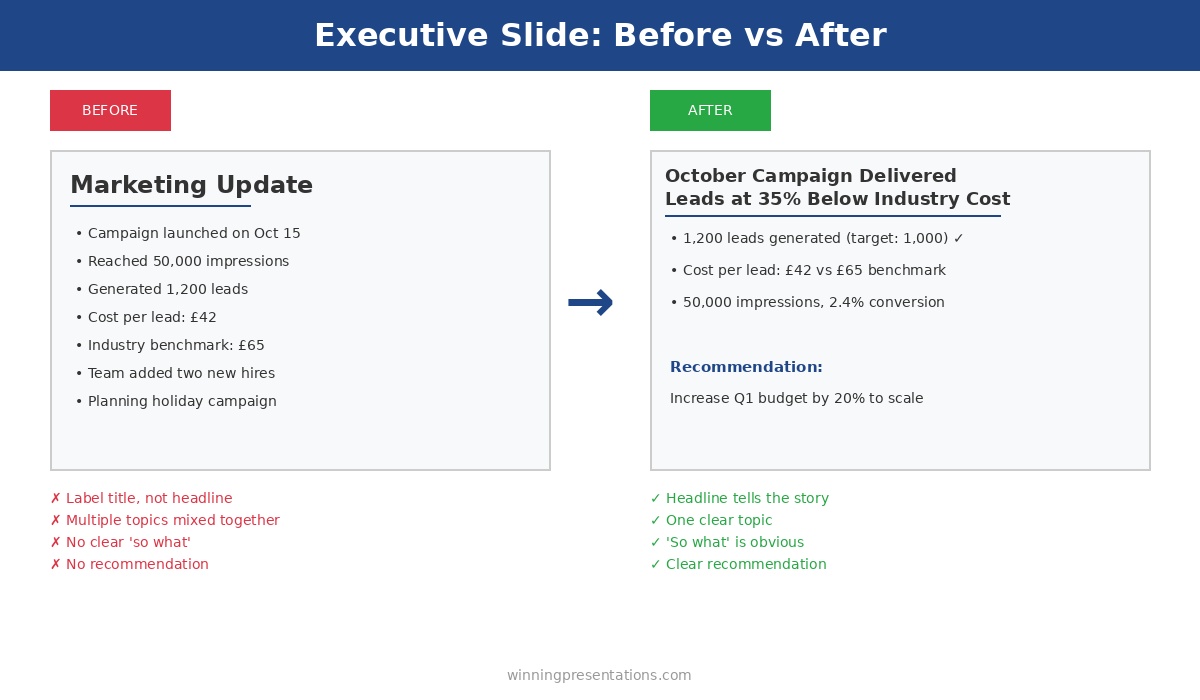
Executive slide before and after example - transforming a weak marketing update into a clear headline with recommendation
The same information, restructured: vague claims become specific evidence in your investor pitch deck

Investor Pitch Deck Mistake #7: Too Many Slides

I’ve reviewed 40-slide investor pitch decks. No investor reads 40 slides in an initial review. Your investor pitch deck will be skimmed, and if the key information isn’t immediately visible, you won’t get a meeting.

Fix for your investor pitch deck: 10-12 slides maximum for your investor pitch deck. If you can’t tell your story in 12 slides, you don’t understand your story well enough. Additional detail belongs in an appendix or data room, not your core investor pitch deck.

The Investor Pitch Deck Structure That Gets Meetings

Based on investor pitch decks that have successfully raised funding, here’s the structure that works:

Investor Pitch Deck Structure (10-12 Slides)

  1. Title: Company name, one-line description, contact
  2. Problem: The pain point you’re solving (quantified)
  3. Solution: Your product/service — how it solves the problem
  4. Traction: Evidence it’s working (revenue, users, growth)
  5. Market: Size of opportunity (bottom-up calculation)
  6. Business Model: How you make money
  7. Competition: Landscape and your differentiation
  8. Go-to-Market: How you acquire customers
  9. Team: Why you’ll win (relevant credentials)
  10. Financials: Projections with clear assumptions
  11. Ask: Amount, use of funds, milestones

This investor pitch deck structure follows the logic investors use to evaluate opportunities. Problem → Solution → Evidence → Opportunity → Execution → Team → Numbers → Ask.

Building an investor pitch deck for your raise?

The Executive Slide System includes the Investor Pitch template with this exact structure, plus AI prompts to help you craft each section. Clients have used these investor pitch deck frameworks to raise over £250 million in funding.

The 30-Second Investor Pitch Deck Test

Before sending your investor pitch deck, apply this test:

Give your investor pitch deck to someone unfamiliar with your business. Let them look at it for 30 seconds. Then ask:

  • What problem does this company solve?
  • How big is the opportunity?
  • What evidence is there that it’s working?
  • How much are they raising?

If they can’t answer all four questions from a 30-second scan of your investor pitch deck, revise until they can. Those are the questions investors need answered immediately — and 30 seconds is all you get.

FAQs About Investor Pitch Decks

How long should an investor pitch deck be?

10-12 slides for the core investor pitch deck. You can have an appendix with additional detail, but the main deck must tell a complete story in under 12 slides. Investors won’t read more than that in an initial review.

Should I include a demo in my investor pitch deck?

Not in the deck itself. Your investor pitch deck should work as a standalone document. If investors want a demo, that’s a meeting — which is exactly what your investor pitch deck should earn you.

What if I don’t have traction yet?

Focus your investor pitch deck on the problem, market, and team. If you’re pre-traction, your investor pitch deck must convince investors that the opportunity is real and your team can execute. Early-stage investor pitch decks are about potential; growth-stage decks are about proof.

Should I customise my investor pitch deck for each investor?

Minimally. Your core investor pitch deck should work universally. You might adjust the “why now” slide or add a slide on strategic fit for specific investors, but don’t create entirely different investor pitch decks for each meeting.

Your Investor Pitch Deck Action Plan

If your investor pitch deck isn’t getting meetings, it’s not your idea — it’s your deck. Here’s how to fix it:

  1. Restructure — Follow the 10-12 slide structure above for your investor pitch deck
  2. Quantify — Add numbers to every claim in your investor pitch deck (problem size, traction, market, ask)
  3. Simplify — Cut everything that doesn’t directly answer an investor’s core questions
  4. Test — Run the 30-second test and revise your investor pitch deck until it passes

The investor pitch deck that raised £8M for my biotech client wasn’t revolutionary in its design. It was disciplined in its structure. It answered the right questions in the right order and made it easy for investors to say “yes, I want to meet this team.”

That’s what a great investor pitch deck does. Not dazzle — clarify.

The Executive Slide System complete package - 10 PowerPoint templates, 30 AI prompts, and quick start guide for executive presentations

Get the Investor Pitch Deck Template

The exact investor pitch deck structure that’s helped raise over £250 million — ready for your content. Plus 9 more executive presentation templates and 30 AI prompts.

One biotech client used this investor pitch deck template to secure £8M in Series B funding.

GET INSTANT ACCESS → £39

10 templates • 30 AI prompts • Instant download • 30-day guarantee


Related: How to Create Executive Presentations That Get Approved in 2025 — the complete guide covering all 10 executive presentation types, including the investor pitch deck structure.