

Quick Answer: NLP anchoring is a psychological technique that associates a specific sensory cue (touch, sound, or gesture) with a desired mental state. By repeatedly pairing the cue with confidence, you train your nervous system to trigger that state on command—allowing you to access calm assurance moments before presenting, regardless of anxiety levels.
Jump to Section
- My Five Years of Terror—and the Discovery That Changed Everything
- What Is NLP Anchoring, Exactly?
- The Science: Why Anchoring Actually Works
- How to Create Your Own Anchor (Step-by-Step)
- How to Fire Your Anchor Before Presenting
- Advanced Techniques for Powerful Anchors
- The Mistakes That Kill Anchoring (And How to Avoid Them)
My Five Years of Terror—and the Discovery That Changed Everything
For five years, I was terrified. Not of the content I knew I’d present—I was confident in that. I was terrified of the presentation itself. My hands would shake. My throat would tighten. My mind would go blank the moment I stood up. I’d spend nights before presentations feeling sick, and I’d wake at 3 am in cold panic.
I was a corporate banker with 24 years of technical expertise. I could advise clients on complex financial structures, but I couldn’t stand in front of a room without my nervous system hijacking me.
Then I trained in neuro-linguistic programming and clinical hypnotherapy. I discovered anchoring—a technique that quite literally rewired my nervous system’s response to presenting. Not through willpower. Not through breathing exercises alone (though they help). But through direct neurological conditioning.
Within three months of using the anchor I’ll teach you in this article, I went from being the person who dreaded presenting to being the person people asked for advice on how to present with such calm confidence. That shift changed my career, my income, and my entire relationship with public speaking.
Quick Diagnostic: Is Anchoring Right for Your Anxiety?
Before we go further, let’s make sure we’re addressing the right problem. Anchoring is exceptionally effective for acute presentation anxiety—the kind where you know exactly what to say, but your nervous system misfires when you’re about to deliver it. Your chest tightens. Your hands shake. Your breathing becomes shallow. You might even feel nauseous.
Anchoring works because it gives your nervous system a physiological pathway to access calm confidence on demand. It’s not about thinking positively or reframing thoughts. It’s about conditioning a sensory-motor response that your body can reproduce instantly.
However, if you’re experiencing burnout, chronic exhaustion, or a deeper nervous system depletion from overwork, anchoring alone won’t be sufficient. You’d benefit from a more comprehensive programme that addresses both acute anxiety and system recovery.
The good news: most presenters dealing with stage fear fall into the acute anxiety category, and that’s exactly what anchoring solves. If that’s you—if you’re confident in your content but your nervous system sabotages you in the moment—this technique will be transformative.
Ready to learn how to create your first anchor? Let’s go. Or if you want the full system including other hypnotherapy techniques for presentation anxiety, Conquer Speaking Fear £39 walks you through the complete process.
What Is NLP Anchoring, Exactly?
NLP anchoring is a technique from neuro-linguistic programming that uses a deliberate sensory trigger—a gesture, sound, or physical touch—to evoke a specific mental or emotional state on command.
Here’s the mechanism: Your brain is fundamentally associative. Pavlov’s dogs learned to salivate at the sound of a bell because the bell became paired with food. You learned to feel hunger when you smell coffee in the morning because that smell has been paired with breakfast time. This is classical conditioning, and it’s one of the most reliable processes in neuroscience.
Anchoring harnesses that same principle deliberately. You choose a mental state you want to access (confidence, calm, focus). You experience that state intensely. Then you pair it with a specific, unique sensory trigger—perhaps pressing your thumb and forefinger together, or touching a specific point on your wrist. After multiple repetitions, that trigger becomes hardwired to that state. Eventually, you can activate the state simply by firing the trigger.
The anchor itself is neutral. A thumb-and-finger press is meaningless. But through repetition and intensity, your nervous system learns: This gesture means access confidence now.
Unlike positive self-talk or visualisation, anchoring doesn’t rely on conscious thought. Your nervous system doesn’t care what your logical brain believes. Once an anchor is properly installed, it works even if you’re anxious, doubtful, or disoriented—because the anchor operates at a neurological level, not an intellectual one.
The Science: Why Anchoring Actually Works
When you experience a powerful emotion or mental state, your brain activates specific neural pathways. If you’re feeling confident, particular networks in your prefrontal cortex, amygdala, and anterior cingulate cortex light up. These aren’t abstract concepts—they’re actual electrical and chemical activity in your brain.
When you pair that brain state with a sensory cue repeatedly, something remarkable happens: the neural pathway becomes bidirectional. Normally, confidence leads to calm physiology. But through anchoring, the sensory cue activates the confidence pathway directly, bypassing the need for logical thought or conscious effort.
This is why anchoring is so effective for presentation anxiety. Anxiety lives in the amygdala and limbic system—the ancient, automatic parts of your brain. You can’t logic your way out of amygdala activation. But you can create a more powerful competing activation through anchoring. When you fire your anchor, you’re not fighting anxiety with your conscious mind. You’re recruiting the same ancient brain systems to create a stronger, competing state of calm.
The research supports this. Studies on neuro-linguistic programming show that anchoring produces measurable changes in cortisol levels (stress hormone), heart rate variability, and subjective anxiety ratings. It’s not placebo. It’s not wishful thinking. It’s applied neuroscience.
This is particularly important if you’ve read about how presentation anxiety lives in your nervous system—because anchoring is one of the most direct ways to communicate with that nervous system and shift its default response.
How quickly does an NLP anchor start to work?
Most people report feeling a shift within 2–3 uses of a properly installed anchor. You’ll notice the anchor firing (triggering the state) immediately, though the intensity builds over the first week or two of consistent use. For presentation anxiety specifically, you should feel measurably calmer within 3–5 presentations where you’ve used the anchor. That said, the stronger and more emotionally vivid your anchor installation, the faster it works.
How to Create Your Own Anchor (Step-by-Step)
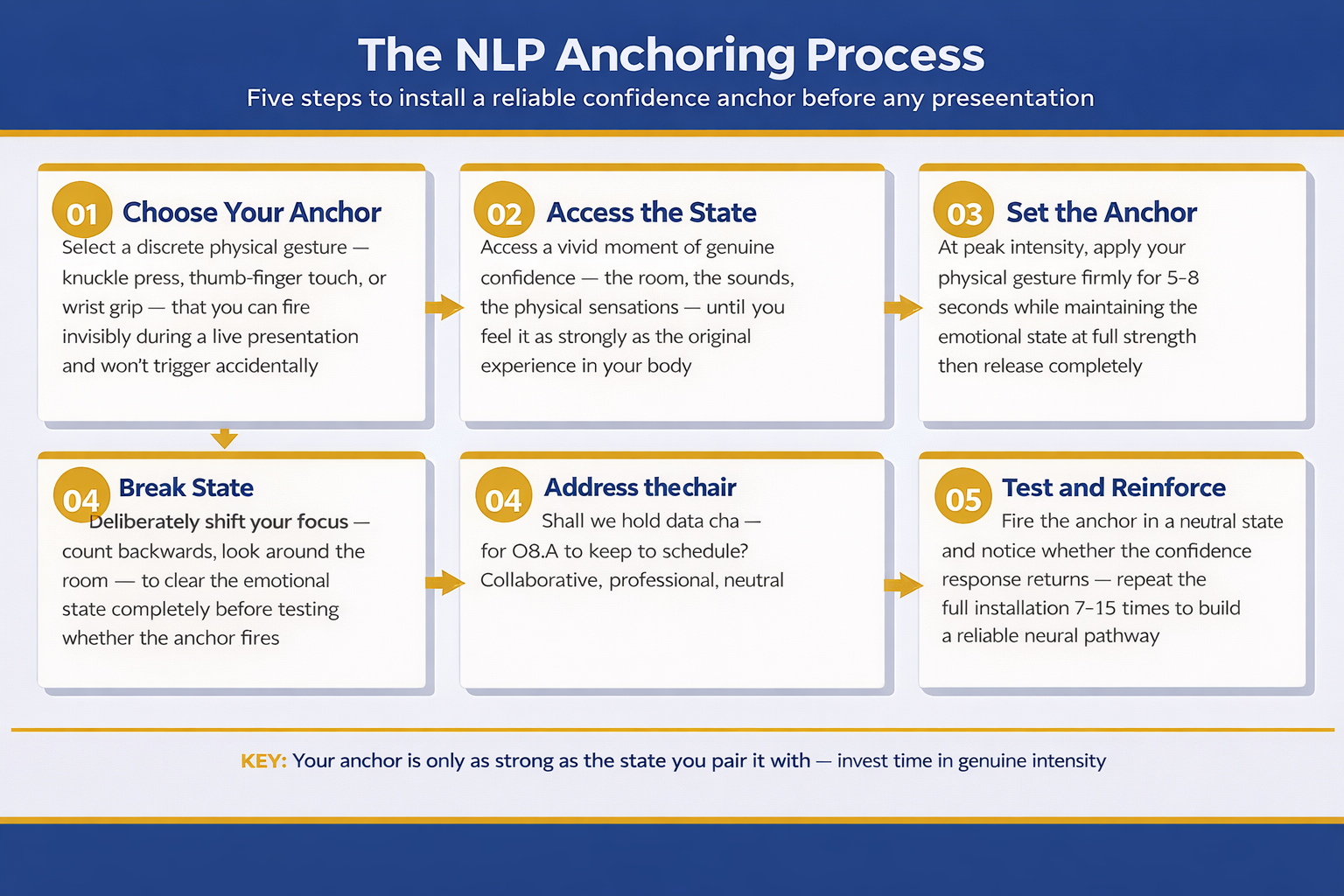
Now for the practical bit. This is where anchoring stops being theory and becomes something you can actually use. Creating an anchor involves four key steps.
Step 1: Choose Your Trigger
Your trigger needs to be specific, unique, and easy to reproduce. Most people choose a physical gesture because it’s portable and invisible during a presentation. Common triggers include:
- Pressing your thumb and forefinger together (the most popular choice)
- Touching a specific point on your wrist or arm
- Pressing your tongue against the roof of your mouth in a particular way
- Squeezing a specific muscle in your leg
The trigger should be something you can do discreetly, even while presenting or on a video call. You also want it to be distinct enough that you don’t trigger it accidentally throughout your day. Choose something now and stick with it—consistency is crucial for anchoring.
Step 2: Activate a Powerful State of Confidence
This is the critical step that most people skip or rush through, which is why their anchors don’t work. You cannot create a strong anchor while feeling mildly confident. You need to activate a genuinely powerful state of confidence and calm.
The best way to do this is to recall a specific memory where you felt absolutely confident and assured. Not arrogant—genuinely calm and certain of your capabilities. It could be from presenting, from a moment in your career, or from any domain of life. Close your eyes. Step into that memory. Remember what you saw, what you felt in your body, your posture, your breathing. Make it vivid and visceral. Spend at least 2–3 minutes fully inhabiting that state.
If you don’t have a powerful confidence memory, you can create one through visualisation. Imagine yourself presenting brilliantly—calm, articulate, commanding the room. Watch yourself as if you’re watching a film. Then step into the image and feel it from the inside. Again, spend 2–3 minutes really living it, not just thinking about it.
Step 3: Pair the Trigger with the State (The Anchoring Moment)
At the peak moment of your confidence state—when you’re feeling it most strongly—perform your trigger gesture. If you’ve chosen the thumb-and-forefinger press, press them together firmly while taking a breath. Hold the trigger for 2–3 seconds whilst the state is at its strongest. Then release.
This is the moment of anchoring. You’re creating an association between the gesture and the state.
Step 4: Repeat the Installation (Minimum 7 Times)
A single pairing is not enough. Your nervous system learns through repetition. Repeat the full process—activate the state, pause, reach peak confidence, fire the trigger—a minimum of 7 times in one session. Ideally 10–15 times. Each time, make sure you’re reaching genuine confidence, not just half-heartedly going through the motions.
After your first installation session, repeat the anchor at least once daily for five days. This cements the neural pathway. After that, you can maintain it with occasional use (firing the anchor a few times per week).
If you want additional anchoring variations and how to layer multiple anchors together, Conquer Speaking Fear £39 includes a complete guided video walkthrough of this exact process.
Stop Anxiety Before It Hijacks Your Presentation
- Create a neurological anchor that accesses calm on demand—no willpower required
- Learn the exact 7-step installation process used by executives who present to boards and investors
- Discover how to use your anchor in real presentations (even when presenting on video)
- Understand why traditional anxiety management often fails—and what actually works
- Install your anchor correctly the first time (mistakes will cost you weeks of progress)
Get Conquer Speaking Fear → £39
How to Fire Your Anchor Before Presenting (The Deployment Strategy)
Installing an anchor is one thing. Using it effectively in the high-stress environment of a real presentation is another. Here’s how to actually deploy your anchor when it matters most.
The Pre-Presentation Window (15 Minutes Before)
Find a private space—the bathroom, a quiet hallway, your car, even a locked conference room. You need 2–3 minutes of solitude. Fire your anchor 3–5 times in succession. Each time, pause for a few seconds and let yourself feel the calm it generates. Don’t just mechanically perform the gesture; actually inhabit the confident state it triggers.
This is different from the installation process. You’re not trying to deepen the anchor further. You’re activating it to bring that confident state into your present moment, ready for your presentation.
The Waiting Moment
After you fire the anchor, you have roughly 10–15 minutes before the anchor naturally “decays”—meaning the neurological activation fades. Time your anchor-firing strategically so that you’re presenting within that window. If you’re waiting longer than 15 minutes, fire the anchor again closer to your presentation start.
During the Presentation Itself
Once you’re presenting, you can fire the anchor discreetly during the talk if you feel anxiety spiking. A thumb-and-finger press hidden at your side, or a tongue-press that no one will notice, can reset your nervous system mid-presentation. Some presenters do this during pauses, whilst taking a sip of water, or when moving between sections of their talk.
Most people find they don’t need to fire it during the presentation if they’ve installed it strongly and fired it beforehand. The initial activation is usually sufficient.
What if I forget to fire my anchor before presenting?
If you’ve already begun presenting, you can still fire it discreetly at any point. The anchor will activate a calm state within seconds. However, the better strategy is to build firing the anchor into your pre-presentation routine, so it becomes automatic. Some presenters fire their anchor whilst walking to the stage, or immediately before they’re introduced. Make it part of your ritual.
Advanced Techniques for Powerful Anchors
Once you’ve installed a basic anchor, you can enhance it with additional techniques that make it stronger and more reliable. Here are the most effective variations.
Stacking Anchors (Multiple States)
Instead of anchoring only to confidence, you can create separate anchors for different states: calm, focus, articulation, charisma. Then fire them all in sequence before presenting, creating a compounded effect. For instance, you might press your thumb-and-forefinger for calm, then touch your wrist for focus, then press a leg muscle for charisma. The neurological intensity multiplies.
Anchor Chaining
This involves firing one anchor to access a state, then immediately performing a second action (perhaps a power pose or a specific breathing pattern) whilst the first anchor is active. This creates an association between the anchor and the secondary behaviour, making both more powerful together.
Collapsing Anchors
If you have a lingering anxiety state that you want to eliminate, you can create an anchor for confidence, then deliberately activate the anxiety state, and fire the confidence anchor immediately whilst the anxiety is present. The confidence state “collapses” the anxiety state, and over repetitions, this weakens the anxiety response. This is advanced work and works best when paired with understanding your fight-or-flight response.
Resource Anchoring
Some people create an anchor not just for a mental state, but for accessing a specific resource or memory of a person they trust. For example, you might anchor to a memory of a mentor you admire, or a moment when a colleague praised your presentation skills. The anchor gives you neurological access to that resource precisely when you need it.
Never Walk Into a Presentation Unprepared Again
- Master anchoring plus five additional NLP techniques specifically for presentation anxiety
Get Conquer Speaking Fear → £39
Can anchors fade or stop working?
An anchor can weaken if you don’t use it regularly. Think of it like a muscle—if you stop exercising, it atrophies. However, it’s remarkably easy to reactivate. Even if you haven’t used an anchor in months, firing it a few times usually restores its full power. Additionally, if you repeatedly fail at your anchor (for instance, trying to fire it whilst in a state of panic without having installed it properly first), you can inadvertently weaken it. This is why proper installation is non-negotiable.
The Mistakes That Kill Anchoring (And How to Avoid Them)
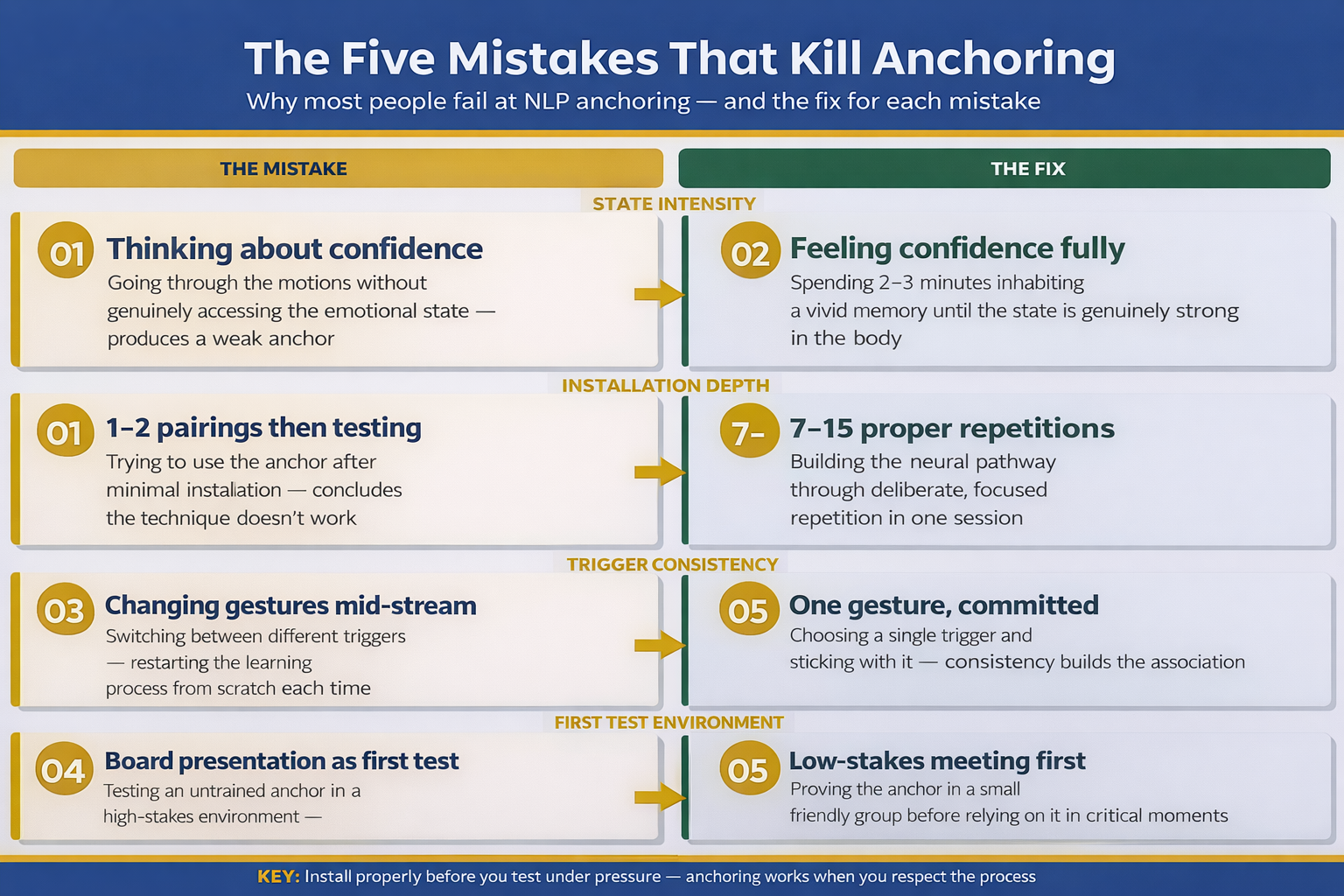
I’ve seen hundreds of people attempt anchoring and fail. Not because anchoring doesn’t work, but because they made preventable mistakes during installation or deployment. Here are the most common ones.
Mistake 1: Installing Without Reaching a Genuinely Powerful State
This is the number one reason anchors fail. People think about confidence rather than feeling it. They go through the motions without really accessing the state. Your anchor will be only as strong as the state you pair it with. If you’re 60% confident during installation, your anchor will trigger 60% confidence when you fire it. Invest the time to genuinely access a powerful, vivid state of confidence. Make it real. Make it felt.
Mistake 2: Firing the Anchor Without Installing It Properly First
Some people try to use an anchor after just one or two pairings, then conclude it doesn’t work. Anchors need a minimum of 7 proper installations to be neurologically reliable. You’re building a neural pathway, and pathways need repetition to become strong. If you try to use an untrained anchor under stress, it won’t work—and then you’ll question the whole technique.
Mistake 3: Changing Your Trigger Mid-Stream
Once you choose a trigger, commit to it. If you keep switching between different gestures, you never build a consistent pairing. Your brain is learning: This gesture means this state. If you’re constantly introducing new gestures, you’re starting the learning process from scratch each time.
Mistake 4: Relying on the Anchor Alone Without Context
Anchoring is extraordinarily powerful, but it’s not magic. If you’re presenting on zero sleep, or you’re in a genuinely dangerous situation (not presentation anxiety, but actual danger), no anchor will override your nervous system’s appropriate response. Anchoring works best when paired with proper preparation, adequate sleep, and other practical tools like breathing techniques.
Mistake 5: Firing the Anchor Under Extreme Distress Without Prior Installation
Your first test of an anchor should not be a high-stakes presentation in front of your board of directors. Install the anchor in low-stress situations first (perhaps presenting to a small friendly group, or in a low-pressure meeting). Let it prove itself in manageable contexts before you rely on it in the most critical moments.
Beyond these installation mistakes, there are also mistakes in how people think about what anchoring can do. Anchoring is brilliant for acute presentation anxiety. It’s less effective if you’re dealing with chronic burnout or deeper nervous system dysregulation. Know what problem you’re solving.
If you want to understand not just how to install an anchor, but also how to diagnose what type of presentation anxiety you’re dealing with and which techniques work for each type, Conquer Speaking Fear £39 walks through the complete diagnostic and treatment process.
Learn From Someone Who’s Used Anchoring With Thousands of Presenters
- 24 years in corporate banking at JPMorgan Chase, PwC, Royal Bank of Scotland, and Commerzbank
- Qualified clinical hypnotherapist and certified NLP practitioner with live case studies from clients
- Video walkthroughs of the exact anchor installation process, plus six additional NLP techniques
- Troubleshooting guide: what to do when your anchor isn’t working (and why)
- Real-world deployment strategies for presentations, investor pitches, board meetings, and speaking engagements
Get Conquer Speaking Fear → £39
Want the slides too?
If you’re installing anchors but struggling to deliver them with visual confidence, your slides might be working against you instead of amplifying your message. The Executive Slide System £39 teaches the slide design and delivery approach used by executives at FTSE 100 firms—so your visuals reinforce your nervous system work, not undermine it.
Is NLP Anchoring Right For You?
✅ Anchoring is right for you if:
- You’re confident in your presentation content but anxious in the delivery
- Your anxiety spikes only in presentation moments, not throughout your day
- You want a practical tool you can use immediately, before your next presentation
- You’re open to learning applied neuroscience rather than relying on willpower alone
- You’ve tried breathing exercises and positive self-talk but need something stronger
- You’re willing to spend 20 minutes installing an anchor properly before expecting results
❌ Anchoring might not be sufficient if:
- You’re experiencing severe chronic anxiety unrelated to presentations
- You’re burnt out or experiencing nervous system exhaustion from overwork
- You lack confidence in your presentation content itself
- You’re unwilling to spend time practising the anchor installation process
- You’re expecting a magic solution without any personal effort or commitment
- You’re in acute crisis and need immediate professional mental health support
Frequently Asked Questions
How long does it take to install an anchor properly?
The initial installation takes 20–30 minutes. This includes 10–15 repetitions of activating the state, reaching peak confidence, and firing the trigger. After installation, you’ll want to reinforce it daily for 5 days (5–10 minutes per day). Most people report measurable results within a week, though the anchor becomes more powerful over the first month of use.
Can anchoring work if I’m naturally anxious or introverted?
Yes, absolutely. Anchoring doesn’t depend on your personality type or baseline anxiety level. It depends on your nervous system’s ability to learn associations, and that’s universal. Whether you’re naturally anxious or calm, whether you’re introverted or extroverted, your nervous system can be trained to access confidence on command. Introversion and anxiety are different things—introversion is personality, anxiety is a nervous system state.
What if I’ve tried anchoring before and it didn’t work?
Most commonly, anchoring “failed” because the initial installation wasn’t done properly. Perhaps the state wasn’t genuinely powerful, or the anchor was fired only once or twice before being tested under stress, or the trigger was changed mid-stream. The technique itself is neurologically sound. If you’re willing to redo the installation with proper attention to each step, it will work. The second time around, most people see dramatic results.
Can I use anchoring alongside other anxiety-management techniques?
Yes, and in fact this is the ideal approach. Anchoring works brilliantly with breathing techniques, preparation, adequate sleep, and other NLP methods. Anchoring addresses the neurological pathway to confidence. Other techniques address preparation, physical state, and cognitive framing. Together, they’re more powerful than any single tool alone.
🆓 Free resource: Executive Presentation Checklist — a free guide to strengthen your presentation preparation.
Read These Partner Posts Today
We published three articles today. Explore the full suite:
Your Next Step
You now understand how anchoring works, why it’s neurologically powerful, and exactly how to install an anchor that will be reliable in your presentations. The technique is straightforward. The challenge most people face isn’t understanding—it’s execution. Most people read about anchoring and then don’t actually do it.
So here’s my challenge to you: within the next three days, choose your trigger gesture, find a quiet space for 20 minutes, activate a memory of genuine confidence, and install your anchor using the step-by-step process outlined above. Don’t overthink it. Don’t wait for the “perfect” moment. Just do it. By next week, you’ll have a neurological tool that will fundamentally change how your body responds to presentations. Your next presentation is your first real test. Use the anchor beforehand, and notice the difference.
If you want the full video walkthrough, additional NLP techniques, and troubleshooting support, Conquer Speaking Fear £39 is designed exactly for that.


