Tag: budget approval

19 Apr 2026

Multi-Year Budget Proposal: The 3-Horizon Framework for Executive Approval

Quick Answer

A multi-year budget proposal earns approval when structured around three planning horizons: the investment case for Year 1 (what you are asking for today), the return trajectory for Years 2–3 (when and how value accumulates), and the strategic cost of not proceeding. Finance committees do not reject well-analysed proposals because the numbers are wrong. They reject them because the structure does not make the decision easy.

Henrik had the numbers. Three years of financial modelling. Sensitivity analysis across four scenarios. A phased investment plan that any finance director would recognise as thorough. He walked into the capital allocation committee certain that rigour would carry the proposal.

The committee deferred it in 22 minutes.

The feedback was not that the numbers were wrong. It was that the committee could not see “what we are being asked to approve today versus what comes later.” The proposal had been built as a document, not a decision structure. Every year’s costs were present. The decision logic — what the committee needed to commit to now, and why — was absent.

Multi-year budget proposals fail at this exact point more than any other. The financial analysis is usually sound. The presentation structure is not built for how finance committees actually make multi-year decisions.

Need a complete budget presentation structure?

The Executive Slide System includes budget request templates and framework guides designed for multi-year investment cases and CFO-level review committees.

Explore the System →

Why Most Multi-Year Proposals Fail at the First Committee

Finance committees reviewing multi-year proposals are not asking “is this a good investment?” in the abstract. They are asking a specific question: “What are we committing to today, and what does that commit us to over three years?” These are different questions, and most proposals are structured to answer only the first.

The most common structural failure is presenting all three years as equivalent decisions. Year 1, Year 2, and Year 3 costs appear in the same table, at the same level of detail, as if the committee is being asked to approve all three simultaneously. Finance committees make phased commitments. They approve Year 1 funding while noting Year 2 and Year 3 dependencies. Conflating the approval decision with the forward commitment is the source of most first-committee deferrals on multi-year proposals.

The second failure is front-loading cost without front-loading rationale. When the first slides a committee sees are tables of expenditure, the default cognitive response is scepticism — which is the appropriate professional reaction to cost proposals. If the rationale for the investment has not been established before the numbers appear, every figure is evaluated against “why are we spending this?” rather than “is this the right level of investment for the return?”

The third failure is the absence of a cost-of-delay argument. Multi-year proposals are particularly vulnerable to deferral because they feel like decisions that can wait. Without a credible, specific cost of not proceeding this planning cycle, you are giving the committee permission to defer without consequence.

The 3-Horizon Framework Explained

The 3-horizon framework restructures a multi-year proposal around how finance committees evaluate long-range investment, rather than how financial models are typically built.

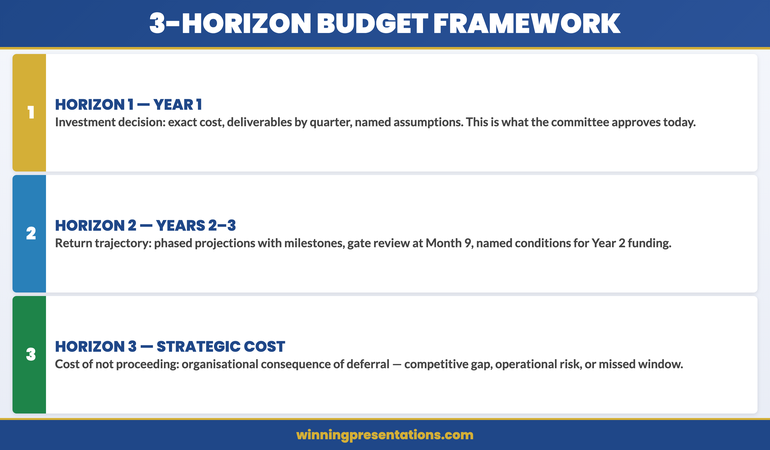
Horizon 1 covers the immediate investment decision: what is being committed to this financial year, at what cost, and for what specific outcome. This is the only horizon the committee needs to approve today.

Horizon 2 covers the return trajectory: how value accumulates in Years 2 and 3, under what conditions, and what the key milestones are that signal whether the programme is on track. This horizon tells the committee what they are agreeing to in principle when they approve Horizon 1.

Horizon 3 covers the strategic context: what the organisation’s competitive or operational position looks like if this investment does not proceed. This is the cost-of-delay argument — the most often absent element, and the most important for overcoming the default deferral instinct.

The framework works because it matches the structure of a finance committee’s decision-making process rather than the structure of a financial model. It separates the approval decision from the forward commitment from the strategic rationale, and presents each in the order a committee needs to process them.

Three planning horizons infographic: Horizon 1 — Year 1 investment decision, Horizon 2 — Years 2 and 3 return trajectory, Horizon 3 — cost of not proceeding

Horizon 1: Building the Year 1 Investment Case

The Year 1 investment case is the most specific and most detailed section of your proposal. This is what the committee is being asked to approve today, and it needs to hold up under direct scrutiny. Every figure should be supportable, every assumption named, every dependency identified.

Structure the Year 1 case around four elements: the problem being addressed, the investment required, the outputs delivered by year-end, and the risk of not investing at this level. The problem statement should quantify the current state using operational data you can defend. “Our current process takes 12 days and introduces rework at roughly one in six outputs” is defensible. “We are 40% less efficient than best practice” is not — the comparison is unverifiable and finance committees notice.

The Year 1 output statement should describe deliverables, not benefits. Benefits belong in Horizon 2. Year 1 deliverables are what you will have produced by year-end: infrastructure built, system deployed, team trained, pilot completed. These are verifiable. They give the committee something concrete to hold you to, which builds credibility rather than eroding it.

Horizon 2: Showing the Return Trajectory

The return trajectory for Years 2 and 3 should be presented at a coarser level of detail than Year 1. Finance committees expect long-range projections to carry wider confidence intervals. Presenting Year 3 figures with Year 1 precision signals either that you have not thought carefully about uncertainty, or that you are suppressing it. A range with named assumptions is more credible than a specific number that implies false precision.

The key elements of Horizon 2 are the milestones that signal the programme is on track, the trigger points that would prompt a review or a pause decision, and the cumulative return projection with its named dependencies. Being explicit about what Years 2 and 3 figures assume — which market conditions, which internal capacity, which decisions not yet made — demonstrates analytical maturity. Finance committees are far more comfortable with named uncertainty than with projections that appear to ignore it.

Present Horizon 2 as a conditional commitment: “Approving Year 1 today gives you visibility of the Year 2 cost envelope. Year 2 funding would be subject to a gate review at Month 9, where we present against the delivery milestones.” This is how large programmes are actually managed. Presenting it explicitly signals governance competence, which builds more confidence with a finance committee than any spreadsheet.

Horizon 3: The Cost of Not Proceeding

Horizon 3 is not about what happens to the project if it is not approved. It is about what happens to the organisation. The two produce very different responses from finance committees. “We will not achieve our efficiency targets” is a project consequence. “Our unit cost per transaction will remain 34% above sector median while competitors who have made this investment begin undercutting our contract pricing” is an organisational consequence. The second creates a decision imperative that the first does not.

The cost-of-delay argument is also where you introduce the competitive, regulatory, or technology context that a three-year investment is typically responding to. If there is a market shift, a regulatory deadline, or a technology window that makes this planning cycle the optimal one for investment, state it in Horizon 3. This reframes the question from “should we do this?” to “is this the right time?” — which most finance committees will answer in your favour if the evidence is credible and specific.

⭐ Maven Flagship — Executive Buy-In

Walk into your next approval meeting prepared

The Executive Buy-In Presentation System gives you 7 self-paced modules covering stakeholder analysis, case construction, and the presentation structures that hold up to scrutiny.

Monthly cohort enrolment — £499, lifetime access.

Enrol in the Executive Buy-In System →

Slide Structure for the Proposal Deck

The slide order for a multi-year budget proposal should follow the 3-horizon logic, not the financial model structure. The sequence that earns finance committee approval:

Slide 1 — Decision Summary. One slide: what you are recommending, what it costs in Year 1, what it returns over three years, and the consequence of not proceeding. Readable in 60 seconds.

Slides 2–3 — The Problem Being Addressed. Current state data establishing why the investment is necessary. Operational metrics, competitive positioning, or regulatory context — whichever is most relevant. This comes before the cost because it frames the cost as a response rather than a request.

Slides 4–6 — Horizon 1 Investment Case. Year 1 cost breakdown, deliverables by quarter, assumptions, and risks. This is the most detailed section because it is the decision being made today.

Slides 7–8 — Horizon 2 Return Trajectory. Phased return projection with named milestones, gate review points, and the conditions under which Years 2 and 3 funding would be confirmed.

Slide 9 — Decision Request. What you need approved today, in one sentence, with the action assignment and the timeline. This is the closing structure that ensures your proposal ends with a decision rather than a deferral — the same principle behind every effective executive presentation close.

For proposals that have already gone through one failed submission, the budget resubmission framework covers how to restructure after rejection without undermining your credibility on the second attempt. For ongoing tracking once a budget is approved, the budget variance presentation structure gives finance committees the accountability view they expect in subsequent review cycles.

When your organisation uses zero-based budgeting rather than prior-year baselines, the zero-based budget presentation approach runs alongside the three-horizon structure to justify every line of Year 1 investment from first principles.

The Executive Slide System includes budget request templates and AI prompt cards for building the three-horizon narrative quickly before a capital allocation deadline.

Preparing for CFO-Level Questions

Finance directors and CFOs reviewing multi-year proposals will focus on a predictable cluster of questions. Preparing specific answers before the committee meeting is the minimum standard for a proposal of this size.

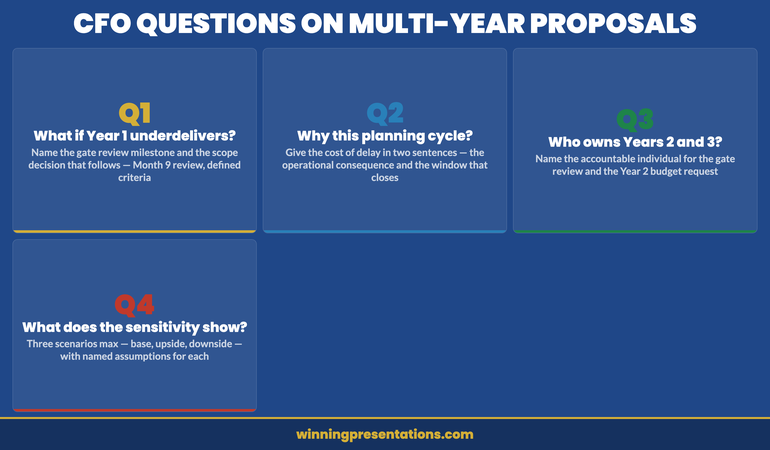
“What happens if Year 1 underdelivers?” This tests whether you have a contingency plan. The answer should name the gate review milestone, define what “underdelivers” means specifically, and describe the decision that follows. “If we are behind Month 9 delivery milestones by more than 15%, we bring a revised scope to the Q4 committee rather than proceeding to Year 2 funding.”

“Why now rather than next planning cycle?” This is the Horizon 3 question in direct form. Your answer is the cost-of-delay argument in two sentences: the operational or competitive consequence of waiting, and the specific factor that makes this planning cycle the right one. Without a credible answer to this question, the proposal is at high risk of deferral regardless of how good the analysis is.

“Who owns the Year 2 and Year 3 commitments?” Finance committees need clear programme ownership before approving multi-year investment. Name the individual accountable for the Month 9 gate review and the Year 2 budget request. If they are not in the room, explain when they will be briefed.

Finance committee Q and A preparation infographic: three CFO questions on multi-year proposals and the response structure for each

Build the Full Case, Not Just the Financial Model

The Executive Slide System — £39, instant access — includes templates, AI prompt cards and framework guides for budget proposals at every seniority level, from departmental requests to capital allocation committees.

  • Budget Request template structured for phased, multi-year investment
  • AI prompt cards to build the three-horizon narrative quickly under deadline

Get the Executive Slide System →

Designed for senior budget owners who need approval at the first committee meeting.

Frequently Asked Questions

How far ahead should a multi-year budget proposal project?

For most corporate planning cycles, a three-year horizon is standard. Year 1 should be presented at budget-line level of detail. Years 2 and 3 are typically shown at programme or workstream level, with clear acknowledgement that they are indicative and subject to gate reviews. Projecting beyond three years in a single proposal usually signals that the scope is too large to be decided in one committee meeting and may need restructuring as a phased programme with separate approval stages.

Should the proposal include a sensitivity analysis?

Yes, but keep it brief and specific. One slide showing the outcome under three scenarios — base case, upside, and downside — with the assumptions that drive each. Finance committees expect sensitivity analysis on investment proposals of this size. However, a sensitivity analysis with more than three scenarios or more than four variables per scenario suggests you are not confident in your base case, which creates the opposite impression from the one you intend.

What is the right length for a multi-year budget proposal presentation?

Nine to twelve slides is the appropriate range for a finance committee presentation. The detailed financial model belongs in a supporting document or appendix, not in the main deck. Finance committees need to make a decision; they do not need to review every assumption in the room. If the committee wants the detailed model, they will ask for it. Present the decision case, not the workings.

How do you handle a committee that wants to reduce Year 1 scope before approving?

Prepare for this in advance by identifying which Year 1 elements are critical-path dependencies for Years 2 and 3 outcomes, and which are not. If the committee wants to reduce scope, offer a restructured Year 1 that protects the dependencies while deferring the discretionary elements. This is more credible than defending the full scope, and it signals that you understand programme priority rather than treating everything as equally essential.

The Winning Edge — Weekly Executive Communication Insights

Each Thursday: one high-stakes communication technique, one real case study, one action you can apply before your next meeting.

Subscribe to The Winning Edge →

Download the free Executive Presentation Checklist — a one-page structure review for any high-stakes meeting.

About the Author

Mary Beth Hazeldine is the Owner & Managing Director of Winning Presentations. With 25 years of corporate banking experience at JPMorgan Chase, PwC, Royal Bank of Scotland, and Commerzbank, she has delivered high-stakes presentations in boardrooms across three continents.

A qualified clinical hypnotherapist and NLP practitioner, Mary Beth advises executives across financial services, healthcare, technology, and government on structuring presentations for high-stakes funding rounds and approvals.

Book a discovery call | View services

09 Apr 2026

Budget Resubmission Presentation: What to Change After the First Rejection

Quick Answer

A budget resubmission presentation should not simply re-present the original proposal with adjusted numbers. Finance committees that rejected your initial submission are looking for evidence that you understood why it was rejected, that you have addressed the underlying concerns, and that you can defend the revised case under scrutiny. The structure of the resubmission matters as much as the revised figures.

Kenji had been Head of Technology at a retail banking group for two years when his infrastructure modernisation budget was rejected at the April finance committee. The committee’s feedback was brief: the proposal lacked sufficient evidence of ROI, and the timeline was considered optimistic given the organisation’s recent delivery record on technology projects.

His initial response was to rebuild the financial model. He spent three weeks tightening the numbers, adding sensitivity analyses, and extending the timeline by six months. When he presented the revised proposal in June, the committee rejected it again. This time the feedback was different: the committee was not confident the business case addressed the fundamental question of why this investment was necessary now rather than in the next financial year.

The financial model had never been the problem. The problem was that Kenji’s original presentation had led with capability and features — what the infrastructure would be able to do — rather than with risk and consequence — what would happen if the current infrastructure was not replaced. The committee had rejected the framing of the proposal, not just the numbers. Until the resubmission addressed that framing, no amount of revised modelling would produce a different outcome.

Preparing a budget resubmission?

Before you rebuild the model, check whether your slide structure addresses what the committee actually rejected. The Executive Slide System includes financial presentation frameworks designed for approval meetings, including resubmissions after rejection. Explore the System →

Why Budgets Are Rejected and What Finance Actually Needs

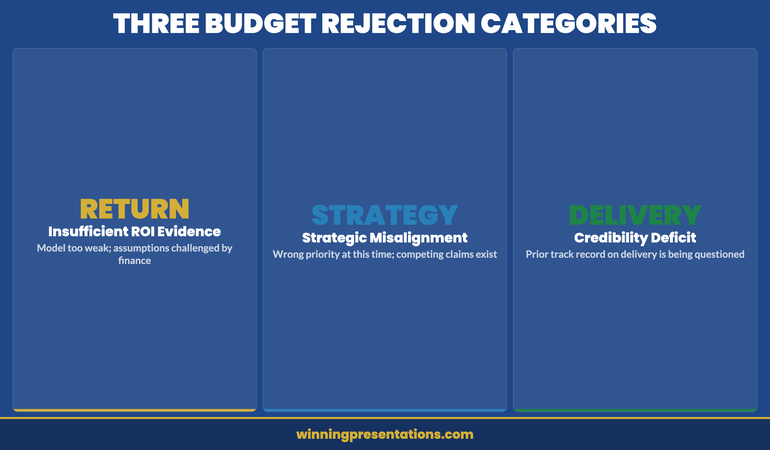
Budget rejections fall into three categories, and only one of them is actually about the numbers. Understanding which category your rejection belongs to determines what the resubmission needs to address.

The first category is insufficient evidence of return. The committee cannot see a credible path from the investment to a measurable outcome. This is a modelling and assumptions problem — and it is the only category where revising the financial model alone will resolve the issue. If you can provide tighter assumptions, stronger benchmarks, or a clearer articulation of how return will be measured and when, the resubmission has a direct path to approval.

The second category is strategic misalignment. The committee does not believe this investment is the right priority at this time, relative to other competing claims on the budget. No amount of modelling resolves this. The resubmission needs to demonstrate how this investment connects to the organisation’s current strategic priorities, and specifically why deferring it creates a worse outcome than approving it now.

The third category — the most common and the hardest to diagnose — is a credibility deficit. The committee is not confident that the presenter or their team can deliver what is being proposed. This is particularly acute when the organisation has a history of late or over-budget technology or infrastructure projects, which is a reason Kenji’s second submission failed. A resubmission that does not directly address the delivery confidence problem will not succeed, regardless of the quality of the financial model.

Most rejected budgets contain elements of all three. The task before the resubmission is to identify which is the dominant concern, because that determines the entire structure of the revised presentation.

Three categories of budget rejection: return evidence, strategic alignment, and delivery credibility

The First Move After Rejection

The first thing to do after a budget rejection is not to revise the proposal. It is to understand precisely what was rejected and why. This sounds obvious, but most post-rejection conversations focus on what the presenter thinks the committee meant, rather than on getting the committee’s actual concerns on record.

Request a debrief, ideally with the finance director or the committee chair, within a week of the decision. The question to ask is not “what would it take to get this approved?” — which puts the committee in the position of designing your resubmission — but rather “what specific concerns were unresolved at the point of decision?” This frames the conversation as a diagnostic rather than a negotiation, and experienced finance directors will give you considerably more useful feedback if they feel they are being asked to help you understand rather than being pressured to change their minds.

Document the feedback carefully. When the resubmission is eventually presented, the committee will compare what they said to what you addressed. If the resubmission does not map directly to the documented concerns, it signals that you either did not understand the feedback or chose to work around it — neither of which builds confidence.

What to Change — and What Not to Touch

There is a common instinct to make the resubmission significantly different from the original — to demonstrate responsiveness and effort. This instinct is partially right and partially dangerous. Substantial changes that address the committee’s documented concerns signal that you listened and acted. Substantial changes that go beyond what was asked signal either that you had doubts about the original proposal that you did not disclose, or that you are making changes to appear responsive rather than because they are substantively right.

Change the structure of the case if the rejection was about framing. If the committee rejected the proposal because the rationale was wrong — capability-led rather than risk-led, for example — restructure the argument, not just the slides. The committee will recognise a slide reshuffle; they will not recognise a genuinely different argument unless it is genuinely different.

Change the financial assumptions if they were specifically challenged. If the committee requested more conservative growth projections or questioned the cost assumptions, revise them with explicit references to what changed and why. Do not quietly update figures without acknowledging the change — the committee will notice the difference and will want to know why the original numbers were presented if these more cautious assumptions were available.

Do not change anything that was not the subject of feedback. Altering elements of the proposal that the committee did not question suggests uncertainty about the original position, and invites new questions about material that was previously settled.

For guidance on structuring the financial argument itself, the approach in zero-based budget presentations is directly applicable to resubmissions where the original proposal was rejected on return-evidence grounds — the discipline of justifying each line from first principles removes the assumption problem that often underlies the “insufficient ROI” rejection.

Executive Slide System

Build Financial Presentations That Get Budget Approval

The Executive Slide System provides structured frameworks for financial and budget presentations, including resubmissions after rejection. It includes slide templates for finance committee meetings, AI prompt cards to build the case quickly, and scenario guides for challenging approval environments.

  • Slide templates for budget and financial approval presentations
  • AI prompt cards to structure the resubmission argument
  • Framework guides for risk-led and return-led financial cases
  • Scenario playbooks for budget, capex, and resource allocation items

Get the Executive Slide System — £39

Designed for budget and financial presentations in regulated and corporate environments.

Structuring the Resubmission Presentation

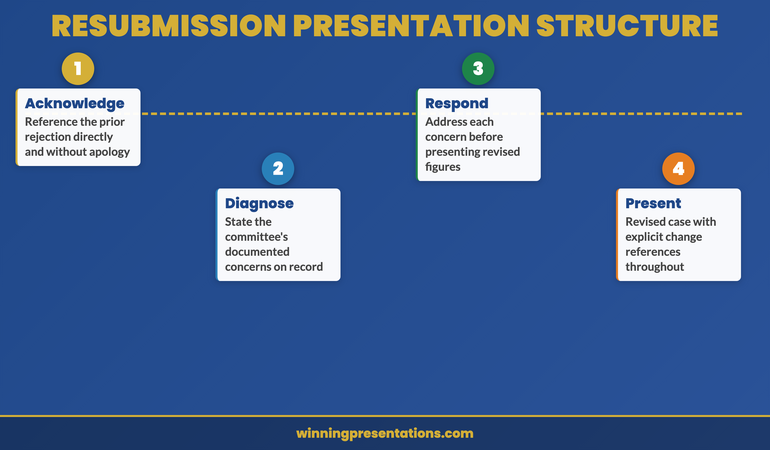
A budget resubmission presentation has a structural requirement that the original proposal does not: it must acknowledge the previous rejection before making the case. Presenting a revised budget as if the original was never rejected — simply updating the figures and re-presenting the slides — is the single most common structural error in resubmissions, and it consistently produces a worse reception than the original.

The committee knows this is a resubmission. Pretending otherwise reads as either oblivious or evasive. The structure that works is: acknowledgement, diagnosis, response, revised case.

Acknowledgement: Open with a brief, direct reference to the previous submission and its outcome. “This is a revised proposal for [project], following the committee’s decision in April. The original submission was rejected on two grounds, which I will address directly.” This signals that you are aware of the history, you are not defensive about it, and the resubmission is designed to resolve the specific concerns raised.

Diagnosis: State what you understood the committee’s concerns to be. If you had a debrief conversation, reference it. “Based on the feedback received from [name/role], the committee’s primary concerns were: [specific concerns].” This gives the committee the opportunity to confirm or correct your understanding before the revised case is presented, and it demonstrates that you conducted a genuine post-rejection diagnostic rather than simply revising the slides.

Response: Address each concern directly, in the order it was raised. Not buried in the appendix, not woven into the financial model — directly, as a standalone section that the committee can evaluate before the revised figures are presented. This is the part of the resubmission that most commonly gets cut for time, which is almost always a mistake. The committee’s concerns are the test the resubmission must pass; address them before asking for approval.

Revised case: Present the updated financial proposal, incorporating the changes made in response to the committee’s feedback, with explicit references to what changed and why.

For reference on how resource and financial proposals are typically structured for contested approval environments, the resource allocation presentation framework covers the argumentation approach that works when budgets are under direct competitive pressure.

The Three Objections to Address Before They Raise Them

In a resubmission, there are typically three objections that the committee will raise regardless of how comprehensively the original concerns were addressed. Addressing these proactively — before they are raised as questions — materially reduces the risk of a second rejection.

The first is: “Why should we approve this now rather than defer it to next year’s cycle?” This objection is almost always present when a budget was rejected once already. The committee may have approved an alternative proposal in the interim, making this one appear less urgent than it did six months ago. The resubmission needs a current-state argument: what has changed since the original submission, and how does that change affect the cost or risk of waiting a further twelve months?

The second is: “What gives us confidence the delivery will be successful?” This is particularly acute when the organisation has a track record of project overruns, or when the project scope has changed between the original and revised submissions. A resubmission that does not include a delivery confidence section — covering governance arrangements, milestone structure, and how delivery risk will be managed — will encounter this objection in the room.

The third is: “Is this the right amount?” After a rejection, committees are sensitive to whether the revised budget is genuinely right-sized or has simply been reduced to secure approval, with the expectation that a supplementary request will follow. If the budget has been reduced from the original, explain specifically what scope was removed to achieve the reduction, not just that the figure is lower.

Three pre-emptive objections for a budget resubmission: timing, delivery confidence, and budget sizing

Presenting the Revision Without Looking Defensive

The psychological challenge of a resubmission is presenting a revised case with full conviction when you know the committee has already said no once. The temptation is to over-qualify — to hedge the revised figures, acknowledge every uncertainty, and soften the recommendation. This reads as lack of confidence in the revised case, which is the last impression a resubmission needs to create.

The discipline is to hold the distinction between acknowledging the rejection and diminishing the recommendation. You can acknowledge the previous decision with directness and without apology, and then present the revised case with exactly the same conviction you would bring to a first submission. The rejection was of the previous case; this is a different case. It deserves to be presented as such.

Avoid two common tone errors. The first is apologetic framing — “I know you have concerns about this, and I hope this revised version addresses them” — which positions the presenter as petitioner rather than professional making a considered case. The second is over-confident dismissal — “I believe we have now resolved all the concerns raised” — which can read as arrogant and tends to provoke the committee into finding new concerns. The right tone is direct and measured: “The revised proposal addresses the specific concerns raised in April. Here is how.”

If the capital expenditure case involves significant infrastructure investment, the guidance in capital expenditure presentations covers how to frame large investment proposals in a way that holds up under scrutiny — including how to address delivery risk in the financial narrative itself rather than in a separate risk register that committees rarely read.

If your budget proposal has been rejected once and you are preparing the resubmission, the Executive Slide System includes financial presentation frameworks that address the structural requirements of a second-attempt approval, including how to lead with the committee’s previous concerns.

Executive Slide System

Slide Templates for Budget and Financial Approval Meetings

Structure your resubmission using frameworks designed for contested financial approvals — from the opening acknowledgement to the revised recommendation and delivery confidence section.

Get the Executive Slide System — £39

Designed for financial and budget presentations in corporate and regulated environments.

Frequently Asked Questions

How long should a budget resubmission presentation be?

A resubmission should typically be shorter than the original proposal, not longer. If the original was rejected because the case was unclear, adding more slides rarely resolves the problem — it usually compounds it. The acknowledgement-diagnosis-response-revised case structure can typically be delivered in eight to twelve slides, with supporting detail in the appendix. The committee has already read a version of this proposal; they do not need the full context again. They need to see that their specific concerns have been addressed and that the revised figures are sound.

Should you request a meeting with the finance director before the formal resubmission?

Yes, where possible. A pre-meeting with the finance director or a relevant committee member before the formal resubmission gives you the opportunity to test whether your revised case addresses their concerns before the formal meeting, and it signals engagement with the feedback process rather than a determination to push the proposal through regardless. It is not appropriate to use this meeting to lobby for approval — it is a diagnostic conversation, not a pre-vote. The question to ask is whether your diagnosis of the rejection matches their recollection of the discussion.

What should you do if the budget is rejected a second time?

Request a direct conversation with the committee chair or finance director to understand whether the objection is to this proposal specifically or to the priority of the investment in the current environment. If the committee has a fundamental view that the investment should not happen now — regardless of the quality of the case — no amount of revised modelling will change the outcome. The more productive path is to understand what conditions would need to change for the proposal to succeed, and to determine whether those conditions are likely to be met within a timeframe that makes the investment still relevant.

The Winning Edge — Weekly Newsletter

Each Thursday: one executive presentation insight, one structure, one practical tool. Read by executives across financial services, healthcare, technology, and infrastructure.

Subscribe to The Winning Edge

Preparing a budget or financial approval presentation? The Executive Presentation Checklist is a free download covering structure, language, and approval-readiness for finance committee and board presentations.

About the Author

Mary Beth Hazeldine is Owner and Managing Director of Winning Presentations. With 25 years of corporate banking experience at JPMorgan Chase, PwC, Royal Bank of Scotland, and Commerzbank, she advises executives across financial services, healthcare, technology, and government on structuring presentations for high-stakes funding rounds, board approvals, and governance reviews. View services | Book a discovery call

12 Feb 2026
Executive presenting headcount request to leadership team with approval indicators

The Headcount Request That Got Yes When Everyone Said No

“We’re in a hiring freeze. The answer is no.”

That’s what my client heard when she mentioned her headcount request to her CFO in the corridor. The company had just announced a 15% budget reduction. Every department was being told to do more with less. And Sarah needed 12 new engineers to deliver a project the CEO had personally championed.

Two weeks later, she got all 12 approved.

Not because she had special connections. Not because the freeze was lifted. But because her presentation made it impossible to say no — by making the cost of “no” crystal clear.

I’m sharing this now because headcount requests in 2026 face unprecedented scrutiny. AI is reshaping workforce planning, budgets are tight, and executives are asking harder questions about every hire. The old approach — “we need more people because we’re busy” — doesn’t work anymore. What works is a business case so compelling that approval becomes the obvious choice.

Quick answer: Successful headcount requests don’t ask for people — they present a business case for outcomes. The structure that works: lead with the business problem (not the resource gap), quantify the cost of inaction, present headcount as the solution to a problem leadership already cares about, and pre-answer the objections before they’re raised. This approach gets approval even during hiring freezes because it reframes the request from “cost” to “investment with measurable return.”

I’ve helped executives request headcount in every economic condition — boom times when money flowed freely, and downturns when every hire required CEO approval. The pattern is consistent: the requests that get approved aren’t the ones with the best justification. They’re the ones with the best presentation.

Sarah’s situation was typical. She had a genuine need — her team was working 60-hour weeks, attrition was climbing, and the CEO’s pet project was at risk. But her first draft presentation was also typical: a list of reasons why she needed more people, supported by workload data and burnout statistics.

It would have failed. Here’s why — and what we changed.

Why Most Headcount Requests Fail

The fundamental mistake in headcount presentations is starting with the resource gap. “We need 12 more engineers because…” immediately puts leadership in defence mode. They hear “cost” before they hear “value.”

The Psychology of No

When executives hear a headcount request, three mental processes activate simultaneously:

Budget protection: “Where will this money come from? What else won’t get funded?”

Precedent fear: “If I approve this, what other requests will follow?”

Accountability anxiety: “If this hire doesn’t work out, it’s my signature on the approval.”

Your presentation has to address all three — before they become objections.

The “Busy” Trap

The most common headcount justification is also the weakest: “We’re too busy.” Every department is busy. Every manager feels understaffed. “Busy” doesn’t differentiate your request — it makes you sound like everyone else who’s asking.

What executives actually need to hear: not that you’re busy, but that specific business outcomes are at risk without additional resources. That’s a completely different conversation.

🎯 Executive Slide System — Headcount Request Templates Included

Stop building headcount presentations from scratch. The Executive Slide System includes ready-to-use templates for resource requests, budget approvals, and business cases — all structured to get executive buy-in.

  • Business case structure that leads with outcomes
  • ROI calculation frameworks executives trust
  • Objection pre-answer templates
  • Decision slide formats that drive approval

Get the Executive Slide System → £39

Instant download. Used in headcount requests that have secured hundreds of new hires across banking and consulting environments.

The 5-Slide Structure That Gets Yes

Here’s the exact structure Sarah used to get 12 engineers approved during a hiring freeze:

Slide 1: The Business Problem (Not the Resource Gap)

Don’t open with “We need more people.” Open with the business problem that leadership already cares about.

Sarah’s opening: “Project Phoenix — the CEO’s priority initiative — is at risk of missing its Q3 deadline. Current trajectory shows a 67% probability of 8-week delay, which would push launch past the competitor window.”

Notice what’s not mentioned: headcount, engineers, workload, burnout. The first slide is entirely about business impact. Leadership is now thinking about Project Phoenix, not about budget.

Slide 2: The Cost of Inaction

Before you present your solution, make the cost of doing nothing undeniable.

Sarah’s slide: “An 8-week delay costs £2.4M in delayed revenue, puts the Series B timeline at risk, and allows CompetitorX to establish market position. Additionally, current team attrition trajectory suggests we lose 3 senior engineers in the next 90 days — each representing £180K in replacement and ramp-up costs.”

This slide does the heavy lifting. When the cost of inaction is £2.4M+, the cost of 12 engineers looks like a bargain.

Slide 3: The Solution (Now You Can Mention Headcount)

Only after establishing the problem and the cost of inaction do you present headcount as the solution.

Sarah’s framing: “To deliver Phoenix on schedule and protect the £2.4M revenue, we need to add 12 engineers over the next 6 weeks. This represents a £840K annual investment that protects £2.4M in near-term revenue and establishes the team capacity for the 2027 roadmap.”

The headcount request is now positioned as a solution to a problem leadership wants solved — not as a cost to be minimised.

Slide 4: The Risk Mitigation

Address the “what if it doesn’t work” fear before it’s voiced.

Sarah included:

  • Hiring timeline: Specific milestones with contingency plans
  • Ramp-up plan: How new hires become productive (with timeline)
  • Success metrics: How leadership will know the investment is working
  • Exit ramp: What happens if business conditions change

This slide removes the “what if” anxiety that kills approvals.

Slide 5: The Decision

End with a clear, specific ask — not a vague request for “support.”

Sarah’s close: “I’m requesting approval to open 12 engineering requisitions immediately, with a £840K annual budget allocation. This protects £2.4M in Phoenix revenue and positions us for the 2027 roadmap. I need your decision by Friday to maintain the hiring timeline.”

Clear ask. Clear timeline. Clear next step.


5-slide headcount request structure showing business case framework for approval

Want this structure as a ready-to-use template? The Executive Slide System includes the complete headcount request framework — plus decision slides, ROI calculators, and objection pre-answers.

Get the Templates → £39

Making the Numbers Undeniable

The difference between headcount requests that get approved and those that get “let’s revisit next quarter” often comes down to how the numbers are presented.

The ROI Frame

Never present headcount as a cost. Always present it as an investment with measurable return.

Weak: “12 engineers will cost £840K annually.”

Strong: “A £840K investment protects £2.4M in revenue and enables £4.2M in 2027 roadmap delivery. ROI: 7.9x in year one.”

The numbers are the same. The frame is completely different.

The Comparison Anchor

Give leadership a reference point that makes your request seem reasonable.

Sarah’s anchor: “The cost of 12 engineers (£840K) is less than the cost of the 8-week delay (£2.4M), less than the cost of losing 3 senior engineers to attrition (£540K in replacement costs), and less than the consulting alternative (£1.2M for equivalent capacity).”

When you anchor against worse alternatives, your request becomes the sensible middle ground.

The Staged Approach

If your full request feels too large, offer a staged alternative that gets you started.

Sarah’s backup: “If 12 immediate hires isn’t possible, a phased approach of 6 now and 6 in Q2 still protects the Phoenix timeline, though with reduced margin for error.”

This shows flexibility while maintaining the business case. Leadership often approves the full request when they see you’ve thought through alternatives.

📊 Build Business Cases That Get Approved

The Executive Slide System gives you the frameworks for any approval presentation — headcount, budget, project investment, or strategic initiative. Stop guessing what executives want to see.

  • Cost-of-inaction calculation templates
  • ROI presentation frameworks
  • Risk mitigation slide structures
  • Decision slide formats that drive action

Get the Executive Slide System → £39

Instant download. Developed from 24 years of corporate banking presentations where every resource request faced intense scrutiny.

Pre-Answering the Objections

The best headcount presentations answer objections before they’re raised. Here are the five you’ll face — and how to address them in your slides:

Objection 1: “Can’t you do more with AI/automation?”

Pre-answer: Include a slide on what you’ve already automated and why the remaining work requires human judgment. “We’ve automated 40% of routine tasks. The remaining work — architecture decisions, client relationships, complex problem-solving — requires experienced engineers.”

Objection 2: “What about contractors instead of FTEs?”

Pre-answer: Show the total cost comparison including ramp-up time, knowledge retention, and long-term flexibility. Contractors often cost more when you factor in everything.

Objection 3: “Can you reprioritise instead?”

Pre-answer: Show what gets cut if you don’t add headcount — and the business impact of those cuts. Make leadership choose between options, not between “yes” and “no.”

Objection 4: “What if the project gets cancelled?”

Pre-answer: Show how the roles support multiple initiatives, not just one project. “These 12 engineers support Phoenix, but also provide capacity for the 2027 roadmap and reduce our single-point-of-failure risk on critical systems.”

Objection 5: “Why now? Can’t it wait?”

Pre-answer: Show the cost of delay. “Every month we wait adds £300K to the eventual cost (higher salaries in a tighter market, extended project timeline, continued attrition of current team).”

Handling the Tough Q&A

Even with perfect slides, headcount requests face intense questioning. Here’s how to handle the moments that determine approval:

When They Challenge Your Numbers

Don’t get defensive. Show your work.

“The £2.4M delay cost comes from three factors: £1.8M in delayed subscription revenue based on current pipeline, £400K in additional contractor costs to extend the bridge period, and £200K in opportunity cost from the sales team’s reduced confidence in our delivery timeline. I can walk through each calculation.”

When They Ask for Less

Don’t immediately agree. Show the trade-offs.

“I can work with 8 instead of 12, but I want to be transparent about what that means: we move from 95% confidence on the Q3 deadline to about 70%, and we lose the buffer for the inevitable surprises. If 8 is the decision, I’ll make it work — but I want leadership to understand the risk we’re accepting.”

When They Want to Delay the Decision

Make the cost of delay concrete.

“I understand the desire for more time. But every week we delay the hiring process adds roughly 2 weeks to the project timeline, because good candidates don’t stay on the market. If we decide Friday, we can still hit Q3. If we wait until end of month, Q3 becomes unlikely.”

Facing tough Q&A on your headcount request? The Executive Q&A Handling System gives you frameworks for handling challenges, pushback, and curveball questions with confidence.

Get the Q&A System → £39

What Happened to Sarah

Sarah presented to the CFO, COO, and CEO on a Thursday morning. The same CFO who had said “the answer is no” in the corridor.

The presentation took 12 minutes. The Q&A took 20. Most of the questions were about implementation details — a sign that approval was likely.

By Friday afternoon, she had written approval for all 12 positions.

The CFO told her afterwards: “I’ve seen a hundred headcount requests this year. Yours was the only one that made me feel like saying no would cost us money.”

That’s the reframe that changes everything. Not “please give me resources” but “here’s what you lose if you don’t.”

🎯 Get Your Headcount Approved

The Executive Slide System includes everything you need to build a headcount presentation that gets yes:

  • Business case templates: Lead with outcomes, not resource gaps
  • Cost-of-inaction frameworks: Make “no” more expensive than “yes”
  • ROI calculators: Present investment, not cost
  • Objection pre-answers: Address concerns before they’re raised
  • Decision slides: Clear asks that drive approval

Get the Executive Slide System → £39

Instant download. The same frameworks used in headcount requests that have secured hundreds of new hires — even during hiring freezes.

📬 PS: Weekly strategies for executive presentations and getting buy-in. Subscribe to The Winning Edge — practical techniques from 24 years in corporate boardrooms.

Frequently Asked Questions

What if my company has a strict hiring freeze with no exceptions?

Even “no exceptions” freezes have exceptions — they just require CEO-level approval and an exceptional business case. Use the cost-of-inaction framework to show that the freeze is costing more than the hire. If the numbers are compelling enough, freezes get unfrozen. If they’re not, at least you’ve positioned yourself for first approval when the freeze lifts.

How do I request headcount when I can’t quantify the revenue impact?

Focus on risk and cost avoidance instead of revenue. “Without this hire, we have single-point-of-failure risk on a critical system” or “Current overtime costs are £X per month and climbing” or “Attrition risk in the current team represents £Y in replacement costs.” Not everything ties to revenue, but everything ties to something leadership cares about.

Should I ask for more than I need, expecting to be negotiated down?

No. Ask for exactly what you need with clear justification. Padding your request damages credibility and invites the “let’s cut this by 30%” response. If you need 12, ask for 12 and show why 12 is the right number. You can offer a phased alternative, but don’t inflate the initial ask.

How long should a headcount presentation be?

Five to seven slides maximum for the core presentation. You can have backup slides for detailed questions, but the main narrative should be completable in 10-15 minutes. Executives make headcount decisions quickly when the business case is clear — long presentations signal unclear thinking.

Related: If past presentation failures are affecting your confidence in high-stakes requests like headcount approvals, read Presentation PTSD Is Real: Signs You’re Still Carrying an Old Failure for techniques to break the pattern.

Sarah’s CFO was right about one thing: during a hiring freeze, the default answer is no.

But defaults can be overridden — when the cost of “no” is higher than the cost of “yes.”

Your headcount request isn’t about getting resources. It’s about presenting a business case so compelling that approval becomes the obvious choice.

Lead with the problem. Quantify the cost of inaction. Position headcount as the solution. Pre-answer the objections. Ask for a clear decision.

That’s how you get yes when everyone else is hearing no.

About the Author

Mary Beth Hazeldine is the Owner & Managing Director of Winning Presentations. With 24 years in corporate banking at JPMorgan Chase, PwC, Royal Bank of Scotland, and Commerzbank, she has supported hundreds of resource requests, budget approvals, and headcount presentations in high-scrutiny environments.

A certified hypnotherapist and NLP practitioner, Mary Beth combines executive communication expertise with an understanding of the psychology behind approval decisions. She helps professionals build business cases that get yes — even when the default answer is no.

Book a discovery call | View services

28 Jan 2026
Professional woman in enrollment conversation during coffee meeting, actively engaging with colleague about stakeholder buy-in

Pre-Meeting Executive Alignment: How to Get Approval Before You Present

The CFO approved £2 million before my client finished slide one.

Not because the presentation was brilliant. Not because the data was compelling. Because the decision had already been made — three days earlier, over a 12-minute conversation and one carefully crafted email.

The presentation? A formality. A public confirmation of a private agreement.

This is what pre-meeting executive alignment looks like when it’s done right. And it’s the skill that separates professionals who constantly fight for approval from those who walk into rooms where “yes” is already waiting.

Quick Answer: Pre-meeting executive alignment is the practice of socializing your recommendation with key stakeholders before the formal presentation. Done correctly, it surfaces objections early, builds champions, and transforms the meeting from a decision point into a confirmation ceremony. The most effective executives spend more time on pre-alignment than on slides.

📋 Presenting for Approval This Week? Do This First:

48-72 hours before your presentation:

  1. Identify the real decision-maker (often not the most senior person)
  2. Request 10 minutes — “I’d value your perspective before Thursday’s meeting”
  3. Share your recommendation (not all your slides — just the answer)
  4. Ask: “What concerns would you want me to address?”
  5. Send a follow-up email summarizing what you heard and how you’ll address it

This 10-minute conversation often determines the outcome more than the 30-minute presentation.

The Email That Changed Everything

Early in my banking career at JPMorgan, I watched a colleague present a flawless business case for a new trading system. The logic was airtight. The ROI was clear. The slides were polished.

The CFO said no.

Not because the proposal was weak — but because he’d been blindsided. He had concerns about implementation risk that were never addressed. He felt ambushed by a major capital request he hadn’t been prepared for. His “no” wasn’t about the merits. It was about the process.

A month later, I saw a more senior colleague get a larger budget approved in half the time. The difference? She’d spent 20 minutes with the CFO the week before, walking him through her thinking and asking what would make him comfortable.

By the time she presented, he was already her champion. He’d helped shape the proposal. His concerns were already addressed. The meeting was a formality.

That’s when I understood: the presentation isn’t where the decision gets made. It’s where the decision gets announced.

Why Pre-Alignment Works

Pre-meeting alignment works because of three psychological principles that govern how senior people make decisions:

1. Executives hate surprises

Senior leaders are evaluated on judgment. Being caught off-guard in a meeting — especially by something they “should have known” — feels like a failure. When you pre-align, you’re protecting their reputation, not just selling your idea.

2. Ownership drives support

When someone contributes to shaping a proposal, they become invested in its success. The CFO who suggested adding a risk mitigation section will defend that section in the meeting. Pre-alignment turns potential blockers into co-authors.

3. Public positions are hard to reverse

Once someone takes a position in a meeting, backing down feels like losing face. If you surface objections privately, they can be addressed without anyone having to publicly change their mind. Private alignment prevents public conflict.

For more on how executives actually make decisions, see our guide to executive presentation structure.

How do you get stakeholder alignment before a meeting?

Get stakeholder alignment by having brief one-on-one conversations with key decision-makers 48-72 hours before your presentation. Share your recommendation (not all your slides), ask what concerns they’d want addressed, then incorporate their input. Follow up with a short email confirming what you heard. This transforms potential opponents into contributors who are invested in your success.

Timeline showing pre-alignment process: 1 week before identify stakeholders, 48-72 hours before have conversations, 24 hours before send summary email, meeting day present with confidence

⭐ Maven Flagship — Executive Buy-In

Walk into your next approval meeting prepared

The Executive Buy-In Presentation System gives you 7 self-paced modules covering stakeholder analysis, case construction, and the presentation structures that hold up to scrutiny.

Monthly cohort enrolment — £499, lifetime access.

Enrol in the Executive Buy-In System →

The 5-Step Pre-Alignment Process

Here’s the exact process I teach executives for pre-meeting alignment:

Step 1: Map Your Stakeholders (1 Week Before)

Before you build a single slide, answer these questions:

  • Who will be in the room?
  • Who has formal decision authority?
  • Who has informal influence? (Often more important)
  • Who might object, and why?
  • Who could be a champion if they understood the benefits?

Create a simple grid: Name | Role | Likely Position | Key Concern | How to Reach

Step 2: Prioritise Your Conversations (5-7 Days Before)

You can’t pre-align with everyone. Prioritise:

  1. The decision-maker (whoever actually signs off)
  2. Potential blockers (people likely to object)
  3. Influential voices (people others listen to)

Three to four conversations is usually enough. More than that becomes logistically difficult and can feel like you’re “working the room” too hard.

Step 3: Have the Conversations (48-72 Hours Before)

Request brief meetings: “I’m presenting to the steering committee on Thursday. I’d value 10 minutes of your perspective beforehand — would Tuesday or Wednesday work?”

In the conversation:

  • Share your recommendation in one sentence
  • Explain the core logic (2-3 minutes max)
  • Ask: “What concerns would you want me to address?”
  • Listen more than you talk
  • Thank them for their input

Do NOT present all your slides. This isn’t a preview — it’s a consultation.

How do you get executive buy-in for a project?

Executive buy-in comes from making “yes” feel safe, not from having the best data. The most reliable method is pre-meeting alignment: share your recommendation privately with key stakeholders before the formal presentation, address their concerns in advance, and let them contribute to shaping the proposal. By meeting time, they’re invested in your success.

Step 4: Incorporate and Acknowledge (24-48 Hours Before)

After your conversations:

  • Adjust your presentation to address the concerns you heard
  • Add a slide or talking point that directly acknowledges input: “Based on conversations with the team, I’ve added a section on implementation risk…”
  • Send a brief follow-up email to each person you spoke with

This follow-up email is crucial. It confirms you listened and creates a paper trail of their involvement.

Step 5: Present With Confidence (Meeting Day)

When you’ve done proper pre-alignment:

  • You know what objections are coming (because you asked)
  • You’ve already addressed the major concerns (in your slides)
  • Key stakeholders feel heard (because they contributed)
  • The decision-maker isn’t being surprised (because you briefed them)

The presentation becomes a confirmation, not a persuasion exercise.

For more on presenting to senior leadership, see our guide on how to present to a board of directors.

Need the slide structure that executives respond to?

Get the Executive Slide System → £39

The Email Template That Works

Here’s the follow-up email template I used with my client — the one that preceded the £2M approval:

Subject: Following up on our conversation — Thursday’s budget review

Hi [Name],

Thank you for taking time yesterday to share your perspective on the [project name] proposal.

I heard two key points:

  1. [Concern #1 they raised]
  2. [Concern #2 they raised]

I’ve updated the presentation to address both directly — specifically, I’ve added [what you added] and revised [what you changed].

Looking forward to Thursday. Please let me know if anything else comes to mind before then.

Best,
[Your name]

This email does three things:

  1. Confirms you listened (they see their concerns reflected back)
  2. Shows you acted (you made changes based on their input)
  3. Creates investment (they’re now part of the proposal’s development)

Comparison showing traditional approach vs pre-alignment approach: traditional leads to surprises and objections, pre-alignment leads to support and quick approval

What is pre-meeting alignment?

Pre-meeting alignment is the practice of having brief one-on-one conversations with key stakeholders before a formal presentation or decision meeting. The goal is to share your recommendation, surface concerns early, incorporate feedback, and build support — so the meeting becomes a confirmation of a decision that’s already been shaped collaboratively, rather than a debate.

⭐ The Slide Structure That Closes After Pre-Alignment

Pre-alignment gets stakeholders ready to say yes. The Executive Slide System gives you the structure that makes “yes” easy — recommendation-first, objection-addressed, decision-clear.

Inside the system:

  • The exact 6-slide structure executives prefer
  • How to lead with your recommendation (not context)
  • Where to place proof so it reassures, not defends
  • The decision slide format that gets action

Get the Executive Slide System → £39

Built from 24 years of corporate banking experience. Works for budget requests, board presentations, and client pitches.

Common Mistakes to Avoid

Pre-alignment is powerful, but it can backfire if done wrong:

Mistake #1: Presenting your full deck in the pre-meeting

The pre-alignment conversation is a consultation, not a preview. Share your recommendation and ask for input — don’t walk through 25 slides. If you do, the actual meeting feels redundant.

Mistake #2: Only talking to supporters

It’s tempting to pre-align with people you know will agree. But the value is in reaching potential blockers. The CFO who might object is exactly who you need to talk to beforehand.

Mistake #3: Ignoring what you hear

If someone raises a concern and you don’t address it, you’ve made things worse. They’ll feel unheard and may actively oppose you in the meeting. Either incorporate their feedback or explain why you couldn’t.

Mistake #4: Being too obvious about “working the room”

Pre-alignment should feel like genuine consultation, not political manoeuvring. Frame it as seeking input, not building a coalition. “I’d value your perspective” works. “I’m lining up support” does not.

Mistake #5: Skipping the follow-up email

The conversation creates alignment. The email locks it in. Without the written follow-up, people can forget what they said or claim they never agreed. The email creates accountability.

For the slide structure that works after you’ve done pre-alignment, see our guide to CFO-approved budget presentations.

Ready to structure slides that close after pre-alignment?

Get the Executive Slide System → £39

When Pre-Alignment Isn’t Possible

Sometimes you can’t pre-align — you don’t have access, there’s no time, or the culture doesn’t support it. In those cases:

  • Lead with your recommendation anyway. Even without pre-alignment, the structure still matters. Don’t build to your conclusion.
  • Anticipate objections yourself. If you can’t ask stakeholders what concerns them, use your judgment and address likely objections proactively.
  • Create space for input during the meeting. If they haven’t had a chance to shape the proposal, give them opportunities to contribute: “Before I continue, I’d welcome any initial reactions.”

Pre-alignment dramatically improves your odds. But even without it, the right structure helps.

Is Pre-Alignment Right For Your Situation?

Chart showing when pre-alignment works well vs when it may not be appropriate

⭐ Complete Your Approval Strategy

Pre-alignment opens the door. The Executive Slide System walks you through it — with the exact structure, format, and flow that executives respond to.

Everything you get:

  • The 6-slide executive structure (recommendation-first)
  • Real before/after transformations
  • Slide-by-slide breakdown with formatting guidance
  • Templates for budget, board, and client presentations

Get the Executive Slide System → £39

Instant download. The same structure I taught in corporate banking for budget approvals and steering committee decisions.

Frequently Asked Questions

Isn’t this just politics or manipulation?

Pre-alignment isn’t manipulation — it’s good communication. You’re not hiding information or going behind anyone’s back. You’re consulting stakeholders, incorporating their input, and making the formal meeting more productive for everyone. The alternative — blindsiding people with a major request in a public meeting — is actually less respectful of their time and position.

What if I don’t have access to the decision-makers beforehand?

Start with whoever you can reach. Even pre-aligning with one influential person is better than none. You can also ask your manager or sponsor to help facilitate introductions: “Would it be appropriate for me to brief [Name] before Thursday?” If truly no access is possible, focus on anticipating objections yourself and structuring your presentation to address them proactively.

How far in advance should I do pre-alignment?

48-72 hours before the meeting is ideal. Too early (more than a week) and priorities may shift or people forget. Too late (day before) and there’s no time to incorporate feedback or for them to process. The sweet spot gives you time to adjust your presentation while keeping the conversation fresh in everyone’s mind.

What if someone changes their mind in the actual meeting?

It happens, but it’s rare when you’ve done proper pre-alignment. If someone raises a new objection, don’t panic. Acknowledge it calmly: “That’s a fair point — I’d like to think through the implications. Can I follow up with you after the meeting?” This shows confidence and prevents the meeting from derailing. The follow-up email you sent creates a record of their earlier input, which usually keeps positions stable.

Get Weekly Executive Presentation Insights

Strategies for getting approval, building credibility, and presenting with confidence — from 24 years in corporate banking.

Subscribe to The Winning Edge →

📋 Free Resource: Executive Presentation Checklist

A quick-reference checklist covering structure, pre-alignment, and delivery. Use it before your next high-stakes presentation.

Download Free Checklist →

Your Next Step

The next time you have a presentation where you need approval, try the pre-alignment approach:

  1. Identify 2-3 key stakeholders
  2. Request 10 minutes of their time before the meeting
  3. Share your recommendation and ask what concerns they’d want addressed
  4. Incorporate their feedback and send a follow-up email

You’ll be surprised how much easier the actual presentation becomes when the groundwork is already laid.

P.S. Once you’re in the meeting, delivery matters too. If you struggle with projecting confidence, I wrote about how to project your voice without shouting — it’s more about resonance than volume.

P.P.S. If you’re spending too long building presentations, check out how to cut presentation creation time without cutting quality — the system approach that saves hours.

About Mary Beth Hazeldine
Owner & Managing Director of Winning Presentations. 24 years in corporate banking at JPMorgan Chase, PwC, RBS, and Commerzbank. I’ve seen hundreds of presentations succeed or fail based on what happened before the meeting started. Pre-alignment is the skill I wish someone had taught me in year one.

11 Dec 2025
Budget request slides - the CFO-approved 6-slide format that gets yes

Budget Request Slides: The CFO-Approved Format That Gets Yes [2026]

📅 Updated: December 2025 — Includes AI prompts to build your slides in 20 minutes

Updated 27 March 2026 — Revised for the latest Microsoft Copilot and ChatGPT capabilities.

Quick Answer: What Should Budget Request Slides Include?

Effective budget request slides follow a 6-slide format: (1) The Ask — your specific request and expected ROI upfront, (2) The Problem — cost of inaction, (3) The Solution, (4) ROI calculation with visible assumptions, (5) Implementation timeline, (6) Risk mitigation. The key is leading with your number, not burying it after 20 slides of background research.

⭐ GET BUDGET REQUEST TEMPLATES

Executive Slide System

Pre-built budget slides + ROI calculator + AI prompts to customise

Download Templates — £39

Includes budget, board, QBR, and strategy templates


Stop Guessing What to Type. Start Building in 25 Minutes.

The Executive Prompt Pack gives you 71 tested prompts for ChatGPT and Copilot — structured by scenario so you know exactly what to type:

  • Build from scratch — scenario prompts for board reviews, budget requests, and investor decks
  • Rescue and rewrite — audit an existing deck, condense it, or fix one slide at a time
  • Industry-specific prompts for financial services, banking, consulting, and executive audiences
  • Power modifiers that transform any prompt into board-ready output
  • The 25-minute deck workflow that replaces 3–4 hours of manual building

Works with ChatGPT, Microsoft Copilot, and Edit with Copilot (formerly Agent Mode). Updated March 2026.

Get the Executive Prompt Pack → £19.99

Why Most Budget Slides Get Rejected

I’ve reviewed hundreds of budget presentations. The pattern is always the same: 20 slides of research, analysis, and justification — then finally, buried on slide 18, the actual request.

By then, the CFO has mentally checked out.

Here’s what CFOs are actually thinking during your presentation: “What do you want, how much, and why should I prioritise this over everything else competing for budget?”

If you don’t answer that in the first 30 seconds, you’re fighting uphill.

Related: Budget Presentation Template: Complete Guide

The 6-Slide Budget Format That Works

This format has helped my clients secure over £250 million in funding. It works because it mirrors how CFOs actually evaluate requests.

Budget request slides - the CFO-approved 6-slide format that gets yes

Slide 1: The Ask

State your request in the first 30 seconds. Example: “Requesting £400K for marketing automation. Expected return: £1.2M in 12 months. 3x ROI. Decision needed by January 15.”

Slide 2: The Problem

Quantify the cost of doing nothing. CFOs respond to loss more than gain. What is the current situation costing in money, time, or missed opportunity?

Slide 3: The Solution

What you’re proposing and why this option versus alternatives. Keep it tight — you’re not selling the product, you’re selling the outcome.

Slide 4: The ROI

This is the slide CFOs actually care about. Show investment, expected return, payback period, and — critically — your assumptions. CFOs don’t trust black-box numbers.

Slide 5: The Timeline

Key milestones with dates. Include a checkpoint where you’ll evaluate results. This reduces perceived risk.

Slide 6: The Risk

Address what could go wrong before they ask. Show your mitigation plan. CFOs trust presenters who acknowledge uncertainty.

📧
Get Weekly Presentation Tips

Join executives getting my best frameworks and AI prompts every Thursday.

Subscribe to The Winning Edge →

For 71 tested prompts covering every scenario — build from scratch, rescue an existing deck, or fix individual slides — the Executive Prompt Pack gives you exactly what to type, updated for the latest Copilot and ChatGPT capabilities.

The ROI Slide: Get This Right

Your ROI slide should be scannable in 5 seconds. Use this format:

Metric Amount
Total Investment £400,000
Expected Return (Year 1) £1,200,000
ROI 200%
Payback Period 4 months

Always show your assumptions. A footnote saying “Based on 15% conversion improvement (industry benchmark: 12-18%)” builds credibility instantly.

71 Prompts. Every Scenario Covered.

Build from scratch, rescue an existing deck, or perfect individual slides — the Executive Prompt Pack covers every scenario. Works with ChatGPT, Copilot, and Edit with Copilot. Updated March 2026.

Get the Prompts → £19.99

Use AI to Build Your Budget Slides

With Copilot, you can generate the first draft in 20 minutes.

Try this prompt:

"Create a 6-slide budget request presentation. Slide 1: Executive ask with amount, expected ROI, and deadline. Slide 2: Cost of current problem. Slide 3: Proposed solution. Slide 4: ROI table with assumptions. Slide 5: Implementation timeline. Slide 6: Risk mitigation. Context: [your details]. Professional tone for CFO audience."

Related: 50 Best Copilot Prompts for PowerPoint

Related Resources

About the Author

Mary Beth Hazeldine spent 24 years in corporate banking at JPMorgan Chase, PwC, Royal Bank of Scotland, and Commerzbank, helping clients secure over £250 million in funding. She now trains executives at Winning Presentations.

11 Dec 2025
Budget presentation template - the 6-slide structure that gets CFOs to say yes - free template and AI prompts from Winning Presentations

Budget Presentation Template: How to Get Your Budget Approved First Time [2026]

Quick Answer: What Makes a Budget Presentation Get Approved?

The most effective budget presentation template follows a 6-slide structure: (1) The Ask — lead with your specific request and expected ROI, (2) The Problem — cost of inaction, (3) The Solution, (4) ROI calculation with assumptions, (5) Timeline with milestones, (6) Risk mitigation. CFOs approve budgets that make the ROI obvious and the decision easy. Put your ask on slide 1, not slide 15.

📥
Want the Complete Budget Template Pack?

Stop building budget decks from scratch. Get ready-to-use templates with the exact 6-slide structure CFOs expect — plus AI prompts to customise them for your specific request.

Updated 27 March 2026 — Revised for the latest Microsoft Copilot and ChatGPT capabilities.

✓ 6-slide budget template
✓ ROI calculator slides
✓ CFO-ready formatting
✓ AI customisation prompts

Get the Executive Slide System — £39

Includes budget, board, QBR, and strategy templates • Instant download


Why Most Budget Presentations Get “Let’s Revisit Next Quarter”

In 2019, a marketing director asked me to review her budget presentation before a critical board meeting. She wanted £400K for a new platform. Her slides were thorough — market research, vendor comparisons, implementation timeline.

She didn’t get the budget. The CFO said it was “interesting” and suggested they “revisit it next quarter.”

Three months later, she came back with the same request — but a completely different presentation. Six slides instead of twenty-two. Numbers framed differently. One critical addition.

She got £500K. More than she’d originally asked for.

The difference wasn’t better data. It was better structure.

After 24 years in corporate banking at JPMorgan Chase, PwC, Royal Bank of Scotland, and Commerzbank — where I helped clients secure over £250 million in funding — I’ve learned that budget approvals follow predictable patterns. CFOs and boards don’t reject good ideas. They reject presentations that don’t speak their language.

This is the budget presentation template that gets approvals — the same structure I teach executives who need to secure resources without endless back-and-forth.

What You’ll Learn in This Guide

  • The 6-slide budget template that gets CFOs to say yes
  • Why most budget requests get “let’s revisit next quarter” (and how to avoid it)
  • The ROI framework that makes your numbers impossible to ignore
  • How to use AI tools like Copilot to build your budget deck in 20 minutes
  • The one question you must answer before slide 1

📧 Get Weekly Presentation Tips

Join 500+ executives getting my best insights on AI-powered presentations every Thursday.
Subscribe to The Winning Edge →


Stop Guessing What to Type. Start Building in 25 Minutes.

The Executive Prompt Pack gives you 71 tested prompts for ChatGPT and Copilot — structured by scenario so you know exactly what to type:

  • Build from scratch — scenario prompts for board reviews, budget requests, and investor decks
  • Rescue and rewrite — audit an existing deck, condense it, or fix one slide at a time
  • Industry-specific prompts for financial services, banking, consulting, and executive audiences
  • Power modifiers that transform any prompt into board-ready output
  • The 25-minute deck workflow that replaces 3–4 hours of manual building

Works with ChatGPT, Microsoft Copilot, and Edit with Copilot (formerly Agent Mode). Updated March 2026.

Get the Executive Prompt Pack → £19.99

Why Most Budget Presentations Fail

I’ve reviewed hundreds of budget presentations. The pattern is painfully consistent:

Twenty slides of justification. Charts showing market trends. Competitive analysis. Implementation timelines. Risk assessments. All the “homework” that proves you’ve done your research.

And then the CFO says: “This is thorough. Let’s discuss it offline.”

Translation: No.

Here’s what most people miss: CFOs don’t approve budgets because of research. They approve budgets because of ROI.

Every budget request is competing against every other budget request in the company. The marketing platform competes against the sales tool competes against the engineering hire competes against the office expansion. CFOs are playing portfolio allocation.

Your job isn’t to prove your idea is good. Your job is to prove it’s the best use of the company’s next pound.

That requires a completely different presentation structure.Budget presentation ROI framework showing investment, return, timeline, and risk

The Budget Presentation Template: 6 Slides That Get Approved

This template is designed around how CFOs actually think. Instead of building up to your request, you lead with it. Instead of hoping they see the ROI, you calculate it for them.

Slide 1: The Ask (Yes, First)

Most budget presentations bury the request on slide 15. By then, you’ve lost them.

Start with what you want. Be specific. Be bold.

What to include:

  • The exact amount you’re requesting
  • What it will fund (one sentence)
  • The expected return (quantified)
  • When you need the decision

Example: “Requesting £400K for marketing automation platform. Expected return: £1.2M additional revenue in 12 months (3x ROI). Decision needed by January 15 for Q1 implementation.”

That’s 32 words. A CFO can read it in 8 seconds and know exactly what’s at stake.

Why this works: CFOs are busy. They’re context-switching between meetings. If they don’t know what you want in the first 30 seconds, they spend the rest of your presentation wondering “where is this going?” instead of evaluating your case.

Slide 2: The Problem (Cost of Inaction)

This is the slide most people skip — and it’s often the most important one.

Before a CFO will spend money on your solution, they need to feel the pain of the current state. What is the problem costing the company right now?

What to include:

  • The current state (quantified pain)
  • What it’s costing in money, time, or opportunity
  • What happens if we do nothing

Example: “Current state: Manual lead processing takes 12 hours/week (£31K annual labour cost). We’re losing 23% of leads due to slow response time (£180K lost revenue). Competitors using automation are winning deals we should be closing.”

Pro tip: “Cost of inaction” is more powerful than “benefit of action.” Loss aversion is real. A CFO will work harder to avoid losing £180K than to gain £180K.

Slide 3: The Solution (What You’ll Do)

Now — and only now — explain what you want to buy and why.

What to include:

  • What you’re proposing (specific solution)
  • Why this solution vs. alternatives
  • What success looks like

Keep this slide tight. You’re not selling the product — you’re selling the outcome.

Example: “Solution: HubSpot Marketing Hub (Enterprise). Why HubSpot: Integrates with existing Salesforce CRM, 4.5/5 G2 rating, 3 competitors in our space already using it. Success metric: Lead response time under 5 minutes, 15% conversion rate improvement.”

Related: The Executive Summary Slide: How to Write the Only Slide That Matters

Slide 4: The ROI (The Only Slide CFOs Actually Care About)

This is your make-or-break slide. Get this right, and everything else is supporting detail.

What to include:

  • Investment: Total cost (including implementation, training, ongoing)
  • Return: Expected revenue or savings (be specific)
  • Timeline: When returns begin, when you break even
  • Confidence level: How certain are these numbers?

Format this as a simple table:

Metric Amount
Total Investment (Year 1) £400,000
Expected Return (Year 1) £1,200,000
Net Benefit £800,000
ROI 200%
Payback Period 4 months

Critical: Show your assumptions. CFOs don’t trust black-box numbers. A footnote saying “Based on 15% conversion improvement (industry benchmark: 12-18%)” builds credibility. Hiding your assumptions destroys it.

💡
Building Your Budget Deck Now?

The Executive Slide System includes a pre-built ROI calculator slide with the exact table format above — just plug in your numbers. Plus AI prompts to generate your cost-of-inaction analysis.

Get the Templates — £39
or keep reading for the full framework ↓

Slide 5: The Timeline (How You’ll Execute)

CFOs have seen too many approved budgets go nowhere. Show them you’ve thought through implementation.

What to include:

  • Key milestones with dates
  • Who’s responsible for each phase
  • When they’ll see first results
  • Decision points and checkpoints

Example timeline:

  • January: Vendor contract signed, kickoff meeting
  • February: Implementation and CRM integration
  • March: Team training, pilot with 2 campaigns
  • April: Full rollout, first performance review
  • July: 6-month ROI checkpoint

Pro tip: Include a “kill switch” — a checkpoint where you’ll evaluate whether to continue. This reduces perceived risk. “If we’re not seeing 10% improvement by Month 4, we’ll pause and reassess.”

Slide 6: The Risk Mitigation (Why This Won’t Fail)

Every CFO is thinking about what could go wrong. Address it before they ask.

What to include:

  • Top 2-3 risks to success
  • How you’ll mitigate each one
  • What you’ve already done to de-risk

Example:

  • Risk: Team adoption is slow → Mitigation: Vendor provides dedicated onboarding specialist, we’ve identified 3 internal champions
  • Risk: Integration issues with CRM → Mitigation: IT has reviewed architecture, vendor has certified Salesforce integration
  • Risk: ROI takes longer than projected → Mitigation: Month 4 checkpoint, conservative projections (used 12% not 18% benchmark)

Why this works: By raising risks yourself, you show maturity and thoroughness. CFOs trust presenters who acknowledge uncertainty more than those who pretend everything is guaranteed.

The 6-Slide Budget Presentation Template - 1. The Ask 2. The Problem 3. The Solution 4. The ROI T. The Timeline 5. The Risk

The One Question You Must Answer

Before you build a single slide, answer this question:

“Why should the company invest this money in my project instead of any other project?”

This is what CFOs are really evaluating. Your budget request isn’t judged in isolation — it’s judged against every other request on their desk.

If you can’t articulate why your project deserves priority, neither can they. And when CFOs can’t articulate priority, they default to “let’s revisit next quarter.”

The marketing director I mentioned at the start? The difference in her second presentation wasn’t more data. It was one slide showing that her £400K request had higher projected ROI than two other approved projects. She made the CFO’s decision easy by framing her budget in portfolio terms.

She got more than she asked for because she made her project impossible to deprioritise.

For 71 tested prompts covering every scenario — build from scratch, rescue an existing deck, or fix individual slides — the Executive Prompt Pack gives you exactly what to type, updated for the latest Copilot and ChatGPT capabilities.

How to Build Your Budget Presentation with AI

With Copilot’s new Agent Mode, you can build a solid first draft of your budget presentation in about 20 minutes.

Prompt for Slide 1 (The Ask):

"Create an executive summary slide for a budget request. Amount: [£X]. Purpose: [one sentence]. Expected ROI: [X%]. Decision deadline: [date]. Format as 4 bullet points, each under 15 words."

Prompt for Slide 2 (Cost of Inaction):

"Create a 'cost of inaction' slide showing the business impact of not investing. Current problem: [describe]. Quantify: labour costs, lost revenue, competitive disadvantage. Make CFOs feel the pain of the status quo."

Prompt for Slide 4 (ROI):

"Create an ROI summary table for a budget request. Investment: [£X]. Expected return: [£X]. Include: total cost, expected return, net benefit, ROI percentage, payback period. Add a row for key assumptions."

Related: 50 Best Copilot PowerPoint Prompts That Actually Work

Budget Presentation Mistakes to Avoid

After reviewing hundreds of budget decks, these are the patterns that get requests rejected:

Mistake 1: Burying the ask

If your budget amount doesn’t appear until slide 10, you’ve already lost. CFOs spend the first 9 slides wondering “where is this going?” instead of evaluating your case. Lead with the number.

Mistake 2: Focusing on features, not outcomes

“This platform has AI-powered analytics, automated workflows, and real-time dashboards” tells a CFO nothing. “This platform will reduce lead response time from 12 hours to 5 minutes, increasing conversion by 15%” tells them everything.

Mistake 3: Presenting one option

Sophisticated budget presenters offer choices: “Option A: £400K for full implementation. Option B: £200K for pilot phase with expansion in Q3.” This gives CFOs control and shows you’ve thought through alternatives.

Mistake 4: No clear ROI

If you can’t quantify the return, CFOs can’t justify the spend. “This will improve efficiency” isn’t ROI. “This will save 500 hours annually (£25K in labour costs)” is ROI.

Mistake 5: Ignoring risk

Every CFO is thinking “what if this fails?” If you don’t address it, they assume you haven’t thought about it. Acknowledge risks, then explain your mitigation plan.

Budget Season Timing: When to Present

Timing matters more than most people realise:

  • Best time: 4-6 weeks before budget finalisation. CFOs are actively allocating funds and open to new requests.
  • Good time: Mid-quarter, when there’s flexibility for “found money” from underspent budgets.
  • Worst time: Right after budget lock. You’ll hear “great idea, let’s put it in next year’s planning.”

If you’re reading this in December 2025, January budget requests are still in play at most companies. Move fast.

Free Guide vs. Executive Slide System — What’s the Difference?

What You Get This Article Executive Slide System (£39)
6-slide structure explanation
Ready-to-use PowerPoint templates ✓ 4 template types
Pre-built ROI calculator slide ✓ Plug in your numbers
AI prompts for customisation 3 basic prompts 25+ industry-specific
QBR, board, and strategy templates ✓ Full executive suite
Best for Learning the framework Getting approvals fast

“Got my £180K budget approved in the first meeting. The ROI slide template made the CFO’s decision easy.”

— James T., Head of Operations, Manchester

71 Prompts. Every Scenario Covered.

Build from scratch, rescue an existing deck, or perfect individual slides — the Executive Prompt Pack covers every scenario. Works with ChatGPT, Copilot, and Edit with Copilot. Updated March 2026.

Get the Prompts → £19.99

Frequently Asked Questions

How do you present a budget request to executives?

Lead with your ask, not your research. State the exact amount, expected ROI, and decision deadline in your first slide. Then walk through the problem (cost of inaction), solution, ROI calculation, timeline, and risk mitigation. Keep it to 6 slides maximum. Executives have seen enough 30-slide budget decks — they’ll appreciate the focus.

What should a budget presentation include?

An effective budget presentation needs six elements: (1) The specific ask with expected return, (2) The problem or cost of doing nothing, (3) Your proposed solution, (4) ROI calculation with clear assumptions, (5) Implementation timeline with milestones, (6) Risk mitigation plan. Everything else is appendix material.

How do you justify a budget increase?

Focus on ROI, not need. “We need more resources” gets rejected. “£50K investment will generate £200K in returns (4x ROI) within 12 months” gets approved. Quantify everything: time saved, revenue gained, costs avoided, risks reduced. Make the CFO’s decision mathematically obvious.

How long should a budget presentation be?

Six slides for the core presentation. Everything beyond that goes in the appendix for reference. CFOs don’t have time for 30-slide budget reviews, and long presentations signal fuzzy thinking. If you can’t make your case in 6 slides, you haven’t clarified your thinking yet.

Related Budget and Executive Presentation Resources

About the Author

Mary Beth Hazeldine spent 24 years in corporate banking at JPMorgan Chase, PwC, Royal Bank of Scotland, and Commerzbank, helping clients raise over £250 million in funding. She now trains executives to communicate with impact at Winning Presentations.