
Tag: boardroom credibility

20 Apr 2026
Female executive responding to a board question with composed authority at a polished conference table, steady eye contact with the questioner, corporate boardroom setting, navy and gold tones, editorial photography style

When “I Don’t Know” Is the Right Answer: Honesty and Credibility in Q&A

Quick Answer

Saying “I don’t know” in an executive Q&A is not a credibility risk — fabricating or hedging an answer you do not have is. An honest acknowledgement of a knowledge gap, delivered with composure and a clear commitment to follow up, signals analytical rigour and professional integrity. The executives who build the strongest long-term credibility in Q&A are those who are consistently accurate, not those who are never uncertain.

Astrid had been the Group Finance Director for four years when she presented the annual results to the full board. The presentation had been prepared meticulously. Every number had been stress-tested. The narrative was clear. She had rehearsed the likely questions with her team.

Then the Non-Executive Chairman asked a question she had not anticipated — a specific query about the pension liability calculation methodology that her actuarial team handled directly. Astrid knew the conclusion of the calculation. She did not know the precise methodology behind it.

She had two options. She could construct a plausible-sounding answer from the elements she did know and hope the Chairman would not press further. Or she could say, clearly and without apology: “I know the output of that calculation and I’m confident in the number. The methodology question is one for my actuarial team — I’ll send you a direct briefing note by end of day tomorrow.”

She chose the second. The Chairman nodded and moved on. Afterwards, he told a colleague that Astrid was one of the most trustworthy senior managers he had encountered in a boardroom setting. The reason he gave: she never guessed.

Preparing for executive-level Q&A?

The Executive Q&A Handling System is a structured approach to predicting, preparing for, and responding to the questions that matter most in high-stakes meetings — including how to handle the ones you cannot fully answer.

Explore the System →

The Credibility Myth: Why Executives Resist Saying “I Don’t Know”

The instinct to avoid admitting a knowledge gap in an executive setting is understandable. In many organisational cultures, being the person with the answer is associated with authority, preparation, and competence. Being the person without the answer can feel like exposure — a signal to the room that you are not as across the brief as your role requires.

This instinct is mostly wrong, and importantly, it is wrong in proportion to the seniority of the audience. Junior stakeholders may expect a presenter to be encyclopaedic. Senior executives, who have conducted hundreds of Q&A sessions themselves, tend to evaluate a different quality: reliability. They are not asking themselves “does this person know everything?” — that is not a realistic standard at any level of an organisation. They are asking: “Can I trust what this person tells me?” And trust is built through accuracy, not omniscience.

An executive who gives a confident but inaccurate answer to avoid admitting uncertainty creates a specific kind of credibility problem. If the inaccuracy is discovered — in the meeting, in a subsequent review, or when the decision based on that answer produces a poor outcome — every previous statement they have made is retrospectively questioned. A single fabricated answer does more damage to credibility than ten honest admissions of limited knowledge.

The executives who maintain the strongest Q&A reputations over time are not the ones who always have the answer. They are the ones who are never wrong about what they know.

When Honesty Wins the Room

There are specific conditions in which an honest acknowledgement of a knowledge gap does more than protect credibility — it actively builds it. The first is when the gap is genuine and discoverable. If the question requires information that is genuinely outside your brief, and an informed audience member would recognise that fact, saying “that sits with my technical team rather than directly with me — I’ll get you the precise figure” is not weakness. It is accurate scope management. An attempt to answer it anyway would be visible and would undermine the parts of the Q&A where you do have genuine authority.

The second condition is when the honest answer demonstrates analytical rigour. “I don’t have sufficient data to answer that confidently yet — we’re three weeks into the monitoring period” is not an admission of failure. It is a signal that you distinguish between what is known and what is speculative — which is exactly the quality that drives sound decision-making. A board or committee that receives this answer typically respects it. They have encountered the alternative too often: confident assertions delivered ahead of the evidence.

The third condition is a follow-up setting — a presentation that follows a prior meeting where a commitment was made. If you promised to return with specific data and you are now doing so, the explicit acknowledgement that a previous question was outside your knowledge and has now been addressed signals follow-through. It transforms an earlier limitation into a demonstration of reliability.
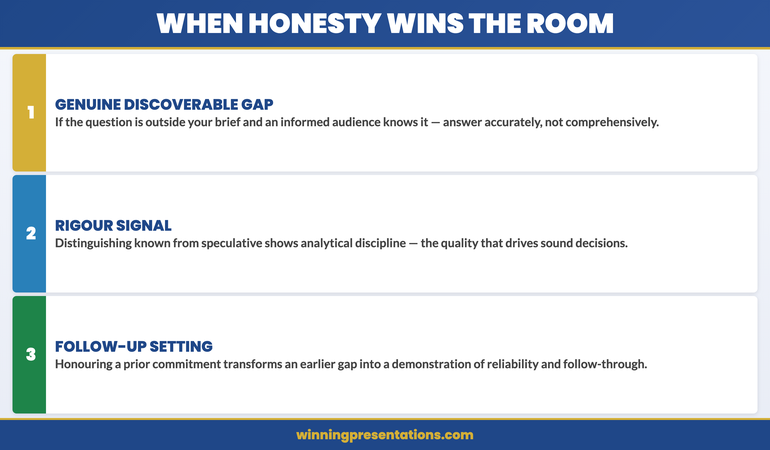
Three conditions when honesty wins the room: Genuine discoverable gap, Analytical rigour signal, and Follow-up demonstration — with the credibility effect of each

How to Frame an Honest Answer Without Undermining Authority

The difference between an honest answer that builds credibility and one that appears as unpreparedness lies almost entirely in framing. Three structural elements determine which it becomes.

First, state what you do know before acknowledging what you do not. “The contract is currently in its second year of a three-year term — the specific break clause mechanics are something I’d want to confirm with Legal before giving you a definitive answer.” This structure demonstrates knowledge within your scope, then accurately bounds what lies outside it. It prevents the common misreading of “I don’t know” as “I know nothing about this topic.”

Second, be specific about the gap rather than vague. “I’m not sure” reads as uncertain. “I don’t have the Q3 breakdown with me — I can have it to you by close of business tomorrow” reads as organised. Specificity about what you do not know, and a specific commitment for when you will, converts a limitation into a process signal.

Third, maintain physical composure. An honest answer delivered with hesitation, lowered eye contact, or a apologetic tone reads as embarrassment — which confirms the questioner’s suspicion that the gap was a failing rather than a boundary. The same words delivered with steady eye contact and a settled tone read as professional precision. The authority of the answer comes from the delivery as much as the content.

The Executive Q&A Handling System

A structured system for predicting and handling the questions that define executive credibility. The Executive Q&A Handling System — £39, instant access — includes frameworks for preparing comprehensive question banks, structuring responses under pressure, and managing the questions you cannot fully answer.

  • Question prediction frameworks for high-stakes meetings
  • Response structures for difficult, partial, and hostile questions
  • Preparation playbooks for board, committee, and investor settings
  • Techniques for managing credibility when knowledge is incomplete

Get the Q&A Handling System →

Designed for executives who present to boards, committees, and senior investment panels.

The Follow-Up Commitment: Turning a Gap Into a Demonstration

The follow-up commitment is what separates an honest answer from a deflection. An executive who says “I’ll get back to you on that” without specifying when, how, or to whom leaves the questioner with a vague promise rather than a reliable commitment. An executive who says “I’ll send you the confirmed figure directly by tomorrow morning, copied to the Chair” has converted a knowledge gap into a visible process of accountability.

The follow-up commitment also reframes the dynamic of the Q&A moment. When a question cannot be fully answered in the room, the audience’s attention shifts from the gap to the response to the gap. A specific, confident commitment captures that attention and directs it toward a positive signal: this person handles incomplete situations with precision, which is exactly how they will handle the programme they are proposing.

Always honour the commitment, and always do so by the deadline you named. An honest answer followed by a missed follow-up produces a credibility outcome significantly worse than either alone. The missed follow-up reframes the original admission as evasion in retrospect. Conversely, an honest answer followed by a timely, accurate follow-up is one of the most effective credibility-building sequences available in an executive presenting context.

If you are preparing a comprehensive question bank before a high-stakes meeting, the article on structuring Q&A answers with the STAR method provides a useful companion framework for the questions you can fully answer. The Executive Q&A Handling System covers both preparation and in-the-moment handling across all question types.

Handling Partial Knowledge: What You Know and What You Don’t

Most Q&A knowledge gaps are not total. The more common situation is partial knowledge: you understand the principle or the conclusion but not the precise mechanism; you know the figure for last year but not the current year; you know the general direction of the regulation but not the specific implementation date. How you manage that partiality determines whether the answer reads as informed or evasive.

The structure for partial knowledge answers has three components. State what you know with confidence, including the level of confidence: “The overall direction here is clear — the regulation moves in our favour.” Then bound the partial gap precisely: “The implementation date I’d want to verify before committing to it — my understanding is Q4, but I know there have been recent consultation updates.” Then offer a disposition: “I can confirm that by the end of the week.”

This three-part structure works because it separates what is established from what is uncertain, and treats each appropriately. The questioner receives accurate information about your actual knowledge state — which is exactly what they need to evaluate the reliability of your answer. An attempt to present partial knowledge as complete knowledge fails on this dimension and creates trust problems when the gap becomes apparent.

A related technique is to use epistemic language accurately: “My understanding is…”, “I believe the figure is… but let me verify”, “to the best of my knowledge…” These phrases are not hedges of weakness. They are precision instruments that allow you to communicate exactly what your confidence level is, which allows the audience to calibrate accordingly.
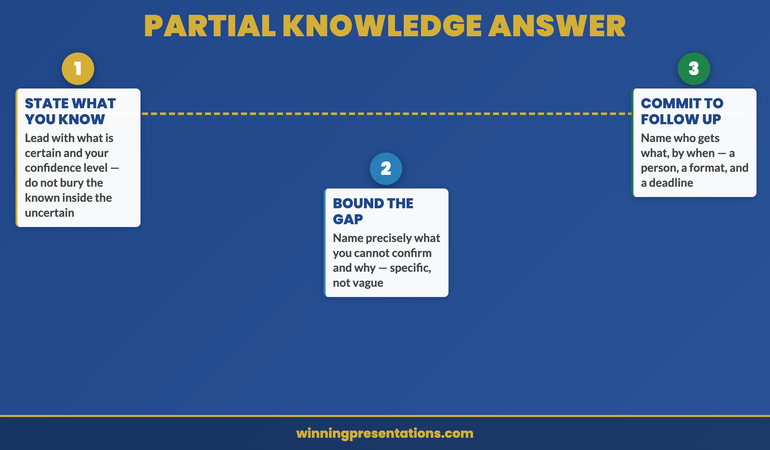
Partial knowledge answer structure: three components — State what you know with confidence level, Bound the gap precisely, Offer a specific commitment — with example language for each

When “I Don’t Know” Is Not the Right Response

There are situations where admitting a knowledge gap is not the optimal choice, and understanding them prevents overuse of the technique to the point where it undermines preparation credibility.

The first situation is when the gap is in core material that you should reasonably be expected to know. If you are presenting a business case and a committee member asks what the total budget request is, “I’d need to check” is not an honest answer — it is a preparation failure. There are categories of question for which the honest answer requires preparation, not admission. Know the boundaries of your own brief thoroughly enough that you can distinguish between what is genuinely outside your scope and what is simply inadequately prepared.

The second situation is when the question is a testing question rather than an information-seeking one. Some senior executives ask questions they already know the answer to, specifically to test whether you do. In these cases, a confident, accurate answer demonstrates mastery. An honest “I don’t know” is technically honest but fails the test it was designed to pass. Distinguishing between testing questions and genuine information requests requires reading the questioner — their tone, their prior statements, their domain expertise. If they clearly know the answer already, they are testing you.

The third situation is when the answer requires a judgement rather than a fact. “What do you think will happen to the market over the next twelve months?” is not a knowledge gap question. It is a judgement question. “I don’t know” is an evasion here. The appropriate response is an honest assessment of your view, with appropriate calibration: “My judgement, based on what we’re seeing in the data, is X — though there are two or three scenarios that could change that.”

Prepare for the distinction between these question types in advance. The article on recognising fishing questions in Q&A covers how to read the intent behind questions rather than simply their surface content. Pre-meeting stakeholder alignment conversations can also surface likely questions in advance, so you can prepare substantive answers rather than relying on honest admission in the room.

Preparing for Honest Q&A in Advance

The most effective Q&A practitioners are not the ones who are best at improvising under pressure. They are the ones who have thought most rigorously about what they do and do not know before they walk into the room. This preparation has two components: mapping the question space, and mapping the knowledge boundary.

Mapping the question space means systematically identifying every question that is plausible given the material you are presenting, the audience you are presenting to, and the context of the meeting. For a financial presentation, this includes detail questions about the numbers, methodology questions about how they were calculated, strategic questions about whether the conclusion is the right one, and risk questions about what happens if assumptions do not hold. For each category, prepare the substantive answer. For the ones you cannot fully answer, prepare the honest framing and the follow-up commitment.

Mapping the knowledge boundary means being explicit with yourself — before the meeting — about the precise edges of what you know. Not in general, but for this specific presentation and this specific audience. The CFO will ask different questions than the Chief Operating Officer. The edge of your knowledge looks different in each conversation. Knowing where that edge is, in advance, means you will not discover it with surprise in the room. You will encounter it exactly where you expected it, and you will have a composed and specific response ready.

The Executive Q&A Handling System

A structured system for predicting and handling executive Q&A — including the questions you cannot fully answer. £39, instant access.

Get the Q&A Handling System →

Designed for executives preparing for board, committee, and investor Q&A sessions.

Frequently Asked Questions

Does saying “I don’t know” damage your credibility with a senior audience?

Not when it is framed correctly. Senior executives evaluate reliability above all other qualities in a Q&A setting. An honest acknowledgement of a knowledge gap, delivered with composure and a specific follow-up commitment, signals exactly the quality they are looking for: the discipline to distinguish between what is known and what is speculative. What damages credibility is a confident answer that turns out to be inaccurate — which retroactively undermines everything else the executive has said in the room.

How do you avoid looking unprepared when you don’t know the answer?

The most effective technique is to state clearly what you do know before acknowledging the gap. “The overall financial position is solid — the specific covenant calculation for that structure is one I’d want to confirm with the treasury team before giving you a definitive figure.” This structure demonstrates knowledge within your scope, then accurately bounds what lies outside it. It prevents the conflation of “I don’t know this one detail” with “I am not across this brief.” Composure in delivery reinforces that this is a boundary, not an oversight.

What if the question you can’t answer is about something you feel you should know?

There are two situations here. If you genuinely should know it and do not, that is a preparation gap — acknowledge it honestly, commit to following up, and use the experience to calibrate your preparation more thoroughly for the next meeting. Do not compound the preparation gap by constructing an answer you are not confident in. If the question is in genuinely ambiguous territory — neither clearly inside nor clearly outside your scope — err on the side of honesty and specificity: name exactly what you know, name exactly what you would need to confirm, and make the commitment clearly.

The Winning Edge — A Newsletter for Executives Who Present

Every Thursday: one structured technique for executive presentations and high-stakes Q&A. Written for senior leaders who need to communicate with precision and authority.

Subscribe to The Winning Edge →

If you are preparing for a major presentation and want to manage the anxiety that comes with difficult Q&A, read the companion article on cognitive restructuring for presentation anxiety.

About the Author

Mary Beth Hazeldine is the Owner and Managing Director of Winning Presentations. With 25 years of corporate banking experience at JPMorgan Chase, PwC, Royal Bank of Scotland, and Commerzbank, she advises executives across financial services, healthcare, technology, and government on structuring presentations and handling high-stakes Q&A with precision and authority.

24 Mar 2026
Senior executive delivering high-stakes presentation with confident posture in corporate boardroom

Executive Presence in Presentations: What Senior Leaders Actually Evaluate Beyond Your Slides

Executive presence in presentations isn’t about magnetism or performance—it’s about demonstrable competence, strategic clarity, and the ability to command trust under pressure. Senior leaders evaluate far more than your slides: they assess your command of the room, your mastery of your subject, your composure under challenge, and whether you’ve thought through the implications of what you’re proposing.

Ingrid had delivered six successful funding rounds for her tech division. She knew her numbers. She’d refined her deck over three weeks. But walking into the boardroom to present her £12m expansion proposal to the new CFO, she felt something shift. The CFO watched her first slide without comment, then asked: “What are you assuming about market adoption?” Ingrid had the answer—but she paused, checked her notes, then delivered it hesitantly. The CFO nodded, said nothing more, and later blocked the proposal. Not because the numbers were wrong. But because Ingrid had signalled uncertainty in the moment she needed to signal authority. The proposal went to a peer who presented the exact same case with conviction and ease. That’s the gap between having a good presentation and having executive presence.

Presenting to senior leaders?

The Executive Slide System includes slide templates and frameworks designed for executive presentations.

What Executive Presence Actually Means

Executive presence is not charisma. It’s not charm, not stage presence, not the ability to tell a compelling story. Those things can enhance a presentation, but they’re not the foundation.

Executive presence is credibility manifested in real time. It’s the visible confidence that you’ve thought deeper than the room expects, that you understand not just what you’re proposing but why it matters, what could go wrong, and what you’ll do if it does. It’s the composure that says: I’ve considered this from every angle, and I’m not rattled by your questions.

In the corporate banking world I spent 24 years navigating, I watched hundreds of pitches. The ones that moved money weren’t always the slickest. They were the ones where the presenter had so thoroughly mastered their subject that they could be interrupted mid-sentence, take a challenging question, and respond with precision—without returning to notes or hedging language. That’s executive presence. It’s the inverse of relying on your deck to carry you.

The stakes in executive presentations are different from standard business presentations. You’re typically asking for approval, funding, or organisational commitment. Your audience is experienced at detecting weakness—not nastiness, but genuine uncertainty about whether you’ve thought this through. Your job isn’t to entertain them or even impress them with smooth delivery. Your job is to convince them you’re someone worth trusting with their time and their resources.

Build the Slides That Back Up Your Presence

When your slides are designed for executive scrutiny, you’re freed from defending basic structure and can focus entirely on credibility and command.

  • ✓ Executive-focused templates that eliminate obvious weakness
  • ✓ AI prompt cards for rapid risk/mitigation framing
  • ✓ Strategic structure guides for high-stakes asks

Explore the System

Designed for high-stakes executive approval presentations

The Three Things Senior Leaders Evaluate

When a senior leader sits in your presentation, they’re running a rapid assessment on three fronts. Understanding these helps you calibrate what actually matters.

1. Do you know your subject better than I do? This is the opening test. If you hesitate on foundational questions, if you misstate a metric, if you have to say “let me check that,” you’ve broken a critical assumption. Senior leaders make fast decisions partly because they trust specialists to have already done the deep work. When you can’t defend basic facts under pressure, you signal that you either haven’t done the work or you’re not confident in it. Either way, you lose authority immediately.

2. Have you thought through implications that I would think through? This is the depth test. Every proposal has risks, constraints, dependencies. A presenter with true executive presence acknowledges these unprompted. You don’t wait for the CFO to find the flaw in your financial model—you’ve already highlighted it and explained why it’s not a blocker. You don’t present a restructuring plan without addressing talent retention or transition risk. You show that you’ve already thought three moves ahead. This is often what separates approval from rejection—not the core idea, but whether you’ve demonstrated strategic foresight.

3. Do I trust you to manage this if I say yes? This is the character test. Under pressure, do you become defensive or curious? Do you answer the question asked, or do you dodge into your talking points? When challenged, do you hold steady or do you fold? Senior leaders know they’re betting on your ability to execute under real-world conditions. They’re watching for signs of resilience, intellectual honesty, and the capacity to think on your feet. If you come across as rehearsed, brittle, or overly polished, you fail this test. If you come across as grounded and adaptable, you pass.

Senior leader evaluating executive presence during presentation

Why Slide Quality Alone Isn’t Enough

This is where many executives stumble. They invest heavily in aesthetics—design, animation, colour, professional imagery—and assume that a polished deck will carry them. It won’t.

A beautiful presentation can actually work against you in executive contexts. If your slides are so slick that they feel detached from you, if they’re so visually complex that they distract from your message, if they signal more about design resources than strategic thinking, you’ve created distance between yourself and your audience. Senior leaders don’t want to admire your presentation. They want to trust your thinking.

What matters is this: your slides should support your credibility, not replace it. The best executive presentations I’ve seen use clean, understated design. A strong headline. Data presented clearly. Plenty of white space. This forces the presenter into the spotlight. Your slides become a reference point, not a performance.

More importantly, consider what your slides reveal about your thinking. If you have seventeen slides for a thirty-minute presentation, you’re asking your audience to process information faster than they can actually absorb it. That signals either poor planning or poor respect for their time. If you have one data point per slide and no context about why it matters, you’re hiding your thinking rather than showing it. If your slide titles are generic (“Market Overview,” “Key Findings”), you’re forcing the audience to listen to you to understand your point—whereas a strategic headline on that slide would make your logic instantly clear.

The hidden factor that keeps talented presenters from advancing is often that they’re too focused on presentation mechanics and not focused enough on the thinking that those mechanics should reveal. Executive presence comes from letting your strategic clarity show through a disciplined deck.

If you’re building a presentation for a high-stakes approval decision, your slide structure should demonstrate that you’ve thought the issue through from multiple angles. The Executive Slide System includes templates that force this kind of strategic architecture—so you’re not starting with aesthetics, you’re starting with logic.

The Structure That Signals Leadership

There’s a predictable structure that senior leaders find credible, because it mirrors how they themselves think through problems. Understanding this structure is one of the fastest ways to improve your executive presence.

Start with the situation, not the solution. Before you tell them what you want, show them why you’re asking. What’s changed? What’s broken? What’s the gap between where we are and where we need to be? This contextualises your ask and demonstrates that you’re responding to a real problem, not pushing an agenda.

Name the constraints openly. What can’t we do? What are we assuming? What could go wrong? By surfacing constraints before your audience has to, you show you’ve done realistic thinking rather than wishful thinking. This is where many presenters lose credibility—they present best-case scenarios as if they’re certain. Leadership expects you to acknowledge uncertainty.

Present your option as one of several. Even if you have a clear recommendation, show that you’ve considered alternatives and explain why you rejected them. This demonstrates critical thinking rather than linear thinking. It also makes your recommendation feel more thoughtful—you chose this, you didn’t just default to it.

Be explicit about decision triggers and success metrics. What will tell us this worked? What will tell us it failed? What decision points will we revisit? This signals that you’re thinking in terms of management and accountability, not just implementation. You’re already positioned to own the outcome.

This structure shows respect for your audience’s time and their need for clarity. It also creates natural space for questions—and questions, when you’ve prepared for them this way, become opportunities to deepen credibility rather than threats.

Strategic presentation structure framework for executives

Strategy Isn’t Enough Without Execution

  • ✓ Slide templates that force this strategic architecture
  • ✓ Ready to deploy for your next executive ask

Get the System

Common Presence-Killers to Eliminate

Some patterns consistently undermine executive presence. If you recognise yourself in any of these, the fix is straightforward.

Over-apologising. “I’m sorry, this is a complex topic…” or “Sorry, let me clarify…” weakens your position before you begin. You’re signalling that you expect your audience to judge you harshly. Replace apologies with directness: “This is complex. Here’s the logic.” Confidence doesn’t mean never hedging—it means hedging strategically, not reflexively.

Filler language. “Um,” “like,” “you know,” “so,” repeated between sentences, destroys executive presence faster than almost anything else. It signals you’re thinking rather than you’ve thought. Record yourself. Identify your pattern. Practice the pause instead. A three-second silence while you gather your next thought sounds far more authoritative than verbal filler.

Reading from your slides or notes. This is the single fastest way to lose authority. Your audience can read. What they need from you is interpretation, insight, and real-time response. If you’re reading, you’re not present—you’re a narrator. Confidence comes from knowing you don’t need your notes, which means preparing differently than most people do. Prepare to know your story, not to recite it.

Defensive responses to questions. When challenged, do you explain or do you defend? There’s a difference. A defensive response feels like you’re protecting yourself; an explanatory response feels like you’re sharing information. “That’s a good question. The reason we structured it this way…” sounds fundamentally different from “Well, actually…” Practice staying curious when questioned, even when you disagree.

Mismatched energy and situation. Some presentations call for urgency and directness. Others call for thoughtfulness and deliberation. If you come in energised and rapid-fire when the room needs careful consideration, you’ll seem scattered. If you come in measured and cautious when the situation calls for conviction, you’ll seem uncertain. Match your energy to the stakes and the moment.

Frequently Asked Questions

Can you build executive presence, or is it something you’re born with?

It’s entirely buildable. Executive presence looks like a natural talent because people who have it make it look effortless—but that effortlessness is the product of relentless preparation. You prepare so thoroughly that you can be present rather than anxious. You practise your logic so many times that you can adapt it in real time. You think through scenarios so carefully that questions feel like invitations rather than threats. None of that is innate.

What if I’m naturally quiet or introverted?

Introversion and executive presence are entirely separate things. Some of the most commanding presenters I’ve worked with were introverts. They didn’t fill the room with energy; they commanded attention through clarity and authority. If you’re quiet, your superpower is that people have to listen to hear you. Use that. Speak deliberately. Make each word count. Senior leaders respect precision far more than volume.

How do I recover if I lose composure during a presentation?

Pause. Acknowledge it silently—don’t apologise for being human. Take a breath. Return to your logic. Most audiences respect this more than pretending nothing happened. You’ve just demonstrated that you stay grounded under pressure, which is exactly what they want to see. The presentation itself isn’t what matters; your ability to recover is.

Should I memorise my presentation?

No. Memorising creates rigidity. If you’ve memorised and someone asks a question that disrupts your script, you’ll panic. Instead, internalise your logic. Know your argument so deeply that you can explain it in any order, emphasise any part, and adapt to any question. This is the difference between being a performer and being a strategist. Senior leaders want strategists.

The Winning Edge

Weekly presentation strategies for executives who present under pressure.

Subscribe Free

Not ready to invest? Start with the free Executive Presentation Checklist — a quick-reference guide for your next high-stakes presentation.

This post was published alongside “Restructuring Presentations: How to Build Team Trust Through Change Communication” as part of our executive series.

Executive presence isn’t about being the most confident person in the room. It’s about being the most prepared, the most thoughtful, and the most honest about what you do and don’t know.

About the Author

Mary Beth Hazeldine is Owner & Managing Director of Winning Presentations. With 24 years of corporate banking experience at JPMorgan Chase, PwC, Royal Bank of Scotland, and Commerzbank, she advises executives across financial services, healthcare, technology, and government on structuring presentations for high-stakes funding rounds and approvals.

Book a discovery call | View services

01 Mar 2026
New director presenting recommendation-first slide to boardroom of executives

Your First Board Presentation as a New Director

My first time presenting to the board lasted four minutes. I’d prepared for forty.

The chair thanked me after slide two, said the board had read the pre-read, and asked one question I hadn’t anticipated. Four minutes. Twelve days of preparation. And the only thing that mattered was a question I’d never considered.

Quick Answer: Your first board presentation as a new director succeeds or fails on structure, not content. Directors don’t want your expertise demonstrated — they want a clear recommendation, the key risk, and the ask. Lead with the decision. Keep it under 12 slides. Prepare for the five questions every board asks, not the fifty you’re worried about.

🚨 First board presentation coming up this week?

Quick 60-second check before you build another slide:

  • Does your first slide state your recommendation (not your agenda)?
  • Can a director grasp your ask within 30 seconds?
  • Have you identified who on the board will challenge you — and on what?

→ Need the exact board presentation templates? Get the Executive Slide System (£39)

I worked with a newly appointed director at a financial services company last year. She’d spent three months preparing her inaugural board appearance — a 34-slide deck covering every metric her division tracked, every risk on her register, and every initiative she’d launched since joining.

The board chair cut her off on slide six.

“We’ve read the pack,” he said. “What do you need from us?”

She didn’t have a clear answer. Because her entire presentation was built to demonstrate competence, not to request a decision. She’d designed a 34-slide CV when the board wanted a 3-slide business case.

After that meeting, we rebuilt her approach from scratch. Her second board presentation was eight slides. She led with the decision, supported it with two data points, and ended with a specific ask. The board approved it in the meeting. No deferrals. No “come back with more detail.”

The difference wasn’t her expertise. It was her structure.

Here’s exactly how to get your initial board-level presentation right — including the structure, the pre-read, and the questions you need to prepare for before you walk in.

The Mistake Every New Director Makes (And Why Boards Tolerate It Exactly Once)

New directors over-present. Every single one. It’s a pattern I’ve seen across hundreds of boardroom presentations at JPMorgan, RBS, PwC, and Commerzbank — and it’s one of the board presentation best practices that experienced directors learn the hard way.

The instinct makes sense. You’re new. You want to prove you belong. So you build a comprehensive deck that demonstrates everything you know about your area.

But boards don’t work that way.

Directors have read your pre-read (or they should have — more on that in a moment). They already know the context. What they need from you in the room is the answer to one question: “What do you need from us, and why should we say yes?”

When you spend your first 15 minutes on context they already have, you signal something dangerous: that you don’t understand how board time works. And that impression is very hard to undo.

The calibration problem: In your previous role, thoroughness was rewarded. At director level, efficiency is rewarded. Your opening board appearance is where that shift either happens — or doesn’t.

Most new directors present like senior managers giving an update. Effective new directors present like peers making a recommendation.

The 8-Slide Structure That Earns Credibility in One Meeting

This is the structure I recommend to every new director presenting to a board for the first time. It’s designed to do two things: demonstrate that you understand how boards operate, and get your item approved without a deferral.

Slide 1: The Recommendation. State what you’re recommending and what you need the board to approve. One sentence. If you can’t articulate this in one sentence, your thinking isn’t ready.

Slide 2: Why Now. The trigger, deadline, or cost of delay. Boards prioritise urgency. Without a “why now,” your item slides to next quarter.

Slide 3: The Business Case (Summary). Financial impact, resource requirement, and timeline. Three numbers maximum. Directors will interrogate the detail — don’t front-load it.

Slide 4: Key Risk + Mitigation. Name the biggest risk and your mitigation plan. Boards respect directors who surface risk voluntarily. Hiding risk destroys trust.

Slide 5: Stakeholder Alignment. Who supports this? Who has concerns? What’s been done to address them? New directors often skip this. Experienced directors never do.

Slide 6: Decision Requested. Restate the specific approval you need. Make it easy to minute. “We recommend the board approve X, at a cost of Y, with implementation beginning Z.”

Slides 7–8: Appendix. Supporting data, detailed financials, scenario analysis. These exist for Q&A, not for presentation. Most boards never open them.

That’s it. Eight slides. Under 10 minutes of presenting. The rest of your time is Q&A — which is where the real board meeting happens.

Infographic showing the 8-slide board presentation structure with numbered steps from recommendation through appendix

The Board Deck That Earns Credibility in One Meeting

Your debut board-level presentation sets the tone for every interaction that follows. The Executive Slide System gives you:

  • The recommendation-first board template — pre-built for the 8-slide structure directors expect
  • The executive summary slide that answers “what do you need from us?” in one glance
  • AI prompts to draft your board deck in 30 minutes (not the 12 days you’re planning)
  • The risk assessment template that surfaces concerns before the board does

Get the Executive Slide System → £39

Built from board-level presentations at JPMorgan, RBS, and Commerzbank — including approvals for multi-million-pound initiatives.

The Pre-Read That Does the Heavy Lifting

Here’s something most new directors don’t realise: the board decision often happens before the meeting. I covered this in detail in my article on executive presentation pre-reads — the principle applies doubly at board level.

Directors read pre-reads on the train, in the car, between other meetings. If your pre-read is clear, structured, and leads with the recommendation, many directors arrive at the meeting having already decided. Your presentation becomes a formality — a chance to confirm, not to persuade.

If your pre-read is 40 pages of context with the recommendation buried on page 37, directors arrive confused. And confused directors defer.

The pre-read structure that works:

Page 1: Executive summary. Recommendation, cost, timeline, key risk, decision requested. Everything a director needs to form a view before reading further.

Pages 2–3: Supporting evidence. The data that supports your recommendation. Not all the data — the data that matters.

Pages 4–5: Risk and mitigation. Detailed risk register for directors who want to interrogate assumptions.

Appendix: Everything else. Background, methodology, detailed financials. Available for reference. Never presented.

A well-structured pre-read means your in-room presentation can be shorter, sharper, and focused entirely on the decision. That’s the goal.

Building your first board pre-read?

The Executive Slide System includes the executive summary template that directors actually read — plus the pre-read structure used in global banking governance.

Get the Executive Slide System → £39

The Five Questions Every Board Asks (Regardless of Topic)

You can’t predict every question a board will ask. But you can predict the categories. After 24 years of banking boardrooms, I can tell you that nearly every first-time director faces the same five question types:

1. “What happens if we don’t do this?” The cost-of-inaction question. Boards need to understand why this can’t wait. If you can’t articulate what happens if they say no, your urgency case is weak.

2. “What’s the downside scenario?” Not worst case — downside. Directors want to know the realistic risk, not the catastrophic one. Have a specific number ready.

3. “Who else supports this?” The stakeholder alignment question. If the CFO hasn’t seen it, the board wants to know why. If a key stakeholder disagrees, the board wants to know what you’ve done about it.

4. “What are we comparing this to?” The alternatives question. Boards don’t approve proposals in isolation. They approve the best option. If you haven’t shown why this is better than the alternatives, expect a deferral.

5. “What do you need from us specifically?” The most important question — and the one new directors fumble most often. Your ask must be specific and minuteable. “Approval to proceed” is vague. “Approval to commit £400K in Q2 for the platform migration, with a progress update at the July board” is minuteable.

Prepare for these five. Have your answers written down. Rehearse them out loud. The content of your slides matters less than how you handle these questions.

People Also Ask:

How long should a new director’s board presentation be?
Aim for 8–12 slides and under 10 minutes of presenting. Boards allocate most time for discussion, not presentation. If your slot is 20 minutes, plan to present for 8 and leave 12 for Q&A.

Should new directors use the same format as other board presenters?
Ask the company secretary for recent board packs. Match the format for consistency but strengthen the recommendation-first structure. Boards appreciate consistency in format and clarity in thinking.

What’s the biggest mistake new directors make in board presentations?
Over-presenting context the board already has. New directors spend too long proving they know the detail and too little time stating what they need the board to decide. Lead with the recommendation. Always.

Conference table with structured board pack showing executive summary first page

Your First Five Minutes: What Directors Actually Notice

Directors form an impression of new board members within the first five minutes. (If you want the full breakdown on what directors read on slides, see what executives actually read in the first 5 seconds.) Not of your expertise — of your judgement. Here’s what they’re watching for:

Do you lead with the decision or the context? Leading with context signals that you’re still operating as a senior manager. Leading with the recommendation signals that you understand governance.

Do you know your numbers cold? You don’t need to present every number. But when a director asks about a specific figure, you need to answer without looking at your slides. Hesitation on your own numbers erodes confidence fast.

Do you name the risk before they do? Directors respect proactive risk disclosure. If you surface the biggest concern before they raise it, you demonstrate maturity. If they have to drag it out of you, you’ve lost ground.

Do you handle the first challenge well? The first pushback question is a test. Not of your answer — of your composure. Stay measured. Don’t over-explain. A direct, two-sentence response earns more respect than a five-minute justification.

Your debut in the boardroom isn’t about impressing the room. It’s about signalling that you belong at the table. Structure does that. Over-presenting undermines it.

Stop Building the 34-Slide “Prove Yourself” Deck

The templates inside the Executive Slide System are designed for the structure boards actually expect — recommendation-first, decision-ready, under 12 slides.

Get the Executive Slide System → £39

The same structure used across board-level governance at global financial institutions.

Worried about the Q&A after your presentation?

Preparation beats confidence every time. Today’s partner article covers the exact Q&A checklist senior executives use — worth reading alongside this one.

Is the Executive Slide System Right For You?

This is for you if:

  • You’ve recently been appointed to a director-level role and have a board presentation coming up
  • You’re spending days building a deck when you know it should take hours
  • You want a clear, structured framework rather than guessing what boards expect
  • You need the pre-read template, executive summary, and risk slides ready to customise

This is NOT for you if:

  • You’re presenting to a team meeting, not a board — the structure is specifically designed for governance-level presentations
  • You need a full presentation skills course rather than slide templates and frameworks
  • You’re looking for industry-specific regulatory templates (these are cross-sector executive templates)


Frequently Asked Questions

How do I find out what format the board expects?

Ask the company secretary for the last three board packs. Study the format, slide count, and level of detail. Match the format for consistency, but strengthen the structure by leading with your recommendation. If no standard exists, the 8-slide structure in this article is a reliable starting point used across multiple sectors.

Should I rehearse my board presentation with a colleague first?

Yes — but choose someone who will challenge you, not reassure you. Ask them to interrupt you on slide two with a difficult question. If you can handle that interruption smoothly, you’re ready. If you can’t, you need to know your content better. Rehearsing with someone senior to you is ideal, as they’ll simulate the board dynamic more accurately.

What if a director asks something I genuinely don’t know?

“I don’t have that figure to hand, but I’ll confirm it by end of day” is a perfectly acceptable board response. What damages credibility is guessing. Directors can tell when you’re improvising numbers. A confident “I’ll come back to you” signals integrity. A fumbled guess signals that your preparation was shallow.

📬 The Winning Edge Newsletter

Weekly boardroom-tested techniques for executives who present under pressure. One actionable insight every week — no fluff.

Subscribe Free →

🆓 Want to start free? Download the Executive Presentation Checklist first.

Read next: If you’re also managing the nerves around your first board appearance, read why even confident presenters still get nervous before every talk — it’s more common than you think.

About the Author

Mary Beth Hazeldine is the Owner & Managing Director of Winning Presentations. With 24 years of corporate banking experience at JPMorgan Chase, PwC, Royal Bank of Scotland, and Commerzbank, she has delivered high-stakes presentations in boardrooms across three continents.

A qualified clinical hypnotherapist and NLP practitioner, Mary Beth combines executive communication expertise with evidence-based techniques for managing presentation anxiety. She advises executives across financial services, healthcare, technology, and government on structuring high-stakes presentations for funding rounds and approvals.

Book a discovery call | View services

Your first board presentation is on the calendar. The structure above takes less than an hour to build. Lead with the decision, prepare for the five questions, and let the pre-read do the heavy lifting. That’s it.

Get the Executive Slide System (£39) and have your board deck built before lunch.

24 Feb 2026
Professional woman in navy blazer standing outside glass-walled boardroom, composing herself before presenting to an unfamiliar executive team

Presenting When You’re the Outsider: Why Your Best Work Gets Ignored (And the Structure That Fixes It)

Quick Answer: Contractors, consultants, and new hires face a presenting as outsider credibility gap that has nothing to do with content quality. The room decides whether to trust you in the first 90 seconds — before your data lands. The fix isn’t more preparation or better slides. It’s a specific slide structure that establishes authority through insight, not introduction. Lead with what you see that insiders can’t. That’s your structural advantage.

I spent 24 years walking into boardrooms where nobody knew my name.

At JPMorgan, I was the London person presenting to the New York desk. At RBS, I was the new hire presenting to a team that had worked together for a decade. At Commerzbank, I was the external consultant brought in to restructure a process the existing team had built.

Every single time, I felt it. That moment before you speak where the room is scanning you — not your slides, not your data — you. Deciding whether you’re worth listening to before you’ve said a word.

The worst was Frankfurt, 2009. I’d been hired to present a risk framework to a steering committee of twelve. I had six weeks of analysis. I had perfect slides. I opened with “Thank you for having me. Let me introduce myself and walk you through my background.”

Three people checked their phones. One left for coffee. I’d lost the room in eleven words.

The next time I walked into that room, I opened differently. I opened with what I’d found — an insight they didn’t have. The same people who’d ignored me were asking questions by slide two.

The content hadn’t changed. The structure had.

🚨 Presenting to a team that doesn’t know you this week? Quick check: Does your first slide lead with insight (what you’ve found) or introduction (who you are)? If it’s introduction, you’re giving the room permission to tune out. → Need the exact outsider-ready slide structure? Get the Executive Slide System → £39

Why the Credibility Gap Exists (And Why Experience Doesn’t Close It)

Here’s what nobody tells you about presenting as outsider credibility: the problem isn’t competence. It’s category.

When you’re internal, you’ve already been sorted. The room knows your track record, your department, your relationship to the decision-maker. They’ve decided — at least partially — whether to take you seriously before you stand up.

When you’re external, you haven’t been sorted yet. You’re in a holding pattern. The room is running a parallel process during your presentation: half their brain is evaluating your content, half is evaluating you.

This is why the same analysis, presented by an insider and an outsider, lands completely differently. The insider gets the benefit of the doubt. The outsider has to earn it — and they have about 90 seconds to do it.

Experience doesn’t automatically close this gap. I’ve watched consultants with 20 years of expertise get ignored because they opened with credentials instead of insight. The room doesn’t care about your CV. They care about whether you understand their problem.

How do you build credibility in a presentation when you’re new?

Not with a “my background” slide. Not with name-dropping previous clients. Those are defensive credibility moves — they try to prove you belong. What works is offensive credibility: demonstrating insight the room doesn’t already have. When you lead with “Here’s what I’ve found,” you skip the credibility queue entirely. You become useful before you become trusted — and usefulness creates trust faster than any CV slide.

The 90-Second Window: What the Room Is Actually Deciding

Research on first impressions in professional settings shows a consistent pattern: people form judgements within seconds, then spend the rest of the interaction confirming those judgements.

In a presentation, the 90-second window isn’t about your content. It’s about three unconscious questions every person in the room is asking:

1. “Does this person understand our world?” Not your world. Not your methodology. Theirs. If your first slide talks about your process, your framework, your approach — you’ve answered “no.” If your first slide talks about their challenge, their deadline, their risk — you’ve answered “yes.”

2. “Are they going to waste my time?” Outsiders over-explain. It’s a defence mechanism — you feel like you need to justify your presence. But every minute of context-setting is a minute the room is deciding you don’t have anything new to say.

3. “Do they have something I don’t?” This is the golden question. If your opening signals you’ve seen something the room hasn’t, every executive in that room leans forward. Not because they trust you. Because they’re curious. And curiosity buys you the next ten minutes.

The executives who present like CEOs understand this instinctively. They lead with the insight, not the introduction. As an outsider, you need to do the same — but with even more precision.

The Credibility Architecture: 4 Slides That Close the Gap

After two decades of presenting as the outsider, I developed a structure I now teach to every contractor, consultant, and new hire I work with. I call it the Credibility Architecture — and it’s the opposite of how most outsiders present.

Most outsiders present like this: Introduction → Background → Methodology → Findings → Recommendation.

The Credibility Architecture: Insight → Implication → Evidence → Ask.

Here’s what each slide does:

Slide 1: The Insight — Open with what you’ve found that the room doesn’t know. Not your conclusion. Not your recommendation. The single most surprising or important thing your analysis revealed. “Your Q3 attrition is 40% higher in the first 90 days than industry benchmark — and it’s concentrated in one department.” That’s an insight. “We conducted a comprehensive analysis of your attrition data” is a process description. One creates curiosity. The other creates boredom.

Slide 2: The Implication — What does this insight mean for their business, their timeline, their risk? This is where you demonstrate judgement. Anyone can present data. Only someone who understands the business can explain what the data means. “At current rates, this costs you £2.3M annually in recruitment and lost productivity — and it accelerates in Q1 when your biggest client renewal is due.”

Slide 3: The Evidence — Now you earn the right to show your methodology. The room is curious. They want to know how you got here. This is where your analysis, your data, your process belongs — after they care, not before.

Slide 4: The Ask — What do you need from the room? A decision, a budget, a next step? The decision slide structure works regardless of whether you’re internal or external — because it focuses on the business outcome, not your authority to request it.

The Credibility Architecture four-slide structure showing Insight, Implication, Evidence, and Ask for outsiders presenting to unfamiliar executive audiences

⭐ Walk Into Any Room and Own It — Even When Nobody Knows You

The Executive Slide System gives you 22 proven slide structures that establish authority through structure, not reputation. Whether you’re a contractor, consultant, or new hire — the templates put your insight first and your credentials where they belong: implicit in the quality of your slides.

Includes:

  • Executive Summary template — the insight-first structure that earns trust in 90 seconds
  • Board Meeting Opener — designed for first-time presentations to unfamiliar audiences
  • 15 scenario playbooks including “First Presentation as New Leader” with exact template + prompt + checklist
  • 51 AI prompts that sharpen your outsider insight into executive-ready language

Get the Executive Slide System → £39

Built from 24 years of presenting as the outsider — at JPMorgan, RBS, PwC, and Commerzbank.

The Outsider’s Hidden Structural Advantage

Here’s something most outsiders don’t realise: you have an advantage that insiders don’t.

Insiders are trapped by context. They know the politics, the history, the unspoken rules — and that knowledge constrains what they’re willing to say. They self-censor. They hedge. They present what’s politically safe rather than what’s analytically true.

You don’t have that constraint. You can say the thing nobody in the room is willing to say — because you don’t have a promotion to protect or a relationship to preserve.

The best outsider presentations I’ve seen — and the ones that led to follow-on contracts, permanent roles, and reputation-building moments — all shared one quality: they said the uncomfortable thing with data behind it.

“Your top performer in sales is actually your biggest risk — their client relationships are personal, not institutional, and when they leave, you lose 60% of that revenue.” Nobody internal would say that. An outsider with the data can.

This is why the Credibility Architecture starts with insight, not credentials. Your unfamiliarity with the politics isn’t a weakness. It’s the reason they hired you. Use it.

The outsider advantage only works if your slide structure supports it. Generic templates signal “I grabbed this from Google.” Decision-first templates signal “I know how executive meetings work.” The Executive Slide System gives you the structure that makes your insight land — whether the room knows you or not.

The 3 Mistakes Outsiders Make (That Insiders Never Would)

What’s the biggest mistake outsiders make in executive presentations?

Mistake 1: The credentials dump. “Before I begin, let me share a bit about my background.” This is the outsider’s security blanket — and it’s a credibility killer. Every minute you spend justifying your presence is a minute the room isn’t learning from you. Insiders never do this because they don’t need to. You shouldn’t either — but for a different reason: your insight is a better credential than your CV.

Mistake 2: Over-qualifying every statement. “Based on our preliminary analysis, and bearing in mind the limitations of the data set, we believe there may be an opportunity to…” Outsiders hedge because they’re afraid of being wrong in a room where they have no political cover. But hedging signals uncertainty — and uncertainty from an outsider is fatal. If you’re not confident enough to state a clear recommendation, the room won’t be confident enough to act on it.

Mistake 3: Presenting your methodology before your findings. This is the biggest one. Outsiders lead with process because they think it builds credibility: “Here’s how thorough we were.” But the room doesn’t care about your process. They care about your conclusions. Lead with what you found. If they want to know how you got there, they’ll ask — and that question is a sign of engagement, not skepticism.

If you’re managing anxiety about presenting to a room that doesn’t know you, it’s worth understanding that much of that anxiety comes from structural uncertainty — not knowing whether the room will engage. When your slides demand engagement (because the insight is too interesting to ignore), the anxiety drops. For more on managing the physical stress of presenting under pressure, see the guide to presenting bad news without destroying credibility.

⭐ Stop Being the Outsider They Politely Ignore

The difference between “thank you for your input” and “when can you present to the board?” isn’t your analysis. It’s your slide structure. The Executive Slide System gives you the decision-first architecture that makes executives engage — regardless of whether they know you.

What’s inside for outsider presentations:

  • Insight-first Executive Summary template — opens with what you found, not who you are
  • Board Meeting Opener — designed for first-time presentations to unfamiliar audiences
  • Stakeholder credibility framing prompts for “new to the room” situations
  • Scenario 10 playbook: First Presentation as New Leader — exact template, prompt, and checklist

Get the Executive Slide System → £39

Built from 24 years of presenting as the outsider — to unfamiliar boardrooms at JPMorgan, RBS, PwC, and Commerzbank.

Every project status update you deliver as a contractor is a credibility opportunity — or a credibility leak. The Executive Slide System includes the exact structure that turns routine updates into reputation-building moments.

When Someone in the Room Doesn’t Want You There

Sometimes the credibility gap isn’t passive — it’s active. Someone in the room has been lobbying against the project you’re working on. Or they wanted a different consultant. Or they feel threatened by an external person doing work they think should be done internally.

I’ve been in this room more times than I can count. At PwC, I once presented a process redesign to a team whose manager had explicitly told the steering committee it wasn’t needed. He sat in the front row with his arms crossed for my entire presentation.

Here’s what works:

Don’t acknowledge the dynamic. The moment you say “I know some of you may be skeptical about bringing in outside help,” you’ve made the political tension the centrepiece of the room’s attention. Present as if every person in the room is there to learn from your findings.

Address their likely objection in your data — by slide 3. If someone thinks this project is unnecessary, your insight slide needs to include the evidence that makes it necessary. Don’t argue with them. Let the data do it. “The current process costs £340K annually in manual workarounds — that’s 4.2 FTEs” is harder to argue with than “we believe there’s an opportunity to streamline.”

Give them an on-ramp. The hostile person needs a way to engage without losing face. Frame your recommendations as building on what already exists: “The team has built a solid foundation. This proposal extends it.” Now they can support you without admitting they were wrong to oppose you.

How should a consultant present to a client’s leadership team?

The same way an insider would — but with more precision. Lead with what you’ve found (the insight), not what you’ve done (the process). State your recommendation clearly (no hedging). And give the room a specific decision to make. The format isn’t different. The margin for error is smaller.

Is This Right For You?

✓ This is for you if:

  • You’re a contractor, consultant, or new hire presenting to a team that doesn’t know you
  • Your analysis is strong but the room doesn’t engage the way you expect
  • You want a slide structure that earns trust through insight, not credentials

✗ This is NOT for you if:

  • You present exclusively to your own team and already have internal credibility
  • You’re looking for design templates (this is structure and logic, not visual design)

⭐ The Structure That Got Me Invited Back to Every Room I Walked Into

In 24 years of presenting as the outsider — across JPMorgan, PwC, RBS, and Commerzbank — I built the frameworks that turn first impressions into lasting authority. The Executive Slide System is that structure, now available as templates and AI prompts you can use before your next meeting.

Inside:

  • 22 executive slide templates — including Executive Summary, Board Opener, and Strategic Recommendation
  • 51 AI prompts — 3 per template (Draft → Refine → Executive Polish)
  • 15 scenario playbooks — find your exact situation, follow it like a recipe
  • 6 checklists covering structure, clarity, logic, and decision readiness

Get the Executive Slide System → £39

Instant download. 30-day money-back guarantee. Used by contractors, consultants, and new hires presenting to unfamiliar leadership teams.

Frequently Asked Questions

How do I present confidently when I don’t know the internal politics?

You don’t need to know the politics to present effectively. You need to know the business problem. Focus your preparation on understanding the specific challenge, the numbers behind it, and what a good outcome looks like for the decision-maker. The Credibility Architecture puts your analysis front and centre — which means the room engages with your findings rather than evaluating your political position. The politics become irrelevant when the insight is strong enough.

Should I acknowledge that I’m new or external?

No — or at least, not as a standalone moment. Saying “As some of you know, I was brought in three weeks ago to…” signals that you consider your outsider status a limitation. Instead, let your first slide do the work. When you open with a specific insight about their business, you implicitly signal that you’ve done the work. The room doesn’t need to know how long you’ve been there. They need to know whether you have something they don’t.

What if someone in the room is hostile to external presenters?

Address their likely objection in your data by slide 3 — before they raise it. If they think your project is unnecessary, include the cost or risk data that makes it necessary. If they feel threatened, frame your recommendations as extensions of existing work. The goal isn’t to win them over in the presentation. It’s to make opposition feel unjustified to everyone else in the room. For more on navigating political dynamics, see the scenario playbook for presenting when someone is undermining you.

📬 The Winning Edge — Weekly Newsletter

One executive presentation insight per week. Real scenarios, real structures, no filler. Written for contractors, consultants, and corporate presenters who present to people they need to impress.

Subscribe Free →

Related: If your first outsider presentation didn’t land the way you hoped, read Presenting After Failure: The 3 Words That Saved a VP’s Career — the recovery structure that rebuilds credibility fast.

Your next presentation to a room that doesn’t know you is on your calendar. You already have the analysis. Now get the structure that makes them listen.

About the Author

Mary Beth Hazeldine is the Owner & Managing Director of Winning Presentations. With 24 years of corporate banking experience at JPMorgan Chase, PwC, Royal Bank of Scotland, and Commerzbank, she has delivered high-stakes presentations in boardrooms across three continents.

A qualified clinical hypnotherapist and NLP practitioner, Mary Beth combines executive communication expertise with evidence-based techniques for managing presentation anxiety. She has trained thousands of executives and supported presentations for high-stakes funding rounds and approvals.

Read more articles at winningpresentations.com