Tag: board governance

27 Apr 2026
Featured image for Data Breach Communication: How to Present a Security Incident to Your Board

Data Breach Communication: How to Present a Security Incident to Your Board

Quick answer: A data breach presentation to your board should open with the scope and severity of the incident, move into a clear timeline of what happened and when it was detected, outline the immediate containment measures already taken, and close with the remediation plan and regulatory obligations. Your board does not need technical forensics — they need governance-level clarity that enables decisive action within the first 72 hours.

Katarina Novak had spent eleven years building her reputation as a meticulous CISO. She had overseen penetration testing schedules, led compliance audits, and negotiated cyber insurance renewals without a single material incident on her record. Then, on a Tuesday afternoon in February, her security operations team flagged unusual data exfiltration patterns across three customer-facing databases.

Within four hours, the scope became clear: approximately 140,000 customer records had been exposed, including names, email addresses, and partial financial data. The regulatory clock was already ticking. Katarina had 72 hours to notify the ICO under UK GDPR, and her CEO had called an emergency board meeting for the following morning.

She sat at her desk at 9 PM, staring at a blank slide deck. She had every technical detail memorised. What she did not have was a structure that would give her board — five non-technical directors with fiduciary responsibilities and personal liability concerns — the clarity they needed to make decisions rather than spiral into recrimination.

Her challenge was not knowledge. It was translation. And that gap between technical mastery and boardroom communication is where most breach presentations fall apart.

If you need a structured approach to crisis board presentations, the Executive Slide System gives you ready-made templates for exactly this kind of high-pressure scenario.

Explore the System →

Why Most Board Breach Briefings Fail

The typical board breach briefing fails for a specific and predictable reason: the presenter structures it as a technical post-mortem rather than a governance decision document. CISOs and IT directors default to what they know — forensic timelines, attack vectors, system architecture diagrams — because that is the world they operate in daily. But a board meeting after a data breach is not a technical review. It is a governance session where directors need to discharge their fiduciary duties, assess organisational risk, and authorise specific actions.

When you present 40 slides of network topology to a room of non-executive directors, you are not being thorough. You are being unclear. The board’s primary concerns are legal exposure, financial impact, reputational damage, and regulatory compliance — in roughly that order. Every slide that does not address one of those four concerns is a slide that wastes the limited attention your board will give you under crisis conditions.

This is the same communication challenge that surfaces when presenting bad news to senior leadership in any context — the instinct to over-explain creates distance rather than clarity. A breach briefing compounds this problem because time pressure is extreme and the emotional stakes for individual directors are high. Non-executive directors carry personal liability under certain regulatory frameworks. They are not sitting in that room with academic curiosity.

The fix is structural, not rhetorical. You do not need to become a better public speaker to deliver an effective breach briefing. You need a framework that translates technical incident data into governance-level decision points — one that your board can follow even when anxiety is running high and trust is under strain.

Structure Your Crisis Board Briefing in 30 Minutes

The Executive Slide System includes 22 templates, 51 AI prompts, and 15 scenario playbooks — including crisis and incident response scenarios. Stop building breach presentations from scratch under time pressure.

£39 — instant access. Designed for high-stakes executive crisis presentations.

Get the Executive Slide System →

The Five-Section Framework for a Data Breach Board Briefing

An effective data breach presentation follows five sections, each designed to answer a specific governance question. This is not a suggestion — it is the logical sequence that allows your board to process the situation, assess risk, and authorise next steps without backtracking or circular discussion.

Section 1: Incident Summary (1-2 slides). What happened, when it was detected, and what data was affected. Use plain language. “Unauthorised access to customer database” is clearer than “threat actor exploited CVE-2026-XXXX via lateral movement from compromised endpoint.” Your board needs to understand the nature and scope of the incident, not the attack methodology.

Section 2: Current Status and Containment (1-2 slides). What has already been done to stop the breach, isolate affected systems, and prevent further data loss. This section is psychologically critical — it demonstrates that the organisation is already acting, which reduces the board’s anxiety and prevents the meeting from becoming a blame session.

Section 3: Regulatory and Legal Obligations (2 slides). Which regulators must be notified, by when, and what has already been filed. If you are presenting to a UK-regulated organisation, ICO notification under UK GDPR is mandatory within 72 hours where the breach poses a risk to individuals’ rights and freedoms. Your board needs to know whether you are within that window and what the notification will say. This connects directly to the kind of compliance presentation structure that boards expect in regulated environments.

Section 4: Impact Assessment (2-3 slides). Financial exposure, reputational risk, customer impact, and insurance coverage. Be specific where you can and honest about what remains uncertain. “We estimate direct costs between £200,000 and £500,000 based on comparable incidents, but this will refine as the forensic investigation concludes” is far more useful than either a precise figure you cannot defend or a vague “significant financial impact.”

Section 5: Remediation Plan and Decision Points (2-3 slides). What the organisation will do next, what resources are required, and what decisions the board needs to make today. This is where many breach briefings fall short — they describe the problem exhaustively but leave the board with no clear actions. Your final slides should include specific asks: approve the forensic investigation budget, authorise customer notification, confirm the external communications strategy.


Five-section framework for data breach board briefing showing incident summary, containment status, regulatory obligations, impact assessment, and remediation plan with decision points

How to Structure Your Opening Slide for Maximum Clarity

Your opening slide sets the cognitive frame for the entire meeting. Get it wrong, and you will spend the next 45 minutes fielding anxious, unfocused questions from directors who are still trying to understand the basics. Get it right, and your board enters the discussion with the mental model they need to engage with your recommendations rather than your forensic data.

The opening slide should contain exactly four elements:

  • Nature of the incident — one sentence. “Unauthorised access to customer records database via compromised vendor credentials.”
  • Scale — number of records, customers, or systems affected. Use ranges if the investigation is ongoing.
  • Detection and containment timeline — when the breach occurred, when it was detected, and when containment was achieved.
  • Current status — a single line: “Contained / Under investigation / Ongoing.” This immediately tells your board whether the building is still on fire.

Notice what is not on this slide: attribution, root cause analysis, system architecture, or vendor blame. Those details belong in the appendix for directors who want to review them after the meeting. Your opening slide is a governance summary, not an incident report.

If structuring crisis slides feels overwhelming, the Executive Slide System provides 22 ready-made templates designed for exactly this kind of high-stakes board scenario.

Presenting the Regulatory Timeline Without Creating Panic

Regulatory deadlines after a data breach are non-negotiable, and your board knows this. What they may not know is how to interpret those deadlines in context — and if you present them without context, you risk triggering panic rather than structured decision-making.

The most effective approach is to present regulatory obligations as a visual timeline rather than a bullet list. Show the 72-hour ICO notification window, the customer notification requirements, any sector-specific obligations (FCA for financial services, NHS Digital for healthcare), and — critically — mark which deadlines have already been met and which are pending. This shifts the board’s mental model from “we are in trouble” to “we are managing a process.”

One question boards frequently ask is: what happens if we miss a regulatory deadline? Prepare for this. Under UK GDPR, late notification can result in administrative fines up to £8.7 million or 2% of annual worldwide turnover, whichever is higher — though in practice, the ICO considers the circumstances and the organisation’s cooperation. Your slide should acknowledge the risk proportionally: serious enough to warrant urgency, not so catastrophic that the board loses confidence in your ability to manage it.

This is also the section where cross-border considerations surface. If affected customers are in multiple jurisdictions, you may have parallel notification obligations. A table showing jurisdiction, regulator, deadline, and status is the clearest format — and it demonstrates to your board that you have mapped the full regulatory landscape rather than focusing only on domestic requirements.

The psychological principle at work here mirrors what applies when presenting change to stakeholders: people accept difficult realities more readily when they can see a clear process for managing them. Your regulatory timeline slide is not just informational — it is a confidence-building tool.

Board-Ready Crisis Slides Without Starting From Scratch

When the clock is ticking and the board is waiting, you need structure, not a blank screen. The Executive Slide System gives you 15 scenario playbooks and 51 AI prompts to build your breach briefing in minutes.

£39 — instant access.

Get the Executive Slide System →

Building a Remediation Slide That Drives Board Confidence

Your remediation slide is where the meeting turns from backward-looking analysis to forward-looking action. This is the slide that determines whether your board leaves the room feeling that the organisation is in control or feeling that it is in freefall.

Structure your remediation plan around three time horizons:

Immediate (0-72 hours): System isolation, credential rotation, forensic investigation initiation, legal counsel engagement, regulatory notification. Most of these should already be in progress or complete by the time you present. Showing completed items demonstrates competence.

Short-term (1-4 weeks): Full forensic report, customer notification execution, external communications rollout, insurance claim filing, vulnerability remediation. Each item should have an owner and a target date.

Medium-term (1-6 months): Security architecture review, vendor risk reassessment, updated incident response procedures, board reporting cadence for ongoing updates. This section signals to your board that you are not just fighting the current fire — you are preventing the next one.

Another common board question: how do we know this will not happen again? The honest answer is that no organisation can guarantee zero risk. But you can demonstrate that the remediation plan addresses the specific vulnerability exploited in this incident and strengthens the broader security posture. Frame it as risk reduction, not risk elimination — your board will respect the honesty and trust your judgment more than if you offer unrealistic assurances.

End your remediation section with explicit decision points. “The board is asked to approve the following: (1) £150,000 budget for third-party forensic investigation, (2) customer notification strategy as outlined, (3) appointment of external crisis communications firm.” Give your board something concrete to vote on. Decision points convert anxiety into agency.


Remediation timeline showing three time horizons for post-breach recovery: immediate actions at 0-72 hours, short-term steps at 1-4 weeks, and medium-term security improvements at 1-6 months

Preparing for the Hardest Board Questions After a Breach

The presentation itself is only half the battle. The Q&A session that follows is where board confidence is truly won or lost. Directors under pressure ask pointed, sometimes adversarial questions — not because they are hostile, but because they are processing personal liability risk in real time.

Prepare for these five questions specifically:

  1. “Were we warned about this risk?” — Have your risk register entries and previous board reporting ready. If cybersecurity risks were flagged in prior meetings, reference those discussions to show continuity of governance.
  2. “What is our personal exposure?” — Non-executive directors carry personal liability under certain frameworks. Have your legal counsel’s assessment of director liability ready, even if it is preliminary.
  3. “Why did it take so long to detect?” — Be factual about dwell time. If detection took days or weeks, explain what detection capabilities were in place and what has changed since.
  4. “Should we disclose publicly before we are required to?” — This is a strategic decision, not a technical one. Present the arguments for early voluntary disclosure (trust, narrative control) alongside the arguments for regulatory-timeline disclosure (completeness, legal protection).
  5. “How much will this cost us?” — Provide a range with clear assumptions. Include direct costs (forensics, notification, remediation), potential regulatory fines, litigation exposure, and customer churn estimates. Be transparent about uncertainty.

The ability to handle hostile questions under pressure is a skill that extends well beyond breach presentations. If you are also preparing for competitive win-back presentations or any high-stakes board scenario, the same principle applies: anticipate the three hardest questions and prepare structured responses before you enter the room.

What should you include in a data breach presentation appendix? Keep the appendix technical and detailed — it is for directors who want deeper information after the meeting. Include the full forensic timeline, system architecture diagrams, vendor assessment reports, and the complete regulatory notification text. Label it clearly as supplementary material so that the board understands it is available but not required reading for the governance decisions at hand.

Frequently Asked Questions

How long should a data breach board presentation be?

Aim for 10 to 15 slides in the main presentation, with a technical appendix available for directors who want additional detail. Under crisis conditions, board attention is compressed — you have approximately 20 minutes before anxiety-driven questions begin to dominate. Structure your core briefing to fit within that window, and allocate the remaining meeting time for discussion and decision-making. Shorter is almost always better in a breach context; every unnecessary slide dilutes the urgency and clarity of your core message.

Should the CISO or the CEO deliver the breach briefing to the board?

In most organisations, the CISO should present the technical incident details and remediation plan, while the CEO or a senior executive should frame the strategic and reputational implications. Co-presenting demonstrates organisational alignment — the board sees that the security team and executive leadership are working from the same information and the same priorities. If your organisation does not have a CISO, the CTO or head of IT should lead the technical sections, with the CEO anchoring the governance narrative and decision points.

What is the biggest mistake executives make in a cybersecurity board briefing?

The most common mistake is presenting the breach as a purely technical event rather than a business risk event. Boards govern risk, not infrastructure. When you spend 80% of your slides on attack vectors, log analysis, and network diagrams, you force non-technical directors to translate that information into governance terms themselves — and most cannot. The second most common mistake is failing to include clear decision points. A briefing that ends with “any questions?” instead of “the board is asked to approve the following three actions” wastes the meeting’s decision-making authority and leaves the organisation in limbo during a period when speed matters.

Join The Winning Edge

Free weekly newsletter for executives who present at board level. Practical frameworks, crisis communication strategies, and slide structure guidance — delivered every Thursday.

Subscribe Free →

Not ready for the full system? Start here instead: download the free Executive Presentation Checklist — a quick-reference guide for structuring any high-stakes board presentation.

Mary Beth Hazeldine is the Owner & Managing Director of Winning Presentations. With 25 years of corporate banking experience at JPMorgan Chase, PwC, Royal Bank of Scotland, and Commerzbank, she advises executives across financial services, healthcare, technology, and government on structuring presentations for high-stakes funding rounds and approvals.

26 Apr 2026
Featured image for Remuneration Committee Presentation: How to Brief Non-Executives on Executive Pay Decisions

Remuneration Committee Presentation: How to Brief Non-Executives on Executive Pay Decisions

Quick Answer

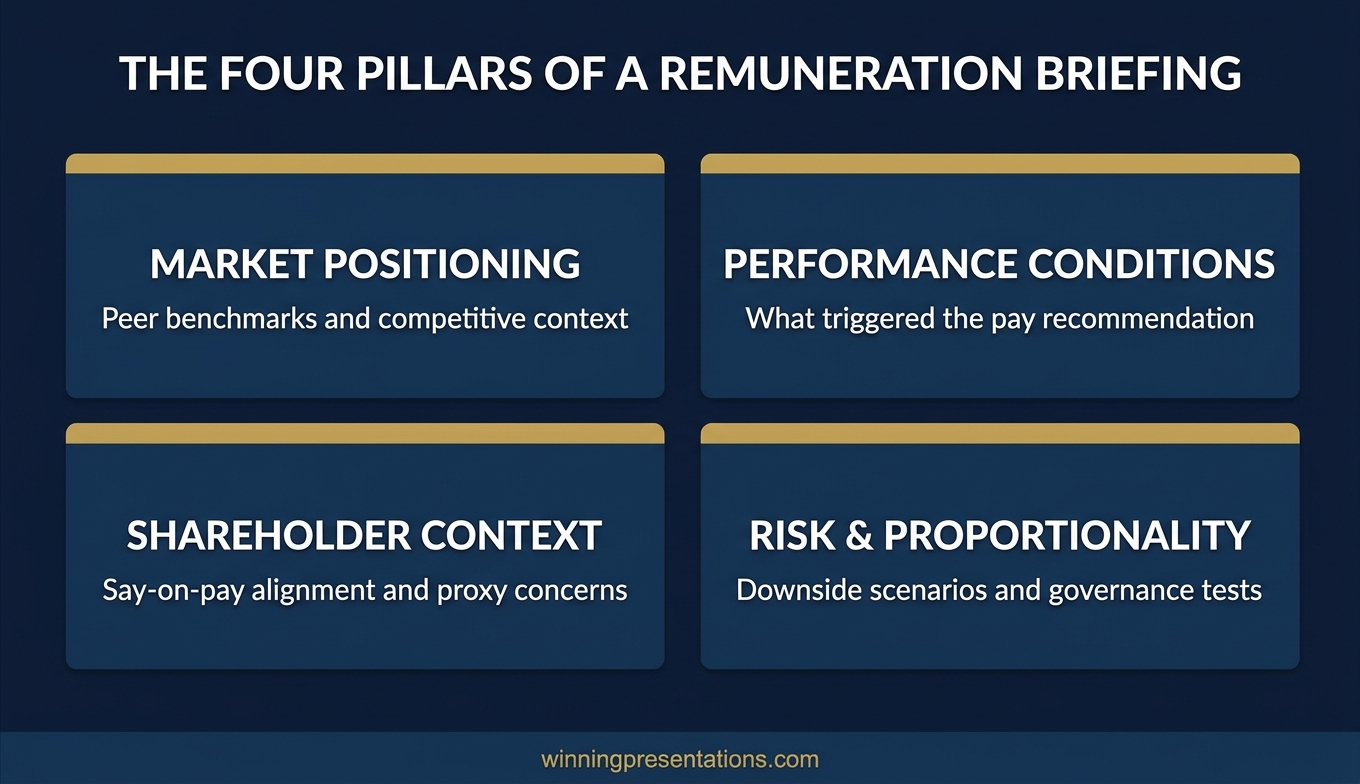
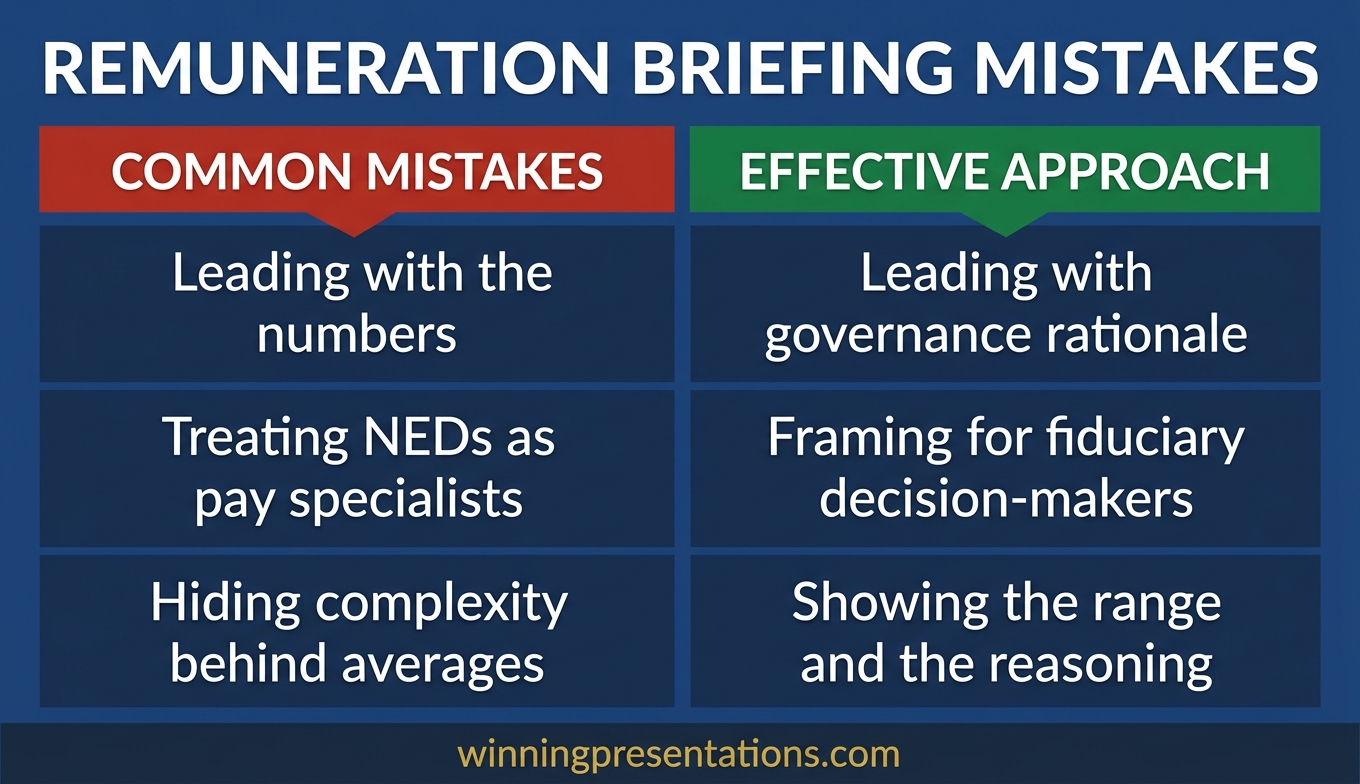
A remuneration committee presentation should lead with the governance rationale behind every pay recommendation, not the numbers themselves. Non-executive directors need to understand the decision framework — market positioning, performance conditions, shareholder context, and risk — before they can approve anything. Structure your briefing around those four pillars and you give the committee what it needs to act.

Laurence had been HR Director at a FTSE 350 financial services firm for three years. He knew the compensation landscape inside out. His benchmarking data was impeccable. His spreadsheets ran to fourteen tabs.

The remuneration committee meeting lasted forty-five minutes. His presentation took thirty of them. When the committee chair — a former FTSE 100 CFO — asked, “What’s the single strongest argument for this package if a shareholder challenges it at the AGM?”, Laurence didn’t have an answer ready.

Not because he didn’t know. Because his presentation hadn’t been structured to surface that answer. He’d built a data briefing. The committee needed a governance briefing. The distinction sounds semantic, but it changes everything about how you organise information, which slides come first, and what the committee remembers when they vote.

I’ve seen this pattern repeatedly across financial services, healthcare, and technology organisations. The person presenting to the remuneration committee is typically the most knowledgeable person in the room on compensation. But knowledge alone doesn’t translate into a presentation that helps non-executives make a confident decision.

Already know the pay data but struggling to frame it for non-executives?

The Executive Slide System includes governance briefing frameworks designed for committee and board presentations — the structures that turn complex data into clear decision support for non-executive directors.

Explore the Executive Slide System →

Why most remuneration committee briefings lose the room

The most common failure in a remuneration committee presentation is not poor data. It’s presenting the data as though the committee members are compensation specialists. They are not. They are non-executive directors with fiduciary responsibilities, broad commercial experience, and a governance lens that prioritises risk, fairness, and shareholder defensibility.

When you open with a detailed salary benchmarking analysis, you’re answering a question the committee hasn’t asked yet. They don’t start with “Is this the right number?” They start with “Is this defensible?” Those two questions require entirely different opening structures.

Three patterns consistently undermine remuneration committee briefings:

  • Data-first sequencing: Leading with median market data, percentile positioning, and peer group analysis before establishing the governance rationale. The committee receives numbers without a framework for evaluating them.
  • Excessive granularity: Presenting every element of the pay package — base, bonus, LTIP, benefits, pension — in sequence without connecting them to the overall narrative. The committee loses the thread between slide five and slide twelve.
  • Missing the shareholder voice: Failing to anticipate how the recommendation would appear in the annual report or at the AGM. Non-executive directors are acutely aware of shareholder scrutiny. If your presentation doesn’t address it, they will — and you won’t control the framing.

Each of these problems has the same root cause: the presentation is structured around what the presenter knows rather than what the committee needs to decide.

Give the Committee a Decision Framework, Not a Data Dump

The Executive Slide System — £39, instant access — includes governance briefing structures designed for committee and board-level presentations. Frame executive pay recommendations around defensibility, not just data. Built from 25 years of corporate banking experience.

  • 22 templates covering board, committee, and approval presentations
  • 51 AI prompts for drafting slides, talking points, and briefing notes
  • 15 scenario playbooks including governance and committee briefings

Get the Executive Slide System →

Designed for executives presenting pay, governance, and approval recommendations to non-executive boards.

The four pillars of a strong committee pay briefing

Every effective pay committee briefing rests on four pillars. These are not sections of your slide deck — they’re lenses that every piece of information in your briefing should be viewed through.

1. Market positioning

Where does the proposed package sit relative to the external market? Non-executive directors need to understand whether you’re positioning at median, upper quartile, or somewhere between — and why. The “why” matters more than the number. A package at the 75th percentile is defensible if the role requires a scarce skill set and the retention risk is genuine. It’s indefensible if it’s there because “that’s where we’ve always been.”

Present your benchmarking data as a single summary slide with the comparator group clearly defined. Save the detailed peer analysis for the appendix. The committee needs the conclusion, not the methodology.

2. Performance conditions

How is variable pay linked to outcomes? This is where many presentations lose clarity. The committee needs to see a direct line between the performance conditions in the bonus and LTIP schemes and the strategic objectives of the organisation. If the conditions are financial — revenue growth, return on equity, total shareholder return — show how they align with the published strategy. If they include non-financial metrics (ESG, customer satisfaction, employee engagement), explain why those metrics are material to long-term value.

3. Shareholder context

What would an institutional investor say about this recommendation? Non-executive directors on remuneration committees are acutely conscious of proxy advisory firms — ISS, Glass Lewis — and the governance codes that define best practice. Your presentation should pre-empt the questions those bodies would raise. If the proposed package includes any element that sits outside the Corporate Governance Code’s expectations, address it explicitly rather than hoping the committee doesn’t notice.

4. Risk and proportionality

What happens if this goes wrong? The committee needs to understand downside scenarios. If the executive underperforms, what clawback or malus provisions apply? If the share price falls, how does the LTIP award look in the annual report? If the pay ratio between the CEO and the median employee widens, how will that be communicated? Presenting the upside without acknowledging the downside is a trust-eroding pattern that experienced non-executives recognise immediately.

Infographic showing the four pillars of a remuneration committee briefing: market positioning, performance conditions, shareholder context, and risk and proportionality

Structuring the narrative for non-executive scrutiny

The slide order in a committee pay briefing matters more than most presenters realise. Non-executive directors process information through a governance lens, and that lens has a specific sequence: rationale first, then data, then recommendation.

A structure that works consistently:

Slide 1: The governance context. One slide that frames the purpose of the meeting. “The committee is being asked to approve the following pay recommendations for FY2027. These recommendations reflect [strategic priority], are benchmarked against [comparator group], and are designed to [retention/alignment objective].” No data yet — just the frame.

Slides 2–3: Market positioning summary. The benchmarking conclusion (not the raw data). Where the package sits, why it sits there, and what happens if you don’t act.

Slides 4–5: Performance conditions and strategic alignment. The link between pay and performance. What must be achieved for variable elements to vest or pay out. How this connects to the published strategy.

Slide 6: Shareholder and governance lens. Pre-empt the AGM question. Address the pay ratio. Note any departures from the governance code and explain why they’re appropriate.

Slide 7: The recommendation. Clear, specific, and presented as a resolution for the committee to approve. This is not a summary — it’s the decision point. State what you’re asking for and in what form.

This structure aligns with the governance sequence that non-executive directors are trained to follow. It respects their fiduciary role and gives them the information they need in the order they need it. For a detailed framework on structuring any board-level presentation within a tight time constraint, see the guide to the board presentation 15-minute framework.

How to handle sensitive data in a pay briefing

Pay committee briefings contain some of the most sensitive data in any organisation. Individual pay packages, performance ratings, retention risk assessments, and internal comparisons — all of this is material that requires careful handling in terms of both presentation and distribution.

Three principles apply to every sensitive element:

Name individuals only when necessary. In most remuneration committee meetings, the committee will review the pay of the executive team by name. But your slides don’t always need to display individual names prominently. Consider whether a summary table with names in an appendix serves the committee better than a slide-by-slide walkthrough of each executive. The committee chair can direct discussion to specific individuals as needed.

Control the document trail. Every slide you present to the remuneration committee may become discoverable in a legal or regulatory context. Write every slide as though it could appear in a newspaper. This doesn’t mean being evasive — it means being precise and avoiding informal language, subjective assessments without evidence, or commentary that could be misinterpreted.

Separate the paper from the presentation. The committee paper (the pre-read) should contain the full detail. Your presentation should contain the decision-support summary. If you try to put everything in the slides, they become too dense for verbal presentation but too sparse for standalone reading. Neither works. The approach to understanding how board papers and presentations serve different purposes is explored in the article on board agenda presentations.

If you want a structured template for governance-level committee briefings rather than building from blank slides each cycle, the Executive Slide System includes frameworks for exactly this type of presentation.

Stop Building Committee Slides From Scratch Every Quarter

The Executive Slide System — £39, instant access — gives you repeatable slide structures for governance presentations, committee briefings, and board approvals. Frame recommendations around defensibility, not just data. 22 templates, 51 AI prompts, 15 scenario playbooks.

Get the Executive Slide System →

Designed for committee, board, and governance presentations.

Infographic showing a seven-slide structure for a remuneration committee briefing with governance context, market data, performance conditions, shareholder lens, and recommendation

Building the shareholder lens into your slides

The remuneration committee’s ultimate accountability is to shareholders. Every pay decision they approve will be disclosed in the Directors’ Remuneration Report and potentially challenged at the AGM. If your presentation doesn’t help the committee see the recommendation through that lens, you’re leaving them to construct the shareholder argument themselves — and they shouldn’t have to.

Three shareholder-facing elements belong in every pay governance briefing:

The pay ratio. The UK Corporate Governance Code requires disclosure of the CEO-to-median-employee pay ratio. Your presentation should show this ratio, show the trend, and explain any year-on-year movement. If the ratio has widened, explain why in terms the committee can relay to shareholders: “The increase reflects the vesting of a three-year LTIP award granted during a period of significant strategic transformation.”

The comparator group logic. Institutional investors frequently challenge the choice of comparator companies used for benchmarking. If your comparator group includes organisations significantly larger or more profitable than yours, explain why the comparison is still relevant. If you’ve excluded outliers, say so. Transparency in methodology builds confidence in the conclusion.

The governance code alignment. Where do your proposals sit relative to the UK Corporate Governance Code or your organisation’s specific governance framework? If you’re compliant on every point, say so clearly. If you’re departing from a provision — for example, by using a notice period longer than twelve months — the “explain” part of “comply or explain” should be in your slides, not left to verbal commentary that may not be minuted.

For a broader view on how to tailor your presentation style when addressing non-executive directors specifically, see the guide to non-executive director board presentations.

The principle of audience-first structuring applies equally whether you’re briefing a committee, a full board, or an investor group. The specifics change; the discipline of leading with what the audience needs to decide does not.

Frequently Asked Questions

How long should a remuneration committee presentation be?

Most effective pay committee briefings run between seven and twelve slides, with the verbal briefing taking fifteen to twenty minutes. The remainder of the committee’s time should be reserved for questions and discussion. If your presentation takes longer than twenty minutes, it almost certainly contains detail that belongs in the committee paper rather than the slides. The committee’s role is to scrutinise and approve, not to be educated on every data point. Keep the slides focused on the decision framework and move the supporting analysis to the appendix.

Should I present benchmarking data or just the conclusions?

Present the conclusions in the main body and keep the detailed benchmarking in an appendix or the committee paper. Non-executive directors need to know where the package sits relative to the market and whether the comparator group is appropriate. They do not typically need to see every peer company’s individual data point during the presentation. If a committee member wants the detail, they’ll ask — and having it in the appendix shows you’ve done the work without consuming presentation time on methodology.

How do I address performance conditions that weren’t fully met?

Directly and early. If an executive’s bonus or LTIP award will vest at a reduced level because certain performance targets weren’t achieved, present this as a demonstration that the pay-for-performance link is working as designed. Frame partial vesting as evidence that the scheme is calibrated appropriately, not as a shortfall. The committee will be reassured by a scheme that discriminates between full and partial achievement. What they worry about is a scheme that always pays out in full regardless of performance.

What’s the biggest mistake presenters make in remuneration committee meetings?

Treating the committee as an audience rather than a decision-making body. The difference shapes everything: your slide order, your level of detail, your opening sentence, and how you handle questions. An audience listens and absorbs. A decision-making body evaluates and approves. When you structure your presentation for evaluation rather than absorption, you lead with the governance rationale, provide the evidence efficiently, and make the recommendation explicit. The committee can then do its job rather than spend time searching for the point.

The Winning Edge

Weekly strategies for executives who present at board and committee level. Every Thursday.

Subscribe Free →

Not ready for the full system? Start here instead: download the free Executive Presentation Checklist — a single-page reference for the structure, framing, and decision flow every governance presentation needs.

For executives preparing for internal career progression alongside committee briefings, the dynamics differ but the audience-first principle applies equally. See the related guide on promotion panel presentations.

Your next remuneration committee briefing should give non-executive directors a governance narrative, not a compensation lecture. Lead with the rationale, structure around the four pillars, and make the recommendation explicit. The committee will notice the difference.

About the Author

Mary Beth Hazeldine is the Owner & Managing Director of Winning Presentations. With 25 years of corporate banking experience at JPMorgan Chase, PwC, Royal Bank of Scotland, and Commerzbank, she advises executives across financial services, healthcare, technology, and government on structuring presentations for high-stakes funding rounds, board briefings, and leadership decisions.