Category: Public Speaking

20 Dec 2025
How to look confident when presenting - 7 techniques to project confidence even when nervous

How to Look Confident When Presenting (Even When You’re Not)

7 techniques that project confidence to your audience — while your nervous system catches up

Here’s a secret from someone who advises executives across financial services, healthcare, technology, and government.

They’ve just learned what confidence looks like — and they do those things deliberately until their nervous system catches up.

I know this because I lived it. For my first five years in banking, I was terrified of presenting. But I learned to look confident when presenting long before I actually felt confident. And eventually, the feeling followed the behaviour.

Here are the seven techniques that make you look confident when presenting — even when you’re shaking inside.

1. Plant Your Feet (And Stop Swaying)

Presenting this week?

If nerves are already building, a framework matters more than another rehearsal. Explore Conquer Speaking Fear →

The physical framework matters: Conquer Speaking Fear addresses the nervous system response that drives visible anxiety — so you can project the confidence you actually have.

Nervous presenters shift their weight, sway side to side, or pace without purpose. It’s one of the most visible signs of anxiety — and your audience registers it immediately.

How to look confident instead:

  • Stand with feet shoulder-width apart
  • Press your feet firmly into the floor
  • Distribute weight evenly on both feet
  • Move only when transitioning between points (purposeful movement)

This “grounding” technique does double duty — it makes you look confident AND activates a calming response in your nervous system. I used this technique extensively in my clinical hypnotherapy practice before bringing it into presentation training.

Related: How to Calm Nerves Before a Presentation: The 5-Minute Reset

2. Slow Your Speech (Especially at the Start)

When we’re nervous, we speed up. It’s a fight-or-flight response — our brain wants to get through the “danger” as quickly as possible.

The problem? Fast speech signals anxiety. Slow speech signals confidence and authority.

How to look confident instead:

  • Deliberately slow your first three sentences by 30%
  • Pause between sentences (count “one” silently)
  • Drop your pitch slightly — nervous voices rise

Your audience can’t tell you’re nervous if you don’t sound nervous. Control your pace, and you control their perception.

Look Confident. Even When You Don’t Feel It.

Looking confident when presenting is a skill, not a personality trait. Conquer Speaking Fear (£39, instant access) gives you the physical and structural framework that changes how you come across — before and during the presentation.

  • Nervous system techniques that reduce the visible signs of anxiety
  • Voice, posture, and pace frameworks that project authority naturally
  • The preparation system that replaces last-minute panic with structured readiness
  • Designed for professionals who know their content but struggle to show it

Get Conquer Speaking Fear → £39

Designed for professionals who need to project composure, not just feel it.

3. Make Eye Contact With Friendly Faces

Nervous presenters do one of two things: avoid eye contact entirely, or scan the room so fast they connect with no one.

Confident presenters hold eye contact with individuals — typically 3-5 seconds per person.

How to look confident instead:

  • Before you start, identify three friendly faces in different parts of the room
  • Rotate your eye contact between these three people
  • Ignore the sceptics (crossed arms, phone-checkers) — they’re not your audience

This technique makes you look confident while creating genuine connection. And connection reduces your own anxiety — it reminds your brain these are humans, not threats.

Related: Public Speaking Tips: 15 Techniques That Actually Work

4. Use Pauses Instead of Filler Words

“Um,” “uh,” “so,” “like,” “you know” — filler words scream nervousness. But the instinct behind them is right: you need a moment to think.

The solution isn’t to think faster. It’s to pause silently.

How to look confident instead:

  • When you need to think, stop talking completely
  • Take a breath
  • Then continue

Here’s the counterintuitive truth: pauses make you look MORE confident, not less. Watch any skilled speaker — they pause constantly. It signals that you’re in control, not rushing.

5. Open Your Posture (Uncross Everything)

Closed posture — crossed arms, hunched shoulders, hands clasped in front — signals defensiveness. Your audience reads it as insecurity.

How to look confident instead:

  • Keep arms uncrossed and relaxed at sides (or use gestures)
  • Roll shoulders back and down
  • Keep chin parallel to the floor (not tucked down)
  • Take up space rather than shrinking

Before you present, do a quick “power pose” in private — hands on hips, chest open, for 60 seconds. Research is mixed on whether it changes your hormones, but it absolutely interrupts the closed posture that anxiety creates.

6. Gesture With Purpose

Nervous presenters either freeze their hands (stiff at sides or gripping notes) or gesture frantically. Neither looks confident.

How to look confident instead:

Infographic for: look confident when presenting (image 1)

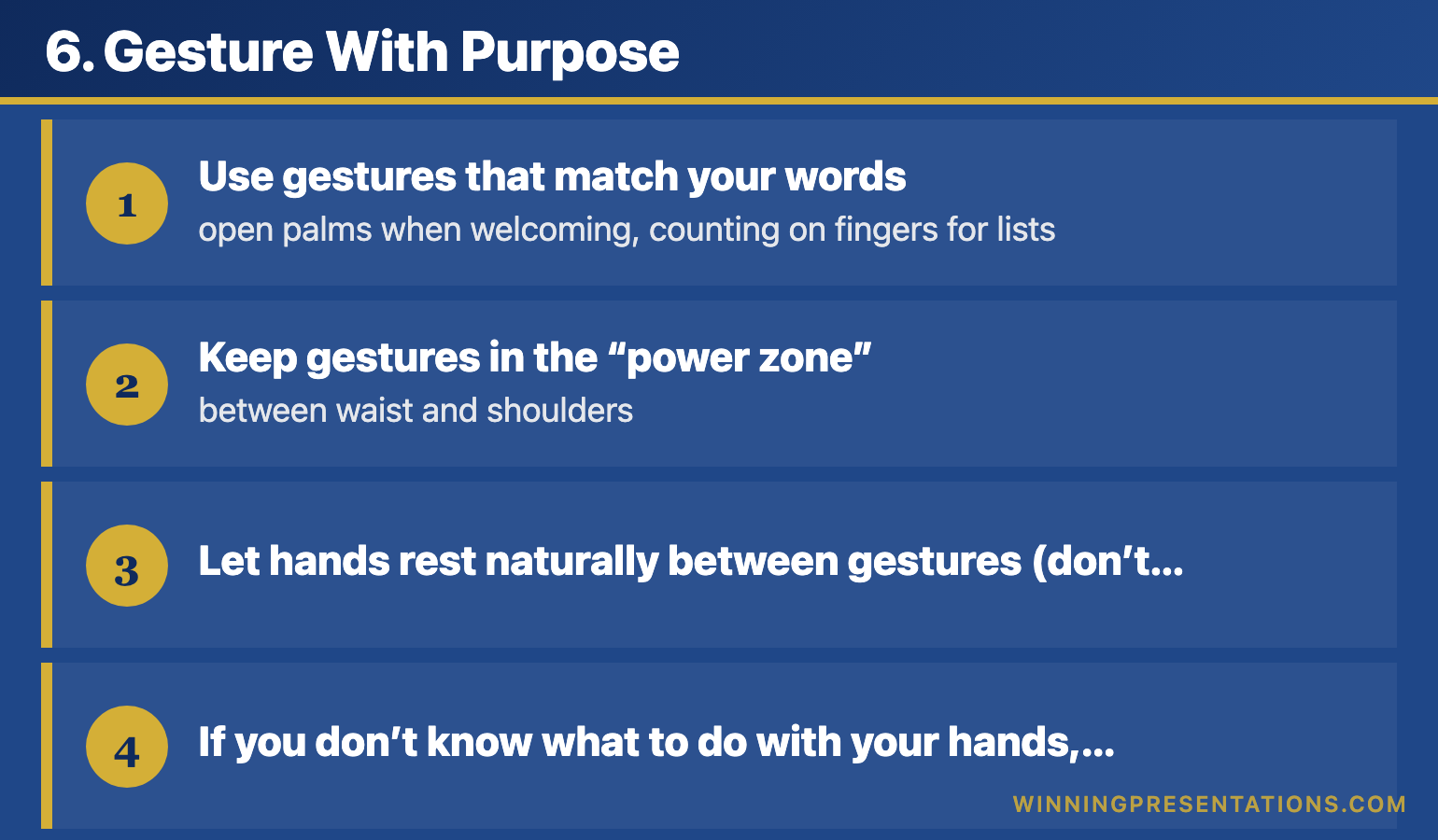
  • Use gestures that match your words — open palms when welcoming, counting on fingers for lists
  • Keep gestures in the “power zone” — between waist and shoulders
  • Let hands rest naturally between gestures (don’t wring them)
  • If you don’t know what to do with your hands, hold a clicker or pen

Purposeful gestures don’t just look confident — they help you think. Research shows that gesturing while speaking actually improves verbal fluency.

Related: Presentation Confidence: How to Build It (Not Fake It)

7. Recover From Mistakes Without Apologising

Every presenter makes mistakes. The difference between looking confident and looking nervous is how you handle them.

Nervous presenters apologise profusely, call attention to errors, or freeze up. Confident presenters recover smoothly and move on.

How to look confident instead:

Infographic for: look confident when presenting (image 2)

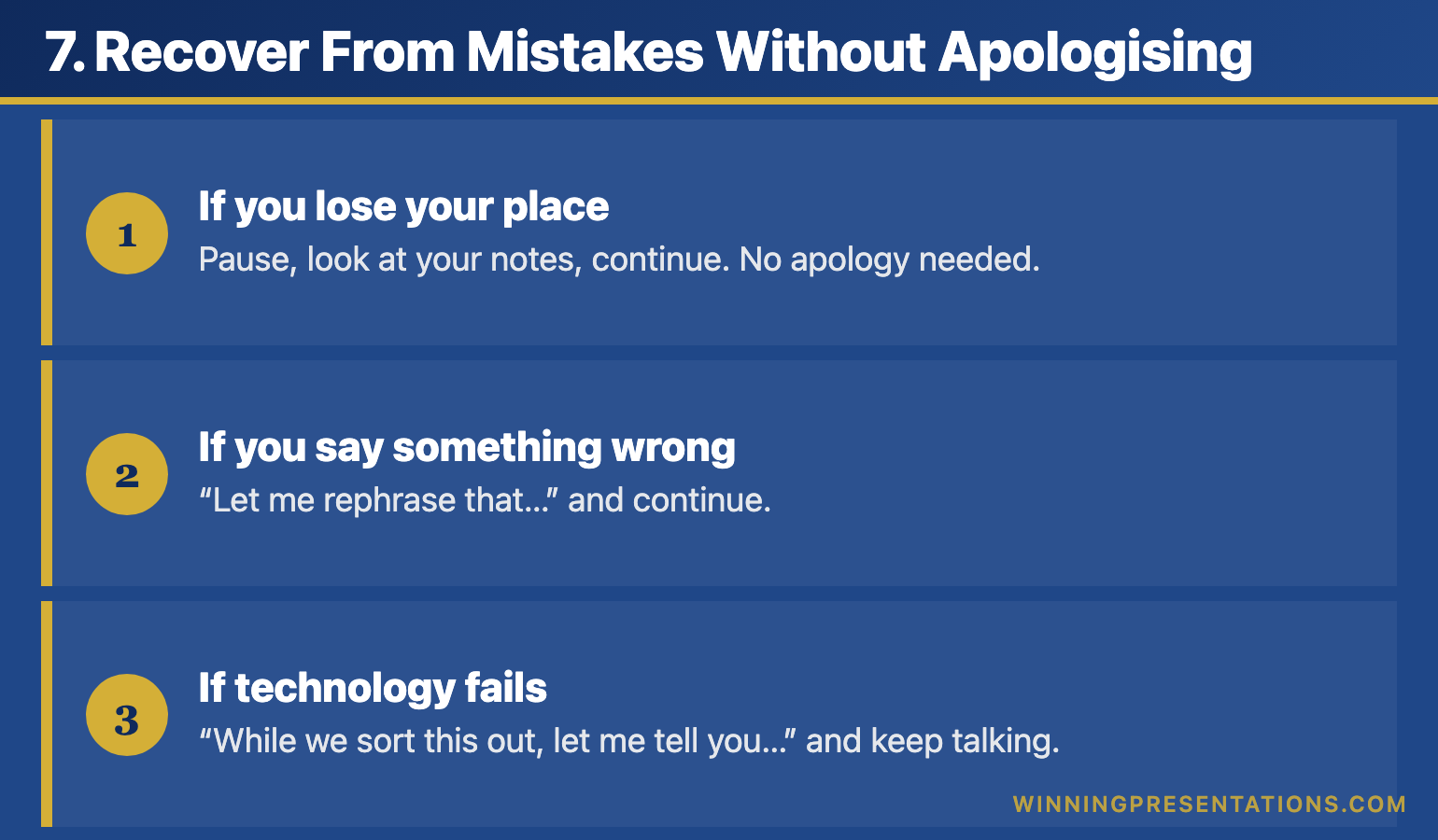
  • If you lose your place: Pause, look at your notes, continue. No apology needed.
  • If you say something wrong: “Let me rephrase that…” and continue.
  • If technology fails: “While we sort this out, let me tell you…” and keep talking.

Pre-plan your recovery phrases. When you know you can handle anything, you look confident because you genuinely feel in control.

Related: How to Start a Presentation: 15 Powerful Opening Techniques

Why Looking Confident Leads to Feeling Confident

There’s a psychological principle at work here: behaviour shapes emotion, not just the reverse.

When you adopt confident body language, your brain receives signals that you’re safe. Your nervous system calms down. And over time, the feeling of confidence follows the appearance of confidence.

I discovered this accidentally in my first five years of banking. By forcing myself to look confident when presenting, I gradually became more confident. The techniques became automatic. The anxiety faded.

You don’t have to wait to feel confident before presenting well. You can look confident now — and let the feeling catch up later.

Consistent Composure. Every Presentation.

Conquer Speaking Fear (£39, instant access) builds composure that holds — across different audiences, stakes, and settings. Structured techniques, not confidence tips.

Get Conquer Speaking Fear → £39

Designed for experienced professionals who present regularly under pressure.

Frequently Asked Questions

How do I look confident when my hands are shaking?

Hold something — a clicker, a pen, or your notes. This gives the shaking somewhere to go without being visible. Also, the shaking usually subsides within 60-90 seconds of starting. If you can get through your opening, your body will calm down.

What if I can’t make eye contact without feeling more nervous?

Look at foreheads instead of eyes — the audience can’t tell the difference. Or focus on the friendly faces only. You don’t need to make eye contact with everyone, just enough people to create connection.

How do I slow down when my instinct is to rush?

Memorise your first three sentences word-for-word and practice them at half speed. When you start slowly, you’re more likely to maintain that pace. Also, build in deliberate pauses — after your opening, after key points, before your conclusion.

Does “fake confidence” actually work?

It’s not about faking — it’s about doing what confident presenters do. The behaviours (grounding, eye contact, pauses, open posture) are real skills you’re building. Over time, the feeling follows the behaviour. You’re not pretending; you’re practising.


Your Next Step

Pick one technique from this list and use it in your next presentation:

  1. Plant your feet — the easiest to implement immediately
  2. Slow your first three sentences — sets the tone for everything that follows
  3. Replace filler words with pauses — makes the biggest visible difference

Master one technique before adding another. Within a few presentations, you’ll look confident without thinking about it.

Go deeper: Presentation Confidence: How to Build It (And Why “Fake It Till You Make It” Doesn’t Work) — the complete guide to building lasting confidence.


Mary Beth Hazeldine is a qualified clinical hypnotherapist and Owner & Managing Director of Winning Presentations. After spending her first five years in banking terrified of presenting, she learned to look confident before she felt confident — and went on to present successfully for 19 more years at JPMorgan, PwC, RBS, and Commerzbank. She has since advised executives across financial services, healthcare, technology, and government.

The Winning Edge Newsletter

Weekly techniques for executives who present under pressure. Evidence-based, practical, no fluff.

Subscribe Free →

Not ready for the full system? Start here: download the free 7 Presentation Frameworks — practical structures for any presentation scenario.

20 Dec 2025
Presentation confidence guide - how to build lasting confidence with frameworks not fake it till you make it

Presentation Confidence: How to Build It (And Why “Fake It Till You Make It” Doesn’t Work)

A hypnotherapist explains why presentation confidence isn’t a personality trait — and the framework that transformed a nervous junior banker into a confident presenter for 19 years

For my first five years in banking, I had zero presentation confidence. Not because I lacked knowledge — I knew my material cold. But every time I had to present, my voice would shake, my mind would go blank, and I’d avoid speaking up entirely.

I wasn’t presenting to boards back then. I was too junior. It was the everyday moments that terrified me: credit committee presentations, client meetings, speaking up in internal discussions. I’d sit there with something valuable to say and stay silent because I didn’t trust myself to deliver it.

Then I took a training course called “Pitching to Win” — and everything changed.

It didn’t make me a confident person. It gave me something far more powerful: a framework. A structure I could follow every single time. And that framework gave me presentation confidence for the next 19 years at JPMorgan, PwC, RBS, and Commerzbank.

Years later, when I trained as a clinical hypnotherapist and treated hundreds of anxiety clients, I finally understood the science behind why that framework worked — and why “fake it till you make it” never does.

The 5 Pillars of Lasting Presentation Confidence

After 35 years of presenting and training others to become confident presenters, I’ve identified five pillars that create lasting presentation confidence. Notice that none of them require you to “be” confident — they require you to do specific things.

The 5 pillars of presentation confidence - structure, rituals, recovery, evidence, and physiology

Pillar 1: Structural Certainty

Know exactly how your presentation flows before you start. Not word-for-word memorisation — structural certainty. You should be able to answer:

  • What’s my opening line? (Memorised, word-for-word)
  • What are my 3-5 key points?
  • What transitions move me between sections?
  • What’s my closing line? (Memorised, word-for-word)

When you have structural certainty, your brain relaxes. It knows where you’re going even if you stumble along the way. This is the foundation of speaking with confidence.

Related: How to Start a Presentation: 15 Powerful Opening Techniques

Pillar 2: Preparation Rituals

Confident presenters don’t wing it. They have rituals — consistent pre-presentation routines that signal to their brain: “We’ve done this before. We know what happens next.”

My ritual before every high-stakes presentation:

  1. Review my opening (2 minutes)
  2. 3-Breath Reset — in for 4, hold for 4, out for 6, repeat 3 times (90 seconds)
  3. Ground my feet — press them firmly into the floor (30 seconds)
  4. Say out loud: “I’m excited to share this” (5 seconds)

The content of the ritual matters less than its consistency. Your nervous system learns that this sequence leads to successful presenting — and that builds presentation confidence automatically.

Related: How to Calm Nerves Before a Presentation: The 5-Minute Reset

Pillar 3: Recovery Protocols

Here’s a secret about confident presenters: they make mistakes too. The difference is they have recovery protocols — pre-planned responses to common problems.

When you know you can recover from anything, mistakes lose their power to create panic.

Pre-plan your recovery phrases:

  • Mind goes blank: “Let me come back to that point…” (look at notes, continue)
  • Lose your place: “The key thing I want you to take away is…” (pivot to your main message)
  • Technical failure: “While we sort this out, let me tell you the story behind this data…”
  • Hostile question: “That’s a fair challenge. Here’s how I see it…”

When I finally understood this — that confident presenters aren’t mistake-free, they’re recovery-ready — my entire relationship with presenting changed.

Pillar 4: Competence Evidence

Your brain needs evidence that you can do this. Not affirmations. Evidence.

Build your evidence bank:

  • Record yourself presenting (painful but invaluable)
  • Start small — team meetings before board meetings
  • Collect wins — keep a note of presentations that went well
  • Get specific feedback — “What worked?” not just “That was great”

Every successful presentation is evidence your brain can reference next time. The more evidence, the more your nervous system trusts that you’ll be okay — and the more you become a genuinely confident presenter.

Pillar 5: Physiological Control

This is where my hypnotherapy training transformed my understanding. Presentation confidence isn’t just mental — it’s physiological.

You can directly influence your nervous system state through:

  • Breathing patterns — Extended exhales activate the parasympathetic response
  • Posture — Open posture signals safety to your brain
  • Grounding — Physical connection to the floor redirects nervous energy
  • Anchoring — NLP techniques that access confident states on demand

These aren’t tricks. They’re how your nervous system works. When you understand the machinery, you can operate it deliberately — and that’s the fastest path to confident public speaking.

Related: Public Speaking Tips: 15 Psychology-Backed Techniques

Related:  How to Look Confident When Presenting (Even When You’re Not)

Want to Build Lasting Presentation Confidence?

My AI-Enhanced Presentation Mastery course teaches the complete system — frameworks that eliminate uncertainty, psychology techniques from my hypnotherapy practice, plus AI tools that cut preparation time by 75%.

What’s included:

  • The structural frameworks that build real confidence
  • Psychology techniques for managing your nervous system
  • Self-paced modules with lifetime access
  • 50+ AI prompts to prepare faster and better

£499 — self-paced, immediate access.

See the full curriculum →

How to Build Presentation Confidence in Different Situations

The five pillars apply everywhere, but different contexts require different emphasis. Here’s how to become a confident presenter in specific situations:

Building Confidence for Internal Meetings

This is where most presentation anxiety actually lives — not in formal presentations, but in everyday meetings where you need to speak up with confidence.

Build presentation confidence by:

  • Preparing one key point before every meeting
  • Speaking early — the longer you wait, the harder it gets
  • Using grounding (press your feet into the floor) while seated
  • Starting with questions rather than statements if direct contribution feels hard

I spent five years avoiding contribution in internal meetings. The framework that changed this: prepare one thing to say, say it in the first 10 minutes, then relax.

Building Confidence for Client Presentations

Client presentations carry stakes — which means your nervous system is more alert. Combat this with over-preparation on structure:

  • Know your opening cold (word-for-word memorised)
  • Have your three key messages written on a card
  • Prepare answers to the five most likely questions
  • Arrive early and familiarise yourself with the room

Related: How to Create Executive Presentations That Get Results

Building Confidence for High-Stakes Presentations

Board presentations. Investor pitches. Career-defining moments. The framework matters even more here — high stakes amplify everything, including the benefit of preparation.

  • Rehearse out loud at least three times (not in your head — out loud)
  • Do a full dress rehearsal if possible — same room, same setup
  • Front-load your confidence — put your strongest material in the first two minutes when you’re most nervous
  • Have a pre-presentation ritual and do it without fail

Related: How CEOs Actually Present: Executive Presentation Skills

Stop the Racing Heart Before Your Next Meeting

Conquer Your Fear of Public Speaking is a neuroscience-based programme covering nervous system regulation, cognitive reframing, physical symptom management, and pre-presentation protocols — £39, instant access.

Get Conquer Your Fear of Public Speaking →

Designed for professionals who want to present with genuine confidence

Why Presentation Confidence Compounds Over Time

Here’s what nobody tells you about becoming a confident presenter: confidence compounds.

Each successful presentation — even a small one — deposits evidence in your brain that you can do this. Over time, these deposits accumulate. Your nervous system references them automatically. What once required conscious effort becomes unconscious competence.

I wasn’t “confident” after one good presentation. I became a confident presenter after hundreds — each one building on the last, each one reinforced by the same framework.

That’s why the framework matters so much. It’s not just about surviving individual presentations. It’s about building a system that makes you more confident every time you use it.

35 years later, I still use the same principles. The content changes. The framework doesn’t.

Building presentation confidence - what works vs what doesn't work comparison chart How presentation confidence compounds over time - each success builds evidence for your nervous system

Presentation Confidence Killers (And How to Avoid Them)

Killer #1: Comparing Yourself to “Natural” Presenters

There’s no such thing as a natural confident presenter. There are people who’ve had more practice, better training, or more supportive environments. But nobody was born confident at presenting.

Fix: Focus on your own progress, not others’ apparent ease.

Killer #2: Perfectionism

Waiting until you feel “ready” means waiting forever. Perfectionism is anxiety wearing a productivity mask.

Fix: Aim for “good enough to be useful” not “perfect.” Your audience wants value, not perfection.

Killer #3: Avoiding Presentations

Every presentation you avoid is evidence you’re collecting against yourself. Your brain learns: “This is dangerous. We should keep avoiding it.”

Fix: Take small opportunities. Team updates. Brief contributions. Build the evidence bank.

Killer #4: Post-Presentation Rumination

Replaying every mistake after a presentation trains your brain to associate presenting with pain.

Fix: Do a structured debrief instead. Three things that worked, one thing to improve next time. Then stop.

Want the complete nervous system toolkit? Conquer Speaking Fear (£39) gives you the clinical framework behind these five pillars — structured for executives who present under pressure.

If this pattern sounds familiar

You are not alone in this — and it is not a willpower problem. When preparation and practice have not been enough on their own, a structured approach that works at the nervous system level can make the difference. Conquer Speaking Fear was designed for exactly this situation.

If your preparation is solid but your nerves still derail you, Conquer Your Fear of Public Speaking gives you a structured system to manage exactly this.

Frequently Asked Questions About Presentation Confidence

How long does it take to build presentation confidence?

Most people notice meaningful improvement within 3-5 presentations when using a consistent framework. Real confidence — the kind that feels automatic — typically takes 15-20 presentations over several months. The key is consistency: same framework, same rituals, same recovery protocols.

Can introverts become confident presenters?

Absolutely. Some of the most confident presenters I’ve trained are introverts. Introversion means you process internally and may need recovery time after social interaction — it doesn’t mean you can’t present well. In fact, introverts often prepare more thoroughly, which builds more presentation confidence.

What if I’ve tried building confidence before and it didn’t work?

Usually this means you were trying to “feel” confident rather than “do” confident. Confidence isn’t an emotion you summon — it’s an outcome of preparation, practice, and physiological management. Focus on the five pillars (structure, rituals, recovery, evidence, physiology) rather than trying to feel a certain way.

Does presentation confidence come from knowing your material?

Knowing your material is necessary but not sufficient. I’ve seen experts freeze because they knew the content but had no framework for delivering it. You need both: subject matter expertise AND presentation structure. The framework is what lets your expertise come through.

How do I build confidence when I rarely present?

Create opportunities. Volunteer for team updates. Offer to present someone else’s work. Join a speaking group. The less you present, the less evidence your brain has — and the more anxious you’ll be when presentations do arise. Frequency builds presentation confidence more than intensity.

Can I build presentation confidence quickly before an important presentation?

You can’t build deep confidence overnight, but you can create the conditions for a confident performance. Focus on: knowing your opening cold, having a clear structure, preparing recovery phrases, and doing your pre-presentation ritual. This won’t make you permanently confident, but it will get you through the presentation — and that’s one more deposit in your evidence bank.


Your Nerves Aren’t the Problem — Your Response to Them Is

Conquer Your Fear of Public Speaking gives you a structured system to manage physical symptoms, reframe anxious thoughts, and build genuine confidence for any speaking situation — £39, instant access.

Get the Programme →

Designed for executives who want to stop dreading presentations

Your Next Step to Becoming a Confident Presenter

Building presentation confidence is simple, but not easy. It requires you to stop waiting to “feel” confident and start doing the things that create confidence.

Here’s what I suggest:

  1. Choose your next presentation — even a small team update
  2. Apply one framework — structure your content with a clear opening, three points, and a strong close
  3. Create one ritual — even just three deep breaths before you start
  4. Notice what happens — collect the evidence

That’s how it starts. One framework. One ritual. One presentation at a time.

Go deeper: Public Speaking Tips: 15 Psychology-Backed Techniques That Actually Work — the complete guide to speaking with confidence.

Presentation confidence cheat sheet - the 5 pillars and key techniques for confident presenting

Ready to Build Real Presentation Confidence?

AI-Enhanced Presentation Mastery

Frameworks that build confidence + Psychology that makes it stick + AI that cuts prep time

£249 £499

Early bird ends December 31st • 60 seats • Full refund guarantee

Learn More →

The Winning Edge — Weekly Presentation Insights

One technique, one mindset shift, and one real-world scenario every week. Practical, evidence-based, read in under 3 minutes.

Join The Winning Edge — Free


Mary Beth Hazeldine is a qualified clinical hypnotherapist and Owner & Managing Director of Winning Presentations. She spent 25 years in corporate banking at JPMorgan, PwC, Royal Bank of Scotland, and Commerzbank. After struggling with presentation anxiety for her first five years, she discovered that frameworks — not fake confidence — were the key to becoming a confident presenter. She works with executives across financial services, consulting, and corporate leadership, helping them present with genuine confidence.

19 Dec 2025
How to calm nerves before a presentation - 5 minute reset technique for presentation anxiety

How to Calm Nerves Before a Presentation: The 5-Minute Reset That Actually Works

A hypnotherapist’s structured technique for stopping presentation anxiety before you walk into the room

You’re about to present. Your heart is racing. Your hands are shaking. Your mind is going blank.

You need something that works in the next five minutes — not a week-long course on confidence.

I’m going to give you exactly that. As a clinical hypnotherapist who applies evidence-based clinical techniques to managing presentation anxiety.

It takes five minutes. It works every time. And by the end of this article, you’ll have a pre-presentation routine you can use for the rest of your career.

Why You Can’t “Think” Your Way Out of Presentation Anxiety

Here’s what most people get wrong when trying to calm nerves before a presentation: they try to think their way out of a physiological response.

“Relax.” “You’ve got this.” “Stop being nervous.”

It doesn’t work. In my hypnotherapy practice, I saw this pattern time and again with executive clients. Presentation anxiety isn’t a thinking problem — it’s a nervous system response. Your brain has detected a threat (the audience) and triggered fight-or-flight.

No amount of positive self-talk will override that biological reaction. You need to speak directly to your nervous system.

That’s exactly what the 5-Minute Reset does.

Related: Public Speaking Tips: 15 Techniques That Actually Work

The 5-Minute Pre-Presentation Reset (Step-by-Step)

Do this sequence in order, ideally somewhere private — a bathroom, your car, an empty corridor. It takes five minutes and will change your physiological state completely.

Infographic for: calm nerves before presentation (image 1)

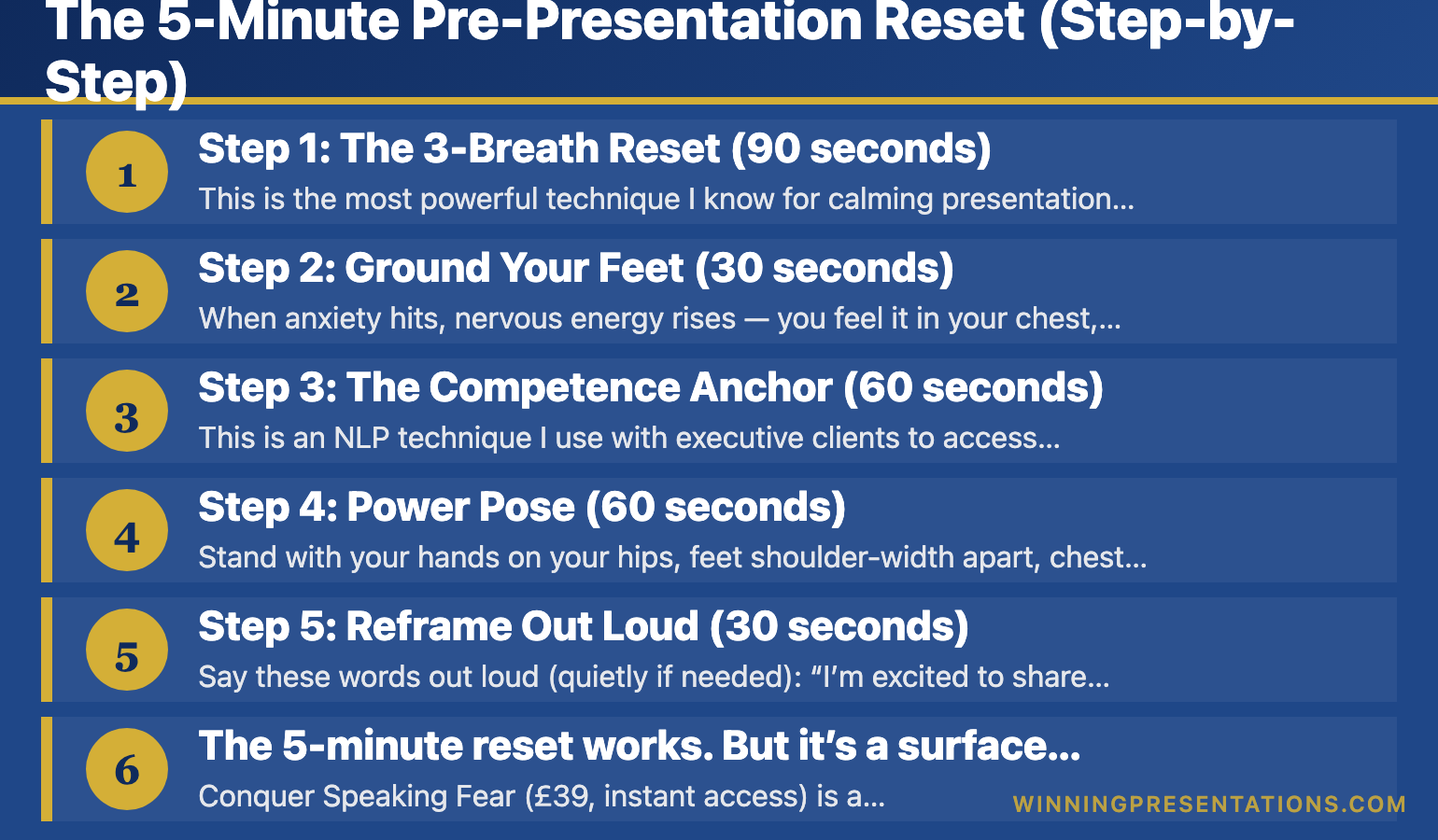
Step 1: The 3-Breath Reset (90 seconds)

This is the most powerful technique I know for calming presentation nerves. I used it with panic attack clients for years before bringing it into executive training.

How to do it:

  1. Breathe in through your nose for 4 counts
  2. Hold for 4 counts
  3. Breathe out through your mouth for 6 counts
  4. Repeat 3 times

Why it works: The extended exhale activates your parasympathetic nervous system — literally telling your brain the threat is over. This isn’t relaxation advice; it’s how your nervous system is wired. I’ve used this exact technique to help clients stop panic attacks in their tracks.

Three breaths. Ninety seconds. Do it every single time.

Step 2: Ground Your Feet (30 seconds)

When anxiety hits, nervous energy rises — you feel it in your chest, throat, and head. Your feet want to pace or shift.

Counter this by pressing your feet firmly into the floor. Feel the ground beneath you. Imagine roots growing from your feet into the earth.

This “grounding” technique redirects nervous energy downward and creates physical stability that will translate to vocal stability when you speak. It’s a core technique in anxiety therapy that I used extensively in my clinical hypnotherapy practice before adapting it for presenters.

Related: How to Start a Presentation: 15 Powerful Opening Techniques

Step 3: The Competence Anchor (60 seconds)

This is an NLP technique I use with executive clients to access confident states on demand. It’s one of the most effective ways to calm nerves before a presentation because it gives you a physical trigger you can use anywhere.

How to create it:

  1. Remember a time you felt completely confident — any context
  2. Close your eyes and fully re-experience that moment
  3. When the feeling peaks, press your thumb and forefinger together firmly
  4. Hold for 5 seconds, then release

You’ve now created a physical trigger. Before you present, press your thumb and forefinger together to access that state. Your nervous system doesn’t distinguish between remembered confidence and current confidence.

This is the same anchoring technique I used to help anxiety clients access calm states on demand. It works for presentations too.

Step 4: Power Pose (60 seconds)

Stand with your hands on your hips, feet shoulder-width apart, chest open. Hold for 60 seconds.

Research on power posing is mixed, but I’ve seen it work consistently with the executives I train. At minimum, it interrupts the closed, protective posture that presentation anxiety creates — hunched shoulders, crossed arms, shallow breathing.

That posture change affects your mental state. Open body, open mind.

Step 5: Reframe Out Loud (30 seconds)

Say these words out loud (quietly if needed): “I’m excited to share this.”

Not “I’m calm” — your body knows that’s a lie. “I’m excited” works because the physiological response to excitement is identical to anxiety: racing heart, heightened alertness, energy surge. The only difference is the label you put on it.

Research shows that reframing anxiety as excitement actually improves performance. One sentence. Say it out loud. It matters.

🎯 Want This Entire Routine on a Printable Card?

The include the 5-Minute Reset, voice warm-ups, power poses, and 20+ techniques on printable cards you can keep in your bag. Review them before any high-stakes presentation.

Stop managing nerves. Eliminate them.

The 5-minute reset works. But it’s a surface technique — and you know it.

Conquer Speaking Fear (£39, instant access) is a hypnotherapist-designed system that targets the root cause of presentation anxiety — not just the symptoms. Use the reset in the short term; use the system to stop needing it.

  • Fear Type Assessment — identify exactly what drives your anxiety response
  • 10 evidence-based techniques with structured practice
  • 5 word-for-word scripts for worst-case scenarios
  • 30-day structured plan — build lasting confidence

Get Conquer Speaking Fear → £39

⚡ Presenting this week?

If you’re heading into a high-stakes presentation this week and need more than a 5-minute reset, Conquer Speaking Fear gives you the complete system — including the pre-presentation protocols that make the nerves manageable every time.

Explore Conquer Speaking Fear →

The 60-Second Emergency Version

No time for the full reset? Here’s how to calm presentation nerves in under a minute:

Infographic for: calm nerves before presentation (image 2)

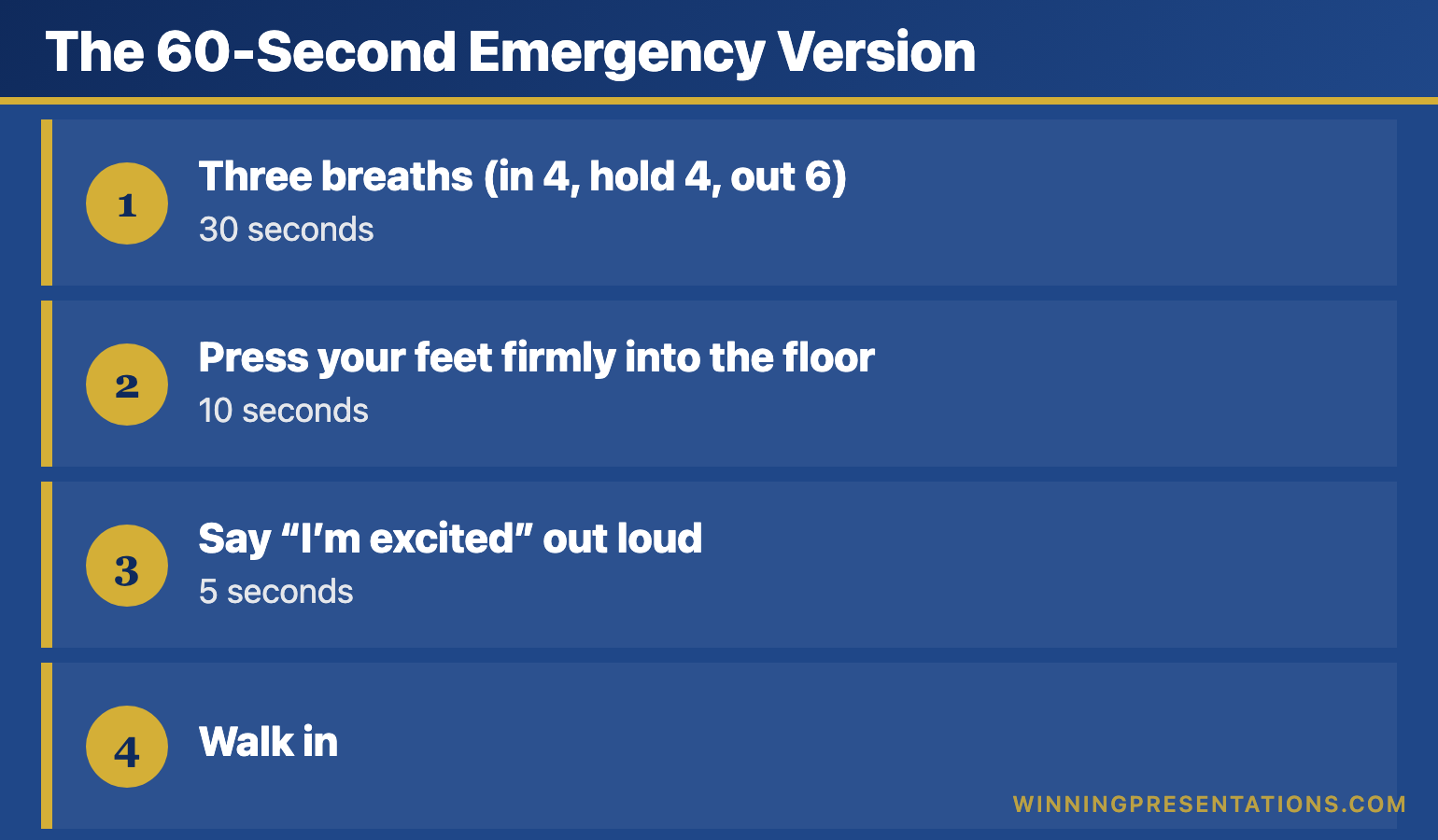
  1. Three breaths (in 4, hold 4, out 6) — 30 seconds
  2. Press your feet firmly into the floor — 10 seconds
  3. Say “I’m excited” out loud — 5 seconds
  4. Walk in

Forty-five seconds. It won’t eliminate your nerves completely, but it will take the edge off enough to get through your opening — and the first 60 seconds are when presentation anxiety is highest. After that, you’ll settle.

What to Do If Your Mind Goes Blank During the Presentation

Even with preparation, it happens. You’re mid-sentence and suddenly — nothing. Your mind is completely empty.

Here’s your recovery plan:

  1. Pause. It feels like an eternity to you. To the audience, it looks like confidence.
  2. Look at your slide or notes. No one judges you for this.
  3. Say: “Let me come back to that point…” and move to the next section.

The audience rarely notices these moments as much as you fear. And knowing you have a recovery plan removes the panic that makes blanking worse.

Related: How to End a Presentation: 7 Closing Techniques That Work

Why This Works When Other Techniques Don’t

Most advice for calming nerves before a presentation focuses on what to think. But as I learned in my clinical hypnotherapy practice, you can’t think your way out of a physiological state.

The 5-Minute Reset works because it targets your nervous system directly:

  • Breathing activates the parasympathetic response
  • Grounding redirects nervous energy
  • Anchoring accesses stored confident states
  • Posture interrupts anxiety body language
  • Reframing changes how your brain interprets the arousal

Each step builds on the last. Together, they create a reliable state change that works whether you’re presenting to five people or five hundred.

Related: How to Create Executive Presentations That Get Results

Building Long-Term Presentation Confidence

The 5-Minute Reset is a powerful tool for calming nerves before any presentation. But if presentation anxiety is a recurring challenge, you’ll want to build deeper confidence over time.

That means:

  • Knowing your opening cold — Memorise your first 30 seconds word-for-word so you don’t have to think when nerves are highest
  • Arriving early — Get to the room first and make the space yours
  • Creating a consistent ritual — Use the same pre-presentation routine every time so your brain learns to associate it with successful outcomes
  • Practising in stressful conditions — Rehearse standing up, in front of colleagues, in the actual room when possible

I cover all 15 of these techniques in my comprehensive guide: Public Speaking Tips: 15 Techniques That Actually Work

Ready to build confidence that works long-term?

Conquer Speaking Fear is a complete system for executives who understand their material but still feel the anxiety response before every presentation. 75-page workbook. Evidence-based. Immediate download.

Want to stop relying on the reset and start walking in composed? Conquer Speaking Fear builds the foundation underneath the techniques →

Learn more about Conquer Speaking Fear → £39

Frequently Asked Questions

How do I stop shaking before a presentation?

Shaking comes from adrenaline — you can’t stop the adrenaline, but you can process it. Do the 3-Breath Reset (breathe in 4, hold 4, out 6, repeat 3 times), then hold something in your hands — a clicker, pen, or notes — to occupy them. The shaking usually subsides within 60-90 seconds of starting your presentation if you don’t fight it.

What if I get nervous again during the presentation?

Use a micro-reset: take one slow breath (in 4, out 6), press your feet into the floor, and continue. You can do this while speaking or during a natural pause. The audience won’t notice.

Does the 5-Minute Reset work for virtual presentations?

Absolutely. Do the full routine before you go on camera. The only adaptation: during the presentation, you can ground your feet while seated, and focus your eye contact on the camera lens (not the screen) to create connection.

What if I only have 2 minutes before presenting?

Use the 60-Second Emergency Version: three breaths (30 seconds), ground your feet (10 seconds), say “I’m excited” out loud (5 seconds), then walk in. It’s enough to take the edge off your presentation anxiety.

Why do I get presentation anxiety when I know the material?

Because anxiety isn’t about knowledge — it’s about perceived threat. Your nervous system interprets being watched and judged as danger, regardless of how prepared you are. That’s why techniques that target the nervous system directly (like the 5-Minute Reset) work better than “just know your stuff” advice.


📬 The Winning Edge Newsletter

Weekly strategies for speaking confidence, executive presence, and career-critical presentation moments.

Subscribe free →

Your Next Step

You now have a structured technique to calm nerves before any presentation. Here’s what I want you to do:

  1. Save this article — bookmark it or print the steps
  2. Use the 5-Minute Reset before your next presentation — even a low-stakes meeting
  3. Notice the difference — in your body, your voice, your confidence

Once you’ve experienced how well this works, you’ll never present without it again.

Go deeper: Public Speaking Tips: 15 Techniques That Actually Work — the complete guide to confident presenting, from a hypnotherapist who specialises in executive presentation skills.


Mary Beth Hazeldine is a qualified clinical hypnotherapist and Managing Director of Winning Presentations. She spent 25 years in corporate banking at JPMorgan, PwC, Royal Bank of Scotland, and Commerzbank, and applies evidence-based clinical techniques to managing presentation anxiety. She advises executives across financial services, healthcare, technology, and government.

Not ready for the full system? Start here instead: subscribe to The Winning Edge — weekly strategies for executive confidence and presentation skills, free.

19 Dec 2025
15 public speaking tips that actually work - psychology-backed techniques for confident presentations

Public Speaking Tips: 15 Techniques From Someone Who’s Trained 5,000+ Executives

Quick Answer: Slow your first two sentences by 15%, exhale longer than you inhale, pause after key points, and land one clear closing line. That’s 80% of confident speaking.

Most public speaking tips are useless. “Picture the audience in their underwear.” “Just be yourself.” “Practice in front of a mirror.” You’ve heard them all. They don’t work.

The fear of public speaking — glossophobia — affects up to 75% of people. But it doesn’t have to control you.

I come at this from two directions. First, I spent 24 years presenting to boards, investors, and C-suite executives at JPMorgan, PwC, Royal Bank of Scotland, and Commerzbank. I was terrified for the first five years. The generic public speaking techniques made it worse.

Second — and this is what makes my approach different — I’m a qualified clinical hypnotherapist who has treated hundreds of clients with anxiety disorders. Panic attacks. Social anxiety. Performance anxiety. I’ve seen what actually rewires the fear response, and I’ve brought those techniques into my presentation training.

What changed everything wasn’t tips — it was understanding the psychology behind fear and confident speaking. These public speaking tips come from training over 5,000 executives, combined with my background in NLP (Neuro-Linguistic Programming) and clinical hypnotherapy. They’re not motivational fluff — they’re specific techniques you can use to overcome stage fright and speak confidently in your next presentation.

🎯 Ready to Conquer Your Fear of Public Speaking?

After 5 years of presentation terror and treating hundreds of anxiety clients as a clinical hypnotherapist, I created a system that actually works — not just “breathe and visualise” advice that fails under pressure.

Includes:

  • The neuroscience behind why your brain panics (and how to rewire it)
  • The 60-second reset that works even minutes before you speak
  • Scripts and exercises you can use immediately

Get the Complete System → £39

Based on clinical techniques I used with hundreds of anxiety clients, adapted for high-stakes presenting.

Why Most Public Speaking Tips Fail

Before we get to what works, let’s address why the standard advice doesn’t help with public speaking anxiety.

In my hypnotherapy practice, I saw the same pattern repeatedly: people trying to think their way out of a physiological response. It doesn’t work. Telling someone to “relax” when their nervous system is in fight-or-flight mode is like telling someone with a broken leg to “walk it off.”

Generic public speaking tips fail because they treat symptoms, not causes. The real issues behind fear of public speaking are:

  • Perceived threat response — Your brain interprets audience judgment as physical danger
  • Attention misdirection — You’re focused on yourself instead of your message
  • Lack of control anchors — Nothing feels predictable or manageable
  • Identity attachment — You’ve made the outcome mean something about your worth

These are the same patterns I treated in my anxiety clients. The techniques below address these root causes, not just the surface symptoms. Whether you’re looking to overcome presentation nerves or become a more confident speaker, these strategies will help.

Related: How CEOs Actually Present: Executive Presentation Skills for Leadership

Part 1: Before You Speak (Preparation)

1. The 3-Breath Reset

This is the single most effective technique I teach for calming nerves before a presentation. I used it with my hypnotherapy clients for years before bringing it into corporate training. It takes 30 seconds and changes your physiological state immediately.

How to do it:

  1. Breathe in for 4 counts through your nose
  2. Hold for 4 counts
  3. Breathe out for 6 counts through your mouth
  4. Repeat 3 times

Why it works: The extended exhale activates your parasympathetic nervous system — literally telling your brain the threat is over. This isn’t meditation woo-woo; it’s how your nervous system is wired. I’ve used this technique to help clients stop panic attacks in their tracks.

Do this in the bathroom, in your car, or standing backstage. Three breaths. Every time. It’s one of the most reliable presentation anxiety tips you’ll find.

3-breath reset technique for public speaking anxiety - breathe in 4 counts hold 4 out 6 to calm nerves

2. Arrive in the Room First

One of my most counterintuitive public speaking tips: get to the room early and own the space.

Walk the stage or the front of the room. Touch the podium. Adjust the chair. Stand where you’ll stand when presenting. Your brain needs to register this as YOUR territory, not hostile ground you’re entering.

I learned this presenting to the board at Commerzbank. The executives who commanded the room weren’t more talented — they arrived 15 minutes early and made the space theirs.

3. Know Your First 30 Seconds Cold

You don’t need to memorise your entire presentation. But you absolutely must have your opening locked in — word for word, no improvisation.

Why? Because the first 30 seconds are when your nerves are highest. If you have to think about what to say, you’ll stumble. If it’s automatic, you can focus on delivery while your brain calms down.

This single public speaking tip has helped more nervous presenters than any other technique I teach.

Related: How to Start a Presentation: 15 Powerful Opening Techniques

4. The “What If” Reframe

Nervous speakers ask: “What if I forget my words? What if they hate it? What if I fail?”

Confident speakers ask the same question differently: “What if this goes well? What if they’re genuinely interested? What if this is the presentation that changes everything?”

This isn’t positive thinking — it’s pattern interruption, a technique I used constantly in hypnotherapy. Your brain will answer whatever question you ask it. Ask better questions. It’s a powerful way to overcome stage fright before it takes hold.

These reframing techniques are just the beginning. Conquer Speaking Fear includes the complete set of NLP scripts I used with my hypnotherapy clients — adapted specifically for presentation anxiety.

5. Eliminate “Performance” From Your Mind

Here’s a mindset shift that transformed my speaking: you’re not performing, you’re having a conversation.

When you “perform,” you create distance between yourself and the audience. You become an actor trying to impress. The audience feels it — and so do you.

Instead, think of your presentation as a conversation where you happen to be doing most of the talking. You’re sharing something you know with people who want to hear it. That’s it.

This single reframe has helped more nervous executives develop speaking confidence than any technique I teach.

Part 2: During Your Presentation (Delivery)

6. Find Three Friendly Faces

Before you start speaking, identify three people in different parts of the room who look receptive. Maybe they’re nodding. Maybe they’re smiling. Maybe they just look interested.

During your presentation, rotate your eye contact between these three people. It feels like you’re speaking to individuals who want to hear from you — because you are.

Avoid: the person checking their phone, the one with arms crossed, the obvious sceptic. They exist in every audience. They’re not your target.

7. Pause Before Key Points

Nervous speakers rush. They fill every silence with words because silence feels dangerous.

Here’s the truth: pauses make you look confident, not uncertain.

Before your most important point, stop. Take a breath. Let the silence build. Then deliver your message.

Watch any TED Talk from a masterful speaker. Count the pauses. They’re not accidents — they’re strategic. This is one of the most powerful public speaking techniques for projecting confidence.

Related: How to End a Presentation: 7 Closing Techniques I Teach C-Suite Executives

8. Ground Your Feet

When anxiety hits, nervous energy rises. You feel it in your chest, your throat, your head. Your feet want to pace or shift.

Counter this by consciously pressing your feet into the floor. Feel the ground beneath you. This “grounding” technique redirects nervous energy downward and creates physical stability that translates to vocal stability.

Grounding is a core technique in anxiety therapy. I taught it to hundreds of hypnotherapy clients before adapting it for presenters. I have executives imagine roots growing from their feet into the floor. It sounds strange. It works.

⭐ These Tips Work — But There’s a Faster Way

I spent 5 years terrified of presenting before I cracked the code. Now I’ve packaged everything — the neuroscience, the NLP techniques, the exact scripts — into a system you can use before your next presentation.

What’s inside:

  • The 60-second nervous system reset (works even backstage)
  • Reframing scripts from my clinical hypnotherapy practice
  • The pre-presentation protocol I teach to executives

Conquer Your Speaking Fear → £39

“I went from avoiding all presentations to volunteering for them.” — Senior Manager, Financial Services

9. Speak to the Back Row (Voice Projection)

Project your voice as if the most important person is in the back of the room. This does three things:

  • Forces you to slow down (voice projection requires pace)
  • Deepens your voice (projecting engages your diaphragm)
  • Commands attention (volume signals authority)

You don’t need to shout. Just imagine your words need to reach someone 30 feet away. Your body language and vocal delivery will adjust automatically.

10. Use Purposeful Movement

Standing frozen looks nervous. Pacing looks nervous. The solution is purposeful movement.

Move when you transition between points. Walk to a different spot on stage, plant your feet, deliver the next section. Then move again for the next transition.

This gives your nervous energy somewhere to go while building stage presence that looks intentional rather than anxious.

Part 3: Managing Your Nerves (Psychology)

This section draws heavily on my hypnotherapy training. These aren’t generic mindset tips — they’re clinical techniques adapted for the boardroom.

11. Reframe Nerves as Excitement

This is one of the most research-backed public speaking tips available. Studies show that reframing speech anxiety as excitement improves performance.

The physiological response is identical — racing heart, heightened alertness, energy surge. The only difference is the label you put on it.

Before you present, say out loud: “I’m excited.” Not “I’m calm” (your body knows that’s a lie). “I’m excited” redirects the same energy toward a positive interpretation.

How to reframe public speaking nerves as excitement - same physical response different mindset

12. The Competence Anchor

This is an NLP technique I’ve used with hundreds of clients — both in my hypnotherapy practice and in executive training — to build speaking confidence.

How to create it:

  1. Remember a time you felt completely confident — any context
  2. Close your eyes and fully re-experience that moment
  3. When the feeling peaks, press your thumb and forefinger together
  4. Repeat 5-10 times with different confident memories

Now you have a physical trigger. Before presenting, press your thumb and forefinger together to access that state. Your nervous system doesn’t distinguish between remembered confidence and current confidence. This is the same anchoring technique I used to help anxiety clients access calm states on demand.

The Competence Anchor is one of dozens of NLP techniques in Conquer Speaking Fear. The full system includes audio exercises so you can build these anchors properly.

13. Prepare for Mistakes (So They Don’t Derail You)

Mistakes will happen. You’ll lose your train of thought. The slide won’t advance. You’ll say the wrong word.

The difference between amateur and professional speakers isn’t that professionals don’t make mistakes — it’s that mistakes don’t throw them off.

Pre-plan your recovery phrases:

  • “Let me come back to that point…”
  • “Actually, the more important thing is…”
  • “Where was I? Right — [key word from your notes]”

When you know you can recover, mistakes lose their power to create panic. This is essential for anyone learning how to speak in public with confidence.

For a deep dive on building lasting confidence, see my guide on how to speak confidently in public.

14. Detach From Outcome

This is advanced, but it’s the public speaking tip that creates lasting transformation.

Most presentation anxiety comes from attachment to outcome. You need them to approve. You need them to be impressed. You need to not embarrass yourself.

But here’s the truth: you don’t control how they respond. You only control what you deliver.

Shift your goal from “make them say yes” to “deliver my message as clearly as possible.” The first goal creates anxiety because it’s outside your control. The second creates focus because it’s entirely within your control.

I’ve seen executives transform overnight with this shift. The paradox is that when you stop needing a specific outcome, you usually get better outcomes.

15. Create a Pre-Presentation Ritual

Every confident speaker I’ve trained has a ritual. Not superstition — a deliberate sequence that signals to their brain: “It’s time to perform.”

My ritual before high-stakes presentations:

  1. Review my opening (2 minutes)
  2. 3-Breath Reset (30 seconds)
  3. Competence Anchor — press thumb and forefinger (10 seconds)
  4. Power pose in private — hands on hips, chest open (60 seconds)
  5. Say out loud: “I’m excited to share this” (5 seconds)

Total: under 5 minutes. The consistency is what matters. Your brain learns that this sequence leads to successful presenting, and it prepares accordingly.

5-minute pre-presentation ritual for public speaking confidence - review opening, breathing, power pose

Related: How to Create Executive Presentations That Get Results

Public Speaking Tips for Specific Situations

Different contexts require adapting these public speaking techniques. Here’s how to speak confidently in specific high-stakes situations:

Virtual Presentations

Virtual presenting has unique challenges. You can’t read the room. Energy feels flat. Distractions are everywhere.

Adapt these techniques:

  • Look at the camera, not the screen (this creates “eye contact”)
  • Exaggerate your facial expressions by 20% (the camera flattens them)
  • Stand if possible — it improves your energy and breathing
  • Use people’s names frequently to maintain audience engagement

Related: Why Most QBR Presentations Bore Leadership (And How to Fix Yours)

Board Presentations

Boards are time-poor and decision-focused. They don’t want a performance — they want clarity.

  • Lead with your recommendation (tip #3 applies here — know your opening cold)
  • Speak with authority, not apology
  • Anticipate the three questions they’ll ask and have answers ready

If you’re preparing slides for a board presentation, see our Executive Presentation Template for the structure that commands attention.

Related: The Board Presentation Structure Nobody Teaches You

Investor Pitches

High stakes, short time, sceptical audience. The speaking confidence techniques become even more critical.

  • Your conviction matters as much as your numbers
  • Pause after your ask — let them process
  • Treat questions as interest, not attacks

Related: Investor Pitch Deck Template: The Sequoia Format That Raised Billions

Speaking Confidently in Meetings

Not every speaking opportunity is a formal presentation. Here’s how to project confidence when speaking in meetings:

  • Speak early — the longer you wait, the harder it gets
  • Use the grounding technique (#8) while seated
  • Prepare one key point you want to make before the meeting starts
  • Lower your vocal pitch slightly (nerves raise pitch)

Common Public Speaking Mistakes to Avoid

Even with these tips, certain mistakes undermine your impact:

Mistake 1: Apologising at the Start

“Sorry, I’m a bit nervous” or “I’m not very good at this” — these phrases kill your credibility before you’ve said anything of substance.

Fix: Start with your content. Your audience doesn’t need to know you’re nervous. Most can’t even tell.

Mistake 2: Reading Slides

If you’re reading what’s on the screen, why are you there? Slides support your message — they don’t replace it.

Fix: Know your content well enough that slides are visual aids, not scripts.

Mistake 3: Ending Weakly

“So, yeah… that’s it. Any questions?” is not an ending. It’s an apology for taking their time.

Fix: Prepare your closing as carefully as your opening. End with a clear call to action or a memorable final statement.

Related: Presentation Structure: 7 Frameworks That Actually Work

How to Practice Public Speaking Skills

Knowing techniques is one thing. Embodying them is another. The fastest path to becoming a better public speaker isn’t more practice — it’s more deliberate practice with specific techniques.

Related: How to Get Better at Public Speaking: What Actually Works

Record Yourself

I know — watching yourself is painful. Do it anyway. You’ll notice filler words, pacing issues, and body language habits you’d never catch otherwise.

Practice Transitions, Not Scripts

Don’t memorise every word. Instead, practice how you move between sections. “After I cover X, I’ll transition to Y by saying Z.” This keeps you flexible while maintaining structure.

Rehearse the Anxiety

Practice in conditions that mimic the stress. Present to colleagues. Present standing up. Present in the actual room if possible. Your brain needs to experience success in challenging conditions to believe it’s possible.

Get Feedback That Matters

“That was great!” isn’t useful feedback. Ask specific questions: “Did I rush through the third section? Was my ask clear? Where did you lose focus?”

Related: How to Improve Public Speaking Skills: The 5 Things That Actually Matter

⭐ Your Next Presentation Doesn’t Have to Feel Like This

If reading these tips made you think “I need this” — the full system goes deeper. It’s everything I learned from treating hundreds of anxiety clients, adapted for high-stakes presenting.

You’ll get:

  • Why your brain panics (and how to interrupt the pattern)
  • The anchoring technique that gives you confidence on demand
  • Audio exercises you can use the morning of your presentation

Get the Complete System → £39

Join hundreds of professionals who’ve transformed their relationship with presenting.

Frequently Asked Questions

How do I calm nerves before a presentation?

Use the 3-Breath Reset: breathe in for 4 counts, hold for 4 counts, breathe out for 6 counts. Repeat 3 times. The extended exhale activates your parasympathetic nervous system and physically calms your body. Combine this with arriving early to own the space and knowing your first 30 seconds cold. For a step-by-step walkthrough, see How to Calm Nerves Before a Presentation.

How do I stop shaking when presenting?

Shaking comes from adrenaline. You can’t stop the adrenaline, but you can process it: (1) Do the 3-Breath Reset before presenting, (2) Hold something — a clicker, a pen, notes — to occupy your hands, (3) Ground your feet firmly on the floor. The shaking usually subsides within 60-90 seconds of starting if you don’t fight it.

What if I forget what to say?

Pause. Look at your notes or slide. Say “Let me come back to that point” and move on. Audiences rarely notice these moments as much as you fear. Preparation helps: know your key points rather than scripts, so you can always return to the core message.

What are the best public speaking tips for beginners?

Start with three fundamentals: (1) Know your opening cold — memorise your first 30 seconds word-for-word, (2) Use the 3-Breath Reset before speaking to calm your nervous system, and (3) Focus on one friendly face in the audience rather than trying to scan everyone. Master these before adding more advanced techniques.

How do I handle a hostile audience?

First, don’t assume hostility — scepticism often looks like hostility but isn’t. If someone is genuinely combative: acknowledge their point (“That’s a fair concern”), answer directly, and move on. Don’t get defensive or debate. Your composure is more persuasive than winning an argument.

How long does it take to become a confident speaker?

Most people see meaningful improvement within 3-5 presentations if they apply these public speaking techniques consistently. Mastery takes years, but competence and speaking confidence come much faster than most people expect. The key is deliberate practice, not just repetition.

Can introverts be good public speakers?

Absolutely. Some of the best speakers I’ve trained are introverts. Introverts often prepare more thoroughly and listen better to audience cues. The key is working with your natural style rather than trying to become an extrovert on stage. Many introverts find that the “conversation, not performance” reframe (tip #5) is particularly helpful.

How can I project confidence when speaking?

Confidence comes from three things: preparation (know your opening cold), physiology (ground your feet, breathe deeply, speak to the back row), and mindset (reframe nerves as excitement, detach from outcome). The Competence Anchor technique (#12) gives you instant access to confident states when you need them.

📧 Join 2,000+ Professionals

Get weekly presentation insights — techniques that actually work, not generic advice.

Subscribe to The Winning Edge →

📖 Free Download: 7 Presentation Frameworks

The structures I use for every presentation type — from team updates to investor pitches.

Download Free →

Your Next Step

These public speaking tips work. But reading about techniques and applying them are different things.

Here’s what I suggest:

  1. Pick three techniques from this article that resonate with you
  2. Apply them to your next presentation — don’t try to do everything at once
  3. Notice what changes — in your nerves, your delivery, your audience response

Once you’ve experienced the difference, you’ll want to go deeper. When you’re ready, Conquer Speaking Fear gives you the complete system — everything I learned from 5 years of presentation terror and treating hundreds of anxiety clients.

Mary Beth Hazeldine is the Managing Director of Winning Presentations. She spent 24 years in corporate banking at JPMorgan Chase, PwC, Royal Bank of Scotland, and Commerzbank before training thousands of executives to present with impact. As a qualified clinical hypnotherapist, she has treated hundreds of clients with anxiety disorders — experience she now applies to help professionals overcome fear of public speaking. Her clients have raised over £250M using her frameworks.

16 Dec 2025
The First 30 Seconds: Why Most Presenters Lose Their Audience Immediately

The First 30 Seconds: Why Most Presenters Lose Their Audience Immediately

I’ve sat through over 500 executive presentations in my career.

Board meetings at JPMorgan. Investor pitches at PwC. Strategy sessions at RBS. Budget reviews at Commerzbank.

And I can tell you the exact moment most presenters lose their audience: somewhere between second 5 and second 30.

Not minute 5. Not slide 5. Second 5.

After 25 years in investment banking and 16 years training executives, I’ve seen the pattern so many times I can predict it. The presenter walks up, clears their throat, and says some version of:

“Good morning everyone. Thanks for having me. Today I’m going to talk about our Q3 results and the strategic initiatives we’re planning for next year. I’ll try to keep this brief because I know you’re all busy.”

And just like that — before a single piece of content has been delivered — the room is gone.

Phones come out. Eyes glaze over. The CFO starts reviewing emails. The CEO is mentally planning their next meeting.

The presenter hasn’t even started, and they’ve already lost.

What’s Actually Happening in Those First 30 Seconds

Here’s what most people don’t understand about audiences: they’re not neutral. They’re not sitting there thinking, “I can’t wait to hear what this person has to say.”

They’re thinking: “Is this going to be worth my time?”

That’s the only question running through their minds. And they answer it fast — usually within 10-30 seconds.

Neuroscientists call this the “primacy effect.” We form impressions quickly and then spend the rest of our time confirming them. If you open weak, you’re fighting that first impression for the next 20 minutes.

If you open strong, everything that follows lands better.

The stakes couldn’t be higher. And most presenters waste this moment completely.

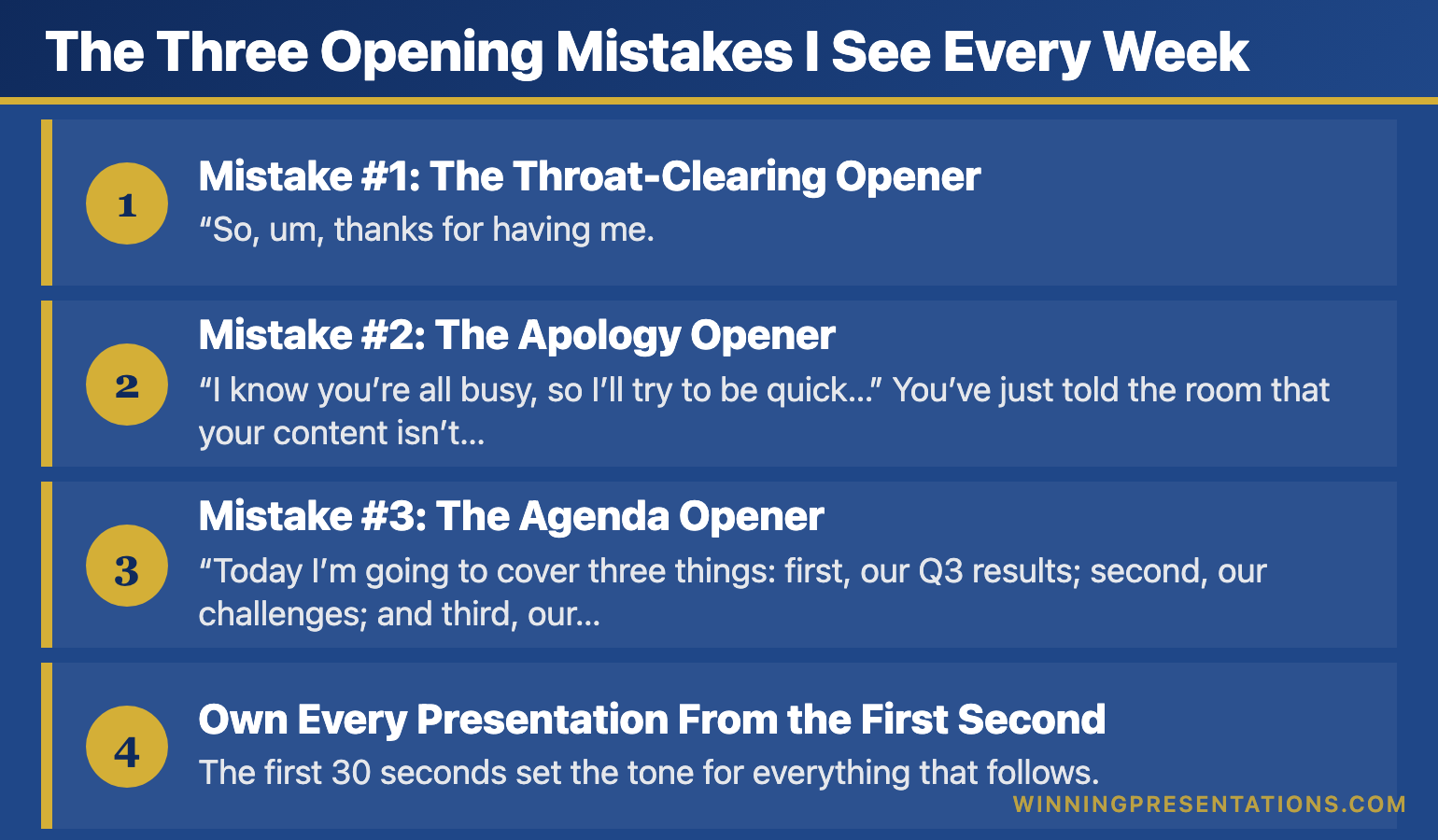
The Three Opening Mistakes I See Every Week

After training over 10,000 executives, I’ve identified the three opening mistakes that kill presentations before they start:

Infographic for: first 30 seconds presentation (image 1)

Mistake #1: The Throat-Clearing Opener

“So, um, thanks for having me. Let me just get my slides up here… okay, there we go. So today I’m going to talk about…”

This signals nervousness, lack of preparation, and — worst of all — that what’s coming isn’t important enough to be planned properly.

Mistake #2: The Apology Opener

“I know you’re all busy, so I’ll try to be quick…”

You’ve just told the room that your content isn’t valuable enough to deserve their full attention. Why would they give it to you?

Mistake #3: The Agenda Opener

“Today I’m going to cover three things: first, our Q3 results; second, our challenges; and third, our plan for next year.”

Boring. Predictable. Zero reason to pay attention. You’ve just told them everything they’re going to hear, so now they don’t need to listen.

The Pattern I’ve Noticed: The executives who get promoted, who close deals, who get their budgets approved — they never open this way. They’ve learned (often through painful experience) that the first 30 seconds determine everything that follows.

Own Every Presentation From the First Second

The first 30 seconds set the tone for everything that follows. The Executive Slide System gives you the exact opening frameworks senior leaders use to command attention and establish authority from the very first word.

Executive Slide System →

What I Learned from a £4 Million Mistake

Early in my banking career, I watched a senior colleague lose a £4 million deal in the first 30 seconds of a pitch.

He walked in, fumbled with the projector, apologized for being “a bit under the weather,” and opened with: “So, I know you’ve seen a lot of these pitches, but hopefully we can show you something different today.”

Hopefully? Hopefully?

The investors checked out immediately. I watched their body language shift — arms crossed, eyes down, phones appearing. The rest of the presentation was technically excellent, but it didn’t matter. The decision had already been made.

Afterwards, the lead investor told us: “You lost me at ‘hopefully.’ If you’re not certain your solution is different, why should I be?”

That moment changed how I thought about presentations forever.

If your first slides need to earn attention instead of losing it, The Executive Slide System gives you 22 ready-made templates to start from.

The 30-Second Framework That Changes Everything

After years of testing, refining, and watching what actually works in high-stakes situations, I developed a simple framework for the first 30 seconds:

Seconds 1-5: PRESENCE
Don’t speak immediately. Walk to your spot. Plant your feet. Make eye contact with three people. Breathe. This silence signals confidence and commands attention.

Seconds 6-15: HOOK
Open with something that creates curiosity — a surprising statistic, a bold statement, a relevant story, or a thought-provoking question. Make them need to hear what comes next.

Seconds 16-25: RELEVANCE
Connect your hook to their world. Why should they care? What’s at stake for them? Make it personal and immediate.

Seconds 26-30: PREVIEW
Tell them exactly what they’ll get from the next few minutes. Be specific about the value you’re delivering.

That’s it. Thirty seconds to transform your presentation from forgettable to commanding.

After the First 30 Seconds, Then What?

The Executive Slide System gives you the complete structure to follow through on a powerful opening — so every presentation you deliver is as strong at the end as it was at the start.

Executive Slide System →

Master Your First 30 Seconds (And Everything After)

The 30-Second Framework is just one module in my comprehensive AI-Enhanced Presentation Mastery course on Maven.

Over 6 weeks, you’ll learn:

  • How to open any presentation with confidence
  • The structure that keeps executives engaged
  • How to handle tough Q&A without freezing
  • Using AI tools to cut preparation time by 80%
  • The closing techniques that drive action

This isn’t theory — it’s the exact system I’ve used to train 10,000+ executives at companies from startups to leading organisations.

Live cohort starts January 2026.

Join the Course →

Why This Matters More Than Ever

In an age of Zoom fatigue and shrinking attention spans, the first 30 seconds matter more than they ever have.

Your audience has more distractions than ever. More tabs open. More messages pinging. More reasons to tune out.

But here’s what hasn’t changed: humans are still wired to pay attention to what’s interesting, relevant, and delivered with confidence.

Master those first 30 seconds, and you’ve earned the right to the next 30 minutes.

Waste them, and you’re talking to a room that’s already moved on.

The choice is yours.


Frequently Asked Questions

Why are the first 30 seconds of a presentation so important?

Research on first impressions shows audiences form judgements about a speaker’s credibility within seconds. If you open weakly — fumbling with slides, apologising, or reading your agenda — the audience mentally downgrades everything that follows. A strong opening creates a halo effect that carries through the entire presentation.

How do I make a strong first impression in a presentation?

Pause before speaking, make eye contact with the room, and deliver your opening line with conviction. Your first sentence should be surprising, relevant, or emotionally resonant — not logistical. Physical presence matters as much as words: stand still, speak clearly, and project confidence even if you do not feel it.

What should I say in the first 30 seconds of a presentation?

Lead with a hook: a striking observation, a question the audience has been thinking, or a brief scenario that illustrates the problem you are solving. Follow immediately with why this matters to them specifically. Do not introduce yourself or outline your agenda — save that for after you have earned their attention.

How do I recover if I start a presentation badly?

Pause, take a breath, and reset. You can say something like “Let me start with the most important point” — this reframes the opening without drawing attention to the stumble. Audiences are forgiving of a rocky start if the content that follows is strong. The recovery matters more than the mistake.

Mary Beth Hazeldine spent 25 years in investment banking at JPMorgan, PwC, RBS, and Commerzbank before becoming an executive presentation coach. She has trained over 10,000 executives and her clients have raised over £250 million using her presentation frameworks. Learn more at Winning Presentations.

One More Thing — Before You Go

Owning the first 30 seconds is the hardest part. The Executive Slide System gives you the structure to back it up — a complete decision-first framework that keeps executives with you all the way through.

Explore the System

Related Reading:

16 Dec 2025
Presentation Opening Lines: 50 Examples from TED Talks to Boardrooms

Presentation Opening Lines: 50 Examples from TED Talks to Boardrooms

Quick Answer: The best presentation opening lines create instant curiosity. Examples: “What if everything you knew about [topic] was wrong?” or “In the next 10 minutes, I’ll show you how to [specific benefit].” Avoid “Today I’m going to talk about…” — it kills attention immediately.

You’re standing in front of the room. Everyone’s looking at you. And you have exactly 10 seconds before they decide whether to pay attention or check their phones.

What do you say?

After training over 10,000 executives, I’ve collected the opening lines that actually work — from TED stages to investment banking boardrooms. Here are 50 you can steal today.

Want these 50 lines in a swipe file?

Get my Presentation Openers & Closers Swipe File — ready to copy, paste, and customize for your next presentation.

Get the Swipe File →

Opening Lines That Create Curiosity

These openers make your audience need to know what comes next:

1. “What if everything you’ve been taught about [topic] is wrong?”

2. “There’s a reason 90% of [audience] fail at [challenge]. And it’s not what you think.”

3. “I’m about to show you something that changed how I think about [topic] forever.”

4. “The biggest lie in [industry] is that [common belief]. Here’s the truth.”

5. “Three years ago, I discovered something that [specific result]. Today, I’m sharing it with you.”

“Win the room. Every time.” — weekly tactics on executive presentations, Copilot for PowerPoint, and the psychology of persuasion. Free, from Mary Beth Hazeldine.

Send me the free newsletter →

Opening Lines with Shocking Statistics

Numbers that surprise create instant engagement:

6. “75% of [audience] will [negative outcome] this year. You don’t have to be one of them.”

7. “In the time it takes me to finish this sentence, [striking statistic].”

8. “£4.2 million. That’s what [problem] cost companies like yours last year.”

9. “The average [professional] spends 23 hours a week on [activity]. I’m going to show you how to cut that in half.”

10. “Only 3% of [audience] ever achieve [goal]. Here’s what they do differently.”

Opening Lines with Stories

Stories activate emotion and memory:

11. “Last Tuesday, I watched a CEO lose a £10 million deal in eleven words.”

12. “When I walked into my first board meeting at JPMorgan, I made a mistake I’ll never forget.”

13. “Picture this: It’s 2am, you’re staring at 47 slides, and your presentation is in 6 hours.”

14. “The worst presentation of my career taught me the most valuable lesson.”

15. “A client called me last week in a panic. What happened next surprised us both.”

5 Categories of Powerful Presentation Opening Lines

Got the opening line — now build the rest in under 30 minutes

Once your hook lands, you still need 11 more slides that hold attention. Executive Slide System: 26 templates, 93 AI prompts, frameworks built in. £39, instant download.

Get the Slide System →

If you want slides that match the impact of a strong opening line, The Executive Slide System gives you 22 ready-made templates to start from.

Want the complete toolkit?

A strong opening is one piece of an executive presentation. The Complete Presenter Bundle pulls all seven products together — slides, Q&A, anxiety, storytelling, delivery, openers, cheat sheets — for £99 (save £91.97 vs buying separately). Lifetime access.

Get the Complete Presenter Bundle — £99 →

Opening Lines with Questions

Questions force active engagement:

16. “When was the last time you sat through a presentation and thought, ‘I wish this was longer’?”

17. “What would it mean for your career if you could [specific outcome]?”

18. “How many of you have ever [common frustrating experience]?” (Wait for hands)

19. “What’s the one thing standing between you and [goal]?”

20. “If I could guarantee [result], would that be worth 15 minutes of your time?”

Opening Lines with Bold Statements

Confidence commands attention:

21. “Everything you’re about to hear contradicts conventional wisdom. And it works.”

22. “I’m not here to give you information. I’m here to change how you think.”

23. “This presentation will either transform your approach or confirm you’re already doing it right.”

24. “By the end of this session, you’ll never [common mistake] again.”

25. “I’ve spent 25 years in boardrooms. Here’s what actually matters.”

Opening Lines for Specific Situations

For Board Presentations:

26. “I’ll give you the recommendation first, then the reasoning. We need £2.3 million to [goal].”

27. “Three numbers tell the story of this quarter: [X], [Y], and [Z].”

28. “Before I show you the data, let me tell you what it means for next year.”

For Investor Pitches:

29. “[Market] is a £4 billion problem. We’ve built the solution.”

30. “In 18 months, we’ve gone from idea to £2 million ARR. Here’s how we’ll 10x that.”

31. “The companies that invested in [comparable] early made 40x returns. This is that opportunity.”

For Sales Presentations:

32. “Your competitors are already doing this. Let me show you what you’re missing.”

33. “I’ve spoken to 50 companies like yours. They all have the same problem.”

34. “What if I told you there’s a way to [benefit] without [sacrifice]?”

For Team Meetings:

35. “I’ve got good news and better news. Which do you want first?”

36. “We’ve achieved something this quarter that’s never been done before.”

37. “I need your help solving a problem that’s been keeping me up at night.”

Opening Lines to Avoid

Never start with these — they kill momentum instantly:

❌ “Good morning, my name is… and today I’m going to talk about…”

❌ “Can everyone hear me okay?”

❌ “I know you’re all busy, so I’ll try to be quick…”

❌ “I’m just going to quickly run through…”

❌ “Sorry, let me just get my slides working…”

❌ “I’m not really an expert, but…”

For a deeper dive into why these openings fail and the psychology behind what works, read my complete guide: How to Start a Presentation: 15 Powerful Openers That Grab Attention.


Mary Beth Hazeldine has trained over 10,000 executives in presentation skills. With 25 years in investment banking (JPMorgan, PwC, RBS, Commerzbank) and 16 years as a presentation coach, she knows what works in high-stakes situations. Learn more at Winning Presentations.

Frequently Asked Questions

What are good opening lines for a presentation?

Strong opening lines create curiosity or recognition. Examples include posing a specific problem your audience faces, sharing a brief scenario they relate to, citing a surprising piece of data, or making a bold claim you will then support. Avoid generic openers like “Good morning, my name is…” or “Today I will be covering…”

How do you write an opening statement for a presentation?

Start by identifying the one thing your audience cares about most, then craft a sentence that speaks directly to that concern. Use specific language — name the scenario, the stakes, or the outcome. Test it by asking: would this make a busy executive look up from their phone?

What is the 10-20-30 rule for presentations?

The 10-20-30 rule, popularised by Guy Kawasaki, suggests presentations should have no more than 10 slides, last no longer than 20 minutes, and use font no smaller than 30 points. While not universally applicable, the principle — simplicity, brevity, and readability — applies to all executive presentations.

How many words should a presentation opening be?

Your opening should be 30-50 words — roughly 15-20 seconds of speaking time. This is enough to deliver one compelling hook. Longer openings risk losing momentum. After the hook, transition to your key message within the first 60 seconds.

Related Reading:

16 Dec 2025
How to Start a Presentation: 15 Powerful Openers That Grab Attention

How to Start a Presentation: 15 Powerful Openers That Grab Attention

Quick Answer: The best way to start a presentation is to grab attention in the first 10 seconds with a surprising statistic, a bold statement, a relevant story, or a thought-provoking question. Avoid starting with “Today I’m going to talk about…” — you’ll lose your audience before you begin.

I’ve watched over 500 executive presentations in my career. Investment bankers pitching billion-pound deals. Biotech founders presenting to skeptical investors. Senior leaders defending budgets to hostile boards.

And I can tell you exactly when most of them lost their audience: the first 30 seconds.

The opening of your presentation isn’t just important — it’s everything. Get it wrong, and you’re fighting an uphill battle for the next 20 minutes. Get it right, and your audience leans in, ready to hear what you have to say.

After 25 years in investment banking at JPMorgan, PwC, RBS, and Commerzbank — plus 16 years coaching executives on high-stakes presentations — I’ve identified exactly what works. Here are 15 powerful openers that grab attention and set you up for success.

Want 50 ready-to-use opening lines?

My Presentation Openers & Closers Swipe File gives you structured opening lines for every situation — from board meetings to investor pitches.

Get 50 Opening Lines →

Why the First 10 Seconds Matter More Than Anything Else

Neuroscience tells us something uncomfortable: your audience decides whether to pay attention within the first 10 seconds. Not 10 minutes. Ten seconds.

This is called the “primacy effect” — we remember beginnings and endings far more than middles. And in those crucial first moments, your audience is asking one question:

“Is this going to be worth my time?”

If you start with “Good morning, my name is Sarah and today I’m going to talk about our Q3 results…” — you’ve already answered that question. And the answer is no.

Here’s what the best presenters do differently.

15 Powerful Ways to Start a Presentation

15 Powerful Presentation Openers Infographic

1. The Shocking Statistic

Numbers that surprise create instant engagement. The key is contrast — show them something that challenges their assumptions.

Example: “75% of venture-backed startups fail. But the companies that master investor presentations are 40% more likely to get funded. Today, I’m going to show you exactly what separates the funded from the forgotten.”

Why it works: You’ve created a gap between what they know and what they need to know. Now they have to keep listening.

2. The Bold Statement

Make a claim that’s unexpected or even slightly controversial. This triggers curiosity and positions you as someone with a point of view.

Example: “Everything you’ve been taught about presenting to boards is wrong. And it’s costing you promotions.”

Why it works: You’ve challenged the status quo. Even if they disagree, they want to hear your reasoning.

3. The Relevant Story

Stories activate different parts of the brain than data alone. A well-chosen story creates emotional connection and makes abstract concepts concrete.

Example: “Three years ago, I sat in a boardroom in Frankfurt and watched a CFO lose a £4 million budget approval in eleven words. He opened with ‘I know we’re over budget, but let me explain.’ The meeting was over before it started.”

Why it works: Stories create suspense. Your audience wants to know what happened next — and how to avoid the same fate.

4. The Thought-Provoking Question

Questions engage the brain differently than statements. They force your audience to think, which means they’re actively participating rather than passively listening.

Example: “When was the last time you sat through a presentation and thought, ‘I wish this was longer’?”

Why it works: You’ve made them smile and acknowledged a shared frustration. You’re on the same side now.

5. The “Imagine” Scenario

Invite your audience into a future state. This technique, borrowed from hypnotherapy, creates a vivid mental picture that makes your solution feel tangible.

Example: “Imagine walking into your next board presentation completely calm. You know exactly what to say. The executives are nodding. And when you finish, the CEO says, ‘That was exactly what we needed.’ What would that be worth to you?”

Why it works: You’ve made them feel the outcome before you’ve explained the process.

6. The Counterintuitive Truth

Share something that goes against conventional wisdom. This positions you as an expert with insider knowledge.

Example: “The best presentations I’ve ever seen had zero bullet points. None. And they won billion-pound deals.”

Why it works: You’ve challenged a default assumption. Now they need to understand why.

Stop Fumbling Your Presentation Openings

The Executive Slide System gives you structured opening frameworks that command attention immediately — so you walk into every presentation knowing exactly how to start.

Executive Slide System →

7. The Specific Promise

Tell them exactly what they’ll get from the next few minutes. Be specific and benefit-focused.

Example: “In the next 12 minutes, I’m going to give you the three-slide structure that’s helped my clients raise over £250 million in funding. You can implement it in your next presentation tomorrow.”

Why it works: You’ve set clear expectations and promised immediate value. They know what’s coming and why it matters.

8. The Shared Problem

Articulate the pain your audience is experiencing. When people feel understood, they trust you to provide the solution.

Example: “You’ve spent three weeks on this presentation. You’ve rehearsed it a dozen times. And you still can’t shake the feeling that when you stand up, your mind will go blank and everyone will see you’re not ready.”

Why it works: You’ve demonstrated that you understand their world. You’re not just another presenter — you’re someone who gets it.

Struggling with presentation anxiety?

My Calm Under Pressure Toolkit gives you breathing techniques, confidence frameworks, and mental preparation strategies used by professional speakers.

Get the Confidence Toolket →

9. The Behind-the-Scenes Insight

Give them access to information they wouldn’t normally have. This creates a sense of exclusivity and trust.

Example: “I’ve sat in due diligence meetings at four global banks. And I can tell you exactly what the investment committee says after you leave the room…”

Why it works: You’re offering insider knowledge. They’re getting something not everyone gets access to.

10. The Historical Parallel

Connect your topic to a famous moment in history. This adds weight and context to your message.

Example: “In 1984, Steve Jobs stood in front of shareholders and said three words that changed Apple forever. Those three words weren’t about technology — they were about belief. And they’re the same three words you need in your next pitch.”

Why it works: You’ve borrowed credibility from a known success story and created curiosity about the connection.

11. The Live Demonstration

Show rather than tell. A well-executed demo captures attention like nothing else.

Example: Start by silently walking to the front of the room, pausing for three full seconds, and making eye contact with five people before saying a word. Then say: “That silence made you pay attention. Today, I’m going to show you how to command a room before you even speak.”

Why it works: You’ve demonstrated your expertise in real-time. No one is checking their phone now.

12. The Personal Failure

Vulnerability creates connection. When you share a mistake, you become human — and your audience trusts you more.

Example: “The worst presentation of my career was in front of 200 people at a banking conference. I blanked on my own name. Literally forgot who I was. And what I learned in the next 30 seconds saved my career.”

Why it works: They want to know how you recovered. And they believe you’ll help them avoid the same fate.

13. The Unexpected Object

Bring a physical prop. Objects create visual interest and give you something to anchor your message.

Example: Hold up a single slide printout. “This is the only slide that mattered in a £50 million deal. One slide. The other 47 were background noise. Today, I’ll show you how to find your one slide.”

Why it works: Physical objects break the pattern of typical presentations. People pay attention to what’s different.

14. The Direct Challenge

Challenge your audience to think differently or take action. This creates engagement through a sense of urgency.

Example: “By the end of this presentation, you’ll either change how you open every meeting — or you’ll keep losing your audience in the first 30 seconds. The choice is yours.”

Why it works: You’ve raised the stakes. This isn’t just information — it’s a decision point.

15. The Silence

Sometimes the most powerful opening is no words at all. Strategic silence commands attention and demonstrates confidence.

Example: Walk to the front. Stand still. Look at your audience for 5 full seconds. Then, quietly: “Now that I have your attention… let’s talk about why most presentations lose it.”

Why it works: Silence is unexpected. In a world of noise, quiet commands the room.

The Openings That Kill Your Credibility

Now that you know what works, here’s what to avoid:

❌ “Can everyone hear me?” — Start as if you’re already in command.

❌ “I’m just going to quickly talk about…” — The word “just” diminishes your message before you’ve delivered it.

❌ “I know you’re all busy, so I’ll try to be quick…” — You’ve just signaled that what you’re about to say isn’t important.

❌ “Today I’m going to talk about…” — Boring. They know you’re going to talk. Show them why they should care.

❌ “Let me just share my screen…” — Technical fumbling kills momentum. Have everything ready before you speak.

❌ Apologizing for anything — Never open with an apology. It puts you on the back foot immediately.

A Powerful Opening Deserves an Equally Powerful Deck

The Executive Slide System pairs your strong opening with a decision-first slide structure that keeps executives engaged from your first word to your final ask.

Executive Slide System →

If you want opening slides that command attention from the first second, The Executive Slide System gives you 22 ready-made templates to start from.

How to Choose the Right Opening for Your Situation

Not every opener works for every context. Here’s how to match your opening to your audience:

Board presentations: Use the Bold Statement, Specific Promise, or Shocking Statistic. Executives want confidence and clarity.

Investor pitches: Use the Relevant Story, Specific Promise, or Behind-the-Scenes Insight. Investors need to trust you before they trust your numbers.

Team meetings: Use the Shared Problem, Thought-Provoking Question, or “Imagine” Scenario. Internal audiences need to feel included.

Sales presentations: Use the Counterintuitive Truth, Direct Challenge, or Personal Failure. Buyers are skeptical — surprise them.

Conference keynotes: Use the Live Demonstration, Silence, or Historical Parallel. Large audiences need theatrical moments to stay engaged.

Ready to Transform How You Present?

For immediate help:

For complete transformation:

My AI-Enhanced Presentation Mastery course covers everything — from opening to closing, from confidence to content. Live cohort starts January 2026.

Join the Maven Course →

The 30-Second Opening Framework

If you remember nothing else from this article, use this simple framework for your next presentation:

Second 1-5: Establish presence (pause, make eye contact, breathe)

Second 6-15: Hook them (statistic, story, question, or bold statement)

Second 16-25: Create relevance (why this matters to THEM)

Second 26-30: Preview the value (what they’ll get from the next X minutes)The 30-Second Opening Framework: Presence, Hook, Relevance, Preview

That’s it. Thirty seconds to change the trajectory of your entire presentation.

One More Thing — Before You Go

If you want a complete presentation system — not just a strong opening — the Executive Slide System gives you the full structure from first slide to final close.

Explore the System

What Happens After a Great Opening

A powerful opening does more than grab attention — it changes the dynamic of the entire presentation.

When you open strong, you feel more confident. Your audience is engaged. You have momentum. Everything that follows is easier.

When you open weak, you spend the rest of the presentation trying to recover. You can feel the room’s attention drifting. You rush. You doubt yourself.

The difference between a presentation that wins and one that’s forgotten often comes down to those first 30 seconds.

Choose your opening carefully. Practice it until it’s second nature. And walk into that room knowing that before you’ve even finished your first sentence, you’ve already won half the battle.


Mary Beth Hazeldine is an executive presentation coach with 25 years in investment banking (JPMorgan, PwC, RBS, Commerzbank) and 16 years training executives to present with confidence. She has trained over 10,000 executives through Winning Presentations.

Related Reading:

Frequently Asked Questions

How should I start a presentation to grab attention?

Open with a surprising statistic, a bold statement, a relevant story, or a thought-provoking question. The first 10 seconds determine whether your audience leans in or checks out. Avoid starting with your name, your agenda, or ‘Today I’m going to talk about…’ — these signal a routine presentation.

What is the best opening line for a business presentation?

The best opening lines create immediate relevance for the audience. Try a specific problem statement they recognise (‘Every quarter, we lose three days rebuilding the same slides’), a counterintuitive claim, or a brief client scenario. The key is making the audience feel the topic matters to them personally, not just to you.

How do you start a presentation without being nervous?

Prepare your opening line word-for-word and practise it until it feels natural. Arrive early, claim your space, and take one slow breath before speaking. Starting with a well-rehearsed line gives you momentum — nervousness typically drops after the first 30 seconds once you hear your own voice sounding confident.

Should I start a presentation with a joke?

Only if humour is natural to your style and the setting allows it. In executive and board settings, opening with a relevant observation or insight is more effective than a joke. A failed joke creates awkwardness that takes minutes to recover from, while a compelling question or story creates instant engagement with zero risk.

📧 The Winning Edge Newsletter

Weekly insights on executive presentations, QBR strategies, and what’s actually working in boardrooms right now.

Subscribe Free →