20 Dec 2025
How to look confident when presenting - 7 techniques to project confidence even when nervous

How to Look Confident When Presenting (Even When You’re Not)

7 techniques that project confidence to your audience β€” while your nervous system catches up

Here’s a secret from someone who advises executives across financial services, healthcare, technology, and government.

They’ve just learned what confidence looks like β€” and they do those things deliberately until their nervous system catches up.

I know this because I lived it. For my first five years in banking, I was terrified of presenting. But I learned to look confident when presenting long before I actually felt confident. And eventually, the feeling followed the behaviour.

Here are the seven techniques that make you look confident when presenting β€” even when you’re shaking inside.

1. Plant Your Feet (And Stop Swaying)

Presenting this week?

If nerves are already building, a framework matters more than another rehearsal. Explore Conquer Speaking Fear β†’

The physical framework matters: Conquer Speaking Fear addresses the nervous system response that drives visible anxiety β€” so you can project the confidence you actually have.

Nervous presenters shift their weight, sway side to side, or pace without purpose. It’s one of the most visible signs of anxiety β€” and your audience registers it immediately.

How to look confident instead:

  • Stand with feet shoulder-width apart
  • Press your feet firmly into the floor
  • Distribute weight evenly on both feet
  • Move only when transitioning between points (purposeful movement)

This “grounding” technique does double duty β€” it makes you look confident AND activates a calming response in your nervous system. I used this technique extensively in my clinical hypnotherapy practice before bringing it into presentation training.

Related: How to Calm Nerves Before a Presentation: The 5-Minute Reset

2. Slow Your Speech (Especially at the Start)

When we’re nervous, we speed up. It’s a fight-or-flight response β€” our brain wants to get through the “danger” as quickly as possible.

The problem? Fast speech signals anxiety. Slow speech signals confidence and authority.

How to look confident instead:

  • Deliberately slow your first three sentences by 30%
  • Pause between sentences (count “one” silently)
  • Drop your pitch slightly β€” nervous voices rise

Your audience can’t tell you’re nervous if you don’t sound nervous. Control your pace, and you control their perception.

Look Confident. Even When You Don’t Feel It.

Looking confident when presenting is a skill, not a personality trait. Conquer Speaking Fear (Β£39, instant access) gives you the physical and structural framework that changes how you come across β€” before and during the presentation.

  • Nervous system techniques that reduce the visible signs of anxiety
  • Voice, posture, and pace frameworks that project authority naturally
  • The preparation system that replaces last-minute panic with structured readiness
  • Designed for professionals who know their content but struggle to show it

Get Conquer Speaking Fear β†’ Β£39

Designed for professionals who need to project composure, not just feel it.

3. Make Eye Contact With Friendly Faces

Nervous presenters do one of two things: avoid eye contact entirely, or scan the room so fast they connect with no one.

Confident presenters hold eye contact with individuals β€” typically 3-5 seconds per person.

How to look confident instead:

  • Before you start, identify three friendly faces in different parts of the room
  • Rotate your eye contact between these three people
  • Ignore the sceptics (crossed arms, phone-checkers) β€” they’re not your audience

This technique makes you look confident while creating genuine connection. And connection reduces your own anxiety β€” it reminds your brain these are humans, not threats.

Related: Public Speaking Tips: 15 Techniques That Actually Work

4. Use Pauses Instead of Filler Words

“Um,” “uh,” “so,” “like,” “you know” β€” filler words scream nervousness. But the instinct behind them is right: you need a moment to think.

The solution isn’t to think faster. It’s to pause silently.

How to look confident instead:

  • When you need to think, stop talking completely
  • Take a breath
  • Then continue

Here’s the counterintuitive truth: pauses make you look MORE confident, not less. Watch any skilled speaker β€” they pause constantly. It signals that you’re in control, not rushing.

5. Open Your Posture (Uncross Everything)

Closed posture β€” crossed arms, hunched shoulders, hands clasped in front β€” signals defensiveness. Your audience reads it as insecurity.

How to look confident instead:

  • Keep arms uncrossed and relaxed at sides (or use gestures)
  • Roll shoulders back and down
  • Keep chin parallel to the floor (not tucked down)
  • Take up space rather than shrinking

Before you present, do a quick “power pose” in private β€” hands on hips, chest open, for 60 seconds. Research is mixed on whether it changes your hormones, but it absolutely interrupts the closed posture that anxiety creates.

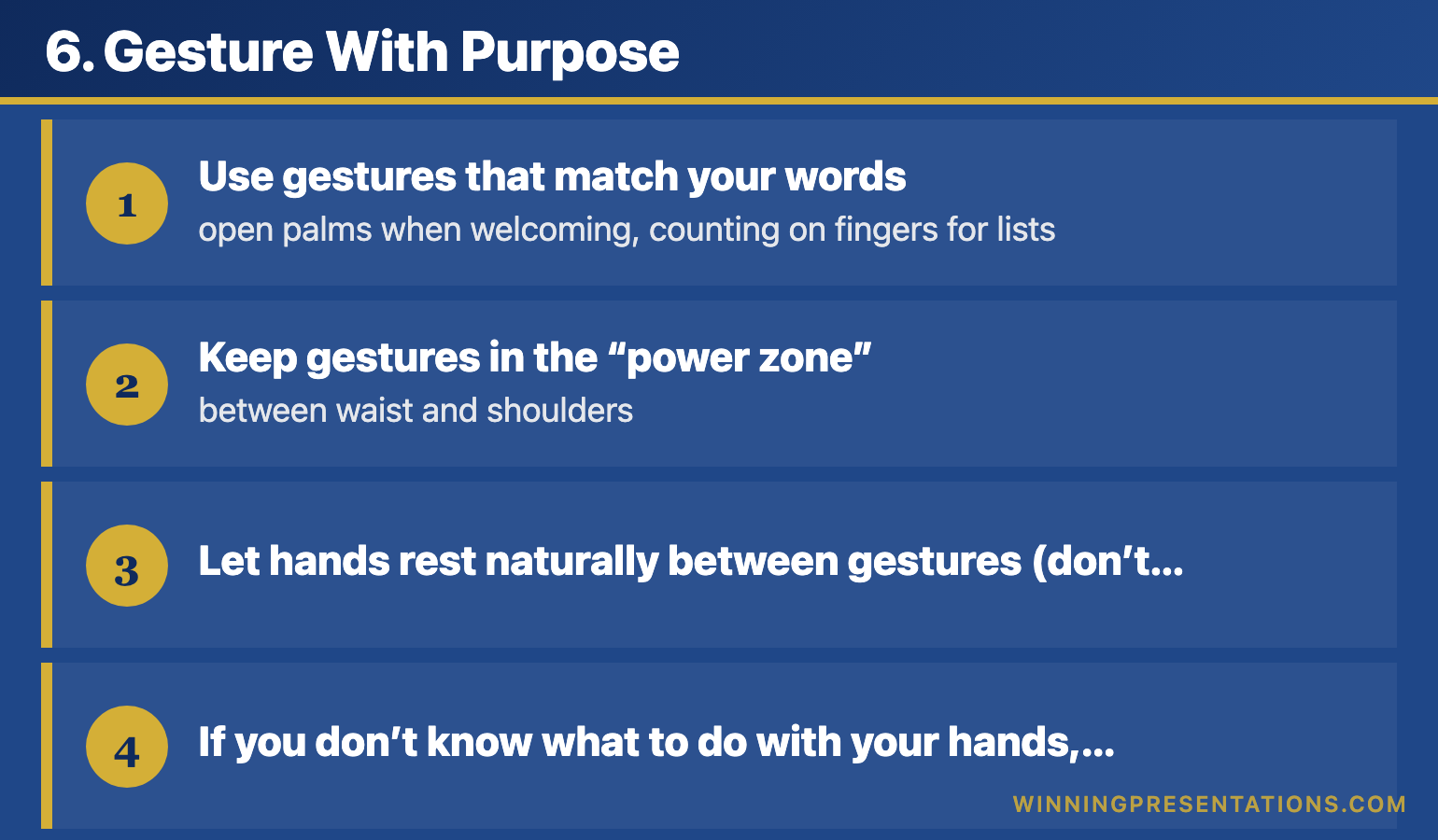
6. Gesture With Purpose

Nervous presenters either freeze their hands (stiff at sides or gripping notes) or gesture frantically. Neither looks confident.

How to look confident instead:

Infographic for: look confident when presenting (image 1)

  • Use gestures that match your words β€” open palms when welcoming, counting on fingers for lists
  • Keep gestures in the “power zone” β€” between waist and shoulders
  • Let hands rest naturally between gestures (don’t wring them)
  • If you don’t know what to do with your hands, hold a clicker or pen

Purposeful gestures don’t just look confident β€” they help you think. Research shows that gesturing while speaking actually improves verbal fluency.

Related: Presentation Confidence: How to Build It (Not Fake It)

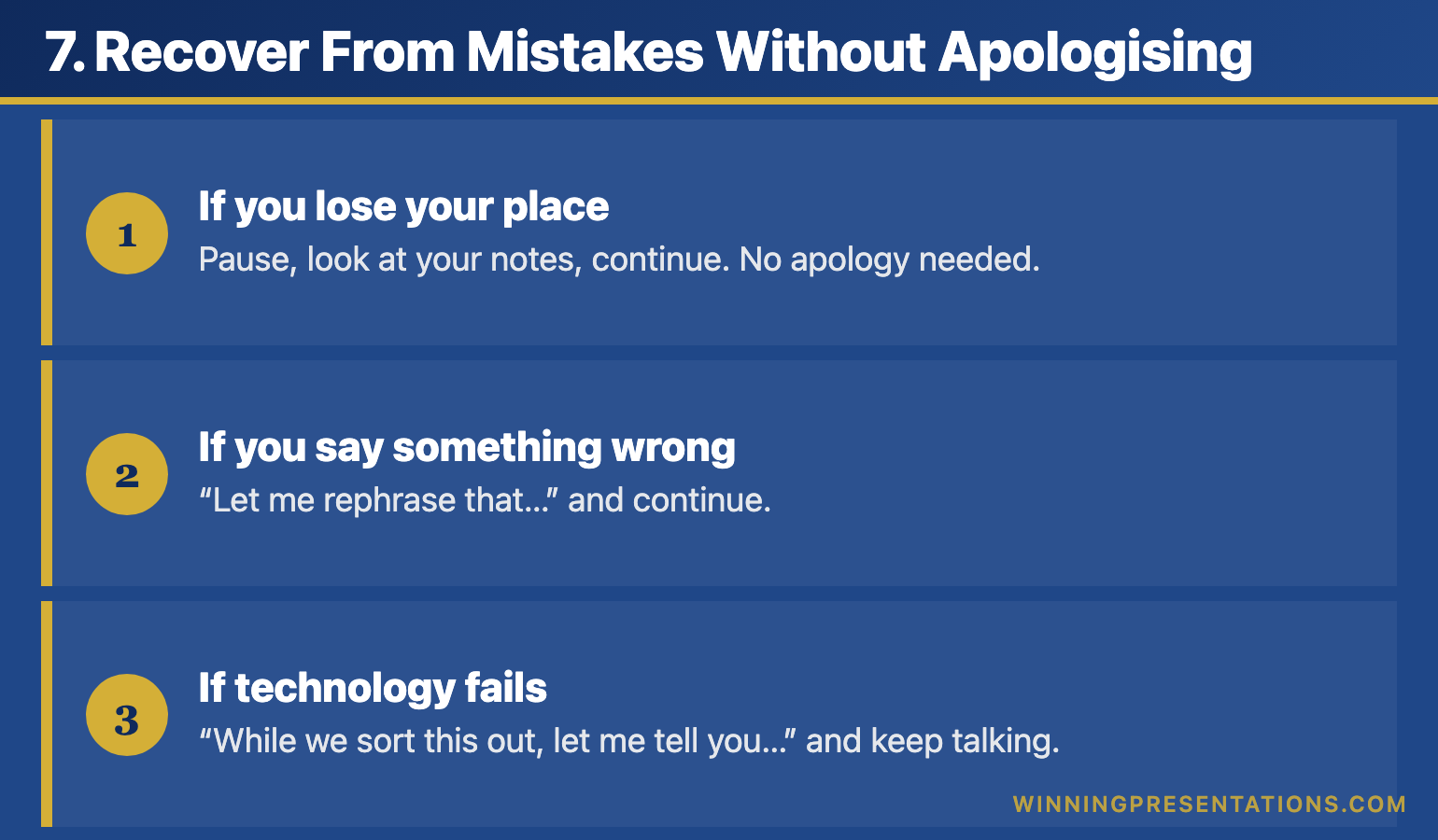
7. Recover From Mistakes Without Apologising

Every presenter makes mistakes. The difference between looking confident and looking nervous is how you handle them.

Nervous presenters apologise profusely, call attention to errors, or freeze up. Confident presenters recover smoothly and move on.

How to look confident instead:

Infographic for: look confident when presenting (image 2)

  • If you lose your place: Pause, look at your notes, continue. No apology needed.
  • If you say something wrong: “Let me rephrase that…” and continue.
  • If technology fails: “While we sort this out, let me tell you…” and keep talking.

Pre-plan your recovery phrases. When you know you can handle anything, you look confident because you genuinely feel in control.

Related: How to Start a Presentation: 15 Powerful Opening Techniques

Why Looking Confident Leads to Feeling Confident

There’s a psychological principle at work here: behaviour shapes emotion, not just the reverse.

When you adopt confident body language, your brain receives signals that you’re safe. Your nervous system calms down. And over time, the feeling of confidence follows the appearance of confidence.

I discovered this accidentally in my first five years of banking. By forcing myself to look confident when presenting, I gradually became more confident. The techniques became automatic. The anxiety faded.

You don’t have to wait to feel confident before presenting well. You can look confident now β€” and let the feeling catch up later.

Consistent Composure. Every Presentation.

Conquer Speaking Fear (Β£39, instant access) builds composure that holds β€” across different audiences, stakes, and settings. Structured techniques, not confidence tips.

Get Conquer Speaking Fear β†’ Β£39

Designed for experienced professionals who present regularly under pressure.

Frequently Asked Questions

How do I look confident when my hands are shaking?

Hold something β€” a clicker, a pen, or your notes. This gives the shaking somewhere to go without being visible. Also, the shaking usually subsides within 60-90 seconds of starting. If you can get through your opening, your body will calm down.

What if I can’t make eye contact without feeling more nervous?

Look at foreheads instead of eyes β€” the audience can’t tell the difference. Or focus on the friendly faces only. You don’t need to make eye contact with everyone, just enough people to create connection.

How do I slow down when my instinct is to rush?

Memorise your first three sentences word-for-word and practice them at half speed. When you start slowly, you’re more likely to maintain that pace. Also, build in deliberate pauses β€” after your opening, after key points, before your conclusion.

Does “fake confidence” actually work?

It’s not about faking β€” it’s about doing what confident presenters do. The behaviours (grounding, eye contact, pauses, open posture) are real skills you’re building. Over time, the feeling follows the behaviour. You’re not pretending; you’re practising.


Your Next Step

Pick one technique from this list and use it in your next presentation:

  1. Plant your feet β€” the easiest to implement immediately
  2. Slow your first three sentences β€” sets the tone for everything that follows
  3. Replace filler words with pauses β€” makes the biggest visible difference

Master one technique before adding another. Within a few presentations, you’ll look confident without thinking about it.

Go deeper: Presentation Confidence: How to Build It (And Why “Fake It Till You Make It” Doesn’t Work) β€” the complete guide to building lasting confidence.


Mary Beth Hazeldine is a qualified clinical hypnotherapist and Owner & Managing Director of Winning Presentations. After spending her first five years in banking terrified of presenting, she learned to look confident before she felt confident β€” and went on to present successfully for 19 more years at JPMorgan, PwC, RBS, and Commerzbank. She has since advised executives across financial services, healthcare, technology, and government.

The Winning Edge Newsletter

Weekly techniques for executives who present under pressure. Evidence-based, practical, no fluff.

Subscribe Free β†’

Not ready for the full system? Start here: download the free 7 Presentation Frameworks β€” practical structures for any presentation scenario.

20 Dec 2025
Presentation confidence guide - how to build lasting confidence with frameworks not fake it till you make it

Presentation Confidence: How to Build It (And Why “Fake It Till You Make It” Doesn’t Work)

A hypnotherapist explains why presentation confidence isn’t a personality trait β€” and the framework that transformed a nervous junior banker into a confident presenter for 19 years

For my first five years in banking, I had zero presentation confidence. Not because I lacked knowledge β€” I knew my material cold. But every time I had to present, my voice would shake, my mind would go blank, and I’d avoid speaking up entirely.

I wasn’t presenting to boards back then. I was too junior. It was the everyday moments that terrified me: credit committee presentations, client meetings, speaking up in internal discussions. I’d sit there with something valuable to say and stay silent because I didn’t trust myself to deliver it.

Then I took a training course called “Pitching to Win” β€” and everything changed.

It didn’t make me a confident person. It gave me something far more powerful: a framework. A structure I could follow every single time. And that framework gave me presentation confidence for the next 19 years at JPMorgan, PwC, RBS, and Commerzbank.

Years later, when I trained as a clinical hypnotherapist and treated hundreds of anxiety clients, I finally understood the science behind why that framework worked β€” and why “fake it till you make it” never does.

The 5 Pillars of Lasting Presentation Confidence

After 35 years of presenting and training others to become confident presenters, I’ve identified five pillars that create lasting presentation confidence. Notice that none of them require you to “be” confident β€” they require you to do specific things.

The 5 pillars of presentation confidence - structure, rituals, recovery, evidence, and physiology

Pillar 1: Structural Certainty

Know exactly how your presentation flows before you start. Not word-for-word memorisation β€” structural certainty. You should be able to answer:

  • What’s my opening line? (Memorised, word-for-word)
  • What are my 3-5 key points?
  • What transitions move me between sections?
  • What’s my closing line? (Memorised, word-for-word)

When you have structural certainty, your brain relaxes. It knows where you’re going even if you stumble along the way. This is the foundation of speaking with confidence.

Related: How to Start a Presentation: 15 Powerful Opening Techniques

Pillar 2: Preparation Rituals

Confident presenters don’t wing it. They have rituals β€” consistent pre-presentation routines that signal to their brain: “We’ve done this before. We know what happens next.”

My ritual before every high-stakes presentation:

  1. Review my opening (2 minutes)
  2. 3-Breath Reset β€” in for 4, hold for 4, out for 6, repeat 3 times (90 seconds)
  3. Ground my feet β€” press them firmly into the floor (30 seconds)
  4. Say out loud: “I’m excited to share this” (5 seconds)

The content of the ritual matters less than its consistency. Your nervous system learns that this sequence leads to successful presenting β€” and that builds presentation confidence automatically.

Related: How to Calm Nerves Before a Presentation: The 5-Minute Reset

Pillar 3: Recovery Protocols

Here’s a secret about confident presenters: they make mistakes too. The difference is they have recovery protocols β€” pre-planned responses to common problems.

When you know you can recover from anything, mistakes lose their power to create panic.

Pre-plan your recovery phrases:

  • Mind goes blank: “Let me come back to that point…” (look at notes, continue)
  • Lose your place: “The key thing I want you to take away is…” (pivot to your main message)
  • Technical failure: “While we sort this out, let me tell you the story behind this data…”
  • Hostile question: “That’s a fair challenge. Here’s how I see it…”

When I finally understood this β€” that confident presenters aren’t mistake-free, they’re recovery-ready β€” my entire relationship with presenting changed.

Pillar 4: Competence Evidence

Your brain needs evidence that you can do this. Not affirmations. Evidence.

Build your evidence bank:

  • Record yourself presenting (painful but invaluable)
  • Start small β€” team meetings before board meetings
  • Collect wins β€” keep a note of presentations that went well
  • Get specific feedback β€” “What worked?” not just “That was great”

Every successful presentation is evidence your brain can reference next time. The more evidence, the more your nervous system trusts that you’ll be okay β€” and the more you become a genuinely confident presenter.

Pillar 5: Physiological Control

This is where my hypnotherapy training transformed my understanding. Presentation confidence isn’t just mental β€” it’s physiological.

You can directly influence your nervous system state through:

  • Breathing patterns β€” Extended exhales activate the parasympathetic response
  • Posture β€” Open posture signals safety to your brain
  • Grounding β€” Physical connection to the floor redirects nervous energy
  • Anchoring β€” NLP techniques that access confident states on demand

These aren’t tricks. They’re how your nervous system works. When you understand the machinery, you can operate it deliberately β€” and that’s the fastest path to confident public speaking.

Related: Public Speaking Tips: 15 Psychology-Backed Techniques

Related:Β Β How to Look Confident When Presenting (Even When You’re Not)

Want to Build Lasting Presentation Confidence?

My AI-Enhanced Presentation Mastery course teaches the complete system β€” frameworks that eliminate uncertainty, psychology techniques from my hypnotherapy practice, plus AI tools that cut preparation time by 75%.

What’s included:

  • The structural frameworks that build real confidence
  • Psychology techniques for managing your nervous system
  • Self-paced modules with lifetime access
  • 50+ AI prompts to prepare faster and better

Β£499 β€” self-paced, immediate access.

See the full curriculum β†’

How to Build Presentation Confidence in Different Situations

The five pillars apply everywhere, but different contexts require different emphasis. Here’s how to become a confident presenter in specific situations:

Building Confidence for Internal Meetings

This is where most presentation anxiety actually lives β€” not in formal presentations, but in everyday meetings where you need to speak up with confidence.

Build presentation confidence by:

  • Preparing one key point before every meeting
  • Speaking early β€” the longer you wait, the harder it gets
  • Using grounding (press your feet into the floor) while seated
  • Starting with questions rather than statements if direct contribution feels hard

I spent five years avoiding contribution in internal meetings. The framework that changed this: prepare one thing to say, say it in the first 10 minutes, then relax.

Building Confidence for Client Presentations

Client presentations carry stakes β€” which means your nervous system is more alert. Combat this with over-preparation on structure:

  • Know your opening cold (word-for-word memorised)
  • Have your three key messages written on a card
  • Prepare answers to the five most likely questions
  • Arrive early and familiarise yourself with the room

Related: How to Create Executive Presentations That Get Results

Building Confidence for High-Stakes Presentations

Board presentations. Investor pitches. Career-defining moments. The framework matters even more here β€” high stakes amplify everything, including the benefit of preparation.

  • Rehearse out loud at least three times (not in your head β€” out loud)
  • Do a full dress rehearsal if possible β€” same room, same setup
  • Front-load your confidence β€” put your strongest material in the first two minutes when you’re most nervous
  • Have a pre-presentation ritual and do it without fail

Related: How CEOs Actually Present: Executive Presentation Skills

Stop the Racing Heart Before Your Next Meeting

Conquer Your Fear of Public Speaking is a neuroscience-based programme covering nervous system regulation, cognitive reframing, physical symptom management, and pre-presentation protocols β€” Β£39, instant access.

Get Conquer Your Fear of Public Speaking β†’

Designed for professionals who want to present with genuine confidence

Why Presentation Confidence Compounds Over Time

Here’s what nobody tells you about becoming a confident presenter: confidence compounds.

Each successful presentation β€” even a small one β€” deposits evidence in your brain that you can do this. Over time, these deposits accumulate. Your nervous system references them automatically. What once required conscious effort becomes unconscious competence.

I wasn’t “confident” after one good presentation. I became a confident presenter after hundreds β€” each one building on the last, each one reinforced by the same framework.

That’s why the framework matters so much. It’s not just about surviving individual presentations. It’s about building a system that makes you more confident every time you use it.

35 years later, I still use the same principles. The content changes. The framework doesn’t.

Building presentation confidence - what works vs what doesn't work comparison chart How presentation confidence compounds over time - each success builds evidence for your nervous system

Presentation Confidence Killers (And How to Avoid Them)

Killer #1: Comparing Yourself to “Natural” Presenters

There’s no such thing as a natural confident presenter. There are people who’ve had more practice, better training, or more supportive environments. But nobody was born confident at presenting.

Fix: Focus on your own progress, not others’ apparent ease.

Killer #2: Perfectionism

Waiting until you feel “ready” means waiting forever. Perfectionism is anxiety wearing a productivity mask.

Fix: Aim for “good enough to be useful” not “perfect.” Your audience wants value, not perfection.

Killer #3: Avoiding Presentations

Every presentation you avoid is evidence you’re collecting against yourself. Your brain learns: “This is dangerous. We should keep avoiding it.”

Fix: Take small opportunities. Team updates. Brief contributions. Build the evidence bank.

Killer #4: Post-Presentation Rumination

Replaying every mistake after a presentation trains your brain to associate presenting with pain.

Fix: Do a structured debrief instead. Three things that worked, one thing to improve next time. Then stop.

Want the complete nervous system toolkit? Conquer Speaking Fear (Β£39) gives you the clinical framework behind these five pillars β€” structured for executives who present under pressure.

If this pattern sounds familiar

You are not alone in this β€” and it is not a willpower problem. When preparation and practice have not been enough on their own, a structured approach that works at the nervous system level can make the difference. Conquer Speaking Fear was designed for exactly this situation.

If your preparation is solid but your nerves still derail you, Conquer Your Fear of Public Speaking gives you a structured system to manage exactly this.

Frequently Asked Questions About Presentation Confidence

How long does it take to build presentation confidence?

Most people notice meaningful improvement within 3-5 presentations when using a consistent framework. Real confidence β€” the kind that feels automatic β€” typically takes 15-20 presentations over several months. The key is consistency: same framework, same rituals, same recovery protocols.

Can introverts become confident presenters?

Absolutely. Some of the most confident presenters I’ve trained are introverts. Introversion means you process internally and may need recovery time after social interaction β€” it doesn’t mean you can’t present well. In fact, introverts often prepare more thoroughly, which builds more presentation confidence.

What if I’ve tried building confidence before and it didn’t work?

Usually this means you were trying to “feel” confident rather than “do” confident. Confidence isn’t an emotion you summon β€” it’s an outcome of preparation, practice, and physiological management. Focus on the five pillars (structure, rituals, recovery, evidence, physiology) rather than trying to feel a certain way.

Does presentation confidence come from knowing your material?

Knowing your material is necessary but not sufficient. I’ve seen experts freeze because they knew the content but had no framework for delivering it. You need both: subject matter expertise AND presentation structure. The framework is what lets your expertise come through.

How do I build confidence when I rarely present?

Create opportunities. Volunteer for team updates. Offer to present someone else’s work. Join a speaking group. The less you present, the less evidence your brain has β€” and the more anxious you’ll be when presentations do arise. Frequency builds presentation confidence more than intensity.

Can I build presentation confidence quickly before an important presentation?

You can’t build deep confidence overnight, but you can create the conditions for a confident performance. Focus on: knowing your opening cold, having a clear structure, preparing recovery phrases, and doing your pre-presentation ritual. This won’t make you permanently confident, but it will get you through the presentation β€” and that’s one more deposit in your evidence bank.


Your Nerves Aren’t the Problem β€” Your Response to Them Is

Conquer Your Fear of Public Speaking gives you a structured system to manage physical symptoms, reframe anxious thoughts, and build genuine confidence for any speaking situation β€” Β£39, instant access.

Get the Programme β†’

Designed for executives who want to stop dreading presentations

Your Next Step to Becoming a Confident Presenter

Building presentation confidence is simple, but not easy. It requires you to stop waiting to “feel” confident and start doing the things that create confidence.

Here’s what I suggest:

  1. Choose your next presentation β€” even a small team update
  2. Apply one framework β€” structure your content with a clear opening, three points, and a strong close
  3. Create one ritual β€” even just three deep breaths before you start
  4. Notice what happens β€” collect the evidence

That’s how it starts. One framework. One ritual. One presentation at a time.

Go deeper: Public Speaking Tips: 15 Psychology-Backed Techniques That Actually Work β€” the complete guide to speaking with confidence.

Presentation confidence cheat sheet - the 5 pillars and key techniques for confident presenting

Ready to Build Real Presentation Confidence?

AI-Enhanced Presentation Mastery

Frameworks that build confidence + Psychology that makes it stick + AI that cuts prep time

Β£249 Β£499

Early bird ends December 31st β€’ 60 seats β€’ Full refund guarantee

Learn More β†’

The Winning Edge β€” Weekly Presentation Insights

One technique, one mindset shift, and one real-world scenario every week. Practical, evidence-based, read in under 3 minutes.

Join The Winning Edge β€” Free


Mary Beth Hazeldine is a qualified clinical hypnotherapist and Owner & Managing Director of Winning Presentations. She spent 25 years in corporate banking at JPMorgan, PwC, Royal Bank of Scotland, and Commerzbank. After struggling with presentation anxiety for her first five years, she discovered that frameworks β€” not fake confidence β€” were the key to becoming a confident presenter. She works with executives across financial services, consulting, and corporate leadership, helping them present with genuine confidence.

19 Dec 2025
Presentation skills training comparison - traditional vs psychology and AI approach for lasting confidence

Presentation Skills Training: Why Most Programs Fail (And What Actually Works)

A hypnotherapist and ex-banker reveals why traditional presentation training doesn’t stick β€” and the psychology + AI approach that does

You’ve probably been through presentation skills training before. A one-day workshop. A corporate programme. Maybe even executive coaching.

And yet here you are, still searching for answers.

That’s not your fault. It’s a fundamental problem with how presentation training is designed. After 24 years presenting in corporate banking and treating hundreds of anxiety clients as a clinical hypnotherapist, I’ve seen exactly why most programmes fail β€” and what actually creates lasting change.

🎁 Free Download: Get my Executive Presentation Checklist β€” the pre-presentation routine I use before every high-stakes talk. A taste of what proper training includes.

Why Traditional Presentation Skills Training Doesn’t Work

Most presentation training focuses on the wrong things:

Problem #1: They teach techniques without addressing psychology.

“Make eye contact.” “Use gestures.” “Vary your tone.” These are surface-level tips that don’t help when your nervous system is in fight-or-flight mode. In my hypnotherapy practice, I saw this constantly β€” people who knew exactly what they should do but couldn’t do it when anxiety hit.

You can’t perform techniques when your hands are shaking and your mind is blank.

Problem #2: One-day workshops don’t create lasting change.

Research on skill acquisition is clear: lasting change requires spaced practice over time, not a single intensive session. Yet most corporate presentation training is a one-day event that’s forgotten within weeks.

Problem #3: They ignore the preparation bottleneck.

Most presentation anxiety comes from inadequate preparation β€” not lack of delivery skills. When you’re rushing to finish slides the night before, of course you’ll be nervous. But traditional training focuses almost entirely on delivery, not on how to prepare effectively.

Problem #4: They don’t adapt to how work has changed.

AI has transformed how we create content. Professionals who learn to use these tools effectively can prepare presentations in a fraction of the time β€” reducing anxiety and improving quality. Yet most presentation training ignores this entirely.

Related: Why Most Presentation Training Fails (And What Actually Works)

What Effective Presentation Skills Training Actually Looks Like

After training over 5,000 executives and treating hundreds of anxiety clients, I’ve identified what actually works:

1. Address the Psychology First

Before you can improve delivery, you need to manage your nervous system. This means learning techniques that work at the physiological level β€” breathing patterns that activate the parasympathetic response, anchoring techniques that access confident states on demand, and reframing methods that change how your brain interprets arousal.

This isn’t “mindset” fluff. It’s applied psychology from clinical practice.

Related: Public Speaking Tips: 15 Techniques That Actually Work

2. Fix the Preparation Problem

The executives I train who are most confident aren’t naturally gifted speakers β€” they’re exceptionally well-prepared. They have systems for structuring their message, creating compelling visuals, and rehearsing effectively.

Modern AI tools have made this dramatically easier. What used to take 6+ hours can now be done in 90 minutes β€” if you know how to use the tools correctly. That extra preparation time translates directly to confidence.

Related: AI Presentation Workflow: How I Cut Creation Time from 6 Hours to 90 Minutes

3. Space Learning Over Time

Skill development requires practice, feedback, and iteration. A single workshop can’t provide that. Effective training happens over weeks, with opportunities to apply techniques, get feedback, and refine your approach.

4. Combine AI Efficiency with Human Connection

AI can help you create better content faster. But the delivery β€” the presence, the connection, the ability to read the room and adapt β€” that’s irreducibly human. The best training teaches you to leverage AI for preparation while developing the human skills that make presentations memorable.

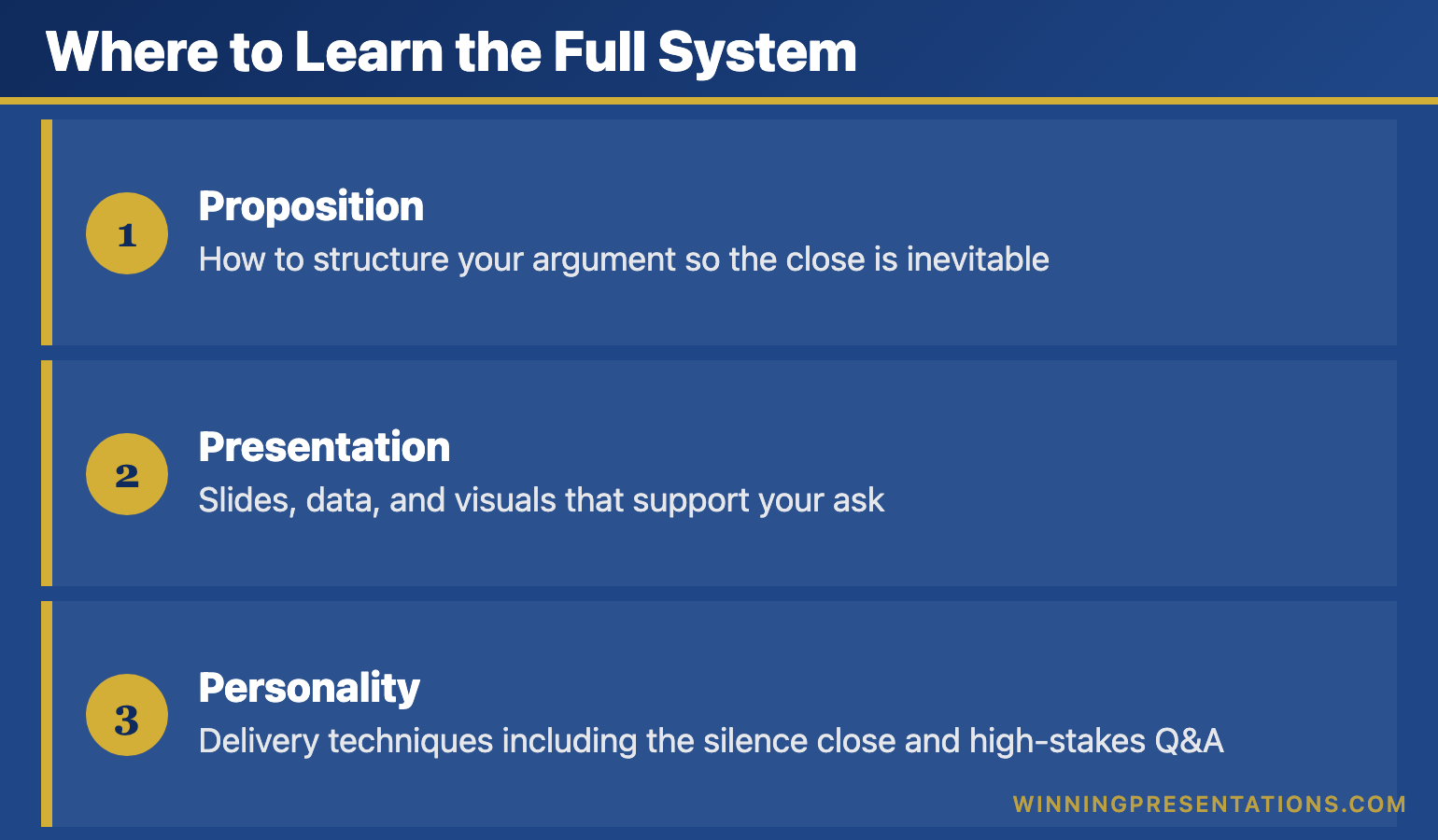
The 3Ps Framework: How My Clients Have Raised Β£250M+

Over 35 years, I’ve developed a methodology called the 3Ps Framework that addresses all three elements of effective presenting:

Proposition: What you’re actually saying β€” the structure, the argument, the story. Most presentations fail here before anyone opens their mouth. AI tools can dramatically accelerate this phase when used correctly.

Presentation: How the content is visualised and delivered. This includes slide design, pacing, and the technical aspects of delivery. Again, AI can help β€” but only if you know how to prompt it effectively.

Personality: The human element β€” presence, confidence, connection. This is where psychology matters most. No AI can give you executive presence. But the right techniques can unlock it.

Clients using this framework have raised over Β£250 million in funding. Not because they became different people β€” but because they learned to prepare effectively, manage their psychology, and deliver with authentic confidence.

Related: The 3Ps Framework: How My Clients Have Raised Β£250M+ in Funding

Presentation Skills Training That Actually Works

My AI-Enhanced Presentation Mastery course combines everything that makes training effective:

  • Psychology-based confidence techniques from my hypnotherapy practice
  • AI-powered preparation systems that cut creation time by 75%
  • Spaced learning over 8 modules with 2 live coaching sessions
  • Real-world application to your actual presentations

January cohort: Β£249 (increases to Β£499 in April)

Only 60 seats. Early bird ends December 31st.

See the full curriculum β†’

Who This Approach Works Best For

The psychology + AI approach to presentation skills training is particularly effective for:

Executives who present to boards and investors. High stakes require both confidence and preparation. The AI tools accelerate your preparation; the psychology techniques ensure you deliver with presence.

Professionals who’ve tried training before without lasting results. If you’ve done workshops that didn’t stick, you likely need the psychology component that was missing β€” not more tips on gestures and eye contact.

Anyone who spends too long preparing presentations. If you’re regularly working late on slides, AI-enhanced workflows can reclaim hours of your week while actually improving quality.

People who know their material but freeze under pressure. This is a classic sign that psychology, not knowledge, is the bottleneck. Clinical techniques for managing your nervous system will help more than any delivery tip.

Related: How to Create Executive Presentations That Get Results

What to Look for in Presentation Skills Training

If you’re evaluating options for presentation skills training, here’s what to look for:

Does it address psychology, not just technique? Look for programmes that teach anxiety management, confidence building, and mindset β€” not just “10 tips for better slides.”

Is it spaced over time or a one-day event? Lasting change requires practice and iteration. A single workshop is entertainment, not training.

Does it include modern tools? AI has changed how presentations are created. Training that ignores this is already outdated.

Is there personalised feedback? Generic advice only gets you so far. Look for programmes with live coaching or feedback on your specific presentations.

What’s the trainer’s actual experience? Theory is easy. Look for trainers who have presented in high-stakes environments themselves β€” not just taught others to do it.

Frequently Asked Questions

How is this different from corporate presentation training?

Most corporate training focuses on delivery tips (eye contact, gestures, voice) without addressing the psychology that prevents you from using those tips under pressure. It’s also typically a one-day event with no follow-up. The approach I teach addresses psychology first, uses AI to solve the preparation bottleneck, and is spaced over time for lasting change.

I’ve done presentation training before and it didn’t help. Why would this be different?

If previous training didn’t work, it likely focused on surface techniques without addressing your nervous system’s response to presenting. The psychology-based techniques I teach β€” drawn from clinical hypnotherapy β€” work at the physiological level where anxiety actually lives. That’s the missing piece for most people.

Do I need to be technical to use the AI components?

Not at all. The AI tools I teach (primarily Microsoft Copilot and ChatGPT) are designed to work with natural language prompts. If you can describe what you want, you can use these tools. The course includes exact prompts you can copy and adapt.

How much time does the training require?

The AI-Enhanced Presentation Mastery course includes 8 self-paced modules (about 30-45 minutes each) plus 2 live coaching sessions (90 minutes each). Most people complete it over 4-6 weeks while applying techniques to real presentations.

What if I’m already a confident presenter?

The AI components alone can save you 4+ hours per presentation. Even confident presenters benefit from more efficient preparation and advanced techniques for reading the room, handling difficult questions, and adapting on the fly.

Is there a guarantee?

Yes. Maven offers a full refund until the halfway point of the course. If it’s not working for you, you get your money back.


Your Next Step

If you’re serious about improving your presentation skills β€” not just attending another workshop that doesn’t stick β€” here’s what I recommend:

  1. Start with the fundamentals. Read my guide to 15 Public Speaking Tips That Actually Work and try the techniques in your next presentation.
  2. Download the checklist. Get the Executive Presentation Checklist and use it before your next high-stakes talk.
  3. Consider structured training. If you want the complete system β€” psychology, AI tools, and live coaching β€” the AI-Enhanced Presentation Mastery course covers everything.

The January cohort has 60 seats at Β£249 (early bird pricing ends December 31st). After that, the price increases to Β£499.

Ready for Presentation Training That Actually Works?

AI-Enhanced Presentation Mastery

Psychology-based confidence + AI-powered preparation + Live coaching

Β£249 Β£499

Early bird ends December 31st β€’ 60 seats β€’ Full refund guarantee

Enrol Now β†’


Mary Beth Hazeldine is a qualified clinical hypnotherapist and Managing Director of Winning Presentations. She spent 24 years in corporate banking at JPMorgan, PwC, Royal Bank of Scotland, and Commerzbank, and has trained over 5,000 executives to present with impact. Her clients have raised over Β£250M using her frameworks.

19 Dec 2025
How to calm nerves before a presentation - 5 minute reset technique for presentation anxiety

How to Calm Nerves Before a Presentation: The 5-Minute Reset That Actually Works

A hypnotherapist’s structured technique for stopping presentation anxiety before you walk into the room

You’re about to present. Your heart is racing. Your hands are shaking. Your mind is going blank.

You need something that works in the next five minutes β€” not a week-long course on confidence.

I’m going to give you exactly that. As a clinical hypnotherapist who applies evidence-based clinical techniques to managing presentation anxiety.

It takes five minutes. It works every time. And by the end of this article, you’ll have a pre-presentation routine you can use for the rest of your career.

Why You Can’t “Think” Your Way Out of Presentation Anxiety

Here’s what most people get wrong when trying to calm nerves before a presentation: they try to think their way out of a physiological response.

“Relax.” “You’ve got this.” “Stop being nervous.”

It doesn’t work. In my hypnotherapy practice, I saw this pattern time and again with executive clients. Presentation anxiety isn’t a thinking problem β€” it’s a nervous system response. Your brain has detected a threat (the audience) and triggered fight-or-flight.

No amount of positive self-talk will override that biological reaction. You need to speak directly to your nervous system.

That’s exactly what the 5-Minute Reset does.

Related: Public Speaking Tips: 15 Techniques That Actually Work

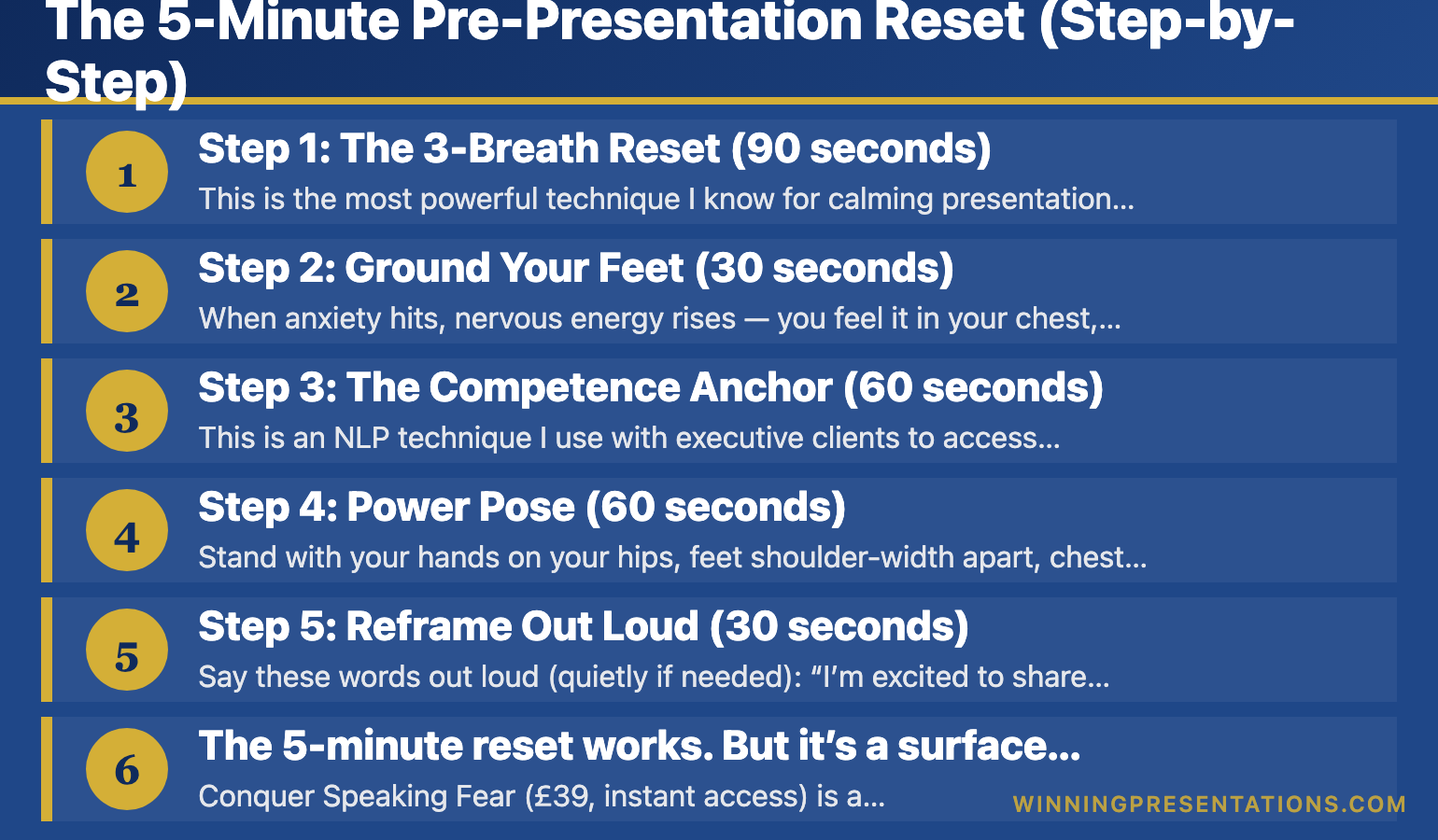
The 5-Minute Pre-Presentation Reset (Step-by-Step)

Do this sequence in order, ideally somewhere private β€” a bathroom, your car, an empty corridor. It takes five minutes and will change your physiological state completely.

Infographic for: calm nerves before presentation (image 1)

Step 1: The 3-Breath Reset (90 seconds)

This is the most powerful technique I know for calming presentation nerves. I used it with panic attack clients for years before bringing it into executive training.

How to do it:

  1. Breathe in through your nose for 4 counts
  2. Hold for 4 counts
  3. Breathe out through your mouth for 6 counts
  4. Repeat 3 times

Why it works: The extended exhale activates your parasympathetic nervous system β€” literally telling your brain the threat is over. This isn’t relaxation advice; it’s how your nervous system is wired. I’ve used this exact technique to help clients stop panic attacks in their tracks.

Three breaths. Ninety seconds. Do it every single time.

Step 2: Ground Your Feet (30 seconds)

When anxiety hits, nervous energy rises β€” you feel it in your chest, throat, and head. Your feet want to pace or shift.

Counter this by pressing your feet firmly into the floor. Feel the ground beneath you. Imagine roots growing from your feet into the earth.

This “grounding” technique redirects nervous energy downward and creates physical stability that will translate to vocal stability when you speak. It’s a core technique in anxiety therapy that I used extensively in my clinical hypnotherapy practice before adapting it for presenters.

Related: How to Start a Presentation: 15 Powerful Opening Techniques

Step 3: The Competence Anchor (60 seconds)

This is an NLP technique I use with executive clients to access confident states on demand. It’s one of the most effective ways to calm nerves before a presentation because it gives you a physical trigger you can use anywhere.

How to create it:

  1. Remember a time you felt completely confident β€” any context
  2. Close your eyes and fully re-experience that moment
  3. When the feeling peaks, press your thumb and forefinger together firmly
  4. Hold for 5 seconds, then release

You’ve now created a physical trigger. Before you present, press your thumb and forefinger together to access that state. Your nervous system doesn’t distinguish between remembered confidence and current confidence.

This is the same anchoring technique I used to help anxiety clients access calm states on demand. It works for presentations too.

Step 4: Power Pose (60 seconds)

Stand with your hands on your hips, feet shoulder-width apart, chest open. Hold for 60 seconds.

Research on power posing is mixed, but I’ve seen it work consistently with the executives I train. At minimum, it interrupts the closed, protective posture that presentation anxiety creates β€” hunched shoulders, crossed arms, shallow breathing.

That posture change affects your mental state. Open body, open mind.

Step 5: Reframe Out Loud (30 seconds)

Say these words out loud (quietly if needed): “I’m excited to share this.”

Not “I’m calm” β€” your body knows that’s a lie. “I’m excited” works because the physiological response to excitement is identical to anxiety: racing heart, heightened alertness, energy surge. The only difference is the label you put on it.

Research shows that reframing anxiety as excitement actually improves performance. One sentence. Say it out loud. It matters.

🎯 Want This Entire Routine on a Printable Card?

The include the 5-Minute Reset, voice warm-ups, power poses, and 20+ techniques on printable cards you can keep in your bag. Review them before any high-stakes presentation.

Stop managing nerves. Eliminate them.

The 5-minute reset works. But it’s a surface technique β€” and you know it.

Conquer Speaking Fear (Β£39, instant access) is a hypnotherapist-designed system that targets the root cause of presentation anxiety β€” not just the symptoms. Use the reset in the short term; use the system to stop needing it.

  • Fear Type Assessment β€” identify exactly what drives your anxiety response
  • 10 evidence-based techniques with structured practice
  • 5 word-for-word scripts for worst-case scenarios
  • 30-day structured plan β€” build lasting confidence

Get Conquer Speaking Fear β†’ Β£39

⚑ Presenting this week?

If you’re heading into a high-stakes presentation this week and need more than a 5-minute reset, Conquer Speaking Fear gives you the complete system β€” including the pre-presentation protocols that make the nerves manageable every time.

Explore Conquer Speaking Fear β†’

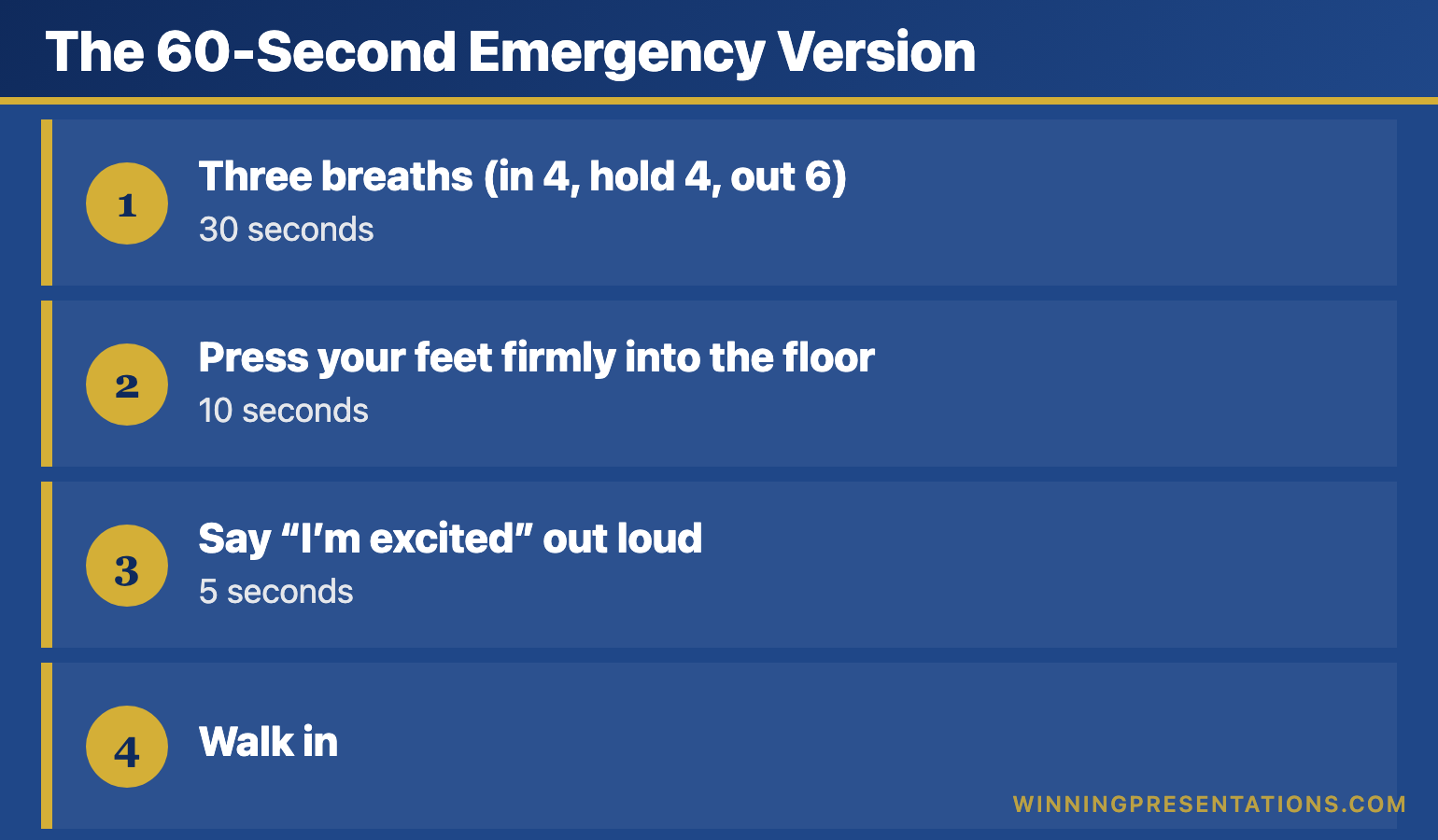
The 60-Second Emergency Version

No time for the full reset? Here’s how to calm presentation nerves in under a minute:

Infographic for: calm nerves before presentation (image 2)

  1. Three breaths (in 4, hold 4, out 6) β€” 30 seconds
  2. Press your feet firmly into the floor β€” 10 seconds
  3. Say “I’m excited” out loud β€” 5 seconds
  4. Walk in

Forty-five seconds. It won’t eliminate your nerves completely, but it will take the edge off enough to get through your opening β€” and the first 60 seconds are when presentation anxiety is highest. After that, you’ll settle.

What to Do If Your Mind Goes Blank During the Presentation

Even with preparation, it happens. You’re mid-sentence and suddenly β€” nothing. Your mind is completely empty.

Here’s your recovery plan:

  1. Pause. It feels like an eternity to you. To the audience, it looks like confidence.
  2. Look at your slide or notes. No one judges you for this.
  3. Say: “Let me come back to that point…” and move to the next section.

The audience rarely notices these moments as much as you fear. And knowing you have a recovery plan removes the panic that makes blanking worse.

Related: How to End a Presentation: 7 Closing Techniques That Work

Why This Works When Other Techniques Don’t

Most advice for calming nerves before a presentation focuses on what to think. But as I learned in my clinical hypnotherapy practice, you can’t think your way out of a physiological state.

The 5-Minute Reset works because it targets your nervous system directly:

  • Breathing activates the parasympathetic response
  • Grounding redirects nervous energy
  • Anchoring accesses stored confident states
  • Posture interrupts anxiety body language
  • Reframing changes how your brain interprets the arousal

Each step builds on the last. Together, they create a reliable state change that works whether you’re presenting to five people or five hundred.

Related: How to Create Executive Presentations That Get Results

Building Long-Term Presentation Confidence

The 5-Minute Reset is a powerful tool for calming nerves before any presentation. But if presentation anxiety is a recurring challenge, you’ll want to build deeper confidence over time.

That means:

  • Knowing your opening cold β€” Memorise your first 30 seconds word-for-word so you don’t have to think when nerves are highest
  • Arriving early β€” Get to the room first and make the space yours
  • Creating a consistent ritual β€” Use the same pre-presentation routine every time so your brain learns to associate it with successful outcomes
  • Practising in stressful conditions β€” Rehearse standing up, in front of colleagues, in the actual room when possible

I cover all 15 of these techniques in my comprehensive guide: Public Speaking Tips: 15 Techniques That Actually Work

Ready to build confidence that works long-term?

Conquer Speaking Fear is a complete system for executives who understand their material but still feel the anxiety response before every presentation. 75-page workbook. Evidence-based. Immediate download.

Want to stop relying on the reset and start walking in composed? Conquer Speaking Fear builds the foundation underneath the techniques β†’

Learn more about Conquer Speaking Fear β†’ Β£39

Frequently Asked Questions

How do I stop shaking before a presentation?

Shaking comes from adrenaline β€” you can’t stop the adrenaline, but you can process it. Do the 3-Breath Reset (breathe in 4, hold 4, out 6, repeat 3 times), then hold something in your hands β€” a clicker, pen, or notes β€” to occupy them. The shaking usually subsides within 60-90 seconds of starting your presentation if you don’t fight it.

What if I get nervous again during the presentation?

Use a micro-reset: take one slow breath (in 4, out 6), press your feet into the floor, and continue. You can do this while speaking or during a natural pause. The audience won’t notice.

Does the 5-Minute Reset work for virtual presentations?

Absolutely. Do the full routine before you go on camera. The only adaptation: during the presentation, you can ground your feet while seated, and focus your eye contact on the camera lens (not the screen) to create connection.

What if I only have 2 minutes before presenting?

Use the 60-Second Emergency Version: three breaths (30 seconds), ground your feet (10 seconds), say “I’m excited” out loud (5 seconds), then walk in. It’s enough to take the edge off your presentation anxiety.

Why do I get presentation anxiety when I know the material?

Because anxiety isn’t about knowledge β€” it’s about perceived threat. Your nervous system interprets being watched and judged as danger, regardless of how prepared you are. That’s why techniques that target the nervous system directly (like the 5-Minute Reset) work better than “just know your stuff” advice.


πŸ“¬ The Winning Edge Newsletter

Weekly strategies for speaking confidence, executive presence, and career-critical presentation moments.

Subscribe free β†’

Your Next Step

You now have a structured technique to calm nerves before any presentation. Here’s what I want you to do:

  1. Save this article β€” bookmark it or print the steps
  2. Use the 5-Minute Reset before your next presentation β€” even a low-stakes meeting
  3. Notice the difference β€” in your body, your voice, your confidence

Once you’ve experienced how well this works, you’ll never present without it again.

Go deeper: Public Speaking Tips: 15 Techniques That Actually Work β€” the complete guide to confident presenting, from a hypnotherapist who specialises in executive presentation skills.


Mary Beth Hazeldine is a qualified clinical hypnotherapist and Managing Director of Winning Presentations. She spent 25 years in corporate banking at JPMorgan, PwC, Royal Bank of Scotland, and Commerzbank, and applies evidence-based clinical techniques to managing presentation anxiety. She advises executives across financial services, healthcare, technology, and government.

Not ready for the full system? Start here instead: subscribe to The Winning Edge β€” weekly strategies for executive confidence and presentation skills, free.

19 Dec 2025
15 public speaking tips that actually work - psychology-backed techniques for confident presentations

Public Speaking Tips: 15 Techniques From Someone Who’s Trained 5,000+ Executives

Quick Answer: Slow your first two sentences by 15%, exhale longer than you inhale, pause after key points, and land one clear closing line. That’s 80% of confident speaking.

Most public speaking tips are useless. “Picture the audience in their underwear.” “Just be yourself.” “Practice in front of a mirror.” You’ve heard them all. They don’t work.

The fear of public speaking β€” glossophobia β€” affects up to 75% of people. But it doesn’t have to control you.

I come at this from two directions. First, I spent 24 years presenting to boards, investors, and C-suite executives at JPMorgan, PwC, Royal Bank of Scotland, and Commerzbank. I was terrified for the first five years. The generic public speaking techniques made it worse.

Second β€” and this is what makes my approach different β€” I’m a qualified clinical hypnotherapist who has treated hundreds of clients with anxiety disorders. Panic attacks. Social anxiety. Performance anxiety. I’ve seen what actually rewires the fear response, and I’ve brought those techniques into my presentation training.

What changed everything wasn’t tips β€” it was understanding the psychology behind fear and confident speaking. These public speaking tips come from training over 5,000 executives, combined with my background in NLP (Neuro-Linguistic Programming) and clinical hypnotherapy. They’re not motivational fluff β€” they’re specific techniques you can use to overcome stage fright and speak confidently in your next presentation.

🎯 Ready to Conquer Your Fear of Public Speaking?

After 5 years of presentation terror and treating hundreds of anxiety clients as a clinical hypnotherapist, I created a system that actually works β€” not just “breathe and visualise” advice that fails under pressure.

Includes:

  • The neuroscience behind why your brain panics (and how to rewire it)
  • The 60-second reset that works even minutes before you speak
  • Scripts and exercises you can use immediately

Get the Complete System β†’ Β£39

Based on clinical techniques I used with hundreds of anxiety clients, adapted for high-stakes presenting.

Why Most Public Speaking Tips Fail

Before we get to what works, let’s address why the standard advice doesn’t help with public speaking anxiety.

In my hypnotherapy practice, I saw the same pattern repeatedly: people trying to think their way out of a physiological response. It doesn’t work. Telling someone to “relax” when their nervous system is in fight-or-flight mode is like telling someone with a broken leg to “walk it off.”

Generic public speaking tips fail because they treat symptoms, not causes. The real issues behind fear of public speaking are:

  • Perceived threat response β€” Your brain interprets audience judgment as physical danger
  • Attention misdirection β€” You’re focused on yourself instead of your message
  • Lack of control anchors β€” Nothing feels predictable or manageable
  • Identity attachment β€” You’ve made the outcome mean something about your worth

These are the same patterns I treated in my anxiety clients. The techniques below address these root causes, not just the surface symptoms. Whether you’re looking to overcome presentation nerves or become a more confident speaker, these strategies will help.

Related: How CEOs Actually Present: Executive Presentation Skills for Leadership

Part 1: Before You Speak (Preparation)

1. The 3-Breath Reset

This is the single most effective technique I teach for calming nerves before a presentation. I used it with my hypnotherapy clients for years before bringing it into corporate training. It takes 30 seconds and changes your physiological state immediately.

How to do it:

  1. Breathe in for 4 counts through your nose
  2. Hold for 4 counts
  3. Breathe out for 6 counts through your mouth
  4. Repeat 3 times

Why it works: The extended exhale activates your parasympathetic nervous system β€” literally telling your brain the threat is over. This isn’t meditation woo-woo; it’s how your nervous system is wired. I’ve used this technique to help clients stop panic attacks in their tracks.

Do this in the bathroom, in your car, or standing backstage. Three breaths. Every time. It’s one of the most reliable presentation anxiety tips you’ll find.

3-breath reset technique for public speaking anxiety - breathe in 4 counts hold 4 out 6 to calm nerves

2. Arrive in the Room First

One of my most counterintuitive public speaking tips: get to the room early and own the space.

Walk the stage or the front of the room. Touch the podium. Adjust the chair. Stand where you’ll stand when presenting. Your brain needs to register this as YOUR territory, not hostile ground you’re entering.

I learned this presenting to the board at Commerzbank. The executives who commanded the room weren’t more talented β€” they arrived 15 minutes early and made the space theirs.

3. Know Your First 30 Seconds Cold

You don’t need to memorise your entire presentation. But you absolutely must have your opening locked in β€” word for word, no improvisation.

Why? Because the first 30 seconds are when your nerves are highest. If you have to think about what to say, you’ll stumble. If it’s automatic, you can focus on delivery while your brain calms down.

This single public speaking tip has helped more nervous presenters than any other technique I teach.

Related: How to Start a Presentation: 15 Powerful Opening Techniques

4. The “What If” Reframe

Nervous speakers ask: “What if I forget my words? What if they hate it? What if I fail?”

Confident speakers ask the same question differently: “What if this goes well? What if they’re genuinely interested? What if this is the presentation that changes everything?”

This isn’t positive thinking β€” it’s pattern interruption, a technique I used constantly in hypnotherapy. Your brain will answer whatever question you ask it. Ask better questions. It’s a powerful way to overcome stage fright before it takes hold.

These reframing techniques are just the beginning. Conquer Speaking Fear includes the complete set of NLP scripts I used with my hypnotherapy clients β€” adapted specifically for presentation anxiety.

5. Eliminate “Performance” From Your Mind

Here’s a mindset shift that transformed my speaking: you’re not performing, you’re having a conversation.

When you “perform,” you create distance between yourself and the audience. You become an actor trying to impress. The audience feels it β€” and so do you.

Instead, think of your presentation as a conversation where you happen to be doing most of the talking. You’re sharing something you know with people who want to hear it. That’s it.

This single reframe has helped more nervous executives develop speaking confidence than any technique I teach.

Part 2: During Your Presentation (Delivery)

6. Find Three Friendly Faces

Before you start speaking, identify three people in different parts of the room who look receptive. Maybe they’re nodding. Maybe they’re smiling. Maybe they just look interested.

During your presentation, rotate your eye contact between these three people. It feels like you’re speaking to individuals who want to hear from you β€” because you are.

Avoid: the person checking their phone, the one with arms crossed, the obvious sceptic. They exist in every audience. They’re not your target.

7. Pause Before Key Points

Nervous speakers rush. They fill every silence with words because silence feels dangerous.

Here’s the truth: pauses make you look confident, not uncertain.

Before your most important point, stop. Take a breath. Let the silence build. Then deliver your message.

Watch any TED Talk from a masterful speaker. Count the pauses. They’re not accidents β€” they’re strategic. This is one of the most powerful public speaking techniques for projecting confidence.

Related: How to End a Presentation: 7 Closing Techniques I Teach C-Suite Executives

8. Ground Your Feet

When anxiety hits, nervous energy rises. You feel it in your chest, your throat, your head. Your feet want to pace or shift.

Counter this by consciously pressing your feet into the floor. Feel the ground beneath you. This “grounding” technique redirects nervous energy downward and creates physical stability that translates to vocal stability.

Grounding is a core technique in anxiety therapy. I taught it to hundreds of hypnotherapy clients before adapting it for presenters. I have executives imagine roots growing from their feet into the floor. It sounds strange. It works.

⭐ These Tips Work β€” But There’s a Faster Way

I spent 5 years terrified of presenting before I cracked the code. Now I’ve packaged everything β€” the neuroscience, the NLP techniques, the exact scripts β€” into a system you can use before your next presentation.

What’s inside:

  • The 60-second nervous system reset (works even backstage)
  • Reframing scripts from my clinical hypnotherapy practice
  • The pre-presentation protocol I teach to executives

Conquer Your Speaking Fear β†’ Β£39

“I went from avoiding all presentations to volunteering for them.” β€” Senior Manager, Financial Services

9. Speak to the Back Row (Voice Projection)

Project your voice as if the most important person is in the back of the room. This does three things:

  • Forces you to slow down (voice projection requires pace)
  • Deepens your voice (projecting engages your diaphragm)
  • Commands attention (volume signals authority)

You don’t need to shout. Just imagine your words need to reach someone 30 feet away. Your body language and vocal delivery will adjust automatically.

10. Use Purposeful Movement

Standing frozen looks nervous. Pacing looks nervous. The solution is purposeful movement.

Move when you transition between points. Walk to a different spot on stage, plant your feet, deliver the next section. Then move again for the next transition.

This gives your nervous energy somewhere to go while building stage presence that looks intentional rather than anxious.

Part 3: Managing Your Nerves (Psychology)

This section draws heavily on my hypnotherapy training. These aren’t generic mindset tips β€” they’re clinical techniques adapted for the boardroom.

11. Reframe Nerves as Excitement

This is one of the most research-backed public speaking tips available. Studies show that reframing speech anxiety as excitement improves performance.

The physiological response is identical β€” racing heart, heightened alertness, energy surge. The only difference is the label you put on it.

Before you present, say out loud: “I’m excited.” Not “I’m calm” (your body knows that’s a lie). “I’m excited” redirects the same energy toward a positive interpretation.

How to reframe public speaking nerves as excitement - same physical response different mindset

12. The Competence Anchor

This is an NLP technique I’ve used with hundreds of clients β€” both in my hypnotherapy practice and in executive training β€” to build speaking confidence.

How to create it:

  1. Remember a time you felt completely confident β€” any context
  2. Close your eyes and fully re-experience that moment
  3. When the feeling peaks, press your thumb and forefinger together
  4. Repeat 5-10 times with different confident memories

Now you have a physical trigger. Before presenting, press your thumb and forefinger together to access that state. Your nervous system doesn’t distinguish between remembered confidence and current confidence. This is the same anchoring technique I used to help anxiety clients access calm states on demand.

The Competence Anchor is one of dozens of NLP techniques in Conquer Speaking Fear. The full system includes audio exercises so you can build these anchors properly.

13. Prepare for Mistakes (So They Don’t Derail You)

Mistakes will happen. You’ll lose your train of thought. The slide won’t advance. You’ll say the wrong word.

The difference between amateur and professional speakers isn’t that professionals don’t make mistakes β€” it’s that mistakes don’t throw them off.

Pre-plan your recovery phrases:

  • “Let me come back to that point…”
  • “Actually, the more important thing is…”
  • “Where was I? Right β€” [key word from your notes]”

When you know you can recover, mistakes lose their power to create panic. This is essential for anyone learning how to speak in public with confidence.

For a deep dive on building lasting confidence, see my guide on how to speak confidently in public.

14. Detach From Outcome

This is advanced, but it’s the public speaking tip that creates lasting transformation.

Most presentation anxiety comes from attachment to outcome. You need them to approve. You need them to be impressed. You need to not embarrass yourself.

But here’s the truth: you don’t control how they respond. You only control what you deliver.

Shift your goal from “make them say yes” to “deliver my message as clearly as possible.” The first goal creates anxiety because it’s outside your control. The second creates focus because it’s entirely within your control.

I’ve seen executives transform overnight with this shift. The paradox is that when you stop needing a specific outcome, you usually get better outcomes.

15. Create a Pre-Presentation Ritual

Every confident speaker I’ve trained has a ritual. Not superstition β€” a deliberate sequence that signals to their brain: “It’s time to perform.”

My ritual before high-stakes presentations:

  1. Review my opening (2 minutes)
  2. 3-Breath Reset (30 seconds)
  3. Competence Anchor β€” press thumb and forefinger (10 seconds)
  4. Power pose in private β€” hands on hips, chest open (60 seconds)
  5. Say out loud: “I’m excited to share this” (5 seconds)

Total: under 5 minutes. The consistency is what matters. Your brain learns that this sequence leads to successful presenting, and it prepares accordingly.

5-minute pre-presentation ritual for public speaking confidence - review opening, breathing, power pose

Related: How to Create Executive Presentations That Get Results

Public Speaking Tips for Specific Situations

Different contexts require adapting these public speaking techniques. Here’s how to speak confidently in specific high-stakes situations:

Virtual Presentations

Virtual presenting has unique challenges. You can’t read the room. Energy feels flat. Distractions are everywhere.

Adapt these techniques:

  • Look at the camera, not the screen (this creates “eye contact”)
  • Exaggerate your facial expressions by 20% (the camera flattens them)
  • Stand if possible β€” it improves your energy and breathing
  • Use people’s names frequently to maintain audience engagement

Related: Why Most QBR Presentations Bore Leadership (And How to Fix Yours)

Board Presentations

Boards are time-poor and decision-focused. They don’t want a performance β€” they want clarity.

  • Lead with your recommendation (tip #3 applies here β€” know your opening cold)
  • Speak with authority, not apology
  • Anticipate the three questions they’ll ask and have answers ready

If you’re preparing slides for a board presentation, see our Executive Presentation Template for the structure that commands attention.

Related: The Board Presentation Structure Nobody Teaches You

Investor Pitches

High stakes, short time, sceptical audience. The speaking confidence techniques become even more critical.

  • Your conviction matters as much as your numbers
  • Pause after your ask β€” let them process
  • Treat questions as interest, not attacks

Related: Investor Pitch Deck Template: The Sequoia Format That Raised Billions

Speaking Confidently in Meetings

Not every speaking opportunity is a formal presentation. Here’s how to project confidence when speaking in meetings:

  • Speak early β€” the longer you wait, the harder it gets
  • Use the grounding technique (#8) while seated
  • Prepare one key point you want to make before the meeting starts
  • Lower your vocal pitch slightly (nerves raise pitch)

Common Public Speaking Mistakes to Avoid

Even with these tips, certain mistakes undermine your impact:

Mistake 1: Apologising at the Start

“Sorry, I’m a bit nervous” or “I’m not very good at this” β€” these phrases kill your credibility before you’ve said anything of substance.

Fix: Start with your content. Your audience doesn’t need to know you’re nervous. Most can’t even tell.

Mistake 2: Reading Slides

If you’re reading what’s on the screen, why are you there? Slides support your message β€” they don’t replace it.

Fix: Know your content well enough that slides are visual aids, not scripts.

Mistake 3: Ending Weakly

“So, yeah… that’s it. Any questions?” is not an ending. It’s an apology for taking their time.

Fix: Prepare your closing as carefully as your opening. End with a clear call to action or a memorable final statement.

Related: Presentation Structure: 7 Frameworks That Actually Work

How to Practice Public Speaking Skills

Knowing techniques is one thing. Embodying them is another. The fastest path to becoming a better public speaker isn’t more practice β€” it’s more deliberate practice with specific techniques.

Related: How to Get Better at Public Speaking: What Actually Works

Record Yourself

I know β€” watching yourself is painful. Do it anyway. You’ll notice filler words, pacing issues, and body language habits you’d never catch otherwise.

Practice Transitions, Not Scripts

Don’t memorise every word. Instead, practice how you move between sections. “After I cover X, I’ll transition to Y by saying Z.” This keeps you flexible while maintaining structure.

Rehearse the Anxiety

Practice in conditions that mimic the stress. Present to colleagues. Present standing up. Present in the actual room if possible. Your brain needs to experience success in challenging conditions to believe it’s possible.

Get Feedback That Matters

“That was great!” isn’t useful feedback. Ask specific questions: “Did I rush through the third section? Was my ask clear? Where did you lose focus?”

Related: How to Improve Public Speaking Skills: The 5 Things That Actually Matter

⭐ Your Next Presentation Doesn’t Have to Feel Like This

If reading these tips made you think “I need this” β€” the full system goes deeper. It’s everything I learned from treating hundreds of anxiety clients, adapted for high-stakes presenting.

You’ll get:

  • Why your brain panics (and how to interrupt the pattern)
  • The anchoring technique that gives you confidence on demand
  • Audio exercises you can use the morning of your presentation

Get the Complete System β†’ Β£39

Join hundreds of professionals who’ve transformed their relationship with presenting.

Frequently Asked Questions

How do I calm nerves before a presentation?

Use the 3-Breath Reset: breathe in for 4 counts, hold for 4 counts, breathe out for 6 counts. Repeat 3 times. The extended exhale activates your parasympathetic nervous system and physically calms your body. Combine this with arriving early to own the space and knowing your first 30 seconds cold. For a step-by-step walkthrough, see How to Calm Nerves Before a Presentation.

How do I stop shaking when presenting?

Shaking comes from adrenaline. You can’t stop the adrenaline, but you can process it: (1) Do the 3-Breath Reset before presenting, (2) Hold something β€” a clicker, a pen, notes β€” to occupy your hands, (3) Ground your feet firmly on the floor. The shaking usually subsides within 60-90 seconds of starting if you don’t fight it.

What if I forget what to say?

Pause. Look at your notes or slide. Say “Let me come back to that point” and move on. Audiences rarely notice these moments as much as you fear. Preparation helps: know your key points rather than scripts, so you can always return to the core message.

What are the best public speaking tips for beginners?

Start with three fundamentals: (1) Know your opening cold β€” memorise your first 30 seconds word-for-word, (2) Use the 3-Breath Reset before speaking to calm your nervous system, and (3) Focus on one friendly face in the audience rather than trying to scan everyone. Master these before adding more advanced techniques.

How do I handle a hostile audience?

First, don’t assume hostility β€” scepticism often looks like hostility but isn’t. If someone is genuinely combative: acknowledge their point (“That’s a fair concern”), answer directly, and move on. Don’t get defensive or debate. Your composure is more persuasive than winning an argument.

How long does it take to become a confident speaker?

Most people see meaningful improvement within 3-5 presentations if they apply these public speaking techniques consistently. Mastery takes years, but competence and speaking confidence come much faster than most people expect. The key is deliberate practice, not just repetition.

Can introverts be good public speakers?

Absolutely. Some of the best speakers I’ve trained are introverts. Introverts often prepare more thoroughly and listen better to audience cues. The key is working with your natural style rather than trying to become an extrovert on stage. Many introverts find that the “conversation, not performance” reframe (tip #5) is particularly helpful.

How can I project confidence when speaking?

Confidence comes from three things: preparation (know your opening cold), physiology (ground your feet, breathe deeply, speak to the back row), and mindset (reframe nerves as excitement, detach from outcome). The Competence Anchor technique (#12) gives you instant access to confident states when you need them.

πŸ“§ Join 2,000+ Professionals

Get weekly presentation insights β€” techniques that actually work, not generic advice.

Subscribe to The Winning Edge β†’

πŸ“– Free Download: 7 Presentation Frameworks

The structures I use for every presentation type β€” from team updates to investor pitches.

Download Free β†’

Your Next Step

These public speaking tips work. But reading about techniques and applying them are different things.

Here’s what I suggest:

  1. Pick three techniques from this article that resonate with you
  2. Apply them to your next presentation β€” don’t try to do everything at once
  3. Notice what changes β€” in your nerves, your delivery, your audience response

Once you’ve experienced the difference, you’ll want to go deeper. When you’re ready, Conquer Speaking Fear gives you the complete system β€” everything I learned from 5 years of presentation terror and treating hundreds of anxiety clients.

Mary Beth Hazeldine is the Managing Director of Winning Presentations. She spent 24 years in corporate banking at JPMorgan Chase, PwC, Royal Bank of Scotland, and Commerzbank before training thousands of executives to present with impact. As a qualified clinical hypnotherapist, she has treated hundreds of clients with anxiety disorders β€” experience she now applies to help professionals overcome fear of public speaking. Her clients have raised over Β£250M using her frameworks.
18 Dec 2025
AI presentation workflow showing time savings from 6 hours to 90 minutes with before and after comparison

AI Presentation Workflow: How I Cut Creation Time from 6 Hours to 90 Minutes

The exact system I use with Copilot to build presentations that actually win decisions

My AI presentation workflow changed everything.

Six months ago, I spent 6 hours on a pitch deck for a biotech client. The slides looked professional. The data was solid. The client lost the funding round.

Last month, a similar client needed a similar deck. I used my AI presentation workflow. Spent 90 minutes. They raised Β£4.2 million.

Same me. Same expertise. Completely different approach to using AI.

🎁 Free Download: Get my 10 Essential Copilot Prompts β€” the exact prompts I use in this workflow. No email required.

Here’s what I’ve learned after testing AI presentation workflows on hundreds of client decks: most people use Copilot backwards.

They open PowerPoint, type “create a presentation about Q3 results,” and wonder why the output looks generic and forgettable.

That’s not an AI presentation workflow. That’s hoping AI will think for you. It won’t.

The workflow I’m sharing today is different. It’s the system I’ve refined over the past year, tested on real presentations for investment banks, biotech founders, and SaaS executives. It’s also the foundation of the course I’m launching in January.

Why Your AI Presentation Workflow Isn’t Working

Let me guess what’s happening:

You prompt Copilot. You get 15 slides of generic structure β€” title, agenda, overview, data, data, data, summary, questions. It’s technically correct. It looks like every other AI-generated deck.

You spend the next two hours trying to fix it. Moving slides around. Rewriting bullet points. Fighting with formatting. By the end, you’ve saved no time and the presentation still feels… flat.

Sound familiar?

The problem isn’t Copilot. The problem is you’re asking AI to do your strategic thinking. It can’t. Here’s what AI cannot do:

  • Decide what your audience needs to believe
  • Determine which data actually matters for this decision
  • Structure an argument that leads to action
  • Know when to break the rules for impact

That’s your job. But here’s the breakthrough: once you’ve done that thinking, AI executes ten times faster than you can manually.

The AI presentation workflow I’m about to share separates strategic thinking (you) from execution (AI). That’s why it works.

Want the Complete System?

The AI-Enhanced Presentation Mastery course teaches this entire workflow with templates, 50+ prompts, and live practice sessions.

January cohort: Β£249 (increases to Β£499 in April)

Only 60 seats. Early bird ends December 31st.

See what’s included β†’

4-step AI presentation workflow - AVP Framework, 132 Rule, SEE Formula, and AI Execution with time for each step
The AI Presentation Workflow: 4 Steps

This is the exact process I use. It works for investor pitches, board presentations, sales decks, and executive updates. The frameworks adapt to any presentation type.

Step 1: AVP Framework (5 minutes β€” before you touch PowerPoint)

Before I prompt Copilot for anything, I answer three questions on paper:

A β€” Action: What specific decision or action do I need from this audience?

V β€” Value: What’s in it for them? Why should they care?

P β€” Proof: What evidence will make them believe me?

This takes 5 minutes. Most people skip it and spend hours wandering through slides wondering why nothing feels right.

Real example from a client deck last month:

  • Action: Approve Β£500K for the pilot programme by Friday
  • Value: This solves the customer churn problem costing us Β£2M annually
  • Proof: Three case studies showing 40% churn reduction, internal data on our trajectory, ROI calculation showing 4x return

Now β€” and only now β€” am I ready to use AI. See the difference? I’m not asking Copilot to figure out my strategy. I’m asking it to execute a strategy I’ve already defined.

Related: How to Structure a Presentation: 7 Frameworks That Actually Work

AVP Framework diagram showing Action Value Proof - three questions to answer before creating presentations with AI

Step 2: The 132 Rule for Structure

The 132 Rule is how I structure every presentation, regardless of length:

  • 1 β€” One core message (the thing you want them to remember)
  • 3 β€” Three supporting arguments (the structure of your case)
  • 2 β€” Two types of evidence per argument (facts + stories)

This is where Copilot becomes genuinely powerful.

My prompt (this took me months to refine):

“I’m presenting to [specific audience] requesting [specific decision]. My core message is [from AVP]. My three supporting arguments are: 1) [argument], 2) [argument], 3) [argument]. Create a presentation outline that opens with my recommendation, develops each argument with one data point and one brief example, and closes with my specific ask and timeline.”

Executive Resource

Stop Writing AI Prompts From Scratch

The Executive Prompt Pack gives you 50 battle-tested prompts for executive-level presentations β€” board updates, budget requests, investor briefs, and Q&A preparation. Built for PowerPoint Copilot and ChatGPT.

Get the Executive Prompt Pack β†’

Used by executives preparing for board briefings, budget requests, and high-stakes presentations.

That’s a 30-second prompt. Copilot generates a structured outline in another 30 seconds. What used to take me 45 minutes now takes one minute.

The key: I gave Copilot the strategic decisions. It handled the structural execution.

Related: Best Copilot PowerPoint Prompts That Actually Work

The 132 Rule for presentation structure - 1 core message, 3 supporting arguments, 2 evidence types per argument with visual tree diagram

Step 3: S.E.E. Formula for Each Section

Generic AI presentations fail because every slide sounds the same β€” informative but forgettable. The audience nods politely and does nothing.

The S.E.E. formula fixes this:

  • S β€” Statement: What’s the point of this slide? (One sentence, opinionated)
  • E β€” Evidence: What proves it? (Specific data, quote, or case study)
  • E β€” Emotion: Why does it matter to THIS audience? (The “so what?”)

My prompt for transforming flat slides:

“For this slide about [topic], the key statement is [X]. The evidence is [data point]. Rewrite to emphasise what this means for [specific audience] β€” connect it to their priorities, not just the numbers. Make the title state the conclusion, not describe the content.”

Copilot becomes a translation layer between your data and your audience’s concerns. You provide the strategic insight; it finds the words.

S.E.E. Formula for persuasive slides - Statement Evidence Emotion framework for transforming flat presentations
Step 4: AI Handles the Grunt Work

Once the strategic structure is solid, there’s tedious work that AI handles brilliantly:

  • Reformatting bullet points into cleaner layouts
  • Rewriting descriptive titles into action titles (“Q3 Revenue Analysis” β†’ “Revenue Beat Target by 12% β€” Here’s Why It’s Sustainable”)
  • Creating consistency across the deck
  • Generating speaker notes
  • Building an executive summary from the full deck

None of these require strategic thinking. All of them used to eat hours. Now they take minutes.

Related: PowerPoint Copilot Tutorial: Complete Guide 2025

AI presentation workflow time comparison table showing tasks reduced from 5+ hours to 70 minutes total

The Real Time Savings

Here’s what changed when I adopted this AI presentation workflow:

Task Before With AI Workflow
Strategic planning (AVP) Skipped β€” then struggled 5 minutes
Outline creation 45 minutes 2 minutes
First draft slides 2 hours 20 minutes
Formatting and polish 1 hour 10 minutes
Review and refinement 1.5 hours 30 minutes
Total 5+ hours ~70 minutes

That’s 4+ hours saved per presentation. If you create two presentations a week, that’s 400+ hours a year β€” ten full work weeks.

Who This Works For (And Who It Doesn’t)

This AI presentation workflow works if you:

  • Already know your content but struggle to structure it persuasively
  • Spend too long on slides that don’t get the results they should
  • Want to use AI strategically, not just as a shortcut
  • Present to executives, boards, investors, or clients who make decisions

This probably isn’t right for you if:

  • You want AI to do all the thinking (it can’t β€” and the results show it)
  • You’re looking for templates without learning the strategy behind them
  • You don’t present regularly enough to justify learning a system

I’m direct about this because I’d rather you know upfront. The people who get results from this workflow β€” and from my course β€” are professionals who present regularly and want to get dramatically better, faster.

What Happens in the Course

The AI presentation workflow above is the foundation. The AI-Enhanced Presentation Mastery course goes deeper:

8 self-paced modules (January–April 2026):

  • Module 1: AI as your strategic co-creator (not a shortcut)
  • Module 2: The AVP framework with templates and examples
  • Module 3: The 132 Rule β€” structuring any presentation
  • Module 4: S.E.E. formula β€” making every slide persuasive
  • Module 5: Data storytelling with AI
  • Module 6: Building your personal prompt playbook
  • Module 7: Executive presence and delivery
  • Module 8: The complete AI presentation workflow

2 live coaching sessions (April 2026):

  • Live deck reviews and feedback
  • Q&A on your specific challenges
  • Recordings available if you can’t attend

Resources you keep forever:

  • 50+ tested prompts (my personal library)
  • AVP and S.E.E. templates
  • Before/after slide transformations
  • The complete AI presentation workflow PDF
  • Lifetime access to all materials and updates

Ready to Master the AI Presentation Workflow?

January cohort opens December 31st.

Β£249 Β£499

Early bird price β€’ 60 seats maximum β€’ Lifetime access

Enrol Now β†’

Backed by the Maven Guarantee β€” full refund until halfway point

Try the Workflow Today

You don’t need the course to start. Here’s what to do with your next presentation:

  1. Before opening PowerPoint: Write down your AVP (Action, Value, Proof). 5 minutes.
  2. Use the 132 Rule: Define your one message, three arguments, and two pieces of evidence per argument.
  3. Prompt Copilot with your strategy: Use the prompts above β€” give it your decisions, let it execute.
  4. Apply S.E.E. to each slide: Statement, Evidence, Emotion.

If this workflow saves you even one hour on your next presentation, imagine what happens when you master the complete system.


Mary Beth Hazeldine is the Managing Director of Winning Presentations. She spent 24 years in corporate banking at JPMorgan Chase, PwC, Royal Bank of Scotland, and Commerzbank before training thousands of executives to present with impact. Her clients have raised over Β£250M using her frameworks.

18 Dec 2025
First slide examples for presentations before and after

The First Slide Nobody Knows How to Write (And 10 Examples That Work)

Stop staring at a blank title slide. Here’s exactly what to put on it.

You’ve got your presentation structured. You know your key points. You’ve even rehearsed the middle section.

But you’re still staring at slide one.

What do you actually put on the first slide? Your name and the date? A clever quote? The company logo? Something that “grabs attention”?

Most people get this wrong β€” and it costs them the room before they’ve said a word.

After 24 years presenting to boards, investors, and C-suite executives at JPMorgan, PwC, and Royal Bank of Scotland, I’ve tested dozens of opening slide approaches. Here are the 10 that consistently work.

Why Your First Slide Matters More Than You Think

Your audience decides in the first 30 seconds whether to pay attention or check their phones. The first slide sets that tone.

A weak first slide signals: “This will be like every other boring presentation.”

A strong first slide signals: “This person knows what they’re doing. I should listen.”

The difference isn’t design. It’s intent. Your first slide should do ONE of three things:

  • Create curiosity β€” make them want to know more
  • Establish stakes β€” show them why this matters
  • State your position β€” tell them exactly what you’re recommending

Here are 10 ways to do that.

10 First Slide Presentation Examples That Actually Work

1. The Bold Claim

State your conclusion upfront. No build-up, no context, no “let me walk you through.”

Example:

“We should acquire Company X for Β£15M. Here’s why.”

Why it works: Executives don’t want to wait for your conclusion. Give it to them immediately, then spend the rest of the presentation proving it.

Best for: Board presentations, executive briefings, any audience with authority and limited time.

Related: The Pyramid Principle for Presentations

2. The Provocative Question

Ask something that challenges assumptions or creates immediate tension.

Example:

“What if everything we know about customer retention is wrong?”

Why it works: Questions engage the brain differently than statements. The audience can’t help but start formulating answers.

Best for: Strategy presentations, innovation pitches, challenging the status quo.

3. The Startling Statistic

Lead with a number that makes people sit up.

Example:

“Β£4.2 million. That’s what this problem cost us last quarter.”

Why it works: Specific numbers feel concrete and credible. They create immediate stakes.

Best for: Budget requests, problem presentations, any situation where you need to establish urgency.

First slide example showing startling statistic presentation opening

4. The Before/After Promise

Show the transformation you’re offering.

Example:

“From 6-hour turnaround to 45 minutes. This is what AI did for our team.”

Why it works: People understand contrast instantly. The gap between before and after creates curiosity about how you got there.

Best for: Case studies, sales presentations, process improvement updates.

5. The Enemy Slide

Name the problem your audience is fighting.

Example:

“Manual reporting is killing your team’s productivity.”

Why it works: When you articulate someone’s pain better than they can, you earn instant credibility. They think: “This person understands my world.”

Best for: Sales pitches, proposals, any presentation where you’re solving a problem.

Related: How to Structure a Presentation: The Step-by-Step Guide

6. The Counterintuitive Truth

Challenge conventional wisdom immediately.

Example:

“The best sales teams don’t focus on selling.”

Why it works: Contradictions create cognitive tension. The audience needs to hear the explanation to resolve it.

Best for: Thought leadership, keynotes, any presentation where you’re changing minds.

7. The Single Word

Maximum impact, minimum noise.

Example:

“Momentum.”

Why it works: A single word forces the audience to lean in. What does it mean? Why that word? You have their full attention for your verbal explanation.

Best for: Keynotes, team rallies, presentations where you want to create a memorable moment.

Get All 25 Templates

The Openers & Closers Swipe File includes:

  • 10 opening slide templates (with fill-in-the-blank scripts)
  • 15 closing slide templates (including “The Ask” and “The Callback”)
  • Before/after examples showing weak vs. strong versions
  • Guidance on which opener fits which situation

Stop reinventing the wheel for every presentation.

Get instant access (Β£9.99) β†’

Sorted slide one β€” now build slides two through twelve

Once you’ve nailed the opener, the Executive Slide System gives you 26 templates including Board Meeting Opener and Executive Summary. Drop your content in. Β£39, instant download.

Get the Slide System β†’

8. The “What If” Scenario

Paint a picture of a different future.

Example:

“What if you could close deals in half the time with twice the confidence?”

Why it works: “What if” bypasses skepticism. It’s hypothetical, so there’s nothing to argue with. But it plants a seed of possibility.

Best for: Product launches, vision presentations, sales pitches.

9. The Audience Mirror

Describe exactly what they’re experiencing right now.

Example:

“You’ve got 47 slides, a meeting in an hour, and no idea what your main point is.”

Why it works: When someone describes your situation perfectly, you trust them. They clearly understand your world.

Best for: Training sessions, consulting pitches, any presentation where you’re positioning yourself as the expert.

10. The Direct Ask

Skip the preamble entirely. Say what you want.

Example:

“I need Β£500K and 6 months. Here’s what I’ll deliver.”

Why it works: Directness signals confidence. It respects the audience’s time. And it frames everything that follows as justification for a specific request.

Best for: Budget requests, investor pitches, any presentation where you’re asking for a decision.

Related: How to End a Presentation: 7 Closing Techniques

Opening slide example showing direct ask presentation technique

What NOT to Put on Your First Slide

Now that you know what works, here’s what to avoid:

❌ Your name and title β€” Nobody cares yet. Earn their attention first.

❌ The date and meeting title β€” They know what meeting they’re in.

❌ A table of contents β€” Save it for documents. Presentations should flow.

❌ “Today we’ll cover…” β€” This signals a lecture, not a conversation.

❌ A generic quote β€” Unless it’s directly relevant, it’s filler.

❌ Your company logo taking up the whole slide β€” Branding matters, but not more than your message.

Your first slide has one job: make them want slide two.

Matching Your Opener to Your Situation

The right opening depends on your audience and goal:

Situation Best Openers
Board presentation Bold Claim, Direct Ask
Sales pitch Enemy Slide, Before/After, What If
Investor pitch Startling Statistic, Direct Ask, Bold Claim
Keynote / all-hands Single Word, Provocative Question, Counterintuitive Truth
Training session Audience Mirror, Before/After
Strategy recommendation Bold Claim, Provocative Question

Want the complete toolkit?

The first slide is one piece of a working executive presentation. The Complete Presenter Bundle pulls all seven products together β€” slides, Q&A, anxiety, storytelling, delivery, openers, cheat sheets β€” for Β£99 (save Β£91.97 vs buying separately). Lifetime access.

Get the Complete Presenter Bundle β€” Β£99 β†’

Frequently Asked Questions

Should I introduce myself on the first slide?

No. Earn their attention first, then introduce yourself β€” either verbally after your opening or on slide two. The exception is if you’re unknown to the audience AND your credibility is central to the message. Even then, keep it brief.

What about title slides for formal presentations?

If protocol requires a title slide (some board meetings, academic presentations), use it β€” but make it work harder. Instead of “Q3 Financial Update,” try “Q3 Results: Why We’re Accelerating Investment.” Same information, but it creates curiosity.

How do I choose between these openers?

Ask yourself: What does my audience need to feel in the first 10 seconds? Curious? Alarmed? Reassured? Challenged? Pick the opener that creates that emotion. When in doubt, go with The Bold Claim for executives or The Enemy Slide for sales.


Stop Staring at Blank Slides

Your first slide sets the tone for everything that follows. Get it right, and you’ve earned attention. Get it wrong, and you’re fighting uphill for the next 20 minutes.

The Openers & Closers Swipe File gives you 25 templates you can use immediately:

  • 10 opening slides with fill-in-the-blank scripts
  • 15 closing slides (including The Single Ask, The Callback, and The Forward Story)
  • Before/after examples showing weak vs. strong versions
  • Situation guide so you always pick the right one

Get the Swipe File (Β£9.99) β†’

Instant download. Use it on your next presentation.


Mary Beth Hazeldine is the Managing Director of Winning Presentations. She spent 24 years in corporate banking at JPMorgan Chase, PwC, Royal Bank of Scotland, and Commerzbank before training thousands of executives to present with impact. Her clients have raised over Β£250M using her frameworks.

18 Dec 2025
How to structure a presentation step by step guide

How to Structure a Presentation: The Step-by-Step Guide for Any Situation

The exact process I use to structure presentations that have helped clients raise Β£250M+

You have a presentation next week. Maybe it’s a board update, a sales pitch, or an investor meeting. You know your content β€” the problem is figuring out what order to put it in.

Most people start with a blank slide and begin typing. That’s backwards.

After 24 years in corporate banking at JPMorgan, PwC, Royal Bank of Scotland, and Commerzbank β€” and training thousands of executives since β€” I’ve developed a step-by-step process for structuring any presentation. It works whether you have 5 slides or 50, whether you’re presenting to your team or the board.

Here’s exactly how to structure a presentation that gets results.

The 5-Step Process to Structure Any Presentation

Before you open PowerPoint, you need clarity on five things. Skip any of these and your presentation structure will fall apart.

Want ready-made structures instead of building from scratch?

The Executive Slide System includes 17 PowerPoint templates with proven structures for every business presentation β€” board meetings, budget requests, sales pitches, QBRs, and more. Plus 51 AI prompts to generate your content.

Get the templates (Β£39) β†’

Step 1: Define Your One Thing

Every presentation needs a single core message. Not three messages. Not “several key points.” One thing you want the audience to remember.

Ask yourself: If my audience forgets everything else, what’s the one thing they must remember?

Examples:

  • Budget presentation: “We need Β£500K to hit our Q3 targets”
  • Sales pitch: “Our solution cuts your processing time by 60%”
  • Board update: “We’re on track, but need a decision on the expansion”
  • Investor pitch: “We’re raising Β£2M to capture a Β£500M market”

Write this down before you do anything else. Every slide you create should support this one thing.

Presentation structure diagram showing one core message with supporting points

Step 2: Know Your Audience’s Starting Point

The biggest presentation structure mistake is assuming your audience knows what you know.

Before you structure anything, answer these questions:

  • What do they already know about this topic?
  • What do they care about most? (Hint: usually money, time, or risk)
  • What concerns or objections will they have?
  • What decision are they able to make?

A presentation to your team requires different structure than the same content presented to the board. Your team wants details. The board wants the decision and the headline numbers.

Related: How to Present to a CFO: The Finance-First Framework

Step 3: Choose Your Framework

Now you’re ready to pick a presentation structure. The right framework depends on your situation:

Situation Best Framework Why It Works
Sales pitch or proposal Problem-Solution-Benefit Creates urgency, then delivers relief
Executive briefing Pyramid Principle Answer first, details only if needed
Data presentation What-So What-Now What Turns numbers into decisions
Keynote or all-hands Hero’s Journey Inspires through narrative
Strategy recommendation SCQA Creates tension that demands resolution
Investor pitch 10-20-30 Rule Forces clarity and brevity
Client meeting (flexible) Modular Deck Adapts to conversation flow

Deep dive: Presentation Structure: 7 Frameworks That Actually Work

Don’t know which to choose? Default to Problem-Solution-Benefit for external audiences and Pyramid Principle for internal executives.

πŸ’‘ Want to combine these frameworks with AI? My AI-Enhanced Presentation Mastery course teaches you how to use Copilot as a strategic partner β€” cut creation time from 6 hours to 90 minutes while doubling impact.

Step 4: Build Your Slide Skeleton

Now β€” and only now β€” open PowerPoint.

Don’t write content yet. Just create placeholder slides with titles only. This is your skeleton.

Example: Problem-Solution-Benefit structure for a sales pitch

  1. Title slide
  2. The Problem (what pain they’re experiencing)
  3. The Cost (what this problem costs them)
  4. The Cause (why the problem exists)
  5. The Solution (your answer β€” benefits, not features)
  6. How It Works (3 steps maximum)
  7. Proof (case study with specific numbers)
  8. Next Step (one clear action)

Eight slides. That’s it. If you need more, you probably haven’t synthesised enough.

Pro tip: Read your slide titles in sequence. They should tell a complete story without any content. If someone read only your titles, would they understand your message?

Step 5: Fill In the Content (Last)

Only after your skeleton is solid do you write the actual content.

For each slide, ask:

  • What’s the ONE point this slide makes?
  • What’s the minimum evidence needed to prove it?
  • What can I cut?

Most slides need 3-5 bullet points maximum. If you have more, you’re putting two slides’ worth of content on one slide.

Related: Stop Writing Slide Titles Like This (Before and After Examples)

Skip the Skeleton β€” Get Pre-Built Structures

The 5-step process works. But it takes time.

The Executive Slide System gives you 17 ready-made presentation structures β€” just fill in your content. Includes:

  • 17 PowerPoint templates (Board, QBR, Budget, Sales, Investor, and more)
  • 51 AI prompts to generate content for each slide
  • 7 proven frameworks (Pyramid Principle, Problem-Solution-Benefit, SCQA, etc.)
  • Before/after examples showing exactly what good looks like

Get instant access (Β£39) β†’

How to Structure Different Types of Presentations

The 5-step process applies universally. But each presentation type has nuances. Here’s how to structure the most common ones:

How to Structure a Sales Presentation

Use Problem-Solution-Benefit. The structure is:

  1. Problem β€” State their pain (be specific to their situation)
  2. Cost β€” Quantify what it’s costing them
  3. Cause β€” Explain why the problem exists
  4. Solution β€” Your answer (benefits first, features later)
  5. How It Works β€” 3 steps maximum
  6. Proof β€” Case study with specific numbers
  7. Next Step β€” One clear action

Spend 70% of your prep time on slides 1-3. If they don’t feel the problem, they won’t care about your solution.

Template: Sales Presentation Template: The Structure Top Performers Use

How to Structure an Executive Presentation

Use the Pyramid Principle. Lead with your answer:

  1. The Answer β€” Your recommendation in one sentence
  2. Supporting Point 1 β€” Strongest argument + evidence
  3. Supporting Point 2 β€” Second argument + evidence
  4. Supporting Point 3 β€” Third argument + evidence
  5. Implications β€” What this means for the business
  6. Next Steps β€” What you need from them

Never more than 3 supporting points. If you have more, group related points together.

Template: Executive Presentation Template: 12 Slides That Command the Room

How to Structure a Board Presentation

Boards have specific expectations. Your structure must include:

  1. The Ask β€” What decision you need (slide 1, not slide 12)
  2. Context β€” Brief background (what they need to know)
  3. Recommendation β€” Your proposed course of action
  4. Business Case β€” ROI, costs, timeline
  5. Risks β€” What could go wrong and your mitigation
  6. Decision β€” Restate the ask with clear options

Board presentations fail when the ask is buried. Put it on slide 1.

Template: Board Presentation Template: The Complete Guide

How to Structure a Data Presentation

Use What-So What-Now What for every data point:

  • What β€” The facts (specific numbers with context)
  • So What β€” Why it matters (interpretation)
  • Now What β€” What to do about it (action)

Every chart needs a “So What.” If you can’t explain why data matters in one sentence, don’t include it.

Related: Team Dashboards That Tell a Story (Not Just Show Numbers)

Data presentation structure using What So What Now What framework

Common Presentation Structure Mistakes

I’ve reviewed thousands of presentations. These mistakes appear in 80% of them:

Mistake 1: Starting with Background

“Let me give you some context…” is how most presentations start. It’s also where most audiences check out.

Fix: Start with why they should care. Context comes after you’ve earned their attention.

Mistake 2: Building to the Conclusion

Academic training teaches us to present evidence then reach a conclusion. Business presentations are the opposite.

Fix: Lead with your recommendation. Provide evidence for those who want it.

Mistake 3: Too Many Points

If you have 7 key messages, you have 0 key messages. The audience will remember none of them.

Fix: Three points maximum. If you need more, you haven’t synthesised enough.

Mistake 4: No Clear Ask

“Let me know what you think” is not an ask. “I need your approval by Friday” is an ask.

Fix: End every presentation with one specific action and a deadline.

Related: How to End a Presentation: 7 Closing Techniques I Teach C-Suite Executives

Using AI to Structure Your Presentation

Tools like ChatGPT and PowerPoint Copilot can accelerate your presentation structure β€” if you use them correctly.

Related: The AI Presentation Workflow That Cut My Creation Time in Half

Good prompt:

“Create a presentation structure using Problem-Solution-Benefit framework for [TOPIC]. Include slide titles only β€” no content yet. The audience is [AUDIENCE] and the goal is [DECISION NEEDED].”

Bad prompt:

“Create a presentation about [TOPIC].”

AI gives you speed. Your judgment gives you substance. Use AI for the skeleton, then refine with your expertise.

Related: Best Copilot PowerPoint Prompts That Actually Work

Want to Master AI-Enhanced Presentations?

The frameworks in this article become 10x more powerful when combined with AI. My new course teaches you exactly how to use Copilot as a strategic thinking partner β€” not just a slide generator.

What you’ll learn:

  • The AVP Framework β€” Strategic planning before you prompt AI
  • The 132 Rule β€” Structure any presentation in minutes
  • The S.E.E. Formula β€” Make every slide persuasive
  • 50+ tested prompts from my personal library
  • 2 live coaching sessions with deck reviews

AI-Enhanced Presentation Mastery

Β£249 Β£499 β€” Early bird until December 31st

January cohort β€’ 60 seats maximum β€’ Lifetime access

See the Full Curriculum β†’

Frequently Asked Questions

How many slides should a presentation have?

There’s no universal answer, but here are guidelines: 1 slide per minute of speaking time is a reasonable maximum. A 20-minute presentation should have 15-20 slides. More importantly, each slide should make ONE point. If you have 40 slides for a 20-minute presentation, you’re probably putting too little on each slide β€” or talking too fast.

What’s the best presentation structure for beginners?

Start with Problem-Solution-Benefit. It’s intuitive (problem β†’ solution β†’ why it matters), works for most situations, and forces you to focus on the audience’s needs rather than your content. Once you’re comfortable, expand to Pyramid Principle for executive audiences.

How do I structure a presentation with lots of data?

Use What-So What-Now What for every data point. Don’t show data without interpretation. Every chart should answer: What does this show? Why does it matter? What should we do about it? Cut any data that doesn’t directly support your one core message.

Should I structure differently for virtual presentations?

Yes. Attention spans are shorter online. Use more frequent transitions (every 2-3 minutes), bigger text, and more visuals. Keep slides simpler β€” viewers are on smaller screens. And build in interaction every 5 minutes to maintain engagement.


Get Presentation Structures That Work

The 5-step process will help you structure any presentation from scratch. But if you want to skip the blank-slide struggle, I’ve done the work for you.

The Executive Slide System includes:

  • 17 PowerPoint templates β€” Every structure covered in this article, ready to use
  • 51 AI prompts β€” Generate content for each slide in minutes
  • 7 presentation frameworks β€” Pyramid Principle, Problem-Solution-Benefit, SCQA, and more
  • Before/after examples β€” See exactly what transforms a weak presentation into a strong one

My clients have used these templates to raise over Β£250 million in funding and get budgets approved at Fortune 500 companies.

Get the Executive Slide System (Β£39) β†’

Instant download. Lifetime access. 30-day money-back guarantee.


Mary Beth Hazeldine is the Managing Director of Winning Presentations, where she trains executives at investment banks, biotech companies, and SaaS firms to present with impact. Her clients have raised over Β£250M using her presentation frameworks.

17 Dec 2025
How to End a Presentation: 7 Closing Techniques I Teach C-Suite Executives

How to End a Presentation: 7 Closing Techniques I Teach C-Suite Executives

The difference between polite nods and signed approvals

I’ve trained executives at JPMorgan, PwC, and Royal Bank of Scotland. I’ve helped biotech founders raise Β£250M+ in funding. And after 24 years in corporate banking and thousands of presentations coached, I can tell you this:

Most presentations die in the last 60 seconds.

Everything else can be perfect β€” compelling data, clean slides, confident delivery β€” but a weak close kills the deal. The audience leaves nodding politely and then… nothing happens.

Here are 7 closing techniques I teach senior executives. I’m sharing 3 in full today. The other 4? Those are part of the deep-dive in my AI-Enhanced Presentation Mastery course launching in January.

Why Presentation Closings Fail

Before the techniques, let’s diagnose the problem.

Bad closings usually fall into three traps:

The Fizzle: “So… that’s it. Any questions?” You just handed control to the room and signalled uncertainty.

The Repeat: Summarising every slide again. Your audience isn’t stupid. They were there.

The Vague Ask: “Let me know what you think.” Think about what? Do what? By when?

Great presentation endings do the opposite. They create momentum, clarity, and commitment.

Technique 1: The Single Ask

This is the most important closing technique, and the one executives resist most.

The rule: End with ONE specific request. Not three options. Not “a few things to consider.” One thing.

Here’s why it works: Decision fatigue is real. When you give people multiple options at the end of a presentation, you’re asking them to do more cognitive work. Most will default to “I’ll think about it” β€” which means nothing happens.

Weak close: “So we could either proceed with the pilot, or do more research, or schedule a follow-up discussion to align stakeholders.”

Strong close: “I’m asking for approval to start the pilot on January 15th. That requires your sign-off today.”

One ask. Specific. Time-bound.

When I coach executives on investor pitches, this is often where we spend the most time. They want to hedge, offer alternatives, seem flexible. But flexibility at the close reads as uncertainty.

Your call to action should answer: What do you want them to do, and by when?

Technique 2: The Forward Story

This technique works brilliantly for strategic presentations, board meetings, and any situation where you’re proposing change.

Instead of ending with what you’ve covered, end with what happens next β€” told as a story.

Structure:

  • “Imagine it’s [specific future date]…”
  • Describe the outcome as if it’s already happened
  • Make the audience the hero of that story

Example:

“Imagine it’s July 2026. We’ve completed the integration, and your team is running both systems from a single dashboard. The CFO just told you the efficiency savings hit Β£2.3 million β€” Β£800K more than we projected. That’s the future we’re building. The first step is approving the Phase 1 budget today.”

This works because it:

  • Creates emotional connection to the outcome
  • Makes the decision feel smaller (it’s just “the first step”)
  • Positions the audience as the one who made it happen

I use this technique constantly with biotech founders pitching investors. Investors aren’t buying your science β€” they’re buying a future where your science changed something. Show them that future.

Technique 3: The Silence Close

This one takes nerve. Most people can’t do it without practice.

After you make your ask, stop talking.

Don’t fill the silence. Don’t add qualifiers. Don’t say “so yeah” or “if that makes sense” or “let me know what you think.”

Just ask, then wait.

Example:

“I’m recommending we proceed with Vendor A. The cost is Β£340,000, and I need your approval today to meet the Q2 deadline.”

[Silence]

Here’s what happens in that silence: the other person has to respond. They can’t just let your words hang there. And whatever they say next tells you exactly where you stand.

If they object, you’ve surfaced the real issue. If they agree, you’ve closed. If they ask a question, you’ve identified what’s actually blocking the decision.

Most presenters panic in silence and start backpedaling: “Of course, we could also look at other options…” You just undermined your own recommendation.

The silence close requires confidence. It requires believing your recommendation is sound. That’s why we practice it extensively in my course β€” it’s a skill, not a personality trait.

β†’ Learn all 7 techniques in the January course (early bird: Β£249)

The Other 4 Techniques

I’ve shared three. Here’s what’s in the full system:

Technique 4: The Callback Close β€” Referencing your opening to create narrative closure

Technique 5: The Objection Preempt β€” Addressing the unspoken concern before they raise it

Technique 6: The Social Proof Stack β€” Using specific evidence at the close to overcome last-second doubt

Technique 7: The Next Yes β€” For situations where you can’t get the final decision today

Each of these has specific language patterns, practice exercises, and real examples from executive presentations I’ve coached.

Where to Learn the Full System

I’m running AI-Enhanced Presentation Mastery on Maven starting January 2026.

It’s not just closing techniques. It’s the complete system:

Infographic for: how to end a presentation (image 1)

  • Proposition: How to structure your argument so the close is inevitable
  • Presentation: Slides, data, and visuals that support your ask
  • Personality: Delivery techniques including the silence close and high-stakes Q&A

This is the same methodology that’s helped my clients raise over Β£250 million in funding and get budgets approved at Fortune 500 companies.

Early bird pricing closes December 31st.

β†’ Join the January cohort for Β£249 (save Β£50)

Try This Today

You probably have a presentation coming up. Before you finalise your final slide, ask yourself:

  1. What is my ONE ask?
  2. Can I paint a forward story of what success looks like?
  3. Am I prepared to stop talking after I make the ask?

If you can answer yes to all three, your presentation ending is already stronger than 90% of presenters.

Frequently Asked Questions

How long should a presentation closing be?

60-90 seconds maximum. Your close should be the most focused part of your presentation β€” not a second summary. State your ask, paint the forward story if appropriate, then stop.

What’s the best way to end a presentation to executives?

Lead with your recommendation, not your reasoning. Executives want the answer first, then the supporting evidence. Use the Single Ask technique: one specific request with a deadline.

How do I end a presentation without saying “any questions?”

Replace it with a specific call to action. Instead of “Any questions?” try “I’m asking for your approval on the pilot budget. What concerns would you need addressed before signing off today?”


Mary Beth Hazeldine is the Managing Director of Winning Presentations, where she trains executives at investment banks, biotech companies, and SaaS firms to present with impact. Her clients have raised over Β£250M using her methodology.

Her AI-Enhanced Presentation Mastery course launches January 2026. Early bird enrollment (Β£249) closes December 31st.

17 Dec 2025
The Pyramid Principle for Presentations - McKinsey's secret weapon for executive communication

The Pyramid Principle for Presentations: McKinsey’s Secret Weapon (Used Wrong by Most)

πŸ“… Updated: January 2026

Quick Answer

The Pyramid Principle is a communication framework developed by Barbara Minto at McKinsey that structures presentations top-down: lead with your answer first, then support it with 3 key points, each backed by evidence. It’s the opposite of how most people present (building to a conclusion) and dramatically more effective for executive audiences who want your recommendation, not your thought process.

Contents


“Win the room. Every time.” β€” weekly tactics on executive presentations, Copilot for PowerPoint, and the psychology of persuasion. Free, from Mary Beth Hazeldine.

Send me the free newsletter β†’

What Is the Pyramid Principle?

The Pyramid Principle was developed by Barbara Minto at McKinsey in the 1960s and has since become the standard for executive communication at consulting firms, investment banks, and Fortune 500 companies worldwide.

The core idea is simple: start with the answer.

Most people present bottom-up β€” they walk through their analysis, build the case piece by piece, and finally reveal their conclusion. This feels logical to the presenter. It mirrors how they did the work.

But it’s torture for the audience.

Executives don’t want to follow your journey. They want your destination. They want to know what you recommend, then decide whether they need the supporting detail.

The Pyramid Principle flips the structure:

  1. Start with the answer β€” your main recommendation or finding
  2. Group supporting arguments β€” 3 key points that prove your answer
  3. Order logically β€” each point supported by evidence

It’s called a “pyramid” because the structure looks like one: single point at the top, broader supporting base below.

Related: Presentation Structure: 7 Frameworks That Actually Work

Why It Works for Executive Presentations

I’ve trained executives at JPMorgan, PwC, and dozens of other firms. The Pyramid Principle works because it aligns with how senior leaders actually process information.

Executives are time-poor. A CEO might have 15 minutes between meetings. If your conclusion is on slide 12, they’ll never see it. If it’s on slide 1, they can engage immediately β€” and choose whether to dig deeper.

Executives are decision-makers. They don’t need to understand every detail of your analysis. They need to know: What do you recommend? Why? What do you need from me? The Pyramid answers all three in the first 2 minutes.

Executives will interrupt. If you’re building to a conclusion, every question derails you. If you’ve already stated your answer, questions become productive exploration of supporting points.

A client of mine β€” a director at a major consulting firm β€” used to get interrupted constantly in partner meetings. His presentations were thorough but bottom-up. We restructured using the Pyramid Principle. The interruptions didn’t stop, but they changed: instead of “get to the point,” partners started asking “tell me more about point 2.” He made partner 8 months later.

Got the framework β€” but your next deck is still bottom-up?

Executive Slide System has the Pyramid Principle built into 26 templates and 93 AI prompts, so you can apply Minto’s structure to a real deck without rebuilding from scratch. Β£39, instant download, 30-day refund.

Explore the System β†’

The Pyramid Structure (Slide by Slide)

Here’s how to apply the Pyramid Principle to a typical executive presentation:

Slide 1: The Answer

State your recommendation or key finding in one sentence. Be direct. Be specific.

  • ❌ “We’ve been analysing the market opportunity…”
  • βœ… “We should acquire Company X for Β£15M β€” it will generate Β£4M annual savings within 18 months.”

Slide 2: Supporting Point 1

Your strongest argument. Lead with the point, then provide evidence.

  • Point: “The acquisition eliminates our largest cost centre”
  • Evidence: Current outsourcing costs, projected in-house costs, timeline to realise savings

Slide 3: Supporting Point 2

Second strongest argument, same structure.

  • Point: “Company X has technology we’d need 2 years to build”
  • Evidence: Capability comparison, build vs. buy analysis

Slide 4: Supporting Point 3

Third argument. Never more than 3 β€” if you need more, you haven’t synthesised enough.

  • Point: “The asking price is below market value”
  • Evidence: Comparable transactions, valuation methodology

Slide 5: Implications

What this means for the business. Risks, dependencies, timeline.

Slide 6: Next Steps

What you need from the audience. One clear ask.

Pyramid Principle structure diagram - answer at top, 3 supporting points below, evidence at base

The Rule of Three: Why exactly 3 supporting points? Because humans can hold 3-4 items in working memory. More than 3 points and your audience starts forgetting the first one. Fewer than 3 and your argument feels thin. Three is the magic number.

The consulting director I mentioned earlier? He’d known the Pyramid Principle for years β€” but still struggled to execute it. The Executive Slide System gave him ready-to-use templates that forced him to structure properly. Eight months later, he made partner.

The MECE Rule: Mutually Exclusive, Collectively Exhaustive

The Pyramid Principle has a companion concept: MECE (pronounced “me-see”). Your supporting points should be:

Mutually Exclusive: No overlap between points. Each argument is distinct.

  • ❌ “It saves money” and “It reduces costs” (these overlap)
  • βœ… “It saves money” and “It saves time” and “It reduces risk” (distinct)

Collectively Exhaustive: Together, they cover all the important ground. No major gaps.

MECE matters because overlap confuses your audience (“wait, didn’t you already say that?”) and gaps invite objections (“but what about…?”).

Before you finalise your 3 supporting points, ask:

  1. Is there any overlap between these points?
  2. If someone accepted all 3 points, would they accept my answer?
  3. What’s the strongest objection β€” and is it addressed?

Apply the Pyramid Principle in under 30 minutes

26 templates + 93 AI prompts that fill slides in pyramid order. Β£39, instant access.

Get the System β†’

Before and After: A Real Example

Here’s how the Pyramid Principle transforms an actual presentation:

BEFORE (Bottom-Up):

  1. Slide 1: Agenda
  2. Slide 2: Background on the project
  3. Slide 3: Methodology we used
  4. Slide 4: Data we collected
  5. Slide 5: Analysis of Option A
  6. Slide 6: Analysis of Option B
  7. Slide 7: Analysis of Option C
  8. Slide 8: Comparison matrix
  9. Slide 9: Risks and considerations
  10. Slide 10: Our recommendation

Problem: The CEO checked out by slide 4. The recommendation never landed.

AFTER (Pyramid Principle):

  1. Slide 1: “We recommend Option B β€” it delivers 40% higher ROI with acceptable risk”
  2. Slide 2: Point 1 β€” ROI comparison (Option B wins on financial returns)
  3. Slide 3: Point 2 β€” Implementation timeline (Option B is fastest)
  4. Slide 4: Point 3 β€” Risk profile (Option B risks are manageable)
  5. Slide 5: What we need to proceed
  6. Appendix: Methodology, detailed analysis, data (available if asked)

Result: CEO approved in the meeting. Total presentation time: 8 minutes.

Want ready-made before/after examples for your own presentations? The Executive Slide System includes real transformation examples you can use as models.

3 Common Mistakes (And How to Fix Them)

Mistake 1: Burying the answer in context

❌ “Given the market conditions and our strategic priorities and the competitive landscape… we recommend X.”

βœ… “We recommend X.” Full stop. Context comes after, if needed.

Mistake 2: More than 3 supporting points

If you have 5 points, you haven’t synthesised. Group related points together. “Financial benefits” can cover cost savings, revenue increase, and working capital improvement β€” that’s one point, not three.

Mistake 3: Supporting points that don’t actually support

Every point must directly answer “why should I accept your recommendation?” If a point is interesting but doesn’t support your answer, cut it or move it to the appendix.

Related: Executive Presentation Template: 12 Slides That Command the Room

From Framework to Finished Presentation

The Pyramid Principle tells you how to structure your thinking. But there’s a gap between knowing the structure and having slides ready for Monday’s board meeting.

That’s where most people struggle. They understand “answer first, 3 supporting points” β€” but what exactly goes on each slide? How do you phrase the opening? What evidence is compelling vs. overwhelming?

I’ve spent 24 years closing that gap.

The Executive Slide System gives you the complete Pyramid Principle deck β€” not just a framework, but ready-to-use slides with placeholders you fill in. Plus AI prompts to generate content for each section and scripts for what to say when you present.

What’s Included: Free vs. Paid

What You Get Free Checklist Executive Slide System (Β£39)
Pyramid Principle overview βœ“ βœ“
7 frameworks reference card βœ“ βœ“
Ready-to-use PowerPoint templates β€” βœ“ 17 templates
Pyramid Principle slide deck β€” βœ“ 6-slide template
AI prompts for each slide β€” βœ“ 51 prompts
Before/after examples β€” βœ“ Real transformations
Result Understand the principle Present like McKinsey

Walk into the boardroom with slides that lead with the answer first

Executive Slide System β€” 26 templates including Strategic Recommendation, Board Meeting Opener, and Executive Summary. Built-in frameworks: Pyramid Principle, SCQA, AVP. Β£39.

Get the Slide System β†’

Want the complete toolkit?

The Pyramid Principle is one of seven frameworks senior presenters need. The Complete Presenter Bundle pulls all seven products together β€” slides, Q&A, anxiety, storytelling, delivery, openers, cheat sheets β€” for Β£99 (save Β£91.97 vs buying separately). Lifetime access.

Get the Complete Presenter Bundle β€” Β£99 β†’

Frequently Asked Questions

What is the Pyramid Principle in simple terms?

The Pyramid Principle means starting with your answer or recommendation first, then supporting it with 3 key points, each backed by evidence. It’s the opposite of building to a conclusion β€” you state the conclusion immediately and let your audience decide how much supporting detail they need.

Who invented the Pyramid Principle?

Barbara Minto developed the Pyramid Principle while working at McKinsey & Company in the 1960s. She later wrote “The Pyramid Principle: Logic in Writing and Thinking,” which became the standard text for business communication at consulting firms worldwide.

When should you NOT use the Pyramid Principle?

Avoid the Pyramid Principle when your audience needs to be emotionally engaged before hearing your conclusion (use the Hero’s Journey instead), when you’re delivering bad news that requires context first, or when you genuinely don’t have a recommendation yet. It’s designed for situations where you have a clear answer and a decision-making audience.

What is MECE and how does it relate to the Pyramid Principle?

MECE stands for Mutually Exclusive, Collectively Exhaustive. It’s a test for your supporting points: they should have no overlap (mutually exclusive) and together cover all the important ground (collectively exhaustive). MECE ensures your argument is logically airtight.

How many supporting points should I have?

Exactly 3. Human working memory can hold 3-4 items comfortably. More than 3 points and your audience starts forgetting earlier ones. If you have 5 points, you haven’t synthesised enough β€” group related points together.

πŸ“§ The Winning Edge Newsletter

Weekly insights on presentations that close deals, win budgets, and advance careers. Join 2,000+ executives.

Subscribe Free β†’

🎁 Not Ready to Buy? Start Here.

Get the free checklist with the Pyramid Principle template and 6 other frameworks. You can upgrade to full templates later.

Download Free Checklist β†’

Related Resources

Struggling with nerves when presenting to executives? The Pyramid Principle helps you sound confident because you lead with your answer. But if physical anxiety is holding you back, see: Stage Fright Before Presentations: The First 60 Seconds Protocol


About the Author

Mary Beth Hazeldine has trained executives on high-stakes presentations for over 15 years. With 24 years in corporate banking at JPMorgan Chase, PwC, Royal Bank of Scotland, and Commerzbank, she’s used the Pyramid Principle in hundreds of board presentations and client pitches. Her clients have closed over Β£250 million using her presentation frameworks.