
Voice Coaching for Senior Executives: Why It Differs From Public Speaker Training
QUICK ANSWER
Voice coaching designed for actors, broadcasters, and public speakers solves a different problem from the one senior executives face. The brief is different (credibility under scrutiny, not projection or expressiveness), the pitch and pace targets are different, and the fixes that work on stage often signal performance in the boardroom. Senior executives need vocal training calibrated to senior decision audiences, not to general public-speaking ones.
JUMP TO
A different brief ·
What standard voice coaching gets right and wrong ·
Three vocal targets at executive level ·
The voice under senior pressure ·
Where the fixes actually live ·
FAQ
Tomás had been working with a voice coach for eleven months. The coach was excellent — trained at a London drama school, with a client list that included broadcasters and corporate keynote speakers. Tomás had been referred by an HR business partner who was confident the coaching would help him “show up bigger” in front of the executive committee.
It did not. Tomás came out of the coaching with a fuller, more resonant voice that landed beautifully when he was reading a prepared speech. It did not survive a board meeting. The first time the chair interrupted him with a sharp question, his voice went back to where it had been a year earlier. The second time, the same. By the fourth interruption his voice had thinned again and the case unravelled in front of him. The coaching had given him a stage voice. The boardroom had asked for something different and he did not have it.
This is not unusual. The voice coaching industry was built largely around stage and broadcast work, and most of its best material assumes a willing audience and a known piece of text. Senior executives operate in a different regime. The audience is not willing in the same way, the text is partly improvised under interruption, and the moments where the voice matters most are exactly the moments where stage technique tends to break down.
Voice and presence at senior level — as a curriculum
If you would rather work the senior-presence question through a structured framework than reverse-engineer it from generic voice coaching, the Executive Buy-In Presentation System covers the structures, psychology, and delivery patterns that hold up to senior scrutiny.
A different brief
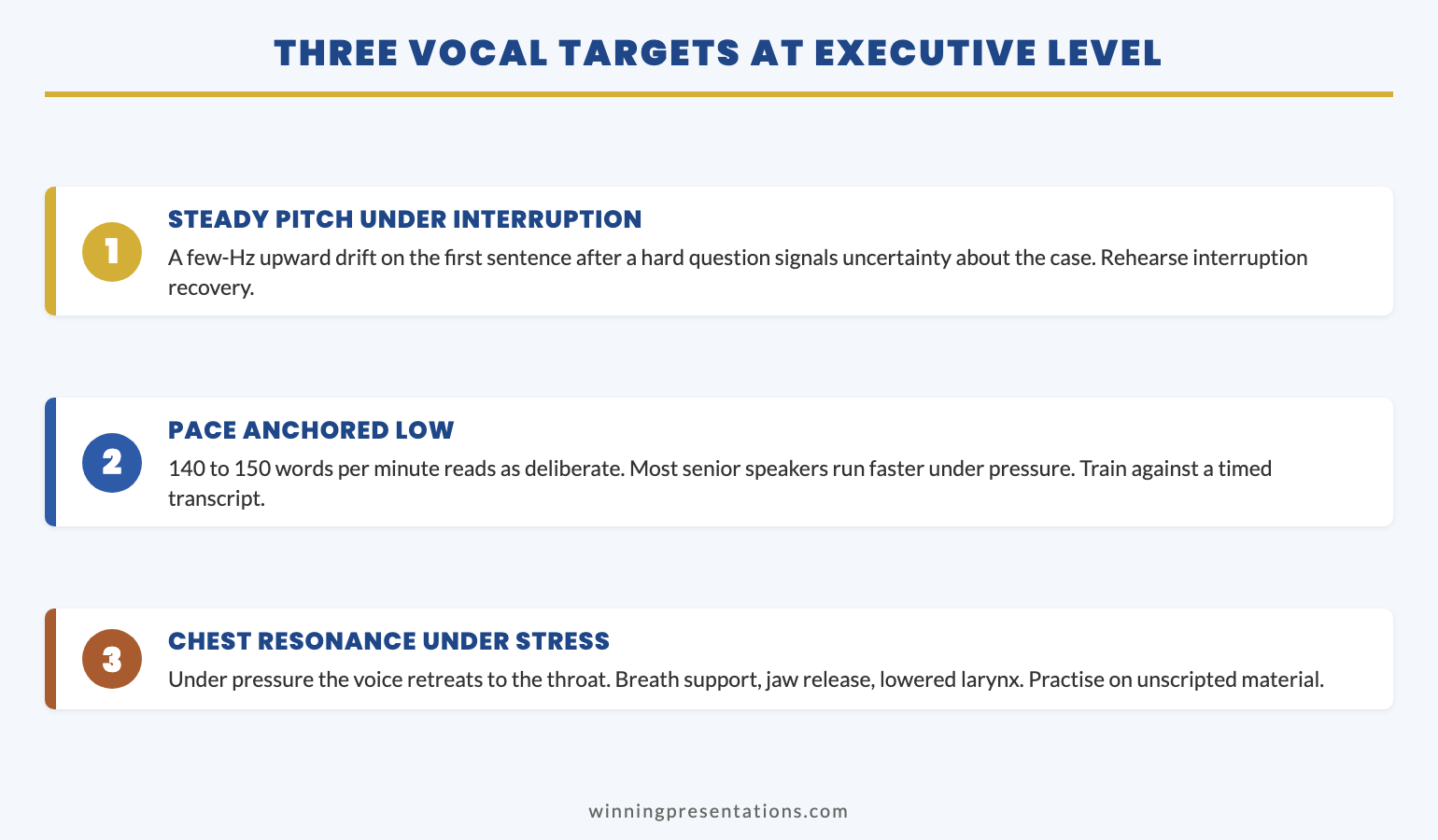
Stage and broadcast voice coaching is built around a clear brief: the voice must carry, must remain expressive, must hold attention across material the speaker has prepared in detail. The success metric is the audience’s experience — do they feel reached, do they feel moved, can they hear every word from the back of the room.
The senior executive brief is almost the opposite shape. The voice does not need to carry to the back of a room. It needs to read as credible at conversational distance under conditions where the speaker is being assessed in real time. The success metric is not whether the audience felt reached. It is whether the chair, the CFO, and the most sceptical voice in the room downgrade their confidence in the speaker because of how the voice landed in the difficult moments.
That brief shift changes almost everything about what useful voice training looks like. Projection becomes much less important — senior rooms are small. Expressiveness becomes a liability — the voice that “performs” reads as theatrical. The skill that matters most is voice stability under pressure, which the stage canon barely covers.
What standard voice coaching gets right and wrong for executives
The fundamentals do transfer. Breath control transfers cleanly. Diaphragmatic support transfers. Hydration discipline transfers. Posture, jaw release, the basic mechanics of producing a sound that does not strain — all of this is foundational in any context.
What does not transfer cleanly is the layer of work above the fundamentals. The expressive layer. The work on vocal modulation, on landing a punchline, on placing emphasis to draw an audience in. Stage coaches spend a lot of time on this layer because their clients need it. Senior executives, in front of decision audiences, very rarely need it — and when they use it, the room reads them as performing rather than presenting.
The result is that an executive who has spent six or twelve months in stage-style voice coaching often comes out with two voices. A polished one for prepared material, where the new training shows up beautifully. And a tense, slightly compressed one for unscripted, high-stakes moments, where the new training has done nothing for them. The chair’s interruption, the difficult question, the moment the case is being challenged — the voice in those moments is unchanged, because nothing in the curriculum trained it.
Three vocal targets at executive level
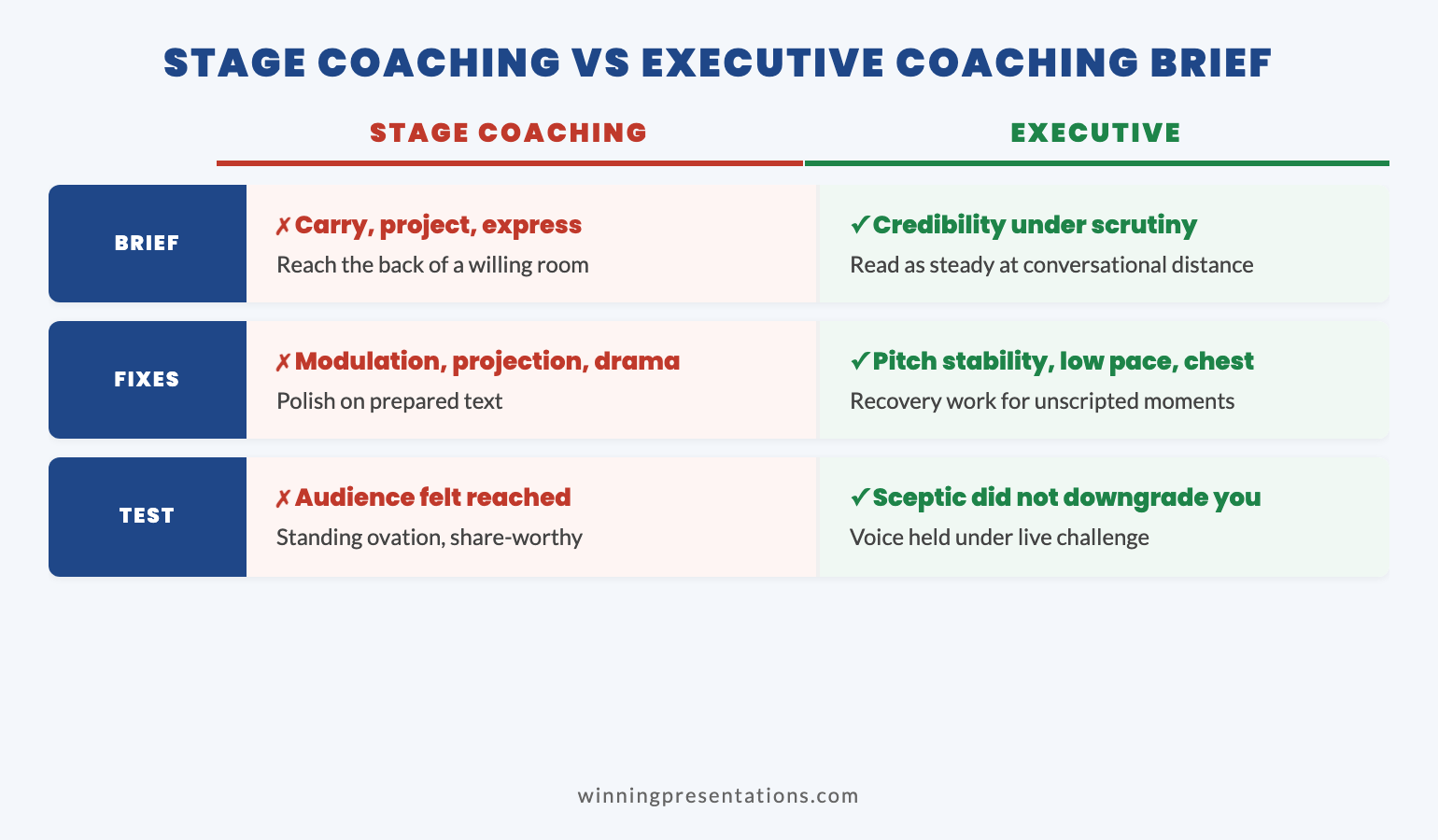
If the senior brief is different, what are the targets that actually matter? Three patterns recur across senior professionals who handle their voice well in high-stakes rooms.
Steady pitch under interruption. The most common voice failure in senior settings is a small upward drift in pitch when the speaker is interrupted, challenged, or asked a difficult question. The drift is typically only a few Hz. The speaker does not notice it. The room reads it instantly — not as nerves, but as uncertainty about the case. Voice training that does not specifically address pitch stability under live challenge will leave this gap untouched, because stage rehearsal does not produce the conditions that cause it.
Pace anchored at the lower end of conversational. Stage coaches tend to push pace up, because audiences need stimulation. Senior approvers need the opposite. The speaker who runs at a slightly slower pace than feels natural — perhaps 140 to 150 words per minute — reads as more thoughtful, more deliberate, more in command of the material. This is one of the rare areas where the stage instinct and the senior instinct diverge cleanly. Voice control in executive Q&A walks through the pace-and-pitch work that holds up under live scrutiny.
Resonance in the chest, not the throat. Under stress the voice tends to retreat into the throat, where it sounds thinner and tighter. Stage coaches work on this; senior contexts amplify the need. The fix is the same in both cases — breath support, jaw release, lowered larynx — but the moments where senior executives need the fix are the unscripted ones, not the prepared ones. Training that addresses chest resonance only on prepared text leaves the most consequential moments untrained.
The voice under senior pressure is a different muscle
The reason stage voice training does not transfer cleanly is that the moments where the senior voice matters most are the moments where stage training has not gone. A read-through of prepared material in front of a coach is unlike a board meeting in almost every relevant respect. The senior speaker is sitting, not standing. They are at conversational distance, not stage distance. They are being interrupted. They are being asked questions they did not anticipate. They are being assessed for the substance of what they are saying as well as the way they are saying it.
Senior voice training that works addresses these conditions directly. It rehearses interruption recovery. It rehearses the answer-then-pause structure that holds vocal stability in difficult Q&A. It rehearses the small breath that resets the voice before a sentence the speaker knows is going to be challenged. None of this is exotic. It is, in most cases, the same fundamentals applied to a different context. But the context-specific practice is what makes the work transfer to the moments that matter.
For senior executives who already have stage-style voice training, the most useful next step is rarely more of the same. It is structured practice in conditions that simulate the actual rooms — interruption, scrutiny, unscripted answers, sustained focus on the speaker’s judgement rather than the speaker’s performance. The voice-shakes presentation reset covers the in-the-moment recovery work for the specific moments where the voice tends to break in senior rooms.
EXECUTIVE BUY-IN PRESENTATION SYSTEM
Voice and presence are downstream of structure
Most voice problems in senior rooms are downstream of structural ones — an unprepared answer, an unframed recommendation, an objection that has not been pre-handled. The Executive Buy-In Presentation System is built around the structures that remove those upstream causes, so the voice has less to absorb.
- 7 modules of self-paced course content
- Optional live Q&A / coaching calls (fully recorded — watch back anytime)
- No deadlines, no mandatory session attendance
- New cohort opens every month — enrol whenever suits you
- Lifetime access to all course materials
£499, lifetime access. Self-paced with monthly cohort enrolment — optional recorded Q&A sessions available.
Designed for senior professionals presenting to boards, investment committees, and executive sponsors.
Where the fixes actually live
The most common piece of feedback I hear from senior executives who have done significant voice coaching is that the work has helped them in some contexts and left them unchanged in others. The specific phrase is usually something like, “the coaching helps when I am in control of the material, and falls apart when I am not.” That diagnosis is correct, and it points directly at where the next round of work needs to live.
The fix is rarely a different voice coach. The fundamentals the coach has installed are valuable. The fix is to layer senior-context practice on top: rehearsing the conditions that cause vocal instability in real rooms, rehearsing the recovery work for the specific moments where the voice tends to break, and — usually most consequentially — doing the structural and pre-handling work that removes some of the moments where the voice has to absorb pressure in the first place.
This last point is worth slowing down on. Many vocal failures in senior rooms are not really vocal failures. They are structural ones. The voice cracked because the speaker did not have an answer ready. The pace ran away because the speaker was searching for words on an objection they had not anticipated. The pitch drifted because the speaker realised they had committed to a position they could not defend. Voice coaching cannot fix these. The case can — if it has been built so that the predictable hard moments have already been pre-handled.
Want the slide structures that protect the voice?
When the deck does the structural work — recommendation first, scannable slides, load-bearing case — the voice has less to carry. The Executive Slide System is the templates side of that picture: 26 templates, 93 AI prompts, and 16 scenario playbooks for senior decision audiences.
Why senior voice work is its own discipline
The voice coaching industry serves a wide audience. Stage actors, broadcasters, keynote speakers, conference presenters, professional voiceover artists. The methods are excellent for those audiences and have been refined over decades. Senior executives are a niche inside that broader market, and most general voice coaching does not specialise in their conditions.
Recognising that gap is the first move. The fundamentals from a good general coach remain valuable. The senior-context work — pitch stability under interruption, pace anchored low, chest resonance under stress, recovery work tied to the moments where the voice tends to break in real rooms, structural and pre-handling work that removes some of the pressure upstream — is what completes the picture for the rooms senior professionals actually present in.
EXECUTIVE BUY-IN PRESENTATION SYSTEM
When the structure is right, the voice has less to absorb
7 self-paced modules covering stakeholder analysis, case construction, objection pre-handling, and the presentation structures that hold up to scrutiny — the upstream work that removes most of the moments where senior voice training is needed in the first place. £499, lifetime access.
Self-paced with monthly cohort enrolment. No deadlines, no mandatory session attendance.
Frequently asked questions
Is voice coaching worth it for senior executives?
The fundamentals are worth it — breath, support, posture, basic vocal mechanics. The expressive and projection layers are usually a poor fit for senior decision audiences. The most useful approach is to take the fundamentals from a good coach and layer senior-context practice on top: pitch stability under interruption, pace at the lower end of conversational, chest resonance under stress, recovery work for unscripted Q&A.
What is the most common voice problem in senior presentations?
A small upward pitch drift under interruption or challenge. The drift is typically only a few Hz, but senior rooms read it as uncertainty about the case rather than nerves. The fix is specific: rehearsal under simulated interruption, breath-and-pause patterns at the start of difficult answers, and structural pre-handling that removes the worst of the surprise from the unscripted moments.
Should senior executives slow their pace down?
Usually yes. Most senior speakers run at 160 to 170 words per minute under pressure. The pace that reads as deliberate and in-command in senior rooms is often closer to 140 to 150 wpm, with deliberate working pauses. The fix is not just intent — it is structural. Rehearsing with a metronome or against a timed transcript, and shaping the slides so they do not push pace forward unnecessarily, both help.
Can voice work fix all senior speaking problems?
No. Many vocal failures in senior rooms are downstream of structural ones — the case had a gap, the answer had not been prepared, the objection had not been anticipated. Voice training cannot fix these. The case can. Most senior professionals find that pre-handling work and structural rigour remove a large fraction of the moments where the voice has to absorb pressure in the first place. The remaining moments are where targeted senior voice training pays off.
The Winning Edge
A weekly newsletter for senior professionals who present at board level. One specific structural idea per issue, drawn from real boardroom and committee work. No filler.
Not ready for the full system? Start here instead: download the free Executive Presentation Checklist — the pre-flight checks that catch the structural mistakes most senior professionals make in the last 24 hours before a high-stakes meeting.
If this article landed for you, Public speaking for executives vs everyone is the natural next read. It walks through the broader distinction between general public speaking training and senior-level presenting.
Next step: watch a recording of yourself presenting under interruption (a Q&A clip, a town hall video, anything live). Listen for pitch drift in the first sentence after a question, and for pace under challenge. That is usually where the next round of senior voice work needs to start.
Mary Beth Hazeldine is the Owner & Managing Director of Winning Presentations. With 24 years of corporate banking experience at JPMorgan Chase, PwC, Royal Bank of Scotland, and Commerzbank, she advises senior professionals across financial services, healthcare, technology, and government on structuring presentations for high-stakes funding rounds and approvals. She speaks German and works extensively with the German-speaking financial markets.